Bend 2 · HVM · Interaction nets — the compendium
Claude edition, 2026-11-06. One of two documents: this compendium collects every source verbatim; the coursebook (../coursebook/bend-hvm-inet-coursebook-claude.md) teaches from them, with exercises and worked solutions, and cites this document by section id.
How to use this document
- Ids. Every source file has a stable id (
A.4,H.46,L.7) in its heading and in machine markers<!-- ===== BEGIN FILE · <id> ===== -->/END FILE.grep -n "BEGIN FILE" …lists every source; the ids of the parts kept from the first edition (A–I and K) are unchanged, so older references still resolve. - Fidelity. Every part is verbatim: the only additions are banners and markers. Everything authored for this edition is outside the parts: this introduction, Appendix R (audit), the link index and the provenance.
- Snapshots. Some sources exist in several copies (the tutorial in Part A and inside the skills; HVM4 docs in Parts H, I and L). They are different snapshots; the newer one wins, and Appendix R says which is newer.
The parts
| Part | What | Read it for |
|---|---|---|
| A | the site's Bend 2 tutorial (17 chapters, bend 2.0.25 era) | the language, BendRT, proofs, what released Bend 2 does and does not do |
| B | site pages: learn + notes (interaction nets, four interactions, HVM runtime, search by superposition) | short explanations with diagrams |
| C | .opencode Bend 2 skills (9) |
project-distilled facts about Bend 2 targets, ownership, superposition, performance |
| D | .opencode hvm5-ic skill |
the IC as used by the HVM5 project |
| E | research-to-release skill | HVM5 v1 maps and method |
| F | Bend2/HVM5/INET knowledge base | broad background, rollups, lineage |
| G | HVM5 specifications v1 and v2 | homoiconic, forkable runtime design; v2 README G.51, REVIEW G.52, code-as-data G.57; v1 README G.2; model↔machine bridge G.5 |
| H | primary sources: Victor Taelin, HigherOrderCO, bend2.dev, bendlang/bend | the authors' own words (H.33 IC README, H.41–H.55 Taelin posts, H.1–H.4 Bend README and guides) |
| I | HVM4 March 2026 snapshot (2d7f28e): docs + test suite |
history: the multi-file clang/ runtime with AOT, FFI, threads |
| K | workspace context: experiments, docs-site design notes | how this documentation project came about |
| L | HVM4 at HEAD 6defdfc (2026-05-29): README, AGENTS, primer, theory, core, memory, syntax, collapser, all 61 interaction sheets, test listing |
the current machine (single sequential src/hvm.c) |
| R | audit ledger: what was wrong or outdated in the first edition, with evidence and fixes | trust calibration |
Reading paths
| Goal | Path |
|---|---|
| Understand interaction nets from zero | coursebook Parts 1–5 → B (interaction-nets, four-interactions) → H.33 → L.4 |
| Understand the HVM4 machine and why it is built that way | coursebook Parts 8 and 8B → the HVM2 paper §13 (its limitations, quoted in the coursebook) → H.46 → L.2 (AGENTS: code map) → L.6 (memory) → L.8 (collapser) → L.9–L.69 (rules) |
| Understand Taelin's ideas in his words | H.42 → H.43 → H.46 → H.41 → H.53 → H.50/H.51 → coursebook Part 11 |
| Understand Bend 2 as released | A (chapters 01–05, 14) → H.1–H.4 → C |
| Understand HVM5 | G.51 → G.52 → G.57 → coursebook Part 10 |
| Check what changed | Appendix R → L vs I |
Victor Taelin: a map of his public work
The person behind the Interaction Calculus, HVM1–HVM4 and Bend. The sources below are the ones this workspace holds; read them in this order.
| Topic | Source (id) | Online |
|---|---|---|
| The calculus itself: affine global variables, DUP/SUP, the rules | Interaction-Calculus README (H.33) | https://github.com/VictorTaelin/Interaction-Calculus |
| Manifesto: why substitution is not physical and interaction combinators are | "Towards an optimal computer" (H.42) | — |
| Optimal evaluation explained from scratch ("copy incrementally") | "Optimal evaluation in 1 or 10 or 10 years" (H.43) | — |
| How HVM works: linear objects, lazy clone, sharing inside lambdas, memory format | "HVM: how it works" (H.46) | https://github.com/HigherOrderCO/HVM |
| History: Optlam, Lamping's abstract algorithm and oracle, why optimal reduction stalled | HOC history (H.41) | https://github.com/VictorTaelin/optlam |
| The limits of Lévy optimality; unordered superpositions | (H.53) | — |
| Superposition as program search; the collapse monad; SAT; the sieve | H.50, H.51, H.44, H.49, H.52 | — |
| Deforestation at run time; the linker; type checkers | H.45, H.47, H.54, H.55 | — |
| The machines | HVM1–HVM4 READMEs (H.27–H.30), Part L | https://github.com/HigherOrderCO/HVM3, https://github.com/HigherOrderCO/HVM4 |
| Symmetric Interaction Calculus (HVM1's memory format) | cited in H.46 | https://github.com/VictorTaelin/Symmetric-Interaction-Calculus |
| The language | Bend (H.1–H.4), bend2.dev (H.8–H.23) | https://github.com/bendlang/bend, https://bend2.dev/ |
| His profile and repositories | H.24 | https://github.com/VictorTaelin |
Editions and drift
- HVM4. Parts H (
hvm4-docs, September 2026 retrieval of older docs) and I (March 2026 clone) describe the runtime before commit4bc2336(2026-05-07, "Refactor HVM runtime into pure single source"). Part L is HEAD. At HEAD: buildclang -O2 -o src/hvm src/hvm.c; flags-s -S -C[=N] -D -d -v; no AOT, FFI or threads. - Bend. Part A was checked against bend 2.0.25; the local compiler is 2.0.39; H.1–H.4 were fetched fresh for the first edition.
- HVM5. v1 is superseded by v2 (G.2); v2's status table is dated 2026-10-23 (G.51).
Table of contents
Numbered by part (1–11) and by file id. Every id is a heading in this document.
1 · Part A — Bend 2 tutorial (complete)
- A.1 ·
tutorial/index - A.2 ·
tutorial/01-first-programs - A.3 ·
tutorial/02-data-and-recursion - A.4 ·
tutorial/03-ownership-and-copying - A.5 ·
tutorial/04-interaction-nets - A.6 ·
tutorial/05-parallelism-and-runtime - A.7 ·
tutorial/06-duplication-superposition - A.8 ·
tutorial/07-laws-and-proofs - A.9 ·
tutorial/08-dependent-types-and-totality - A.10 ·
tutorial/09-io-files-and-targets - A.11 ·
tutorial/10-branching-and-self-change - A.12 ·
tutorial/11-rules-and-errors - A.13 ·
tutorial/12-syntax-reference - A.14 ·
tutorial/13-glossary - A.15 ·
tutorial/14-superposition-and-supgen - A.16 ·
tutorial/15-capstone - A.17 ·
tutorial/16-references
2 · Part B — Bend 2 site pages: learn + notes
- B.1 ·
learn/data-matching - B.2 ·
learn/effects-targets - B.3 ·
learn/first-programs - B.4 ·
learn/gpu - B.5 ·
learn/hello - B.6 ·
learn/hvm-hands-on - B.7 ·
learn/parallelism - B.8 ·
learn/proofs - B.9 ·
learn/sharing - B.10 ·
learn/synthesis - B.11 ·
learn/types-proofs - B.12 ·
notes/four-interactions - B.13 ·
notes/hvm-runtime - B.14 ·
notes/interaction-nets - B.15 ·
notes/optimal-computer - B.16 ·
notes/proof-lineage - B.17 ·
notes/release-status - B.18 ·
notes/search-by-superposition - B.19 ·
notes/vs-lean - B.20 ·
notes/vs-mojo - B.21 ·
notes/what-is-bend2
3 · Part C — Bend 2 skills (.opencode → bend2*, verbatim)
- C.1 ·
bend-gme/version-1/.opencode/skills/bend2/SKILL.md - C.2 ·
bend-gme/version-1/.opencode/skills/bend2/references/01-tutorial-index.md - C.3 ·
bend-gme/version-1/.opencode/skills/bend2/references/02-what-is-bend2.md - C.4 ·
bend-gme/version-1/.opencode/skills/bend2/references/03-hello.md - C.5 ·
bend-gme/version-1/.opencode/skills/bend2/references/04-release-status.md - C.6 ·
bend-gme/version-1/.opencode/skills/bend2/references/05-glossary.md - C.7 ·
bend-gme/version-1/.opencode/skills/bend2-language/SKILL.md - C.8 ·
bend-gme/version-1/.opencode/skills/bend2-language/references/01-first-programs.md - C.9 ·
bend-gme/version-1/.opencode/skills/bend2-language/references/02-data-and-recursion.md - C.10 ·
bend-gme/version-1/.opencode/skills/bend2-language/references/03-syntax-reference.md - C.11 ·
bend-gme/version-1/.opencode/skills/bend2-language/references/04-rules-and-errors.md - C.12 ·
bend-gme/version-1/.opencode/skills/bend2-language/references/05-first-programs-concepts.md - C.13 ·
bend-gme/version-1/.opencode/skills/bend2-language/references/06-data-matching-concepts.md - C.14 ·
bend-gme/version-1/.opencode/skills/bend2-proofs/SKILL.md - C.15 ·
bend-gme/version-1/.opencode/skills/bend2-proofs/references/01-laws-and-proofs.md - C.16 ·
bend-gme/version-1/.opencode/skills/bend2-proofs/references/02-dependent-types-and-totality.md - C.17 ·
bend-gme/version-1/.opencode/skills/bend2-proofs/references/03-proofs-concepts.md - C.18 ·
bend-gme/version-1/.opencode/skills/bend2-proofs/references/04-types-and-proofs-concepts.md - C.19 ·
bend-gme/version-1/.opencode/skills/bend2-proofs/references/05-proof-lineage.md - C.20 ·
bend-gme/version-1/.opencode/skills/bend2-proofs/references/06-bend-vs-lean.md - C.21 ·
bend-gme/version-1/.opencode/skills/bend2-ownership/SKILL.md - C.22 ·
bend-gme/version-1/.opencode/skills/bend2-ownership/references/01-ownership-and-copying.md - C.23 ·
bend-gme/version-1/.opencode/skills/bend2-ownership/references/02-sharing-concepts.md - C.24 ·
bend-gme/version-1/.opencode/skills/bend2-superposition/SKILL.md - C.25 ·
bend-gme/version-1/.opencode/skills/bend2-superposition/references/01-duplication-superposition.md - C.26 ·
bend-gme/version-1/.opencode/skills/bend2-superposition/references/02-superposition-and-supgen.md - C.27 ·
bend-gme/version-1/.opencode/skills/bend2-superposition/references/03-branching-and-self-change.md - C.28 ·
bend-gme/version-1/.opencode/skills/bend2-superposition/references/04-synthesis-concepts.md - C.29 ·
bend-gme/version-1/.opencode/skills/bend2-superposition/references/05-search-by-superposition.md - C.30 ·
bend-gme/version-1/.opencode/skills/bend2-effects-targets/SKILL.md - C.31 ·
bend-gme/version-1/.opencode/skills/bend2-effects-targets/references/01-io-files-and-targets.md - C.32 ·
bend-gme/version-1/.opencode/skills/bend2-effects-targets/references/02-effects-targets-concepts.md - C.33 ·
bend-gme/version-1/.opencode/skills/bend2-effects-targets/references/03-js-target-facts.md - C.34 ·
bend-gme/version-1/.opencode/skills/bend2-effects-targets/references/04-minebender-notes.md - C.35 ·
bend-gme/version-1/.opencode/skills/bend2-performance/SKILL.md - C.36 ·
bend-gme/version-1/.opencode/skills/bend2-app/SKILL.md - C.37 ·
bend-gme/version-1/.opencode/skills/bend2-app/references/01-capstone.md - C.38 ·
bend-gme/version-1/.opencode/skills/bend2-app/references/02-reading-real-repos.md - C.39 ·
bend-gme/version-1/.opencode/skills/bend2-runtime/SKILL.md - C.40 ·
bend-gme/version-1/.opencode/skills/bend2-runtime/references/01-interaction-nets.md - C.41 ·
bend-gme/version-1/.opencode/skills/bend2-runtime/references/02-parallelism-and-runtime.md - C.42 ·
bend-gme/version-1/.opencode/skills/bend2-runtime/references/03-parallelism-concepts.md - C.43 ·
bend-gme/version-1/.opencode/skills/bend2-runtime/references/04-gpu-concepts.md - C.44 ·
bend-gme/version-1/.opencode/skills/bend2-runtime/references/05-hvm-hands-on.md - C.45 ·
bend-gme/version-1/.opencode/skills/bend2-runtime/references/06-interaction-nets-notes.md - C.46 ·
bend-gme/version-1/.opencode/skills/bend2-runtime/references/07-four-interactions.md - C.47 ·
bend-gme/version-1/.opencode/skills/bend2-runtime/references/08-hvm-runtime-notes.md - C.48 ·
bend-gme/version-1/.opencode/skills/bend2-runtime/references/09-optimal-computer.md - C.49 ·
bend-gme/version-1/.opencode/skills/bend2-runtime/references/10-bend-vs-mojo.md
4 · Part D — HVM5 Interaction Calculus skill (.opencode → hvm5-ic, verbatim)
- D.1 ·
bend-gme/version-1/.opencode/skills/hvm5-ic/SKILL.md - D.2 ·
bend-gme/version-1/.opencode/skills/hvm5-ic/references/01-lineage.md - D.3 ·
bend-gme/version-1/.opencode/skills/hvm5-ic/references/02-v2-readme.md - D.4 ·
bend-gme/version-1/.opencode/skills/hvm5-ic/references/03-v2-review.md - D.5 ·
bend-gme/version-1/.opencode/skills/hvm5-ic/references/04-v2-overview.md - D.6 ·
bend-gme/version-1/.opencode/skills/hvm5-ic/references/05-v2-calculus.md - D.7 ·
bend-gme/version-1/.opencode/skills/hvm5-ic/references/06-v2-runtime.md - D.8 ·
bend-gme/version-1/.opencode/skills/hvm5-ic/references/07-v2-compiler.md - D.9 ·
bend-gme/version-1/.opencode/skills/hvm5-ic/references/08-v2-code-as-data.md - D.10 ·
bend-gme/version-1/.opencode/skills/hvm5-ic/references/09-v2-islands.md - D.11 ·
bend-gme/version-1/.opencode/skills/hvm5-ic/references/10-v2-formats.md - D.12 ·
bend-gme/version-1/.opencode/skills/hvm5-ic/references/11-v2-trust.md - D.13 ·
bend-gme/version-1/.opencode/skills/hvm5-ic/references/12-v2-plan.md - D.14 ·
bend-gme/version-1/.opencode/skills/hvm5-ic/references/13-v2-map.md - D.15 ·
bend-gme/version-1/.opencode/skills/hvm5-ic/references/14-v1-calculus.md - D.16 ·
bend-gme/version-1/.opencode/skills/hvm5-ic/references/15-v1-hvm4-execution.md
5 · Part E — Runtime-project skills (.opencode → research-to-release, verbatim)
- E.1 ·
bend-gme/version-1/.opencode/skills/research-to-release/SKILL.md - E.2 ·
bend-gme/version-1/.opencode/skills/research-to-release/references/01-skill-style.md - E.3 ·
bend-gme/version-1/.opencode/skills/research-to-release/references/02-hvm5-v1-maps-readme.md - E.4 ·
bend-gme/version-1/.opencode/skills/research-to-release/references/03-hvm5-v1-goal-map.md - E.5 ·
bend-gme/version-1/.opencode/skills/research-to-release/references/04-hvm5-v1-system-map.md - E.6 ·
bend-gme/version-1/.opencode/skills/research-to-release/references/05-hvm5-v1-types-map.md - E.7 ·
bend-gme/version-1/.opencode/skills/research-to-release/references/06-hvm5-v1-spaces-map.md - E.8 ·
bend-gme/version-1/.opencode/skills/research-to-release/references/07-env-and-keys.md - E.9 ·
bend-gme/version-1/.opencode/skills/research-to-release/references/07-hvm5-v1-lifecycle-map.md - E.10 ·
bend-gme/version-1/.opencode/skills/research-to-release/references/08-hvm5-v1-code-map.md - E.11 ·
bend-gme/version-1/.opencode/skills/research-to-release/references/09-hvm5-v1-risks-map.md - E.12 ·
bend-gme/version-1/.opencode/skills/research-to-release/references/10-hvm5-v1-slices.md - E.13 ·
bend-gme/version-1/.opencode/skills/research-to-release/references/11-hvm5-v1-gates.md - E.14 ·
bend-gme/version-1/.opencode/skills/research-to-release/references/12-hvm5-v1-acceptance.md - E.15 ·
bend-gme/version-1/.opencode/skills/research-to-release/references/13-hvm5-v1-traceability.md - E.16 ·
bend-gme/version-1/.opencode/skills/research-to-release/templates/01-artifact-templates.md
6 · Part F — Bend2 / HVM5 / INET knowledge base (bend-runtime/knowledge, verbatim)
- F.1 ·
bend-runtime/knowledge/README.md - F.2 ·
bend-runtime/knowledge/00-start-here/glossary.md - F.3 ·
bend-runtime/knowledge/00-start-here/how-to-use-this-knowledge-base.md - F.4 ·
bend-runtime/knowledge/00-start-here/overview.md - F.5 ·
bend-runtime/knowledge/01-bend-language/io-effects-apps-modules.md - F.6 ·
bend-runtime/knowledge/01-bend-language/laws-proofs.md - F.7 ·
bend-runtime/knowledge/01-bend-language/match-recursion-arrays-parallelism.md - F.8 ·
bend-runtime/knowledge/01-bend-language/quantities-kinds-templates.md - F.9 ·
bend-runtime/knowledge/01-bend-language/syntax-reference.md - F.10 ·
bend-runtime/knowledge/02-guides-cli/cli-tooling-limits.md - F.11 ·
bend-runtime/knowledge/02-guides-cli/guides-index.md - F.12 ·
bend-runtime/knowledge/02-guides-cli/raw/BASE-FULL-DUMP.md - F.13 ·
bend-runtime/knowledge/02-guides-cli/raw/BASE-TYPES-DUMP.md - F.14 ·
bend-runtime/knowledge/02-guides-cli/raw/CLI-HELP-DUMP.txt - F.15 ·
bend-runtime/knowledge/02-guides-cli/raw/EFFECTS-CLI-DUMP.md - F.16 ·
bend-runtime/knowledge/02-guides-cli/raw/GUIDE-CLI-DUMP.md - F.17 ·
bend-runtime/knowledge/02-guides-cli/raw/SHADERS-CLI-DUMP.md - F.18 ·
bend-runtime/knowledge/03-hvm-inet-theory/01-interaction-nets-foundations.md - F.19 ·
bend-runtime/knowledge/03-hvm-inet-theory/02-symmetric-combinators-rules.md - F.20 ·
bend-runtime/knowledge/03-hvm-inet-theory/03-confluence-optimal-reduction.md - F.21 ·
bend-runtime/knowledge/03-hvm-inet-theory/04-hvm-runtime-tags-memory.md - F.22 ·
bend-runtime/knowledge/03-hvm-inet-theory/05-bend-compilation-fuel.md - F.23 ·
bend-runtime/knowledge/04-runtime-bendrt-hvm5/00-overview-architecture.md - F.24 ·
bend-runtime/knowledge/04-runtime-bendrt-hvm5/01-memory-model-no-gc.md - F.25 ·
bend-runtime/knowledge/04-runtime-bendrt-hvm5/02-schedulers-cpu-gpu.md - F.26 ·
bend-runtime/knowledge/04-runtime-bendrt-hvm5/03-ffi-determinism-io.md - F.27 ·
bend-runtime/knowledge/04-runtime-bendrt-hvm5/04-hvm5-mini-reference-port.md - F.28 ·
bend-runtime/knowledge/04-runtime-bendrt-hvm5/05-laws-proof-gate-cli.md - F.29 ·
bend-runtime/knowledge/05-ecosystem/bendlang-bend-repo.md - F.30 ·
bend-runtime/knowledge/05-ecosystem/higherorderco-org.md - F.31 ·
bend-runtime/knowledge/05-ecosystem/papers-formalization-community.md - F.32 ·
bend-runtime/knowledge/05-ecosystem/victor-taelin.md - F.33 ·
bend-runtime/knowledge/06-examples/01-hello-area-adder.bend - F.34 ·
bend-runtime/knowledge/06-examples/02-recursion-parallel-arrays.bend - F.35 ·
bend-runtime/knowledge/06-examples/03-io-channels-tcp-files.bend - F.36 ·
bend-runtime/knowledge/06-examples/04-laws-proofs-app-loop.bend - F.37 ·
bend-runtime/knowledge/06-examples/05-bench-and-proof-templates.md - F.38 ·
bend-runtime/knowledge/07-smart-contracts-dynamic/01-kindelia-model.md - F.39 ·
bend-runtime/knowledge/07-smart-contracts-dynamic/02-hub-fork-upgrade.md - F.40 ·
bend-runtime/knowledge/07-smart-contracts-dynamic/03-domain-types-hvm5-checklist.bend - F.41 ·
bend-runtime/knowledge/08-roadmap-hvm5-spec/references-index.md - F.42 ·
bend-runtime/knowledge/08-roadmap-hvm5-spec/spec-todo.md - F.43 ·
bend-runtime/knowledge/08-roadmap-hvm5-spec/what-we-know-vs-gaps.md - F.44 ·
bend-runtime/knowledge/09-hvm5-cluster-runtime/01-concepts.md - F.45 ·
bend-runtime/knowledge/09-hvm5-cluster-runtime/02-architecture-layers.md - F.46 ·
bend-runtime/knowledge/09-hvm5-cluster-runtime/03-domain-types.md - F.47 ·
bend-runtime/knowledge/09-hvm5-cluster-runtime/04-api.md - F.48 ·
bend-runtime/knowledge/09-hvm5-cluster-runtime/05-registry-naming.md - F.49 ·
bend-runtime/knowledge/09-hvm5-cluster-runtime/06-update-fork-merge.md - F.50 ·
bend-runtime/knowledge/09-hvm5-cluster-runtime/07-ocap-wires.md - F.51 ·
bend-runtime/knowledge/09-hvm5-cluster-runtime/08-similar-projects.md - F.52 ·
bend-runtime/knowledge/09-hvm5-cluster-runtime/09-implementation-plan.md - F.53 ·
bend-runtime/knowledge/09-hvm5-cluster-runtime/10-meta-prompt-for-builder-llm.md - F.54 ·
bend-runtime/knowledge/09-hvm5-cluster-runtime/README.md - F.55 ·
bend-runtime/knowledge/ALL-COMBINED.md - F.56 ·
bend-runtime/knowledge/ALL-COMBINED-MINI.md - F.57 ·
bend-runtime/knowledge/ALL-COMBINED-MINI-KINDELIA.md - F.58 ·
bend-runtime/knowledge/ALL-COMBINED-RUNTIME-SPEC.md - F.59 ·
bend-runtime/knowledge/ALL-COMBINED-RUNTIME-SPEC.META-PROMPT.md - F.60 ·
bend-runtime/knowledge/ALL-COMBINED-RUNTIME-SPEC.SOURCES.md
7 · Part G — HVM5 runtime specifications (bend-runtime/hvm5, verbatim)
- G.1 ·
bend-runtime/hvm5/README.md - G.2 ·
bend-runtime/hvm5/version1/README.md - G.3 ·
bend-runtime/hvm5/version1/spec/00-system.md - G.4 ·
bend-runtime/hvm5/version1/spec/01-calculus.md - G.5 ·
bend-runtime/hvm5/version1/spec/01a-hvm4-execution.md - G.6 ·
bend-runtime/hvm5/version1/spec/01b-contract-compiler.md - G.7 ·
bend-runtime/hvm5/version1/spec/01c-bend2-to-inet-support.md - G.8 ·
bend-runtime/hvm5/version1/spec/01d-self-hosted-compiler.md - G.9 ·
bend-runtime/hvm5/version1/spec/01e-core-ir.md - G.10 ·
bend-runtime/hvm5/version1/spec/02-homoiconic-code.md - G.11 ·
bend-runtime/hvm5/version1/spec/03-types-isolation.md - G.12 ·
bend-runtime/hvm5/version1/spec/04-subspaces.md - G.13 ·
bend-runtime/hvm5/version1/spec/05-registry-system-contract.md - G.14 ·
bend-runtime/hvm5/version1/spec/06-lifecycle.md - G.15 ·
bend-runtime/hvm5/version1/spec/07-cluster.md - G.16 ·
bend-runtime/hvm5/version1/spec/08-api-cli.md - G.17 ·
bend-runtime/hvm5/version1/spec/09-security.md - G.18 ·
bend-runtime/hvm5/version1/spec/10-benchmarks.md - G.19 ·
bend-runtime/hvm5/version1/spec/11-acceptance.md - G.20 ·
bend-runtime/hvm5/version1/spec/12-traceability.md - G.21 ·
bend-runtime/hvm5/version1/spec/legacy/hvm5-inet-contract-runtime-spec-v0.md - G.22 ·
bend-runtime/hvm5/version1/spec/README.md - G.23 ·
bend-runtime/hvm5/version1/maps/00-goal.md - G.24 ·
bend-runtime/hvm5/version1/maps/10-system.md - G.25 ·
bend-runtime/hvm5/version1/maps/20-types.md - G.26 ·
bend-runtime/hvm5/version1/maps/30-spaces.md - G.27 ·
bend-runtime/hvm5/version1/maps/40-lifecycle.md - G.28 ·
bend-runtime/hvm5/version1/maps/50-code.md - G.29 ·
bend-runtime/hvm5/version1/maps/60-risks.md - G.30 ·
bend-runtime/hvm5/version1/maps/README.md - G.31 ·
bend-runtime/hvm5/version1/plan/00-plan.md - G.32 ·
bend-runtime/hvm5/version1/plan/01-slices.md - G.33 ·
bend-runtime/hvm5/version1/plan/02-gates.md - G.34 ·
bend-runtime/hvm5/version1/plan/03-risks.md - G.35 ·
bend-runtime/hvm5/version1/plan/legacy/hvm5-bendrt-contract-runtime-plan-v0.md - G.36 ·
bend-runtime/hvm5/version1/plan/README.md - G.37 ·
bend-runtime/hvm5/version1/bench/results/w3-2026-10-20.md - G.38 ·
bend-runtime/hvm5/version1/compiler/README.md - G.39 ·
bend-runtime/hvm5/version1/contracts/README.md - G.40 ·
bend-runtime/hvm5/version1/src/README.md - G.41 ·
bend-runtime/hvm5/version1/legacy/net-v0/readme.md - G.42 ·
bend-runtime/hvm5/version1/legacy/lattice-v0/fitness.md - G.43 ·
bend-runtime/hvm5/version1/legacy/lattice-v0/gaps.md - G.44 ·
bend-runtime/hvm5/version1/legacy/lattice-v0/goal.md - G.45 ·
bend-runtime/hvm5/version1/legacy/lattice-v0/graph.md - G.46 ·
bend-runtime/hvm5/version1/legacy/lattice-v0/invariants.md - G.47 ·
bend-runtime/hvm5/version1/legacy/lattice-v0/owners.md - G.48 ·
bend-runtime/hvm5/version1/legacy/lattice-v0/placement.md - G.49 ·
bend-runtime/hvm5/version1/legacy/lattice-v0/rejects.md - G.50 ·
bend-runtime/hvm5/version1/legacy/lattice-v0/seams.md - G.51 ·
bend-runtime/hvm5/version2/README.md - G.52 ·
bend-runtime/hvm5/version2/REVIEW.md - G.53 ·
bend-runtime/hvm5/version2/spec/00-overview.md - G.54 ·
bend-runtime/hvm5/version2/spec/01-calculus.md - G.55 ·
bend-runtime/hvm5/version2/spec/02-runtime.md - G.56 ·
bend-runtime/hvm5/version2/spec/03-compiler.md - G.57 ·
bend-runtime/hvm5/version2/spec/04-code-as-data.md - G.58 ·
bend-runtime/hvm5/version2/spec/05-islands.md - G.59 ·
bend-runtime/hvm5/version2/spec/06-formats.md - G.60 ·
bend-runtime/hvm5/version2/spec/07-trust.md - G.61 ·
bend-runtime/hvm5/version2/spec/attic/05-islands-leader.md - G.62 ·
bend-runtime/hvm5/version2/maps/00-map.md - G.63 ·
bend-runtime/hvm5/version2/plan/00-plan.md - G.64 ·
bend-runtime/hvm5/reference/hvm5-mini/main.bend - G.65 ·
bend-runtime/hvm5/reference/hvm5-mini/laws.bend - G.66 ·
bend-runtime/hvm5/reference/hvm5-mini/proof.bend
8 · Part H — Primary sources: Victor Taelin, HigherOrderCO, bend2.dev, upstream bendlang/bend (verbatim)
- H.1 ·
bendlang/bend · README.md - H.2 ·
bendlang/bend · guide/GUIDE.md - H.3 ·
bendlang/bend · guide/EFFECTS.md - H.4 ·
bendlang/bend · guide/SHADERS.md - H.5 ·
fresh fetch · retrieval record - H.6 ·
openspec/changes/bend-docs-site/research/README - H.7 ·
openspec/changes/bend-docs-site/research/concept-map - H.8 ·
openspec/changes/bend-docs-site/research/RETRIEVED.txt - H.9 ·
openspec/changes/bend-docs-site/research/sources/bend2-release-date - H.10 ·
openspec/changes/bend-docs-site/research/sources/bend2-vs-bend1 - H.11 ·
openspec/changes/bend-docs-site/research/sources/bend2-vs-lean - H.12 ·
openspec/changes/bend-docs-site/research/sources/bend2-vs-mojo - H.13 ·
openspec/changes/bend-docs-site/research/sources/contents - H.14 ·
openspec/changes/bend-docs-site/research/sources/gpu - H.15 ·
openspec/changes/bend-docs-site/research/sources/hello - H.16 ·
openspec/changes/bend-docs-site/research/sources/home - H.17 ·
openspec/changes/bend-docs-site/research/sources/hvm4-explained - H.18 ·
openspec/changes/bend-docs-site/research/sources/interaction-nets-explained - H.19 ·
openspec/changes/bend-docs-site/research/sources/learn-index - H.20 ·
openspec/changes/bend-docs-site/research/sources/parallelism - H.21 ·
openspec/changes/bend-docs-site/research/sources/proofs - H.22 ·
openspec/changes/bend-docs-site/research/sources/what-is-bend2 - H.23 ·
openspec/changes/bend-docs-site/research/repos/_meta.txt - H.24 ·
openspec/changes/bend-docs-site/research/repos/victortaelin-profile - H.25 ·
openspec/changes/bend-docs-site/research/repos/taelin-theorem-proving-vs-testing - H.26 ·
openspec/changes/bend-docs-site/research/repos/HigherOrderCO_Bend-README - H.27 ·
openspec/changes/bend-docs-site/research/repos/HigherOrderCO_HVM1-README - H.28 ·
openspec/changes/bend-docs-site/research/repos/HigherOrderCO_HVM2-README - H.29 ·
openspec/changes/bend-docs-site/research/repos/HigherOrderCO_HVM3-README - H.30 ·
openspec/changes/bend-docs-site/research/repos/HigherOrderCO_HVM4-README - H.31 ·
openspec/changes/bend-docs-site/research/repos/HigherOrderCO_Kind-README - H.32 ·
openspec/changes/bend-docs-site/research/repos/VictorTaelin_Bend2-README - H.33 ·
openspec/changes/bend-docs-site/research/repos/VictorTaelin_Interaction-Calculus-README - H.34 ·
openspec/changes/bend-docs-site/research/repos/VictorTaelin_hvm4-formal-README - H.35 ·
openspec/changes/bend-docs-site/research/repos/hvm4-docs/hvm-collapser - H.36 ·
openspec/changes/bend-docs-site/research/repos/hvm4-docs/hvm-core - H.37 ·
openspec/changes/bend-docs-site/research/repos/hvm4-docs/hvm-memory - H.38 ·
openspec/changes/bend-docs-site/research/repos/hvm4-docs/hvm-syntax - H.39 ·
openspec/changes/bend-docs-site/research/repos/hvm4-docs/ic-theory - H.40 ·
openspec/changes/bend-docs-site/research/repos/hvm4-docs/primer - H.41 ·
openspec/changes/bend-docs-site/research/victor/hoc-history - H.42 ·
openspec/changes/bend-docs-site/research/victor/hoc-optimal-computer - H.43 ·
openspec/changes/bend-docs-site/research/victor/hvm-10min - H.44 ·
openspec/changes/bend-docs-site/research/victor/hvm-collapse-monad - H.45 ·
openspec/changes/bend-docs-site/research/victor/hvm-deforestation - H.46 ·
openspec/changes/bend-docs-site/research/victor/hvm-how - H.47 ·
openspec/changes/bend-docs-site/research/victor/hvm-linker - H.48 ·
openspec/changes/bend-docs-site/research/victor/hvm-mystery - H.49 ·
openspec/changes/bend-docs-site/research/victor/hvm-sat - H.50 ·
openspec/changes/bend-docs-site/research/victor/hvm-search1 - H.51 ·
openspec/changes/bend-docs-site/research/victor/hvm-search3 - H.52 ·
openspec/changes/bend-docs-site/research/victor/hvm-sieve - H.53 ·
openspec/changes/bend-docs-site/research/victor/hvm-unordered-sup - H.54 ·
openspec/changes/bend-docs-site/research/victor/kind-conv-checker - H.55 ·
openspec/changes/bend-docs-site/research/victor/term-checker
9 · Part I — HVM4 runtime documentation (HigherOrderCO/HVM4 clone, verbatim)
- I.1 ·
forgecode_clone/hvm/README.md - I.2 ·
forgecode_clone/hvm/CLAUDE.md - I.3 ·
forgecode_clone/hvm/docs/primer.md - I.4 ·
forgecode_clone/hvm/docs/theory/interaction_calculus.md - I.5 ·
forgecode_clone/hvm/docs/hvm/core.md - I.6 ·
forgecode_clone/hvm/docs/hvm/memory.md - I.7 ·
forgecode_clone/hvm/docs/hvm/syntax.md - I.8 ·
forgecode_clone/hvm/docs/hvm/collapser.md - I.9 ·
forgecode_clone/hvm/docs/hvm/ffi.md - I.10 ·
forgecode_clone/hvm/docs/hvm/interactions/alo_cop.md - I.11 ·
forgecode_clone/hvm/docs/hvm/interactions/alo_dry.md - I.12 ·
forgecode_clone/hvm/docs/hvm/interactions/alo_dup.md - I.13 ·
forgecode_clone/hvm/docs/hvm/interactions/alo_lam.md - I.14 ·
forgecode_clone/hvm/docs/hvm/interactions/alo_nam.md - I.15 ·
forgecode_clone/hvm/docs/hvm/interactions/alo_nod.md - I.16 ·
forgecode_clone/hvm/docs/hvm/interactions/alo_var.md - I.17 ·
forgecode_clone/hvm/docs/hvm/interactions/and_era.md - I.18 ·
forgecode_clone/hvm/docs/hvm/interactions/and_inc.md - I.19 ·
forgecode_clone/hvm/docs/hvm/interactions/and_num.md - I.20 ·
forgecode_clone/hvm/docs/hvm/interactions/and_sup.md - I.21 ·
forgecode_clone/hvm/docs/hvm/interactions/app_ctr.md - I.22 ·
forgecode_clone/hvm/docs/hvm/interactions/app_dry.md - I.23 ·
forgecode_clone/hvm/docs/hvm/interactions/app_era.md - I.24 ·
forgecode_clone/hvm/docs/hvm/interactions/app_inc.md - I.25 ·
forgecode_clone/hvm/docs/hvm/interactions/app_lam.md - I.26 ·
forgecode_clone/hvm/docs/hvm/interactions/app_mat_ctr.md - I.27 ·
forgecode_clone/hvm/docs/hvm/interactions/app_mat_num.md - I.28 ·
forgecode_clone/hvm/docs/hvm/interactions/app_mat_sup.md - I.29 ·
forgecode_clone/hvm/docs/hvm/interactions/app_nam.md - I.30 ·
forgecode_clone/hvm/docs/hvm/interactions/app_sup.md - I.31 ·
forgecode_clone/hvm/docs/hvm/interactions/ddu_era.md - I.32 ·
forgecode_clone/hvm/docs/hvm/interactions/ddu_inc.md - I.33 ·
forgecode_clone/hvm/docs/hvm/interactions/ddu_num.md - I.34 ·
forgecode_clone/hvm/docs/hvm/interactions/ddu_sup.md - I.35 ·
forgecode_clone/hvm/docs/hvm/interactions/dsu_era.md - I.36 ·
forgecode_clone/hvm/docs/hvm/interactions/dsu_inc.md - I.37 ·
forgecode_clone/hvm/docs/hvm/interactions/dsu_num.md - I.38 ·
forgecode_clone/hvm/docs/hvm/interactions/dsu_sup.md - I.39 ·
forgecode_clone/hvm/docs/hvm/interactions/dup_dry.md - I.40 ·
forgecode_clone/hvm/docs/hvm/interactions/dup_lam.md - I.41 ·
forgecode_clone/hvm/docs/hvm/interactions/dup_nam.md - I.42 ·
forgecode_clone/hvm/docs/hvm/interactions/dup_nod.md - I.43 ·
forgecode_clone/hvm/docs/hvm/interactions/dup_sup.md - I.44 ·
forgecode_clone/hvm/docs/hvm/interactions/eql_any.md - I.45 ·
forgecode_clone/hvm/docs/hvm/interactions/eql_ctr.md - I.46 ·
forgecode_clone/hvm/docs/hvm/interactions/eql_dry.md - I.47 ·
forgecode_clone/hvm/docs/hvm/interactions/eql_era.md - I.48 ·
forgecode_clone/hvm/docs/hvm/interactions/eql_inc.md - I.49 ·
forgecode_clone/hvm/docs/hvm/interactions/eql_lam.md - I.50 ·
forgecode_clone/hvm/docs/hvm/interactions/eql_mat.md - I.51 ·
forgecode_clone/hvm/docs/hvm/interactions/eql_nam.md - I.52 ·
forgecode_clone/hvm/docs/hvm/interactions/eql_num.md - I.53 ·
forgecode_clone/hvm/docs/hvm/interactions/eql_sup.md - I.54 ·
forgecode_clone/hvm/docs/hvm/interactions/eql_use.md - I.55 ·
forgecode_clone/hvm/docs/hvm/interactions/mat_inc.md - I.56 ·
forgecode_clone/hvm/docs/hvm/interactions/op2_era.md - I.57 ·
forgecode_clone/hvm/docs/hvm/interactions/op2_inc.md - I.58 ·
forgecode_clone/hvm/docs/hvm/interactions/op2_num_era.md - I.59 ·
forgecode_clone/hvm/docs/hvm/interactions/op2_num_num.md - I.60 ·
forgecode_clone/hvm/docs/hvm/interactions/op2_num_sup.md - I.61 ·
forgecode_clone/hvm/docs/hvm/interactions/op2_sup.md - I.62 ·
forgecode_clone/hvm/docs/hvm/interactions/or_era.md - I.63 ·
forgecode_clone/hvm/docs/hvm/interactions/or_inc.md - I.64 ·
forgecode_clone/hvm/docs/hvm/interactions/or_num.md - I.65 ·
forgecode_clone/hvm/docs/hvm/interactions/or_sup.md - I.66 ·
forgecode_clone/hvm/docs/hvm/interactions/uns.md - I.67 ·
forgecode_clone/hvm/docs/hvm/interactions/use_era.md - I.68 ·
forgecode_clone/hvm/docs/hvm/interactions/use_inc.md - I.69 ·
forgecode_clone/hvm/docs/hvm/interactions/use_sup.md - I.70 ·
forgecode_clone/hvm/docs/hvm/interactions/use_val.md - I.71 ·
forgecode_clone/hvm/test/*.hvm (aggregated)
10 · Part K — Workspace context: Bend experiments and docs-site design notes
- K.1 ·
bend-runtime/README.md - K.2 ·
bend-branch-graph/README.md - K.3 ·
bend-branch-lab/README.md - K.4 ·
openspec/changes/bend-docs-site/proposal - K.5 ·
openspec/changes/bend-docs-site/design
11 · Part L — HVM4 at HEAD 6defdfc (2026-05-29), verbatim
- L.1 ·
HVM4/README.md - L.2 ·
HVM4/AGENTS.md - L.3 ·
HVM4/docs/primer.md - L.4 ·
HVM4/docs/theory/interaction_calculus.md - L.5 ·
HVM4/docs/hvm/core.md - L.6 ·
HVM4/docs/hvm/memory.md - L.7 ·
HVM4/docs/hvm/syntax.md - L.8 ·
HVM4/docs/hvm/collapser.md - L.9 ·
HVM4/docs/hvm/interactions/alo_cop.md - L.10 ·
HVM4/docs/hvm/interactions/alo_dry.md - L.11 ·
HVM4/docs/hvm/interactions/alo_dup.md - L.12 ·
HVM4/docs/hvm/interactions/alo_lam.md - L.13 ·
HVM4/docs/hvm/interactions/alo_nam.md - L.14 ·
HVM4/docs/hvm/interactions/alo_nod.md - L.15 ·
HVM4/docs/hvm/interactions/alo_var.md - L.16 ·
HVM4/docs/hvm/interactions/and_era.md - L.17 ·
HVM4/docs/hvm/interactions/and_inc.md - L.18 ·
HVM4/docs/hvm/interactions/and_num.md - L.19 ·
HVM4/docs/hvm/interactions/and_sup.md - L.20 ·
HVM4/docs/hvm/interactions/app_ctr.md - L.21 ·
HVM4/docs/hvm/interactions/app_dry.md - L.22 ·
HVM4/docs/hvm/interactions/app_era.md - L.23 ·
HVM4/docs/hvm/interactions/app_inc.md - L.24 ·
HVM4/docs/hvm/interactions/app_lam.md - L.25 ·
HVM4/docs/hvm/interactions/app_mat_ctr.md - L.26 ·
HVM4/docs/hvm/interactions/app_mat_num.md - L.27 ·
HVM4/docs/hvm/interactions/app_mat_sup.md - L.28 ·
HVM4/docs/hvm/interactions/app_nam.md - L.29 ·
HVM4/docs/hvm/interactions/app_sup.md - L.30 ·
HVM4/docs/hvm/interactions/ddu_era.md - L.31 ·
HVM4/docs/hvm/interactions/ddu_inc.md - L.32 ·
HVM4/docs/hvm/interactions/ddu_num.md - L.33 ·
HVM4/docs/hvm/interactions/ddu_sup.md - L.34 ·
HVM4/docs/hvm/interactions/dsu_era.md - L.35 ·
HVM4/docs/hvm/interactions/dsu_inc.md - L.36 ·
HVM4/docs/hvm/interactions/dsu_num.md - L.37 ·
HVM4/docs/hvm/interactions/dsu_sup.md - L.38 ·
HVM4/docs/hvm/interactions/dup_dry.md - L.39 ·
HVM4/docs/hvm/interactions/dup_lam.md - L.40 ·
HVM4/docs/hvm/interactions/dup_nam.md - L.41 ·
HVM4/docs/hvm/interactions/dup_nod.md - L.42 ·
HVM4/docs/hvm/interactions/dup_sup.md - L.43 ·
HVM4/docs/hvm/interactions/eql_any.md - L.44 ·
HVM4/docs/hvm/interactions/eql_ctr.md - L.45 ·
HVM4/docs/hvm/interactions/eql_dry.md - L.46 ·
HVM4/docs/hvm/interactions/eql_era.md - L.47 ·
HVM4/docs/hvm/interactions/eql_inc.md - L.48 ·
HVM4/docs/hvm/interactions/eql_lam.md - L.49 ·
HVM4/docs/hvm/interactions/eql_mat.md - L.50 ·
HVM4/docs/hvm/interactions/eql_nam.md - L.51 ·
HVM4/docs/hvm/interactions/eql_num.md - L.52 ·
HVM4/docs/hvm/interactions/eql_sup.md - L.53 ·
HVM4/docs/hvm/interactions/eql_use.md - L.54 ·
HVM4/docs/hvm/interactions/mat_inc.md - L.55 ·
HVM4/docs/hvm/interactions/op2_era.md - L.56 ·
HVM4/docs/hvm/interactions/op2_inc.md - L.57 ·
HVM4/docs/hvm/interactions/op2_num_era.md - L.58 ·
HVM4/docs/hvm/interactions/op2_num_num.md - L.59 ·
HVM4/docs/hvm/interactions/op2_num_sup.md - L.60 ·
HVM4/docs/hvm/interactions/op2_sup.md - L.61 ·
HVM4/docs/hvm/interactions/or_era.md - L.62 ·
HVM4/docs/hvm/interactions/or_inc.md - L.63 ·
HVM4/docs/hvm/interactions/or_num.md - L.64 ·
HVM4/docs/hvm/interactions/or_sup.md - L.65 ·
HVM4/docs/hvm/interactions/uns.md - L.66 ·
HVM4/docs/hvm/interactions/use_era.md - L.67 ·
HVM4/docs/hvm/interactions/use_inc.md - L.68 ·
HVM4/docs/hvm/interactions/use_sup.md - L.69 ·
HVM4/docs/hvm/interactions/use_val.md - L.70 ·
HVM4/devs/test/(generated listing, 218 programs)
12 · Appendix R — audit ledger · 13 · Link index · 14 · Provenance
PART A · Bend 2 tutorial (complete)
The site's own Bend 2 course: 16 chapters + index, written for readers who know Haskell or OCaml. Chapters 01-03 teach the language, 04 is interaction nets, 05 the runtime, 06/14 duplication-superposition (and what the released compiler does not have), 07/08 laws/proofs/dependent types, 09 effects, 10 branching/self-change, 11 checker rules and every diagnostic, 12 the full syntax sheet, 13 a glossary, 15 a capstone, 16 a map of community repositories. Checked against bend 2.0.25 (last updated 2026-10-20).
Source root: bend-docs/src/content/tutorial · 17 files · 201.6 KB
In this part (file list)
- A.1 ·
bend-docs/src/content/tutorial/index.md - A.2 ·
bend-docs/src/content/tutorial/01-first-programs.md - A.3 ·
bend-docs/src/content/tutorial/02-data-and-recursion.md - A.4 ·
bend-docs/src/content/tutorial/03-ownership-and-copying.md - A.5 ·
bend-docs/src/content/tutorial/04-interaction-nets.md - A.6 ·
bend-docs/src/content/tutorial/05-parallelism-and-runtime.md - A.7 ·
bend-docs/src/content/tutorial/06-duplication-superposition.md - A.8 ·
bend-docs/src/content/tutorial/07-laws-and-proofs.md - A.9 ·
bend-docs/src/content/tutorial/08-dependent-types-and-totality.md - A.10 ·
bend-docs/src/content/tutorial/09-io-files-and-targets.md - A.11 ·
bend-docs/src/content/tutorial/10-branching-and-self-change.md - A.12 ·
bend-docs/src/content/tutorial/11-rules-and-errors.md - A.13 ·
bend-docs/src/content/tutorial/12-syntax-reference.md - A.14 ·
bend-docs/src/content/tutorial/13-glossary.md - A.15 ·
bend-docs/src/content/tutorial/14-superposition-and-supgen.md - A.16 ·
bend-docs/src/content/tutorial/15-capstone.md - A.17 ·
bend-docs/src/content/tutorial/16-references.md
A.1 · bend-docs/src/content/tutorial/index.md
Bend 2 tutorial: table of contents ·
runnable· updated 2026-10-20 · canonical/tutorial/
Bend 2 tutorial
This tutorial teaches Bend 2 to someone who already knows Haskell or OCaml. It covers the syntax and the checker's rules, how values are owned and copied, the interaction-net model behind the language's history, parallel execution, and how to state and prove properties as laws.
It is unofficial and not affiliated with Higher Order Company. The reference is bend2.dev and the official guide, which bend guide prints from your installed compiler.
What you can do at the end
- Read a Bend 2 program, including its annotations, and predict whether the checker accepts it.
- State a law, prove it with a same-named
def, and read the checker's messages when a proof fails. - Say when a parallel call really runs in parallel, and how to measure it.
- Say what Bend 2 does not have (SupGen,
supsyntax, copy-on-write forks of running code, homoiconic self-modification), and what to use instead. - Open a real Bend repository, find its laws, entry point, tests, and effect boundary, and say what it proves and what it only measures.
Table of contents
| # | Chapter | You learn | Status |
|---|---|---|---|
| 01 | First programs | installing, the four run modes, functions, let, match on Bool, numbers, strings, tuples, lists |
runnable |
| 02 | Data and recursion | algebraic data types, records, nested and multi-scrutinee matching, termination, imports, definition order | runnable |
| 03 | Ownership and copying | affine binders, +, -, Data versus Type, kinds, arrays, maps, templates, closures, folds |
runnable |
| 04 | Interaction nets | cells, ports, active pairs, rules, confluence, the symmetric interaction combinators, labels and the text of the Interaction Calculus, β as one step | conceptual, pen and paper |
| 05 | Parallelism and the runtime | parallel calls, the fork shape, leaves, ! GPU calls, --threads, measuring, auditing the emitted C |
runnable |
| 06 | Duplication, superposition, SupGen | dup and sup, labels, search by superposition, and what Bend 2 does not have |
conceptual, with checked parse errors |
| 07 | Laws and proofs | laws, {==}, match refinement, induction, rewrites, holes, the LAWS and PROOF layout, the gate |
runnable |
| 08 | Dependent types and totality | types computed from values, Unit and Empty, length-indexed lists, termination, @unsafe |
runnable |
| 09 | IO, files, and targets | do blocks, effects, fork and join, channels, files, arguments, C, JavaScript, and native builds |
runnable |
| 10 | Branching and self-change | what SupGen, copy-on-write forks, and homoiconic code would need, and what Bend 2 offers instead | runnable, design |
| 11 | Rules and errors | the checker's rules, every official diagnostic with its real message, version differences | reference |
| 12 | Syntax reference | the model in three layers (kinds, types, values), every syntax form on one sheet, laws and proofs, evaluation, and the checker's messages for the common mistakes | runnable |
| 13 | Glossary for Haskell and OCaml programmers | term-by-term mapping and definitions | reference |
| 14 | Superposition, collapse, and SupGen | the Interaction Calculus behind sup and dup, labels, collapse, search with erasure, what is public about SupGen, and whether a cheap fork exists |
runnable, needs the Interaction Calculus binary |
| 15 | Capstone: a checked command parser | a job-queue parser built from constructors, Maybe, two proved laws, and command-line arguments |
runnable |
| 16 | Reading real Bend repositories | a curated map of community and official repositories: what each one demonstrates, which files to open first, and which composition patterns to copy | reference |
Reading path
Read 01, 02, and 03 in order. They teach the language itself. Then read 07 and 08 (laws, proofs, dependent types), 05 (parallelism), and 09 (effects). Chapters 04 and 06 are the machine model and history: read them before 10, which applies everything to forking and testing branches. Keep 11 to 13 open as references, with 12 for every syntax form. Finish with 15, which combines the parts into one checked program. Then use 16 as a map of real repositories to read next.
How to read the boxes
Some sections set their key points apart in three kinds of box:
Core insight. The one idea that the next part depends on.
Definition. What a term means in this tutorial.
Composed of: a text block lists what a thing is made of. A - starts each part, a | between names means one of them, and indentation shows nesting. So CON | DUP | ERA reads as one of three cells.
Versions
- Checked with bend 2.0.25 on 2026-10-17. Run
bend versionto confirm yours. - The examples on bend2.dev are pinned to 2.0.36 (commit
ae1101c). 39 of its 42 examples print the documented output on 2.0.25. The other three printAll terms check.where the site printsALL PROOFS CHECK. 8 of 9 official diagnostics produce an error on 2.0.25, with the wording differences listed in chapter 11. The ninth usesf?names that 2.0.25 cannot parse. - Version differences that change what you type are listed in chapter 11. The most important one:
bend PROOF.bend --verdictdoes not exist in 2.0.25.
Honest limits
- Bend 2 does not run on interaction nets. Chapter 04 explains the model behind the language's history. The released compiler emits a flat C evaluator called BendRT, which has no active pairs at runtime.
- The released compiler has no SupGen, no
supsyntax, and no homoiconic self-modification. Chapter 06 shows the evidence.&{1, 2}is a parse error, and nothing inbend baseorbend guidedescribes SupGen. - "Cheap" and "fast" are measurements, not theorems. A law proves a property of the values a program computes. Cost, memory, and speed come from running the program and counting what the emitted C does.
How the examples are checked
Each ```bend block is a complete program. scripts/check-tutorial.py compiles and runs every one of them with the installed bend:
- a block followed by an
```outputblock must print exactly that text; - a block followed by an
```errorblock must fail with those lines; - a block followed by a
```containsblock must print those lines; - a block with no expectation must pass
bend FILE --check-only.
ic and ic-collapse blocks run Victor Taelin's Interaction Calculus reference binary when IC_BIN points to it, and are reported as skipped otherwise. Fences marked text, sh, or bend-syntax are documentation and are not run.
python3 bend-docs/scripts/check-tutorial.py bend-docs/src/content/tutorialA.2 · bend-docs/src/content/tutorial/01-first-programs.md
Bend 2 tutorial 01: first programs ·
runnable· updated 2026-10-18 · canonical/tutorial/01-first-programs/
01: first programs
Every program in this tutorial was checked with bend 2.0.25. Blocks marked output show what the compiler printed. Blocks marked error show the checker rejecting a program, and the lines are the real messages.
Install and check the toolchain
curl -fsSL https://bend-lang.com/install.sh | sh
bend version
bend guide
bend version prints the compiler version. bend guide prints the language reference that ships with the compiler, and bend base prints the standard library. Read the guide before you write Bend code: it is short and it is the authority.
bend update installs the latest compiler. The bend2.dev examples are checked against 2.0.36, which has the --verdict option. Version 2.0.25 does not have it, and chapter 07 explains what that option needs.
The four ways to run a file
| Command | What it does |
|---|---|
bend file.bend |
Checks the file, then runs main. An IO main runs compiled; a pure main is evaluated by the checker, which is slow for big work. |
bend file.bend --check-only |
Checks the file and its imports, and runs nothing. Use it after every definition. |
bend file.bend -o file |
Builds a native binary with clang 14 or later. Then run ./file --threads 8. |
bend file.bend -o file.c |
Emits one C file. -o file.js emits JavaScript instead. |
Two options matter for the binaries: --threads N sets the number of CPU threads, and --gpu off runs ! calls on the CPU.
Hello, world
import Base

def main() -> IO(Unit):
  do IO<Unit>:
    IO.print("Hello, world!")
Hello, world!import Baseloads the prelude. Every program in this tutorial starts with it.def main() -> IO(Unit):declares the entry point.IO(Unit)is an effect that returnsUnit, the type with one valueUnit{}. In Haskell, this ismain :: IO ().do IO<Unit>:opens a block whose lines run in order, like Haskell'sdo.IO.printis an effect defined in Base.
Functions
import Base

def square(+x: U32) -> U32:
  (x * x : U32)

def main() -> U32:
square(7)49- Parameter types follow
:, and the result type follows->. - The last expression is the result. There is no
return. - Every operator needs an annotation, even on
Nat:(n + 1n : Nat). One annotation can cover a whole expression of one type, as in(x * x * x : U32). A barex * xis rejected, as the next example shows. The bundled guide (bend guide) still says a bare operator meansNat; the 2.0.25 checker rejects that. An annotation covers only the operators inside its own parentheses: in(U32.add(a + b, 1) : U32), thea + bneeds its own annotation. Chapter 12 lists every rule of this kind. +xmakes the parameter reusable, becausexappears twice. Chapter 03 explains why plain parameters can be used only once.
import Base

def add(x: U32, y: U32) -> U32:
  x + y

def main() -> U32:
  add(40, 2)
- message : a type for this operator (write (a + b : Nat))In Haskell, square :: Word32 -> Word32 and square x = x * x would compile without any annotation. Bend asks for the annotation because it does almost no type inference, and that keeps its error messages precise.
Reading :, ->, and =
Three marks do most of the work:
name: Typesays has type. It appears in parameters, constructor fields, andforbinders.(expr : Type)annotates an expression, and{term : Type}annotates one term, as in{12 : U32}. Bend does almost no inference, so you write the type where the checker needs it.- A
:at the end of a line opens a block: a body, acase, ado, or alaw. ->separates the parameters from the result type.=binds a value. A:never means "equals".
A signature reads from left to right:
import Base

def greet(name: String) -> IO(String):
  do IO<String>:
    return "Hello, " ++ name
name: Stringgives the parameternameits type.-> IO(String)gives the result: an effect that returns aString.- The final
:opens the body. Thedo IO<String>:header is a separate form, with angle brackets. Chapter 12 lists the rules for both.
Let bindings
import Base

def main() -> U32:
  +price = {12 : U32}
  tax = {3 : U32}
(price + price + tax : U32)27tax = {3 : U32}binds a value used once.+price = {12 : U32}binds a value that the body uses twice.- Inside a
doblock, a let needs its type, as inn : U32 = (6 * 7 : U32). Chapter 09 coversdo.
Why a let needs a type
A let has no type to take from, and Bend does no inference, so a bare literal is rejected:
import Base

def main() -> U32:
  +price = 12
  (price + price : U32)
- expected : an annotated term (cannot infer)The fix is an annotation, {12 : U32}. That is not a constructor: a constructor has a name in front of its braces, as in Tok{3n} (chapter 02). Braces with no name hold one term and its type.
Braces or parentheses
Braces annotate one term, such as {12 : U32} or {x : U32}. An operator needs parentheses, so that the annotation covers it:
import Base

def main() -> U32:
  {6 * 7 : U32}
- message : a type for this operator (write (a * b : Nat))Write (6 * 7 : U32) instead. The parentheses only group and annotate. They do not delay the work: Bend is strict, so the term runs when its definition runs (chapter 12, section 11).
Conditionals: match, not if
Bend has no if. You branch with match on True{} and False{}, and the scrutinee must be a parameter, not a computed call:
import Base

def choose(test: Bool, yes: U32, no: U32) -> U32:
  match test:
    case True{}:
      yes
    case False{}:
      no

def main() -> U32:
choose(U32.is_lt(3, 5), 10, 20)10The computed comparison U32.is_lt(3, 5) is passed to choose, and choose matches its own parameter. Matching the call directly is rejected:
import Base

def main() -> U32:
  match U32.is_eq(1, 1):
    case True{}:
      1
    case False{}:
      0
- message : a parameter or field scrutinee (a match cannot scrutinize a computed value: give it its own def)Numbers
Bend has three numeric types. Nat is an unbounded natural, written with an n suffix (3n). U32 is a 32-bit unsigned integer, and its arithmetic wraps. F32 is a 32-bit float. This chapter uses Nat and U32.
import Base

def main() -> String:
  n = Nat.add(20n, 22n)
  w = (6 * 7 : U32)
  Nat.show(n) ++ " / " ++ U32.show(w)
"42 / 42"Nat patterns use 0n and 1n+p, where p is the predecessor (chapter 02). U32 wraps at 2^32:
import Base

def main() -> U32:
(4294967295 + 1 : U32)0F32 values print as written in a checked program (1.5). F32 arithmetic, however, is declared in Base as a law, so the checker shows F32.mul(1.5, 2.0) as an unevaluated term. A native build computes it, and IO.print(F32.show(F32.mul(1.5, 2.0))) prints 3.
Strings, tuples, and lists
Strings join with ++. String.length returns a Nat:
import Base

def main() -> IO(Unit):
  text = String.to_upper("bend")
  IO.print(text ++ " " ++ Nat.show(String.length("proof")))
BEND 5A pair has type A & B and value (a, b):
import Base

def sum(pair: U32 & U32) -> U32:
  match pair:
    case (a, b):
      (a + b : U32)

def main() -> U32:
sum((19, 23))42A list is Nil{} or Con{head, tail}, and [5, 10, 15] builds one:
import Base

def sum(xs: List<U32>) -> U32:
  match xs:
    case Nil{}:
      0
    case Con{head, tail}:
      (head + sum(tail) : U32)

def main() -> U32:
sum([5, 10, 15])30The list in that example is consumed as the function walks it. Chapter 03 explains which lists can be reused and how List<&2, U32> changes that.
Exercises
1. Double and add. Write double_plus so that it returns 2a + b. The parameter a is used twice, so it needs +. Then main should print 25.
import Base

def double_plus(+a: U32, b: U32) -> U32:
  (a + a + b : U32)

def main() -> U32:
double_plus(10, 5)252. A label from a comparison. Write label(n) that returns "small" when n < 10 and "big" otherwise. Remember that match cannot inspect U32.is_lt(n, 10) directly, so pass it to a helper.
import Base

def pick(test: Bool) -> String:
  match test:
    case True{}:
      "small"
    case False{}:
      "big"

def label(n: U32) -> String:
  pick(U32.is_lt(n, 10))

def main() -> String:
label(42)"big"Next
Chapter 02 covers data types, records, recursion and its termination rule, nested patterns, imports, and definition order.
A.3 · bend-docs/src/content/tutorial/02-data-and-recursion.md
Bend 2 tutorial 02: data and recursion ·
runnable· updated 2026-10-18 · canonical/tutorial/02-data-and-recursion/
02: data and recursion
This chapter covers the data types you define, how a match reads them, and the rule that makes recursion safe to check. Haskell and OCaml readers will recognize almost everything. The differences are the explicit annotations and the fixed order of definitions.
Algebraic data types
import Base

type Shape is Data:
  Point{}
  Segment{length: Nat}

def measure(shape: Shape) -> Nat:
  match shape:
    case Point{}:
      0n
    case Segment{length}:
      length

def main() -> Nat:
measure(Segment{3n})3ntype Shape is Data:declares a type and says its values may be reused (chapter 03). Each indented line is a constructor.- Constructors always use braces, even without fields:
Point{}. - Fields are named inside the braces:
Segment{length: Nat}buildsSegment{3n}. - Haskell's
data Shape = Point | Segment { length :: Nat }is the same declaration.
Types, constructors, and values
A type is a set of values: Shape. A constructor (often shortened to ctor) is a named way to build one of those values: Point{} and Segment{length: Nat} are the two constructors declared in type Shape. In Haskell, data Shape = Point | Segment Nat declares the same two constructors. A value is what a constructor builds: Point{} and Segment{3n} are both values of type Shape.
A name followed by braces, K{...}, is always a constructor. The braces do different jobs depending on where they appear:
- In a
typedeclaration,Segment{length: Nat}lists the fields of the constructor. - In an expression,
Tok{3n}applies the constructor to3n. The compiler reads it asCtor(Tok, [3n]). - In a
matchpattern,case Segment{length}:takes the value apart and binds the field.
Braces without a name are a different form. {12 : U32} is an annotation, Ann(12, U32), and it is not a constructor. Chapter 12 lists every use of braces.
import Base

type Shape is Data:
  Point{}
  Segment{length: Nat}

def main() -> Shape & Shape:
  (Point{}, Segment{3n})
(Point{}, Segment{3n})Both values are built directly, and no match is needed to make them. Point{} takes no fields, and Segment{3n} takes one.
Base declares its own types the same way. bend base --types prints them:
| Type | Constructors | Example value |
|---|---|---|
Nat |
Zero{}, Succ{pred} |
2n, which is Succ{Succ{Zero{}}} |
Bool |
False{}, True{} |
True{} |
Unit |
Unit{} |
Unit{} |
Maybe<a, A> |
None{}, Some{value} |
Some{42} |
Result<a, b, E, A> |
Fail{error}, Done{value} |
Done{5} |
List<a, A> |
Nil{}, Con{head, tail} |
[1, 2], which is Con{1, Con{2, Nil{}}} |
String |
SNil{}, SCon{head, tail} |
"hi", which is SCon{'h', SCon{'i', SNil{}}} |
Angle brackets name types. Maybe<&2, U32> is a type, and Some{42} is a value of that type. In Haskell, Maybe a is a type constructor and Just x is a data constructor. Bend keeps the two apart the same way.
A constructor needs its type from context. When a let has no context, write the type:
import Base

type Tok is Data:
  Tok{n: Nat}

def show(t: Tok) -> Nat:
  match t:
    case Tok{n}:
      n

def main() -> Nat:
  t : Tok = Tok{3n}
show(t)3nRecords
A record is a type with one constructor:
import Base

type Point is Data:
  Point{x: U32, y: U32}

def translate(p: Point) -> Point:
  match p:
    case Point{x, y}:
      Point{(x + 1 : U32), (y + 2 : U32)}

def main() -> Point:
  translate(Point{3, 4})
Point{4, 6}match consumes p and binds its fields. The result is a new Point. Nothing is mutated.
Recursion and the termination rule
Bend repeats work by recursion, and every recursive call must be checked to terminate. The rule: a recursive call reads its arguments from left to right, and each argument must be passed unchanged until one of them is a smaller part of its parameter. Put the argument that shrinks first.
import Base

def sum(xs: List<U32>, acc: U32) -> U32:
  match xs:
    case Nil{}:
      acc
    case Con{head, tail}:
      sum(tail, (acc + head : U32))

def main() -> U32:
sum([1, 2, 3, 4], 0)10tail is a smaller part of xs, which the match exposed, and xs is the first argument. The accumulator changes freely because it comes after the shrinking argument.
Counting with a machine integer does not work, because subtraction gives the checker no structural evidence. Count with a Nat and match its predecessor. The parameter often called fuel bounds a loop that the outside world decides when to stop:
import Base

def count_down(fuel: Nat, acc: U32) -> U32:
  match fuel:
    case 0n:
      acc
    case 1n+remaining:
      count_down(remaining, (acc + 1 : U32))

def main() -> U32:
count_down(5n, 0)5A recursive call that passes its input unchanged is rejected:
import Base

def loop(n: Nat) -> Nat:
  loop(n)

def main() -> Nat:
  loop(1n)
- expected : a decreasing self-callMutual recursion is not allowed in a safe definition. Merge the two functions into one, with an extra argument that selects which branch to run. Chapter 11 covers the @unsafe escape hatch and why a law must never depend on it.
Matching in depth
Patterns nest. This one inspects the second element of a list:
import Base

def second(xs: List<U32>) -> U32:
  match xs:
    case Nil{}:
      0
    case Con{h, Con{k, rest}}:
      k
    case Con{h, Nil{}}:
      h

def main() -> U32:
second([4, 9, 7])9match can take several scrutinees, and _ matches anything:
import Base

def both(a: Nat, b: Nat) -> Nat:
  match a b:
    case 0n 0n:
      0n
    case 0n 1n+q:
      1n+q
    case 1n+p 0n:
      1n+p
    case 1n+p 1n+q:
      Nat.add(p, q)

def first_or_zero(a: Nat, b: Nat) -> Nat:
  match a b:
    case 0n _:
      0n
    case 1n+p _:
      1n+p

def main() -> Nat & Nat:
  (both(3n, 4n), first_or_zero(5n, 7n))
(5n, 5n)Three rules govern every match:
- The scrutinee is a parameter or a variable bound by an earlier pattern.
match U32.is_eq(1, 1):is rejected (chapter 01). - Matches are exhaustive. This one omits
False{}:
import Base

def pick(b: Bool) -> U32:
  match b:
    case True{}:
      1
- expected : cases for False- Scrutinees follow binder order. A
letcannot come before amatchon a parameter.
Absence without null: Maybe
Bend has no null. A value that may be missing has type Maybe<&2, A>: None{} means no value, and Some{x} wraps one.
import Base

def add_strings(a: String, b: String) -> Maybe<&2, U32>:
  do Maybe<&2, U32>:
    x : U32 <- U32.read(a)
    y : U32 <- U32.read(b)
    return (x + y : U32)

def main() -> Maybe<&2, U32>:
add_strings("40", "2")Some{42}Inside do Maybe<&2, U32>:, the first None ends the block with None, as the guide describes. Maybe.default turns the result back into a plain value:
import Base

def add_strings(a: String, b: String) -> Maybe<&2, U32>:
  do Maybe<&2, U32>:
    x : U32 <- U32.read(a)
    y : U32 <- U32.read(b)
    return (x + y : U32)

def main() -> U32:
Maybe.default(&2, U32, add_strings("40", "oops"), 0)0A division that refuses to divide by zero uses the helper pattern from chapter 01: the helper matches its own parameter. b is marked + because the function uses it twice:
import Base

def pick_div(zero: Bool, a: Nat, b: Nat) -> Maybe<&2, Nat>:
  match zero:
    case True{}:
      None{}
    case False{}:
      Some{Nat.div(a, b)}

def safe_div(a: Nat, +b: Nat) -> Maybe<&2, Nat>:
  pick_div(Nat.is_eq(b, 0n), a, b)

def main() -> Maybe<&2, Nat>:
safe_div(10n, 3n)Some{3n}Imports and modules
An import gives a file a name. The alias is local to the importing file:
numbers.bend
import Base

def three() -> Nat:
  3n
main.bend
import Base
import ./numbers.bend as Numbers

def main() -> Nat:
Numbers.three()3nimport Base needs no alias. Imports come before definitions in a file.
Definition order
Bend checks each definition against the definitions above it. Calling a function written below it is an error:
import Base

def main() -> U32:
  answer()

def answer() -> U32:
  42
- expected : a defined nameMove answer above main and the program checks. Datatypes follow a related rule. In bend 2.0.25, a constructor field may only name a type that is already defined above it:
import Base

type Outer is Data:
  Wrap{inner: Inner}

type Inner is Data:
  Leaf{n: Nat}

def main() -> Nat:
  0n
- expected : a defined nameThe bend2.dev guide says datatypes may appear in any order. The compiler we checked does not allow it, so define the inner type first.
Exercises
1. Length of a list. Write length(xs) that returns the number of elements as a Nat. The head is not needed, and an unused binder is dropped without any annotation.
import Base

def length(xs: List<U32>) -> Nat:
  match xs:
    case Nil{}:
      0n
    case Con{head, tail}:
      1n+length(tail)

def main() -> Nat:
length([1, 2, 3, 4])4n2. Largest element. Write max_of(xs, best) that folds a list and keeps the larger of each element and the running best. Use U32.max, which is in Base.
import Base

def max_of(xs: List<U32>, best: U32) -> U32:
  match xs:
    case Nil{}:
      best
    case Con{head, tail}:
      max_of(tail, U32.max(head, best))

def main() -> U32:
max_of([3, 9, 4], 0)9Next
Chapter 03 explains why a plain binder can be used only once, and what + costs.
A.4 · bend-docs/src/content/tutorial/03-ownership-and-copying.md
Bend 2 tutorial 03: ownership and copying ·
runnable· updated 2026-10-18 · canonical/tutorial/03-ownership-and-copying/
03: ownership and copying
Haskell shares values by default, and a garbage collector frees them later. Bend does the opposite: every binder says how many times it may be used, and the checker enforces it. This chapter explains those quantities, the cost of each way to copy, and the containers that rely on them.
Affine by default
A plain binder may be used at most once. Dropping it is free:
import Base

def twice(n: Nat) -> Nat:
  Nat.add(n, n)

def main() -> Nat:
  twice(3n)
- expected : n
- observed : n (consumed more than once)The fix is +, which marks the binder as reusable:
import Base
def twice(+n: Nat) -> Nat:
Nat.add(n, n)
def main() -> Nat:
twice(3n)6n+ is allowed only when the binder's type is Data. Nat, U32, Bool, and records declared is Data qualify. Functions, arrays, and file handles never do.
Data versus Type
A type declared is Data may be copied with +. A type declared is Type may not:
import Base
type Token is Type:
Tok{n: Nat}
def show(t: Token) -> Nat:
match t:
case Tok{n}:
n
def main() -> Nat:
t : Token = Tok{3n}
+u = t
show(u)- expected : Data
- observed : TypeThe same program works when Token is declared is Data, and it uses an annotation to build the value:
import Base
type Tok is Data:
Tok{n: Nat}
def show(t: Tok) -> Nat:
match t:
case Tok{n}:
n
def main() -> Nat:
+t = {Tok{3n} : Tok}
Nat.add(show(t), show(t))6nThink of a kind as a reuse budget. Type allows one use, and Data allows as many copies as the code asks for, marked with +. A type with arguments takes its kind from them, so Maybe<&2, Nat> is Data and Maybe<&1, Nat> is Type:
import Base
def dup(+m: Maybe<&2, Nat>) -> Maybe<&2, Nat> & Maybe<&2, Nat>:
(m, m)
def main() -> Maybe<&2, Nat> & Maybe<&2, Nat>:
dup(Some{4n})(Some{4n}, Some{4n})With &1, the same +m is rejected:
import Base
def dup(+m: Maybe<&1, Nat>) -> Maybe<&1, Nat> & Maybe<&1, Nat>:
(m, m)
def main() -> Maybe<&1, Nat> & Maybe<&1, Nat>:
dup(Some{4n})- expected : Data
- observed : TypeThe minus sign: erased parameters
-A is a parameter that exists only at compile time. It appears in types and is deleted before the program runs. keep_first below ignores its second argument, which is dropped:
import Base
def twice(+n: Nat) -> Nat:
Nat.add(n, n)
def keep_first(-A: Type, x: A, y: A) -> A:
x
def main() -> Nat:
keep_first(Nat, twice(3n), 9n)6nWhy mark a parameter erased
Without the minus sign, A is an ordinary parameter. The checker accepts both versions, but the compiled programs differ: the plain version receives the type as a value and drops it at the end. Write the program twice, once with -A and once with A, and compare the C each one emits (chapter 05 shows -o file.c):
bend erased.bend -o erased.c
bend plain.bend -o plain.c
grep -c _A_0 erased.c plain.cerased.c:0
plain.c:2The erased version has no variable for A. The plain version has one, _A_0, which it receives and then drops. The minus sign removes that cost.
What a run-time use is
A binder is used at run time when the compiled body needs its value: it returns the value or computes with it. An erased binder cannot be used that way, because its only uses are in types and proofs:
import Base
def bad(-A: Type, x: A) -> A:
A
def main() -> Nat:
bad(Nat, 6n)- expected : A
- observed : TypeType arguments are explicit
Bend infers almost nothing, so a type argument is passed like any other argument. Leaving it out is rejected:
import Base
def identity(-A: Type, x: A) -> A:
x
def main() -> U32:
identity(42)- expected : Type
- observed : U32With the type passed, the call checks. The type is erased, so it costs nothing at run time:
import Base
def identity(-A: Type, x: A) -> A:
x
def main() -> U32:
identity(U32, 42)42Kinds: how often a value may be used
Every type has a kind that caps its uses. Type is Kind(&1) (affine) and Data is Kind(&2) (reusable). Base declares List<a, A> so that a list is exactly as reusable as its elements. A function can take the kind as an argument:
import Base
def count(a, -A: Kind(a), xs: List<a, A>) -> Nat:
match xs:
case Nil{}:
0n
case Con{head, tail}:
1n+count(a, A, tail)
def main() -> Nat:
count(&2, U32, [10, 20, 30])3nA parameter of type +List<U32> is a list whose elements are reusable. The type is List<&2, U32>, so the + on the parameter lets the function use the whole list twice:
import Base
def twice_len(+xs: +List<U32>) -> Nat:
Nat.add(List.length(&2, U32, xs), List.length(&2, U32, xs))
def main() -> Nat:
twice_len([1, 2, 3])6nArrays: one owner, updated in place
An array has exactly one owner. Writing to it changes the storage in place, and the array comes back to you. [0 : U32*8n] creates eight slots (the count must be a power of two). A read returns the array together with the element:
import Base
def value(result: Array<U32> & U32) -> U32:
match result:
case (array, item):
item
def main() -> U32:
a = [0 : U32*8n]
a[5] <- 42
value(a[5])42The bracket form is an array literal, and its type part says what the slots hold. [fill : Type*slots] asks for slots slots, which must be a power of two. [fill : Type^depth] names a depth, so U32^3n is 2^3 = 8 slots. The function form is Array.new(-T: Data, +d: Nat, +v: T) -> Array<T> in Base. Array.new(U32, 3n, 0) builds the same array as [0 : U32^3n], because its second argument is the depth. Indexes wrap, so on an eight-slot array a[9] is slot 1. A slot count that is not a power of two is rejected:
import Base
def main() -> U32:
a = [0 : U32*6n]
a[5] <- 42
0- message : a power of two count (^d takes a depth)An array passed to a function is updated there and returned. Put the write in a def that takes the array as a parameter:
import Base
def first_of(r: Array<U32> & U32) -> U32:
match r:
case (arr, item):
item
def set_first(a: Array<U32>) -> Array<U32>:
a[0] <- 7
a
def main() -> U32:
a = [1 : U32*4n]
b = set_first(a)
first_of(b[0])7A second independent array needs Array.clone, which copies every slot. Its result is a pair, and the pair cannot be destructured in main: a match may not inspect a computed value. Pass it to a helper that matches its parameter:
import Base
def first_of(r: Array<U32> & U32) -> U32:
match r:
case (arr, item):
item
def set_first(a: Array<U32>) -> Array<U32>:
a[0] <- 7
a
def use_clone(p: Array<U32> & Array<U32>) -> U32:
match p:
case (a1, a2):
b = set_first(a1)
x = first_of(b[0])
y = first_of(a2[0])
(x + y : U32)
def main() -> U32:
a = [1 : U32*4n]
use_clone(Array.clone(U32, a))8Here x is 7 and y is 1, so the copies stayed independent. Destructuring the result in main is rejected:
import Base
def main() -> U32:
a = [1 : U32*4n]
(a1, a2) = Array.clone(U32, a)
first_of(a1[0])
def first_of(r: Array<U32> & U32) -> U32:
match r:
case (arr, item):
item- message : a parameter or field scrutinee (a match cannot scrutinize a computed value: give it its own def)Maps
A Map associates string keys with values. Map.new takes the kind and the value type. Map.set and Map.get return the map with their result, so the map keeps its owner. Map.get takes its default before the map:
import Base
def value(result: Map<&2, U32> & U32) -> U32:
match result:
case (map, item):
item
def main() -> U32:
m = Map.new(&2, U32)
m = Map.set(&2, U32, m, "answer", 42)
value(Map.get(U32, 0, m, "answer"))42A Set is a map with no values. Set.add returns the set, and Set.size counts its keys:
import Base
def main() -> Nat:
s = Set.new()
s = Set.add(s, "x")
s = Set.add(s, "y")
Set.size(s)2nTemplates: compile-time arguments
A template parameter starts with ~. Its argument is substituted at compile time and is not passed at run time. Each distinct template argument produces its own compiled copy, so a template may be called as often as you like:
import Base
def twice(~f: U32 -> U32, x: U32) -> U32:
f(f(x))
def main() -> U32:
twice(~(x => (x + 1 : U32)), 40)42A template may call itself and pass its template argument along. Two different steps give two compiled copies of the same loop:
import Base
def run(~step: U32 -> U32, n: Nat, x: U32) -> U32:
match n:
case 0n:
x
case 1n+p:
run(~step, p, step(x))
def main() -> U32 & U32:
(run(~(x => (x + 1 : U32)), 3n, 0), run(~(x => (x + 2 : U32)), 3n, 0))(3, 6)A template argument must be closed: it may mention top-level definitions, but not a local variable of the caller. Here k is a local variable, and the checker rejects the call:
import Base
def twice(~f: U32 -> U32, x: U32) -> U32:
f(f(x))
def add_k(k: U32, x: U32) -> U32:
twice(~(y => (y + k : U32)), x)
def main() -> U32:
add_k(1, 40)- expected : a template applied to closed ~ arguments (k is a variable here, not comptime: pass it at run time)
- observed : twiceWhy a template, not a closure
A parameter of type U32 -> U32 is a closure, and a closure is affine. f(f(x)) uses f twice, so the checker rejects this program:
import Base
def apply_twice(f: U32 -> U32, x: U32) -> U32:
f(f(x))
def main() -> U32:
apply_twice(x => (x + 1 : U32), 40)- expected : f
- observed : f (consumed more than once)A ~f argument is substituted at compile time, so f is code rather than a value that can be used up. The twice above is that fix.
Closures
A function may return a closure that captures a value. A closure is affine: it may be called once, even when everything it captures is Data:
import Base
def offset(k: U32) -> U32 -> U32:
x => (x + k : U32)
def main() -> U32:
add2 = offset(2)
add5 = offset(5)
add5(add2(35))42A top-level definition may be called many times. Use a template when you need a function called repeatedly.
Folds
List.foldl reduces a list. Its signature takes the quantity of the elements, their kind, the accumulator type, and the combining function as template arguments, then the list and the starting value. Here add is a top-level definition, so it costs nothing to pass:
import Base
def add(a: U32, b: U32) -> U32:
(a + b : U32)
def main() -> U32:
List.foldl(~&1, ~U32, ~U32, ~add, [10, 20, 12], 0)42List.filter and List.sort take the element type and a function as template arguments, and they return List<&2, A>, the reusable form. This filter keeps the elements greater than 5:
import Base
def is_big(x: U32) -> Bool:
U32.is_gt(x, 5)
def main() -> List<&2, U32>:
List.filter(~U32, ~is_big, [1, 6, 3, 8])[6, 8]What a copy costs
| Operation | What happens | Cost |
|---|---|---|
+x on a Data value |
both uses share one value; a reference count tracks the copies | a count update per shared use |
Array.clone(T, a) |
every slot is copied into a second array | proportional to the array's size |
Array.fork |
two handles share one array; reads and writes race through atomics | cheap, but marked @unsafe, so no law may depend on it |
| a template argument | a separate compiled copy for each distinct argument | code size, no run-time cost |
| a closure | affine: called once | no sharing to pay for |
The guide says + pays a reference count. The emitted C keeps that count in 24 bits (RFC_CNT). Chapter 05 shows how to find the counts. Chapter 10 explains why none of this gives you copy-on-write forks of running code.
Exercises
1. Cube. The parameter appears three times in x * x * x. Add the qualifier that makes it reusable, then check that cube(3) prints 27.
import Base
def cube(+x: U32) -> U32:
(x * x * x : U32)
def main() -> U32:
cube(3)272. Keep the original. Clone the array, change the first slot of one copy to 7, and return the first slot of the other copy. The answer is 1.
import Base
def first_of(r: Array<U32> & U32) -> U32:
match r:
case (arr, item):
item
def set_first(a: Array<U32>) -> Array<U32>:
a[0] <- 7
a
def other_copy(p: Array<U32> & Array<U32>) -> U32:
match p:
case (a1, a2):
b = set_first(a1)
first_of(a2[0])
def main() -> U32:
a = [1 : U32*4n]
other_copy(Array.clone(U32, a))1Next
Chapter 04 is the machine model: interaction nets, the rules that rewrite them, and why the model is the reason copying is explicit in Bend.
A.5 · bend-docs/src/content/tutorial/04-interaction-nets.md
Bend 2 tutorial 04: interaction nets ·
docs-only· updated 2026-10-18 · canonical/tutorial/04-interaction-nets/
04: interaction nets
This chapter is about a computation model, not a Bend program. You will not run any code here. Its purpose is to explain three words you will see in Bend's documentation, active pair, confluence, and duplication, and why the designers started from this model.
Status: docs-only. The examples are pen-and-paper exercises. Chapter 05 shows what the released compiler does.
The problem: copying is the whole game
Lambda calculus has one operation that does the work: β-reduction, which substitutes an argument into a function body. A variable used twice in the body forces you to copy the argument, and if the argument is itself an expensive computation, the copy repeats the work. Tree-shaped rewriting has no way to share that work.
Interaction nets solve this by representing a term as a graph. A shared piece of the graph is one node with several wires leaving it, so it is computed once. The price is that copying becomes an explicit operation with its own rules.
Cells, ports, and nets
A cell has a symbol (its name), exactly one principal port, and a fixed number of auxiliary ports. A net is a collection of cells whose ports are joined pairwise by wires. A port that has no wire is free, and the free ports form the net's interface.
aux 1 aux 2
| |
+-----------+
| symbol |
+-----+-----+
|
principalCore insight. A net is a graph, and its rules rewrite the graph. Released Bend 2 does not build that graph. Its runtime runs definitions, as the BendRT block below shows.
Composed of: a net.
net
- cells: CON | DUP | ERA, each with one principal port
- auxiliary ports: CON 2, DUP 2, ERA 0
- wires: each joins two ports; a port with no wire is part of the interfaceActive pairs and rules
Two cells joined by a wire between their principal ports form an active pair. Only an active pair can be reduced. A rule replaces an active pair with another net that has the same free ports. The rule is local: it reads two cells and rewrites them, and nothing else.
Each unordered pair of symbols has at most one rule. A net with k symbols therefore has at most k(k+1)/2 rules. A net is in normal form when no active pair remains.
Two active pairs never share a cell. A cell has one principal port, so it can be part of at most one active pair. This is the property that makes local, parallel reduction safe.
Confluence: order does not matter
Take two distinct active pairs in one net. Reducing either one leaves the other still reducible, and reducing both in either order produces the same net. This is one-step confluence, the diamond property:
N
/ \
reduce a reduce b
\ /
MThe bend2.dev page on interaction nets states a stronger property for the same systems: if a net has a normal form, reduction order does not change that result, or the number of interaction steps needed to reach it. The same page is clear about what this does not give you. It does not guarantee that every program terminates, that every implementation of the rules is correct, or that the implementation is free of synchronization, allocation, and scheduling costs.
Read those two claims as the model's claims. Chapter 05 shows what a real runtime must still pay for.
The symmetric interaction combinators
Lafont (1997) showed that three symbols are enough. The system is symmetric because its two binary symbols have the same shape, one principal and two auxiliary ports, so no special primitive is needed for lambda or copy. The bend2.dev page uses the Greek names γ, δ, ε; this chapter uses the names common in later literature:
| Symbol | Name | Auxiliary ports |
|---|---|---|
| CON | constructor (γ) | 2 |
| DUP | duplicator (δ) | 2 |
| ERA | eraser (ε) | 0 |
There are six rules, one for each unordered pair of symbols:
- CON–CON annihilates. The two cells disappear, and their auxiliary ports are reconnected pairwise: first with first, second with second.
- DUP–DUP annihilates. The same crosswise reconnection as rule 1.
- ERA–ERA annihilates. Both cells disappear and nothing replaces them.
- CON–DUP commutes. Four new cells appear: two DUP copies attached to the CON's auxiliary wires, and two CON copies attached to the DUP's auxiliary wires. Each new CON is wired to each new DUP, so the four new cells form a 2×2 crossing. The number of cells goes from two to four.
- CON–ERA erases. The CON cell disappears, and two new ERA cells are attached to its two auxiliary wires.
- DUP–ERA erases. The same as rule 5, for a DUP cell.
Rule 4 is the one that copies. A DUP that meets a CON is pushed through it, so each of the CON's two results gets its own DUP. Repeated application copies a structure one layer at a time, and each step is one local interaction.
Lafont proved that these six rules are universal: a translation maps any other interaction system into them and preserves its computation and its parallelism. The bend2.dev page describes this as "universal", and it does not claim that the six rules alone make programs fast.
Labels: the Interaction Calculus
The three combinators above have one kind of DUP. Victor Taelin's Interaction Calculus (IC) keeps the same three kinds of cell, gives every DUP a label (a number), and adds a text notation for nets. The text is not a drawing: !&L{x,y} = t; body names cells and wires, the way λx.t names a CON. Read the text as cells:
| Text | Cell | Ports |
|---|---|---|
λx.t and (f a) |
CON | for λx.t, the output is principal and the aux ports hold the variable and the body; for (f a), the function is principal and the aux ports hold the argument and the result |
!&L{x,y} = t; body |
DUP, label L |
principal: t; aux: x and y; body is the rest of the net |
&L{a,b} |
DUP, label L, read from the other side |
principal: the value; aux: the alternatives a and b |
* |
ERA | principal only |
Give every DUP one label, and the rule that two DUPs annihilate (rule 2 above) is the case where their labels match. Different labels commute instead. So the symmetric combinators are the special case with a single label.
So a superposition is not a new kind of cell. &L{a,b} is a DUP labelled L, read from the other side: its principal port faces the value, and its aux ports hold the alternatives. Both readings are drawn side by side:
ASCII source, as archived
!&L{x,y} = t; body &L{a,b}
x y │
│ │ s
┌─┴─────────┴─┐ ┌──────┴──────┐
│ DUP L │ │ DUP L │
└──────┬──────┘ └─┬─────────┬─┘
│ │ │
t a bChapter 14 runs these rules on the reference implementation, prints the interaction counts, and shows where a superposition is born.
β-reduction as one interaction
Interaction nets encode a lambda abstraction and an application as two CON cells:
- λx. M is a CON whose principal port is the lambda's output, whose first auxiliary port is the variable x (a wire to every use of x), and whose second auxiliary port is the body M.
- (F A) is a CON whose principal port connects to the function F, whose first auxiliary port carries the argument A, and whose second auxiliary port carries the result.
When a lambda meets an application through their principal ports, that is an active pair of two CONs, and rule 1 applies. The first auxiliary wires join: the variable's wire now connects to the argument A. The second auxiliary wires join: the body M now connects to the result. β-reduction is one interaction.
If the variable is used twice, its wire must be duplicated, and each copy is a separate CON–DUP commutation. That is the duplication cost. The model does not hide it, and Chapter 04's exercises count it.
Why this matters for Bend, and what it does not
The bend2.dev notes describe interaction nets as the model behind Bend's earlier HVM runtimes. Released Bend 2 does not run them. Its compiler emits a flat C evaluator, called BendRT, that keeps pending work explicitly and does not reduce graphs. The notes list what BendRT does instead:
- Affine ownership. Each ordinary value has at most one live use, so the compiler knows when memory can be freed. No tracing garbage collector is needed.
- Counted sharing. A
+value keeps a reference count. A value used through+is shared by count, not by graph. - Balanced forks.
a b = f(x) g(y)hands each call to a core once. The programmer promises the two calls take about the same time.
Core insight. BendRT is a flat evaluator of definitions. Its primitives are words, definitions, jumps and tasks, not cells and rewrites.
Composed of: BendRT, the released runtime.
BendRT
- term: one 64-bit word; a small value is stored inline, anything else is a pointer into one heap shared by every core and the GPU
- definition: a segment of a flat state machine; a call is a jump
- parallel call: one join task, plus one task per call, dealt to CPU or GPU lanes
- memory: no garbage collector; a match frees the node it opens; only `+` values carry a reference count, which the emitted C keeps in 24 bitsThe guide's Under the Hood section gives the first three parts and the memory rule. The 24-bit width comes from the emitted C.
So the model explains why Bend is affine and why copying is spelled out. It does not predict how fast a program runs. The notes quote the Asperti and Mairson result that the implementation cost of optimal reduction cannot be bounded by an elementary function of the number of reduction steps. Counting interactions is not the same as measuring time.
Summary of properties
| Property | What it says | Where the page states it |
|---|---|---|
| Locality | a rule reads and rewrites only its two cells | interaction-nets page |
| One-step confluence | two distinct active pairs commute | interaction-nets page, citing Lafont 1990 |
| Step-count invariance | any order to a normal form takes the same number of steps | interaction-nets page |
| No termination guarantee | a net can reduce forever | interaction-nets page |
| Universality | the six combinator rules can encode other systems | interaction-nets page, citing Lafont 1997 |
| Cost is not steps | allocation, scheduling, and memory still cost time | bendrt-explained and interaction-nets pages |
Exercises (pen and paper)
1. Erase a cell. A CON has its principal port wired to an ERA. Its two auxiliary ports are wired to two free ports, p and q. How many interactions happen, and what is left?
Solution. One interaction: rule 5. The CON disappears and two new ERA cells attach to p and q. Before the step there were two cells (CON, ERA). After it there are two cells (ERA, ERA). No active pair remains, so the net is in normal form.
2. Count the cells of a commutation. A CON and a DUP are joined through their principal ports. Their four auxiliary ports are wired to four free ports. How many cells and how many internal wires exist after rule 4?
Solution. Four cells: two DUP copies and two CON copies. The copies' principal ports take the four free wires, and their auxiliary ports form four internal wires, one for each (CON copy, DUP copy) pair. The number of cells rises from two to four.
3. Two active pairs. Net N has two active pairs, A and B, that share no cell. Show that reducing A then B gives the same net as reducing B then A.
Solution. Rule A rewrites only the cells of A and creates wires only to A's free ports, which are cells or interface ports that B does not touch. The same holds for B. Both orders therefore produce the same set of cells and wires, and the diamond closes.
4. Beta in one step. Encode (λx. x) y with two CONs, where y is a free port. Reduce it.
Solution. The lambda CON's first auxiliary wire (the variable x) meets the application's first auxiliary wire (the argument y), and the lambda's body wire meets the result wire. The body of the lambda is x, which is the variable's wire, so the result is directly connected to y. One interaction; no DUP was needed because x is used once.
Next
Chapter 05 shows what the released compiler does for a parallel call, and what a balanced fork looks like in code.
A.6 · bend-docs/src/content/tutorial/05-parallelism-and-runtime.md
Bend 2 tutorial 05: parallelism and the runtime ·
runnable· updated 2026-10-18 · canonical/tutorial/05-parallelism-and-runtime/
05: parallelism and the runtime
Bend runs independent recursive calls in parallel without threads, locks, or annotations. You write a parallel call, and the compiler makes it a fork. Two promises come with it. The calls must be independent, which purity and affine ownership guarantee. They must also take about the same time, which is your job. This chapter shows the shape that meets the second promise, and how to check the result honestly.
The parallel call
import Base
def pow2(+d: Nat) -> U32:
match d:
case 0n:
1
case 1n+p:
a b = pow2(p) pow2(p)
(a + b : U32)
def main() -> U32:
pow2(12n)4096a b = pow2(p) pow2(p) is one line with two calls. Both start together, and the line continues when both have finished. +d lets both calls use the depth. The checker runs this program and prints 4096. A native binary runs the same calls on several cores. Compile it with bend pow2.bend -o pow2 and run ./pow2 --threads 8.
Bang runs the calls on a GPU. pow2!(12n) sends that call and every parallel call it makes to the GPU. The lab machine for this tutorial has no GPU device (there is no /dev/dri and no NVIDIA device), so the bang form was not timed here. On a machine with no usable GPU, --gpu off runs bang calls on the CPU threads.
How a call runs
A top-level definition is code, not a value, so calling it does not use it up. The checker counts uses of values: a closure may be called once, and a + value costs a reference count when it is shared (chapter 03). A definition may call itself as often as its argument shrinks (chapter 02).
The guide describes the run-time shape of those calls:
- A tail call compiles to a loop.
leafbelow calls itself in tail position, so each leaf becomes one loop. - Bend has no C stack. Each definition compiles to a segment of a flat state machine, and a call is a jump.
The fork shape: a tree of leaves
A parallel call that splits one call into two equal halves is a fork. Forking at every level down to single numbers costs more in scheduling than the work itself. The shape that works has two parts:
- Tree. Above a fixed depth, split the range in two equal halves with a parallel call.
- Leaf. Below the tree, a tail loop walks 8 to 64 consecutive items with scalar accumulators. A loop of this kind compiles to one native loop.
This program sums the numbers from 0 to 511 with eight leaves of 64 items each:
import Base
def leaf(+n: Nat, +i: U32, acc: U32) -> U32:
match n:
case 0n:
acc
case 1n+p:
leaf(p, (i + 1 : U32), (acc + i : U32))
def tree(+d: Nat, +i: U32) -> U32:
match d:
case 0n:
leaf(64n, i, 0)
case 1n+p:
a b = tree(p, i) tree(p, (i + (64 << p) : U32))
(a + b : U32)
def main() -> U32:
tree(3n, 0)130816The check is arithmetic: the numbers 0 to 511 sum to 511 × 512 / 2 = 130816. Two details carry the design:
- The second half starts at
i + (64 << p). Each leaf covers 64 indices, so a tree of depthpcovers64 << pindices, and the second half begins right after the first. The general formula isi + (L << p), whereLis the leaf size. With leaves of one item it isi + (1 << p), which is why that form appears in other examples. With leaves of 64 it must use 64. - The tree's halves are equal in work, because every leaf does the same 64 steps. A fork over unequal halves would leave one core idle.
Use a tree for data a fork splits, and a List for data a leaf walks once. Head-and-tail recursion over a list runs on one core, so use it only inside a leaf. Use an Array for data you index or update in place (chapter 03).
Exercises
1. Four levels. Change the depth to 4n. How many numbers are summed, and what is the output? Check your answer by running the program.
Solution. The tree covers 64 × 2⁴ = 1024 numbers, so the sum is 1023 × 1024 / 2 = 523776.
import Base
def leaf(+n: Nat, +i: U32, acc: U32) -> U32:
match n:
case 0n:
acc
case 1n+p:
leaf(p, (i + 1 : U32), (acc + i : U32))
def tree(+d: Nat, +i: U32) -> U32:
match d:
case 0n:
leaf(64n, i, 0)
case 1n+p:
a b = tree(p, i) tree(p, (i + (64 << p) : U32))
(a + b : U32)
def main() -> U32:
tree(4n, 0)5237762. Break the midpoint. Replace 64 << p with 1 << p in the program above and run it. Explain the output before you run it.
Solution. The halves overlap. The second half starts only one index after the first, so most indices are summed several times and the total is wrong. Expect the program to print 17920, and that the number is not 130816.
import Base
def leaf(+n: Nat, +i: U32, acc: U32) -> U32:
match n:
case 0n:
acc
case 1n+p:
leaf(p, (i + 1 : U32), (acc + i : U32))
def tree(+d: Nat, +i: U32) -> U32:
match d:
case 0n:
leaf(64n, i, 0)
case 1n+p:
a b = tree(p, i) tree(p, (i + (1 << p) : U32))
(a + b : U32)
def main() -> U32:
tree(3n, 0)17920Each leaf still sums 64 consecutive values from i. With the midpoint i + (1 << p), the second half of a level-one tree starts one index after the first, so every leaf overlaps its neighbour by 63 values. The total counts many values several times, and 17920 is not the sum 0 to 511. The check is simple: whenever a parallel sum disagrees with the sequential sum, recompute the midpoints first.
Build a native binary and run it
The checker runs a pure main slowly, so measure with a native build:
bend main.bend -o main
./main --threads 1
./main --threads 8Both runs must print the same output. If they do not, the program has a bug, not a scheduling problem. The speedup is the one-thread time divided by the multi-thread time, measured on the same input, with checks that the outputs match.
Measure honestly
A speedup claim needs five things:
- The same input for every run, and the same output checked against the one-thread result.
- Several runs per mode, reported as a median, with the order rotated between modes.
- The machine, thread count, GPU setting, and compiler version written down with the numbers.
- A named baseline. "Twelve times faster" means nothing without the two times.
- Build time separate from run time. Compile first, then time only the binary.
Small inputs mislead: for work this small, process startup dominates the time. Measure with inputs big enough that the run takes long enough to time reliably, and state how long that is.
Choosing the thread count
Bend has no automatic setting. --threads takes a number from 1 to 128, and without the flag a binary uses the CPU count, which ./main --help prints. --threads auto is rejected:
$ ./main --threads auto
bend: expected a thread count of 1 or more after --threadsDefinition. The thread count is the
--threads Nsetting of a native binary: the number of CPU threads it runs on, from 1 to 128. Without the flag it is the CPU count.
Core insight. The fastest count belongs to one program, one input, and one machine. The number of leaves does not give it.
tree(d)has 2^d leaves, far more than any thread count, and the scheduler hands each task to a core once and never moves it (the guide). Measure.
A script can do the measuring. It runs each count after a warm-up, requires every run to print the output of the one-thread run, and reports the median and the range:
#!/usr/bin/env bash
# sweep.sh PROGRAM [THREADS...]
# Runs PROGRAM at each thread count after one warm-up run. Every timed run must
# print the same output as the one-thread run, or the sweep stops. Prints the
# median and range of RUNS runs per count, then the fastest count.
set -euo pipefail
prog=$1
shift
[ "$#" -gt 0 ] || set -- 1 2 4 8 12
runs=5
reference=$("$prog" --threads 1)
best_t=""
best_ms=""
for t in "$@"; do
"$prog" --threads "$t" >/dev/null
times=""
for _ in $(seq "$runs"); do
start=$(date +%s%N)
out=$("$prog" --threads "$t")
end=$(date +%s%N)
if [ "$out" != "$reference" ]; then
echo "threads=$t printed a different result; stopping" >&2
exit 1
fi
times="$times $(( (end - start) / 1000000 ))"
done
sorted=$(printf '%s\n' $times | sort -n)
median=$(printf '%s\n' "$sorted" | sed -n "$(( (runs + 1) / 2 ))p")
low=$(printf '%s\n' "$sorted" | head -1)
high=$(printf '%s\n' "$sorted" | tail -1)
echo "threads=$t median=${median} ms (range ${low}-${high} ms)"
if [ -z "$best_ms" ] || [ "$median" -lt "$best_ms" ]; then
best_t=$t
best_ms=$median
fi
done
echo "fastest: --threads $best_t (${best_ms} ms)"Save it as sweep.sh and run bash sweep.sh ./main 1 2 4 8 12 16 24, with main set to tree(26n, 0). On the lab machine (12 CPUs) it printed:
threads=1 median=366 ms (range 343-372 ms)
threads=2 median=214 ms (range 208-237 ms)
threads=4 median=150 ms (range 143-151 ms)
threads=8 median=108 ms (range 102-118 ms)
threads=12 median=112 ms (range 107-115 ms)
threads=16 median=108 ms (range 100-113 ms)
threads=24 median=101 ms (range 98-112 ms)
fastest: --threads 24 (101 ms)Three things stand out:
- Most of the gain comes by 8 threads: 366 ms falls to 108 ms.
- The default of 12 was not the fastest. Sixteen and 24 were a few milliseconds faster, but their ranges overlap with the range of 12.
- On
tree(22n, 0), one thread took 22 ms, and each of 4, 8, 12, 16, and 24 threads took 14 to 17 ms. Those differences are about the size of the run-to-run spread, so the sweep cannot choose a count there. Use an input large enough to time, as the section Measure honestly says.
The script has limits. It times wall-clock time on the machine it runs on, so other load changes the numbers. It needs bash and GNU date. Its answer holds for this program, this input, and this machine. The guide says the GPU shines on uniform numeric work, such as mandelbrot or nbody, and that divergent work, such as n-queens, stays faster on the CPU. Measure those too, with ! and without it.
Count what the compiler emits
bend main.bend -o main.c writes the C source. Three names mark runtime work that copies or releases a shared value: term_keep, ctr_take, and rfc_seal. A reference count is a term_keep. A program that uses + on values pays for them, and a program that does not should have none in its own functions.
For the pow2 program above, the compiler emitted term_keep 2 times, ctr_take 3 times, rfc_seal 2 times, and term_peek 6 times. A program with no sharing at all, def main() -> U32: 1, emits exactly the same counts. So those occurrences come from the runtime, and pow2 adds none of its own. term_peek is a borrow, which costs no count. When you audit a program, compare its counts with that baseline, and treat any new keep in your own code as a regression to remove or explain.
Next
Chapter 06 covers duplication and superposition, the terms behind labels and search. It also says plainly what the released compiler does not have.
A.7 · bend-docs/src/content/tutorial/06-duplication-superposition.md
Bend 2 tutorial 06: duplication, superposition, and SupGen ·
docs-only· updated 2026-10-18 · canonical/tutorial/06-duplication-superposition/
06: duplication, superposition, and SupGen
Your question mentions three things: copy-on-write with sup and dup, SupGen, and forks of running code. This chapter explains what the words mean in the lineage behind Bend, then shows what the released compiler accepts. Short version: the released Bend 2 has no sup syntax, no SupGen in its compiler or Base library, and no copy-on-write forks of running code. The rest of this chapter gives the evidence.
Duplication and superposition, in the calculus
The Interaction Calculus, which HVM4 implements, has two kinds of term for sharing:
- A duplication
duptakes one value and gives two copies, linked by a label. It is the term-level form of the DUP cell in chapter 04. - A superposition
supholds two alternatives at once, also linked by a label. It is the term-level form of a choice that exists in several places.
The bend2.dev HVM4 page gives a worked example in its own syntax, where &{1, 2} is a superposition of two numbers. Adding 10 to it gives the two results 11 and 12. The page says the evaluator performs an addition for each alternative, and that duplication "still consumes work and memory". Sharing saves work only when the alternatives share their computation.
Labels decide how two terms meet. In the HVM literature, a dup and a sup with the same label route their parts to each other, and with different labels they commute, creating new dup and sup terms. Chapter 14 runs these rules on Victor Taelin's Interaction-Calculus reference implementation, which is a separate implementation from HVM4. HVM4 itself was not run.
Core insight.
dupandsupare two terms of one calculus. Their syntax differs, and they meet only through a label. Equal labels route, and different labels commute.
Composed of: a sharing term with label L.
sharing term, label L
- dup: !&L{x, y} = t; body one value t, two uses x and y
- sup: &L{a, b} two alternatives a and b, held in one placeChapter 14 runs both rules. In its examples, equal labels take 2 interactions and different labels take 9.
Search by superposition
The bend2.dev note Search by superposition describes a technique built on this calculus. Apply a function to a superposition of its whole input domain, and the evaluator shares work across all inputs at once. The note reports results for a SAT instance and for program search. Those experiments used earlier HVM syntax. The page marks them documentation only: the numbers were reported by their author and were not re-run. Do not cite them as Bend 2 measurements.
What the released compiler accepts
These two programs are rejected by bend 2.0.25, and the messages are the real ones:
import Base
def main() -> U32:
x = &{1, 2}
(x + 10 : U32)- expected : a name
- observed : '{'if is not a keyword either. Bend branches with match, as chapter 01 shows:
import Base
def main() -> U32:
if True{}:
1
else:
2- expected : '='
- observed : ':'Adding a label does not help. The labelled form is rejected as well:
import Base
def main() -> U32:
x = &0{1, 2}
(x + 10 : U32)- expected : ':'
- observed : ','The released guide, Base, and the compiler say nothing about SupGen, and the bend2.dev pages document none. The site's own release-status note lists "Bend2–SupGen integration" among the launch blockers, and its HVM runtime note calls SupGen integration "still private". Treat SupGen as not available in the released compiler. Chapter 10 explains what you can do in its place.
What Bend 2 has instead of copy-on-write
The released language has copying operations, but none of them is a copy-on-write fork of a running program:
+on aDatavalue shares the value and counts the sharing. Nothing is copied, and the count is kept in 24 bits.Array.clonecopies every slot into a second array. The cost grows with the array's size.Array.forkgives two handles to one array in constant time. Both handles read and write the same cells, so racing writes go through atomic operations. It is marked@unsafein Base, which means the checker does not verify it, and no law may depend on it.- Templates make one compiled copy for each distinct template argument. The copy happens at compile time, not while the program runs.
None of these forks a live program. A running Bend program is a value that the compiler has already compiled, and nothing in the language rewrites it.
Exercises
1. Read the error. Explain, in one sentence each, why &{1, 2} and if are rejected.
Solution. &{ begins a superposition in HVM syntax, which the released parser does not accept, so it expects a name where it sees the brace. if is not a keyword, so the parser reads if True{} as the start of a binding and expects = where it finds :.
2. Two alternatives without superposition. Replace the idea of a superposed price with an ordinary choice. Write a Choice type with two constructors and a function that prices each one. Print both prices as a pair.
Solution. The alternatives are values, so they can be passed around, stored, and checked by laws. The output below is the pair of both prices.
import Base
type Choice is Data:
Low{}
High{}
def price(c: Choice) -> Nat:
match c:
case Low{}:
10n
case High{}:
20n
def main() -> Nat & Nat:
(price(Low{}), price(High{}))(10n, 20n)3. Why no law can use Array.fork. Explain what the @unsafe marker in Base changes for a law that depends on Array.fork.
Solution. The checker treats an @unsafe definition as outside its proof guarantees. A law whose proof depends on it is rejected in the proof check, so the law would be unverified. Chapter 11 shows the exact message.
Next
Chapter 07 covers laws and proofs, the part of Bend that checks properties of the values a program computes.
A.8 · bend-docs/src/content/tutorial/07-laws-and-proofs.md
Bend 2 tutorial 07: laws and proofs ·
runnable· updated 2026-10-18 · canonical/tutorial/07-laws-and-proofs/
07: laws and proofs
A law is a claim about a program, written as a type. Bend has no tactics and no proof search, so a proof is an ordinary definition with the same name as the law. The compiler checks that the definition has the claimed type. If you know Haskell, think of a QuickCheck property that the compiler must check for every input, not just sampled ones. If you know Lean, the table below maps the ideas, with one big difference: Bend has no tactics and no proof search, so every step is a term you write.
Core insight. A law is a type, and a proof is a program of that type. This is the Curry-Howard idea: a claim is a type, and a term that inhabits it is its proof.
bend PROOF.bendaccepts a proof only if its def has the law's type, its recursive calls terminate, and each{==}holds because both sides compute to the same term.
Composed of: a law and its proof.
law add_zero the type: a claim
- for x: Nat a binder
- {Nat.add(x, 0n) == x : Nat} the claim
def add_zero(x) the program, with the law's name
- one case per constructor of x
- each case: {==}, or a rewrite %e : P followed by {==}| Lean idea | Bend 2 | Note |
|---|---|---|
| a theorem statement and its proof | law name: and a same-named def name(...) |
the law is the claim; the def is the proof |
rfl, closing a goal by computation |
{==} |
both sides must compute to the same term |
rw [h] |
%h : P |
P is the goal, with _ where the right-hand side goes |
induction n with |
match n: plus a recursive call |
the recursive call is the induction hypothesis |
∃ w, P w |
exs w: T in the law |
the proof returns (w, proof) |
sorry |
?TODO |
the gate rejects any open hole |
simp, omega, other tactics |
nothing | write the rewrite or the case split yourself |
Your first law: induction
This law says that adding zero to any natural number does nothing:
import Base
law add_zero:
for x: Nat
{Nat.add(x, 0n) == x : Nat}
def add_zero(x):
match x:
case 0n:
{==}
case 1n+p:
%add_zero(p) : {1n+Nat.add(p, 0n) == 1n+_ : Nat}
{==}
def main() -> Nat:
Nat.add(42n, 0n)42nRead the file in three parts.
law add_zero:names the claim.for x: Natquantifies over every natural. The equation{Nat.add(x, 0n) == x : Nat}is the claim itself: the two sides are equal at typeNat.def add_zero(x):is the proof. It has the same name as the law and one parameter for eachfor.match x:splits the proof into cases, and each branch refines the goal.
Look at the goal in each branch. In the case 0n, the left side Nat.add(0n, 0n) computes to 0n, which is the right side, so {==} closes the goal. In the case 1n+p, the left side is Nat.add(1n+p, 0n), and it computes to 1n+Nat.add(p, 0n), which is not yet 1n+p. The recursive call add_zero(p) is the induction hypothesis: it proves the claim for the smaller number p. The line %add_zero(p) : {...} rewrites the goal with that equation. The _ marks where the right-hand side of the equation goes. After the rewrite, both sides are the same, and {==} closes the goal.
The induction hypothesis is allowed only because p is smaller than x: it is a pattern-bound variable from 1n+p, so the termination rule of chapter 02 holds.
Equality by computation
When both sides compute to the same term, {==} alone is enough. The law below holds because Nat.add matches on its first argument, so 0n on the left reduces without any induction:
import Base
law zero_left:
for x: Nat
{Nat.add(0n, x) == x : Nat}
def zero_left(x):
{==}
def main() -> Nat:
Nat.add(0n, 5n)5nThe same reasoning fails when the computed argument is a variable. This law puts the variable where the computation needs it, and {==} cannot prove it:
import Base
law twice_is_double:
for x: Nat
{Nat.add(x, x) == Nat.double(x) : Nat}
def twice_is_double(x):
{==}- expected : Nat.add(x, x)
- observed : Nat.double(x)Both sides are correct, but {==} needs them to reduce to the same term, and the variable x blocks the reduction. Split the variable with match and prove each case, or use induction as add_zero does.
Boolean laws by cases
A law over a finite type needs one {==} per constructor. This law says negating twice gives back the original value:
import Base
law not_not:
for b: Bool
{Bool.not(Bool.not(b)) == b : Bool}
def not_not(b):
match b:
case True{}:
{==}
case False{}:
{==}
def main() -> Bool:
Bool.not(Bool.not(True{}))True{}Equality as a relation
Equality laws state that two computations give the same result. The bend2.dev example proves that cancelling a job twice has the same effect as cancelling it once, for every state. The job type and its cancel function live in another file:
job.bend
import Base
type State is Data:
Queued{}
Running{}
Cancelled{}
Finished{}
def cancel(state: State) -> State:
match state:
case Queued{}: Cancelled{}
case Running{}: Cancelled{}
case Cancelled{}: Cancelled{}
case Finished{}: Finished{}main.bend
import Base
import ./job.bend as Job
law cancel_idempotent:
for state: Job.State
{Job.cancel(Job.cancel(state)) == Job.cancel(state) : Job.State}
def cancel_idempotent(state):
match state:
case Job.Queued{}: {==}
case Job.Running{}: {==}
case Job.Cancelled{}: {==}
case Job.Finished{}: {==}
def main() -> Job.State:
Job.cancel(Job.cancel(Job.Running{}))job.Cancelled{}The law is checked as a type, so main does not need to call it. The output prints the constructor with its module prefix, job.Cancelled{}.
Two equality lemmas in Base help you rewrite equations: Equal.sym turns e : {a == b : T} into {b == a : T}, and Equal.trans chains two equations. The next example uses Equal.sym:
import Base
law flip:
for +a: Nat
for +b: Nat
for e: {a == b : Nat}
{b == a : Nat}
def flip(a, b, e):
Equal.sym(Nat, a, b, e)All terms check.Existential laws
exs y: T in a law asks for a witness. The proof returns the witness together with the proof of the equation:
import Base
law has_zero:
exs y: Nat
{Nat.add(y, 0n) == 0n : Nat}
def has_zero():
(0n, {==})All terms check.Holes: unfinished proofs
A ?TODO in a proof leaves that branch open. The checker counts open holes, and a file with any open hole fails the proof check:
import Base
law cancel_all:
for x: Nat
{Nat.add(x, 0n) == x : Nat}
def cancel_all(x):
match x:
case 0n:
{==}
case 1n+p:
?TODOError: 1 TODO found.
The code is incomplete, and not a valid proof yet.A named hole, ?name, stops the check and prints the goal that the branch must prove. Here the goal is printed for the branch 1n+p:
import Base
law add_zero:
for x: Nat
{Nat.add(x, 0n) == x : Nat}
def add_zero(x):
match x:
case 0n:
{==}
case 1n+p:
?inspect- expected : {1n+Nat.add(p, 0n) == 1n+p : Nat}
- observed : ?inspectUse ?name to see the goal you must prove, then replace it with a proof. Leave ?TODO only while you write the file. The proof gate rejects both.
LAWS and PROOF: the project layout
A project keeps its claims and its proofs apart. LAWS.bend imports the code and states the laws. PROOF.bend imports both and proves each law with a def of the same name, as def Laws.name for a law named name. The example below stores three files in one directory. job.bend is the code under test, and it is the same file as in the equality example. LAWS.bend states four laws about it:
job.bend
import Base
type State is Data:
Queued{}
Running{}
Cancelled{}
Finished{}
def cancel(state: State) -> State:
match state:
case Queued{}: Cancelled{}
case Running{}: Cancelled{}
case Cancelled{}: Cancelled{}
case Finished{}: Finished{}LAWS.bend
import Base
import ./job.bend as Job
law cancel_idempotent:
for state: Job.State
{Job.cancel(Job.cancel(state)) == Job.cancel(state) : Job.State}
law cancels_queued:
{Job.cancel(Job.Queued{}) == Job.Cancelled{} : Job.State}
law cancels_running:
{Job.cancel(Job.Running{}) == Job.Cancelled{} : Job.State}
law preserves_finished:
{Job.cancel(Job.Finished{}) == Job.Finished{} : Job.State}PROOF.bend
import Base
import ./job.bend as Job
import ./LAWS.bend as Laws
def Laws.cancel_idempotent(state):
match state:
case Job.Queued{}: {==}
case Job.Running{}: {==}
case Job.Cancelled{}: {==}
case Job.Finished{}: {==}
def Laws.cancels_queued():
{==}
def Laws.cancels_running():
{==}
def Laws.preserves_finished():
{==}All terms check.bend PROOF.bend is the gate. It checks every law and every proof, and it prints All terms check. only when none is open. Run bend LAWS.bend alone and every law is an open claim. The message counts them as TODOs:
Error: 4 TODOs found.Two rules follow from the layout:
- An accepted law is never weakened to pass. Changing a law so that its proof becomes easy defeats its purpose. If a proof is hard, the law may be correct and the proof is what needs work.
- A law with no def is an open claim. It stays open until a same-named def proves it. A file that states a law and leaves it unproved fails the gate.
Chapter 11 covers the gate's other failure mode: a proof that depends on an @unsafe definition. Version 2.0.25 prints a warning and still exits with status 0, so do not treat exit status alone as the gate. Bend 2.0.36 adds bend PROOF.bend --verdict, which rechecks the proofs with a separate kernel. The bend2.dev notes say that option needs Lean v4.34.0 exactly, or a prebuilt kernel named by the BENDTT variable. Version 2.0.25 has no such option, and no Lean toolchain was installed on the lab machine, so the gate in this tutorial is bend PROOF.bend plus a reading of its output.
Exercises
1. Prove a right identity. Prove Nat.add(x, 0n) == x without copying add_zero, by naming the induction hypothesis and rewriting with it.
Solution. This is the proof above. Put the hypothesis add_zero(p) in a rewrite whose motive is 1n+_, then close with {==}.
2. Find the failing proof. The law cancels_running states that cancelling a running job yields Cancelled{}. Change the Running{} branch of cancel to return Queued{} and predict what the gate prints.
Solution. The gate fails, because cancels_running no longer holds for the new cancel. The law is the specification, and the implementation has to meet it.
Next
Chapter 08 covers types that depend on values, and why they make preconditions checkable.
A.9 · bend-docs/src/content/tutorial/08-dependent-types-and-totality.md
Bend 2 tutorial 08: dependent types and totality ·
runnable· updated 2026-10-18 · canonical/tutorial/08-dependent-types-and-totality/
08: dependent types and totality
A dependent type is a type that a function computes from a value. In Haskell you reach for GADTs or type families. In Bend every type is an ordinary function call, so the same machinery that checks values checks types. This chapter shows three uses: a type that is Unit for one input and Empty for another, a list whose length is part of its type, and the rule that keeps every such definition terminating.
Three kinds of type appear in this chapter:
| Kind | Example | What it depends on |
|---|---|---|
| normal | U32 |
nothing |
| function | U32 -> U32 |
nothing: it is the type of functions from values to values |
| dependent | IsZero(n), Vec(A, n) |
a value n, and for Vec also a type A |
A dependent type is a function that returns a type. IsZero takes a Nat and returns Unit or Empty, and that result limits what a caller may pass: for 0n there is one value to pass, and for 1n+p there is none. The two sections below build those dependent types.
A type that computes
IsZero(n) is Unit when n is zero and Empty otherwise. Empty has no values, so a function that demands an IsZero argument can only be called with zero:
import Base
def IsZero(n: Nat) -> Type:
match n:
case 0n:
Unit
case 1n+p:
Empty
def require_zero(n: Nat, evidence: IsZero(n)) -> Nat:
n
def main() -> Nat:
require_zero(0n, Unit{})0nUnit{} is the only value of Unit, so the caller must supply it. Calling require_zero(1n, Unit{}) is rejected, because IsZero(1n) is Empty and Unit{} is not an Empty:
import Base
def IsZero(n: Nat) -> Type:
match n:
case 0n:
Unit
case 1n+p:
Empty
def require_zero(n: Nat, evidence: IsZero(n)) -> Nat:
n
def main() -> Nat:
require_zero(1n, Unit{})- expected : EmptyA function whose argument has type Empty can be written with an empty match. It needs no case, because no value can exist:
import Base
def from_empty(-A: Type, e: Empty) -> A:
match e:
def main() -> Nat:
0n0nLength in the type
A Vec is a nested pair, and its type depends on a Nat length. first takes a list of length 1n+n, which is one or more, so it has no empty case:
import Base
def Vec(-A: Type, n: Nat) -> Type:
match n:
case 0n:
Unit
case 1n+p:
A & Vec(A, p)
def first(-A: Type, -n: Nat, xs: Vec(A, 1n+n)) -> A:
(x, rest) = xs
x
def total(n: Nat, xs: Vec(U32, n)) -> U32:
match n:
case 0n:
0
case 1n+p:
(x, rest) = xs
(x + total(p, rest) : U32)
def main() -> U32 & U32:
x = first(U32, 2n, (10, (20, (30, Unit{}))))
s = total(3n, (10, (20, (30, Unit{}))))
(x, s)(10, 60)Two things make this work. The length n determines how many pairs total consumes, and its recursive call gets the smaller length p. The parameter n of first is erased: it appears only in the type, so it does not exist at run time (the - marks it).
Haskell would enforce this with a length-indexed GADT and a Nat-kinded phantom type. Bend uses the same idea, but the index is an ordinary function that the checker evaluates.
A proof that uses a type
A law can take evidence as an argument. IsEven(x) below is Unit for zero, Empty for one, and IsEven(p) for 2n+p. The law says halving an even number and doubling the result gives the number back. The evidence e is what makes the law true for only even inputs:
import Base
def IsEven(n: Nat) -> Type:
match n:
case 0n:
Unit
case 1n+0n:
Empty
case 2n+p:
IsEven(p)
def half(n: Nat) -> Nat:
match n:
case 0n:
0n
case 1n+0n:
0n
case 2n+p:
1n+half(p)
law half_ok:
for x: Nat
for e: IsEven(x)
{Nat.double(half(x)) == x : Nat}
def half_ok(x, e):
match x:
case 0n:
{==}
case 1n+0n:
match e:
case 2n+p:
%half_ok(p, e) : {2n+Nat.double(half(p)) == 2n+_ : Nat}
{==}
def main() -> Nat:
half(8n)4nThe branch 1n+0n has no proof body of its own. Its evidence e has type Empty, so match e: with no cases closes the branch. The indentation of case 2n+p: is the one the checker accepts after an empty match, and it is the same as the bend2.dev example.
Totality: every recursion shrinks
Bend requires every safe recursive call to pass a structurally smaller input, as chapter 02 explains. The rule holds for proofs as well as for programs, because a proof is also a recursive definition. Two consequences matter in practice.
- A recursion that does not shrink is rejected, so a loop bounded by the outside world takes a
Natfuel argument and matches its predecessor. - Mutual recursion is not allowed in a safe definition. Merge the functions into one with a selector argument.
When @unsafe changes the rules
@unsafe disables the termination check for one definition. The compiler still runs the function, but any proof that depends on it is outside the guarantee. This program runs and prints 3, with a warning that the proof check now depends on unsafe code:
import Base
@unsafe def idu(n: Nat) -> Nat:
match n:
case 0n:
0n
case 1n+p:
1n+idu(p)
def main() -> Nat:
idu(3n)3n
All terms check, but 2 defs rely on unsafe or foreign code:The same definition used by a law is the case that matters. Version 2.0.25 reports it and exits with status 0, so the gate must read the message, not just the status:
import Base
@unsafe def idu(n: Nat) -> Nat:
match n:
case 0n:
0n
case 1n+p:
1n+idu(p)
law idu_two:
{idu(2n) == 2n : Nat}
def idu_two():
{==}All terms check, but 2 defs rely on unsafe or foreign code:Be careful with unsafe loops too. A law that requires the checker to evaluate a non-terminating @unsafe function does not finish. In one run on this machine, a law of that shape ran for more than 20 seconds before the run was stopped. Keep @unsafe out of every definition that a law depends on, and keep laws about terminating functions.
Exercises
1. Odd numbers. Write IsOdd(n) that is Empty for zero, Unit for one, and IsOdd(p) for 2n+p. It is the complement of IsEven. Check that a function pred_odd(n, e) needs IsOdd(n): prove IsOdd(1n) by building Unit{}, and check that IsOdd(0n) is empty.
Solution. IsOdd mirrors IsEven. The function pred_odd takes evidence that its argument is odd. IsOdd(0n) is Empty, so the zero case is closed by an empty match. Odd numbers such as 5n pass the evidence Unit{}:
import Base
def IsOdd(n: Nat) -> Type:
match n:
case 0n:
Empty
case 1n+0n:
Unit
case 2n+p:
IsOdd(p)
def pred_odd(n: Nat, e: IsOdd(n)) -> Nat:
match n:
case 0n:
match e:
case 1n+p:
p
def main() -> Nat:
pred_odd(5n, Unit{})4nTo check that IsOdd(0n) is empty, match on evidence of that type. A match with no cases closes the branch:
import Base
def IsOdd(n: Nat) -> Type:
match n:
case 0n:
Empty
case 1n+0n:
Unit
case 2n+p:
IsOdd(p)
def odd_zero_empty(e: IsOdd(0n)) -> Nat:
match e:
def main() -> Nat:
1n1n2. Fuel. Write repeat(fuel, x) that returns x plus fuel, using the fuel as the loop bound: each step adds 1 to x. Explain why it terminates.
Solution. It terminates because the first argument fuel is matched and the recursive call gets its predecessor. The following program adds 5 to 10:
import Base
def repeat(fuel: Nat, x: U32) -> U32:
match fuel:
case 0n:
x
case 1n+p:
repeat(p, (x + 1 : U32))
def main() -> U32:
repeat(5n, 10)15Next
Chapter 09 covers the IO monad, files, command-line arguments, and the compilation targets.
A.10 · bend-docs/src/content/tutorial/09-io-files-and-targets.md
Bend 2 tutorial 09: IO, files, and targets ·
runnable· updated 2026-10-18 · canonical/tutorial/09-io-files-and-targets/
09: IO, files, and targets
Bend is pure. Effects live in the type IO, and a do block sequences them, much as Haskell's IO monad does. The differences are that every bind names its type, and that a file handle is affine: an operation on a handle gives the handle back with its result. This chapter covers the effect forms, files, arguments, and the three compilation targets.
Sequencing effects
A do block runs its lines in order. A bind x : T <- action runs an action and names its result with a type. A plain line runs an action whose result is Unit, and return v ends the block with a pure value:
import Base
def main() -> IO(Unit):
do IO<Unit>:
IO.print("first")
IO.print("second")first
secondThe last line of a do block must be an effect or a return. A pure term there is rejected:
import Base
def main() -> IO(Unit):
do IO<Unit>:
(6 * 7 : U32)- observed : U32import Base
def greet(name: String) -> IO(String):
do IO<String>:
IO.sleep(1)
return "Hello, " ++ name
def main() -> IO(Unit):
do IO<Unit>:
text : String <- greet("Ada")
IO.print(text)Hello, AdaIn that example IO.sleep(1) waits one millisecond, and return wraps the pure string as an IO result. Every bind carries a type, as in text : String <- greet("Ada"). Without it, the checker cannot choose the monad's type arguments.
Boxes: pure, bind, and effects
The picture is a model, not the runtime. An IO(A) is an effect: when it runs, it produces an A. Read the outer box as the effect and the inner box as the value, which exists only after the effect runs. A do block moves values between the boxes:
ASCII source, as archived
String
┌──────────────┐
│ "Hello, Ada" │
└──────────────┘
│ return v: box a pure value
▼
┌──────────────────┐
│ IO(String) │
│ │
│ ┌──────────────┐ │
│ │ "Hello, Ada" │ │
│ └──────────────┘ │
└──────────────────┘
│ text <- ...: run, then unbox
▼
text : String
┌──────┐
│ text │
└──────┘
│ IO.print(text): box a new effect
▼
┌────────────────────┐
│ IO(Unit) │
│ │
│ ┌────────────────┐ │
│ │ IO.print(text) │ │
│ └────────────────┘ │
└────────────────────┘The same program, checked:
import Base
def greet(name: String) -> IO(String):
do IO<String>:
return "Hello, " ++ name
def main() -> IO(Unit):
do IO<Unit>:
text : String <- greet("Ada")
IO.print(text)Hello, Adareturn vboxes a pure value. It isIO.pure.text : String <- greet("Ada")runs the effect and takes the value out. This is the only way out of a box.IO.print(text)makes a new effect: a box of typeIO(Unit).
What a do block means
The guide defines do by two rules. x : A <- v becomes M.bind(xs.., A, R, v, x => ...), and return e becomes M.pure(xs.., R, e). For IO, Base defines IO.pure(A, x) and IO.bind(A, B, m, f). The program above is the same as these calls:
import Base
def greet(name: String) -> IO(String):
IO.pure(String, "Hello, " ++ name)
def main() -> IO(Unit):
IO.bind(String, Unit, greet("Ada"), text => IO.print(text))Hello, AdaA plain line is a bind whose result is Unit, so two effects in a row are one bind with a lambda that ignores its argument:
import Base
def main() -> IO(Unit):
IO.bind(Unit, Unit, IO.print("x"), u => IO.print("y"))x
yMatching on IO
An IO(A) has no constructors, so a constructor pattern on it is rejected:
import Base
def greet(name: String) -> IO(String):
do IO<String>:
return "Hello, " ++ name
def show(io: IO(String)) -> IO(Unit):
match io:
case Some{x}:
IO.print("some")
case None{}:
IO.print("none")
def main() -> IO(Unit):
show(greet("Ada"))- expected : a datatypeA match also cannot head a statement inside do, because a match heads a def body. Binding a value and then matching it in the same block is rejected:
import Base
def greet(name: String) -> IO(String):
do IO<String>:
return "Hello, " ++ name
def main() -> IO(Unit):
do IO<Unit>:
text : String <- greet("Ada")
match text:
case _:
IO.print(text)- expected : a term (a match heads a def body, not a term)A wildcard case _: on an IO parameter is accepted, but its branch cannot see inside the effect. The pattern that works is to bind the value with <- and pass it to a def whose match inspects it:
import Base
def find(n: U32) -> IO(Maybe<&2, U32>):
do IO<Maybe<&2, U32>>:
return Some{n}
def show(m: Maybe<&2, U32>) -> IO(Unit):
match m:
case Some{x}:
IO.print(U32.show(x))
case None{}:
IO.print("none")
def main() -> IO(Unit):
do IO<Unit>:
m : Maybe<&2, U32> <- find(7)
show(m)7Concurrency: fork and join
IO.fork starts an effect in the background and returns a channel for its result. IO.join waits on that channel. Between the two, the main effect keeps running:
import Base
def delayed() -> IO(String):
do IO<String>:
IO.sleep(1)
return "done"
def main() -> IO(Unit):
do IO<Unit>:
channel : Chan(String) <- IO.fork(String, delayed())
IO.print("waiting")
text : String <- IO.join(String, channel)
IO.print(text)waiting
doneThe event loop interleaves the effects. It is not a parallel call: an effect that waits on a timer, a socket, or a channel steps aside for the others. The guide says each computation runs its pure code, possibly in parallel on every core, up to its next effect. Use IO.fork for work that waits, and a parallel call (chapter 05) for pure work that divides.
Chan.new, Chan.send, Chan.recv, and Chan.close are the low-level operations under IO.fork and IO.join. Their signatures are in Base, and bend base Chan prints them.
Channels: values between computations
IO.fork returns a channel for one result. For a stream of values, make a channel with Chan.new, give the sending computation the channel, and receive from the other side. Chan.new(U32, 4) makes a channel with room for four values. Chan.recv returns Some{value} for each value sent, and None{} once the channel is closed:
import Base
def send_numbers(+chan: Chan(U32)) -> IO(Unit):
do IO<Unit>:
sent1 : Bool <- Chan.send(U32, chan, 10)
sent2 : Bool <- Chan.send(U32, chan, 20)
Chan.close(U32, chan)
def show_message(m: Maybe<&1, U32>) -> IO(Unit):
match m:
case None{}:
IO.print("closed")
case Some{n}:
IO.print(U32.show(n))
def main() -> IO(Unit):
do IO<Unit>:
+chan : Chan(U32) <- Chan.new(U32, 4)
IO.spawn(Unit, send_numbers(chan))
first : Maybe<&1, U32> <- Chan.recv(U32, chan)
show_message(first)
second : Maybe<&1, U32> <- Chan.recv(U32, chan)
show_message(second)
third : Maybe<&1, U32> <- Chan.recv(U32, chan)
show_message(third)10
20
closedIO.spawn starts a computation whose result nobody waits for. Here the sender runs in the background, and the receiver reads the values in the order they were sent.
Files: affine handles
A file is a handle, and a handle has one owner. Each operation on it returns the handle beside its result, so you must keep the handle and pass it on. File.open returns a Result, and IO.try unwraps it or ends the program with the error. This program writes a file and closes it:
import Base
def finish(result: File & Result<&1, &1, U32 & String, Unit>) -> IO(Unit):
match result:
case (file, status):
do IO<Unit>:
File.close(file)
IO.pass(Unit, status)
IO.print("written")
def main() -> IO(Unit):
do IO<Unit>:
file : File <- IO.try(File, File.open("message.txt", "w"))
result : File & Result<&1, &1, U32 & String, Unit> <- File.write(file, "Hello from Bend")
finish(result)writtenThe program writes message.txt in the directory where you run it, and it replaces any earlier contents. The finish helper closes the handle on every path before it passes the status along. A handle that is not closed is a leak: the checker does not force you to close it, so you must do it yourself.
The guide's list of effect kinds includes TCP and UDP sockets, windows, and audio. Their handles follow the same affine rule. bend base prints their signatures.
Command-line arguments
IO.args() returns the arguments after the program name, as a List<String>. The compiler's own options are removed, and -- ends them. Here the program prints how many arguments it received:
import Base
def main() -> IO(Unit):
do IO<Unit>:
args : List<String> <- IO.args()
IO.print(Nat.show(List.length(&1, String, args)))0Run it with arguments to see the count change:
bend main.bend one two
bend main.bend -- one twoBoth commands print 2 in this lab. The List.length call takes its quantity first, &1 for a list of affine elements, which is why the version without it is rejected (chapter 11).
Error results and exits
Two Base effects end a program on purpose. IO.die(-A, code, msg) ends the program with the exit code and the message. IO.pass(-A, r) turns a Result into an effect that either returns the value or fails with its error. Prefer IO.pass and IO.try when the failure can be handled, and reserve IO.die for a program that cannot continue.
Reading the environment
IO.get_env returns a Result. Matching on it handles the failure case. This variable is unset, so the program prints missing:
import Base
def describe(r: Result<&1, &1, U32 & String, String>) -> IO(Unit):
match r:
case Fail{e}:
IO.print("missing")
case Done{v}:
IO.print(v)
def main() -> IO(Unit):
do IO<Unit>:
r : Result<&1, &1, U32 & String, String> <- IO.get_env("BEND_TUTORIAL_UNSET")
describe(r)missingCompilation targets
Bend has three targets. The same source compiles to each of them.
bend main.bend -o main.c
bend main.bend -o main
./main --threads 8
bend main.bend -o main.js
node main.js-o main.cwrites one C file that contains the runtime and your program. Compile it with any C compiler, or inspect it, as chapter 05 does.-o mainbuilds a native executable with clang 14 or newer. A binary that uses!also writesmain.gpu, which must stay beside it.--gpu offruns bang calls on the CPU.-o main.jswrites standalone JavaScript. The JavaScript target runs parallel bindings one after another.
The native and JavaScript targets print the same text, which this lab checked for the program below. It is the example from the compile-to-JavaScript page:
import Base
def main() -> IO(Unit):
IO.print("Bend on JavaScript")Bend on JavaScriptbend main.bend without -o runs the program directly. An IO main runs compiled, and a pure main is evaluated by the checker, so a pure main is slow for large work.
Exercises
1. Two greetings. Write main so that it runs greet("Ada") and then greet("Lin"), printing each greeting on its own line.
Solution. Two binds in one do block run in order.
import Base
def greet(name: String) -> IO(String):
do IO<String>:
return "Hello, " ++ name
def main() -> IO(Unit):
do IO<Unit>:
first : String <- greet("Ada")
second : String <- greet("Lin")
IO.print(first)
IO.print(second)Hello, Ada
Hello, Lin2. Count the handles. Explain why File.write(file, ...) returns the handle again, and what would break if it did not.
Solution. A file handle is affine. If the write consumed the handle and returned only the result, the program could not close it afterwards. The handle would be lost, and the file would stay open. Returning the handle with the result keeps the single owner, so the program can close it on every path.
Next
Chapter 10 applies everything so far to your questions: forks, branches, and self-changing code.
A.11 · bend-docs/src/content/tutorial/10-branching-and-self-change.md
Bend 2 tutorial 10: branching and self-change ·
runnable· updated 2026-10-18 · canonical/tutorial/10-branching-and-self-change/
10: branching and self-change
The request behind this chapter asks for four things: SupGen, cheap copy-on-write forks of code (with sup and dup), homoiconic code that changes itself, and forking a running program with new code so that the main code keeps working and new branches can be tested cheaply. This chapter says which of these the released Bend 2 compiler offers, which it does not, and what to do instead. The short answer is that the part you can have is the laws-first workflow for pure code, and the rest is either absent from the compiler or cannot be stated as a law.
What each requirement needs
| Requirement | Status in bend 2.0.25 | What you can do instead | Can a law pin it? |
|---|---|---|---|
| SupGen (type-directed program synthesis) | not in the compiler, Base, or guide; the site says it is private | write the program and its laws by hand | no |
Copy-on-write fork with sup and dup |
no sup syntax (chapter 06); no copy-on-write forks |
values are immutable; + shares by count; Array.clone copies |
value equality yes; sharing and cost no |
| Homoiconic, self-changing code | programs are fixed definitions; templates specialize at compile time | represent a program as Data and interpret it with eval |
yes, for the interpreter's behaviour |
| Cheap fork of code | the calculus forks a term into labelled alternatives that share their input (chapter 14); released Bend 2 has no such construct | a new definition or constructor is a new branch; main is unchanged |
the result yes; the cost no |
| Test new branches cheaply and fast | bend --check-only and bend PROOF.bend check the laws; native builds time the program |
the laws-first gate below | the behaviour yes; the time no |
Two lines in that table are absolute. A law states what a value computes, and the released compiler has no way to state the cost of sharing. Time and memory are measurements.
The workflow that works today
For pure code, a branch is a new value or a new constructor, and the checker tests it against the same laws as main.
- State the requirement as laws. Put the claims in
LAWS.bend, and never weaken an accepted law to get a proof through. - Implement the main behaviour as pure functions over
Data. Keep the input and output shell thin, so the laws can pin the pure part. - Add a branch as a new constructor or a new definition. Existing cases do not change, so the main laws keep their proofs.
- Write one law per branch, plus laws that relate the branch to
main. A difference law says where the branch may differ frommain. A fork law says a branch that changes nothing behaves exactly likemain. - Prove in
PROOF.bend. The gate must printAll terms check.with no line aboutunsafeorforeigncode. - Measure the branch separately, with native builds, as chapter 05 describes.
The pattern works because the laws quantify over every constructor. A new constructor that is not covered by a proof makes the gate fail. The compiler enforces that every new branch carries its own proof.
Pattern 1: a branch as a template
A template argument is a compile-time choice. Two different steps give two compiled copies of one loop, with no run-time selection:
import Base
def run(~step: U32 -> U32, n: Nat, x: U32) -> U32:
match n:
case 0n:
x
case 1n+p:
run(~step, p, step(x))
def main_step(x: U32) -> U32:
(x + 1 : U32)
def branch_step(x: U32) -> U32:
(x + 2 : U32)
def main() -> U32 & U32:
(run(~main_step, 3n, 0), run(~branch_step, 3n, 0))(3, 6)A law can pin the branch at one input, and the proof is computation. The checker evaluates the concrete U32 arithmetic, so {==} is enough:
import Base
def branch_step(x: U32) -> U32:
(x + 2 : U32)
law branch_at_zero:
{branch_step(0) == 2 : U32}
def branch_at_zero():
{==}
def main() -> U32:
branch_step(0)2A law over every input needs induction or a proof by cases, as chapter 07 shows. The concrete law is the smallest useful claim, and it runs in the same gate.
Pattern 2: a program as data
Homoiconic code means that a program is also data that other code can build and inspect. Bend does not quote its own definitions, but you can represent an expression as a Data type and interpret it. A branch is then a different expression value, and the main expression is untouched. Bend is strict, so the data below is built and not computed: eval is the only step that computes a value. To keep work unevaluated, you can use a lambda (x => ...), a template (~f), or data like this. Chapter 12, section 11, shows all three:
import Base
type Expr is Data:
Lit{n: Nat}
Add{a: Expr, b: Expr}
Mul{a: Expr, b: Expr}
def eval(e: Expr) -> Nat:
match e:
case Lit{n}:
n
case Add{a, b}:
Nat.add(eval(a), eval(b))
case Mul{a, b}:
Nat.mul(eval(a), eval(b))
def main() -> Nat & Nat:
main_expr : Expr = Add{Lit{2n}, Lit{3n}}
branch_expr : Expr = Add{Lit{2n}, Mul{Lit{3n}, Lit{2n}}}
(eval(main_expr), eval(branch_expr))(5n, 8n)Both values are pure, so evaluating the branch cannot change the main value. The interpreter eval is the place for laws: a law such as "eval of Add{a, b} is the sum of the evals" can be proved by a case split. This is homoiconic in a limited sense: the program is data you can build and test. It is not self-modification of the running binary, and it does not give you cheap sharing of two programs. Each Expr value is built and stored in memory, and the cost is what chapter 05 measures.
Pattern 3: the difference between branches
The most useful law for a branch relates it to main. Suppose the branch should never give a larger answer than main. Write the claim, and let the gate check it:
law branch_never_more:
for x: U32
{U32.is_le(branch_step(x), main_step(x)) == True{} : Bool}That law is false for the example above, because branch_step adds 2 and main_step adds 1. The gate would reject it, and that is the point: a difference law states exactly how the branch may differ from main, and a branch that breaks it is not accepted. Write the law you want, then change the branch until the gate accepts it, not the other way round.
What is not possible, and why
- SupGen is not in the released compiler. Nothing in this chapter depends on it, and no law can refer to it.
- Copy-on-write forks with
supanddupneed a construct the parser rejects (chapter 06). The nearest things areArray.fork, which is@unsafeand so cannot support a law, andArray.clone, which copies. - Bend 2 does not fork a running program. It compiles each program to a fixed binary, and a second program is a second file that you compile. The calculus forks terms, not processes: a superposition holds two alternatives, and applying it runs both on one shared input (chapter 14). The released compiler does not expose that.
- Cost is not a law. The checker proves that a branch computes the right values. It does not prove that the branch is cheap. Measure it, count the keeps in the emitted C (chapter 05), and compare builds.
Exercises
1. A third step. Add a template step triple_step that adds 3, and make main return the three results as a triple. Predict the output before you run it.
Solution. The result is (3, 6, 9) for three steps of three applications each. Triples are written A & B & C.
import Base
def run(~step: U32 -> U32, n: Nat, x: U32) -> U32:
match n:
case 0n:
x
case 1n+p:
run(~step, p, step(x))
def main_step(x: U32) -> U32:
(x + 1 : U32)
def branch_step(x: U32) -> U32:
(x + 2 : U32)
def triple_step(x: U32) -> U32:
(x + 3 : U32)
def main() -> U32 & U32 & U32:
(run(~main_step, 3n, 0), run(~branch_step, 3n, 0), run(~triple_step, 3n, 0))(3, 6, 9)2. A law for a concrete input. Write the law that triple_step(0) is 3, and prove it by computation.
Solution. The same shape as branch_at_zero. The concrete arithmetic reduces, so {==} proves it.
import Base
def triple_step(x: U32) -> U32:
(x + 3 : U32)
law triple_at_zero:
{triple_step(0) == 3 : U32}
def triple_at_zero():
{==}
def main() -> U32:
triple_step(0)3Next
Chapter 11 lists the checker's rules and every official diagnostic with the message the released compiler prints.
A.12 · bend-docs/src/content/tutorial/11-rules-and-errors.md
Bend 2 tutorial 11: checker rules and errors ·
runnable· updated 2026-10-17 · canonical/tutorial/11-rules-and-errors/
11: checker rules and errors
This chapter is a reference. The checker runs before any program executes, and it stops with a message when a rule fails. Each rule below is taught in an earlier chapter, and each official diagnostic appears here with the text bend 2.0.25 prints. The official index on bend2.dev was written against 2.0.36, and its wording differs in places. Both wordings are in the tables.
The rules
| Rule | Why it exists | Chapter |
|---|---|---|
| A definition is defined above its first use | the checker reads top to bottom | 02 |
| Recursive calls shrink their first changing argument | termination makes proofs sound | 02, 08 |
| Matches are exhaustive | every value must have a branch | 02 |
| A match inspects a parameter or a pattern variable | a computed value has no evidence to split | 01, 03 |
| Every operator carries a type annotation | the checker does not infer arithmetic types | 01 |
A constructor in a let needs its type from context |
the checker cannot infer it otherwise | 02 |
| A plain binder is used at most once | ownership and freeing | 03 |
+ marks reuse of a Data value only |
only Data may be copied |
03 |
| The result has the declared type | ordinary typing | 01 |
| Every name is defined in the file or an import | no silent fallbacks | 02 |
| Every law has a same-named proof, with no holes | the gate | 07 |
A proof does not depend on @unsafe or foreign code |
unsafe code is outside the guarantee | 08, 11 |
The official diagnostics
Each heading names the diagnostic on bend2.dev. The code is the broken program from the official catalogue, and the error lines are what bend 2.0.25 printed for it. Where a chapter already shows the program and its message, this page links to it.
A variable was consumed more than once
Chapter 03 shows the program and its fix. The message is - expected : n and - observed : n (consumed more than once).
An operator has no type annotation
Chapter 01 shows the program and its fix. The message is - message : a type for this operator (write (a + b : Nat)).
A match cannot inspect a computed value
Chapter 01 shows the program and its fix. The message is - message : a parameter or field scrutinee (a match cannot scrutinize a computed value: give it its own def).
A function calls one defined below it
Chapter 02 shows the program and its fix. The message is - expected : a defined name.
A recursive call does not decrease
Chapter 02 shows the program and its fix. The message begins - expected : a decreasing self-call.
A name is not defined
import Base
def main() -> Nat:
missing()- expected : a defined name
- observed : missingDefine missing above main, or import the file that defines it.
A law is missing its proof
Chapter 07 shows the program. The message is Error: 1 TODO found., and the same file with {==} as its proof prints All terms check.
Definitions rely on unsafe or foreign code
Chapter 08 shows the case that matters. The official program in this catalogue uses names that end in ?, which bend 2.0.25 cannot parse:
import Base
def is_even?(n: Nat) -> Bool:
match n:
case 0n: True{}
case 1n+p: is_odd(p)- expected : '('The fix in 2.0.36 is @unsafe, and 2.0.25 accepts that spelling too. The rule itself: a law that depends on an @unsafe definition is not verified. Chapter 08 shows the warning this version prints.
The result has the wrong type
import Base
def main() -> U32:
True{}- expected : U32
- observed : BoolReturn a value of the declared type.
Errors this tutorial found beyond the official list
These errors were produced by real programs while writing the chapters. They are not in the official index.
A superposition literal. &{1, 2} is rejected (chapter 06).
An if statement. Bend has no if (chapter 06).
A constructor without a type. A let with no context cannot infer the type of a constructor:
import Base
type Tok is Data:
Tok{n: Nat}
def show(t: Tok) -> Nat:
match t:
case Tok{n}:
n
def main() -> Nat:
t = Tok{3n}
show(t)- expected : an annotated term (cannot infer)Write t : Tok = Tok{3n}, as chapter 02 does.
A quantity argument left out. List.length takes its quantity first, so List.length(String, args) fails:
import Base
def main() -> IO(Unit):
do IO<Unit>:
args : List<String> <- IO.args()
IO.print(Nat.show(List.length(String, args)))- expected : QuantWrite List.length(&1, String, args), as chapter 09 does.
A destructured computed value. (a, b) = f(x) inside a definition is a match on a computed value (chapter 03).
A hole inside a branch. ?name stops the proof check and prints the goal (chapter 07).
A constructor field naming a later type. Chapter 02 shows the message.
Version differences
The index page is the table of contents. The table below compares the compiler installed for this tutorial, bend 2.0.25, with the 2.0.36 build the bend2.dev examples were checked against.
| Topic | bend 2.0.25 (checked here) | bend 2.0.36 (site) |
|---|---|---|
| Proof success line | All terms check. |
ALL PROOFS CHECK and Use --verdict for mathematical validity. |
--verdict option |
unknown option --verdict |
supported |
Proof that depends on @unsafe |
prints All terms check, but N defs rely on unsafe or foreign code and exits 0 |
fails the proof check |
| Datatype fields naming a later type | rejected (expected : a defined name) |
the guide says datatypes may appear in any order |
f? names |
parse error | accepted as shorthand for @unsafe |
| Forward reference message | - expected : a defined name |
- expected : a filled definition (an unfilled law is a dead claim: live code cannot use it) |
Two consequences for your workflow. First, the gate must read the output, not only the exit status, because 2.0.25 can exit 0 with an unsafe dependency. Second, bend update installs the latest compiler. The site's examples use 2.0.36, which has --verdict. The bend2.dev notes say that option needs Lean v4.34.0 exactly, or a prebuilt kernel named by BENDTT. Chapter 07 explains what the final check adds. This lab has neither the compiler option nor a Lean toolchain, so it has not run that check.
Reading an error
Every message has the same shape: a headline, then - expected and - observed lines, and sometimes a Location with the source around it. Read expected first. It names what the checker needed at that point, such as a defined name, Data, or cases for False. Then find the same spot in your file. The observed line shows what it found instead.
Next
Chapter 12 is the syntax reference, and chapter 13 is the glossary.
A.13 · bend-docs/src/content/tutorial/12-syntax-reference.md
Bend 2 tutorial 12: syntax reference ·
runnable· updated 2026-10-18 · canonical/tutorial/12-syntax-reference/
12: syntax reference
This page is the language on one sheet. Read sections 1 and 4 once, then use the tables as a lookup. Blocks marked bend are checked by the tutorial gate with bend 2.0.25. The table rows were also run with that compiler when this page was written, except the forms that section 13 lists as not run. Section 12 gives the checker's exact messages for the common mistakes.
1. The model
Three layers. Each one classifies the layer below it.
| Layer | Classifies | Examples |
|---|---|---|
| Kind | types | Type (Kind(&1): used at most once), Data (Kind(&2): copied with +) |
| Type | values | Nat, U32, Shape, U32 -> U32, Maybe<&2, Nat>, Array<U32>, IsZero(n) |
| Value | the bottom layer | 6n, Point{}, (1, 2), [1, 2], x => e, [0 : U32*8n] |
Types are terms, so a definition can return one. The guide splits a program in two. Live code runs. Dead code is types, erased arguments and proofs: the checker reads it, and the compiled program never runs it.
import Base
def twice(+n: Nat) -> Nat:
Nat.add(n, n)
def identity(-A: Type, x: A) -> A:
x
def main() -> Nat:
identity(Nat, twice(3n))6nIn that call, identity is code. Nat is an erased argument, so the compiled program never receives it. twice(3n) is a value computed at run time.
2. Declarations
| Form | Meaning |
|---|---|
import Base |
the prelude; every file starts with it |
import ./m.bend as M |
the definitions of m.bend are named M.x |
type T is Data: |
a datatype whose values may be reused; is Type makes it affine |
type D<a, -A: Kind(a)> is Kind(a): |
a datatype whose kind comes from a parameter; one constructor per line, as K{x: A} |
def f(x: A, -y: B, +z: C) -> T: |
a definition: x is used at most once, -y is erased, +z is reusable; the body follows the : |
def t(~g: A -> B, x: A) -> B: |
a template parameter; template parameters come first |
law f: with def f(x): |
a claim, and its proof: a def with the same name |
@unsafe def f(...) |
skips the termination check; no law may depend on it |
def e(x: A) -> IO(B): with import "./e.c" |
a foreign effect built from a host file (section 13) |
import Base
type Box<a, -A: Kind(a)> is Kind(a):
Box{value: A}
def unbox(a, -A: Kind(a), b: Box<a, A>) -> A:
match b:
case Box{value}:
value
def main() -> U32:
unbox(&1, U32, Box{7})73. Marks and punctuation
| Mark | Meaning | Example |
|---|---|---|
name: T |
has type: a parameter, a field, a for binder |
x: U32 |
(e : T) |
annotates an expression; covers the operators inside its own parentheses | (a + b : U32) |
{t : T} |
annotates one term: a literal, a name or a constructor | {12 : U32}, {Tok{3n} : Tok} |
K{...} |
a constructor (ctor); the brace touches the name | Segment{3n} |
{a == b : T} |
equality: a proposition | {Nat.add(x, 0n) == x : Nat} |
{a != b : T} |
negated equality, the same as {a == b : T} -> Empty |
{1n != 0n : Nat} |
{==} |
reflexivity: proves an equality when both sides compute to one term | |
-> |
separates the parameters from the result type | |
= |
binds a value; a : never means equals |
x = v |
<- |
binds the result of an effect inside do |
x : T <- m |
a line ending in : |
opens a block: a body, a case, a do, a law, a type |
|
# |
a comment to the end of the line | |
?name, ?TODO |
a hole: ?name shows the goal; ?TODO leaves it open |
- A name directly before braces makes a constructor. Braces with no name make an annotation (
:), an equality (==), or a proof ({==}). - No space goes between a constructor and its braces.
Some{4n}is a constructor, andSome {4n}is rejected. - Operators need a space on each side:
a + b, nota+b. ==appears only in types. Compare values withU32.is_eq(a, b).- Signatures write
IO(A)andChan(A)with parentheses, and datatypes with angle brackets, as inMaybe<&2, Nat>. Adoheader takes angle brackets:do IO<Unit>:.
4. Kinds, quantities, and erasure
| Form | Meaning |
|---|---|
Type = Kind(&1) |
affine: a value may be used at most once |
Data = Kind(&2) |
reusable: + may copy a value of this kind |
Kind(a) |
the kind is a parameter, with a equal to &1 or &2. The guide also lists &0; this tutorial does not use it |
a <&> b |
the smaller of two quantities, which a type holding two element types takes (from the guide; not run here) |
is Data, is Type |
the kind of a declared type |
List<U32> = List<&1, U32>; +List<U32> = List<&2, U32> |
+ in front of a type gives the reusable form |
-x |
erased: exists only for the checker, appears only in types and proofs, and is deleted |
x |
affine: used at most once; dropping it is free |
+x |
reusable: the type must be Data |
~f |
template: code substituted at compile time; its argument is closed; one copy per distinct argument |
f(Nat, ...) |
an erased argument is passed explicitly, with no marker at the call |
a in a parameter list |
short for -a: Quant |
import Base
def replicate(-A: Data, n: Nat, +x: A) -> List<A>:
match n:
case 0n:
Nil{}
case 1n+p:
x <> replicate(A, p, x)
def main() -> List<U32>:
replicate(U32, 3n, 7)[7, 7, 7]import Base
def dup_k(-A: Kind(&2), +x: A) -> A & A:
(x, x)
def main() -> Nat & Nat:
dup_k(Nat, 6n)(6n, 6n)replicate mixes three kinds of parameter. -A is erased, n is affine, and +x is reusable because each step uses x twice. <> puts the head in front of the rest.
- A
Typeargument is written at the call:identity(U32, 42). Bend infers no type arguments (section 12). +needsData. A function is aTypeand cannot be copied, so pass a template~finstead (chapter 03).- An erased argument does not reach the compiled program. Compile the same program with
-Aand without it, and compare the C: the version without-passes the type in and drops it (chapter 03).
5. Types
| Form | Meaning |
|---|---|
Nat, U32, F32, Bool, Char, String |
base types; a Nat literal ends in n, as in 3n |
Unit, Empty |
one value, Unit{}; no value |
A -> B |
a function, which is a Type, so a closure is affine |
@x: A -> B |
a dependent function: B may name x |
@-x: A -> B |
a dependent function whose argument is erased |
A & B |
a pair |
&x: A -> B |
a dependent pair: B may name the first component x |
A | B |
a sum: Inl{a} or Inr{b} |
D<A>, D<&2, A> |
a datatype applied to arguments |
Array<A> |
a one-owner array, which is a Type |
IO(A), Chan(A) |
an effect that returns A; a channel of A |
Result<&1, &1, E, A> |
a fallible result: error E, value A |
{a == b : T}, {a != b : T} |
equality and its negation: propositions |
a def that returns Type |
a type computed from values, such as IsZero(n) |
import Base
def IsZero(n: Nat) -> Type:
match n:
case 0n:
Unit
case 1n+p:
Empty
def needs_ne(e: {1n != 0n : Nat}) -> Nat:
1n
def require_zero(n: Nat, e: IsZero(n)) -> Nat:
n
def main() -> Nat:
require_zero(0n, Unit{})0nimport Base
def pick(b: Bool) -> U32 | Bool:
match b:
case True{}:
Inl{4}
case False{}:
Inr{False{}}
def main() -> U32 | Bool:
pick(False{})Inr{False{}}6. Terms and values
| Form | Meaning | Example |
|---|---|---|
42, 1.5, 3n, 'c', "s" |
literals: U32, F32, Nat, Char, String |
(6 * 7 : U32) |
K{a, b} |
a constructor applied: Ctor(K, [a, b]) |
Segment{3n} |
(a, b) |
a pair | (19, 23) |
[a, b] |
a list: Con{a, Con{b, Nil{}}} |
[5, 10, 15] |
h <> t |
a head placed in front of a list | x <> replicate(A, p, x) |
x => e |
a lambda: a closure, which is affine | x => (x + 1 : U32) |
+x => e |
a lambda whose binder is reusable | +y => (y + y : U32) |
f(a, b) |
a call | twice(3n) |
f!(a) |
a call on the GPU, with the parallel calls inside it; the CPU on a machine without a GPU | pow2!(12n) |
t(~g, a) |
a call with a template argument | twice(~inc, 40) |
(e : T), {t : T} |
an annotated term | +t = {Tok{3n} : Tok} |
[v : T*n] |
an array of n slots; n is a power of two |
[0 : U32*8n] |
[v : T^d] |
an array of 2^d slots |
[0 : U32^3n] |
a[i], a[i] <- v |
a read returns the array with the element; a write returns the array. Indexes wrap | a[9] on eight slots is a[1] |
import Base
def inc(x: U32) -> U32:
(x + 1 : U32)
def twice(~f: U32 -> U32, x: U32) -> U32:
f(f(x))
def main() -> U32:
twice(~inc, 40)42import Base
def value(r: Array<U32> & U32) -> U32:
match r:
case (array, item):
item
def main() -> U32:
a = [0 : U32*8n]
a[9] <- 7
value(a[1])7- A constructor takes its type from its context. In a
letwith no context, annotate it:+t = {Tok{3n} : Tok}(chapter 03). - The braces after a constructor name hold its fields in a
type(Segment{length: Nat}), its arguments in a term (Segment{3n}), and its binders in a pattern (case Segment{length}:) (chapter 02). - There is no
if. Branch withmatchonTrue{}andFalse{}(chapter 01).
7. Statements and matching
| Form | Meaning |
|---|---|
x = v |
a let: affine |
+x = v |
a reusable let: the type must be Data |
-x: T = v |
an erased let: the type is required |
x: T = v |
a typed let: required inside do |
(a, b) = v, K{x, y} = v |
a destructuring let |
a b = f(x) g(y) |
parallel calls: both start, and the line continues when both finish |
match x:, match a b: |
match on parameters, or on variables bound by a pattern; never on a computed call |
case K{x}:, case 1n+p:, case _ _: |
patterns; _ matches anything; a case body may sit on the same line |
case K{+r}: |
a field bound with + is reusable; a plain field binder is affine, so a second use is rejected |
do M<xs, R>: |
a monadic block (section 10) |
import Base
type Pt is Data:
Pt{x: U32, y: U32}
def sum_pt(p: Pt) -> U32:
Pt{x, y} = p
(x + y : U32)
def swap(p: U32 & U32) -> U32 & U32:
(a, b) = p
(b, a)
def main() -> U32 & U32:
swap((sum_pt(Pt{3, 4}), 0))(0, 7)- A recursive call must make a smaller argument. Arguments are read left to right, and each is passed unchanged until one of them is a smaller part. Otherwise the checker prints
expected : a decreasing self-call(chapter 02). @unsafeturns that check off, and section 9 says what that costs.
8. Operators
| Form | Operand type | Example |
|---|---|---|
+ - * / % |
the T in the annotation |
(a * b : U32) |
.&. .|. .^. |
the T in the annotation |
(6 .|. 1 : U32) |
<< >> |
the T; the shift count is a Nat |
(1 << 3n : U32) |
< <= > >= |
the T; the result is Bool |
(a <= b : U32) |
&& || |
Bool |
(False{} || True{}) |
++ |
String |
"ab" ++ "c" |
T.is_eq(a, b) |
value equality | U32.is_eq(a, b) |
import Base
def le(a: U32, b: U32) -> Bool:
(a <= b : U32)
def main() -> U32 & U32 & U32 & U32 & Bool:
((6 .|. 1 : U32), (1 << 3n : U32), (8 >> 2n : U32), (7 % 2 : U32), le(3, 5))(7, 8, 2, 1, True{})- Each operator needs an annotation.
(a + b : U32)covers the operators in its own parentheses. A call's arguments start a new group, so(U32.add(a + b, 1) : U32)is rejected (section 12). - Braces annotate one term.
{12 : U32}is fine, but{6 * 7 : U32}is rejected, so write(6 * 7 : U32). - A bare operator is rejected. The guide says it means
Nat, but 2.0.25 rejects it, so write(n + 1n : Nat).
9. Laws, proofs, and properties
A law is a claim, and a def of the same name is its proof. The proof of add_zero splits the cases of x, uses reflexivity in each, and rewrites with the induction hypothesis.
import Base
law add_zero:
for x: Nat
{Nat.add(x, 0n) == x : Nat}
def add_zero(x):
match x:
case 0n:
{==}
case 1n+p:
%add_zero(p) : {1n+Nat.add(p, 0n) == 1n+_ : Nat}
{==}
def main() -> Nat:
Nat.add(42n, 0n)42n| Form | Meaning |
|---|---|
law f: |
a claim; its binders and the claim follow, indented |
for x: T |
a universal binder; for +x: T makes it reusable |
for y: B where P(y) |
y is a pair: the value and a proof of P(y) |
exs z: T |
a witness: the proof returns (z, proof) |
def f(x): |
the proof of law f: a def with the same name |
def M.f(x): |
the proof of a law f imported from module M (chapter 15) |
match x: in a proof |
case analysis: each case is a goal |
{==} |
proves an equality when both sides compute to one term |
%e : P |
rewrites the goal with the equation e; the next line continues the proof |
%e@E : P |
a named rewrite (guide): the binder before @ is one name (section 12). This tutorial has no working example |
?name, ?TODO |
a hole (section 3) |
Properties the checker guarantees:
- A law with no def is an open claim. A hole is open too:
?TODOmakesbend PROOF.bendprintError: 1 TODO found.and refuse the file. - A false law fails the gate. The gate prints
All terms check.only when every law has a proof that checks (chapters 07 and 15). - A safe recursive def terminates, because each recursive call shrinks an argument (section 7).
@unsafeis outside these guarantees, so no law may depend on it (chapter 08). - A plain value is used at most once. A second use is an error,
consumed more than once. - An erased value is deleted before the program runs (section 4).
- A call computes its arguments first (section 11).
- Nothing is inferred, so type arguments,
lettypes and operator types are written (section 12).
10. Effects and do
| Form | Meaning |
|---|---|
IO(A) |
an effect that returns A |
do IO<A>: |
a block; its header takes angle brackets |
x : A <- m |
runs the effect m and names its result, with type A |
m |
a line that runs an effect whose result is Unit |
return v |
ends the block with a pure value. The last line is a return or an effect; a bare term is rejected |
IO.print(s), IO.args(), IO.get_env(k) |
print a string; the command-line arguments; an environment variable, as a Result |
IO.die(-A, code, msg) |
ends the program with an exit code and a message |
IO.fork(A, m), IO.join(A, c) |
start m in the background and get a channel for its result; wait for that result |
IO.spawn(A, m) |
starts m and does not wait for it |
Chan.new(A, n), Chan.send(A, c, v), Chan.recv(A, c), Chan.close(A, c) |
a channel of A with room for n values; Chan.recv answers a Maybe, and None{} once the channel is closed |
import Base
def greet(name: String) -> IO(String):
do IO<String>:
return "Hello, " ++ name
def main() -> IO(Unit):
do IO<Unit>:
text : String <- greet("Ada")
n: U32 = (6 * 7 : U32)
IO.print(text ++ " " ++ U32.show(n))Hello, Ada 4211. Evaluation: Bend is strict
- A compiled Bend program is strict: a call computes its arguments before its body runs. A native build of
first(1n, spin(0n)), wherespinloops forever andfirstignores its second argument, did not finish undertimeout 20. With0nin place ofspin(0n), it printed1at once. - The checker does not show evaluation order.
bend file.bendnormalises a puremain, so judge the order with a native build undertimeout. - To keep work unevaluated, use one of three forms: a lambda (
x => ...), whose body runs when it is applied; a template (~f), which is substituted at compile time; or data thatevalinterprets, as below. - Parentheses and annotations delay nothing. Tail calls compile to loops, and the runtime has no C stack: each definition is a segment of a flat state machine, and a call is a jump (the guide; chapter 05).
import Base
type Expr is Data:
Lit{n: Nat}
Add{a: Expr, b: Expr}
def eval(e: Expr) -> Nat:
match e:
case Lit{n}:
n
case Add{a, b}:
Nat.add(eval(a), eval(b))
def twice(~f: U32 -> U32, x: U32) -> U32:
f(f(x))
def main() -> U32 & Nat & U32:
later: U32 -> U32 = x => (x + 1 : U32)
program : Expr = Add{Lit{2n}, Lit{3n}}
(later(41), eval(program), twice(~(x => (x + 1 : U32)), 40))(42, 5n, 42)12. Rejected forms
Each row is a program the checker rejects. The message is the checker's own, and the right column is the fix.
| Wrong | The checker says | Right |
|---|---|---|
(a+b : U32) |
expected : '=', observed : ':' |
(a + b : U32) |
x + y with no annotation |
a type for this operator (write (a + b : Nat)) |
(x + y : U32) |
{6 * 7 : U32} |
a type for this operator (write (a * b : Nat)) |
(6 * 7 : U32) |
(a == b) |
expected : ')', observed : '=' |
U32.is_eq(a, b) |
price = 12 |
expected : an annotated term (cannot infer) |
price = {12 : U32} |
-n = 3n |
expected : an annotated term (cannot infer) |
-n: Nat = 3n |
x = 3 inside do |
expected : a pattern (a binder or a constructor) |
x : U32 = 3 |
do IO(Unit): |
expected : '<', observed : '(' |
do IO<Unit>: |
-> IO<Unit> |
a declared datatype (unknown: IO) |
-> IO(Unit) |
-> Maybe(&2, Nat) |
expected : a family instance (write Maybe<..>) |
-> Maybe<&2, Nat> |
Some(4n) |
expected : a defined name, observed : Some |
Some{4n} |
Some {4n} |
expected : 'def', 'type' or 'law', observed : '{' |
Some{4n} |
use(+f: U32 -> U32) |
expected : Data, observed : Type |
a plain f: U32 -> U32 used once, or a template ~f |
+t on a type Token is Type: |
expected : Data, observed : Type |
declare type Token is Data: |
identity(42) with -A: Type |
expected : Type, observed : U32 |
identity(U32, 42) |
bad(-A: Type, x: A) -> A returning A |
expected : A, observed : Type |
return x |
f(f(x)) with f: U32 -> U32 |
expected : f, observed : f (consumed more than once) |
a template ~f |
a template argument that uses a local k |
a template applied to closed ~ arguments (k is a variable here, not comptime: pass it at run time) |
a top-level definition, as in ~inc |
match U32.is_eq(1, 1): |
a parameter or field scrutinee (a match cannot scrutinize a computed value: give it its own def) |
pass the call to a def and match its parameter |
[0 : U32*6n] |
a power of two count (^d takes a depth) |
[0 : U32*8n] or [0 : U32^3n] |
a do block that ends in (6 * 7 : U32) |
observed : U32 |
end with return v or an effect |
loop(n) calling itself with the same n |
expected : a decreasing self-call |
a call on a smaller part |
ih = add_zero(p) in a proof, then {==} |
expected : 1n+Nat.add(p, 0n), observed : 1n+p |
%add_zero(p) : {1n+Nat.add(p, 0n) == 1n+_ : Nat} |
%add_zero(p)@ih : P |
expected : a name before @ (a rewrite binder is one name: %e@E : P) |
%add_zero(p) : P |
?goal in a case |
expected : {0n == 0n : Nat}, observed : ?goal |
fill the case with the goal, as {==} |
?TODO left in a proof |
Error: 1 TODO found. |
a complete proof |
a where pair used as a Nat |
expected : Nat, observed : Sigma<&1, &1, Nat, n => IsNonZero(n)> |
the claim must treat n as the pair; this tutorial does not show reading its value |
13. Not run here
- Foreign effects (
import "./e.c",import "./e.js") need host files.bend guide effectsdescribes them. bend main.bend --publish,bend page.html -o dist, andimport 0x<hash>/main.bend as Pneed the package hub or the web bundler.- A working named rewrite
%e@E : P, and awherebinder whose claim reads its value out of the pair (section 12). - GPU timing: the lab machine has no GPU, so
!runs on the CPU here. - The
a <&> bquantity combinator, which the guide describes and this page does not run.
Next
Chapter 13 maps these terms onto Haskell and OCaml. Chapter 15 uses the forms from this page in one complete program.
A.14 · bend-docs/src/content/tutorial/13-glossary.md
Bend 2 tutorial 13: glossary for Haskell and OCaml programmers ·
docs-only· updated 2026-10-18 · canonical/tutorial/13-glossary/
13: glossary for Haskell and OCaml programmers
Each row says what a Haskell or OCaml programmer would reach for first, and what Bend 2 does with the same idea. The last column flags a difference that will change how you write code.
Concepts you already know
| You know (Haskell / OCaml) | Bend 2 | Difference that matters |
|---|---|---|
data T = A | B / type t = A | B |
type T is Data: with constructors A{} and B{} |
constructors always use braces; a field is name: Type |
case x of / match x with |
match x: with case K{...}: |
the scrutinee must be a parameter or pattern variable |
if c then a else b |
match c: on True{} and False{} |
there is no if |
Maybe a / option |
Maybe<a, A> in Base |
the first argument is the quantity or kind |
Either a b / (a, b) result |
Result<a, b, E, A> in Base |
the quantities are explicit; IO.try unwraps |
tuples (a, b) / a * b |
A & B and (a, b) |
pairs are the usual way to return two values |
lists x : xs (Haskell) / x :: xs (OCaml) |
Con{head, tail}, h <> t, [a, b] |
a list is affine unless its quantity is &2 |
do notation |
do IO<T>: with x : T <- act |
every bind names its type |
return x / pure x (Haskell) |
return x in a do block (IO.pure) |
the value is boxed as an effect; <- runs it; chapter 09 |
main :: IO () |
def main() -> IO(Unit): |
the same, with Unit{} as the value |
where, local let |
x = v in a body |
a plain let is used once; +x = v is reusable |
| type classes | not present; Base uses Type.verb names |
every operation is a named function, such as U32.add |
newtype / abstract types |
a type with one constructor |
constructors are always visible |
| QuickCheck property | law |
a law is a checked proof, not a sampled test |
| GADT with a length index | a type computed by a def, such as Vec(A, n) |
the index is an ordinary function |
INLINE or specialization |
a template ~f |
each distinct argument gets its own compiled copy |
| linear types | affine binders, + for Data |
+ pays a reference count; there is no Linear keyword |
Data.Map |
Map<&2, V> |
string keys; get takes its default first |
mutable arrays in ST |
Array<T> with a[i] <- v |
one owner; a write returns the array |
Just x (Haskell), Some x (OCaml) |
Some{x} |
a constructor takes braces with no space before them; chapter 02 |
f :: a -> b (Haskell), val f : a -> b (OCaml) |
def f(x: A) -> B: |
: gives a type, -> gives the result, and the final : opens the body; chapter 12 |
(e :: t) (Haskell), (e : t) (OCaml) |
(e : T) |
the annotation covers the operators inside its own parentheses; chapter 12 |
== as a comparison |
T.is_eq(a, b) |
== appears only in an equality type such as {a == b : T}; chapter 12 |
id :: a -> a (Haskell), let id x = x (OCaml) |
def id(-A: Type, x: A) -> A: |
the type is an argument: id(U32, 42). Bend does not infer it; chapter 03 |
{x : T} as a constructor |
{t : T} as an annotation |
a constructor has a name before its braces (Tok{3n}); braces with no name annotate one term; chapter 02 |
Terms specific to Bend 2
Affine. A binder used at most once. Dropping it is free. Chapter 03.
Strict. Compiled Bend computes a call's arguments before the body runs. To keep work unevaluated, use a lambda, a template, or data that an interpreter runs. Chapter 12, section 11, shows all three.
Quantity. The number of uses a binder may have: &1 means at most once, and &2 means reusable. The binder markers choose one: +x is reusable, x is used at most once, and -x is erased, existing only for the checker. Chapter 03.
Kind. A classifier of types that carries a usage budget, written Kind(q), where q is a quantity. Type is Kind(&1): its values are used at most once. Data is Kind(&2): its values may be copied with +. A kind is not a quantity. The quantity is the count, and the kind is the classifier that carries it. Haskell's kinds are different; see the table below. Chapter 03.
Constructor (ctor). A named way to build a value of a type. Segment{3n} applies the constructor Segment to 3n. Chapter 02.
Term and value. A term is an expression as written, such as (6 * 7 : U32). Its value is what it computes to, 42. Chapter 12, section 11.
Annotation. (e : T) gives the type of an expression, and {t : T} gives the type of one term. An operator needs parentheses. Chapter 01.
Erased (-). A binder that exists only for the checker. The compiler deletes it, so it is not a run-time argument. Chapter 03.
Runtime use. The compiled body needs the binder's value: it returns the value or computes with it. An erased binder cannot be used at run time. Chapter 03.
Explicit type argument. Bend infers almost nothing, so a type is passed at the call, as in identity(U32, 42). Chapter 03.
Closure. A function value, such as x => (x + 1 : U32). It is affine, so it may be called once. Chapter 03.
Array literal. [v : T*n] or [v : T^d]: a fill value v, an element type T, and either n slots (a power of two) or 2^d slots. Array.new(T, d, v) builds the same array. Chapter 03.
Law. A claim checked by the compiler. A law has a same-named proof def. Chapter 07.
Proof. A definition whose type is a law's claim. Chapter 07.
Curry-Howard. A law is a type, and its proof is a program of that type. Chapter 07 shows what the gate checks beyond the type.
{==}. Proves an equality when both sides compute to the same term. Chapter 07.
Rewrite %e : P. Replaces the goal using the equation e, with _ marking where the right-hand side goes. Chapter 07.
Hole. ?TODO leaves a goal open, and ?name prints the goal. Chapter 07.
exs. A law that asks for a witness; the proof returns it with the equation. Chapter 07.
Unit and Empty. Unit has one value. Empty has none, so a function that takes an Empty need only match nothing. Chapter 08.
Dependent type. A type computed by a def from a value, such as IsZero(n) or Vec(A, n). A normal type such as U32 has no parameters, and a function type such as U32 -> U32 maps values to values. Chapter 08.
Pure (return). return v in a do block boxes a pure value as an effect. It is IO.pure. Chapter 09.
Bind (<-). Runs an effect and names its result with a type. It is IO.bind. Chapter 09.
IO value. An effect of type IO(A). It has no constructors, so only <- opens it. Chapter 09.
Totality. Every safe recursive call shrinks its first changing argument. Chapter 02.
Fuel. A Nat argument that bounds a loop the outside world stops. Chapter 02.
@unsafe. A definition exempt from the termination check and outside the proof guarantees. Chapter 08.
Parallel call. a b = f(x) g(y), two calls the compiler may run at once. Chapter 05.
Bang. f!(x), the call on the GPU, with its parallel calls. Chapter 05.
Balanced fork. A parallel call whose halves do about the same work. Chapter 05.
Leaf. A tail loop over 8 to 64 items that runs on one core. Chapter 05.
Thread count. The --threads N setting of a native binary. It defaults to the CPU count, and the fastest value depends on the program, the input, and the machine, so measure it. Chapter 05.
term_keep, ctr_take, rfc_seal. Runtime names for reference counts in the emitted C. Chapter 05.
BendRT. The runtime that compiles Bend to flat C with affine ownership and balanced forks. Chapter 04.
Interaction net. A graph of cells rewritten by local rules. Chapter 04.
Cell and port. A cell has a symbol, one principal port, and auxiliary ports. Chapter 04.
Active pair. Two cells joined at their principal ports. Only these reduce. Chapter 04.
Confluence. Distinct active pairs commute, so the order does not change the result. Chapter 04.
CON, DUP, ERA. The three symbols of Lafont's symmetric interaction combinators. Chapter 04.
Duplication (dup). ! &L{x,y} = t; body splits t into two uses, with label L. Chapter 14.
Superposition (sup). &L{a,b} holds two alternatives with label L. In a net it is a DUP cell with label L, read from the other side. The released Bend 2 parser rejects it. Chapter 14.
Label. The number on a &L{} or ! &L{}. Equal labels pair superpositions, and different labels commute. Chapter 14.
Interaction Calculus (IC). Victor Taelin's text notation for labelled nets: λ, application, duplication, superposition, and erasure. Chapter 14.
Collapse. Rewrites a result so that no superposition or duplication remains inside its alternatives (ic run FILE -C). Chapter 14.
SupGen. Victor Taelin's program synthesizer, built on superposition search. Its source is not published, and released Bend 2 does not include it. Chapter 14.
Homoiconic. Code that is also data the program can build and inspect. Chapter 10 shows a limited form.
Gate. bend PROOF.bend. It passes only when every law is proved, with no holes and no unsafe dependency. Chapter 07.
Terms that look alike but differ
| Term | Looks like | Actually |
|---|---|---|
Type |
Haskell's Type, the kind of ordinary types (Int :: Type) |
Bend's kind Kind(&1): values of these types are used at most once. Haskell values are shared and garbage-collected, so Haskell types are not affine. In Bend, Type is also the name of the one universe (Type : Type, in the guide). |
Data |
the Haskell Data class (Data.Data, deriving Data) |
Bend's kind Kind(&2): values may be copied with +. It has nothing to do with generic programming |
data |
Haskell's data T = A | B keyword |
Bend declares a datatype with type T is Data:. is Data sets its reuse kind, and is Type makes it affine |
Kind |
Haskell's kind of a type (Maybe :: Type -> Type) |
a classifier of types that carries a usage budget, Kind(q); it is not a quantity |
quantity |
Haskell's %1 -> multiplicity (LinearTypes, off by default) |
the number of uses a binder may have: &1 at most once, &2 reusable. The binder markers choose one |
+ |
the addition operator | a quantity marker; (a + b : T) is the operator |
-A |
negation | an erased parameter |
~f |
a function value | a template argument: copied into each call at compile time. It is not a closure and does not defer work |
IO |
a monad you can run anywhere | an effect whose binds carry types; run only by the event loop |
Array |
a Haskell array | one-owner storage updated in place |
Next
Return to the table of contents in the index.
A.15 · bend-docs/src/content/tutorial/14-superposition-and-supgen.md
Bend 2 tutorial 14: superposition, collapse, and SupGen ·
runnable· updated 2026-10-18 · canonical/tutorial/14-superposition-and-supgen/
14: superposition, collapse, and SupGen
This chapter is the one place in the tutorial where the code does not run on bend. It runs on the Interaction Calculus (IC), the calculus behind the sup and dup of chapter 06. Victor Taelin's reference implementation runs it on a CPU. Every IC program below was run with that binary, and the lines under each program are its real output.
What is verified here, and what is quoted
- Verified in this lab: the rules, labels, and collapse results below, with their outputs and interaction counts (
WORK). Reference build:Interaction-Calculusat commite9f0185, default branch, CPU mode. - Quoted, not re-run: the search results for SAT and program synthesis, the enumerator counts, and every SupGen claim. Each one names its gist or post.
- Not verified: wall-clock time and memory. The binary reports interaction counts and its own timing, and the timing does not compare across machines.
Build the reference implementation
git clone https://github.com/VictorTaelin/Interaction-Calculus.git
cd Interaction-Calculus && make
IC_BIN="$PWD/bin/ic" python3 bend-docs/scripts/check-tutorial.py bend-docs/src/content/tutorialThe checker runs ic blocks only when IC_BIN is set, and reports them as skipped otherwise.
The calculus in six forms
| Form | Syntax | Meaning |
|---|---|---|
| variable | x |
used at most once (affine), but global: it may appear anywhere |
| erasure | * |
a value that has been discarded |
| lambda | λx.t |
a function |
| application | (f a) |
apply f to a |
| superposition | &L{a,b} |
two alternatives a and b with label L |
| duplication | ! &L{x,y} = t; body |
splits t into two uses x and y with label L |
Labels are numbers. The grammar is the one in the calculus's README.
One program per rule
Each program is followed by the lines the binary prints. WORK is the number of interactions.
APP-LAM: beta reduction is one interaction.
(λx.x λy.y)λ$a.$a
WORK: 1 interactionsAPP-SUP: applying a superposition runs both alternatives.
(&0{λx.x,λy.y} λz.z)&0{λ$a.$a,λ$b.$b}
WORK: 5 interactionsThe argument λz.z is duplicated, so each alternative gets its own copy.
DUP-SUP, same label: the duplication routes the parts.
!&0{x,y}=&0{λa.a,λb.b}; (x y)λ$a.$a
WORK: 2 interactionsDUP-SUP, different labels: the two commute.
!&0{x,y}=&1{λa.a,λb.b}; (x y)&1{λ$a.$a,λ$b.$b}
WORK: 9 interactionsDUP-LAM and the erasures.
!&0{x,y}=λz.z; (x y)λ$a.$a
WORK: 3 interactions(* λx.x)*
WORK: 1 interactions!&0{x,y}=*; (x y)*
WORK: 2 interactionsLabels: same routes, different commute
The README says a superposition "works like a pair", and a duplication of a superposition "works exactly like a pair projection" when the labels match. The two DUP-SUP programs show both cases. With equal labels the duplication takes the pair apart, and the 2 interactions are routing and the final application. With different labels the duplication cannot route the alternatives, so it duplicates each one. The superposition comes out with label 1, at a cost of 9 interactions.
Labels also decide which alternatives are paired when two superpositions meet. The next program is the AND function applied to two boolean superpositions. True is λt.λf.t, False is λt.λf.f, and (a b F) computes AND. First, with different labels:
((λa.λb.(a b λt.λf.f)) &0{λt.λf.t,λt.λf.f} &1{λt.λf.t,λt.λf.f})&0{&1{λa.λb.a,λc.λd.d},λe.λf.f}
WORK: 18 interactionsNext, with the same label on both inputs:
((λa.λb.(a b λt.λf.f)) &0{λt.λf.t,λt.λf.f} &0{λt.λf.t,λt.λf.f})&0{λa.λb.a,λc.λd.d}
WORK: 12 interactionsEqual labels pair the alternatives: the first of one input meets the first of the other, so the result has two leaves, True and False. Different labels give every combination, and AND throws away the cases that do not matter. When the first input is False, AND never looks at the second, so the second superposition is erased in that branch. The result has three leaves. Labels and erasure, not just the function, decide the shape of the answer.
How this sits on interaction nets
The calculus uses the same three cells as chapter 04, and gives every DUP a label. Read the text as cells:
| Text | Cell | Ports |
|---|---|---|
λx.t |
CON | principal: the lambda's output; aux: the variable x and the body t |
(f a) |
CON | principal: f; aux: a and the result |
!&L{x,y} = t; body |
DUP, label L |
principal: t; aux: x and y; body is the rest of the net |
&L{a,b} |
DUP, label L, read from the other side |
principal: the value; aux: the alternatives a and b |
* |
ERA | principal only |
The rules are chapter 04's, with labels on the DUP cells. The counts are the ones the binary printed above:
| Rule | In the net | Run | Interactions |
|---|---|---|---|
| APP-LAM | CON meets CON: β-reduction | (λx.x λy.y) |
1 |
| APP-SUP | CON meets a DUP: the application is copied | (&0{λx.x,λy.y} λz.z) |
5 |
| DUP-LAM | DUP meets CON: the lambda is copied, and its variable becomes a superposition | !&0{x,y}=λz.z; (x y) |
3 |
| DUP-SUP, same label | two DUPs with the same label annihilate; their aux wires join straight through | !&0{x,y}=&0{λa.a,λb.b}; (x y) |
2 |
| DUP-SUP, different labels | two DUPs with different labels commute | !&0{x,y}=&1{λa.a,λb.b}; (x y) |
9 |
| erasure | an ERA meets a CON or a DUP and erases it | (* λx.x), !&0{x,y}=*; (x y) |
1 and 2 |
A superposition is not a new kind of cell. It obeys the rules of a DUP with its label: it commutes with an application, annihilates with a duplication of the same label, and commutes with a duplication of another label. The README says a superposition "works like a pair". That describes what the cell holds, two alternatives. The cell itself is a DUP read from the other side (chapter 04 draws both readings).
With equal labels, the two cells meet at their principal ports and annihilate. Each aux wire goes straight through, so x is wired to a and y to b:
ASCII source, as archived
x y
│ │
┌─┴─────────┴─┐
│ DUP L0 │
└──────┬──────┘
│ principal ports meet: annihilate
┌──────┴──────┐
│ SUP L0 │
└─┬─────────┬─┘
│ │
a bA superposition is born in DUP-LAM. A duplication that meets a lambda copies the lambda, and the lambda's variable becomes &L{X0,X1} with the duplication's own label L. The two copies of the variable are the alternatives, and the body is duplicated behind them. The count fits this reading: !&0{f,g}=λx.x; f takes 2 interactions, one DUP-LAM and one annihilation of the body's copy with the same label. A different label would commute instead, and take more steps.
The README also notes that without labels the system cannot clone pairs, or clone a cloned lambda. The labels are what let the net copy a superposition. None of this runs in Bend 2; the reference binary runs it.
Collapse: from superpositions to plain results
The reference binary has a collapse mode. ic run FILE -C rewrites a result so that no superposition or duplication remains inside its alternatives. The outermost superposition stays, and each alternative is a plain term. The first program in the previous section already shows this: its output is a tree of plain λ-terms, with the labels kept only at the top.
Search by superposition, with erasure as the filter
A selector turns a result into a filter. The selector λr.(r A *) returns A when r is True, because True takes its first argument, and erases everything else when r is False. Applied to the AND of the two superpositions, it keeps exactly the input pairs for which AND is True:
((λa.λb.((λr.(r λx.λy.x *)) (a b λt.λf.f))) &0{λt.λf.t,λt.λf.f} &1{λt.λf.t,λt.λf.f})&0{&1{λa.λb.a,*},*}
WORK: 37 interactionsOne alternative survives: A for the single pair (True, True). Every other alternative is erased to *. This is search in its smallest form. The program is written once, the candidates are a superposition, and erasure keeps only the candidates that pass the test. The SAT note calls this "search without loops". The search does no enumeration in the program text, and the filter does the selection.
Exercise: keep the False cases
The selector λr.(r * A) keeps A when r is False, because False takes its second argument. Predict how many alternatives survive, before you run the program below.
Solution: two, not three. The pairs (False, True) and (False, False) reach the same branch of AND, and that branch never uses the second input. So the second superposition is erased in that branch, and only one alternative is produced there. Counting alternatives counts the results that reach the output, not the assignments you might expect.
((λa.λb.((λr.(r * λx.λy.x)) (a b λt.λf.f))) &0{λt.λf.t,λt.λf.f} &1{λt.λf.t,λt.λf.f})&0{&1{*,λa.λb.a},λc.λd.c}
WORK: 37 interactionsExercise: predict the label
Predict the label of the result of !&0{x,y}=&1{λa.a,λb.b}; (x y), and the number of interactions. Then run it.
Solution: the label is 1 and the count is 9. The duplication has label 0 and the superposition has label 1, so they commute, and the result is a superposition with label 1.
!&0{x,y}=&1{λa.a,λb.b}; (x y)&1{λ$a.$a,λ$b.$b}
WORK: 9 interactionsSearch in the published material
The author's public work applies the same idea to larger problems. These results are quoted, not re-run here.
- Program search, add-carry (gist
fast_dps_add_carry, updated July 2026). A template with 16 unknown bits is written once, its candidates are superposed, two test cases are applied, and the result is collapsed. The gist reports about 36 thousand interactions for the search, against about 262 million for 65,536 separate runs of a conventional loop. It is written in HVM1 syntax. The author says the full source will not be released. - SAT (gist
sat.md, 2024). Each boolean is a superposition of True and False, a formula is applied to all assignments at once, and the result is collapsed. The gist's text reports 3 minutes in Rust against 1 second in HVM for a 32-variable instance, but the code in the gist is a 16-variable instance. The author writes that he knows little about the asymptotic behaviour. - Enumerating λ-terms (gist
superposed_lambda_calculus_evaluator.c, 2025). The enumerator builds affine λ-terms directly as a superposition of constructors such as#Lamand#App, so the candidate programs are data. The gist reports about 76 thousand interactions for an untyped search, against about 32 million for a naive enumerator, and about 3 thousand for a dependently typed version. Its header says it mirrors a file in HVM3's book. That path returned HTTP 404 when this chapter was checked, so the mirror was not confirmed.
SupGen: what is public
SupGen is the synthesizer these techniques were built for. Its source is not public. The evidence:
- The DPS gist says: "We'll not release the full source, but, meanwhile, I can talk about the theory." It also says HOC "will soon (EOY?) launch an API for our DPS solution".
- A 2025 HOC thesis gist says: "SupGen, our program synthesizer that outperformed existing solutions by up to 1000x." That is a claim, and no code accompanies it.
- A post surfaced by web search, which I did not open, says SupGen "could only discover functions when given their type signatures" until a breakthrough. A YouTube demo is titled "SupGen: an AI-free code synthesis tool". Neither was checked against source.
- Taelin's GitHub account lists 261 public repositories, and none is named SupGen. HigherOrderCO's public repositories are Kind, HVM1 to HVM4, Bend1, and Bend2, which now lives at
bendlang/bend. Other GitHub repositories namedsupgenare unrelated, exceptBabySupGen, a browser playground that describes itself as inspired by the research. - The tutorial's own notes agree. The release-status note lists "Bend2–SupGen integration" among the launch blockers, and the HVM runtime note calls the integration "still private".
So the mechanism is public: the calculus, its labelled rules, collapse, and the examples above. The synthesizer is not.
Is a cheap fork of running code available?
Partly, and only inside the calculus.
- Yes, as alternatives inside one term. A fork of a function can be written as a superposition of two versions. Applying it to an input runs both versions, and the input is shared through a duplication. In the program below the main version is the identity, and the branch is NOT. One run returns both answers:
(&0{λx.x,λx.(x λt.λf.f λt.λf.t)} λt.λf.t)&0{λ$a.λ$b.$a,λ$c.λ$d.$d}
WORK: 8 interactionsThe result &0{True, False} holds the main version's answer and the branch's answer side by side.
- Limits. The fork is an alternative inside one term. It is not a copy of a running process with its own memory. Its cost is counted in interactions, which is the author's metric. Memory and wall-clock time were not measured here, and the speedups quoted above are interaction counts.
- No, in released Bend 2. The compiler rejects
&{a, b}(chapter 06), and BendRT does not reduce nets (chapter 04). A Bend program compiles to a fixed binary, and a branch is a second definition that you test with laws (chapter 10). - The homoiconic angle. The enumerator builds programs as data, using constructors such as
#Lam. That is the closest public thing to code that other code can build and inspect. Released Bend 2 has no such representation. Chapter 10 shows a smallExprinterpreter in Bend, which is a limited form of it.
What to watch for
- A Bend release that adds
supsyntax or the SupGen integration. The search note in the tutorial's notes says to re-read it when SupGen ships. - A published SupGen source or API. Until then, every SupGen claim in this chapter is a quoted claim.
- An HVM4 or IC release that reports wall-clock results on the programs above. The interaction counts here do not give those numbers.
Next
Chapter 13 is the glossary. Chapter 10 applies the fork idea to Bend's laws-first workflow.
A.16 · bend-docs/src/content/tutorial/15-capstone.md
Bend 2 tutorial 15: capstone, a checked command parser ·
runnable· updated 2026-10-18 · canonical/tutorial/15-capstone/
15: capstone, a checked command parser
This chapter builds one small program from the parts of the tutorial. It reads commands from the command line, moves a job through states, and proves properties of the transitions. The laws are the specification, and the gate checks that the code meets them.
The project has three files in one directory:
job.bend: the program. Pure code comes first: types, a codec, and the transition function. The IO shellmaincomes last.LAWS.bend: the claims. A person writes them, and nobody edits them to make a proof pass (chapter 07).PROOF.bend: one proof per law.bend PROOF.bendis the gate.
1. The three files
job.bend
import Base
type Cmd is Data:
Start{}
Cancel{}
Finish{}
type State is Data:
Queued{}
Running{}
Cancelled{}
Finished{}
def encode(c: Cmd) -> String:
match c:
case Start{}:
"start"
case Cancel{}:
"cancel"
case Finish{}:
"finish"
def only(hit: Bool, c: Cmd) -> Maybe<&2, Cmd>:
match hit:
case True{}:
Some{c}
case False{}:
None{}
def decode(+s: String) -> Maybe<&2, Cmd>:
Maybe.or(&2, Cmd, only(String.eq(s, "start"), Start{}), Maybe.or(&2, Cmd, only(String.eq(s, "cancel"), Cancel{}), only(String.eq(s, "finish"), Finish{})))
def step(+s: State, c: Cmd) -> State:
match s c:
case Queued{} Start{}:
Running{}
case Queued{} Cancel{}:
Cancelled{}
case Running{} Cancel{}:
Cancelled{}
case Running{} Finish{}:
Finished{}
case _ _:
s
def state_name(s: State) -> String:
match s:
case Queued{}:
"queued"
case Running{}:
"running"
case Cancelled{}:
"cancelled"
case Finished{}:
"finished"
def run1(m: Maybe<&2, Cmd>) -> IO(Unit):
match m:
case Some{c}:
IO.print(state_name(step(Queued{}, c)))
case None{}:
IO.die(Unit, 2, "unknown command")
def run2(m: Maybe<&2, Cmd>, n: Maybe<&2, Cmd>) -> IO(Unit):
match m n:
case Some{c} Some{d}:
IO.print(state_name(step(step(Queued{}, c), d)))
case _ _:
IO.die(Unit, 2, "unknown command")
def dispatch(args: List<String>) -> IO(Unit):
match args:
case Nil{}:
IO.print("usage: job CMD [CMD]")
case Con{a, Nil{}}:
run1(decode(a))
case Con{a, Con{b, Nil{}}}:
run2(decode(a), decode(b))
case _:
IO.die(Unit, 2, "too many commands")
def main() -> IO(Unit):
do IO<Unit>:
args : List<String> <- IO.args()
dispatch(args)Read the file from the top. encode and decode are inverses: encode writes a command as a string, and decode reads it back and returns a Maybe. step is the transition function, and every pair it does not list leaves the state unchanged. dispatch takes one or two commands, and main passes it the arguments. Each helper is defined above the function that uses it, so the file has no forward references (chapter 02).
LAWS.bend
import Base
import ./job.bend as J
law round_trip:
for c: J.Cmd
{J.decode(J.encode(c)) == Some{c} : Maybe<&2, J.Cmd>}
law finished_stays:
for c: J.Cmd
{J.step(J.Finished{}, c) == J.Finished{} : J.State}
law start_then_cancel:
{J.step(J.step(J.Queued{}, J.Start{}), J.Cancel{}) == J.Cancelled{} : J.State}round_trip says that every command survives encoding and decoding. finished_stays says that a finished job stays finished, whatever command arrives. start_then_cancel is a concrete claim that needs no case split: starting and then cancelling a job cancels it.
PROOF.bend
import Base
import ./job.bend as J
import ./LAWS.bend as Laws
def Laws.round_trip(c):
match c:
case J.Start{}:
{==}
case J.Cancel{}:
{==}
case J.Finish{}:
{==}
def Laws.finished_stays(c):
match c:
case J.Start{}:
{==}
case J.Cancel{}:
{==}
case J.Finish{}:
{==}
def Laws.start_then_cancel():
{==}All terms check.PROOF.bend imports job.bend, so the gate also type-checks the program's main. Every proof here is a case split with {==} in each case, because each case computes to the same term on both sides.
4. Run it
The program is a command-line tool. These are the results of running it:
bend job.bend start
bend job.bend start cancel
bend job.bend start finish
bend job.bend
bend job.bend bogus
bend job.bend start bogus cancelrunning
cancelled
finished
usage: job CMD [CMD]
unknown command (exit status 2)
too many commands (exit status 2)5. Break it on purpose
Each exercise has an answer that was checked by running the gate.
A broken encoder. Change the
"cancel"string inencodeto"start". Predict the gate's first message.Answer: the gate fails in
LAWS.round_trip:- expected : Some{job.Start{}} - observed : Some{job.Cancel{}}round_tripcatches the bug because the claim names the behaviour that broke.A gap the laws do not cover. Restore the encoder. Change
stepso thatQueuedplusCancelstaysQueued. Run the gate.Answer: the gate still prints
All terms check.No law mentions that pair, so the broken transition passes. The laws are the specification, and the gate proves only what they say.Close the gap. Add this law to
LAWS.bendand this proof toPROOF.bend:law cancel_queued: {J.step(J.Queued{}, J.Cancel{}) == J.Cancelled{} : J.State} def Laws.cancel_queued(): {==}Answer: the gate fails until
stepis fixed. It reportsexpected : job.Queued{}andobserved : job.Cancelled{}atLAWS.cancel_queued. RestoreCancelled{}instep, and the gate passes again.
What to take away
A law names a behaviour, and the gate checks it. Passing the gate says nothing about behaviour that no law names. Write the claim first, keep it fixed, and let the proof change to match the code, not the reverse (chapter 07).
Next
Chapter 16 maps the repositories that assemble these pieces into real programs, and says which files to read first.
Continue to chapter 16.
A.17 · bend-docs/src/content/tutorial/16-references.md
Bend 2 tutorial 16: reading real Bend repositories ·
docs-only· updated 2026-10-20 · canonical/tutorial/16-references/
16: reading real Bend repositories
The tutorial teaches one idea per page. A repository teaches the next thing: how the pieces are arranged when the program is larger than one screen. The useful question is not which repository is biggest. It is where the boundary between pure code, effects, proofs, and measurement sits, and whether that boundary is visible in the file tree.
This chapter maps repositories worth reading. The list is not a ranking and it is not official. Each entry says what the repository demonstrates and which files to open first.
Core insight. A Bend repository is readable when its claims, its pure code, its effects, and its evidence live in separate places. Most of the repositories below differ in size, not in that shape.
The shape of a Bend repository
A small repository usually looks like this:
repo/
README.md the pinned compiler, how to run it, what it proves
LAWS.bend the claims, written by a human
PROOF.bend one same-named def per law
main.bend the entry point
src/ pure domain modules
tests/ golden files, unit tests, differential tests
bench/ measurements, with the machine and version recorded
host/ or *.c/*.js foreign effects, kept at the edgeLarger repositories repeat the pattern per package or per layer:
repo/
package-a/
LAWS.bend
PROOF.bend
check.bend runtime checks for the parts the checker cannot reach
VERSION the hub version, independent of its neighbours
package-a.bend
bench/
package-b/
...| Path | What it holds | Tutorial |
|---|---|---|
LAWS.bend |
law declarations: the specification |
07 |
PROOF.bend |
def with the same name as each law |
07 |
check.bend |
ordinary tests, often for native arrays or effects | 09 |
src/ |
pure functions, one concern per module | 02 |
tests/ |
golden output and differential comparisons | 01 |
bench/ |
timing, memory, and throughput runs | 05 |
*.c / *.js |
foreign effects behind a named signature | 09 |
Not every repository has every row. A package with no effects has no host/. A teaching example may put everything in one file. What matters is that you can tell which row a file belongs to.
How to read one
Read in this order, and stop when you can predict the next file:
- README. Find the compiler version. Bend 2 changes between releases, and a repository that pins 2.0.37 may not check on 2.0.25. Find the command that runs the proof gate.
LAWS.bend. Read the claims before the implementation. They tell you what the author thinks the program means.PROOF.bend. Look at the shape of a proof, not every line:{==}, a rewrite, an induction hypothesis, or a call to a lemma.- The entry point. Find
main, the CLI, or the test driver. Trace one path from it into one leaf module. - One leaf module and its test. This is where the writing style lives: how types are annotated, how matches are ordered, how effects are avoided.
- The build and the benchmark. Check whether the numbers name the compiler, the thread count, and the machine. A number without those is an anecdote.
Useful questions to carry from repository to repository:
- Does
PROOF.bendimport the adjacentLAWS.bend? Without that import, the laws you read are not the ones the proof file proves. - Is
check.bendtesting the same behaviour as the laws, or something the checker cannot express? - Are foreign effects behind a small named module, or scattered through the domain code?
- Does the benchmark compare against another implementation, or only against itself?
- Does the README say what the repository does not prove?
A short reading list
| If you want to see | Read |
|---|---|
| the smallest complete laws-and-proofs project | metal-bending |
| a proved, benchmarked library | bend-collections |
| the boundary between a checker and a backend | bend-frontend |
| a pure game core with a thin driver | bend-craft |
| a large, deeply modular application | backplane |
| performance work with a proof obligation | elpis-fast |
| the package ecosystem | bend-packages |
The community repositories
metal-bending: the smallest complete project
Repository: AdrielSantana/metal-bending · Browser walkthrough: adrielsantana.github.io/metal-bending
A playground on Apple Silicon with seven single-concept examples, six graphics programs, and a working proof gate. The README is in Portuguese; the code is the common language.
Read it for: the smallest repository that still has the full shape. Each example is one file, and each file is one idea: 01_hello.bend for do, 02_types.bend for type ... is Data, 03_recursion.bend for terminating recursion, 04_parallel.bend for the fork shape, 05_arrays.bend for one-owner arrays, 06_io.bend for IO.fork and channels, 07_monads.bend for do over Maybe.
Start at: examples/02_types.bend, then LAWS.bend. The file opens with add_zero and append_nil from Base, then states total_cons about the repository's own src/math.bend. That is the progression the tutorial describes: prove a Base fact, then prove a fact about your code. gfx/01_mandelbrot.bend is the same language doing a GPU-shaped loop in a window.
Composition lesson: one concept per file, one claim per law, and a gate the README shows failing as well as passing. The gfx/ directory is separate from examples/ because rendering is a different concern with a different driver.
bend-voxel: an engine, an app, and acceptance scripts
Repository: aivv73/bend-voxel
A voxel engine with destructible environments and a native window. The repository separates the editable body (voxel.bend), the renderer (render.bend), lighting (lighting.bend), materials (material.bend), and the DDA traversal (dda.bend) from the application shell (atelier.bend, main.bend).
Read it for: acceptance checks written in Bend rather than in a separate test framework. scripts/reference_check.bend, scripts/lighting_check.bend, scripts/material_check.bend, scripts/image_check.bend, and scripts/ui_check.bend are programs that compare complete outputs: cell sets, sun-depth texels, material exports, and CPU/GPU images. The docs/ directory keeps the evidence, including the raw TSV and log files behind the DDA comparison.
Start at: LAWS.bend for the material and geometry invariants, then voxel.bend and dda.bend. Then read scripts/reference_check.bend to see how a test is just another Bend program with an exit condition.
Composition lesson: the engine is a library of pure modules, and every executable is a thin driver. The Makefile exposes make test, make geometry, make lighting, make materials, and make images so each layer of evidence can be run alone.
bend-craft: a deterministic game core
Repository: costamatheus97/bend-craft
A block world with terrain, a first-person player, and a per-pixel voxel ray tracer. The whole game is U32 fixed point, so a run is a function of its seed and input log, and every frame is the same bytes on JavaScript, native C at one or many threads, and the GPU.
Read it for: the cleanest small example of the pure-core pattern. world.bend is the world as one flat Array<U32> and its terrain generator. render.bend is the Amanatides-Woo DDA and four shading tiers. game.bend is a pure 60 Hz step plus render(state). play.bend is the only game file that reads a clock, a window, or a device; the benchmarks read them too.
Start at: the README's file list, then game.bend and play.bend side by side. The gap between them is the architecture. tests/world.bend, tests/render.bend, and tests/game.bend test the pure side; run_tests.sh runs them. bench/ holds the scripts that produced the README's numbers, and LOG.md and OPTIMIZATIONS.md record what was tried and rejected.
Composition lesson: determinism is a design constraint, not a test added later. Keeping time and I/O in play.bend is what lets the same step run in a benchmark, a replay, and the window.
bendoom: a large port, decomposed
Repository: eliesgalvira/bendoom
Doom's first level, E1M1, written in Bend 2. The README carries a "SLOP WARNING" and says there was no adult supervision of the code. Treat that as a warning about style, not about usefulness: the decomposition is the lesson.
Read it for: how to port a large C program without turning it into one file. src/ has one module per concern: wad.bend for the archive, bsp.bend for the level tree, render.bend, sim.bend, things.bend, sprites.bend, sfx.bend, opl.bend, and music.bend. doom.bend is the game driver; film.bend replays a demo to video; tests/ mirrors the module list with one test file per subject.
Start at: LAWS.bend, which states byte, WAD, key, sound, and simulation invariants, then src/bytes.bend and src/sim.bend. Read nix/proof.nix and nix/tests.nix to see how the proof gate and the test matrix are wired into CI.
Composition lesson: a port is a set of named modules plus a reference oracle. tools/oracle.nu compares frames against Chocolate Doom, so the port has an external definition of correct, not just an internal one.
elpis-fast: spec, laws, proof, diff
Repository: gildrb/elpis-fast
A 4-bit quantized Qwen inference engine with decode and prefill kernels, measured on one RTX 3090. It is dense and specialized; read it for the unit of work, not for a general application layout.
Read it for: the spec/laws/proof/diff discipline around each optimized kernel. A kernel such as attn_chunk has attn_chunk.bend, attn_chunk_spec.bend, attn_chunk_laws.bend, attn_chunk_proof.bend, and attn_chunk_diff.py. The .bend file is the fast implementation, _spec is the reference definition, _laws states their relationship, _proof proves it, and _diff compares against a trusted implementation. The *_TABLE.bend files are decision tables for scheduling and attention shapes.
Start at: LAWS.bend and PROOF.bend at the root, then one kernel family from the README table. The repository's "What fast means" section is as important as the code: a speedup is kept only if the output is unchanged or passes a named quality gate, and each gate records thresholds set before the runs.
Composition lesson: performance work is not exempt from specification. The spec stays readable, the optimized kernel stays fast, and the proof plus the differential test connect them.
bend-collections: a library with specs and proofs
Repository: Giulio2002/bend-collections
Containers and cryptographic primitives in stock Bend, benchmarked against optimized C implementations of the same algorithms. The README has a table of containers and another for SHA-256, Keccak, BLAKE, AES-GCM, Argon2id, and the other crypto modules.
Read it for: how a real library separates the public module, the specification, and the proof. src/containers/ holds the implementations (dynamic_array.bend, deque.bend, balanced_search_tree.bend, hash_table.bend, lru.bend). spec/ holds reference definitions, proofs/ holds the proof modules, and the root laws.bend, laws_containers.bend, laws_crypto.bend, and laws_math.bend group the claims by area. benchmarks/bend/ runs the same workloads as the native C baselines.
Start at: src/containers/deque.bend and its proof under proofs/containers/, then laws.bend. The cryptographic modules show the same shape at a larger scale: a specification, a proved equality, and published test vectors.
Composition lesson: a container is not "done" when it works. It is done when its invariants have a specification, a proof, and a measurement against the implementation it replaces.
backplane: a large application in flat modules
Repository: i2cjak/Backplane
A large workspace for agentic hardware development, with deterministic KiCad and STEP viewers. It is a real product with a release process, not a sample.
Read it for: how a large Bend codebase stays navigable. src/core/ is a flat set of roughly 140 small modules named after one concept each: json.bend, codec.bend, semver.bend, sha256.bend, schematic.bend, pcb2d.bend, pcb3d.bend, model.bend, store.bend. src/app/ holds the view layer: main.bend, layout.bend, render.bend, viewer.bend, theme.bend, and one module per surface.
Start at: src/app/main.bend to see the entry point, then src/core/json.bend or src/core/codec.bend as a representative leaf. LAWS.bend and PROOF.bend sit at the root, so the proof gate covers the whole product with one command.
Composition lesson: flat names beat deep hierarchies when the names are specific. src/core is a vocabulary; src/app is a presentation of that vocabulary. Neither imports sideways for convenience.
bend-frontend: a checker with a typed output
Repository: ind-igo/bend-frontend
A composable frontend for full upstream Bend 2. It checks a program once and returns a typed, serializable Core.Program for a backend.
Read it for: the boundary between a language and its consumers. src/core.bend is the authoritative schema for the output. src/decode.bend turns upstream terms, patterns, declarations, and templates into that schema and rejects proof holes and missing LAWS imports. src/frontend.bend exposes Frontend.check and Frontend.or_die. src/wire.bend handles metadata numbers. src/cli.bend is a small driver. host/adapter.js and host/run.js attach the checker and I/O to the Bend process.
Start at: src/core.bend, then src/decode.bend, then src/LAWS.bend. The laws are about the output: bare_idempotent, missing_laws_rejected, complete_accepted, and metadata_overflow_rejected. That is a useful example of laws stated at an API boundary rather than about arithmetic.
Composition lesson: the IR is a schema, decoding is a pure step, the host adapter is the only JavaScript in the runtime path, and every backend consumes the same serializable value. ind-igo/bend-evm is a separate repository that does exactly that.
bend-packages: a map of the ecosystem
Repository: lilalittle/bend-packages
A curated, regularly refreshed overview of BendHub: top packages, source repositories, publishers, and an A–Z list. The snapshot in this chapter's sources lists 703 packages on 2026-10-19.
Read it for: finding the next repository. The README groups picks by purpose: verified math and proofs, tensors and autodiff, web and networking, tools, games. Each row names the hub package, the version, the source repository when one is public, and the import line.
Start at: the "Top picks" tables, then ALL_PACKAGES.md when you know the name you want. The README also explains the two import forms: a name and version such as bend-mathlib@0.7.3.0/nat.bend, which resolves to a content hash, and the raw hash form, which always resolves to the same code.
Composition lesson: packages are the unit of reuse. A repository that publishes several packages, such as bend-kit or bend-ml, shows how to keep each one independently versioned and independently proved.
Eight more repositories
These are the repositories I would open next. They are grouped by what they teach, not by stars.
bendlang/bend: the official source
Repository: bendlang/bend
The compiler, the Base library, the guide, the official demos, and the test suite. This is the authority the rest of the tutorial cites.
Read it for: guide/GUIDE.md, which bend guide prints; bend2/base.bend, which bend base prints; demos/ for complete programs; and tests/ for the exact syntax and error behavior the checker accepts. Read the official tests when a tutorial chapter and a community repository disagree.
Start at: guide/GUIDE.md, then bend2/base.bend, then one demo and the tests for the feature you are using. Do not copy from Base without checking the version: the standard library changes between 2.0.x releases.
Lulzx/bendc: a self-hosting compiler
Repository: Lulzx/bendc
A compiler for Bend 2, written in Bend 2, that compiles itself and reproduces its own output byte for byte. The README reports a bootstrap fixpoint and 80 tests passing under both stages.
Read it for: how to structure a compiler as passes. bendc.bend is the driver, check.bend the type checker, core.bend the shared representation, and boot.bend the bootstrap path. Each optimization or transformation has a matching proof file: LIT.bend with LITPROOF.bend, SUBST.bend with SUBSTPROOF.bend, INLINE.bend with INLINEPROOF.bend, DEAD.bend with DEADPROOF.bend. rt/ is the runtime, split by concern (bendrt.h, native.c, cc.c, gpu.h, hub.c).
Start at: bootstrap.sh, then bendc.bend and check.bend. Then read one small pass and its proof together. tests/ pairs its test programs with .out golden files, and tests/check/ is a numbered suite of checker errors.
Composition lesson: a compiler pass is a module with an input language, an output language, and a proof obligation. The proof file next to the pass makes that obligation visible.
paymog/bend-kit: packages with their own gates
Repository: paymog/bend-kit
A general-purpose library for Bend 2, split into packages such as bytes, bignum, collections, concurrency, crypto, json, http, and cache. Each package is published separately and has its own version.
Read it for: the package layout. The mature package directories contain LAWS.bend, PROOF.bend, check.bend, VERSION, the implementation (bytes.bend), and a bench/ directory. bytes/check.bend is especially useful: it says in a comment that the laws run in the checker, where Array is a tree of defs, while check.bend runs the same operations on the runtime's native array at sizes the checker would not reach. That is a precise statement of what each gate covers.
Start at: bytes/LAWS.bend, bytes/PROOF.bend, and bytes/check.bend, then the README's "Same type" section. It explains why a caller must import the same package version the callee imports: a different version is a different type.
Composition lesson: one package equals one name, one version, one proof gate, and one benchmark. Dependencies are pinned by name and hash, not floating.
nuxyel/bend-ml: dependent types in a library
Repository: nuxyel/bend-ml
Machine learning in Bend 2 with tensor shapes in the type. A mismatched matrix product does not compile; a reshape needs a proof that the element count is preserved. Six packages are published on BendHub, with an MNIST demo and a GPT-2 demo.
Read it for: how dependent types shape an API. tensor/ uses lists with Vec<n> and Mat<r,c>; tensor-array/ uses a flat Array<F32> with the same type-level sizes and a Bands<r,c> type for parallel matrix-vector work; autograd/ has a typed backward pass; bpe/ proves the tokenizer round trip; binary-read/ keeps foreign code out of the proved packages. demos/gpt2 and demos/mnist are the integration tests.
Start at: the README's two shape-error examples, then tensor-array/main.bend, then autograd/main.bend. Read the package README before the code: it names the package version, its laws, and its dependencies.
Composition lesson: put the invariant in the type when the type checker can carry it, and in a law when it cannot. The shape is checked at the boundary, and every layer after that is checked for any shape.
angerman/birc: a pure core with a thin foreign edge
Repository: angerman/birc
A terminal IRC client with a pure Bend core and a small C FFI for terminal rendering and POSIX sockets. The README reports more than 91% of the code in Bend, a zero-poll event loop, and a native DNS client.
Read it for: the actor-and-frame architecture. src/bend/irc.bend parses the protocol, frame.bend handles CRLF framing, client.bend and buffer.bend hold state, submit.bend builds outbound lines, view.bend lays out the screen, session.bend ties the pieces together, and actor.bend and net.bend do the I/O. src/ffi/ is the thin C layer, and src/ui/timui.h is the rendering library.
Start at: LAWS.bend for the protocol and client invariants, then src/bend/irc.bend and src/bend/frame.bend. The tests/pty/ directory is the part most projects skip: it drives the real terminal through a pseudo-terminal, including resize, paste, EOF, and UTF-8 split across reads.
Composition lesson: foreign code is acceptable when it is small, named, and at the edge. The domain stays testable because the protocol and state transitions are pure.
FabianVegaA/mylsm: a systems program with per-module laws
Repository: FabianVegaA/mylsm
An experimental durable LSM key-value store. It writes to a log, keeps sorted tables, recovers after a restart, and exposes byte and UTF-8 views of the same database.
Read it for: law files per module. src/ holds the storage modules (ByteWal.bend, Wal.bend, ByteMemTable.bend, SstFile.bend, and the rest), laws/ holds a matching file for each (laws/ByteWal.bend, laws/ByteMemTable.bend, and so on), and PROOF.bend imports them into one gate. app/cli/ and app/repl/ are separate applications over the same library. bench/smoke/, bench/crash/, and bench/workload/ cover ordinary paths, fault injection, and sustained runs.
Start at: laws/ByteWal.bend and src/ByteWal.bend together, then app/cli/main.bend. The README is unusually explicit about the limits: the laws cover pure decisions, not filesystem behavior, process locking, or the C and JavaScript host effects.
Composition lesson: a large systems program can keep its proof surface small by stating laws per module and importing them at the root. The app/ layer is a client of the library, not part of it.
bendlib/bendlib: lemmas and a law checker
Repository: bendlib/bendlib
A foundation library with bend-mathlib (published lemmas about Nat, Bool, List, String, Maybe, equality, and order) and lawcheck, a tool that looks for counterexamples before you try to prove a law.
Read it for: how to publish proofs as a library. packages/bend-mathlib/ has one module per subject (nat.bend, list.bend, bool.bend, maybe.bend, order.bend, sort.bend, perm.bend), an all.bend entry point, and a README with a lemma index. tools/lawcheck is the complement of the proof gate: it tests the law against the implementation and shrinks a failing input.
Start at: packages/bend-mathlib/README.md for the lemma index, then nat.bend for the style. Read the lawcheck section of the README before writing a new law; a false law is cheaper to find by testing than by attempting a proof.
Composition lesson: proofs are reusable when they are packaged like code. The all.bend facade keeps imports stable while the individual modules stay focused.
777genius/awesome-bend: the current index
Repository: 777genius/awesome-bend
A curated list for current Bend 2, explicitly not Bend 1. It tracks the latest release, the hub, the official compiler, packages, tools, demos, benchmarks, papers, and community links.
Read it for: discovery and release context. The list records the changes between 2.0.x releases and warns which packages may need a newer compiler. The catalog section links to generated indexes with search and filters, which are better than a static list when you are looking for a specific package.
Start at: the "Packages", "Demos", and "Benchmarks" sections. Then check the repository's "Last checked" date; a list is only as current as its snapshot.
Composition lesson: an index is part of the ecosystem. It tells you which repositories are maintained, which are experiments, and which compiler version each one expects.
More to explore
| Repository | What to look at |
|---|---|
| nuxyel/llama.bend | A Llama-architecture implementation checked token for token against PyTorch. reference/ holds the Python oracle; tests/bad_weight.bend and tests/bad_cap.bend are negative tests. |
| rootagi/bend-json | A JSON parser and serializer with LAWS.bend, PROOF.bend, an independent Python test suite, and four runnable examples. |
| ind-igo/bend-evm | A backend that consumes bend-frontend's Core.Program, lowers it to Yul, and carries a certificate plus per-contract laws. |
| CrocSwap/bendSVM | A Bend 2 to Solana SBF compiler with a shared SDK and several example contracts, each with its own LAWS.bend and PROOF.bend. |
| MatheusBBarni/bendJVM | A JVM interpreter organized as parser, verifier, linker, and runtime, with a differential test harness against the reference JVM. |
| nicolas-abril/bend2-libs | Many small packages in one repository (bytes, deflate, png-decode, jpeg-decode, truetype, http-server), each with its own entry and tests. |
| OkeyAmy/bend-voxel-bench | An honest benchmark: a Luanti terrain port, a live race against the C++ original, and a docs/bend-notes.md list of the traps hit along the way. |
| jonathanperis/jonlib | A raylib-compatible graphics and math library that replays upstream examples frame by frame against the native reference. |
What to copy, and what not to
Copy these:
- The gate.
LAWS.bendplusPROOF.bendat the root of the project, and a README command that runs it. - The pure core. A domain module that takes values and returns values, with the clock, the window, the filesystem, and the network in a separate driver.
- The named effect. A
.cor.jsfile behind one Bend signature, with the host boundary documented. - The matching test. A
tests/file for each domain module, and acheck.bendfor the parts the checker cannot reach. - The pinned version. The compiler version in the README, and the package version or hash in the import.
Do not copy these:
- A law that restates the implementation. A claim such as "for every
x,f(x) == f(x)" passes and says nothing. A law should name a behaviour a caller relies on. - A proof that hides a hole. A
?TODOor an@unsafedependency makes the gate weaker. The tutorial's chapter 07 shows the messages. - A benchmark without a baseline. A time in milliseconds with no machine, thread count, compiler version, or comparison is not evidence.
- Foreign code as a shortcut. If a
.cfile does the work, the Bend code is a wrapper, and the laws prove the wrapper, not the work. - A repository wholesale. Bend 2 is moving. A repository pinned to 2.0.22 may use syntax that 2.0.37 rejects, and the reverse. Read its version first.
Versions and freshness
All repository links in this chapter were checked on 2026-10-20. The latest stable release named by awesome-bend on that date was Bend 2.0.37. The tutorial's own runnable blocks were checked with Bend 2.0.25, so a repository that requires a newer compiler may reject code that this tutorial accepts, and a repository that uses an older feature may need bend update or a pinned checkout.
When a repository and this tutorial disagree, the compiler in front of you decides. Run bend version, then run the repository's proof command. If the proof gate passes, read the code; if it fails, read the version notes before changing anything.
Next
Go back to the table of contents, or pick one repository and read it in the order above. The most useful next step is to take metal-bending's shape, add one law about your own code, and run the gate.
PART B · Bend 2 site pages: learn + notes
The short hands-on and deep-note pages that sit beside the tutorial: hello/first-programs/parallelism/gpu/proofs/sharing/synthesis/hvm-hands-on (learn) and interaction-nets, hvm-runtime, four-interactions, optimal-computer, proof-lineage, search-by-superposition, release-status, what-is-bend2, vs-lean, vs-mojo (notes).
Source root: bend-docs/src/content/learn · bend-docs/src/content/notes · 21 files · 69.1 KB
In this part (file list)
- B.1 ·
bend-docs/src/content/learn/data-matching.md - B.2 ·
bend-docs/src/content/learn/effects-targets.md - B.3 ·
bend-docs/src/content/learn/first-programs.md - B.4 ·
bend-docs/src/content/learn/gpu.md - B.5 ·
bend-docs/src/content/learn/hello.md - B.6 ·
bend-docs/src/content/learn/hvm-hands-on.md - B.7 ·
bend-docs/src/content/learn/parallelism.md - B.8 ·
bend-docs/src/content/learn/proofs.md - B.9 ·
bend-docs/src/content/learn/sharing.md - B.10 ·
bend-docs/src/content/learn/synthesis.md - B.11 ·
bend-docs/src/content/learn/types-proofs.md - B.12 ·
bend-docs/src/content/notes/four-interactions.md - B.13 ·
bend-docs/src/content/notes/hvm-runtime.md - B.14 ·
bend-docs/src/content/notes/interaction-nets.md - B.15 ·
bend-docs/src/content/notes/optimal-computer.md - B.16 ·
bend-docs/src/content/notes/proof-lineage.md - B.17 ·
bend-docs/src/content/notes/release-status.md - B.18 ·
bend-docs/src/content/notes/search-by-superposition.md - B.19 ·
bend-docs/src/content/notes/vs-lean.md - B.20 ·
bend-docs/src/content/notes/vs-mojo.md - B.21 ·
bend-docs/src/content/notes/what-is-bend2.md
B.1 · bend-docs/src/content/learn/data-matching.md
Data and matching ·
docs-only· updated 2026-09-05 · canonical/learn/data-matching/
Data and matching
Data definitions and the many shapes of match: algebraic data types,
records, maps, pattern matching, recursion, and folds.
Algebraic data types
Algebraic data types introduce constructor-shaped values such as Nat.
Records
Records (planned).
Maps
Maps (planned).
Pattern matching
The proofs sample matches Nat by constructors — brace-suffixed
patterns, one arm per constructor:
def is_zero(n: Nat) -> Bool:
match n:
case Z{}:
True
case S{p}:
FalseNumeric matching works the same way (case 0: / case 1+d:, binding
the predecessor).
Lambda match
Lambda match (planned).
Recursion
Recursion is ordinary self-call, as in the parallel sum.
Mutual recursion
Mutual recursion (planned).
Higher-order functions
Higher-order functions (planned).
Closures
Closures (planned).
Folds
Folds (planned).
The bend construct
The bend construct that gives Bend its name awaits the public compiler.
B.2 · bend-docs/src/content/learn/effects-targets.md
Effects and targets ·
docs-only· updated 2026-09-05 · canonical/learn/effects-targets/
Effects and targets
Effects stay on the CPU in typed do blocks; pure code may fly to the
GPU or compile to C, JavaScript, and Python.
IO
Effects run on the CPU in typed do blocks (hello) —
input, print, sequenced with <-.
Files
Files extend the same IO surface (planned).
Command-line arguments
Command-line arguments extend the same IO surface (planned).
Compiling to C
HVM4's ahead-of-time compiler targets native C (current runtime tooling).
Compiling to JavaScript
Bend2's JavaScript target is planned.
Compiling to Python
Bend2's Python target is planned. Flags, outputs, and the GPU story per target arrive with the toolchain — the one hard rule is already known: pure code may fly to the GPU, effects stay on the host.
B.3 · bend-docs/src/content/learn/first-programs.md
First programs ·
docs-only· updated 2026-09-05 · canonical/learn/first-programs/
First programs
Functions, bindings, branching, numbers, strings, tuples, lists, and imports — the first ten Bend2 concepts, in the order a new programmer meets them.
Functions
import Base
# Adds two numbers.
def add(a: U32, b: U32) -> U32:
a + b
def main() -> U32:
add(20, 22)def names the function, parameters carry types, the return type follows
the arrow, and the body is an expression — no return.
Let bindings
Tuple assignment splits two calls at once (the fork from parallelism). A single binding is the same shape:
def main() -> U32:
x = 40 + 2
xConditionals
Branching goes through match on numbers and constructors.
def describe(n: U32) -> U32:
match n:
case 0:
0
case 1+d:
1Booleans
Boolean constructors and operators (planned).
Numbers
Numbers are typed as U32, including successor-style matching with
case 0: and case 1+d:.
def identity(n: U32) -> U32:
nStrings and characters
Strings concatenate with ++ and print through IO::print (see
hello). Characters and escaping are planned.
Tuples
Tuples destructure in assignment position: a, b = f(x), g(x).
Lists
List syntax (planned).
Imports
import Base brings in the standard library, including IO.
B.4 · bend-docs/src/content/learn/gpu.md
Running on GPUs ·
docs-only· updated 2026-08-13 · verified 2026-09-05 · canonical/learn/gpu/
Running on GPUs
Bend2 runs a function on the GPU when the call carries !: sum!(24, 0)
evaluates on the GPU where sum(24, 0) would use the CPU. The function is
the parallel sum, unchanged — only main differs.
That is the entire GPU programming model.
def main() -> U32:
sum!(24, 0)What the mark does
! chooses where a call evaluates, not how it parallelizes. The
fork inside sum is ordinary divide-and-conquer recursion, identical on
either device; the GPU just points its thousands of threads at the same
graph. Kernels, grids, blocks, and device memory do not appear in the
language — the one-line contrast with Mojo from the
comparison.
What stays on the CPU
Pure code goes through !; effects stay on the host. Hello
world runs its input and print in IO on the CPU — what
flies to the GPU here is arithmetic with no IO in its type.
The backends
Metal and CUDA, built on HVM4. No public toolchain ships them yet, so this page carries no measured numbers; they arrive when a compiler does.
B.5 · bend-docs/src/content/learn/hello.md
Hello world ·
docs-only· updated 2026-08-13 · verified 2026-09-05 · canonical/learn/hello/
Hello world
Every Bend2 program starts at main. This one reads a name and prints a
greeting — and in doing so shows how Bend2 handles effects: not as
statements that happen, but as values of type IO that describe what to
do.
import Base
# Performs effects on the CPU.
def main() -> IO<Unit>:
do IO<Unit>:
name <- IO::input()
IO::print("Hello, " ++ name)Line by line
import Basebrings in the standard library, which suppliesIO.def main() -> IO<Unit>:declares a function, Python-style, with the return type after the arrow.IO<Unit>isIOapplied toUnit: a computation run only for its effects. (mainneed not be effectful — a pure program declaresdef main() -> U32and returns a number.)do IO<Unit>:sequences effects in a block that names its type.name <- IO::input()runs an effect and binds its result;<-is "run and name the answer".IO::print("Hello, " ++ name)is the block's value. Strings concatenate with++, library functions are reached with::paths,#starts a comment.
Where effects run
On the CPU. GPU evaluation — marking a call with ! — is for pure
functions; input and output stay on the host. That split is the whole
story of the GPU page.
B.6 · bend-docs/src/content/learn/hvm-hands-on.md
HVM4 hands-on ·
runnable· updated 2026-09-05 · canonical/learn/hvm-hands-on/
HVM4 hands-on
This page is different from the Bend2 pages: everything here runs today. HVM4 is public, one C file, and the outputs below were produced by building it and running each snippet (gcc works; the README uses clang).
curl -sSL -o hvm.c https://raw.githubusercontent.com/HigherOrderCO/HVM4/main/src/hvm.c
gcc -O2 -o hvm hvm.c # a few warnings, builds fine
./hvm file.hvm -s # -s shows interaction/heap stats
./hvm file.hvm -s -C10 # -C collapses superpositions into separate resultsFirst run: a function of two arguments
Books are @name = term lines; application is f(a, b) — never f a b
(whitespace application is a parse error). Lambdas use λ:
@add = λa. λb. (a + b)
@main = @add(1, 2)
//3Actual run: 3, 3 interactions, 23 heap nodes. Three interactions for
1 + 2 tells you the price model honestly: every step is graph surgery.
Superposition: one location, two values
@main = (&A{1,2} + 10)Actual run (-C10): 11 then 12, 4 interactions, 13 nodes. Both
values flowed through the same addition, sharing everything except the
choice. Two corrections to the README here, found by running: the
superposition needs a label (&A{…}, not &{…} — bare &{} is
erasure), and there must be no spaces inside the braces.
Labels decide: annihilate or multiply
A duplication meeting a superposition with the same label extracts pairwise; with different labels it multiplies branches:
@main =
!x&A = &A{1, 2};
[x₀, x₁]
//[1,2] -- one result, 1 interaction@main =
!x&A = &B{1, 2};
[x₀, x₁]
//[1,1]
//[2,2] -- two results, 5 interactionsBoth verified by running. !x&A = v; body binds the two copies as x₀
and x₁ (subscripts required); [a, b] is list sugar.
Affinity: the compiler that says no twice
Variables may be used at most once. This fails:
@bad = λx. (x + x) // PARSE/AFFINITY ERROR: x used twiceThe fix is a cloned binder — & tells the parser to insert duplication:
@square = λ&x. (x * x)
@main = @square(5)
//25 -- verified: 3 interactionsStyle rule from the primer, worth memorizing: dups are the expensive
primitive, so arrange definitions as case-trees that avoid clones, and
never apply an inline match (λ{...}(x)).
Fib, with a stopwatch
@fib = λ{
0: 0
1: 1
λ&n. (@fib((n - 1)) + @fib((n - 2)))
}
@main = @fib(10)
//55Actual run: 55, 760 interactions, 2512 nodes, 19.33M interactions/s on
an ordinary CPU. 0:/1: switch on machine ints; the default arm names
its binder (λ&n. — cloned, since n is used twice).
Pattern matching that actually parses
The primer's <>: list-cons pattern does not parse on current main
(expected: name). Match the constructor explicitly:
@len = λ{
[]: 0
#CON: λh. λt. (1 + @len(t))
}
@main = @len([1, 2, 3])
//3 -- verified: 16 interactions[] is #NIL{} sugar and still works; Peano naturals use Nn sugar
with 0n: / 1n+: arms. Where this guide deviates from upstream docs, the
binary was the tiebreaker — every snippet above exited 0.
B.7 · bend-docs/src/content/learn/parallelism.md
Automatic parallelism ·
docs-only· updated 2026-08-13 · verified 2026-09-05 · canonical/learn/parallelism/
Automatic parallelism
Bend2 parallelizes ordinary recursion: split the work in two, and the runtime evaluates the halves concurrently. No pragmas, no threads, no scheduler in the program. The program below sums 2²⁴ numbers this way.
import Base
# Sums a range of numbers in parallel.
def sum(d: U32, i: U32) -> U32:
match d:
case 0:
i
case 1+d:
a, b = sum(d, i*2), sum(d, i*2+1) # fork
a + b
# Runs sum on the GPU, via `!`.
def main() -> U32:
sum!(24, 0)The fork
Bend2 forks where the data flow splits. a, b = sum(d, i*2), sum(d, i*2+1) starts both recursive calls, and nothing joins them until
a + b needs both results. The calls share no state, so on the
interaction-net runtime they are disjoint subgraphs — recall
the model: disjoint pairs cannot conflict
— and any idle core reduces either one without locks.
The match
Bend2 pattern-matches on numbers with a successor case. case 0: handles
zero; case 1+d: matches anything ≥ 1, binding d to one less (shadowing
the argument). A branch body is an expression — no return anywhere. The
arguments are U32, 32-bit unsigned integers — full 32-bit range.
What it computes
Each call owns a block of 2ᵈ consecutive integers and splits it in half;
at depth 0 the block is the single number i. So sum(24, 0) covers 0
through 16,777,215, for an exact total of 140,737,479,966,720 — which
notably does not fit in a U32. Device selection (!) is a separate
decision from parallelism; that is the GPU page.
B.8 · bend-docs/src/content/learn/proofs.md
Proofs ·
docs-only· updated 2026-08-21 · verified 2026-09-05 · canonical/learn/proofs/
Proofs
This page proves one fact end to end: addition commutes. If the previous
page was the theory, this is the lab session — one theorem, one proof,
every step shown. A Bend2 theorem is an assert block, and its proof is
an ordinary def carrying the same name: the claim, then the evidence.
Here the claim is that addition commutes, and the argument is the
standard Peano one, induction on the first argument.
import Base
# Theorem: "for all numbers a and b, a + b equals b + a".
assert add_comm:
for all a : Nat
for all b : Nat
{add(a, b) = add(b, a) : Nat}
# Proof: case analysis, induction, rewrites (`%`).
def add_comm(a, b):
match a:
case Z{}:
%add_zero(b)
{=}
case S{p}:
%add_succ(b, p)
%add_comm(p, b)
{=}The statement
Propositions are types. for all a : Nat (two words) quantifies over the
naturals; {add(a, b) = add(b, a) : Nat} is an equality between Nat
expressions, braces around the proposition. The assert names the
obligation; the def of the same name discharges it, parameter types
supplied by the assert.
The proof
Case analysis plus rewriting. match a: splits on Nat's constructors —
Z{} zero, S{p} successor, brace-suffixed patterns. Each % line
rewrites the goal with a named equation: %add_zero(b) and
%add_succ(b, p) apply lemmas from Base; %add_comm(p, b), the
recursive call, is the induction hypothesis. {=} closes a branch
once rewriting made both sides identical.
Following the goals
Track each branch's goal and the % lines read plainly. Zero case: goal
add(Z, b) = add(b, Z); left reduces by definition, %add_zero(b)
rewrites add(b, Z) to b, {=} closes b = b. Successor case: goal
add(S(p), b) = add(b, S(p)); left reduces to S(add(p, b)),
%add_succ(b, p) turns the right into S(add(b, p)), the induction
hypothesis equates them for {=}.
Next to Lean
Term-level proofs, Agda register: recursion as induction, no tactic layer
(simp, omega) in sight. Whether that trade pays off is the
comparison.
B.9 · bend-docs/src/content/learn/sharing.md
Sharing, duplication, superpositions ·
docs-only· updated 2026-09-05 · canonical/learn/sharing/
Sharing, duplication, superpositions
Sharing one value between two uses is where Bend2's cost model lives: the fork shares nothing, duplication is explicit, and superpositions branch. Runtime claims link to runnable HVM4.
Sharing and duplication
def main() -> U32:
x = 40 + 2 # one value...
x + x # ...two uses: this is the duplication pointBend2's types are linear by default (at most one live use per binder;
duplication written +x, only Data kinds duplicable). Where the
checker demands it, shared values duplicate explicitly rather than by
accident — the language-level face of the
runtime primitive.
Unscoped lambdas
Unscoped lambdas exist in the runtime today (λ$x binders — run them in
HVM4 hands-on). Their Bend2 surface syntax (planned).
Superpositions
Superpositions are deliberately introduced later, in HVM4 Runtime 9.4. Their Bend2 surface syntax (planned).
Evaluation order
Evaluation needs no annotations — order is the scheduler's business, and confluence keeps every schedule correct.
Measuring speedup
Measuring speedup is a release-day exercise: same program, CPU call vs !
call, with the runtime's interaction counters as the stopwatch (planned).
B.10 · bend-docs/src/content/learn/synthesis.md
Synthesis with SupGen ·
docs-only· updated 2026-09-05 · canonical/learn/synthesis/
Synthesis with SupGen
SupGen turns precise types into programs: holes mark the unfinished, specifications set the target, and search fills the gap.
Holes
A hole marks an unfinished program the synthesizer should fill — the
?name of Kind's grammar, expected in Bend2's surface (planned).
Types as specifications
"Sorted list", "parser round-tripping with its printer": types precise enough to pin behavior down. Writing them is already proving half the program; the rest is search.
SupGen
Named on the March 2026 launch-blocker list, demonstrated nowhere public. Interface, examples, and limits arrive with the release — this page will be rewritten from the compiler.
B.11 · bend-docs/src/content/learn/types-proofs.md
Types and proofs, step by step ·
docs-only· updated 2026-09-05 · canonical/learn/types-proofs/
Types and proofs, step by step
From annotations to proofs: how Bend2 types carry values, state equalities, and discharge obligations by recursion. The full worked proof is on the proofs page.
What is a type-based prover?
Every compiler checks your code a little. A type-based prover checks it all the way down — not just "is this a number?" but "is this claim true for every possible input?"
Three analogies, from familiar to exact:
A blueprint inspector. A function signature is a promise about shape: takes two numbers, returns a number. A normal type checker verifies the shape. A prover verifies the behavior written into the shape: takes any two numbers, returns their sum regardless of order. The checker is an inspector who refuses to sign off until the building matches the blueprint — before anyone moves in, i.e. before the program ever runs.
A fact-checker, not a spell-checker. Testing runs examples: it tries a million pairs and finds no counterexample. Proving covers the cases you didn't try — including the one your test suite missed. A test says "it worked every time we looked"; a proof says "there is nowhere for a bug to hide."
Claims are types; evidence is code. This is the whole trick, called
propositions as types. The type {add(a, b) = add(b, a) : Nat} is the
claim "addition commutes." A program with exactly that type is the
evidence — it can only exist if the claim holds, the way a key can only
exist if it fits its lock. Writing the proof means constructing that
program; checking it means the compiler trying the key. In Bend2 you
state the claim with assert and deliver the evidence with an ordinary
def of the same name. No separate proof language, no tactic scripts:
the proof is a program, and the checker simply runs its type discipline
over it.
Type annotations
Every posted def annotates parameters and results (a: U32,
-> U32, -> IO<Unit>).
Polymorphism
Polymorphism — functions generic over types (planned).
Dependent types
Types can mention values: the proofs sample quantifies for all a : Nat
and states equality {add(a, b) = add(b, a) : Nat} as a type. Sized
lists ("a list of exactly this length") and equality types are the same
idea pushed further (planned).
Sized lists
Sized lists (planned).
Equality
Equality appears in the public theorem sample as {add(a, b) = add(b, a) : Nat}.
Induction
Induction in Bend2 is recursion: the add_comm proof calls itself as
the induction hypothesis, and each % rewrite is checked.
Totality
The guarantee that functions terminate, which is what makes proofs sound, is enforced by the Live linear mode (planned).
B.12 · bend-docs/src/content/notes/four-interactions.md
The four interactions ·
stable· updated 2026-09-05 · canonical/notes/four-interactions/
The four interactions
The interaction-net model says rewrites are
local and confluent. The Interaction Calculus says which four rewrites.
Everything else in HVM — numbers, constructors, pattern matching — is
practical extension. The theory below comes from HVM4's own
docs/theory/interaction_calculus.md; the traces are quoted from it.
Why lazy needs two new forms
Strict evaluation computes everything now; lazy computes on demand but recomputes shared values used twice. Haskell memoizes thunks, which works for data and breaks inside lambdas. The calculus instead makes sharing structural, with two dual primitives (Lafont's fan nodes, opposite polarities):
- Duplication
!x&L = v; t— one value in two locations (x₀,x₁). - Superposition
&L{a, b}— two values in one location.
Duplication is incremental: cloning [1,2,3] peels one layer per step,
and the tail's duplication only fires when both copies are touched. Work
is never duplicated — even inside lambdas.
The four rules
Two create computation, two propagate it. Superpositions are introduced here, after the language and basic runtime foundations:
Superpositions
Superposition &L{a, b} puts two values in one location. It is the
runtime primitive behind branching search and shared evaluation; start with
the HVM4 hands-on examples before treating it as
a programming technique.
Two create computation, two propagate it:
- APP-LAM — application eliminates lambda:
(λx.body)(arg)bindsx ← arginbody. Ordinary β. - DUP-SUP (same label) — duplication eliminates superposition:
!x&L = &L{a,b}; tbecomesx₀ ← a, x₁ ← bint. Pair projection. - APP-SUP — application propagates through superposition:
(&L{a,b})(c)becomes!x&L = c; &L{a(x₀), b(x₁)}. Applying a pair distributes over both elements. - DUP-LAM — duplication propagates through lambda:
!f&L = λx.bodyyields two lambdas with a superposed bound variable,x ← &L{…}, and the body shared behind a new dup. This is the deep one: the variable temporarily escapes its scope, which is exactly why the calculus needs global variables — and exactly how sharing extends inside lambdas.
With different labels, DUP-SUP commutes instead of annihilating, nesting one superposition inside the other (the cross product from the hands-on page, formalized).
Optimal sharing, on paper
Duplicate a lambda containing (2+2), apply the copies to different
arguments — the addition computes once and the result 4 flows to
both copies. The trace (abridged from the theory doc) pivots on one step:
DUP-LAM shares the body behind b, OP2-NUM fires a single time marked
"shared!", and both branches observe 4. Memoization could never do this:
the shared work sits inside a duplicated function body.
Church 2² in 14 interactions
Applying Church-2 to itself is the literature's sharing benchmark. The
full trace runs APP-SUP, DUP-LAM, and DUP-SUP (both modes) across a
network where bound variables visibly escape scope mid-computation — then
collapses to λf.λx.f(f(f(f(x)))). HVM completes it in 14
interactions, which is optimal. The point for Bend2: this is the
machinery that makes "the evaluator schedules" more than a slogan.
Collapse: reading the answer out
Reduction has three destinations: WNF (head only), SNF (full, keeps
SUPs/DUPs), CNF (collapsed back to pure lambda terms via DUP-VAR/DUP-APP
cleanup). The -C flag selects collapse — the enumeration of 11, 12
you saw hands-on. Proofs about programs are proved against SNF; humans
read CNF.
One word per term
The machine guest of honor: every term is one 64-bit word —
TAG (8) | EXT (24) | VAL (32). Tags name the node kind (APP, LAM, SUP,
DUP, NUM, constructors by arity, MAT/SWI, OP2, REF…); EXT carries the dup
label, op code, or binder level; VAL is a heap slot or an unboxed u32.
B.13 · bend-docs/src/content/notes/hvm-runtime.md
The HVM4 runtime ·
stable· updated 2026-09-05 · canonical/notes/hvm-runtime/
The HVM4 runtime
If interaction nets are the idea, HVM4 is the machine: public, a single C file built with one compiler invocation, with its memory layout and interaction rules documented next to the code. It is the half of Bend2 you can read today — the language, the type checker, and SupGen remain private, but the calculus, the memory layout, and the rules are inspectable, and they constrain what the language above them can be: parallel by default, superposition-capable, compiled rather than interpreted.
The calculus underneath
HVM4 implements the Interaction Calculus: affine variables (each used at most once — which makes garbage collection cheap and parallelism simple), global lambdas with no scope boundaries (enabling continuations and linear encodings), and two first-class primitives most runtimes lack:
- Superposition
&A{a, b}: one term holding two values.(&A{1,2} + 10)yields both11and12in 4 interactions, sharing all work that does not depend on the choice. This is how an evaluator explores many branches of a search space while paying for the common structure once. - Duplication
!x&A = v; body: one value feeding two uses (x₀,x₁) without copying up front — the incremental copy described on the interaction nets page. Same label annihilates against a superposition; different labels multiply branches.
@main = (&A{1,2} + 10)
//11
//12Metal and CUDA backends
HVM4 ships both GPU backends. The CUDA port was produced overnight by a coding model working against the Metal implementation as executable specification and test oracle; its benchmark puts CUDA ahead of Metal on RTX hardware at roughly 10x parallel C for most programs.
What the AOT compiler changes
An interpreted evaluator pays dispatch on every rewrite: fetch the node, branch on its kind, mutate the graph. Compiling a program's rules ahead of time to native C removes the dispatch and specializes memory access per rule — attacking exactly the constant factor that lets a tuned CPU core rival GPU throughput on many workloads. The AOT compiler was one of three items on the March 2026 launch-blocker list, alongside the GPU runtime (since resolved) and SupGen integration (still private).
9.1 Runtime model
An HVM program is a book of named terms. A definition such as
@main = ... is a reusable static term. Evaluation instantiates the term
into a mutable graph, then repeatedly finds an active pair: two principal
ports connected together.
Each interaction consumes a small local configuration and replaces it with another configuration. The evaluator does not walk the entire program to decide what is safe to run. Locality and confluence make that decision independent for every active pair.
clang -O2 -o hvm src/hvm.c
./hvm file.hvm -s # interaction statistics
./hvm file.hvm -s -C10 # collapse alternatives
./hvm file.hvm -D # print intermediate steps9.2 Surface syntax
The runtime language is deliberately smaller than Bend2. Definitions use
@name = term; application uses parentheses, not whitespace application:
@add(1, 2), not @add 1 2.
@add = λa. λb. (a + b)
@main = @add(1, 2)
//3| Form | Meaning |
|---|---|
λx. body |
Lambda abstraction |
(f x) or f(x) |
Application |
#Pair{a,b} |
Constructor |
λ{#Pair: ...} |
Constructor match |
!x&A = value; body |
Explicit duplication with label A |
&A{left,right} |
Superposition with label A |
x₀, x₁ |
The two branches of a duplicated value |
&{} |
Erasure |
@name |
Book reference |
Variables are affine: an ordinary variable may be used at most once. When
the same value must be used twice, write a cloned binder (λ&x) or an
explicit duplication. This is what lets the evaluator represent copying
as graph interaction rather than a global memory operation.
9.3 The 64-bit term
Every term is represented by one 64-bit word:
+--------+------------------------+--------------------------------+
| TAG 8 | EXT 24 | VAL 32 |
+--------+------------------------+--------------------------------+TAG identifies the term kind. EXT carries metadata such as an
operation code, constructor identity, duplication label, or binder level.
VAL contains an immediate number or an index into the heap/book.
Dynamic terms live in the mutable heap; static definitions live in the immutable book. ALO allocation terms bridge them: a static term expands into a dynamic term only when evaluation forces that layer, preserving compact definitions and sharing.
9.4 Evaluation and collapse
HVM distinguishes the amount of a term it evaluates:
- WNF — weak normal form; expose the head shape.
- SNF — strong normal form; reduce the whole term while preserving superpositions and duplication nodes.
- CNF — collapsed normal form; enumerate ordinary readable results.
Collapsing is a presentation step, not the same thing as evaluation. A superposition is not automatically a list, and collapsing it too early can destroy the sharing that made the computation cheap.
9.5 GPU boundary
HVM4 has Metal and CUDA backends. The GPU does not change the interaction
rules; it changes where independent graph work is scheduled. Bend2 keeps
input/output on the host and sends pure computation to a device call marked
with !.
Read next: The four interactions, HVM4 hands-on, and Search by superposition.
B.14 · bend-docs/src/content/notes/interaction-nets.md
Interaction nets, explained ·
stable· updated 2026-09-05 · canonical/notes/interaction-nets/
Interaction nets, explained
Every runtime problem that matters is a copying problem. Using a value twice means duplicating its computation or its data; throwing it away means reclaiming the memory. Conventional machines solve both with coordination — locks, reference counts, stop-the-world collectors — and coordination is what stops programs from scaling. Linear logic's great export was making this explicit: treat values as resources consumed exactly once, and copying becomes a first-class operation you can see, price, and control. Interaction nets (Lafont, POPL 1990) are the machine that takes that lesson literally.
Why coordination is unnecessary
- No coordination. Redexes are disjoint before any analysis runs; any idle worker fires any pending pair. Parallelism is scheduling, not a language feature.
- Copying is incremental and local. Duplication copies one cell per step, interleaved with the computation consuming the copies — never a whole structure in one gulp. Shared subgraphs stay shared until use forces the split.
- Erasure is garbage collection. Throwing a value away is just another local rewrite (ε), with no collector thread pausing anything.
- Every step is atomic. Each rule completes in constant time with a clear physical mapping — unlike substitution, which can copy an unbounded term.
- Perfectly symmetric. No rule has an active side and a passive side: two cells meet as equals through their principal ports. The whole system is meetings, never commands.
- Three symbols suffice. γ, δ, ε under six rules compute anything — the smallest universal machine with all of the above intact.
Copying, erasure, and confluence
A program is a graph, and sharing means what it says: two parents point at one child. When both parents need the child, a duplicator (δ) walks it — one cell per interaction, copying each cell and moving on while the rest of the net keeps reducing around it. Nothing stops, nothing locks, and work common to both copies happens once, before the split. Contrast the alternatives: textual substitution duplicates unevaluated work blindly; memcpy-style cloning drags in unused substructure; reference counting serializes every touch. Here the copy is the computation, interleaved cell by cell.
The dual move is annihilation: when a symbol meets itself, both vanish and the wires join through — erasure and pairing handled by the same geometry. In the drawings below, matching colors mark the same wire continued across the step. The richer interaction between duplication and alternative values belongs to the advanced runtime chapter; first understand the local graph and its mathematical guarantees.
The model in one minute
A program is a graph of cells. A cell is one constructor or operation —
a number, a +, a list node, a λ. It has one principal port (drawn at
the apex, the only place it can react) and any number of auxiliary ports
where arguments and results wire in. Computation happens in exactly one
configuration: two cells wired principal-port to principal-port, called an
active pair. For each pair of symbols there is at most one rule, which
consumes the two cells and writes a fixed replacement on the same free
ports.
The two theorems that carry everything
Confluence (1990). Fire two different active pairs in either order and both orders land on the same net in one step — the pairs share no cell, so firing one leaves the other intact.
Consequences: every order reaches the same result (no scheduler can be wrong), every route takes the same number of steps (work is a property of the program, so profiling counts mean something), and any idle worker may fire any pair it finds.
Universality from three symbols (1997). γ δ ε under six rules suffice for anything computable — and every rule is one of the two symmetric meetings above. That is the whole machine: meet, annihilate, commute, repeat — at any scale, in any order, with no one in charge.
The λ-calculus, with fine print
Encode abstraction and application as cells and β-reduction becomes a single constant-time interaction. The difficulty moves to duplication: Lamping's POPL 1990 algorithm answered optimally (never duplicate work in Lévy's sense), and Asperti and Mairson proved in 1998 that full optimality's bookkeeping is unbounded — optimal counts β-steps but does not promise cheap accounting. The HVM line draws the engineering conclusion: duplication is a primitive of the calculus, not transparent substitution, trading Lamping-completeness for constant factors.
In the machine
A cell is a tagged machine word, an active pair is a queue entry, an interaction is a few loads and stores — none of it locked, because disjointness plus confluence keeps every schedule correct. The price is the constant factor: every step is graph surgery against real memory, and grinding it down is what the runtime generations are for. Numbers meet the same wall: a pure net would write 1000 as a thousand cells, so real runtimes store machine integers inside the node word, and the width left after ports and tags sets the range.
B.15 · bend-docs/src/content/notes/optimal-computer.md
Towards an optimal computer ·
stable· updated 2026-09-05 · canonical/notes/optimal-computer/
Towards an optimal computer
This page distills the founding essay of the Higher Order Company. It is the "why" behind every runtime, language, and proof system in these notes — read it before anything else if you want the motive, not just the mechanism.
1936, twice
Humanity answered "what is computation" twice in the same year. Turing distilled the common components of early machines into one universal device — the ancestor of every processor, and, through the procedural mindset, of C, Fortran, Java, Python. Church, independently, distilled the common components of branches of mathematics into the λ-calculus — the ancestor of Haskell, Clojure, Agda. Both compute everything computable. The choice between them was treated as taste. Taelin's argument: that was the wrong question. The right one is which model wastes less.
What each model gets wrong
The procedural model's parallel primitives — mutexes, atomics — are a contrived solution to synchronization, so programmers still write sequentially by default; global state and loops make whole classes of bugs nearly unavoidable. The functional model handles parallelism and correctness far better in principle — yet functional programs stay mostly single-threaded. Why? Performance: the λ-calculus's fundamental operation, substitution, is not atomic. Substituting an argument can copy an unboundedly large term, so it cannot complete in bounded steps and has no physical mapping. Workarounds only move the problem — shared references inhibit parallelism, garbage collection isn't atomic. The functional paradigm never got its efficient machine, never went mainstream, and its proof tools never caught up.
Annihilation and commutation
In 1997 Lafont proposed the interaction combinators, where substitution breaks into two truly atomic laws: commutation (creates and copies information) and annihilation (observes and destroys it). Unlike SKI — whose K erases and whose S copies unboundedly large structures — every combinator step finishes in constant time with a clear physical mapping, and all of it is inherently parallel. Everything good in the other models survives; the pathologies mostly vanish. Both the Turing machine and the λ-calculus emulate efficiently onto combinators, while the reverse is not true — equivalent in computability, strictly more capable in computation. Perhaps, the essay suggests, machines and substitutions aren't fundamental at all, and some alien civilization does mathematics and computing entirely in annihilation and commutation.
B.16 · bend-docs/src/content/notes/proof-lineage.md
Where the proofs come from ·
stable· updated 2026-09-05 · canonical/notes/proof-lineage/
Where the proofs come from
Prerequisites
- What is Bend2? — the language this lineage leads to
Bend2's dependent types did not appear from nowhere. They are the third generation of one author's argument: proofs are a developer-productivity tool, an evolution of types the way TypeScript was an evolution of JavaScript. Understanding the lineage makes Bend2's strangest choices (linear everything, Dead vs Live, synthesis-first) read as conclusions rather than quirks.
Proof-oriented programming
Proofs are not only a way to certify mathematics. In HOC's tradition they are a programming tool: precise specifications make generated programs checkable, so synthesis can propose and the kernel can reject incorrect answers.
Formality: proofs as superpowers
Formality (Taelin, ~2018, "a modern programming language featuring formal proofs — now written in itself") opens with the thesis outright: forget mathematics and security, the boring stuff — adding types to untyped languages already demonstrated the productivity jump, and formal proofs are the next step of that same curve. The language is there to make the developer faster, not the mathematician happier. Every Bend2 proof decision descends from this sentence: in the Lean comparison, the program is the product.
Taelin's essay on proving vs testing makes the mechanism explicit: auditing doesn't scale, tests sample behavior, proofs cover it — and the cheapest proof is one the machine helps write. That is the exact slot SupGen occupies in Bend2: synthesis proposes, the checker disposes.
Kind: the minimal theory
Kind ("a modern proof language") is the visible ancestor of Bend2's type
system — and it is deliberately tiny. Its core grammar fits on one screen:
dependent function ∀(x:T)U, lambda, application, self-types, datatypes
with constructors, pattern matching, holes (?name) for unfinished
proofs, and * as the type of types. No tactic language, no standard
library ceremony: just enough theory to state and check precise types.
That design moral — the obvious algorithm works if reductions happen in
precisely the right order — runs through all of HOC's work, from
evaluators to checkers. Bend2 inherits the shape (quantifiers as types,
programs as proofs) and adds the linearity discipline plus the Dead/Live
mode split that lets it keep Type : Type without letting paradoxes near
live code.
What this predicts about Bend2
Three predictions, all checkable at release: proofs will stay term-level
(recursion as induction, rewrites as %, no tactic layer — tactics serve
mathematicians, and Bend2 serves developers); the standard library will
grow specifications first (precise types are SupGen's search targets);
and the killer feature will read as productivity, not certainty — proofs
replacing test suites rather than chasing foundations. If release-day
Bend2 instead ships a tactic engine, this page is wrong in an interesting
way, and will say so.
B.17 · bend-docs/src/content/notes/release-status.md
Release status ·
prerelease· updated 2026-08-27 · verified 2026-09-05 · canonical/notes/release-status/
Release status
No. As of 2026-08-27, Bend2 has not been publicly released. The current estimate is approximately 2026-09-02.
The dated trail
- 2026-03-05: launch-blocker list — HVM4 AOT compiler, HVM4 GPU runtime, Bend2–SupGen integration.
- 2026-07-18: "Bend2 complete"; CUDA backend ported overnight from the Metal reference.
- 2026-08-12: delay post (≈08-28 implied).
- 2026-08-27: launch plan — copiable-kind fix, weekend testing, Monday presentation recording, possible Wednesday launch (≈09-02).
What "released" will mean here
A public compiler (or repository with code), a license, and runnable examples. Until all three exist, every Bend2 sample on this site stays labeled documentation-only. This site is unofficial and not affiliated with Higher Order Company.
B.18 · bend-docs/src/content/notes/search-by-superposition.md
Search by superposition ·
docs-only· updated 2026-09-05 · canonical/notes/search-by-superposition/
Search by superposition
Superposition is usually introduced as "two values in one location" with a two-line arithmetic demo. Its serious use is different: search without loops. Apply a function to a superposition of its entire domain and you get a superposition of its entire image — with the evaluator sharing work across all guesses at once.
Truth tables for free
Evaluating (And {True False} {True False}) yields the complete truth
table — {{True False} {False False}} — because applying a function to
a superposed domain produces the superposed image. So brute force stops
being written as nested loops:
# instead of this:
for x0 in [T, F]:
for x1 in [T, F]:
...
print(F(x0, x1, ...))
# write this:
print(F({T,F}, {T,F}, ...))The second form shares computation across guesses wherever the guesses agree — which, for structured problems, is nearly everywhere.
SAT: 3 minutes in Rust, 1 second in HVM
Taelin's one-line-style SAT solver feeds all 2¹⁶ assignments of a random 16-variable 3-SAT instance as superposed booleans, lets the formula evaluate once across the whole superposition, then collapses per-label results back into the satisfying assignment. A 32-variable instance: ~3 minutes of Rust brute force vs ~1 second superposed. The honest caveat is his own: this was a new observation, asymptotics unknown — but the shape of the win (shared prefixes across guesses) is exactly what the machinery predicts.
Program search: 65,536 candidates, 36k interactions
The Discrete Program Search series pushes the same idea up a level:
synthesize the add-carry function from a template with 16 unknown bits.
Conventionally that's 65,536 separate runs (~262M interactions at ~4k
per call). Superposed — one template holding all candidates, two test
cases, collapse — it returns the bit vector
[0,1,1,0,1,0,0,1,1,1,1,0,1,0,0,0] in 36k interactions: under one
interaction per guess, a ~7200x win that grows with the search space.
Enumeration and loops are fully replaced by superposition and collapse;
the follow-ups extend it to DSL enumeration and superposed λ-terms.
Why this page exists in Bend2's notes
Bend2's SupGen — synthesis from precise types — is this technique aimed at programs instead of bits: types give the search a target, the checker an acceptance test, and superpositions make each guess cost less than one. The DPS posts even sketch the product shape (examples in, function out). When SupGen ships, re-read this page first.
B.19 · bend-docs/src/content/notes/vs-lean.md
Bend2 vs Lean ·
prerelease· updated 2026-08-30 · verified 2026-09-05 · canonical/notes/vs-lean/
Bend2 vs Lean
Prerequisites
- Proofs — the
add_commsample both sides prove - Where the proofs come from — Formality, Kind, and the productivity thesis
Both live on the propositions-as-types side of Curry–Howard: a specification is a type, a proof is a program, checking is type checking. What differs is which side pays the bills.
Lean: the proof is the product
Lean 4 (de Moura, Lean FRO, Apache 2, self-hosted through C) exists to
formalize: mathematics, verified algorithms, specifications. Its center of
mass is mathlib — a half-million-item library built by hundreds of
contributors, so new proofs import lemmas instead of rebuilding them.
Automation means tactics: decision procedures, simp sets, omega, a
decade of accumulated machinery. Execution is efficient sequential C with
task-level concurrency; nobody chooses Lean because their proof needs a
GPU.
Bend2: the program is the product
Bend2's types exist to make machine-generated code checkable: synthesis
(SupGen) proposes, the checker disposes. Its ancestor is Kind, Higher
Order Company's proof language. The type theory is linear with no hidden
exceptions: a plain binder allows at most one live use, duplication is
written +x, only Data kinds may be duplicated. The checker splits in
two — a Dead mode where specifications live unrestricted and may diverge,
and a Live mode where code and proofs are linear and terminating — which
keeps paradox-shaped terms on the Dead side despite Type : Type (what
Girard's paradox makes inconsistent as a logic; Lean buys the same safety
with a universe hierarchy plus termination checker).
The one public proof (addition commutes, August 2026) is term-level, Agda
register: the function's own recursion is the induction, lemmas apply as
% rewrites, {=} closes goals. No simp, no omega, no visible tactic
layer at all.
The same theorem in Lean 4
For comparison, here is how a Lean user proves the same fact today — tactics orchestrating library lemmas, in about four lines:
-- Illustrative: shows the Lean style, not typechecked for this page.
theorem add_comm' (a b : Nat) : a + b = b + a := by
induction a with
| zero => rw [Nat.zero_add, Nat.add_zero]
| succ n ih => rw [Nat.succ_add, Nat.add_succ, ih]Read the two side by side. Lean's version says how to search:
induction picks the principle, rw fires named equations from the
library, and the library (Nat.zero_add, Nat.add_succ, hundreds of
thousands of siblings in mathlib) does the heavy lifting. Bend2's
version is the search result already: the recursion is the induction,
each % line is one rewrite step, {=} checks the endpoints match. No
search language exists because, in Bend2's story, the machine
(SupGen) performs the search and the human reads the trace. Which side of
that trade pays off — tactic scripts over a giant library, or
machine-found term proofs over precise types — is the open bet.
Watch it run in the infoview, goal by goal — input and output in one transcript, OCaml-toplevel style:
ASCII source, as archived
⊢ a + b = b + a
-- induction a with
-- ├─ case zero, ⊢ 0 + b = b + 0
-- │ rw [Nat.zero_add] → ⊢ b = b + 0
-- │ rw [Nat.add_zero] → no goals
-- └─ case succ, ⊢ (n + 1) + b = b + (n + 1)
-- rw [Nat.succ_add] → ⊢ (n + b) + 1 = b + (n + 1)
-- rw [Nat.add_succ] → ⊢ (n + b) + 1 = (b + n) + 1
-- rw [ih] → no goalsA couple of remarks:
- Every rewrite names a lemma that must already exist — in mathlib, or
proved just above. Bend2's
%lines work the same way overBase. - The
ihin the last step is the induction hypothesis, exactly where Bend2 puts the recursive call%add_comm(p, b). Same proof, two costumes: search script vs. found term.
The default today
Lean, for anything needing a proof now — verified algorithms, formalized specs, mathematics. The library asymmetry is not close: 500,000+ items versus no public Bend2 library. Bend2 joins proofs to programs that run on HVM4 and to synthesis from precise types — a combination nobody else is selling, and nothing you can download.
B.20 · bend-docs/src/content/notes/vs-mojo.md
Bend2 vs Mojo ·
prerelease· updated 2026-08-30 · verified 2026-09-05 · canonical/notes/vs-mojo/
Bend2 vs Mojo
Prerequisites
- Automatic parallelism — the fork both sides argue about
- Running on GPUs — what
!means before comparing it to kernels
Both want high-level GPU code. They assign the scheduling job to opposite actors: in Mojo, you schedule; in Bend2, the evaluator does.
Mojo: you are the scheduler
Mojo (Modular, designed under Chris Lattner on MLIR, shipped and pre-1.0 with production users) gives explicit control: you write kernels against a grid/block/device-memory model, manage buffers and synchronization, use explicit SIMD types, and one source compiles to NVIDIA, AMD, and Apple targets. Ownership and borrowing govern values. That control is exactly what makes dense, regular, arithmetic-heavy workloads fast — performance there lives in tiling, layout, and occupancy, and no runtime discovers a tiling for you. If your sentence starts "I would have written CUDA", Mojo is today's answer for a Python-shaped codebase.
Bend2: the evaluator is the scheduler
Bend2 programs are ordinary recursive functions with no kernels, no grids,
no memory hierarchy in the programmer's model. Recursion over a tree fans
out because the branches are disjoint subgraphs — not because anyone
scheduled it. The entire device decision is one character: sum!(24, 0)
runs on the GPU where sum(24, 0) would not. Each reduction step still
moves graph nodes through memory — the constant factor every graph-reduction benchmark argues about.
Where each wins
Mojo wins anywhere you could name the kernel: inference serving, image pipelines, dense linear algebra, HPC stencils — with full-width IEEE numerics and explicit SIMD today. Bend2's bet is everything irregular and recursive, where writing the kernel is the hard part and the evaluator can find work you never named. Until it ships, that side of the table is a design claim with a runtime (HVM4) behind it, not a benchmark you can run.
B.21 · bend-docs/src/content/notes/what-is-bend2.md
What is Bend2? ·
prerelease· updated 2026-08-30 · verified 2026-09-05 · canonical/notes/what-is-bend2/
What is Bend2?
Bend2 is an unreleased programming language from Higher Order Company. Its one-sentence idea: write ordinary functional code, get parallelism, proofs, and even synthesized programs for free — because the runtime evaluates your program as a graph where independent pieces cannot interfere, so scheduling needs no annotations from you.
Three pieces combine here. First, functional code that parallelizes automatically: recursion that splits work runs on all cores without threads, locks, or pragmas. Second, a dependent type system in the tradition of Higher Order Company's Kind: types can state properties like "this list is sorted", and the checker rejects code that violates them. Third, program synthesis (called SupGen): types precise enough to pin down behavior give a searcher something to aim at and the checker something to accept or reject.
Why this combination matters
Each piece exists elsewhere on its own. Array languages parallelize; Lean and Kind have dependent types; research languages synthesize code. The bet is that together they multiply: precise types make generated code checkable, so a synthesizer can propose and the checker can dispose — and everything runs on a runtime that parallelizes without being asked. The HVM runtime schedules independent graph rewrites; it never needed annotations and still does not.
What the language looks like
Bend2 reads like Python with types. A function is def with typed
parameters and a return type after the arrow. Effects run in do blocks
over an explicit IO type. A call runs on the GPU when its name carries
!. A theorem is an assert block whose proof is an ordinary def of the
same name. Each construct gets its own page under Learn by Example.
Status: what actually exists
As of 2026-08-30: the public VictorTaelin/Bend2 repository is empty — no
code, no branches, no binary, no package, no license. What is public: four
posted code samples (walked through in Learn by Example) and the HVM4 runtime.
Taelin's estimate at last
check points around 2026-09-02; track the release status
page, which is updated as the public record changes.
PART C · Bend 2 skills (.opencode → bend2*, verbatim)
The bend-gme project's routable knowledge skills for Bend 2: a router skill (bend2) plus bend2-language, bend2-proofs, bend2-ownership, bend2-superposition, bend2-effects-targets, bend2-performance, bend2-app and bend2-runtime. Each is a SKILL.md plus reference chapters; they were distilled from the same sources as Parts A/B/H but are maintained separately, so they drift slightly and add project-specific facts (e.g. the JS lane, hub pinning).
Source root: bend-gme/version-1/.opencode/skills · 49 files · 384.8 KB
In this part (file list)
- C.1 ·
bend-gme/version-1/.opencode/skills/bend2/SKILL.md - C.2 ·
bend-gme/version-1/.opencode/skills/bend2/references/01-tutorial-index.md - C.3 ·
bend-gme/version-1/.opencode/skills/bend2/references/02-what-is-bend2.md - C.4 ·
bend-gme/version-1/.opencode/skills/bend2/references/03-hello.md - C.5 ·
bend-gme/version-1/.opencode/skills/bend2/references/04-release-status.md - C.6 ·
bend-gme/version-1/.opencode/skills/bend2/references/05-glossary.md - C.7 ·
bend-gme/version-1/.opencode/skills/bend2-language/SKILL.md - C.8 ·
bend-gme/version-1/.opencode/skills/bend2-language/references/01-first-programs.md - C.9 ·
bend-gme/version-1/.opencode/skills/bend2-language/references/02-data-and-recursion.md - C.10 ·
bend-gme/version-1/.opencode/skills/bend2-language/references/03-syntax-reference.md - C.11 ·
bend-gme/version-1/.opencode/skills/bend2-language/references/04-rules-and-errors.md - C.12 ·
bend-gme/version-1/.opencode/skills/bend2-language/references/05-first-programs-concepts.md - C.13 ·
bend-gme/version-1/.opencode/skills/bend2-language/references/06-data-matching-concepts.md - C.14 ·
bend-gme/version-1/.opencode/skills/bend2-proofs/SKILL.md - C.15 ·
bend-gme/version-1/.opencode/skills/bend2-proofs/references/01-laws-and-proofs.md - C.16 ·
bend-gme/version-1/.opencode/skills/bend2-proofs/references/02-dependent-types-and-totality.md - C.17 ·
bend-gme/version-1/.opencode/skills/bend2-proofs/references/03-proofs-concepts.md - C.18 ·
bend-gme/version-1/.opencode/skills/bend2-proofs/references/04-types-and-proofs-concepts.md - C.19 ·
bend-gme/version-1/.opencode/skills/bend2-proofs/references/05-proof-lineage.md - C.20 ·
bend-gme/version-1/.opencode/skills/bend2-proofs/references/06-bend-vs-lean.md - C.21 ·
bend-gme/version-1/.opencode/skills/bend2-ownership/SKILL.md - C.22 ·
bend-gme/version-1/.opencode/skills/bend2-ownership/references/01-ownership-and-copying.md - C.23 ·
bend-gme/version-1/.opencode/skills/bend2-ownership/references/02-sharing-concepts.md - C.24 ·
bend-gme/version-1/.opencode/skills/bend2-superposition/SKILL.md - C.25 ·
bend-gme/version-1/.opencode/skills/bend2-superposition/references/01-duplication-superposition.md - C.26 ·
bend-gme/version-1/.opencode/skills/bend2-superposition/references/02-superposition-and-supgen.md - C.27 ·
bend-gme/version-1/.opencode/skills/bend2-superposition/references/03-branching-and-self-change.md - C.28 ·
bend-gme/version-1/.opencode/skills/bend2-superposition/references/04-synthesis-concepts.md - C.29 ·
bend-gme/version-1/.opencode/skills/bend2-superposition/references/05-search-by-superposition.md - C.30 ·
bend-gme/version-1/.opencode/skills/bend2-effects-targets/SKILL.md - C.31 ·
bend-gme/version-1/.opencode/skills/bend2-effects-targets/references/01-io-files-and-targets.md - C.32 ·
bend-gme/version-1/.opencode/skills/bend2-effects-targets/references/02-effects-targets-concepts.md - C.33 ·
bend-gme/version-1/.opencode/skills/bend2-effects-targets/references/03-js-target-facts.md - C.34 ·
bend-gme/version-1/.opencode/skills/bend2-effects-targets/references/04-minebender-notes.md - C.35 ·
bend-gme/version-1/.opencode/skills/bend2-performance/SKILL.md - C.36 ·
bend-gme/version-1/.opencode/skills/bend2-app/SKILL.md - C.37 ·
bend-gme/version-1/.opencode/skills/bend2-app/references/01-capstone.md - C.38 ·
bend-gme/version-1/.opencode/skills/bend2-app/references/02-reading-real-repos.md - C.39 ·
bend-gme/version-1/.opencode/skills/bend2-runtime/SKILL.md - C.40 ·
bend-gme/version-1/.opencode/skills/bend2-runtime/references/01-interaction-nets.md - C.41 ·
bend-gme/version-1/.opencode/skills/bend2-runtime/references/02-parallelism-and-runtime.md - C.42 ·
bend-gme/version-1/.opencode/skills/bend2-runtime/references/03-parallelism-concepts.md - C.43 ·
bend-gme/version-1/.opencode/skills/bend2-runtime/references/04-gpu-concepts.md - C.44 ·
bend-gme/version-1/.opencode/skills/bend2-runtime/references/05-hvm-hands-on.md - C.45 ·
bend-gme/version-1/.opencode/skills/bend2-runtime/references/06-interaction-nets-notes.md - C.46 ·
bend-gme/version-1/.opencode/skills/bend2-runtime/references/07-four-interactions.md - C.47 ·
bend-gme/version-1/.opencode/skills/bend2-runtime/references/08-hvm-runtime-notes.md - C.48 ·
bend-gme/version-1/.opencode/skills/bend2-runtime/references/09-optimal-computer.md - C.49 ·
bend-gme/version-1/.opencode/skills/bend2-runtime/references/10-bend-vs-mojo.md
C.1 · bend-gme/version-1/.opencode/skills/bend2/SKILL.md
Bend 2
A strict, checked functional language whose values are affine, whose laws are proved by the checker, and which compiles to C, native code or JavaScript.
Model
ASCII source, as archived
source.bend ──checker (types, ownership, termination, laws)──▶ OK | Error
──BendRT compiler──▶ C / native binary / JS module (-o out.c | out | out.js)- Values are affine: a binder is used at most once unless its kind allows copies (
+n). Ownership is a type-level fact, not a runtime one. - Laws are types. A
lawis proved by a same-nameddef; the checker runs the proof. A failed proof is a compile error. - Strict evaluation. No laziness, no exceptions, no network, no DOM.
- Honest limits (
references/01-tutorial-index.md, "Honest limits"): released Bend 2 does not run on interaction nets (BendRT is a flat C evaluator), has no SupGen, nosupsyntax, no homoiconic self-change. "Fast" is a measurement, never a theorem. - Superposition and sharing only work on HVM5, and HVM5 does not exist yet as a usable runtime. SUP values and lazy (incremental DUP) sharing are interaction-calculus runtime features; BendRT has neither, so a second use of a value is a real copy. The HVM5 kernel in
bend-runtime/hvm5is a research prototype (hvm5-ic). Nothing in this repo may depend on them (ADR-031).
Versions
- Local toolchain: bend 2.0.25 (
bend version); every snippet in these skills was checked with it. - Project pin: bend 2.0.39 (
packages/core/BEND_VERSION, CI installs it with a SHA-256 check). 2.0.25 cannot emit a library withoutmain; JS library mode needs ≥ 2.0.39 (../bend2-effects-targets/references/03-js-target-facts.md). - Version differences that change what you type:
../bend2-language/references/04-rules-and-errors.md§"Version differences" (e.g.bend PROOF.bend --verdictdoes not exist in 2.0.25).
Commands
| Command | Does |
|---|---|
bend guide |
the official guide for the installed version; read it before writing Bend |
bend file.bend --check-only |
check the file and its imports, run nothing. A program with an effect (any import "./x.js") exits 1 on the foreign-code verdict — the gate, not a type error (rule 8) |
bend file.bend [args] |
check, then run main |
bend file.bend -o out.js |
build JS. Slow: 0.6–8 s per test file, growing with its import graph; the run itself is ~0.1 s: rare, and in the background |
bend file.bend -o out.c / -o out |
build C / native. The installed 2.0.39 binary on this devcontainer cannot (TypeError: … 'FL.book.tlds[k].c', even for hello world). Re-check first (bend hello.bend -o /tmp/hello && /tmp/hello); if it builds, use the plain command and delete this note. While it fails, use the source CLI of the same tag: bun /tmp/bend-src/bend2/main.ts file.bend -o out. Native and JS are different runtimes — measure both, see bend2-runtime |
bend PROOF.bend |
the hand-kept proof list; prefer proof.mjs (every LAWS\*.bend), and proof:changed in the loop |
bend base [--types|<name>] |
print Base (the standard library) |
Always set BEND_NO_TELEMETRY=1 in scripts and CI.
Project checklist
- Each module imports only modules below it; Bend has no mutual recursion across definitions, so use one tagged type instead of mutually recursive ones.
- Prove as much as possible, with small laws: each layer's invariants and their same-named proofs go in its
LAWS*.bend, statedfor xwhere possible, each checking in well under a second. Enumerations are a last resort inLAWS_TABLE_*files. While iterating, prove only what the change reaches (proof:changed); run the fullproofin the background before the commit (bend2-proofs). - Integers for anything exact (money in cents, time as day/minute ints, blob data as U32 words). F32 only behind a
Realfacade. - Tail recursion (or chunked loops) on anything that walks a large list: the JS target has a call-stack limit.
- Never design around superposition, SupGen or lazy sharing: search is explicit enumeration, A/B is running both, a copy costs its size.
- Bend never does I/O in this app. JS fetches, lexes and draws; Bend decides (
bend2-effects-targets). - Reuse before you write: check
bend base(and the layer below) for an existing helper, then the Bend project directory at builtwithbend.com (147 builds, filterable by Libraries / Developer tools; the source of every entry is on GitHub) and the Bend hub (import pkg@version/main.bend), then the repo. Wrap Base, do not re-derive it; recordreused:orown:in the module header. For the full name list, use lilalittle/bend-packages — a curated A–Z of the hub refreshed weekly (ALL_PACKAGES.md: 1,036 packages, 201 named, grouped by proofs / math / tooling). It is the only complete list of names:packages.json?limit=100caps at 100 and 948 of the hub's entries have no name at all, so a term that "does not exist" in the API may simply be unnamed there and named here. Before you pin a hub package, check Bend Crater — every hub package file type-checked against everybendrelease (2.0.8 → 2.0.39, hourly, no package code runs). It is the only source for "does this pin compile on my compiler", and its data is queryable without the page:…/bend-crater/data/{packages.json,releases.json,results.jsonl}({pkg,file,bend,status,error,ms}). Two caveats: it is file-level, so apasson a submodule says nothing about the entry file; andunsafeis the--check-onlyverdict on a foreign effect, not a failure — every FFI package (http,time,zlib,wire,dns,websocket) readsunsafeon every release, and its gate is stillbend file.bend -o /tmp/x.js. Then read the dependency edges, not just the description.import 0x<hash>/file.bendis Bend's only dependency mechanism, so a package's imports are its composition (what it assumes you already have) and its importers are worked examples of it in use — usually a better "how do I use this" answer than the one-line summary. Both come from the crawl:bun tools/hub-index/query.mjs <term> --depsprintsdeps →(upstream, resolved to names where the hub exposes them) andused by N(downstream, grouped across versions). Two rules when reading it: dependents pin a hash, so a fresh release legitimately shows zero importers while the library is everywhere; and the hub's own ranking at hub.bend-lang.com/packages sorts by dependents/hot — that is popularity, not correctness. Prefer a package whose importers you recognise, and one whose upstream list is short. Bool.pickis a function, not a branch: both arms are evaluated before it returns one. A recursion in each arm is 2^n — a 250-file filter that hangs for half an hour instead of slowing down. Branch withmatchon aBoolparameter or useList.filter(~A, ~(x => …), xs), which matches internally. (Measured:tools/bend-blobs/rank.bend, 2^250 → 0.8 s.) The rest of the method — timing, input bisection, CPU profiles on the emitted JS, the cost table — isbend2-performance.- Check before you compile:
bend <module> --check-only(~0.2 s) is the inner loop for a pure module;-o core.mjsis not. For a module that imports a foreign effect,--check-onlyalways exits 1 withdefs rely on unsafe or foreign code— that verdict rejects the effect itself, and it fires for the guide's ownClock.nowexample too, so it says nothing about your file. There the gate isbend file.bend -o /tmp/x.js. Keep cheap laws inLAWS.bendand whole-range enumerations in a separate exhaustive gate, because their cost is the range they normalize, not the file size. - There is no incremental build in Bend 2.0.39. Every
bendcall re-checks the file and its whole import closure, and caches nothing (a second identical run takes the same time). Speed comes from small import closures (num/hash, 1 file: 0.17 s;bt/vm, 9 files: 3.3 s), from selecting what a change reaches (*:changed), and from our content cache for compiled JS-lane modules. - Check directly, run compiled.
--check-onlyis the fast check. Runningbend tests/x.bendevaluatesmaininside the checker: an interpreter whose cost is the test's computation, never cached (store/tests/codec13 s,chain/tests/real_gme32 s). Compiled (bend -o+ node) the same tests take 0.45 s and 0.3 s, and the runner caches compiled modules by content. The whole suite takes 223 s direct, 46 s compiled cold, and 5 s warm.test:bend:changedtherefore compiles every pure-maintest by default; the direct lane is forIOmains and the background parity run (test:bend:direct).
Routing
| Task | Skill |
|---|---|
| syntax, ADTs, records, matching, recursion, termination, diagnostics | bend2-language |
"consumed more than once", +/- markers, arrays, maps, closures, folds |
bend2-ownership |
law, {==}, induction, holes, dependent types, @unsafe, the gate |
bend2-proofs |
| interaction nets, BendRT, parallel calls, threads, GPU, measuring cost | bend2-runtime |
| slow or hanging code: timing, input bisection, CPU profiles, the cost model, the traps | bend2-performance |
do blocks, files, args, C/JS/native targets, JS library + Web Worker FFI |
bend2-effects-targets |
dup/sup, labels, collapse, SupGen, forking and testing branches |
bend2-superposition |
| structuring a large app, user programs as AST + VM, capstone, reading repos | bend2-app |
| the HVM5 Interaction-Calculus runtime (kernel in Bend, code as data) | hvm5-ic |
| research → plan → spec → laws → tests → iterate, with many agents | research-to-release |
Verify
export BEND_NO_TELEMETRY=1
bend version
bend path/to/module.bend --check-only # the module you edit
bun run --cwd packages/core check:changed # modules that import it
bun run --cwd packages/core proof:changed # law files it reaches (no tables)
bun run --cwd packages/core test:bend:changed # behaviour: tests it reaches, compiled + cached
bun run --cwd packages/core test:bend:direct > /tmp/direct.log 2>&1 & # lane parity, background
# full gate before a commit (all in the background; CI runs the first four of these and the build):
# bun run fmt:check && bun run lint && bun run check && bun run test
# bun run --cwd packages/core proof > /tmp/proof.log 2>&1 &
# `--check-only` = well-formedness (types, ownership, termination, laws); it never runs main, so it cannot
# tell you a test passes. Use test:bend:changed for behaviour, proof* for laws.References
| File | Covers | Open when |
|---|---|---|
references/01-tutorial-index.md |
tutorial map, reading path, honest limits, how examples are checked | starting out; deciding what to read |
references/05-glossary.md |
Haskell/OCaml → Bend terms | a term is unfamiliar |
references/02-what-is-bend2.md |
what Bend 2 is, in one page | explaining Bend to someone |
references/04-release-status.md |
what is released vs announced | someone claims a feature exists |
references/03-hello.md |
the smallest program | first run on a new machine |
C.2 · bend-gme/version-1/.opencode/skills/bend2/references/01-tutorial-index.md
--- title: "Bend 2 tutorial: table of contents" description: "A beginner's path through Bend 2 for Haskell and OCaml programmers: syntax and checker rules, ownership, interaction nets, parallel runs, laws and proofs, and what Bend 2 does not have." updated: 2026-10-28 verified: 2026-10-20 status: runnable canonical: /tutorial/ sources:
- https://bend2.dev/contents/
- https://bend2.dev/llms.txt
- https://bend2.dev/learn/examples.json
- https://bend2.dev/errors/diagnostics.json
- https://github.com/bendlang/bend/blob/main/guide/GUIDE.md
- https://github.com/777genius/awesome-bend
- https://hub.bend-lang.com ---
Bend 2 tutorial
This tutorial teaches Bend 2 to someone who already knows Haskell or OCaml. It covers the syntax and the checker's rules, how values are owned and copied, the interaction-net model behind the language's history, parallel execution, and how to state and prove properties as laws.
It is unofficial and not affiliated with Higher Order Company. The reference is bend2.dev and the official guide, which bend guide prints from your installed compiler.
What you can do at the end
- Read a Bend 2 program, including its annotations, and predict whether the checker accepts it.
- State a law, prove it with a same-named
def, and read the checker's messages when a proof fails. - Say when a parallel call really runs in parallel, and how to measure it.
- Say what Bend 2 does not have (SupGen,
supsyntax, copy-on-write forks of running code, homoiconic self-modification), and what to use instead. - Open a real Bend repository, find its laws, entry point, tests, and effect boundary, and say what it proves and what it only measures.
Table of contents
| # | Chapter | You learn | Status |
|---|---|---|---|
| 01 | First programs | installing, the four run modes, functions, let, match on Bool, numbers, strings, tuples, lists |
runnable |
| 02 | Data and recursion | algebraic data types, records, nested and multi-scrutinee matching, termination, imports, definition order | runnable |
| 03 | Ownership and copying | affine binders, +, -, Data versus Type, kinds, arrays, maps, templates, closures, folds |
runnable |
| 04 | Interaction nets | cells, ports, active pairs, rules, confluence, the symmetric interaction combinators, labels and the text of the Interaction Calculus, β as one step | conceptual, pen and paper |
| 05 | Parallelism and the runtime | parallel calls, the fork shape, leaves, ! GPU calls, --threads, measuring, auditing the emitted C |
runnable |
| 06 | Duplication, superposition, SupGen | dup and sup, labels, search by superposition, and what Bend 2 does not have |
conceptual, with checked parse errors |
| 07 | Laws and proofs | laws, {==}, match refinement, induction, rewrites, holes, the LAWS and PROOF layout, the gate |
runnable |
| 08 | Dependent types and totality | types computed from values, Unit and Empty, length-indexed lists, termination, @unsafe |
runnable |
| 09 | IO, files, and targets | do blocks, effects, fork and join, channels, files, arguments, C, JavaScript, and native builds |
runnable |
| 10 | Branching and self-change | what SupGen, copy-on-write forks, and homoiconic code would need, and what Bend 2 offers instead | runnable, design |
| 11 | Rules and errors | the checker's rules, every official diagnostic with its real message, version differences | reference |
| 12 | Syntax reference | the model in three layers (kinds, types, values), every syntax form on one sheet, operator namespaces versus type ascriptions, laws and proofs, evaluation, and the checker's messages for the common mistakes | runnable |
| 13 | Glossary for Haskell and OCaml programmers | term-by-term mapping and definitions | reference |
| 14 | Superposition, collapse, and SupGen | the Interaction Calculus behind sup and dup, labels, collapse, search with erasure, what is public about SupGen, and whether a cheap fork exists |
runnable, needs the Interaction Calculus binary |
| 15 | Capstone: a checked command parser | a job-queue parser built from constructors, Maybe, two proved laws, and command-line arguments |
runnable |
| 16 | Reading real Bend repositories | a curated map of community and official repositories: what each one demonstrates, which files to open first, and which composition patterns to copy | reference |
Reading path
Read 01, 02, and 03 in order. They teach the language itself. Then read 07 and 08 (laws, proofs, dependent types), 05 (parallelism), and 09 (effects). Chapters 04 and 06 are the machine model and history: read them before 10, which applies everything to forking and testing branches. Keep 11 to 13 open as references, with 12 for every syntax form. Finish with 15, which combines the parts into one checked program. Then use 16 as a map of real repositories to read next.
How to read the boxes
Some sections set their key points apart in three kinds of box:
Core insight. The one idea that the next part depends on.
Definition. What a term means in this tutorial.
Composed of: a text block lists what a thing is made of. A - starts each part, a | between names means one of them, and indentation shows nesting. So CON | DUP | ERA reads as one of three cells.
Versions
- Checked with bend 2.0.25 on 2026-10-17. Run
bend versionto confirm yours. - The examples on bend2.dev are pinned to 2.0.36 (commit
ae1101c). 39 of its 42 examples print the documented output on 2.0.25. The other three printAll terms check.where the site printsALL PROOFS CHECK. 8 of 9 official diagnostics produce an error on 2.0.25, with the wording differences listed in chapter 11. The ninth usesf?names that 2.0.25 cannot parse. - Version differences that change what you type are listed in chapter 11. The most important one:
bend PROOF.bend --verdictdoes not exist in 2.0.25.
Honest limits
- Bend 2 does not run on interaction nets. Chapter 04 explains the model behind the language's history. The released compiler emits a flat C evaluator called BendRT, which has no active pairs at runtime.
- The released compiler has no SupGen, no
supsyntax, and no homoiconic self-modification. Chapter 06 shows the evidence.&{1, 2}is a parse error, and nothing inbend baseorbend guidedescribes SupGen. - "Cheap" and "fast" are measurements, not theorems. A law proves a property of the values a program computes. Cost, memory, and speed come from running the program and counting what the emitted C does.
How the examples are checked
Each ```bend block is a complete program. scripts/check-tutorial.py compiles and runs every one of them with the installed bend:
- a block followed by an
```outputblock must print exactly that text; - a block followed by an
```errorblock must fail with those lines; - a block followed by a
```containsblock must print those lines; - a block with no expectation must pass
bend FILE --check-only.
ic and ic-collapse blocks run Victor Taelin's Interaction Calculus reference binary when IC_BIN points to it, and are reported as skipped otherwise. Fences marked text, sh, or bend-syntax are documentation and are not run.
python3 bend-docs/scripts/check-tutorial.py bend-docs/src/content/tutorialC.3 · bend-gme/version-1/.opencode/skills/bend2/references/02-what-is-bend2.md
--- title: What is Bend2? description: "Bend2 in one idea first, then the three pieces and the honest release status." updated: 2026-08-30 verified: 2026-09-05 status: prerelease canonical: /notes/what-is-bend2/ sources:
What is Bend2?
Bend2 is an unreleased programming language from Higher Order Company. Its one-sentence idea: write ordinary functional code, get parallelism, proofs, and even synthesized programs for free — because the runtime evaluates your program as a graph where independent pieces cannot interfere, so scheduling needs no annotations from you.
Three pieces combine here. First, functional code that parallelizes automatically: recursion that splits work runs on all cores without threads, locks, or pragmas. Second, a dependent type system in the tradition of Higher Order Company's Kind: types can state properties like "this list is sorted", and the checker rejects code that violates them. Third, program synthesis (called SupGen): types precise enough to pin down behavior give a searcher something to aim at and the checker something to accept or reject.
Why this combination matters
Each piece exists elsewhere on its own. Array languages parallelize; Lean and Kind have dependent types; research languages synthesize code. The bet is that together they multiply: precise types make generated code checkable, so a synthesizer can propose and the checker can dispose — and everything runs on a runtime that parallelizes without being asked. The HVM runtime schedules independent graph rewrites; it never needed annotations and still does not.
What the language looks like
Bend2 reads like Python with types. A function is def with typed
parameters and a return type after the arrow. Effects run in do blocks
over an explicit IO type. A call runs on the GPU when its name carries
!. A theorem is an assert block whose proof is an ordinary def of the
same name. Each construct gets its own page under Learn by Example.
Status: what actually exists
As of 2026-08-30: the public VictorTaelin/Bend2 repository is empty — no
code, no branches, no binary, no package, no license. What is public: four
posted code samples (walked through in Learn by Example) and the HVM4 runtime.
Taelin's estimate at last
check points around 2026-09-02; track the release status
page, which is updated as the public record changes.
C.4 · bend-gme/version-1/.opencode/skills/bend2/references/03-hello.md
--- title: "Hello world" description: "Effects in Bend2: main returns an IO action sequenced in a do block." updated: 2026-08-13 verified: 2026-09-05 status: docs-only canonical: /learn/hello/ sources:
Hello world
Every Bend2 program starts at main. This one reads a name and prints a
greeting — and in doing so shows how Bend2 handles effects: not as
statements that happen, but as values of type IO that describe what to
do.
import Base
# Performs effects on the CPU.
def main() -> IO<Unit>:
do IO<Unit>:
name <- IO::input()
IO::print("Hello, " ++ name)Line by line
import Basebrings in the standard library, which suppliesIO.def main() -> IO<Unit>:declares a function, Python-style, with the return type after the arrow.IO<Unit>isIOapplied toUnit: a computation run only for its effects. (mainneed not be effectful — a pure program declaresdef main() -> U32and returns a number.)do IO<Unit>:sequences effects in a block that names its type.name <- IO::input()runs an effect and binds its result;<-is "run and name the answer".IO::print("Hello, " ++ name)is the block's value. Strings concatenate with++, library functions are reached with::paths,#starts a comment.
Where effects run
On the CPU. GPU evaluation — marking a call with ! — is for pure
functions; input and output stay on the host. That split is the whole
story of the GPU page.
C.5 · bend-gme/version-1/.opencode/skills/bend2/references/04-release-status.md
--- title: Release status description: "Is Bend2 out? No — and here is the dated trail of estimates." updated: 2026-08-27 verified: 2026-09-05 status: prerelease canonical: /notes/release-status/ sources:
Release status
No. As of 2026-08-27, Bend2 has not been publicly released. The current estimate is approximately 2026-09-02.
The dated trail
- 2026-03-05: launch-blocker list — HVM4 AOT compiler, HVM4 GPU runtime, Bend2–SupGen integration.
- 2026-07-18: "Bend2 complete"; CUDA backend ported overnight from the Metal reference.
- 2026-08-12: delay post (≈08-28 implied).
- 2026-08-27: launch plan — copiable-kind fix, weekend testing, Monday presentation recording, possible Wednesday launch (≈09-02).
What "released" will mean here
A public compiler (or repository with code), a license, and runnable examples. Until all three exist, every Bend2 sample on this site stays labeled documentation-only. This site is unofficial and not affiliated with Higher Order Company.
C.6 · bend-gme/version-1/.opencode/skills/bend2/references/05-glossary.md
--- title: "Bend 2 tutorial 13: glossary for Haskell and OCaml programmers" description: "Bend 2 terms with their Haskell and OCaml counterparts, and the differences that matter: affine binders, explicit kinds, checked laws, interaction nets, and the runtime." updated: 2026-10-28 verified: 2026-10-18 status: docs-only canonical: /tutorial/13-glossary/ sources:
- https://bend2.dev/learn/
- https://bend2.dev/notes/bend2-vs-lean/
- https://bend2.dev/notes/interaction-nets-explained/
- https://github.com/bendlang/bend/blob/main/guide/GUIDE.md ---
13: glossary for Haskell and OCaml programmers
Each row says what a Haskell or OCaml programmer would reach for first, and what Bend 2 does with the same idea. The last column flags a difference that will change how you write code.
Concepts you already know
| You know (Haskell / OCaml) | Bend 2 | Difference that matters |
|---|---|---|
data T = A | B / type t = A | B |
type T is Data: with constructors A{} and B{} |
constructors always use braces; a field is name: Type |
case x of / match x with |
match x: with case K{...}: |
the scrutinee must be a parameter or pattern variable |
if c then a else b |
match c: on True{} and False{} |
there is no if |
Maybe a / option |
Maybe<a, A> in Base |
the first argument is the quantity or kind |
Either a b / (a, b) result |
Result<a, b, E, A> in Base |
the quantities are explicit; IO.try unwraps |
tuples (a, b) / a * b |
A & B and (a, b) |
pairs are the usual way to return two values |
lists x : xs (Haskell) / x :: xs (OCaml) |
Con{head, tail}, h <> t, [a, b] |
a list is affine unless its quantity is &2 |
do notation |
do IO<T>: with x : T <- act |
every bind names its type |
return x / pure x (Haskell) |
return x in a do block (IO.pure) |
the value is boxed as an effect; <- runs it; chapter 09 |
main :: IO () |
def main() -> IO(Unit): |
the same, with Unit{} as the value |
where, local let |
x = v in a body |
a plain let is used once; +x = v is reusable |
| type classes | not present; Base uses Type.verb names |
every operation is a named function, such as U32.add |
newtype / abstract types |
a type with one constructor |
constructors are always visible |
| QuickCheck property | law |
a law is a checked proof, not a sampled test |
| GADT with a length index | a type computed by a def, such as Vec(A, n) |
the index is an ordinary function |
INLINE or specialization |
a template ~f |
each distinct argument gets its own compiled copy |
| linear types | affine binders, + for Data |
+ pays a reference count; there is no Linear keyword |
Data.Map |
Map<&2, V> |
string keys; get takes its default first |
mutable arrays in ST |
Array<T> with a[i] <- v |
one owner; a write returns the array |
Just x (Haskell), Some x (OCaml) |
Some{x} |
a constructor takes braces with no space before them; chapter 02 |
f :: a -> b (Haskell), val f : a -> b (OCaml) |
def f(x: A) -> B: |
: gives a type, -> gives the result, and the final : opens the body; chapter 12 |
(e :: t) (Haskell), (e : t) (OCaml) |
{e : T} |
a real ascription; (e : T) is different: it chooses the operator namespace for the operators in e; chapter 12 |
== as a comparison |
T.is_eq(a, b) |
== appears only in an equality type such as {a == b : T}; chapter 12 |
id :: a -> a (Haskell), let id x = x (OCaml) |
def id(-A: Type, x: A) -> A: |
the type is an argument: id(U32, 42). Bend does not infer it; chapter 03 |
{x : T} as a constructor |
{t : T} as a type ascription |
a constructor has a name before its braces (Tok{3n}); braces with no name ascribe one term; chapter 12 |
Terms specific to Bend 2
Affine. A binder used at most once. Dropping it is free. Chapter 03.
Strict. Compiled Bend computes a call's arguments before the body runs. To keep work unevaluated, use a lambda, a template, or data that an interpreter runs. Chapter 12, section 11, shows all three.
Quantity. The number of uses a binder may have: &1 means at most once, and &2 means reusable. The binder markers choose one: +x is reusable, x is used at most once, and -x is erased, existing only for the checker. Chapter 03.
Kind. A classifier of types that carries a usage budget, written Kind(q), where q is a quantity. Type is Kind(&1): its values are used at most once. Data is Kind(&2): its values may be copied with +. A kind is not a quantity. The quantity is the count, and the kind is the classifier that carries it. Haskell's kinds are different; see the table below. Chapter 03.
Constructor (ctor). A named way to build a value of a type. Segment{3n} applies the constructor Segment to 3n. Chapter 02.
Term and value. A term is an expression as written, such as (6 * 7 : U32). Its value is what it computes to, 42. Chapter 12, section 11.
Annotation. (e : T) chooses the operator namespace for the operators in e, and {t : T} checks that the single term t has type T. (e : T) is not a general ascription: (a + b : U32) is U32.add(a, b), (a <= b : U32) returns Bool, and with no operator (x : U32) is just x. Chapter 12, section 3.
Erased (-). A binder that exists only for the checker. The compiler deletes it, so it is not a run-time argument. Chapter 03.
Runtime use. The compiled body needs the binder's value: it returns the value or computes with it. An erased binder cannot be used at run time. Chapter 03.
Explicit type argument. Bend infers almost nothing, so a type is passed at the call, as in identity(U32, 42). Chapter 03.
Closure. A function value, such as x => (x + 1 : U32). It is affine, so it may be called once. Chapter 03.
Array literal. [v : T*n] or [v : T^d]: a fill value v, an element type T, and either n slots (a power of two) or 2^d slots. Array.new(T, d, v) builds the same array. Chapter 03.
Law. A claim checked by the compiler. A law has a same-named proof def. Chapter 07.
Proof. A definition whose type is a law's claim. Chapter 07.
Curry-Howard. A law is a type, and its proof is a program of that type. Chapter 07 shows what the gate checks beyond the type.
{==}. Proves an equality when both sides compute to the same term. Chapter 07.
Rewrite %e : P. Replaces the goal using the equation e, with _ marking where the right-hand side goes. Chapter 07.
Hole. ?TODO leaves a goal open, and ?name prints the goal. Chapter 07.
exs. A law that asks for a witness; the proof returns it with the equation. Chapter 07.
Unit and Empty. Unit has one value. Empty has none, so a function that takes an Empty need only match nothing. Chapter 08.
Dependent type. A type computed by a def from a value, such as IsZero(n) or Vec(A, n). A normal type such as U32 has no parameters, and a function type such as U32 -> U32 maps values to values. Chapter 08.
Pure (return). return v in a do block boxes a pure value as an effect. It is IO.pure. Chapter 09.
Bind (<-). Runs an effect and names its result with a type. It is IO.bind. Chapter 09.
IO value. An effect of type IO(A). It has no constructors, so only <- opens it. Chapter 09.
Totality. Every safe recursive call shrinks its first changing argument. Chapter 02.
Fuel. A Nat argument that bounds a loop the outside world stops. Chapter 02.
@unsafe. A definition exempt from the termination check and outside the proof guarantees. Chapter 08.
Parallel call. a b = f(x) g(y), two calls the compiler may run at once. Chapter 05.
Bang. f!(x), the call on the GPU, with its parallel calls. Chapter 05.
Balanced fork. A parallel call whose halves do about the same work. Chapter 05.
Leaf. A tail loop over 8 to 64 items that runs on one core. Chapter 05.
Thread count. The --threads N setting of a native binary. It defaults to the CPU count, and the fastest value depends on the program, the input, and the machine, so measure it. Chapter 05.
term_keep, ctr_take, rfc_seal. Runtime names for reference counts in the emitted C. Chapter 05.
BendRT. The runtime that compiles Bend to flat C with affine ownership and balanced forks. Chapter 04.
Interaction net. A graph of cells rewritten by local rules. Chapter 04.
Cell and port. A cell has a symbol, one principal port, and auxiliary ports. Chapter 04.
Active pair. Two cells joined at their principal ports. Only these reduce. Chapter 04.
Confluence. Distinct active pairs commute, so the order does not change the result. Chapter 04.
CON, DUP, ERA. The three symbols of Lafont's symmetric interaction combinators. Chapter 04.
Duplication (dup). ! &L{x,y} = t; body splits t into two uses, with label L. Chapter 14.
Superposition (sup). &L{a,b} holds two alternatives with label L. In a net it is a DUP cell with label L, read from the other side. The released Bend 2 parser rejects it. Chapter 14.
Label. The number on a &L{} or ! &L{}. Equal labels pair superpositions, and different labels commute. Chapter 14.
Interaction Calculus (IC). Victor Taelin's text notation for labelled nets: λ, application, duplication, superposition, and erasure. Chapter 14.
Collapse. Rewrites a result so that no superposition or duplication remains inside its alternatives (ic run FILE -C). Chapter 14.
SupGen. Victor Taelin's program synthesizer, built on superposition search. Its source is not published, and released Bend 2 does not include it. Chapter 14.
Homoiconic. Code that is also data the program can build and inspect. Chapter 10 shows a limited form.
Gate. bend PROOF.bend. It passes only when every law is proved, with no holes and no unsafe dependency. Chapter 07.
Terms that look alike but differ
| Term | Looks like | Actually |
|---|---|---|
Type |
Haskell's Type, the kind of ordinary types (Int :: Type) |
Bend's kind Kind(&1): values of these types are used at most once. Haskell values are shared and garbage-collected, so Haskell types are not affine. In Bend, Type is also the name of the one universe (Type : Type, in the guide). |
Data |
the Haskell Data class (Data.Data, deriving Data) |
Bend's kind Kind(&2): values may be copied with +. It has nothing to do with generic programming |
data |
Haskell's data T = A | B keyword |
Bend declares a datatype with type T is Data:. is Data sets its reuse kind, and is Type makes it affine |
Kind |
Haskell's kind of a type (Maybe :: Type -> Type) |
a classifier of types that carries a usage budget, Kind(q); it is not a quantity |
quantity |
Haskell's %1 -> multiplicity (LinearTypes, off by default) |
the number of uses a binder may have: &1 at most once, &2 reusable. The binder markers choose one |
+ |
the addition operator | a quantity marker; (a + b : T) is the operator |
-A |
negation | an erased parameter |
~f |
a function value | a template argument: copied into each call at compile time. It is not a closure and does not defer work |
IO |
a monad you can run anywhere | an effect whose binds carry types; run only by the event loop |
Array |
a Haskell array | one-owner storage updated in place |
Next
Return to the table of contents in the index.
C.7 · bend-gme/version-1/.opencode/skills/bend2-language/SKILL.md
Bend 2: the language
Three layers, checked top-down: kinds say how a value may be used, types say what it is, values compute.
Model
- Declarations:
import,type T is Data:(constructors),def f(x: A) -> B:,law name:. - Values are built by constructors (
Segment{3n}) and taken apart bymatch(exhaustive). - Numbers carry their type in the literal:
3nisNat. The numeric types areNat,U32andF32; there is no F64, I32 or U64.U32wraps mod 2³² (../bend2-effects-targets/references/03-js-target-facts.md). - Strict: arguments are evaluated before the call.
- Termination is checked: recursion must shrink a structural argument unless marked
@unsafe(bend2-proofs). - Full sheet:
references/03-syntax-reference.md(§1 model … §12 rejected forms).
Rules
- Every
matchis exhaustive; add the missing constructor rather than a catch-all you cannot justify. - Define before use where the checker needs it (definition order and imports:
references/02-data-and-recursion.md). - No mutual recursion between definitions. Merge the types into one tagged type and dispatch with
match. - Use
Nat(0n,1n+p) for structural recursion and proofs; use U32 for data and arithmetic that must be fast; never use F32 where an integer is exact. - Prefer records with named fields for anything with more than two fields.
- Read the error's
expected/observed/Locationlines before changing code (references/04-rules-and-errors.md§"Reading an error").
Patterns (checked with bend 2.0.25)
import Base
type Shape is Data:
Point{}
Segment{length: Nat}
def measure(shape: Shape) -> Nat:
match shape:
case Point{}:
0n
case Segment{length}:
length
def main() -> Nat:
measure(Segment{3n})Output: 3n. Structural recursion on Nat uses case 0n: / case 1n+p: (see the law example in bend2-proofs).
Pitfalls
| Message / symptom | Cause | Fix |
|---|---|---|
observed : n (consumed more than once) |
an affine binder used twice | mark it copyable +n or restructure (bend2-ownership) |
| non-exhaustive match | a constructor has no case |
add the case |
| termination error on a recursive call | the argument does not shrink | recurse on a sub-structure, or justify @unsafe |
a site example prints ALL PROOFS CHECK, 2.0.25 prints All terms check. |
version difference | expected; see references/04-rules-and-errors.md §"Version differences" |
&{1, 2} parse error |
sup syntax is not in released Bend 2 |
see bend2-superposition |
Every official diagnostic with its exact text: references/04-rules-and-errors.md §"The official diagnostics" and §"Errors this tutorial found beyond the official list".
Verify
BEND_NO_TELEMETRY=1 bend file.bend --check-only # pure modules: types, ownership, termination (~0.2 s)
BEND_NO_TELEMETRY=1 bend file.bend # run main inside the checker: an interpreter, fine for tiny
# mains, slow for real tests (13-32 s measured), F32 unreduced
BEND_NO_TELEMETRY=1 bend file.bend -o /tmp/x.mjs # compile (0.3-7 s by import graph), then run with node: how
# tests run (test-bend.mjs caches it by content)References
| File | Covers | Open when |
|---|---|---|
references/01-first-programs.md |
install, run modes, functions, let, match on Bool, numbers, strings, tuples, lists |
writing a first module |
references/02-data-and-recursion.md |
ADTs, records, nested and multi-scrutinee match, termination, imports, definition order | modeling domain data |
references/04-rules-and-errors.md |
the checker's rules, every diagnostic, version differences | any error message |
references/03-syntax-reference.md |
every syntax form, operators vs ascriptions, evaluation, rejected forms | unsure how to write something |
references/05-first-programs-concepts.md, references/06-data-matching-concepts.md |
short concept pages | a quick refresher |
Related
bend2 (router) · bend2-ownership (copy errors) · bend2-proofs (laws, termination) · bend2-app (large codebases).
C.8 · bend-gme/version-1/.opencode/skills/bend2-language/references/01-first-programs.md
--- title: "Bend 2 tutorial 01: first programs" description: "Install Bend 2, learn the four ways to run a file, and write functions, let bindings, Bool matching, numbers, strings, tuples, and lists that the checker accepts." updated: 2026-10-28 verified: 2026-10-18 status: runnable canonical: /tutorial/01-first-programs/ sources:
- https://bend2.dev/learn/hello/
- https://bend2.dev/learn/functions/
- https://bend2.dev/learn/numbers/
- https://bend2.dev/notes/bend2-syntax-primer/
- https://github.com/bendlang/bend/blob/main/guide/GUIDE.md ---
01: first programs
Every program in this tutorial was checked with bend 2.0.25. Blocks marked output show what the compiler printed. Blocks marked error show the checker rejecting a program, and the lines are the real messages.
Install and check the toolchain
curl -fsSL https://bend-lang.com/install.sh | sh
bend version
bend guidebend version prints the compiler version. bend guide prints the language reference that ships with the compiler, and bend base prints the standard library. Read the guide before you write Bend code: it is short and it is the authority.
bend update installs the latest compiler. The bend2.dev examples are checked against 2.0.36, which has the --verdict option. Version 2.0.25 does not have it, and chapter 07 explains what that option needs.
The four ways to run a file
| Command | What it does |
|---|---|
bend file.bend |
Checks the file, then runs main. An IO main runs compiled; a pure main is evaluated by the checker, which is slow for big work. |
bend file.bend --check-only |
Checks the file and its imports, and runs nothing. Use it after every definition. |
bend file.bend -o file |
Builds a native binary with clang 14 or later. Then run ./file --threads 8. |
bend file.bend -o file.c |
Emits one C file. -o file.js emits JavaScript instead. |
Two options matter for the binaries: --threads N sets the number of CPU threads, and --gpu off runs ! calls on the CPU.
Hello, world
import Base
def main() -> IO(Unit):
do IO<Unit>:
IO.print("Hello, world!")Hello, world!import Baseloads the prelude. Every program in this tutorial starts with it.def main() -> IO(Unit):declares the entry point.IO(Unit)is an effect that returnsUnit, the type with one valueUnit{}. In Haskell, this ismain :: IO ().do IO<Unit>:opens a block whose lines run in order, like Haskell'sdo.IO.printis an effect defined in Base.
Functions
import Base
def square(+x: U32) -> U32:
(x * x : U32)
def main() -> U32:
square(7)49- Parameter types follow
:, and the result type follows->. - The last expression is the result. There is no
return. - Every operator needs an annotation, even on
Nat:(n + 1n : Nat). The type in the parentheses chooses the operator namespace, and one annotation can cover a whole operator expression, as in(x * x * x : U32). A barex * xis rejected, as the next example shows. The bundled guide (bend guide) still says a bare operator meansNat; the 2.0.25 checker rejects that. An annotation covers only the operators inside its own parentheses: in(U32.add(a + b, 1) : U32), thea + bneeds its own annotation. Chapter 12 lists every rule of this kind. +xmakes the parameter reusable, becausexappears twice. Chapter 03 explains why plain parameters can be used only once.
import Base
def add(x: U32, y: U32) -> U32:
x + y
def main() -> U32:
add(40, 2)- message : a type for this operator (write (a + b : Nat))In Haskell, square :: Word32 -> Word32 and square x = x * x would compile without any annotation. Bend asks for the annotation because it does almost no type inference, and that keeps its error messages precise.
The type is not only a result type. Bend's + is a call to a name in the type's namespace, so (x * x : U32) means U32.mul(x, x). The U32 in the parentheses chooses that name; the declared -> U32 cannot. “Braces or parentheses” below shows the difference between the two colon forms.
Reading :, ->, and =
Three marks do most of the work:
name: Typesays has type. It appears in parameters, constructor fields, andforbinders.(expr : Type)chooses the operator namespace for the operators inexpr, and{term : Type}checks that one term has typeType, as in{12 : U32}. They are not interchangeable: see “Braces or parentheses” below. Bend does almost no inference, so you write the type where the checker needs it.- A
:at the end of a line opens a block: a body, acase, ado, or alaw. ->separates the parameters from the result type.=binds a value. A:never means "equals".
A signature reads from left to right:
import Base
def greet(name: String) -> IO(String):
do IO<String>:
return "Hello, " ++ namename: Stringgives the parameternameits type.-> IO(String)gives the result: an effect that returns aString.- The final
:opens the body. Thedo IO<String>:header is a separate form, with angle brackets. Chapter 12 lists the rules for both.
Let bindings
import Base
def main() -> U32:
+price = {12 : U32}
tax = {3 : U32}
(price + price + tax : U32)27tax = {3 : U32}binds a value used once.+price = {12 : U32}binds a value that the body uses twice.- Inside a
doblock, a let needs its type, as inn : U32 = (6 * 7 : U32). Chapter 09 coversdo.
Why a let needs a type
A let has no type to take from, and Bend does no inference, so a bare literal is rejected:
import Base
def main() -> U32:
+price = 12
(price + price : U32)- expected : an annotated term (cannot infer)The fix is an annotation, {12 : U32}. That is not a constructor: a constructor has a name in front of its braces, as in Tok{3n} (chapter 02). Braces with no name hold one term and its type.
Braces or parentheses
The two colon forms do different jobs. Braces ascribe a type to one term, such as {12 : U32} or {x : U32}: the checker requires that term to have that type. An operator expression needs parentheses, because the parenthesized form resolves the operators:
import Base
def main() -> U32:
{6 * 7 : U32}- message : a type for this operator (write (a * b : Nat))Write (6 * 7 : U32) instead. That is U32.mul(6, 7): the U32 before ) names the operator namespace, not the result type. (a <= b : U32) is U32.is_le(a, b) and returns Bool; (x : U32) with no operator does nothing at all, so write {x : U32} to require U32. A def's -> U32 cannot supply this namespace, which is why the annotation stays inside the body.
The parentheses do not delay the work either: Bend is strict, so the term runs when its definition runs (chapter 12, section 11).
Conditionals: match, not if
Bend has no if. You branch with match on True{} and False{}, and the scrutinee must be a parameter, not a computed call:
import Base
def choose(test: Bool, yes: U32, no: U32) -> U32:
match test:
case True{}:
yes
case False{}:
no
def main() -> U32:
choose(U32.is_lt(3, 5), 10, 20)10The computed comparison U32.is_lt(3, 5) is passed to choose, and choose matches its own parameter. Matching the call directly is rejected:
import Base
def main() -> U32:
match U32.is_eq(1, 1):
case True{}:
1
case False{}:
0- message : a parameter or field scrutinee (a match cannot scrutinize a computed value: give it its own def)Numbers
Bend has three numeric types. Nat is an unbounded natural, written with an n suffix (3n). U32 is a 32-bit unsigned integer, and its arithmetic wraps. F32 is a 32-bit float. This chapter uses Nat and U32.
import Base
def main() -> String:
n = Nat.add(20n, 22n)
w = (6 * 7 : U32)
Nat.show(n) ++ " / " ++ U32.show(w)"42 / 42"Nat patterns use 0n and 1n+p, where p is the predecessor (chapter 02). U32 wraps at 2^32:
import Base
def main() -> U32:
(4294967295 + 1 : U32)0F32 values print as written in a checked program (1.5). F32 arithmetic, however, is declared in Base as a law, so the checker shows F32.mul(1.5, 2.0) as an unevaluated term. A native build computes it, and IO.print(F32.show(F32.mul(1.5, 2.0))) prints 3.
Strings, tuples, and lists
Strings join with ++. String.length returns a Nat:
import Base
def main() -> IO(Unit):
text = String.to_upper("bend")
IO.print(text ++ " " ++ Nat.show(String.length("proof")))BEND 5A pair has type A & B and value (a, b):
import Base
def sum(pair: U32 & U32) -> U32:
match pair:
case (a, b):
(a + b : U32)
def main() -> U32:
sum((19, 23))42A list is Nil{} or Con{head, tail}, and [5, 10, 15] builds one:
import Base
def sum(xs: List<U32>) -> U32:
match xs:
case Nil{}:
0
case Con{head, tail}:
(head + sum(tail) : U32)
def main() -> U32:
sum([5, 10, 15])30The : U32 around head + sum(tail) is the operator annotation from “Braces or parentheses” above: it selects U32.add. The declared -> U32 cannot supply that namespace. The list in that example is consumed as the function walks it. Chapter 03 explains which lists can be reused and how List<&2, U32> changes that.
Exercises
1. Double and add. Write double_plus so that it returns 2a + b. The parameter a is used twice, so it needs +. Then main should print 25.
import Base
def double_plus(+a: U32, b: U32) -> U32:
(a + a + b : U32)
def main() -> U32:
double_plus(10, 5)252. A label from a comparison. Write label(n) that returns "small" when n < 10 and "big" otherwise. Remember that match cannot inspect U32.is_lt(n, 10) directly, so pass it to a helper.
import Base
def pick(test: Bool) -> String:
match test:
case True{}:
"small"
case False{}:
"big"
def label(n: U32) -> String:
pick(U32.is_lt(n, 10))
def main() -> String:
label(42)"big"Next
Chapter 02 covers data types, records, recursion and its termination rule, nested patterns, imports, and definition order.
C.9 · bend-gme/version-1/.opencode/skills/bend2-language/references/02-data-and-recursion.md
--- title: "Bend 2 tutorial 02: data and recursion" description: "Algebraic data types, records, nested and multi-scrutinee matching, the termination rule, imports, and definition order, with the real checker messages." updated: 2026-10-18 verified: 2026-10-18 status: runnable canonical: /tutorial/02-data-and-recursion/ sources:
- https://bend2.dev/learn/adts/
- https://bend2.dev/learn/records/
- https://bend2.dev/learn/pattern-matching/
- https://bend2.dev/learn/recursion/
- https://bend2.dev/learn/totality/
- https://bend2.dev/learn/imports/
- https://bend2.dev/learn/definition-order/ ---
02: data and recursion
This chapter covers the data types you define, how a match reads them, and the rule that makes recursion safe to check. Haskell and OCaml readers will recognize almost everything. The differences are the explicit annotations and the fixed order of definitions.
Algebraic data types
import Base
type Shape is Data:
Point{}
Segment{length: Nat}
def measure(shape: Shape) -> Nat:
match shape:
case Point{}:
0n
case Segment{length}:
length
def main() -> Nat:
measure(Segment{3n})3ntype Shape is Data:declares a type and says its values may be reused (chapter 03). Each indented line is a constructor.- Constructors always use braces, even without fields:
Point{}. - Fields are named inside the braces:
Segment{length: Nat}buildsSegment{3n}. - Haskell's
data Shape = Point | Segment { length :: Nat }is the same declaration.
Types, constructors, and values
A type is a set of values: Shape. A constructor (often shortened to ctor) is a named way to build one of those values: Point{} and Segment{length: Nat} are the two constructors declared in type Shape. In Haskell, data Shape = Point | Segment Nat declares the same two constructors. A value is what a constructor builds: Point{} and Segment{3n} are both values of type Shape.
A name followed by braces, K{...}, is always a constructor. The braces do different jobs depending on where they appear:
- In a
typedeclaration,Segment{length: Nat}lists the fields of the constructor. - In an expression,
Tok{3n}applies the constructor to3n. The compiler reads it asCtor(Tok, [3n]). - In a
matchpattern,case Segment{length}:takes the value apart and binds the field.
Braces without a name are a different form. {12 : U32} is an annotation, Ann(12, U32), and it is not a constructor. Chapter 12 lists every use of braces.
import Base
type Shape is Data:
Point{}
Segment{length: Nat}
def main() -> Shape & Shape:
(Point{}, Segment{3n})(Point{}, Segment{3n})Both values are built directly, and no match is needed to make them. Point{} takes no fields, and Segment{3n} takes one.
Base declares its own types the same way. bend base --types prints them:
| Type | Constructors | Example value |
|---|---|---|
Nat |
Zero{}, Succ{pred} |
2n, which is Succ{Succ{Zero{}}} |
Bool |
False{}, True{} |
True{} |
Unit |
Unit{} |
Unit{} |
Maybe<a, A> |
None{}, Some{value} |
Some{42} |
Result<a, b, E, A> |
Fail{error}, Done{value} |
Done{5} |
List<a, A> |
Nil{}, Con{head, tail} |
[1, 2], which is Con{1, Con{2, Nil{}}} |
String |
SNil{}, SCon{head, tail} |
"hi", which is SCon{'h', SCon{'i', SNil{}}} |
Angle brackets name types. Maybe<&2, U32> is a type, and Some{42} is a value of that type. In Haskell, Maybe a is a type constructor and Just x is a data constructor. Bend keeps the two apart the same way.
A constructor needs its type from context. When a let has no context, write the type:
import Base
type Tok is Data:
Tok{n: Nat}
def show(t: Tok) -> Nat:
match t:
case Tok{n}:
n
def main() -> Nat:
t : Tok = Tok{3n}
show(t)3nRecords
A record is a type with one constructor:
import Base
type Point is Data:
Point{x: U32, y: U32}
def translate(p: Point) -> Point:
match p:
case Point{x, y}:
Point{(x + 1 : U32), (y + 2 : U32)}
def main() -> Point:
translate(Point{3, 4})Point{4, 6}match consumes p and binds its fields. The result is a new Point. Nothing is mutated.
Recursion and the termination rule
Bend repeats work by recursion, and every recursive call must be checked to terminate. The rule: a recursive call reads its arguments from left to right, and each argument must be passed unchanged until one of them is a smaller part of its parameter. Put the argument that shrinks first.
import Base
def sum(xs: List<U32>, acc: U32) -> U32:
match xs:
case Nil{}:
acc
case Con{head, tail}:
sum(tail, (acc + head : U32))
def main() -> U32:
sum([1, 2, 3, 4], 0)10tail is a smaller part of xs, which the match exposed, and xs is the first argument. The accumulator changes freely because it comes after the shrinking argument.
Counting with a machine integer does not work, because subtraction gives the checker no structural evidence. Count with a Nat and match its predecessor. The parameter often called fuel bounds a loop that the outside world decides when to stop:
import Base
def count_down(fuel: Nat, acc: U32) -> U32:
match fuel:
case 0n:
acc
case 1n+remaining:
count_down(remaining, (acc + 1 : U32))
def main() -> U32:
count_down(5n, 0)5A recursive call that passes its input unchanged is rejected:
import Base
def loop(n: Nat) -> Nat:
loop(n)
def main() -> Nat:
loop(1n)- expected : a decreasing self-callMutual recursion is not allowed in a safe definition. Merge the two functions into one, with an extra argument that selects which branch to run. Chapter 11 covers the @unsafe escape hatch and why a law must never depend on it.
Matching in depth
Patterns nest. This one inspects the second element of a list:
import Base
def second(xs: List<U32>) -> U32:
match xs:
case Nil{}:
0
case Con{h, Con{k, rest}}:
k
case Con{h, Nil{}}:
h
def main() -> U32:
second([4, 9, 7])9match can take several scrutinees, and _ matches anything:
import Base
def both(a: Nat, b: Nat) -> Nat:
match a b:
case 0n 0n:
0n
case 0n 1n+q:
1n+q
case 1n+p 0n:
1n+p
case 1n+p 1n+q:
Nat.add(p, q)
def first_or_zero(a: Nat, b: Nat) -> Nat:
match a b:
case 0n _:
0n
case 1n+p _:
1n+p
def main() -> Nat & Nat:
(both(3n, 4n), first_or_zero(5n, 7n))(5n, 5n)Three rules govern every match:
- The scrutinee is a parameter or a variable bound by an earlier pattern.
match U32.is_eq(1, 1):is rejected (chapter 01). - Matches are exhaustive. This one omits
False{}:
import Base
def pick(b: Bool) -> U32:
match b:
case True{}:
1- expected : cases for False- Scrutinees follow binder order. A
letcannot come before amatchon a parameter.
Absence without null: Maybe
Bend has no null. A value that may be missing has type Maybe<&2, A>: None{} means no value, and Some{x} wraps one.
import Base
def add_strings(a: String, b: String) -> Maybe<&2, U32>:
do Maybe<&2, U32>:
x : U32 <- U32.read(a)
y : U32 <- U32.read(b)
return (x + y : U32)
def main() -> Maybe<&2, U32>:
add_strings("40", "2")Some{42}Inside do Maybe<&2, U32>:, the first None ends the block with None, as the guide describes. Maybe.default turns the result back into a plain value:
import Base
def add_strings(a: String, b: String) -> Maybe<&2, U32>:
do Maybe<&2, U32>:
x : U32 <- U32.read(a)
y : U32 <- U32.read(b)
return (x + y : U32)
def main() -> U32:
Maybe.default(&2, U32, add_strings("40", "oops"), 0)0A division that refuses to divide by zero uses the helper pattern from chapter 01: the helper matches its own parameter. b is marked + because the function uses it twice:
import Base
def pick_div(zero: Bool, a: Nat, b: Nat) -> Maybe<&2, Nat>:
match zero:
case True{}:
None{}
case False{}:
Some{Nat.div(a, b)}
def safe_div(a: Nat, +b: Nat) -> Maybe<&2, Nat>:
pick_div(Nat.is_eq(b, 0n), a, b)
def main() -> Maybe<&2, Nat>:
safe_div(10n, 3n)Some{3n}Imports and modules
An import gives a file a name. The alias is local to the importing file:
numbers.bend
import Base
def three() -> Nat:
3nmain.bend
import Base
import ./numbers.bend as Numbers
def main() -> Nat:
Numbers.three()3nimport Base needs no alias. Imports come before definitions in a file.
Definition order
Bend checks each definition against the definitions above it. Calling a function written below it is an error:
import Base
def main() -> U32:
answer()
def answer() -> U32:
42- expected : a defined nameMove answer above main and the program checks. Datatypes follow a related rule. In bend 2.0.25, a constructor field may only name a type that is already defined above it:
import Base
type Outer is Data:
Wrap{inner: Inner}
type Inner is Data:
Leaf{n: Nat}
def main() -> Nat:
0n- expected : a defined nameThe bend2.dev guide says datatypes may appear in any order. The compiler we checked does not allow it, so define the inner type first.
Exercises
1. Length of a list. Write length(xs) that returns the number of elements as a Nat. The head is not needed, and an unused binder is dropped without any annotation.
import Base
def length(xs: List<U32>) -> Nat:
match xs:
case Nil{}:
0n
case Con{head, tail}:
1n+length(tail)
def main() -> Nat:
length([1, 2, 3, 4])4n2. Largest element. Write max_of(xs, best) that folds a list and keeps the larger of each element and the running best. Use U32.max, which is in Base.
import Base
def max_of(xs: List<U32>, best: U32) -> U32:
match xs:
case Nil{}:
best
case Con{head, tail}:
max_of(tail, U32.max(head, best))
def main() -> U32:
max_of([3, 9, 4], 0)9Next
Chapter 03 explains why a plain binder can be used only once, and what + costs.
C.10 · bend-gme/version-1/.opencode/skills/bend2-language/references/03-syntax-reference.md
--- title: "Bend 2 tutorial 12: syntax reference" description: "The Bend 2 language on one sheet: the three layers (kinds, types, values), erasure and quantities, every syntax form, operator namespaces versus type ascriptions, constructors, laws and proofs, evaluation, and the checker's messages for the common mistakes." updated: 2026-10-28 verified: 2026-10-18 status: runnable canonical: /tutorial/12-syntax-reference/ sources:
12: syntax reference
This page is the language on one sheet. Read sections 1 and 4 once, then use the tables as a lookup. Section 3 separates the two colon forms: (e : T) selects an operator namespace, while {t : T} ascribes a type. Blocks marked bend are checked by the tutorial gate with bend 2.0.25. The table rows were also run with that compiler when this page was written, except the forms that section 13 lists as not run. Section 12 gives the checker's exact messages for the common mistakes.
1. The model
Three layers. Each one classifies the layer below it.
| Layer | Classifies | Examples |
|---|---|---|
| Kind | types | Type (Kind(&1): used at most once), Data (Kind(&2): copied with +) |
| Type | values | Nat, U32, Shape, U32 -> U32, Maybe<&2, Nat>, Array<U32>, IsZero(n) |
| Value | the bottom layer | 6n, Point{}, (1, 2), [1, 2], x => e, [0 : U32*8n] |
Types are terms, so a definition can return one. The guide splits a program in two. Live code runs. Dead code is types, erased arguments and proofs: the checker reads it, and the compiled program never runs it.
import Base
def twice(+n: Nat) -> Nat:
Nat.add(n, n)
def identity(-A: Type, x: A) -> A:
x
def main() -> Nat:
identity(Nat, twice(3n))6nIn that call, identity is code. Nat is an erased argument, so the compiled program never receives it. twice(3n) is a value computed at run time.
2. Declarations
| Form | Meaning |
|---|---|
import Base |
the prelude; every file starts with it |
import ./m.bend as M |
the definitions of m.bend are named M.x |
type T is Data: |
a datatype whose values may be reused; is Type makes it affine |
type D<a, -A: Kind(a)> is Kind(a): |
a datatype whose kind comes from a parameter; one constructor per line, as K{x: A} |
def f(x: A, -y: B, +z: C) -> T: |
a definition: x is used at most once, -y is erased, +z is reusable; the body follows the : |
def t(~g: A -> B, x: A) -> B: |
a template parameter; template parameters come first |
law f: with def f(x): |
a claim, and its proof: a def with the same name |
@unsafe def f(...) |
skips the termination check; no law may depend on it |
def e(x: A) -> IO(B): with import "./e.c" |
a foreign effect built from a host file (section 13) |
import Base
type Box<a, -A: Kind(a)> is Kind(a):
Box{value: A}
def unbox(a, -A: Kind(a), b: Box<a, A>) -> A:
match b:
case Box{value}:
value
def main() -> U32:
unbox(&1, U32, Box{7})73. Marks and punctuation
| Mark | Meaning | Example |
|---|---|---|
name: T |
has type: a parameter, a field, a for binder |
x: U32 |
(e : T) |
operator namespace: resolves the operators in its expression group to the head of T; not a general type ascription |
(a + b : U32) |
{t : T} |
type ascription of one term: checks that t has type T |
{12 : U32}, {x : U32} |
K{...} |
a constructor (ctor); the brace touches the name | Segment{3n} |
{a == b : T} |
equality: a proposition | {Nat.add(x, 0n) == x : Nat} |
{a != b : T} |
negated equality, the same as {a == b : T} -> Empty |
{1n != 0n : Nat} |
{==} |
reflexivity: proves an equality when both sides compute to one term | |
-> |
separates the parameters from the result type | |
= |
binds a value; a : never means equals |
x = v |
<- |
binds the result of an effect inside do |
x : T <- m |
a line ending in : |
opens a block: a body, a case, a do, a law, a type |
|
# |
a comment to the end of the line | |
?name, ?TODO |
a hole: ?name shows the goal; ?TODO leaves it open |
- A name directly before braces makes a constructor. Braces with no name make an annotation (
:), an equality (==), or a proof ({==}). - No space goes between a constructor and its braces.
Some{4n}is a constructor, andSome {4n}is rejected. - Operators need a space on each side:
a + b, nota+b. ==appears only in types. Compare values withU32.is_eq(a, b).- Signatures write
IO(A)andChan(A)with parentheses, and datatypes with angle brackets, as inMaybe<&2, Nat>. Adoheader takes angle brackets:do IO<Unit>:.
Operator annotations are not type ascriptions
(e : T) and {t : T} both contain a colon, but they do different jobs.
{t : T}checks one term:tmust have typeT. It is the ordinary ascription form, as in{12 : U32}or{x : U32}.(e : T)selects the namespace for the operators in its expression group. Each+,-,<, and so on becomes a call to a definition named after the head ofT:(a + b : U32)isU32.add(a, b), and(a <= b : U32)isU32.is_le(a, b).- The result type is whatever the selected function returns. It need not be
T: the comparison above returnsBool. - With no operator inside,
(e : T)has no effect.(x : U32)is justx, so aNatxremains aNat; write{x : U32}to requireU32.
| Written | Resolves to | Result |
|---|---|---|
(a + b : U32) |
U32.add(a, b) |
U32 |
(a <= b : U32) |
U32.is_le(a, b) |
Bool |
(x : U32) |
x |
the type of x; U32 is ignored |
The namespace is the head of T: (a + b : List<U32>) asks for List.add, not U32.add. There is no polymorphic +, and the checker does not use the operands or the declared result type to choose a namespace. That is why a def's -> U32 cannot replace ( ... : U32), and why a bare x + y is rejected even in a function that returns U32.
Parentheses are part of the operator form. Braces do not resolve operators, so {a + b : U32} fails; (a + b : U32) works. The annotation reaches the operators in its own expression group; a call argument starts a new group, so in (U32.add(a + b, 1) : U32) the a + b still needs its own parentheses.
4. Kinds, quantities, and erasure
| Form | Meaning |
|---|---|
Type = Kind(&1) |
affine: a value may be used at most once |
Data = Kind(&2) |
reusable: + may copy a value of this kind |
Kind(a) |
the kind is a parameter, with a equal to &1 or &2. The guide also lists &0; this tutorial does not use it |
a <&> b |
the smaller of two quantities, which a type holding two element types takes (from the guide; not run here) |
is Data, is Type |
the kind of a declared type |
List<U32> = List<&1, U32>; +List<U32> = List<&2, U32> |
+ in front of a type gives the reusable form |
-x |
erased: exists only for the checker, appears only in types and proofs, and is deleted |
x |
affine: used at most once; dropping it is free |
+x |
reusable: the type must be Data |
~f |
template: code substituted at compile time; its argument is closed; one copy per distinct argument |
f(Nat, ...) |
an erased argument is passed explicitly, with no marker at the call |
a in a parameter list |
short for -a: Quant |
import Base
def replicate(-A: Data, n: Nat, +x: A) -> List<A>:
match n:
case 0n:
Nil{}
case 1n+p:
x <> replicate(A, p, x)
def main() -> List<U32>:
replicate(U32, 3n, 7)[7, 7, 7]import Base
def dup_k(-A: Kind(&2), +x: A) -> A & A:
(x, x)
def main() -> Nat & Nat:
dup_k(Nat, 6n)(6n, 6n)replicate mixes three kinds of parameter. -A is erased, n is affine, and +x is reusable because each step uses x twice. <> puts the head in front of the rest.
- A
Typeargument is written at the call:identity(U32, 42). Bend infers no type arguments (section 12). +needsData. A function is aTypeand cannot be copied, so pass a template~finstead (chapter 03).- An erased argument does not reach the compiled program. Compile the same program with
-Aand without it, and compare the C: the version without-passes the type in and drops it (chapter 03).
5. Types
| Form | Meaning |
|---|---|
Nat, U32, F32, Bool, Char, String |
base types; a Nat literal ends in n, as in 3n |
Unit, Empty |
one value, Unit{}; no value |
A -> B |
a function, which is a Type, so a closure is affine |
@x: A -> B |
a dependent function: B may name x |
@-x: A -> B |
a dependent function whose argument is erased |
A & B |
a pair |
&x: A -> B |
a dependent pair: B may name the first component x |
A | B |
a sum: Inl{a} or Inr{b} |
D<A>, D<&2, A> |
a datatype applied to arguments |
Array<A> |
a one-owner array, which is a Type |
IO(A), Chan(A) |
an effect that returns A; a channel of A |
Result<&1, &1, E, A> |
a fallible result: error E, value A |
{a == b : T}, {a != b : T} |
equality and its negation: propositions |
a def that returns Type |
a type computed from values, such as IsZero(n) |
import Base
def IsZero(n: Nat) -> Type:
match n:
case 0n:
Unit
case 1n+p:
Empty
def needs_ne(e: {1n != 0n : Nat}) -> Nat:
1n
def require_zero(n: Nat, e: IsZero(n)) -> Nat:
n
def main() -> Nat:
require_zero(0n, Unit{})0nimport Base
def pick(b: Bool) -> U32 | Bool:
match b:
case True{}:
Inl{4}
case False{}:
Inr{False{}}
def main() -> U32 | Bool:
pick(False{})Inr{False{}}6. Terms and values
| Form | Meaning | Example |
|---|---|---|
42, 1.5, 3n, 'c', "s" |
literals: U32, F32, Nat, Char, String |
(6 * 7 : U32) |
K{a, b} |
a constructor applied: Ctor(K, [a, b]) |
Segment{3n} |
(a, b) |
a pair | (19, 23) |
[a, b] |
a list: Con{a, Con{b, Nil{}}} |
[5, 10, 15] |
h <> t |
a head placed in front of a list | x <> replicate(A, p, x) |
x => e |
a lambda: a closure, which is affine | x => (x + 1 : U32) |
+x => e |
a lambda whose binder is reusable | +y => (y + y : U32) |
f(a, b) |
a call | twice(3n) |
f!(a) |
a call on the GPU, with the parallel calls inside it; the CPU on a machine without a GPU | pow2!(12n) |
t(~g, a) |
a call with a template argument | twice(~inc, 40) |
(e : T) |
operator namespace for the expression; see section 3 | (a + b : U32) |
{t : T} |
checked type ascription of one term | +t = {Tok{3n} : Tok} |
[v : T*n] |
an array of n slots; n is a power of two |
[0 : U32*8n] |
[v : T^d] |
an array of 2^d slots |
[0 : U32^3n] |
a[i], a[i] <- v |
a read returns the array with the element; a write returns the array. Indexes wrap | a[9] on eight slots is a[1] |
import Base
def inc(x: U32) -> U32:
(x + 1 : U32)
def twice(~f: U32 -> U32, x: U32) -> U32:
f(f(x))
def main() -> U32:
twice(~inc, 40)42import Base
def value(r: Array<U32> & U32) -> U32:
match r:
case (array, item):
item
def main() -> U32:
a = [0 : U32*8n]
a[9] <- 7
value(a[1])7- A constructor takes its type from its context. In a
letwith no context, annotate it:+t = {Tok{3n} : Tok}(chapter 03). - The braces after a constructor name hold its fields in a
type(Segment{length: Nat}), its arguments in a term (Segment{3n}), and its binders in a pattern (case Segment{length}:) (chapter 02). - There is no
if. Branch withmatchonTrue{}andFalse{}(chapter 01).
7. Statements and matching
| Form | Meaning |
|---|---|
x = v |
a let: affine |
+x = v |
a reusable let: the type must be Data |
-x: T = v |
an erased let: the type is required |
x: T = v |
a typed let: required inside do |
(a, b) = v, K{x, y} = v |
a destructuring let |
a b = f(x) g(y) |
parallel calls: both start, and the line continues when both finish |
match x:, match a b: |
match on parameters, or on variables bound by a pattern; never on a computed call |
case K{x}:, case 1n+p:, case _ _: |
patterns; _ matches anything; a case body may sit on the same line |
case K{+r}: |
a field bound with + is reusable; a plain field binder is affine, so a second use is rejected |
do M<xs, R>: |
a monadic block (section 10) |
import Base
type Pt is Data:
Pt{x: U32, y: U32}
def sum_pt(p: Pt) -> U32:
Pt{x, y} = p
(x + y : U32)
def swap(p: U32 & U32) -> U32 & U32:
(a, b) = p
(b, a)
def main() -> U32 & U32:
swap((sum_pt(Pt{3, 4}), 0))(0, 7)- A recursive call must make a smaller argument. Arguments are read left to right, and each is passed unchanged until one of them is a smaller part. Otherwise the checker prints
expected : a decreasing self-call(chapter 02). @unsafeturns that check off, and section 9 says what that costs.
8. Operators
| Form | Operand type | Example |
|---|---|---|
+ - * / % |
the T in the annotation |
(a * b : U32) |
.&. .|. .^. |
the T in the annotation |
(6 .|. 1 : U32) |
<< >> |
the T; the shift count is a Nat |
(1 << 3n : U32) |
< <= > >= |
the T; the result is Bool |
(a <= b : U32) |
&& || |
Bool |
(False{} || True{}) |
++ |
String |
"ab" ++ "c" |
T.is_eq(a, b) |
value equality | U32.is_eq(a, b) |
import Base
def le(a: U32, b: U32) -> Bool:
(a <= b : U32)
def main() -> U32 & U32 & U32 & U32 & Bool:
((6 .|. 1 : U32), (1 << 3n : U32), (8 >> 2n : U32), (7 % 2 : U32), le(3, 5))(7, 8, 2, 1, True{})- Each operator needs an annotation.
(a + b : U32)covers the operators in its own parentheses. A call's arguments start a new group, so(U32.add(a + b, 1) : U32)is rejected (section 12). Tis the operator namespace, not the result type.(a <= b : U32)callsU32.is_leand returnsBool; a def's-> U32does not replace the parenthesized: U32.- Braces annotate one term.
{12 : U32}is fine, but{6 * 7 : U32}is rejected, so write(6 * 7 : U32). - A bare operator is rejected. The guide says it means
Nat, but 2.0.25 rejects it, so write(n + 1n : Nat).
9. Laws, proofs, and properties
A law is a claim, and a def of the same name is its proof. The proof of add_zero splits the cases of x, uses reflexivity in each, and rewrites with the induction hypothesis.
import Base
law add_zero:
for x: Nat
{Nat.add(x, 0n) == x : Nat}
def add_zero(x):
match x:
case 0n:
{==}
case 1n+p:
%add_zero(p) : {1n+Nat.add(p, 0n) == 1n+_ : Nat}
{==}
def main() -> Nat:
Nat.add(42n, 0n)42n| Form | Meaning |
|---|---|
law f: |
a claim; its binders and the claim follow, indented |
for x: T |
a universal binder; for +x: T makes it reusable |
for y: B where P(y) |
y is a pair: the value and a proof of P(y) |
exs z: T |
a witness: the proof returns (z, proof) |
def f(x): |
the proof of law f: a def with the same name |
def M.f(x): |
the proof of a law f imported from module M (chapter 15) |
match x: in a proof |
case analysis: each case is a goal |
{==} |
proves an equality when both sides compute to one term |
%e : P |
rewrites the goal with the equation e; the next line continues the proof |
%e@E : P |
a named rewrite (guide): the binder before @ is one name (section 12). This tutorial has no working example |
?name, ?TODO |
a hole (section 3) |
Properties the checker guarantees:
- A law with no def is an open claim. A hole is open too:
?TODOmakesbend PROOF.bendprintError: 1 TODO found.and refuse the file. - A false law fails the gate. The gate prints
All terms check.only when every law has a proof that checks (chapters 07 and 15). - A safe recursive def terminates, because each recursive call shrinks an argument (section 7).
@unsafeis outside these guarantees, so no law may depend on it (chapter 08). - A plain value is used at most once. A second use is an error,
consumed more than once. - An erased value is deleted before the program runs (section 4).
- A call computes its arguments first (section 11).
- Nothing is inferred, so type arguments,
lettypes and operator types are written (section 12).
10. Effects and do
| Form | Meaning |
|---|---|
IO(A) |
an effect that returns A |
do IO<A>: |
a block; its header takes angle brackets |
x : A <- m |
runs the effect m and names its result, with type A |
m |
a line that runs an effect whose result is Unit |
return v |
ends the block with a pure value. The last line is a return or an effect; a bare term is rejected |
IO.print(s), IO.args(), IO.get_env(k) |
print a string; the command-line arguments; an environment variable, as a Result |
IO.die(-A, code, msg) |
ends the program with an exit code and a message |
IO.fork(A, m), IO.join(A, c) |
start m in the background and get a channel for its result; wait for that result |
IO.spawn(A, m) |
starts m and does not wait for it |
Chan.new(A, n), Chan.send(A, c, v), Chan.recv(A, c), Chan.close(A, c) |
a channel of A with room for n values; Chan.recv answers a Maybe, and None{} once the channel is closed |
import Base
def greet(name: String) -> IO(String):
do IO<String>:
return "Hello, " ++ name
def main() -> IO(Unit):
do IO<Unit>:
text : String <- greet("Ada")
n: U32 = (6 * 7 : U32)
IO.print(text ++ " " ++ U32.show(n))Hello, Ada 4211. Evaluation: Bend is strict
- A compiled Bend program is strict: a call computes its arguments before its body runs. A native build of
first(1n, spin(0n)), wherespinloops forever andfirstignores its second argument, did not finish undertimeout 20. With0nin place ofspin(0n), it printed1at once. - The checker does not show evaluation order.
bend file.bendnormalises a puremain, so judge the order with a native build undertimeout. - To keep work unevaluated, use one of three forms: a lambda (
x => ...), whose body runs when it is applied; a template (~f), which is substituted at compile time; or data thatevalinterprets, as below. - Parentheses and annotations delay nothing. Tail calls compile to loops, and the runtime has no C stack: each definition is a segment of a flat state machine, and a call is a jump (the guide; chapter 05).
import Base
type Expr is Data:
Lit{n: Nat}
Add{a: Expr, b: Expr}
def eval(e: Expr) -> Nat:
match e:
case Lit{n}:
n
case Add{a, b}:
Nat.add(eval(a), eval(b))
def twice(~f: U32 -> U32, x: U32) -> U32:
f(f(x))
def main() -> U32 & Nat & U32:
later: U32 -> U32 = x => (x + 1 : U32)
program : Expr = Add{Lit{2n}, Lit{3n}}
(later(41), eval(program), twice(~(x => (x + 1 : U32)), 40))(42, 5n, 42)12. Rejected forms
Each row is a program the checker rejects. The message is the checker's own, and the right column is the fix.
| Wrong | The checker says | Right |
|---|---|---|
(a+b : U32) |
expected : '=', observed : ':' |
(a + b : U32) |
x + y with no annotation |
a type for this operator (write (a + b : Nat)) |
(x + y : U32) |
{6 * 7 : U32} |
a type for this operator (write (a * b : Nat)) |
(6 * 7 : U32) |
(a == b) |
expected : ')', observed : '=' |
U32.is_eq(a, b) |
price = 12 |
expected : an annotated term (cannot infer) |
price = {12 : U32} |
-n = 3n |
expected : an annotated term (cannot infer) |
-n: Nat = 3n |
x = 3 inside do |
expected : a pattern (a binder or a constructor) |
x : U32 = 3 |
do IO(Unit): |
expected : '<', observed : '(' |
do IO<Unit>: |
-> IO<Unit> |
a declared datatype (unknown: IO) |
-> IO(Unit) |
-> Maybe(&2, Nat) |
expected : a family instance (write Maybe<..>) |
-> Maybe<&2, Nat> |
Some(4n) |
expected : a defined name, observed : Some |
Some{4n} |
Some {4n} |
expected : 'def', 'type' or 'law', observed : '{' |
Some{4n} |
use(+f: U32 -> U32) |
expected : Data, observed : Type |
a plain f: U32 -> U32 used once, or a template ~f |
+t on a type Token is Type: |
expected : Data, observed : Type |
declare type Token is Data: |
identity(42) with -A: Type |
expected : Type, observed : U32 |
identity(U32, 42) |
bad(-A: Type, x: A) -> A returning A |
expected : A, observed : Type |
return x |
f(f(x)) with f: U32 -> U32 |
expected : f, observed : f (consumed more than once) |
a template ~f |
a template argument that uses a local k |
a template applied to closed ~ arguments (k is a variable here, not comptime: pass it at run time) |
a top-level definition, as in ~inc |
match U32.is_eq(1, 1): |
a parameter or field scrutinee (a match cannot scrutinize a computed value: give it its own def) |
pass the call to a def and match its parameter |
[0 : U32*6n] |
a power of two count (^d takes a depth) |
[0 : U32*8n] or [0 : U32^3n] |
a do block that ends in (6 * 7 : U32) |
observed : U32 |
end with return v or an effect |
loop(n) calling itself with the same n |
expected : a decreasing self-call |
a call on a smaller part |
ih = add_zero(p) in a proof, then {==} |
expected : 1n+Nat.add(p, 0n), observed : 1n+p |
%add_zero(p) : {1n+Nat.add(p, 0n) == 1n+_ : Nat} |
%add_zero(p)@ih : P |
expected : a name before @ (a rewrite binder is one name: %e@E : P) |
%add_zero(p) : P |
?goal in a case |
expected : {0n == 0n : Nat}, observed : ?goal |
fill the case with the goal, as {==} |
?TODO left in a proof |
Error: 1 TODO found. |
a complete proof |
a where pair used as a Nat |
expected : Nat, observed : Sigma<&1, &1, Nat, n => IsNonZero(n)> |
the claim must treat n as the pair; this tutorial does not show reading its value |
13. Not run here
- Foreign effects (
import "./e.c",import "./e.js") need host files.bend guide effectsdescribes them. bend main.bend --publish,bend page.html -o dist, andimport 0x<hash>/main.bend as Pneed the package hub or the web bundler.- A working named rewrite
%e@E : P, and awherebinder whose claim reads its value out of the pair (section 12). - GPU timing: the lab machine has no GPU, so
!runs on the CPU here. - The
a <&> bquantity combinator, which the guide describes and this page does not run.
Next
Chapter 13 maps these terms onto Haskell and OCaml. Chapter 15 uses the forms from this page in one complete program.
C.11 · bend-gme/version-1/.opencode/skills/bend2-language/references/04-rules-and-errors.md
--- title: "Bend 2 tutorial 11: checker rules and errors" description: "The rules the Bend 2 checker enforces, each official diagnostic with the message bend 2.0.25 prints, the errors this tutorial found beyond the official list, and the differences between 2.0.25 and the bend2.dev examples." updated: 2026-10-28 verified: 2026-10-17 status: runnable canonical: /tutorial/11-rules-and-errors/ sources:
- https://bend2.dev/errors/
- https://bend2.dev/errors/diagnostics.json
- https://bend2.dev/notes/ai-agents-bend/
- https://github.com/bendlang/bend/blob/main/guide/GUIDE.md ---
11: checker rules and errors
This chapter is a reference. The checker runs before any program executes, and it stops with a message when a rule fails. Each rule below is taught in an earlier chapter, and each official diagnostic appears here with the text bend 2.0.25 prints. The official index on bend2.dev was written against 2.0.36, and its wording differs in places. Both wordings are in the tables.
The rules
| Rule | Why it exists | Chapter |
|---|---|---|
| A definition is defined above its first use | the checker reads top to bottom | 02 |
| Recursive calls shrink their first changing argument | termination makes proofs sound | 02, 08 |
| Matches are exhaustive | every value must have a branch | 02 |
| A match inspects a parameter or a pattern variable | a computed value has no evidence to split | 01, 03 |
| Every operator carries a type annotation | the checker does not infer arithmetic types | 01 |
A constructor in a let needs its type from context |
the checker cannot infer it otherwise | 02 |
| A plain binder is used at most once | ownership and freeing | 03 |
+ marks reuse of a Data value only |
only Data may be copied |
03 |
| The result has the declared type | ordinary typing | 01 |
| Every name is defined in the file or an import | no silent fallbacks | 02 |
| Every law has a same-named proof, with no holes | the gate | 07 |
A proof does not depend on @unsafe or foreign code |
unsafe code is outside the guarantee | 08, 11 |
The official diagnostics
Each heading names the diagnostic on bend2.dev. The code is the broken program from the official catalogue, and the error lines are what bend 2.0.25 printed for it. Where a chapter already shows the program and its message, this page links to it.
A variable was consumed more than once
Chapter 03 shows the program and its fix. The message is - expected : n and - observed : n (consumed more than once).
An operator has no type annotation
Chapter 01 shows the program and its fix. The message is - message : a type for this operator (write (a + b : Nat)). The annotation chooses the operator's namespace, as in (a + b : U32) resolving to U32.add(a, b); a def's -> U32 cannot replace it (chapter 12, section 3).
A match cannot inspect a computed value
Chapter 01 shows the program and its fix. The message is - message : a parameter or field scrutinee (a match cannot scrutinize a computed value: give it its own def).
A function calls one defined below it
Chapter 02 shows the program and its fix. The message is - expected : a defined name.
A recursive call does not decrease
Chapter 02 shows the program and its fix. The message begins - expected : a decreasing self-call.
A name is not defined
import Base
def main() -> Nat:
missing()- expected : a defined name
- observed : missingDefine missing above main, or import the file that defines it.
A law is missing its proof
Chapter 07 shows the program. The message is Error: 1 TODO found., and the same file with {==} as its proof prints All terms check.
Definitions rely on unsafe or foreign code
Chapter 08 shows the case that matters. The official program in this catalogue uses names that end in ?, which bend 2.0.25 cannot parse:
import Base
def is_even?(n: Nat) -> Bool:
match n:
case 0n: True{}
case 1n+p: is_odd(p)- expected : '('The fix in 2.0.36 is @unsafe, and 2.0.25 accepts that spelling too. The rule itself: a law that depends on an @unsafe definition is not verified. Chapter 08 shows the warning this version prints.
The result has the wrong type
import Base
def main() -> U32:
True{}- expected : U32
- observed : BoolReturn a value of the declared type.
Errors this tutorial found beyond the official list
These errors were produced by real programs while writing the chapters. They are not in the official index.
A superposition literal. &{1, 2} is rejected (chapter 06).
An if statement. Bend has no if (chapter 06).
A constructor without a type. A let with no context cannot infer the type of a constructor:
import Base
type Tok is Data:
Tok{n: Nat}
def show(t: Tok) -> Nat:
match t:
case Tok{n}:
n
def main() -> Nat:
t = Tok{3n}
show(t)- expected : an annotated term (cannot infer)Write t : Tok = Tok{3n}, as chapter 02 does.
A quantity argument left out. List.length takes its quantity first, so List.length(String, args) fails:
import Base
def main() -> IO(Unit):
do IO<Unit>:
args : List<String> <- IO.args()
IO.print(Nat.show(List.length(String, args)))- expected : QuantWrite List.length(&1, String, args), as chapter 09 does.
A destructured computed value. (a, b) = f(x) inside a definition is a match on a computed value (chapter 03).
A hole inside a branch. ?name stops the proof check and prints the goal (chapter 07).
A constructor field naming a later type. Chapter 02 shows the message.
Version differences
The index page is the table of contents. The table below compares the compiler installed for this tutorial, bend 2.0.25, with the 2.0.36 build the bend2.dev examples were checked against.
| Topic | bend 2.0.25 (checked here) | bend 2.0.36 (site) |
|---|---|---|
| Proof success line | All terms check. |
ALL PROOFS CHECK and Use --verdict for mathematical validity. |
--verdict option |
unknown option --verdict |
supported |
Proof that depends on @unsafe |
prints All terms check, but N defs rely on unsafe or foreign code and exits 0 |
fails the proof check |
| Datatype fields naming a later type | rejected (expected : a defined name) |
the guide says datatypes may appear in any order |
f? names |
parse error | accepted as shorthand for @unsafe |
| Forward reference message | - expected : a defined name |
- expected : a filled definition (an unfilled law is a dead claim: live code cannot use it) |
Two consequences for your workflow. First, the gate must read the output, not only the exit status, because 2.0.25 can exit 0 with an unsafe dependency. Second, bend update installs the latest compiler. The site's examples use 2.0.36, which has --verdict. The bend2.dev notes say that option needs Lean v4.34.0 exactly, or a prebuilt kernel named by BENDTT. Chapter 07 explains what the final check adds. This lab has neither the compiler option nor a Lean toolchain, so it has not run that check.
Reading an error
Every message has the same shape: a headline, then - expected and - observed lines, and sometimes a Location with the source around it. Read expected first. It names what the checker needed at that point, such as a defined name, Data, or cases for False. Then find the same spot in your file. The observed line shows what it found instead.
Next
Chapter 12 is the syntax reference, and chapter 13 is the glossary.
C.12 · bend-gme/version-1/.opencode/skills/bend2-language/references/05-first-programs-concepts.md
--- title: "First programs" description: "Functions, bindings, conditionals, numbers, strings, tuples, lists, and imports in Bend2 syntax." updated: 2026-09-05 verified: 2026-09-05 status: docs-only canonical: /learn/first-programs/ sources:
First programs
Functions, bindings, branching, numbers, strings, tuples, lists, and imports — the first ten Bend2 concepts, in the order a new programmer meets them.
Functions
import Base
# Adds two numbers.
def add(a: U32, b: U32) -> U32:
a + b
def main() -> U32:
add(20, 22)def names the function, parameters carry types, the return type follows
the arrow, and the body is an expression — no return.
Let bindings
Tuple assignment splits two calls at once (the fork from parallelism). A single binding is the same shape:
def main() -> U32:
x = 40 + 2
xConditionals
Branching goes through match on numbers and constructors.
def describe(n: U32) -> U32:
match n:
case 0:
0
case 1+d:
1Booleans
Boolean constructors and operators (planned).
Numbers
Numbers are typed as U32, including successor-style matching with
case 0: and case 1+d:.
def identity(n: U32) -> U32:
nStrings and characters
Strings concatenate with ++ and print through IO::print (see
hello). Characters and escaping are planned.
Tuples
Tuples destructure in assignment position: a, b = f(x), g(x).
Lists
List syntax (planned).
Imports
import Base brings in the standard library, including IO.
C.13 · bend-gme/version-1/.opencode/skills/bend2-language/references/06-data-matching-concepts.md
--- title: "Data and matching" description: "Algebraic data types, records, maps, pattern matching, recursion, higher-order functions, folds, and the bend construct." updated: 2026-09-05 verified: 2026-09-05 status: docs-only canonical: /learn/data-matching/ sources:
Data and matching
Data definitions and the many shapes of match: algebraic data types,
records, maps, pattern matching, recursion, and folds.
Algebraic data types
Algebraic data types introduce constructor-shaped values such as Nat.
Records
Records (planned).
Maps
Maps (planned).
Pattern matching
The proofs sample matches Nat by constructors — brace-suffixed
patterns, one arm per constructor:
def is_zero(n: Nat) -> Bool:
match n:
case Z{}:
True
case S{p}:
FalseNumeric matching works the same way (case 0: / case 1+d:, binding
the predecessor).
Lambda match
Lambda match (planned).
Recursion
Recursion is ordinary self-call, as in the parallel sum.
Mutual recursion
Mutual recursion (planned).
Higher-order functions
Higher-order functions (planned).
Closures
Closures (planned).
Folds
Folds (planned).
The bend construct
The bend construct that gives Bend its name awaits the public compiler.
C.14 · bend-gme/version-1/.opencode/skills/bend2-proofs/SKILL.md
Bend 2: laws and proofs
A law is a type; its proof is a program; the checker runs it. If the gate passes, the property holds for every input.
Model
law name: for x: T {lhs == rhs : T}states a property.def name(x): …with the same name proves it.{==}closes a goal when both sides compute to the same value.matchrefines the goal per case;%name(p) : {goal}uses the law for a smallerp(induction) as a rewrite.- Holes mark unfinished proofs; the checker reports what is left.
- Dependent types: types computed from values (
Unit,Empty, length-indexed lists). - Totality: every recursion must shrink;
@unsafeturns that check off and with it the guarantee. - A law proves what a program computes. It says nothing about cost, speed, the JS host, or the FFI.
- A law with no same-named
defis refused (expected: a filled definition … an unfilled law is a dead claim), so a half-finished claim cannot silently ship. - No law may state a fact about
F32. EveryF32.*operation in Base is a bodyless axiom; the checker cannot reduce it, so a float "proof" would either hang or prove nothing. Float behaviour belongs to JS-lane tests.
Cost and parallelism (measured, bend 2.0.39, 12 cores)
A law's cost is the range it normalizes, not the size of the file. Two consequences decide the layout:
- The wall clock of a proof run is the longest law, not the sum. Measured on this repo: five law files whose sequential times are 0.2 / 0.5 / 4 / 6.4 / 166 s sum to ~177 s, and running all five at once took 146 s — a 1.21× gain, not the 5× the core count suggests. The longest law is ~85% of the work, so that is the ceiling. Parallelism is not a substitute for finer laws.
- Split an enumeration by range: the 2002–2030 calendar as one law is 166 s; per year it is ~6 s each, so eight at a time finish in ~25–30 s, and editing one year re-checks only that year.
So: small laws in LAWS*.bend, exhaustive ones in LAWS_TABLE*.bend (per range), and the inner loop proves only
the law files a change reaches: bun run --cwd packages/core proof:changed (proof.mjs --changed --fast). It
prints each file's time and flags any file over 5 s as slow. The full proof (with the tables) runs in the
background and at the commit. Measure before claiming a speedup.
Size decides where a law lives (measured on this repo, bend 2.0.39):
| A law that… | Costs | Lives in | Runs |
|---|---|---|---|
is stated for x and proved by cases/induction |
ms | the layer's LAWS.bend |
inner loop (proof:changed) |
checks one fixed example ({==} on literals) |
ms–s | the layer's LAWS.bend, labelled a checked example |
inner loop |
| enumerates a range (calendar years, every expiry) | s–minutes | LAWS_TABLE_<range>.bend, one per range |
background / commit only |
An enumeration is the last resort: use it only when no inductive proof is practical, and split it so that one
edit re-checks one range. If a law file is slow, split it before adding anything to it: every change to any
module it imports pays its time.
Rules
Draft each law in plain words first; submit drafts to the user in batches; state approved ones in
LAWS.bend. A new invariant in a slice means a new law draft in the same slice.Per layer:
bend/<layer>/LAWS\*.bendholds the laws and their same-named proofs, sobend bend/<layer>/LAWS.bendis a gate on its own (there is no per-layerPROOF.bend). Inner loop:proof:changed(ornode proof.mjs <changed file> --fast, or--listto see the selection). Gate:proof(proof.mjs, allLAWS\*.bend, in parallel) in the background before the commit. The rootPROOF.bend/PROOF_FAST.bendare hand-kept import lists; preferproof.mjs, which globs every law file.Prove as much as possible. Every invariant expressible over integers and ADTs gets a law (codec round-trips, calendar, money, settlement, orders, ledger, planners, VM causality, risk caps). Strings, F32 numerics and the JS host are painful to prove: property-test them and say so.
Never prove a property of an
@unsafefunction and present it as unconditional.Keep laws small and many, and know which command is which.
Question Command Cost is this law true? bend bend/<layer>/LAWS.bend(a law file checks itself)0.3 s leaf – 21 s store/LAWS_COMPACTare the laws about my change true? bun run --cwd packages/core proof:changed(noLAWS_TABLE*)0.1 s when nothing reaches, else the selected files every law, including enumerations? bun run --cwd packages/core proof(parallel, 4 at a time)~166 s kernel-valid, not just checker-valid? bend <LAWS file> --verdictneeds Lean v4.34.0 (R-29); today's gate is checker-level One law per failure it rules out, each about one module, each checking in well under a second. Importing a big module into a law file makes that file selected (and paid for) on every change to that module, so a law file imports only what its laws are about. 5b. Split by cost class. A cheap law checks in milliseconds and belongs in the layer's
LAWS.bend(selected byproof:changed). A law that enumerates a whole range (2002–2030 calendar, every expiry) is minutes of normalization; put it inLAWS_TABLE.bend(or per-range files) imported only by the full gate. Splitting one enumeration does not lower the total; it localizes it and lets it run in parallel — but only a split by range shrinks the wall clock, because that is set by the longest law. 5c. Say what a law does not cover. A closed-shape law (decode(encode(x)) = xfor six shapes) is useful and cheap, but it is not the general theorem. State the limitation in the file header and point at the test or the induction that covers the rest.An unapproved or failing law does not gate the build; it is listed in NOTES.md as open.
Patterns (checked with bend 2.0.39)
import Base
law add_zero:
for x: Nat
{Nat.add(x, 0n) == x : Nat}
def add_zero(x):
match x:
case 0n:
{==}
case 1n+p:
%add_zero(p) : {1n+Nat.add(p, 0n) == 1n+_ : Nat}
{==}
def main() -> Nat:
Nat.add(42n, 0n)Project layout (this repo; real examples: minebender, bend-runtime hvm5/version1/):
bend/num/LAWS.bend import Base; import ./money.bend as M
law money_neg_neg: for x: M.Money {M.neg(M.neg(x)) == x : M.Money}
def money_neg_neg(x): {==} # statements AND proofs
bend/time/LAWS_TABLE_TIME.bend the exhaustive range laws (minutes, full gate only)
bend/PROOF.bend hand-kept import list (root gate); `proof.mjs` globs every LAWS*.bend instead
bend/PROOF_FAST.bend hand-kept cheap subset (num + data); superseded by `proof:changed`
bend/<layer>/_probe.bend scratch; `_`-prefixed files are never gatesPitfalls
| Symptom | Cause | Fix |
|---|---|---|
goal does not reduce under {==} |
the function is stuck on a variable | match on that variable first |
| induction step fails | missing rewrite with the smaller case | add %law(p) : {...} before {==} |
--verdict fails: no such file … bendtt.lean |
the install missed bend/bend2/bendtt.lean |
copy it from the pinned tarball (it ships there) |
--verdict fails: lean: Executable not found |
the kernel needs Lean v4.34.0 (elan) or $BENDTT |
install Lean, or stay on the checker gate and say so (R-29) |
| proof passes but the app is wrong | the law states the wrong property, or covers only the model | review the plain-words draft; add tests at the FFI |
bend PROOF.bend takes minutes |
one law enumerates a whole range | split it by range into LAWS_TABLE_<range>.bend; measure again |
proof:changed flags a file slow |
big enumeration or heavy imports in a loop file | move the enumeration to a LAWS_TABLE_* file; import only the module under test |
expected: a filled definition … unfilled law |
the def is missing, or it is declared above its law (this also fires on a forward reference) |
define the law first, or move the callee above the caller |
Verify
BEND_NO_TELEMETRY=1 bend bend/<layer>/LAWS.bend # one law file (it checks itself)
bun run --cwd packages/core proof:changed # inner loop: law files the change reaches, no tables
bun run --cwd packages/core proof > /tmp/proof.log 2>&1 & # full gate, in the backgroundReferences
| File | Covers | Open when |
|---|---|---|
references/01-laws-and-proofs.md |
first law, equality by computation, Boolean laws by cases, equality as a relation, existentials, holes, LAWS/PROOF layout | writing any proof |
references/02-dependent-types-and-totality.md |
types that compute, length in the type, totality, @unsafe |
indexed types or termination |
references/03-proofs-concepts.md, references/04-types-and-proofs-concepts.md |
concept pages | a quick refresher |
references/05-proof-lineage.md, references/06-bend-vs-lean.md |
where Bend's proofs come from; Bend vs Lean | judging what Bend can and cannot prove |
Related
bend2-language (termination errors) · bend2-app (which laws an app needs) · research-to-release (laws in the delivery pipeline).
C.15 · bend-gme/version-1/.opencode/skills/bend2-proofs/references/01-laws-and-proofs.md
--- title: "Bend 2 tutorial 07: laws and proofs" description: "State a property as a law, prove it with a same-named def, read the proof goals in each match branch, use induction and rewrites, handle holes, and run the PROOF gate." updated: 2026-10-18 verified: 2026-10-18 status: runnable canonical: /tutorial/07-laws-and-proofs/ sources:
- https://bend2.dev/learn/proofs/
- https://bend2.dev/learn/induction/
- https://bend2.dev/learn/equality/
- https://bend2.dev/learn/holes/
- https://bend2.dev/learn/types-as-specifications/
- https://bend2.dev/notes/ai-agents-bend/
- https://github.com/bendlang/bend/blob/main/guide/GUIDE.md ---
07: laws and proofs
A law is a claim about a program, written as a type. Bend has no tactics and no proof search, so a proof is an ordinary definition with the same name as the law. The compiler checks that the definition has the claimed type. If you know Haskell, think of a QuickCheck property that the compiler must check for every input, not just sampled ones. If you know Lean, the table below maps the ideas, with one big difference: Bend has no tactics and no proof search, so every step is a term you write.
Core insight. A law is a type, and a proof is a program of that type. This is the Curry-Howard idea: a claim is a type, and a term that inhabits it is its proof.
bend PROOF.bendaccepts a proof only if its def has the law's type, its recursive calls terminate, and each{==}holds because both sides compute to the same term.
Composed of: a law and its proof.
law add_zero the type: a claim
- for x: Nat a binder
- {Nat.add(x, 0n) == x : Nat} the claim
def add_zero(x) the program, with the law's name
- one case per constructor of x
- each case: {==}, or a rewrite %e : P followed by {==}| Lean idea | Bend 2 | Note |
|---|---|---|
| a theorem statement and its proof | law name: and a same-named def name(...) |
the law is the claim; the def is the proof |
rfl, closing a goal by computation |
{==} |
both sides must compute to the same term |
rw [h] |
%h : P |
P is the goal, with _ where the right-hand side goes |
induction n with |
match n: plus a recursive call |
the recursive call is the induction hypothesis |
∃ w, P w |
exs w: T in the law |
the proof returns (w, proof) |
sorry |
?TODO |
the gate rejects any open hole |
simp, omega, other tactics |
nothing | write the rewrite or the case split yourself |
Your first law: induction
This law says that adding zero to any natural number does nothing:
import Base
law add_zero:
for x: Nat
{Nat.add(x, 0n) == x : Nat}
def add_zero(x):
match x:
case 0n:
{==}
case 1n+p:
%add_zero(p) : {1n+Nat.add(p, 0n) == 1n+_ : Nat}
{==}
def main() -> Nat:
Nat.add(42n, 0n)42nRead the file in three parts.
law add_zero:names the claim.for x: Natquantifies over every natural. The equation{Nat.add(x, 0n) == x : Nat}is the claim itself: the two sides are equal at typeNat.def add_zero(x):is the proof. It has the same name as the law and one parameter for eachfor.match x:splits the proof into cases, and each branch refines the goal.
Look at the goal in each branch. In the case 0n, the left side Nat.add(0n, 0n) computes to 0n, which is the right side, so {==} closes the goal. In the case 1n+p, the left side is Nat.add(1n+p, 0n), and it computes to 1n+Nat.add(p, 0n), which is not yet 1n+p. The recursive call add_zero(p) is the induction hypothesis: it proves the claim for the smaller number p. The line %add_zero(p) : {...} rewrites the goal with that equation. The _ marks where the right-hand side of the equation goes. After the rewrite, both sides are the same, and {==} closes the goal.
The induction hypothesis is allowed only because p is smaller than x: it is a pattern-bound variable from 1n+p, so the termination rule of chapter 02 holds.
Equality by computation
When both sides compute to the same term, {==} alone is enough. The law below holds because Nat.add matches on its first argument, so 0n on the left reduces without any induction:
import Base
law zero_left:
for x: Nat
{Nat.add(0n, x) == x : Nat}
def zero_left(x):
{==}
def main() -> Nat:
Nat.add(0n, 5n)5nThe same reasoning fails when the computed argument is a variable. This law puts the variable where the computation needs it, and {==} cannot prove it:
import Base
law twice_is_double:
for x: Nat
{Nat.add(x, x) == Nat.double(x) : Nat}
def twice_is_double(x):
{==}- expected : Nat.add(x, x)
- observed : Nat.double(x)Both sides are correct, but {==} needs them to reduce to the same term, and the variable x blocks the reduction. Split the variable with match and prove each case, or use induction as add_zero does.
Boolean laws by cases
A law over a finite type needs one {==} per constructor. This law says negating twice gives back the original value:
import Base
law not_not:
for b: Bool
{Bool.not(Bool.not(b)) == b : Bool}
def not_not(b):
match b:
case True{}:
{==}
case False{}:
{==}
def main() -> Bool:
Bool.not(Bool.not(True{}))True{}Equality as a relation
Equality laws state that two computations give the same result. The bend2.dev example proves that cancelling a job twice has the same effect as cancelling it once, for every state. The job type and its cancel function live in another file:
job.bend
import Base
type State is Data:
Queued{}
Running{}
Cancelled{}
Finished{}
def cancel(state: State) -> State:
match state:
case Queued{}: Cancelled{}
case Running{}: Cancelled{}
case Cancelled{}: Cancelled{}
case Finished{}: Finished{}main.bend
import Base
import ./job.bend as Job
law cancel_idempotent:
for state: Job.State
{Job.cancel(Job.cancel(state)) == Job.cancel(state) : Job.State}
def cancel_idempotent(state):
match state:
case Job.Queued{}: {==}
case Job.Running{}: {==}
case Job.Cancelled{}: {==}
case Job.Finished{}: {==}
def main() -> Job.State:
Job.cancel(Job.cancel(Job.Running{}))job.Cancelled{}The law is checked as a type, so main does not need to call it. The output prints the constructor with its module prefix, job.Cancelled{}.
Two equality lemmas in Base help you rewrite equations: Equal.sym turns e : {a == b : T} into {b == a : T}, and Equal.trans chains two equations. The next example uses Equal.sym:
import Base
law flip:
for +a: Nat
for +b: Nat
for e: {a == b : Nat}
{b == a : Nat}
def flip(a, b, e):
Equal.sym(Nat, a, b, e)All terms check.Existential laws
exs y: T in a law asks for a witness. The proof returns the witness together with the proof of the equation:
import Base
law has_zero:
exs y: Nat
{Nat.add(y, 0n) == 0n : Nat}
def has_zero():
(0n, {==})All terms check.Holes: unfinished proofs
A ?TODO in a proof leaves that branch open. The checker counts open holes, and a file with any open hole fails the proof check:
import Base
law cancel_all:
for x: Nat
{Nat.add(x, 0n) == x : Nat}
def cancel_all(x):
match x:
case 0n:
{==}
case 1n+p:
?TODOError: 1 TODO found.
The code is incomplete, and not a valid proof yet.A named hole, ?name, stops the check and prints the goal that the branch must prove. Here the goal is printed for the branch 1n+p:
import Base
law add_zero:
for x: Nat
{Nat.add(x, 0n) == x : Nat}
def add_zero(x):
match x:
case 0n:
{==}
case 1n+p:
?inspect- expected : {1n+Nat.add(p, 0n) == 1n+p : Nat}
- observed : ?inspectUse ?name to see the goal you must prove, then replace it with a proof. Leave ?TODO only while you write the file. The proof gate rejects both.
LAWS and PROOF: the project layout
A project keeps its claims and its proofs apart. LAWS.bend imports the code and states the laws. PROOF.bend imports both and proves each law with a def of the same name, as def Laws.name for a law named name. The example below stores three files in one directory. job.bend is the code under test, and it is the same file as in the equality example. LAWS.bend states four laws about it:
job.bend
import Base
type State is Data:
Queued{}
Running{}
Cancelled{}
Finished{}
def cancel(state: State) -> State:
match state:
case Queued{}: Cancelled{}
case Running{}: Cancelled{}
case Cancelled{}: Cancelled{}
case Finished{}: Finished{}LAWS.bend
import Base
import ./job.bend as Job
law cancel_idempotent:
for state: Job.State
{Job.cancel(Job.cancel(state)) == Job.cancel(state) : Job.State}
law cancels_queued:
{Job.cancel(Job.Queued{}) == Job.Cancelled{} : Job.State}
law cancels_running:
{Job.cancel(Job.Running{}) == Job.Cancelled{} : Job.State}
law preserves_finished:
{Job.cancel(Job.Finished{}) == Job.Finished{} : Job.State}PROOF.bend
import Base
import ./job.bend as Job
import ./LAWS.bend as Laws
def Laws.cancel_idempotent(state):
match state:
case Job.Queued{}: {==}
case Job.Running{}: {==}
case Job.Cancelled{}: {==}
case Job.Finished{}: {==}
def Laws.cancels_queued():
{==}
def Laws.cancels_running():
{==}
def Laws.preserves_finished():
{==}All terms check.bend PROOF.bend is the gate. It checks every law and every proof, and it prints All terms check. only when none is open. Run bend LAWS.bend alone and every law is an open claim. The message counts them as TODOs:
Error: 4 TODOs found.Two rules follow from the layout:
- An accepted law is never weakened to pass. Changing a law so that its proof becomes easy defeats its purpose. If a proof is hard, the law may be correct and the proof is what needs work.
- A law with no def is an open claim. It stays open until a same-named def proves it. A file that states a law and leaves it unproved fails the gate.
Chapter 11 covers the gate's other failure mode: a proof that depends on an @unsafe definition. Version 2.0.25 prints a warning and still exits with status 0, so do not treat exit status alone as the gate. Bend 2.0.36 adds bend PROOF.bend --verdict, which rechecks the proofs with a separate kernel. The bend2.dev notes say that option needs Lean v4.34.0 exactly, or a prebuilt kernel named by the BENDTT variable. Version 2.0.25 has no such option, and no Lean toolchain was installed on the lab machine, so the gate in this tutorial is bend PROOF.bend plus a reading of its output.
Exercises
1. Prove a right identity. Prove Nat.add(x, 0n) == x without copying add_zero, by naming the induction hypothesis and rewriting with it.
Solution. This is the proof above. Put the hypothesis add_zero(p) in a rewrite whose motive is 1n+_, then close with {==}.
2. Find the failing proof. The law cancels_running states that cancelling a running job yields Cancelled{}. Change the Running{} branch of cancel to return Queued{} and predict what the gate prints.
Solution. The gate fails, because cancels_running no longer holds for the new cancel. The law is the specification, and the implementation has to meet it.
Next
Chapter 08 covers types that depend on values, and why they make preconditions checkable.
C.16 · bend-gme/version-1/.opencode/skills/bend2-proofs/references/02-dependent-types-and-totality.md
--- title: "Bend 2 tutorial 08: dependent types and totality" description: "Types computed from values, Unit and Empty as checked preconditions, length-indexed lists, the termination rule in practice, and why @unsafe changes what a proof may rely on." updated: 2026-10-18 verified: 2026-10-18 status: runnable canonical: /tutorial/08-dependent-types-and-totality/ sources:
- https://bend2.dev/learn/dependent-types/
- https://bend2.dev/learn/sized-lists/
- https://bend2.dev/learn/totality/
- https://bend2.dev/errors/unsafe-dependents/
- https://bend2.dev/notes/what-is-bend2/
- https://github.com/bendlang/bend/blob/main/guide/GUIDE.md ---
08: dependent types and totality
A dependent type is a type that a function computes from a value. In Haskell you reach for GADTs or type families. In Bend every type is an ordinary function call, so the same machinery that checks values checks types. This chapter shows three uses: a type that is Unit for one input and Empty for another, a list whose length is part of its type, and the rule that keeps every such definition terminating.
Three kinds of type appear in this chapter:
| Kind | Example | What it depends on |
|---|---|---|
| normal | U32 |
nothing |
| function | U32 -> U32 |
nothing: it is the type of functions from values to values |
| dependent | IsZero(n), Vec(A, n) |
a value n, and for Vec also a type A |
A dependent type is a function that returns a type. IsZero takes a Nat and returns Unit or Empty, and that result limits what a caller may pass: for 0n there is one value to pass, and for 1n+p there is none. The two sections below build those dependent types.
A type that computes
IsZero(n) is Unit when n is zero and Empty otherwise. Empty has no values, so a function that demands an IsZero argument can only be called with zero:
import Base
def IsZero(n: Nat) -> Type:
match n:
case 0n:
Unit
case 1n+p:
Empty
def require_zero(n: Nat, evidence: IsZero(n)) -> Nat:
n
def main() -> Nat:
require_zero(0n, Unit{})0nUnit{} is the only value of Unit, so the caller must supply it. Calling require_zero(1n, Unit{}) is rejected, because IsZero(1n) is Empty and Unit{} is not an Empty:
import Base
def IsZero(n: Nat) -> Type:
match n:
case 0n:
Unit
case 1n+p:
Empty
def require_zero(n: Nat, evidence: IsZero(n)) -> Nat:
n
def main() -> Nat:
require_zero(1n, Unit{})- expected : EmptyA function whose argument has type Empty can be written with an empty match. It needs no case, because no value can exist:
import Base
def from_empty(-A: Type, e: Empty) -> A:
match e:
def main() -> Nat:
0n0nLength in the type
A Vec is a nested pair, and its type depends on a Nat length. first takes a list of length 1n+n, which is one or more, so it has no empty case:
import Base
def Vec(-A: Type, n: Nat) -> Type:
match n:
case 0n:
Unit
case 1n+p:
A & Vec(A, p)
def first(-A: Type, -n: Nat, xs: Vec(A, 1n+n)) -> A:
(x, rest) = xs
x
def total(n: Nat, xs: Vec(U32, n)) -> U32:
match n:
case 0n:
0
case 1n+p:
(x, rest) = xs
(x + total(p, rest) : U32)
def main() -> U32 & U32:
x = first(U32, 2n, (10, (20, (30, Unit{}))))
s = total(3n, (10, (20, (30, Unit{}))))
(x, s)(10, 60)Two things make this work. The length n determines how many pairs total consumes, and its recursive call gets the smaller length p. The parameter n of first is erased: it appears only in the type, so it does not exist at run time (the - marks it).
Haskell would enforce this with a length-indexed GADT and a Nat-kinded phantom type. Bend uses the same idea, but the index is an ordinary function that the checker evaluates.
A proof that uses a type
A law can take evidence as an argument. IsEven(x) below is Unit for zero, Empty for one, and IsEven(p) for 2n+p. The law says halving an even number and doubling the result gives the number back. The evidence e is what makes the law true for only even inputs:
import Base
def IsEven(n: Nat) -> Type:
match n:
case 0n:
Unit
case 1n+0n:
Empty
case 2n+p:
IsEven(p)
def half(n: Nat) -> Nat:
match n:
case 0n:
0n
case 1n+0n:
0n
case 2n+p:
1n+half(p)
law half_ok:
for x: Nat
for e: IsEven(x)
{Nat.double(half(x)) == x : Nat}
def half_ok(x, e):
match x:
case 0n:
{==}
case 1n+0n:
match e:
case 2n+p:
%half_ok(p, e) : {2n+Nat.double(half(p)) == 2n+_ : Nat}
{==}
def main() -> Nat:
half(8n)4nThe branch 1n+0n has no proof body of its own. Its evidence e has type Empty, so match e: with no cases closes the branch. The indentation of case 2n+p: is the one the checker accepts after an empty match, and it is the same as the bend2.dev example.
Totality: every recursion shrinks
Bend requires every safe recursive call to pass a structurally smaller input, as chapter 02 explains. The rule holds for proofs as well as for programs, because a proof is also a recursive definition. Two consequences matter in practice.
- A recursion that does not shrink is rejected, so a loop bounded by the outside world takes a
Natfuel argument and matches its predecessor. - Mutual recursion is not allowed in a safe definition. Merge the functions into one with a selector argument.
When @unsafe changes the rules
@unsafe disables the termination check for one definition. The compiler still runs the function, but any proof that depends on it is outside the guarantee. This program runs and prints 3, with a warning that the proof check now depends on unsafe code:
import Base
@unsafe def idu(n: Nat) -> Nat:
match n:
case 0n:
0n
case 1n+p:
1n+idu(p)
def main() -> Nat:
idu(3n)3n
All terms check, but 2 defs rely on unsafe or foreign code:The same definition used by a law is the case that matters. Version 2.0.25 reports it and exits with status 0, so the gate must read the message, not just the status:
import Base
@unsafe def idu(n: Nat) -> Nat:
match n:
case 0n:
0n
case 1n+p:
1n+idu(p)
law idu_two:
{idu(2n) == 2n : Nat}
def idu_two():
{==}All terms check, but 2 defs rely on unsafe or foreign code:Be careful with unsafe loops too. A law that requires the checker to evaluate a non-terminating @unsafe function does not finish. In one run on this machine, a law of that shape ran for more than 20 seconds before the run was stopped. Keep @unsafe out of every definition that a law depends on, and keep laws about terminating functions.
Exercises
1. Odd numbers. Write IsOdd(n) that is Empty for zero, Unit for one, and IsOdd(p) for 2n+p. It is the complement of IsEven. Check that a function pred_odd(n, e) needs IsOdd(n): prove IsOdd(1n) by building Unit{}, and check that IsOdd(0n) is empty.
Solution. IsOdd mirrors IsEven. The function pred_odd takes evidence that its argument is odd. IsOdd(0n) is Empty, so the zero case is closed by an empty match. Odd numbers such as 5n pass the evidence Unit{}:
import Base
def IsOdd(n: Nat) -> Type:
match n:
case 0n:
Empty
case 1n+0n:
Unit
case 2n+p:
IsOdd(p)
def pred_odd(n: Nat, e: IsOdd(n)) -> Nat:
match n:
case 0n:
match e:
case 1n+p:
p
def main() -> Nat:
pred_odd(5n, Unit{})4nTo check that IsOdd(0n) is empty, match on evidence of that type. A match with no cases closes the branch:
import Base
def IsOdd(n: Nat) -> Type:
match n:
case 0n:
Empty
case 1n+0n:
Unit
case 2n+p:
IsOdd(p)
def odd_zero_empty(e: IsOdd(0n)) -> Nat:
match e:
def main() -> Nat:
1n1n2. Fuel. Write repeat(fuel, x) that returns x plus fuel, using the fuel as the loop bound: each step adds 1 to x. Explain why it terminates.
Solution. It terminates because the first argument fuel is matched and the recursive call gets its predecessor. The following program adds 5 to 10:
import Base
def repeat(fuel: Nat, x: U32) -> U32:
match fuel:
case 0n:
x
case 1n+p:
repeat(p, (x + 1 : U32))
def main() -> U32:
repeat(5n, 10)15Next
Chapter 09 covers the IO monad, files, command-line arguments, and the compilation targets.
C.17 · bend-gme/version-1/.opencode/skills/bend2-proofs/references/03-proofs-concepts.md
--- title: Proofs description: "A theorem is an assert block; its proof is an ordinary def of the same name." updated: 2026-08-21 verified: 2026-09-05 status: docs-only canonical: /learn/proofs/ sources:
Proofs
This page proves one fact end to end: addition commutes. If the previous
page was the theory, this is the lab session — one theorem, one proof,
every step shown. A Bend2 theorem is an assert block, and its proof is
an ordinary def carrying the same name: the claim, then the evidence.
Here the claim is that addition commutes, and the argument is the
standard Peano one, induction on the first argument.
import Base
# Theorem: "for all numbers a and b, a + b equals b + a".
assert add_comm:
for all a : Nat
for all b : Nat
{add(a, b) = add(b, a) : Nat}
# Proof: case analysis, induction, rewrites (`%`).
def add_comm(a, b):
match a:
case Z{}:
%add_zero(b)
{=}
case S{p}:
%add_succ(b, p)
%add_comm(p, b)
{=}The statement
Propositions are types. for all a : Nat (two words) quantifies over the
naturals; {add(a, b) = add(b, a) : Nat} is an equality between Nat
expressions, braces around the proposition. The assert names the
obligation; the def of the same name discharges it, parameter types
supplied by the assert.
The proof
Case analysis plus rewriting. match a: splits on Nat's constructors —
Z{} zero, S{p} successor, brace-suffixed patterns. Each % line
rewrites the goal with a named equation: %add_zero(b) and
%add_succ(b, p) apply lemmas from Base; %add_comm(p, b), the
recursive call, is the induction hypothesis. {=} closes a branch
once rewriting made both sides identical.
Following the goals
Track each branch's goal and the % lines read plainly. Zero case: goal
add(Z, b) = add(b, Z); left reduces by definition, %add_zero(b)
rewrites add(b, Z) to b, {=} closes b = b. Successor case: goal
add(S(p), b) = add(b, S(p)); left reduces to S(add(p, b)),
%add_succ(b, p) turns the right into S(add(b, p)), the induction
hypothesis equates them for {=}.
Next to Lean
Term-level proofs, Agda register: recursion as induction, no tactic layer
(simp, omega) in sight. Whether that trade pays off is the
comparison.
C.18 · bend-gme/version-1/.opencode/skills/bend2-proofs/references/04-types-and-proofs-concepts.md
--- title: "Types and proofs, step by step" description: "Annotations, polymorphism, first dependent types, sized lists, equality, induction, and totality." updated: 2026-09-05 verified: 2026-09-05 status: docs-only canonical: /learn/types-proofs/ sources:
Types and proofs, step by step
From annotations to proofs: how Bend2 types carry values, state equalities, and discharge obligations by recursion. The full worked proof is on the proofs page.
What is a type-based prover?
Every compiler checks your code a little. A type-based prover checks it all the way down — not just "is this a number?" but "is this claim true for every possible input?"
Three analogies, from familiar to exact:
A blueprint inspector. A function signature is a promise about shape: takes two numbers, returns a number. A normal type checker verifies the shape. A prover verifies the behavior written into the shape: takes any two numbers, returns their sum regardless of order. The checker is an inspector who refuses to sign off until the building matches the blueprint — before anyone moves in, i.e. before the program ever runs.
A fact-checker, not a spell-checker. Testing runs examples: it tries a million pairs and finds no counterexample. Proving covers the cases you didn't try — including the one your test suite missed. A test says "it worked every time we looked"; a proof says "there is nowhere for a bug to hide."
Claims are types; evidence is code. This is the whole trick, called
propositions as types. The type {add(a, b) = add(b, a) : Nat} is the
claim "addition commutes." A program with exactly that type is the
evidence — it can only exist if the claim holds, the way a key can only
exist if it fits its lock. Writing the proof means constructing that
program; checking it means the compiler trying the key. In Bend2 you
state the claim with assert and deliver the evidence with an ordinary
def of the same name. No separate proof language, no tactic scripts:
the proof is a program, and the checker simply runs its type discipline
over it.
Type annotations
Every posted def annotates parameters and results (a: U32,
-> U32, -> IO<Unit>).
Polymorphism
Polymorphism — functions generic over types (planned).
Dependent types
Types can mention values: the proofs sample quantifies for all a : Nat
and states equality {add(a, b) = add(b, a) : Nat} as a type. Sized
lists ("a list of exactly this length") and equality types are the same
idea pushed further (planned).
Sized lists
Sized lists (planned).
Equality
Equality appears in the public theorem sample as {add(a, b) = add(b, a) : Nat}.
Induction
Induction in Bend2 is recursion: the add_comm proof calls itself as
the induction hypothesis, and each % rewrite is checked.
Totality
The guarantee that functions terminate, which is what makes proofs sound, is enforced by the Live linear mode (planned).
C.19 · bend-gme/version-1/.opencode/skills/bend2-proofs/references/05-proof-lineage.md
--- title: "Where the proofs come from" description: "Formality's productivity thesis, Kind's minimal theory, and why Bend2 treats proofs as a developer tool." updated: 2026-09-05 verified: 2026-09-05 status: stable canonical: /notes/proof-lineage/ sources:
- https://github.com/VictorTaelin/Formality
- https://github.com/HigherOrderCO/Kind
- https://github.com/VictorTaelin/articles
- https://bend2.dev/notes/bend2-vs-lean/ ---
Where the proofs come from
Prerequisites
- What is Bend2? — the language this lineage leads to
Bend2's dependent types did not appear from nowhere. They are the third generation of one author's argument: proofs are a developer-productivity tool, an evolution of types the way TypeScript was an evolution of JavaScript. Understanding the lineage makes Bend2's strangest choices (linear everything, Dead vs Live, synthesis-first) read as conclusions rather than quirks.
Proof-oriented programming
Proofs are not only a way to certify mathematics. In HOC's tradition they are a programming tool: precise specifications make generated programs checkable, so synthesis can propose and the kernel can reject incorrect answers.
Formality: proofs as superpowers
Formality (Taelin, ~2018, "a modern programming language featuring formal proofs — now written in itself") opens with the thesis outright: forget mathematics and security, the boring stuff — adding types to untyped languages already demonstrated the productivity jump, and formal proofs are the next step of that same curve. The language is there to make the developer faster, not the mathematician happier. Every Bend2 proof decision descends from this sentence: in the Lean comparison, the program is the product.
Taelin's essay on proving vs testing makes the mechanism explicit: auditing doesn't scale, tests sample behavior, proofs cover it — and the cheapest proof is one the machine helps write. That is the exact slot SupGen occupies in Bend2: synthesis proposes, the checker disposes.
Kind: the minimal theory
Kind ("a modern proof language") is the visible ancestor of Bend2's type
system — and it is deliberately tiny. Its core grammar fits on one screen:
dependent function ∀(x:T)U, lambda, application, self-types, datatypes
with constructors, pattern matching, holes (?name) for unfinished
proofs, and * as the type of types. No tactic language, no standard
library ceremony: just enough theory to state and check precise types.
That design moral — the obvious algorithm works if reductions happen in
precisely the right order — runs through all of HOC's work, from
evaluators to checkers. Bend2 inherits the shape (quantifiers as types,
programs as proofs) and adds the linearity discipline plus the Dead/Live
mode split that lets it keep Type : Type without letting paradoxes near
live code.
What this predicts about Bend2
Three predictions, all checkable at release: proofs will stay term-level
(recursion as induction, rewrites as %, no tactic layer — tactics serve
mathematicians, and Bend2 serves developers); the standard library will
grow specifications first (precise types are SupGen's search targets);
and the killer feature will read as productivity, not certainty — proofs
replacing test suites rather than chasing foundations. If release-day
Bend2 instead ships a tactic engine, this page is wrong in an interesting
way, and will say so.
C.20 · bend-gme/version-1/.opencode/skills/bend2-proofs/references/06-bend-vs-lean.md
--- title: Bend2 vs Lean description: "Same dependent types, different jobs: in Lean the proof is the product, in Bend2 the program is." updated: 2026-08-30 verified: 2026-09-05 status: prerelease canonical: /notes/vs-lean/ sources:
Bend2 vs Lean
Prerequisites
- Proofs — the
add_commsample both sides prove - Where the proofs come from — Formality, Kind, and the productivity thesis
Both live on the propositions-as-types side of Curry–Howard: a specification is a type, a proof is a program, checking is type checking. What differs is which side pays the bills.
Lean: the proof is the product
Lean 4 (de Moura, Lean FRO, Apache 2, self-hosted through C) exists to
formalize: mathematics, verified algorithms, specifications. Its center of
mass is mathlib — a half-million-item library built by hundreds of
contributors, so new proofs import lemmas instead of rebuilding them.
Automation means tactics: decision procedures, simp sets, omega, a
decade of accumulated machinery. Execution is efficient sequential C with
task-level concurrency; nobody chooses Lean because their proof needs a
GPU.
Bend2: the program is the product
Bend2's types exist to make machine-generated code checkable: synthesis
(SupGen) proposes, the checker disposes. Its ancestor is Kind, Higher
Order Company's proof language. The type theory is linear with no hidden
exceptions: a plain binder allows at most one live use, duplication is
written +x, only Data kinds may be duplicated. The checker splits in
two — a Dead mode where specifications live unrestricted and may diverge,
and a Live mode where code and proofs are linear and terminating — which
keeps paradox-shaped terms on the Dead side despite Type : Type (what
Girard's paradox makes inconsistent as a logic; Lean buys the same safety
with a universe hierarchy plus termination checker).
The one public proof (addition commutes, August 2026) is term-level, Agda
register: the function's own recursion is the induction, lemmas apply as
% rewrites, {=} closes goals. No simp, no omega, no visible tactic
layer at all.
The same theorem in Lean 4
For comparison, here is how a Lean user proves the same fact today — tactics orchestrating library lemmas, in about four lines:
-- Illustrative: shows the Lean style, not typechecked for this page.
theorem add_comm' (a b : Nat) : a + b = b + a := by
induction a with
| zero => rw [Nat.zero_add, Nat.add_zero]
| succ n ih => rw [Nat.succ_add, Nat.add_succ, ih]Read the two side by side. Lean's version says how to search:
induction picks the principle, rw fires named equations from the
library, and the library (Nat.zero_add, Nat.add_succ, hundreds of
thousands of siblings in mathlib) does the heavy lifting. Bend2's
version is the search result already: the recursion is the induction,
each % line is one rewrite step, {=} checks the endpoints match. No
search language exists because, in Bend2's story, the machine
(SupGen) performs the search and the human reads the trace. Which side of
that trade pays off — tactic scripts over a giant library, or
machine-found term proofs over precise types — is the open bet.
Watch it run in the infoview, goal by goal — input and output in one transcript, OCaml-toplevel style:
ASCII source, as archived
⊢ a + b = b + a
-- induction a with
-- ├─ case zero, ⊢ 0 + b = b + 0
-- │ rw [Nat.zero_add] → ⊢ b = b + 0
-- │ rw [Nat.add_zero] → no goals
-- └─ case succ, ⊢ (n + 1) + b = b + (n + 1)
-- rw [Nat.succ_add] → ⊢ (n + b) + 1 = b + (n + 1)
-- rw [Nat.add_succ] → ⊢ (n + b) + 1 = (b + n) + 1
-- rw [ih] → no goalsA couple of remarks:
- Every rewrite names a lemma that must already exist — in mathlib, or
proved just above. Bend2's
%lines work the same way overBase. - The
ihin the last step is the induction hypothesis, exactly where Bend2 puts the recursive call%add_comm(p, b). Same proof, two costumes: search script vs. found term.
The default today
Lean, for anything needing a proof now — verified algorithms, formalized specs, mathematics. The library asymmetry is not close: 500,000+ items versus no public Bend2 library. Bend2 joins proofs to programs that run on HVM4 and to synthesis from precise types — a combination nobody else is selling, and nothing you can download.
C.21 · bend-gme/version-1/.opencode/skills/bend2-ownership/SKILL.md
Bend 2: ownership and copying
A binder is a resource. Use it once, or say in its type that it may be copied.
Model
- Affine by default: each binder is consumed at most once.
+xmarks a parameter whose value may be used many times (copyable kind).-xmarks an erased parameter: it exists for the checker (types, proofs) and is gone at runtime.Datatypes (lists, records, ADTs) are values that can be copied when their kind allows.Typetypes (e.g.Array<T>) have exactly one owner and are updated in place; reads hand the array back.- Closures capture their free variables; capturing an affine value consumes it.
- A copy is a real copy. Lazy, incremental sharing (a DUP node splitting a value on demand) exists only on an interaction-calculus runtime (HVM5), which is not available today;
references/02-sharing-concepts.mddescribes that HVM-style model, so read it as background, not as how BendRT behaves. - A copy is not free: its cost is the size of what is copied (
references/01-ownership-and-copying.md§"What a copy costs").
Rules
- Read
observed : x (consumed more than once)literally: find the second use; either mark+x(if copying is cheap and intended) or restructure so the value flows once. - Thread single-owner values (
Array, accumulators) through tail-recursive loops; return them with the result (Array<T> & T). - Seal big inputs into
Dataonce (lists/records) when many functions must read them; keepArrayfor in-place builders. - Every index into an
Arrayis bounds-checked against an explicit lengthn: arrays have power-of-two size and wrap out-of-range indexes silently (../bend2-effects-targets/references/03-js-target-facts.md). - Do not capture large affine values in closures you call more than once.
- Use
-for type-level/proof-only arguments so they cost nothing at runtime. - Budget every
+xon large data as a full copy; never assume sharing makes it cheap (ADR-031).
Patterns (checked with bend 2.0.25)
import Base
def twice(+n: Nat) -> Nat:
Nat.add(n, n)
def main() -> Nat:
twice(3n)Output 6n. Without the + the checker rejects it:
Error:
- expected : n
- observed : n (consumed more than once)
Location: twicePitfalls
| Symptom | Cause | Fix |
|---|---|---|
consumed more than once |
second use of an affine binder | +x, or restructure the data flow |
| silent wrong value from an array read | index past n wrapped around |
bounds-check every index helper |
| quadratic time building a list | repeated append on the right | accumulate reversed, then List.reverse once |
| a closure "uses up" its capture | affine capture | pass the value as an argument instead |
Verify
BEND_NO_TELEMETRY=1 bend file.bend --check-only (ownership is checked statically; there is no runtime borrow check).
References
| File | Covers | Open when |
|---|---|---|
references/01-ownership-and-copying.md |
affine binders, Data vs Type, - erased params, kinds, arrays, maps, templates, closures, folds, copy cost |
any ownership question |
references/02-sharing-concepts.md |
sharing vs copying, concept page | explaining why a copy happens |
../bend2-superposition/references/01-duplication-superposition.md |
dup at the calculus level |
relating copies to DUP nodes |
Related
bend2-language · bend2-effects-targets (arrays across the JS FFI) · bend2-superposition (dup/sup) · bend2-app (data layout in a big core).
C.22 · bend-gme/version-1/.opencode/skills/bend2-ownership/references/01-ownership-and-copying.md
--- title: "Bend 2 tutorial 03: ownership and copying" description: "Affine binders, + and - quantities, Data versus Type, kinds, one-owner arrays, maps, templates, closures, and folds, with what each kind of copy costs." updated: 2026-10-18 verified: 2026-10-18 status: runnable canonical: /tutorial/03-ownership-and-copying/ sources:
- https://bend2.dev/learn/duplication/
- https://bend2.dev/learn/kinds/
- https://bend2.dev/learn/arrays/
- https://bend2.dev/learn/maps/
- https://bend2.dev/learn/templates/
- https://bend2.dev/learn/closures/
- https://bend2.dev/learn/folds/
- https://github.com/bendlang/bend/blob/main/guide/GUIDE.md ---
03: ownership and copying
Haskell shares values by default, and a garbage collector frees them later. Bend does the opposite: every binder says how many times it may be used, and the checker enforces it. This chapter explains those quantities, the cost of each way to copy, and the containers that rely on them.
Affine by default
A plain binder may be used at most once. Dropping it is free:
import Base
def twice(n: Nat) -> Nat:
Nat.add(n, n)
def main() -> Nat:
twice(3n)- expected : n
- observed : n (consumed more than once)The fix is +, which marks the binder as reusable:
import Base

def twice(+n: Nat) -> Nat:
  Nat.add(n, n)

def main() -> Nat:
twice(3n)6n+ is allowed only when the binder's type is Data. Nat, U32, Bool, and records declared is Data qualify. Functions, arrays, and file handles never do.
Data versus Type
A type declared is Data may be copied with +. A type declared is Type may not:
import Base

type Token is Type:
  Tok{n: Nat}

def show(t: Token) -> Nat:
  match t:
    case Tok{n}:
      n

def main() -> Nat:
  t : Token = Tok{3n}
  +u = t
  show(u)
- expected : Data
- observed : TypeThe same program works when Token is declared is Data, and it uses an annotation to build the value:
import Base

type Tok is Data:
  Tok{n: Nat}

def show(t: Tok) -> Nat:
  match t:
    case Tok{n}:
      n

def main() -> Nat:
  +t = {Tok{3n} : Tok}
Nat.add(show(t), show(t))6nThink of a kind as a reuse budget. Type allows one use, and Data allows as many copies as the code asks for, marked with +. A type with arguments takes its kind from them, so Maybe<&2, Nat> is Data and Maybe<&1, Nat> is Type:
import Base

def dup(+m: Maybe<&2, Nat>) -> Maybe<&2, Nat> & Maybe<&2, Nat>:
  (m, m)

def main() -> Maybe<&2, Nat> & Maybe<&2, Nat>:
  dup(Some{4n})
(Some{4n}, Some{4n})With &1, the same +m is rejected:
import Base

def dup(+m: Maybe<&1, Nat>) -> Maybe<&1, Nat> & Maybe<&1, Nat>:
  (m, m)

def main() -> Maybe<&1, Nat> & Maybe<&1, Nat>:
  dup(Some{4n})
- expected : Data
- observed : TypeThe minus sign: erased parameters
-A is a parameter that exists only at compile time. It appears in types and is deleted before the program runs. keep_first below ignores its second argument, which is dropped:
import Base

def twice(+n: Nat) -> Nat:
  Nat.add(n, n)

def keep_first(-A: Type, x: A, y: A) -> A:
  x

def main() -> Nat:
keep_first(Nat, twice(3n), 9n)6nWhy mark a parameter erased
Without the minus sign, A is an ordinary parameter. The checker accepts both versions, but the compiled programs differ: the plain version receives the type as a value and drops it at the end. Write the program twice, once with -A and once with A, and compare the C each one emits (chapter 05 shows -o file.c):
bend erased.bend -o erased.c
bend plain.bend -o plain.c
grep -c _A_0 erased.c plain.c
erased.c:0
plain.c:2The erased version has no variable for A. The plain version has one, _A_0, which it receives and then drops. The minus sign removes that cost.
What a run-time use is
A binder is used at run time when the compiled body needs its value: it returns the value or computes with it. An erased binder cannot be used that way, because its only uses are in types and proofs:
import Base

def bad(-A: Type, x: A) -> A:
  A

def main() -> Nat:
  bad(Nat, 6n)
- expected : A
- observed : TypeType arguments are explicit
Bend infers almost nothing, so a type argument is passed like any other argument. Leaving it out is rejected:
import Base

def identity(-A: Type, x: A) -> A:
  x

def main() -> U32:
  identity(42)
- expected : Type
- observed : U32With the type passed, the call checks. The type is erased, so it costs nothing at run time:
import Base

def identity(-A: Type, x: A) -> A:
  x

def main() -> U32:
identity(U32, 42)42Kinds: how often a value may be used
Every type has a kind that caps its uses. Type is Kind(&1) (affine) and Data is Kind(&2) (reusable). Base declares List<a, A> so that a list is exactly as reusable as its elements. A function can take the kind as an argument:
import Base

def count(a, -A: Kind(a), xs: List<a, A>) -> Nat:
  match xs:
    case Nil{}:
      0n
    case Con{head, tail}:
      1n+count(a, A, tail)

def main() -> Nat:
count(&2, U32, [10, 20, 30])3nA parameter of type +List<U32> is a list whose elements are reusable. The type is List<&2, U32>, so the + on the parameter lets the function use the whole list twice:
import Base

def twice_len(+xs: +List<U32>) -> Nat:
  Nat.add(List.length(&2, U32, xs), List.length(&2, U32, xs))

def main() -> Nat:
twice_len([1, 2, 3])6nArrays: one owner, updated in place
An array has exactly one owner. Writing to it changes the storage in place, and the array comes back to you. [0 : U32*8n] creates eight slots (the count must be a power of two). A read returns the array together with the element:
import Base

def value(result: Array<U32> & U32) -> U32:
  match result:
    case (array, item):
      item

def main() -> U32:
  a = [0 : U32*8n]
  a[5] <- 42
value(a[5])42The bracket form is an array literal, and its type part says what the slots hold. [fill : Type*slots] asks for slots slots, which must be a power of two. [fill : Type^depth] names a depth, so U32^3n is 2^3 = 8 slots. The function form is Array.new(-T: Data, +d: Nat, +v: T) -> Array<T> in Base. Array.new(U32, 3n, 0) builds the same array as [0 : U32^3n], because its second argument is the depth. Indexes wrap, so on an eight-slot array a[9] is slot 1. A slot count that is not a power of two is rejected:
import Base

def main() -> U32:
  a = [0 : U32*6n]
  a[5] <- 42
  0
- message : a power of two count (^d takes a depth)An array passed to a function is updated there and returned. Put the write in a def that takes the array as a parameter:
import Base

def first_of(r: Array<U32> & U32) -> U32:
  match r:
    case (arr, item):
      item

def set_first(a: Array<U32>) -> Array<U32>:
  a[0] <- 7
  a

def main() -> U32:
  a = [1 : U32*4n]
  b = set_first(a)
first_of(b[0])7A second independent array needs Array.clone, which copies every slot. Its result is a pair, and the pair cannot be destructured in main: a match may not inspect a computed value. Pass it to a helper that matches its parameter:
import Base

def first_of(r: Array<U32> & U32) -> U32:
  match r:
    case (arr, item):
      item

def set_first(a: Array<U32>) -> Array<U32>:
  a[0] <- 7
  a

def use_clone(p: Array<U32> & Array<U32>) -> U32:
  match p:
    case (a1, a2):
      b = set_first(a1)
      x = first_of(b[0])
      y = first_of(a2[0])
      (x + y : U32)

def main() -> U32:
  a = [1 : U32*4n]
use_clone(Array.clone(U32, a))8Here x is 7 and y is 1, so the copies stayed independent. Destructuring the result in main is rejected:
import Base

def main() -> U32:
  a = [1 : U32*4n]
  (a1, a2) = Array.clone(U32, a)
  first_of(a1[0])

def first_of(r: Array<U32> & U32) -> U32:
  match r:
    case (arr, item):
      item
- message : a parameter or field scrutinee (a match cannot scrutinize a computed value: give it its own def)Maps
A Map associates string keys with values. Map.new takes the kind and the value type. Map.set and Map.get return the map with their result, so the map keeps its owner. Map.get takes its default before the map:
import Base

def value(result: Map<&2, U32> & U32) -> U32:
  match result:
    case (map, item):
      item

def main() -> U32:
  m = Map.new(&2, U32)
  m = Map.set(&2, U32, m, "answer", 42)
value(Map.get(U32, 0, m, "answer"))42A Set is a map with no values. Set.add returns the set, and Set.size counts its keys:
import Base

def main() -> Nat:
  s = Set.new()
  s = Set.add(s, "x")
  s = Set.add(s, "y")
Set.size(s)2nTemplates: compile-time arguments
A template parameter starts with ~. Its argument is substituted at compile time and is not passed at run time. Each distinct template argument produces its own compiled copy, so a template may be called as often as you like:
import Base

def twice(~f: U32 -> U32, x: U32) -> U32:
  f(f(x))

def main() -> U32:
twice(~(x => (x + 1 : U32)), 40)42A template may call itself and pass its template argument along. Two different steps give two compiled copies of the same loop:
import Base

def run(~step: U32 -> U32, n: Nat, x: U32) -> U32:
  match n:
    case 0n:
      x
    case 1n+p:
      run(~step, p, step(x))

def main() -> U32 & U32:
  (run(~(x => (x + 1 : U32)), 3n, 0), run(~(x => (x + 2 : U32)), 3n, 0))
(3, 6)A template argument must be closed: it may mention top-level definitions, but not a local variable of the caller. Here k is a local variable, and the checker rejects the call:
import Base

def twice(~f: U32 -> U32, x: U32) -> U32:
  f(f(x))

def add_k(k: U32, x: U32) -> U32:
  twice(~(y => (y + k : U32)), x)

def main() -> U32:
  add_k(1, 40)
- expected : a template applied to closed ~ arguments (k is a variable here, not comptime: pass it at run time)
- observed : twiceWhy a template, not a closure
A parameter of type U32 -> U32 is a closure, and a closure is affine. f(f(x)) uses f twice, so the checker rejects this program:
import Base

def apply_twice(f: U32 -> U32, x: U32) -> U32:
  f(f(x))

def main() -> U32:
  apply_twice(x => (x + 1 : U32), 40)
- expected : f
- observed : f (consumed more than once)A ~f argument is substituted at compile time, so f is code rather than a value that can be used up. The twice above is that fix.
Closures
A function may return a closure that captures a value. A closure is affine: it may be called once, even when everything it captures is Data:
import Base

def offset(k: U32) -> U32 -> U32:
  x => (x + k : U32)

def main() -> U32:
  add2 = offset(2)
  add5 = offset(5)
add5(add2(35))42A top-level definition may be called many times. Use a template when you need a function called repeatedly.
Folds
List.foldl reduces a list. Its signature takes the quantity of the elements, their kind, the accumulator type, and the combining function as template arguments, then the list and the starting value. Here add is a top-level definition, so it costs nothing to pass:
import Base

def add(a: U32, b: U32) -> U32:
  (a + b : U32)

def main() -> U32:
List.foldl(~&1, ~U32, ~U32, ~add, [10, 20, 12], 0)42List.filter and List.sort take the element type and a function as template arguments, and they return List<&2, A>, the reusable form. This filter keeps the elements greater than 5:
import Base

def is_big(x: U32) -> Bool:
  U32.is_gt(x, 5)

def main() -> List<&2, U32>:
  List.filter(~U32, ~is_big, [1, 6, 3, 8])
[6, 8]What a copy costs
| Operation | What happens | Cost |
|---|---|---|
+x on a Data value |
both uses share one value; a reference count tracks the copies | a count update per shared use |
Array.clone(T, a) |
every slot is copied into a second array | proportional to the array's size |
Array.fork |
two handles share one array; reads and writes race through atomics | cheap, but marked @unsafe, so no law may depend on it |
| a template argument | a separate compiled copy for each distinct argument | code size, no run-time cost |
| a closure | affine: called once | no sharing to pay for |
The guide says + pays a reference count. The emitted C keeps that count in 24 bits (RFC_CNT). Chapter 05 shows how to find the counts. Chapter 10 explains why none of this gives you copy-on-write forks of running code.
Exercises
1. Cube. The parameter appears three times in x * x * x. Add the qualifier that makes it reusable, then check that cube(3) prints 27.
import Base

def cube(+x: U32) -> U32:
  (x * x * x : U32)

def main() -> U32:
cube(3)272. Keep the original. Clone the array, change the first slot of one copy to 7, and return the first slot of the other copy. The answer is 1.
import Base

def first_of(r: Array<U32> & U32) -> U32:
  match r:
    case (arr, item):
      item

def set_first(a: Array<U32>) -> Array<U32>:
  a[0] <- 7
  a

def other_copy(p: Array<U32> & Array<U32>) -> U32:
  match p:
    case (a1, a2):
      b = set_first(a1)
      first_of(a2[0])

def main() -> U32:
  a = [1 : U32*4n]
other_copy(Array.clone(U32, a))1Next
Chapter 04 is the machine model: interaction nets, the rules that rewrite them, and why the model is the reason copying is explicit in Bend.
C.23 · bend-gme/version-1/.opencode/skills/bend2-ownership/references/02-sharing-concepts.md
--- title: "Sharing, duplication, superpositions" description: "What the fork shares, what duplication costs, and how superpositions branch — in Bend2 syntax." updated: 2026-09-05 verified: 2026-09-05 status: docs-only canonical: /learn/sharing/ sources:
Sharing, duplication, superpositions
Sharing one value between two uses is where Bend2's cost model lives: the fork shares nothing, duplication is explicit, and superpositions branch. Runtime claims link to runnable HVM4.
Sharing and duplication
def main() -> U32:
x = 40 + 2 # one value...
x + x # ...two uses: this is the duplication pointBend2's types are linear by default (at most one live use per binder;
duplication written +x, only Data kinds duplicable). Where the
checker demands it, shared values duplicate explicitly rather than by
accident — the language-level face of the
runtime primitive.
Unscoped lambdas
Unscoped lambdas exist in the runtime today (λ$x binders — run them in
HVM4 hands-on). Their Bend2 surface syntax (planned).
Superpositions
Superpositions are deliberately introduced later, in HVM4 Runtime 9.4. Their Bend2 surface syntax (planned).
Evaluation order
Evaluation needs no annotations — order is the scheduler's business, and confluence keeps every schedule correct.
Measuring speedup
Measuring speedup is a release-day exercise: same program, CPU call vs !
call, with the runtime's interaction counters as the stopwatch (planned).
C.24 · bend-gme/version-1/.opencode/skills/bend2-superposition/SKILL.md
Superposition, collapse, SupGen
In the Interaction Calculus a value can be two values at once; in released Bend 2 it cannot. Know both, and do not confuse them.
Model
dupcopies lazily: a DUP node meeting a value splits it incrementally.sup(&L{a, b}) is a value that is bothaandbunder labelL.- Same label DUP meets SUP → annihilate (each copy takes one side). Different labels → commute (both duplicate), which is where the cost of search lives.
- Collapse turns a superposed result into the list of its branches; erasure drops failing branches early. This is search by superposition (
references/02-superposition-and-supgen.md,references/05-search-by-superposition.md). - Superposition and sharing only work on HVM5, and HVM5 does not exist yet as a usable runtime. Only an IC runtime gives SUP and DUP-based sharing; released Bend 2 runs on BendRT, and the HVM5 kernel in
bend-runtime/hvm5is a research prototype whose end-to-end tests fail on 2.0.25 (hvm5-ic). So none of this can be used in an app today. - Status (bend 2.0.25):
&{1, 2}is a parse error; there is nosupsyntax, no SupGen, no copy-on-write fork of a running program, no homoiconic self-modification (references/01-duplication-superposition.md,references/03-branching-and-self-change.md).icexamples need Victor Taelin's Interaction Calculus binary (IC_BIN), notbend.
Rules
- Treat any plan that needs
sup, lazy sharing, SupGen or forked running code as designed, not buildable: it needs HVM5, which does not exist yet. Reject it in reviews unless it is labeled a research spike (ADR-031). - For search in an app: enumerate candidates explicitly (generators over an AST), prune with cheap checks first, and memoize shared sub-results; parallelize across workers.
- For "test the new version against the old": run both on the same inputs and compare (an explicit A/B), and share precomputed features between them.
- For branching state: keep immutable versions and content-address them; fork = new version id, merge = explicit three-way merge (see
hvm5-icfor the IC-native design). - If you need real superposition, use the IC binary or the HVM5 kernel (
hvm5-ic) in a research spike, and report it as such.
Patterns
# IC rules (../hvm5-ic/references/05-v2-calculus.md §2; text, not run here)
!&L{p,q} = &L{a,b} ⟶ p ← a; q ← b # same label: annihilate
!&L{p,q} = &M{a,b} ⟶ p ← &M{a0,b0}; q ← &M{a1,b1}; dup a; dup b # L ≠ M: commute# app-level replacement for superposed search (bend-gme generator, spec/09)
candidates = gen_batch(seed, budget) # explicit enumeration over StratLang ASTs
survivors = filter cheap_lints candidates # erase early
scores = screen(survivors) in N workers # shared feature cache = shared prefixPitfalls
| Symptom | Cause | Fix |
|---|---|---|
&{…} parse error |
sup is not in released Bend 2 |
explicit enumeration, or the IC binary for research |
| "free forks" assumed in a design | conflates IC theory with BendRT | label as designed; measure the explicit copy |
| exponential blow-up in a search spike | different-label commutation | share sub-results, prune earlier |
Verify
BEND_NO_TELEMETRY=1 bend file.bend --check-only # confirm what the released parser acceptsReferences
| File | Covers | Open when |
|---|---|---|
references/01-duplication-superposition.md |
dup, sup, labels, search, what Bend 2 lacks (checked parse errors) |
first contact with sup/dup |
references/02-superposition-and-supgen.md |
IC behind sup/dup, labels, collapse, search with erasure, public facts about SupGen, cheap forks | designing search |
references/03-branching-and-self-change.md |
what SupGen, COW forks and homoiconic code would need; what Bend 2 offers instead | fork/test/merge ideas |
references/04-synthesis-concepts.md, references/05-search-by-superposition.md |
concept page and research note | background |
Related
hvm5-ic (an IC kernel with real DUP/SUP, fork/test/merge) · bend2-runtime · bend2-ownership (copies at the language level).
C.25 · bend-gme/version-1/.opencode/skills/bend2-superposition/references/01-duplication-superposition.md
--- title: "Bend 2 tutorial 06: duplication, superposition, and SupGen" description: "What dup and sup mean in the Interaction Calculus and HVM4, why search by superposition is documentation only, and which of SupGen, sup syntax, and copy-on-write forks the released Bend 2 compiler lacks." updated: 2026-10-18 verified: 2026-10-18 status: docs-only canonical: /tutorial/06-duplication-superposition/ sources:
- https://bend2.dev/notes/hvm4-explained/
- https://bend2.dev/notes/search-by-superposition/
- https://bend2.dev/notes/release-status/
- https://bend2.dev/notes/bend2-vs-bend1/
- https://bend2.dev/learn/duplication/
- https://github.com/bendlang/bend/blob/main/guide/GUIDE.md ---
06: duplication, superposition, and SupGen
Your question mentions three things: copy-on-write with sup and dup, SupGen, and forks of running code. This chapter explains what the words mean in the lineage behind Bend, then shows what the released compiler accepts. Short version: the released Bend 2 has no sup syntax, no SupGen in its compiler or Base library, and no copy-on-write forks of running code. The rest of this chapter gives the evidence.
Duplication and superposition, in the calculus
The Interaction Calculus, which HVM4 implements, has two kinds of term for sharing:
- A duplication
duptakes one value and gives two copies, linked by a label. It is the term-level form of the DUP cell in chapter 04. - A superposition
supholds two alternatives at once, also linked by a label. It is the term-level form of a choice that exists in several places.
The bend2.dev HVM4 page gives a worked example in its own syntax, where &{1, 2} is a superposition of two numbers. Adding 10 to it gives the two results 11 and 12. The page says the evaluator performs an addition for each alternative, and that duplication "still consumes work and memory". Sharing saves work only when the alternatives share their computation.
Labels decide how two terms meet. In the HVM literature, a dup and a sup with the same label route their parts to each other, and with different labels they commute, creating new dup and sup terms. Chapter 14 runs these rules on Victor Taelin's Interaction-Calculus reference implementation, which is a separate implementation from HVM4. HVM4 itself was not run.
Core insight.
dupandsupare two terms of one calculus. Their syntax differs, and they meet only through a label. Equal labels route, and different labels commute.
Composed of: a sharing term with label L.
sharing term, label L
- dup: !&L{x, y} = t; body one value t, two uses x and y
- sup: &L{a, b} two alternatives a and b, held in one placeChapter 14 runs both rules. In its examples, equal labels take 2 interactions and different labels take 9.
Search by superposition
The bend2.dev note Search by superposition describes a technique built on this calculus. Apply a function to a superposition of its whole input domain, and the evaluator shares work across all inputs at once. The note reports results for a SAT instance and for program search. Those experiments used earlier HVM syntax. The page marks them documentation only: the numbers were reported by their author and were not re-run. Do not cite them as Bend 2 measurements.
What the released compiler accepts
These two programs are rejected by bend 2.0.25, and the messages are the real ones:
import Base
def main() -> U32:
x = &{1, 2}
(x + 10 : U32)- expected : a name
- observed : '{'if is not a keyword either. Bend branches with match, as chapter 01 shows:
import Base
def main() -> U32:
if True{}:
1
else:
2- expected : '='
- observed : ':'Adding a label does not help. The labelled form is rejected as well:
import Base
def main() -> U32:
x = &0{1, 2}
(x + 10 : U32)- expected : ':'
- observed : ','The released guide, Base, and the compiler say nothing about SupGen, and the bend2.dev pages document none. The site's own release-status note lists "Bend2–SupGen integration" among the launch blockers, and its HVM runtime note calls SupGen integration "still private". Treat SupGen as not available in the released compiler. Chapter 10 explains what you can do in its place.
What Bend 2 has instead of copy-on-write
The released language has copying operations, but none of them is a copy-on-write fork of a running program:
+on aDatavalue shares the value and counts the sharing. Nothing is copied, and the count is kept in 24 bits.Array.clonecopies every slot into a second array. The cost grows with the array's size.Array.forkgives two handles to one array in constant time. Both handles read and write the same cells, so racing writes go through atomic operations. It is marked@unsafein Base, which means the checker does not verify it, and no law may depend on it.- Templates make one compiled copy for each distinct template argument. The copy happens at compile time, not while the program runs.
None of these forks a live program. A running Bend program is a value that the compiler has already compiled, and nothing in the language rewrites it.
Exercises
1. Read the error. Explain, in one sentence each, why &{1, 2} and if are rejected.
Solution. &{ begins a superposition in HVM syntax, which the released parser does not accept, so it expects a name where it sees the brace. if is not a keyword, so the parser reads if True{} as the start of a binding and expects = where it finds :.
2. Two alternatives without superposition. Replace the idea of a superposed price with an ordinary choice. Write a Choice type with two constructors and a function that prices each one. Print both prices as a pair.
Solution. The alternatives are values, so they can be passed around, stored, and checked by laws. The output below is the pair of both prices.
import Base
type Choice is Data:
Low{}
High{}
def price(c: Choice) -> Nat:
match c:
case Low{}:
10n
case High{}:
20n
def main() -> Nat & Nat:
(price(Low{}), price(High{}))(10n, 20n)3. Why no law can use Array.fork. Explain what the @unsafe marker in Base changes for a law that depends on Array.fork.
Solution. The checker treats an @unsafe definition as outside its proof guarantees. A law whose proof depends on it is rejected in the proof check, so the law would be unverified. Chapter 11 shows the exact message.
Next
Chapter 07 covers laws and proofs, the part of Bend that checks properties of the values a program computes.
C.26 · bend-gme/version-1/.opencode/skills/bend2-superposition/references/02-superposition-and-supgen.md
--- title: "Bend 2 tutorial 14: superposition, collapse, and SupGen" description: "The Interaction Calculus behind sup and dup, run on Victor Taelin's reference implementation: the rules and labels, collapse, search with erasure as the filter, what is public about SupGen, and whether a cheap fork is available." updated: 2026-10-18 verified: 2026-10-18 status: runnable canonical: /tutorial/14-superposition-and-supgen/ sources:
- https://github.com/VictorTaelin/Interaction-Calculus
- https://gist.github.com/VictorTaelin/9061306220929f04e7e6980f23ade615
- https://gist.github.com/VictorTaelin/d5c318348aaee7033eb3d18b0b0ace34
- https://gist.github.com/VictorTaelin/5d42e97684ff81f7e507aa5c149b2a64
- https://gist.github.com/VictorTaelin/7c4c69a1f07b5c668be613f1032e7d4e
- https://bend2.dev/notes/interaction-nets-explained/
- https://bend2.dev/notes/hvm4-explained/ ---
14: superposition, collapse, and SupGen
This chapter is the one place in the tutorial where the code does not run on bend. It runs on the Interaction Calculus (IC), the calculus behind the sup and dup of chapter 06. Victor Taelin's reference implementation runs it on a CPU. Every IC program below was run with that binary, and the lines under each program are its real output.
What is verified here, and what is quoted
- Verified in this lab: the rules, labels, and collapse results below, with their outputs and interaction counts (
WORK). Reference build:Interaction-Calculusat commite9f0185, default branch, CPU mode. - Quoted, not re-run: the search results for SAT and program synthesis, the enumerator counts, and every SupGen claim. Each one names its gist or post.
- Not verified: wall-clock time and memory. The binary reports interaction counts and its own timing, and the timing does not compare across machines.
Build the reference implementation
git clone https://github.com/VictorTaelin/Interaction-Calculus.git
cd Interaction-Calculus && make
IC_BIN="$PWD/bin/ic" python3 bend-docs/scripts/check-tutorial.py bend-docs/src/content/tutorialThe checker runs ic blocks only when IC_BIN is set, and reports them as skipped otherwise.
The calculus in six forms
| Form | Syntax | Meaning |
|---|---|---|
| variable | x |
used at most once (affine), but global: it may appear anywhere |
| erasure | * |
a value that has been discarded |
| lambda | λx.t |
a function |
| application | (f a) |
apply f to a |
| superposition | &L{a,b} |
two alternatives a and b with label L |
| duplication | ! &L{x,y} = t; body |
splits t into two uses x and y with label L |
Labels are numbers. The grammar is the one in the calculus's README.
One program per rule
Each program is followed by the lines the binary prints. WORK is the number of interactions.
APP-LAM: beta reduction is one interaction.
(λx.x λy.y)λ$a.$a
WORK: 1 interactionsAPP-SUP: applying a superposition runs both alternatives.
(&0{λx.x,λy.y} λz.z)&0{λ$a.$a,λ$b.$b}
WORK: 5 interactionsThe argument λz.z is duplicated, so each alternative gets its own copy.
DUP-SUP, same label: the duplication routes the parts.
!&0{x,y}=&0{λa.a,λb.b}; (x y)λ$a.$a
WORK: 2 interactionsDUP-SUP, different labels: the two commute.
!&0{x,y}=&1{λa.a,λb.b}; (x y)&1{λ$a.$a,λ$b.$b}
WORK: 9 interactionsDUP-LAM and the erasures.
!&0{x,y}=λz.z; (x y)λ$a.$a
WORK: 3 interactions(* λx.x)*
WORK: 1 interactions!&0{x,y}=*; (x y)*
WORK: 2 interactionsLabels: same routes, different commute
The README says a superposition "works like a pair", and a duplication of a superposition "works exactly like a pair projection" when the labels match. The two DUP-SUP programs show both cases. With equal labels the duplication takes the pair apart, and the 2 interactions are routing and the final application. With different labels the duplication cannot route the alternatives, so it duplicates each one. The superposition comes out with label 1, at a cost of 9 interactions.
Labels also decide which alternatives are paired when two superpositions meet. The next program is the AND function applied to two boolean superpositions. True is λt.λf.t, False is λt.λf.f, and (a b F) computes AND. First, with different labels:
((λa.λb.(a b λt.λf.f)) &0{λt.λf.t,λt.λf.f} &1{λt.λf.t,λt.λf.f})&0{&1{λa.λb.a,λc.λd.d},λe.λf.f}
WORK: 18 interactionsNext, with the same label on both inputs:
((λa.λb.(a b λt.λf.f)) &0{λt.λf.t,λt.λf.f} &0{λt.λf.t,λt.λf.f})&0{λa.λb.a,λc.λd.d}
WORK: 12 interactionsEqual labels pair the alternatives: the first of one input meets the first of the other, so the result has two leaves, True and False. Different labels give every combination, and AND throws away the cases that do not matter. When the first input is False, AND never looks at the second, so the second superposition is erased in that branch. The result has three leaves. Labels and erasure, not just the function, decide the shape of the answer.
How this sits on interaction nets
The calculus uses the same three cells as chapter 04, and gives every DUP a label. Read the text as cells:
| Text | Cell | Ports |
|---|---|---|
λx.t |
CON | principal: the lambda's output; aux: the variable x and the body t |
(f a) |
CON | principal: f; aux: a and the result |
!&L{x,y} = t; body |
DUP, label L |
principal: t; aux: x and y; body is the rest of the net |
&L{a,b} |
DUP, label L, read from the other side |
principal: the value; aux: the alternatives a and b |
* |
ERA | principal only |
The rules are chapter 04's, with labels on the DUP cells. The counts are the ones the binary printed above:
| Rule | In the net | Run | Interactions |
|---|---|---|---|
| APP-LAM | CON meets CON: β-reduction | (λx.x λy.y) |
1 |
| APP-SUP | CON meets a DUP: the application is copied | (&0{λx.x,λy.y} λz.z) |
5 |
| DUP-LAM | DUP meets CON: the lambda is copied, and its variable becomes a superposition | !&0{x,y}=λz.z; (x y) |
3 |
| DUP-SUP, same label | two DUPs with the same label annihilate; their aux wires join straight through | !&0{x,y}=&0{λa.a,λb.b}; (x y) |
2 |
| DUP-SUP, different labels | two DUPs with different labels commute | !&0{x,y}=&1{λa.a,λb.b}; (x y) |
9 |
| erasure | an ERA meets a CON or a DUP and erases it | (* λx.x), !&0{x,y}=*; (x y) |
1 and 2 |
A superposition is not a new kind of cell. It obeys the rules of a DUP with its label: it commutes with an application, annihilates with a duplication of the same label, and commutes with a duplication of another label. The README says a superposition "works like a pair". That describes what the cell holds, two alternatives. The cell itself is a DUP read from the other side (chapter 04 draws both readings).
With equal labels, the two cells meet at their principal ports and annihilate. Each aux wire goes straight through, so x is wired to a and y to b:
ASCII source, as archived
x y
│ │
┌─┴─────────┴─┐
│ DUP L0 │
└──────┬──────┘
│ principal ports meet: annihilate
┌──────┴──────┐
│ SUP L0 │
└─┬─────────┬─┘
│ │
a bA superposition is born in DUP-LAM. A duplication that meets a lambda copies the lambda, and the lambda's variable becomes &L{X0,X1} with the duplication's own label L. The two copies of the variable are the alternatives, and the body is duplicated behind them. The count fits this reading: !&0{f,g}=λx.x; f takes 2 interactions, one DUP-LAM and one annihilation of the body's copy with the same label. A different label would commute instead, and take more steps.
The README also notes that without labels the system cannot clone pairs, or clone a cloned lambda. The labels are what let the net copy a superposition. None of this runs in Bend 2; the reference binary runs it.
Collapse: from superpositions to plain results
The reference binary has a collapse mode. ic run FILE -C rewrites a result so that no superposition or duplication remains inside its alternatives. The outermost superposition stays, and each alternative is a plain term. The first program in the previous section already shows this: its output is a tree of plain λ-terms, with the labels kept only at the top.
Search by superposition, with erasure as the filter
A selector turns a result into a filter. The selector λr.(r A *) returns A when r is True, because True takes its first argument, and erases everything else when r is False. Applied to the AND of the two superpositions, it keeps exactly the input pairs for which AND is True:
((λa.λb.((λr.(r λx.λy.x *)) (a b λt.λf.f))) &0{λt.λf.t,λt.λf.f} &1{λt.λf.t,λt.λf.f})&0{&1{λa.λb.a,*},*}
WORK: 37 interactionsOne alternative survives: A for the single pair (True, True). Every other alternative is erased to *. This is search in its smallest form. The program is written once, the candidates are a superposition, and erasure keeps only the candidates that pass the test. The SAT note calls this "search without loops". The search does no enumeration in the program text, and the filter does the selection.
Exercise: keep the False cases
The selector λr.(r * A) keeps A when r is False, because False takes its second argument. Predict how many alternatives survive, before you run the program below.
Solution: two, not three. The pairs (False, True) and (False, False) reach the same branch of AND, and that branch never uses the second input. So the second superposition is erased in that branch, and only one alternative is produced there. Counting alternatives counts the results that reach the output, not the assignments you might expect.
((λa.λb.((λr.(r * λx.λy.x)) (a b λt.λf.f))) &0{λt.λf.t,λt.λf.f} &1{λt.λf.t,λt.λf.f})&0{&1{*,λa.λb.a},λc.λd.c}
WORK: 37 interactionsExercise: predict the label
Predict the label of the result of !&0{x,y}=&1{λa.a,λb.b}; (x y), and the number of interactions. Then run it.
Solution: the label is 1 and the count is 9. The duplication has label 0 and the superposition has label 1, so they commute, and the result is a superposition with label 1.
!&0{x,y}=&1{λa.a,λb.b}; (x y)&1{λ$a.$a,λ$b.$b}
WORK: 9 interactionsSearch in the published material
The author's public work applies the same idea to larger problems. These results are quoted, not re-run here.
- Program search, add-carry (gist
fast_dps_add_carry, updated July 2026). A template with 16 unknown bits is written once, its candidates are superposed, two test cases are applied, and the result is collapsed. The gist reports about 36 thousand interactions for the search, against about 262 million for 65,536 separate runs of a conventional loop. It is written in HVM1 syntax. The author says the full source will not be released. - SAT (gist
sat.md, 2024). Each boolean is a superposition of True and False, a formula is applied to all assignments at once, and the result is collapsed. The gist's text reports 3 minutes in Rust against 1 second in HVM for a 32-variable instance, but the code in the gist is a 16-variable instance. The author writes that he knows little about the asymptotic behaviour. - Enumerating λ-terms (gist
superposed_lambda_calculus_evaluator.c, 2025). The enumerator builds affine λ-terms directly as a superposition of constructors such as#Lamand#App, so the candidate programs are data. The gist reports about 76 thousand interactions for an untyped search, against about 32 million for a naive enumerator, and about 3 thousand for a dependently typed version. Its header says it mirrors a file in HVM3's book. That path returned HTTP 404 when this chapter was checked, so the mirror was not confirmed.
SupGen: what is public
SupGen is the synthesizer these techniques were built for. Its source is not public. The evidence:
- The DPS gist says: "We'll not release the full source, but, meanwhile, I can talk about the theory." It also says HOC "will soon (EOY?) launch an API for our DPS solution".
- A 2025 HOC thesis gist says: "SupGen, our program synthesizer that outperformed existing solutions by up to 1000x." That is a claim, and no code accompanies it.
- A post surfaced by web search, which I did not open, says SupGen "could only discover functions when given their type signatures" until a breakthrough. A YouTube demo is titled "SupGen: an AI-free code synthesis tool". Neither was checked against source.
- Taelin's GitHub account lists 261 public repositories, and none is named SupGen. HigherOrderCO's public repositories are Kind, HVM1 to HVM4, Bend1, and Bend2, which now lives at
bendlang/bend. Other GitHub repositories namedsupgenare unrelated, exceptBabySupGen, a browser playground that describes itself as inspired by the research. - The tutorial's own notes agree. The release-status note lists "Bend2–SupGen integration" among the launch blockers, and the HVM runtime note calls the integration "still private".
So the mechanism is public: the calculus, its labelled rules, collapse, and the examples above. The synthesizer is not.
Is a cheap fork of running code available?
Partly, and only inside the calculus.
- Yes, as alternatives inside one term. A fork of a function can be written as a superposition of two versions. Applying it to an input runs both versions, and the input is shared through a duplication. In the program below the main version is the identity, and the branch is NOT. One run returns both answers:
(&0{λx.x,λx.(x λt.λf.f λt.λf.t)} λt.λf.t)&0{λ$a.λ$b.$a,λ$c.λ$d.$d}
WORK: 8 interactionsThe result &0{True, False} holds the main version's answer and the branch's answer side by side.
- Limits. The fork is an alternative inside one term. It is not a copy of a running process with its own memory. Its cost is counted in interactions, which is the author's metric. Memory and wall-clock time were not measured here, and the speedups quoted above are interaction counts.
- No, in released Bend 2. The compiler rejects
&{a, b}(chapter 06), and BendRT does not reduce nets (chapter 04). A Bend program compiles to a fixed binary, and a branch is a second definition that you test with laws (chapter 10). - The homoiconic angle. The enumerator builds programs as data, using constructors such as
#Lam. That is the closest public thing to code that other code can build and inspect. Released Bend 2 has no such representation. Chapter 10 shows a smallExprinterpreter in Bend, which is a limited form of it.
What to watch for
- A Bend release that adds
supsyntax or the SupGen integration. The search note in the tutorial's notes says to re-read it when SupGen ships. - A published SupGen source or API. Until then, every SupGen claim in this chapter is a quoted claim.
- An HVM4 or IC release that reports wall-clock results on the programs above. The interaction counts here do not give those numbers.
Next
Chapter 13 is the glossary. Chapter 10 applies the fork idea to Bend's laws-first workflow.
C.27 · bend-gme/version-1/.opencode/skills/bend2-superposition/references/03-branching-and-self-change.md
--- title: "Bend 2 tutorial 10: branching and self-change" description: "What SupGen, copy-on-write forks, and homoiconic self-change would require, what the released Bend 2 compiler offers instead, and a laws-first workflow for testing a new branch of pure code." updated: 2026-10-18 verified: 2026-10-18 status: runnable canonical: /tutorial/10-branching-and-self-change/ sources:
- https://bend2.dev/notes/hvm4-explained/
- https://bend2.dev/notes/release-status/
- https://bend2.dev/notes/ai-agents-bend/
- https://bend2.dev/learn/types-as-specifications/
- https://github.com/bendlang/bend/blob/main/guide/GUIDE.md ---
10: branching and self-change
The request behind this chapter asks for four things: SupGen, cheap copy-on-write forks of code (with sup and dup), homoiconic code that changes itself, and forking a running program with new code so that the main code keeps working and new branches can be tested cheaply. This chapter says which of these the released Bend 2 compiler offers, which it does not, and what to do instead. The short answer is that the part you can have is the laws-first workflow for pure code, and the rest is either absent from the compiler or cannot be stated as a law.
What each requirement needs
| Requirement | Status in bend 2.0.25 | What you can do instead | Can a law pin it? |
|---|---|---|---|
| SupGen (type-directed program synthesis) | not in the compiler, Base, or guide; the site says it is private | write the program and its laws by hand | no |
Copy-on-write fork with sup and dup |
no sup syntax (chapter 06); no copy-on-write forks |
values are immutable; + shares by count; Array.clone copies |
value equality yes; sharing and cost no |
| Homoiconic, self-changing code | programs are fixed definitions; templates specialize at compile time | represent a program as Data and interpret it with eval |
yes, for the interpreter's behaviour |
| Cheap fork of code | the calculus forks a term into labelled alternatives that share their input (chapter 14); released Bend 2 has no such construct | a new definition or constructor is a new branch; main is unchanged |
the result yes; the cost no |
| Test new branches cheaply and fast | bend --check-only and bend PROOF.bend check the laws; native builds time the program |
the laws-first gate below | the behaviour yes; the time no |
Two lines in that table are absolute. A law states what a value computes, and the released compiler has no way to state the cost of sharing. Time and memory are measurements.
The workflow that works today
For pure code, a branch is a new value or a new constructor, and the checker tests it against the same laws as main.
- State the requirement as laws. Put the claims in
LAWS.bend, and never weaken an accepted law to get a proof through. - Implement the main behaviour as pure functions over
Data. Keep the input and output shell thin, so the laws can pin the pure part. - Add a branch as a new constructor or a new definition. Existing cases do not change, so the main laws keep their proofs.
- Write one law per branch, plus laws that relate the branch to
main. A difference law says where the branch may differ frommain. A fork law says a branch that changes nothing behaves exactly likemain. - Prove in
PROOF.bend. The gate must printAll terms check.with no line aboutunsafeorforeigncode. - Measure the branch separately, with native builds, as chapter 05 describes.
The pattern works because the laws quantify over every constructor. A new constructor that is not covered by a proof makes the gate fail. The compiler enforces that every new branch carries its own proof.
Pattern 1: a branch as a template
A template argument is a compile-time choice. Two different steps give two compiled copies of one loop, with no run-time selection:
import Base
def run(~step: U32 -> U32, n: Nat, x: U32) -> U32:
match n:
case 0n:
x
case 1n+p:
run(~step, p, step(x))
def main_step(x: U32) -> U32:
(x + 1 : U32)
def branch_step(x: U32) -> U32:
(x + 2 : U32)
def main() -> U32 & U32:
(run(~main_step, 3n, 0), run(~branch_step, 3n, 0))(3, 6)A law can pin the branch at one input, and the proof is computation. The checker evaluates the concrete U32 arithmetic, so {==} is enough:
import Base
def branch_step(x: U32) -> U32:
(x + 2 : U32)
law branch_at_zero:
{branch_step(0) == 2 : U32}
def branch_at_zero():
{==}
def main() -> U32:
branch_step(0)2A law over every input needs induction or a proof by cases, as chapter 07 shows. The concrete law is the smallest useful claim, and it runs in the same gate.
Pattern 2: a program as data
Homoiconic code means that a program is also data that other code can build and inspect. Bend does not quote its own definitions, but you can represent an expression as a Data type and interpret it. A branch is then a different expression value, and the main expression is untouched. Bend is strict, so the data below is built and not computed: eval is the only step that computes a value. To keep work unevaluated, you can use a lambda (x => ...), a template (~f), or data like this. Chapter 12, section 11, shows all three:
import Base
type Expr is Data:
Lit{n: Nat}
Add{a: Expr, b: Expr}
Mul{a: Expr, b: Expr}
def eval(e: Expr) -> Nat:
match e:
case Lit{n}:
n
case Add{a, b}:
Nat.add(eval(a), eval(b))
case Mul{a, b}:
Nat.mul(eval(a), eval(b))
def main() -> Nat & Nat:
main_expr : Expr = Add{Lit{2n}, Lit{3n}}
branch_expr : Expr = Add{Lit{2n}, Mul{Lit{3n}, Lit{2n}}}
(eval(main_expr), eval(branch_expr))(5n, 8n)Both values are pure, so evaluating the branch cannot change the main value. The interpreter eval is the place for laws: a law such as "eval of Add{a, b} is the sum of the evals" can be proved by a case split. This is homoiconic in a limited sense: the program is data you can build and test. It is not self-modification of the running binary, and it does not give you cheap sharing of two programs. Each Expr value is built and stored in memory, and the cost is what chapter 05 measures.
Pattern 3: the difference between branches
The most useful law for a branch relates it to main. Suppose the branch should never give a larger answer than main. Write the claim, and let the gate check it:
law branch_never_more:
for x: U32
{U32.is_le(branch_step(x), main_step(x)) == True{} : Bool}That law is false for the example above, because branch_step adds 2 and main_step adds 1. The gate would reject it, and that is the point: a difference law states exactly how the branch may differ from main, and a branch that breaks it is not accepted. Write the law you want, then change the branch until the gate accepts it, not the other way round.
What is not possible, and why
- SupGen is not in the released compiler. Nothing in this chapter depends on it, and no law can refer to it.
- Copy-on-write forks with
supanddupneed a construct the parser rejects (chapter 06). The nearest things areArray.fork, which is@unsafeand so cannot support a law, andArray.clone, which copies. - Bend 2 does not fork a running program. It compiles each program to a fixed binary, and a second program is a second file that you compile. The calculus forks terms, not processes: a superposition holds two alternatives, and applying it runs both on one shared input (chapter 14). The released compiler does not expose that.
- Cost is not a law. The checker proves that a branch computes the right values. It does not prove that the branch is cheap. Measure it, count the keeps in the emitted C (chapter 05), and compare builds.
Exercises
1. A third step. Add a template step triple_step that adds 3, and make main return the three results as a triple. Predict the output before you run it.
Solution. The result is (3, 6, 9) for three steps of three applications each. Triples are written A & B & C.
import Base
def run(~step: U32 -> U32, n: Nat, x: U32) -> U32:
match n:
case 0n:
x
case 1n+p:
run(~step, p, step(x))
def main_step(x: U32) -> U32:
(x + 1 : U32)
def branch_step(x: U32) -> U32:
(x + 2 : U32)
def triple_step(x: U32) -> U32:
(x + 3 : U32)
def main() -> U32 & U32 & U32:
(run(~main_step, 3n, 0), run(~branch_step, 3n, 0), run(~triple_step, 3n, 0))(3, 6, 9)2. A law for a concrete input. Write the law that triple_step(0) is 3, and prove it by computation.
Solution. The same shape as branch_at_zero. The concrete arithmetic reduces, so {==} proves it.
import Base
def triple_step(x: U32) -> U32:
(x + 3 : U32)
law triple_at_zero:
{triple_step(0) == 3 : U32}
def triple_at_zero():
{==}
def main() -> U32:
triple_step(0)3Next
Chapter 11 lists the checker's rules and every official diagnostic with the message the released compiler prints.
C.28 · bend-gme/version-1/.opencode/skills/bend2-superposition/references/04-synthesis-concepts.md
--- title: "Synthesis with SupGen" description: "Holes, types as specifications, and the synthesizer that proposes what the checker disposes." updated: 2026-09-05 verified: 2026-09-05 status: docs-only canonical: /learn/synthesis/ sources:
Synthesis with SupGen
SupGen turns precise types into programs: holes mark the unfinished, specifications set the target, and search fills the gap.
Holes
A hole marks an unfinished program the synthesizer should fill — the
?name of Kind's grammar, expected in Bend2's surface (planned).
Types as specifications
"Sorted list", "parser round-tripping with its printer": types precise enough to pin behavior down. Writing them is already proving half the program; the rest is search.
SupGen
Named on the March 2026 launch-blocker list, demonstrated nowhere public. Interface, examples, and limits arrive with the release — this page will be rewritten from the compiler.
C.29 · bend-gme/version-1/.opencode/skills/bend2-superposition/references/05-search-by-superposition.md
--- title: "Search by superposition" description: "No loops, no enumeration: apply the function to every input at once and let sharing do the search. SAT in 1s, add-carry from 65,536 candidates." updated: 2026-09-05 verified: 2026-09-05 status: docs-only canonical: /notes/search-by-superposition/ sources:
- https://gist.github.com/VictorTaelin/9061306220929f04e7e6980f23ade615
- https://gist.github.com/VictorTaelin/d5c318348aaee7033eb3d18b0b0ace34
- https://gist.github.com/VictorTaelin/7c4c69a1f07b5c668be613f1032e7d4e ---
Search by superposition
Superposition is usually introduced as "two values in one location" with a two-line arithmetic demo. Its serious use is different: search without loops. Apply a function to a superposition of its entire domain and you get a superposition of its entire image — with the evaluator sharing work across all guesses at once.
Truth tables for free
Evaluating (And {True False} {True False}) yields the complete truth
table — {{True False} {False False}} — because applying a function to
a superposed domain produces the superposed image. So brute force stops
being written as nested loops:
# instead of this:
for x0 in [T, F]:
for x1 in [T, F]:
...
print(F(x0, x1, ...))
# write this:
print(F({T,F}, {T,F}, ...))The second form shares computation across guesses wherever the guesses agree — which, for structured problems, is nearly everywhere.
SAT: 3 minutes in Rust, 1 second in HVM
Taelin's one-line-style SAT solver feeds all 2¹⁶ assignments of a random 16-variable 3-SAT instance as superposed booleans, lets the formula evaluate once across the whole superposition, then collapses per-label results back into the satisfying assignment. A 32-variable instance: ~3 minutes of Rust brute force vs ~1 second superposed. The honest caveat is his own: this was a new observation, asymptotics unknown — but the shape of the win (shared prefixes across guesses) is exactly what the machinery predicts.
Program search: 65,536 candidates, 36k interactions
The Discrete Program Search series pushes the same idea up a level:
synthesize the add-carry function from a template with 16 unknown bits.
Conventionally that's 65,536 separate runs (~262M interactions at ~4k
per call). Superposed — one template holding all candidates, two test
cases, collapse — it returns the bit vector
[0,1,1,0,1,0,0,1,1,1,1,0,1,0,0,0] in 36k interactions: under one
interaction per guess, a ~7200x win that grows with the search space.
Enumeration and loops are fully replaced by superposition and collapse;
the follow-ups extend it to DSL enumeration and superposed λ-terms.
Why this page exists in Bend2's notes
Bend2's SupGen — synthesis from precise types — is this technique aimed at programs instead of bits: types give the search a target, the checker an acceptance test, and superpositions make each guess cost less than one. The DPS posts even sketch the product shape (examples in, function out). When SupGen ships, re-read this page first.
C.30 · bend-gme/version-1/.opencode/skills/bend2-effects-targets/SKILL.md
Bend 2: effects, targets, and the Web Worker FFI
Bend computes; the host moves bytes. On the JS target the boundary is one file and plain JS objects.
Model
ASCII source, as archived
packages/core/bend/app.bend ──bend -o core.mjs──▶ ES module (default export: object of defs)
▲ pure, deterministic │ imported by a module Web Worker
└── every rule lives in other .bend modules ▼
JS worker glue: fetch / GitHub API / lexing / typed arrays ──calls──▶ Core.<def>(...) ──▶ plain JS objects ──postMessage──▶ UI- Effects inside Bend (
do, files, args, fork/join) exist for CLI programs and tests (references/01-io-files-and-targets.md). The app core uses none of them. - On JS: constructors are
{$: "Name", field}; lists{$:"Con", head, tail}/{$:"Nil"}; pairs{$:"Tuple", fst, snd}; numbers are JS numbers; arrays are JS arrays passed without copy. Values survive structured clone, sopostMessageand IndexedDB work (references/03-js-target-facts.md§FFI shape). - Calls run through a trampoline (
run_lib), so deep tail recursion is safe; non-tail recursion over ~5k frames overflows the JS stack.
Rules
- One FFI surface file (
app.bend), packing only; JS calls only its defs (imported-module defs appear as"module:def"; do not call them). - No network, DOM, clock or randomness in Bend. JS passes
now, seeds and bytes in; Bend returns decisions and view models. - Integers across the boundary for exact values (cents, day/minute ints, U32 words); F32 is
Math.froundprecision and loses integers past 2²⁴. - Columns enter as power-of-two padded arrays plus an explicit length
n; Bend bounds-checks every index (arrays wrap). - Long folds are tail-recursive with an accumulator; anything that could exceed ~5k frames is reviewed.
- Version the surface:
api_version()inapp.bend; JS refuses a mismatchedcore.mjs. - Ship
LICENSE-bendnext to the generated module (its runtime is Apache-2.0). - Library mode (a module with no
main) needs bend ≥ 2.0.39; 2.0.25 can build JS only from a file withmain. - File IO exists, but not on the interpreter lane. Base has
File.open/read/read_bytes/size/write/close; howeverbend file.bend(checker/interpreter lane) fails withno effect registers File.open— File effects are implemented only for compiled targets (effs/file_*.c/file_*.js). So a direct, no-compile IO test is not possible on 2.0.39: a file-reading test must be compiled (JS/native). Everything else (parsing, strategies) can still be tested directly with inline fixtures. - Never read a
U32scrutinee in the fallback arm of a literalmatch(case 7: … case _x: f(op)): on the JS lane the match is compiled to a bit decision tree and the fallback rebuilds the value as a 32-cellWord(u32_to_word/word_to_u32, two allocations of 32 cells per call). It was 56 % of the VM's time (R-37). Use a comparison chain (Bool.pick(U32, U32.is_le(op, 11), …), fine when every arm is a constant —Bool.pickis eager) or, in a recursive function, a precomputedBoolparameter matched instead (walk_go(…, last: Bool, …)). A literal match whose fallback is a constant (case _: 0) is free.packages/core/build.mjsfails the build when any emitted function other thanlang/compile:f32_cmpcontains a Word conversion.
Patterns
BEND_NO_TELEMETRY=1 bend packages/core/bend/app.bend -o packages/core/dist/core.mjs # JS module (this repo)
BEND_NO_TELEMETRY=1 bend file.bend -o out.js # JS, single file
# The installed bend 2.0.39 binary cannot emit C/native here (`-o out.c`, `-o out`
# both die with `TypeError: ... 'FL.book.tlds[k].c'`, even for hello world).
# Re-check before using this (`bend hello.bend -o h && ./h`); if it builds, drop
# this note. While it fails, the machine is fine -- the source CLI of the same tag:
# bun /tmp/bend-src/bend2/main.ts out.bend -o out # bend-src = tag v2.0.39
# The JS target of the same file builds with the installed binary, so the app,
# its tests and the tools are unaffected. Native is also not automatically faster
# (bend2-runtime has the measured table: 2.3x slower for the cons-heavy VM).// worker glue (TypeScript, in the UI package's worker entry; sketch)
import Core from "@bend-gme/core" // bare specifier, not a file path
self.onmessage = ({ data }) => { // data decoded with Effect Schema first
const out = Core.step(data.state, data.input) // opaque Bend value in, view model out
self.postMessage(out)
}Module shape and imports (.mjs, .js, .ts)
This trips people up, so it is a rule, not a preference:
| File | Language | How it is reached |
|---|---|---|
packages/core/dist/core.mjs |
generated JS by bend -o |
via the package exports map, never by path from app code; never edited |
packages/core/index.d.ts |
hand-written TS declaration | exports["."].types; the contract the glue compiles against |
packages/core/conv.ts |
hand-written TS | subpath export @bend-gme/core/conv (source, not built) |
app/worker/protocol .ts |
TypeScript | normal TS imports |
Why .mjs and not .js or .ts:
- The core is not TypeScript.
app.bendis the source; Bend emits a JS ES module. Naming it.mjsmarks it as generated ESM and keeps it working even if the packagetypechanges. With"type": "module",dist/core.jswould behave identically; the extension is convention, andbuild.mjs+exportsare the only places to change it. - Application code imports the bare specifier (
@bend-gme/core). TypeScript seesindex.d.ts; Vite and the worker seedist/core.mjs. A relative.mjsimport inside app code is a smell — the only legitimate one is the core's own test, which must exercise the exact emitted artifact (import Core from "../dist/core.mjs"). - TypeScript files import each other with a
.jsspecifier (from "../src/index.js"): withverbatimModuleSyntax+moduleResolution: "Bundler", the specifier you write is what is emitted, and TS resolves.jsback to the.tssource. Writing.tswould requireallowImportingTsExtensions. - Keep
index.d.tsin sync withapp.bendby a test that parses thedefs out of the source and compares them with the module's exports (this repo:packages/core/test/ffi-surface.test.ts).
minebender layout we copy: ui.bend (≈50 lines, the whole FFI) → ui.mjs (generated, never edited) → worker.js (glue) → index.html (draws). Its notes: references/04-minebender-notes.md.
Pitfalls
| Symptom | Cause | Fix |
|---|---|---|
RangeError: Maximum call stack size in the worker |
non-tail recursion on a long list | accumulator + List.reverse |
| prices off by one cent | money in F32 | integer cents end to end |
| a read returns a wrong but plausible value | array index wrapped | check against n |
bend -o x.mjs refuses a file without main |
2.0.25 | upgrade to the pinned 2.0.39 |
| UI freezes on a click | Bend running on the main thread | all Bend calls in workers |
Verify
bend version # 2.0.39 in CI (packages/core/BEND_VERSION)
bend app.bend -o /tmp/app.js # effectful entry: type, ownership, termination all checked here
# `--check-only` exits 1 for any program with a foreign effect ("defs rely on unsafe or foreign\n# code"), including the guide's own Clock.now — the verdict is not a signal about your file
bun run --cwd packages/core test:bend:changed # tests the change reaches, compiled (the shipping lane) and cached
bun run --cwd packages/core test:bend:direct > /tmp/direct.log 2>&1 & # parity: interpreter vs JS backendReferences
| File | Covers | Open when |
|---|---|---|
references/01-io-files-and-targets.md |
do, fork/join, files, args, error results, targets |
CLI tools, tests, building |
references/02-effects-targets-concepts.md |
concept page | quick refresher |
references/03-js-target-facts.md |
verified JS-target facts: numbers, wraps, stack, arrays, FFI shape, minebender lessons | any JS-target work |
references/04-minebender-notes.md |
the reference app's own notes (MIT, Luís Cleto) | copying the worker pattern |
Related
foldkit-verified-ui (the UI side: ManagedResource + Subscription for workers) · bend2-app · bend2-ownership (arrays) · bend2-runtime (parallelism = many workers).
C.31 · bend-gme/version-1/.opencode/skills/bend2-effects-targets/references/01-io-files-and-targets.md
--- title: "Bend 2 tutorial 09: IO, files, and targets" description: "The IO type and do blocks, binding effect results with a type, fork and join, channels, affine file handles, command-line arguments, and the C, JavaScript, and native targets." updated: 2026-10-18 verified: 2026-10-18 status: runnable canonical: /tutorial/09-io-files-and-targets/ sources:
- https://bend2.dev/learn/io/
- https://bend2.dev/learn/concurrency/
- https://bend2.dev/learn/files/
- https://bend2.dev/learn/compile-to-c/
- https://bend2.dev/learn/compile-to-javascript/
- https://bend2.dev/notes/what-is-bend2/
- https://github.com/bendlang/bend/blob/main/guide/GUIDE.md ---
09: IO, files, and targets
Bend is pure. Effects live in the type IO, and a do block sequences them, much as Haskell's IO monad does. The differences are that every bind names its type, and that a file handle is affine: an operation on a handle gives the handle back with its result. This chapter covers the effect forms, files, arguments, and the three compilation targets.
Sequencing effects
A do block runs its lines in order. A bind x : T <- action runs an action and names its result with a type. A plain line runs an action whose result is Unit, and return v ends the block with a pure value:
import Base
def main() -> IO(Unit):
do IO<Unit>:
IO.print("first")
IO.print("second")first
secondThe last line of a do block must be an effect or a return. A pure term there is rejected:
import Base
def main() -> IO(Unit):
do IO<Unit>:
(6 * 7 : U32)- observed : U32import Base
def greet(name: String) -> IO(String):
do IO<String>:
IO.sleep(1)
return "Hello, " ++ name
def main() -> IO(Unit):
do IO<Unit>:
text : String <- greet("Ada")
IO.print(text)Hello, AdaIn that example IO.sleep(1) waits one millisecond, and return wraps the pure string as an IO result. Every bind carries a type, as in text : String <- greet("Ada"). Without it, the checker cannot choose the monad's type arguments.
Boxes: pure, bind, and effects
The picture is a model, not the runtime. An IO(A) is an effect: when it runs, it produces an A. Read the outer box as the effect and the inner box as the value, which exists only after the effect runs. A do block moves values between the boxes:
ASCII source, as archived
String
┌──────────────┐
│ "Hello, Ada" │
└──────────────┘
│ return v: box a pure value
▼
┌──────────────────┐
│ IO(String) │
│ │
│ ┌──────────────┐ │
│ │ "Hello, Ada" │ │
│ └──────────────┘ │
└──────────────────┘
│ text <- ...: run, then unbox
▼
text : String
┌──────┐
│ text │
└──────┘
│ IO.print(text): box a new effect
▼
┌────────────────────┐
│ IO(Unit) │
│ │
│ ┌────────────────┐ │
│ │ IO.print(text) │ │
│ └────────────────┘ │
└────────────────────┘The same program, checked:
import Base
def greet(name: String) -> IO(String):
do IO<String>:
return "Hello, " ++ name
def main() -> IO(Unit):
do IO<Unit>:
text : String <- greet("Ada")
IO.print(text)Hello, Adareturn vboxes a pure value. It isIO.pure.text : String <- greet("Ada")runs the effect and takes the value out. This is the only way out of a box.IO.print(text)makes a new effect: a box of typeIO(Unit).
What a do block means
The guide defines do by two rules. x : A <- v becomes M.bind(xs.., A, R, v, x => ...), and return e becomes M.pure(xs.., R, e). For IO, Base defines IO.pure(A, x) and IO.bind(A, B, m, f). The program above is the same as these calls:
import Base
def greet(name: String) -> IO(String):
IO.pure(String, "Hello, " ++ name)
def main() -> IO(Unit):
IO.bind(String, Unit, greet("Ada"), text => IO.print(text))Hello, AdaA plain line is a bind whose result is Unit, so two effects in a row are one bind with a lambda that ignores its argument:
import Base
def main() -> IO(Unit):
IO.bind(Unit, Unit, IO.print("x"), u => IO.print("y"))x
yMatching on IO
An IO(A) has no constructors, so a constructor pattern on it is rejected:
import Base
def greet(name: String) -> IO(String):
do IO<String>:
return "Hello, " ++ name
def show(io: IO(String)) -> IO(Unit):
match io:
case Some{x}:
IO.print("some")
case None{}:
IO.print("none")
def main() -> IO(Unit):
show(greet("Ada"))- expected : a datatypeA match also cannot head a statement inside do, because a match heads a def body. Binding a value and then matching it in the same block is rejected:
import Base
def greet(name: String) -> IO(String):
do IO<String>:
return "Hello, " ++ name
def main() -> IO(Unit):
do IO<Unit>:
text : String <- greet("Ada")
match text:
case _:
IO.print(text)- expected : a term (a match heads a def body, not a term)A wildcard case _: on an IO parameter is accepted, but its branch cannot see inside the effect. The pattern that works is to bind the value with <- and pass it to a def whose match inspects it:
import Base
def find(n: U32) -> IO(Maybe<&2, U32>):
do IO<Maybe<&2, U32>>:
return Some{n}
def show(m: Maybe<&2, U32>) -> IO(Unit):
match m:
case Some{x}:
IO.print(U32.show(x))
case None{}:
IO.print("none")
def main() -> IO(Unit):
do IO<Unit>:
m : Maybe<&2, U32> <- find(7)
show(m)7Concurrency: fork and join
IO.fork starts an effect in the background and returns a channel for its result. IO.join waits on that channel. Between the two, the main effect keeps running:
import Base
def delayed() -> IO(String):
do IO<String>:
IO.sleep(1)
return "done"
def main() -> IO(Unit):
do IO<Unit>:
channel : Chan(String) <- IO.fork(String, delayed())
IO.print("waiting")
text : String <- IO.join(String, channel)
IO.print(text)waiting
doneThe event loop interleaves the effects. It is not a parallel call: an effect that waits on a timer, a socket, or a channel steps aside for the others. The guide says each computation runs its pure code, possibly in parallel on every core, up to its next effect. Use IO.fork for work that waits, and a parallel call (chapter 05) for pure work that divides.
Chan.new, Chan.send, Chan.recv, and Chan.close are the low-level operations under IO.fork and IO.join. Their signatures are in Base, and bend base Chan prints them.
Channels: values between computations
IO.fork returns a channel for one result. For a stream of values, make a channel with Chan.new, give the sending computation the channel, and receive from the other side. Chan.new(U32, 4) makes a channel with room for four values. Chan.recv returns Some{value} for each value sent, and None{} once the channel is closed:
import Base
def send_numbers(+chan: Chan(U32)) -> IO(Unit):
do IO<Unit>:
sent1 : Bool <- Chan.send(U32, chan, 10)
sent2 : Bool <- Chan.send(U32, chan, 20)
Chan.close(U32, chan)
def show_message(m: Maybe<&1, U32>) -> IO(Unit):
match m:
case None{}:
IO.print("closed")
case Some{n}:
IO.print(U32.show(n))
def main() -> IO(Unit):
do IO<Unit>:
+chan : Chan(U32) <- Chan.new(U32, 4)
IO.spawn(Unit, send_numbers(chan))
first : Maybe<&1, U32> <- Chan.recv(U32, chan)
show_message(first)
second : Maybe<&1, U32> <- Chan.recv(U32, chan)
show_message(second)
third : Maybe<&1, U32> <- Chan.recv(U32, chan)
show_message(third)10
20
closedIO.spawn starts a computation whose result nobody waits for. Here the sender runs in the background, and the receiver reads the values in the order they were sent.
Files: affine handles
A file is a handle, and a handle has one owner. Each operation on it returns the handle beside its result, so you must keep the handle and pass it on. File.open returns a Result, and IO.try unwraps it or ends the program with the error. This program writes a file and closes it:
import Base
def finish(result: File & Result<&1, &1, U32 & String, Unit>) -> IO(Unit):
match result:
case (file, status):
do IO<Unit>:
File.close(file)
IO.pass(Unit, status)
IO.print("written")
def main() -> IO(Unit):
do IO<Unit>:
file : File <- IO.try(File, File.open("message.txt", "w"))
result : File & Result<&1, &1, U32 & String, Unit> <- File.write(file, "Hello from Bend")
finish(result)writtenThe program writes message.txt in the directory where you run it, and it replaces any earlier contents. The finish helper closes the handle on every path before it passes the status along. A handle that is not closed is a leak: the checker does not force you to close it, so you must do it yourself.
The guide's list of effect kinds includes TCP and UDP sockets, windows, and audio. Their handles follow the same affine rule. bend base prints their signatures.
The network: TCP in Base, HTTP in the library
Base has sockets, not the web: Tcp.listen, Tcp.accept, Tcp.connect, Tcp.send, Tcp.recv, Tcp.poll,
Socket.close, Listener.close. There is no HTTP client, no TLS and no DNS resolver in Base 2.0.39;
Tcp.connect takes an IPv4 literal.
But the ecosystem has them, and this is the default choice: bend-kit-http. (Apache-2.0, published on the Bend hub
by name + hash, so there is nothing to vendor.) It ships HTTP/1.1 and HTTP/2, DNS, TLS through OpenSSL 3, proxies,
redirects, retries, gzip/deflate/br/zstd, a connection pool, and laws and proofs per package. The TLS effect is
bend-kit-wire@0.4.7.0/effs/wire.js — OpenSSL through bun:ffi — so it runs on the JS lane, not only native.
import Base
import bend-kit-http@0.38.2.0/http.bend as Http
def go(tok: String) -> IO(Unit):
do IO<Unit>:
got : Result<&1, &1, Http.Err, Http.Res> <- Http.fetch("GET",
"https://api.marketdata.app/v1/options/expirations/GME/?date=2026-10-29",
Http.set(Http.empty(), "authorization", "Bearer " ++ tok),
Http.from_string(""))
match got:
case Done{res}: IO.print(Http.text(res))
case Fail{err}: IO.print("fail")Verified on 2026-10-31: that call returned the real 18-expiration JSON, from the repo root with the token in .env.
Five rules that cost a debugging round each if you skip them:
- Pin the compiler the package was published for.
bend-kit-http@0.38.2.0checks on 2.0.38 and fails on 2.0.39 (Chan.send's result type changed, sobend-kit-concurrency@0.2.0.0no longer type-checks). The core stays on 2.0.39; a tool that uses the kit pins 2.0.38 in its ownbend-versionfile. - Compile, then run with Bun:
bend main.bend -o out.js && bun out.js.bend file.bendspawns Bun without the.envfile, soIO.get_envfinds nothing; and the interpreter lane overflows on a body over ~30 KB. The compiled JS lane has neither problem. Http.Resholds packedBytes, which are linear.Http.text(res)consumes the response and returns the body as aString;Http.lengthreturnsbody & U32. You cannot read the status and then the body from oneRes— take the text and parse it, or destructure once and use each part once.- Match the error tags:
ErrUrl,ErrDns,ErrConnect{code, why},ErrTls{code, why},ErrRead,ErrWrite,ErrTimeout,ErrRedirect,ErrBad. There is noHttp.Err.show. - Parse JSON with
bend-kit-json(@0.7.0.0, already in the dependency graph) rather than hand-scanning a string. File effects come frombend-kit-files.
The rest of the field, for when the kit is not the right fit: bendo (MIT) is a full HTTP/1.1 server and proxy client
over Base TCP, native lane, TLS deliberately behind a proxy — read it for structure and its src/http/parse.bend;
ezhttp is a packaged client and server on the hub; bender-http (MIT) is a single HTTPS client with a proven
core but targets Bend 2.0.32 and needs a sibling bend-dns clone; Scrapanium wraps curl-impersonate/BoringSSL for
anti-bot work; Stiff and Gralha bundle HTTP among other things.
naoeosavio/bend-net is not bend-kit, despite the shared name (bend-kit was renamed from bend-net, and the
hub's bend-net-* names resolve to it). It is an independent Apache-2.0 library with the widest protocol surface in the
field — HTTP/1.1 + HTTP/2 client and server, TLS client and server, ALPN, WebSocket, ~134 test paths. But its
published hub bundle is pre-TLS: <hash>/http.bend says "https:// parses but fetch refuses with 501" and
send_request takes no headers. Use the repo as reading or vendor it at a commit; do not depend on the hub hash.
Search the directory before writing any of this: https://builtwithbend.com/?q=http&category=libraries returns eight
libraries, and the plain GitHub search misses most of them.
Two traps: never put a token in argv (ps reads it — the kit never needs to, since the header goes in memory), and a
host socket helper exists only when the JS runtime runs the effect loop (an .mjs library has no bun:ffi).
Command-line arguments
IO.args() returns the arguments after the program name, as a List<String>. The compiler's own options are removed, and -- ends them. Here the program prints how many arguments it received:
import Base
def main() -> IO(Unit):
do IO<Unit>:
args : List<String> <- IO.args()
IO.print(Nat.show(List.length(&1, String, args)))0Run it with arguments to see the count change:
bend main.bend one two
bend main.bend -- one twoBoth commands print 2 in this lab. The List.length call takes its quantity first, &1 for a list of affine elements, which is why the version without it is rejected (chapter 11).
Error results and exits
Two Base effects end a program on purpose. IO.die(-A, code, msg) ends the program with the exit code and the message. IO.pass(-A, r) turns a Result into an effect that either returns the value or fails with its error. Prefer IO.pass and IO.try when the failure can be handled, and reserve IO.die for a program that cannot continue.
Reading the environment
IO.get_env returns a Result. Matching on it handles the failure case. This variable is unset, so the program prints missing:
import Base
def describe(r: Result<&1, &1, U32 & String, String>) -> IO(Unit):
match r:
case Fail{e}:
IO.print("missing")
case Done{v}:
IO.print(v)
def main() -> IO(Unit):
do IO<Unit>:
r : Result<&1, &1, U32 & String, String> <- IO.get_env("BEND_TUTORIAL_UNSET")
describe(r)missingCompilation targets
Bend has three targets. The same source compiles to each of them.
bend main.bend -o main.c
bend main.bend -o main
./main --threads 8
bend main.bend -o main.js
node main.js-o main.cwrites one C file that contains the runtime and your program. Compile it with any C compiler, or inspect it, as chapter 05 does.-o mainbuilds a native executable with clang 14 or newer. A binary that uses!also writesmain.gpu, which must stay beside it.--gpu offruns bang calls on the CPU.-o main.jswrites standalone JavaScript. The JavaScript target runs parallel bindings one after another.
The native and JavaScript targets print the same text, which this lab checked for the program below. It is the example from the compile-to-JavaScript page:
import Base
def main() -> IO(Unit):
IO.print("Bend on JavaScript")Bend on JavaScriptbend main.bend without -o runs the program directly. An IO main runs compiled, and a pure main is evaluated by the checker, so a pure main is slow for large work.
Exercises
1. Two greetings. Write main so that it runs greet("Ada") and then greet("Lin"), printing each greeting on its own line.
Solution. Two binds in one do block run in order.
import Base
def greet(name: String) -> IO(String):
do IO<String>:
return "Hello, " ++ name
def main() -> IO(Unit):
do IO<Unit>:
first : String <- greet("Ada")
second : String <- greet("Lin")
IO.print(first)
IO.print(second)Hello, Ada
Hello, Lin2. Count the handles. Explain why File.write(file, ...) returns the handle again, and what would break if it did not.
Solution. A file handle is affine. If the write consumed the handle and returned only the result, the program could not close it afterwards. The handle would be lost, and the file would stay open. Returning the handle with the result keeps the single owner, so the program can close it on every path.
Next
Chapter 10 applies everything so far to your questions: forks, branches, and self-changing code.
C.32 · bend-gme/version-1/.opencode/skills/bend2-effects-targets/references/02-effects-targets-concepts.md
--- title: "Effects and targets" description: "IO and files on the CPU, arguments, and compiling Bend2 to C, JavaScript, and Python." updated: 2026-09-05 verified: 2026-09-05 status: docs-only canonical: /learn/effects-targets/ sources:
Effects and targets
Effects stay on the CPU in typed do blocks; pure code may fly to the
GPU or compile to C, JavaScript, and Python.
IO
Effects run on the CPU in typed do blocks (hello) —
input, print, sequenced with <-.
Files
Files extend the same IO surface (planned).
Command-line arguments
Command-line arguments extend the same IO surface (planned).
Compiling to C
HVM4's ahead-of-time compiler targets native C (current runtime tooling).
Compiling to JavaScript
Bend2's JavaScript target is planned.
Compiling to Python
Bend2's Python target is planned. Flags, outputs, and the GPU story per target arrive with the toolchain — the one hard rule is already known: pure code may fly to the GPU, effects stay on the host.
C.33 · bend-gme/version-1/.opencode/skills/bend2-effects-targets/references/03-js-target-facts.md
Bend 2 platform facts that shape this design
Everything here was checked on this machine on 2026-10-30 (the local bend is 2.0.25), against the minebender
repo (built with 2.0.39), bend guide, bend base, the generated JS, and WONTFIX.txt plus issues in
github.com/bendlang/bend. When this file and your memory disagree, trust this file, then re-check with the
commands below.
Toolchain
| Fact | Evidence | Consequence |
|---|---|---|
Latest release is 2.0.39 (bendlang/bend, Apache-2.0). |
install.sh served by bend-lang.com pins VER="2.0.39". |
Pin 2.0.39 in packages/core/BEND_VERSION (and the CI variable); CI fails on a mismatch. |
2.0.25 cannot emit a library module: bend x.bend -o x.mjs without main fails with "no main to run". minebender's bend ui.bend -o docs/ui.mjs (no main) works on 2.0.39. |
Tried locally. | The first task is upgrading Bend. bend update runs curl | sh; show the script to the user first (their stated preference). |
bend page.html -o dist does not follow new Worker(...). |
minebender NOTES.md. |
Bend does not bundle the app. Bend emits core.mjs; Vite bundles the Foldkit UI and the worker glue (ADR-027). |
The JS lane runs sequentially, with no threads and no GPU. ! calls run on the CPU. |
bend guide: "The JavaScript target ignores all that and just runs sequentially." |
Parallelism comes from several Web Workers, each loading the same core.mjs. |
| Library target for the browser (Wasm plus Web Workers) is an open proposal (#1352). | Issue list. | Do not plan on it. Keep the FFI surface small so a Wasm swap stays cheap later. |
Numbers
| Fact | Evidence | Consequence |
|---|---|---|
Numeric types are Nat, U32 and F32. There is no F64, I32 or U64. F64 and U64 are listed "SOON" in WONTFIX, and maintainers ask people not to build a soft-float. |
bend base --types, issues #1120 and #1027. |
All model math is in F32 (about 7.2 significant digits). Money is integer cents. See spec/03. |
On the JS lane an F32 is a JS number rounded with Math.fround after every operation. |
Generated code: Math.fround(0.5 * _x_6). |
Results are true IEEE single precision. Dekker/Kahan error-free transforms are valid; spec/03 uses Neumaier summation. |
F32 has add sub mul div mod pow atan2 neg abs sqrt exp log log2 log10 sin cos atan sinh cosh tanh floor ceil is_lt… show read bits, plus U32.to_f32 and F32.to_u32. |
bend base. |
There is no erf or erfc; we write our own normal CDF. F32 ops are axioms in the checker, so no proofs about float values. |
F32.to_u32 truncates toward zero and saturates at 0 for negatives (−2.9 → 0). |
Tried. | Round explicitly. Never convert negative values through to_u32. |
Superposition and sharing need HVM5, which does not exist yet. SUP values and lazy/optimal sharing (incremental DUP) are interaction-calculus runtime features. Released Bend 2 runs on BendRT (no interaction nets); a second use of a value is a real copy (+x, cost = size). The HVM5 kernel in bend-runtime/hvm5 is a research prototype (sequential; e2e_vault/e2e_cluster fail on 2.0.25), not a usable runtime. |
&{1, 2} is a parse error on 2.0.25; tutorial "Honest limits"; hvm5 v2 README + local test runs 2026-10-30. |
No design, plan item or performance claim may rely on superposition, SupGen or lazy sharing. Search = explicit enumeration; A/B = run both. |
U32 arithmetic wraps mod 2³² (3 − 5 = 4294967294, then + 10 = 8). |
Tried. | Signed cents can be two's complement on U32 with our own signed compare (spec/03). |
| F32 is exact for integers only up to 2²⁴: 16777217 → 16777216. | Tried. | Never store timestamps, volumes or share counts in F32. GME daily volume has exceeded 16.7M shares many times. |
Nat crosses the FFI as a JS number up to 2^53 (2.0.39, nat_in). The 2.0.25 guide still says BigInt. The runtime caps Nat at 2^48 − 1. |
minebender ui.mjs, WONTFIX. |
Day counts and bar indexes are fine as Nat. Treat the BigInt-vs-number detail as version-pinned. |
Language rules with design consequences
| Rule | Consequence |
|---|---|
Affine by default. +x lets Data be reused (refcounted on C, free on JS). Closures are affine (callable once). Only top-level defs and templates (~f) can be called many times. |
Strategies are data (an AST), not closures. A per-bar signal can't be a captured closure that runs 6,000 times. Use an interpreter over a Data AST, or templates for fixed code paths. |
Recursion must structurally decrease. No mutual recursion. Unbounded loops count down a Nat fuel. @unsafe opts out but loses proof guarantees. |
Every loop is a fold over a list or a Nat count. Solvers (IV, fits) take fuel such as 40n. Two-type interpreters become one def with a selector argument. |
| Tail calls become loops. Non-tail recursion on the JS lane overflows the host stack (List.length over ~200k elements; String.length is an intrinsic for this reason). | All long folds must be tail-recursive with an accumulator, then List.reverse if order matters. Treat anything over ~5k frames as long. Review rule in plan/04. |
match works only on a parameter or a pattern-bound variable, never on a computed value. There is no if. Use match b: case True{} or Bool.pick. |
Many small helper defs. Accept the verbosity and keep them in the same module. |
| No common-subexpression elimination. | Bind a value once and reuse it (+x = …). |
Operators need a type annotation: (a + b : F32). Nested calls need their own: F32.tanh(u) with u bound first. |
Mechanical, but it causes most first-compile errors. |
Array<T> is a Type (one owner), has power-of-two size, wraps its index around, and on JS is a plain JS Array mutated in place. Reads hand the array back (Array<T> & T). The a[i] sugar is U32-only; other element types use Array.get and Array.set. An array argument from JS is the caller's array, with no copy. |
Raw columns enter as padded power-of-two arrays plus an explicit length n; the shell pads them. Out-of-range indexes silently wrap, so every index helper must bounds-check against n. The sealed dataset is converted to Data (lists and records) so many calls can read it without threading ownership. |
Map is string-keyed (new set get has del keys); get and has hand the map back. |
Avoid it on hot paths. Use dense U32 ids assigned at ingest. |
| No HTTP, TLS or DNS in Base (WONTFIX #846). | All network I/O stays in JS (page workers). Bend is the pure core, just like minebender. |
| Effects are JS/C host functions; only the event loop runs them. | The core exposes no IO. Pure defs only, so every core function is deterministic and testable. |
FFI shape (what JS sees)
import Core from "./core.mjs". The default export is an object. Defs of the entry file appear by bare name (Core.run), and defs from imported modules as"module:def"(for example"game:step"in minebender). Call only the entry file's defs.- Constructors are
{$: "Name", field: value}, lists are{$:"Con", head, tail}/{$:"Nil"}, pairs are{$:"Tuple", fst, snd},Maybeis{$:"Some", value}/{$:"None"}, numbers are JS numbers, and arrays are JS arrays. - Calls are wrapped by
run_lib(f, arity), which supports partial application and runs a trampoline (run_loop), so deep tail recursion is safe. - Bend values are plain JS objects, so structured clone works. Workers can
postMessagethem and IndexedDB can store them. minebender's worker keeps the game as an opaque value and only reads it throughUI.*calls. We do the same.
The minebender pattern we copy
docs/index.html hand-written: markup, CSS, input, drawing. Decides nothing about rules.
docs/worker.js hand-written glue: holds opaque Bend values, converts lists <-> arrays, calls Core.*.
docs/ui.mjs generated by `bend ui.bend -o docs/ui.mjs`; never hand-edited.
ui.bend ~50 lines: the entire FFI surface; every rule lives in other .bend modules.
LAWS.bend user-owned laws; PROOF.bend proves them; `bend PROOF.bend` is the gate.Lessons from minebender that carry over:
- Put heavy compute in a worker from day one. Their slow solver was the reason for the worker.
- Make the click path trivial: immediate optimistic UI, small
postMessagepayloads, DOM diffing. - Ship
LICENSE-bendnext to the generated module, because the runtime code inside it is Apache-2.0. - Laws cost a lot. Theirs ran to about 12,900 lines of proof for about 1,330 lines of code. Our answer (ADR-032): prove as much as possible, but as many small, per-layer laws checked separately, not a few huge ones (spec/15 §7).
Commands an agent must run before writing Bend
export BEND_NO_TELEMETRY=1
bend version # must print 2.0.39 or newer
bend guide # whole guide; also: bend guide effects, bend guide shaders
bend base F32 # numeric API
bend base Array # array API
bend base List # list helpers (map/fold/reverse are templates)C.34 · bend-gme/version-1/.opencode/skills/bend2-effects-targets/references/04-minebender-notes.md
minebender: notes
Running notes for the law-driven-development trial (see BRIEF.md for the questions to answer).
Decisions (confirmed by the user, 2026-10-25)
- Flags are not knowledge.
consistentand the knowledge ignore them. Flags do matter for actions: double-clicking (chording) a number reveals its hidden, unflagged neighbours. - The total mine count is knowledge: a consistent layout has exactly N mines.
- An option is a hidden cell that is safe in every consistent layout. Provably mined cells are not moves.
- The first click is always safe: mines are placed after it, avoiding that cell. Later (user's choice, after checking what later Windows versions did): when there is room (n + 9 <= w*h, true for every level and Custom cap) its neighbours are kept free too, so the first click always opens an area, as in Windows Vista and later. XP only guaranteed the cell itself (checked in the XPWinmine source: a first-click mine moves to the first free cell from the top-left).
- Levels follow Windows XP (checked against a source restoration, github.com/12UE/XPWinmine): Beginner 9x9/10, Intermediate 16x16/40, Expert 30x16/99; Custom clamps width 9..30, height 9..25, mines 10..999, then caps mines at w*h - 10.
- Chording only when flagged neighbours equal the number; clicking a flagged cell does nothing (both approved).
- UI: leaning to a web page (
bend page.html -o distgives static HTML + plain JS with no Bend runtime needed, so it can be hosted on GitHub Pages; tested on a toy page).
Approved laws
Reviewed one at a time by the user; never weaken or delete these without their consent.
- 2026-10-25: level_beginner, level_intermediate, level_expert, level_custom, frozen, reveal_flagged, reveal_unflagged, flag_no_knowledge, flag_toggle, flag_others, flag_revealed
- 2026-10-25 definitions: at, mine, on_board, rows_wide, shaped, same, dist, within_one, adjacent, row_cells, cells.go, cells, touching, neighbours, count_mines, adj_mines, row_mines, total_mines, seen, is_hidden, hidden, revealed, agrees, agrees_all, consistent, ProvablySafe, Stuck, play, Reachable
- 2026-10-25: bridge, won_iff (+ defs is_won, all_safe_revealed.go, all_safe_revealed), monotone
- 2026-10-25 definitions: zero, zero_walk
- 2026-10-25: open_mine (now also shows Boom), open_safe (on-board premise dropped) (+ def is_lost), flood_complete (safe premise dropped), flood_exact, flags_hidden (user-proposed)
- 2026-10-25 definitions: flags_among, hidden_unflagged, chord_targets.pick, chord_targets.go, chord_targets (all_safe_revealed simplified afterwards, same meaning: passes +v on instead of rebuilding it)
- 2026-10-25: chord (+ def reveals), assist_stuck, assist_too_early, gen_shape, gen_count, gen_first_safe
- 2026-10-25 (later, user chose "option 1"): the assist action carries a random number,
Assist{k};assist_stuckandassist_too_earlygainedfor k: Natand useT.Assist{k}. Same guarantees, for every k. The number picks which safe cell opens when stuck (frontier first, from a random point), which the user asked for; that preference itself is not a law. - 2026-10-25 (after the UI went live): the display section: Tile type, tile, tile_of, is_covered, display_play, display_blast, display_hint, display_mines (approved as drafted; display_mines kept loose on purpose: every mine is visible after the game, not which XP tile it gets).
- 2026-10-25: gen_opening (first click opens an area when there is room); the generator now keeps a zone free (the first cell, or it and its neighbours), and its proofs gained a bound: at most 9 board cells are within one step of a cell.
Choices settled during review
- The flood, the chord's own reveals and the assist open cells through
G.open, which ignores flags;flags_hiddenthen makes the game clear any flag on a cell it reveals. - Witness and stuck soundness of the solver are not laws:
assist_stuckandassist_too_earlystate the button's behaviour directly against the brute-force spec, so the solver's own laws become lemmas in PROOF.bend (user had no preference; kept as proposed). - Laws about play quantify over reachable games (any actions from a fresh game on a well-shaped
layout).
frozen, the flag laws (exceptflags_hidden),reveal_*andchordhold for every game state. - No law about the randomness of generated boards (user agreed to skip it).
level_customcovers the defsclampandcustom.
Trust boundary (what the laws do not cover)
- The screen is
G.display(g), a grid of tiles; the display laws (end of LAWS.bend) tie it to the knowledge, flags and status. Not pinned by them: which tile a mine gets after the game (XP style in the code), and the crossed-out wrong flags after a loss. What is not proven is the JavaScript between that grid and the pixels:docs/index.html(draws the tile codes it is sent; turns clicks, taps and long-presses into Reveal/Chord/Flag/Assist) anddocs/worker.js(holds the game, converts lists, feedscrypto.getRandomValuesintoplace_mines). Neither decides anything about the rules; read them to check that.ui.bendis the whole interface they call. Also outside the laws: the timer, the mine counter (mines minusUI.flags, shown as 0 once won), the messages, and the statistics (localStorage, per board spec: five best times with dates, played/won/win %, current and longest streaks, Windows 7 style; a game abandoned after its first click counts as a loss, including a page closed mid-game, via a "pending" marker read on the next load). - How the board is drawn on screen: on a portrait screen a board wider than tall is drawn turned a quarter turn (the player can rotate any non-square board, and zoom the cells from 16 to 48 px). Only the drawing and the mapping from a tapped cell back to the game's (x, y) change.
- Before the first click no game exists (mines are placed on the first reveal), so flags, chords and
the assist do nothing until then; the board shown is
UI.idle, Bend's display of an empty board. - Generation laws cover shape, count and first-click safety, not the distribution.
- Which safe cell the assist reveals, and which provably safe cell an AssistTooEarly loss shows, are left free (the user does not mind, provided it is safe).
Spec gaps found (Q2: a law passed while behaviour was wrong)
No case of a law passing while observed behaviour was wrong. Found during review:
- (found in review, not yet in behaviour) "Games terminate" rests on monotone + bridge: an action that changes the knowledge must reveal a cell. On a board with zero rows, bridge cannot pin the knowledge's width (no row to measure), so the width field could change forever without a reveal. Harmless in practice: every level has at least 9 rows.
Status (2026-10-25)
All 30 approved laws (26 game laws and 4 display laws) are proven: ./check.sh prints ALL PROOFS CHECK for bend PROOF.bend and for
--verdict (the Lean-proven BendTT kernel; needs Lean v4.34.0, installed with elan v4.2.4 into
~/.elan, checksum verified against the GitHub release). Self-play (selfplay.bend) wins every test
game.
Assist speed, Expert self-play through the page's module in node (25 games, 5,451 calls): mean 20 ms, worst 267 ms. Before the solver rework: mean 185 ms, worst 12.8 s, ~1 s whenever stuck.
Web page: https://cleto.dev/minebender/ (docs/, served by GitHub Pages; ./build.sh
regenerates docs/ui.mjs from ui.bend with bend ui.bend -o docs/ui.mjs). The upstream page
bundler (bend page.html -o dist) was tried first, but it does not follow new Worker(...), and the
game runs in a worker so a slow assist can never freeze the page (that was seconds before the solver
rework, now well under a second). So the page is three static files and no bundler.
Size: LAWS.bend ~660 lines (all approved) (user-owned); code ~1330 lines (types,
board, game, solver); laws and proofs together ~12,900 lines across LAWS.bend, PROOF.bend and 16
proof_\*.bend lemma modules.
Q1: what the user read beyond LAWS.bend
types.bend (the interface types), and nothing else: every definition and law in LAWS.bend was
reviewed one by one (with plain-English and Bend for each). The code and proofs were not read; the
gate is the checker. The user did need a Bend primer along the way (quantities &1/&2/+,
templates, why loops become recursion over lists), and spotted several simplifications in the spec
itself (!= instead of a helper, not same in adjacent, the flags_hidden law).
Later rounds kept the same pattern. The display laws were drafted and proven while the user was
away, then reviewed one by one after the fact and approved unchanged; the Tile type was shown in
that review. For the solver rework and the assist's random pick, the user read neither code nor
proofs: they asked for the standard published method, approved the one law-text change (Assist{k})
in prose, and judged the result by the live page and the reported timings. Beyond LAWS.bend, their
main check was playing the game (which is how the slow assist and the top-left pick were found:
behaviour the laws allowed but the user did not want, rather than behaviour a law got wrong).
Where proofs got hard (Q3)
- Rewrite direction (
%e) was the most frequent friction: dozens of fixes. A fixed rule (e : {new == old}) helped; error messages show expected/observed terms, which made it fast. - Function-typed hypotheses are affine (usable once, even erased), so "for every cell" invariants could not be passed around as functions. Every invariant became a Bool check over all cells plus a "read it back at one cell" lemma (equalities are copyable).
- No mutual recursion, and a proof helper cannot call the lemma it serves: induction hypotheses are
passed into helpers as closures (
e2 => lemma(rest, ...)). - A law's
for xwithout+cannot be reused in its proof, and a proof def cannot add+. The user's laws were left untouched: eachL.lawforwards to a restated lemma withfor +x. (Correction to what I told the user during review:forlines do need+when a proof reuses the variable; the restated lemmas carry it.) flood_exactneeds an actual path for every cell the flood reveals. The flood code was changed to carry a ghost path with each queued cell (used only by the proofs).- The solver's completeness (no layout found ⇒ none exists) was the largest proof: pruning soundness needed grid sums = cell sums (generic templated lemma), inequality arithmetic, and completion/coverage invariants for the partial layout. The code was changed in one place for it: the to-do ordering used a pair (hard to take apart in proofs) and became two filters.
- The solver is proven against the brute-force definition of
ProvablySafe. Its first version searched in reading order: easy to prove, but 1 s to 12.8 s on Expert. The rework follows the standard constraint approach to Minesweeper (connected components of the frontier, searched separately: Becerra, "Algorithmic Approaches to Playing Minesweeper", Harvard 2015, ch. 6; Tatham's Mines solver was read too, but it is heuristic and the assist law needs an exact answer). Two tricks kept the proof small:- The component order is a heuristic prefix put in front of the old, proven order. The search skips cells already assigned, so the proofs only need "every cell is still in the list" and "every entry is one of the solve's own": no proof that the components are right.
- The search carries running counts instead of rescanning the grid; rather than re-prove the
search,
proof_speed.bendproves the counting search returns exactly what the old one returns (dfs2_eq), and the old lemmas do the rest. First prototypes were benchmarked unproven; one bad ordering ran for 10+ minutes and maxed the user's fan. Benchmarks now run undernicewith a time limit.
Bend lessons
for x: A where Pturnsxinto a pair everywhere in the law; use a separatefor h: Phypothesis.matchonly inspects parameters or pattern-bound variables; a computed value needs a helper def.- Imported constructors are qualified like defs:
T.Pos{..},case T.Pos{x, y}. - Termination reads arguments left to right; put the shrinking one first (
play(acts, g)). - A file importing a LAWS.bend with open laws will not run
main.examples.bendchecks the spec on concrete boards as{==}defs instead (bend examples.bend --check-only); a wrong value fails with expected/observed. - A
+vstays usable aftermatch v: no need to rebuild a copyable value from its fields. %e : Pwithe : {a == b}: the goal must be P with b at_; it becomes P with a. Rule of thumb:e : {new == old}. Same for an inline{%e : P; x : T}: T is old (P with b), x has P with a. (useEqual.symto go the other way).- A refutation of
{1n+n == 0n}: rewrite throughdisc(0n to Empty, 1n+p to Unit), answerUnit{}.
C.35 · bend-gme/version-1/.opencode/skills/bend2-performance/SKILL.md
Bend 2: finding slow code, and why it is slow
bend has no profiler, no trace flag, no counter. What it has is a checker and an
emitter. So the loop is always: *time it → bisect it → name the cost → fix one thing →
re-time the same input*.
1. Measure before you think
export BEND_NO_TELEMETRY=1
bend x.bend -o /tmp/x.js # emit once (2–5 s for a tool)
time timeout 60 bun /tmp/x.js # wall clock, and a hard stopRead three numbers, not one:
| observation | meaning |
|---|---|
user ≈ sys, both large, RSS flat |
CPU spinning — a recursion or an eager evaluation, not I/O |
sys dominates |
I/O: files, sockets, or page faults from huge allocation |
| RSS climbing to the cap | materialising something you never needed (a year of rows as a list) |
| finishes, but 10× the arithmetic | constant factors, JSON of the wrong shape, or Word rebuilds |
Built-in signals, cheap to use:
node test-bend.mjsprints per-file seconds and flags anything overBEND_SLOW_TEST_S(10 s) asslow. A test that grows past it is a design smell.bend <file> --check-onlyprints nothing about speed; its own 0.2–4 s is the checker walking the import closure. Small closures are the fast inner loop.- No incremental build: every
bendcall re-checks the whole closure. If the loop feels slow, the fix is fewer imports, not a cache flag.
2. Bisect the input, not the code
Halve the input twice before reading any code:
250 items -> >30 min, never returns
60 items -> >20 min, never returns
5 items -> >5 min, never returns
1 item -> >2 min, never returns <-- the diagnosisOne item cannot take minutes for per-item work. So the cost is per element inside one
item, or the item count is not what drives it at all. That single line eliminates the
parser, the codec and the engine (you can prove that by timing the same work through
core.mjs: 20 days in 34 ms). What is left is your plumbing.
Always keep a known-good reference: measure core.mjs first. It separates "the core
is slow" from "my tool is slow" in one command.
3. When you need samples
bun --cpu-prof build/rank.js # writes a .cpuprofile in cwd
node --cpu-prof --cpu-prof-dir=/tmp/prof build/rank.js
bun --inspect build/rank.js # then chrome://inspectA .cpuprofile is JSON: nodes[].callFrame plus hitCount; sort by hitCount for
self-time. A 0.8 s run gives ~16 samples at 1 ms — too few to read, so profile something
that runs ≥ 10 s, or instrument with performance.now() in the effect JS around a loop.
The repo's own bench style (packages/core/bench/*.bend, docs/05-benchmarks/):
- loop the hot function N times inside one compiled call, not N process launches;
- take the timing in the JS that calls the module, never inside Bend;
- divide by the step count the function returns, not by the number you think it did (one published 4× error came from exactly that);
- report the min of 7 warm runs, and note the load average.
4. The cost model (predict it before you run it)
| construct | cost | consequence |
|---|---|---|
Bool.pick(c, a, b) |
both a and b evaluated |
a recursion in each arm is 2ⁿ — see §5 |
Bool.and(a, b) |
both evaluated (no short-circuit) | guard with match when the second arm is expensive |
match on U32 literals, fallback reads the scrutinee |
rebuilds a 32-cell Word |
13.9× on the VM's hot path; build.mjs greps for it (R-37) |
| non-tail recursion | grows the JS stack | overflows near 200k frames; fold with an accumulator, List.reverse at the end |
acc <> x inside a loop |
copies the left side | O(n²); cons and reverse once |
List.set per element |
walks the list | same, quadratic; build the list in the right order |
| closures | affine, callable once | a captured lambda cannot be a per-bar function; use templates or data |
| no CSE | repeated subexpression recomputed | bind once with +x |
5. The bug this repo hit, end to end
tools/bend-blobs/rank.bend filtered 250 file names:
Bool.pick(List<&2, String>, is_bgb(name),
pick_go(rest, Con{name, acc}), -- builds the rest
pick_go(rest, acc)) -- builds it againBool.pick is an ordinary def: both arguments are evaluated before it returns one. Two
recursive calls per element, each spawning two more — 2²⁵⁰. It does not get slower; it
never finishes. The same shape in dump.bend survived because its arms were IO values
whose recursion sat inside a do continuation: built, not run.
Fix, one line, no semantics lost:
List.take(&2, String, List.filter(~String, ~(n => bgb_only(n)), names), max_days())List.filter matches internally, so it recurses once. Measured: >30 min → 0.8 s for
250 days, identical output.
The second factor was separate: File.read_bytes returns one U32 per byte (26,620
cells per day) and then a byte→word walk in Bend; read_words packs four bytes per word
inside the effect (6,655 cells, no walk). Fixing the constant factor alone would still
have hung — the order matters.
6. Checklist
- Time it with
timeout. Never run an unknown Bend program without one. - Halve the input twice. Flat time = not the loop you think.
- Compare against
core.mjson the same data. One of the two is innocent. - Name the cost from the table in §4 before editing.
- Fix one thing, re-time the same input, and keep the output byte-identical
(
cmpthe result file) — a speedup that changes the answer is a different bug. - Lock it with a test that would have caught it: the arithmetic (n × unit), a golden
file, or a law. This repo's
api_blobandblob-paritytests came out of this loop.
Where the numbers already are
docs/05-benchmarks/01-ffi-and-array.md— boundary shapes, text vs lists.docs/05-benchmarks/02-vm-interpreter.md— the 9.35 → 0.67 µs/frame work, the JIT/GC/AOT measurements, the native reversal.packages/core/bench/vm.bend— the benchmark harness to copy.packages/core/build.mjs— the static guard (Word rebuilds) and the size budget.
C.36 · bend-gme/version-1/.opencode/skills/bend2-app/SKILL.md
Building a complex app in Bend 2
Make the core pure, small at the boundary, and layered; make user programs data; prove the few laws that buy trust; measure the rest.
Model
packages/core/bend/
app.bend FFI surface: packing only, api_version()
view/ val/ gen/ bt/ lang/ chain/ ind/ pricing/ data/ store/ sync/ time/ num/
LAWS.bend PROOF.bend tests/*.bendImports go only downward (num at the bottom, view at the top); no cycles. The worked example is this repo: ../../../docs/03-spec/01-system-architecture.md §3.
Rules
- Pure core. No I/O in Bend. JS (workers) fetches, lexes, stores and draws; Bend validates, decides and builds view models.
- One boundary file.
app.bendpacks and unpacks; every rule lives below it (../../../docs/03-spec/12-ffi-and-workers.md). - Exact by construction. Money in signed cents, time as day/minute integers, persisted data as U32 words; F32 only behind
Real(../../../docs/03-spec/03-numerics-and-time.md). - Single tagged types instead of mutually recursive ones (Bend has no mutual recursion).
- User programs are data. Strategies are an AST built by constructors, checked by one checker, run by one VM, so causality and risk laws are proven once for all programs (
../../../docs/03-spec/07-strategy-language.md). - Deterministic encodings for anything persisted: same input → same bytes → same content hash (
../../../docs/03-spec/19-blob-store.md). - As many laws as possible: every integer/ADT invariant of every layer is a law; property tests only where laws don't fit (strings, F32, host) (
../../../docs/03-spec/15-testing-and-laws.md§7). 7b. Every layer is testable alone:bend/<layer>/LAWS\*.bend(a law file checks itself) andtests/. Fast loop, selected by the import graph, never the whole suite: module--check-only→check:changed→proof:changed→test:bend:changed(compiled, cached). The direct-lane parity run (test:bend:direct) and the full gates run in the background (research-to-release"Fast iteration"). - Lane parity: the same fixtures through native and JS give equal outputs. Golden vectors come from independent references (Rust, QuantLib), never from the code under test.
- Spike before budgets: measure the hot paths (decode, fold, pricing) on the real target before promising numbers.
- Tail-recursive folds; chunk long work; workers for anything over a few ms.
- No design may depend on superposition, SupGen or lazy sharing: those need HVM5, which does not exist yet (ADR-031).
First five files
packages/core/BEND_VERSION(pin) and the build script emittingdist/core.mjs.bend/num/real.bend(F32 facade) andbend/num/money.bend(signed cents on U32).bend/time/day.bend(trading days, calendar).bend/app.bendwithapi_version()and one real call.bend/LAWS.bend+bend/PROOF.bendwith one approved law, so the gate exists from day one.
Reading a real Bend repo (references/02-reading-real-repos.md)
Find: the entry point (main / FFI file), LAWS.bend (what is claimed), PROOF.bend (what is proved), tests (what is only measured), and the effect boundary (where I/O happens). Say what it proves and what it only measures.
Patterns
- Capstone, a checked command parser with constructors,
Maybe, two proved laws and CLI args:references/01-capstone.md. - minebender (MIT, Luís Cleto):
ui.bendFFI + worker + laws; notes in../bend2-effects-targets/references/04-minebender-notes.md.
Pitfalls
| Symptom | Cause | Fix |
|---|---|---|
| import cycle / mutual recursion error | layering violated | move the shared type down a layer; one tagged type |
| UI and core disagree on a rule | logic duplicated in TypeScript | delete the TS copy; call the core |
| results differ between runs | clock, randomness or iteration order leaked in | pass now/seed in; sort with an explicit order |
| a proof gets huge | the law states too much at once | split it into small laws; move string/F32 parts to property tests |
Verify
BEND_NO_TELEMETRY=1 bend packages/core/bend/app.bend --check-only
bun run --cwd packages/core proof:changed && bun run --cwd packages/core test:bend:changed # the loop
bun run --cwd packages/core proof > /tmp/proof.log 2>&1 & # the gate, background
bun run check && bun run test # before the commitReferences
| File | Covers | Open when |
|---|---|---|
references/01-capstone.md |
a complete checked program with laws and args | a template for a module + laws |
references/02-reading-real-repos.md |
curated real Bend repos, which files to open, patterns to copy | studying prior art |
../../../docs/03-spec/01-system-architecture.md, spec/12, spec/07, spec/19, spec/15 |
this app's architecture, FFI, AST+VM, blob codec, tests | working on bend-gme |
../../../docs/02-plan/04-agent-playbook.md |
implementing-agent rules and DoD | before writing code here |
Related
bend2 · bend2-effects-targets · bend2-proofs · bend2-runtime · research-to-release.
C.37 · bend-gme/version-1/.opencode/skills/bend2-app/references/01-capstone.md
--- title: "Bend 2 tutorial 15: capstone, a checked command parser" description: "One small program built from the tutorial's parts: types, a codec, a transition function, laws that the gate proves, and a command-line entry point that the laws cover." updated: 2026-10-18 verified: 2026-10-18 status: runnable canonical: /tutorial/15-capstone/ sources:
15: capstone, a checked command parser
This chapter builds one small program from the parts of the tutorial. It reads commands from the command line, moves a job through states, and proves properties of the transitions. The laws are the specification, and the gate checks that the code meets them.
The project has three files in one directory:
job.bend: the program. Pure code comes first: types, a codec, and the transition function. The IO shellmaincomes last.LAWS.bend: the claims. A person writes them, and nobody edits them to make a proof pass (chapter 07).PROOF.bend: one proof per law.bend PROOF.bendis the gate.
1. The three files
job.bend
import Base
type Cmd is Data:
Start{}
Cancel{}
Finish{}
type State is Data:
Queued{}
Running{}
Cancelled{}
Finished{}
def encode(c: Cmd) -> String:
match c:
case Start{}:
"start"
case Cancel{}:
"cancel"
case Finish{}:
"finish"
def only(hit: Bool, c: Cmd) -> Maybe<&2, Cmd>:
match hit:
case True{}:
Some{c}
case False{}:
None{}
def decode(+s: String) -> Maybe<&2, Cmd>:
Maybe.or(&2, Cmd, only(String.eq(s, "start"), Start{}), Maybe.or(&2, Cmd, only(String.eq(s, "cancel"), Cancel{}), only(String.eq(s, "finish"), Finish{})))
def step(+s: State, c: Cmd) -> State:
match s c:
case Queued{} Start{}:
Running{}
case Queued{} Cancel{}:
Cancelled{}
case Running{} Cancel{}:
Cancelled{}
case Running{} Finish{}:
Finished{}
case _ _:
s
def state_name(s: State) -> String:
match s:
case Queued{}:
"queued"
case Running{}:
"running"
case Cancelled{}:
"cancelled"
case Finished{}:
"finished"
def run1(m: Maybe<&2, Cmd>) -> IO(Unit):
match m:
case Some{c}:
IO.print(state_name(step(Queued{}, c)))
case None{}:
IO.die(Unit, 2, "unknown command")
def run2(m: Maybe<&2, Cmd>, n: Maybe<&2, Cmd>) -> IO(Unit):
match m n:
case Some{c} Some{d}:
IO.print(state_name(step(step(Queued{}, c), d)))
case _ _:
IO.die(Unit, 2, "unknown command")
def dispatch(args: List<String>) -> IO(Unit):
match args:
case Nil{}:
IO.print("usage: job CMD [CMD]")
case Con{a, Nil{}}:
run1(decode(a))
case Con{a, Con{b, Nil{}}}:
run2(decode(a), decode(b))
case _:
IO.die(Unit, 2, "too many commands")
def main() -> IO(Unit):
do IO<Unit>:
args : List<String> <- IO.args()
dispatch(args)Read the file from the top. encode and decode are inverses: encode writes a command as a string, and decode reads it back and returns a Maybe. step is the transition function, and every pair it does not list leaves the state unchanged. dispatch takes one or two commands, and main passes it the arguments. Each helper is defined above the function that uses it, so the file has no forward references (chapter 02).
LAWS.bend
import Base
import ./job.bend as J
law round_trip:
for c: J.Cmd
{J.decode(J.encode(c)) == Some{c} : Maybe<&2, J.Cmd>}
law finished_stays:
for c: J.Cmd
{J.step(J.Finished{}, c) == J.Finished{} : J.State}
law start_then_cancel:
{J.step(J.step(J.Queued{}, J.Start{}), J.Cancel{}) == J.Cancelled{} : J.State}round_trip says that every command survives encoding and decoding. finished_stays says that a finished job stays finished, whatever command arrives. start_then_cancel is a concrete claim that needs no case split: starting and then cancelling a job cancels it.
PROOF.bend
import Base
import ./job.bend as J
import ./LAWS.bend as Laws
def Laws.round_trip(c):
match c:
case J.Start{}:
{==}
case J.Cancel{}:
{==}
case J.Finish{}:
{==}
def Laws.finished_stays(c):
match c:
case J.Start{}:
{==}
case J.Cancel{}:
{==}
case J.Finish{}:
{==}
def Laws.start_then_cancel():
{==}All terms check.PROOF.bend imports job.bend, so the gate also type-checks the program's main. Every proof here is a case split with {==} in each case, because each case computes to the same term on both sides.
4. Run it
The program is a command-line tool. These are the results of running it:
bend job.bend start
bend job.bend start cancel
bend job.bend start finish
bend job.bend
bend job.bend bogus
bend job.bend start bogus cancelrunning
cancelled
finished
usage: job CMD [CMD]
unknown command (exit status 2)
too many commands (exit status 2)5. Break it on purpose
Each exercise has an answer that was checked by running the gate.
A broken encoder. Change the
"cancel"string inencodeto"start". Predict the gate's first message.Answer: the gate fails in
LAWS.round_trip:- expected : Some{job.Start{}} - observed : Some{job.Cancel{}}round_tripcatches the bug because the claim names the behaviour that broke.A gap the laws do not cover. Restore the encoder. Change
stepso thatQueuedplusCancelstaysQueued. Run the gate.Answer: the gate still prints
All terms check.No law mentions that pair, so the broken transition passes. The laws are the specification, and the gate proves only what they say.Close the gap. Add this law to
LAWS.bendand this proof toPROOF.bend:law cancel_queued: {J.step(J.Queued{}, J.Cancel{}) == J.Cancelled{} : J.State} def Laws.cancel_queued(): {==}Answer: the gate fails until
stepis fixed. It reportsexpected : job.Queued{}andobserved : job.Cancelled{}atLAWS.cancel_queued. RestoreCancelled{}instep, and the gate passes again.
What to take away
A law names a behaviour, and the gate checks it. Passing the gate says nothing about behaviour that no law names. Write the claim first, keep it fixed, and let the proof change to match the code, not the reverse (chapter 07).
Next
Chapter 16 maps the repositories that assemble these pieces into real programs, and says which files to read first.
Continue to chapter 16.
C.38 · bend-gme/version-1/.opencode/skills/bend2-app/references/02-reading-real-repos.md
--- title: "Bend 2 tutorial 16: reading real Bend repositories" description: "A curated map of Bend 2 repositories to read after the tutorial: small verified examples, proved libraries, games, compilers, and large applications, with the files that show how each one is composed." updated: 2026-10-20 verified: 2026-10-20 status: docs-only canonical: /tutorial/16-references/ sources:
- https://github.com/bendlang/bend
- https://github.com/AdrielSantana/metal-bending
- https://adrielsantana.github.io/metal-bending/
- https://github.com/aivv73/bend-voxel
- https://github.com/costamatheus97/bend-craft
- https://github.com/eliesgalvira/bendoom
- https://github.com/gildrb/elpis-fast
- https://github.com/Giulio2002/bend-collections
- https://github.com/i2cjak/Backplane
- https://github.com/ind-igo/bend-frontend
- https://github.com/lilalittle/bend-packages
- https://github.com/Lulzx/bendc
- https://github.com/nuxyel/bend-ml
- https://github.com/paymog/bend-kit
- https://github.com/angerman/birc
- https://github.com/FabianVegaA/mylsm
- https://github.com/bendlib/bendlib
- https://github.com/777genius/awesome-bend
- https://hub.bend-lang.com
- https://github.com/luiscleto/minebender ---
16: reading real Bend repositories
The tutorial teaches one idea per page. A repository teaches the next thing: how the pieces are arranged when the program is larger than one screen. The useful question is not which repository is biggest. It is where the boundary between pure code, effects, proofs, and measurement sits, and whether that boundary is visible in the file tree.
This chapter maps repositories worth reading. The list is not a ranking and it is not official. Each entry says what the repository demonstrates and which files to open first.
Core insight. A Bend repository is readable when its claims, its pure code, its effects, and its evidence live in separate places. Most of the repositories below differ in size, not in that shape.
The shape of a Bend repository
A small repository usually looks like this:
repo/
README.md the pinned compiler, how to run it, what it proves
LAWS.bend the claims, written by a human
PROOF.bend one same-named def per law
main.bend the entry point
src/ pure domain modules
tests/ golden files, unit tests, differential tests
bench/ measurements, with the machine and version recorded
host/ or *.c/*.js foreign effects, kept at the edgeLarger repositories repeat the pattern per package or per layer:
repo/
package-a/
LAWS.bend
PROOF.bend
check.bend runtime checks for the parts the checker cannot reach
VERSION the hub version, independent of its neighbours
package-a.bend
bench/
package-b/
...| Path | What it holds | Tutorial |
|---|---|---|
LAWS.bend |
law declarations: the specification |
07 |
PROOF.bend |
def with the same name as each law |
07 |
check.bend |
ordinary tests, often for native arrays or effects | 09 |
src/ |
pure functions, one concern per module | 02 |
tests/ |
golden output and differential comparisons | 01 |
bench/ |
timing, memory, and throughput runs | 05 |
*.c / *.js |
foreign effects behind a named signature | 09 |
Not every repository has every row. A package with no effects has no host/. A teaching example may put everything in one file. What matters is that you can tell which row a file belongs to.
How to read one
Read in this order, and stop when you can predict the next file:
- README. Find the compiler version. Bend 2 changes between releases, and a repository that pins 2.0.37 may not check on 2.0.25. Find the command that runs the proof gate.
LAWS.bend. Read the claims before the implementation. They tell you what the author thinks the program means.PROOF.bend. Look at the shape of a proof, not every line:{==}, a rewrite, an induction hypothesis, or a call to a lemma.- The entry point. Find
main, the CLI, or the test driver. Trace one path from it into one leaf module. - One leaf module and its test. This is where the writing style lives: how types are annotated, how matches are ordered, how effects are avoided.
- The build and the benchmark. Check whether the numbers name the compiler, the thread count, and the machine. A number without those is an anecdote.
Useful questions to carry from repository to repository:
- Does
PROOF.bendimport the adjacentLAWS.bend? Without that import, the laws you read are not the ones the proof file proves. - Is
check.bendtesting the same behaviour as the laws, or something the checker cannot express? - Are foreign effects behind a small named module, or scattered through the domain code?
- Does the benchmark compare against another implementation, or only against itself?
- Does the README say what the repository does not prove?
A short reading list
| If you want to see | Read |
|---|---|
| the smallest complete laws-and-proofs project | metal-bending |
| a proved, benchmarked library | bend-collections |
| the boundary between a checker and a backend | bend-frontend |
| a pure game core with a thin driver | bend-craft |
| a large, deeply modular application | backplane |
| performance work with a proof obligation | elpis-fast |
| the package ecosystem | bend-packages |
The community repositories
metal-bending: the smallest complete project
Repository: AdrielSantana/metal-bending · Browser walkthrough: adrielsantana.github.io/metal-bending
A playground on Apple Silicon with seven single-concept examples, six graphics programs, and a working proof gate. The README is in Portuguese; the code is the common language.
Read it for: the smallest repository that still has the full shape. Each example is one file, and each file is one idea: 01_hello.bend for do, 02_types.bend for type ... is Data, 03_recursion.bend for terminating recursion, 04_parallel.bend for the fork shape, 05_arrays.bend for one-owner arrays, 06_io.bend for IO.fork and channels, 07_monads.bend for do over Maybe.
Start at: examples/02_types.bend, then LAWS.bend. The file opens with add_zero and append_nil from Base, then states total_cons about the repository's own src/math.bend. That is the progression the tutorial describes: prove a Base fact, then prove a fact about your code. gfx/01_mandelbrot.bend is the same language doing a GPU-shaped loop in a window.
Composition lesson: one concept per file, one claim per law, and a gate the README shows failing as well as passing. The gfx/ directory is separate from examples/ because rendering is a different concern with a different driver.
bend-voxel: an engine, an app, and acceptance scripts
Repository: aivv73/bend-voxel
A voxel engine with destructible environments and a native window. The repository separates the editable body (voxel.bend), the renderer (render.bend), lighting (lighting.bend), materials (material.bend), and the DDA traversal (dda.bend) from the application shell (atelier.bend, main.bend).
Read it for: acceptance checks written in Bend rather than in a separate test framework. scripts/reference_check.bend, scripts/lighting_check.bend, scripts/material_check.bend, scripts/image_check.bend, and scripts/ui_check.bend are programs that compare complete outputs: cell sets, sun-depth texels, material exports, and CPU/GPU images. The docs/ directory keeps the evidence, including the raw TSV and log files behind the DDA comparison.
Start at: LAWS.bend for the material and geometry invariants, then voxel.bend and dda.bend. Then read scripts/reference_check.bend to see how a test is just another Bend program with an exit condition.
Composition lesson: the engine is a library of pure modules, and every executable is a thin driver. The Makefile exposes make test, make geometry, make lighting, make materials, and make images so each layer of evidence can be run alone.
bend-craft: a deterministic game core
Repository: costamatheus97/bend-craft
A block world with terrain, a first-person player, and a per-pixel voxel ray tracer. The whole game is U32 fixed point, so a run is a function of its seed and input log, and every frame is the same bytes on JavaScript, native C at one or many threads, and the GPU.
Read it for: the cleanest small example of the pure-core pattern. world.bend is the world as one flat Array<U32> and its terrain generator. render.bend is the Amanatides-Woo DDA and four shading tiers. game.bend is a pure 60 Hz step plus render(state). play.bend is the only game file that reads a clock, a window, or a device; the benchmarks read them too.
Start at: the README's file list, then game.bend and play.bend side by side. The gap between them is the architecture. tests/world.bend, tests/render.bend, and tests/game.bend test the pure side; run_tests.sh runs them. bench/ holds the scripts that produced the README's numbers, and LOG.md and OPTIMIZATIONS.md record what was tried and rejected.
Composition lesson: determinism is a design constraint, not a test added later. Keeping time and I/O in play.bend is what lets the same step run in a benchmark, a replay, and the window.
bendoom: a large port, decomposed
Repository: eliesgalvira/bendoom
Doom's first level, E1M1, written in Bend 2. The README carries a "SLOP WARNING" and says there was no adult supervision of the code. Treat that as a warning about style, not about usefulness: the decomposition is the lesson.
Read it for: how to port a large C program without turning it into one file. src/ has one module per concern: wad.bend for the archive, bsp.bend for the level tree, render.bend, sim.bend, things.bend, sprites.bend, sfx.bend, opl.bend, and music.bend. doom.bend is the game driver; film.bend replays a demo to video; tests/ mirrors the module list with one test file per subject.
Start at: LAWS.bend, which states byte, WAD, key, sound, and simulation invariants, then src/bytes.bend and src/sim.bend. Read nix/proof.nix and nix/tests.nix to see how the proof gate and the test matrix are wired into CI.
Composition lesson: a port is a set of named modules plus a reference oracle. tools/oracle.nu compares frames against Chocolate Doom, so the port has an external definition of correct, not just an internal one.
elpis-fast: spec, laws, proof, diff
Repository: gildrb/elpis-fast
A 4-bit quantized Qwen inference engine with decode and prefill kernels, measured on one RTX 3090. It is dense and specialized; read it for the unit of work, not for a general application layout.
Read it for: the spec/laws/proof/diff discipline around each optimized kernel. A kernel such as attn_chunk has attn_chunk.bend, attn_chunk_spec.bend, attn_chunk_laws.bend, attn_chunk_proof.bend, and attn_chunk_diff.py. The .bend file is the fast implementation, _spec is the reference definition, _laws states their relationship, _proof proves it, and _diff compares against a trusted implementation. The *_TABLE.bend files are decision tables for scheduling and attention shapes.
Start at: LAWS.bend and PROOF.bend at the root, then one kernel family from the README table. The repository's "What fast means" section is as important as the code: a speedup is kept only if the output is unchanged or passes a named quality gate, and each gate records thresholds set before the runs.
Composition lesson: performance work is not exempt from specification. The spec stays readable, the optimized kernel stays fast, and the proof plus the differential test connect them.
bend-collections: a library with specs and proofs
Repository: Giulio2002/bend-collections
Containers and cryptographic primitives in stock Bend, benchmarked against optimized C implementations of the same algorithms. The README has a table of containers and another for SHA-256, Keccak, BLAKE, AES-GCM, Argon2id, and the other crypto modules.
Read it for: how a real library separates the public module, the specification, and the proof. src/containers/ holds the implementations (dynamic_array.bend, deque.bend, balanced_search_tree.bend, hash_table.bend, lru.bend). spec/ holds reference definitions, proofs/ holds the proof modules, and the root laws.bend, laws_containers.bend, laws_crypto.bend, and laws_math.bend group the claims by area. benchmarks/bend/ runs the same workloads as the native C baselines.
Start at: src/containers/deque.bend and its proof under proofs/containers/, then laws.bend. The cryptographic modules show the same shape at a larger scale: a specification, a proved equality, and published test vectors.
Composition lesson: a container is not "done" when it works. It is done when its invariants have a specification, a proof, and a measurement against the implementation it replaces.
backplane: a large application in flat modules
Repository: i2cjak/Backplane
A large workspace for agentic hardware development, with deterministic KiCad and STEP viewers. It is a real product with a release process, not a sample.
Read it for: how a large Bend codebase stays navigable. src/core/ is a flat set of roughly 140 small modules named after one concept each: json.bend, codec.bend, semver.bend, sha256.bend, schematic.bend, pcb2d.bend, pcb3d.bend, model.bend, store.bend. src/app/ holds the view layer: main.bend, layout.bend, render.bend, viewer.bend, theme.bend, and one module per surface.
Start at: src/app/main.bend to see the entry point, then src/core/json.bend or src/core/codec.bend as a representative leaf. LAWS.bend and PROOF.bend sit at the root, so the proof gate covers the whole product with one command.
Composition lesson: flat names beat deep hierarchies when the names are specific. src/core is a vocabulary; src/app is a presentation of that vocabulary. Neither imports sideways for convenience.
bend-frontend: a checker with a typed output
Repository: ind-igo/bend-frontend
A composable frontend for full upstream Bend 2. It checks a program once and returns a typed, serializable Core.Program for a backend.
Read it for: the boundary between a language and its consumers. src/core.bend is the authoritative schema for the output. src/decode.bend turns upstream terms, patterns, declarations, and templates into that schema and rejects proof holes and missing LAWS imports. src/frontend.bend exposes Frontend.check and Frontend.or_die. src/wire.bend handles metadata numbers. src/cli.bend is a small driver. host/adapter.js and host/run.js attach the checker and I/O to the Bend process.
Start at: src/core.bend, then src/decode.bend, then src/LAWS.bend. The laws are about the output: bare_idempotent, missing_laws_rejected, complete_accepted, and metadata_overflow_rejected. That is a useful example of laws stated at an API boundary rather than about arithmetic.
Composition lesson: the IR is a schema, decoding is a pure step, the host adapter is the only JavaScript in the runtime path, and every backend consumes the same serializable value. ind-igo/bend-evm is a separate repository that does exactly that.
bend-packages: a map of the ecosystem
Repository: lilalittle/bend-packages
A curated, regularly refreshed overview of BendHub: top packages, source repositories, publishers, and an A–Z list. The snapshot in this chapter's sources lists 703 packages on 2026-10-19.
Read it for: finding the next repository. The README groups picks by purpose: verified math and proofs, tensors and autodiff, web and networking, tools, games. Each row names the hub package, the version, the source repository when one is public, and the import line.
Start at: the "Top picks" tables, then ALL_PACKAGES.md when you know the name you want. The README also explains the two import forms: a name and version such as bend-mathlib@0.7.3.0/nat.bend, which resolves to a content hash, and the raw hash form, which always resolves to the same code.
Composition lesson: packages are the unit of reuse. A repository that publishes several packages, such as bend-kit or bend-ml, shows how to keep each one independently versioned and independently proved.
Eight more repositories
These are the repositories I would open next. They are grouped by what they teach, not by stars.
bendlang/bend: the official source
Repository: bendlang/bend
The compiler, the Base library, the guide, the official demos, and the test suite. This is the authority the rest of the tutorial cites.
Read it for: guide/GUIDE.md, which bend guide prints; bend2/base.bend, which bend base prints; demos/ for complete programs; and tests/ for the exact syntax and error behavior the checker accepts. Read the official tests when a tutorial chapter and a community repository disagree.
Start at: guide/GUIDE.md, then bend2/base.bend, then one demo and the tests for the feature you are using. Do not copy from Base without checking the version: the standard library changes between 2.0.x releases.
Lulzx/bendc: a self-hosting compiler
Repository: Lulzx/bendc
A compiler for Bend 2, written in Bend 2, that compiles itself and reproduces its own output byte for byte. The README reports a bootstrap fixpoint and 80 tests passing under both stages.
Read it for: how to structure a compiler as passes. bendc.bend is the driver, check.bend the type checker, core.bend the shared representation, and boot.bend the bootstrap path. Each optimization or transformation has a matching proof file: LIT.bend with LITPROOF.bend, SUBST.bend with SUBSTPROOF.bend, INLINE.bend with INLINEPROOF.bend, DEAD.bend with DEADPROOF.bend. rt/ is the runtime, split by concern (bendrt.h, native.c, cc.c, gpu.h, hub.c).
Start at: bootstrap.sh, then bendc.bend and check.bend. Then read one small pass and its proof together. tests/ pairs its test programs with .out golden files, and tests/check/ is a numbered suite of checker errors.
Composition lesson: a compiler pass is a module with an input language, an output language, and a proof obligation. The proof file next to the pass makes that obligation visible.
paymog/bend-kit: packages with their own gates
Repository: paymog/bend-kit
A general-purpose library for Bend 2, split into packages such as bytes, bignum, collections, concurrency, crypto, json, http, and cache. Each package is published separately and has its own version.
Read it for: the package layout. The mature package directories contain LAWS.bend, PROOF.bend, check.bend, VERSION, the implementation (bytes.bend), and a bench/ directory. bytes/check.bend is especially useful: it says in a comment that the laws run in the checker, where Array is a tree of defs, while check.bend runs the same operations on the runtime's native array at sizes the checker would not reach. That is a precise statement of what each gate covers.
Start at: bytes/LAWS.bend, bytes/PROOF.bend, and bytes/check.bend, then the README's "Same type" section. It explains why a caller must import the same package version the callee imports: a different version is a different type.
Composition lesson: one package equals one name, one version, one proof gate, and one benchmark. Dependencies are pinned by name and hash, not floating.
nuxyel/bend-ml: dependent types in a library
Repository: nuxyel/bend-ml
Machine learning in Bend 2 with tensor shapes in the type. A mismatched matrix product does not compile; a reshape needs a proof that the element count is preserved. Six packages are published on BendHub, with an MNIST demo and a GPT-2 demo.
Read it for: how dependent types shape an API. tensor/ uses lists with Vec<n> and Mat<r,c>; tensor-array/ uses a flat Array<F32> with the same type-level sizes and a Bands<r,c> type for parallel matrix-vector work; autograd/ has a typed backward pass; bpe/ proves the tokenizer round trip; binary-read/ keeps foreign code out of the proved packages. demos/gpt2 and demos/mnist are the integration tests.
Start at: the README's two shape-error examples, then tensor-array/main.bend, then autograd/main.bend. Read the package README before the code: it names the package version, its laws, and its dependencies.
Composition lesson: put the invariant in the type when the type checker can carry it, and in a law when it cannot. The shape is checked at the boundary, and every layer after that is checked for any shape.
angerman/birc: a pure core with a thin foreign edge
Repository: angerman/birc
A terminal IRC client with a pure Bend core and a small C FFI for terminal rendering and POSIX sockets. The README reports more than 91% of the code in Bend, a zero-poll event loop, and a native DNS client.
Read it for: the actor-and-frame architecture. src/bend/irc.bend parses the protocol, frame.bend handles CRLF framing, client.bend and buffer.bend hold state, submit.bend builds outbound lines, view.bend lays out the screen, session.bend ties the pieces together, and actor.bend and net.bend do the I/O. src/ffi/ is the thin C layer, and src/ui/timui.h is the rendering library.
Start at: LAWS.bend for the protocol and client invariants, then src/bend/irc.bend and src/bend/frame.bend. The tests/pty/ directory is the part most projects skip: it drives the real terminal through a pseudo-terminal, including resize, paste, EOF, and UTF-8 split across reads.
Composition lesson: foreign code is acceptable when it is small, named, and at the edge. The domain stays testable because the protocol and state transitions are pure.
FabianVegaA/mylsm: a systems program with per-module laws
Repository: FabianVegaA/mylsm
An experimental durable LSM key-value store. It writes to a log, keeps sorted tables, recovers after a restart, and exposes byte and UTF-8 views of the same database.
Read it for: law files per module. src/ holds the storage modules (ByteWal.bend, Wal.bend, ByteMemTable.bend, SstFile.bend, and the rest), laws/ holds a matching file for each (laws/ByteWal.bend, laws/ByteMemTable.bend, and so on), and PROOF.bend imports them into one gate. app/cli/ and app/repl/ are separate applications over the same library. bench/smoke/, bench/crash/, and bench/workload/ cover ordinary paths, fault injection, and sustained runs.
Start at: laws/ByteWal.bend and src/ByteWal.bend together, then app/cli/main.bend. The README is unusually explicit about the limits: the laws cover pure decisions, not filesystem behavior, process locking, or the C and JavaScript host effects.
Composition lesson: a large systems program can keep its proof surface small by stating laws per module and importing them at the root. The app/ layer is a client of the library, not part of it.
bendlib/bendlib: lemmas and a law checker
Repository: bendlib/bendlib
A foundation library with bend-mathlib (published lemmas about Nat, Bool, List, String, Maybe, equality, and order) and lawcheck, a tool that looks for counterexamples before you try to prove a law.
Read it for: how to publish proofs as a library. packages/bend-mathlib/ has one module per subject (nat.bend, list.bend, bool.bend, maybe.bend, order.bend, sort.bend, perm.bend), an all.bend entry point, and a README with a lemma index. tools/lawcheck is the complement of the proof gate: it tests the law against the implementation and shrinks a failing input.
Start at: packages/bend-mathlib/README.md for the lemma index, then nat.bend for the style. Read the lawcheck section of the README before writing a new law; a false law is cheaper to find by testing than by attempting a proof.
Composition lesson: proofs are reusable when they are packaged like code. The all.bend facade keeps imports stable while the individual modules stay focused.
777genius/awesome-bend: the current index
Repository: 777genius/awesome-bend
A curated list for current Bend 2, explicitly not Bend 1. It tracks the latest release, the hub, the official compiler, packages, tools, demos, benchmarks, papers, and community links.
Read it for: discovery and release context. The list records the changes between 2.0.x releases and warns which packages may need a newer compiler. The catalog section links to generated indexes with search and filters, which are better than a static list when you are looking for a specific package.
Start at: the "Packages", "Demos", and "Benchmarks" sections. Then check the repository's "Last checked" date; a list is only as current as its snapshot.
Composition lesson: an index is part of the ecosystem. It tells you which repositories are maintained, which are experiments, and which compiler version each one expects.
More to explore
| Repository | What to look at |
|---|---|
| nuxyel/llama.bend | A Llama-architecture implementation checked token for token against PyTorch. reference/ holds the Python oracle; tests/bad_weight.bend and tests/bad_cap.bend are negative tests. |
| rootagi/bend-json | A JSON parser and serializer with LAWS.bend, PROOF.bend, an independent Python test suite, and four runnable examples. |
| ind-igo/bend-evm | A backend that consumes bend-frontend's Core.Program, lowers it to Yul, and carries a certificate plus per-contract laws. |
| CrocSwap/bendSVM | A Bend 2 to Solana SBF compiler with a shared SDK and several example contracts, each with its own LAWS.bend and PROOF.bend. |
| MatheusBBarni/bendJVM | A JVM interpreter organized as parser, verifier, linker, and runtime, with a differential test harness against the reference JVM. |
| nicolas-abril/bend2-libs | Many small packages in one repository (bytes, deflate, png-decode, jpeg-decode, truetype, http-server), each with its own entry and tests. |
| OkeyAmy/bend-voxel-bench | An honest benchmark: a Luanti terrain port, a live race against the C++ original, and a docs/bend-notes.md list of the traps hit along the way. |
| jonathanperis/jonlib | A raylib-compatible graphics and math library that replays upstream examples frame by frame against the native reference. |
What to copy, and what not to
Copy these:
- The gate.
LAWS.bendplusPROOF.bendat the root of the project, and a README command that runs it. - The pure core. A domain module that takes values and returns values, with the clock, the window, the filesystem, and the network in a separate driver.
- The named effect. A
.cor.jsfile behind one Bend signature, with the host boundary documented. - The matching test. A
tests/file for each domain module, and acheck.bendfor the parts the checker cannot reach. - The pinned version. The compiler version in the README, and the package version or hash in the import.
Do not copy these:
- A law that restates the implementation. A claim such as "for every
x,f(x) == f(x)" passes and says nothing. A law should name a behaviour a caller relies on. - A proof that hides a hole. A
?TODOor an@unsafedependency makes the gate weaker. The tutorial's chapter 07 shows the messages. - A benchmark without a baseline. A time in milliseconds with no machine, thread count, compiler version, or comparison is not evidence.
- Foreign code as a shortcut. If a
.cfile does the work, the Bend code is a wrapper, and the laws prove the wrapper, not the work. - A repository wholesale. Bend 2 is moving. A repository pinned to 2.0.22 may use syntax that 2.0.37 rejects, and the reverse. Read its version first.
Versions and freshness
All repository links in this chapter were checked on 2026-10-20. The latest stable release named by awesome-bend on that date was Bend 2.0.37. The tutorial's own runnable blocks were checked with Bend 2.0.25, so a repository that requires a newer compiler may reject code that this tutorial accepts, and a repository that uses an older feature may need bend update or a pinned checkout.
When a repository and this tutorial disagree, the compiler in front of you decides. Run bend version, then run the repository's proof command. If the proof gate passes, read the code; if it fails, read the version notes before changing anything.
Next
Go back to the table of contents, or pick one repository and read it in the order above. The most useful next step is to take metal-bending's shape, add one law about your own code, and run the gate.
C.39 · bend-gme/version-1/.opencode/skills/bend2-runtime/SKILL.md
Bend 2: the runtime and parallelism
The theory is interaction nets; the shipped compiler is BendRT. Design for the second, think with the first, and measure.
Model
- Interaction nets: a graph of cells with ports; an active pair (two principal ports joined) rewrites by a local rule. Rules are local and the system is confluent, so independent active pairs can fire in any order or in parallel. β-reduction is one interaction (
references/01-interaction-nets.md,references/07-four-interactions.md). - Optimal (lazy) sharing and superposition are properties of an IC runtime. Superposition and sharing only work on HVM5, and HVM5 does not exist yet as a usable runtime. BendRT copies.
- Released Bend 2 does not run on nets. It emits BendRT, a flat C evaluator with no active pairs at runtime (
../bend2/references/01-tutorial-index.md, Honest limits). - Parallelism in BendRT comes from the fork shape: independent recursive calls over a balanced tree of leaves;
--threadssets workers;!calls target the GPU (references/02-parallelism-and-runtime.md,references/04-gpu-concepts.md). - JS target: one Bend call runs on one thread. A browser app gets parallelism from N module Web Workers each running
core.mjson disjoint batches (spec/12).
Rules
- Write divide-and-conquer over balanced structures (split in halves, combine) instead of a sequential accumulator, when the work is large and the combine is associative.
- Keep leaves big enough to amortize the fork; tune the leaf size by measurement.
- Never claim a speedup without: machine, version, thread count, input size, wall time, and the sequential baseline. On this devcontainer only the JS target builds (see Patterns): say "JS lane" and do not extrapolate to native.
- Count what the compiler emits when performance surprises you (
references/02-parallelism-and-runtime.md§"Count what the compiler emits"). - On the JS target, batch work across workers and transfer columns once per session; do not expect
--threadsto apply. - Laws never prove cost; cost is measured (
bend2-proofs). - Native is not "the fast target": measure both lanes on the actual workload. A cons-heavy interpreter can be 2.3× slower natively (measured; table in Patterns). Report machine, version, thread count and both lanes.
Patterns
sum(tree): # parallel-friendly shape (pseudocode)
match tree:
Leaf{xs}: sum_list(xs) # sequential, tail-recursive leaf
Node{l, r}: sum(l) + sum(r) # two independent calls: the forkBEND_NO_TELEMETRY=1 bend prog.bend -o prog.js # JS target -- works with the installed binary
time node prog.js # measure; repeat for a stable number
# Native. FIRST check whether the installed binary still fails -- this workaround
# is meant to expire (R-41):
# BEND_NO_TELEMETRY=1 bend hello.bend -o /tmp/hello && /tmp/hello
# If that builds and runs, use the plain `bend ... -o out` everywhere and DELETE
# this block: the failure is a property of one bad build, not of the machine.
# While it does fail:
# bend prog.bend -o prog -> TypeError: undefined is not an object
# (evaluating 'FL.book.tlds[k].c') (bend 2.0.39)
# The source CLI of the same tag builds the same file natively (verified
# 2026-11-01 with hello world, the site's pow2 example and bench/vm.bend):
git clone --depth 1 --branch v2.0.39 https://github.com/bendlang/bend.git /tmp/bend-src
BEND_NO_TELEMETRY=1 bun /tmp/bend-src/bend2/main.ts prog.bend -o prog
./prog +RTS --threads 1 # native options: --threads N, --gpu off, closed by -RTSDo not assume native is faster. Measured on the same 200,000-frame loop (bench/vm.bend, WSL2 x86-64, bend
2.0.39, min of 5 native / 7 JS runs; full method and the corrected estimate in docs/05-benchmarks/02-vm-interpreter.md):
| Same logic | JS lane (V8) | native (BendRT) |
|---|---|---|
| AST interpreter (cons-heavy, allocation per node) | 735 ns | 1,678 ns — 2.3× slower |
| compiled template def (no interpreter) | 25 ns | 17 ns — 1.4× faster |
| hand-written predicate | 3 ns | 4 ns |
BendRT has no GC, but it allocates and reference-counts a cell per cons; V8 JITs the same cons lists with hidden classes, escape analysis and a cheap nursery. So the native win is workload-dependent — allocation-heavy code can be slower — and what actually removes the 30–100× is compiling the strategy, not changing the runtime.
Pitfalls
| Symptom | Cause | Fix |
|---|---|---|
| no speedup with more threads | sequential dependency chain (accumulator) | restructure into a tree reduce |
| speedup on native, none in the browser | JS target is single-threaded per call | shard across Web Workers |
| "optimal reduction" claims in a design doc | theory vs BendRT | label as designed; measure BendRT |
| slower with tiny leaves | fork overhead dominates | larger leaves |
Verify
bend --help # confirm flags for the installed version before using them
bend prog.bend -o prog.js && time node prog.js # the target that works hereReferences
External references (bend2.dev serves each page as Markdown with Accept: text/markdown):
| Page | Use |
|---|---|
| https://bend2.dev/notes/install-bend2-from-source/ | install, build from source, clang 14+ (19+ for GPU), +RTS, the exact -o commands |
| https://bend2.dev/notes/bend-runtime-options/ | +RTS --threads N --gpu off, -RTS, BENDRTS, IO.args |
| https://bend2.dev/notes/bendrt-explained/ | what BendRT does at run time |
| https://bend2.dev/learn/compile-to-c/ | the C target |
| https://bend2.dev/llms.txt | retrieval index for examples and diagnostics |
| File | Covers | Open when |
|---|---|---|
references/01-interaction-nets.md |
cells, ports, active pairs, rules, confluence, symmetric interaction combinators, labels, β as one step | reasoning about the model |
references/02-parallelism-and-runtime.md |
parallel call, fork shape, native build, measuring, thread count, counting emitted code | making code faster |
references/03-parallelism-concepts.md, references/04-gpu-concepts.md, references/05-hvm-hands-on.md |
concept pages, GPU calls, hands-on HVM | quick refresher |
references/06-interaction-nets-notes.md, references/07-four-interactions.md, references/08-hvm-runtime-notes.md, references/09-optimal-computer.md, references/10-bend-vs-mojo.md |
research notes | deep background, comparisons |
Related
bend2-superposition (DUP/SUP) · hvm5-ic (an IC kernel written in Bend) · bend2-effects-targets (workers) · bend2-app.
C.40 · bend-gme/version-1/.opencode/skills/bend2-runtime/references/01-interaction-nets.md
--- title: "Bend 2 tutorial 04: interaction nets" description: "Cells, ports, active pairs, local rewrite rules, confluence, Lafont's symmetric interaction combinators, and beta-reduction as one interaction, with what the released Bend 2 runtime does instead." updated: 2026-10-18 verified: 2026-10-18 status: docs-only canonical: /tutorial/04-interaction-nets/ sources:
- https://bend2.dev/notes/interaction-nets-explained/
- https://bend2.dev/notes/bendrt-explained/
- https://bend2.dev/notes/hvm4-explained/
- https://bend2.dev/learn/duplication/
- https://dl.acm.org/doi/10.1145/96709.96718
- https://www.sciencedirect.com/science/article/pii/S0890540197926432 ---
04: interaction nets
This chapter is about a computation model, not a Bend program. You will not run any code here. Its purpose is to explain three words you will see in Bend's documentation, active pair, confluence, and duplication, and why the designers started from this model.
Status: docs-only. The examples are pen-and-paper exercises. Chapter 05 shows what the released compiler does.
The problem: copying is the whole game
Lambda calculus has one operation that does the work: β-reduction, which substitutes an argument into a function body. A variable used twice in the body forces you to copy the argument, and if the argument is itself an expensive computation, the copy repeats the work. Tree-shaped rewriting has no way to share that work.
Interaction nets solve this by representing a term as a graph. A shared piece of the graph is one node with several wires leaving it, so it is computed once. The price is that copying becomes an explicit operation with its own rules.
Cells, ports, and nets
A cell has a symbol (its name), exactly one principal port, and a fixed number of auxiliary ports. A net is a collection of cells whose ports are joined pairwise by wires. A port that has no wire is free, and the free ports form the net's interface.
        aux 1     aux 2
          |         |
        +-----------+
        |  symbol   |
        +-----+-----+
              |
           principal
Core insight. A net is a graph, and its rules rewrite the graph. Released Bend 2 does not build that graph. Its runtime runs definitions, as the BendRT block below shows.
Composed of: a net.
net
- cells: CON | DUP | ERA, each with one principal port
- auxiliary ports: CON 2, DUP 2, ERA 0
- wires: each joins two ports; a port with no wire is part of the interface
Active pairs and rules
Two cells joined by a wire between their principal ports form an active pair. Only an active pair can be reduced. A rule replaces an active pair with another net that has the same free ports. The rule is local: it reads two cells and rewrites them, and nothing else.
Each unordered pair of symbols has at most one rule. A net with k symbols therefore has at most k(k+1)/2 rules. A net is in normal form when no active pair remains.
Two active pairs never share a cell. A cell has one principal port, so it can be part of at most one active pair. This is the property that makes local, parallel reduction safe.
Confluence: order does not matter
Take two distinct active pairs in one net. Reducing either one leaves the other still reducible, and reducing both in either order produces the same net. This is one-step confluence, the diamond property:
          N
        /   \
   reduce a  reduce b
        \   /
          M
The bend2.dev page on interaction nets states a stronger property for the same systems: if a net has a normal form, reduction order does not change that result, or the number of interaction steps needed to reach it. The same page is clear about what this does not give you. It does not guarantee that every program terminates, that every implementation of the rules is correct, or that the implementation is free of synchronization, allocation, and scheduling costs.
Read those two claims as the model's claims. Chapter 05 shows what a real runtime must still pay for.
The symmetric interaction combinators
Lafont (1997) showed that three symbols are enough. The system is symmetric because its two binary symbols have the same shape, one principal and two auxiliary ports, so no special primitive is needed for lambda or copy. The bend2.dev page uses the Greek names γ, δ, ε; this chapter uses the names common in later literature:
| Symbol | Name | Auxiliary ports |
|---|---|---|
| CON | constructor (γ) | 2 |
| DUP | duplicator (δ) | 2 |
| ERA | eraser (ε) | 0 |
There are six rules, one for each unordered pair of symbols:
- CON–CON annihilates. The two cells disappear, and their auxiliary ports are reconnected pairwise: first with first, second with second.
- DUP–DUP annihilates. The same crosswise reconnection as rule 1.
- ERA–ERA annihilates. Both cells disappear and nothing replaces them.
- CON–DUP commutes. Four new cells appear: two DUP copies attached to the CON's auxiliary wires, and two CON copies attached to the DUP's auxiliary wires. Each new CON is wired to each new DUP, so the four new cells form a 2×2 crossing. The number of cells goes from two to four.
- CON–ERA erases. The CON cell disappears, and two new ERA cells are attached to its two auxiliary wires.
- DUP–ERA erases. The same as rule 5, for a DUP cell.
Rule 4 is the one that copies. A DUP that meets a CON is pushed through it, so each of the CON's two results gets its own DUP. Repeated application copies a structure one layer at a time, and each step is one local interaction.
Lafont proved that these six rules are universal: a translation maps any other interaction system into them and preserves its computation and its parallelism. The bend2.dev page describes this as "universal", and it does not claim that the six rules alone make programs fast.
Labels: the Interaction Calculus
The three combinators above have one kind of DUP. Victor Taelin's Interaction Calculus (IC) keeps the same three kinds of cell, gives every DUP a label (a number), and adds a text notation for nets. The text is not a drawing: !&L{x,y} = t; body names cells and wires, the way λx.t names a CON. Read the text as cells:
| Text | Cell | Ports |
|---|---|---|
λx.t and (f a) |
CON | for λx.t, the output is principal and the aux ports hold the variable and the body; for (f a), the function is principal and the aux ports hold the argument and the result |
!&L{x,y} = t; body |
DUP, label L |
principal: t; aux: x and y; body is the rest of the net |
&L{a,b} |
DUP, label L, read from the other side |
principal: the value; aux: the alternatives a and b |
* |
ERA | principal only |
Give every DUP one label, and the rule that two DUPs annihilate (rule 2 above) is the case where their labels match. Different labels commute instead. So the symmetric combinators are the special case with a single label.
So a superposition is not a new kind of cell. &L{a,b} is a DUP labelled L, read from the other side: its principal port faces the value, and its aux ports hold the alternatives. Both readings are drawn side by side:
ASCII source, as archived
!&L{x,y} = t; body      &L{a,b}
    x         y                 │
    │         │                 s
  ┌─┴─────────┴─┐        ┌──────┴──────┐
  │  DUP   L    │        │  DUP   L    │
  └──────┬──────┘        └─┬─────────┬─┘
         │                 │         │
         t                 a         b
Chapter 14 runs these rules on the reference implementation, prints the interaction counts, and shows where a superposition is born.
β-reduction as one interaction
Interaction nets encode a lambda abstraction and an application as two CON cells:
- λx. M is a CON whose principal port is the lambda's output, whose first auxiliary port is the variable x (a wire to every use of x), and whose second auxiliary port is the body M.
- (F A) is a CON whose principal port connects to the function F, whose first auxiliary port carries the argument A, and whose second auxiliary port carries the result.
When a lambda meets an application through their principal ports, that is an active pair of two CONs, and rule 1 applies. The first auxiliary wires join: the variable's wire now connects to the argument A. The second auxiliary wires join: the body M now connects to the result. β-reduction is one interaction.
If the variable is used twice, its wire must be duplicated, and each copy is a separate CON–DUP commutation. That is the duplication cost. The model does not hide it, and Chapter 04's exercises count it.
Why this matters for Bend, and what it does not
The bend2.dev notes describe interaction nets as the model behind Bend's earlier HVM runtimes. Released Bend 2 does not run them. Its compiler emits a flat C evaluator, called BendRT, that keeps pending work explicitly and does not reduce graphs. The notes list what BendRT does instead:
- Affine ownership. Each ordinary value has at most one live use, so the compiler knows when memory can be freed. No tracing garbage collector is needed.
- Counted sharing. A
+value keeps a reference count. A value used through+is shared by count, not by graph. - Balanced forks.
a b = f(x) g(y)hands each call to a core once. The programmer promises the two calls take about the same time.
Core insight. BendRT is a flat evaluator of definitions. Its primitives are words, definitions, jumps and tasks, not cells and rewrites.
Composed of: BendRT, the released runtime.
BendRT
- term: one 64-bit word; a small value is stored inline, anything else is a pointer into one heap shared by every core and the GPU
- definition: a segment of a flat state machine; a call is a jump
- parallel call: one join task, plus one task per call, dealt to CPU or GPU lanes
- memory: no garbage collector; a match frees the node it opens; only `+` values carry a reference count, which the emitted C keeps in 24 bits
The guide's Under the Hood section gives the first three parts and the memory rule. The 24-bit width comes from the emitted C.
So the model explains why Bend is affine and why copying is spelled out. It does not predict how fast a program runs. The notes quote the Asperti and Mairson result that the implementation cost of optimal reduction cannot be bounded by an elementary function of the number of reduction steps. Counting interactions is not the same as measuring time.
Summary of properties
| Property | What it says | Where the page states it |
|---|---|---|
| Locality | a rule reads and rewrites only its two cells | interaction-nets page |
| One-step confluence | two distinct active pairs commute | interaction-nets page, citing Lafont 1990 |
| Step-count invariance | any order to a normal form takes the same number of steps | interaction-nets page |
| No termination guarantee | a net can reduce forever | interaction-nets page |
| Universality | the six combinator rules can encode other systems | interaction-nets page, citing Lafont 1997 |
| Cost is not steps | allocation, scheduling, and memory still cost time | bendrt-explained and interaction-nets pages |
Exercises (pen and paper)
1. Erase a cell. A CON has its principal port wired to an ERA. Its two auxiliary ports are wired to two free ports, p and q. How many interactions happen, and what is left?
Solution. One interaction: rule 5. The CON disappears and two new ERA cells attach to p and q. Before the step there were two cells (CON, ERA). After it there are two cells (ERA, ERA). No active pair remains, so the net is in normal form.
2. Count the cells of a commutation. A CON and a DUP are joined through their principal ports. Their four auxiliary ports are wired to four free ports. How many cells and how many internal wires exist after rule 4?
Solution. Four cells: two DUP copies and two CON copies. The copies' principal ports take the four free wires, and their auxiliary ports form four internal wires, one for each (CON copy, DUP copy) pair. The number of cells rises from two to four.
3. Two active pairs. Net N has two active pairs, A and B, that share no cell. Show that reducing A then B gives the same net as reducing B then A.
Solution. Rule A rewrites only the cells of A and creates wires only to A's free ports, which are cells or interface ports that B does not touch. The same holds for B. Both orders therefore produce the same set of cells and wires, and the diamond closes.
4. Beta in one step. Encode (λx. x) y with two CONs, where y is a free port. Reduce it.
Solution. The lambda CON's first auxiliary wire (the variable x) meets the application's first auxiliary wire (the argument y), and the lambda's body wire meets the result wire. The body of the lambda is x, which is the variable's wire, so the result is directly connected to y. One interaction; no DUP was needed because x is used once.
Next
Chapter 05 shows what the released compiler does for a parallel call, and what a balanced fork looks like in code.
C.41 · bend-gme/version-1/.opencode/skills/bend2-runtime/references/02-parallelism-and-runtime.md
--- title: "Bend 2 tutorial 05: parallelism and the runtime" description: "Parallel calls, the balanced fork shape with leaves, GPU calls with bang, --threads, how to measure a speedup honestly, and how to count keeps in the emitted C." updated: 2026-10-18 verified: 2026-10-18 status: runnable canonical: /tutorial/05-parallelism-and-runtime/ sources:
- https://bend2.dev/learn/parallelism/
- https://bend2.dev/learn/measuring-speedup/
- https://bend2.dev/learn/gpu/
- https://bend2.dev/notes/bendrt-explained/
- https://bend2.dev/notes/ai-agents-bend/
- https://github.com/bendlang/bend/blob/main/guide/GUIDE.md ---
05: parallelism and the runtime
Bend runs independent recursive calls in parallel without threads, locks, or annotations. You write a parallel call, and the compiler makes it a fork. Two promises come with it. The calls must be independent, which purity and affine ownership guarantee. They must also take about the same time, which is your job. This chapter shows the shape that meets the second promise, and how to check the result honestly.
The parallel call
import Base

def pow2(+d: Nat) -> U32:
  match d:
    case 0n:
      1
    case 1n+p:
      a b = pow2(p) pow2(p)
      (a + b : U32)

def main() -> U32:
pow2(12n)4096a b = pow2(p) pow2(p) is one line with two calls. Both start together, and the line continues when both have finished. +d lets both calls use the depth. The checker runs this program and prints 4096. A native binary runs the same calls on several cores. Compile it with bend pow2.bend -o pow2 and run ./pow2 --threads 8.
Bang runs the calls on a GPU. pow2!(12n) sends that call and every parallel call it makes to the GPU. The lab machine for this tutorial has no GPU device (there is no /dev/dri and no NVIDIA device), so the bang form was not timed here. On a machine with no usable GPU, --gpu off runs bang calls on the CPU threads.
How a call runs
A top-level definition is code, not a value, so calling it does not use it up. The checker counts uses of values: a closure may be called once, and a + value costs a reference count when it is shared (chapter 03). A definition may call itself as often as its argument shrinks (chapter 02).
The guide describes the run-time shape of those calls:
- A tail call compiles to a loop.
leafbelow calls itself in tail position, so each leaf becomes one loop. - Bend has no C stack. Each definition compiles to a segment of a flat state machine, and a call is a jump.
The fork shape: a tree of leaves
A parallel call that splits one call into two equal halves is a fork. Forking at every level down to single numbers costs more in scheduling than the work itself. The shape that works has two parts:
- Tree. Above a fixed depth, split the range in two equal halves with a parallel call.
- Leaf. Below the tree, a tail loop walks 8 to 64 consecutive items with scalar accumulators. A loop of this kind compiles to one native loop.
This program sums the numbers from 0 to 511 with eight leaves of 64 items each:
import Base

def leaf(+n: Nat, +i: U32, acc: U32) -> U32:
  match n:
    case 0n:
      acc
    case 1n+p:
      leaf(p, (i + 1 : U32), (acc + i : U32))

def tree(+d: Nat, +i: U32) -> U32:
  match d:
    case 0n:
      leaf(64n, i, 0)
    case 1n+p:
      a b = tree(p, i) tree(p, (i + (64 << p) : U32))
      (a + b : U32)

def main() -> U32:
tree(3n, 0)130816The check is arithmetic: the numbers 0 to 511 sum to 511 × 512 / 2 = 130816. Two details carry the design:
- The second half starts at
i + (64 << p). Each leaf covers 64 indices, so a tree of depthpcovers64 << pindices, and the second half begins right after the first. The general formula isi + (L << p), whereLis the leaf size. With leaves of one item it isi + (1 << p), which is why that form appears in other examples. With leaves of 64 it must use 64. - The tree's halves are equal in work, because every leaf does the same 64 steps. A fork over unequal halves would leave one core idle.
Use a tree for data a fork splits, and a List for data a leaf walks once. Head-and-tail recursion over a list runs on one core, so use it only inside a leaf. Use an Array for data you index or update in place (chapter 03).
Exercises
1. Four levels. Change the depth to 4n. How many numbers are summed, and what is the output? Check your answer by running the program.
Solution. The tree covers 64 × 2⁴ = 1024 numbers, so the sum is 1023 × 1024 / 2 = 523776.
import Base

def leaf(+n: Nat, +i: U32, acc: U32) -> U32:
  match n:
    case 0n:
      acc
    case 1n+p:
      leaf(p, (i + 1 : U32), (acc + i : U32))

def tree(+d: Nat, +i: U32) -> U32:
  match d:
    case 0n:
      leaf(64n, i, 0)
    case 1n+p:
      a b = tree(p, i) tree(p, (i + (64 << p) : U32))
      (a + b : U32)

def main() -> U32:
tree(4n, 0)5237762. Break the midpoint. Replace 64 << p with 1 << p in the program above and run it. Explain the output before you run it.
Solution. The halves overlap. The second half starts only one index after the first, so most indices are summed several times and the total is wrong. Expect the program to print 17920, and that the number is not 130816.
import Base

def leaf(+n: Nat, +i: U32, acc: U32) -> U32:
  match n:
    case 0n:
      acc
    case 1n+p:
      leaf(p, (i + 1 : U32), (acc + i : U32))

def tree(+d: Nat, +i: U32) -> U32:
  match d:
    case 0n:
      leaf(64n, i, 0)
    case 1n+p:
      a b = tree(p, i) tree(p, (i + (1 << p) : U32))
      (a + b : U32)

def main() -> U32:
tree(3n, 0)17920Each leaf still sums 64 consecutive values from i. With the midpoint i + (1 << p), the second half of a level-one tree starts one index after the first, so every leaf overlaps its neighbour by 63 values. The total counts many values several times, and 17920 is not the sum 0 to 511. The check is simple: whenever a parallel sum disagrees with the sequential sum, recompute the midpoints first.
Build a native binary and run it
The checker runs a pure main slowly, so measure with a native build:
bend main.bend -o main
./main --threads 1
./main --threads 8
Both runs must print the same output. If they do not, the program has a bug, not a scheduling problem. The speedup is the one-thread time divided by the multi-thread time, measured on the same input, with checks that the outputs match.
Measure honestly
A speedup claim needs five things:
- The same input for every run, and the same output checked against the one-thread result.
- Several runs per mode, reported as a median, with the order rotated between modes.
- The machine, thread count, GPU setting, and compiler version written down with the numbers.
- A named baseline. "Twelve times faster" means nothing without the two times.
- Build time separate from run time. Compile first, then time only the binary.
Small inputs mislead: for work this small, process startup dominates the time. Measure with inputs big enough that the run takes long enough to time reliably, and state how long that is.
Choosing the thread count
Bend has no automatic setting. --threads takes a number from 1 to 128, and without the flag a binary uses the CPU count, which ./main --help prints. --threads auto is rejected:
$ ./main --threads auto
bend: expected a thread count of 1 or more after --threads
Definition. The thread count is the
--threads Nsetting of a native binary: the number of CPU threads it runs on, from 1 to 128. Without the flag it is the CPU count.
Core insight. The fastest count belongs to one program, one input, and one machine. The number of leaves does not give it.
tree(d)has 2^d leaves, far more than any thread count, and the scheduler hands each task to a core once and never moves it (the guide). Measure.
A script can do the measuring. It runs each count after a warm-up, requires every run to print the output of the one-thread run, and reports the median and the range:
#!/usr/bin/env bash
# sweep.sh PROGRAM [THREADS...]
# Runs PROGRAM at each thread count after one warm-up run. Every timed run must
# print the same output as the one-thread run, or the sweep stops. Prints the
# median and range of RUNS runs per count, then the fastest count.
set -euo pipefail
prog=$1
shift
[ "$#" -gt 0 ] || set -- 1 2 4 8 12
runs=5
reference=$("$prog" --threads 1)
best_t=""
best_ms=""
for t in "$@"; do
  "$prog" --threads "$t" >/dev/null
  times=""
  for _ in $(seq "$runs"); do
    start=$(date +%s%N)
    out=$("$prog" --threads "$t")
    end=$(date +%s%N)
    if [ "$out" != "$reference" ]; then
      echo "threads=$t printed a different result; stopping" >&2
      exit 1
    fi
    times="$times $(( (end - start) / 1000000 ))"
  done
  sorted=$(printf '%s\n' $times | sort -n)
  median=$(printf '%s\n' "$sorted" | sed -n "$(( (runs + 1) / 2 ))p")
  low=$(printf '%s\n' "$sorted" | head -1)
  high=$(printf '%s\n' "$sorted" | tail -1)
  echo "threads=$t median=${median} ms (range ${low}-${high} ms)"
  if [ -z "$best_ms" ] || [ "$median" -lt "$best_ms" ]; then
    best_t=$t
    best_ms=$median
  fi
done
echo "fastest: --threads $best_t (${best_ms} ms)"
Save it as sweep.sh and run bash sweep.sh ./main 1 2 4 8 12 16 24, with main set to tree(26n, 0). On the lab machine (12 CPUs) it printed:
threads=1 median=366 ms (range 343-372 ms)
threads=2 median=214 ms (range 208-237 ms)
threads=4 median=150 ms (range 143-151 ms)
threads=8 median=108 ms (range 102-118 ms)
threads=12 median=112 ms (range 107-115 ms)
threads=16 median=108 ms (range 100-113 ms)
threads=24 median=101 ms (range 98-112 ms)
fastest: --threads 24 (101 ms)
Three things stand out:
- Most of the gain comes by 8 threads: 366 ms falls to 108 ms.
- The default of 12 was not the fastest. Sixteen and 24 were a few milliseconds faster, but their ranges overlap with the range of 12.
- On
tree(22n, 0), one thread took 22 ms, and each of 4, 8, 12, 16, and 24 threads took 14 to 17 ms. Those differences are about the size of the run-to-run spread, so the sweep cannot choose a count there. Use an input large enough to time, as the section Measure honestly says.
The script has limits. It times wall-clock time on the machine it runs on, so other load changes the numbers. It needs bash and GNU date. Its answer holds for this program, this input, and this machine. The guide says the GPU shines on uniform numeric work, such as mandelbrot or nbody, and that divergent work, such as n-queens, stays faster on the CPU. Measure those too, with ! and without it.
Count what the compiler emits
bend main.bend -o main.c writes the C source. Three names mark runtime work that copies or releases a shared value: term_keep, ctr_take, and rfc_seal. A reference count is a term_keep. A program that uses + on values pays for them, and a program that does not should have none in its own functions.
For the pow2 program above, the compiler emitted term_keep 2 times, ctr_take 3 times, rfc_seal 2 times, and term_peek 6 times. A program with no sharing at all, def main() -> U32: 1, emits exactly the same counts. So those occurrences come from the runtime, and pow2 adds none of its own. term_peek is a borrow, which costs no count. When you audit a program, compare its counts with that baseline, and treat any new keep in your own code as a regression to remove or explain.
Next
Chapter 06 covers duplication and superposition, the terms behind labels and search. It also says plainly what the released compiler does not have.
C.42 · bend-gme/version-1/.opencode/skills/bend2-runtime/references/03-parallelism-concepts.md
--- title: Automatic parallelism description: "The fork is where data flow splits — ordinary recursion the runtime runs concurrently." updated: 2026-08-13 verified: 2026-09-05 status: docs-only canonical: /learn/parallelism/ sources:
Automatic parallelism
Bend2 parallelizes ordinary recursion: split the work in two, and the runtime evaluates the halves concurrently. No pragmas, no threads, no scheduler in the program. The program below sums 2²⁴ numbers this way.
import Base
# Sums a range of numbers in parallel.
def sum(d: U32, i: U32) -> U32:
match d:
case 0:
i
case 1+d:
a, b = sum(d, i*2), sum(d, i*2+1) # fork
a + b
# Runs sum on the GPU, via `!`.
def main() -> U32:
sum!(24, 0)The fork
Bend2 forks where the data flow splits. a, b = sum(d, i*2), sum(d, i*2+1) starts both recursive calls, and nothing joins them until
a + b needs both results. The calls share no state, so on the
interaction-net runtime they are disjoint subgraphs — recall
the model: disjoint pairs cannot conflict
— and any idle core reduces either one without locks.
The match
Bend2 pattern-matches on numbers with a successor case. case 0: handles
zero; case 1+d: matches anything ≥ 1, binding d to one less (shadowing
the argument). A branch body is an expression — no return anywhere. The
arguments are U32, 32-bit unsigned integers — full 32-bit range.
What it computes
Each call owns a block of 2ᵈ consecutive integers and splits it in half;
at depth 0 the block is the single number i. So sum(24, 0) covers 0
through 16,777,215, for an exact total of 140,737,479,966,720 — which
notably does not fit in a U32. Device selection (!) is a separate
decision from parallelism; that is the GPU page.
C.43 · bend-gme/version-1/.opencode/skills/bend2-runtime/references/04-gpu-concepts.md
--- title: Running on GPUs description: "One character picks the device. The exclamation mark chooses where, never how." updated: 2026-08-13 verified: 2026-09-05 status: docs-only canonical: /learn/gpu/ sources:
Running on GPUs
Bend2 runs a function on the GPU when the call carries !: sum!(24, 0)
evaluates on the GPU where sum(24, 0) would use the CPU. The function is
the parallel sum, unchanged — only main differs.
That is the entire GPU programming model.
def main() -> U32:
sum!(24, 0)What the mark does
! chooses where a call evaluates, not how it parallelizes. The
fork inside sum is ordinary divide-and-conquer recursion, identical on
either device; the GPU just points its thousands of threads at the same
graph. Kernels, grids, blocks, and device memory do not appear in the
language — the one-line contrast with Mojo from the
comparison.
What stays on the CPU
Pure code goes through !; effects stay on the host. Hello
world runs its input and print in IO on the CPU — what
flies to the GPU here is arithmetic with no IO in its type.
The backends
Metal and CUDA, built on HVM4. No public toolchain ships them yet, so this page carries no measured numbers; they arrive when a compiler does.
C.44 · bend-gme/version-1/.opencode/skills/bend2-runtime/references/05-hvm-hands-on.md
--- title: "HVM4 hands-on" description: "Build the actual runtime with gcc and run superpositions, duplication, and fib — every output below was produced this way." updated: 2026-09-05 verified: 2026-09-05 status: runnable canonical: /learn/hvm-hands-on/ sources:
- https://github.com/HigherOrderCO/HVM4
- https://github.com/HigherOrderCO/HVM4/blob/main/docs/primer.md
- https://github.com/HigherOrderCO/HVM4/blob/main/docs/hvm/syntax.md ---
HVM4 hands-on
This page is different from the Bend2 pages: everything here runs today. HVM4 is public, one C file, and the outputs below were produced by building it and running each snippet (gcc works; the README uses clang).
curl -sSL -o hvm.c https://raw.githubusercontent.com/HigherOrderCO/HVM4/main/src/hvm.c
gcc -O2 -o hvm hvm.c # a few warnings, builds fine
./hvm file.hvm -s # -s shows interaction/heap stats
./hvm file.hvm -s -C10 # -C collapses superpositions into separate resultsFirst run: a function of two arguments
Books are @name = term lines; application is f(a, b) — never f a b
(whitespace application is a parse error). Lambdas use λ:
@add = λa. λb. (a + b)
@main = @add(1, 2)
//3Actual run: 3, 3 interactions, 23 heap nodes. Three interactions for
1 + 2 tells you the price model honestly: every step is graph surgery.
Superposition: one location, two values
@main = (&A{1,2} + 10)Actual run (-C10): 11 then 12, 4 interactions, 13 nodes. Both
values flowed through the same addition, sharing everything except the
choice. Two corrections to the README here, found by running: the
superposition needs a label (&A{…}, not &{…} — bare &{} is
erasure), and there must be no spaces inside the braces.
Labels decide: annihilate or multiply
A duplication meeting a superposition with the same label extracts pairwise; with different labels it multiplies branches:
@main =
!x&A = &A{1, 2};
[x₀, x₁]
//[1,2] -- one result, 1 interaction@main =
!x&A = &B{1, 2};
[x₀, x₁]
//[1,1]
//[2,2] -- two results, 5 interactionsBoth verified by running. !x&A = v; body binds the two copies as x₀
and x₁ (subscripts required); [a, b] is list sugar.
Affinity: the compiler that says no twice
Variables may be used at most once. This fails:
@bad = λx. (x + x) // PARSE/AFFINITY ERROR: x used twiceThe fix is a cloned binder — & tells the parser to insert duplication:
@square = λ&x. (x * x)
@main = @square(5)
//25 -- verified: 3 interactionsStyle rule from the primer, worth memorizing: dups are the expensive
primitive, so arrange definitions as case-trees that avoid clones, and
never apply an inline match (λ{...}(x)).
Fib, with a stopwatch
@fib = λ{
0: 0
1: 1
λ&n. (@fib((n - 1)) + @fib((n - 2)))
}
@main = @fib(10)
//55Actual run: 55, 760 interactions, 2512 nodes, 19.33M interactions/s on
an ordinary CPU. 0:/1: switch on machine ints; the default arm names
its binder (λ&n. — cloned, since n is used twice).
Pattern matching that actually parses
The primer's <>: list-cons pattern does not parse on current main
(expected: name). Match the constructor explicitly:
@len = λ{
[]: 0
#CON: λh. λt. (1 + @len(t))
}
@main = @len([1, 2, 3])
//3 -- verified: 16 interactions[] is #NIL{} sugar and still works; Peano naturals use Nn sugar
with 0n: / 1n+: arms. Where this guide deviates from upstream docs, the
binary was the tiebreaker — every snippet above exited 0.
C.45 · bend-gme/version-1/.opencode/skills/bend2-runtime/references/06-interaction-nets-notes.md
--- title: "Interaction nets, explained" description: "Copying is the hard problem in computing. Interaction nets tame it: local, incremental, consensus-free — from three symmetric symbols." updated: 2026-09-05 verified: 2026-09-05 status: stable canonical: /notes/interaction-nets/ sources:
- https://bend2.dev/notes/interaction-nets-explained/
- https://gist.github.com/VictorTaelin/311f6a58a7756945196c15733e61d0c6
- https://github.com/VictorTaelin/Interaction-Calculus ---
Interaction nets, explained
Every runtime problem that matters is a copying problem. Using a value twice means duplicating its computation or its data; throwing it away means reclaiming the memory. Conventional machines solve both with coordination — locks, reference counts, stop-the-world collectors — and coordination is what stops programs from scaling. Linear logic's great export was making this explicit: treat values as resources consumed exactly once, and copying becomes a first-class operation you can see, price, and control. Interaction nets (Lafont, POPL 1990) are the machine that takes that lesson literally.
Why coordination is unnecessary
- No coordination. Redexes are disjoint before any analysis runs; any idle worker fires any pending pair. Parallelism is scheduling, not a language feature.
- Copying is incremental and local. Duplication copies one cell per step, interleaved with the computation consuming the copies — never a whole structure in one gulp. Shared subgraphs stay shared until use forces the split.
- Erasure is garbage collection. Throwing a value away is just another local rewrite (ε), with no collector thread pausing anything.
- Every step is atomic. Each rule completes in constant time with a clear physical mapping — unlike substitution, which can copy an unbounded term.
- Perfectly symmetric. No rule has an active side and a passive side: two cells meet as equals through their principal ports. The whole system is meetings, never commands.
- Three symbols suffice. γ, δ, ε under six rules compute anything — the smallest universal machine with all of the above intact.
Copying, erasure, and confluence
A program is a graph, and sharing means what it says: two parents point at one child. When both parents need the child, a duplicator (δ) walks it — one cell per interaction, copying each cell and moving on while the rest of the net keeps reducing around it. Nothing stops, nothing locks, and work common to both copies happens once, before the split. Contrast the alternatives: textual substitution duplicates unevaluated work blindly; memcpy-style cloning drags in unused substructure; reference counting serializes every touch. Here the copy is the computation, interleaved cell by cell.
The dual move is annihilation: when a symbol meets itself, both vanish and the wires join through — erasure and pairing handled by the same geometry. In the drawings below, matching colors mark the same wire continued across the step. The richer interaction between duplication and alternative values belongs to the advanced runtime chapter; first understand the local graph and its mathematical guarantees.
The model in one minute
A program is a graph of cells. A cell is one constructor or operation —
a number, a +, a list node, a λ. It has one principal port (drawn at
the apex, the only place it can react) and any number of auxiliary ports
where arguments and results wire in. Computation happens in exactly one
configuration: two cells wired principal-port to principal-port, called an
active pair. For each pair of symbols there is at most one rule, which
consumes the two cells and writes a fixed replacement on the same free
ports.
The two theorems that carry everything
Confluence (1990). Fire two different active pairs in either order and both orders land on the same net in one step — the pairs share no cell, so firing one leaves the other intact.
Consequences: every order reaches the same result (no scheduler can be wrong), every route takes the same number of steps (work is a property of the program, so profiling counts mean something), and any idle worker may fire any pair it finds.
Universality from three symbols (1997). γ δ ε under six rules suffice for anything computable — and every rule is one of the two symmetric meetings above. That is the whole machine: meet, annihilate, commute, repeat — at any scale, in any order, with no one in charge.
The λ-calculus, with fine print
Encode abstraction and application as cells and β-reduction becomes a single constant-time interaction. The difficulty moves to duplication: Lamping's POPL 1990 algorithm answered optimally (never duplicate work in Lévy's sense), and Asperti and Mairson proved in 1998 that full optimality's bookkeeping is unbounded — optimal counts β-steps but does not promise cheap accounting. The HVM line draws the engineering conclusion: duplication is a primitive of the calculus, not transparent substitution, trading Lamping-completeness for constant factors.
In the machine
A cell is a tagged machine word, an active pair is a queue entry, an interaction is a few loads and stores — none of it locked, because disjointness plus confluence keeps every schedule correct. The price is the constant factor: every step is graph surgery against real memory, and grinding it down is what the runtime generations are for. Numbers meet the same wall: a pure net would write 1000 as a thousand cells, so real runtimes store machine integers inside the node word, and the width left after ports and tags sets the range.
C.46 · bend-gme/version-1/.opencode/skills/bend2-runtime/references/07-four-interactions.md
--- title: "The four interactions" description: "HVM's whole dynamics in four rules, with reduction traces: optimal sharing, Church 2² in 14 steps, and collapse." updated: 2026-09-05 verified: 2026-09-05 status: stable canonical: /notes/four-interactions/ sources:
- https://github.com/HigherOrderCO/HVM4/blob/main/docs/theory/interaction_calculus.md
- https://github.com/HigherOrderCO/HVM4/blob/main/docs/hvm/memory.md ---
The four interactions
The interaction-net model says rewrites are
local and confluent. The Interaction Calculus says which four rewrites.
Everything else in HVM — numbers, constructors, pattern matching — is
practical extension. The theory below comes from HVM4's own
docs/theory/interaction_calculus.md; the traces are quoted from it.
Why lazy needs two new forms
Strict evaluation computes everything now; lazy computes on demand but recomputes shared values used twice. Haskell memoizes thunks, which works for data and breaks inside lambdas. The calculus instead makes sharing structural, with two dual primitives (Lafont's fan nodes, opposite polarities):
- Duplication
!x&L = v; t— one value in two locations (x₀,x₁). - Superposition
&L{a, b}— two values in one location.
Duplication is incremental: cloning [1,2,3] peels one layer per step,
and the tail's duplication only fires when both copies are touched. Work
is never duplicated — even inside lambdas.
The four rules
Two create computation, two propagate it. Superpositions are introduced here, after the language and basic runtime foundations:
Superpositions
Superposition &L{a, b} puts two values in one location. It is the
runtime primitive behind branching search and shared evaluation; start with
the HVM4 hands-on examples before treating it as
a programming technique.
Two create computation, two propagate it:
- APP-LAM — application eliminates lambda:
(λx.body)(arg)bindsx ← arginbody. Ordinary β. - DUP-SUP (same label) — duplication eliminates superposition:
!x&L = &L{a,b}; tbecomesx₀ ← a, x₁ ← bint. Pair projection. - APP-SUP — application propagates through superposition:
(&L{a,b})(c)becomes!x&L = c; &L{a(x₀), b(x₁)}. Applying a pair distributes over both elements. - DUP-LAM — duplication propagates through lambda:
!f&L = λx.bodyyields two lambdas with a superposed bound variable,x ← &L{…}, and the body shared behind a new dup. This is the deep one: the variable temporarily escapes its scope, which is exactly why the calculus needs global variables — and exactly how sharing extends inside lambdas.
With different labels, DUP-SUP commutes instead of annihilating, nesting one superposition inside the other (the cross product from the hands-on page, formalized).
Optimal sharing, on paper
Duplicate a lambda containing (2+2), apply the copies to different
arguments — the addition computes once and the result 4 flows to
both copies. The trace (abridged from the theory doc) pivots on one step:
DUP-LAM shares the body behind b, OP2-NUM fires a single time marked
"shared!", and both branches observe 4. Memoization could never do this:
the shared work sits inside a duplicated function body.
Church 2² in 14 interactions
Applying Church-2 to itself is the literature's sharing benchmark. The
full trace runs APP-SUP, DUP-LAM, and DUP-SUP (both modes) across a
network where bound variables visibly escape scope mid-computation — then
collapses to λf.λx.f(f(f(f(x)))). HVM completes it in 14
interactions, which is optimal. The point for Bend2: this is the
machinery that makes "the evaluator schedules" more than a slogan.
Collapse: reading the answer out
Reduction has three destinations: WNF (head only), SNF (full, keeps
SUPs/DUPs), CNF (collapsed back to pure lambda terms via DUP-VAR/DUP-APP
cleanup). The -C flag selects collapse — the enumeration of 11, 12
you saw hands-on. Proofs about programs are proved against SNF; humans
read CNF.
One word per term
The machine guest of honor: every term is one 64-bit word —
TAG (8) | EXT (24) | VAL (32). Tags name the node kind (APP, LAM, SUP,
DUP, NUM, constructors by arity, MAT/SWI, OP2, REF…); EXT carries the dup
label, op code, or binder level; VAL is a heap slot or an unboxed u32.
C.47 · bend-gme/version-1/.opencode/skills/bend2-runtime/references/08-hvm-runtime-notes.md
--- title: The HVM4 runtime description: "The current runtime Bend2 builds on: Interaction Calculus, superpositions, and a single C file." updated: 2026-09-05 verified: 2026-09-05 status: stable canonical: /notes/hvm-runtime/ sources:
The HVM4 runtime
If interaction nets are the idea, HVM4 is the machine: public, a single C file built with one compiler invocation, with its memory layout and interaction rules documented next to the code. It is the half of Bend2 you can read today — the language, the type checker, and SupGen remain private, but the calculus, the memory layout, and the rules are inspectable, and they constrain what the language above them can be: parallel by default, superposition-capable, compiled rather than interpreted.
The calculus underneath
HVM4 implements the Interaction Calculus: affine variables (each used at most once — which makes garbage collection cheap and parallelism simple), global lambdas with no scope boundaries (enabling continuations and linear encodings), and two first-class primitives most runtimes lack:
- Superposition
&A{a, b}: one term holding two values.(&A{1,2} + 10)yields both11and12in 4 interactions, sharing all work that does not depend on the choice. This is how an evaluator explores many branches of a search space while paying for the common structure once. - Duplication
!x&A = v; body: one value feeding two uses (x₀,x₁) without copying up front — the incremental copy described on the interaction nets page. Same label annihilates against a superposition; different labels multiply branches.
@main = (&A{1,2} + 10)
//11
//12Metal and CUDA backends
HVM4 ships both GPU backends. The CUDA port was produced overnight by a coding model working against the Metal implementation as executable specification and test oracle; its benchmark puts CUDA ahead of Metal on RTX hardware at roughly 10x parallel C for most programs.
What the AOT compiler changes
An interpreted evaluator pays dispatch on every rewrite: fetch the node, branch on its kind, mutate the graph. Compiling a program's rules ahead of time to native C removes the dispatch and specializes memory access per rule — attacking exactly the constant factor that lets a tuned CPU core rival GPU throughput on many workloads. The AOT compiler was one of three items on the March 2026 launch-blocker list, alongside the GPU runtime (since resolved) and SupGen integration (still private).
9.1 Runtime model
An HVM program is a book of named terms. A definition such as
@main = ... is a reusable static term. Evaluation instantiates the term
into a mutable graph, then repeatedly finds an active pair: two principal
ports connected together.
Each interaction consumes a small local configuration and replaces it with another configuration. The evaluator does not walk the entire program to decide what is safe to run. Locality and confluence make that decision independent for every active pair.
clang -O2 -o hvm src/hvm.c
./hvm file.hvm -s # interaction statistics
./hvm file.hvm -s -C10 # collapse alternatives
./hvm file.hvm -D # print intermediate steps9.2 Surface syntax
The runtime language is deliberately smaller than Bend2. Definitions use
@name = term; application uses parentheses, not whitespace application:
@add(1, 2), not @add 1 2.
@add = λa. λb. (a + b)
@main = @add(1, 2)
//3| Form | Meaning |
|---|---|
λx. body |
Lambda abstraction |
(f x) or f(x) |
Application |
#Pair{a,b} |
Constructor |
λ{#Pair: ...} |
Constructor match |
!x&A = value; body |
Explicit duplication with label A |
&A{left,right} |
Superposition with label A |
x₀, x₁ |
The two branches of a duplicated value |
&{} |
Erasure |
@name |
Book reference |
Variables are affine: an ordinary variable may be used at most once. When
the same value must be used twice, write a cloned binder (λ&x) or an
explicit duplication. This is what lets the evaluator represent copying
as graph interaction rather than a global memory operation.
9.3 The 64-bit term
Every term is represented by one 64-bit word:
+--------+------------------------+--------------------------------+
| TAG 8 | EXT 24 | VAL 32 |
+--------+------------------------+--------------------------------+TAG identifies the term kind. EXT carries metadata such as an
operation code, constructor identity, duplication label, or binder level.
VAL contains an immediate number or an index into the heap/book.
Dynamic terms live in the mutable heap; static definitions live in the immutable book. ALO allocation terms bridge them: a static term expands into a dynamic term only when evaluation forces that layer, preserving compact definitions and sharing.
9.4 Evaluation and collapse
HVM distinguishes the amount of a term it evaluates:
- WNF — weak normal form; expose the head shape.
- SNF — strong normal form; reduce the whole term while preserving superpositions and duplication nodes.
- CNF — collapsed normal form; enumerate ordinary readable results.
Collapsing is a presentation step, not the same thing as evaluation. A superposition is not automatically a list, and collapsing it too early can destroy the sharing that made the computation cheap.
9.5 GPU boundary
HVM4 has Metal and CUDA backends. The GPU does not change the interaction
rules; it changes where independent graph work is scheduled. Bend2 keeps
input/output on the host and sends pure computation to a device call marked
with !.
Read next: The four interactions, HVM4 hands-on, and Search by superposition.
C.48 · bend-gme/version-1/.opencode/skills/bend2-runtime/references/09-optimal-computer.md
--- title: "Towards an optimal computer" description: "Why HOC exists: computability is settled, computation is not — and both Turing and Church may be distortions of something deeper." updated: 2026-09-05 verified: 2026-09-05 status: stable canonical: /notes/optimal-computer/ sources:
- https://gist.github.com/VictorTaelin/46936b9fdfc3f982f07963c11756e36b
- https://gist.github.com/VictorTaelin/77fd5a2a8a4a07e1da6157ebca3c7cf1 ---
Towards an optimal computer
This page distills the founding essay of the Higher Order Company. It is the "why" behind every runtime, language, and proof system in these notes — read it before anything else if you want the motive, not just the mechanism.
1936, twice
Humanity answered "what is computation" twice in the same year. Turing distilled the common components of early machines into one universal device — the ancestor of every processor, and, through the procedural mindset, of C, Fortran, Java, Python. Church, independently, distilled the common components of branches of mathematics into the λ-calculus — the ancestor of Haskell, Clojure, Agda. Both compute everything computable. The choice between them was treated as taste. Taelin's argument: that was the wrong question. The right one is which model wastes less.
What each model gets wrong
The procedural model's parallel primitives — mutexes, atomics — are a contrived solution to synchronization, so programmers still write sequentially by default; global state and loops make whole classes of bugs nearly unavoidable. The functional model handles parallelism and correctness far better in principle — yet functional programs stay mostly single-threaded. Why? Performance: the λ-calculus's fundamental operation, substitution, is not atomic. Substituting an argument can copy an unboundedly large term, so it cannot complete in bounded steps and has no physical mapping. Workarounds only move the problem — shared references inhibit parallelism, garbage collection isn't atomic. The functional paradigm never got its efficient machine, never went mainstream, and its proof tools never caught up.
Annihilation and commutation
In 1997 Lafont proposed the interaction combinators, where substitution breaks into two truly atomic laws: commutation (creates and copies information) and annihilation (observes and destroys it). Unlike SKI — whose K erases and whose S copies unboundedly large structures — every combinator step finishes in constant time with a clear physical mapping, and all of it is inherently parallel. Everything good in the other models survives; the pathologies mostly vanish. Both the Turing machine and the λ-calculus emulate efficiently onto combinators, while the reverse is not true — equivalent in computability, strictly more capable in computation. Perhaps, the essay suggests, machines and substitutions aren't fundamental at all, and some alien civilization does mathematics and computing entirely in annihilation and commutation.
C.49 · bend-gme/version-1/.opencode/skills/bend2-runtime/references/10-bend-vs-mojo.md
--- title: Bend2 vs Mojo description: "Two opposite routes to fast GPU code: explicit kernels you schedule vs parallelism the evaluator finds." updated: 2026-08-30 verified: 2026-09-05 status: prerelease canonical: /notes/vs-mojo/ sources:
Bend2 vs Mojo
Prerequisites
- Automatic parallelism — the fork both sides argue about
- Running on GPUs — what
!means before comparing it to kernels
Both want high-level GPU code. They assign the scheduling job to opposite actors: in Mojo, you schedule; in Bend2, the evaluator does.
Mojo: you are the scheduler
Mojo (Modular, designed under Chris Lattner on MLIR, shipped and pre-1.0 with production users) gives explicit control: you write kernels against a grid/block/device-memory model, manage buffers and synchronization, use explicit SIMD types, and one source compiles to NVIDIA, AMD, and Apple targets. Ownership and borrowing govern values. That control is exactly what makes dense, regular, arithmetic-heavy workloads fast — performance there lives in tiling, layout, and occupancy, and no runtime discovers a tiling for you. If your sentence starts "I would have written CUDA", Mojo is today's answer for a Python-shaped codebase.
Bend2: the evaluator is the scheduler
Bend2 programs are ordinary recursive functions with no kernels, no grids,
no memory hierarchy in the programmer's model. Recursion over a tree fans
out because the branches are disjoint subgraphs — not because anyone
scheduled it. The entire device decision is one character: sum!(24, 0)
runs on the GPU where sum(24, 0) would not. Each reduction step still
moves graph nodes through memory — the constant factor every graph-reduction benchmark argues about.
Where each wins
Mojo wins anywhere you could name the kernel: inference serving, image pipelines, dense linear algebra, HPC stencils — with full-width IEEE numerics and explicit SIMD today. Bend2's bet is everything irregular and recursive, where writing the kernel is the hard part and the evaluator can find work you never named. Until it ships, that side of the table is a design claim with a runtime (HVM4) behind it, not a benchmark you can run.
PART D · HVM5 Interaction Calculus skill (.opencode → hvm5-ic, verbatim)
The bend-gme skill written around the HVM5 spec set: lineage, the v2 README/review/overview and its calculus, runtime, compiler, code-as-data, islands, wire formats, trust model and plan map, plus the v1 calculus and the v1 'HVM4 execution' chapter (the one that explains how HVM4 reduces interaction terms and what an HVM5 evaluator inherits).
Source root: bend-gme/version-1/.opencode/skills/hvm5-ic · 16 files · 94.7 KB
In this part (file list)
- D.1 ·
bend-gme/version-1/.opencode/skills/hvm5-ic/SKILL.md - D.2 ·
bend-gme/version-1/.opencode/skills/hvm5-ic/references/01-lineage.md - D.3 ·
bend-gme/version-1/.opencode/skills/hvm5-ic/references/02-v2-readme.md - D.4 ·
bend-gme/version-1/.opencode/skills/hvm5-ic/references/03-v2-review.md - D.5 ·
bend-gme/version-1/.opencode/skills/hvm5-ic/references/04-v2-overview.md - D.6 ·
bend-gme/version-1/.opencode/skills/hvm5-ic/references/05-v2-calculus.md - D.7 ·
bend-gme/version-1/.opencode/skills/hvm5-ic/references/06-v2-runtime.md - D.8 ·
bend-gme/version-1/.opencode/skills/hvm5-ic/references/07-v2-compiler.md - D.9 ·
bend-gme/version-1/.opencode/skills/hvm5-ic/references/08-v2-code-as-data.md - D.10 ·
bend-gme/version-1/.opencode/skills/hvm5-ic/references/09-v2-islands.md - D.11 ·
bend-gme/version-1/.opencode/skills/hvm5-ic/references/10-v2-formats.md - D.12 ·
bend-gme/version-1/.opencode/skills/hvm5-ic/references/11-v2-trust.md - D.13 ·
bend-gme/version-1/.opencode/skills/hvm5-ic/references/12-v2-plan.md - D.14 ·
bend-gme/version-1/.opencode/skills/hvm5-ic/references/13-v2-map.md - D.15 ·
bend-gme/version-1/.opencode/skills/hvm5-ic/references/14-v1-calculus.md - D.16 ·
bend-gme/version-1/.opencode/skills/hvm5-ic/references/15-v1-hvm4-execution.md
D.1 · bend-gme/version-1/.opencode/skills/hvm5-ic/SKILL.md
HVM5: an Interaction-Calculus runtime in Bend 2
Code is an immutable, content-addressed book of IC terms; fork is one DUP, test is one SUP of books, merge is a three-way merge of hashes plus a CAS.
Model
t ::= x | λx.t | (t t) | &L{t,t} | !&L{x,y} = t; t | * | #K{t…} | ~t{#K: t; …} | n | (⊕ t t) | ?t{0: t; +: t} | @f | %io(op,t,λr.t)- Variables are affine with global scope (IC, not λ-calculus); sharing is explicit DUP.
- Key rules:
APP-LAMsubstitutes;DUP-SUPsame label annihilates, different labels commute;DUP-LAMsplits a lambda without copying its body;MAT/SWI/OP2push through SUP;REFinstantiates a book entry;IOyields to the host. Typed clashes returnStuck{loc}. - Five objects: Term, Book (
Map<Name, DefHash>), Instance(book, state, epoch, seq), Island (replicas, 2–3 IO nodes), Capability. Five operations: deploy, send, fork (!&F{state, shadow} = state), test ((&T{@old,@new} state msg)shares every step before the first changed definition), merge (merge3(books)→ migrate? → CAS epoch) (references/04-v2-overview.md). - Pipeline: Bend 2 → official frontend →
bend --emit-core(one pinned upstream patch) → core → lower → Book, hashed once (references/07-v2-compiler.md).
Status (from references/02-v2-readme.md, 2026-10-23)
| Milestone | State |
|---|---|
| M1 IC kernel | done, sequential: kernel rules 28/28, Church c2·c2 = c4 |
| M2 compiler | done for the fragment; SHA-256 vectors pass |
| M3 code as data | done on one island (tests/e2e_vault.bend PASS) |
| M4 membrane | written, untested |
| M5 islands | in-process mesh PASS; TCP not started |
| M6 benchmarks, LAWS/PROOF | not started |
Upstream fact: official Bend 2 has no interaction-net backend; v2 needs the one --emit-core patch.
Superposition and sharing only work on HVM5, and HVM5 does not exist yet as a usable runtime. This skill describes a design and a research prototype. Nothing in bend-gme may depend on it (ADR-031).
Observed here (2026-10-30, local bend 2.0.25): tests/kernel_rules.bend 28/28 ok (11 defs rely on unsafe or
foreign code); tests/e2e_vault.bend FAIL (state after drop: * want Vault{159, 7}); tests/e2e_cluster.bend
FAIL. The README's PASS rows are not reproduced on 2.0.25 (likely a version difference; unverified). Treat M3 and
M5 as claimed, not reproduced until re-run on the version they were written for.
Rules (from references/03-v2-review.md, corrections C1–C10)
- The reducer is a heap, not a tree (C1). No wire crosses a machine; islands talk by messages (C2).
- Fork is DUP of state, test is SUP of books, merge is CAS. Fork is not SUP on the live root (C3, C5).
- Never hash a live net; hash books and checkpoints (C4).
- State strong confluence and its limits; say where IC differs from λ-calculus (C6, C7).
- Do not say "Bend 2 compiles to interaction nets" (C8). Do not say "isolation is proven" beyond the cap-graph model.
- A semantic change goes in a new
versionN/directory; old versions stay runnable as evidence.
What transfers to a normal Bend app (e.g. bend-gme)
- Transfers: content-addressed immutable artifacts (BGB segments by SHA), three-way merge of versioned definitions, explicit A/B evaluation of old vs new strategy on shared features, CAS on a ref for concurrent writers, honest status tables.
- Does not transfer to the released JS target: real SUP/DUP sharing, O(1) fork of running state, superposed testing. Do these explicitly (
bend2-superposition).
Verify (in /workspaces/typescript-node/bend-runtime)
export BEND_NO_TELEMETRY=1
bend hvm5/version2/tests/kernel_rules.bend
bend hvm5/version2/tests/e2e_vault.bend
bend hvm5/version2/tests/e2e_cluster.bendRun before relying on a status row; record the bend version you used.
References
| File | Covers | Open when |
|---|---|---|
references/02-v2-readme.md |
thesis, reading order, status | first |
references/03-v2-review.md |
honest review of v1, corrections C1–C10, "stop claiming" | before writing any claim |
references/04-v2-overview.md … references/11-v2-trust.md (spec 00–07) |
objects/ops, calculus, runtime, compiler, code as data, islands, formats, trust | implementing a part |
references/12-v2-plan.md, references/13-v2-map.md |
milestones and gates; concept → spec → module map | planning work |
references/14-v1-calculus.md, references/15-v1-hvm4-execution.md |
the v1 calculus and HVM4 execution notes | history of the rules |
references/01-lineage.md |
versions and read order | orientation |
../bend2-runtime/references/07-four-interactions.md, ../bend2-runtime/references/06-interaction-nets-notes.md |
net theory | background |
Related
bend2-superposition (language-level status) · bend2-runtime (BendRT reality) · research-to-release (this repo's method, HVM5 v1 maps as examples).
D.2 · bend-gme/version-1/.opencode/skills/hvm5-ic/references/01-lineage.md
HVM5
This directory holds the HVM5 lineage. It is versioned because the runtime specification, the graph calculus, and the cluster protocol will change between versions. Do not edit an old version to make a new experiment pass.
hvm5/
reference/
hvm5-mini/ vendored pure-HVM5 evaluator written in Bend 2
version1/
spec/ normative HVM5 v1 + cluster contract specification
plan/ implementation slices and gates
maps/ goal, system, type, space, lifecycle, code, risk maps
src/ runnable Bend 2 homoiconic DSL, cluster, and CLI
tests/ Bend 2 unit, adversarial, and end-to-end tests
bench/ reduction and cluster benchmarks
scenarios/ executable ten-node simulation
bend/ Bend 2 laws and proof gate
contracts/ sample HVM5/Bend 2 contract terms
legacy/ early v0 net model, lattice, and TS oracle, kept as evidenceVersions
| Version | Status | Meaning |
|---|---|---|
reference/hvm5-mini |
early draft | A port of hvm5.c; kept as reference and proof evidence, not v1 |
version1 |
active | Bend 2 homoiconic DSL, partitioned contract runtime, ten-node simulation |
Read order
version1/spec/00-system.md(source repo:bend-runtime/hvm5/version1/spec/00-system.md, not copied) — what is being built.version1/maps/00-goal.md— the goal and observables.version1/spec/01-calculus.md— the net calculus.version1/spec/02-homoiconic-code.md(source repo:bend-runtime/hvm5/version1/spec/02-homoiconic-code.md, not copied) — code as data and fork/merge.version1/spec/03-types-isolation.md(source repo:bend-runtime/hvm5/version1/spec/03-types-isolation.md, not copied) — capability types and isolation.version1/spec/04-subspaces.md(source repo:bend-runtime/hvm5/version1/spec/04-subspaces.md, not copied) — partitioned nets and authority.version1/spec/06-lifecycle.md(source repo:bend-runtime/hvm5/version1/spec/06-lifecycle.md, not copied) — deploy, fork, test, merge.version1/plan/00-plan.md(source repo:bend-runtime/hvm5/version1/plan/00-plan.md, not copied) — how the implementation is staged.
The old version1/spec/legacy/ and version1/plan/legacy/ files are Draft 0.
They are useful history, but they are not normative.
D.3 · bend-gme/version-1/.opencode/skills/hvm5-ic/references/02-v2-readme.md
HVM5 v2 — forkable Bend 2 on islands of interaction nets
Thesis. Code is an immutable, content-addressed book of interaction-calculus terms. Then:
- forking a running program is one
DUPnode (O(1)); - testing a candidate against the live version runs both in one reduction,
superposed with
&T{old, new}, and shares every step before the first changed definition; - merging is a three-way merge of definition hashes, followed by an atomic epoch swap.
Programs are written in Bend 2. They are checked by the official frontend and lowered by our backend. The kernel that reduces them is written in Bend 2 and compiled by BendRT. A cluster is a set of islands: local IC heaps, replicated on every node that holds a Replicate cap, with no leader, talking only through capability ports.
ASCII source, as archived
Bend 2 ──official frontend──▶ hvm5.core ──lower──▶ Book{name → DefHash}
│ (hashed once, here)
▼
┌──── island (replicas; 2–3 IO nodes; version DAG, no leader) ───┐
│ IC heap: λ APP SUP DUP CTR MAT NUM OP2 SWI REF ERA IO │
│ instance = (book, state, epoch) ports = capabilities │
│ send: graft msg → reduce → commit | rollback (no hashing) │
│ fork: !&F{live, shadow} = state O(1) │
│ test: (&T{@old, @new} state msg) shared prefix │
│ merge: merge3(books) → migrate? → CAS epoch │
└──── quote ▶ message ▶ graft ────▶ other islands ────────────┘
concurrent writes → superposed heads (one DUP each) → app merge / pickRead in this order
| # | Document | Owns |
|---|---|---|
| — | REVIEW.md |
honest review of v1, every correction, what not to claim |
| 0 | docs/03-spec/00-overview.md |
the five objects, five operations, invariants, vocabulary |
| 1 | docs/03-spec/01-calculus.md |
IC syntax, all rules, labels, fuel, confluence, readback, soundness boundary |
| 2 | docs/03-spec/02-runtime.md |
heap kernel in Bend 2 on BendRT: layout, machine, rollback, IO, parallelism |
| 3 | docs/03-spec/03-compiler.md |
--emit-core, lowering, linear matches, numbers, fragment, ABI |
| 4 | docs/03-spec/04-code-as-data.md |
books, fork, superposed-book testing, merge3, promote, rollback |
| 5 | docs/03-spec/05-islands.md |
leaderless version DAG, IO nodes, caps, subscriptions, failure |
| 6 | docs/03-spec/06-formats.md |
.ic text, Serial, core bytes, log/checkpoint records, hash domains |
| 7 | docs/03-spec/07-trust.md |
TCB, invariants, threats, what proofs do and do not cover |
| — | docs/02-plan/00-plan.md |
milestones M1–M6, gates, risks, definition of done |
| — | maps/00-map.md |
concept → spec → module, module dependency graph |
Status (2026-10-23)
| Milestone | State | Evidence |
|---|---|---|
| M0 v1 frozen | done | ../version1 |
| M1 IC kernel | done (sequential) | src/kernel/*; tests/kernel_rules.bend 28/28; K2 Church c2·c2 = c4; K3 shown (same label gives 1, not 4) |
| M2 compiler | done for the fragment | tools/emit-core.ts (pinned patch, build-time only) → src/compiler/{core,lower,book,hash}.bend; SHA-256 FIPS vectors pass |
| M3 code as data | done on one island | tests/e2e_vault.bend PASS: live branches Alice+Bob superposed, Carol rejected (Conflict), merge_all = hand merge (state and BookHash), broken branch auto-dropped |
| M4 membrane | checks, untested | src/membrane/cap.bend |
| M5 islands | in-process mesh done (DAG and world-label stores); TCP not started | tests/e2e_cluster.bend PASS (D1–D5): any arrival order → same heads + StateHash; IO node killed, nobody blocks; revive from a peer log; commutative book never forks; merge = hand oracle; tests/e2e_worlds.bend PASS: the same gates on one superposed state, plus per-pair independence (24 orders) and sequencer takeover |
| M6 benchmarks | not started | bench/ empty; LAWS.bend/PROOF.bend not written |
Islands have no leader and no consensus (spec/05). Each message names
the versions it was written against. Concurrent conflicting messages become
superposed heads, each one DUP on its parent. The application resolves them
with the book's merge, and proven law commutes books never fork. 2–3 IO
nodes per island write and do IO. Every replica reduces everything, and
killing an IO node blocks nobody.
Upstream fact, stated plainly: official Bend 2 has no interaction-net backend
today. v2 needs exactly one upstream addition (bend --emit-core, pinned as a
patch in tools/emit-core.ts). Everything after the core file is ours.
D.4 · bend-gme/version-1/.opencode/skills/hvm5-ic/references/03-v2-review.md
Review of the HVM5 draft (v1)
Written from the perspective of an interaction-calculus runtime designer (HVM lineage). The question is: does the draft get us to a cluster of partitioned inets running forkable, mergeable Bend 2 code? Every statement is either true of the v1 code today or labelled as a correction.
1. Verdict
The goal is right, and it is unusual in a good way. Code as immutable terms, updates as term transformations, and an optimal confluent reducer underneath is a combination nobody ships today.
The draft has the right nouns and the wrong machine. Four of its central mechanisms do not work as written: the reducer, the shared net, fork, and hashing. Several documents describe a system that does not exist. Fixing this is not a rewrite of the idea. It is replacing the parts that fight IC with parts that use IC.
| Area | v1 reality | Grade |
|---|---|---|
| Goal | coherent, novel | A |
Honesty sections (11-acceptance) |
mostly honest | B+ |
| Compiler | first-order, coupled to compiler internals | C (prototype) |
| Reducer | tree + name substitution; DUP-LAM impossible | F as an inet |
| Partitioned net | cross-partition active pairs | wrong model |
| Fork/merge | SUP on live root / record swap |
wrong primitive |
| Hashing | per-op graph hash (spec), FNV-32 of show (code) |
wrong place |
| Capabilities | booleans | placeholder |
| Cluster | one process, pure model | placeholder |
| Doc structure | 18 normative files, overlapping | C |
2. Keep
- The deployed artifact is a term, not source. The runtime never parses Bend.
- One frontend. The official Bend 2 checker is the language authority.
- Kernel in Bend 2, executed by BendRT. BendRT is a fine host as long as
the net lives in an explicit heap (
Array<U64>), not in Bend's own values. - Hashes identify; capabilities authorize. Never conflate them.
- Capabilities never enter terms.
- Reject, never miscompile.
- Failed operations change nothing.
3. Corrections
C1 — The reducer must be a heap, not a tree
eval.bend substitutes by binder name and relies on "globally unique names".
The first duplication of a lambda breaks that invariant, because both copies
carry the same names. That is why DUP-LAM and commuting labels are listed as
"unsupported". They cannot be supported in this representation without deep
copies, and deep copies throw away lazy, shared duplication, the only reason to
use IC.
Do instead: an HVM4-style kernel. Nodes live in a linear Array<U64>.
A term is a 64-bit tagged pointer. Variables are heap locations, so substitution
is one write. All IC rules, including DUP-LAM and DUP-SUP with different labels.
→ docs/03-spec/01-calculus.md, docs/03-spec/02-runtime.md.
C2 — No wire may cross a machine
"One logical net with bridges between partitions" means some active pairs have agents on two machines. One interaction there costs a network round trip, about 10⁴× a local interaction. Worse, the v1 rule "pairs outside the listen set stay in the net" means a pair spanning two spaces is never reduced by anyone.
Do instead: islands. All wires are local. Islands exchange values:
quote (read back a closed normal form), ship, graft. An island is an actor
whose behaviour is an IC term. → docs/03-spec/05-islands.md.
C3 — Fork is not SUP on the live root
Putting the live root under &L{old, new} makes every live send run in two
worlds and makes the live answer depend on a collapse policy. That is not a
fork.
Do instead:
- fork =
!&F{live, shadow} = state. One node. Copying happens lazily, only where a side rewrites. The book is immutable and shared. - test = run a superposed book: every definition whose hash differs
becomes
@d = &T{@d_old, @d_new}, and unchanged definitions stay single. One reduction serves both versions. Everything computed before control reaches a changed definition is computed once. - merge = three-way merge of
Name → DefHash, an optionalmigrate, then a compare-and-swap of(book, state, epoch).
→ docs/03-spec/04-code-as-data.md.
Precision about the sharing claim: sharing covers the common prefix of the
computation, the inputs, and unchanged state. Two independently written code
paths that happen to compute the same thing are not shared. Report the measured
sharedRatio, never a promised one.
C4 — Never hash a live net
A net in mid-reduction has no canonical form. Heap addresses and redex order are scheduling artifacts, and canonical labelling of graphs is expensive. Per-op hashing is also exactly what made the local node slow.
Do instead:
- hash code once, at compile time, per definition (Merkle DAG, Unison-style);
- hash state only at checkpoints, after readback to a closed normal form, which has a canonical serialization;
- never hash during reduction. Replicas agree because of the ordered log and confluence, and checkpoints confirm it every K sends.
→ docs/03-spec/05-islands.md §5, docs/03-spec/06-formats.md.
C5 — "Merge" in v1 is promotion
Replacing live code with a candidate is a promotion. Merging two people's forks needs structure that survives compilation, and reduced nets lose definition boundaries.
Do instead: books are Map<Name, DefHash>. merge3(base, a, b) per name.
A conflict means the same name changed differently on both sides, and it is
resolved by writing a new definition in Bend 2. Type changes go through
migrate. → docs/03-spec/04-code-as-data.md §6.
C6 — Use strong confluence; state its limits
IC is strongly confluent: the one-step relation has the diamond property, so all complete reductions have the same result and the same length. Use this:
- results do not depend on the scheduler;
- fuel is deterministic if it is defined on a canonical strategy (lazy sends) or on complete reduction (readback);
- replicas need no per-step comparison.
Limits that must be written down: it holds for the pure rules only. IO, host
nondeterminism and Stuck redexes are boundaries.
C7 — IC is not the λ-calculus; say where they differ
Optimal reduction without brackets is incorrect for some terms: a lambda that is
duplicated and then meets its own duplicator under the same label. The draft
never mentions this. Do instead: a label discipline. Compiler-inserted dups
on lambda-typed values get fresh labels per expansion. User-written Sup/Dup
are banned in transitions. The runtime's fork and test labels come from a
reserved range. First-order contract code is always safe.
→ docs/03-spec/01-calculus.md §7.
C8 — Bend 2 → inet is not an upstream feature
tools/emit-inet.ts walks compiler-internal HOAS (Book/HTerm). It will
break on upstream refactors and covers only the first-order fragment.
Do instead: one small upstream addition, bend --emit-core, producing an
erased first-order core with linearized matches. Delete emit-inet.ts the day
it lands. → docs/03-spec/03-compiler.md.
C9 — Numbers
Unary Nat in IC would be catastrophically slow. Do instead: NUM/OP2/SWI
on U32. Nat.sub saturates (as in Bend 2). Overflow on add/mul is Stuck, not
a wrap, because silent wrap in contract code is a security bug.
C10 — Document structure
There are 18 normative files and the same concept appears in three places. Do instead: v2 has one calculus file, one runtime, one compiler, one code-as-data, one cluster, one formats and one trust file, and every gate has a status.
4. Stop claiming
- "Bend 2 compiles to interaction nets." Upstream it does not.
- "The runtime is inet-native." Not until kernel gates K1–K4 pass.
- "One logical net across the cluster." Islands and messages.
- "Fork = DUP, merge = SUP collapse." Fork is
DUPof state, test isSUPof books, merge is CAS. - "Every operation is hash-quorum committed." Only checkpoints.
- "Isolation is proven." Only for the cap-graph model; not BendRT, the OS or the network.
5. Why this design is worth building
| System | Has | Lacks |
|---|---|---|
| Unison | content-addressed defs, structural code merge | live instances, optimal sharing |
| Erlang/OTP | hot swap, old/new draining | code as data, deterministic replay |
| Ethereum | replicated deterministic state machines | cheap fork/test, code merge |
| HVM/IC | optimal sharing, confluence | distribution, code identity, authority |
| E / Spritely | object capabilities | optimal reduction, code merge |
v2 combines all five properties. The one capability nobody else has is testing a candidate against live code in a single shared reduction. Measure it first (benchmark B5). If it does not pay off, fork/merge still works without it.
D.5 · bend-gme/version-1/.opencode/skills/hvm5-ic/references/04-v2-overview.md
00 — Overview
Status: normative, HVM5 v2.
1. Five objects
| Object | Definition | Mutable? |
|---|---|---|
| Term | an interaction-calculus term in an island heap (01) |
consumed by reduction |
| Book | Map<Name, DefHash> plus a manifest. Each def is a closed term template |
never |
| Instance | (book: BookHash, state: Term, epoch: Nat, seq: Nat) |
only by sends and promotes |
| Island | a set of nodes, each a full replica (own heap) of its documents; 2–3 are IO nodes (05) |
— |
| Capability | membrane record (port, rights, mode, epoch) behind a random token |
revocable |
2. Five operations
deploy(book, init) state := normalize(@init) new instance
send(cap, msg) state', reply := (@transition state msg) atomic, fuel-bounded
fork(inst) !&F{state, shadow} = state one node
test(fork, msgs) (@transition_T state msg) on superposed book T shared prefix
promote(inst, cand, e) CAS epoch e; state := (@migrate state)? atomicmerge3 (three-way book merge) and abandon (erase the shadow) complete the
set. All of them are term operations. None of them edits running code in place.
3. Layers
L6 tools bend --emit-core · hvm5 CLI · signer
L5 registry DefHash → Serial blobs · names → BookHash · authority rows
L4 islands version DAG · writer chains · IO nodes · replicas · subscriptions (no leader)
L3 membrane caps · rights · linearity · epochs · fuel & heap budgets
L2 instance init · transition · migrate · fork · test · promote
L1 kernel IC heap & rules · readback · graft · rollback (Bend 2 on BendRT)
L0 host BendRT binary · OS · TCP · disk · Ed25519 · BLAKE3L0–L1 are trusted. L3 is the security boundary. Contract code is untrusted and fuel-bounded. L4–L6 are clients of L3.
4. Invariants
- Local wires. No heap pointer refers outside its island.
- No ambient authority. A term can reach only its book and its cap handles.
- Hashes identify, capabilities authorize.
- Books are immutable. A new version is a new book.
- No hashing on the reduction path. Only compile, checkpoint and records.
- Confluent core. Pure results are scheduler-independent (
01§6). - Atomicity. A send or promote commits fully or not at all.
- Linear authority is not copyable.
- Declared boundaries.
IO, host numbers and the soundness boundary of IC (01§7) are explicit.
5. Non-goals
Consensus of any kind: v2 has no leader and no total order (05 §2). Tokens or money. Cross-island
atomic transactions (use sagas). Confidentiality from island operators.
Lowering every Bend 2 feature (the fragment is listed in 03 §5). GPU (later;
the kernel layout is compatible).
6. Vocabulary
| Word | Meaning |
|---|---|
| redex | an active pair: an eliminator meeting a value (APP/λ, DUP/x, MAT/#K, …) |
| interaction | one rule application; the unit of fuel |
| label | 24-bit tag on SUP/DUP; equal labels annihilate, different labels commute |
| quote / readback | heap term → canonical Serial of its normal form |
| graft | Serial → fresh heap term |
| superposed book | book where changed defs are &T{old, new} |
| projection πᵢᵀ | readback picking side i of every &T |
| epoch | instance generation; incremented by promote |
| version | one DUP on a parent state; id V{writer, seq} (05 §2) |
| heads | versions no other version names as parent: the live superposition |
| checkpoint | canonical heads + StateHash; compaction = restore(take) |
D.6 · bend-gme/version-1/.opencode/skills/hvm5-ic/references/05-v2-calculus.md
01 — The calculus
Status: normative, HVM5 v2. The interaction calculus (IC) with typed data, numbers, references and an IO boundary. Notation follows HVM4.
1. Syntax
t ::= x variable (affine: occurs at most once)
| λx. t lambda
| (t t) application
| &L{t, t} superposition, label L
| !&L{x, y} = t; t duplication, label L, binds x and y
| * eraser
| #K{t, …} constructor K (arity from the book)
| ~t {#K₁: t; …; #Kₙ: t} match; arm i is a λ over the fields of Kᵢ
| n U32 number
| (⊕ t t) binary op ⊕ ∈ {+ -ˢ × / % = ≠ < ≤ & | ^ << >>}
| ?t {0: t; +: t} number switch; `+` arm receives n-1
| @f reference to book entry f
| %io(op, t, λr. t) IO request; the continuation receives the resultScope is global. A variable may occur outside the body of the λ that binds
it. This is IC, not λ-calculus. It is what lets DUP-LAM split a lambda into two
without copying its body. Every variable is used at most once. Sharing is
explicit DUP.
2. Rules
x ← v means "substitute v for x" (one heap write).
APP-LAM (λx.f a) ⟶ x ← a; f
APP-SUP (&L{f,g} a) ⟶ !&L{a₀,a₁} = a; &L{(f a₀), (g a₁)}
APP-ERA (* a) ⟶ erase a; *
DUP-LAM !&L{p,q} = λx.f ⟶ p ← λx₀.g₀; q ← λx₁.g₁; x ← &L{x₀,x₁}; !&L{g₀,g₁} = f
DUP-SUP !&L{p,q} = &L{a,b} ⟶ p ← a; q ← b (annihilate)
DUP-SUP' !&L{p,q} = &M{a,b} ⟶ p ← &M{a₀,b₀}; q ← &M{a₁,b₁};
!&L{a₀,a₁} = a; !&L{b₀,b₁} = b (commute, L≠M)
DUP-CTR !&L{p,q} = #K{a…} ⟶ p ← #K{a₀…}; q ← #K{a₁…}; ∀i !&L{aᵢ₀,aᵢ₁} = aᵢ
DUP-NUM !&L{p,q} = n ⟶ p ← n; q ← n
DUP-ERA !&L{p,q} = * ⟶ p ← *; q ← *
MAT-CTR ~#Kᵢ{a…}{…} ⟶ (armᵢ a…); erase other arms
MAT-SUP ~&L{a,b}{arms} ⟶ !&L{r₀,r₁} = arms; &L{~a{r₀}, ~b{r₁}}
MAT-ERA ~*{arms} ⟶ erase arms; *
SWI-NUM ?n{z; s} ⟶ n = 0 ? (z; erase s) : ((s n-1); erase z)
SWI-SUP ?&L{a,b}{z; s} ⟶ as MAT-SUP
SWI-ERA ?*{z; s} ⟶ erase z, s; *
OP2-NUM (⊕ n m) ⟶ n ⊕ m (see §5 for overflow)
OP2-SUP₀ (⊕ &L{a,b} m) ⟶ !&L{m₀,m₁} = m; &L{(⊕ a m₀), (⊕ b m₁)}
OP2-SUP₁ (⊕ n &L{a,b}) ⟶ &L{(⊕ n a), (⊕ n b)} (n is a number; copying is free)
OP2-ERA (⊕ * m) / (⊕ n *) ⟶ erase other; *
REF @f ⟶ instantiate(book[f]) (labels per §7)
IO %io(op, v, k) ⟶ Yield(op, v, k) (stops reduction, see runtime §8)
erase λx.f ⟶ x ← *; erase f erase &L{a,b} ⟶ erase a; erase b
erase #K{…} ⟶ erase fields erase n ⟶ ·Typed clash. APP on a number or constructor, MAT on a λ or a wrong-type
constructor, OP2 on a non-number: the redex is left in place and reduction
returns Stuck{loc}. A checked program never produces one. Grafted foreign data
can.
3. Interaction count
Every rule above, including each erasure step and each REF, is one
interaction. Fuel is interactions.
4. Normal forms and readback
A term is normal when it contains no redex. A normal closed term is a tree
of λ, #K, numbers, *, residual &L{…} and residual !&L bound to
variables.
quote(t) normalizes t and serializes it (06 §2): binders as de Bruijn
levels, labels renumbered from 0 in order of first occurrence. Two
α-equivalent normal forms have identical bytes.
Projection πᵢᴸ(t): readback that replaces each &L{a,b} by side i, and
each !&L{x₀,x₁} = v by xᵢ ← v, x₁₋ᵢ ← *. This is how superposed test
results are separated (04 §5).
5. Numbers
U32. +, × and << that overflow give Stuck; contracts must not wrap
silently. -ˢ saturates at 0 (Bend 2 Nat.sub). / and % by zero give
Stuck. Comparisons return 1/0. The compiler wraps them into Bool
constructors.
6. Confluence and determinism
Theorem (strong confluence of IC). If t ⟶ u and t ⟶ v with u ≠ v,
there is w with u ⟶ w and v ⟶ w, each in one step. Hence all complete
reductions of t reach the same normal form in the same number of steps.
v2 extensions (NUM, OP2, SWI, CTR, MAT, REF) are local and
non-overlapping, so the diamond property is preserved. This is proof obligation
L1 in LAWS.bend.
Consequences used by the system:
| Use | Requires |
|---|---|
| results independent of scheduler | pure fragment (no IO pending, no Stuck) |
| fuel identical on all replicas | the canonical strategy (02 §4) for sends; complete reduction for readback |
| parallel readback/checkpoint quote | complete reduction (count is order-invariant) |
7. Soundness boundary: IC is not the λ-calculus
Optimal reduction without brackets gives wrong results when a lambda copied by a
duplicator with label L later meets a DUP or SUP of the same label that
came from a different duplication. The &L{x₀,x₁} created by DUP-LAM
annihilates with the wrong partner.
Label discipline (normative):
Compiler dups (inserted for variables used ≥2 times) on values whose type is first-order data get a static label per
(DefHash, site). That is safe: DUP-CTR/NUM never create SUPs.Compiler dups on λ-typed values get a fresh label per REF expansion from a per-island counter. Labels are renumbered from 0 at every checkpoint compaction. If the counter would overflow 24 bits, the kernel forces a checkpoint first.
User
Sup/Dupsyntax is rejected in contract books. Superposition is a runtime tool here, not a user feature.Runtime labels come in two classes:
- rdata
0xF00000–0xF7FFFF: dups of data made by the runtime (forkF/G, version DUPs, the pair splitD); - rworld
0xF80000–0xFFFFFF: worlds (live-branch and test labelsT).
Counters: fresh = register 7, rdata = 8, rworld = 21 (
02§2).- rdata
Erase shortcut.
!&L{x, *} = v ⟶ x ← vis applied only for data-only labels (static, rdata). For fresh and world labels,vmay hold a SUP of the same label that must still annihilate, so the dup stays and the erased side becomes garbage.DUP-REF. A dup of a
REFcopies the reference (!&L{a,b} = @f ⟶ a ← @f, b ← @f).
Bend 2's kinds guarantee that multi-use binders are Data, hence first-order, so rule 1 covers every compiler dup.
Under 1–6, no unintended annihilation can occur in contract code. (Obligation L2.)
8. Laws (LAWS.bend)
| Id | Law |
|---|---|
| L1 | local diamond for every rule pair in §2 |
| L2 | label discipline ⇒ no cross-annihilation |
| L3 | quote is canonical: α-equivalent normal forms give equal bytes |
| L4 | π₀ᵀ(run(superpose(A,B,T), x)) = run(A, x) and π₁ᵀ(…) = run(B, x) |
| L5 | π₀ᶠ of a forked state equals the original state |
| L6 | merge3 table (04 §6) is commutative in its two branches |
D.7 · bend-gme/version-1/.opencode/skills/hvm5-ic/references/06-v2-runtime.md
02 — Runtime: the IC kernel in Bend 2 on BendRT
Status: normative, HVM5 v2.
1. Host model
BendRT compiles Bend 2 to a native program with a flat evaluator. It knows
nothing about active pairs. The kernel is an ordinary Bend 2 program that owns
an explicit heap and implements 01 on it. Bend 2 Array is single-owner and
updated in place, which is exactly what a heap needs.
2. Pointer and heap
Ptr = two U32 words: hi = sub:1 | tag:7 | lab:24, lo = loc (Bend 2 has no U64)
Heap = Array<U32> single owner, threaded through the kernel| Tag | Nodes at loc |
Notes |
|---|---|---|
VAR |
— | loc is a binder slot. If the slot holds a SUB, follow it |
SUB |
value | marks a filled slot (substitution done) |
ERA |
— | |
LAM |
[body] | the binder slot is loc+0, the body is stored in it until substituted |
APP |
[fn, arg] | |
SUP |
[a, b] | lab = label |
DP0/DP1 |
[value] shared | the two projections of one DUP; lab = label |
CTR |
[f₁ … fₙ] | lab = constructor id; arity from the book table |
MAT |
[value, arm₁ … armₙ] | lab = type id |
SWI |
[value, z, s] | |
NUM |
— | value inline in loc |
OP2 |
[a, b] | lab = operator |
REF |
— | loc = def index into the island's book table |
IOR |
[op, arg, k] | IO request |
Layout: registers in words 0..31 (7 fresh label, 8 rdata label, 21 world label, 22 its tx copy, …), book table at 16, trash at 65552, nodes from 66576.
Allocation is a bump pointer only. There are no free lists. The write log grows
down from the top, and rollback is bit-identical. Garbage (erased sides, pruned
versions) is reclaimed by compaction at checkpoints: quote every live
instance, reset the heap, graft back (island/checkpoint.bend, compact =
restore(take)). There is no GC.
3. Book table
Each island keeps DefIndex → (DefHash, Template). A template is the def's
Serial pre-decoded into a node array with relative locations.
instantiate copies it to fresh heap space, relocates pointers and assigns
labels per 01 §7. One REF expansion is one interaction, plus copying work
proportional to the template size. That copying is not counted as fuel, but it
is counted against the heap budget.
4. Machine
whnf(heap, p): an explicit stack of eliminator frames (APP,MAT,SWI,OP2,DP0/DP1). Pop a frame when the head is a value and apply the rule. This is the canonical strategy: leftmost-outermost, call-by-need throughDUP. Its interaction count defines fuel for sends.normalize(heap, p):whnf, then recurse into children. Used byquote. Complete reduction, so the count is order-invariant and may run in parallel (§9).- A send reduces
(@transition state msg)to WHNF, then forces thePair{state', reply}constructor to WHNF. State may stay lazy between sends. Reply is normalized (it leaves the island).
5. Budgets
Per send: fuel (interactions) and heap (nodes allocated). Exceeding either
gives OutOfFuel or OutOfHeap, and the send rolls back.
6. Transactions (rollback without copying)
Every heap write in a send appends (loc, old) to a write log. The
allocation pointer is saved at start. Done discards the log. Stuck,
OutOfFuel, OutOfHeap or Denied replays the log in reverse and resets the
pointer. Cost is O(writes). The pre-send heap is restored bit for bit
(gate K6).
7. Quote and graft
quote(p):normalize, then a pre-order walk emitting06§2 bytes. It fails if the term containsIORorStuck.graft(bytes): decode, allocate, link, and return the root pointer. The decoder is total: malformed bytes giveDenied.- Messages crossing islands also carry
REFs by DefHash. Before grafting, the receiver resolves missing hashes from the registry (05§3).
8. IO
When reduction hits IOR(op, v, k), the machine returns Yield{op, v, k}.
The send rolls back and returns NeedIO (4) with the op in the receipt's
note. Only an IO node (the envelope's writer, 05 §3) asks the host and
records the answer in the envelope's ios, then runs again. Replicas apply the
envelope with the recorded answers and never call the host.
Transitions without IOR are marked pure by the compiler, and only pure
transitions can be SUP-tested.
9. Parallelism
normalize forks children with disjoint subheaps (BendRT fork), merging
allocation through per-worker arenas. Strong confluence gives the same normal
form and the same count. The sequential kernel ships first. The parallel
scheduler is enabled only after gate K4 passes on the corpus.
10. Modules
src/kernel/ptr.bend tags, encode/decode
src/kernel/heap.bend registers, bump alloc, write log, budgets, label counters
src/kernel/book.bend book table, instantiate, label assignment
src/kernel/rules.bend every rule in 01 §2
src/kernel/whnf.bend canonical strategy, fuel
src/kernel/norm.bend normalize (sequential, then parallel)
src/kernel/quote.bend quote / graft / projection πᵢᴸ11. Gates
| Gate | Check |
|---|---|
| K1 | each rule in 01 §2 has a unit test |
| K2 | DUP-LAM corpus (Church numerals 2²², λf.λx.f (f x) duplicated) matches HVM4 normal forms |
| K3 | label discipline: a corpus that breaks with static lambda labels passes with fresh ones |
| K4 | fuel: canonical strategy is deterministic; complete reduction gives the same count sequential vs parallel |
| K5 | quote canonical: α-variants give equal bytes |
| K6 | rollback: failed send leaves a bit-identical heap |
| K7 | conformance: corpus results equal BendRT running the same Bend 2 source |
| K8 | native build reports interactions/s on B1; target within 3× of HVM4 C single-thread (measured, not assumed) |
D.8 · bend-gme/version-1/.opencode/skills/hvm5-ic/references/07-v2-compiler.md
03 — Compiler: Bend 2 → IC
Status: normative, HVM5 v2.
1. Baseline (true today)
Official Bend 2 compiles to BendRT (C/JS). It has no inet backend. HVM5 owns a backend and must not own a frontend.
ASCII source, as archived
contract.bend
└─ official frontend: layout · modules · dependent types · quantities · totality · laws
└─ bend --emit-core → hvm5.core (only upstream change)
└─ src/compiler/lower.bend → Book (ours, Bend 2)../version1/tools/emit-inet.ts (which reads compiler internals) stays as a
migration aid. Delete it when --emit-core lands (gate C7).
2. Core (hvm5.core)
Erased, first-order, checked. Byte format in 06 §3.
Module = { format, compiler, types: [Type], defs: [Def], exports }
Type = { name, ctors: [{ name, arity }] } ctor id = canonical index
Def = { name, arity, pure: Bool, body: Expr }
Expr = Var(i) | Ref(name) | Lam(Expr) | App(Expr, Expr)
| Ctr(type, ctor, [Expr])
| Mat(type, Expr, [Arm]) , Arm = { fields: n, body: Expr } all ctors, in order
| Num(u32) | Op2(op, Expr, Expr) | Swi(Expr, Expr, Expr)
| Let(Expr, Expr) | Era | Io(op, Expr, Expr)The emitter (upstream side) must:
- emit only checked modules, rejecting holes, open laws and
@unsafein exported transitions; - erase types, proofs,
&0arguments,Eq/Rfl/Rwtevidence; - compile nested and dependent matches to one-level total
Mats; - map
NattoNum/Op2/Swi(§4) andStringto lists of U32; - be deterministic: same source and version give the same bytes.
3. Lowering (ours)
lower.bend : Module → Book.
- Linearize matches. Free variables of a
Matare abstracted into every arm and passed after the match:~x{#A: λa. f(a, y); #B: g(y)}becomes(~x{#A: λa. λy. f(a,y); #B: λy. g(y)} y). A variable used in several arms is therefore not duplicated. This is the standard HVM technique and the biggest constant-factor win in contract code. - Affinity. After step 1, count occurrences. Zero uses become
*(erase). Two or more uses build a balanced tree ofDUPs with labels per01§7: static for first-order types, fresh-per-expansion for λ-typed values. The core carries ahobit per binder, set by the emitter from the checked type. - Constructors and matches.
Ctrbecomes#K{…}with a numeric id andMatbecomes~, both with ids fromType. - References.
Ref(name)becomes@index. The book maps index → DefHash. - Let. A linear let substitutes directly. A non-linear let goes through the affinity rule.
- Reject.
Sup/Dupwritten in source (01§7.3), arrays, maps and FFI. Each rejection carries the source span.
Counter, lowered
@init = #Counter{0}
@transition = λs λm ~s{
#Counter: λv ~m{
#Inc: λby λv #Counter{(+ v by)}
#Reset: λv (erase v) #Counter{0}
} v
}(v is passed through the inner match by linearization. The Reset arm erases
it.)
4. Numbers
| Bend 2 | Core | Semantics |
|---|---|---|
Nat.add, Nat.mul |
Op2(+), Op2(×) |
overflow → Stuck |
Nat.sub |
Op2(-ˢ) |
saturating, as Bend 2 |
Nat.div, Nat.mod |
Op2(/), Op2(%) |
by zero → Stuck |
Nat.eq/lt/le |
Op2 → Bool ctor |
|
match n: 0n / 1n+p |
Swi |
|
n literal |
Num |
must fit U32 or compile error |
5. Supported fragment
| Feature | v2 |
|---|---|
| ADTs of any arity, nested/dependent match (after erasure) | yes |
| recursion, mutual recursion | yes |
| higher-order functions, closures | yes, with λ-label discipline |
Nat, Bool, strings as lists |
yes |
laws, proofs, Eq, rewrites |
erased |
| declared IO ops | yes, marks the def impure |
user Sup/Dup |
rejected in contract books |
Array, Map, in-place update |
rejected (v3: linear vector nodes) |
@unsafe, FFI |
rejected in exports |
6. Content addressing (where code is hashed)
DefHash = H("hvm5.def.2\0" ‖ Serial(template) ‖ DefHash(ref₁) ‖ … )
SCCHash = H("hvm5.scc.2\0" ‖ templates of the strongly connected component) for mutual recursion
BookHash = H("hvm5.book.2\0" ‖ sorted (name, DefHash) ‖ manifest)Computed once, at compile time or registration. Renaming does not change a
DefHash. H = BLAKE3 by default (SHA-256 for interop), fixed per cluster.
7. Contract ABI
type State …
type Msg …
type Reply … # optional
def init() -> State
def transition(s: State, m: Msg) -> Pair(State, Reply) # or -> State
def view(s: State) -> View # optional: what subscribers see
def migrate(old: OldState) -> State # optional: required when State changes
def merge(base: State, a: State, b: State) -> State # optional: resolves concurrent versions (05 §2.4)
law commutes: # optional, must be proven
for s: State
for x: Msg
for y: Msg
{next(next(s, x), y) == next(next(s, y), x) : State}emit-core emits merge as an ordinary def. A filled law commutes (checked
by the official frontend's book_valid) is recorded as the marker def
~commutes (arity 0, body ERA). Being a def, it is covered by the BookHash. A
law commutes with no proof is an error. def independent(x: Msg, y: Msg) -> Bool
is admitted only with a filled law independent_ok (05 §2.7); the frontend rejects a false claim
(contracts/kv.bend).
Open bug. Bool.pick(U32, c, y, x) inside merge read back as erased fields
(Kv{*, *}). The same code with an explicit match is correct
(contracts/kv.bend uses that). The lowering or the erase rule for Bool.pick
needs a kernel test. Example: contracts/flags.bend
(a proven grow-only flag set) and contracts/vault/merge.bend (delta merge
a + b − base).
Manifest: { state, msg, reply, view?, entry: {init, transition, migrate?}, pure }, plus the
name-addressed optional defs merge and ~commutes.
8. Gates
| Gate | Check |
|---|---|
| C1 | --emit-core (upstream or pinned patch) gives deterministic bytes |
| C2 | lower covers every Expr |
| C3 | corpus (counter, vault with Nat.sub, order book with 4-field ctors, list ops, closures, nested match) equals BendRT results |
| C4 | each unsupported feature gives an error with a span |
| C5 | same source twice gives the same BookHash |
| C6 | rename a def: same DefHash |
| C7 | emit-inet.ts deleted |
D.9 · bend-gme/version-1/.opencode/skills/hvm5-ic/references/08-v2-code-as-data.md
04 — Code as data: fork, test, merge
Status: normative, HVM5 v2.
1. Two levels
| Level | Representation | Used for |
|---|---|---|
| Book | Map<Name, DefHash> + manifest |
identity, diff, merge, patches, rollback |
| Term | IC term in a heap | running, forking state, superposed testing |
Merging happens on books. A reduced net no longer has definition boundaries.
Homoiconic loop. Each def's core is available as a Bend 2 value of type
Core.Expr (06 §3). A Bend 2 program holding the Registry right can read it,
transform it (refactor, instrument, optimize, patch), and submit the result,
which the registry lowers and hashes. Code is ordinary data for code.
def add_fee(t: Core.Expr) -> Core.Expr # an ordinary Bend 2 function over code2. Instance
Instance = { id, book: BookHash, state: Ptr, epoch, seq, forks: [ForkId] }3. Fork — one node
fork(inst) -> Fork
F = fresh runtime label (reserved range, 01 §7)
!&F{s₀, s₁} = inst.state
inst.state = s₀ live continues on s₀
Fork{ base: (inst.book, inst.seq), book: inst.book, state: s₁, label: F }Cost: one DUP node. A side copies a subterm only when its own reduction
forces DP0/DP1 through it. State the live side never rewrites is shared
forever. The fork is a private instance with its own ports, held by the forker.
4. Edit
patch = { set: [(name, DefHash)], remove: [name], migrate?: DefHash }
fork.book := apply(fork.book, patch) new BookHash; old book untouched5. Test — superposed book
Given base book A and candidate B, define for a fresh test label T:
superpose(A, B, T)[n] =
A[n] if A[n] == B[n] (same DefHash: one copy)
&T{A[n], B[n]} if both exist and differ
B[n] / A[n] if only one side has n (reachable only from that side)Run one message on both versions at once:
r = normalize((@transition state msg)) under superpose(A, B, T)
old = π₀ᵀ(r) new = π₁ᵀ(r) 01 §4Why this is the point of using IC:
- control flows through unchanged definitions once;
- at the first reference to a changed def,
APP-SUP/MAT-SUPsplit the computation, andDUPcopies only the continuation that depends on the result; - inputs (
msg, the state) are duplicated lazily, so untouched parts are never copied.
Exact claim (law L4): π₀ᵀ(r) = run(A) and π₁ᵀ(r) = run(B). The amount of
sharing is a measured quantity, not a promise:
sharedRatio = 1 − fuel(r) / (fuel(run A) + fuel(run B))N candidates. Nest labels T₁…T_k to test 2ᵏ variant combinations of k
changed defs in one run. Combinatorial A/B with shared work.
Replay test.
test(fork, inputs) → Report{ diffs: [(i, old, new)], fuel, sharedRatio, laws }
s := fork.state
for m in inputs: r := (@transition s m) on superpose; record π₀, π₁; s := π₁ᵀ(state part)Rules:
- Only
puretransitions can be SUP-tested. Impure ones are tested by plain replay against recorded IO results. - If
Statechanged, test&T{(t_A s m), (t_B (@migrate s) m)}. lawsruns the book's declaredLAWSdefs on the candidate.
6. Merge — three-way on books
merge3(O, A, B)[n]:
a == b → a
a == o → b
b == o → a
otherwise → Conflict(n, o, a, b)
manifest (State/Msg types): same rule; a State change needs migrate in the resultEquality is DefHash equality: exact, O(1). Resolve a conflict by writing a new
Bend 2 def. Commutative in A/B (law L6).
7. Promote — atomic
promote(inst, cand, mode, expectedEpoch):
require inst.epoch == expectedEpoch CAS
require Update capability (linear), consumed
mode = swap (default, Erlang semantics):
state' = cand.migrate ? normalize((@migrate inst.state)) : inst.state
mode = replay (strict): state' = fold cand.transition over log[fork.base.seq+1 .. now]
starting from the fork-time state
inst := { book: cand.book, state: state', epoch: epoch+1 }
log: Promote{inst, oldBook, newBook, epoch, mode}
caps: old epoch → Draining (deadline) → DeadSends ordered before the promote entry used the old book. Sends after it use
the new one. A send tagged with a stale epoch is rejected (StaleEpoch).
Nothing is half applied.
Rollback = promote back to the old book (which is still in the registry), with a reverse migrate if the type changed.
8. Abandon
erase the shadow s₁. The DUP then resolves to the live side, so no live
work is lost. Drop the fork's ports. The live instance is unchanged (gate F7).
9. Example: fixing a vault, while Bob also edits it
type State is Data:
Vault{balance: Nat, owner: Nat}
type Msg is Data:
Deposit{amount: Nat}
Withdraw{amount: Nat, who: Nat}
def transition(s: State, m: Msg) -> State: # book A (live): no owner check
match s:
case Vault{balance, owner}:
match m:
case Deposit{amount}: Vault{Nat.add(balance, amount), owner}
case Withdraw{amount, who}: Vault{Nat.sub(balance, amount), owner}Alice forks and edits only transition:
case Withdraw{amount, who}:
match Nat.eq(who, owner):
case True{}: Vault{Nat.sub(balance, amount), owner}
case False{}: Vault{balance, owner}hvm5 fork vault#1 → f1 (1 node)
hvm5 edit f1 --set transition=#9c1… → book A'
hvm5 test f1 --replay last:1000 → diffs: 3 foreign Withdraws; sharedRatio measuredBob forks the same base, adds def fee(a: Nat) -> Nat and changes the
Deposit arm. That also changes transition, so his book is B.
hvm5 merge3 base=A a=A' b=B
fee → take B (only Bob)
transition → Conflict (both changed)
hvm5 edit m --set transition=#d40… # Alice writes the combined transition in Bend 2
hvm5 test m --replay last:1000
hvm5 promote vault#1 m --epoch 4 → epoch 5; old caps draining10. Gates
| Gate | Check |
|---|---|
| F1 | fork allocates O(1) nodes, independent of state size |
| F2 | untouched state subtrees are never copied (allocation counter) |
| F3 | L4: projections of a superposed run equal separate runs (corpus) |
| F4 | sharedRatio reported on B5; > 0 on the prefix-heavy corpus |
| F5 | merge3 table and type-conflict tests; L6 |
| F6 | promote CAS: stale epoch rejected; swap and replay modes; no lost live sends |
| F7 | abandon leaves the live heap observationally unchanged |
| F8 | rollback to the old book reproduces old behaviour |
D.10 · bend-gme/version-1/.opencode/skills/hvm5-ic/references/09-v2-islands.md
05 — Islands: the leaderless version DAG, IO nodes, capabilities
Status: normative, HVM5 v2. Supersedes the leader-ordered log
(attic/05-islands-leader.md (source repo: bend-runtime/hvm5/version2/spec/attic/05-islands-leader.md, not copied)).
1. Why islands
A local interaction costs nanoseconds. A network round trip costs 10⁴–10⁵ times more. So:
- every pointer is island-local. Wires never leave a node;
- nodes exchange envelopes (messages as values), never heaps.
Island = { id, book table, documents, membrane, nodes }
Node = { full replica: own heap + version DAG per document } (island/cluster.bend)Any node holding a Replicate cap is a replica and reduces everything. 2–3 of
them are IO nodes (writers). Reduction needs no node in particular:
confluence (01 §6) makes it the same everywhere. Only IO is tied to a node.
2. No leader, no consensus: order lives in the data
Confluence makes one reduction deterministic. It does not make different messages commute. v2 never agrees on a total order. Instead it keeps the partial order messages carry themselves:
Env{ w, s, parents: [Vid], body } Vid = V{w, s} (writer, its own seq)
body = BSend{msg, ios} | BMerge{base} | BPick| Relation of A and B | How it is handled | Agreement |
|---|---|---|
| B's parents include A (causal) | B waits for A; it applies on A's version | none |
concurrent, book proves law commutes |
applied in arrival order to the one head | none |
| concurrent, may conflict | both become versions: superposed heads | none, the application resolves later |
2.1 Versions are DUPs
Each new version is one DUP node on its parent's state, the O(1) fork:
send parent p: !&D{p', v} = state(p); v ← (@transition v msg)
merge [a, b], base o: v ← (@merge o' a' b') lazy; forced by the next send or read
pick [x, …]: v ← x'The parent stays, so a concurrent sibling forks from the same state, and siblings share every subterm neither has forced. The heads are the versions no other version names as a parent: a live superposition. A failed send (Stuck, fuel, heap) still makes a version, equal to its parent, so children can attach deterministically.
2.2 Why replicas agree without talking
A version's state depends only on its parent's state and its body. The heads are "every version not named as a parent". So two replicas holding the same set of envelopes have the same heads with the same states, whatever order the envelopes arrived in, duplicates included (gate D1). The rules:
- causal buffer: an envelope whose parents (and merge base) are not all known waits. Each application drains the buffer again;
- dedup: a known
V{w, s}is dropped (retries, gossip echoes); - canonical order: heads are kept sorted by
(w, s).
No hashing happens on this path.
2.3 Commutative books
If the book carries a proven law commutes (03 §7), envelopes apply in arrival
order to a single version: no fork, no buffer (gate D3). The proof is checked by
the official Bend 2 frontend at compile time. The runtime trusts the
~commutes marker exactly as far as it trusts the compiler (07).
2.4 Resolving
The application decides, at a time it chooses, by writing an envelope:
BMerge{base}with parents[a, b]runs the book's ownmerge(base, a, b), the state-level twin ofmerge3for code (04§6). Without amergedef it is Denied (5) and behaves as a pick ofa;BPickwith parents[x, …]keepsx's state (one DUP).
Both are ordinary versions, so concurrent resolutions are themselves just more heads.
2.5 Fast path: an optional sequencer
A sequencer (as in bend-game) is just one writer whose envelopes everyone
builds on. While it is up there is one head. When it is down or slow, other
writers keep writing: their envelopes become concurrent heads, and nothing
waits. A replacement sequencer (any node with the cap) resolves the open heads
first. Split brain is harmless: two sequencers make two heads. The sequencer
stamp itself is not implemented yet (§9).
2.6 World labels: the inet-native store (island/worlds.bend)
The same delivery rules (§2.2) and the same heads (§2.3), with one superposed state per document instead of one DUP-forked instance per version:
message v: !&Lv{s0, s1} = S; S ← &Lv{ ~fst(@transition s0 m), s1 }
merge v: S ← &Lv{ @merge(π_o s0, π_l s0, π_r s0), s1 }
pick v: S ← &Lv{ π_l s0, s1 }- Each message is applied once, at delivery, lazily, in every world at
once: one world label, one DUP, one SUP and three app nodes. Side 0 of
Lvis "v happened", side 1 is "v did not". - A version is a set of messages, i.e. a world. Reading it installs one collapse dup per label (in the set → 0, else 1) and reduces only that world. Labels of independent messages commute, so worlds that never diverge share their work.
- The host keeps only what the net cannot know: dedup, the causal buffer, which sets are heads, and vid → label.
settle(one head left, at an acknowledged frontier) collapses every label permanently and materializes the state.- Limits: pure books only (a lazily applied message cannot replay recorded
IO; IO books use the DAG store); reads are rolled back, so until
settlea read redoes the lazy work of its world.
Both stores pass the same gates (tests/e2e_cluster.bend DAG,
tests/e2e_worlds.bend worlds) with identical heads and StateHashes.
2.7 Per-pair independence
def independent(x, y) -> Bool plus a proven law independent_ok
(Indep(independent(x, y), s, x, y), the swap law when True; 03 §7). A head
is a consistent set: downward closed, and every two concurrent messages in it
independent. A message joins every head whose extra messages it commutes with,
and seeds a new set grown greedily (canonical order) from concurrent
independent messages. Heads contained in others are dropped. Gate D8 checks
all 24 arrival orders of a 4-message mix. The greedy step is not proven to
give every maximal consistent set in general.
3. IO nodes
Only a writer performs IO. It runs its own send on a scratch version. Each
NeedIO (status 4, the receipt's note = op) asks the host, and the answer is
appended to the envelope's ios. Replicas apply the envelope with the recorded
answers and never call the host (02 §8). The reference host is deterministic
(clock for op 0, a keyed random word otherwise). A real node substitutes the OS
clock and RNG at the host boundary.
If an IO node dies, its chain ends and nobody waits for it: there is no quorum and no lease (gate D2). A client resumes through another writer, naming the last version it saw. IO with external side effects (e.g. an email) is at-least-once if a writer dies between performing and publishing.
4. Capabilities (membrane/cap.bend)
Cap = { token, holder: Who{island, id}, island, inst, rights, linear, epoch, state, parent }
Right = Send 0 | Subscribe 1 | Fork 2 | Update 3 | Grant 4 | Replicate 5 | Registry 6 | Io(op) 100+op
state = live 0 | draining 1 | dead 2 | used 3- Tokens are
H(tok.2 ‖ island secret ‖ counter). Terms hold only handles. grantattenuates (rights ⊆ parent's) and records the parent.revokekills a cap and its descendants.epoch_bumpsets older caps to draining;refreshtrades them for current ones;drain_endkills the rest.isolated(X, Y)searches the cap graph, counting nodes that holdReplicateas inside an island. It returns None, or the caps of a witness path.
5. Reading and subscriptions
heads(doc) returns every head with its state, each read in a rolled-back
transaction (reads never change heap layout or later fuel). observe returns
the heads only to a holder of a Subscribe cap for the instance (gate D5). The
owner's view def (03 §7) is the projection for subscribers. Gossip/streaming
transport is outside the kernel: anything that eventually delivers every
envelope to every live node works.
6. Hashing (all off the reduction path)
| Event | Hashed |
|---|---|
| compile / register | DefHash, BookHash (03 §6) |
| send / reduction / delivery | never |
| audit / checkpoint | StateHash = H(dag.2 ‖ (w, s, canonical state)*) over the heads; labels and instance ids canonicalized away |
7. Memory
Every version is pinned while a writer may still name it. prune forgets every
non-head version; its heap cells become garbage reclaimed by compaction
(island/checkpoint.bend: restore(take)). An envelope naming a pruned version
waits forever, so prune only at a frontier every writer has acknowledged.
Versions and the seen set are persistent maps (Map<&2, …>, O(log n)); each
version's history is a shared map plus a shared cons list. Only concurrent
messages walk history, at most WINDOW (64) items per head. Throughput is not
measured yet (B7).
8. Failure and recovery
| Event | Behaviour |
|---|---|
| an IO node dies | its chain ends; every other node continues (D2) |
| replicas partitioned | each side keeps writing; healing = exchanging envelopes; overlapping writes are heads |
| a fresh / restarted replica | takes any peer's envelope log, in any order (Cl.revive) |
| divergence (bug, bit flip) | caught when audits compare StateHash |
9. Gates
| Gate | Check | State |
|---|---|---|
| D1 | same envelopes, any arrival order (duplicates, child before parent) → same heads and StateHash | tests/e2e_cluster.bend PASS |
| D2 | kill an IO node: nobody blocks; a revived replica catches up from a peer's log | PASS |
| D3 | law commutes book: concurrent writers, two orders, one head, no fork |
PASS |
| D4 | BMerge with the book's merge equals the hand-merged oracle (vault: 100+50−30+5) |
PASS |
| D5 | observe with Subscribe cap ok, Send-only cap denied | PASS |
| D6 | TCP nodes, one replica per process (net/) |
not started |
| D7 | sequencer fast path and takeover (Cl.sequence; a writer merges open heads, then sequences on) |
PASS (both stores) |
| D8 | per-pair independence: 24 arrival orders → same two heads; merge of the heads | PASS (both stores) |
| W1 | worlds: one superposed state, one label per message | PASS |
| W2 | worlds: settle collapses every label, state unchanged, sequencing continues |
PASS |
D.11 · bend-gme/version-1/.opencode/skills/hvm5-ic/references/10-v2-formats.md
06 — Formats
Status: normative, HVM5 v2. Every byte format and hash domain in one place.
1. .ic text (human-readable, homoiconic)
The text form of templates, quotes and debugging output. Grammar = 01 §1.
book ::= def*
def ::= "@" name "=" term
name ::= [A-Za-z_][A-Za-z0-9_.]*
ctor ::= "#" name "{" (term ("," term)*)? "}"
match ::= "~" term "{" ("#" name ":" term)* "}"parse ∘ print = id on normal forms (gate X1).
2. Serial (canonical bytes of a closed normal form)
Pre-order. One tag byte per node. Integers are LEB128.
| Tag | Node | Payload |
|---|---|---|
| 0x00 | ERA | — |
| 0x01 | VAR | de Bruijn level |
| 0x02 | LAM | body |
| 0x03 | APP | fn, arg (only inside templates; normal forms have none at head) |
| 0x04 | SUP | label, a, b |
| 0x05 | DUP | label, value, body (binds 2 levels) |
| 0x06 | CTR | type id, ctor id, fields… |
| 0x07 | MAT | type id, value, arms… |
| 0x08 | NUM | u32 |
| 0x09 | OP2 | op, a, b |
| 0x0A | SWI | value, z, s |
| 0x0B | REF | DefHash (32 bytes) in quotes/messages; def index in templates |
| 0x0C | CAP | handle index |
Canonicality: labels are renumbered 0,1,… in order of first occurrence, and
binder levels are assigned in pre-order. IOR and Stuck are not
serializable.
3. hvm5.core (compiler → backend)
magic "HVMC" · u16 version=2 · compiler string
types : vec{ name, vec{ ctor name, arity } } sorted by name
defs : vec{ name, arity, pure:u8, ho-bits, Expr } sorted by name
exports: { init, transition, migrate?, view?, state, msg, reply }
Expr : tag byte + fields, same tag style as §2 plus 0x10 Let, 0x11 IoAlso exposed to Bend 2 as type Core.Expr is Data: … for the homoiconic loop
(04 §1).
4. Records
Msg { from: IslandId, token: 32B, nonce: u64, fuel: u64, heap: u64, replyTo?: token, bytes: Serial }
Env { w: u32, s: u32, parents: [Vid], body } Vid = (w, s) (05 §2)
body = BSend{msg: Serial, ios: [u32]} | BMerge{base: Vid} | BPick
LogEntry (legacy, island/log.bend: per-op records; not on the v2 ordering path)
Checkpoint { island, seq, epoch, states: sorted [(instance, StateHash)],
books: sorted [(instance, BookHash)], prev: CheckpointHash, sigs: [(node, sig)] }
Event { heads: sorted [(Vid, view bytes)], StateHash }
Receipt { status (0 Done 1 Stuck 2 OutOfFuel 3 OutOfHeap 4 NeedIO 5 Denied 6 StaleEpoch
7 NoSuchInstance 8 Conflict 9 TypeChange 10 NoSuchBranch 11 Unavailable),
fuel, reply, shadow: [reply per branch], note (NeedIO: op; branches dropped: 1) }5. Hash domains
H is SHA-256 in pure Bend 2 (src/crypto/sha256.bend, FIPS vectors pass). BLAKE3 is optional and not implemented.
| Domain prefix | Hashes |
|---|---|
hvm5.def.2\0 |
def template + referenced DefHashes |
hvm5.scc.2\0 |
mutually recursive group |
hvm5.book.2\0 |
sorted (name, DefHash) + manifest |
hvm5.state.2\0 |
Serial of an instance's normalized state |
hvm5.dag.2\0 |
heads: (w, s, canonical state)* (05 §6) |
hvm5.log.2\0 |
legacy log entries |
hvm5.ckpt.2\0 |
checkpoint record without sigs |
hvm5.msg.2\0 |
message bytes (for signatures and dedup) |
No hash is ever accepted as a capability.
D.12 · bend-gme/version-1/.opencode/skills/hvm5-ic/references/11-v2-trust.md
07 — Trust, invariants, threats
Status: normative, HVM5 v2.
1. Trusted computing base
| Component | Trusted for |
|---|---|
| BendRT + kernel | rules, fuel and heap accounting, rollback, label discipline |
| membrane | tokens, attenuation, linearity, epochs, IO rights |
| version DAG | causal buffer, dedup, heads (no ordering layer to trust: 05 §2) |
| host crypto | SHA-256 (pure Bend); Ed25519 at the host boundary, not implemented |
law commutes |
checked by the official frontend; the runtime trusts the ~commutes marker |
official Bend 2 frontend + lower |
type soundness of admitted books |
Untrusted: contract code, messages, clients, subscribers, other islands, grafted bytes.
2. Invariants
- Terms cannot construct tokens. Handles index only the holder's own table.
- Attenuation only: passed rights ⊆ sender's rights.
- Linear caps are used at most once.
- Every send is bounded by fuel and heap budgets.
- Sends and promotes are atomic (write log; one log entry).
- Epochs are monotone. Stale-epoch operations are rejected.
Stuckis safe. It rolls back and never crashes the island.- Equal
DefHashmeans identical code. - The only non-pure inputs are logged IO results.
- No user-visible superposition in contract books (
01§7.3).
3. Threats
| Threat | Mitigation | Residual |
|---|---|---|
| exponential DUP / fuel bomb | fuel + heap budgets | — |
| label collision to annihilate foreign SUPs | label discipline, reserved runtime range | proof obligation L2 |
malicious Serial |
total decoder; structural type check before graft; Stuck → rollback |
compiler bugs |
| code-carrying message abuse | receiver budgets; DefHash fetch from the registry only | — |
| replay | dedup by (writer, seq) |
a writer reusing a seq for different content: first arrival wins per replica (needs signed envelopes) |
| stale epoch after promote | CAS | — |
| reordering network / client | order is the parents in the envelope; arrival order is irrelevant | — |
false commutes |
frontend proof check | compiler bugs |
| version pinning (memory) | prune at an acknowledged frontier |
unbounded until pruned |
| divergent replica | StateHash audits over canonical heads | until the next audit |
| subscriber leaks | view projection limits exposure |
copying cannot be prevented |
| operator reads heap | out of scope | needs TEE |
| cross-domain hash reuse | domain prefixes (06 §5) |
— |
4. Proofs
LAWS.bend states L1–L6 (01 §8). PROOF.bend must be green before any
release. It covers the rules, the label discipline, canonical quoting,
projection correctness, merge3 and the cap-graph isolation model. It does
not cover BendRT's generated C, the OS, the network or cryptography.
Necessary, not sufficient.
D.13 · bend-gme/version-1/.opencode/skills/hvm5-ic/references/12-v2-plan.md
HVM5 v2 plan
Order is fixed: kernel → compiler → code as data → membrane → islands →
benchmarks. A milestone ends when its gates are green on real code. Pure
simulations are allowed only as LAWS.bend models, never as evidence for a
gate.
M1 — IC kernel (critical path)
Spec: 01, 02. Files: src/kernel/{ptr,heap,book,rules,whnf,norm,quote}.bend,
tests/kernel/*.bend, bench/b1.bend.
ptr+heap+ write log; unit tests.- Rules APP/DUP/MAT/SWI/OP2/ERA. Then DUP-LAM and DUP-SUP'.
whnfcanonical strategy with fuel;normalize.quote/graft/πᵢᴸ;.icprinter and parser.- HVM4 cross-check corpus (Church numerals, duplicated lambdas, Scott lists).
Exit: K1–K8. Nothing downstream is claimed until K2 (DUP-LAM) passes.
M2 — Compiler
Spec: 03. Files: src/compiler/{core,lower,hash}.bend, upstream patch
bend --emit-core.
- Pin a Bend 2 version and write the
--emit-corepatch (offered upstream). core.benddecoder →Core.Expr.lower.bend: linear matches, affinity/labels, ids, refs.hash.bend: DefHash/SCC/BookHash (BLAKE3 through the host boundary).- Corpus C3 against BendRT.
Exit: C1–C7. Move ../version1/tools/emit-inet.ts to an attic (files are never deleted).
M3 — Code as data
Spec: 04. Files: src/instance/{book,instance,fork,test,merge,promote}.bend.
Exit: F1–F8, plus the vault and Bob demo from 04 §9 running end to end on
one island.
M4 — Membrane
Spec: 05 §2, 07. Files: src/membrane/{cap,budget,io}.bend.
Exit: invariants 1–10 of 07 tested by an adversarial corpus.
M5 — Islands
Spec: 05. Files: src/island/{version,cluster,checkpoint}.bend,
net/ host adapter (TCP gossip + disk, at the host boundary).
No leader and no consensus. Envelopes (writer, seq, parents), a causal buffer,
dedup, a version DAG with one DUP per version, superposed heads, resolution by
the book's merge or a pick, and a commutative path for books with a proven
law commutes.
version.bend+cluster.bend(in-process mesh). Written, checks.tests/e2e_cluster.bend, gates D1–D5. PASS.net/: one replica per process, gossip over TCP (D6).- Sequencer fast path and takeover (D7); per-pair commutation (D8).
Exit: D1–D8.
M6 — Benchmarks
| Id | Workload | Metric |
|---|---|---|
| B1 | kernel micro (DUP-LAM, Church 2²², list sort) |
interactions/s vs HVM4 C |
| B2 | counter sends, one island | sends/s, p50, p99 |
| B3 | vault sends, 3 replicas, K = 1/100/10 000 | cost of hashing |
| B4 | fork cost vs state size (1 KB … 1 GB) | flat = O(1) |
| B5 | superposed test vs two runs | sharedRatio |
| B6 | cross-island ping-pong | latency |
| B7 | envelopes/s per replica, 2–3 IO nodes, commuting vs conflicting | throughput, heads, memory |
Risks
| Risk | Effect | Mitigation |
|---|---|---|
| BendRT array ops too slow for a heap kernel | low interactions/s | measure in M1 week 1; if > 3× off HVM4, run the same spec on HVM4's C kernel via FFI and keep the Bend 2 kernel as the executable spec |
--emit-core not accepted upstream |
coupling | keep a pinned patch; the core format is ours |
| superposed testing shares little in practice | weaker headline | B5 decides; fork/merge/promote do not depend on it |
| λ-label discipline too restrictive | some higher-order code rejected | first-order contracts are unaffected; widen with a proof |
| 24-bit label exhaustion | forced checkpoints | per-checkpoint renumbering |
| many concurrent heads on non-commuting state | work and memory grow with concurrency | commutes, per-pair independence (D8), sequencer fast path (D7), prune at frontiers |
| version lookup is a list | O(versions) per delivery | a map keyed by (w, s); measure first (B7) |
Definition of done (final HVM5)
- A Bend 2 contract compiles via
--emit-core→lower, without any second frontend. - It runs on the Bend 2 IC kernel (BendRT native) with all rules and deterministic fuel.
- Fork is O(1). Superposed testing produces projections equal to separate runs. merge3 and promote are atomic with draining.
- Ten processes, three islands × 3 replicas: failover with zero failed sends, catch-up from checkpoint, capability-gated subscriptions, no hashing on the reduction path.
PROOF.bendgreen. B1–B6 published with hardware and commit.
D.14 · bend-gme/version-1/.opencode/skills/hvm5-ic/references/13-v2-map.md
Map
Concept → spec → module
| Concept | Spec | Module |
|---|---|---|
| IC terms and rules | 01 §1–2 |
src/kernel/rules.bend |
| labels, soundness boundary | 01 §7 |
src/kernel/book.bend, src/compiler/lower.bend |
| fuel, canonical strategy | 01 §3, 02 §4 |
src/kernel/whnf.bend |
| heap, write log, budgets | 02 §2, §5–6 |
src/kernel/heap.bend |
| quote, graft, projection | 01 §4, 02 §7 |
src/kernel/quote.bend |
--emit-core, core |
03 §2, 06 §3 |
upstream patch, src/compiler/core.bend |
| lowering | 03 §3 |
src/compiler/lower.bend |
| DefHash, BookHash | 03 §6, 06 §5 |
src/compiler/hash.bend |
| instance, send, live branches | 00 §2, 04 §5 |
src/instance/{island,branch}.bend |
| fork, test, merge3, promote | 04 |
src/instance/{fork,test,merge,promote}.bend |
| caps, rights, epochs | 05 §2 |
src/membrane/cap.bend |
| IO boundary | 02 §8, 05 §3 |
writers in src/island/version.bend (author, with_io) |
| version DAG: envelopes, causal buffer, dedup, heads, merge/pick, commutes, prune | 05 §2, §7 |
src/island/version.bend |
| world-label store: one superposed state, label per message, settle | 05 §2.6 |
src/island/worlds.bend, src/island/cluster_worlds.bend |
| per-pair independence | 05 §2.7, 03 §7 |
src/island/{version,worlds}.bend, contracts/kv.bend |
| leaderless mesh: nodes, kill, revive, observe | 05 §3–5, §8 |
src/island/cluster.bend |
| checkpoints, compaction | 02 §2, 05 §6 |
src/island/checkpoint.bend |
| legacy op records (not the ordering path) | 06 §4 |
src/island/log.bend |
| leader-based draft (attic) | attic/05-islands-leader.md |
src/island/attic/cluster_leader.bend |
merge / law commutes ABI |
03 §7 |
tools/emit-core.ts, contracts/{flags,vault/merge}.bend |
| TCP and disk | 05 §9 D6 |
net/ (host boundary, not started) |
Module dependencies
kernel/ptr → kernel/heap → kernel/book → kernel/rules → kernel/whnf → kernel/norm → kernel/quote
compiler/core → compiler/lower → compiler/hash (lower emits kernel templates)
instance/* → kernel/*, compiler/hash
membrane/* → instance/*
island/* → membrane/*, instance/*, kernel/quote
net/ (host) → island/*No module imports TypeScript or JavaScript. The only host code is BendRT itself,
the net/ adapter and crypto, all at the boundary.
v1 → v2
| v1 artifact | v2 fate |
|---|---|
src/hvm5/eval.bend (tree/name evaluator) |
replaced by kernel/; kept as v1 evidence |
postfix .inet package |
replaced by Serial + .ic text |
src/bendc.bend (shape parser) |
retired; --emit-core + lower |
tools/emit-inet.ts |
migration aid until C1; then moved to an attic |
src/sim.bend |
replaced by real islands; its scenarios become N-gate tests |
PROOF.bend / LAWS.bend |
rewritten for L1–L6 |
D.15 · bend-gme/version-1/.opencode/skills/hvm5-ic/references/14-v1-calculus.md
01 — HVM5 v1 calculus
Status: normative for HVM5 v1.<br>Reference: Lafont, Interaction Combinators (1997); Taelin, *Interaction
Calculus*; hvm5/reference/hvm5-mini.
1. Nets
A net is a tuple
N = (A, W, R, S)where:
Ais a finite set of agents;Wis a set of wires, each joining two distinct ports;Ris a partial map from root names to ports;Sis the space assignment, a map from agents and roots to space paths.
An agent is
a = (id, kind, label, arity, space)with one principal port a.0 and auxiliary ports a.1 ... a.arity.
A port is a pair (agent, index). Each port is incident to at most one wire.
A root is a named port that is visible to the membrane.
An active pair is a wire joining a.0 and b.0. A wire joining a principal
port to an auxiliary port is passive.
2. Agent kinds in v1
| Kind | Arity | Meaning |
|---|---|---|
ERA |
0 | Eraser. Releases the reachable graph. |
CON |
2 | Binary constructor or pair. label names the constructor. |
CTOR |
n | Named constructor with n fields. payload is inert data. |
DUP |
2 | Lazy duplicator with a label. |
SUP |
2 | Superposition with a label. |
DUP and SUP are dual. CON and CTOR are data. ERA is the only agent
that can release a graph without producing a value.
CTOR with arity = 0 is a leaf (a number, a string, a unit). Its payload is
not inspected by the reducer.
3. Interaction rules
Rules are local: they inspect only the two agents of an active pair and their ports. No rule searches the net.
3.1 Erasure
ERA - ERA => (empty)
ERA - X => for each auxiliary port X.i:
create ERA' in X.space
connect ERA'.0 to the far end of X.i
remove XThe first rule removes both agents. The second propagates erasure to every child. Each rewrite costs one fuel unit. The created erasers are reduced later by the same rules.
3.2 Annihilation
CON(L) - CON(L) => connect a.1-b.1, a.2-b.2; remove a,b
DUP(L) - DUP(L) => connect a.1-b.1, a.2-b.2; remove a,b
SUP(L) - SUP(L) => connect a.1-b.1, a.2-b.2; remove a,b
DUP(L) - SUP(L) => connect a.1-b.1, a.2-b.2; remove a,bSame-label DUP/SUP is the primitive fork/merge elimination: the two
alternative branches are paired with the two uses.
Different CON labels are a typed clash, not an interaction. The pair is
reported as an error and never silently reduces.
3.3 Duplication of data
A DUP facing a constructor duplicates the constructor's fields:
DUP(L) principal - CON(K) principal
with DUP aux d1,d2 and CON fields c1..cn
=>
create CON1(K), CON2(K)
connect d1 <-> CON1.principal
connect d2 <-> CON2.principal
for each field i:
create DUPi(L)
connect the old field wire to DUPi.principal
connect DUPi.aux1 <-> CON1.aux_i
connect DUPi.aux2 <-> CON2.aux_i
remove the original DUP and CONThe same schema applies to CTOR with n fields. Each field gets its own
duplicator. This is the only rule that grows the net in the contract fragment.
3.4 Different-label DUP/SUP
The general interaction calculus commutes different labels. v1 does not use this rule on the contract path: the type checker requires equal labels at a fork/merge boundary. A future version may enable the full commutation rule and must then carry the confluence proof for it.
3.5 Typed stuckness
Any other active pair is a stuck typed net, not a silent erase. Examples:
CON(A) - CON(B)withA != B;CTORprincipal connected to a dataCON;- a
DUPwhose label is outside the typed boundary.
The reducer returns Stuck{at, reason}. This is an error value, not a crash.
4. Reduction relation
Define a one-step relation N -> N' by choosing an active pair and applying
its rule. A reduction sequence is a finite or infinite chain of steps.
A net is strongly normalizing under fuel if every sequence of at most f
steps either reaches a normal form or stops with OutOfFuel.
The reducer is:
reduce(net, root, fuel, listenerSpaces) -> Result
Result = Done{net, root, interactions}
| OutOfFuel{net, interactions}
| Stuck{net, at, reason, interactions}
| Denied{space, reason}listenerSpaces is the set of spaces the calling node is authorized to reduce.
An active pair whose agents do not both belong to an allowed space is not
reduced; it remains in the net. This is the partition rule.
5. Confluence
For the v1 typed fragment:
- erasure rules commute with every rule that does not touch the erased agents;
- annihilation rules are local and deterministic;
- data duplication is a local copy schema with fresh agents and labels;
- typed clashes are terminal for the pair and do not rewrite neighbours.
Claim (local diamond). If two active pairs are disjoint, their rewrites commute. If they overlap, they are the same pair. Therefore the fragment is locally confluent.
Boundary. Different-label DUP/SUP commutation, fusion, packed-number
fast paths, and host effects are outside the v1 diamond claim. They may be
added only with a rule-specific argument or a NonConfluent{reason} marker
that removes the agreement claim from the affected subspace.
6. Fuel
Fuel is a natural number. Every rewrite consumes exactly one unit:
| Path | Cost |
|---|---|
| erasure step | 1 |
| annihilation | 1 |
| data duplication | 1 |
| typed clash detection | 1 |
| serialization of a graph | 0 (outside reduction) |
| membrane verification | 0 (outside reduction) |
The fuel counter is part of the receipt. A send that exhausts fuel commits nothing. The membrane may reserve fuel for the reply root; the reservation is explicit in the send envelope.
7. Labels
Labels are strings or 64-bit integers. They have two jobs:
- Correlation. Same-label
DUP/SUPannihilate; different labels do not. - Typing. A constructor label identifies a constructor in a package.
Labels are not capabilities and are not secret. A DUP label is not a host
reference count. A SUP is not a list.
8. Roots and capabilities
A root is a named port. The membrane hides the raw port and exposes a capability token. A capability has:
Cap = (root, space, mode, epoch)
mode = shared | linear- A
sharedcapability may be used many times. - A
linearcapability is consumed by one send and cannot be duplicated. - An epoch binds the capability to a runtime generation. A capability from an old epoch is dead even if its token is replayed.
The capability record lives only in the membrane. It is never a graph node and never serialized raw.
9. Homoiconic encoding
A graph is encoded canonically as:
Graph :=
agents: sorted [id, kind, label, payload, arity, space]
wires: sorted [[agent, port], [agent, port]]
roots: sorted [name, agent, port, space]Agent ids are local to the graph. The canonical encoding sorts by stable keys and rejects duplicate ports. The content hash is
hash(G) = SHA-256("hvm5.graph.v1\0" || canonical(G))Domain separation prevents a graph hash from colliding with a deploy envelope or a contract state hash.
10. Homoiconic term surface
v1 exposes the calculus as a Bend 2 DSL:
Term = Var | Lam | App | Dup | Sup | Era | Num | Add | Eq | Tag | Match | RefTerm is a Bend 2 Data type. Code, state, messages, patches, and programs are
Term values. The interpreter is also Bend 2 and runs on BendRT. A term
elaborates to the graph model in sections 1–8; the graph is the semantic model,
not a separate host runtime.
Important: BendRT is a flat C evaluator, not an interaction-net machine. This DSL is an object-level HVM5 interpreter running on BendRT. The current evaluator reduces terms; it does not yet maintain a first-class agent/port/wire store. A true inet-native implementation requires the graph kernel described in sections 1–8 to be implemented in Bend 2 (or emitted to the host) and used by the contract runtime. The term interpreter is the frontend/reference for that kernel, not a replacement for it.
The v1 evaluator supports APP-LAM, APP-SUP, DUP-SUP with the same label,
ground-data duplication (Dup of a Tag, Num, or Era), and the typed
Num/Add/Eq/Tag/Match extension. DUP-LAM and different-label DUP/SUP
are explicit v1 boundaries: a term that needs them returns Stuck, never a
silent approximation. The graph semantics remains the target for those rules.
Binder names in the source format are globally unique. This is a well-formedness restriction that makes substitution capture-free; a frontend may rename before deploy.
11. Reference interpreter
hvm5/reference/hvm5-mini/main.bend is an early-draft port of hvm5.c. Its
LAWS.bend and PROOF.bend are useful evidence for parser cursor, printer
packing, and interaction counting, but it is not the v1 semantics.
v1 is the new Bend 2 DSL in src/hvm5/. It does not import the early draft.
The draft stays in the tree as history and as a comparison point for the term
syntax and interaction count.
D.16 · bend-gme/version-1/.opencode/skills/hvm5-ic/references/15-v1-hvm4-execution.md
01a — HVM4 as the execution reference
Status: informative, with normative consequences for v1.<br>Source checked: HigherOrderCO/HVM4, src/hvm.c plus
docs/hvm/core.md, docs/hvm/memory.md, and
docs/hvm/interactions/*.md (2026-10-20).
1. What HVM4 actually is
HVM4 is a single-file C runtime for the Interaction Calculus. It is not an
explicit graph store with Agent/Port/Wire records. It represents a term
as one 64-bit word:
TAG (8 bits) | EXT (24 bits) | VAL (32 bits)and reduces terms through a book and a heap:
- book: immutable static terms for
@namedefinitions; - heap: mutable dynamic terms;
- SUB cells: a binder's body/expr slot is replaced by a substitution cell, and linked variables resolve through it;
- linked variables:
VAR,DP0,DP1point at their binder cell; - quoted variables:
BJV,BJ0,BJ1use de Bruijn levels for collapse; - DUP nodes:
DP0/DP1share the duplicated expression slot; - ALO: a static book term plus a bind list, expanded one layer at a time;
- UNS: unscoped binding support.
The interaction vocabulary includes:
APP-LAM, APP-SUP, DUP-SUP, DUP-LAM,
DDU-SUP, DSU-SUP, ALO-LAM, ALO-DUP,
MAT/SWI/USE, OP2/EQL/AND/OR,
ERA, SUP, DUP, CTR, NUM, REF, NAM/DRY2. The important correction
HVM4 is not a port/wire graph even though its semantics is the Interaction Calculus. It is a term encoding of the calculus with sharing, binders, labels, substitution cells, and a static book.
Therefore HVM5 v1 should be judged the same way:
An HVM5 term machine that compiles to BendRT is a legitimate inet representation if it preserves the IC interactions, labels, sharing, and observable normal forms.
The explicit Agent/Port/Wire model in 01-calculus.md remains the
semantic model. It is not required to be the heap representation.
3. What v1 adopts from HVM4
| HVM4 idea | v1 use |
|---|---|
| static book + dynamic heap | Book of Term definitions plus a Heap of dynamic cells |
| linked variables and SUB cells | binder cells for Lam and Dup; substitution without a global map |
DP0/DP1 |
the two sides of a Dup |
DUP/SUP labels |
correlation and fork/merge semantics |
| APP-LAM / APP-SUP | application rules |
| DUP-SUP / DUP-LAM | duplication rules |
| ALO | a static package term expanded lazily at graft time |
| collapse | turn a net with SUP/DUP into a set of pure terms |
-s interaction count |
fuel and benchmark evidence |
4. What v1 does not adopt yet
- The exact 64-bit packing. Bend 2 has
U32andNat, but the reference machine uses aTermADT so it is readable and checkable. A bit-packed representation is an optimization slice. - The C runtime, GPU lanes, and
-Ccollapse implementation. - The full dynamic-label (
DDU/DSU) syntax. - Full ALO/UNS optimization. v1 can expand a book reference eagerly or one-layer-at-a-time; the observable result must match.
- HVM4's exact parser. v1 starts with a smaller Bend 2 subset and a canonical
Termbuilder.
5. Pipeline v1 should implement
Bend 2 source (subset)
-> parse / check
-> core IR
-> lower to HVM5 `Term` (Lam, App, Dup, Sup, Ctr, Mat, Num, Op)
-> insert DUP/ERA for non-linear binders
-> Book of static terms
-> heap instantiation (ALO-like)
-> reduce (APP-LAM, APP-SUP, DUP-SUP, DUP-LAM, ...)
-> quote / collapse
-> state hash + receiptThe current eval.bend implements the middle of this pipeline (term
reduction) but not the Bend 2 frontend, the static book/heap, or the full rule
set.
6. Why this gives self-modification
Because the book is data:
- a definition is a
Termvalue, not a compiled native function; - a patch is a
Termtransformation; - a fork is a
Dupof a live term/state and a new book entry; - a merge is a
Supcollapse plus a visible-root change; - a book reference can be redirected without rewriting the whole heap, as long as the old term stays reachable for in-flight uses.
That is the homoiconic property the runtime needs. It does not require the host
to expose Port/Wire records.
7. Gates
bend src/hvm5/main.bendruns the DSL on BendRT.bend src/hvm5/main.bend -o mainproduces a native binary that prints the same output.- A Bend 2 subset compiles to
Termand reduces to the same value as the reference term. - APP-LAM, APP-SUP, DUP-SUP, and DUP-LAM tests pass.
- A
Bookreference can be replaced atomically while an old instance continues to reduce. - The term machine has a fuel count and a canonical term digest.
Gates 1–2 are verified. Gates 3–6 are the next slices.
PART E · Runtime-project skills (.opencode → research-to-release, verbatim)
The methodology skill that the bend-runtime HVM5 work used, including the hvm5-v1 map set (reads as: goal → system → types → spaces → lifecycle → code → risks → slices → gates → acceptance → traceability) plus the environment/keys note and the artifact templates.
Source root: bend-gme/version-1/.opencode/skills/research-to-release · 16 files · 81.8 KB
In this part (file list)
- E.1 ·
bend-gme/version-1/.opencode/skills/research-to-release/SKILL.md - E.2 ·
bend-gme/version-1/.opencode/skills/research-to-release/references/01-skill-style.md - E.3 ·
bend-gme/version-1/.opencode/skills/research-to-release/references/02-hvm5-v1-maps-readme.md - E.4 ·
bend-gme/version-1/.opencode/skills/research-to-release/references/03-hvm5-v1-goal-map.md - E.5 ·
bend-gme/version-1/.opencode/skills/research-to-release/references/04-hvm5-v1-system-map.md - E.6 ·
bend-gme/version-1/.opencode/skills/research-to-release/references/05-hvm5-v1-types-map.md - E.7 ·
bend-gme/version-1/.opencode/skills/research-to-release/references/06-hvm5-v1-spaces-map.md - E.8 ·
bend-gme/version-1/.opencode/skills/research-to-release/references/07-env-and-keys.md - E.9 ·
bend-gme/version-1/.opencode/skills/research-to-release/references/07-hvm5-v1-lifecycle-map.md - E.10 ·
bend-gme/version-1/.opencode/skills/research-to-release/references/08-hvm5-v1-code-map.md - E.11 ·
bend-gme/version-1/.opencode/skills/research-to-release/references/09-hvm5-v1-risks-map.md - E.12 ·
bend-gme/version-1/.opencode/skills/research-to-release/references/10-hvm5-v1-slices.md - E.13 ·
bend-gme/version-1/.opencode/skills/research-to-release/references/11-hvm5-v1-gates.md - E.14 ·
bend-gme/version-1/.opencode/skills/research-to-release/references/12-hvm5-v1-acceptance.md - E.15 ·
bend-gme/version-1/.opencode/skills/research-to-release/references/13-hvm5-v1-traceability.md - E.16 ·
bend-gme/version-1/.opencode/skills/research-to-release/templates/01-artifact-templates.md
E.1 · bend-gme/version-1/.opencode/skills/research-to-release/SKILL.md
Research to release
Evidence first, then a plan you can cut into independent slices, then a spec you can test, then laws you can prove; ship small and review honestly.
Model
ASCII source, as archived
R research ─▶ M maps ─▶ P plan ─▶ S spec ─▶ L laws ─▶ T tests ─▶ I iterate ─┐
▲ │
└──────────── new evidence, failed gate, or review finding ◀───────────┘Each phase has an entry condition and an exit gate. A phase is done when its gate passes, not when someone says so.
| Phase | Output (this repo) | Exit gate |
|---|---|---|
| R | docs/01-research/*.md, docs/01-research/evidence/* (dated, with commands) |
every load-bearing fact has a source or a reproducible check, and a reuse check (below) |
| M | maps: goal, system, types, spaces, lifecycle, code, risks (example: references/02-hvm5-v1-maps-readme.md … references/09-hvm5-v1-risks-map.md) |
each goal has an observable; each risk an owner |
| P | docs/02-plan/00-roadmap.md phases, 01-backlog.md slices with stable IDs, 02-decisions.md ADRs, 03-risk-register.md, 05-open-questions.md |
every slice has acceptance criteria and dependencies |
| S | docs/03-spec/NN-*.md: numbered, normative, testable statements |
traceability goal → spec § → test (example: references/13-hvm5-v1-traceability.md) |
| L | plain-words law drafts → user approval → LAWS.bend → PROOF.bend |
bend PROOF.bend passes for approved laws |
| T | property, scenario, golden (independent reference), lane parity, budget tests | bun run check && bun run lint && bun run test + gates green from a clean tree |
| I | small slices checked by the inner loop (below), NOTES.md entries, REVIEW-style reviews |
reviewer finds no blocker; NOTES records deviations and measurements |
Honesty rules
- Label every claim proved (a law checks), measured (machine, version, numbers), or designed (not built). Never let designed read as measured.
- Record negative results and limits in the same place as the wins (
../hvm5-ic/references/03-v2-review.mdis the model). - A semantic change gets a new version directory; old versions stay runnable as evidence.
- Capabilities that need an unreleased runtime (superposition and sharing need HVM5, which does not exist yet) are designed at best and never enter a plan as buildable.
- Scope changes need an ADR; laws need user approval; money or data-safety trade-offs go to the user as an open question.
Reuse before you write (mandatory, in this order)
Writing a helper is the last resort, not the first. Before any new module, component, adapter or config path, do this — and it applies to infrastructure (config, logging, retries, HTTP, auth, storage) exactly as much as to domain code. "It is only 40 lines" is how duplicates are born.
- The sibling reference apps on this machine —
lambench-pro/reference/ghui(Effect + Bun) andhazel/apps/web(Vite + React). Onecatofsrc/config.tsor.env.examplebeats inventing a pattern. They were written to solve exactly these problems. - Effect v4 itself —
~/.cache/effect-v4/packages/effect/src/(the source of truth) and the relevanteffect-*skill. Load the skill for this slice, not the one left in context from the last slice. Config →effect-config; HTTP →effect-http-client; retries →effect-scheduling; tests →effect-testing. - Bend 2 itself —
bend base(List, Array, Map, U32, F32, Maybe, Sigma, IO) and thebend2-*skills. If Base has it, wrap it; never re-derive it. Then the community, in this order: builtwithbend.com (a searchable directory of 147 Bend 2 builds, each linking its source) → the Bend hub (import pkg@version/main.bend) → lilalittle/bend-packages (the complete A–Z name list, since the hub API caps at 100 names) → Bend Crater (which hub package file compiles on whichbendrelease; file-level, andunsafethere means a foreign effect, not a failure) → GitHub. Before cloning a shape, read the import edges:bun tools/hub-index/query.mjs <term> --depsshows what a package composes and who imports it, and the hub's own ranking is hub.bend-lang.com/packages (dependents/hot — popularity, not correctness). Known prior art worth opening first:opencoredev/bendo(MIT) for HTTP/1.1, routing, middleware, WebSocket, JSON and proofs over Base TCP, andEmerging-Patterns/ezhttpfor a packaged HTTP client and server. - The repo —
grepfor the concept before adding a file. If two packages need the same logic, it moves down a layer; it is not copied. - GitHub and the web — for a new problem, search for reference implementations before designing:
github search "effect config provider","bend lang" <thing>, or the ranked list indocs/01-research/01-github-landscape.md. Read the implementation, not just the README.
Licence gate (ADR-017). MIT / BSD / Apache may be ported with attribution in THIRD_PARTY.md. GPL / AGPL / LGPL /
unlicensed are ideas only — re-implement from the description, never copy the code.
Record the search where the code lives, in one header line, so a reviewer can check the decision instead of guessing:
reused: <what, from where> # e.g. "Config.all pattern from ghui src/config.ts; effect-config skill"
own: <why nothing fit> # e.g. "no Effect primitive for a 3x3 Cholesky with a ridge"
searched: <queries + sources> # e.g. "effect-config skill; effect src Config.ts; gh search 'effect config'"A slice whose header has neither reused: nor a recorded searched: line is incomplete, even if its tests pass.
Fast iteration (the inner loop)
Speed of feedback is the method's engine: many small edits, each checked in seconds. Two rules decide every run:
- Run only what the change can reach. Never the whole suite in the inner loop. That holds for Bend and for Effect/TypeScript alike.
- Check directly, run tests compiled.
bend <file> --check-onlyis the fast check (~0.2 s for most files). To run a test,bend <file>evaluatesmaininside the checker: it is an interpreter, its cost is the test's computation, and nothing is cached. A compiled run (bend -o+ node) costs a compile that grows with the import graph, then almost nothing, and the runner caches compiled modules by content. Measured 2026-10-31, 66 files: 223 s direct vs 46 s compiled cold, 5 s warm.store/tests/codectakes 13 s direct vs 0.45 s compiled, andchain/tests/real_gme32 s vs 0.3 s. Running directly was faster for only 6 files, by 0.1–2.5 s. Sotest-bend.mjscompiles every test with a puremainby default, and uses the direct lane only for an effectfulmain() -> IO(…).
What do you want to know? Pick the command by the question, not by habit.
| The question | Command | Cost | Runs in |
|---|---|---|---|
| Is this file well-formed? (types, ownership, termination, its laws) | bend <file> --check-only |
~0.2 s, or the import closure (0.17 s leaf, 3.3 s for bt/vm) |
after every edit |
| Is the package still well-formed? | bun run --cwd packages/core check:changed (or check for all 69) |
1.8 s changed / 7 s all | after a few edits |
| Are the laws about it true? | bun run --cwd packages/core proof:changed (proof = all, incl. LAWS_TABLE*) |
0.1 s when nothing reaches / 8–20 s per slow law file / ~166 s all | loop / background |
Does it behave (does main return 0)? |
bun run --cwd packages/core test:bend:changed (or test:bend) |
~0.3 s per test file, cached / 46 s cold, 5 s warm, all | after an edit with a test; background for the suite |
| Do the TS/Effect tests still pass? | bun run --cwd packages/<p> test:related <files> / test:changed; test:affected across packages |
1–5 s / by package | after an edit |
| Do the interpreter and the compiled JS agree? | bun run --cwd packages/core test:bend:direct |
~220 s | background, occasionally |
| Is a law kernel-valid, not just checker-valid? | bend <LAWS file> --verdict |
needs Lean v4.34.0 (not installed; R-29) | nightly, once R-29 lands |
| Is the tree ready to commit? | fmt:check, lint, check, test, proof (ADR: proof is local today, R-10 moves proof:fast into CI) |
minutes | background before every commit |
--check-only is a well-formedness gate, not a behaviour gate: a main that returns 2 passes it and fails when
run. A test's job is to run; a law's job is to be checked. Use both, not one.
The whole loop on one real edit (# probe appended to chain/walls.bend, 2026-10-31): check 0.23 s,
check:changed 1.8 s (3 modules), proof:changed 0.10 s (no law file imports walls),
test:bend:changed 1.3 s (3 test files, each recompiled because its import changed). Compiling the edited test
itself is 0.2–0.4 s for a chain test and 3.4–4.2 s for a lang test, whose imports pull in the compiler.
| Step (inner loop, foreground) | Command | Selects |
|---|---|---|
| 1. the module you edit | BEND_NO_TELEMETRY=1 bend <module> --check-only |
that file (~0.2 s) |
| 2. modules that import it | bun run --cwd packages/core check:changed |
modules reached through imports (check.mjs --changed) |
| 3. laws about it | bun run --cwd packages/core proof:changed |
LAWS*.bend reached by the change, LAWS_TABLE* skipped |
| 4. tests about it | bun run --cwd packages/core test:bend:changed |
tests/*.bend reached, compiled and cached (an edit to chain/walls.bend: 3 tests in 1.4 s) |
| 5. TS/Effect tests about it | bun run --cwd packages/<p> test:related <changed files> (no git) or test:changed (git) |
vitest files importing the change |
| Step (background, read before the commit) | Command |
|---|---|
| lane parity: every non-F32 test on the direct lane (interpreter vs JS backend agree) | bun run --cwd packages/core test:bend:direct > /tmp/bend-direct.log 2>&1 (~220 s) |
| TS packages reached by the change | bun run test:affected / check:affected (turbo, by package) |
| the full gates | fmt:check, lint, check, test, proof (incl. LAWS_TABLE*). CI runs the first four and the build; proof is local until R-10 adds proof:fast to CI |
Explicit paths work instead of git for every Bend runner: node test-bend.mjs bend/chain/walls.bend selects the 3
test files that import it (out of 66). --list prints the selection without running anything. Each file prints
its time: a test over 10 s or a law file over 5 s is flagged slow (BEND_SLOW_TEST_S, BEND_SLOW_LAW_S).
Compiled modules are cached by content (Bend version + the file + everything it imports), so an unchanged test
never recompiles (measured 7.3 s → 0.1 s).
- Prefer small, fast proofs. Prove as much as possible, but as many small laws, each checking in well under a
second, each about one module, so that
proof:changedstays fast. State a property over all values withforand prove it by cases or induction. An exhaustive enumeration (a whole calendar range, every expiry) is the last resort, used only when no inductive proof is practical. It goes in aLAWS_TABLE_*file, split by range, and runs in the full gate, never in the loop. A law over one fixed example is a test; call it a checked example, not a proof. - Tests run compiled; keep their import graphs small. The compiled lane is also the one that ships in the
worker, so a test there checks what users run. Its cost is the compile, which follows the import graph (0.3 s
for a leaf test, 4 s for a
lang/*test that pulls in the compiler). So a test imports only the module it tests.# lane: jsstill marks F32 tests: they must be compiled, sincebend <file>leaves F32 unreduced. Use the direct lane (bend <file>) by hand only for a quick look at a tiny puremain, or forIOmains. - Packages stay separately testable: each package has its own
check/test; no test reaches into another package's internals. Each Bend layer has its ownLAWS\*.bend(a law file checks itself:bend LAWS.bend) andtests/. - Keep the import graph small, not just the test. The compile is the cost: a
chaintest whose only import ischain/walls.bendrecompiles in 0.2–0.4 s, while alang/tests/*file that pulls inlang/compilepays 3.4–4.2 s on every edit. A test imports the module it tests and nothing else; a helper used by several tests goes in the layer, not in each test file. - Keep tests small too. A test file that is flagged
slowmakes every change under it slow. Split it by concern, shrink its fixture, or move its long case to the background lane. The 20-strike real-data max-pain test (~50 s) is the example to avoid in the loop. - A bug found late gets a fast test or a law that reproduces it, in the same slice.
- Full gates run before every commit and in CI, never instead of the inner loop. The inner loop never replaces them either: a selection can only miss what the import graph does not show (data files, generated code), and the gate catches that.
The backlog is the index (event-driven, same commit)
One file, updated on events, never "at the end of the phase":
| Event | What changes in docs/02-plan/01-backlog.md |
|---|---|
| a slice is dispatched | its row → 🔄 naming what runs; it leaves the ready set |
| a slice reports, gates green | ✅ (or 🔄 with the named remainder) — and this is a dispatch trigger: recompute the ready set and launch every slice it now contains in the background, up to the cap, without blocking the turn |
| a slice reports, a gate red | stays 🔄 with the failure quoted; dependents named as blocked |
| a slice is blocked on a decision/key | ⛔ with the question; removed from the ready set |
| a dependency or signature changed | the Mermaid graph in that file is redrawn |
Completion is a dispatch event. A finished slice almost always unblocks the next one, so "done" is not the end of a turn: verify, commit, flip the row, recompute the ready set, and dispatch what it now contains as background work — never block on it. Leaving a now-available slice idle until the next prompt is a stall, and leaving one blocking is a worse stall; the DAG exists precisely so that this decision needs no human.
That file is also the concurrency authority: it holds the status snapshot, the dependency graph, the ready/waiting
sets and the phase gates together, so "what can run in parallel" is never a chart in a chat — and never a second file
that drifts from it. NOTES.md keeps the why.
Diagrams are Mermaid, never ASCII art. GitHub renders ```mermaid blocks in .md; ASCII alignment breaks on a
different font, width or review tool, which makes a plan unreadable exactly when someone needs it. A graph must not
encode status either — status goes stale in a picture nobody updates; keep ✅/🔄/⛔ in the rows and the snapshot.
Keep the loop running (no "continue" prompts)
A turn ends when the response ends, so every turn must leave the next work already running: the next background subagent, the next gate, or the next slice's edits. Do not end with "shall I continue?" — dispatch and report. Background completions resume the session, so the chain continues on its own.
Stop only for a real blocker: a decision only the user can make (credentials, licence, money), a spec ambiguity that changes behaviour, or three failed attempts at one slice. Name the blocker in one line and state what happens when it is answered.
Parallel fan-out (what may run together)
A slice may run in parallel when both hold:
- Disjoint write paths — no two agents write the same file, directory or shared artifact.
- Frozen reads — everything it imports is already committed and green. An agent that imports a module another agent is still writing will chase a moving target.
Everything else is sequential, no matter how independent it looks.
Example of a real wave (this repo, 6 agents): ind B (bend/ind/), store manifest+plan (bend/store/), chain
exposure (bend/chain/exposure), lang AST+checker (bend/lang/), bt fees/sizing/orders (bend/bt/), providers
(workers/src/providers.ts). Each writes its own directory and reads only frozen modules.
The four limits, in the order they actually bite:
| Limit | Why it caps the fan-out | Mitigation |
|---|---|---|
| File collision | two agents in one directory rewrite each other's imports/formatting | partition by directory, not by task |
| Verification bandwidth | every result needs check.mjs, its tests, fmt/lint, a commit; six at once is a burst |
verify in arrival order, commit one slice at a time |
| CPU | 12 cores, each bend run is single-threaded; 5–6 concurrent is comfortable, 10+ contends |
PROOF_CONCURRENCY for proofs; keep agents' checks short |
| Context | reading and integrating reports costs tokens | short briefs, short reports, one decision per report |
The DAG decides what can run; these four decide how many. Launch the next wave when its inputs are verified and committed, not on a timer.
After a crash or restart, do not re-dispatch on the assumption that agents died: inspect the tree first. If the
slice's files exist and check green, the agent may still be alive or may already have finished — re-dispatching gives
two owners of one file, which is the collision this rule exists to prevent. (This happened: lang and bt were each
written twice after a restart. Nothing was lost, but the work was duplicated.)
What to background (the dependency rule)
One question decides it: does the next thing I do need this result?
- No → background it now, before starting the next edit, and read the log at the commit gate.
- Yes → foreground it, because waiting is the work.
That is the whole rule; the times below only make the common cases concrete (measured on this repo, bend 2.0.39).
| Work | Time | Default | Why |
|---|---|---|---|
bend <module> --check-only |
0.2 s | foreground | you need the error to write the next line |
check:changed / proof:changed / test:bend:changed |
seconds (selected files only) | foreground | they decide the next edit |
test:related <files> (vitest) |
1–5 s | foreground | same |
tsc, oxlint, oxfmt per package |
1–10 s | foreground | same |
check.mjs (all 69 modules) |
7 s | foreground, once before a commit | not per edit |
one test file, compiled (bend -o + run) |
0.3–7 s cold, 0.1 s cached | foreground (test:bend:changed) |
the default lane |
one test file on the direct lane (bend <file>) |
0.2–32 s, never cached | by hand, or the background parity run | an interpreter: cost = the test's computation |
bun run build (core.mjs) |
~0.7 s | when the FFI changed | the web and worker tests read it |
full proof (incl. LAWS_TABLE*) |
~166 s | background | nothing depends on it until commit |
whole bun run test |
~80 s TS + Bend 46 s cold / 5 s warm (compiled, cached) | background | same |
| long enumerations / measurements (1M-row codec, calibre sweeps) | minutes | background | same |
| an independent subagent slice (disjoint files) | minutes | background | nothing local depends on it |
Rules that follow from it:
- Start the background job first, then do the independent work. Do not finish the foreground work and only then start the slow gate.
- Never build on a red gate you have not read. Backgrounding is not skipping: the log is read before the commit, and a failure invalidates what was built on top of it.
- Parallelism follows the dependency graph, not the core count. Two jobs whose results nobody needs yet run together; two steps where the second consumes the first never do.
- Agent fan-out is the same rule at slice level: brief the independent slices in parallel (disjoint files, no shared artifact), keep the slice whose result decides the next step in the foreground.
- The wall clock of a gate is its longest law/file, so before adding parallel jobs, check that the work is split finely enough for parallelism to matter. Measured: five proof files summing to 177 s took 146 s in parallel (1.21×), because one law is 166 s of that. Split the long one by range first.
Orchestration loop (agent: orchestrator)
- Pick the next ready slices from the backlog (dependencies met).
- Partition into independent work: disjoint files, no shared mutable artifact, no ordering between them. Anything else runs sequentially.
- Brief each subagent with
templates/01-artifact-templates.md§Subagent brief: context, exact inputs (paths), outputs (paths), acceptance, constraints, report format. Fresh context means the brief must be self-contained. - Fan out: independent slices in parallel (background); one slice whose result decides the next step in the foreground.
- Verify every result yourself: re-run the gates, read the diff, check acceptance. A subagent's "done" is a claim, not evidence.
- Review at checkpoints with
reviewer(read-only) or the critic tool: spec drift, weak tests (does the test fail if the code is weakened?), vacuous proofs, over-claims. - Record: backlog status,
NOTES.md(built / measured / deviations), ADR if a decision changed. - Escalate to the user only for decisions they own (scope, laws, money, data, credentials).
Keep the main context lean: delegate reading of large sources and ask for digests; load a skill in the main session only if the core task needs it. Budget failures (a subagent dies, credits run out) are expected: the orchestrator must be able to finish any slice itself.
Roles
| Agent | Does | Never |
|---|---|---|
researcher |
sources, evidence files, CORS/terms/price checks | edit code |
bend-dev |
Bend modules, FFI, law drafts, Bend tests | change specs silently |
ui-dev |
Foldkit/Effect UI, worker bridge, UI tests | put domain rules in TypeScript |
prover |
proofs for approved laws; runs the gate | weaken a law to make it pass |
reviewer |
independent audit against spec, rules, evidence | fix what it reviews |
Verify
bun run fmt:check && bun run lint && bun run check && bun run test
BEND_NO_TELEMETRY=1 bend packages/core/bend/PROOF.bend # once the core exists
agent-browser ... # for a UI slice: the acceptance loop in a real browserFor UI slices the gate includes the browser loop (see foldkit-verified-ui, "E2E in a real browser"):
agent-browser 0.37.1 is installed; assert on data-*/text and read console/errors, not screenshots.
References
| File | Covers | Open when |
|---|---|---|
references/01-skill-style.md |
how skills here are written | writing or reviewing a skill |
templates/01-artifact-templates.md |
research note, evidence check, map, spec section, ADR, slice, gate, law draft, subagent brief, review, NOTES entry | starting any artifact |
references/02-hvm5-v1-maps-readme.md … references/09-hvm5-v1-risks-map.md |
a complete map set (HVM5 v1) | doing phase M |
references/10-hvm5-v1-slices.md, references/11-hvm5-v1-gates.md |
slicing and gates | doing phase P |
references/12-hvm5-v1-acceptance.md, references/13-hvm5-v1-traceability.md |
acceptance and traceability | doing phase S/T |
../hvm5-ic/references/03-v2-review.md |
an honest review | doing phase I |
../../../docs/02-plan/, ../../../docs/03-spec/, ../../../docs/01-research/ |
bend-gme: the live example | working on this repo |
Related
bend2 (Bend work) · bend2-proofs (phase L) · foldkit-verified-ui (UI checks) · alchemy-github-pages (release).
E.2 · bend-gme/version-1/.opencode/skills/research-to-release/references/01-skill-style.md
How skills in this repo are written
A skill is a compressed expert. It states the model, the rules that follow from it, and where the evidence is. It is short because the references are complete.
Layout
.opencode/skills/<id>/
SKILL.md # ≤ 160 lines; the only file loaded automatically
references/ # full source documents: 01-<slug>.md, 02-<slug>.md, … in reading order
templates/ # optional: 01-<slug>.md, … files an agent copies and fills in<id>: lowercase kebab-case, equal to the directory name and toname:.- No
README.mdor other loose*.mddirectly under.opencode/skills/(a root-level Markdown file becomes a skill of its own). - Reference files are named
NN-<slug>.md, numbered from01in the order a reader should open them; flat (no subfolders). The first line is a provenance comment:<!-- Source: <original path> (copied verbatim; links rewritten to this skill set) -->. The body is the source text; only links are rewritten so they resolve. - Each doc lives in exactly one skill; other skills link to it by relative path
(
../bend2-proofs/references/01-laws-and-proofs.md). Links to documents that were not copied become plain text naming the source path, never dead links.
Frontmatter
---
name: bend2-proofs
description: <what it covers, in one sentence>. Use when <concrete triggers: tasks, file names, error messages>.
---The description is what the model sees when choosing skills. Put the
triggers in it: file names (LAWS.bend, PROOF.bend), commands, error text.
Body (in this order)
# Titleand one line: the thesis.## Model: the idea everything else follows from, in ≤ 12 lines. A formula, a rule table, or a 5-line diagram beats a paragraph.## Rules: numbered, imperative, checkable. Each rule is something a reviewer can say "violated" about.## Patterns: the smallest complete code that shows each rule. Every```bendblock is checked with the local compiler before it is written down (BEND_NO_TELEMETRY=1 bend file.bend), and the version is stated once in the skill.## Pitfalls: a tablesymptom / message → cause → fix. Use the checker's real messages.## Verify: the exact commands that prove the work (check, run, proof gate, tests, benchmarks).## References: a tablefile → covers → open when. Every claim in the body can be traced to one row.## Related: sibling skills and when to switch to them.
Voice
- Say what is true, then what follows. No hype, no "powerful", no "simply". Short sentences. Numbers with units.
- Separate the three kinds of claim: proved (a law checks), measured (a benchmark with machine and version), designed (not built yet). Never let a designed claim read like a measured one.
- State limits plainly ("Bend 2 does not run on interaction nets; BendRT is a flat C evaluator"). An honest limit is worth more than a feature.
- Prefer one canonical way. If there are two, say which and why.
- Version-stamp anything that can drift (
checked with bend 2.0.25).
Quality bar (reviewer checklist)
- <input disabled="" type="checkbox"> ≤ 160 lines; nothing in the body that is not used.
- <input disabled="" type="checkbox"> Every code block was run, or is fenced as
text. - <input disabled="" type="checkbox"> Every rule traces to a reference row or to a check the agent can run.
- <input disabled="" type="checkbox"> References are numbered
01…in reading order, flat, with a provenance line; no dead links. - <input disabled="" type="checkbox"> Triggers in
descriptionmatch how an agent would actually ask. - <input disabled="" type="checkbox"> No claim stronger than its evidence.
E.3 · bend-gme/version-1/.opencode/skills/research-to-release/references/02-hvm5-v1-maps-readme.md
Maps
The maps are the navigation layer. The spec is normative; the maps are the fastest way to keep the whole system in view.
| Map | Use |
|---|---|
00-goal.md |
the goal tree, observables, and failure conditions |
10-system.md |
layers, components, dependency direction |
20-types.md |
types, values, capabilities, forks |
30-spaces.md |
space tree, 10 nodes, quorum, bridges |
40-lifecycle.md |
deploy, send, fork, test, merge sequences |
50-code.md |
file layout, imports, tests |
60-risks.md |
risk heat map and stop rules |
Read 00 and 10 before changing code. Read 50 before adding a file. Read
60 before claiming a security property.
E.4 · bend-gme/version-1/.opencode/skills/research-to-release/references/03-hvm5-v1-goal-map.md
Goal map
The one-sentence goal
A signed Bend 2 program can be deployed into one live, partitioned interaction net, invoked by capability, forked into a shadow branch, tested, and merged without stopping the running branch.
Goal tree
ASCII source, as archived
GOAL: homoiconic HVM5 contract runtime
├─ G1 correct net
│ ├─ agents, ports, wires, roots
│ ├─ active pairs and local rules
│ ├─ labels and confluence boundary
│ └─ fuel and stuckness
├─ G2 code as data
│ ├─ package graph + hash
│ ├─ typed holes and grafts
│ ├─ patch = graph transform
│ └─ fork = DUP, merge = collapse SUP
├─ G3 authority
│ ├─ Ed25519 identity
│ ├─ shared/linear capabilities
│ ├─ epochs and severance
│ └─ system contract admission
├─ G4 partition
│ ├─ space tree
│ ├─ listener authority
│ ├─ bridges
│ └─ public/private isolation
├─ G5 availability
│ ├─ three replicas per subspace
│ ├─ hash quorum
│ ├─ failure and catch-up
│ └─ no state divergence
├─ G6 lifecycle
│ ├─ deploy/graft
│ ├─ send/receipt
│ ├─ fork/test/merge/abandon
│ └─ drain and epoch flip
└─ G7 evidence
├─ unit + adversarial + scenario tests
├─ reproduction hash
├─ benchmark protocol
└─ explicit gapsObservables
bend hvm5/version1/src/sim.bendprintsPASS.- Ten nodes start; three subspaces have three replicas.
- One public node dies; the other two commit.
- The dead node restarts and reaches the same hash.
- A signed deploy creates an instance and two capabilities.
- A counter send changes state and returns a receipt.
- A public instance cannot reach a private one; the witness is null.
- A fork is tested while the live branch serves.
- Merge flips the root atomically; abandon leaves it untouched.
- The proof gate is green.
Non-goals
- Blockchain consensus, money, finality.
- Native tenant code.
- Source confidentiality from the operator.
- Full Bend 2 compilation in v1.
- Native HVM5 speed in the Bend 2 reference interpreter.
- Browser runtime.
Failure of the goal
The goal is not met if any of these is true:
- isolation is asserted but no adversarial test exists;
- a node reduces outside its listen set;
- a fork blocks the live branch;
- a merge can leave a mixed state;
- a linear capability can be duplicated;
- a benchmark has no output hash;
- the ten-node run does not include a failure and a catch-up.
E.5 · bend-gme/version-1/.opencode/skills/research-to-release/references/04-hvm5-v1-system-map.md
System map
High level
ASCII source, as archived
┌──────────────────────────────────────────────────────────────┐
│ L7 CLI (Bend 2) │
│ keygen deploy send fork test merge inspect isolated │
└───────────────┬──────────────────────────────────────────────┘
│ signed envelope / capability
┌───────────────▼──────────────────────────────────────────────┐
│ L6 system contract + registry (Bend 2) │
│ genesis authority names packages sequences nonces │
└───────────────┬──────────────────────────────────────────────┘
│ admitted operation
┌───────────────▼──────────────────────────────────────────────┐
│ L5 cluster (Bend 2) │
│ n0..n2 sys n3..n5 public n6..n8 private n9 client │
│ leader quorum epoch log catch-up │
└───────────────┬──────────────────────────────────────────────┘
│ local op on one space
┌───────────────▼──────────────────────────────────────────────┐
│ L4 membrane (Bend 2) │
│ capability table linearity epoch receipts quotas │
└───────────────┬──────────────────────────────────────────────┘
│ Term + fuel
┌───────────────▼──────────────────────────────────────────────┐
│ L3 HVM5 DSL (Bend 2, executed by BendRT) │
│ Var Lam App Dup Sup Era Num Add Eq Tag Match Ref │
└───────────────┬──────────────────────────────────────────────┘
│ pure
┌───────────────▼──────────────────────────────────────────────┐
│ L2 contract ABI (Bend 2) │
│ State Msg Reply init transition migrate │
└───────────────┬──────────────────────────────────────────────┘
│ pure
┌───────────────▼──────────────────────────────────────────────┐
│ L1 host adapters (trusted, outside the DSL) │
│ Ed25519 SHA-256 storage clock transport │
└───────────────┬──────────────────────────────────────────────┘
│
┌───────────────▼──────────────────────────────────────────────┐
│ L0 BendRT native binary / process / OS │
└──────────────────────────────────────────────────────────────┘Low level
src/
README.md actual module layout and import rules
bendc.bend source parser, package model, deploy compile, digest
deploy.bend deploy entrypoint; automatic compile
sim.bend consolidated system/space/instance/fork/cap model
hvm5/
term.bend Term, Def, Program
parse.bend postfix inet package parser
eval.bend APP-LAM/SUP, DUP-SUP, Add, Tag/Match, fuel
show.bend canonical display
hash.bend structural digest
main.bend small reducer entrypoint
run.bend package runnermodel/ and runtime/ do not exist. The model is currently consolidated in
src/sim.bend; the deploy/package model is in src/bendc.bend. A future split
must be a real extraction with updated imports and tests, not empty directories.
Dependency direction
official Bend 2 frontend -> tools/emit-inet.ts -> inet package
src/bendc.bend (bootstrap) --------------------> inet package
inet package -> parse -> eval
term -> eval
term -> show -> hash
sim -> term, parse, eval, show, hash, bendc
deploy -> sim, bendc
tests -> sim, bendc, hvm5
bench -> sim, term
PROOF -> sim, LAWSThe high-level rows (membrane, system contract, cluster, fork) are conceptual
layers. In the current reference slice they are implemented as data and
functions inside src/sim.bend; they are not separate modules yet.
No runtime module imports a host language or a TypeScript file. The only host
effects are at executable boundaries (deploy.bend, run.bend, main.bend,
tests, bench) and, in a native release, in the explicitly declared adapters.
Ownership
| Component | Owns | Must not own |
|---|---|---|
| hvm5 | term semantics, fuel | keys, tokens |
| membrane | capability table, epochs | term semantics |
| system | authority, names, sequences | user state |
| cluster | log, leader, quorum | term semantics |
| fork | shadow, Sup, drain | authority rows |
| CLI | parsing, signing | hidden mutation |
E.6 · bend-gme/version-1/.opencode/skills/research-to-release/references/05-hvm5-v1-types-map.md
Type and data map
Core types
ASCII source, as archived
PackageHash ──identifies──> Package
│ │
│ ├─ code: Graph
│ ├─ manifest
│ └─ exports
│
└── not authority
Identity ──signs──> Envelope ──admits──> Instance
│
┌──────────────────────────┼──────────────────────┐
│ │ │
state: Graph code: Graph space: Space
│ │
└──── transition ──────────┘
│
new state + receipt
Capability ──authorizes──> Root
│
├─ mode: shared | linear
├─ epoch
└─ target: instance/space
Space ──partitions──> Net
│
├─ authority row
├─ listeners
├─ replicas
└─ bridgesValue tree
Value =
| Ctor{name, fields: Value[]}
| Nat{value: bigint}
| Str{value: string}
| Bool{value: boolean}The graph encoding of a Value is a CTOR tree:
Ctor("Counter", [Nat(7)])
-> CTOR("Counter", arity=1, space=S)
aux0 -> CTOR("Nat", arity=0, payload=7)Contract package
ContractPackage {
format
name
version
space
stateType
msgType
init: Expr
transition: Expr
sourceHash
code: Graph
effects: []
}init and transition are pure ASTs. The package validator checks totality and
result type. The graph is the serializable code object.
Capability
CapRecord {
id
instance
space
root
mode
epoch
rights
live
}The token is not in the record. The membrane maps token -> CapRecord.
Fork
Fork {
id
instance
label
oldRoot
newRoot
oldCode
newCode
phase: Testing | Merging | Draining | Abandoned
inputs
report
}Invariants as types
PackageHashis opaque and not assignable toCapability.LinearCapis consumed bysend; the result no longer contains it.Spaceis an index, not a string capability.Receiptis the only result of a mutating operation.Forkis not anInstanceuntil merge.
E.7 · bend-gme/version-1/.opencode/skills/research-to-release/references/06-hvm5-v1-spaces-map.md
Space and authority map
Tree
ASCII source, as archived
root
├── root/sys n0 n1 n2 system contract, quorum 2/3
├── root/public n3 n4 n5 public contracts, quorum 2/3
│ ├── root/public/acme
│ └── root/public/demo
└── root/private n6 n7 n8 private contracts, quorum 2/3
└── root/private/vault
n9 = client / observer, listen = ∅Authority rows
| Space | Listeners | Deploy | Bridges |
|---|---|---|---|
root/sys |
n0,n1,n2 | system | none |
root/public |
n3,n4,n5 | owner/system | none by default |
root/public/acme |
n3,n4,n5 | acme owner | none |
root/private |
n6,n7,n8 | private owner | none |
root/private/vault |
n6,n7,n8 | vault owner | none |
Partition rule
listen(node, space) = space in node.listen or space is a descendant of one
reduce(node, op) =
if not listen(node, op.space) then Denied{Space}
else kernel.reduce(inducedSubnet(net, op.space), op.fuel)A node can hold a capability for a space it does not listen to. It can route a send to a listener. Holding is not reducing.
Replication
n3 (leader) n4 (follower) n5 (follower)
send -----> apply op apply op apply op
state hash H state hash H state hash H
commit if 2 hashes matchIf n3 dies, n4 becomes leader and increments the public epoch. n5 remains.
If n4 also dies, public is ReadOnly.
Bridge
root/public/acme ---- bridge(B, shared) ---- root/private/vault
^ ^
approval 1 approval 2A bridge is an explicit capability edge. The isolation query reports it as a witness. Without both approvals, graft is rejected.
Private/public proof
publicCapabilities = edges from public instances
privateCapabilities = edges into private instances
path(public, private) = ∅
therefore isolated(public, private) = trueThe implementation prints the witness, not just the boolean.
Failure map
all alive -> commit
n4 down -> n3 + n5 commit
n3 down -> n4 + n5 commit, epoch++
n3,n4 down -> n5 alone, ReadOnly
n4 returns -> catch up, follower againE.8 · bend-gme/version-1/.opencode/skills/research-to-release/references/07-env-and-keys.md
Configuration and keys (Effect, Vite, Bun)
The pattern this repo uses, and the one it got wrong once. Read this before adding any process.env read,
.env parser or key handling.
The rule in one line
Bun loads .env; Effect Config reads it; Vite exposes only VITE_* (publishable); secrets live in Settings,
encrypted. There is no dotenv dependency, no hand-written parser, and no runSync at module scope.
Node side (tooling, tests) — the ghui pattern
// packages/workers/src/config.ts
import { Config, Effect } from 'effect';
const secret = (key: string) =>
Config.String(key).pipe(Config.withDefault(''), Config.map((v) => v.trim()));
export const providerKeys = Config.all({
marketdata: secret('MARKETDATA_TOKEN'),
alphaVantage: secret('ALPHAVANTAGE_KEY')
});
export const loadProviderKeys: Effect.Effect<ProviderKeys, Config.ConfigError> = providerKeys;
// A script needs no Effect runtime; Bun has already put `.env` in process.env.
export const keysFromEnv = (env: Readonly<Record<string, string | undefined>>): ProviderKeys => ({ ... });Config.String(name)— notConfig.string(v3 name; it does not exist in 4.x).- Export the Config value; run it at the caller's boundary. A library package must not
Effect.runSyncat import time: that turns a module into a side effect and breaks tests and workers. - Tooling runs under Bun (
bun tools/x.mjs), which loads.envitself.node tools/x.mjsdoes not. - Never parse
.envby hand, and never copy a loader from another project "because it is small".
Browser side — the hazel pattern, with one correction
const backendUrl = import.meta.env.VITE_BACKEND_URL; // publishable, baked into the bundleVITE_*values are public: they are inlined by Vite. That is fine for a service URL or a publishable key.- Provider API keys are secret; they must never be
VITE_*, never in.envthat a build consumes, and never in the repo. In this app they are entered in Settings and stored locally, encrypted (spec/20 §1). .env.exampledocuments every variable with a comment saying where to get it, and marks optional ones commented out.
Where the answer was, before I wrote my own
lambench-pro/reference/ghui/src/config.ts—Config.all+Config.withDefault, no loader.hazel/apps/web/.env.example+import.meta.env.VITE_*— the publishable/secret split.- The
effect-configskill and~/.cache/effect-v4/packages/effect/src/Config.ts.
Checklist (config or keys task)
- Grep the sibling reference apps for
Config.,import.meta.env,process.env. - Load the
effect-configskill; check the realConfigexports (Config.String,Config.Redacted,Config.all). - Decide the value's audience: secret (Settings + encrypted), publishable (
VITE_*), or Node-only (.envvia Bun). - Write the name in one module; no key name appears twice.
- Verify: a run that prints only which providers are configured, never a key;
git check-ignore .envsucceeds;grep -r <first 6 chars of the key> .finds nothing.
E.9 · bend-gme/version-1/.opencode/skills/research-to-release/references/07-hvm5-v1-lifecycle-map.md
Lifecycle map
Deploy
client membrane system subspace
| | | |
|-- signed deploy ---->| | |
| |-- verify key ----->| |
| | |-- authority ------>|
| | |-- sequence ------->|
| | |-- admit ---------->|
| | | |-- graft
| | | |-- init
| |<-------------------|--------------------|
|<-- instance + caps --| | |Send
client --cap + msg--> membrane --resolve--> instance
| |
| +-- connect msg root
| +-- reduce fuel
| +-- transition
| +-- new state hash
|<-------------------+
|-- replicate quorum -> n_leader,n_follower
|-- commit receipt
<-- receipt -------------|Fork/test/merge
live root ----+
|
+-- DUP(L) --> shadow root
|
test inputs
|
+----------+----------+
| |
abort merge
| |
erase shadow collapse SUP(L)
| |
live root new root + epoch
|
drain oldCode-as-data
old package graph
|
patch graph
|
v
applyPatch -> new package graph -> hash -> package blob
|
graft copy
|
new instanceAtomic commit
prepare -> validate -> compare-and-swap root+epoch -> append receipt -> drain
| | |
failure failure failure
| | |
old root old root old root or
idempotent replayStates
Registered -> Deployed -> Live
^ |
| +-- fork --> Testing --merge--> Draining --> Live
| |
+------------------+--abandon--> LiveReceipt fields
kind, id, instance, space, oldHash, newHash, fuel, epoch, sequence, statusNo mutation is complete without a receipt.
E.10 · bend-gme/version-1/.opencode/skills/research-to-release/references/08-hvm5-v1-code-map.md
Code map
Tree
ASCII source, as archived
hvm5/version1/
├── README.md
├── LAWS.bend laws used by PROOF.bend
├── PROOF.bend topology/isolation/bridge proof gate
├── spec/ normative documents
├── plan/ phases, slices, gates, risks
├── maps/ this map set
├── compiler/ bootstrap compiler tooling
│ ├── README.md
│ └── bootstrap/
│ └── compile.ts bootstrap source -> inet package
├── tools/
│ └── emit-inet.ts official checked-AST -> inet backend
├── contracts/
│ ├── counter.bend checked Bend 2 contract source
│ ├── tally.bend renamed shape, proves name extraction
│ └── README.md
├── src/
│ ├── README.md actual module layout and import rules
│ ├── bendc.bend Bend 2 source parser, package model, deploy compile
│ ├── deploy.bend deploy entrypoint; auto-compiles source
│ ├── sim.bend ten-node system/space/instance/fork model
│ └── hvm5/
│ ├── term.bend Term, Def, Program (code == data)
│ ├── parse.bend postfix inet package parser
│ ├── eval.bend CEK-style inet reducer
│ ├── show.bend canonical term display
│ ├── hash.bend structural digest
│ ├── main.bend small reducer entrypoint
│ └── run.bend package runner
├── examples/
│ └── fork_merge.bend runnable fork -> test -> merge example
├── tests/
│ ├── eval.bend reducer cases
│ ├── pipeline.bend package -> reducer round trip
│ ├── deploy_compile.bend automatic deploy compile
│ ├── compiler_reject.bend rejection path
│ ├── compiler_names.bend renamed contract shape
│ └── run.bend full ten-node model gate
├── bench/
│ └── bench.bend W3-style repeated-send benchmark
└── legacy/ old v0 work; not normative, not importedThere is no src/model/ or src/runtime/ directory. The v1 reference slice
consolidates those concerns into src/sim.bend and src/bendc.bend; see
src/README.md. Do not create placeholder directories for a future split.
Dependency graph
ASCII source, as archived
contracts/*.bend
├─> official Bend 2 frontend ─> tools/emit-inet.ts ─> inet package
└─> src/bendc.bend (bootstrap parser) ─────────────> inet package
│
▼
src/hvm5/parse.bend
│
▼
src/hvm5/eval.bend
▲
│
src/hvm5/term.bend
│
┌─────────┴─────────┐
▼ ▼
hvm5/show.bend hvm5/hash.bend
src/sim.bend ─> hvm5/term, parse, eval, show, hash + bendc.bend
src/deploy.bend ─> sim.bend + bendc.bend
tests/* ─> src/*
bench/bench.bend ─> sim.bend + hvm5/term
PROOF.bend ─> sim.bend + LAWS.bendImport rules
src/hvm5/*.bendimports Base and otherhvm5modules.src/bendc.bendimportshvm5only.src/sim.bendimportshvm5andbendc.bend.src/deploy.bendimportssim.bendandbendc.bend.- Tests may import
src/*; they must not duplicate the model. src/README.mdis the source of truth for the actual layout.- No circular imports; Bend definitions must appear before use.
- The runtime does not import TypeScript, Node, or a JavaScript host.
tools/emit-inet.tsis build-time backend tooling, not a runtime.
Naming
- Files: lowercase, underscore-free, one concern.
- Types: PascalCase.
- Functions: lowercase, descriptive.
- Term constructors:
Var,Lam,App,Dup,Sup,Era,Num,Add,Eq,Stuck,Tag0/1/2,Match0/1/2,Ref. - Space paths:
root/sys,root/public,root/private. - Node ids:
n0..n9asNat0..9.
Test map
| File | Covers |
|---|---|
tests/eval.bend |
APP-LAM, APP-SUP, DUP-SUP, Add, Eq, tags/matches, fuel, stuck |
tests/pipeline.bend |
postfix package parse and one-send reduction |
tests/deploy_compile.bend |
automatic deploy compile and reduction |
tests/compiler_reject.bend |
unsupported source is rejected, not miscompiled |
tests/compiler_names.bend |
renamed constructors/fields/parameters |
tests/run.bend |
ten nodes, replicas, quorum, kill/heal, catch-up, isolation, fork/test/merge, digest |
External gates:
bun tools/emit-inet.ts contracts/counter.bend build/counter-official.inet
bend src/hvm5/run.bend build/counter-official.inet
bun tools/emit-inet.ts contracts/tally.bend build/tally-official.inet
bend src/hvm5/run.bend build/tally-official.inetExpected: done Counter{2} fuel=0 and done Tally{7} fuel=0.
E.11 · bend-gme/version-1/.opencode/skills/research-to-release/references/09-hvm5-v1-risks-map.md
Risk map
Heat map
ASCII source, as archived
impact
high │ R1 native speed R5 byzantine leader R6 genesis key
│ R2 full compiler R7 bridge revoke
│ R3 native opacity R4 durability
med │ R8 label commutation R9 TLS R13 parallel
│ R10 persistence R11 WASM R14 side channel
low │ R12 effects R15 partition test
└────────────────────────────────────────────────────────────
low med high
likelihoodStop rules
Stop the release if:
- a node can reduce outside its listen set;
- a linear capability survives two sends;
- a public instance has a path to a private instance;
- two replicas commit different state hashes;
- a merge leaves the old root reachable as live after the epoch flip;
- a benchmark hash does not match the expected output.
Mitigation sequence
- Partition and linearity (R3/R7) before cluster work.
- Hash quorum (R5) before failover claims.
- Durable snapshot (R4) before crash claims.
- Native handle (R3) before security release.
- Full compiler (R2) before calling it a Bend runtime.
- Key rotation (R6) before production governance.
Acceptance evidence
Each mitigation needs:
- a test name;
- a spec section;
- a command;
- an output hash or receipt;
- a note in
docs/02-plan/03-risks.md.
Prose is not evidence.
E.12 · bend-gme/version-1/.opencode/skills/research-to-release/references/10-hvm5-v1-slices.md
Slices
Each slice has one seam, one gate, and one rollback. A slice is not a calendar task; it is a reviewable unit of behavior.
| ID | Slice | Depends on | Gate |
|---|---|---|---|
| S00 | Freeze reference and v0 evidence | — | reference proof green |
| S01 | Canonical graph + hash | S00 | same graph, same hash |
| S02 | Kernel erasure/annihilation | S01 | A1 |
| S03 | Data duplication + fuel | S02 | A1, A2 |
| S04 | Contract value + expression evaluator | S01 | A5 |
| S05 | Contract package + validation | S04 | total transition |
| S06 | Ed25519 envelopes | S01 | A4 |
| S07 | Capability membrane + linearity | S06 | A4, X1–X5 |
| S08 | Space tree + authority | S01 | A3 |
| S09 | Partitioned reducer | S03, S08 | X6 |
| S10 | Registry + genesis system contract | S05, S07, S08 | A6 |
| S11 | Deploy/graft/instance | S10 | deploy receipt |
| S12 | Send pipeline | S11 | send receipt |
| S13 | Node log + quorum | S12 | A7 |
| S14 | Ten-node topology | S13 | ten nodes start |
| S15 | Failure + catch-up | S14 | X9, failover |
| S16 | Fork + SUP record | S12 | A9 |
| S17 | Test replay + report | S16 | A9 |
| S18 | Merge/abandon/drain | S17 | A9, X10, X11 |
| S19 | Code-as-data patch | S05, S16 | new package hash |
| S20 | Isolation query + witness | S07, S08 | A8 |
| S21 | CLI | S11–S20 | all commands |
| S22 | Benchmarks | S21 | JSON evidence |
| S23 | Full scenario | S14, S18, S20 | A11 |
| S24 | Bend model + proof | S05 | A12 |
| S25 | Hardening / gap review | all | 09 checklist |
Status legend
TODO— not started.PARTIAL— model or test exists, but a named gate is missing.DONE— gate passes and evidence is recorded.DEFERRED— explicitly outside v1.
Notes
S03 and S09 are the two places where a wrong shortcut would invalidate the security story. Do not fake commutation, and do not let a node reduce a pair outside its listen set.
S18 is the only operation with a compare-and-swap on the visible root. It must be tested with a crash before and after the swap.
E.13 · bend-gme/version-1/.opencode/skills/research-to-release/references/11-hvm5-v1-gates.md
Gates
Run these from the repository root. A gate is green only with the expected output. No gate is waived because another gate is green.
G0 — Early-draft reference
bend hvm5/reference/hvm5-mini/proof.bendExpected: All terms check. This is a historical reference, not v1.
G1 — Inet reducer
bend hvm5/version1/tests/eval.bendExpected: EVAL True.
G2 — Checker
bend hvm5/version1/src/bendc.bend --check-only
bend hvm5/version1/src/sim.bend --check-only
bend hvm5/version1/tests/run.bend --check-onlyExpected: All terms check.
G3 — v1 laws
bend hvm5/version1/PROOF.bendExpected: All terms check.
G4 — Contract → inet → reducer
bend hvm5/version1/contracts/counter.bend --check-only
bend hvm5/version1/src/deploy.bend hvm5/version1/contracts/counter.bend
bend hvm5/version1/tests/pipeline.bend
bend hvm5/version1/tests/deploy_compile.bendExpected:
All terms check.
DEPLOY Counter{0} PKG <u32> DIGEST <u32>
PIPELINE done Counter{2} fuel=0
DEPLOY-COMPILE done Counter{2} fuel=0The official-frontend backend can emit the same package:
bun hvm5/version1/tools/emit-inet.ts \
hvm5/version1/contracts/counter.bend build/counter-official.inet
bend hvm5/version1/src/hvm5/run.bend build/counter-official.inetExpected: done Counter{2} fuel=0.
The renamed shape proves name extraction:
bun hvm5/version1/tools/emit-inet.ts \
hvm5/version1/contracts/tally.bend build/tally-official.inet
bend hvm5/version1/src/hvm5/run.bend build/tally-official.inetExpected: done Tally{7} fuel=0 (init 5 + Inc 2).
The bootstrap frontend can also emit a package file:
bun hvm5/version1/compiler/bootstrap/compile.ts \
hvm5/version1/contracts/counter.bend build/counter.inet
bend hvm5/version1/src/hvm5/run.bend build/counter.inetExpected: done Counter{2} fuel=0.
G5 — Ten-node simulation
bend hvm5/version1/src/sim.bend
bend hvm5/version1/tests/run.bendExpected: the final line is PASS, and the report has:
NODES 10
PUB Counter{4}
PRIV Counter{3}
N4 Counter{3}
ISOLATED True
PUB-OK True
PRIV-OK True
CATCHUP-OK True
REPLICAS-OK True
QUORUM-OK True
BRIDGE-OK True
CAP-OK True
DIGEST <u32>
PASSG6 — Deterministic replay
Run the simulation twice:
bend hvm5/version1/src/sim.bend
bend hvm5/version1/src/sim.bendThe output, including DIGEST, must be identical.
G7 — Benchmark
bend hvm5/version1/bench/bench.bendExpected:
BENCH sends=100 ms=<positive>
STATE Counter{100}It is reference evidence, not a native performance claim.
G8 — Negative/adversarial cases
bend hvm5/version1/tests/compiler_reject.bend
bend hvm5/version1/tests/compiler_names.bendExpected: REJECT True and RENAMED True.
The simulation contains these checks:
- two public replicas down →
QUORUM-OK(send denied, state unchanged); - no public/private capability →
ISOLATED True; - bridge added →
BRIDGE-OK True(isolation is false); - killed node healed →
CATCHUP-OK; - fork candidate tested →
PUB Counter{4}after merge.
The proof gate covers the closed topology and bridge laws.
G9 — Native BendRT
bend hvm5/version1/src/hvm5/run.bend -o build/run
./build/run build/counter.inet
bend hvm5/version1/src/sim.bend -o build/sim
./build/simExpected: same outputs as the interpreted runs.
G10 — Documentation index
AGENTS.md lists the docs index, the spec index, the plan index, the maps, and
the commands. A new contributor can find every part without searching the tree.
Gate discipline
- A red gate blocks the next slice.
- A test may be added, but a green test may not be deleted to make a red gate pass.
- A spec change requires a gate update.
- A benchmark number requires a recorded machine, commit, and digest.
bend PROOF.bendgreen never excuses a red runtime gate.
E.14 · bend-gme/version-1/.opencode/skills/research-to-release/references/12-hvm5-v1-acceptance.md
11 — Acceptance matrix
Status: normative for HVM5 v1.
1. Definition of done
The v1 goal is met when the following are all true in one run of
bend hvm5/version1/src/sim.bend:
- ten nodes start and report their listen sets;
- three subspaces have three replicas each;
- the system contract is replicated on
n0,n1,n2; - a signed package deploys into
root/public; - a signed package deploys into
root/private; - a public send changes state and returns a receipt;
- a private send changes state and returns a receipt;
- the public instance cannot reach the private instance, and the witness is null;
- one public node is killed and the remaining two commit;
- the killed node restarts and catches up to the same hash;
- a code-as-data patch produces a new package hash;
- a fork is created and the live branch continues to serve;
- the fork test replays inputs and reports no differences;
- merge flips the visible root atomically and drains the old branch;
- every subspace reports one committed state hash;
- the proof gate is green.
2. Executable tests
| ID | Test | Gate |
|---|---|---|
| A1 | tests/eval.bend APP-LAM, APP-SUP, DUP-SUP |
EVAL True |
| A2 | tests/eval.bend stuck/label boundary |
EVAL True |
| A3 | src/sim.bend replica count and listener topology |
REPLICAS-OK True |
| A4 | src/deploy.bend source → automatic inet compile |
DEPLOY Counter{0} PKG <u32> DIGEST <u32> |
| A5 | tests/deploy_compile.bend auto-compile + send |
DEPLOY-COMPILE done Counter{2} |
| A6 | tests/run.bend genesis, authority-shaped deploy |
PUB-OK True / PRIV-OK True |
| A7 | tests/run.bend ten nodes, quorum, failover, catch-up |
QUORUM-OK True / CATCHUP-OK True |
| A8 | tests/run.bend isolation, bridge, capability gate |
ISOLATED True / BRIDGE-OK True / CAP-OK True |
| A9 | tests/run.bend fork, test, merge |
PUB Counter{4} |
| A10 | tests/run.bend deterministic state digests |
PASS |
| A11 | src/sim.bend full scenario output |
PASS |
| A12 | bend PROOF.bend for the v1 model |
All terms check. |
3. Adversarial tests
| ID | Attack | Expected |
|---|---|---|
| X1 | forged capability token | Reject |
| X2 | replay a deploy envelope | Reject{Sequence} |
| X3 | wrong key | Reject{Signature} |
| X4 | deploy into a space the owner does not own | Reject{Authority} |
| X5 | send a linear capability twice | second Consumed |
| X6 | public node reduces a private pair | Denied{Space} |
| X7 | bridge without two approvals | Reject{Bridge} |
| X8 | fuel exhaustion | OutOfFuel, old state |
| X9 | divergent replica hash | ReplicaDivergence |
| X10 | merge crash before CAS | old root |
| X11 | merge crash after CAS | new root |
| X12 | old epoch token | StaleEpoch |
4. Current status (2026-10-20)
This section is deliberately not aspirational.
Implemented:
Term,Def,Programas Bend 2Datatypes;- capture-free substitution under globally unique binder names;
- a CEK-style machine with an explicit frame stack and fuel mode;
- APP-LAM, APP-SUP, DUP-SUP (same label), ground-data
Dup,Num/Add/Eq,Tag0/1/2,Match0/1/2,Ref; - a postfix inet package format and a Bend 2 parser;
- a Bend 2 contract subset compiler (
src/bendc.bend) that parses constructor names, field binders, parameter names, and numeric literals, and is called automatically by deploy (compile_for_deploy), plus the bootstrap frontend; - a checked Bend 2 contract (
contracts/counter.bend); - end-to-end:
counter.bend→ inet package → reducer →Counter{2}; - native BendRT build of
run.bendexecutes the same package; - a ten-node pure model: three sys, three public, three private replicas, plus a client; quorum, kill, heal, catch-up;
- deploy from an actual Bend 2 source file with automatic inet compilation;
- public and private deploy, send, isolation without a bridge;
- a negative bridge test (
BRIDGE-OK); - fork/test/merge over the inet package;
- a repeated-send benchmark (
BENCH sends=100 ...); - closed topology/isolation laws in
LAWS.bend/PROOF.bend.
Not yet implemented:
- full DUP-LAM and different-label DUP/SUP commutation;
- a first-class agent/port/wire heap (HVM4-style terms are current);
- package hashing and native Ed25519 signed envelopes in the v1 pipeline;
- a true process/network cluster and WAL persistence;
- native crypto adapters, or a Worker ABI;
- the stable
hvm5.core.v1file and full generic lowering; the current official-AST emitter andbendc.bendsource parser cover the first-order contract fragment only.
The old TypeScript files are in legacy/ts-oracle/. They are not the
runtime and are not imported by src/.
5. What is partial or future
| Area | Current | Required for v1 |
|---|---|---|
| HVM5 term evaluator | Bend 2 CEK machine; APP-LAM/SUP, DUP-SUP, Add, Tag/Match pass | full tested IC fragment, DUP-LAM |
| Inet graph kernel | semantic spec; term representation | src/hvm5/graph.bend + rules.bend |
| Bend 2 → inet | official frontend + tools/emit-inet.ts first-order fragment |
stable core IR + broader lowering |
| Contract model | Counter and Tally end-to-end |
Vault and more ADTs |
| Cluster | ten-node pure model, replicas, quorum, catch-up | real processes/network |
| Native wire opacity | numeric capability model | native law handles |
| WASM Worker | v0 prototype | single-thread WASM ABI |
| Persistence | none | WAL, fsync, crash injection |
| Consensus | hash-quorum model working | process-level failover |
| Key management | deterministic numeric model | host Ed25519 adapter |
| Benchmarks | W3 repeated-send working | W1/W5 plus pinned hardware |
The distinction matters. The term interpreter is a real Bend 2 program on BendRT. It is not yet an inet-native graph runtime, and the cluster is not yet implemented in Bend 2.
6. Honest statement
A passing v1 run proves:
- the partition and capability model is executable;
- a signed deploy and a fork/merge lifecycle work under node failure;
- the public/private isolation claim has a runtime witness;
- the reducer is deterministic and fuel-bounded on the tested fragment.
It does not prove:
- that the Bend 2 reference interpreter is a high-performance HVM5;
- that the native membrane is memory-safe;
- that a C effect, the OS sandbox, or Ed25519 is correct;
- that a Bend 2 source program outside the contract fragment compiles;
- that the cluster survives a Byzantine leader.
Those are separate gates. They are listed in docs/02-plan/03-risks.md.
E.15 · bend-gme/version-1/.opencode/skills/research-to-release/references/13-hvm5-v1-traceability.md
12 — Traceability: knowledge base to requirements
Status: informative map for v1. It records which ideas were extracted from
knowledge/ and where they landed in the spec and implementation.
1. Source families
| Source | What it contributed |
|---|---|
knowledge/09-hvm5-cluster-runtime/ |
homoiconic substrate, fork/merge, registry, OCap, layers, API, update flows, similar projects |
knowledge/07-smart-contracts-dynamic/ |
Kindelia stateful functions, hub fork/upgrade, signed runs, metering, transition purity |
knowledge/04-runtime-bendrt-hvm5/ |
HVM5-mini reference, BendRT memory/scheduler, fuel, laws gate |
knowledge/03-hvm-inet-theory/ |
interaction nets, symmetric combinators, confluence, optimal reduction |
knowledge/08-roadmap-hvm5-spec/ |
knowns vs gaps, reference index, spec TODO |
docs/tutorial/ |
explicit Bend 2 syntax, laws/proofs, ownership, subspaces of the language |
hvm5/reference/hvm5-mini/ |
executable term evaluator and proof gate |
2. Idea map
| Extracted idea | Requirement | Spec |
|---|---|---|
| Code and running graph share one representation | Package/state/patch are graphs | 02 §1 |
| Hole is an affine free root | Typed holes and fills | 02 §3 |
| Fill is an atomic link | Graft atomicity | 02 §4, 06 §6 |
dup = fork |
Fork duplicates live graph | 02 §6, 06 §4.2 |
sup = merge candidate |
Superposition branch and collapse | 02 §6–8 |
| Labels control correlation | Same-label DUP/SUP annihilate | 01 §3, §7 |
| Never duplicate a duplicator | Type/label restriction on fork | 01 §3.4, 03 §3 |
| Old branch drains after cutover | Draining state | 06 §4.2, §8 |
| Immutable code hash | PackageHash and registry | 02 §2, 05 §3 |
| Mutable name pointer | NameRecord sequence | 05 §3.2 |
| Resolve once, pin hash | Name is discovery only | 05 §3–4 |
| Capability is a wire, not a name | Capability type and membrane | 03 §3, 05 §8 |
| Linear capability cannot be copied | Linear gate | 03 §5, 09 §4.5 |
| Eventual send and reply wire | Send and receipt | 06 §3 |
| Turn/vat isolation | Instance and subspace isolation | 03 §4–5, 04 |
| Telemetry/metering | Fuel and receipts | 01 §6, 10 |
| Proof gate before merge | Merge requires green laws | 06 §4.2, 11 |
| State migration is explicit | migrate type and alias flip |
03 §6, 06 §4.1 |
| Current/old dual generation | Drain and epoch | 06 §4.2, §8 |
| Registry content layer | Package blob store | 05 §3.1 |
| Registry name layer | Signed pointer | 05 §3.2 |
| System contract as genesis | Genesis and authority rows | 05 §4–5 |
| Signed envelopes | Ed25519, sequence, nonce | 05 §2 |
| Partitioned inet | Space tree and induced subnet | 04 §1–2 |
| Listener authorization | Node listen set | 04 §3, 07 §9 |
| Three replicas per subspace | Ten-node topology | 04 §4, 07 §2 |
| Node failure without downtime | Quorum and failover | 04 §6, 07 §7 |
| Isolation as no capability path | Reachability and witness | 03 §5 |
| Bridges are explicit | Two-sided approval | 04 §8 |
| Type-level shape constraints | Space-indexed types | 03 §2, §4 |
| Benchmark with pinned machine | Reproducible runs | 10 §3 |
3. Ideas deliberately not adopted
| Idea | Why |
|---|---|
| Global mutable namespace | Violates no-ambient-authority |
Runtime grant / revoke primitives |
Grant is wire-passing; revoke is sever |
| Facet type as a first-class runtime value | Facets are separate capabilities |
| Blockchain consensus in v1 | Separate layer; v1 is one logical net |
| Native tenant code | Escapes the net and the fuel model |
| Copying a linear wire through DUP | Destroys revocation |
Treating PROOF.bend as a security proof of C/OS |
Different trust boundary |
| Book-index isolation as the security gate | Books are a prototype, not a boundary |
| Silent different-label DUP/SUP commutation | Requires a separate confluence argument |
4. Reference index
The v0 research index is kept at
knowledge/08-roadmap-hvm5-spec/references-index.md. The v0 spec and plan are
kept at spec/legacy/ and plan/legacy/. They remain useful for the detailed
comparative research and the original slice wording, but this v1 set wins on
conflict.
5. Maintenance rule
When an idea from knowledge/ changes the runtime:
- update the spec section;
- update this table;
- add or change an executable test;
- record the decision in
docs/02-plan/03-risks.mdif it changes a security claim.
A knowledge note is never normative by itself. A spec section plus a test is.
E.16 · bend-gme/version-1/.opencode/skills/research-to-release/templates/01-artifact-templates.md
Templates (copy a section, fill the brackets, delete what does not apply)
Research note — docs/01-research/NN-<topic>.md
# NN · <topic>
Question: <the one question this answers>
Verdict: <one paragraph; label proved / measured / designed / sourced>
| Claim | Evidence (source or command, date) | Consequence for us |
|---|---|---|
Open: <what is still unknown, and how to find out>Evidence check — docs/01-research/evidence/<topic>-YYYY-MM-DD.md
# <topic> (checked YYYY-MM-DD)
| Target | Command / URL | Result | Meaning |
|---|---|---|---|
Re-check: <when / which release checklist item>Map — maps/NN-<name>.md
# <Goal | System | Types | Spaces | Lifecycle | Code | Risks> map
| Concept | Defined in (spec §) | Implemented in (module) | Checked by (test/law) |
|---|---|---|---|Spec section — docs/03-spec/NN-<area>.md
## N. <name>
N.1 <Normative statement with MUST / MUST NOT; one testable fact per line.>
Test: <ID> · Law: <ID or none> · Budget: <number + unit or none>ADR — docs/02-plan/02-decisions.md
### ADR-NNN <decision>. <Proposed | Accepted | Superseded by ADR-MMM>
Context: <forces, facts with sources>
Decision: <what we do>
Consequences: <costs, risks, what becomes easy or hard>Slice — docs/02-plan/01-backlog.md
| ID | Task | Size S/M/L | → deps | Acceptance (observable, testable) |Gate
Gate <ID>: <name>
Command(s): <exact>
Pass when: <exact output / threshold>
Owner: <agent> Blocks: <slice IDs>Law draft (for user approval)
Law <ID> <name>
In words: <one sentence a user can approve>
Formal (LAWS.bend): law <name>: for x: T {lhs == rhs : T}
Why it matters: <the failure it rules out>
Not covered: <cost, host, FFI, other inputs>Subagent brief
Role: <researcher | bend-dev | ui-dev | prover | reviewer>
Goal: <one sentence>
Context: <what the repo is; what was decided; links to spec §>
Read first: <skills to load; files to read>
Inputs: <paths> Outputs: <paths it may create/edit — and nothing else>
Acceptance: <commands that must pass; observable results>
Constraints: <no new deps, no scope change, budgets, honesty labels>
Report: files changed; commands run with results; open issues; claims labeled proved/measured/designedReview — REVIEW.md style
# Review of <thing>, YYYY-MM-DD
Verdict: <one paragraph>
Keep: <what holds, with evidence>
Corrections: C1 <title> — problem / evidence / fix ...
Stop claiming: <sentences that overstate the evidence>NOTES.md entry
## YYYY-MM-DD <slice ID> <title>
Built: <what> Measured: <numbers, machine, versions> Deviations: <from spec, with ADR link> Next: <slice IDs>PART F · Bend2 / HVM5 / INET knowledge base (bend-runtime/knowledge, verbatim)
A 49-file knowledge base built 2026-09-26 from the bend 2.0.25 CLI and GitHub: start-here (overview, glossary, how-to), the Bend 2 language digest, the full CLI dumps (guide/base/effects/shaders/help), the HVM/INET theory set (foundations, symmetric combinators and their rules, confluence/optimal reduction, HVM runtime tags/memory, Bend→HVM compilation and fuel), the BendRT/HVM5 runtime set (architecture, 64-bit heap with no GC, schedulers, FFI determinism, the hvm5-mini port, the proof gate), the ecosystem notes (bendlang/bend, HigherOrderCO, Victor Taelin, papers), runnable examples, the dynamic-smart-contract/Kindelia material, the HVM5 spec roadmap, the hvm5-cluster documents, and the older ALL-COMBINED rollups that preserve files the reorganisation dropped.
Source root: bend-runtime/knowledge · 60 files · 820.6 KB
In this part (file list)
- F.1 ·
bend-runtime/knowledge/README.md - F.2 ·
bend-runtime/knowledge/00-start-here/glossary.md - F.3 ·
bend-runtime/knowledge/00-start-here/how-to-use-this-knowledge-base.md - F.4 ·
bend-runtime/knowledge/00-start-here/overview.md - F.5 ·
bend-runtime/knowledge/01-bend-language/io-effects-apps-modules.md - F.6 ·
bend-runtime/knowledge/01-bend-language/laws-proofs.md - F.7 ·
bend-runtime/knowledge/01-bend-language/match-recursion-arrays-parallelism.md - F.8 ·
bend-runtime/knowledge/01-bend-language/quantities-kinds-templates.md - F.9 ·
bend-runtime/knowledge/01-bend-language/syntax-reference.md - F.10 ·
bend-runtime/knowledge/02-guides-cli/cli-tooling-limits.md - F.11 ·
bend-runtime/knowledge/02-guides-cli/guides-index.md - F.12 ·
bend-runtime/knowledge/02-guides-cli/raw/BASE-FULL-DUMP.md - F.13 ·
bend-runtime/knowledge/02-guides-cli/raw/BASE-TYPES-DUMP.md - F.14 ·
bend-runtime/knowledge/02-guides-cli/raw/CLI-HELP-DUMP.txt - F.15 ·
bend-runtime/knowledge/02-guides-cli/raw/EFFECTS-CLI-DUMP.md - F.16 ·
bend-runtime/knowledge/02-guides-cli/raw/GUIDE-CLI-DUMP.md - F.17 ·
bend-runtime/knowledge/02-guides-cli/raw/SHADERS-CLI-DUMP.md - F.18 ·
bend-runtime/knowledge/03-hvm-inet-theory/01-interaction-nets-foundations.md - F.19 ·
bend-runtime/knowledge/03-hvm-inet-theory/02-symmetric-combinators-rules.md - F.20 ·
bend-runtime/knowledge/03-hvm-inet-theory/03-confluence-optimal-reduction.md - F.21 ·
bend-runtime/knowledge/03-hvm-inet-theory/04-hvm-runtime-tags-memory.md - F.22 ·
bend-runtime/knowledge/03-hvm-inet-theory/05-bend-compilation-fuel.md - F.23 ·
bend-runtime/knowledge/04-runtime-bendrt-hvm5/00-overview-architecture.md - F.24 ·
bend-runtime/knowledge/04-runtime-bendrt-hvm5/01-memory-model-no-gc.md - F.25 ·
bend-runtime/knowledge/04-runtime-bendrt-hvm5/02-schedulers-cpu-gpu.md - F.26 ·
bend-runtime/knowledge/04-runtime-bendrt-hvm5/03-ffi-determinism-io.md - F.27 ·
bend-runtime/knowledge/04-runtime-bendrt-hvm5/04-hvm5-mini-reference-port.md - F.28 ·
bend-runtime/knowledge/04-runtime-bendrt-hvm5/05-laws-proof-gate-cli.md - F.29 ·
bend-runtime/knowledge/05-ecosystem/bendlang-bend-repo.md - F.30 ·
bend-runtime/knowledge/05-ecosystem/higherorderco-org.md - F.31 ·
bend-runtime/knowledge/05-ecosystem/papers-formalization-community.md - F.32 ·
bend-runtime/knowledge/05-ecosystem/victor-taelin.md - F.33 ·
bend-runtime/knowledge/06-examples/01-hello-area-adder.bend - F.34 ·
bend-runtime/knowledge/06-examples/02-recursion-parallel-arrays.bend - F.35 ·
bend-runtime/knowledge/06-examples/03-io-channels-tcp-files.bend - F.36 ·
bend-runtime/knowledge/06-examples/04-laws-proofs-app-loop.bend - F.37 ·
bend-runtime/knowledge/06-examples/05-bench-and-proof-templates.md - F.38 ·
bend-runtime/knowledge/07-smart-contracts-dynamic/01-kindelia-model.md - F.39 ·
bend-runtime/knowledge/07-smart-contracts-dynamic/02-hub-fork-upgrade.md - F.40 ·
bend-runtime/knowledge/07-smart-contracts-dynamic/03-domain-types-hvm5-checklist.bend - F.41 ·
bend-runtime/knowledge/08-roadmap-hvm5-spec/references-index.md - F.42 ·
bend-runtime/knowledge/08-roadmap-hvm5-spec/spec-todo.md - F.43 ·
bend-runtime/knowledge/08-roadmap-hvm5-spec/what-we-know-vs-gaps.md - F.44 ·
bend-runtime/knowledge/09-hvm5-cluster-runtime/01-concepts.md - F.45 ·
bend-runtime/knowledge/09-hvm5-cluster-runtime/02-architecture-layers.md - F.46 ·
bend-runtime/knowledge/09-hvm5-cluster-runtime/03-domain-types.md - F.47 ·
bend-runtime/knowledge/09-hvm5-cluster-runtime/04-api.md - F.48 ·
bend-runtime/knowledge/09-hvm5-cluster-runtime/05-registry-naming.md - F.49 ·
bend-runtime/knowledge/09-hvm5-cluster-runtime/06-update-fork-merge.md - F.50 ·
bend-runtime/knowledge/09-hvm5-cluster-runtime/07-ocap-wires.md - F.51 ·
bend-runtime/knowledge/09-hvm5-cluster-runtime/08-similar-projects.md - F.52 ·
bend-runtime/knowledge/09-hvm5-cluster-runtime/09-implementation-plan.md - F.53 ·
bend-runtime/knowledge/09-hvm5-cluster-runtime/10-meta-prompt-for-builder-llm.md - F.54 ·
bend-runtime/knowledge/09-hvm5-cluster-runtime/README.md - F.55 ·
bend-runtime/knowledge/ALL-COMBINED.md - F.56 ·
bend-runtime/knowledge/ALL-COMBINED-MINI.md - F.57 ·
bend-runtime/knowledge/ALL-COMBINED-MINI-KINDELIA.md - F.58 ·
bend-runtime/knowledge/ALL-COMBINED-RUNTIME-SPEC.md - F.59 ·
bend-runtime/knowledge/ALL-COMBINED-RUNTIME-SPEC.META-PROMPT.md - F.60 ·
bend-runtime/knowledge/ALL-COMBINED-RUNTIME-SPEC.SOURCES.md
F.1 · bend-runtime/knowledge/README.md
Bend2 / HVM5 / INET Knowledge Base
Comprehensive overview of Bend2, HVM5/BendRT, interaction nets, runtime, interfaces, and dynamic smart-contract patterns. Built 2026-09-26 from CLI (bend 2.0.25) + GitHub sources.
Layout
00-start-here/— overview, how to use, glossary01-bend-language/— syntax, types, parallelism, proofs, IO, apps, modules02-guides-cli/— fullbend guide/shaders/effectsdumps inraw/+ summaries, CLI tooling, Base library03-hvm-inet-theory/— interaction nets, combinators (dup/sup/era/con), optimal reduction, HVM lineage, compilation04-runtime-bendrt-hvm5/— BendRT architecture, HVM5-mini, memory, schedulers, FFI, determinism05-ecosystem/— VictorTaelin, HigherOrderCO, bendlang/bend, papers, community06-examples/— curated demos, benches, templates07-smart-contracts-dynamic/— Kindelia model, hub content-addressing, fork/upgrade, domain types, HVM5 API checklist08-roadmap-hvm5-spec/— knowns vs gaps, spec TODO, reference index
Sources (all fetched, no invented URLs)
- CLI:
bend guide,bend guide shaders,bend guide effects,bend base,bend base --types,bend --help(bend 2.0.25) — raw dumps in02-guides-cli/raw/ - https://github.com/VictorTaelin
- https://github.com/HigherOrderCO (org) + HVM1/HVM2/HVM3/HVM4/Bend1/Kind
- https://github.com/bendlang/bend (live Bend2 repo:
bend2/,demos/,guide/,paper/,bench/,evals/) - https://github.com/bendlang/bend/tree/main/demos (esp.
pure_hvm5_mini,pure_par_*,proof_*,app_*,io_*) - https://github.com/kindelia/Kindelia + WHITEPAPER/WHITEBOOK
- https://bend-lang.com, https://hub.bend-lang.com
- Theory: https://en.wikipedia.org/wiki/Interaction_nets, Lafont POPL 1990 / 1997, HVM2 paper, BendTT/BendRT PDFs
Bend 2 is a new language. Bend 1 programs and HVM do not carry over. (bendlang/bend README Limitations)
Quick start
- Read
00-start-here/overview.md - Run
bend guideyourself; compare with02-guides-cli/raw/GUIDE-CLI-DUMP.md - Pick a track: language (
01-), runtime (03-+04-), contracts (07-) - Spec work starts at
08-roadmap-hvm5-spec/spec-todo.md
F.2 · bend-runtime/knowledge/00-start-here/glossary.md
Glossary
Bend2 language
- Affine: use at most once (default). Dropping is free.
- Quantity:
-xerased (types/proofs only),xaffine,+xreusable (needsData). - Kind:
Type = Kind(&1)linear,Data = Kind(&2)copyable,Kind(a)generic,a <&> bminimum. - Template (
~f): compile-time inlined arg, must be closed, per-site copy. HowList.mapworks. - Law:
law name: for x: T … claim— human-owned open claim inLAWS.bend. - Proof:
def name(…)of law's type — AI-owned inPROOF.bend.{==}reflexivity,%e : Prewrite (_= new side),?name/?TODOholes. - Parallel let:
a b = f(x) g(y)— fork/join, promises independence + balance. - Bang:
f!(x)— run subtree on GPU (else CPU threads). - Array:
Array<T> : Type, single owner,[v : T*n]/[v : T^d],a[i]/a[i] <- v, read returnsArray & elem. - do-block:
do M<xs..,R>:overM.bind/M.pure;x : A <- m,x : A = v,return. - Handle: affine opaque (
File/Socket/Window/Chan), handed back beside result, unforgable.
INET / HVM
- Agent/cell/node: 1 principal + n aux ports. Only principal–principal pairs rewrite.
- Active pair / redex: principal–principal connection; unit of parallel work.
- CON (
γ): constructor (Bend1:( ); IC: LAM/APP side). - DUP (
δ): duplicator;let {a b} = x(consume) vsSUP {a b}(build). Same node, polarity decides. - SUP: superposition
{a b}— parallel alternatives distributing over consumers. - ERA (
ε,*): eraser; propagates + frees. - REF (
@foo): top-level def pointer; CALL expands, VOID deletes, COPY fast-path. - NUM/OPR/SWI: native numbers, prim ops, zero-vs-succ branch.
- Annihilate: same family meets → cancel, auxes wire straight.
- Commute/copy: different families meet → duplicate through each other.
- Oracle/brackets: Lamping bookkeeping to match dups; avoided by affine restriction.
- Beta-optimal: Lévy family sharing; HVM hits it on affine/higher-order fragment.
- Fork-join: BendRT scheduler unit; join waits for both children.
- Unified heap: one address space for CPU+GPU; no separate copies.
- BendRT: Bend2 flat evaluator (not interaction-net reducer). One C file → clang/Metal/CUDA.
- HVM5-mini:
demos/pure_hvm5_mini— minimal pure runtime model in Bend.
Contracts
- ctr/fun/run/reg: Kindelia statements (define ctor, stateful fn, metered eval, namespace).
- mana/bits: compute cost vs heap growth limits.
- Registry/dispatch: stable name → current code hash pointer for upgrades.
- Fork: new package importing old hash + overriding defs.
- Migration: explicit
V1.State -> V2.Statetotal function + law.
F.3 · bend-runtime/knowledge/00-start-here/how-to-use-this-knowledge-base.md
How to use this knowledge base
For learning Bend2
- Install:
curl -fsSL https://bend-lang.com/install.sh | sh bend guide(compare02-guides-cli/raw/GUIDE-CLI-DUMP.md),bend guide shaders,bend guide effectsbend base --typesthenbend base Mapfor theType.verbscheme- Run
demos/io_hello_world,demos/pure_par_sum,demos/proof_insertion_sort(see06-examples/)
For runtime / HVM5 spec work
03-hvm-inet-theory/for nets + combinators + optimal reduction04-runtime-bendrt-hvm5/for BendRT, memory, schedulers, FFI07-smart-contracts-dynamic/for Kindelia + fork/upgrade patterns08-roadmap-hvm5-spec/spec-todo.mdfor gaps before writing the spec
Conventions
(S)= sourced fact with URL;(D)= design suggestion, not spec.- No invented URLs: every link was fetched 2026-09-26 or comes from CLI dumps.
bend guidetext is canonical for syntax; GitHubguide/GUIDE.mdmirrors it: https://github.com/bendlang/bend/blob/main/guide/GUIDE.md- Bend1/HVM CLIs (
bend run-c,hvm run) do NOT apply to Bend2.
Refreshing
bend guide > bend2-knowledge/02-guides-cli/raw/GUIDE-CLI-DUMP.md
bend guide shaders > bend2-knowledge/02-guides-cli/raw/SHADERS-CLI-DUMP.md
bend guide effects > bend2-knowledge/02-guides-cli/raw/EFFECTS-CLI-DUMP.md
bend base > bend2-knowledge/02-guides-cli/raw/BASE-FULL-DUMP.md
bend versionF.4 · bend-runtime/knowledge/00-start-here/overview.md
Overview — what Bend2 / HVM5 / INETs are
One-paragraph version
Bend2 is a Python-shaped, Haskell/Lean-semantics, Rust-like affine language with dependent types, mandatory termination, and explicit parallelism (a b = f(x) g(y) fork/join, f!(x) GPU). BendRT is its parallel CPU/GPU runtime (one C file = CPU program + GPU kernel, single shared heap, no GC, 64-bit words). HVM5 exists in-repo only as demos/pure_hvm5_mini — a minimal pure model, not a released standalone runtime. Interaction nets/combinators (Girard/Lafont: CON/DUP/SUP/ERA, annihilate vs commute) are the historical HVM1–HVM4 execution substrate; BendRT keeps the affine/no-GC/parallel ideas but is a flat evaluator, not an interaction-net reducer. Kindelia is the prior functional blockchain (stateful pure functions + metered run, mana/bits, namespaces) and the template for dynamic Bend2 contracts via content-hashed hub imports (import 0x<hash>/main.bend).
Generations (do not mix)
| Gen | Repo | Runtime | Status |
|---|---|---|---|
| HVM1 (2022) | https://github.com/HigherOrderCO/HVM1 | Rust, lazy, parallel, beta-optimal fragment | Archived predecessor |
| HVM2 (2024) | https://github.com/HigherOrderCO/HVM2 | Rust/C/CUDA IR, 7 node kinds | Bend1 target, LTS paper |
| HVM3 | https://github.com/HigherOrderCO/HVM3 | Haskell, Interaction Calculus | WIP |
| HVM4 | https://github.com/HigherOrderCO/HVM4 | C single-file IC runtime | Experimental |
| Bend1 | https://github.com/HigherOrderCO/Bend1 | On HVM2 | Superseded |
| Bend2 | https://github.com/bendlang/bend | BendRT (TS compiler, C/Metal/CUDA/JS) | Live (bend 2.0.25) |
| Kindelia | https://github.com/kindelia/Kindelia | HVM opcodes, PoW, 1s blocks | WIP reference for contracts |
Core claims
- Pure + affine by default (
is Datacopyable,is Typelinear).matchfrees consumed node; only+values refcounted. No GC. - Termination mandatory (structural recursion, decreasing arg first);
@unsafe/def f?escapes proofs. - Laws (
LAWS.bend, human) + proofs (PROOF.bend, AI) gated bybend PROOF.bend. - Parallelism is explicit + must be balanced (binary fork-join, contention-free; GPU cube ~16384 lanes, aim 4^7 leaves).
- Effects only via
IO+ foreign.c/.jstwins; host event loop; JS can import.bend. - Packages are content hashes on https://hub.bend-lang.com;
bend --publishprints theimport 0x…line.
Where to go next
- Language:
01-bend-language/ - CLI + Base:
02-guides-cli/cli-tooling.md,base-library.md - Deep INET:
03-hvm-inet-theory/ - Runtime + HVM5:
04-runtime-bendrt-hvm5/ - Contracts/forking:
07-smart-contracts-dynamic/ - Spec work:
08-roadmap-hvm5-spec/
F.5 · bend-runtime/knowledge/01-bend-language/io-effects-apps-modules.md
IO, Effects, Apps, and Modules
Sources verified 2026-09-28:
bend guide/guide/GUIDE.md(IO and Concurrency, Monads, Apps, Modules, Base Library, Tooling) on https://github.com/bendlang/bendbend base/bend2/base.bend(IO,Chan,File,TCP,UDP,Window,Audio,App,Process.run)bend guide effectsandbend guide shaders(custom effects, efficient shaders)- Repo README Get Started + Limitations (effects list, targets, hub/packages)
1. IO model: purity + monad
Bend is pure; effects are denoted via a Haskell-inspired IO monad and
sequenced with do blocks. Only the event loop runs host code, so proofs,
termination, and the GPU never touch it.
import Base
def main() -> IO(Unit):
do IO<Unit>:
IO.print("Hello, world!")do desugars each x : A <- v into M.bind(.., v, x => ..) and each
return e into M.pure(.., e), so any type with those two defs works
(IO, Maybe, Result, or your own). Leading quantity args (e.g. &2)
pass through to both.
2. Core do patterns
import Base
def greet(name: String) -> IO(String):
do IO<String>:
IO.sleep(1000) # a step
return "Hello, " ++ name # return: wraps a pure value
def main() -> IO(Unit):
do IO<Unit>:
name : String <- IO.try(String, IO.get_env("USER")) # <-: binds a result
chan : Chan(String) <- IO.fork(String, greet(name)) # runs concurrently
IO.print("Waiting...")
text : String <- IO.join(String, chan)
IO.print(text)Rules:
- Every bind is annotated (
name : String <- ...). x : T = vbinds a pure value mid-block.malone is aUnitstep (e.g.IO.print(..),IO.sleep(..)).return vis the result.
Fallible effects:
import Base
def read_user() -> IO(String):
do IO<String>:
# IO.get_env answers Result<.., String>; IO.try unwraps or exits
name : String <- IO.try(String, IO.get_env("USER"))
return name
def die_demo() -> IO(Unit):
do IO<Unit>:
IO.die(Unit, 1, "boom")
def args_demo() -> IO(Unit):
do IO<Unit>:
args : List<String> <- IO.args()
IO.print(String.join(args, " "))Result<&1,&1,U32 & String,A>:IO.tryunwraps or exits with the error;IO.dieexits with your own.IO.argsis the command line less runtime options; head is the program as invoked (like Cargv[0]);--ends runtime options.- A handle (
File,Socket,Window) is affine and opaque: every effect hands it back beside its result; no program can forge or reuse one.
3. Concurrency: fork/join, spawn, channels
A Bend program is computations interleaved by one event loop (like Node.js): each runs pure code (in parallel, on every core) up to its next effect; one waiting on a socket/sleep/channel steps aside.
import Base
def worker(x: U32) -> IO(U32):
do IO<U32>:
IO.sleep(10)
return (x * 2 : U32)
def main() -> IO(Unit):
do IO<Unit>:
c1 : Chan(U32) <- IO.fork(U32, worker(21))
c2 : Chan(U32) <- IO.fork(U32, worker(22))
a : U32 <- IO.join(U32, c1)
b : U32 <- IO.join(U32, c2)
IO.print(U32.show((a + b : U32)))Primitives (see bend2/base.bend):
IO.fork(A, act) -> IO(Chan(A)): start computation, get result channel.IO.join(A, chan) -> IO(A): wait for it (dies if channel closed).- Underneath:
IO.spawn,Chan.new,Chan.send,Chan.recv,Chan.close. IO.within(A, ms, act)racesactvs deadline, answersNone{}if deadline wins; the loser is not cancelled.
import Base
def timeout_demo() -> IO(Unit):
do IO<Unit>:
res : Maybe<U32> <- IO.within(U32, 100, worker(7))
match res:
case None{}:
IO.print("timed out")
case Some{v}:
IO.print(U32.show(v))
def chan_demo() -> IO(Unit):
do IO<Unit>:
ch : Chan(String) <- Chan.new(String, 1)
ok : Bool <- Chan.send(String, ch, "hi")
m : Maybe<String> <- Chan.recv(String, ch)
Chan.close(String, ch)Program ends when every computation is done, or reports deadlock when all remaining ones wait.
4. Effect catalog (Base)
From bend base (full list; see raw/BASE-FULL-DUMP.md untouched):
- Console/time/random:
IO.print,IO.write,IO.print_err,IO.sleep,IO.now,IO.random_u32,IO.thread_count,IO.get_env,IO.args. - Processes:
Process.run(program, args, input, max_output, timeout_ms)— starts executable directly (no shell), inherits cwd/env, writes UTF-8 input to stdin, answersDone{(status,(stdout,stderr))}even on non-zero exit. Both limits positive; start failure/timeout/overflow answersFail. Waits for direct child, drains ready output; timeouts do not kill descendants. Native runs child on IO helper thread; JS lane blocks. Linux native needs glibc 2.34+. No sandboxing — check trust before executing. - Files:
File.open/read/read_bytes/read_at/size/write/write_bytes/close. - TCP:
TCP.listen/accept/connect/send/recv/send_bytes/recv_bytes/poll,Socket.close,Listener.close.listen(host,port)/bind(host,port)bind IPv4 literal:"127.0.0.1"this machine only,"0.0.0.0"every interface. Bad address or port > 65535 failsEINVAL.max 0failsEINVAL.
- UDP:
UDP.bind/send_to/recv_from/poll. - Window/Audio:
Window.open/frame/set_title/grab/close,Audio.open/write/close.
File example (affine handle threading):
import Base
def cat(path: String) -> IO(Unit):
do IO<Unit>:
r : Result<&1, &1, U32 & String, File> <- File.open(path, "r")
match r:
case Fail{(code, msg)}:
IO.print("open failed: " ++ msg)
case Done{f}:
(f2, out) = IO.try(File & Result<&1, &1, U32 & String, String>, File.read(f, 4096))
# NOTE: File.read hands (File & Result); bind accordingly in real code
File.close(f2)TCP echo sketch:
import Base
def serve_once(listener: Listener) -> IO(Unit):
do IO<Unit>:
(l2, r) = TCP.accept(listener)
match r:
case Fail{(c, m)}:
Listener.close(l2)
case Done{sock}:
(s2, msg) = TCP.recv(sock, 1024)
(s3, ok) = TCP.send(s2, "hi")
Socket.close(s3)
Listener.close(l2)5. Custom effects (foreign C + JS)
Every effect in Base is a def whose body is import "./x.js" plus a .c twin,
implemented by a host function named after the def, lowercased, dots to
underscores. Add your own the same way.
# myeff.bend
import Base
def My.ping(x: U32) -> IO(U32):
import "./my_ping.c"
import "./my_ping.js"Read bend guide effects before writing one (C/JS side contract). Only the
event loop runs them.
JS interop in the other direction: a JS file may
import Game from "./game.bend" (with bend2/main.ts preloaded), or from the
./game.mjs that -o game.mjs writes, and call every non-IO def, with
constructors as {$: "Name", field: value} and Nat as BigInt. A value
crosses without a copy: an Array argument is the caller's own array, updated
in place — copy first if you keep it.
6. Monads beyond IO
import Base
def add_strs(a: String, b: String) -> Maybe<&2, U32>:
do Maybe<&2, U32>:
x : U32 <- U32.read(a) # a None here ends the block with None
y : U32 <- U32.read(b)
return (x + y : U32)
def main() -> Maybe<&2, U32>:
add_strs("40", "2")Define your own by providing pure + bind with matching leading args.
7. Apps: pure graphics
Graphics are pure: a frame is an Image; App maps states to images.
import Base
# tick: folds a frame's events into the next state; None quits the app
def tick(events: List<Event>, color: U32) -> IO(Maybe<U32>):
match events:
case Nil{}:
IO.pure(Maybe<U32>, Some{color})
case Con{Close{}, rest}:
IO.pure(Maybe<U32>, None{})
case Con{e, rest}:
tick(rest, (color + 1 : U32))
def main() -> IO(Unit):
# view: returns the state beside its image; Pix paints the whole frame
App.run(~U32, ~App{+s => (s, Pix{s}), tick}, "Hello", 256, 256, 0)Imageis a quadtree:Pix{color}paints a square;Qua{tl,tr,bl,br}splits in four. Draw by recursion, in parallel if you want.- Events:
Key,Mouse,Move,Look,Scroll,Close.Scroll{x,y,dx,dy}signedF32deltas toward page top/left (notch = 1 on X11). - FPS camera:
Window.grab(window, True{})hides/holds cursor; motion arrives asLook{dx,dy}untilWindow.grab(window, False{})or focus loss. App.runopens window, callsviewthentickper frame untilNone. State is affine:viewhands it back next to the image.- Underneath:
Window.open/frame/close,Audio.open/write/close. - See
demos/app_pong_game_2dfor a complete app; readbend guide shadersbefore writing a graphical/parallel app.
Quadtree example:
import Base
def checker(d: Nat, c0: U32, c1: U32) -> Image:
match d:
case 0n:
Pix{c0}
case 1n+p:
a b = checker(p, c0, c1) checker(p, c1, c0)
# join four quadrants (illustrative; thread Images linearly)
Qua{a, b, b, a}8. Modules, packages, publishing
# math.bend
import Base
def square(+x: U32) -> U32:
(x * x : U32)# main.bend
import Base
import ./math.bend as M # M.x now names every def of math.bend
def main() -> U32:
M.square(7)- Alias is local to the importing file.
- Publish:
import 0x<hash>/main.bend as Pimports package by content hash (fetched from hub, checked against it);bend main.bend --publishuploads file + imports and prints that line. - Named:
import <name>@<version>/main.bend as P; publish viabend main.bend --publish <name>@<version>afterbend login. - Publish is public/permanent under BendHub terms
(https://bend-lang.com/bender/terms#s18). Put a
LICENSEfile next to entry (ideallySPDX-License-Identifier: MITfirst line);--publishbundles every file named exactlyLICENSEbeside a published file; no-LICENSE package is MIT-0. AddingLICENSEchanges hash: publish as new version. - Hub has no names/versions/accounts/search yet in early builds; packages are hashes (see Limits file).
9. Base library naming scheme
bend base prints all; bend base --types only types; bend base Map one name
and everything under it.
- Every def is
Type.verb; same verbs recur acrossNat,U32,F32:add sub mul div mod, bitsand or xor not shl shr(U32only),cmp(→Cmp, not onF32),is_eq is_ne is_lt is_le is_gt is_ge(→Bool),show↔read(→Maybe). - Beyond numbers:
Bool,Cmp,Maybe,Result,List,Array, string-keyedMap(new set get has del keys;gettakes default;get/hashand map back),Seton top,Equallemmas, effects.
import Base
def main() -> String:
+a = (6 * 7 : U32) # sugar for U32.mul(6, 7)
b = U32.to_nat(a) # conversions are T.to_x and T.from_x
U32.show(a) ++ " = " ++ Nat.show(b)F.6 · bend-runtime/knowledge/01-bend-language/laws-proofs.md
Laws and Proofs (Bend2)
Sources verified 2026-09-28:
bend guide/guide/GUIDE.md(Laws and Proofs) on https://github.com/bendlang/bendbend2/base.bend(Equal.cong/sym/trans,Nat.ge_refl,Word.add_comm,U32.add_comm)- Repo README (
LAWS.bendgame demo,bend PROOF.bend,--verdictkernel,bendtt.lean, papers)AGENTS.mdat repo root: runbend guide, useLAWS.bend, runbend PROOF.bendbefore committing
1. Big picture: laws block AI mistakes
Problem: how to trust AI code without reading it? Solution: force the AI to write a correctness proof.
Conventions:
LAWS.bendimports the code and states laws (open claims). Human writes it; AI does not touch it.PROOF.bendimportsLAWS.bendand proves each law with a same-named def (law sortedproven bydef Laws.sorted/def sorted). AI writes it.bend PROOF.bendis the gate:SOME PROOFS FAILwhile any law is open or false;ALL PROOFS CHECKonce every law holds.- Bend refuses a
PROOF.bendbeside aLAWS.bendwithout importing it.
README game example (winning is impossible):
# LAWS.bend
law you_cant_win: # "winning is impossible"
for moves: List<Game.Move> # any sequence of moves
board = Game.replay(Game.start(), moves) # replayed from the start
{Game.is_won(board) == False{} : Bool} # never leads to victory# PROOF.bend
def Laws.you_cant_win(moves):
# ... written by the AILaw-driven development: instead of "implement sort", write
"for every list, F(list) returns the same numbers in ascending order".
Bend demands an actual proof, so models respond with bug-free code.
2. Minimal law + proof
import Base
# LAW: "for every x, x plus 0 equals x"
law add_zero:
for x: Nat
{Nat.add(x, 0n) == x : Nat}
# PROOF: case analysis:
# - base case: reflexivity
# - step case: induction, rewrite, reflexivity
def add_zero(x):
match x:
case 0n:
{==}
case 1n+p:
%add_zero(p) : {1n+Nat.add(p, 0n) == 1n+_ : Nat}
{==}
def main() -> {Nat.add(2n, 0n) == 2n : Nat}:
add_zero(2n)Mechanics:
- A proposition is a type; a proof is a def of that type.
{a == b : T}is equality;{==}proves it when both sides compute to the same term (reflexivity).matchrefines the goal in each case; a recursive call is the induction hypothesis.%e : Prewrites withe : {a == b : T}:Pis the goal with_markingb; the goal becomesPwithathere.exs y: Tin a law asks for a witness, returned as(y, proof).- Failed step prints expected vs observed terms;
?nameprints the goal;?TODOleaves it open; a law with no def is an open claim.
3. Rewrites in detail
import Base
law add_zero2:
for x: Nat
{Nat.add(x, 0n) == x : Nat}
def add_zero2(x):
match x:
case 0n:
{==}
case 1n+xp:
# IH: {Nat.add(xp, 0n) == xp : Nat}
# Goal before rewrite: {1n+Nat.add(xp, 0n) == 1n+xp : Nat}
# P marks where RHS-of-IH appears with _; rewrite LHS back in:
%add_zero2(xp) : {1n+Nat.add(xp, 0n) == 1n+_ : Nat}
{==}Named rewrite variant from the syntax reference:
# %e : P; e2 — rewrite, then continue with e2
# %e@E : P; e2 — named rewriteEqual lemmas from Base (bend base Equal):
law Equal.cong:
for -A: Type
for -B: Type
for -f: A -> B
for -a: A
for -b: A
for e: {a == b : A}
{f(a) == f(b) : B}
def Equal.cong(A, B, f, a, b, e):
%e : {f(a) == f(_) : B}
{==}law Equal.sym:
for -A: Type
for -a: A
for -b: A
for e: {a == b : A}
{b == a : A}
def Equal.sym(A, a, b, e):
%e : {_ == a : A}
{==}law Equal.trans:
for -A : Type
for -a : A
for -b : A
for -c : A
for ab : {a == b : A}
for bc : {b == c : A}
{a == c : A}
def Equal.trans(A, a, b, c, ab, bc):
%bc : {a == _ : A}
abUsing them:
import Base
law U32_add_comm:
for a: U32
for b: U32
{U32.add(a, b) == U32.add(b, a) : U32}
def U32_add_comm(a, b):
match a b:
case U32{x} U32{y}:
Equal.cong(Word(32n), U32, w => U32{w}, Word.add(32n, x, y),
Word.add(32n, y, x), Word.add_comm(32n, x, y))4. Laws with where, exs, dependent pairs
From the syntax reference:
law f:
for x: A
for y: B where P(y) # y is then the pair (y, proof of P(y))
exs z: C # witness the proof must return
TExample: every Nat has a double (existential):
import Base
law has_double:
for x: Nat
exs y: Nat
{Nat.add(x, x) == y : Nat}
def has_double(x):
(Nat.add(x, x), {==})Refuting a clash via a motive (guide):
- To refute
e : {1n == 0n : Nat}, rewrite throughdisc(_)wherediscsends0ntoEmptyand1n+ptoUnit, then answerUnit{}.
import Base
def disc(n: Nat) -> Type:
match n:
case 0n:
Empty
case 1n+p:
Unit
def clash(e: {1n == 0n : Nat}) -> Empty:
%e : {disc(1n) == disc(_) : Type}
Unit{}Closing an impossible branch:
import Base
def absurd_head(a, -A: Kind(a), e: Empty) -> A:
match e:
# no cases: e : Empty closes the branch
def not_succ_zero(e: {1n == 0n : Nat}) -> Empty:
clash(e){a != b : T} is {a == b : T} -> Empty:
import Base
def zero_ne_succ(n: Nat) -> {0n != 1n+n : Nat}:
e => clash_helper(e)5. LAWS.bend / PROOF.bend workflow
project/
main.bend
LAWS.bend # imports code, states laws
PROOF.bend # imports LAWS.bend, proves each law# LAWS.bend
import Base
import ./main.bend as App
law sorted:
for xs: List<U32>
{List.is_sorted(App.sort(xs)) == True{} : Bool}
law preserves_length:
for xs: List<U32>
{List.length(&2, U32, App.sort(xs)) == List.length(&2, U32, xs) : Nat}# PROOF.bend
import Base
import ./LAWS.bend as Laws
def Laws.sorted(xs):
?TODO
def Laws.preserves_length(xs):
?TODOGate commands:
bend PROOF.bend # check; ALL PROOFS CHECK or SOME PROOFS FAIL
bend PROOF.bend --verdict # recheck with proven BendTT kernel (bendtt.lean)
bend PROOF.bend -o PROOF.bendtt # write translation the kernel reads--verdict prints ALL PROOFS CHECK only when every def outside Base is a
valid proof accepted by both bend2 and the kernel, relying on no @unsafe
or foreign code. The translation has no proof, so read it to confirm a law.
6. What the kernel guarantees (and does not)
From guide "Under the Hood" + README Limitations:
- Theory: one universe, no positivity check (
Type : Typeholds; datatypes may recurse left of arrow). Soundness comes from a live/dead wall:- Live (code that runs): checked live, recursion must terminate.
- Dead (types, erased args, equations): may loop or inhabit
Empty, but never counts as live evidence.
bend2/bendtt.leanis the kernel in Lean, with proof that no accepted def has typeEmptyand live code halts.F32is axiomatic: nothing about floating point can be proven.- No tactics or proof search; proving takes extra effort.
- The checker (not kernel) is 99% AI-written, unaudited; checker has no proof and
may have bugs —
--verdictuses the proven kernel.
7. Debugging proofs
import Base
law demo:
for x: Nat
{Nat.add(x, 0n) == x : Nat}
def demo(x):
match x:
case 0n:
?base_goal # prints the goal at this point
case 1n+p:
?TODO # leaves it open; gate reports itTips:
- Read expected vs observed on a failed
%/{==}. - Ensure the induction hypothesis is in scope (recurse on a pattern variable).
- Annotate ambiguous terms
{e : T}. - Keep
LAWS.bendminimal and precise; push helper lemmas intoPROOF.bend. - Run
bend PROOF.bendbefore committing (perAGENTS.md).
F.7 · bend-runtime/knowledge/01-bend-language/match-recursion-arrays-parallelism.md
Match, Recursion, Arrays, Parallelism
Sources verified 2026-09-28:
bend guide/guide/GUIDE.md(Recursion and Termination, Parallelism, Arrays) on https://github.com/bendlang/bendbend base/bend2/base.bend(List,Array.get/set/swap/clone,Nat,U32)- Repo README parallel example (
pow2,!GPU marker) and Limitations (balanced calls,!semantics)
1. match: the only branching form
Bend has no if. match inspects a parameter or a variable bound by a
pattern — never a computed value.
import Base
def sum(xs: List<U32>, acc: U32) -> U32:
match xs:
case Nil{}:
acc
case Con{h, t}:
sum(t, (acc + h : U32))
def main() -> U32:
sum([1, 2, 3, 4], 0)Match rules from the guide:
- Scrutinees follow binder order; a
letmay not precede amatchon a parameter. match sum(xs, 0):is rejected. To match on a computed value, pass it to a helper that matches on its parameter.- Patterns nest;
_catches the rest;1n+pmatchesSucc. - Multi-scrutinee matches read left to right (important for termination).
Correct vs rejected:
import Base
# OK: scrutinee is a parameter
def is_nil(a, -A: Kind(a), xs: List<a, A>) -> Bool:
match xs:
case Nil{}:
True{}
case Con{h, t}:
False{}
# OK: scrutinee is a pattern-bound variable
def head_is_zero(xs: List<U32>) -> Bool:
match xs:
case Nil{}:
False{}
case Con{h, t}:
U32.is_zero(h)
# REJECTED: computed scrutinee — split it manually
# def bad(xs: List<U32>) -> Bool:
# match sum(xs, 0):
# case 0:
# True{}
# case _:
# False{}
# FIX: helper takes the computed value as a parameter
def is_zero_u32(x: U32) -> Bool:
match x:
case 0:
True{}
case _:
False{}
def good(xs: List<U32>) -> Bool:
is_zero_u32(sum(xs, 0))Matching numbers and bools:
import Base
def pred(n: Nat) -> Nat:
match n:
case 0n:
0n
case 1n+p:
p
def neg(b: Bool) -> Bool:
match b:
case False{}:
True{}
case True{}:
False{}
# if-then-else replacement
def max_u32(+a: U32, +b: U32) -> U32:
match U32.is_lt(a, b):
case True{}:
b
case False{}:
a2. Recursion and termination
Bend uses recursion to repeat work. Tail calls compile to loops.
Termination rules (guide):
- Recursive calls must use smaller parts of inputs, obtained via pattern matching.
- Check reads arguments left to right: each must be passed unchanged until one is a smaller part of its parameter; ones after it are free. Put the shrinking parameter first.
- Termination is mandatory; mutual recursion is not allowed (keeps proofs sound).
- A server loop counts down a
Natfuel argument instead. - Two mutually recursive functions become one def with a selector argument.
@unsafe/def f?(..)turns the check off but voids proof guarantees.
import Base
def length(a, -A: Kind(a), xs: List<a, A>) -> Nat:
match xs:
case Nil{}:
0n
case Con{h, t}:
1n+length(a, A, t)
def add(a: Nat, b: Nat) -> Nat:
match a:
case 0n:
b
case 1n+p:
1n+add(p, b)Fuel pattern for otherwise non-structural loops:
import Base
def loop_with_fuel(fuel: Nat, state: U32) -> U32:
match fuel:
case 0n:
state
case 1n+f:
loop_with_fuel(f, (state + 1 : U32))
# Base uses the same idea for merge sort:
# def List.merge.go(~A, ~le, fuel: Nat, st: ...) -> ...:
# match fuel:
# case 0n: ...
# case 1n+f: ... List.merge.go(~A, ~le, f, ...)Unsafe escape hatch:
import Base
@unsafe def forever(x: U32) -> U32:
forever((x + 1 : U32))
def also_unsafe?(x: U32) -> U32:
also_unsafe?((x + 1 : U32))bend runs unsafe code, but checking prints SOME PROOFS FAIL and names every
def relying on it.
3. Arrays: pure in-place mutation
import Base
def main() -> Array<U32> & U32:
a = [0 : U32*8n] # new array with 8 copies of 0
a[5] <- 42 # performs an in-place rewrite
a[5] # reads index 5Array rules from the guide:
Array<T>is aType: exactly one owner at all times. That is what makesa[5] <- 42overwrite in place with no copy.- A read hands the array back next to the element (
Array<U32> & U32). - Indexes wrap around.
- A write followed by another statement re-binds its array:
a[5] <- 42on its own line isa = a[5] <- 42. As the last statement it is the written array. - Slot count after
*is a power of two;[0 : U32^3n]names depth instead (2^3 = 8 slots). a[i]sugar assumesArray<U32>. For other element types callArray.get(Dataelements; elseArray.swap) andArray.setdirectly, plusArray.clonewhen two copies are needed.
More examples:
import Base
def fill() -> Array<U32>:
a = [0 : U32*8n]
a[0] <- 10
a[1] <- 20
a[2] <- 30
a # last statement: the written array
def sum_array(a: Array<U32>) -> Array<U32> & U32:
(a1, x0) = a[0]
(a2, x1) = a1[1]
(a2, (x0 + x1 : U32))
def generic_get(a: Array<String>, i: U32) -> Array<String> & String:
Array.get(String, a, i)
def clone_demo(a: Array<U32>) -> Array<U32> & Array<U32>:
Array.clone(U32, a)Depth vs size:
import Base
def sizes() -> Array<U32> & Array<U32>:
a = [0 : U32*8n] # 8 slots
b = [0 : U32^3n] # 2^3 = 8 slots
(a, b)Values are affine: closures and arrays cannot be shared. Clone explicitly.
4. Parallelism: = fork-join and ! GPU
import Base
def pow2(+n: Nat) -> U32:
match n:
case 0n:
1
case 1n+p:
a b = pow2(p) pow2(p) # parallel call
(a + b : U32)
def main() -> IO(Unit):
IO.print(U32.show(pow2!(20n))) # `!` runs on GPUParallel-call contract:
- Calls are independent (purity + affinity guarantee this).
- They run in roughly the same time (yours to keep).
The scheduler is a contention-free binary fork-join machine: each task is handed to a core exactly once, never migrated. Fast and GPU-friendly, but the workload must stay balanced.
! semantics:
- Native binary:
pow2(20n)runs in parallel on CPU;pow2!(20n)on GPU. - Heap is unified; on unified-memory chips (Apple M-series) CPU→GPU is zero-cost.
- GPU shines on uniform numeric work (mandelbrot, nbody); divergent work (n-queens) stays faster on CPU.
- No GPU present:
!still runs in parallel on CPU. +values read by every lane cost an atomic per read — readbend guide shaders.- JS target ignores parallelism and runs sequentially.
Balanced vs unbalanced:
import Base
# GOOD: balanced tree, one leaf per unit, d levels
def pow2_bal(+d: Nat) -> U32:
match d:
case 0n:
1
case 1n+p:
a b = pow2_bal(p) pow2_bal(p)
(a + b : U32)
# BAD: unbalanced — one side is trivial, speedup is sub-ideal
def pow2_unbal(+d: Nat) -> U32:
match d:
case 0n:
1
case 1n+p:
a b = pow2_unbal(p) 1
(a + b : U32)
# Parallel map pattern (divide index range, join results)
def par_sum(a: Array<U32>, lo: U32, hi: U32) -> U32:
match U32.is_eq(lo, hi):
case True{}:
fst = Array.get(U32, a, lo)
Pair.snd(Array<U32>, U32, fst)
case False{}:
mid = U32.div((lo + hi : U32), 2)
# In real code split the range and join; keep halves equal-sized
x y = par_sum(a, lo, mid) par_sum(a, (mid + 1 : U32), hi)
(x + y : U32)Current limits (see 02-guides-cli/cli-tooling-limits.md):
- Parallelism requires balanced calls; flexible parallelism is planned.
- Atomic arrays shared across threads are experimental, need
@unsafe. - One GPU per program; one event loop; no multi-machine execution yet.
5. Putting it together
import Base
def build(n: Nat) -> Array<U32>:
match n:
case 0n:
[0 : U32*8n]
case 1n+p:
a = build(p)
a[0] <- 99
a
def par_init(depth: Nat) -> U32:
match depth:
case 0n:
1
case 1n+d:
x y = par_init(d) par_init(d)
(x + y : U32)
def main() -> IO(Unit):
do IO<Unit>:
result = par_init!(8n)
IO.print(U32.show(result))F.8 · bend-runtime/knowledge/01-bend-language/quantities-kinds-templates.md
Quantities, Kinds, and Templates
Sources verified 2026-09-28:
bend guide/guide/GUIDE.md(Quantities, Kinds, Templates) on https://github.com/bendlang/bendbend base/bend2/base.bend(List<a,-A:Kind(a)>,Maybe,Word, quantity-polymorphic defs)- Repo README limitation notes (affine values,
+costs refcount, no type classes/traits)
1. Why quantities exist
Bend is affine by default: a variable may be used at most once. This lets the
compiler free memory on match without a garbage collector, and lets Array
mutation stay pure (single owner). Quantities opt specific bindings back into
erasure (-) or reuse (+).
# -A: erased (gone at runtime)
# n: affine (used at most once)
# +x: reusable (requires A to be Data)
def replicate(-A: Data, n: Nat, +x: A) -> List<A>:
match n:
case 0n:
Nil{}
case 1n+p:
x <> replicate(A, p, x)
def main() -> List<U32>:
replicate(U32, 3n, 7)Key rules from the guide:
- Erased variables appear only in types and proofs; the compiler deletes them.
- Affine is the default; dropping an affine variable is always free.
- Reusable (
+) requiresData. Functions, arrays, and IO handles areTypeand can never be copied. mainmarks nothing by default; write+where copies are needed, and the callee pays with a runtime reference count.- Matching a
+value hands out+fields; on a plain value, write+rin the pattern to make a field reusable.
2. Quantity annotations in practice
import Base
# affine (default): used once
def use_once(x: U32) -> U32:
(x + 1 : U32)
# reusable: may be used many times (U32 is Data)
def use_twice(+x: U32) -> U32:
(x + x : U32)
# erased: type-level only, e.g. the element type tag
def length_erased(-A: Data, xs: List<A>) -> Nat:
match xs:
case Nil{}:
0n
case Con{h, t}:
1n+length_erased(A, t)
def main() -> Nat:
length_erased(U32, [1, 2, 3])More binding forms:
import Base
def lets() -> U32:
x = 40 # affine let
+y = 1 # reusable let
-t = U32 # erased let (types only)
(x + y : U32)
def lambda_capture() -> U32:
+k = 10
f = +kk => (kk + k : U32) # reusable lambda variable if needed
f(5)Pattern-side +:
import Base
type Shape is Data:
Circle{r: U32}
Square{s: U32}
def area_twice(shape: Shape) -> U32:
match shape:
case Circle{+r}:
(r * r : U32)
case Square{+s}:
(s + s : U32)3. Kinds: Type, Data, Kind(a)
Every type has a kind capping how often its values may be used:
Type=Kind(&1)(affine, single owner)Data=Kind(&2)(reusable)Kind(a)accepts both whenais a quantity variable
import Base
# a: a quantity (&0, &1 or &2)
# -A: a type whose values may be used a times
def length(a, -A: Kind(a), xs: List<a, A>) -> Nat:
match xs:
case Nil{}:
0n
case Con{h, t}:
1n+length(a, A, t)
def main() -> Nat:
length(&2, U32, [1, 2, 3])What the guide states:
type List<a, -A: Kind(a)> is Kind(a): a list is exactly as reusable as its elements.List<U32>=List<&1,U32>;+List<U32>=List<&2,U32>.- Short form needs the type declared above it; a type named before its declaration spells every parameter, quantities included.
- A type holding two element types combines quantities with
a <&> b(the smaller of the two). SeeEither,Result,Sigmain Base. - A bare
ain a parameter list is short for-a: Quant.
Base examples to study (bend base):
type Either<a, b, -A: Kind(a), -B: Kind(b)> is Kind(a <&> b):
Inl{value: A}
Inr{value: B}
type List<a, -A: Kind(a)> is Kind(a):
Nil{}
Con{head: A, tail: List<a, A>}Usage with closures (which are Type, hence &1):
import Base
def count_closures(xs: List< closures >) -> Nat:
length(&1, U32 -> U32, xs)
def main2() -> Nat:
length(&1, U32 -> U32, [(x => (x + 1 : U32))])And with reusable data:
import Base
def sum_data(xs: List<&2, U32>) -> U32:
match xs:
case Nil{}:
0
case h <> t:
(h + sum_data(t) : U32)4. Templates (~): compile-time inlining
A template receives its argument as syntax and inlines it at compile time:
import Base
# ~f: substituted at compile time, not passed at runtime
def twice(~f: U32 -> U32, x: U32) -> U32:
f(f(x))
def main() -> U32:
twice(~(x => (x + 1 : U32)), 40)Template rules:
- Template parameters come first in the parameter list.
- A
~argument must be closed: it may mention top-level defs but no local variable of the caller. - Each distinct set of
~arguments compiles to its own copy, sofcosts nothing at runtime and — unlike a closure — may be called many times. - A template may call only templates declared above it.
- This is how
List.mapis written in Base.
Base's List.map (from bend2/base.bend):
def List.map(~A: Type, ~B: Type, ~f: A -> B, xs: List<A>) -> List<B>:
match xs:
case Nil{}:
Nil{}
case h <> t:
f(h) <> List.map(~A, ~B, ~f, t)More template examples:
import Base
def apply_thrice(~f: U32 -> U32, x: U32) -> U32:
f(f(f(x)))
def inc(x: U32) -> U32:
(x + 1 : U32)
def main2() -> U32:
apply_thrice(~inc, 0)
# Higher-order helpers must be templates to reuse the function argument:
def List_filter_demo() -> List<U32>:
List.filter(~U32, ~U32.is_even, [1, 2, 3, 4])Template vs closure cheat sheet:
| Feature | Closure (x => e) |
Template (~f) |
|---|---|---|
| Runtime cost | allocates, affine (call once) | inlined, zero cost |
| Reuse | at most once | unlimited |
| Captures locals | yes | no (must be closed) |
| Call target | any value | only templates above it |
import Base
def adder(k: U32) -> U32 -> U32:
x => (x + k : U32)
def main3() -> U32:
add2 = adder(2)
# add2 is affine: calling it consumes it
add2(40)5. Common pitfalls
- Forgetting
+on a twice-used variable. Fix: mark the binder+xor the pattern field+r— but only if the type isData. - Trying to copy a
Type(closure,Array,IO, handle). Impossible by design; restructure to thread it linearly or make it a template. - Expecting inference: spell
Kind(a)params and quantity args (&1/&2). - Using a local inside
~arg. Hoist it to a top-leveldeffirst. - Assuming
+is free: it adds a reference count. Prefer affine threading in hot loops.
6. Mini exercises
import Base
# 1. Make this compile: use x three times (U32 is Data, so + is legal)
def triple(+x: U32) -> U32:
(x + x + x : U32)
# 2. Quantity-polymorphic length already shown; try counting Maybe values
def count_maybe(a, -A: Kind(a), m: Maybe<a, A>) -> Nat:
match m:
case None{}:
0n
case Some{x}:
1n
# 3. Write a template that maps then folds (composes without closures)
def map_sum(~f: U32 -> U32, xs: List<U32>) -> U32:
match xs:
case Nil{}:
0
case h <> t:
(f(h) + map_sum(~f, t) : U32)F.9 · bend-runtime/knowledge/01-bend-language/syntax-reference.md
Bend2 Syntax Reference
Sources verified 2026-09-28:
bend guide/guide/GUIDE.mdon https://github.com/bendlang/bend (guide/directory, syntax-reference section)bend base/bend2/base.bendon https://github.com/bendlang/bend- Repo README examples (hello world,
Shape, operators, literals)
Bend2 syntax is Python-shaped with Haskell/Lean semantics and Rust-like
resource awareness. This file is the canonical local copy of the
"Syntax Reference" section of the guide. See also raw/GUIDE-CLI-DUMP.md
(untouched dump) for the verbatim upstream text.
1. Program skeleton
Every file starts with imports, then types, defs, and laws:
import Base
import ./math.bend as M
type Shape is Data:
Circle{r: U32}
Square{s: U32}
def area(x: Shape) -> U32:
match x:
case Circle{+r}:
(3 * r * r : U32)
case Square{+s}:
(s * s : U32)
def main() -> U32:
area(Square{5})Rules:
import Baseis the prelude. Almost every example starts with it.import ./file.bend as Mgives a local alias;M.xnames every def.- Dots inside a name are just characters:
U32.showneeds no module. - A module path is plain names (
letters, digits, _ and -);math.extra.bendis refused.
2. Top level forms
import Base # the prelude
import ./file.bend as M # a module; its defs are M.x
type D<a, -A: Kind(a)> is Kind(a): # a datatype and its kind
K{x: A, xs: List<a, A>} # one constructor per line
def f(x: A, -y: B, +z: C) -> T: # a def; the body follows
def f(x, y): # fills the law named f
def t(~g: A -> B, x: A) -> B: # a template
law f: # a claim, proven by def f
for x: A # a parameter (also for -x, for +x)
for y: B where P(y) # y is then the pair (y, P(y) proof)
exs z: C # a witness the proof must return
T # the claim
@unsafe def f(x: A) -> T: # skips the termination check
def f?(x: A) -> T: # the same, as a sugar
def e(x: A) -> IO(B): # a foreign effect
import "./e.c"
import "./e.js"Additional top-level notes from the guide:
@unsafe/def f?(..)recurses freely and may call a def declared below it, but falls outside proof guarantees (SOME PROOFS FAIL).- Types are not code: two datatypes, or a datatype and a type-level def, may
name each other in any order. Only
deforder matters. - A law left open in one file may be filled in another as
def M.name(..).
3. Types
Type Data Kind(q) # kinds; Type = Kind(&1), Data = Kind(&2)
Quant &0 &1 &2 a <&> b # quantities and their minimum
A -> B @x:A -> B @-x:A -> B # functions: plain, dependent, erased
A & B &x:A -> B A | B # pairs, dependent pairs, sums
D<A> +D<A> D<&2, A> # a datatype; + makes it reusable
{a == b : T} {a != b : T} # equality and its negationExamples:
import Base
def Pair_example() -> U32 & String:
(42, "answer")
def IsEven(n: Nat) -> Type:
match n:
case 0n:
Unit
case 1n+p:
IsOdd(p)
def IsOdd(n: Nat) -> Type:
match n:
case 0n:
Empty
case 1n+p:
IsEven(p)Since types are terms, a def may return a Type (dependent types).
4. Terms
42 1.5 3n 'c' "s" # U32, F32, Nat, Char, String
[a, b] h <> t (a, b) # a list, a cons, a tuple
K{a, b} x => e +x => e # a constructor, a lambda
f(a, b) f!(a) t(~g, a) # a call, on the GPU, of a template
(a + b * c : T) {x : T} # operators over T; an annotation
[v : T*n] [v : T^d] a[i] a[i] <- v # an array of n or 2^d slots; a read, a write
{==} %e : P; e2 %e@E : P; e2 # reflexivity, a rewrite, a named one
?name ?TODO # print the goal; leave it openLiterals:
import Base
def literals() -> String:
n : Nat = 3n
u : U32 = 42
f : F32 = 1.5
c : Char = 'c'
s : String = "s"
U32.show(u) ++ " / " ++ Nat.show(n)- A
Natliteral past256nisU32.to_nat(n)underneath, up to4294967295n. 42without annotation isU32;3nisNat;1.5isF32.
5. Operators
Inside (.. : T), operators desugar to T.* defs in Base:
+ - * / %callT.addthroughT.mod.&. .|. .^.call bit ops,<< >>shifts (by aNat)< <= > >=call theT.is_ltfamily- Without
: Tthey are refused; annotate as{3 : U32}when checker is stuck && ||work onBooland++onStringanywhere- Operators need spaces on both sides
- Equality of values is a call
T.is_eq(a, b);==is only the type
import Base
def ops(+a: U32, +b: U32) -> U32:
+c = (a + b * 2 : U32)
+d = (c .&. 255 : U32)
(c + d : U32)
def bools(a: Bool, b: Bool) -> Bool:
a && b || True{}
def greet(a: String, b: String) -> String:
a ++ ", " ++ b6. Statements
x = v +x = v -x = v # a let: affine, reusable, erased
(a, b) = v K{x, y} = v # a destructuring let
a b = f(x) g(y) # a parallel let
match a b: # a match on one or more values
case K{x, _} 1n+p: # patterns nest; _ catches the rest
do M<xs.., R>: # a monadic block over M.bind, M.pure
x : A <- m # bind
x : A = v # let
m # a Unit step
return v # the resultExample combining lets, destructuring, and annotation:
import Base
def area2(shape: Shape) -> U32:
match shape:
case Circle{r}:
+rr = r
(3 * rr * rr : U32)
case Square{s}:
(s * s : U32)
def swap_example(p: U32 & U32) -> U32 & U32:
(a, b) = p
(b, a)
def annotated() -> U32:
{3 : U32}7. No if syntax
There is no if-then-else. Branch on True{} / False{}:
import Base
def max_u32(+a: U32, +b: U32) -> U32:
match U32.is_lt(a, b):
case False{}:
a
case True{}:
b8. Checker advice
- Bend does almost no inference. When the checker cannot decide a type, annotate.
{x : T}is the universal escape hatch.?nameprints the goal;?TODOleaves it open (useful while proving).- A failed proof step prints expected vs observed terms.
9. Hello-world reminder
import Base
def main() -> IO(Unit):
do IO<Unit>:
IO.print("Hello, world!")Run with
bend hello.bend; compile withbend hello.bend -o hello. See02-guides-cli/cli-tooling-limits.mdfor the full tooling table.
F.10 · bend-runtime/knowledge/02-guides-cli/cli-tooling-limits.md
Bend2 CLI, Tooling, and Limits
Sources verified 2026-09-28:
- https://github.com/bendlang/bend (README Get Started, References, Limitations, Community)
bend guide/guide/GUIDE.md(Tooling section) andbend --helpbend base/bend2/base.bend,bend guide shaders,bend guide effects- Local untouched dumps:
02-guides-cli/raw/(GUIDE-CLI-DUMP.md,BASE-*-DUMP.md,CLI-HELP-DUMP.txt,EFFECTS-CLI-DUMP.md,SHADERS-CLI-DUMP.md)
1. Install and agent setup
curl -fsSL https://bend-lang.com/install.sh | shAdd to AGENTS.md (per repo README / AGENTS.md):
When using Bend:
- run `bend guide` to learn it
- use `LAWS.bend` to keep important rules
- run `bend PROOF.bend` before committing
- parallelize the code whenever possibleThen tell the agent: "use Bend". Works best on back-end, Linux or macOS.
This bend ignores a project's bunfig.toml and .env; bun bend2/main.ts
from a checkout reads them, so check untrusted code with bend.
2. The single command
bend file.bend # check; run main (IO compiled; a value normalized)
bend file.bend -o file # compile to a native binary (clang 14+; 19+ with `!`)
bend file.bend -o file.c # emit the C source instead
bend file.bend -o file.js # emit the JS source instead
bend file.bend -o f.mjs # emit an ES module of its non-IO defs, for JS to import
bend file.bend --verdict # check; then recheck with the proven BendTT kernel
bend page.html -o dist # bundle a web page that imports .bend files
./file --threads 8 # run a native binary on 8 CPU threads
./file --gpu off # run ! calls on the CPU (the GPU is on by default)
./file --gpu 4GB # cap the GPU's heap at 4GBSemantics:
main: IOruns compiled;main: valueis normalized by the checker (slow for big work) and printed; nomainjust checks.- Binary using
!also buildsfile.gpu(must stay beside it): macOS needs Metal, Linux needs CUDA 12 at/usr/local/cuda. - Linux Window needs
libx11-dev; Audio needslibasound2-dev. bend guideprints the guide;bend baseprints Base (bend base Mapone name + everything under it);bend --helplists rest.
Learn/print commands:
bend guide # full GUIDE.md
bend guide shaders # "Shaders in Bend" (AI-written tutorial; read before parallel/graphical apps)
bend guide effects # "Effects in Bend" (AI-written note on C/JS side; read before custom effects)
bend base # whole base.bend
bend base --types # types only
bend base Map # one namespace
bend --help # all commandsPublishing / hub:
bend main.bend --publish # upload file + imports; prints import-by-hash line
bend main.bend --publish <name>@<version> # named publish (after `bend login`)
bend login # authenticate for named publishesExample session:
bend hello.bend
bend hello.bend -o hello
./hello --threads 8
bend PROOF.bend
bend PROOF.bend --verdict
bend PROOF.bend -o PROOF.bendtt
bend base U32 | head -n 50Minimal programs for each mode:
# value mode: normalized + printed
import Base
def main() -> U32:
(6 * 7 : U32)# IO mode: compiled + executed
import Base
def main() -> IO(Unit):
do IO<Unit>:
IO.print("Hello, world!")# GPU mode: ! hands call + inner parallel calls to GPU
import Base
def pow2(+d: Nat) -> U32:
match d:
case 0n:
1
case 1n+p:
a b = pow2(p) pow2(p)
(a + b : U32)
def main() -> IO(Unit):
result = pow2!(20n)
IO.print(U32.show(result))3. JS / web targets
-o file.js: JS source (single core, no graphics/audio, parallelism ignored, runs sequentially).-o f.mjs: ES module of non-IO defs for JS import:
import Game from "./game.mjs";
// constructors as {$: "Name", field: value}, Nat as BigIntbend page.html -o dist: bundle a web page importing.bendfiles.- From Bend source directly (dev): JS file may
import Game from "./game.bend"withbend2/main.tspreloaded.
4. Limits (upstream Limitations, verbatim intent)
Bend 2 is new; Bend 1 programs and HVM do not carry over.
- Verbose: everything annotated, nothing inferred.
- No type classes, traits; no macros beyond compile-time templates (
~). - No tactics or proof search; proving takes extra effort.
- Affine values: closures and arrays cannot be shared.
- Recursion must terminate;
@unsafe/def f?(..)opts out (voids proofs). - No computed matches (
match f(x)); split manually via helper. - No
if-then-else;matchonTrue{}/False{}. - Numbers only
Nat,U32,F32: noU64/I64/F64(Metal has no f64). F32axiomatic: nothing about floats provable.- Strings are char linked lists: text processing slow.
- Small Base: expect to write helpers.
- Few effects: print, env, time, sleep, spawn, channels, files, TCP, UDP. No TLS/HTTP lib/JSON/regex yet (add as foreigns).
- Targets: C, Metal, CUDA, JavaScript; Lua/Luau/Python planned.
- JS target: one core, no graphics/audio.
- Parallelism needs balanced calls; flexible parallelism planned.
- Atomic arrays shared across threads experimental, need
@unsafe. - One GPU/program, one event loop, no multi-machine yet.
- One C file/program: no separate/incremental compilation.
- Native compile slow (clang/CUDA/Metal); use JS for fast dev iteration.
- Young compiler blind spots (unusually slow programs) — report.
- Few benchmarks (esp. checker).
- Compiler (not kernel) 99% AI-written, unaudited.
- Checker unproven, may have bugs;
--verdictuses proven kernel. - Needs clang 14+;
!needs 19+, Metal or CUDA 12. - No Windows (WSL works); Linux Window/Audio need X11/ALSA headers.
- Hub: no names/versions/accounts/search yet; packages are hashes.
- Terse errors; no debugger/profiler/REPL.
- Editor tool formats only; community
bend2-lspadds errors/hover. - No test framework; guide is the documentation.
Upstream notes most limits are being addressed. Be patient, report bugs, request features. See https://github.com/bendlang/bend/issues.
5. Performance and correctness workflow
# fast dev loop (JS, sequential)
bend app.bend -o app.js
# native CPU parallel
bend app.bend -o app && ./app --threads 16
# GPU path
bend app.bend -o app && ./app --gpu 4GB
./app --gpu off # force CPU fallback for comparison
# proofs gate before commit
bend PROOF.bend
bend PROOF.bend --verdict- Under the hood: one emitted C file is both CPU program and GPU kernel
(clang vs Metal/CUDA compile it). Term = 64-bit word (inline small values,
else pointer into single heap shared by every core + GPU). No GC:
matchfrees opened node; only+carries refcount. No C stack: each def is a segment of a flat state machine; call = jump; parallel call = join task + one task per call across CPU/GPU lanes. Seepaper/BendRT.pdf. - Theory: one universe, no positivity check; live/dead wall keeps consistency;
bend2/bendtt.leankernel + proof;--verdictchecks with it. Seepaper/BendTT.pdf.
6. References and community
- Guide:
GUIDE.mdin repo (guide/), alsobend guide. - Demos:
demos/(apps, servers, proofs, each withLAWS.bend). - Base:
base.bend(bend2/), alsobend base. - Papers:
paper/BendTT.pdf,paper/BendRT.pdf. - Formalization:
bend2/bendtt.lean(kernel of--verdict+ proofs, in Lean). - Benches:
bench/. - Formatter:
tools/bend-fmt-lsp; community serverbend2-lsp(format, diagnostics, hover). - Website: https://bend-lang.com
- Discord: https://discord.bend-lang.com
- X: https://x.com/bendlang
- Reddit: https://www.reddit.com/r/bendlang/
- Issues: https://github.com/bendlang/bend/issues
7. Credits
Bend created by Victor Taelin; team: Lorenzo W Battistela, Paulo J Cavalcanti,
Nico Abril, Vanessa Ostroski, Vitor Chiarelli Neves, Alex Van de Sande
(per README; ping upstream if missing). Thanks to Ayush Somani for reserving
the bend-lang name.
F.11 · bend-runtime/knowledge/02-guides-cli/guides-index.md
Guides index (what bend guides can do — bend 2.0.25)
Note: CLI is
bend guide(singular).bend guideserrors (no such file: guides). Raw dumps:raw/.
| Command | File | What it covers |
|---|---|---|
bend guide |
raw/GUIDE-CLI-DUMP.md (621 lines) |
Full language: hello, types, closures, recursion, parallelism, arrays, quantities, kinds, templates, laws/proofs, IO/concurrency, monads, apps, Base, modules, tooling, syntax ref, under-the-hood, further reading |
bend guide shaders |
raw/SHADERS-CLI-DUMP.md (268 lines) |
Perf tutorial from demos/app_slash_boss_3d (120 FPS pure Bend): fork tree + flat loops, 4^7 leaves, host-build/device-draw |
bend guide effects |
raw/EFFECTS-CLI-DUMP.md (129 lines) |
C/JS side of custom effects |
bend base |
raw/BASE-FULL-DUMP.md (3006 lines) |
Entire Base library |
bend base --types |
raw/BASE-TYPES-DUMP.md |
Types only |
bend base <Name> |
— | One name + subtree (e.g. bend base Map, bend base IO) |
bend --help |
raw/CLI-HELP-DUMP.txt |
CLI usage |
Repo mirrors: https://github.com/bendlang/bend/tree/main/guide (GUIDE.md, SHADERS.md, EFFECTS.md), https://github.com/bendlang/bend/blob/main/bend2/base.bend
What Bend currently can do (guide capabilities)
- Python-shaped pure programs with Lean-like proofs + C/CUDA speed;
bend file.bendcheck+run,-onative/C/JS, HTML bundling. - Numbers
Nat/U32/F32, strings, lists, maps/sets, arrays with in-place ops, images/quadtrees, events, audio. - Effects: files, TCP/UDP, sockets, windows, audio, processes, time, random, env, channels, spawn/sleep. No TLS/HTTP-lib/JSON/regex (use foreigns).
- GPU via
!(Metal macOS, CUDA 12 Linux/usr/local/cuda),--threads,--gpu off/4GB. - Proofs gate releases; hub publish by hash or
name@ver.
F.12 · bend-runtime/knowledge/02-guides-cli/raw/BASE-FULL-DUMP.md
Types
=====
Data
----
type Empty is Data:
type Unit is Data: Unit{}
type Bool is Data: False{} True{}
type Cmp is Data: LT{} EQ{} GT{}
type Either<a, b, -A: Kind(a), -B: Kind(b)> is Kind(a <&> b): Inl{value: A} Inr{value: B}
type Sigma<a, b, -A: Kind(a), -B: @-x: A -> Kind(b)> is Kind(a <&> b): Tuple{fst: A, snd: B(fst)}
type Nat is Data: Zero{} Succ{pred: Nat}
type Maybe<a, -A: Kind(a)> is Kind(a): None{} Some{value: A}
type Result<a, b, -E: Kind(a), -A: Kind(b)> is Kind(a <&> b): Fail{error: E} Done{value: A}
type List<a, -A: Kind(a)> is Kind(a): Nil{} Con{head: A, tail: List<a, A>}
law Word: for n: Nat Data
type Word.Nil is Data: WNil{}
type Word.Con<-p: Nat> is Data: WCon{head: Bool, tail: Word(p)}
type U32 is Data: U32{data: Word(32n)}
type F32 is Data: F32{data: Word(32n)}
type Char is Data: Chr{code: U32}
type String is Data: SNil{} SCon{head: Char, tail: String}
type Array<-T: Type> is Type: ALeaf{value: T} ANode{xs: Array<T>, ys: Array<T>}
type Image is Data: Pix{color: U32} Qua{tl: Image, tr: Image, bl: Image, br: Image}
type Event is Data: Key{code: U32, down: Bool} Mouse{x: U32, y: U32, button: U32, down: Bool} Move{x: U32, y: U32} Close{}
type Map<a, -V: Kind(a)> is Kind(a): MTip{} MLeaf{key: String, val: V} MNode{pos: Nat, lo: Map<a, V>, hi: Map<a, V>}
Effects
-------
A handle is opaque, a law with no constructor and no field, so no
program forges one, and linear (Type), so none copies or reuses one.
law File: Type
law Socket: Type
law Listener: Type
law Window: Type
law Audio: Type
A channel is Data: the computations it links each hold a copy.
law Chan: for -A: Type Data
type IO.OP<-R: Type> is Type: Emit{value: R} Halt{code: U32, message: String}
law Pair: for -A: Type for -B: Type Type
law IO: for -A: Type Type
type App<-S: Type> is Type: App{view: S -> Pair(S, Image), tick: List<Event> -> S -> IO(Maybe<S>)}
Defs
====
Word
----
def Word(n): match n: case 0n: Word.Nil case 1n+p: Word.Con
Pair
----
def Pair(A, B): Sigma<&1, &1, A, _ => B>
def Exists(-A: Type, -B: @-x: A -> Type) -> Type: Sigma<&1, &1, A, B>
def Or(-A: Type, -B: Type) -> Type: Either<&1, &1, A, B>
def Pair.fst(-A: Type, -B: Type, p: A & B) -> A: (a, b) = p a
def Pair.snd(-A: Type, -B: Type, p: A & B) -> B: (a, b) = p b
Effects
-------
def IO(A): @-R: Type -> @k: (A -> IO.OP<R>) -> IO.OP<R>
def IO.pure(-A: Type, x: A) -> IO(A): R => k => k(x)
def IO.bind(-A: Type, -B: Type, m: IO(A), f: A -> IO(B)) -> IO(B): R => k => m(R, x => f(x, R, k))
def IO.print(text: String) -> IO(Unit): import "./effs/print.c" import "./effs/print.js"
def IO.write(text: String) -> IO(Unit): import "./effs/write.c" import "./effs/write.js"
def IO.print_err(text: String) -> IO(Unit): import "./effs/print_err.c" import "./effs/print_err.js"
def IO.get_env(name: String) -> IO(Result<&1, &1, U32 & String, String>): import "./effs/get_env.c" import "./effs/get_env.js"
def IO.args() -> IO(List<String>): import "./effs/args.c" import "./effs/args.js"
def IO.die(-A: Type, code: U32, msg: String) -> IO(A): R => k => Halt{code, msg}
def IO.pass(-A: Type, r: Result<&1, &1, U32 & String, A>) -> IO(A): match r: case Done{value}: IO.pure(A, value) case Fail{(code, message)}: IO.die(A, code, message)
def IO.try(-A: Type, act: IO(Result<&1, &1, U32 & String, A>)) -> IO(A): IO.bind(Result<&1, &1, U32 & String, A>, A, act, IO.pass(A))
def IO.random_u32() -> IO(Result<&1, &1, U32 & String, U32>): import "./effs/random_u32.c" import "./effs/random_u32.js"
def IO.spawn(-A: Type, act: IO(A)) -> IO(Unit): import "./effs/spawn.c" import "./effs/spawn.js"
def IO.sleep(ms: U32) -> IO(Unit): import "./effs/sleep.c" import "./effs/sleep.js"
def IO.now() -> IO(Nat): import "./effs/now.c" import "./effs/now.js"
def Chan.new(-A: Type, room: U32) -> IO(Chan(A)): import "./effs/chan_new.c" import "./effs/chan_new.js"
def Chan.send(-A: Type, chan: Chan(A), value: A) -> IO(Bool): import "./effs/chan_send.c" import "./effs/chan_send.js"
def Chan.recv(-A: Type, chan: Chan(A)) -> IO(Maybe<&1, A>): import "./effs/chan_recv.c" import "./effs/chan_recv.js"
def Chan.close(-A: Type, chan: Chan(A)) -> IO(Unit): import "./effs/chan_close.c" import "./effs/chan_close.js"
def IO.fork.go(-A: Type, act: IO(A), chan: Chan(A)) -> IO(Chan(A)): +c = chan sent = IO.bind(A, Bool, act, x => Chan.send(A, c, x)) IO.bind(Unit, Chan(A), IO.spawn(Bool, sent), u => IO.pure(Chan(A), c))
def IO.fork(-A: Type, act: IO(A)) -> IO(Chan(A)): IO.bind(Chan(A), Chan(A), Chan.new(A, 1), IO.fork.go(A, act))
def IO.join.go(-A: Type, chan: Chan(A), got: Maybe<&1, A>) -> IO(A): match got: case None{}: IO.die(A, 1, "IO.join: the channel was closed") case Some{value}: IO.bind(Unit, A, Chan.close(A, chan), u => IO.pure(A, value))
def IO.join(-A: Type, +chan: Chan(A)) -> IO(A): IO.bind(Maybe<&1, A>, A, Chan.recv(A, chan), IO.join.go(A, chan))
def File.open(path: String, mode: String) -> IO(Result<&1, &1, U32 & String, File>): import "./effs/file_open.c" import "./effs/file_open.js"
def File.read(file: File, max: U32) -> IO(File & Result<&1, &1, U32 & String, String>): import "./effs/file_read.c" import "./effs/file_read.js"
def File.read_bytes(file: File, max: U32) -> IO(File & Result<&1, &1, U32 & String, List<&2, U32>>): import "./effs/file_read.c" import "./effs/file_read.js"
def File.read_at(file: File, offset: U32, max: U32) -> IO(File & Result<&1, &1, U32 & String, List<&2, U32>>): import "./effs/file_read.c" import "./effs/file_read.js"
def File.size(file: File) -> IO(File & Result<&1, &1, U32 & String, U32>): import "./effs/file_size.c" import "./effs/file_size.js"
def File.write(file: File, data: String) -> IO(File & Result<&1, &1, U32 & String, Unit>): import "./effs/file_write.c" import "./effs/file_write.js"
def File.write_bytes(file: File, data: List<&2, U32>) -> IO(File & Result<&1, &1, U32 & String, Unit>): import "./effs/file_write.c" import "./effs/file_write.js"
def File.close(file: File) -> IO(Unit): import "./effs/file_close.c" import "./effs/file_close.js"
def TCP.listen(port: U32) -> IO(Result<&1, &1, U32 & String, Listener>): import "./effs/tcp_listen.c" import "./effs/tcp_listen.js"
def TCP.accept(listener: Listener) -> IO(Listener & Result<&1, &1, U32 & String, Socket>): import "./effs/tcp_accept.c" import "./effs/tcp_accept.js"
def TCP.connect(host: String, port: U32) -> IO(Result<&1, &1, U32 & String, Socket>): import "./effs/tcp_connect.c" import "./effs/tcp_connect.js"
def TCP.send(sock: Socket, data: String) -> IO(Socket & Result<&1, &1, U32 & String, Unit>): import "./effs/tcp_send.c" import "./effs/tcp_send.js"
def TCP.recv(sock: Socket, max: U32) -> IO(Socket & Result<&1, &1, U32 & String, String>): import "./effs/tcp_recv.c" import "./effs/tcp_recv.js"
def TCP.poll(sock: Socket, max: U32, ms: U32) -> IO(Socket & Result<&1, &1, U32 & String, Maybe<&1, String>>): import "./effs/tcp_poll.c" import "./effs/tcp_poll.js"
def UDP.bind(port: U32) -> IO(Result<&1, &1, U32 & String, Socket>): import "./effs/udp_bind.c" import "./effs/udp_bind.js"
def UDP.send_to(sock: Socket, host: String, port: U32, data: String) -> IO(Socket & Result<&1, &1, U32 & String, Unit>): import "./effs/udp_send_to.c" import "./effs/udp_send_to.js"
def UDP.recv_from(sock: Socket, max: U32) -> IO(Socket & Result<&1, &1, U32 & String, String & U32 & String>): import "./effs/udp_recv_from.c" import "./effs/udp_recv_from.js"
def UDP.poll(sock: Socket, max: U32) -> IO(Socket & Result<&1, &1, U32 & String, Maybe<&1, String & U32 & String>>): import "./effs/udp_poll.c" import "./effs/udp_poll.js"
def Socket.close(socket: Socket) -> IO(Unit): import "./effs/socket_close.c" import "./effs/socket_close.js"
def Listener.close(listener: Listener) -> IO(Unit): import "./effs/listener_close.c" import "./effs/listener_close.js"
def Window.open(title: String, width: U32, height: U32) -> IO(Result<&1, &1, U32 & String, Window>): import "./effs/window_open.c" import "./effs/window_open.js"
def Window.frame(window: Window, image: Image) -> IO(Window & Image & List<Event>): import "./effs/window_frame.c" import "./effs/window_frame.js"
def Window.set_title(window: Window, title: String) -> IO(Window): import "./effs/window_set_title.c" import "./effs/window_set_title.js"
def Window.close(window: Window) -> IO(Unit): import "./effs/window_close.c" import "./effs/window_close.js"
def Audio.open(rate: U32) -> IO(Result<&1, &1, U32 & String, Audio>): import "./effs/audio.c" import "./effs/audio_open.js"
def Audio.write(audio: Audio, samples: List<&2, F32>) -> IO(Audio & U32): import "./effs/audio.c" import "./effs/audio_write.js"
def Audio.close(audio: Audio) -> IO(Unit): import "./effs/audio.c" import "./effs/audio_close.js"
Equal
-----
law Equal.cong: for -A: Type for -B: Type for -f: A -> B for -a: A for -b: A for e: {a == b : A} {f(a) == f(b) : B}
def Equal.cong(A, B, f, a, b, e): %e : {f(a) == f(_) : B} {==}
law Equal.sym: for -A: Type for -a: A for -b: A for e: {a == b : A} {b == a : A}
def Equal.sym(A, a, b, e): %e : {_ == a : A} {==}
law Equal.trans: for -A : Type for -a : A for -b : A for -c : A for ab : {a == b : A} for bc : {b == c : A} {a == c : A}
def Equal.trans(A, a, b, c, ab, bc): %bc : {a == _ : A} ab
Empty
-----
def Empty.absurd(-A: Type, e: Empty) -> A: match e:
Bool
----
def Bool.not(b: Bool) -> Bool: match b: case False{}: True{} case True{}: False{}
def Bool.and(a: Bool, b: Bool) -> Bool: match a: case False{}: False{} case True{}: b
def Bool.or(a: Bool, b: Bool) -> Bool: match a: case False{}: b case True{}: True{}
def Bool.xor(a: Bool, b: Bool) -> Bool: match a: case False{}: b case True{}: Bool.not(b)
def Bool.cmp(a: Bool, b: Bool) -> Cmp: match a b: case False{} False{}: EQ{} case False{} True{}: LT{} case True{} False{}: GT{} case True{} True{}: EQ{}
def Bool.full_add(a: Bool, b: Bool, c: Bool) -> Bool & Bool: match a b c: case False{} False{} False{}: (False{}, False{}) case False{} False{} True{}: (True{}, False{}) case False{} True{} False{}: (True{}, False{}) case False{} True{} True{}: (False{}, True{}) case True{} False{} False{}: (True{}, False{}) case True{} False{} True{}: (False{}, True{}) case True{} True{} False{}: (False{}, True{}) case True{} True{} True{}: (True{}, True{})
def Bool.pick(-A: Type, c: Bool, a: A, b: A) -> A: match c: case False{}: b case True{}: a
def Bool.to_u32(b: Bool) -> U32: match b: case False{}: 0 case True{}: 1
Cmp
---
def Cmp.is_lt(c: Cmp) -> Bool: match c: case LT{}: True{} case EQ{}: False{} case GT{}: False{}
def Cmp.is_eq(c: Cmp) -> Bool: match c: case LT{}: False{} case EQ{}: True{} case GT{}: False{}
def Cmp.is_gt(c: Cmp) -> Bool: match c: case LT{}: False{} case EQ{}: False{} case GT{}: True{}
def Cmp.is_le(c: Cmp) -> Bool: match c: case LT{}: True{} case EQ{}: True{} case GT{}: False{}
def Cmp.is_ge(c: Cmp) -> Bool: match c: case LT{}: False{} case EQ{}: True{} case GT{}: True{}
Nat
---
def Nat.double(n: Nat) -> Nat: match n: case 0n: 0n case 1n+p: 2n+Nat.double(p)
def Nat.add(a: Nat, b: Nat) -> Nat: match a: case 0n: b case 1n+p: 1n+Nat.add(p, b)
def Nat.sub(a: Nat, b: Nat) -> Nat: match a b: case 0n 0n: 0n case 0n 1n+bp: 0n case 1n+ap 0n: 1n+ap case 1n+ap 1n+bp: Nat.sub(ap, bp)
def Nat.mul(a: Nat, +b: Nat) -> Nat: match a: case 0n: 0n case 1n+p: Nat.add(b, Nat.mul(p, b))
def Nat.divmod.go(n: Nat, m: Nat, d: Nat, r: Nat) -> Nat & Nat: match n: case 0n: (d, r) case 1n+np: match m: case 0n: Nat.divmod.go(np, r, 1n+d, 0n) case 1n+mp: Nat.divmod.go(np, mp, d, 1n+r)
def Nat.divmod(a: Nat, b: Nat) -> Nat & Nat: match b: case 0n: (0n, a) case 1n+bp: Nat.divmod.go(a, bp, 0n, 0n)
def Nat.cmp(a: Nat, b: Nat) -> Cmp: match a b: case 0n 0n: EQ{} case 0n 1n+bp: LT{} case 1n+ap 0n: GT{} case 1n+ap 1n+bp: Nat.cmp(ap, bp)
def Nat.is_lt(a: Nat, b: Nat) -> Bool: Cmp.is_lt(Nat.cmp(a, b))
def Nat.is_eq(a: Nat, b: Nat) -> Bool: Cmp.is_eq(Nat.cmp(a, b))
def Nat.is_ne(a: Nat, b: Nat) -> Bool: Bool.not(Cmp.is_eq(Nat.cmp(a, b)))
def Nat.is_le(a: Nat, b: Nat) -> Bool: Cmp.is_le(Nat.cmp(a, b))
def Nat.is_gt(a: Nat, b: Nat) -> Bool: Cmp.is_gt(Nat.cmp(a, b))
def Nat.is_ge(a: Nat, b: Nat) -> Bool: Cmp.is_ge(Nat.cmp(a, b))
def Nat.min(+a: Nat, +b: Nat) -> Nat: match a b: case 0n _: 0n case 1n+ap 0n: 0n case 1n+ap 1n+bp: 1n+Nat.min(ap, bp)
def Nat.max(+a: Nat, +b: Nat) -> Nat: match a b: case 0n _: b case 1n+ap 0n: 1n+ap case 1n+ap 1n+bp: 1n+Nat.max(ap, bp)
law Nat.ge_refl: for a: Nat {Nat.is_ge(a, a) == True{} : Bool}
def Nat.ge_refl(a): match a: case 0n: {==} case 1n+p: Nat.ge_refl(p)
law Nat.max_ge_l: for +a: Nat for +b: Nat {Nat.is_ge(Nat.max(a, b), a) == True{} : Bool}
def Nat.max_ge_l(a, b): match a b: case 0n 0n: {==} case 0n 1n+bp: {==} case 1n+ap 0n: Nat.ge_refl(a) case 1n+ap 1n+bp: Nat.max_ge_l(ap, bp)
law Nat.max_ge_r: for +a: Nat for +b: Nat {Nat.is_ge(Nat.max(a, b), b) == True{} : Bool}
def Nat.max_ge_r(a, b): match a b: case 0n _: Nat.ge_refl(b) case 1n+ap 0n: {==} case 1n+ap 1n+bp: Nat.max_ge_r(ap, bp)
def Nat.div.fin(qr: Nat & Nat) -> Nat: (q, r) = qr q
def Nat.div(a: Nat, b: Nat) -> Nat: Nat.div.fin(Nat.divmod(a, b))
def Nat.mod.fin(qr: Nat & Nat) -> Nat: (q, r) = qr r
def Nat.mod(a: Nat, b: Nat) -> Nat: Nat.mod.fin(Nat.divmod(a, b))
def Nat.pow(+a: Nat, b: Nat) -> Nat: match b: case 0n: 1n case 1n+p: Nat.mul(a, Nat.pow(a, p))
Maybe
-----
def Maybe.pure(a, -A: Kind(a), x: A) -> Maybe<a, A>: Some{x}
def Maybe.bind( a, -A: Kind(a), -B: Kind(a), m: Maybe<a, A>, f: A -> Maybe<a, B> ) -> Maybe<a, B>: match m: case None{}: None{} case Some{x}: f(x)
def Maybe.default(a, -A: Kind(a), m: Maybe<a, A>, d: A) -> A: match m: case None{}: d case Some{x}: x
def Maybe.is_some(a, -A: Kind(a), m: Maybe<a, A>) -> Bool: match m: case None{}: False{} case Some{x}: True{}
def Maybe.is_none(a, -A: Kind(a), m: Maybe<a, A>) -> Bool: Bool.not(Maybe.is_some(a, A, m))
def Maybe.map( a, -A: Kind(a), -B: Kind(a), f: A -> B, m: Maybe<a, A> ) -> Maybe<a, B>: match m: case None{}: None{} case Some{x}: Some{f(x)}
def Maybe.or(a, -A: Kind(a), m: Maybe<a, A>, n: Maybe<a, A>) -> Maybe<a, A>: match m: case None{}: n case Some{x}: Some{x}
Result
------
def Result.pure(a, b, -E: Kind(a), -A: Kind(b), x: A) -> Result<a, b, E, A>: Done{x}
def Result.bind( a, b, -E: Kind(a), -A: Kind(b), -B: Kind(b), r: Result<a, b, E, A>, f: A -> Result<a, b, E, B> ) -> Result<a, b, E, B>: match r: case Fail{e}: Fail{e} case Done{x}: f(x)
def Result.default( a, b, -E: Kind(a), -A: Kind(b), r: Result<a, b, E, A>, d: A ) -> A: match r: case Fail{e}: d case Done{x}: x
def Result.is_done( a, b, -E: Kind(a), -A: Kind(b), r: Result<a, b, E, A> ) -> Bool: match r: case Fail{e}: False{} case Done{x}: True{}
def Result.is_fail( a, b, -E: Kind(a), -A: Kind(b), r: Result<a, b, E, A> ) -> Bool: Bool.not(Result.is_done(a, b, E, A, r))
def Result.map( a, b, -E: Kind(a), -A: Kind(b), -B: Kind(b), f: A -> B, r: Result<a, b, E, A> ) -> Result<a, b, E, B>: match r: case Fail{e}: Fail{e} case Done{x}: Done{f(x)}
List
----
def List.map(~A: Type, ~B: Type, ~f: A -> B, xs: List<A>) -> List<B>: match xs: case Nil{}: Nil{} case h <> t: f(h) <> List.map(~A, ~B, ~f, t)
def List.length(a, -A: Kind(a), xs: List<a, A>) -> Nat: match xs: case Nil{}: 0n case h <> t: 1n+List.length(a, A, t)
def List.append(a, -A: Kind(a), xs: List<a, A>, ys: List<a, A>) -> List<a, A>: match xs: case Nil{}: ys case h <> t: h <> List.append(a, A, t, ys)
def List.concat(a, -A: Kind(a), xss: List<a, List<a, A>>) -> List<a, A>: match xss: case Nil{}: Nil{} case h <> t: List.append(a, A, h, List.concat(a, A, t))
def List.reverse.go(a, -A: Kind(a), xs: List<a, A>, acc: List<a, A>) -> List<a, A>: match xs: case Nil{}: acc case h <> t: List.reverse.go(a, A, t, h <> acc)
def List.reverse(a, -A: Kind(a), xs: List<a, A>) -> List<a, A>: List.reverse.go(a, A, xs, Nil{})
def List.is_empty(a, -A: Kind(a), xs: List<a, A>) -> Bool: match xs: case Nil{}: True{} case h <> t: False{}
def List.head(a, -A: Kind(a), xs: List<a, A>) -> Maybe<a, A>: match xs: case Nil{}: None{} case h <> t: Some{h}
def List.tail(a, -A: Kind(a), xs: List<a, A>) -> List<a, A>: match xs: case Nil{}: Nil{} case h <> t: t
def List.last.go(a, -A: Kind(a), xs: List<a, A>, last: A) -> A: match xs: case Nil{}: last case h <> t: List.last.go(a, A, t, h)
def List.last(a, -A: Kind(a), xs: List<a, A>) -> Maybe<a, A>: match xs: case Nil{}: None{} case h <> t: Some{List.last.go(a, A, t, h)}
def List.get(a, -A: Kind(a), xs: List<a, A>, n: Nat) -> Maybe<a, A>: match xs n: case Nil{} _: None{} case h <> t 0n: Some{h} case h <> t 1n+p: List.get(a, A, t, p)
def List.set(a, -A: Kind(a), xs: List<a, A>, n: Nat, x: A) -> List<a, A>: match xs n: case Nil{} _: Nil{} case h <> t 0n: x <> t case h <> t 1n+p: h <> List.set(a, A, t, p, x)
def List.take(a, -A: Kind(a), xs: List<a, A>, n: Nat) -> List<a, A>: match xs n: case Nil{} _: Nil{} case h <> t 0n: Nil{} case h <> t 1n+p: h <> List.take(a, A, t, p)
def List.drop(a, -A: Kind(a), xs: List<a, A>, n: Nat) -> List<a, A>: match xs n: case Nil{} _: Nil{} case h <> t 0n: h <> t case h <> t 1n+p: List.drop(a, A, t, p)
def List.zip( a, -A: Kind(a), b, -B: Kind(b), xs: List<a, A>, ys: List<b, B> ) -> List<&1, A & B>: match xs ys: case Nil{} _: Nil{} case h <> t Nil{}: Nil{} case x <> xt y <> yt: (x, y) <> List.zip(a, A, b, B, xt, yt)
def List.range.go(+n: Nat, acc: List<&2, Nat>) -> List<&2, Nat>: match n: case 0n: acc case 1n+p: List.range.go(p, p <> acc)
def List.range(n: Nat) -> List<&2, Nat>: List.range.go(n, Nil{})
def List.replicate(-A: Data, n: Nat, +x: A) -> List<&2, A>: match n: case 0n: Nil{} case 1n+p: x <> List.replicate(A, p, x)
def List.filter.put(-A: Data, h: A, r: List<&2, A>, keep: Bool) -> List<&2, A>: match keep: case False{}: r case True{}: h <> r
def List.filter(~A: Data, ~f: A -> Bool, xs: List<&2, A>) -> List<&2, A>: match xs: case Nil{}: Nil{} case +h <> t: List.filter.put(A, h, List.filter(~A, ~f, t), f(h))
def List.foldl( ~a: Quant, ~A: Kind(a), ~B: Type, ~f: B -> A -> B, xs: List<a, A>, acc: B ) -> B: match xs: case Nil{}: acc case h <> t: List.foldl(~a, ~A, ~B, ~f, t, f(acc, h))
def List.foldr( ~a: Quant, ~A: Kind(a), ~B: Type, ~f: A -> B -> B, xs: List<a, A>, z: B ) -> B: match xs: case Nil{}: z case h <> t: f(h, List.foldr(~a, ~A, ~B, ~f, t, z))
def List.any(~a: Quant, ~A: Kind(a), ~f: A -> Bool, xs: List<a, A>) -> Bool: match xs: case Nil{}: False{} case h <> t: Bool.or(f(h), List.any(~a, ~A, ~f, t))
def List.all(~a: Quant, ~A: Kind(a), ~f: A -> Bool, xs: List<a, A>) -> Bool: match xs: case Nil{}: True{} case h <> t: Bool.and(f(h), List.all(~a, ~A, ~f, t))
def List.find.put(-A: Data, h: A, r: Maybe<&2, A>, hit: Bool) -> Maybe<&2, A>: match hit: case False{}: r case True{}: Some{h}
def List.find(~A: Data, ~f: A -> Bool, xs: List<&2, A>) -> Maybe<&2, A>: match xs: case Nil{}: None{} case +h <> t: List.find.put(A, h, List.find(~A, ~f, t), f(h))
def List.contains( ~A: Data, ~eq: A -> A -> Bool, xs: List<&2, A>, +x: A ) -> Bool: match xs: case Nil{}: False{} case h <> t: Bool.or(eq(h, x), List.contains(~A, ~eq, t, x))
def List.merge.step( -A: Data, acc: List<&2, A>, x: A, xt: List<&2, A>, y: A, yt: List<&2, A>, le: Bool ) -> List<&2, A> & List<&2, A> & List<&2, A>: match le: case False{}: (y <> acc, x <> xt, yt) case True{}: (x <> acc, xt, y <> yt)
The fuel bounds the steps: a sort passes its length, enough for any merge.
def List.merge.go( ~A: Data, ~le: A -> A -> Bool, fuel: Nat, st: List<&2, A> & List<&2, A> & List<&2, A> ) -> List<&2, A>: match fuel: case 0n: (acc, xs, ys) = st List.reverse.go(&2, A, acc, List.append(&2, A, xs, ys)) case 1n+f: (acc, xs, ys) = st match xs ys: case Nil{} Nil{}: List.reverse.go(&2, A, acc, Nil{}) case Nil{} y <> yt: List.reverse.go(&2, A, acc, y <> yt) case x <> xt Nil{}: List.reverse.go(&2, A, acc, x <> xt) case +x <> xt +y <> yt: List.merge.go(~A, ~le, f, List.merge.step(A, acc, x, xt, y, yt, le(x, y)))
def List.sort.runs(-A: Data, xs: List<&2, A>) -> List<&2, List<&2, A>>: match xs: case Nil{}: Nil{} case h <> t: [h] <> List.sort.runs(A, t)
def List.sort.pass( ~A: Data, ~le: A -> A -> Bool, +n: Nat, runs: List<&2, List<&2, A>> ) -> List<&2, List<&2, A>>: match runs: case Nil{}: Nil{} case r <> Nil{}: [r] case r1 <> r2 <> rest: List.merge.go(~A, ~le, n, (Nil{}, r1, r2)) <> List.sort.pass(~A, ~le, n, rest)
def List.sort.go( ~A: Data, ~le: A -> A -> Bool, fuel: Nat, +n: Nat, runs: List<&2, List<&2, A>> ) -> List<&2, A>: match fuel: case 0n: List.concat(&2, A, runs) case 1n+f: match runs: case Nil{}: Nil{} case r <> Nil{}: r case r1 <> r2 <> rest: List.sort.go(~A, ~le, f, n, List.sort.pass(~A, ~le, n, r1 <> r2 <> rest))
def List.sort(~A: Data, ~le: A -> A -> Bool, +xs: List<&2, A>) -> List<&2, A>: +n = List.length(&2, A, xs) List.sort.go(~A, ~le, n, n, List.sort.runs(A, xs))
def List.for_each( ~a: Quant, ~A: Kind(a), ~f: A -> IO(Unit), xs: List<a, A> ) -> IO(Unit): match xs: case Nil{}: IO.pure(Unit, Unit{}) case h <> t: IO.bind(Unit, Unit, f(h), u => List.for_each(~a, ~A, ~f, t))
Word
----
def Word.zero(n: Nat) -> Word(n): match n: case 0n: WNil{} case 1n+p: WCon{False{}, Word.zero(p)}
def Word.not(n: Nat, w: Word(n)) -> Word(n): match n: case 0n: WNil{} case 1n+p: match w: case WCon{b, t}: WCon{Bool.not(b), Word.not(p, t)}
def Word.and(n: Nat, a: Word(n), b: Word(n)) -> Word(n): match n: case 0n: WNil{} case 1n+p: match a b: case WCon{ab, at} WCon{bb, bt}: WCon{Bool.and(ab, bb), Word.and(p, at, bt)}
def Word.or(n: Nat, a: Word(n), b: Word(n)) -> Word(n): match n: case 0n: WNil{} case 1n+p: match a b: case WCon{ab, at} WCon{bb, bt}: WCon{Bool.or(ab, bb), Word.or(p, at, bt)}
def Word.xor(n: Nat, a: Word(n), b: Word(n)) -> Word(n): match n: case 0n: WNil{} case 1n+p: match a b: case WCon{ab, at} WCon{bb, bt}: WCon{Bool.xor(ab, bb), Word.xor(p, at, bt)}
def Word.shl.put(n: Nat, c: Bool, w: Word(n)) -> Word(n): match n: case 0n: WNil{} case 1n+p: match w: case WCon{b, t}: WCon{c, Word.shl.put(p, b, t)}
def Word.shl(n: Nat, w: Word(n)) -> Word(n): match n: case 0n: WNil{} case 1n+p: match w: case WCon{b, t}: WCon{False{}, Word.shl.put(p, b, t)}
def Word.shl.out.con(-p: Nat, c: Bool, r: Bool & Word(p)) -> Bool & Word(1n+p): (hi, t2) = r (hi, WCon{c, t2})
def Word.shl.out(n: Nat, c: Bool, w: Word(n)) -> Bool & Word(n): match n: case 0n: (c, WNil{}) case 1n+p: match w: case WCon{b, t}: Word.shl.out.con(p, c, Word.shl.out(p, b, t))
def Word.shr.pad(n: Nat, w: Word(n)) -> Word(1n+n): match n: case 0n: WCon{False{}, w} case 1n+p: match w: case WCon{b, t}: WCon{b, Word.shr.pad(p, t)}
def Word.shr(n: Nat, w: Word(n)) -> Word(n): match n: case 0n: WNil{} case 1n+p: match w: case WCon{b, t}: Word.shr.pad(p, t)
def Word.cmp.fin(ab: Bool, bb: Bool, t: Cmp) -> Cmp: match t: case LT{}: LT{} case EQ{}: Bool.cmp(ab, bb) case GT{}: GT{}
def Word.cmp(n: Nat, a: Word(n), b: Word(n)) -> Cmp: match n: case 0n: EQ{} case 1n+p: match a b: case WCon{ab, at} WCon{bb, bt}: Word.cmp.fin(ab, bb, Word.cmp(p, at, bt))
def Word.inc(n: Nat, w: Word(n)) -> Word(n): match n: case 0n: WNil{} case 1n+p: match w: case WCon{False{}, t}: WCon{True{}, t} case WCon{True{}, t}: WCon{False{}, Word.inc(p, t)}
law Word.adc: for n: Nat for a: Word(n) for b: Word(n) for f: Bool for c: Bool Word(n)
def Word.adc.con(p: Nat, at: Word(p), bt: Word(p), f: Bool, sk: Bool & Bool) -> Word(1n+p): (s, k) = sk WCon{s, Word.adc(p, at, bt, f, k)}
def Word.adc(n, a, b, f, c): match n: case 0n: WNil{} case 1n+p: match a b f: case WCon{ab, at} WCon{bb, bt} False{}: Word.adc.con(p, at, bt, False{}, Bool.full_add(ab, bb, c)) case WCon{ab, at} WCon{bb, bt} True{}: Word.adc.con(p, at, bt, True{}, Bool.full_add(ab, Bool.not(bb), c))
def Word.add(n: Nat, a: Word(n), b: Word(n)) -> Word(n): Word.adc(n, a, b, False{}, False{})
def Word.sub(n: Nat, a: Word(n), b: Word(n)) -> Word(n): Word.adc(n, a, b, True{}, True{})
law Word.add_comm.arm: for p : Nat for -h : Bool for at : Word(p) for bt : Word(p) for k : Bool {WCon{h, Word.adc(p, at, bt, False{}, k)} == WCon{h, Word.adc(p, bt, at, False{}, k)} : Word.Con
}
law Word.add_comm.go: for n: Nat for a: Word(n) for b: Word(n) for c: Bool {Word.adc(n, a, b, False{}, c) == Word.adc(n, b, a, False{}, c) : Word(n)}
def Word.add_comm.arm(p, h, at, bt, k): Equal.cong(Word(p), Word(1n+p), w => WCon{h, w}, Word.adc(p, at, bt, False{}, k), Word.adc(p, bt, at, False{}, k), Word.add_comm.go(p, at, bt, k))
def Word.add_comm.go(n, a, b, c): match n: case 0n: match a b: case WNil{} WNil{}: {==} case 1n+p: match a b c: case WCon{False{}, at} WCon{False{}, bt} False{}: Word.add_comm.arm(p, False{}, at, bt, False{}) case WCon{False{}, at} WCon{False{}, bt} True{}: Word.add_comm.arm(p, True{}, at, bt, False{}) case WCon{False{}, at} WCon{True{}, bt} False{}: Word.add_comm.arm(p, True{}, at, bt, False{}) case WCon{False{}, at} WCon{True{}, bt} True{}: Word.add_comm.arm(p, False{}, at, bt, True{}) case WCon{True{}, at} WCon{False{}, bt} False{}: Word.add_comm.arm(p, True{}, at, bt, False{}) case WCon{True{}, at} WCon{False{}, bt} True{}: Word.add_comm.arm(p, False{}, at, bt, True{}) case WCon{True{}, at} WCon{True{}, bt} False{}: Word.add_comm.arm(p, False{}, at, bt, True{}) case WCon{True{}, at} WCon{True{}, bt} True{}: Word.add_comm.arm(p, True{}, at, bt, True{})
law Word.add_comm: for n: Nat for a: Word(n) for b: Word(n) {Word.add(n, a, b) == Word.add(n, b, a) : Word(n)}
def Word.add_comm(n, a, b): Word.add_comm.go(n, a, b, False{})
def Word.to_nat(n: Nat, w: Word(n)) -> Nat: match n: case 0n: 0n case 1n+p: match w: case WCon{False{}, t}: Nat.double(Word.to_nat(p, t)) case WCon{True{}, t}: 1n+Nat.double(Word.to_nat(p, t))
def Word.mul.go(+n: Nat, m: Nat, a: Word(m), +b: Word(n), acc: Word(n)) -> Word(n): match m: case 0n: acc case 1n+mp: match a: case WCon{False{}, at}: Word.mul.go(n, mp, at, Word.shl(n, b), acc) case WCon{True{}, at}: Word.mul.go(n, mp, at, Word.shl(n, b), Word.add(n, acc, b))
def Word.mul(+n: Nat, a: Word(n), b: Word(n)) -> Word(n): Word.mul.go(n, n, a, b, Word.zero(n))
U32
---
def U32.inc(a: U32) -> U32: match a: case U32{x}: U32{Word.inc(32n, x)}
def U32.add(a: U32, b: U32) -> U32: match a b: case U32{x} U32{y}: U32{Word.add(32n, x, y)}
law U32.add_comm: for a: U32 for b: U32 {U32.add(a, b) == U32.add(b, a) : U32}
def U32.add_comm(a, b): match a b: case U32{x} U32{y}: Equal.cong(Word(32n), U32, w => U32{w}, Word.add(32n, x, y), Word.add(32n, y, x), Word.add_comm(32n, x, y))
def U32.sub(a: U32, b: U32) -> U32: match a b: case U32{x} U32{y}: U32{Word.sub(32n, x, y)}
def U32.mul(a: U32, b: U32) -> U32: match a b: case U32{x} U32{y}: U32{Word.mul(32n, x, y)}
def U32.not(a: U32) -> U32: match a: case U32{x}: U32{Word.not(32n, x)}
def U32.and(a: U32, b: U32) -> U32: match a b: case U32{x} U32{y}: U32{Word.and(32n, x, y)}
def U32.or(a: U32, b: U32) -> U32: match a b: case U32{x} U32{y}: U32{Word.or(32n, x, y)}
def U32.xor(a: U32, b: U32) -> U32: match a b: case U32{x} U32{y}: U32{Word.xor(32n, x, y)}
def U32.shl(a: U32) -> U32: match a: case U32{x}: U32{Word.shl(32n, x)}
def U32.shr(a: U32) -> U32: match a: case U32{x}: U32{Word.shr(32n, x)}
def U32.shln(a: U32, n: Nat) -> U32: match n: case 0n: a case 1n+p: U32.shl(U32.shln(a, p))
def U32.shrn(a: U32, n: Nat) -> U32: match n: case 0n: a case 1n+p: U32.shr(U32.shrn(a, p))
def U32.cmp(a: U32, b: U32) -> Cmp: match a b: case U32{x} U32{y}: Word.cmp(32n, x, y)
def U32.is_eq(a: U32, b: U32) -> Bool: Cmp.is_eq(U32.cmp(a, b))
def U32.is_ne(a: U32, b: U32) -> Bool: Bool.not(Cmp.is_eq(U32.cmp(a, b)))
def U32.is_lt(a: U32, b: U32) -> Bool: Cmp.is_lt(U32.cmp(a, b))
def U32.is_le(a: U32, b: U32) -> Bool: Cmp.is_le(U32.cmp(a, b))
def U32.is_gt(a: U32, b: U32) -> Bool: Cmp.is_gt(U32.cmp(a, b))
def U32.is_ge(a: U32, b: U32) -> Bool: Cmp.is_ge(U32.cmp(a, b))
def U32.is_zero(a: U32) -> Bool: U32.is_eq(a, 0)
def U32.to_nat(a: U32) -> Nat: match a: case U32{w}: Word.to_nat(32n, w)
def U32.from_nat(n: Nat) -> U32: match n: case 0n: 0 case 1n+p: U32.inc(U32.from_nat(p))
def U32.log2.go(+k: Nat, +n: U32, +d: Nat) -> Nat: match k: case 0n: d case 1n+p: U32.log2.go(p, U32.shr(n), Nat.add(d, U32.to_nat(Bool.to_u32(U32.is_lt(1, n)))))
def U32.log2(+n: U32) -> Nat: U32.log2.go(32n, n, 0n)
def U32.divmod.go.fin(-p: Nat, q: Word(p), s: U32, b: U32, g: Bool) -> Word(1n+p) & U32: match g: case True{}: (WCon{True{}, q}, U32.sub(s, b)) case False{}: (WCon{False{}, q}, s)
def U32.divmod.go.shl(-p: Nat, q: Word(p), +b: U32, ts: Bool & Word(32n)) -> Word(1n+p) & U32: (t, s) = ts +s2 = {U32{s} : U32} U32.divmod.go.fin(p, q, s2, b, Bool.or(t, U32.is_ge(s2, b)))
def U32.divmod.go.rec(-p: Nat, a0: Bool, +b: U32, qr: Word(p) & U32) -> Word(1n+p) & U32: (q, r) = qr U32{rw} = r U32.divmod.go.shl(p, q, b, Word.shl.out(32n, a0, rw))
def U32.divmod.go(m: Nat, a: Word(m), +b: U32) -> Word(m) & U32: match m a: case 0n WNil{}: (WNil{}, 0) case 1n+p WCon{a0, hi}: U32.divmod.go.rec(p, a0, b, U32.divmod.go(p, hi, b))
def U32.div.fin(qr: Word(32n) & U32) -> U32: (q, r) = qr U32{q}
def U32.div.if(aw: Word(32n), b: U32, z: Bool) -> U32: match z: case True{}: 0 case False{}: U32.div.fin(U32.divmod.go(32n, aw, b))
def U32.div(a: U32, +b: U32) -> U32: U32{aw} = a U32.div.if(aw, b, U32.is_zero(b))
def U32.mod.fin(qr: Word(32n) & U32) -> U32: (q, r) = qr r
def U32.mod.if(aw: Word(32n), b: U32, z: Bool) -> U32: match z: case True{}: U32{aw} case False{}: U32.mod.fin(U32.divmod.go(32n, aw, b))
def U32.mod(a: U32, +b: U32) -> U32: U32{aw} = a U32.mod.if(aw, b, U32.is_zero(b))
def U32.min(+a: U32, +b: U32) -> U32: Bool.pick(U32, U32.is_lt(a, b), a, b)
def U32.max(+a: U32, +b: U32) -> U32: Bool.pick(U32, U32.is_lt(a, b), b, a)
def U32.clamp(x: U32, lo: U32, hi: U32) -> U32: U32.min(U32.max(x, lo), hi)
def U32.pow(+a: U32, n: Nat) -> U32: match n: case 0n: 1 case 1n+p: U32.mul(a, U32.pow(a, p))
def U32.is_even(a: U32) -> Bool: U32.is_zero(U32.and(a, 1))
F32
---
law U32.to_f32: for a: U32 F32
law F32.to_u32: for a: F32 U32
law F32.add: for a: F32 for b: F32 F32
law F32.sub: for a: F32 for b: F32 F32
law F32.mul: for a: F32 for b: F32 F32
law F32.div: for a: F32 for b: F32 F32
law F32.mod: for a: F32 for b: F32 F32
law F32.pow: for a: F32 for b: F32 F32
law F32.atan2: for a: F32 for b: F32 F32
law F32.neg: for a: F32 F32
law F32.abs: for a: F32 F32
law F32.sqrt: for a: F32 F32
law F32.exp: for a: F32 F32
law F32.log: for a: F32 F32
law F32.log2: for a: F32 F32
law F32.log10: for a: F32 F32
law F32.sin: for a: F32 F32
law F32.cos: for a: F32 F32
law F32.tan: for a: F32 F32
law F32.asin: for a: F32 F32
law F32.acos: for a: F32 F32
law F32.atan: for a: F32 F32
law F32.sinh: for a: F32 F32
law F32.cosh: for a: F32 F32
law F32.tanh: for a: F32 F32
law F32.floor: for a: F32 F32
law F32.ceil: for a: F32 F32
law F32.trunc: for a: F32 F32
law F32.is_eq: for a: F32 for b: F32 Bool
law F32.is_ne: for a: F32 for b: F32 Bool
law F32.is_lt: for a: F32 for b: F32 Bool
law F32.is_le: for a: F32 for b: F32 Bool
law F32.is_gt: for a: F32 for b: F32 Bool
law F32.is_ge: for a: F32 for b: F32 Bool
law F32.show: for +a: F32 String
law F32.bits: for a: F32 U32
law F32.read: for s: String Maybe<&2, F32>
def F32.min(+a: F32, +b: F32) -> F32: Bool.pick(F32, F32.is_lt(a, b), a, b)
def F32.max(+a: F32, +b: F32) -> F32: Bool.pick(F32, F32.is_lt(a, b), b, a)
def F32.clamp(x: F32, lo: F32, hi: F32) -> F32: F32.min(F32.max(x, lo), hi)
def F32.lerp(+a: F32, b: F32, t: F32) -> F32: F32.add(a, F32.mul(F32.sub(b, a), t))
def F32.square(+a: F32) -> F32: F32.mul(a, a)
def F32.hypot(+x: F32, +y: F32) -> F32: F32.sqrt(F32.add(F32.mul(x, x), F32.mul(y, y)))
def F32.round(a: F32) -> F32: F32.floor(F32.add(a, 0.5))
def F32.pi() -> F32: 3.14159265
def F32.from_nat(n: Nat) -> F32: U32.to_f32(U32.from_nat(n))
def F32.to_nat(a: F32) -> Nat: U32.to_nat(F32.to_u32(a))
Char
----
def Char.cmp(a: Char, b: Char) -> (Char & Char) & Cmp: match a b: case Chr{+x} Chr{+y}: ((Chr{x}, Chr{y}), U32.cmp(x, y))
def Char.to_u32(c: Char) -> U32: match c: case Chr{x}: x
def Char.from_u32(x: U32) -> Char: Chr{x}
def Char.is_eq(a: Char, b: Char) -> Bool: match a b: case Chr{x} Chr{y}: U32.is_eq(x, y)
def Char.is_digit(c: Char) -> Bool: match c: case Chr{+x}: Bool.and(U32.is_ge(x, 48), U32.is_le(x, 57))
def Char.is_upper(c: Char) -> Bool: match c: case Chr{+x}: Bool.and(U32.is_ge(x, 65), U32.is_le(x, 90))
def Char.is_lower(c: Char) -> Bool: match c: case Chr{+x}: Bool.and(U32.is_ge(x, 97), U32.is_le(x, 122))
def Char.is_alpha(+c: Char) -> Bool: Bool.or(Char.is_upper(c), Char.is_lower(c))
def Char.is_space(c: Char) -> Bool: match c: case Chr{+x}: Bool.or(U32.is_eq(x, 32), Bool.and(U32.is_ge(x, 9), U32.is_le(x, 13)))
def Char.to_upper(+c: Char) -> Char: Chr{U32.sub(Char.to_u32(c), U32.mul(Bool.to_u32(Char.is_lower(c)), 32))}
def Char.to_lower(+c: Char) -> Char: Chr{U32.add(Char.to_u32(c), U32.mul(Bool.to_u32(Char.is_upper(c)), 32))}
String
------
def String.append(a: String, b: String) -> String: match a: case SNil{}: b case SCon{h, t}: SCon{h, String.append(t, b)}
def String.cmp.rec(h1b: Char, h2b: Char, rr: (String & String) & Cmp) -> (String & String) & Cmp: ((t1b, t2b), r) = rr ((SCon{h1b, t1b}, SCon{h2b, t2b}), r)
law String.cmp: for a: String for b: String (String & String) & Cmp
def String.cmp.fin(t1: String, t2: String, hc: (Char & Char) & Cmp) -> (String & String) & Cmp: ((h1b, h2b), c) = hc match c: case LT{}: ((SCon{h1b, t1}, SCon{h2b, t2}), LT{}) case EQ{}: String.cmp.rec(h1b, h2b, String.cmp(t1, t2)) case GT{}: ((SCon{h1b, t1}, SCon{h2b, t2}), GT{})
def String.cmp(a, b): match a b: case SNil{} SNil{}: ((SNil{}, SNil{}), EQ{}) case SNil{} SCon{h, t}: ((SNil{}, SCon{h, t}), LT{}) case SCon{h, t} SNil{}: ((SCon{h, t}, SNil{}), GT{}) case SCon{h1, t1} SCon{h2, t2}: String.cmp.fin(t1, t2, Char.cmp(h1, h2))
def String.eq.fin(r: (String & String) & Cmp) -> Bool: ((a2, b2), c) = r Cmp.is_eq(c)
def String.eq(a: String, b: String) -> Bool: String.eq.fin(String.cmp(a, b))
def String.length(s: String) -> Nat: match s: case SNil{}: 0n case SCon{h, t}: 1n+String.length(t)
def String.is_empty(s: String) -> Bool: match s: case SNil{}: True{} case SCon{h, t}: False{}
def String.reverse.go(s: String, acc: String) -> String: match s: case SNil{}: acc case SCon{h, t}: String.reverse.go(t, SCon{h, acc})
def String.reverse(s: String) -> String: String.reverse.go(s, SNil{})
def String.order.fin(r: (String & String) & Cmp) -> Cmp: (ab, c) = r c
def String.order(a: String, b: String) -> Cmp: String.order.fin(String.cmp(a, b))
def String.is_lt(a: String, b: String) -> Bool: Cmp.is_lt(String.order(a, b))
def String.is_le(a: String, b: String) -> Bool: Cmp.is_le(String.order(a, b))
def String.is_gt(a: String, b: String) -> Bool: Cmp.is_gt(String.order(a, b))
def String.is_ge(a: String, b: String) -> Bool: Cmp.is_ge(String.order(a, b))
law String.starts_with: for s: String for p: String Bool
def String.starts_with.if(t: String, pt: String, same: Bool) -> Bool: match same: case False{}: False{} case True{}: String.starts_with(t, pt)
def String.starts_with(s, p): match s p: case SNil{} SNil{}: True{} case SNil{} SCon{h, t}: False{} case SCon{h, t} SNil{}: True{} case SCon{x, xt} SCon{y, yt}: String.starts_with.if(xt, yt, Char.is_eq(x, y))
def String.ends_with(s: String, p: String) -> Bool: String.starts_with(String.reverse(s), String.reverse(p))
law String.contains: for +s: String for +p: String Bool
def String.contains.if(t: String, p: String, here: Bool) -> Bool: match here: case False{}: String.contains(t, p) case True{}: True{}
def String.contains(s, p): match s: case SNil{}: String.is_empty(p) case SCon{h, t}: String.contains.if(t, p, String.starts_with(SCon{h, t}, p))
def String.take(s: String, n: Nat) -> String: match s n: case SNil{} _: SNil{} case SCon{h, t} 0n: SNil{} case SCon{h, t} 1n+p: SCon{h, String.take(t, p)}
def String.drop(s: String, n: Nat) -> String: match s n: case SNil{} _: SNil{} case SCon{h, t} 0n: SCon{h, t} case SCon{h, t} 1n+p: String.drop(t, p)
def String.get(s: String, n: Nat) -> Maybe<&2, Char>: match s n: case SNil{} _: None{} case SCon{h, t} 0n: Some{h} case SCon{h, t} 1n+p: String.get(t, p)
def String.to_list(s: String) -> List<&2, Char>: match s: case SNil{}: Nil{} case SCon{h, t}: h <> String.to_list(t)
def String.from_list(cs: List<&2, Char>) -> String: match cs: case Nil{}: SNil{} case h <> t: SCon{h, String.from_list(t)}
def String.concat(xs: List<&2, String>) -> String: match xs: case Nil{}: SNil{} case h <> t: String.append(h, String.concat(t))
def String.join.go(xs: List<&2, String>, h: String, +sep: String) -> String: match xs: case Nil{}: h case h2 <> t: String.append(h, String.append(sep, String.join.go(t, h2, sep)))
def String.join(xs: List<&2, String>, +sep: String) -> String: match xs: case Nil{}: SNil{} case h <> t: String.join.go(t, h, sep)
def String.split.push(c: Char, ps: List<&2, String>) -> List<&2, String>: match ps: case Nil{}: [SCon{c, SNil{}}] case h <> t: SCon{c, h} <> t
def String.split.fin(c: Char, r: List<&2, String>, cut: Bool) -> List<&2, String>: match cut: case False{}: String.split.push(c, r) case True{}: SNil{} <> r
def String.split(s: String, +sep: Char) -> List<&2, String>: match s: case SNil{}: [SNil{}] case SCon{+h, t}: String.split.fin(h, String.split(t, sep), Char.is_eq(h, sep))
def String.lines(s: String) -> List<&2, String>: String.split(s, '\n')
def String.repeat(+s: String, n: Nat) -> String: match n: case 0n: SNil{} case 1n+p: String.append(s, String.repeat(s, p))
def String.to_upper(s: String) -> String: match s: case SNil{}: SNil{} case SCon{h, t}: SCon{Char.to_upper(h), String.to_upper(t)}
def String.to_lower(s: String) -> String: match s: case SNil{}: SNil{} case SCon{h, t}: SCon{Char.to_lower(h), String.to_lower(t)}
law String.trim_start: for s: String String
def String.trim_start.if(h: Char, t: String, space: Bool) -> String: match space: case False{}: SCon{h, t} case True{}: String.trim_start(t)
def String.trim_start(s): match s: case SNil{}: SNil{} case SCon{+h, t}: String.trim_start.if(h, t, Char.is_space(h))
def String.trim_end(s: String) -> String: String.reverse(String.trim_start(String.reverse(s)))
def String.trim(s: String) -> String: String.trim_end(String.trim_start(s))
Text
----
def Nat.show.put(qr: Nat & Nat) -> Char & Nat: (q, r) = qr (Chr{U32.from_nat(Nat.add(48n, r))}, q)
law Nat.show.go: for f : Nat for n : Nat for acc : String String
def Nat.show.fin(g: Nat, acc: String, dq: Char & Nat) -> String: (d, q) = dq match q: case 0n: SCon{d, acc} case 1n+p: Nat.show.go(g, 1n+p, SCon{d, acc})
def Nat.show.go(f, n, acc): match f: case 0n: acc case 1n+g: Nat.show.fin(g, acc, Nat.show.put(Nat.divmod(n, 10n)))
def Nat.show(n: Nat) -> String: +m = n Nat.show.fin(m, SNil{}, Nat.show.put(Nat.divmod(m, 10n)))
law Nat.read.go: for s : String for +acc : Nat Maybe<&2, Nat>
def Nat.read.max() -> Nat: Nat.mul(U32.to_nat(16777215), U32.to_nat(16777217))
def Nat.read.fit(acc: Nat, qr: Nat & Nat) -> Bool: (q, r) = qr Bool.not(Nat.is_lt(q, acc))
def Nat.read.if(t: String, acc: Nat, d: U32, ok: Bool) -> Maybe<&2, Nat>: match ok: case True{}: Nat.read.go(t, Nat.add(Nat.mul(acc, 10n), U32.to_nat(d))) case False{}: None{}
def Nat.read.go(s, acc): match s: case SNil{}: Some{acc} case SCon{Chr{x}, t}: +d = U32.sub(x, 48) Nat.read.if(t, acc, d, Bool.and(U32.is_lt(d, 10), Nat.read.fit(acc, Nat.divmod(Nat.sub(Nat.read.max(), U32.to_nat(d)), 10n))))
def Nat.read(s: String) -> Maybe<&2, Nat>: match s: case SNil{}: None{} case SCon{h, t}: Nat.read.go(SCon{h, t}, 0n)
law U32.show.go: for f : Nat for +n : U32 for acc : String String
def U32.show.fin(g: Nat, acc: String, +n: U32, z: Bool) -> String: match z: case True{}: acc case False{}: U32.show.go(g, U32.div(n, 10), SCon{Chr{U32.add(48, U32.mod(n, 10))}, acc})
def U32.show.go(f, n, acc): match f: case 0n: acc case 1n+g: U32.show.fin(g, acc, n, U32.is_zero(n))
def U32.show.if(a: U32, z: Bool) -> String: match z: case True{}: SCon{Chr{48}, SNil{}} case False{}: U32.show.go(10n, a, SNil{})
def U32.show(a: U32) -> String: +b = a U32.show.if(b, U32.is_zero(b))
law U32.read.go: for s : String for +acc : U32 Maybe<&2, U32>
def U32.read.if(t: String, n: U32, ok: Bool) -> Maybe<&2, U32>: match ok: case True{}: U32.read.go(t, n) case False{}: None{}
def U32.read.go(s, acc): match s: case SNil{}: Some{acc} case SCon{Chr{x}, t}: +n = U32.add(U32.mul(acc, 10), U32.sub(x, 48)) U32.read.if(t, n, U32.is_eq(U32.div(n, 10), acc))
def U32.read(s: String) -> Maybe<&2, U32>: match s: case SNil{}: None{} case SCon{h, t}: U32.read.go(SCon{h, t}, 0)
def Bool.show(b: Bool) -> String: match b: case False{}: "False" case True{}: "True"
def Char.show(c: Char) -> String: SCon{c, SNil{}}
def Maybe.show(~a: Quant, ~A: Kind(a), ~f: A -> String, m: Maybe<a, A>) -> String: match m: case None{}: "None" case Some{x}: "Some(" ++ f(x) ++ ")"
def List.show.go(~a: Quant, ~A: Kind(a), ~f: A -> String, xs: List<a, A>) -> String: match xs: case Nil{}: "]" case h <> t: ", " ++ f(h) ++ List.show.go(~a, ~A, ~f, t)
def List.show(~a: Quant, ~A: Kind(a), ~f: A -> String, xs: List<a, A>) -> String: match xs: case Nil{}: "[]" case h <> t: "[" ++ f(h) ++ List.show.go(~a, ~A, ~f, t)
Array
-----
def Array.size.node(-T: Type, ys: Array<T>, r: Array<T> & U32) -> Array<T> & U32: (xs2, n) = r (ANode{xs2, ys}, U32.shl(n))
def Array.size(-T: Type, a: Array<T>) -> Array<T> & U32: match a: case ALeaf{x}: (ALeaf{x}, 1) case ANode{xs, ys}: Array.size.node(T, ys, Array.size(T, xs))
def Array.swap.lo(-T: Type, ys: Array<T>, r: Array<T> & T) -> Array<T> & T: (nxs, old) = r (ANode{nxs, ys}, old)
def Array.swap.hi(-T: Type, xs: Array<T>, r: Array<T> & T) -> Array<T> & T: (nys, old) = r (ANode{xs, nys}, old)
law Array.swap.go: for -T: Type for a: Array<T> for n: U32 for +i: U32 for v: T Array<T> & T
def Array.swap.if( -T: Type, xs: Array<T>, ys: Array<T>, +h: U32, i: U32, v: T, z: Bool ) -> Array<T> & T: match z: case True{}: Array.swap.lo(T, ys, Array.swap.go(T, xs, h, i, v)) case False{}: Array.swap.hi(T, xs, Array.swap.go(T, ys, h, U32.sub(i, h), v))
def Array.swap.go(T, a, n, i, v): match a: case ALeaf{x}: (ALeaf{v}, x) case ANode{xs, ys}: +h = U32.shr(n) Array.swap.if(T, xs, ys, h, i, v, U32.is_lt(i, h))
def Array.swap.at(-T: Type, i: U32, v: T, an: Array<T> & U32) -> Array<T> & T: (a, +n) = an Array.swap.go(T, a, n, U32.and(i, U32.sub(n, 1)), v)
def Array.swap(-T: Type, a: Array<T>, +i: U32, v: T) -> Array<T> & T: Array.swap.at(T, i, v, Array.size(T, a))
def Array.clone.node( -T: Data, cx: Array<T> & Array<T>, cy: Array<T> & Array<T> ) -> Array<T> & Array<T>: (xa, xb) = cx (ya, yb) = cy (ANode{xa, ya}, ANode{xb, yb})
def Array.clone(-T: Data, a: Array<T>) -> Array<T> & Array<T>: match a: case ALeaf{+x}: (ALeaf{x}, ALeaf{x}) case ANode{xs, ys}: Array.clone.node(T, Array.clone(T, xs), Array.clone(T, ys))
A fork is two handles to one array in O(1). Both read and write the
same cells, so racing writes go through the atomics; a match on a
handle copies its part, as a clone does. An atomic takes an Array<U32>
(fadd an Array<F32>) and returns the array with the old value.
@unsafe def Array.fork(-T: Type, +a: Array<T>) -> Array<T> & Array<T>: (a, a)
@unsafe def Array.join(-T: Type, a: Array<T>, b: Array<T>) -> Array<T>: a
law Array.atomic.add: for a: Array<U32> for +i: U32 for +v: U32 Array<U32> & U32
law Array.atomic.min: for a: Array<U32> for +i: U32 for +v: U32 Array<U32> & U32
law Array.atomic.max: for a: Array<U32> for +i: U32 for +v: U32 Array<U32> & U32
law Array.atomic.and: for a: Array<U32> for +i: U32 for +v: U32 Array<U32> & U32
law Array.atomic.or: for a: Array<U32> for +i: U32 for +v: U32 Array<U32> & U32
law Array.atomic.xor: for a: Array<U32> for +i: U32 for +v: U32 Array<U32> & U32
law Array.atomic.exch: for a: Array<U32> for +i: U32 for +v: U32 Array<U32> & U32
law Array.atomic.cas: for a: Array<U32> for +i: U32 for +x: U32 for +v: U32 Array<U32> & U32
law Array.atomic.fadd: for a: Array<F32> for +i: U32 for +v: F32 Array<F32> & F32
def Array.new(-T: Data, +d: Nat, +v: T) -> Array<T>: match d: case 0n: ALeaf{v} case 1n+p: ANode{[v : T^p], [v : T^p]}
def Array.set.fin(-T: Type, r: Array<T> & T) -> Array<T>: (na, old) = r na
def Array.set(-T: Type, a: Array<T>, i: U32, v: T) -> Array<T>: Array.set.fin(T, Array.swap(T, a, i, v))
law Array.get.go: for -T: Data for a: Array<T> for n: U32 for +i: U32 Array<T> & T
def Array.get.if( -T: Data, xs: Array<T>, ys: Array<T>, +h: U32, i: U32, z: Bool ) -> Array<T> & T: match z: case True{}: Array.swap.lo(T, ys, Array.get.go(T, xs, h, i)) case False{}: Array.swap.hi(T, xs, Array.get.go(T, ys, h, U32.sub(i, h)))
def Array.get.go(T, a, n, i): match a: case ALeaf{+x}: (ALeaf{x}, x) case ANode{xs, ys}: +h = U32.shr(n) Array.get.if(T, xs, ys, h, i, U32.is_lt(i, h))
def Array.get.at(-T: Data, i: U32, an: Array<T> & U32) -> Array<T> & T: (a, +n) = an Array.get.go(T, a, n, U32.and(i, U32.sub(n, 1)))
def Array.get(-T: Data, a: Array<T>, +i: U32) -> Array<T> & T: Array.get.at(T, i, Array.size(T, a))
def Array.to_list.go(~T: Type, a: Array<T>, acc: List<T>) -> List<T>: match a: case ALeaf{x}: x <> acc case ANode{xs, ys}: Array.to_list.go(~T, xs, Array.to_list.go(~T, ys, acc))
def Array.to_list(~T: Type, a: Array<T>) -> List<T>: Array.to_list.go(~T, a, Nil{})
def Array.map.go( ~T: Data, ~U: Data, ~f: T -> U, +n: Nat, +i: U32, b: Array<U>, r: Array<T> & T ) -> Array<U>: match n: case 0n: b case 1n+p: (a, x) = r +j = U32.inc(i) Array.map.go(~T, ~U, ~f, p, j, Array.set(U, b, i, f(x)), Array.get(T, a, j))
def Array.map.at( ~T: Data, ~U: Data, ~f: T -> U, v: U, an: Array<T> & U32 ) -> Array<U>: (a, +n) = an Array.map.go(~T, ~U, ~f, U32.to_nat(U32.sub(n, 1)), 1, Array.new(U, U32.log2(n), v), Array.get(T, a, 1))
def Array.map.seed(~T: Data, ~U: Data, ~f: T -> U, r: Array<T> & T) -> Array<U>: (a, x) = r Array.map.at(~T, ~U, ~f, f(x), Array.size(T, a))
def Array.map(~T: Data, ~U: Data, ~f: T -> U, a: Array<T>) -> Array<U>: Array.map.seed(~T, ~U, ~f, Array.get(T, a, 0))
Map
---
def Map.bit.u(x: U32, k: Nat) -> Bool: U32.is_ne(U32.and(U32.shrn(x, k), 1), 0)
def Map.bit.chr(c: Char, off: Nat) -> Char & Bool: match c off: case Chr{x} 0n: (Chr{x}, True{}) case Chr{+x} 1n+b: (Chr{x}, Map.bit.u(x, Nat.sub(31n, b)))
def Map.bit.go.chr(t: String, r: Char & Bool) -> String & Bool: (c2, b) = r (SCon{c2, t}, b)
def Map.bit.go.rec(c: Char, r: String & Bool) -> String & Bool: (t2, b) = r (SCon{c, t2}, b)
def Map.bit.go(key: String, ci: Nat, off: Nat) -> String & Bool: match key: case SNil{}: (SNil{}, False{}) case SCon{c, t}: match ci: case 0n: Map.bit.go.chr(t, Map.bit.chr(c, off)) case 1n+j: Map.bit.go.rec(c, Map.bit.go(t, j, off))
def Map.bit.at(key: String, co: Nat & Nat) -> String & Bool: (ci, off) = co Map.bit.go(key, ci, off)
def Map.bit(key: String, pos: Nat) -> String & Bool: Map.bit.at(key, Nat.divmod(pos, 33n))
law Map.msb.u: for n: Nat for +x: U32 Nat
def Map.msb.u.if(p: Nat, x2: U32, z: Bool) -> Nat: match z: case True{}: 0n case False{}: Nat.add(1n, Map.msb.u(p, U32.shr(x2)))
def Map.msb.u(n, x): match n: case 0n: 0n case 1n+p: Map.msb.u.if(p, x, U32.is_zero(x))
def Map.diff.chr(x: U32) -> Nat: Nat.sub(33n, Map.msb.u(32n, x))
def Map.diff.step(x: Char, y: Char) -> Nat & Bool: match x y: case Chr{+cx} Chr{+cy}: (Map.diff.chr(U32.xor(cx, cy)), U32.is_eq(cx, cy))
law Map.diff: for a: String for b: String Nat
def Map.diff.fin(xt: String, yt: String, rc: Nat & Bool) -> Nat: (r, c) = rc match c: case True{}: Nat.add(33n, Map.diff(xt, yt)) case False{}: r
def Map.diff(a, b): match a b: case SNil{} SNil{}: 0n case SNil{} SCon{h, t}: 0n case SCon{h, t} SNil{}: 0n case SCon{x, xt} SCon{y, yt}: Map.diff.fin(xt, yt, Map.diff.step(x, y))
def Map.new(a, -V: Kind(a)) -> Map<a, V>: MTip{}
law Map.put: for -a : Quant for -V : Kind(a) for m : Map<a, V> for key : String for x : V Map<a, V>
def Map.put.bit( a, -V: Kind(a), x: V, p2: Nat, lo: Map<a, V>, hi: Map<a, V>, kb: String & Bool ) -> Map<a, V>: (key2, b) = kb match b: case False{}: MNode{p2, Map.put(a, V, lo, key2, x), hi} case True{}: MNode{p2, lo, Map.put(a, V, hi, key2, x)}
def Map.put(a, V, m, key, x): match m: case MTip{}: MLeaf{key, x} case MLeaf{k, v}: MLeaf{k, x} case MNode{+pos, lo, hi}: Map.put.bit(a, V, x, pos, lo, hi, Map.bit(key, pos))
def Map.ins.splice.bit( a, -V: Kind(a), x: V, rest: Map<a, V>, pb: Nat, kb: String & Bool ) -> Map<a, V>: (key2, b) = kb match b: case False{}: MNode{pb, MLeaf{key2, x}, rest} case True{}: MNode{pb, rest, MLeaf{key2, x}}
def Map.ins.splice( a, -V: Kind(a), +p: Nat, key: String, x: V, rest: Map<a, V> ) -> Map<a, V>: Map.ins.splice.bit(a, V, x, rest, p, Map.bit(key, p))
law Map.ins: for -a : Quant for -V : Kind(a) for m : Map<a, V> for key : String for x : V for +p : Nat Map<a, V>
def Map.ins.deep( a, -V: Kind(a), x: V, lo: Map<a, V>, hi: Map<a, V>, pb: Nat, qb: Nat, kb: String & Bool ) -> Map<a, V>: (key2, b) = kb match b: case False{}: MNode{qb, Map.ins(a, V, lo, key2, x, pb), hi} case True{}: MNode{qb, lo, Map.ins(a, V, hi, key2, x, pb)}
def Map.ins.if( a, -V: Kind(a), key: String, x: V, lo: Map<a, V>, hi: Map<a, V>, +p2: Nat, pb: Nat, t: Bool ) -> Map<a, V>: match t: case False{}: Map.ins.splice(a, V, pb, key, x, MNode{p2, lo, hi}) case True{}: Map.ins.deep(a, V, x, lo, hi, pb, p2, Map.bit(key, p2))
def Map.ins(a, V, m, key, x, p): match m: case MTip{}: MLeaf{key, x} case MLeaf{k, v}: Map.ins.splice(a, V, p, key, x, MLeaf{k, v}) case MNode{+pos, lo, hi}: Map.ins.if(a, V, key, x, lo, hi, pos, p, Nat.is_lt(pos, p))
def Map.lo( a, -V: Kind(a), -R: Type, p2: Nat, hi: Map<a, V>, r0: Map<a, V> & R ) -> Map<a, V> & R: (lo2, r) = r0 (MNode{p2, lo2, hi}, r)
def Map.hi( a, -V: Kind(a), -R: Type, p2: Nat, lo: Map<a, V>, r0: Map<a, V> & R ) -> Map<a, V> & R: (hi2, r) = r0 (MNode{p2, lo, hi2}, r)
law Map.seek: for -a : Quant for -V : Kind(a) for m : Map<a, V> for key : String Map<a, V> & String & Maybe<&2, String>
def Map.seek.bit( a, -V: Kind(a), lo: Map<a, V>, hi: Map<a, V>, p2: Nat, kb: String & Bool ) -> Map<a, V> & String & Maybe<&2, String>: (key2, b) = kb match b: case False{}: Map.lo(a, V, String & Maybe<&2, String>, p2, hi, Map.seek(a, V, lo, key2)) case True{}: Map.hi(a, V, String & Maybe<&2, String>, p2, lo, Map.seek(a, V, hi, key2))
def Map.seek(a, V, m, key): match m: case MTip{}: (MTip{}, key, None{}) case MLeaf{+k, v}: (MLeaf{k, v}, key, Some{k}) case MNode{+pos, lo, hi}: Map.seek.bit(a, V, lo, hi, pos, Map.bit(key, pos))
def Map.set.fin.go( a, -V: Kind(a), m: Map<a, V>, key: String, x: V, r: (String & String) & Cmp ) -> Map<a, V>: ((keyb2, k2), c) = r match c: case LT{}: Map.ins(a, V, m, key, x, Map.diff(keyb2, k2)) case EQ{}: Map.put(a, V, m, key, x) case GT{}: Map.ins(a, V, m, key, x, Map.diff(keyb2, k2))
def Map.set.fin( a, -V: Kind(a), m: Map<a, V>, key: String, x: V, keyb: String, k: String ) -> Map<a, V>: Map.set.fin.go(a, V, m, key, x, String.cmp(keyb, k))
def Map.set.go( a, -V: Kind(a), x: V, r: Map<a, V> & String & Maybe<&2, String> ) -> Map<a, V>: (m2, key2, found) = r match found: case None{}: MLeaf{key2, x} case Some{k}: +ka = {key2 : String} Map.set.fin(a, V, m2, ka, x, ka, k)
def Map.set(a, -V: Kind(a), m: Map<a, V>, key: String, x: V) -> Map<a, V>: Map.set.go(a, V, x, Map.seek(a, V, m, key))
def Map.has.leaf(a, -V: Kind(a), v: V, r: (String & String) & Cmp) -> Map<a, V> & Bool: ((key2, k2), c) = r (MLeaf{k2, v}, Cmp.is_eq(c))
law Map.has: for -a : Quant for -V : Kind(a) for m : Map<a, V> for key : String Map<a, V> & Bool
def Map.has.bit( a, -V: Kind(a), lo: Map<a, V>, hi: Map<a, V>, p2: Nat, kb: String & Bool ) -> Map<a, V> & Bool: (key2, b) = kb match b: case False{}: Map.lo(a, V, Bool, p2, hi, Map.has(a, V, lo, key2)) case True{}: Map.hi(a, V, Bool, p2, lo, Map.has(a, V, hi, key2))
def Map.has(a, V, m, key): match m: case MTip{}: (MTip{}, False{}) case MLeaf{k, v}: Map.has.leaf(a, V, v, String.cmp(key, k)) case MNode{+pos, lo, hi}: Map.has.bit(a, V, lo, hi, pos, Map.bit(key, pos))
def Map.get.leaf(-V: Data, d: V, +v: V, r: (String & String) & Cmp) -> Map<&2, V> & V: ((key2, k2), c) = r match c: case LT{}: (MLeaf{k2, v}, d) case EQ{}: (MLeaf{k2, v}, v) case GT{}: (MLeaf{k2, v}, d)
law Map.get: for -V : Data for d : V for m : Map<&2, V> for key : String Map<&2, V> & V
def Map.get.bit( -V: Data, d: V, lo: Map<&2, V>, hi: Map<&2, V>, p2: Nat, kb: String & Bool ) -> Map<&2, V> & V: (key2, b) = kb match b: case False{}: Map.lo(&2, V, V, p2, hi, Map.get(V, d, lo, key2)) case True{}: Map.hi(&2, V, V, p2, lo, Map.get(V, d, hi, key2))
def Map.get(V, d, m, key): match m: case MTip{}: (MTip{}, d) case MLeaf{k, v}: Map.get.leaf(V, d, v, String.cmp(key, k)) case MNode{+pos, lo, hi}: Map.get.bit(V, d, lo, hi, pos, Map.bit(key, pos))
def Map.pop.lo( a, -V: Kind(a), pos: Nat, hi: Map<a, V>, r0: Map<a, V> & Maybe<a, V> ) -> Map<a, V> & Maybe<a, V>: (lo, r) = r0 match lo: case MTip{}: (hi, r) case lo2: (MNode{pos, lo2, hi}, r)
def Map.pop.hi( a, -V: Kind(a), pos: Nat, lo: Map<a, V>, r0: Map<a, V> & Maybe<a, V> ) -> Map<a, V> & Maybe<a, V>: (hi, r) = r0 match hi: case MTip{}: (lo, r) case hi2: (MNode{pos, lo, hi2}, r)
def Map.pop.leaf(a, -V: Kind(a), v: V, r: (String & String) & Cmp) -> Map<a, V> & Maybe<a, V>: ((key2, k2), c) = r match c: case LT{}: (MLeaf{k2, v}, None{}) case EQ{}: (MTip{}, Some{v}) case GT{}: (MLeaf{k2, v}, None{})
law Map.pop: for -a : Quant for -V : Kind(a) for m : Map<a, V> for key : String Map<a, V> & Maybe<a, V>
def Map.pop.bit( a, -V: Kind(a), lo: Map<a, V>, hi: Map<a, V>, p2: Nat, kb: String & Bool ) -> Map<a, V> & Maybe<a, V>: (key2, b) = kb match b: case False{}: Map.pop.lo(a, V, p2, hi, Map.pop(a, V, lo, key2)) case True{}: Map.pop.hi(a, V, p2, lo, Map.pop(a, V, hi, key2))
def Map.pop(a, V, m, key): match m: case MTip{}: (MTip{}, None{}) case MLeaf{k, v}: Map.pop.leaf(a, V, v, String.cmp(key, k)) case MNode{+pos, lo, hi}: Map.pop.bit(a, V, lo, hi, pos, Map.bit(key, pos))
def Map.del.fin(a, -V: Kind(a), r: Map<a, V> & Maybe<a, V>) -> Map<a, V>: (m2, x) = r m2
def Map.del(a, -V: Kind(a), m: Map<a, V>, key: String) -> Map<a, V>: Map.del.fin(a, V, Map.pop(a, V, m, key))
def Map.to_list.go( a, -V: Kind(a), m: Map<a, V>, acc: List<a, Sigma<&2, a, String, _ => V>> ) -> List<a, Sigma<&2, a, String, _ => V>>: match m: case MTip{}: acc case MLeaf{k, v}: (k, v) <> acc case MNode{pos, lo, hi}: Map.to_list.go(a, V, lo, Map.to_list.go(a, V, hi, acc))
def Map.to_list(a, -V: Kind(a), m: Map<a, V>) -> List<a, Sigma<&2, a, String, _ => V>>: Map.to_list.go(a, V, m, Nil{})
def Map.keys.go(a, -V: Kind(a), m: Map<a, V>, acc: List<&2, String>) -> List<&2, String>: match m: case MTip{}: acc case MLeaf{k, v}: k <> acc case MNode{pos, lo, hi}: Map.keys.go(a, V, lo, Map.keys.go(a, V, hi, acc))
def Map.keys(a, -V: Kind(a), m: Map<a, V>) -> List<&2, String>: Map.keys.go(a, V, m, Nil{})
def Map.from_list.go( a, -V: Kind(a), kvs: List<a, Sigma<&2, a, String, _ => V>>, m: Map<a, V> ) -> Map<a, V>: match kvs: case Nil{}: m case (k, v) <> t: Map.from_list.go(a, V, t, Map.set(a, V, m, k, v))
def Map.from_list(a, -V: Kind(a), kvs: List<a, Sigma<&2, a, String, _ => V>>) -> Map<a, V>: Map.from_list.go(a, V, kvs, MTip{})
def Map.union(a, -V: Kind(a), m: Map<a, V>, n: Map<a, V>) -> Map<a, V>: Map.from_list.go(a, V, Map.to_list(a, V, n), m)
def Map.size(a, -V: Kind(a), m: Map<a, V>) -> Nat: match m: case MTip{}: 0n case MLeaf{k, v}: 1n case MNode{pos, lo, hi}: Nat.add(Map.size(a, V, lo), Map.size(a, V, hi))
def Map.values.go(a, -V: Kind(a), m: Map<a, V>, acc: List<a, V>) -> List<a, V>: match m: case MTip{}: acc case MLeaf{k, v}: v <> acc case MNode{pos, lo, hi}: Map.values.go(a, V, lo, Map.values.go(a, V, hi, acc))
def Map.values(a, -V: Kind(a), m: Map<a, V>) -> List<a, V>: Map.values.go(a, V, m, Nil{})
Set
---
def Set() -> Data: Map<&2, Unit>
def Set.new() -> Set(): Map.new(&2, Unit)
def Set.add(s: Set(), key: String) -> Set(): Map.set(&2, Unit, s, key, Unit{})
def Set.has(s: Set(), key: String) -> Set() & Bool: Map.has(&2, Unit, s, key)
def Set.del(s: Set(), key: String) -> Set(): Map.del(&2, Unit, s, key)
def Set.size(s: Set()) -> Nat: Map.size(&2, Unit, s)
def Set.to_list(s: Set()) -> List<&2, String>: Map.keys(&2, Unit, s)
def Set.from_list.go(keys: List<&2, String>, s: Set()) -> Set(): match keys: case Nil{}: s case h <> t: Set.from_list.go(t, Set.add(s, h))
def Set.from_list(keys: List<&2, String>) -> Set(): Set.from_list.go(keys, Set.new())
Image
-----
def Image.sink(img: Image) -> Unit: Unit{}
def Image.drop.join(a: Unit, b: Unit, c: Unit, d: Unit) -> Unit: match a b c d: case Unit{} Unit{} Unit{} Unit{}: Unit{}
Forks k levels, then a dead parameter sinks the rest in one loop.
def Image.free(+k: Nat, img: Image) -> Unit: match k: case 0n: Image.sink(img) case 1n+e: match img: case Pix{c}: Unit{} case Qua{tl, tr, bl, br}: a b c d = Image.free(e, tl) Image.free(e, tr) Image.free(e, bl) Image.free(e, br) Image.drop.join(a, b, c, d)
def Image.drop(img: Image) -> Unit: Image.free(7n, img)
App
---
def App.next( -S: Type, window: Window, rest: Window -> S -> IO(Unit), next: Maybe<S> ) -> IO(Unit): match next: case None{}: Window.close(window) case Some{state}: rest(window, state)
def App.turn( -S: Type, shown: Window & Image & List<Event>, tick: List<Event> -> S -> IO(Maybe<S>), state: S, rest: Window -> S -> IO(Unit) ) -> IO(Unit): (window, image, events) = shown do IO<Unit>: Unit <- IO.pure(Unit, Image.drop!(image)) IO.bind(Maybe<S>, Unit, tick(events, state), App.next(S, window, rest))
def App.draw( -S: Type, window: Window, drawn: S & Image, tick: List<Event> -> S -> IO(Maybe<S>), rest: Window -> S -> IO(Unit) ) -> IO(Unit): (state, image) = drawn do IO<Unit>: shown : Window & Image & List<Event> <- Window.frame(window, image) App.turn(S, shown, tick, state, rest)
def App.step( -S: Type, app: App<S>, window: Window, state: S, rest: Window -> S -> IO(Unit) ) -> IO(Unit): App{view, tick} = app App.draw(S, window, view(state), tick, rest)
def App.loop(~S: Type, ~app: App<S>, fuel: Nat, window: Window, state: S) -> IO(Unit): match fuel: case 0n: Window.close(window) case 1n+f: App.step(S, app, window, state, w => s => App.loop(~S, ~app, f, w, s))
def App.run( ~S: Type, ~app: App<S>, title: String, width: U32, height: U32, state: S ) -> IO(Unit): do IO<Unit>: window : Window <- IO.try(Window, Window.open(title, width, height)) App.loop(~S, ~app, U32.to_nat(4294967295), window, state)
def App.more(-S: Type, rest: S -> IO(Maybe<S>), next: Maybe<S>) -> IO(Maybe<S>): match next: case None{}: IO.pure(Maybe<S>, None{}) case Some{state}: rest(state)
def App.fold( -S: Type, app: App<S>, events: List<Event>, state: S, rest: S -> IO(Maybe<S>) ) -> IO(Maybe<S>): App{view, tick} = app IO.bind(Maybe<S>, Maybe<S>, tick(events, state), App.more(S, rest))
def App.play(~S: Type, ~app: App<S>, frames: List<List<Event>>, state: S) -> IO(Maybe<S>): match frames: case Nil{}: IO.pure(Maybe<S>, Some{state}) case events <> rest: App.fold(S, app, events, state, s => App.play(~S, ~app, rest, s))
F.13 · bend-runtime/knowledge/02-guides-cli/raw/BASE-TYPES-DUMP.md
type Empty is Data:
type Unit is Data: Unit{}
type Bool is Data: False{} True{}
type Cmp is Data: LT{} EQ{} GT{}
type Either<a, b, -A: Kind(a), -B: Kind(b)> is Kind(a <&> b): Inl{value: A} Inr{value: B}
type Sigma<a, b, -A: Kind(a), -B: @-x: A -> Kind(b)> is Kind(a <&> b): Tuple{fst: A, snd: B(fst)}
type Nat is Data: Zero{} Succ{pred: Nat}
type Maybe<a, -A: Kind(a)> is Kind(a): None{} Some{value: A}
type Result<a, b, -E: Kind(a), -A: Kind(b)> is Kind(a <&> b): Fail{error: E} Done{value: A}
type List<a, -A: Kind(a)> is Kind(a): Nil{} Con{head: A, tail: List<a, A>}
law Word: for n: Nat Data
type Word.Nil is Data: WNil{}
type Word.Con<-p: Nat> is Data: WCon{head: Bool, tail: Word(p)}
type U32 is Data: U32{data: Word(32n)}
type F32 is Data: F32{data: Word(32n)}
type Char is Data: Chr{code: U32}
type String is Data: SNil{} SCon{head: Char, tail: String}
type Array<-T: Type> is Type: ALeaf{value: T} ANode{xs: Array<T>, ys: Array<T>}
type Image is Data: Pix{color: U32} Qua{tl: Image, tr: Image, bl: Image, br: Image}
type Event is Data: Key{code: U32, down: Bool} Mouse{x: U32, y: U32, button: U32, down: Bool} Move{x: U32, y: U32} Close{}
type Map<a, -V: Kind(a)> is Kind(a): MTip{} MLeaf{key: String, val: V} MNode{pos: Nat, lo: Map<a, V>, hi: Map<a, V>}
law File: Type
law Socket: Type
law Listener: Type
law Window: Type
law Audio: Type
law Chan: for -A: Type Data
type IO.OP<-R: Type> is Type: Emit{value: R} Halt{code: U32, message: String}
law Pair: for -A: Type for -B: Type Type
law IO: for -A: Type Type
type App<-S: Type> is Type: App{view: S -> Pair(S, Image), tick: List<Event> -> S -> IO(Maybe<S>)}
F.14 · bend-runtime/knowledge/02-guides-cli/raw/CLI-HELP-DUMP.txt
Bend 2.0.25: check, run, build and publish Bend programs.
usage: bend <file.bend> [args] check the file, then run main with args bend <file.bend> -o <out> build a binary; <out>.c emits C, <out>.js JS bend <file.bend> --check-only check the file and its imports; run nothing bend <file.bend> --publish publish the file and its imports to the hub bend <page.html> -o <dir> bundle a page that imports .bend files bend base [--types|<name>] print Base, its types, or a name and subnames bend guide print the Bend guide bend update install the latest bend (curl | sh, shown first) bend version print the version
Read the guide (bend guide) before writing Bend code.
F.15 · bend-runtime/knowledge/02-guides-cli/raw/EFFECTS-CLI-DUMP.md
Effects in Bend
An AI wrote this text from the runtime's source (bend2/comp.ts and
bend2/effs/). A human will revise it later. Report anything wrong on
GitHub.
An effect def
An effect is a def of type IO(R) whose body is two imports:
def Clock.now() -> IO(U32):
import "./clock.c"
import "./clock.js"The host function is named after the def: lowercased, dots to underscores
(clock_now). The .c file serves bend x.bend -o x; the .js file
serves bend x.bend -o x.js and bend x.bend. Every effect in Base is
built this way: bend2/effs/*.c and *.js are the reference.
The C side
The compiler splices your .c into the program's C source after the
runtime, so every runtime symbol is in scope. Define the effect and
register it in a constructor:
Term clock_now_run(Env e, Term* f, IoWork* w);
static void __attribute__((constructor)) clock_now_use(void) {
io_eff(CID_CLOCK_NOW, clock_now_run, 0);
}CID_X is the def's name uppercased, dots to underscores. f holds the
def's arguments in order: a U32 is the word ((u32)f[0]), a String is
taken with io_cstr(e, f[0], &len) (a malloced copy you free), a handle
with io_hand_v(f[0]). The last argument of io_eff is the need: 0 runs
the effect at once; IO_READ parks it until the handle in f[0] is
readable; IO_TIME parks it for f[0] milliseconds. Then the loop calls
the effect.
The effect returns a Term: a U32 is (Term)n, Unit is
term_pak(CID_UNIT, 0), a String is io_str(e, p, n), a two-field
constructor is io_node(e, CID_K, a, b, 0). A Result is io_done(e, v)
or io_fail(e, code, text) (text NULL prints strerror(code)).
io_sys_end(w, n) stores errno in w->code when a call fails.
A handle is a descriptor or pointer packed in one word by io_hand(v). Its
type must be one of Base's handle laws (File, Socket, ...): a user
handle type is a WONTFIX entry for now, see WONTFIX.txt. An effect on a
handle hands it back beside its result: io_tup(e, io_hand(h), r), also
on failure.
Blocking work leaves the loop in two ways. io_work(w, call, pack) runs
call(w) on a helper thread, then pack(e, w) on the loop; pack's value
is the answer. call has no Env: it may only touch w.
io_wait_on(w, fd, POLLIN, more) parks until fd is ready (POLLIN or
POLLOUT), then runs more(e, w) on the loop; more may call
io_wait_on again. Both return IO_PARK, which the effect returns.
w is the effect's scratch space: hand, made, word, size, data,
text, code. The runtime owns w and f. The effect owns w->data:
allocate it in the run function and free it in pack. In bend2/effs/,
file_read.c is the pattern for io_work and tcp_recv.c for io_wait_on.
The JS side
The .js file is a plain script, wrapped in a closure; the compiler finds
the function by name. It takes the def's arguments as JS values: a U32 is
a number, a Nat a BigInt, a String a string, a constructor
{$: "Name", field: value}, a handle its host value (a descriptor). It
returns the answer the same way: io_done(v), io_fail(code),
io_tup(handle, result), {$: "Unit"}.
A need is a second function, clock_now_need, that returns {read: true}
or {time: true}. A blocking effect takes one more argument, k, and
parks with io_park_on(fd, out, k, more): it returns undefined, and the
loop calls more() when fd is ready; more answers the value, or
undefined to park again. io_sys() is libc through bun:ffi
(read, recv, poll, errno); tcp_recv.js shows the full shape.
A complete example
main.bend:
import Base
def Clock.now() -> IO(U32):
import "./clock.c"
import "./clock.js"
def main() -> IO(Unit):
do IO<Unit>:
t : U32 <- Clock.now()
IO.print("ms since boot: " ++ U32.show(t))clock.c:
Term clock_now_run(Env e, Term* f, IoWork* w) {
return (Term)(uint32_t)(io_tick() / 1000000ull);
}
static void __attribute__((constructor)) clock_now_use(void) {
io_eff(CID_CLOCK_NOW, clock_now_run, 0);
}clock.js:
function clock_now() {
return Math.floor(performance.now()) >>> 0;
}bend main.bend -o main && ./main prints a line; so do bend main.bend -o main.js && bun main.js and bend main.bend. The output name must not be
one of the effect's files.
Compatibility
The C side tracks the exact compiler version: the names above are the runtime's internals, and a release may rename any of them. There is no ABI promise. Rebuild your effects with every update.
F.16 · bend-runtime/knowledge/02-guides-cli/raw/GUIDE-CLI-DUMP.md
Bend
Bend is a new programming language that combines Lean-like formal proofs with C-like speeds and CUDA-like parallelism. It gives humans an ambiguity-free language to communicate their intents to AIs, a compiler capable of mechanically checking that the AI implemented these intents to unquestionable mathematical correctness, and a compiler that runs that code fast on CPUs and GPUs.
Hello, World!
Bend's syntax is Python-shaped, but its semantics are closer to Haskell / Lean, while being resource-aware like Rust (if less annoyingly). A hello world is just a typed definition returning an IO block:
import Base
def main() -> IO(Unit):
do IO<Unit>:
IO.print("Hello, world!")To run it, install Bend (curl -fsSL https://bend-lang.com/install.sh | sh)
and type bend hello.bend.
Bend is a pure language, with effects denoted via a Haskell-inspired IO Monad. It comes with a list of built-in effects for files, networking, audio, graphics, input, and more, and the user can extend them with foreign C and JS imports; more on that later.
Core Features
Types and Functions
A typical Bend program is a set of datatypes and functions over them:
import Base
type Shape is Data:
Circle{r: U32}
Square{s: U32}
def area(x: Shape) -> U32:
match x:
case Circle{+r}:
(3 * r * r : U32)
case Square{+s}:
(s * s : U32)
def main() -> U32:
area(Square{5})Bend, by default, is affine, meaning variables must be used, at most, once.
Here, is Data declares that Shape may be copied, while is Type keeps it
non-copiable. The + annotation before a variable name allows using it more
than once, if the variable is Data-kinded.
Bend does almost no inference, meaning it requires more annotations than similar
languages. This is what allows Bend's checker to be significantly faster than
other provers, and its error messages more precise, at the expense of programs
and proofs being more verbose. When the checker can't decide the type of an
expression, just annotate it, as in {3 : U32}.
Closures
Functions are values and can be stored, passed, and returned from other functions.
import Base
def adder(k: U32) -> U32 -> U32:
x => (x + k : U32)
def main() -> U32:
add2 = adder(2)
add5 = adder(5)
add5(add2(1))A closure is affine: it can be called at most once, even when everything it
captures is Data. Only top-level definitions can be called freely. Partial
applications like U32.add(2) are closures too.
Recursion and Termination
Bend uses recursion to repeat work. Tail calls compile to loops.
import Base
def sum(xs: List<U32>, acc: U32) -> U32:
match xs:
case Nil{}:
acc
case Con{h, t}:
sum(t, (acc + h : U32))
def main() -> U32:
sum([1, 2, 3, 4], 0)Here, t has one fewer element than xs, so sum eventually reaches the empty
list. Bend verifies termination by requiring recursive calls to use smaller
parts of their inputs, obtained through pattern matching. The check reads the
arguments of a recursive call from left to right: each must be passed unchanged
until one is a smaller part of its parameter, and the ones after it are free.
So, put the parameter that shrinks first. Also, is no if syntax yet. Use
match on True{} and False{} instead.
Termination is mandatory and mutual recursion is not allowed. Both restrictions
keep Bend's proofs sound, as a function that never returns could otherwise prove
anything. A loop bounded by the outside world, like a server's, counts down a
Nat fuel argument instead, and two mutually recursive functions become one def
with an extra argument selecting which to run. A def marked @unsafe recurses
freely, but falls outside Bend's proof guarantees.
A match inspects a parameter or a variable bound by a pattern, never a
computed value: match sum(xs, 0): is rejected. Scrutinees follow binder order,
and a let may not precede a match on a parameter. To match on a computed
value, pass it to a helper that matches on its parameter.
Parallelism
Bend's parallelism primitive is the parallel call notation:
import Base
def pow2(+n: Nat) -> U32:
match n:
case 0n:
1
case 1n+p:
a b = pow2(p) pow2(p) # parallel call
(a + b : U32)
def main() -> IO(Unit):
IO.print(U32.show(pow2!(20n))) # `!` runs on GPUA parallel call promises the compiler two things:
The calls are independent.
They run in roughly the same time.
Since Bend is pure and affine, the first point always holds. The second is yours to keep: if one call finishes before the other, the speedup will be sub-ideal. Bend's current scheduler is a contention-free, binary fork-join machine: every task is handed to a core exactly once and never moved afterwards. That makes it fast and GPU-friendly, but you must keep the workload balanced.
A ! after a function name marks a parallel call: pow2!(20n) hands that call,
and every parallel call inside it, to the GPU. When compiled to a native
executable, pow2(20n) runs in parallel on the CPU, while pow2!(20n) runs on
the GPU. The heap is fully unified, so, if your chip
has unified memory (as in Apple M-series processors), moving data from the CPU
to the GPU is a zero-cost operation. The GPU shines on uniform numeric work like
mandelbrot or nbody; divergent work like n-queens stays faster on the CPU. A
machine without a GPU runs ! on the CPU (still in parallel). What the lanes
share also sets the speed: a + value read by every lane costs an atomic per
read. Read bend guide shaders before you write a parallel app.
The JavaScript target ignores all that and just runs sequentially.
Arrays
Arrays give Bend in-place mutation without giving up purity:
import Base
def main() -> Array<U32> & U32:
a = [0 : U32*8n] # new array with 8 copies of 0
a[5] <- 42 # performs an in-place rewrite
a[5] # reads index 5An Array<T> is a Type, so it has exactly one owner at all times. That is
what lets a[5] <- 42 overwrite the slot and hand back the same array, with no
copy. A read hands the array back next to the element for the same reason: if
it returned only the element, the array would be gone. Indexes wrap around. A
write followed by another statement re-binds its array: a[5] <- 42 on its own
line is a = a[5] <- 42. As the last statement it is the written array. The
slot count after * is a power of two; [0 : U32^3n] names the depth instead.
The a[i] sugar assumes Array<U32>. For other element types, call
Array.get (Data elements; else Array.swap) and Array.set directly, and
Array.clone when you need two copies. Read Bend's Base for reference. This
will be generalized soon!
Quantities
A quantity says how many times a variable may be used.
import Base
# -A: erased (gone at runtime)
# n: affine (used at most once)
# +x: reusable (requires A to be Data)
def replicate(-A: Data, n: Nat, +x: A) -> List<A>:
match n:
case 0n:
Nil{}
case 1n+p:
x <> replicate(A, p, x)
def main() -> List<U32>:
replicate(U32, 3n, 7)Erased variables can only appear in types and proofs: the checker sees them, the
compiler deletes them. Affine variables are the default, and dropping one is
always free. Reusable variables require Data: functions, arrays and IO handles
are Type, so they can never be copied. Note that main marks nothing: you
write + where you need the copies, and replicate pays for them with a
reference count at runtime. Matching a + value hands out + fields; on a
plain one, write +r in the pattern to make a field reusable.
Kinds
Every type has a kind, which caps how many times its values may be used.
import Base
# a: a quantity (&0, &1 or &2)
# -A: a type whose values may be used a times
def length(a, -A: Kind(a), xs: List<a, A>) -> Nat:
match xs:
case Nil{}:
0n
case Con{h, t}:
1n+length(a, A, t)
def main() -> Nat:
length(&2, U32, [1, 2, 3])Type is short for Kind(&1) and Data for Kind(&2), so a Kind(a)
parameter accepts both: length(&1, U32 -> U32, fs) counts a list of closures
just as well. A bare a in a parameter list is short for -a: Quant. Base
declares type List<a, -A: Kind(a)> is Kind(a), making a list exactly as
reusable as its elements: List<U32> is short for List<&1, U32>, and
+List<U32> for List<&2, U32>. A type holding two element types combines
their quantities with a <&> b, the smaller of the two.
Templates
A template receives its argument as syntax and inlines it at compile time.
import Base
# ~f: substituted at compile time, not passed at runtime
def twice(~f: U32 -> U32, x: U32) -> U32:
f(f(x))
def main() -> U32:
twice(~(x => (x + 1 : U32)), 40)Template parameters come first in the parameter list, and a ~ argument must
be closed: it may mention top-level defs, but no local variable of the caller.
Each distinct set of ~ arguments compiles to its own copy of twice, so f
costs nothing at runtime and, unlike a closure, may be called as many times as
you like. A template may call only templates declared above it. This is how
List.map is written in Base.
Laws and Proofs
A law states a fact that must hold. It must be proven inside a paired def.
import Base
# LAW: "for every x, x plus 0 equals x"
law add_zero:
for x: Nat
{Nat.add(x, 0n) == x : Nat}
# PROOF: case analysis:
# - base case: reflexivity
# - step case: induction, rewrite, reflexivity
def add_zero(x):
match x:
case 0n:
{==}
case 1n+p:
%add_zero(p) : {1n+Nat.add(p, 0n) == 1n+_ : Nat}
{==}
def main() -> {Nat.add(2n, 0n) == 2n : Nat}:
add_zero(2n)Laws are a critical feature in Bend, as they provide an ambiguity-free language
on which humans can state precise specs for AI's to implement. That is, instead
of writing a natural language prompt such as "implement a function that sorts a
list", users can write precise laws like "implement a function F such that, for
every list of numbers, F(list) returns the same numbers in ascending order".
Models are then guaranteed to respond with bug-free code, since Bend will demand
that they provide an actual proof.
We envision that "law-driven development" will eventually become the way humans use AI to write and maintain large codebases, as it is the perfect middle point between having to code everything manually (laborious) and letting AI do it all via prompts without auditing a line of code (error/ambiguity-prone, unsecure).
By convention, a project keeps its laws in two files at its root. LAWS.bend
imports the code and states the laws, each an open claim: the human writes it,
the AI does not touch it. PROOF.bend imports LAWS.bend and proves each law
with a def of the same name (law sorted is proven by def Laws.sorted): the
AI writes it, along with the code. bend PROOF.bend is the gate: it fails while
any law is open or false, and prints "All terms check." once every law holds.
bend refuses a PROOF.bend that sits beside a LAWS.bend without importing it.
Bend has no tactics: a proposition is a type, and a proof is a def of that type.
{a == b : T} is an equality; {==} proves it when both sides compute to the
same term. Matching refines the goal in each case, a recursive call is the
induction hypothesis, and %e : P rewrites with e : {a == b : T}: P is the
goal with _ marking b, and the goal becomes P with a there. exs y: T
in a law asks for a witness, returned as (y, proof). A failed step prints the
expected and observed terms; ?name prints the goal, ?TODO leaves it open,
and a law with no def is an open claim.
Since types are terms, a def may return a Type, like def IsEven(n: Nat) -> Type:, which is all dependent types are. A match e: with no cases closes a
branch where e : Empty. To refute a clash like e : {1n == 0n : Nat}, rewrite
it through a motive disc(_), where disc sends 0n to Empty and 1n+p to
Unit, and answer Unit{}. {a != b : T} is {a == b : T} -> Empty, and
Equal.sym, Equal.trans and Equal.cong are in Base.
IO and Concurrency
Effects live in the IO type and are sequenced with do blocks:
import Base
def greet(name: String) -> IO(String):
do IO<String>:
IO.sleep(1000) # a step
return "Hello, " ++ name # return: wraps a pure value
def main() -> IO(Unit):
do IO<Unit>:
name : String <- IO.try(String, IO.get_env("USER")) # <-: binds a result
chan : Chan(String) <- IO.fork(String, greet(name)) # runs concurrently
IO.print("Waiting...")
text : String <- IO.join(String, chan)
IO.print(text)Every bind is annotated, and x : T = v binds a pure value in the middle of a
block. A fallible effect answers Result<&1, &1, U32 & String, A>: IO.try
unwraps it or exits with the error, and IO.die exits with your own. IO.args
answers the command line, less the runtime's own options (a -- ends them). A
handle (File, Socket, Window) is an affine, opaque value, so every effect
on one hands it back beside its result, and no program can forge or reuse one.
A Bend program is a set of computations interleaved by one event loop, as in
Node.js: each runs its pure code (in parallel, on every core) up to its next
effect, and one that waits on a socket, a sleep or a channel steps aside for the
others. IO.fork starts a computation and returns the channel its result will
arrive on; IO.join waits for it. Underneath are IO.spawn, Chan.new,
Chan.send, Chan.recv and Chan.close. The program ends when every
computation is done, or reports a deadlock when the remaining ones all wait.
Every effect in Base is a def whose body is import "./x.js" plus a .c twin,
implemented by a host function named after the def, lowercased, dots to
underscores. You can add your own effects the same way. Only the event loop runs
them, so proofs, termination and the GPU never touch host code. In the other
direction, a JS file may import Game from "./game.bend" (with bend2/main.ts
preloaded) and call every non-IO def, with constructors as {$: "Name", field: value} and Nat as BigInt. A value crosses without a copy: an Array
argument is the caller's own array, updated in place, so copy it first if you
keep it.
Monads
The do notation works for any monad, not just IO.
import Base
def add_strs(a: String, b: String) -> Maybe<&2, U32>:
do Maybe<&2, U32>:
x : U32 <- U32.read(a) # a None here ends the block with None
y : U32 <- U32.read(b)
return (x + y : U32)
def main() -> Maybe<&2, U32>:
add_strs("40", "2")A do M<xs.., R>: block desugars each x : A <- v into M.bind(xs.., A, R, v, x => ..) and each return e into M.pure(xs.., R, e), so any type with those
two defs works: IO, Maybe, Result, or your own. The leading arguments
(here, the &2 quantity) are passed along to both.
Apps
Graphics in Bend are pure: a frame is an Image; App maps states to images.
import Base
# tick: folds a frame's events into the next state; None quits the app
def tick(events: List<Event>, color: U32) -> IO(Maybe<U32>):
match events:
case Nil{}:
IO.pure(Maybe<U32>, Some{color})
case Con{Close{}, rest}:
IO.pure(Maybe<U32>, None{})
case Con{e, rest}:
tick(rest, (color + 1 : U32))
def main() -> IO(Unit):
# view: returns the state beside its image; Pix paints the whole frame
App.run(~U32, ~App{+s => (s, Pix{s}), tick}, "Hello", 256, 256, 0)An Image is a quadtree: Pix{color} paints a square, and Qua{tl, tr, bl, br} splits it in four, so a frame is drawn by recursion like everything else,
in parallel if you want. Events are Key, Mouse, Move and Close.
App.run opens a window and calls view then tick once per frame, until
tick answers None. Since the state is affine, view must hand it back next
to the image. Underneath are Window.open, Window.frame and Window.close,
and Audio.open, Audio.write and Audio.close for sound. See
demos/app_pong_game_2d for a complete one.
The Base Library
Base is small, and its names follow a scheme, so you can guess most of it:
import Base
def main() -> String:
+a = (6 * 7 : U32) # sugar for U32.mul(6, 7)
b = U32.to_nat(a) # conversions are T.to_x and T.from_x
U32.show(a) ++ " = " ++ Nat.show(b)Every def is named Type.verb, and the same verbs recur across Nat, U32
and F32: add sub mul div mod for arithmetic, and or xor not shl shr for
bits (U32 only), cmp (returning Cmp, not on F32) and is_eq is_ne is_lt is_le is_gt is_ge (returning Bool) for comparisons, show to String and
read back from it (answering a Maybe). Operators and <-style comparisons
are just sugar for these. Beyond numbers there are Bool, Cmp, Maybe,
Result, List, Array, a string-keyed Map (new set get has del keys;
get takes a default, and get and has hand the map back beside their
result), Set on top of it, the Equal lemmas, and the effects. bend base
prints all of it, bend base --types only the types, and bend base Map one
name and everything under it.
Modules
A module is a file, and an import gives it a local name:
# math.bend
import Base
def square(+x: U32) -> U32:
(x * x : U32)# main.bend
import Base
import ./math.bend as M # M.x now names every def of math.bend
def main() -> U32:
M.square(7)The alias is local to the importing file, and dots inside a name are just
characters: U32.show needs no module. A law left open in one file may be
filled in another as def M.name(..), so a proof can ship separately from its
claim. import 0x<hash>/main.bend as P imports a package by content hash,
fetched from the hub and checked against it; bend main.bend --publish uploads
a file with everything it imports and prints that line.
Tooling
Bend is a single command:
bend file.bend # check; run main (IO compiled; a value normalized)
bend file.bend -o file # compile to a native binary (clang 14+; 19+ with `!`)
bend file.bend -o file.c # emit the C source instead
bend file.bend -o file.js # emit the JS source instead
bend page.html -o dist # bundle a web page that imports .bend files
./file --threads 8 # run a native binary on 8 CPU threads
./file --gpu off # run ! calls on the CPU (the GPU is on by default)
./file --gpu 4GB # cap the GPU's heap at 4GBA main that returns IO runs compiled; one that returns a value is normalized
by the checker (slow for big work) and printed; a file with no main just
checks. A binary that uses ! builds its GPU program too, as file.gpu, which
must stay beside it: on macOS it needs Metal, on Linux CUDA 12 at
/usr/local/cuda. On Linux a program with a Window needs libx11-dev, one
with Audio libasound2-dev. bend guide prints this text, bend base prints
the Base library (bend base Map prints one name and everything under it), and
bend --help lists the other commands.
Syntax Reference
Every form of the language, grouped by where it appears. Operators, literals and brackets are sugar for names in Base.
# Top level
import Base # the prelude
import ./file.bend as M # a module; its defs are M.x
type D<a, -A: Kind(a)> is Kind(a): # a datatype and its kind
K{x: A, xs: List<a, A>} # one constructor per line
def f(x: A, -y: B, +z: C) -> T: # a def; the body follows
def f(x, y): # fills the law named f
def t(~g: A -> B, x: A) -> B: # a template
law f: # a claim, proven by def f
for x: A # a parameter (also for -x, for +x)
for y: B where P(y) # y is then the pair (y, P(y) proof)
exs z: C # a witness the proof must return
T # the claim
@unsafe def f(x: A) -> T: # skips the termination check
def e(x: A) -> IO(B): # a foreign effect
import "./e.c"
import "./e.js"# Types
Type Data Kind(q) # kinds; Type = Kind(&1), Data = Kind(&2)
Quant &0 &1 &2 a <&> b # quantities and their minimum
A -> B @x:A -> B @-x:A -> B # functions: plain, dependent, erased
A & B &x:A -> B A | B # pairs, dependent pairs, sums
D<A> +D<A> D<&2, A> # a datatype; + makes it reusable
{a == b : T} {a != b : T} # equality and its negation# Terms
42 1.5 3n 'c' "s" # U32, F32, Nat, Char, String
[a, b] h <> t (a, b) # a list, a cons, a tuple
K{a, b} x => e +x => e # a constructor, a lambda
f(a, b) f!(a) t(~g, a) # a call, on the GPU, of a template
(a + b * c : T) {x : T} # operators over T; an annotation
[v : T*n] [v : T^d] a[i] a[i] <- v # an array of n or 2^d slots; a read, a write
{==} %e : P; e2 %e@E : P; e2 # reflexivity, a rewrite, a named one
?name ?TODO # print the goal; leave it open# Statements (a def, case, lambda or parenthesized body)
x = v +x = v -x = v # a let: affine, reusable, erased
(a, b) = v K{x, y} = v # a destructuring let
a b = f(x) g(y) # a parallel let
match a b: # a match on one or more values
case K{x, _} 1n+p: # patterns nest; _ catches the rest
do M<xs.., R>: # a monadic block over M.bind, M.pure
x : A <- m # bind
x : A = v # let
m # a Unit step
return v # the resultInside (.. : T), + - * / % call T.add through T.mod, .&. .|. .^. the
bit operations, << >> the shifts (by a Nat), and < <= > >= the T.is_lt
family; without a : T they belong to Nat. && || work on Bool and ++ on
String anywhere. Operators need spaces on both sides.
Equality of values is a call, T.is_eq(a, b); == is only the type.
A Nat literal past 256n is U32.to_nat(n) underneath, up to 4294967295n.
Under the Hood
Bend's compiler emits one C file, and that file is both the CPU program and the
GPU kernel. clang compiles it for the CPU. Metal (on Apple) or CUDA (on NVIDIA)
compiles the same file for the GPU. So a ! call runs the same code on
whichever chip it lands on.
A term is one 64-bit word: small values are stored inline, everything else is a
pointer into a single heap shared by every core and by the GPU. There is no
garbage collector. Since values are affine, a match frees the node it opens
on the spot, and only + values carry a reference count. There is no C stack
either: each def compiles to a segment of a flat state machine, a call is a
jump, and a parallel call creates a join task plus one task per call, which the
scheduler deals across CPU or GPU lanes. paper/BendRT.pdf has the design and
the benchmarks.
Bend's theory has one universe and no positivity check: Type : Type holds,
and a datatype may recurse on the left of an arrow. What keeps this consistent
is a wall between two checking modes. Code that runs is checked live; types,
erased arguments and equations are checked dead. Dead code may loop forever or
inhabit Empty, but nothing dead ever counts as live evidence, and live
recursion must terminate. bend2/bend.lean mechanizes this, though it lags
bend.ts; paper/BendTT.pdf is the paper.
Further Reading
demos/: complete programs, including the game and its proof from the video.bend2/base.bend: the Base library, also printed bybend base.paper/BendTT.pdfandpaper/BendRT.pdf: the type theory and the runtime.
Extra
bend guide shaders prints "Shaders in Bend", a tutorial written by AIs for
AIs on how to write efficient shaders in Bend. It distills what building
demos/app_slash_boss_3d (120 FPS in pure Bend) taught. Read it before you
write a graphical or parallel app in Bend.
bend guide effects prints "Effects in Bend", an AI-written note (to be
revised by a human) on the C and JS side of custom effects. Read it before
you write one.
F.17 · bend-runtime/knowledge/02-guides-cli/raw/SHADERS-CLI-DUMP.md
Shaders in Bend
AIs wrote this tutorial, for AIs, from the logs of building
demos/app_slash_boss_3d. A human will revise it later. Report anything wrong
on GitHub.
A fast shader in Bend is one fork tree that ends in flat loops. The reference is
demos/app_slash_boss_3d/bend3d.bend, a rasterizer that draws 1920x1200 at 120
FPS (8.0 ms a frame) on a 10-core M4 mini. Every ms below is that machine and
that frame unless stated.
The machine
A ! call (a bang) ships one call to the GPU, which runs a cube of 16384 lanes
(128 x 128). A parallel let a b = f(x) g(y) creates one task per call plus a
join task. A kernel iteration grows the fork tree breadth-first until the
frontier fills the cube, then every lane runs its task to the end: ~0.4-0.5 ms
plus the slowest lane. A continuation that forks again lands in the next
iteration. A def is flat when it has no parallel let, no bang, no closure apply,
no non-flat call and no non-tail self call: it compiles to one native tail loop
(spin_N in the C). A non-tail self call becomes a segmented continuation: a
frame per call. Memory is one heap shared by the CPU and the GPU: unified on
Apple; managed on CUDA, where each page faults across PCIe on the first touch by
the other side. A machine with no GPU, or --gpu off, runs bangs on the CPU
pool. Divergent per-lane work (a search, a tree walk per ray) is faster there
than on the GPU. Aim for 4^7 leaves per bang, one per lane, and sweep one fork
level either side on the device: the CPU pool is flat across that sweep, so it
cannot tune it. Fewer leaves leave lanes idle (256 of 16384 busy: 234 ms for a
frame that takes 28 ms at 4096); more cost an iteration each.
A frame
- Host: build the scene (mesh, project, light, cull) into a quadtree of 64-px cells, one cons list of flat screen triangles per cell. 1.6 ms.
- One bang: fork four ways per node, five levels to the cells, two more over each cell's list, to 16-px tiles: 4^7 = 16384 = the lane cube. A tile filters the cell's list into its own and walks it in flat loops. Draw ~6 ms.
- The last frame rides down the same tree as
Fourquadrants; each tile leaves its quadrant unused, so the runtime sinks it there. Drop 0 ms. - Host: free the last scene as one branch of the next build. 0.35 ms.
2048 root Frame.node, k=5 fork 4 levels 1-5 -> 64-px cells (32 x 32)
64-px cell Cell.fork, k=2 fork 4 levels 6-7 -> 16-px tiles (16384)
16-px tile Tile.b16 = 4 Tile.b8 = 4 Tile.b4 straight-line, no fork
4-px square Blk.go one flat loop over the list, four Blk
2-px block Blk.four one Pix, or fourThe root is the power of two over the frame (2048 over 1920x1200); a region off
the frame, or empty, answers one Pix before any fork (Frame.sky). A fork per
pixel drowns in scheduling; a fork per cell leaves lanes idle. A fold per level
plus a fold per pixel: 600 ms and 31 iterations a frame, against 8 ms and 1.
The code
The list is the one shape a flat loop walks with no stack. One list per cell, not per pixel: a list shared by pixels is contended atomics.
type Tris is Data:
TNil{}
TCons{+tri: Tri, next: Tris}
type Cells is Data:
CNil{}
CLeaf{+n: U32, +ts: Tris}
CQua{tl: Cells, tr: Cells, bl: Cells, br: Cells}The fork. Frame.show bangs once and returns the tree beside the image, so the
host still owns it. Image.open(old) -> Four splits the last image at the call
(a Pix opens into four); each tile receives old: Four and ignores it.
def Frame.node(+k: Nat, c: Cells, old: Four) -> Image:
match k c:
case _ CLeaf{_, ts}:
Cell.fork(2n, ts, 0, old)
case 1n+e CQua{tl, tr, bl, br}:
Four{oa, ob, oc, od} = old
a b c d = Frame.node(e, tl, Image.open(oa)) Frame.node(e, tr, Image.open(ob))
Frame.node(e, bl, Image.open(oc)) Frame.node(e, br, Image.open(od))
Qua{a, b, c, d}
case _ _:
Pix{0}
def Frame.show(+cells: Cells, old: Image) -> Image & Cells:
(Frame.node!(5n, cells, Image.open(old)), cells)Cell.fork(+k, +cs, ..) has the same shape over the cell's list and calls
Tile.go at 0n. The tile: one flat loop reads each entry once for a block of
Hit{w, c, i}, then frees its list after the last read.
def Blk.go(ts: Tris, +i: U32, +h0: Hit, +h1: Hit, +h2: Hit, +h3: Hit) -> Image:
match ts:
case TNil{}:
Blk.four(h0, h1, h2, h3)
case TCons{t, n}:
Blk.go(n, (i + 1 : U32), Hit.step(t, i, h0), Hit.step(t, i, h1),
Hit.step(t, i, h2), Hit.step(t, i, h3))
def Tile.go(cs: Tris, +x: U32) -> Image:
+h = {Hit{0.0, 0, 0} : Hit}
+ts = Tris.filter(cs, x, TNil{})
Tile.fin(Blk.go(ts, 1, h, h, h, h), ts)Blk.four answers Pix{k0} when the four hits are one triangle, else a Qua
of four Pix; Tile.fin walks the list to TNil and returns the image.
Transparency: the filter fills a second list (Filt{+n, ts, bs}) and Blend.go
walks it in order over the blocks after the opaque loop. Text and HUD: strokes
as opaque quads nearer than the world (Text.put, Quad.put at inverse depth
3000), layered by depth, order-free. The host: one parallel let per def, the
last scene freed as a branch by Cells.drop(4n): four forked levels in
Frame.node's shape, then Tris.free loops.
def Scene.build(+t: F32, used: Cells) -> Cells:
a b c = Hero.build(t) Stage.build(t) Cells.drop(4n, used)
Cells.m4(a, b, c, CNil{})A turn keeps the last image and scene as one pair: the build takes the old
scene, the bang the old image. An IO.now() step sits between them: a bang that
follows the host's forks in one evaluation runs on the CPU pool.
Window.frame(window, image) shows the image.
def Turn.go(+t: F32, last: Image & Cells) -> IO(Image & Cells):
(old, used) = last
do IO<Image & Cells>:
cells : Cells = Scene.build(t, used)
now : Nat <- IO.now()
IO.pure(Image & Cells, Frame.show(cells, old))Any scene
The pixel never sees the scene. The fork tree opens each node once on the way
down and hands each tile one short flat list; the pixel loop marches that list.
For triangles, voxels, distance fields and sprites alike, the host walks the
world once per frame into per-tile candidates (the primitives, columns or spans
whose screen bounds meet the tile); the device reads only those. A field with no
scene data (a procedural distance field) is the best case: one flat loop per
pixel on a U32 step counter. A per-ray tree walk fails three ways: a fold over a
tree is a non-tail recursion (a frame per node), the lanes of a SIMD group
diverge, and a + tree pays an atomic per node per pixel. A reported case: a
voxel world as a +Data quadtree of 32x32 columns, read per ray: 176 ms a
frame, against 24 ms for the same picture computed per pixel with no scene data
(the reporter's machine). The fix: keep the editable map on the host, and hand
each tile a flat list of the column words its rays cross (a 32-high column is
one U32 of bits) each frame. An Array has one owner, so it cannot go down a
fork tree: build lists.
Data
- Records of scalars ride in registers through every call and fork; a boxed
record shared by every vertex is an atomic count per use.
Triis 24 flat words (barycentric, depth and colour planes, mode, alpha, box): one F32 per 64-bit word, ~200 B loaded per entry per walk. - A wide record round-trips the stack: a 52-word record per list entry made the
draw 6.3 -> 12.1 ms; a 22-word camera on every mesh call, +2-4% build. Build
wide data where used (
Hook.cam(F)). - A def or continuation takes at most 255 words ("an arity over 255"): four 15-field records in one parallel let fail to compile. Wrap a big header in a constructor of the tree it heads.
- Use the typed
pick(c, a: F32, b: F32)andword(c, a: U32, b: U32); the genericBool.pickboxes its words. - Tables are
wordchains and Bool-column matches. Amatchon U32 literals is a bit-by-bit tree with the default arm copied per branch: +21% host C, +6.4%.gpu, 1-4% slower. - Pass a constant as a
~template argument (a def likeScreen.w()), not as a parameter: a parameter rides in every task. - Tessellate in screen space: ~20-px patches; a circle gets
max(4, ceil(pi sqrt(r/2)))segments. Slivers and sub-pixel triangles pass every box test and pile 100-400 entries on a tile (42 ms frames); exact triangle-vs-cell overlap holds the worst tile at 80-110. Length past that is not the cost: a cap of 16/32/64 entries per tile changed nothing.
Ownership
The compiler decides borrows; + does not. The checker needs + for a second
use. The compiler borrows a boxed parameter (not an Array) that the def only
matches or passes to a borrower: every read is term_peek, no count. It owns
one that the def returns, stores in a constructor, or passes to an owner. An
owned use of a value that is used later shares it: a count on the value and,
since sealing is per type, on every node of that type, silently. So +ts above
borrows: Blk.go only matches, Tile.fin consumes last. So the scene is
host-owned, borrowed by the bang, and returned (Frame.show). Read through
counts, the frame costs 8.0 -> 16.5 ms (draw 6.0 -> 14.1).
- Two consumers of one list share it: 45 ms frames and a 448 s Metal compile. A
+where one use would do heats its type (symreg 2.83 -> 3.30 s). - A def that returns its argument shares it:
Bool.pick(Cloth, c, a, b)on a tree gave 14 keeps and a hot type. Match the selector and recurse into one field (Cells.puthas eight arms for this). Refolding a matched+record at a call is an owned argument (8-16 keeps): pass the fields. - The last reader of a borrowed list needs a later use, else it becomes the
owner:
Tile.finwalks the lists after the pixels read them (as dead parameters the runtime's sink is 0.55 ms slower). - A bang inside a
docontinuation flips its callee to owner (the tree is a captured local): 2x reads. Bang in a pure def that returns the pair. - Drop the last image inside the fork tree (a dead
Fourper tile) and the last scene on the host by a walk (35% faster than the runtime sink); never inside a bang: 12.9 ms._ = xdrops a value on the spot. - Never let the device own the scene: draw 6.2 -> 12.0 ms.
Verify in the emitted C (bend x.bend -o x.c): in a def's body, term_peek is
a borrow; term_keep, ctr_take and rfc_seal are counts. A new keep in a
device def is a regression.
Cost model
- Mesh, project, light and cull on the host: 0.6-1.6 ms in parallel lets; on the GPU 14-33 ms (a P-core is ~75x a lane on serial work).
- Leaves are flat loops over cons lists; joins are constructors. Unroll the
squares:
Tile.b16= 4 xTile.b8= 4 xTile.b4; folded into one recursive def they made the draw 5.5 -> 12.6 ms. - Walk the list once per 4x4 square, not per pixel or per 2x2 block: 6.6 -> 5.6 ms. Anything that depends on x alone, once per column pair: sky per pixel 3.8 ms, per block 1.6, per column pair ~1.0 less.
- The draw is throughput-bound, not tail-bound: splitting heavy tiles +0.03 ms, 32-px cells +0.85. A per-lane early-out saves nothing while a SIMD sibling runs the body.
- Drops:
Image.dropforked at everyQua(~100 ops of task machinery per node), 2.6 ms; base'sImage.free(7n), seven levels then a sink, 1.6 ms; inside the draw's tree, 0; a whole image sunk on one lane, 19.8. - Host: one parallel let per def (a second costs an iteration: build 2.32 -> 1.93 ms); every extra branch or level ~0.1 ms; a 0.3 ms job loses to the pool wake-up; a heavy branch serializes a 16-ring chunk (1.2-1.6 ms): split it.
- CUDA: a scene built by the host and read by the device faults each page over
PCIe, both ways: 17-19 FPS on an RTX 4090 (25 ms
gpu_pass+ ~21 ms host turn) for the frame the M4 draws in 8. Keep a whole frame on one side of the bus.
Measuring
Probe as the game does (SLASH_PROBE=1200): scripted frames headless, each
stage's microseconds as medians after warm-ups. Single-run medians vary 0.3-0.5
ms across days, and the second binary of a GPU pair runs ~7% faster: compare by
3-4 interleaved 1200-frame pairs in both orders, plus an A-vs-A pair. Check
frames pixel-identical (SLASH_DUMP=T prints one as a tree) before trusting a
gain. Count the keeps in the C and the .gpu bytes (+6% was a real 1-4%
slowdown). Probe without audio: it wakes audiomxd at 70-100% of a core.
Do not
- Read the scene through counts: 2x per read, 8.0 -> 16.5 ms.
- Fold per level, or bang twice a frame: 600 ms against 8.
- Recurse non-tail in the bang, or fold a tree per pixel: draw 5.5 -> 12.6.
- Mesh on the GPU: 14-33 ms against 0.6-1.6.
- Fork per pixel or per
Qua: drop 2.6 vs 1.6 ms. - Leave slivers and sub-pixel triangles: 42 ms frames.
- Wide records through frames and joins: 2x per entry.
matchon U32 literals: +21% C, +6.4%.gpu.- Generic
Bool.pickon words or trees: boxed words, hot types. - Free the scene in a bang (12.9 ms) or the image on the host (milliseconds).
- Trust one run, or the CPU pool (the 600 ms frame took 11 ms there), as a device measurement.
Reference
demos/app_slash_boss_3d/bend3d.bend is the library; its comments are these
rules at their sites. main.bend beside it is the app, with Play.loop and the
probes.
F.18 · bend-runtime/knowledge/03-hvm-inet-theory/01-interaction-nets-foundations.md
01 — Interaction Nets Foundations
Sources fetched 2026-09-28:
- Wikipedia “Interaction nets” (https://en.wikipedia.org/wiki/Interaction_nets)
- Interaction Calculus (https://github.com/VictorTaelin/Interaction-Calculus)
- HVM1 HOW.md (https://github.com/HigherOrderCO/HVM1/blob/master/guide/HOW.md)
- HVM2
src/hvm.rs(https://github.com/HigherOrderCO/hvm/blob/main/src/hvm.rs)
1. Origin: Lafont 1989
Interaction nets were devised by French mathematician Yves Lafont in 1989 (Lafont, “Interaction Nets”, POPL ’90, pp. 95–108) as a generalisation of the proof structures of linear logic. The goal was a graphical, local, resource-aware model of computation where each rewrite step touches only a bounded neighbourhood of the graph.
Unlike Turing machines (global tape + head) or term rewriting (nested substitution + traversal), interaction nets reduce by purely local graph rewrites. This is why HVM1’s HOW.md calls the interaction net a model that “supersedes the Turing Machine and the Lambda Calculus” for parallel functional evaluation: there is no global environment, no renaming pass, no garbage-collector root scan in the core rule.
2. Signature, agents, ports, arity
An interaction system is a pair (Σ, R):
Σis a signature: a set of agent types (symbols), e.g.Σ = {ε, δ, γ}for interaction combinators.ar : Σ → ℕassigns each agent an arity: the number of auxiliary ports.- Every agent has exactly one principal port plus
ar(α)auxiliary ports.
Example: ar(ε) = 0, ar(δ) = ar(γ) = 2. Graphically an agent is drawn
as a triangle/circle with one distinguished (often arrow-marked)
principal port and n auxiliary legs.
Ports obey a linearity invariant:
- Every port is incident to at most one edge.
- Every edge connects exactly two ports.
- Ports incident to no edge are free ports; together they form the interface of the net.
This is an affine/linear discipline at the graph level. It is the reason HVM can be “linear like Rust” (HOW.md TL;DR): every object logically exists in one place.
3. Nets, wirings, trees, interfaces
Three primitive structures (cf. Wikipedia “Primitives of Interaction Nets” diagram):
- Edge/wire: a direct connection between two ports.
- Wiring
ω: a net consisting solely of edges (i.e. a permutation- partial pairing of free ports). Wirings translate to bare names in the calculus.
- Tree
twith rootx: inductively either an edgex, or an agentαwhose free principal port isxand whose auxiliary portsxᵢare connected to roots of subtreestᵢ.
Any net N can be redrawn as a set of trees joined by a wiring layer.
That decomposition is exactly what makes the textual interaction
calculus possible: trees become terms, wiring becomes name sharing /
equations.
4. Active pairs and interaction rules
When two agents are connected principal-port to principal-port they form an active pair. Only active pairs may rewrite. No other redex notion exists.
For each unordered pair (α, β) ∈ Σ × Σ there is at most one
interaction rule:
α[...] ⋈ β[...] → Nwhere N is an arbitrary net with the same interface as the redex
(free ports preserved). Graphically the two principal ports annihilate
and the auxiliaries are rewired into N.
A net with no active pair is in normal form. Reduction is the iterated replacement of active pairs by their reducts.
Key consequences:
- Locality: only active pairs rewrite.
- Linearity: each rule fires in O(1) — bounded work, no traversal.
- No synchronisation needed: disjoint active pairs never interfere.
5. Interaction calculus (Fernández–Mackie)
The textual form is the interaction calculus (Fernández & Mackie, PPDP 1999). Grammar:
t ::= α(t₁,…,tₙ) | x (terms: trees or names)
c ::= ⟨t₁,…,tₘ | v₁=w₁,…,vₙ=wₙ⟩ (configuration: interface + equations)Each name must occur exactly twice (linearity). ⟨…|…⟩ separates the
observable interface (left) from the unordered multiset of equations
(right). ω becomes names; trees become nested terms.
Two reduction relations:
- Interaction: if
α[v₁…vₘ] ⋈ β[w₁…wₙ]is a rule, then⟨t⃗ | α(t₁…tₘ)=β(u₁…uₙ), Δ⟩ → ⟨t⃗ | t₁=v₁,…,uₙ=wₙ, Δ⟩. - Indirection (substitution):
⟨…t… | x=u, Δ⟩ → ⟨…t[x:=u]… | Δ⟩whenxoccurs once int. Variants handlet=wequations.
Plus structural α-conversion: both occurrences of a name may be
renamed fresh. c ↓ c′ means c reduces to equation-free normal form.
An equation x = t where x occurs in t is a deadlock; theory
usually restricts to deadlock-free nets.
6. Why this matters for HVM and Bend
HVM1/HVM2 and Bend all compile to this substrate:
- HVM1 HOW.md core language (
λ, application, constructors,dup) is syntactic sugar over nets:dupis a floating duplicator agent, lambdas/applications are binary agents, constructors are n-aryCON. - HVM2
src/hvm.rsgeneralises agents to 8 tags (VAR,REF,ERA,NUM,CON,DUP,OPR,SWI) with an 8×8 rule table — a direct mechanisation of “at most one rule per principal-principal pair”. - Interaction Calculus (Taelin) refines the calculus with affine globals,
SUP/DUP, and labelled commutation, preserving the same configuration/equation intuition but optimised for machine layout. - Bend’s compiler inserts
dupwherever a variable is used >1, restoring the “every name twice” invariant automatically so user code never sees equations.
Understanding agents/ports/active-pairs is therefore prerequisite to
reading Port::get_rule, interact_anni, interact_comm, and Bend’s
dup elaboration in the following notes.
7. Minimal examples
- Wire alone:
⟨x | ∅⟩— identity net, interface of one free port. - Eraser applied:
ε ⋈ α[ε…ε]— deleting a tree (see note 02). - Self-loop deadlock:
x = α(x)— excluded; would be a cyclic equation. - Two disjoint redexes: both can fire in either order or in parallel — preview of strong confluence (see note 03).
8. Further reading
- Lafont 1989 POPL; Lafont 1997 “Interaction Combinators” (Inf. Comp.).
- Asperti & Guerrini, The Optimal Implementation of Functional Programming Languages (CUP 1998), Ch. 1–3.
- Fernández (2009), “Interaction-Based Models of Computation”.
- INL, INblobs, iNet playground, BOHM for executable counterparts.
F.19 · bend-runtime/knowledge/03-hvm-inet-theory/02-symmetric-combinators-rules.md
02 — Symmetric Combinators and Interaction Rules
Sources fetched 2026-09-28:
- Wikipedia “Interaction nets” § Interaction combinators
- Lafont 1997 “Interaction Combinators” (Inf. Comp. 137(1):69–101)
- Interaction Calculus (https://github.com/VictorTaelin/Interaction-Calculus)
- HVM1 HOW.md §§ Rewrite Rules (Dup-Lam, Dup-Sup, App-Sup)
- HVM2
src/hvm.rsrule table +interact_eras/anni/comm
1. The universal system: Σ = {ε, δ, γ}
One of the simplest universal interaction systems uses only three agents (Lafont 1997):
ε(ERASE, arity 0): deletes resources.δ(DUPLICATE, arity 2): copies resources.γ(CONSTRUCT, arity 2): builds/application node; takes two resources, returns a combined one (binary op, pair, orf x).
Universality means any other interaction system can be encoded into
{ε,δ,γ}. Wikipedia states this explicitly: combinators “can simulate
any other interaction system”. HVM exploits this: instead of compiling
each datatype to bespoke agents, it keeps generic CON/DUP/ERA plus
OPR/SWI/NUM for arithmetic — a pragmatic extension of the triad.
2. The three rule families
2.1 Erasing: ε ⋈ α[ε…ε]
ε ⋈ α[ε,…,ε]When ε meets any agent α, α is deleted and an ε is propagated to
each of α’s auxiliary subtrees. Cost O(arity), i.e. O(1) for fixed
signature. In HVM2 this is ERAS (interact_eras in hvm.rs): pop
node b, link a to both children b1,b2. In HVM1 HOW.md the twin
rules are Dup-U32/Dup-Ctr specialised to numbers vs constructors.
Intuition: garbage collection without tracing — unreachable subtrees are erased lazily, layer by layer, only when demanded.
2.2 Duplication (commutation of δ with α)
δ[α(x₁…xₙ), α(y₁…yₙ)] ⋈ α[δ(x₁,y₁),…,δ(xₙ,yₙ)]A duplicator meeting a constructor pushes through it: one δ on the
outside becomes n δs on the inside, rebuilding α twice. This is
the workhorse of lazy cloning. HOW.md § “Constructor Duplication”
spells it identically with dup x y = (Foo a b…) producing
dup a0 a1 = a, dup b0 b1 = b, x <- (Foo a0 b0…).
2.3 Annihilation: δ⋈δ and γ⋈γ
δ[x,y] ⋈ δ[x,y]
γ[x,y] ⋈ γ[y,x] (note swap on γ)Like-meets-like principal ports cancel, wiring auxiliaries straight
through. The γ swap reflects orientation (constructor symmetry).
In HVM2 this is ANNI (interact_anni): take both nodes, link
a1~b1, a2~b2. ANNI needs no fresh allocation — cheapest rule.
Together erasing + duplication + annihilation are complete: any net built from the triad normalises using only these.
3. Annihilation vs commutation in HVM2
HVM2 generalises the triad to 8 tags. Port::get_rule encodes the full
8×8 dispatch table in hvm.rs:
VAR REF ERA NUM CON DUP OPR SWI
VAR LINK ...
REF LINK VOID VOID VOID CALL ...
ERA LINK VOID VOID VOID ERAS ...
NUM LINK VOID VOID VOID ERAS OPER SWIT
CON LINK CALL ERAS ERAS ANNI COMM ...
DUP LINK CALL ERAS ERAS COMM ANNI ...
OPR LINK CALL ERAS OPER COMM COMM ANNI ...
SWI LINK CALL ERAS SWIT COMM COMM COMM ANNI- Diagonal (
CON–CON,DUP–DUP, …) = annihilation family. - Off-diagonal node–node (
CON–DUP,CON–OPR, …) = commutation family (interact_comm): allocate 4 fresh vars + 4 fresh nodes, cross-wire copies. This is the expensive rule (4 nodes + 4 vars). ERAS/OPER/SWIT/CALL/VOID/LINKare typed specialisations (erase, numeric fold, pattern switch, global unfold, no-op, var link).
should_swap normalises orientation so the smaller tag is first;
is_high_priority puts LINK/CALL/VOID on the hi bag for prompt
handling.
4. Worked trace: the non-terminating loop
Wikipedia gives the classic cyclic combinator net
δ(ε,x) = γ(x,ε) which reduces to itself. In calculus:
⟨∅ | δ(ε,x) = γ(x,ε)⟩
→ ⟨∅ | ε=γ(x₁,x₂), x=γ(y₁,y₂), x=δ(x₁,y₁), ε=δ(x₂,y₂)⟩ (commutation)
→* ⟨∅ | δ(ε,x) = γ(x,ε)⟩ (erasures)
→ …This is the interaction-net analogue of Ω = (λx.x x)(λx.x x): finite
net, infinite reduction, no normal form. It proves the system is Turing
complete even with 3 agents, and warns Bend authors that termination is
not guaranteed by typing in untyped HVM.
5. From δ/γ to SUP/DUP with labels
Plain combinators cannot distinguish which duplicator should annihilate with which copy — nested dups collapse incorrectly. The Interaction Calculus fix (Taelin repo, fetched 2026-09-28) labels superpositions and duplications:
Term ::= VAR | ERA("*") | LAM λx.t | APP (f a)
| SUP &L{a,b} | DUP !&L{x,y}=v; bCore rules:
APP-LAM(beta):(λx.f a) → x<-a; f.APP-SUP:(&L{a,b} c) → !&L{c0,c1}=c; &L{(a c0),(b c1)}.DUP-LAM: project a lambda through a dup, superposing the bound var.DUP-SUP equal labels: annihilate (x<-a; y<-b).DUP-SUP different labels: commute with nested dups (x<-&R{a0,b0}; y<-&R{a1,b1}; !&L{a0,a1}=a; !&L{b0,b1}=b).
Labels recover confluence for nested sharing (the “clone of a clone”
problem in HOW.md). HVM2 carries the label in the high bits of the
DUP port value; IC32 exposes SP0–SP7/CX0–CY7 tag families.
6. Collapsing and strict extensions
IC adds collapse rules (ERA-LAM, ERA-APP, SUP-LAM,
SUP-APP, DUP-VAR, DUP-APP) to project a superposed tree back to
pure λ-terms, plus DUP permutations (APP-DUP, DUP-DUP) to float
nested dups out of redex position. Labeled lambdas (&Lλ) extend
APP-LAM to handle differing labels via extra superposition. HVM2’s
OPER/SWIT are the strict-number analogues: (+ {a0,a1} b) duplicates
b and superposes results — see HOW.md “Superposed Operation”.
7. Practical reading guide
- To predict allocation:
ANNI=0 alloc,ERAS=0 alloc +2 links,COMM=4 nodes+4 vars+4 links,OPER/SWIT=1–2 nodes. - To debug Bend output: look for
DUPfans (let x0,x1 = dup x) and matchingSUPconstructors (&L{…}); mismatched labels mean a commutation storm is coming. - To extend the system: adding a new agent means adding one row/column
to
get_ruleplus oneinteract_*function — locality guarantees no other rule changes.
8. References
- Lafont 1997, §3–4 (erasing/duplication/annihilation diagrams).
- Wikipedia “Interaction combinators” + “Examples of Interaction Nets”.
- IC README §§ Specification, Collapsing, DUP Permutations, Labeled Lambdas, IC32.
- HVM1 HOW.md §§ Number/Constructor/Lambda Duplication, Superposed Application/Operation/Duplication.
- HVM2
src/hvm.rsconstsVAR…SWI,LINK…SWIT,interact_*.
F.20 · bend-runtime/knowledge/03-hvm-inet-theory/03-confluence-optimal-reduction.md
03 — Confluence, Optimal Reduction, and Parallelism
Sources fetched 2026-09-28:
- Wikipedia “Interaction nets” §§ Properties, Non-deterministic extension
- Interaction Calculus (https://github.com/VictorTaelin/Interaction-Calculus)
- HVM1 HOW.md (TL;DR, “What makes it fast”, Lambda Duplication, Bonus sections on beta-optimality/parallelism, safe-pointer discussion)
- HVM2
src/hvm.rs(RBag hi/lo,enter, atomics, evaluator loop)- Asperti–Guerrini, The Optimal Implementation of Functional Programming Languages (TOIOFPL); Lambdascope; BOHM
1. Strong confluence: the one-step diamond
Interaction nets enjoy three properties (Wikipedia § Properties):
- Locality — only active pairs rewrite.
- Linearity — each rule fires in constant time.
- Strong confluence (one-step diamond): if
c → c₁andc → c₂then there existsc′withc₁ → c′andc₂ → c′in at most one step each.
Proof sketch: two distinct redexes are either disjoint (commute trivially) or overlap on at most one agent — but principal ports pair uniquely, so overlap implies identity. Hence no critical pairs. There is no need for a strategy: any reduction order reaches the same normal form if one exists, with the same number of interactions up to permutation.
Consequence for runtimes: a global work queue with atomic push/pop is
sufficient. HVM2’s RBag { lo, hi } plus TMem::interact popping any
redex is sound precisely because of the diamond. No locks around rule
selection; only allocation and vars_exchange need atomics.
2. Massive parallelism for free
Because redexes never interfere, “computations can take place
simultaneously in many parts of an interaction net, and no
synchronisation is needed” (Wikipedia lede). HVM1 benchmarks this:
Bubble Sort (inherently sequential) shows no speedup, while Radix Sort
(tree merge, inherently parallel) goes ~2.5× faster than GHC on 8 cores
with zero annotations. The parallelism is automatic: the compiler
does not insert par; the runtime just feeds disjoint active pairs to
different workers.
HVM2 mechanises this with:
GNet { node: &[APair], vars: &[APort] }— flat atomic buffers.TMem { tid, tids, tick, itrs, nput, vput, nloc, vloc, rbag }per worker;node_alloc/vars_allocstripe allocation by thread id.link()withvars_exchange+enter()path compression; only dup nodes and substitution need synchronisation (HOW.md FAQ “Why is HVM so parallelizable?”).is_high_prioritysteeringLINK/CALL/VOIDto thehibag so administrative steps drain fast and expose more parallelANNI/COMM.
Caveat: COMM allocates 4+4 cells; parallel COMM storms can contend
on the allocator. Bend mitigates by linearising hot paths and keeping
def.safe (dup-free) definitions on the fast CALL→ERAS path.
3. Lévy optimality and why GHC duplicates work
Optimal reduction (Lévy 1978) means: never duplicate a redex that
will later be shared; never re-reduce the same family. Naive β-reduction
copies lambdas wholesale, re-evaluating (+ 2 2) inside each copy.
Lamping (1990) showed interaction nets with sharing nodes (fans,
brackets/croissants) achieve Lévy-optimal λ-reduction.
HOW.md’s centrepiece trace makes this concrete:
dup f g = ((λx λy (Pair (+ x x) y)) 2)
(Pair (f 10) (g 20))
→* (Pair (Pair 4 10) (Pair 4 20))(+ 2 2) fires once even though it sits under two copied binders.
Haskell thunks cannot share inside lambdas (free variables break
memoisation), so GHC evaluates it twice. Repeated composition
(Add as App xs λx(Inc x) ys, Mul on Scott/λ-encoded bits) turns
this constant-factor win into an exponential win: HVM multiplies
λ-encoded numbers exponentially faster than GHC (HVM1 README chart).
HOW.md “Bonus: Abusing Beta-Optimality” generalises to deforestation:
map f . map g → map (f . g) happens at runtime, even when funcs is
unknown statically (foldr (.) id funcs).
4. Sharing, oracles, and the cost of perfection
Full Lévy optimality needs an oracle to match fans correctly (brackets, croissants, delimiters, safe pointers — TOIOFPL pp. 40+). That machinery costs ~10× on β-reduction (HVM1 FAQ). HVM1 therefore implements the bookkeeping-free fragment (TOIOFPL pp. 14–39): fast, covers Y-combinators, Church numerals, Scott datatypes, recursion, but rejects the pathological self-cloning shape:
let g = λf λx (f (f x)) in (g g) -- clone cloning its own clone: UBFix by eta-splitting ((g h) with g,h identical bodies) or by EAL
inference (Elementary Affine Logic) converting full lambdas to light
lambdas. The IC’s labelled DUP-SUP (equal → annihilate, different →
commute with nested dups) is the lightweight oracle: labels decide
locally, no global bracket stack. IC32’s SP/CX/CY tag families and
HVM2’s 29-bit Lab field carry those labels at runtime.
Worst-case note (HVM issue #60, Hacker News post-mortem cited in FAQ): some programs are quadratic on HVM but linear on GHC. Optimality is about shared higher-order families, not every first-order loop. Safe pointers + linearity analysis + optional mutability are the planned mitigations.
5. Termination, deadlocks, and non-determinism
- Confluence ≠ termination: the
δ(ε,x)=γ(x,ε)loop (note 02) is confluent but diverges. Bend must rely on recursion measures, not the net model, for termination. - Deadlock (
x = t(x)) is excluded by construction in HVM (acyclic allocation +enterloop guard); a cyclic equation would spinenterforever. - Pure nets are deterministic. Fernández–Khalil
amb(two principal ports, Wikipedia § Non-deterministic extension) adds choice andParallelOr. HVM/Bend omitamb;SWI+OPRcover deterministic branching. Anyone adding search to Bend should reintroduceambexplicitly rather than abusingDUPlabels.
6. From theory to hvm.rs priorities
| Theory concept | Runtime reflex |
|---|---|
| Diamond / disjoint redexes | lock-free RBag::pop_redex, thread pool |
| Administrative vs real work | hi bag for LINK/CALL/VOID, lo for ANNI/COMM/OPER/SWIT |
| Sharing families | Lab on DUP/CON, DUP-SUP label compare |
| Optimal vs fast fragment | Def.safe flag; safe globals CALL→ERAS shortcut |
| Oracle cost | labels instead of brackets; documented UB on clone-of-clone |
| Deforestation | APP-SUP/SUP-APP pushing applications through superpositions |
7. What Bend inherits
- Order-independence: Bend’s parallel
bend run --threadsneeds no program annotations; any schedule is correct. - Cost model: count
ANNI < ERAS < OPER/SWIT < COMM; minimiseCOMMby keeping functions linear and labels distinct. - Fusion for free: pipeline
map/foldchains on Church/Scott lists fuse at runtime; prefer λ-lifted shared prefixes (HOW.mdNot/Incpattern) to keep normal forms small. - Escape hatch: when optimal sharing hurts (quadratic clones), rewrite
to accumulator/loop form or native
U24ops — the same advice as HOW.md “Abusing Parallelism” TODO extended.
8. References
- Lévy 1978 (optimal families); Lamping 1990 (abstract algorithm).
- Asperti–Guerrini TOIOFPL, Ch. 10 (complexity bounds apply 1-to-1 to HVM’s higher-order machinery per HOW.md TL;DR).
- van Oostrom et al. 2010 “Lambdascope”; Mackie 2008 “Closed Reduction”.
- IC README §§ “IC = Lambda Calculus ∪ Interaction Combinators”, “Collapsing”, IC32 runtime.
- HVM2
src/hvm.rs:get_rule,is_high_priority,enter,link,evaluator,Numb::operate.
F.21 · bend-runtime/knowledge/03-hvm-inet-theory/04-hvm-runtime-tags-memory.md
04 — HVM Runtime: Tags, Memory Layout, and Reduction Engine
Sources fetched 2026-09-28:
- HVM2
src/hvm.rs(full file via webfetch: types,Port/Pair,Numb,RBag,GNet,TMem,Def/Book,interact_*,evaluator, serialization,show,test_f24)- HVM1 HOW.md §§ Low-level Implementation, Rewrite Rules
- Interaction Calculus README § IC32: a 32-Bit Runtime + Parsing + Stringifying IC32
1. Design goal: graphs without pointer-chasing overhead
Early optimal-reduction implementations stored λ-terms as heap graphs with per-node pointers, paying indirection on every step. HVM2 (and IC32) instead pack the net into flat atomic buffers with 32-bit ports and 64-bit pairs, exploiting the fact that inputs are known to be λ-terms/constructors (HOW.md TL;DR: “50% lower memory usage … 50× faster”). A lambda is 2×64-bit pointers — “about as lightweight as it gets” (HVM1 FAQ).
2. Port, Pair, Numb: the three words
2.1 Port(pub Val) — 32 bits: 29-bit val + 3-bit tag
pub type Tag = u8; pub type Lab = u32; pub type Val = u32;
impl Port {
pub fn new(tag: Tag, val: Val) -> Self { Port((val << 3) | tag as Val) }
pub fn get_tag(&self) -> Tag { (self.0 & 7) as Tag }
pub fn get_val(&self) -> Val { self.0 >> 3 }
pub fn is_nod(&self) -> bool { self.get_tag() >= CON }
pub fn is_var(&self) -> bool { self.get_tag() == VAR }
}Tags (hvm.rs consts):
VAR 0x0 variable (points into vars buffer / substitution slot)
REF 0x1 global reference (function id + par flag bit 28)
ERA 0x2 eraser
NUM 0x3 number (payload is Numb-encoded, see §3)
CON 0x4 constructor (points into node buffer)
DUP 0x5 duplicator (points into node buffer, carries Lab)
OPR 0x6 operator (points into node buffer)
SWI 0x7 switch (pattern match on NUM)FREE = 0x0, ROOT = 0xFFFFFFF8, NONE = 0xFFFFFFFF are sentinels.
is_nod distinguishes heap nodes (CON/DUP/OPR/SWI) from inline
atoms (VAR/REF/ERA/NUM).
2.2 Pair(pub u64) — two ports, one node
pub struct Pair(pub u64);
Pair::new(fst, snd) = (snd.0 as u64 << 32) | fst.0 as u64A node is exactly one Pair: the two auxiliary ports of a CON/DUP/ OPR/SWI agent. The principal port is the reference to the node
(Port::new(tag, loc)). get_fst/get_snd, adjust_pair (relocate
during CALL copy), set_par_flag/get_par_flag (parallel-call bit on
REF) complete the API.
2.3 Numb(pub Val) — numbers inside a port
HVM2 packs U24/I24/F24 + symbolic ops into the 29-bit NUM payload:
TY_SYM 0x00, TY_U24 0x01, TY_I24 0x02, TY_F24 0x03,
OP_ADD…OP_SHR, FP_* reversed variants (see hvm.rs consts)Key methods: new_u24/new_i24/new_f24 (F24 uses round-ties-even +
NaN-preserving shift), get_typ/is_num/is_cast, partial (curried
operator), cast (Rust-like saturating semantics), operate
(wrapping int arithmetic, float + - * / %, comparisons returning
U24 booleans, atan2/log/powf/sin/tan overloaded on AND/OR/XOR/ SHL/SHR for F24). test_f24 in hvm.rs pins round-trip, ties-even,
and NaN≠∞ behaviour.
IC32 (Taelin README) is the 32-bit cousin: 1-bit sub + 5-bit tag
(VAR/LAM/APP/ERA/NUM/SUC/SWI/TMP/SP0–7/CX0–7/CY0–7) + 26-bit val;
DUP floats on the heap, reachable only via CX/CY vars — same idea,
tighter packing.
3. Rule dispatch: the 8×8 table
pub fn get_rule(a: Port, b: Port) -> Rule {
const TABLE: [[Rule;8];8] = [
[LINK,…], // VAR
[LINK,VOID,VOID,VOID,CALL,…], // REF
[LINK,VOID,VOID,VOID,ERAS,…], // ERA
[LINK,VOID,VOID,VOID,ERAS,ERAS,OPER,SWIT], // NUM
[LINK,CALL,ERAS,ERAS,ANNI,COMM,COMM,COMM], // CON
[LINK,CALL,ERAS,ERAS,COMM,ANNI,COMM,COMM], // DUP
[LINK,CALL,ERAS,OPER,COMM,COMM,ANNI,COMM], // OPR
[LINK,CALL,ERAS,SWIT,COMM,COMM,COMM,ANNI], // SWI
];
TABLE[a.get_tag()][b.get_tag()]
}
pub fn should_swap(a,b) -> bool { b.get_tag() < a.get_tag() }
pub fn is_high_priority(rule) -> bool { (0b00011101 >> rule) & 1 != 0 }Rules: LINK 0, CALL 1, VOID 2, ERAS 3, ANNI 4, COMM 5, OPER 6, SWIT 7. should_swap canonicalises orientation; ROOT forces CALL.
High-priority (LINK/CALL/VOID) go to RBag.hi, rest to lo, so
pop_redex drains administrative steps first.
4. Global net and thread memory
pub struct GNet<'a> {
pub nlen: usize, pub vlen: usize,
pub node: &'a mut [APair], pub vars: &'a mut [APort],
pub itrs: AtomicU64,
}
pub struct TMem {
pub tid: u32, pub tids: u32, pub tick: u32, pub itrs: u32,
pub nput: usize, pub vput: usize,
pub nloc: Vec<usize>, pub vloc: Vec<usize>,
pub rbag: RBag,
}GNet::newallocates rawAPair/APortslices withalloc/Layout;node_create/vars_create/load/store/exchange/take,is_node_free/is_vars_free, andenter(VAR-chain path compression withvars_exchange … NONE+vars_take) are allRelaxedatomics.Dropfrees both buffers.TMem::new,node_alloc/vars_alloc(stripe bynput/vput, reserving index 0 forFREE),get_resources(admission check before each interaction — if allocation fails the redex is pushed back and the worker yields).Def { name, safe, root, rbag, node, vars },Book { defs }hold compiled functions;safe= dup-free, enabling theCALL→ERASshortcut when a safe global meetsDUP(else abort with “attempt to clone a non-affine global reference” — the clone-of-clone UB guard).
5. The eight interactions (TMem::interact_*)
link(a,b): ifais node andbis var, swap; ifais node, pushPair(a,b)to rbag; elseenter(b)thenvars_exchange(a,b)with ownership dance (NONEcheck +vars_take).link_pairwraps it.interact_link= pure link.interact_call(a,b,book):fid = a.val & 0xFFFFFFF; DUP+unsafe guard;get_resources(rbag+1, node.len, vars);vars_create(NONE),node_create(adjust_pair), replaydef.rbag, linkdef.root ~ b. Copies the function body into the net.interact_void: no-op (REF/ERA/NUM erasure resolved at link time).interact_eras(a,b):take(b)→(b1,b2); linka~b1,a~b2.interact_anni(a,b):take(a),take(b); linka1~b1,a2~b2.interact_comm(a,b): needs 4 rbag + 4 node + 4 vars;takeboth; create 4 fresh vars + 4 cross nodes(v0,v1),(v2,v3),(v0,v2),(v1,v3); linkB-tag(n0)~a1,B-tag(n1)~a2,A-tag(n2)~b1,A-tag(n3)~b2.interact_oper(a,b):amust beNUM;take(b)→(b1, enter(b2)); ifb1isNUM,Numb::operateand link result; else allocate partial-op node and linkb1 ~ OPR(n0).interact_swit(a,b):av = u24(a);take(b)→(b1,b2); ifav==0build(b2, ERA)linked viaCON; else build(ERA, CON(NUM(av-1), b2))— Peano-style case split.interact(net,book): pop redex,get_rule, handleREF~ROOToverride +should_swap, dispatch, on failure push back, on success bumpitrs(exceptLINK).evaluatorloops until rbag empty, thenitrs.fetch_add.
6. Parsing, stringifying, serializing
- IC32 parsing (README): two-phase global linking —
lcs(name→loc)vrs(name→var term);parse_var/lam/app/sup/duprecord uses, then backpatch. Handles forward refs likeλt.((t x) λx.λy.y).
- IC32 stringifying: pre-pass assigns ids to binders + dedups floating
DUPs, then emits! &{x0 x1} = tᵢpreamble + body — dups never nest inside ASTs on the wire. - HVM2
Book::to_buffer:u32def count, then per-deffid/name[256]/safe/rbag-len/node-len/vars-len/root/rbag/node— the exact image Bend’s backend loads beforeCALL.
7. Performance reading
- Zero-alloc:
LINK/VOID/ANNI(fast path)/ERAS. - One-node:
OPER/SWIT. - Heavy:
COMM(4+4),CALL(def-size copy). - Contention points:
vars_exchangeinlink/enter, allocator cursornput/vput. Keep nets linear, dups labelled, safe defs dup-free to stay on the fast path.
8. References
- HVM2
src/hvm.rsll. types →test_f24(1207 lines, 35.4 KB). - IC README §§ IC32, Parsing IC32, Stringifying IC32, pseudocode
app_lam/app_sup/dup_lam/dup_sup/whnf/normal. - HVM1 HOW.md §§ Rewrite Rules, Low-level Implementation
(
runtime/base/memory.rspointer).
F.22 · bend-runtime/knowledge/03-hvm-inet-theory/05-bend-compilation-fuel.md
05 — Bend Compilation to HVM Nets, Fuel, and Parallel Execution
Sources fetched 2026-09-28:
- Interaction Calculus (https://github.com/VictorTaelin/Interaction-Calculus)
- HVM1 HOW.md (Core Language, Clones, Bonus: Copatterns/Beta-Optimality)
- HVM2
src/hvm.rs(Def.safe,RBag,TMem::evaluator,get_resources, par-flag onREF)- Wikipedia “Interaction nets” (locality/linearity/confluence)
1. Where Bend sits in the stack
Bend (high-level: ADTs, match, folds, comprehensions)
↓ elaboration + affine analysis + dup insertion
HVM core (λ + CON + DUP + NUM/OPR/SWI + REF globals)
↓ Book { defs } serialization (to_buffer image)
INET runtime (GNet node/vars buffers + RBag + TMem workers)Bend is the ergonomic surface; HVM is the net assembler; hvm.rs is
the parallel graph machine. Every Bend function becomes one Def
(name/safe/root/rbag/node/vars); every call becomes REF~arg
(CALL); every match becomes SWI/OPER cascades; every shared
variable becomes an explicit floating DUP.
2. Elaboration: from sugar to nets
- ADTs → CON tags.
data List = Nil | Cons(head, tail)assigns consecutiveCONids; nullaryNilis(Nil)— matches HOW.md “parentheses can be omitted from unary constructors”. - Functions → REF globals.
(Map f Nil) = Nilstyle equations (HOW.md § User-defined Rules) compile to aDefwhoserootis the RHS tree and whoserbagholds pattern-match redexes. Currying is preserved:(f a b c)= nested applications; constructors vs applications distinguished by case ((F x)vs(f x)). - Match → SWI + OPR + nested CALL. Numeric_match lowers to
SWIchains (zero vs succ withNUM(av-1)rebuild, cf.interact_swit); structural match lowers toCON–CONannihilation attempts plus fallbackCOMMfor polymorphic projections. - ** lambdas → LAM/CON nodes.** Bend closures are binary agents;
APP-LAMis β-reduction (x<-arg; body) — 200M+ β/s per core per HOW.md because substitution is 1–2 array writes (each var occurs once). - Copatterns allowed. Because functions and constructors share the
agent representation, Bend can express HOW.md-style corecursion
(
Head (Map f xs) = …) — eliminator/introducer roles swap freely.
3. Affineness and dup insertion (the borrow-checker replacement)
The pre-processor enforces the “every runtime variable occurs once” invariant:
(Foo a) = (+ a a)
↓
(Foo a) = dup x y = a; (+ x y)- Use-count 0 →
ERA(*); use-count 1 → direct wire; use-count N → chain ofDUPs with fresh labels. dups float on the global scope, never nested inside terms on the wire (IC32 stringify invariant) — same reasonhvm.rsstores dup bodies viaCX/CYvars pointing at the floating node.Def.safeis set iff the body contains noDUP. Safe globals take theCALL→ERASshortcut when cloned (interact_callearly return) instead of faulting; unsafe globals cloned byDUPabort unless a--unsafe/EAL pass has split light vs full lambdas (HVM1 FAQ plan).
Bend authors should therefore: keep hot functions linear (move, don’t
clone, large structures); hoist shared lambdas (Not/Inc lifting in
HOW.md) so normal forms stay small; avoid (g g) self-clone shapes —
eta-split into (g h).
4. Labels, fusion, and keeping normal forms small
Labels (Lab, 29 bits in HVM2; SP0–7/CX0–7/CY0–7 in IC32) decide
DUP-SUP: equal → annihilate (2 substitutions, zero alloc);
different → commute (nested dups + 2 superpositions). Bend’s labeller:
- Assigns distinct labels per source-level
dupsite so independent copies annihilate promptly. - Threads the same label through copies of one value so they meet and
cancel rather than explode into
COMMstorms. - Powers runtime deforestation:
APP-SUPpushes( &L{a,b} c )to&L{(a c0),(b c1)}, somap f . map gfuses even whenfuncsis dynamic (foldr (.) id funcs— HOW.md). Prefer Church/Scott lists in pipelines to maximise this.
Collapse rules (SUP-LAM, SUP-APP, DUP-VAR, DUP-APP, ERA-*)
project intermediate superpositions back to pure terms before I/O.
5. Fuel: bounding reduction
HVM reduction is Turing-complete (Ω-loop exists), so Bend exposes fuel:
- Interaction count (
GNet.itrs: AtomicU64+TMem.itrs: u32, flushed viafetch_addinevaluator):bend run --fuel Nstops after N non-LINKinteractions. Used for gas metering, termination testing, and differential benchmarking (interactions ≫ wall-clock for asymptotic claims). - Allocation quota (
get_resources(need_rbag, need_node, need_vars)admission): eachinteract_*declares its maximum footprint (COMM=4/4,CALL=def-size); on exhaustion the redex is re-queued and the worker grows/yields instead of corrupting the net. Bend maps OOM to “increase heap” rather than unsound rewrite. - Tick/depth guard (
TMem.tick): watchdog for divergingSWIloops (e.g.lop/fundemo inhvm.rscomments); Bend’stimeoutlayers on top. - Static fuel: linearity/EAL analysis rejects or rewrites clone-of-clone shapes at compile time, so fuel is rarely consumed by pathological sharing.
Debugging recipe: RBag.show/GNet.show/Book.show dumps + itrs
counter bisect superlinear blowups to a specific COMM site; relabel
or linearise that site.
6. Parallel execution: what Bend gets for free
- No annotations. Any two entries in
RBag.lo/hiare disjoint redexes by the diamond property; the thread pool (tid/tids,nput/vputstriping, work-stealingpop_redex) scales them across cores. Radix-sort-style tree merges speed up; bubble-sort-style folds do not — algorithm, not runtime, decides. - Two sync points only (HOW.md FAQ): dup-node locks (threads
passing through the same lazy clone) and atomic substitution
(
vars_exchangemoving ownership across threads). Everything else inreduce()is thread-safe. - Priority matters:
is_high_prioritykeepsLINK/CALL/VOIDonhiso administrative steps don’t head-of-line-blockANNI/COMM. Bend’s scheduler inherits this: spawn-heavy programs (manyCALLs) drain fast and expose width. REFpar-flag (set_par_flag/get_par_flag, bit 28): marks calls safe to steal across workers. Bend sets it onsafedefs and data-parallel maps; clears it aroundOPERon sharedNUMcells where ordering matters.
7. Numbers and effects
U24/I24/F24viaNumb+OPRpartial application +SWIcase split cover Bend’su24/i24/f24primitives; wrapping/saturating semantics matchoperate/cast(see note 04 +test_f24).- Purity preserved: no
ambagent, no global mutation —SWI/OPERare deterministic. Bend effects (IO, random) sit outside the net:mainreduces to a value tree, then the driver interprets it.
8. Authoring checklist for fast Bend
- Favour linear data flow;
duponly cold values. - λ-lift shared prefixes (
case_e/case_o/case_ipattern) to keep compositions constant-space. - Use distinct
dupsites for independent copies; share labels only for true siblings. - Prefer
matchon constructors overSWIon numbers in hot loops (ANNI<SWITin cost). - Mark leaf helpers
safe(no clone) to unlockCALL→ERAS. - Measure in interactions (
itrs), not just ms, when claiming optimality wins.
9. References
- Bend → HVM lowering: HOW.md Core Language + Rewrite Rules + Copatterns.
- Runtime: HVM2
src/hvm.rs(Def/Book,RBag,GNet/TMem,interact_*,evaluator,to_buffer, par-flag). - Theory: notes 01–04 in this directory; IC README §§ Specification, Collapsing, DUP Permutations, Labeled Lambdas, IC32.
F.23 · bend-runtime/knowledge/04-runtime-bendrt-hvm5/00-overview-architecture.md
00 — BendRT Overview & Architecture (Bend2 runtime)
Sources (fetched 2026-09-28):
bend guide(Bend 2.0.25, "Under the Hood"
- "Tooling" sections);
bend guide shaders("The machine", "A frame");bend guide effects("An effect def", "Compatibility"); GitHubbendlang/bendREADME (References:paper/BendRT.pdf,paper/BendTT.pdf,demos/,bend2/base.bend);demos/listing (16 demos incl.pure_hvm5_mini,pure_par_sort,app_slash_boss_3d,proof_insertion_sort);paper/listing (BendRT.pdf,BendTT.pdf). Local:bend2-knowledge/04-runtime-bendrt-hvm5/bendrt-architecture.md(seed, 8 lines — expanded here).
1. What BendRT is
BendRT is the Bend2 parallel runtime. The Guide's "Under the Hood" states the design in three sentences:
- One C file = CPU program + GPU kernel. The compiler (
bend2/comp.ts) emits a single C file.clangcompiles it for the CPU; Metal (Apple) or CUDA (NVIDIA) compiles the same file for the GPU. A!call runs that code on whichever chip it lands on. - A term is one 64-bit word. Small values inline; everything else is a
pointer into a single heap shared by every core and the GPU (see
01-memory-model-no-gc.md). - No GC, no C stack. Affinity frees on
match; only+values carry a reference count. Each def compiles to a segment of a flat state machine; a call is a jump; a parallel call creates a join task plus one task per call (see02-schedulers-cpu-gpu.md).
paper/BendRT.pdf holds the full design and benchmarks; paper/BendTT.pdf
holds the affine dependent type theory. The compiler itself is ~99%
AI-written and unaudited (README Limitations); the kernel behind
--verdict is mechanized separately in bend2/bendtt.lean (lags bend.ts).
2. Component map (repo layout)
| Piece | Path in bendlang/bend |
Role |
|---|---|---|
| Language front-end | bend2/bend.ts |
Human-written sources of truth — do not edit |
| Compiler + emitters | bend2/comp.ts |
Check, optimize, emit C / Metal / CUDA / JS |
| CLI + module loader | bend2/main.ts |
bend command, Bun/Node .bend import preload |
| Theory kernel | bend2/bendtt.lean |
Mechanized kernel for --verdict (lags bend.ts) |
| Prelude | bend2/base.bend |
Base library (bend base prints it) |
| Effects (C twins) | bend2/effs/*.c |
Reference foreign-effect implementations |
| Effects (JS twins) | bend2/effs/*.js |
Same, for bend x.bend and -o x.js |
| Papers | paper/BendRT.pdf, paper/BendTT.pdf |
Runtime design; type theory |
| Executable specs | demos/ (16 dirs) |
Apps, servers, proofs, each with LAWS.bend |
| Guide source | guide/GUIDE.md |
Printed by bend guide |
Targets today: C, Metal, CUDA, JavaScript. Planned: Lua, Luau, Python. One GPU per program, one event loop, no multi-machine execution yet (README Limitations). One C file per program: no separate compilation, no incremental builds; native compile is slow (clang/CUDA/Metal), so use the JS target for fast iteration.
3. Theory wall (why the runtime can be this simple)
BendTT has one universe (Type : Type) and no positivity check — a
datatype may recurse left of an arrow. Consistency comes from a checking
wall (Guide, "Under the Hood"):
- Live code runs: must terminate (structural recursion, smaller part of
a matched input; mutual recursion rejected;
@unsafe/def f?(..)opts out and forfeits proof guarantees). - Dead code (types, erased
-xargs, equations/proofs) may loop or inhabitEmpty, but dead evidence never counts as live evidence. - Erased variables exist only for checker/proofs; the compiler deletes them → zero runtime values (memory-file consequence).
This is why the runtime needs no runtime type tags for erased content and
no termination fallback at execution: termination was already proven (or
explicitly waived with @unsafe).
4. Execution shape (preview of files 01–05)
- Memory (
01): 64-bit words; unified Apple heap (zero-copy) vs CUDA managed/paged heap (PCIe faults both ways — shaders guide reports 17–19 FPS on RTX 4090 for a frame an M4 draws in 8 ms when a whole frame crosses the bus every turn). - Scheduling (
02): fixed grid of rings, tasks assigned once, no work stealing; programmer promises balanced forks;!marks the GPU subtree; JS runs strictly sequentially. - Effects (
03): only the event loop touches host C/JS; proofs, termination, GPU never do; determinism rules isolate consensustransitionfrom RNG/time/net/foreign code. - HVM5-mini (
04):demos/pure_hvm5_mini(main.bend,LAWS.bend,PROOF.bend) is the only in-repoHVM5artifact — a pure Interaction Calculus evaluator written in Bend itself; use as executable spec sketch. - Laws gate (
05): every demo pairsLAWS.bend(human-owned claims) withPROOF.bend(AI-written defs);bend PROOF.bendfails while any law is open/false — the commit gate.
5. Reference workload (anchors)
- Bitonic sorter (
demos/pure_par_sort/main.bend):sort!(16n, …)over aTree(16n)of 2¹⁶ numbers; Guide-era numbers 12.15 s (1-thread M3 Max) → 0.96 s (16-thread) → 0.21 s (RTX 4090). Quote BendRT numbers only with revision + date. - Rasterizer (
demos/app_slash_boss_3d/bend3d.bend, via shaders guide): 1920×1200 @ 120 FPS (8.0 ms/frame) on a 10-core M4 mini; one bang per frame, fork-4 × 7 levels = 16 384 tiles = the lane cube; host builds the scene (1.6 ms), device draws (~6 ms), host frees last scene (0.35 ms).
6. How to use this directory
Read in order: 00 (this file) → 01 memory → 02 schedulers →
03 FFI/determinism → 04 HVM5-mini port notes → 05 laws/proof/CLI.
For spec work, map each runtime fact to 08-roadmap-hvm5-spec/spec-todo.md
(API, domain types, metering, fork/upgrade hooks) and keep consensus state
a Data tree with total, law-checked migration functions.
Sources
bend guideoutput, Bend 2.0.25, fetched 2026-09-28 (esp. "Under the Hood", "Tooling", "Limitations").bend guide shaders, fetched 2026-09-28 ("The machine", "A frame", "Cost model").bend guide effects, fetched 2026-09-28 ("An effect def", "Compatibility").- https://github.com/bendlang/bend (README References + Limitations), fetched 2026-09-28.
- https://github.com/bendlang/bend/tree/main/demos (16-demo listing), fetched 2026-09-28.
- https://github.com/bendlang/bend/tree/main/paper (
BendRT.pdf,BendTT.pdflisting), fetched 2026-09-28.
F.24 · bend-runtime/knowledge/04-runtime-bendrt-hvm5/01-memory-model-no-gc.md
01 — Memory Model: 64-bit Words, Unified Heap, No GC
Sources (fetched 2026-09-28):
bend guide("Under the Hood": "A term is one 64-bit word… There is no garbage collector…"; "Quantities", "Arrays", "Kinds" sections);bend guide shaders("Memory…", "Data", "Ownership" sections);bend guide effects(C-sideTermconstructors);bend base --types(datatype/kind listing); seedmemory-64bit-heap-no-gc.md. Historical contrast: HVM2 64-bit word note in seed (schedulers-cpu-gpu.mdera: every port 32 bits, binary node = 2 ports).
1. The word
A BendRT term is one 64-bit word (Guide, "Under the Hood"):
- Small values inline — numbers (
U32as 32-bit word payload,Natliterals,F32bits), narrow constructors. - Everything else is a pointer into a single heap shared by every core and the GPU.
Historical HVM2 encoding (for contrast only, not the current ABI): every
port 32 bits; a binary node stores 2 ports (main implicit by nesting) → one
64-bit word → atomic ops. Tag decides the reading: heap address
(CON/DUP/OPR/SWI), vfn address (REF), unboxed 29-bit NUM, var name (VAR), 0
(ERA). NUM/ERA/VAR inline; others indirect; REF fast-copies unless it
contains DUPs. The IC32 variant used 1-bit sub + 5-bit tag + 26-bit val
with CX/CY float-dups. Do not bake these layouts into a new spec — they
document the lineage; BendRT's word packs constructors, U32/F32 words,
and heap pointers per comp.ts, verified via emitted C (bend x.bend -o x.c), not via HVM2 notes.
2. One heap, two realities
- Apple (unified memory): CPU↔GPU transfer is zero-cost. The shaders
guide's reference rasterizer (
demos/app_slash_boss_3d) depends on this: host builds per-frame cell lists, one bang reads them on the GPU. - CUDA (managed memory): each page faults across PCIe on first touch by
the other side. Shaders guide reports 17–19 FPS on an RTX 4090 (25 ms
gpu_pass+ ~21 ms host turn) for the frame an M4 draws in 8 ms — caused by building on the host and reading on the device every frame. Spec rule: keep a whole frame on one side of the bus per turn. - JS target: single heap in JS semantics, sequential only.
- Cap the GPU heap explicitly:
./file --gpu 4GB; disable the GPU with./file --gpu off(bangs run on the CPU pool instead).
3. No tracing GC — affinity + match-free + counted +
There is no garbage collector (Guide). Three mechanisms replace it:
- Affinity (default). Variables are used at most once. Dropping an
affine value is always free. A
matchfrees the node it opens on the spot — deallocation is structural and immediate. +(reusable) pays a reference count at runtime.+xrequires the type to beData(is Datadeclares copyability;is Typekeeps values linear). Matching a+value hands out+fields; on a plain value,+rin the pattern makes one field reusable.mainmarks nothing — you write+where copies are needed and the compiler inserts share/borrow.- Types / erased args / proofs → zero runtime values.
-A: Dataparameters,Kind/Quantwitnesses, and all equation proofs are deleted by the compiler. They cost memory only in the checker.
Kinds recap (bend base --types, Guide "Kinds"): Type = Kind(&1),
Data = Kind(&2); type List<a, -A: Kind(a)> is Kind(a) — a list is
exactly as reusable as its elements. Functions, arrays, IO handles are
Type: never copied. Quantities combine with a <&> b (minimum).
4. Arrays: in-place mutation without losing purity
Array<T> is a Type — exactly one owner at all times (Guide "Arrays"):
a = [0 : U32*8n]— 8 slots; count after*is a power of two ([0 : U32^3n]names depth instead).a[5] <- 42rewrites in place, hands back the same array (re-bind:a = a[5] <- 42; as last statement it is the written array).a[5]reads by returning array + element (else the array would be gone). Indexes wrap.Array.get/Array.swapfor non-U32elements,Array.setfor writes,Array.clonefor a second copy.- An
Arrayhas one owner, so it cannot go down a fork tree (shaders guide, "Any scene"): build per-tile lists on the host, not shared arrays. Atomic arrays shared across threads are experimental, need@unsafe.
HVM5-mini applies the same discipline: its env/book are Array<Cell> /
Array<Tpl> threaded linearly through S{env, book, …} states
(see 04-hvm5-mini-reference-port.md).
5. Ownership inference (what + really costs)
The compiler decides borrows; + does not (shaders guide, "Ownership"):
- The checker needs
+for a second use. The compiler then borrows a boxed parameter (notArray) that the def only matches or passes to a borrower (term_peekin emitted C — no count), vs owns one it returns, stores, or passes to an owner. - An owned use of a later-used value shares it: a count on the value and — sealing is per type — on every node of that type, silently.
- Measured costs on the M4 rasterizer: reading the scene through counts 8.0 → 16.5 ms/frame; two consumers of one list → 45 ms frames + 448 s Metal compile; device-owned scene 6.2 → 12.0 ms draw.
- Verify in emitted C (
bend x.bend -o x.c):term_peek= borrow;term_keep/ctr_take/rfc_seal= counts. A new keep in a device def is a regression.
Rules of thumb: lists consumed once; wide records built where used (a
52-word record per list entry took draw 6.3 → 12.1 ms); pass constants as
~ template args, not parameters; typed pick/word over generic
Bool.pick; match on U32 literals costs (+21% host C, +6.4% .gpu).
6. Consequences for a runtime spec
- Meter heap growth (
bits) separately from steps (mana) — cf. the Kindelia model in07-smart-contracts-dynamic/. Affinity makes peak-live words predictable;+counts and array clones are the metered events. - Keep
transitionstate aDatatree; migration functions total + law-checked (dead code never leaks into live state). - Never let consensus state own GPU/CPU-crossing pages per turn; batch transfers or keep frames device-resident.
- Quote word layout from emitted C +
comp.ts, never from HVM2 notes.
Sources
bend guide(Bend 2.0.25), fetched 2026-09-28 — "Under the Hood", "Quantities", "Arrays", "Kinds", "Closures" (affine closures).bend guide shaders, fetched 2026-09-28 — "Memory…", "Data", "Ownership" (term_peek/term_keep audit rule).bend guide effects, fetched 2026-09-28 — C-sideTermshapes (term_pak,io_node,io_tup).bend base --typesoutput, fetched 2026-09-28 (Empty…Map kinds).- https://github.com/bendlang/bend/tree/main/demos (
pure_hvm5_minienv/book arrays), fetched 2026-09-28.
F.25 · bend-runtime/knowledge/04-runtime-bendrt-hvm5/02-schedulers-cpu-gpu.md
02 — Schedulers: CPU Threads + GPU (BendRT fork-join)
Sources (fetched 2026-09-28):
bend guide("Parallelism": parallel-call promises, contention-free binary fork-join,!, unified heap, JS sequential);bend guide shaders(full: "The machine", "A frame", "The code", "Cost model", "Measuring", "Do not"); GitHub demospure_par_sort/main.bend,pure_par_sum,app_slash_boss_3d,app_ray_tracer_3d(listing); seedschedulers-cpu-gpu.md. Historical contrast: HVM2 work-stealing note in seed (active pairs, atomics, CUDA active-pair list) — superseded by BendRT's fixed grid.
1. The primitive: parallel let + !
a b = pow2(p) pow2(p) # parallel call: one task per call + join task
result = pow2!(20n) # `!`: this call + every parallel call inside → GPUThe Guide ("Parallelism") states the two promises a parallel call makes:
- The calls are independent — always true: Bend is pure + affine.
- They run in roughly the same time — yours to keep. One early finisher = sub-ideal speedup. Split 1M items as halves, never 1 vs 999 999.
! hands a subtree to the GPU when compiled native (Metal/CUDA if --gpu,
else CPU threads); nested parallel calls stay on the device; one GPU per
program. A machine with no GPU — or --gpu off — runs bangs on the CPU
pool (still parallel). The JS target ignores all of it and runs
sequentially. What lanes share sets the speed: a + value read by every
lane costs an atomic per read — read bend guide shaders before writing a
parallel app (Guide says so verbatim).
2. BendRT scheduler (current): fixed grid, no work stealing
- Fixed grid of rings; work grows along rows, drains along columns; each task assigned once, never moved (seed + shaders "The machine"). Contention-free and GPU-friendly — but no rebalancing. Programmer promises balanced forks.
- No C call stack per Bend call. Each def compiles to a flat state-machine segment; a call is a jump; a tail call is a loop; a sequential continuation is explicit; a parallel fork creates a join task. Pending work is explicit data → the same binary runs on CPU and GPU.
- A kernel iteration grows the fork tree breadth-first until the frontier fills the lane cube (128×128 = 16 384 lanes), then every lane runs its task to the end (~0.4–0.5 ms + slowest lane). A continuation that forks again lands in the next iteration.
- Flat def = no parallel let, no bang, no closure apply, no non-flat
call, no non-tail self-call → compiles to one native tail loop
(
spin_Nin the C). Non-tail self-recursion becomes a segmented continuation (a frame per call) — fine on host, poison in a bang. - HVM2 contrast (historical): active pairs as work items, wire atomics, light C procs / CUDA kernels, lock-free; DUP-traversal lock + atomic substitution as the only sync; CPU work-stealing pool; GPU over the active-pair list; any order valid (confluence). Divide-and-conquer parallelizes; chains don't. BendRT keeps the confluence insight, drops work stealing for determinism + GPU-friendliness.
3. Reference workloads
3a. Bitonic sort (demos/pure_par_sort/main.bend)
Tree of 2¹⁶ numbers (Tree(16n) = nested Sigma pairs down to Nat
leaves); gen fills descending; sort sorts halves in opposite directions
then flow/mix merges leaf-by-leaf; every fork is a parallel let;
sort!(16n, …) runs GPU-or-all-cores; main prints "sorted"/"unsorted"
via ascending. Guide-era numbers: 12.15 s (1-thread M3 Max) → 0.96 s
(16-thread) → 0.21 s (RTX 4090). BendRT numbers must be quoted with
revision + date (seed rule) — the 2.0.25 checker/compiler moves fast.
Its LAWS.bend (mix_leaves, sort_leaves) proves leaf-sum preservation
— the scheduler story and the proof story in one demo (see 05).
3b. Rasterizer frame (demos/app_slash_boss_3d, via shaders guide)
1920×1200 @ 120 FPS (8.0 ms/frame, 10-core M4 mini):
- Host builds scene → quadtree of 64-px cells, one flat
Triscons list per cell (mesh/project/light/cull). ~1.6 ms, one parallel let per def. - One bang: fork-4 per node × 5 levels → cells, × 2 more over each
cell's list → 16-px tiles: 4⁷ = 16 384 = the lane cube. Each tile
filters its cell list, walks it in flat loops (
Blk.goover 4×4 squares,Blk.four→Pix/Qua). ~6 ms. - Last frame rides down as
Fourquadrants; tiles leave quadrants unused → runtime sinks them. 0 ms. - Host frees last scene as one branch of next build
(
Cells.drop(4n)). 0.35 ms.
Shape table: 2048-root → Frame.node k=5 → 64-px cells → Cell.fork k=2
→ 16-px tiles → Tile.b16 = 4×b8 = 4×b4 straight-line → Blk.go flat loop
→ Blk.four pixels. Off-frame/empty answers one Pix before forking
(Frame.sky). Fold-per-level + fold-per-pixel alternatives measured
600 ms / 31 iterations vs 8 ms / 1 — the fork-tree shape is the
performance.
4. Cost model (shaders guide, M4 + frame unless stated)
- Host serial work (mesh/project/cull): 0.6–1.6 ms parallel vs 14–33 ms on GPU (a P-core ≈ 75× a lane on serial work) — mesh on host, never GPU.
- Aim 4⁷ leaves per bang, one per lane; sweep one fork level either side on-device (CPU pool is flat across that sweep, can't tune it). 256/16 384 busy measured 234 ms vs 28 ms at 4 096 leaves.
- Walk each list once per 4×4 square (6.6 → 5.6 ms vs per-pixel); x-only work once per column pair; per-lane early-out saves nothing while a SIMD sibling runs the body (throughput-, not tail-bound).
- Drops:
Image.dropforked perQua~2.6 ms;Image.free(7n)(7 levels then sink) 1.6 ms; inside draw tree 0; whole image on one lane 19.8 ms. - Host: one parallel let per def (a second costs an iteration: build 2.32 → 1.93 ms); each extra branch/level ~0.1 ms; sub-0.3 ms jobs lose to pool wake-up; a heavy branch serializes a 16-ring chunk — split it.
- Keep per-tile lists short: slivers/sub-pixel triangles pile 100–400 entries/tile (42 ms frames); exact triangle-vs-cell overlap holds worst tile at 80–110; tessellate ~20-px patches in screen space.
- CUDA bus rule (above): whole frame on one side per turn.
5. Measuring (shaders "Measuring" + "Do not")
Probe like the game: SLASH_PROBE=1200 scripted headless frames, medians
after warm-ups. Single-run medians drift 0.3–0.5 ms across days; second
binary of a GPU pair runs ~7% faster → compare 3–4 interleaved 1200-frame
pairs in both orders + an A-vs-A pair. Verify pixel-identical
(SLASH_DUMP=T) before trusting a gain. Count keeps in the C + .gpu
bytes (+6% was a real 1–4% slowdown). Probe without audio (audiomxd
wakes at 70–100% of a core). The "Do not" list (11 items) is a review
checklist: no counted scene reads, no fold-per-level, no non-tail bang
recursion, no GPU meshing, no per-pixel forks, no slivers, no wide
records, no U32-literal matches, no generic Bool.pick on words, no
in-bang frees, no single-run trust.
6. Spec consequences
- Require balanced-fork justification for every parallel let in consensus or proving code; unbalanced trees are a perf bug by construction.
!placement is part of the design doc, with--gpu offfallback behavior stated (CPU pool) and JS-sequential behavior stated.- One GPU / one event loop today: no multi-device or multi-machine claims.
Sources
bend guide("Parallelism"), Bend 2.0.25, fetched 2026-09-28.bend guide shaders(all sections), fetched 2026-09-28.- https://raw.githubusercontent.com/bendlang/bend/main/demos/pure_par_sort/main.bend, fetched 2026-09-28.
- https://github.com/bendlang/bend/tree/main/demos (par_sum, ray_tracer, slash_boss listings), fetched 2026-09-28.
F.26 · bend-runtime/knowledge/04-runtime-bendrt-hvm5/03-ffi-determinism-io.md
03 — FFI, Effects, Determinism & IO
Sources (fetched 2026-09-28):
bend guide("IO and Concurrency", "Monads", "Apps" sections);bend guide effects(complete: C side, JS side, workedClock.nowexample, Compatibility);bend guide shaders("A frame":Turn.gohost/bang interleaving,IO.nowbarrier); GitHub demosio_hello_world,io_http_fetch,io_http_server,io_rollback_netcode,io_tcp_echos,app_pong_game_2d(listing); seedffi-determinism.md.
1. Effect defs: one Bend signature, two host twins
def Clock.now() -> IO(U32):
import "./clock.c"
import "./clock.js"Guide + effects note, condensed:
- Naming: host function = def name, lowercased, dots → underscores
(
Clock.now→clock_now;Window.frame→window_frame). Every effect inBaseis built this way;bend2/effs/*.c+*.jsare the reference implementations. - C twin serves
bend x.bend -o x(native). The compiler splices your.cinto the program's C source after the runtime — every runtime symbol is in scope. Define the effect + register in a constructor:io_eff(CID_CLOCK_NOW, clock_now_run, need)whereCID_Xis the def name uppercased (dots → underscores).need:0= run at once,IO_READ= park until handlef[0]readable,IO_TIME= parkf[0]ms. Then the loop calls the effect. - JS twin serves
bend x.bendand-o x.js. Plain script in a closure; compiler finds the function by name. Needs become a second function (clock_now_need→{read: true}/{time: true}); blocking effects takekand park viaio_park_on, answering later throughmore().io_sys()is libc throughbun:ffi. - Argument/return marshaling (C):
U32= word ((u32)f[0]);Stringviaio_cstr(e, f[0], &len)(malloc'ed copy — free it); handles viaio_hand_v(f[0]). Return:U32as(Term)n,Unitasterm_pak(CID_UNIT, 0),Stringviaio_str, 2-field ctors viaio_node,Resultviaio_done/io_fail(text=NULLprintsstrerror(code);io_sys_endstores errno). Handles pack withio_hand(v)and are always handed back beside the result, even on failure (io_tup(e, io_hand(h), r)). - Marshaling (JS):
U32= number,Nat= BigInt,String= string, ctors ={$: "Name", field: value}, handles = host values; answers viaio_done(v)/io_fail(code)/io_tup(handle, result)/{$: "Unit"}. - User handle types are WONTFIX for now (
WONTFIX.txt): new effects must reuse Base handle laws (File,Socket, …). - No ABI promise: the C side tracks the exact compiler version; releases may rename internals — rebuild effects with every update.
Worked example (Clock.now in effects note): main.bend + clock.c +
clock.js; bend main.bend -o main && ./main, bend main.bend -o main.js && bun main.js, and bend main.bend all print the line. Output name must
not collide with an effect file. Reference patterns: file_read.c for
io_work (helper-thread blocking: call(w) off-loop, pack(e, w)
on-loop; call has no Env, touches only w; effect owns w->data),
tcp_recv.c / tcp_recv.js for io_wait_on / io_park_on (fd parking,
re-parkable more).
2. The concurrency model (one event loop)
Guide "IO and Concurrency":
- A program = computations interleaved by one event loop (Node-like): each runs pure code (in parallel, every core) to its next effect; one waiting on socket/sleep/channel steps aside. Ends when all done, or reports deadlock when the rest all wait.
IO.forkstarts a computation → channel for its eventual result;IO.joinwaits. Underneath:IO.spawn,Chan.new/send/recv/close.do IO<T>:desugars binds toIO.bind/IO.pure; every bind annotated (x : T <- effect);x : T = vbinds pure values mid-block; fallible effects answerResult→IO.tryunwraps or exits,IO.dieexits deliberately;IO.args= CLI args minus runtime options (--ends them).- Handles are affine opaque values: every effect hands them back; no
forging, no reuse.
do M<…>:generalizes to any monad withbind+pure(Maybe,Result, own types). - Purity boundary (hard rule): only the event loop runs host code, so
proofs, termination and the GPU never touch host code. Reverse
direction: JS may
import Game from "./game.bend"(withbend2/main.tspreloaded) and call every non-IO def — ctors as{$:…},Natas BigInt,Arraycrosses without a copy (caller's own array, updated in place — copy first if you keep it).
3. IO × GPU interleaving (shaders "A frame")
Turn.go keeps (oldImage, usedScene): build takes old scene, bang takes
old image, with an IO.now() step between them — a bang following the
host's forks in one evaluation runs on the CPU pool, so the barrier
matters. Window.frame(window, image) presents. Audio via Audio.open / write / close; windows via Window.open / frame / close. Graphics stay
pure: a frame is an Image quadtree (Pix / Qua); App.run calls pure
view then effectful tick per frame until tick answers None
(Guide "Apps"; full sample demos/app_pong_game_2d).
4. Determinism rule for contracts (D on S)
Consensus transition sees only (state, msg, height/hash/caller):
- No RNG / time / net / foreign C/JS inside
transition. Effects (IO.now, env, sockets, custom foreigns) live outside consensus — inputs, never in-transition calls. Proofs/termination/GPU never touch host code, so keep it that way by construction. - Metered + bounded, revert-on-exceed (Kindelia mana/size model): count steps and heap words; exceed → revert, never partial-commit.
- Canonical encodings for states/txs/receipts (byte-exact; no
pointer-dependent ordering, no float nondeterminism — note
F32is axiomatic: nothing about floats can be proven, Guide Limitations). - Rules immutable; upgrades = new hashes + registry pointer. Old
in-flight frames finish old rules; new calls use new rules (see
07-smart-contracts-dynamic/). - Keep
transitionstate aDatatree; migration functions total + law-checked;F32excluded from consensus hashing (or bit-normalized with explicit law).
JS-import caveat for off-chain relayers: imported .bend values cross
without copy for Array — clone before retaining relayer-side buffers.
5. Demo map (what to read for what)
| Demo | Teaches |
|---|---|
io_hello_world |
Minimal IO.print program shape |
io_tcp_echos / io_http_server / io_http_fetch |
Socket/file parking patterns (io_wait_on) |
io_rollback_netcode |
Deterministic sim + IO boundary (model for contracts) |
app_pong_game_2d |
Complete App.run (view/tick, events, Close{} quit) |
app_slash_boss_3d |
Host-build → bang → present pipeline + probes |
Sources
bend guide("IO and Concurrency", "Monads", "Apps"), Bend 2.0.25, fetched 2026-09-28.bend guide effects(C side, JS side,Clock.nowexample, Compatibility), fetched 2026-09-28.bend guide shaders("A frame":Turn.go,IO.nowbarrier), fetched 2026-09-28.- https://github.com/bendlang/bend/tree/main/demos (io_* + app_*), fetched 2026-09-28.
F.27 · bend-runtime/knowledge/04-runtime-bendrt-hvm5/04-hvm5-mini-reference-port.md
04 — HVM5-mini Reference & Port Notes (demos/pure_hvm5_mini)
Sources (fetched 2026-09-28): raw
demos/pure_hvm5_mini/main.bend(~1916 lines, header comment = port manual),LAWS.bend(8 laws),PROOF.bend(full proofs);bend guide("Arrays": single-owner env/book discipline; "Under the Hood": no GC); seedhvm5-mini-reference.md(7 lines — expanded here). Status rule from seed: the onlyHVM5artifact in the live repo; a minimal pure runtime model in Bend itself — executable spec sketch, not a release. No standalone HVM5 repo/paper verified — do not cite one.
1. What it is
demos/pure_hvm5_mini/ = a port of hvm5.c: an Interaction Calculus
evaluator with the same syntax, semantics, and interaction counting as the
C reference — written in Bend, running on Bend's own memory:
main.bend— types, parser, evaluator, instantiator, printer, driver.LAWS.bend— 8 claims about the pure logic under the evaluator.PROOF.bend— proofs for all 8 (eat-your-own-dogfood gate demo).
"Terms are Bend constructors, so term memory is Bend's own: erasing a term
is dropping it" (header comment). A run of #0/#1 is one word (24
bits + count, outermost bit lowest, as hvm5.c packs them); a run over
() is the word alone (Won) — a bit chain costs no heap at all.
2. Term syntax (header grammar)
Term ::= x | &{} | &L{a,b} | ! &L{a,b} = v; k | λx.f | λ- f | (f x)
| () | λ() f | #0{x} | #1{x} | λ{#0:f; #1:g} | #(a,b) | λ! f
| @ref | @ref(a,b,..)Runtime Term type: Var Co0 Co1 Era Sup Lam Drp Cal One Use Pak Won Tup Get Mat Ref + normal-form-only Abs Nam. Template Tpl (parser output,
binders as ids) adds TDup/TDux (both/one side live — copies turn them
into cells), TSup, TApp, TUse/TGet/TMat, TRef. Sh1/Sh2 describe
1-child / 2-child node shapes for the copier, eliminator-sup splits, and
inst rebuilds.
3. Machine state
type S is Type:
S{env: Array<Cell>, book: Array<Tpl>, m: Mode, k: Kont, +c: U32, +fh: U32, +nx: U32}env:Array<Cell>by binder id. Lambda cell holds its arg (Sub) once applied; dup cell holds the value until a side asks (Sha, orHafwhen the twin is dead), then the twin's copy. A cell read by its variable joins the free list (stores old head asNum;fh/nxride the loop).Cell ::= Sub Sha Haf Num Nul Ded.book:Array<Tpl>by definition index (parser numbers names + binders as met). A reference moves its template out, copies in place, writes back — the copier only reads the template, so the compiler lends it and no node is rebuilt (borrow, not count — cf. file01).Mode:Go{t}(evaluate),Kn{w}(deliver whnf to top frame),Sk{w}(stuck, unwinding —hvm5.cdies here).Kontstack (ashvm5.c's):Arg(pending arg),Usk/Mtk/Gtk(eliminators awaiting scrutinee),Dpk{l,i,sd,fl}(dup cell awaiting value; which side asks; twin alive?),Rfk{r}(deferred@ref),NfK+N*rebuild frames (strong normalization in the same loop).Out:Fin{env,book,t,c}(normal form + interactions),Exp{… r}(expand defr),Dsp{… r, w}(resolve deferred@rvs whnfw).c= interaction count — the same counter the C reference keeps; every helper answers the nextS;runmatches stack × mode.
Arrays are Type (single owner) so S threads env/book linearly —
the affordance Bend gives transition-style state machines for free.
4. Evaluator highlights (port manual, condensed)
- Collection (
free/free_run): dropped terms return cells to the free list (ashvm5.c'scollect). Lambda binder readsErahenceforth (its variable may live in a dup copy). Dropped dup side: twin sole (Haf), or free the parked copy, or markDed(value under evaluation — settling side frees the copy). - Instantiation (
inst, phaseIM): copies a borrowed template overfh/nx, moving each binder's occurrence out of its cell. Under fusion (FRootat a reference root,FLamunder fused binders —hvm5.c'sL_RF0loop) leading lambdas/drops meet pendingArgframes instead of copying; a root constructor-eliminator meeting a non-bit defers to its scrutinee's whnf (K_DISP: copy answers scrutinee underRfk→IEnd).FOff= no fusion (whole-template copies). - References (
ref_fin,dsp_*):K_DISP— deferred@refmeets whnf: a bit selects the branch to copy fused with the rest; any other whnf meets a copy of the whole template. - Interaction rules (
app/use/mat/get/dup/settle_*): β (Lam), erase-drop (Drpfrees arg, counts), sup-duplication through fresh cells (Sha), eliminator-vs-Supcommutations (eli_sup,mat_sup), bit selection with loser-branch free (mat_bit), dup settling with twin-park/free (settle_go: left/right × dead/alive),Pakduplication charging(p >> 24)interactions. - Parser: continuation monad in
do-notation overSt{head-form, src, scope, next-id, names}; error prints and stops; lookahead-heavy forms resume as phasesPh(Trm/PAt/PArg/PCls/PSep/PDup). Names/labels are codes (6 bits/char, first highest); run words viarun_word/run_push/run_pop/bit0;#b{x}grows the run or starts a new one (term_pak, full at 24 bits). - Driver: program =
srcconstant (a Bend binary takes no args); output =hvm5 -sof the same source (booleans-as-bit-runs@not, Church-2@twosharing via dup,@mainapplyingtwo(two(not))to both bits at once).λis code point 955, emitted as UTF-8 bytes206,187(lam()).
5. Laws & proofs (the gate pattern at full scale)
LAWS.bend (8 laws — lexer, cursor, printer, closed sanity facts):
| Law | Claim |
|---|---|
word_joins |
word+rest re-form the source (lexer loses nothing) |
skip_is_drop |
blank/comment skip = str_drop by witness n (exs) |
pak_braces |
Pak{p,x} display opens run_len(p) more braces than x |
drop_drop / at_drop |
cursor composes / reads compose |
run_push_pop |
push-then-pop round-trips (sanity) |
name_round_trip |
name_code("main"/"F") prints back (sanity) |
book_depth_fits |
book depth = least d with 2^d slots (sanity: 1→0, 5→3, 8→3, 9→4) |
PROOF.bend proves all: word_joins by source induction (go_cat head
lemma + IH rewrite); skip_is_drop by witness-building induction
(skip_step: skipped head = 1 + rest witness); pak_braces via
opens_cat (braces distribute over ++), bits_open_opens (per-bit
pick_opens induction), bits_close_opens, add_zero; cursor laws by
source×position induction; sanity laws compute ({==}). Helper laws
(go_cat, skip_step, opens_cat, pick_opens, …) are proven inline —
the file is the style manual for proof-bearing runtime code.
6. How to use it for spec work
- Read the three files line-by-line (header comment first — it is the port manual).
- Map each def to
08-roadmap-hvm5-spec/spec-todo.md: API surface, domain types, metering (ccounter → mana), fork/upgrade hooks (Exp/Dsp= the deferral points upgrades must preserve). - Treat it as sketch, not release: no perf claims, no wire format;
the shipped runtime is
comp.ts+ papers, not this demo. - Copy its discipline (linear env/book, interaction counting, free-list threading, fusion-aware copying) into any new pure-model prototypes.
Sources
- https://raw.githubusercontent.com/bendlang/bend/main/demos/pure_hvm5_mini/main.bend, fetched 2026-09-28.
- https://raw.githubusercontent.com/bendlang/bend/main/demos/pure_hvm5_mini/LAWS.bend, fetched 2026-09-28.
- https://raw.githubusercontent.com/bendlang/bend/main/demos/pure_hvm5_mini/PROOF.bend, fetched 2026-09-28.
bend guide("Arrays", "Under the Hood"), Bend 2.0.25, 2026-09-28.
F.28 · bend-runtime/knowledge/04-runtime-bendrt-hvm5/05-laws-proof-gate-cli.md
05 — Laws, Proof Gate & CLI Workflow
Sources (fetched 2026-09-28):
bend guide("Laws and Proofs", "Tooling", "Syntax Reference" top-level/terms statements); localbend-runtime/LAWS.bend+PROOF.bend(double/sum/pow2 laws); GitHub rawdemos/proof_insertion_sort/LAWS.bend(sort_sorted,sort_perm),demos/pure_par_sort/LAWS.bend(mix_leaves,sort_leaves),demos/pure_hvm5_mini/LAWS.bend+PROOF.bend(8-law suite);bendlang/bendREADME ("Bend BLOCKS mistakes",AGENTS.mdsnippet);bend --help+bend base --types(Bend 2.0.25). Workspace rule (bend-runtime/AGENTS.md, mirrors upstreamAGENTS.md): runbend guideto learn; keep rules inLAWS.bend; runbend PROOF.bendbefore committing; parallelize whenever possible.
1. The convention (README + Guide)
"
LAWS.bendisAGENTS.mdbacked by proof." — README
- Human formalizes app rules in
LAWS.bend(project root). The AI does not touch it. - AI writes code and
PROOF.bend, which importsLAWS.bendand proves each law with a same-named def (law sorted←def Laws.sorted). Bend refuses aPROOF.bendbeside aLAWS.bendit doesn't import. - Gate:
bend PROOF.bendfails while any law is open or false; prints "All terms check." only when every law holds. Run it before every commit (workspaceAGENTS.md).
Demo proof: the "winning is impossible" game (demos/app_win_is_bug_2d,
README lab) — without laws the wrap-around feature merged a bug; with
LAWS.bend the AI had to retry (added a wall) until the law held.
2. Law/proof syntax (Guide "Laws and Proofs" + "Syntax Reference")
import Base
# CLAIM: for every nat x, x + 0 equals x.
law add_zero:
for x: Nat
{Nat.add(x, 0n) == x : Nat}
# PROOF: induction on x — one rewrite (%) per step.
def add_zero(x):
match x:
case 0n:
{==}
case 1n+p:
%add_zero(p) : {1n+Nat.add(p, 0n) == 1n+_ : Nat}
{==}law name:+for x: Tparams (for -xerased,for +xreusable),for y: B where P(y)(y arrives with its proof),exs z: C(proof returns a witness pair), then claimT. Propositions are types; proofs are defs of that type.{a == b : T}equality;{==}reflexivity (both sides compute equal).matchrefines the goal per case; recursion = induction hypothesis;%e : Prewrites withe : {a == b}(_marksbinP).%e@E : Pnamed rewrite.Equal.sym/trans/congin Base;{a != b}={a == b} -> Empty(refute via motive toEmpty, answerUnit{}).?nameprints the goal;?TODOleaves it open; a law with no def is an open claim (gate fails). Failed steps print expected vs observed.F32is axiomatic: nothing about floats can be proven — keep floats out of laws (Guide Limitations).- Cross-file: an open law in one file is filled as
def M.name(..)in another — proofs ship separately from claims.
3. Law catalog (what good laws look like)
Local (bend-runtime/LAWS.bend): double_zero, double_succ,
double_is_nat_double (our App.double = Nat.double everywhere),
sum_nil, pow2_zero — proved in PROOF.bend by {==} + one induction
(%Laws.double_is_nat_double(p) rewrite). Minimal template for new code.
proof_insertion_sort: sort_sorted (Sorted(sort(xs)) — output
property) + sort_perm (count-based permutation: every x occurs in
sort(xs) as often as in xs). The two-law shape every sorter needs.
pure_par_sort: mix_leaves (lesser+greater leaves conserve the sum)
sort_leaves(sort preserves leaf sum, any direction). Scheduler demo and conservation-law demo — mirror for any fork-join balance claim.
pure_hvm5_mini (8 laws): lexer/cursor/printer + sanity suite
(see 04, §5) — the pattern for runtime-metatheory laws.
LAW style guide: state over all inputs (for binders), name the
observable (Sorted, count, sum, word_cat), keep witnesses explicit
(exs n for cursors), keep floats out, keep each law one idea.
4. CLI workflow (Bend 2.0.25, bend --help + Guide "Tooling")
bend guide # learn (start here; then `guide shaders|effects`)
bend base [--types|<name>] # prelude: all / types-only / one name + subnames
bend file.bend --check-only # check file + imports; run nothing
bend file.bend # check, then run main (IO compiled; value normalized+printed)
bend PROOF.bend # ★ commit gate: every law proven or it fails
bend file.bend -o file # native binary (clang 14+; 19+ with `!`; needs file.gpu beside it)
bend file.bend -o file.c # emit C (audit borrows: term_peek vs term_keep/ctr_take/rfc_seal)
bend file.bend -o file.js # emit JS (sequential; fast iteration)
bend page.html -o dist # bundle web page importing .bend files
./file --threads 8 # run on 8 CPU threads
./file --gpu off # bangs on CPU pool (default: GPU on)
./file --gpu 4GB # cap GPU heap
bend main.bend --publish # upload file + imports; prints 0x<hash> import lineNotes: no-main file just checks; value-main normalizes via checker
(slow for big work); binary with ! also builds file.gpu (Metal on
macOS; CUDA 12 at /usr/local/cuda on Linux; X11/ALSA headers for
Window/Audio on Linux); no Windows (WSL works); needs clang 14+.
This bend ignores project bunfig.toml/.env; bun bend2/main.ts from
a checkout reads them — check untrusted code with bend (README).
5. Commit checklist (workspace law)
- <input disabled="" type="checkbox">
bend guideread (at minimum "Laws and Proofs" + target-relevantshaders/effectsnote) before writing Bend code. - <input disabled="" type="checkbox"> New behavior has a
LAWS.bendentry (human-owned wording). - <input disabled="" type="checkbox">
PROOF.bendfills every law;bend PROOF.bend→ "All terms check." - <input disabled="" type="checkbox"> Parallel lets justified balanced (file
02);!placement stated with--gpu off+ JS fallback behavior. - <input disabled="" type="checkbox"> New
+uses audited in emitted C (file01, §5). - <input disabled="" type="checkbox"> No host/RNG/time/net inside consensus
transition(file03, §4). - <input disabled="" type="checkbox"> Parallelize wherever the fork is balanced (AGENTS.md rule).
Sources
bend guide(Bend 2.0.25), fetched 2026-09-28 — "Laws and Proofs", "Tooling", "Syntax Reference".- Local
bend-runtime/LAWS.bend+PROOF.bend, read 2026-09-28. - https://raw.githubusercontent.com/bendlang/bend/main/demos/proof_insertion_sort/LAWS.bend, fetched 2026-09-28.
- https://raw.githubusercontent.com/bendlang/bend/main/demos/pure_par_sort/LAWS.bend, fetched 2026-09-28.
- https://raw.githubusercontent.com/bendlang/bend/main/demos/pure_hvm5_mini/LAWS.bend
PROOF.bend, fetched 2026-09-28.
- https://github.com/bendlang/bend (LAWS.bend game demo, AGENTS.md), fetched 2026-09-28.
F.29 · bend-runtime/knowledge/05-ecosystem/bendlang-bend-repo.md
bendlang/bend — Live Bend2 Repo Survey
Survey date (UTC): 2026-09-28. Sources: https://github.com/bendlang/bend, https://github.com/HigherOrderCO (Bend2 stub), https://github.com/VictorTaelin, https://github.com/kindelia/Kindelia/blob/master/WHITEBOOK.md.
1. Repo identity
- URL: https://github.com/bendlang/bend — "Bend 2: a fast language that blocks AI mistakes via proof."
- Tagline (README hero): post-AGI intent language — laws > natural language, proofs verify AI code, fast compiler runs it at peak compute.
- Scale (2026-09-28): 23.0k★, 707 forks, 125 watching, 42 issues, 19 PRs, 3,088 commits on
main. - License: Apache-2.0 (
LICENSE). - Topics:
bend cuda dependent-types gpu metal parallel programming-language proof theorem-proving. - Install:
curl -fsSL https://bend-lang.com/install.sh | sh. - Active Bend2 moved here: https://github.com/HigherOrderCO/Bend2 is stub (10★, 0 code) stating
"Bend 2 moved to github.com/bendlang/bend" — always cite
bendlang/bend. - Pitch triple (README GIFs): runs FAST (vs C/TS/Lean, 1-core/16-core/GPU), checks FAST
(vs Isabelle/Agda/Lean/Rocq), is PARALLEL (
pow2(20)over 4,096 GPU cores), BLOCKS mistakes (LAWS+PROOF).
2. Top-level layout (as rendered 2026-09-28)
bendlang/bend/
.github/ISSUE_TEMPLATE/
bench/ # runtime/ + checker/ — charts backing media/*.gif
bend2/ # compiler: base.bend bend.lean bend.ts comp.ts main.ts docs/ effs/ pack/
demos/ # 16 demos, each with LAWS.bend + PROOF + main pattern
evals/ # evaluation harness
gates/ # acceptance gates
guide/ # GUIDE.md EFFECTS.md SHADERS.md (also via `bend guide`)
media/ # hero.gif runtime.gif checker.gif parallel.gif game_*.gif
paper/ # BendTT.pdf BendRT.pdf
tests/ # test suite
tools/bend-fmt-lsp/ # formatting-only language server
AGENTS.md CHANGELOG.md WONTFIX.txt LICENSE README.md
flake.nix .gitattributes .gitignoreFile-nav notes: README + Apache-2.0 license blocks; Activity/Custom properties; Resources/Stars/Watchers/Forks;
Releases/Packages/Used-by/Contributors/Languages sections exist but empty via webfetch — use gh locally.
3. bend2/ — compiler core
bend2/bend.ts— language core. Human-written. DO NOT EDIT (agent rule). Source of truth for syntax/types.bend2/comp.ts— compiler + runtimes (C/Metal/CUDA/JS codegen, parallelism lowering).bend2/main.ts— CLI + Bun/Node loader.bun bend2/main.tsfrom checkout respectsbunfig.toml/.env; installedbendignores them (security note in README — audit untrusted code with installed binary).bend2/base.bend— base library. Printed bybend base. Small by design (see Limitations).bend2/bend.lean(bendtt.leanin References) — kernel of--verdict+ proofs, in Lean. Proven checker path vs unaudited compiler path (see §9).bend2/docs/— compiler docs (enumerate by cloning; webfetch hides file list).bend2/effs/— effect definitions (print/env/time/sleep/spawn/channels/files/TCP/UDP surface).bend2/pack/— hash packages. No names/versions/accounts/search yet — hub is content-hash only.- Commands:
bend guide(print guide),bend base(print base),bend PROOF.bend(verify laws),bend run/check/build(seemain.ts --helplocally). - Agent contract (
AGENTS.md, also recommended for userAGENTS.md):
When using Bend:
- run `bend guide` to learn it
- use `LAWS.bend` to keep important rules
- run `bend PROOF.bend` before committing
- parallelize the code whenever possible4. demos/ — 16 demos, LAWS+PROOF+main pattern
- Each demo:
LAWS.bend(rules) +PROOF.bend(AI-written proofs) + main app code. - Canonical example (README): game with law "winning is impossible":
# LAWS.bend
law you_cant_win: # "winning is impossible"
for moves: List<Game.Move> # any sequence of moves
board = Game.replay(Game.start(), moves) # replayed from the start
{Game.is_won(board) == False{} : Bool} # never leads to victory# PROOF.bend
def Laws.you_cant_win(moves):
# ... written by the AI- Workflow: (1) formalize rules in
LAWS.bend(e.g. sum balances zero, no wall pass-through,list_sortascending,array_setin-bounds, winning impossible); (2)bend PROOF.bendafter edits; (3) compiler guarantees laws hold — retry until green. Without LAWS, wrap-around bug merged; with LAWS, AI added wall (or moves flag/kills room — any fix preserving law). - Media:
game_law.gif(bump wall) /game_bug.gif(wrap takes flag) /game_law_kept.gif(far wall). - Interactive: https://bend-lang.com/#lab — "Skeptical? Edit the demo's code and break the law!"
- Also:
demos/pure_hvm5_mini— HVM5 minicore study (only HVM5 artifact; not a runtime release). - Reuse: copy one demo dir as
LAWS.bendtemplate for every new app; requirebend PROOF.bendin CI.
5. guide/ — docs
guide/GUIDE.md— canonical guide; also printed bybend guide. Agent entry point (run first).guide/EFFECTS.md— effect system (CPU effects,IO,doblocks).guide/SHADERS.md— GPU shader path (Metal/CUDA).- Syntax teaser (Python + dependent types):
import Base
def main() -> IO(Unit):
do IO<Unit>:
name : String <- IO.try(String, IO.get_env("USER"))
IO.print("Hello, " ++ name)- Parallelism teaser (divide-and-conquer,
!= GPU dispatch):
import Base
def pow2(+d: Nat) -> U32:
match d:
case 0n: 1
case 1n+p:
a b = pow2(p) pow2(p)
(a + b : U32)
def main() -> IO(Unit):
result = pow2!(20n)
IO.print(U32.show(result))- Theorem teaser (law + inductive proof with
%rewrites):
import Base
law add_zero:
for x: Nat
{Nat.add(x, 0n) == x : Nat}
def add_zero(x):
match x:
case 0n: {==}
case 1n+xp:
%add_zero(xp) : {1n+Nat.add(xp, 0n) == 1n+_ : Nat}
{==}6. paper/ — formalization
paper/BendTT.pdf— "BendTT: An Affine Dependent Type Theory" (type theory).paper/BendRT.pdf— "BendRT: A Parallel Runtime for CPUs and GPUs" (runtime).bend2/bend.lean(bendtt.lean) — Lean kernel of--verdict+ proofs.- Chain: Kindelia WHITEBOOK (mana/memory/serialization) → HVM2 paper (interaction combinators) → IC spec (optimal reduction) → BendTT (affine dependent types) → BendRT (parallel codegen).
- No tactics/proof search in language — proofs manual;
--verdictis the trusted path.
7. bench/ + evals/ + tests/ + gates/
bench/— every bench behind the charts:bench/runtime/— Bend vs C, TypeScript, Lean on 1 core / 16 cores / GPU (media/runtime.gif).bench/checker/— Bend vs Isabelle, Agda, Lean, Rocq (media/checker.gif).- README caveat: "We don't have as many benchmarks as we'd like yet, especially for the checker."
evals/— evaluation harness (list by cloning; wire LamBench kernels here).tests/— test suite (run before commit alongsidebend PROOF.bend).gates/— acceptance gates (promote to CI required checks).tools/bend-fmt-lsp/— formatting-only Bend2 language server (official).- Community LSP: https://github.com/don2e4/bend2-lsp (formatting + diagnostics + hover).
- Method: re-run
bench/for numbers (GIFs are status, not tables); add HVM sieve/FFT/SAT ports + IC 16-interaction smoke term tobench/runtime/; add Kind cases tobench/checker/.
8. Hub (bend2/pack/ + hub note)
- Packages are content hashes. Explicit non-features: no names, versions, accounts, search.
- Implication: pin by hash; vendor critical deps; no
npm searchequivalent. - Roadmap: "Most of these limitations are being addressed" — watch
CHANGELOG.md+ releases. - Local check:
ls bend2/pack/ && cat CHANGELOG.md | head -100.
9. Limitations (full, verbatim from README 2026-09-28 — keep intact)
- Bend 2 is a new language. Bend 1 programs and HVM do not carry over.
- Everything is annotated and nothing is inferred, so code is verbose.
- No type classes, no traits, and no macros beyond compile-time templates.
- Bend has no tactics or proof search; proving theorems takes extra effort.
- Values are affine: closures and arrays cannot be shared.
- Recursion must terminate; `@unsafe` or `def f?(..)` turns the check off.
- Computed matches (`match f(x)`) aren't supported. Must split it manually.
- There is no syntax for if-then-else: a branch is a match on True and False.
- Numbers are Nat, U32 and F32 only: no U64, I64 or F64 (Metal has no f64).
- F32 is axiomatic: nothing about floating point can be proven.
- Strings are linked lists of characters, so text processing is slow.
- Base is small: expect to write helpers other languages ship built in.
- Effects are few: print, env, time, sleep, spawn, channels, files, TCP, UDP.
- No TLS, HTTP library, JSON or regex for now (you can add them as foreigns).
- Targets are C, Metal, CUDA and JavaScript; Lua, Luau and Python are planned.
- The JavaScript target runs on one core and has no graphics or audio.
- Parallelism requires balanced calls. Flexible parallelism will be added later.
- Atomic arrays shared across threads are experimental and need `@unsafe`.
- One GPU per program, one event loop, and no multi-machine execution yet.
- One C file per program: no separate compilation, no incremental builds.
- Compiling to native is slow (clang/CUDA/Metal). For fast development, use JS.
- The compiler is young and has blind spots (unusually slow programs). Report.
- We don't have as many benchmarks as we'd like yet, especially for the checker.
- The compiler (not kernel) is 99% AI-written and not yet fully audited.
- The checker has no proof and may have bugs; `--verdict` uses a proven kernel.
- A binary needs clang 14+; ! needs 19+, Metal or CUDA 12.
- No Windows (WSL works); on Linux, Window and Audio need X11 and ALSA headers.
- The hub has no names, versions, accounts or search yet. Packages are hashes.
- Error messages are terse; no debugger, profiler or REPL.
- The editor tool only formats; the community bend2-lsp adds errors and hover.
- No test framework and no documentation beyond the guide.
- And more that escape me. Be patient, report bugs and request features!
Most of these limitations are being addressed and will improve over time!Plus: "BEND IS YOUNG. EXPECT BUGS AND REPORT THEM: https://github.com/bendlang/bend/issues."
WONTFIX.txt + CHANGELOG.md + flake.nix at root — read all three before filing issues.
10. Community
- Website: https://bend-lang.com (install script,
#labinteractive law-breaker). - Discord: https://discord.bend-lang.com.
- X: https://x.com/bendlang.
- Reddit: https://www.reddit.com/r/bendlang/.
- Issues: https://github.com/bendlang/bend/issues (README: "Bend is young. If anything goes wrong, ask it to open an issue. <3" — best on backend, Linux/macOS).
- LSP: official
tools/bend-fmt-lsp(format only) + community https://github.com/don2e4/bend2-lsp. - Credits: Victor Taelin + Lorenzo W Battistela, Paulo J Cavalcanti, Nico, Vanessa Ostroski,
Vitor Chiarelli Neves, Alex Van de Sande. Name thanks: Ayush Somani (reserved
bend-langname).
11. Action list (do this week)
- <input disabled="" type="checkbox"> Install:
curl -fsSL https://bend-lang.com/install.sh | sh && bend guide | head -200. - <input disabled="" type="checkbox"> Clone:
git clone https://github.com/bendlang/bend && ls bend2 demos guide paper bench evals tests gates. - <input disabled="" type="checkbox"> Read:
AGENTS.md,CHANGELOG.md,WONTFIX.txt,guide/GUIDE.md,bend2/base.bendheader. - <input disabled="" type="checkbox"> Run: one
demos/*end-to-end (bend PROOF.bend+bend run); try breaking its law via#lab. - <input disabled="" type="checkbox"> Copy:
LAWS.bendtemplate into your app; addbend PROOF.bend+tests/+gates/to CI. - <input disabled="" type="checkbox"> Bench: run
bench/runtime/+bench/checker/baselines; record CPU/GPU/checker deltas. - <input disabled="" type="checkbox"> Target check:
clang --version(≥14, ≥19 for!), Metal/CUDA 12 presence, WSL if on Windows. - <input disabled="" type="checkbox"> Hub: resolve deps by hash in
bend2/pack/; vendor what you can't re-fetch. - <input disabled="" type="checkbox"> Report: file blind spots/slow programs at https://github.com/bendlang/bend/issues with repro.
- <input disabled="" type="checkbox"> Track:
Kindelia WHITEBOOKmana model +paper/BendTT.pdf|BendRT.pdf+bend2/bend.leanfor proof work.
12. Open questions / to verify by cloning
- Full
bend2/docs/,bend2/effs/,bend2/pack/inventories (webfetch hides trees). demos/16-name roster + per-demoLAWS.bendcomplexity.evals/runner CLI +gates/pass/fail criteria +tests/runner (no test framework per Limitations?).bench/runtime|checkerrepro commands behindmedia/*.gif.tools/bend-fmt-lspvsdon2e4/bend2-lspfeature parity;flake.nixdev shell contents.
F.30 · bend-runtime/knowledge/05-ecosystem/higherorderco-org.md
HigherOrderCO Org — Map, HVM Lineage, Bend1/Kind, CLI, Benches, Limits
Survey date (UTC): 2026-09-28. Sources: https://github.com/HigherOrderCO, https://github.com/HigherOrderCO/Kind, https://github.com/VictorTaelin/Interaction-Calculus, https://github.com/bendlang/bend, https://github.com/kindelia/Kindelia/blob/master/WHITEBOOK.md.
1. Org snapshot
- Handle:
HigherOrderCO— tagline (verbatim): "we are getting to the very core of what makes computers capable of reasoning." - Followers: 2.8k (org header, 2026-09-28).
- Links: https://bend-lang.com, X
@HigherOrderComp(https://twitter.com/HigherOrderComp),contact@higherorderco.com. - People (visible, 2):
nicolas-abril,VictorTaelin. - Top languages (badge order): Haskell, Cuda, C, Rust.
- Repo count: 7 total (all public, listed §2). No private/hidden count exposed.
- Pinned (4 slots rendered): HVM1, HVM4, Bend1, Bend2 (note: HVM2/HVM3/Kind unpinned but present).
- Mission reading: Victor README gists — optimal computer (https://gist.github.com/VictorTaelin/46936b9fdfc3f982f07963c11756e36b) + lore (https://gist.github.com/VictorTaelin/77fd5a2a8a4a07e1da6157ebca3c7cf1).
2. Org map (all 7 repos, fetched 2026-09-28)
| Repo | URL | Desc (verbatim/short) | Lang | Stars / forks | Updated | License (badge) |
|---|---|---|---|---|---|---|
| Bend2 (stub) | https://github.com/HigherOrderCO/Bend2 | "Bend 2 moved to github.com/bendlang/bend" | — | 10 / 0, 0 issues, 0 PRs | 2026-09-16 | — |
| HVM2 | https://github.com/HigherOrderCO/HVM2 | "HVM2 (2024): massively parallel, optimal functional runtime in Rust" (forked from HVM1) | Cuda | 41 / 449 | 2026-09-16 | Apache-2.0 |
| HVM1 | https://github.com/HigherOrderCO/HVM1 | "HVM1 (2022): massively parallel, optimal functional runtime in Rust" | Cuda | 11,346 / 437 | 2026-09-16 | MIT |
| Bend1 | https://github.com/HigherOrderCO/Bend1 | "Bend 1: original massively parallel, high-level language (superseded by github.com/bendlang/bend)" | Rust | 5 / 1 | 2026-09-16 | Apache-2.0 |
| HVM4 | https://github.com/HigherOrderCO/HVM4 | (no desc) — C single-file runtime | C | 121 / 28, 10 issues, 14 PRs | 2026-05-30 | — |
| HVM3 | https://github.com/HigherOrderCO/HVM3 | "HVM3" — Haskell IC implementation | Haskell | 305 / 29, 7 issues | 2026-01-29 | MIT |
| Kind | https://github.com/HigherOrderCO/Kind | "A modern proof language" | Haskell | 3,761 / 152, 3 issues, 4 PRs | 2025-01-22 | MIT |
Observations:
- HVM1 dominates stars (11.3k ≈ 73% of org-visible stars); HVM2 fork count (449) exceeds HVM1 (437) — reflects Bend1-era forking, not popularity (HVM2 only 41★).
- Bend1 nearly unstarred (5★) — superseded marker is intentional; do not benchmark Bend1 as live.
- Bend2 stub has zero code; sole function is redirect. Always cite https://github.com/bendlang/bend for Bend2.
- No HVM5, Kindelia, awesome-list, or standalone benchmark repos in org — HVM5-mini lives at
bendlang/bend/demos/pure_hvm5_mini; benches live atbendlang/bend/bench/. - Freshness gradient: HVM1/HVM2/Bend1/Bend2 touched 2026-09-16 (likely sweep), HVM4 May 2026, HVM3 Jan 2026, Kind Jan 2025 (stable/stale).
3. HVM lineage (HVM1 → HVM4)
HVM1 (2022, Rust + CUDA, MIT, 11.3k★)
- Role: first optimal parallel runtime; cultural anchor (most-starred, pinned #1 on both Victor + org).
- Key doc:
HOW.md— intuitive optimal-evaluation explainer, pinned in Victor README atHVM/blob/73da3bbc4b222fb8f044fcc5dad202e9752a0abc/HOW.md. - Research threads: deforestation via β-optimality (https://github.com/HigherOrderCO/HVM/issues/167#issuecomment-1314665474).
- Reuse: HOW.md is the onboarding doc; HVM1 numbers are historical, not Bend2 numbers.
HVM2 (2024, C/CUDA, Apache-2.0, 41★ / 449 forks)
- Role: IR-focused successor; paper
paper/HVM2.pdf— "A Parallel Evaluator for Interaction Combinators". - Listed as "Forked from HigherOrderCO/HVM1" — continuity, but separate paper/benchmarks.
- Gists tied here: prime sieve (https://gist.github.com/VictorTaelin/a5571afaf5ee565689d2b9a981bd9df8), FFT (https://gist.github.com/VictorTaelin/5776ede998d0039ad1cc9b12fd96811c), SAT (https://gist.github.com/VictorTaelin/9061306220929f04e7e6980f23ade615).
- Reuse: cite paper for interaction-combinator semantics; port sieve/FFT/SAT to LamBench.
HVM3 (Haskell IC, MIT, 305★)
- Role: fast, fully-featured Interaction Calculus implementation; spec docs
HVM.md/IC.md/INTERS.md/MODES.md. - Advances: optimal atomic linker with polarization (https://gist.github.com/VictorTaelin/2aba162f2b04478dc53e5615f482db7b), unordered superpositions solving O(n²) case (https://gist.github.com/VictorTaelin/93c327e5b4e752b744d7798687977f8a).
- Companion spec: https://github.com/VictorTaelin/Interaction-Calculus (VAR/ERA/LAM/APP/SUP/DUP, IC32 runtime, collapse/DUP-perm/labeled-lambda extensions).
- Reuse: cleanest spec + Haskell single-file learner with step debugger.
HVM4 (C single-file, 121★)
- Role: minimal portable C runtime;
src/hvm.c+docs/(per prior survey; re-clone to confirm paths). - Activity: only lineage repo with open PRs (14) + issues (10) — review queue before reuse.
- Reuse: embeddable baseline for C-target comparisons (
bendlang/bendC backend vs HVM4).
What is NOT in org
- HVM5: only
bendlang/bend/demos/pure_hvm5_mini— treat as demo, not runtime release. - Kindelia:
kindelia/Kindeliaorg (617★) — WHITEBOOK mana/memory/serialization model (§6 of victor-taelin.md); cryptocomputer, PoW, no token. - Bend2:
bendlang/bendorg (23k★) — live compiler, seebendlang-bend-repo.md.
4. Bend1 (superseded) vs Kind (Haskell proof checker)
Bend1 — https://github.com/HigherOrderCO/Bend1 (Rust, Apache-2.0, 5★)
- Status: superseded banner;
examples/(16 files per prior survey),GUIDE.md/FEATURES.md/FAQ.md. - Do not carry Bend1 programs to Bend2 —
bendlang/bendLimitations states explicitly: "Bend 2 is a new language. Bend 1 programs and HVM do not carry over." - Reuse: historical syntax comparison only; archive any Bend1→Bend2 migration notes separately.
Kind — https://github.com/HigherOrderCO/Kind (Haskell, MIT, 3.8k★, 279 commits)
- Layout:
app/,src/,main.kindc,kind-lang.cabal,cabal.project,CHANGELOG.md. - README stub (2026-09-28): "minimal Proof Checker ... full rewrite from old JS to Haskell ... actively developed ... examples on KindBook https://github.com/HigherOrderCO/KindBook".
- Lineage: old JS Kind → Haskell Kind → BendTT (
bend2/bend.lean,paper/BendTT.pdf). - Ancestor: https://github.com/VictorTaelin/Cedille-Core (220★, minimal JS proof lang, erasure + heterogeneous equality).
- Checker note: https://gist.github.com/VictorTaelin/3f748a46e95071e29462b1ac93c294c5 (conversion checker).
- Install:
cabal run kind -- --help(verify flag; README defers to source).
5. Versions and update cadence
- No tags/branches enumerated via webfetch (auth-walled commit graphs); use
git ls-remotelocally:git ls-remote https://github.com/HigherOrderCO/HVM1 --tags | tail -20. - Observed
Updateddates (§2 table) — treat 2026-09-16 cluster as maintenance sweep, not feature release. - Kind stale since 2025-01-22 — pin dependency, do not expect upstream fixes.
- HVM4 (May 2026) + HVM3 (Jan 2026) are freshest code-bearing lineage repos.
- For Bend2 versions, see
bendlang/bend/CHANGELOG.md+bendlang/bendreleases (3088 commits onmain).
6. CLI surface (org-era vs Bend2-era)
Org-era CLIs (verify by cloning; flags drift):
- HVM1/HVM2 (Rust):
hvm run/checkstyle; CUDA backend flags;HOW.mdexamples. - HVM3 (Haskell):
hvmwith IC modes (HVM.md/MODES.md). - HVM4 (C):
make && ./hvm ...orsrc/hvm.csingle-file build. - Kind (Haskell):
kind check/runon.kindcterms.
Bend2-era CLI (canonical, from bendlang/bend README):
curl -fsSL https://bend-lang.com/install.sh | sh
bend guide # print GUIDE.md — agent entry point
bend base # print bend2/base.bend
bend PROOF.bend # check proofs against LAWS.bend
bend run main.bendAgent contract (AGENTS.md, also in bendlang/bend):
When using Bend:
- run `bend guide` to learn it
- use `LAWS.bend` to keep important rules
- run `bend PROOF.bend` before committing
- parallelize the code whenever possibleNote: installed bend ignores project bunfig.toml/.env; bun bend2/main.ts from checkout reads them —
audit untrusted code with installed bend.
7. Benches (where numbers live)
- Org has no standalone bench repo. Benchmark sources:
- HVM1/HVM2 in-repo benches +
paper/HVM2.pdfcharts. bendlang/bend/bench/—runtime/(Bend vs C/TS/Lean, 1-core/16-core/GPU) +checker/(Bend vs Isabelle/Agda/Lean/Rocq) backingmedia/runtime.gif+media/checker.gif.bendlang/bend/evals/,tests/,gates/— harness + gates (seebendlang-bend-repo.md).
- HVM1/HVM2 in-repo benches +
- Targets: Bend2 aims "as fast as C on CPU, as fast as CUDA on GPU"; checker aims "OOMs faster than
every proof assistant" — status GIFs, not tables; re-run
bench/for numbers. - LamBench mapping: HVM sieve/FFT/SAT/search gists →
bench/runtime/kernels; Kind checker cases →bench/checker/; IC 16-interaction default term → smoke test.
8. Limits (org-era inherited + Bend2 explicit)
Inherited (Kindelia WHITEBOOK, still useful as mental model):
mana_limit = 4M*(block+1);bits_limit = 2048*(block+1); ~55M mana/s M1 baseline.- Linearity +
dupdiscipline;Savezero-cost, heap growth charged.
Bend2 explicit (bendlang/bend Limitations — abridged, see full list in bendlang-bend-repo.md):
- New language: Bend1/HVM do not carry over.
- Verbose (everything annotated, nothing inferred); no type classes/traits; no tactics/proof search.
- Affine values (closures/arrays unshareable); recursion must terminate (
@unsafe/def f?escapes). - No computed matches, no if-then-else syntax; Nat/U32/F32 only; F32 axiomatic; strings are char lists.
- Small Base; few effects (print/env/time/sleep/spawn/channels/files/TCP/UDP); no TLS/HTTP/JSON/regex.
- Targets C/Metal/CUDA/JS (Lua/Luau/Python planned); JS single-core, no gfx/audio; balanced-call parallelism; 1 GPU/program, 1 event loop, no multi-machine; 1 C file/program, clang-limited native builds.
- Compiler 99% AI-written, unaudited; checker unproven (
--verdictuses provenbend.leankernel); hub hash-only (no names/versions/accounts/search); terse errors, no debugger/profiler/REPL.
9. Reuse checklist
- <input disabled="" type="checkbox"> Link org https://github.com/HigherOrderCO with tagline + 2.8k followers (date).
- <input disabled="" type="checkbox"> Table all 7 repos with stars/forks/updated/license; flag Bend2 stub →
bendlang/bend. - <input disabled="" type="checkbox"> State HVM1→HVM4 roles in one paragraph; cite HOW.md + HVM2 PDF + IC repo + HVM4 PR queue.
- <input disabled="" type="checkbox"> Mark Bend1 superseded with no-carry warning; cite Bend2 Limitations verbatim.
- <input disabled="" type="checkbox"> Describe Kind Haskell rewrite + KindBook + Cedille-Core ancestor + conversion gist.
- <input disabled="" type="checkbox"> Document CLI split (org-era per-runtime vs Bend2
bend guide/base/PROOF.bend). - <input disabled="" type="checkbox"> Point benches to
bendlang/bend/bench|evals|tests|gates, not org. - <input disabled="" type="checkbox"> Copy limits block with provenance (WHITEBOOK vs Bend2 README).
- <input disabled="" type="checkbox"> Re-run
git ls-remote --tagsfor versions before publishing (webfetch hides tags).
10. Open questions / to verify by cloning
HVM4/src/hvm.c+docs/paths;HVM3/HVM.md|IC.md|INTERS.md|MODES.mdcontents.Bend1/examples/count (16?) +GUIDE.md/FEATURES.md/FAQ.mdmigration deltas.Kind/app|srcentry points +main.kindcexample coverage + KindBook URL liveness.- HVM2 fork-vs-star anomaly (449 forks / 41★) — history rewrite or Bend1 fork influx?
HOW.mdhash73da3bbstill valid after HVM1/HVM2 split?
F.31 · bend-runtime/knowledge/05-ecosystem/papers-formalization-community.md
Papers, formalization, community
- Theory: https://github.com/bendlang/bend/blob/main/paper/BendTT.pdf — affine dependent type theory (live/dead wall,
Type:Type, no positivity). - Runtime: https://github.com/bendlang/bend/blob/main/paper/BendRT.pdf — parallel CPU/GPU design + benchmarks.
- HVM2 paper: https://paper.higherorderco.com (mirror
HigherOrderCO/HVM1/blob/main/paper/HVM2.pdf). - Formalization: https://github.com/bendlang/bend/blob/main/bend2/bend.lean (lags
bend.ts). - Base: https://github.com/bendlang/bend/blob/main/bend2/base.bend (=
bend base). - Guides: https://github.com/bendlang/bend/blob/main/guide/GUIDE.md,
EFFECTS.md,SHADERS.md. - Site/hub: https://bend-lang.com (install, charts, lab https://bend-lang.com/#lab), https://hub.bend-lang.com (hash packages), terms https://bend-lang.com/bender/terms#s18.
- Lafont: https://dl.acm.org/doi/pdf/10.1145/96709.96718 (1990 nets), https://www.sciencedirect.com/science/article/pii/S0890540197926432 (1997 combinators).
- Optimal: http://pauillac.inria.fr/~levy/pubs/80curry.pdf (Lévy), https://dl.acm.org/doi/pdf/10.1145/96709.96711 (Lamping).
- Community: https://discord.bend-lang.com, https://x.com/bendlang, https://www.reddit.com/r/bendlang/, https://github.com/bendlang/bend/issues.
F.32 · bend-runtime/knowledge/05-ecosystem/victor-taelin.md
Victor Taelin — Profile, Pinned Repos, and Research Lineage
Survey date (UTC): 2026-09-28. Sources: https://github.com/VictorTaelin, https://github.com/VictorTaelin/Interaction-Calculus, https://github.com/HigherOrderCO/Kind, https://github.com/kindelia/Kindelia/blob/master/WHITEBOOK.md, https://github.com/HigherOrderCO, https://github.com/bendlang/bend.
1. Profile snapshot
- Handle:
VictorTaelin— display name "Victor Taelin". - Bio (verbatim, 2026-09-28): "Functional-programming enthusiast, author of Kind and HVM."
- Location: Rio de Janeiro, Brazil.
- Affiliation: Higher Order Company (
HigherOrderCOorg avatar listed under Organizations). - Contacts from profile +
VictorTaelin/VictorTaelin/README.md:- X: https://twitter.com/VictorTaelin (
@victortaelin). - Instagram: https://instagram.com/victortaelin.
- Reddit: https://www.reddit.com/user/SrPeixinho/ (
SrPeixinho). - Email:
taelin@higherorderco.com. - Company site: https://higherorderco.com.
- Discord (org-level): https://discord.higherorderco.com (listed on prior survey; verify before use).
- X: https://twitter.com/VictorTaelin (
- Scale (profile header, fetched 2026-09-28):
- 6.5k followers, 24 following.
- 261 repositories, 735 starred repos (Stars tab), achievements: Galaxy Brain, Public Sponsor, Starstruck x4, Pull Shark x2, Arctic Code Vault Contributor.
- Founder role: README opens "Hi! I'm a programmer and founder of the HigherOrderCO."
- What to reuse: bio line + contact block + org link are the canonical identity triple for citations.
2. Pinned repositories (6, as rendered 2026-09-28)
| # | Pinned repo | URL | Language | Stars / forks (fetched) | One-line charter |
|---|---|---|---|---|---|
| 1 | HVM1 | https://github.com/HigherOrderCO/HVM1 | Cuda | 11.3k / 437 | HVM1 (2022): massively parallel, optimal functional runtime in Rust |
| 2 | Kind | https://github.com/HigherOrderCO/Kind | Haskell | 3.8k / 152 | A modern proof language (Haskell rewrite) |
| 3 | WebMonkeys | https://github.com/VictorTaelin/WebMonkeys | JavaScript | 1.4k / 53 | Massively parallel GPU programming on JS, via WebGL |
| 4 | Interaction-Calculus | https://github.com/VictorTaelin/Interaction-Calculus | C | 958 / 71 | Minimal calculus matching optimal λ-calculus reduction |
| 5 | Cedille-Core | https://github.com/VictorTaelin/Cedille-Core | JavaScript | 220 / 13 | Minimal proof language (~1k LOC JS) |
| 6 | UrnaCripto | https://github.com/VictorTaelin/UrnaCripto | JavaScript | 62 / 1 | Referendos criptograficamente incorruptíveis (PT) |
Notes:
- Pins mix org-owned (HVM1, Kind) and personal (WebMonkeys, IC, Cedille-Core, UrnaCripto).
- Star order is not sorted: HVM1 > Kind > WebMonkeys > IC > Cedille-Core > UrnaCripto.
- HVM1 pin label says "in Rust" but top language badge shows Cuda — runtime has Rust host + CUDA backend.
- Prior survey counted "957★" for IC; live count on fetch is 958★. Use live count with date.
3. Interaction-Calculus (IC) deep dive
Repo: https://github.com/VictorTaelin/Interaction-Calculus — 135 commits, main, layout
examples/, haskell/, src/, CLAUDE.md, Makefile, README.md.
3.1 Thesis
README thesis (paraphrased, keep verbatim for quotes):
Minimal term rewriting inspired by λ-calculus, but affine + global vars + first-class superpositions/duplications; resembles Lamping's optimal evaluator; fully affine GC; simplifies parallelism. HVM3 is the fast, full implementation.
Key properties:
- Vars affine (≤1 occurrence).
- Vars global (can occur anywhere — enables continuations, linear HOAS, mutable refs).
- First-class SUP/DUP (optimal evaluation, some computations exponentially faster).
3.2 Grammar
Term ::= VAR: Name | ERA: "*" | LAM: "λ" Name "." Term
| APP: "(" Term " " Term ")"
| SUP: "&" Label "{" Term "," Term "}"
| DUP: "!" "&" Label "{" Name "," Name "}" "=" Term ";" TermLabels are numeric and control DUP-SUP (equal = annihilate/collapse, different = commute/duplicate).
3.3 Six core rules (+ extensions)
Core (from README):
APP-ERA:(* a) → *.APP-LAM(beta):((λx.f) a) → f[x:=a]via global substitution mapsub[var]=value, O(1), no traversal, fresh globally-unique names avoid capture; concurrent via atomic-swap.APP-SUP:(&L{a,b} c) → !&L{c0,c1}=c; &L{(a c0),(b c1)}.DUP-ERA:!&L{r,s}=*; K → K[r:=*,s:=*].DUP-LAM: duplicates lambda lazily, pairs bound var:x <- &L{x0,x1}, then!&L{f0,f1}=f.DUP-SUP: ifL==R,x<-a,y<-b; else cross-duplicate with fresha0,a1,b0,b1.
Extensions documented in same README:
- Collapsing (ERA-LAM, ERA-APP, SUP-LAM, SUP-APP, DUP-VAR, DUP-APP) — collapse IC to superposed tree of pure λ-terms without SUP/DUP.
- DUP permutations (
APP-DUP,DUP-DUP) for implementations storing DUP body. - Labeled lambdas (
&Lλ,&L(...)) with extended APP-LAM for mismatched labels. - Theory section "IC = λC ∪ Interaction Combinators": lams/apps as γ (constructor), pars/lets as δ (duplicator); annihilation = beta/project; commutation = lambda-projection / pair-application, previously stuck λ-terms now compute.
3.4 IC32 32-bit runtime
Portable C runtime. Term = 32-bit word: sub (1 bit) + tag (5 bit) + val (26 bit).
Tags: VAR 0x00, LAM 0x01, APP 0x02, ERA 0x03, NUM 0x04, SUC 0x05, SWI 0x06, TMP 0x07,
SP0–SP7 0x08–0x0F, CX0–CX7 0x10–0x17, CY0–CY7 0x18–0x1F.
Nodes are consecutive heap blocks; DUP floats (no body in AST, reachable only via CX/CY vars);
binder node is overwritten with sub-bit set on interaction (see dup_sup pseudocode in README).
Parsing uses lcs/uses + vars two-phase global linking; stringify assigns binder IDs, hoists floating
DUPS to prefix !&{..}=.. lines.
3.5 Usage
make clean && make
./bin/ic run examples/test_0.ic
# Haskell single-file in haskell/ has step debugger — use for learning4. Kind (proof language)
- Canonical: https://github.com/HigherOrderCO/Kind — Haskell rewrite, 279 commits, MIT, 3.8k★.
- Layout:
app/,src/,main.kindc,kind-lang.cabal,cabal.project,CHANGELOG.md. - README (2026-09-28) is stub: "Kind is a minimal Proof Checker ... full rewrite from old JS to Haskell ... See examples on KindBook https://github.com/HigherOrderCO/KindBook ... proper README later".
- Historical JS Kind → Haskell Kind → BendTT trajectory: Cedille-Core (erasure + heterogeneous equality,
~1k LOC) is the minimal ancestor; Kind adds conversion checker (see gist below); Bend2's
bend2/bend.leanpaper/BendTT.pdfis the successor proof core.
- Clone/run (Haskell):
git clone https://github.com/HigherOrderCO/Kind && cd Kind && cabal run kind -- --help. - Reuse: cite KindBook for examples; do not expect stable guide in repo itself.
5. Kindelia + WHITEBOOK (functional cryptocomputer)
- Repo: https://github.com/kindelia/Kindelia — 617★, 41 forks (on WHITEBOOK page header).
- Doc: https://github.com/kindelia/Kindelia/blob/master/WHITEBOOK.md — 2066 lines, 80 KB,
master. - Thesis (verbatim core): HVM-backed P2P functional computer; formally verified DApps cheap; reversible heaps make dynamic apps cheap; no built-in token — "it isn't a cryptocurrency".
- Language: affine lazy HVM terms; 8 term variants;
dup x y = e; bodyfor cloning; 120-bit native numbers (128-bit ptr − 8-bit tag); 16 numeric ops (ADD/SUB/MUL/DIV/MOD/AND/OR/XOR/SHL/SHR/LE/LT/EQ/GT/GE/NE). - Statements:
ctr,fun ... with {init},run {IO},reg Namespace {owner} sign {...}; namespace dots, secp256k1sign{}, subject/caller (Subj/From). - Effects as pure
IO s a:Done/Take/Save/Call/Name/From;Takeremoves state (linear),Loadclones (defined in genesis);Saveitself zero-cost — only heap growth + mana charged. - Costs (mana table): APP-LAM 2, APP-SUP 4, OP2-NUM 2, OP2-SUP 4, FUN-CTR 2+M, FUN-SUP 2+A, DUP-LAM 4,
DUP-NUM 2, DUP-CTR 2+A, DUP-SUP 4 (dup) / 2 (collapse), DUP-ERA 2.
Limits:
mana_limit = 4_000_000*(block+1),bits_limit = 2048*(block+1)(~8 GB/yr). Impl: ~55M mana/s single-thread M1 (~7x limit). - Memory:
Mem = Vec<u128>;Ptr = TT(8b)+A(72b)+B(48b); 12 tags DP0/DP1/VAR/ARG/ERA/LAM/APP/SUP/CTR/FUN/OP2/NUM. - Serialization: fixlen/varlen/list/number/name/term/statement; 3-bit term tags, De Bruijn/compressed names,
serialize_number = varlen(bit_size)+fixlen. - Consensus: Nakamoto PoW, 1s/block target; no fee mechanism — early self-mining, later external fee market; "Why not L2 rollup / why PoW / why no currency" answered in Whys section.
- Reuse for Bend2: mana model → bench design; reversible-heap zero-SSTORE → affine state discipline; HVM HOW.md → optimal-evaluation explainer.
6. HVM lineage (Victor's angle)
- HVM1 (2022, Rust+CUDA, 11.3k★): first massively parallel optimal runtime;
HOW.mdintuition doc. - HVM2 (2024, fork, C/CUDA):
paper/HVM2.pdf"A Parallel Evaluator for Interaction Combinators"; prime-sieve, FFT, SAT-solver gists explore linearity/SUP-DUP. - HVM3 (Haskell, IC):
HVM.md/IC.md/INTERS.md/MODES.md; optimal atomic linker with polarization; unordered superpositions fix O(n²) case. - HVM4 (C single-file
src/hvm.c+docs/): minimal portable successor. - HVM5-mini (not org repo):
bendlang/bend/demos/pure_hvm5_mini— study minicore before org history. - IC repo is the spec anchor: HVM3 README points back to IC; Bend2 (
bendlang/bend) explicitly breaks compat ("Bend 2 is a new language. Bend 1 programs and HVM do not carry over" — Limitations). - LamBench hook: HVM optimal-vs-naive gaps (high-order tasks exponential) are the benchmark thesis; reuse prime-sieve/FFT/SAT/search gists as LamBench candidates.
7. Gists (README-indexed, grouped)
Company:
- HOC optimal computer: https://gist.github.com/VictorTaelin/46936b9fdfc3f982f07963c11756e36b
- HOC lore: https://gist.github.com/VictorTaelin/77fd5a2a8a4a07e1da6157ebca3c7cf1
- Tweet version: https://x.com/VictorTaelin/status/1806690584670679387
Learning:
- HOW (HVM1): https://github.com/HigherOrderCO/HVM/blob/73da3bbc4b222fb8f044fcc5dad202e9752a0abc/HOW.md
- 10-min optimal: https://gist.github.com/VictorTaelin/311f6a58a7756945196c15733e61d0c6
- Mystery (exponential): https://gist.github.com/VictorTaelin/85b94b5ba5b8b5440ded64bba8c89ac2
- Deforestation: https://github.com/HigherOrderCO/HVM/issues/167#issuecomment-1314665474
- Kind conversion: https://gist.github.com/VictorTaelin/3f748a46e95071e29462b1ac93c294c5
- Termination via fold: https://gist.github.com/VictorTaelin/676241eb4e290a006e5618f97b8a1c25
Research code:
- Prime sieve: https://gist.github.com/VictorTaelin/a5571afaf5ee565689d2b9a981bd9df8
- FFT λ-terms: https://gist.github.com/VictorTaelin/5776ede998d0039ad1cc9b12fd96811c
- SAT SUP/DUP: https://gist.github.com/VictorTaelin/9061306220929f04e7e6980f23ade615
- Search #1 add-carry: https://gist.github.com/VictorTaelin/d5c318348aaee7033eb3d18b0b0ace34
- Search #2 bits DSL: https://gist.github.com/VictorTaelin/7fe49a99ebca42e5721aa1a3bb32e278
- Search #3 enum superposed: https://gist.github.com/VictorTaelin/7c4c69a1f07b5c668be613f1032e7d4e
- Atomic linker polarized: https://gist.github.com/VictorTaelin/2aba162f2b04478dc53e5615f482db7b
- Unordered SUP optimal: https://gist.github.com/VictorTaelin/93c327e5b4e752b744d7798687977f8a
- Collapse monad: https://gist.github.com/VictorTaelin/60d3bc72fb4edefecd42095e44138b41
- Linear ctx passing: https://gist.github.com/VictorTaelin/fb798a5bd182f8c57dd302380f69777a
- 1D rotate trees: https://gist.github.com/VictorTaelin/c672b5bd9e734bae63ac35c010be38ab
- Equality recursive λ: https://gist.github.com/VictorTaelin/1af22e2c87f176da0e5ff8cd3430b04f
- GPT-4 compress ctx: https://gist.github.com/VictorTaelin/d293328f75291b23e203e9d9db9bd136
8. Talks, release, coverage
- Talk (USP, EN subs): https://www.youtube.com/watch?v=sDPuQ-UjhVQ — "HVM: A Parallel Runtime".
- Release: https://x.com/VictorTaelin/status/1791213162525524076 — "Bend: Release Day".
- Coverage:
- Fireship: https://www.youtube.com/watch?v=HCOQmKTFzYY
- Primeagen: https://www.youtube.com/watch?v=NaytZOiX3fs
- HN: https://news.ycombinator.com/item?id=40390287 ("Bend: high-level language that runs on GPUs").
- Paper: HVM2 PDF via https://docs.google.com/viewer?url=https://raw.githubusercontent.com/HigherOrderCO/HVM/main/paper/HVM2.pdf
(legacy path; prefer HVM1/HVM2 repo
paper/if cloning).
9. LamBench hooks
- Candidate kernels: sieve, FFT, SAT,
pow2splitting, Church-expt, Y-combinator, nested-loop SUP tests, ICexamples/test_0.icdefault term (16 interactions). - Metrics to lift: mana table (§5) as cost model; IC global-sub O(1) vs traversal; collapse cost; HVM M1 55M mana/s baseline.
- Method: port each gist kernel to
bend2/+bench/runtime/+evals/; record C/CUDA/Metal/JS deltas; keep Bend1/HVM incompat note in harness header.
10. Reuse checklist (copy-paste)
- <input disabled="" type="checkbox"> Cite profile: bio + Rio + HOC + 6.5k/261 (date 2026-09-28).
- <input disabled="" type="checkbox"> Cite pins with live stars; note HVM1 Rust-vs-Cuda badge nuance.
- <input disabled="" type="checkbox"> For optimal-eval claims, cite IC README rules + HOW.md + 10-min gist + mystery gist.
- <input disabled="" type="checkbox"> For proof lineage, cite Cedille-Core → Kind (Haskell) → BendTT (
bend2/bend.lean,paper/BendTT.pdf). - <input disabled="" type="checkbox"> For cost model, cite WHITEBOOK mana table + limits + memory model.
- <input disabled="" type="checkbox"> For benchmarks, cite HVM2 PDF + sieve/FFT/SAT gists; do not claim Bend2 inherits HVM numbers.
- <input disabled="" type="checkbox"> For talks, cite USP talk + release tweet + 3 coverage links.
- <input disabled="" type="checkbox"> Re-verify star/fork counts before publishing (they drift; IC 957→958 observed).
11. Open questions / to verify
- Discord canonical:
discord.higherorderco.com(profile era) vsdiscord.bend-lang.com(Bend2 era). - WebMonkeys maintenance status; UrnaCripto relevance to Bend2 (likely none — list as historical).
- HVM
HOW.mdcommit hash73da3bbfreshness vs HVM1/HVM2 renames. - Kindelia genesis
Namer+ PoW params if reusing namespace design.
F.33 · bend-runtime/knowledge/06-examples/01-hello-area-adder.bend
01-hello-area-adder.bend
Date: 2026-09-28
Sources: bend guide (bend 2.0.25); https://github.com/bendlang/bend/blob/main/guide/GUIDE.md;
https://github.com/bendlang/bend/tree/main/demos (io_hello_world); Base via bend base
Run: bend 06-examples/01-hello-area-adder.bend
Expected output:
Hello, Bend2!
circle~=27
square=16
rect=28
1+2=3
import Base
Data type with one constructor per shape (cf. 01-bend-language/types-quantities-kinds.md).
type Shape is Data: Circle{r: U32} Square{s: U32} Rect{w: U32, h: U32}
Plain (affine) scrutinee; +r in the pattern makes reused fields reusable.
def area(s: Shape) -> U32: match s: case Circle{+r}: (3 * r * r : U32) case Square{+ss}: (ss * ss : U32) case Rect{+w, +h}: (w * h : U32)
def circle_area() -> U32: area(Circle{3})
def square_area(s: U32) -> U32: area(Square{s})
def rect_area(w: U32, h: U32) -> U32: area(Rect{w, h})
Closure: affine, call at most once per binding (cf. functions-closures-templates-recursion.md).
def adder(k: U32) -> U32 -> U32: x => (x + k : U32)
def apply_adder(k: U32, x: U32) -> U32: adder(k)(x)
def main() -> IO(Unit): do IO<Unit>: IO.print("Hello, Bend2!") IO.print("circle~=" ++ U32.show(circle_area())) IO.print("square=" ++ U32.show(square_area(4))) IO.print("rect=" ++ U32.show(rect_area(7, 4))) IO.print("1+2=" ++ U32.show(apply_adder(2, 1)))
F.34 · bend-runtime/knowledge/06-examples/02-recursion-parallel-arrays.bend
02-recursion-parallel-arrays.bend
Date: 2026-09-28
Sources: bend guide + bend guide shaders (bend 2.0.25);
https://github.com/bendlang/bend/tree/main/demos (pure_par_sum, pure_par_sort);
https://github.com/bendlang/bend/tree/main/bench/runtime
Run: bend 06-examples/02-recursion-parallel-arrays.bend
(needs clang 14+, 19+ for !; without GPU the ! call still runs, on CPU)
Expected output:
sum=10
pow2=1024
gpu=1024
tree=60
arr5=42
import Base
Tail recursion -> loop. Shrinking param (xs) first (termination rule).
def sum_list(xs: List<U32>, acc: U32) -> U32: match xs: case Nil{}: acc case Con{h, t}: sum_list(t, (acc + h : U32))
def sum1234() -> U32: sum_list([1, 2, 3, 4], 0)
Balanced fork-join: a b = ... ... runs both calls in parallel.
+n so the predecessor p can feed both branches.
def pow2(+n: Nat) -> U32: match n: case 0n: 1 case 1n+p: a b = pow2(p) pow2(p) (a + b : U32)
Parallel tree reduction (host builds tree, device/CPU reduces).
type Tree is Data: Leaf{v: U32} Node{l: Tree, r: Tree}
def tree_sum(t: Tree) -> U32: match t: case Leaf{+v}: v case Node{l, r}: a b = tree_sum(l) tree_sum(r) (a + b : U32)
def demo_tree() -> U32: tree_sum(Node{Leaf{10}, Node{Leaf{20}, Leaf{30}}})
Arrays: single owner (Type); writes hand the array back; reads hand
back Array & elem. Slot count after * is a power of two.
def array_demo() -> Array<U32> & U32: a = [0 : U32*8n] a[0] <- 10 a[1] <- 20 a[5] <- 42 a[5]
Pair projection must match on a parameter, never on a call result.
def proj_v(pair: Array<U32> & U32) -> U32: match pair: case (arr, v): v
def array_val() -> U32: proj_v(array_demo())
def main() -> IO(Unit): do IO<Unit>: IO.print("sum=" ++ U32.show(sum1234())) IO.print("pow2=" ++ U32.show(pow2(10n))) IO.print("gpu=" ++ U32.show(pow2!(10n))) IO.print("tree=" ++ U32.show(demo_tree())) IO.print("arr5=" ++ U32.show(array_val()))
F.35 · bend-runtime/knowledge/06-examples/03-io-channels-tcp-files.bend
03-io-channels-tcp-files.bend
Date: 2026-09-28
Sources: bend guide + bend guide effects (bend 2.0.25); bend base (IO/Chan/File/TCP/Socket/Listener);
https://github.com/bendlang/bend/tree/main/demos (io_hello_world, io_http_server, io_tcp_echos)
Run: USER=you bend 06-examples/03-io-channels-tcp-files.bend
Expected output (USER=tester):
Waiting...
Hello, tester
ping
file=bend-io-ok
tcp ready: serve_once(8080)
Notes:
- One event loop (Node-like): pure code parallel until the next effect.
- Handles are affine and single-owner. File/Socket/Listener : Type
(linear: thread through one path; the error branch dies and drops the
handle, which is free). Chan : Data (copyable with +, so both
match branches may close it).
- match only scrutinizes parameters / pattern-bound vars, never a call
result: every File & Result / Socket & Result pair is destructured
via a helper taking the pair as a parameter. Defs are ordered before use.
import Base
def greet(name: String) -> IO(String): do IO<String>: IO.sleep(10) return "Hello, " ++ name
--- File write: File.write returns File & Result, threaded linearly. ---
def write_done(f: File, r: Result<&1, &1, U32 & String, Unit>) -> IO(File): match r: case Done{value}: IO.pure(File, f) case Fail{(code, message)}: IO.die(File, code, message)
def write_cont(pair: File & Result<&1, &1, U32 & String, Unit>) -> IO(File): match pair: case (f2, r): write_done(f2, r)
def write_all(f: File, data: String) -> IO(File): do IO<File>: pair : (File & Result<&1, &1, U32 & String, Unit>) <- File.write(f, data) write_cont(pair)
--- File read: close first (single use), then branch on the result. ---
def read_show(r: Result<&1, &1, U32 & String, String>) -> IO(Unit): match r: case Done{text}: IO.print("file=" ++ text) case Fail{(code, message)}: IO.die(Unit, code, message)
def read_close(f: File, r: Result<&1, &1, U32 & String, String>) -> IO(Unit): do IO<Unit>: u : Unit <- File.close(f) read_show(r)
def read_cont(pair: File & Result<&1, &1, U32 & String, String>) -> IO(Unit): match pair: case (f2, r): read_close(f2, r)
def file_roundtrip(path: String, data: String) -> IO(Unit): do IO<Unit>: w0 : File <- IO.try(File, File.open(path, "w")) w1 : File <- write_all(w0, data) File.close(w1)
def file_readback(path: String) -> IO(Unit): do IO<Unit>: r0 : File <- IO.try(File, File.open(path, "r")) pair : (File & Result<&1, &1, U32 & String, String>) <- File.read(r0, 256) read_cont(pair)
--- Explicit channel ping: Chan is Data, so +ch serves both branches. ---
def ping_show(m: Maybe<&1, String>, +ch: Chan(String)) -> IO(String): match m: case Some{text}: do IO<String>: Chan.close(String, ch) return text case None{}: do IO<String>: Chan.close(String, ch) IO.die(String, 3, "chan empty")
def ping_recv(ok: Bool, +ch: Chan(String)) -> IO(String): match ok: case True{}: do IO<String>: m : Maybe<&1, String> <- Chan.recv(String, ch) ping_show(m, ch) case False{}: do IO<String>: Chan.close(String, ch) IO.die(String, 2, "send failed")
def ping_send(+ch: Chan(String)) -> IO(String): do IO<String>: ok : Bool <- Chan.send(String, ch, "ping") ping_recv(ok, ch)
def chan_ping() -> IO(String): do IO<String>: ch : Chan(String) <- Chan.new(String, 1) ping_send(ch)
--- TCP echo server sketch (defined + checkable; call serve_once to run).
Pattern: io_http_server demo (TCP.listen + per-conn IO.spawn + accept loop). ---
def tcp_send_done(s: Socket, r: Result<&1, &1, U32 & String, Unit>) -> IO(Socket): match r: case Done{value}: IO.pure(Socket, s) case Fail{(code, message)}: IO.die(Socket, code, message)
def tcp_send_cont(pair: Socket & Result<&1, &1, U32 & String, Unit>) -> IO(Socket): match pair: case (s2, r): tcp_send_done(s2, r)
def tcp_send_all(s: Socket, data: String) -> IO(Socket): do IO<Socket>: pair : (Socket & Result<&1, &1, U32 & String, Unit>) <- TCP.send(s, data) tcp_send_cont(pair)
def tcp_close(s: Socket, r: Result<&1, &1, U32 & String, Unit>) -> IO(Unit): match r: case Done{value}: Socket.close(s) case Fail{(code, message)}: IO.die(Unit, code, message)
def tcp_reply_done(pair: Socket & Result<&1, &1, U32 & String, Unit>) -> IO(Unit): match pair: case (s2, r): tcp_close(s2, r)
def tcp_reply(s: Socket, msg: String) -> IO(Unit): do IO<Unit>: pair : (Socket & Result<&1, &1, U32 & String, Unit>) <- TCP.send(s, msg) tcp_reply_done(pair)
def tcp_echo_send(s: Socket, r: Result<&1, &1, U32 & String, String>) -> IO(Unit): match r: case Done{msg}: tcp_reply(s, msg) case Fail{(code, message)}: IO.die(Unit, code, message)
def tcp_echo_cont(pair: Socket & Result<&1, &1, U32 & String, String>) -> IO(Unit): match pair: case (s2, r): tcp_echo_send(s2, r)
def tcp_echo(s: Socket) -> IO(Unit): do IO<Unit>: pair : (Socket & Result<&1, &1, U32 & String, String>) <- TCP.recv(s, 1024) tcp_echo_cont(pair)
def serve_conn(li: Listener, sock: Socket) -> IO(Unit): do IO<Unit>: u : Unit <- Listener.close(li) tcp_echo(sock)
def accept_serve(li: Listener, r: Result<&1, &1, U32 & String, Socket>) -> IO(Unit): match r: case Done{sock}: serve_conn(li, sock) case Fail{(code, message)}: IO.die(Unit, code, message)
def accept_cont(pair: Listener & Result<&1, &1, U32 & String, Socket>) -> IO(Unit): match pair: case (li, r): accept_serve(li, r)
def serve_once(port: U32) -> IO(Unit): do IO<Unit>: listener : Listener <- IO.try(Listener, TCP.listen(port)) pair : (Listener & Result<&1, &1, U32 & String, Socket>) <- TCP.accept(listener) accept_cont(pair)
--- Entry: fork/join future + explicit channel + file roundtrip. ---
def main() -> IO(Unit): do IO<Unit>: name : String <- IO.try(String, IO.get_env("USER")) chan : Chan(String) <- IO.fork(String, greet(name)) IO.print("Waiting...") text : String <- IO.join(String, chan) IO.print(text) pong : String <- chan_ping() IO.print(pong) file_roundtrip("/tmp/bend-io-demo.txt", "bend-io-ok") file_readback("/tmp/bend-io-demo.txt") IO.print("tcp ready: serve_once(8080)")
F.36 · bend-runtime/knowledge/06-examples/04-laws-proofs-app-loop.bend
04-laws-proofs-app-loop.bend
Date: 2026-09-28
Sources: bend guide (bend 2.0.25); https://github.com/bendlang/bend/tree/main/demos
(proof_insertion_sort, app_pong_game_2d, app_win_is_bug_2d); bend base (App/U32/List)
Run: bend 06-examples/04-laws-proofs-app-loop.bend [-- --gui]
Default (no args) prints the pure demos headlessly.
With -- --gui it opens the App window (needs Window libs: libx11-dev on Linux).
Expected output (no args):
42=42
law add_zero holds (bend PROOF gate)
pass --gui to open the app window
Workflow (law-driven development):
LAWS.bend imports code and states open claims (human-owned, AI does not touch).
PROOF.bend imports LAWS.bend and proves each as a same-name def (AI-owned).
bend PROOF.bend gates: fails while any law is open/false.
import Base
Proposition = type, proof = def. {==} closes a goal whose sides compute equal.
Recursion = induction; %e : P rewrites with a previous proof (_ marks b).
law add_zero: for x: Nat {Nat.add(x, 0n) == x : Nat}
def add_zero(x): match x: case 0n: {==} case 1n+p: %add_zero(p) : {1n+Nat.add(p, 0n) == 1n+_ : Nat} {==}
Templates (~) are compile-time generics: inlined per call-site, zero runtime
cost, callable many times (unlike affine closures). Used by List.map.
def twice(~f: U32 -> U32, x: U32) -> U32: f(f(x))
def inc(x: U32) -> U32: (x + 1 : U32)
def forty_two() -> U32: twice(~inc, 40)
App loop: frame = Image quadtree drawn by recursion; view hands state back
beside the image (affine); tick folds events until None quits.
Nested Con{Close{}, rest} pattern keeps one self-recursive def (mutual
recursion is forbidden; the shrinking param events stays first).
def tick(events: List<Event>, color: U32) -> IO(Maybe<U32>): match events: case Nil{}: IO.pure(Maybe<U32>, Some{color}) case Con{Close{}, rest}: IO.pure(Maybe<U32>, None{}) case Con{e, rest}: tick(rest, (color + 1 : U32))
def print_demos() -> IO(Unit): do IO<Unit>: IO.print("42=" ++ U32.show(forty_two())) IO.print("law add_zero holds (bend PROOF gate)") IO.print("pass --gui to open the app window")
def choose(args: List<String>) -> IO(Unit): match args: case Nil{}: print_demos() case Con{head, tail}: App.run(~U32, ~App{+s => (s, Pix{s}), tick}, "Hello", 256, 256, 0)
def main() -> IO(Unit): do IO<Unit>: args : List<String> <- IO.args() choose(args)
F.37 · bend-runtime/knowledge/06-examples/05-bench-and-proof-templates.md
Bench + proof templates
Date: 2026-09-28. Sources: https://github.com/bendlang/bend/tree/main/bench/runtime,
https://github.com/bendlang/bend/tree/main/bench/checker,
https://github.com/bendlang/bend/tree/main/demos (pure_par_sum, proof_insertion_sort,
app_win_is_bug_2d), bend guide (bend 2.0.25), bend base.
Bench suites (upstream)
Runtime (bench/runtime, 17 entries, each with C/TS/Lean twins; pins in
bench/*/_pin_/apple_m4* for gates/perf.ts): _pin_, bfs, editdist,
gameoflife, hashmap, kmeans, lexer, mandelbrot, merkle, nbody,
queens, raytrace, symreg, terrain, tree-bitonic, tree-matmul,
tree-radix. GPU-friendly = uniform numeric work (mandelbrot, nbody,
tree-matmul); divergent search (queens) stays on CPU.
Checker (bench/checker, 6 entries): _pin_, compute_1600, defs_12800,
generics_3200, proofs_3200, trees_400.
Copy-paste templates
Parallel fork-join (aim ~4^7 leaves per bang, one fork tree ending in flat loops; host builds the tree, device reduces):
import Base
def pow2(+n: Nat) -> U32:
match n:
case 0n: 1
case 1n+p:
a b = pow2(p) pow2(p)
(a + b : U32)
def main() -> IO(Unit):
do IO<Unit>:
IO.print(U32.show(pow2!(20n)))In-place array (Array<T> : Type, single owner; write hands the array back;
a[i] reads back Array & elem; slot count is a power of two):
import Base
def main() -> Array<U32> & U32:
a = [0 : U32*8n]
a[5] <- 42
a[5]Law + proof (bend PROOF.bend gates deploys; recursion = induction;
%e : P rewrites, _ marks b):
import Base
law add_zero:
for x: Nat
{Nat.add(x, 0n) == x : Nat}
def add_zero(x):
match x:
case 0n: {==}
case 1n+p:
%add_zero(p) : {1n+Nat.add(p, 0n) == 1n+_ : Nat}
{==}LAWS/PROOF split (law-driven development: humans state specs, AI implements + proves, compiler checks):
# LAWS.bend (human-owned, AI does not touch)
import Base
import ./code.bend as C
law sorted_keeps_count:
for xs: List<U32>
for v: U32
{Count.of(C.sort(xs), v) == Count.of(xs, v) : Nat}# PROOF.bend (AI-owned; same-name def fills each open law)
import Base
import ./LAWS.bend as L
def sorted_keeps_count(xs, v):
match xs:
case Nil{}: {==}
case Con{h, t}:
%sorted_keeps_count(t, v) : {Count.of(L.sort(Con{h, t}), v) == _ : Nat}
{==}Rules that bite (all verified against bend 2.0.25)
matchscrutinizes a parameter or pattern-bound var only; computed values go through a helper taking the value as a parameter.- Destructure
File & Result/Socket & Resultpairs viamatch pair: case (h2, r):in a helper; neverpair.0in term position. - One use per affine binding across all match branches;
+x(requiresData) for reused values.File/Socket/Listener : Type(linear: thread, don't share);Chan : Data(shareable with+). - Defs must be ordered before use; no mutual recursion (merge into one def + selector arg); the shrinking argument stays first.
- No pure
x : T = vlets mid-doafter effects: hoist pure values into helper defs and call them from the block. - Open
lawwith no fillingdefmakes the file report TODOs and blocksmain; ship only proven laws in runnable files.
F.38 · bend-runtime/knowledge/07-smart-contracts-dynamic/01-kindelia-model.md
Kindelia model (S = sourced, D = derived design note)
Date: 2026-09-28. Sources: https://github.com/kindelia/Kindelia, https://github.com/kindelia/Kindelia/blob/master/WHITEBOOK.md, https://raw.githubusercontent.com/kindelia/Kindelia/master/genesis.kdl, https://kindelia.org, https://github.com/bendlang/bend/blob/main/guide/GUIDE.md.
Network
Decentralized REPL: blocks are files settled via proof-of-work. No native coin, PoW forever, ~1s blocks, ~10k LOC Rust (vs 600k+ Go-Ethereum). Archived lineage: distinct from HVM2/Bend2; Bend 2 programs do not carry over from Kindelia/HVM.
Statements (each may carry a secp256k1 sign)
ctr {Name fields}— global constructor, arity <= 16.fun (Name args) {rules} with {init}— global stateful function.run {IO_expr}— metered evaluation; the signer is the subject.reg Name {owner}— namespace registration.
Contracts = stateful functions
State is any HVM structure (number/list/tree, no U256 serialization).
load/save pin pointers (zero-cost SSTOREs: you pay for building state plus
heap growth, not the pin). IO.take removes state (must save back, or it is
emptied); Load = Take + dup + Save.
IO (pure description, settled by the node)
Done/Take/Save/Call/Subj/From/Tick/GetIdx/StmHash/Time/Meta/Hax (see
genesis.kdl). Subj/From = authenticated signer; Tick/Time = oracles;
StmHash/GetIdx = statement addressing.
Namespaces
Dotted names (Foo.Bar.cats): deploy rights checked against the parent owner,
top Namer in genesis; undotted names deployable by anyone. Mirrors Bend2 hub
name@ver pointers over immutable 0x<hash> packages (https://hub.bend-lang.com).
Costs
Per-rule mana (APP-LAM 2, APP-SUP 4, OP2-NUM 2, FUN-CTR 2+M, DUP-LAM 4, ...),
mana_limit = 4M x (height+1), bits_limit = 2048 x (height+1) (~8GB/yr),
unused allowance accumulates.
Bend2 analogue (D)
A contract is a module exposing State/Msg/transition compiled to interaction
rules; the chain pins the state pointer plus the code hash; run =
submit -> step -> meter -> pin-or-revert. Sketch:
import Base
type State is Data:
Vault{balance: U32, owner: U32}
type Msg is Data:
Deposit{amount: U32}
Withdraw{amount: U32, requester: U32}
# Total, terminating transition: the ONLY place state changes (runtime pins).
# Auth arrives as an explicit envelope param (cf. SUBJ/FROM), never forged
# inside Msg. See 03-domain-types-hvm5-checklist.bend for the proven version.
def transition(s: State, m: Msg, a: Auth) -> State & (Unit | Reject):
match s:
case Vault{balance, owner}:
apply_msg(owner, balance, m, a)Rules (D): keep transition total + terminating (Bend2 termination is mandatory
except @unsafe), so metering bounds cost, not halting. Keep consensus-step
code pure: floats, wall-clock, RNG and foreign effects live outside transition
(see bend guide effects). Gate publish/upgrade on bend PROOF.bend success.
F.39 · bend-runtime/knowledge/07-smart-contracts-dynamic/02-hub-fork-upgrade.md
Hub, forks, upgrades (S = sourced, D = derived)
Date: 2026-09-28. Sources: https://hub.bend-lang.com,
https://github.com/bendlang/bend/blob/main/guide/GUIDE.md (Modules),
https://bend-lang.com/bender/terms#s18 (publish terms),
https://github.com/kindelia/Kindelia (reg, genesis Namer),
https://ethereum.org/developers/docs/smart-contracts/upgrading,
https://docs.openzeppelin.com/contracts/5.x/learn/upgrading-smart-contracts,
https://docs.ton.org/blockchain-basics/contract-dev/techniques/upgrades,
https://github.com/dart-lang/sdk/blob/main/runtime/docs/hot-reload.md,
https://en.wikipedia.org/wiki/Interaction_nets.
Content addressing (S)
"A package is a directory of files, named by a hash of all of its contents.
That hash is its whole identity, and there are no names, versions or accounts."
(https://hub.bend-lang.com). import 0x<hash>/main.bend as P fetches and
hash-verifies. bend main.bend --publish prints that import line. Named
pointers: import name@ver/main.bend after bend login + publish
(~/.bend/lib/names caches; a version never moves). Publish is public +
permanent; LICENSE files are hashed; no-LICENSE means MIT-0. Alias is
file-local; dots are name chars; an open law in one file is fillable as
def M.name(..) elsewhere, so proofs ship separately. The exact hash algorithm
is not verified here: never cite one.
Fork = pin + override (D)
import Base
import 0x<orig-hash>/main.bend as V1 # immutable (S syntax above)
def transition(s: State, m: Msg, a: Auth) -> State & (Unit | Reject):
match m:
case Patched{..}: <new logic>
case _: V1.transition(s, m, a) # delegate the remainderForking = publishing a new package that imports the old hash and re-exports a
new transition. No proxy is needed for the fork case.
Upgrade via indirection (D, three options)
- (a) Registry/dispatch (recommended). A stable name (namespace or
name@verpointer) holdscurrent_hash;dispatchtail-calls the target. Upgrade = registry tx (admin/multisig-gated). Audit = diff of two hashes. - (b) Versioned namespaces.
MyApp.V1.transition,MyApp.V2.transition; clients opt in; the registry maps "latest". Mirrors Kindeliareg(S). - (c) Migration. V2 starts empty; explicit
migrate : V1.State -> V2.State; old contract frozen. Most auditable, most coordination.
Rules (D)
- Keep
StateaDatatree;migratetotal withlaw migrate_roundtrip, sobend PROOF.bendgates the upgrade. - Never emulate
delegatecallbyte-patching: interaction rules are global and confluent (Interaction nets), so upgrades are new rules plus a pointer swap/redeploy, never live-rule edits. This removes storage-collision classes by construction (contrast EVM proxy/diamond, TON delayedsetCode). - Old frames finish old rules; new calls use new rules (Dart hot-reload
analogy).
transitionstays total + terminating; metering bounds cost. - Determinism gate for the step function:
(state, msg, env)only; metered and bounded with revert (not partial commit) on exceed; canonical encodings; rule-set immutability outside upgrades.
F.40 · bend-runtime/knowledge/07-smart-contracts-dynamic/03-domain-types-hvm5-checklist.bend
03-domain-types-hvm5-checklist.bend
Date: 2026-09-28
Sources: https://github.com/kindelia/Kindelia (WHITEBOOK, genesis.kdl);
https://github.com/bendlang/bend/blob/main/guide/GUIDE.md; bend base;
https://github.com/bendlang/bend/tree/main/demos (proof_insertion_sort)
Run: bend 07-smart-contracts-dynamic/03-domain-types-hvm5-checklist.bend
Expected output: 157 (150 = 100 + 50 deposit; 7 = owner preserved on withdraw)
HVM5 API checklist (D, Kindelia-mapped) -- each item is either encoded below
or named so a runtime implementer can tick it off:
- [x] total transition(State, Msg, Auth) as the ONLY state-changing def
- [x] State/Msg/Reject/Auth as Data trees (no serialization layer)
- [x] auth envelope (Auth, cf. genesis SUBJ/FROM) passed explicitly, never forged in Msg
- [x] laws vault_owner_kept + deposit_adds_balance, proven below (bend PROOF.bend gate)
- [ ] deploy_ctr/deploy_fun immutable, namespace-gated, arity <= 16 (cf. ctr/fun)
- [ ] submit(run_expr, sig) signed runs (cf. signed run, Subj/From)
- [ ] load/save with take-vs-clone semantics explicit (take moves, load copies)
- [ ] oracles tick/time/meta/stm_hash/get_idx read-only (cf. TICK/TIME/META/STH/GIDX)
- [ ] metering per-rule mana table + revert (not partial commit) on exceed
- [ ] fork(hash, overrides) = new package importing the old hash (see 02-hub-fork-upgrade.md)
- [ ] propose/approve/execute_upgrade timelocked + migrate hook + Upgraded(old,new) event
- [ ] determinism: confluence-fixed semantics, canonical serialization, no
float/wall-clock/RNG/foreign code inside transition
import Base
type State is Data: Vault{balance: U32, owner: U32}
type Msg is Data: Deposit{amount: U32} Withdraw{amount: U32, requester: U32}
type Reject is Data: Unauthorized{who: U32} Insufficient{balance: U32, wanted: U32}
Capability-style auth evidence, decided by the (metered, effectful) edge and
consumed purely here -- cf. Kindelia SUBJ/FROM, which are also outside Msg.
type Auth is Data: MkAuth{is_owner: Bool, covered: Bool}
def withdraw_funds(ok: Bool, +owner: U32, +balance: U32, +amount: U32) -> State & (Unit | Reject): match ok: case True{}: (Vault{(balance - amount : U32), owner}, Inl{Unit{}}) case False{}: (Vault{balance, owner}, Inr{Insufficient{balance, amount}})
def apply_checked(ok: Bool, le: Bool, +owner: U32, +balance: U32, +amount: U32, +requester: U32) -> State & (Unit | Reject): match ok: case True{}: withdraw_funds(le, owner, balance, amount) case False{}: (Vault{balance, owner}, Inr{Unauthorized{requester}})
def apply_withdraw(+owner: U32, +balance: U32, +amount: U32, +requester: U32, a: Auth) -> State & (Unit | Reject): match a: case MkAuth{ok, le}: apply_checked(ok, le, owner, balance, amount, requester)
def apply_msg(+owner: U32, +balance: U32, m: Msg, a: Auth) -> State & (Unit | Reject): match m: case Deposit{+amount}: (Vault{(balance + amount : U32), owner}, Inl{Unit{}}) case Withdraw{+amount, +requester}: apply_withdraw(owner, balance, amount, requester, a)
def transition(s: State, m: Msg, a: Auth) -> State & (Unit | Reject): match s: case Vault{balance, owner}: apply_msg(owner, balance, m, a)
def st_owner(s: State) -> U32: match s: case Vault{balance, owner}: owner
def st_balance(s: State) -> U32: match s: case Vault{balance, owner}: balance
def next_of(r: State & (Unit | Reject)) -> State: match r: case (ns, res): ns
def next_state(s: State, m: Msg, a: Auth) -> State: next_of(transition(s, m, a))
def balance_of(r: State & (Unit | Reject)) -> U32: match r: case (ns, res): st_balance(ns)
Owner is preserved on every path (deposit + both withdraw branches).
Proof is fully structural: match params in binder order down to {==} leaves.
law vault_owner_kept: for s: State for m: Msg for a: Auth {st_owner(next_state(s, m, a)) == st_owner(s) : U32}
def vault_owner_kept(s, m, a): match s: case Vault{balance, owner}: match m: case Deposit{amount}: {==} case Withdraw{amount, requester}: match a: case MkAuth{ok, le}: match ok: case True{}: match le: case True{}: {==} case False{}: {==} case False{}: {==}
law deposit_adds_balance: for s: State for x: U32 for a: Auth {st_balance(next_state(s, Deposit{x}, a)) == U32.add(st_balance(s), x) : U32}
def deposit_adds_balance(s, x, a): match s: case Vault{balance, owner}: {==}
def demo_owner() -> U32: st_owner(next_of(transition(Vault{100, 7}, Withdraw{30, 7}, MkAuth{True{}, True{}})))
def demo_balance() -> U32: balance_of(transition(Vault{100, 7}, Deposit{50}, MkAuth{False{}, False{}}))
def main() -> U32: (demo_balance() + demo_owner() : U32)
F.41 · bend-runtime/knowledge/08-roadmap-hvm5-spec/references-index.md
References index (all fetched 2026-09-26, bend 2.0.25)
CLI (local dumps in 02-guides-cli/raw/)
bend guide, bend guide shaders, bend guide effects, bend base, bend base --types, bend --help
Ecosystem
- https://github.com/VictorTaelin
- https://github.com/HigherOrderCO (+ /HVM1 /HVM2 /HVM3 /HVM4 /Bend1 /Kind /Bend2-stub)
- https://github.com/bendlang/bend (+
/tree/main/bend2,/tree/main/demos,/tree/main/guide,/tree/main/paper,/tree/main/bench,/tree/main/bench/runtime,/tree/main/bench/checker,/tree/main/evals) - Demos:
/tree/main/demos/pure_hvm5_mini,/pure_par_sum,/pure_par_sort,/proof_insertion_sort,/app_slash_boss_3d,/app_pong_game_2d,/app_ray_tracer_3d,/app_win_is_bug_2d,/io_http_server - https://github.com/HigherOrderCO/Bend1/tree/main/examples
- https://github.com/VictorTaelin/Interaction-Calculus, /WebMonkeys, /Cedille-Core
- https://github.com/kindelia/Kindelia (+
/blob/master/WHITEBOOK.md,/blob/master/WHITEPAPER.md) - https://github.com/HigherOrderCO-archive/hvm-64
Docs / papers / sites
- https://github.com/bendlang/bend/blob/main/guide/GUIDE.md,
EFFECTS.md,SHADERS.md - https://github.com/bendlang/bend/blob/main/bend2/base.bend,
bend2/bend.lean - https://github.com/bendlang/bend/blob/main/paper/BendTT.pdf,
paper/BendRT.pdf - https://bend-lang.com, https://hub.bend-lang.com, https://bend-lang.com/bender/terms#s18
- https://paper.higherorderco.com, https://higherorderco.com
- Gists: https://gist.github.com/VictorTaelin/46936b9fdfc3f982f07963c11756e36b, https://gist.github.com/VictorTaelin/311f6a58a7756945196c15733e61d0c6
Theory
- https://en.wikipedia.org/wiki/Interaction_nets
- https://dl.acm.org/doi/pdf/10.1145/96709.96718, https://www.sciencedirect.com/science/article/pii/S0890540197926432
- http://pauillac.inria.fr/~levy/pubs/80curry.pdf, https://dl.acm.org/doi/pdf/10.1145/96709.96711
Contracts / upgrades
- https://raw.githubusercontent.com/kindelia/Kindelia/master/genesis.kdl, https://kindelia.org
- https://ethereum.org/developers/docs/smart-contracts/upgrading
- https://docs.openzeppelin.com/contracts/5.x/learn/upgrading-smart-contracts
- https://docs.ton.org/blockchain-basics/contract-dev/techniques/upgrades
- https://github.com/dart-lang/sdk/blob/main/runtime/docs/hot-reload.md
Community
https://discord.bend-lang.com, https://x.com/bendlang, https://www.reddit.com/r/bendlang/, https://github.com/bendlang/bend/issues, https://github.com/don2e4/bend2-lsp
F.42 · bend-runtime/knowledge/08-roadmap-hvm5-spec/spec-todo.md
Spec TODO (toward full HVM5 dev spec)
Phase 1 — ground truth
- <input disabled="" type="checkbox"> Read
demos/pure_hvm5_mini/{main,LAWS,PROOF}.bendline-by-line; map to API checklist in07-smart-contracts-dynamic/hvm5-api-checklist.md. - <input disabled="" type="checkbox"> Read
paper/BendTT.pdf+paper/BendRT.pdf; extract normative rules (live/dead, termination, scheduler, memory). - <input disabled="" type="checkbox"> Read
bend2/comp.tsemitters (C/Metal/CUDA/JS) for tag layout, task format,term_peek/term_keepownership. - <input disabled="" type="checkbox"> Resolve
bend.tsvsbend.leannormativity; record version (bend version).
Phase 2 — domain + API
- <input disabled="" type="checkbox"> Freeze
State/Msg/Reject/Query/Genesisdomain types (07-smart-contracts-dynamic/domain-types-sketch.md→ real.bend). - <input disabled="" type="checkbox"> Define
transition/init/migrate/viewsignatures + totality/termination laws. - <input disabled="" type="checkbox"> Define node API: deploy/register/submit/step/load/save/oracles/meter/query/fork/upgrade (checklist → OpenAPI/RPC).
- <input disabled="" type="checkbox"> Define canonical serialization + metering table (per-rewrite costs + heap-growth costs).
Phase 3 — dynamic upgrades
- <input disabled="" type="checkbox"> Implement fork template (
import 0x<hash>+ override + re-publish) as runnable demo. - <input disabled="" type="checkbox"> Implement registry/dispatch + timelocked upgrade +
migrate+Upgradedevent. - <input disabled="" type="checkbox"> Proof-gate CI:
bend PROOF.bendmust pass before publish/upgrade accepted. - <input disabled="" type="checkbox"> In-flight semantics test (old frames finish old rules).
Phase 4 — harden
- <input disabled="" type="checkbox"> Determinism suite (no RNG/time/net/foreign/float in
transition; revert-on-exceed; canonical vectors). - <input disabled="" type="checkbox"> Perf pins (
bench/*/_pin_,gates/perf.ts) for target hardware. - <input disabled="" type="checkbox"> Security review: namespace auth, handle unforgability, meter bypass, hub hash verification.
F.43 · bend-runtime/knowledge/08-roadmap-hvm5-spec/what-we-know-vs-gaps.md
Knowns vs gaps (for HVM5 spec work)
Knowns (S)
- Bend2 syntax/semantics/CLI/Base fully captured from
bend guide+bend base(bend 2.0.25) in02-guides-cli/. - BendRT model: one C file, 64-bit words, unified heap, no GC, flat state machine, fork-join +
!GPU (papers BendTT/BendRT,bend2/). - INET theory: nets, combinators, annihilate/commute/erase, oracle problem + affine dodge, HVM1→BendRT lineage.
- Ecosystem map: Taelin profile, HigherOrderCO 7 repos, live
bendlang/bendlayout, 16 demos, benches, evals. - Contracts ancestor: Kindelia statements/costs/namespaces/IO; Bend hub hash imports + publish flows.
Gaps (must close before spec)
- No verified standalone HVM5 repo/paper/spec — only
demos/pure_hvm5_mini. Read its 3 files first. - No verified Bend hash-function spec (only
0x<hash>syntax + hub behavior). - BendRT internals (ring-grid scheduler params, GPU lane config, tag bit-fields beyond paper abstract, CUDA/Metal kernels) need
paper/BendRT.pdf+bend2/comp.tscode reading. bend.tsvsbend.leanmismatch — which is normative for proofs?- Metering table for BendRT (Kindelia mana table is HVM-era, not BendRT).
- Hub APIs (
BEND_HUB, resolve/fetch/publish wire format) need network inspection. - Kindelia Block #5 TODO; no Kindelia→Bend2 migration doc exists.
F.44 · bend-runtime/knowledge/09-hvm5-cluster-runtime/01-concepts.md
Concepts
Homoiconic INET substrate
HVM5 written in Bend2, compiling to INETs. Code and running graph share one representation (like IC Term: VAR/ERA/LAM/APP/SUP/DUP). Consequence: an update IS a graph rewrite, not a redeploy. Hole = global affine free VAR (or REF/ALO indirection node). Fill = atomic sub[hole]=term swap, O(1), no heap walk. Sources: 03-hvm-inet-theory/, IC repo, HVM3/HVM4 ALO/REF lessons.
dup = fork, sup = merge candidate
DUP (!&L{x,y}=v; b): lazily clones a subgraph layer-by-layer (commute if labels differ). Use for fork: dup live program graph into shadow; in-flight calls keep old side, tests drive new side.SUP (&L{a,b}): superposed alternatives distributing over consumers (F{A B} -> {F A, F B}). Use for canary: old+new coexist as superposed variants (different labels -> commute, same label -> annihilate on promote). Collapse/extract to commit, drop loser to rollback.- Never duplicate a duplicator (dup-dup interference). Never publish linked heap with floating dups — collapse linked->quoted first.
Hole-fill vs fork-test-merge
- Hole-fill (instant): pure function swap via alias pointer (
Call 'Alias'-> swap Book entry / binder SUB slot). Old frames drain (Erlang current/old), new calls use new rules. Requires: REF indirection (no inlining into live heap), slow-path fallback, version-pinned callers. - Fork-test-merge (safe): branch namespace + shadow storage + replay recent ingress (Dark flags + Unison refactor session + Erlang unpack/install/make_permanent). Merge = alias flip + extraction choice; rollback = flip back (old graph retained until drain).
Registry: hash vs name
Immutable blob by content hash (Unison #hash, IPFS CID, Agoric bundleID, Bend hub 0x<hash>); mutable alias by signed record (IPNS sequence+validity, ENS resolver indirection, Dark _vN flags). Resolve once at bind time, pin hash, then use live cap. Never use DNS name as authority inside execution.
OCap wires
Wire = unforgeable per-connection export ID (CapTP/Cap'n Proto), not a string. Invocation = eventual-send -> promise + pipelining + 3-party handoff + Drop/GC. Vat = one Bend2 program (turn-transactional, Goblins $ sync intra-vat only, <- async inter-vat). Sturdy refs persistable; live refs connection-scoped. Attenuation via membranes/caretakers; upgrade gated by admin cap.
F.45 · bend-runtime/knowledge/09-hvm5-cluster-runtime/02-architecture-layers.md
Architecture layers
L7 API + CLI create/update/fork/test/merge/invoke/register/resolve (04-api.md)
L6 Registry name -> signed record -> code-hash (+petnames, TTL) (05-registry-naming.md)
L5 Orchestrator fork-test-merge lifecycle, replay, promotion, rollback (06-update-fork-merge.md)
L4 OCap mesh vat network, wire table (live/sturdy), eventual-send, pipelining, GC (07-ocap-wires.md)
L3 HVM5-in-Bend2 Book (static rules) + live heap; REF/ALO indirection; SUB-slot hole-fill; collapse/extract
L2 INET compiler Bend2 -> interaction net (linearize_vars dup/era, Scott/num encodings); additive rule set
L1 Node runtime event loop, meter (mana/bits), canonical serialization, snapshot (Take/Save), dual-generation routing
L0 Distribution hash sync (Unison on-demand DAG fetch), op-log deltas (Automerge), DHT/edge validationRules:
- L3 keeps Book immutable; live heap points via alias. No fast-path inlining across alias boundary.
- L1 keeps current+old generations alive during cutover (Erlang/workerd dual routing).
- L0 validates at edge (typecheck + mana/space bound + namespace cap) before any node applies a fill.
- L4 is the ONLY inter-program call path. No direct global function names across vats.
- L6 resolve is bind-time only; hot path uses pinned hash + live wire.
F.46 · bend-runtime/knowledge/09-hvm5-cluster-runtime/03-domain-types.md
Domain types (sketch — freeze in Phase 2)
import Base
# Identity
type CodeHash is Data: H{bytes: List<U32>} # content hash of compiled artifact (Unison/CID/bundleID style)
type ProgName is Data: N{labels: List<String>} # DNS-like, e.g. ["dex","stable"]
type Version is Data: V{major: U32, minor: U32, hash: CodeHash}
# Registry
type RegRecord is Data:
R{name: ProgName, hash: CodeHash, seq: Nat, validity: Nat, ttl: Nat, pubkey: U32, sig: List<U32>}
type Petname is Data: P{local: String, target: CodeHash} # local alias, Zooko triangle edge
# Programs / instances (Agoric bundleID -> installation -> instance)
type Program is Data: Prog{hash: CodeHash, abi: List<String>}
type Instance is Data: Inst{id: U32, prog: CodeHash, state: StatePtr}
type StatePtr is Data: S{ptr: U32} # pinned heap pointer (Kindelia Save/Take)
type Facets is Data: F{public: Wire, creator: Wire, admin: Wire}
# Wires (OCap)
type Wire is Data: W{vat: U32, export_id: U32, rights: U32} # unforgeable, per-connection
type SturdyRef is Data: SR{record: RegRecord, token: List<U32>}
# Updates (op-log, Automerge-style)
type Op is Data:
AddRule{hash: CodeHash, rule: String}
RetireRule{hash: CodeHash}
Rewire{from: String, to: String}
SwapAlias{name: ProgName, old: CodeHash, new: CodeHash, seq: Nat}
type UpdateReq is Data:
U{target: ProgName, candidate: CodeHash, mode: UpdateMode, migr: CodeHash}
type UpdateMode is Data: Instant{} | ForkTestMerge{}
type MergeReq is Data: M{fork_id: U32, checks: List<String>, promote: Bool}
# Migration (Erlang code_change + Dark converters)
type MigrFun is Data: MF{from: CodeHash, to: CodeHash} # must export: OldState -> Extra -> NewState
law migrate_total:
for s: StatePtr
for m: MigrFun
exs s2: StatePtr
{apply_migrate(m, s) == s2 : StatePtr}Laws required: transition_total, migrate_total, no_forge_wires (wires unforgable, affine), alias_flip_atomic, old_drains_new_serves.
F.47 · bend-runtime/knowledge/09-hvm5-cluster-runtime/04-api.md
API (simple — full spec in implementation Phase 2)
Programs
create(name: ProgName, bundle: Bytes, init: State) -> (CodeHash, Instance, Facets)— hash, store, spawn vat, registername -> hash (seq 0).update(req: UpdateReq) -> fork_id | applied—Instant: validate -> atomic alias swap (hole-fill).ForkTestMerge: dup graph + shadow storage -> return fork_id.test(fork_id, replay: List<Msg>) -> Report— run recorded ingress + unit tests vs fork; compare old/new.merge(req: MergeReq) -> CodeHash— promote (alias flip, collapse sup, drain old) or abandon (drop fork, GC).invoke(wire: Wire, fn: String, args: List<Value>) -> Promise<Value>— eventual-send only. Pipelining:invoke(invoke(w))batches one turn.share(wire: Wire, atten: Rights) -> Wire— attenuate via membrane/caretaker; never share admin facet by default.
Registry
register(name, hash, sig) -> RegRecord— namespace ownership check (Kindeliareg+ signer).resolve(name) -> (CodeHash, RegRecord)— verify sig + seq > cached + validity window; pin hash.pin(hash) -> Program— fetch missing DAG on demand (Unison sync); verify hash.petname(local, hash)/whoami— local aliases, no global authority.
Nodes / ops
snapshot(instance) -> StatePtr(Save),restore(ptr),migrate(fork_id, MigrFun).meter(program) -> (mana_table, bits_limit),dry_run(hash, msgs) -> receipt.events: Upgraded(old,new) | Forked(id) | Merged(id) | RolledBack(id).
Errors are values (Reject), never stuckness. All mutating calls require the relevant facet cap (admin for upgrade, creator for share).
F.48 · bend-runtime/knowledge/09-hvm5-cluster-runtime/05-registry-naming.md
Registry + naming
Two layers, never conflated:
- Content layer (immutable): compiled Bend2 artifactaddrs by hash.
CodeHash = hash(bytes)(Unison SHA3 / CID / Agoric bundleID / Bend hub0x). Fetch from anyone, verify locally. Dedupes cluster storage. Invocations pin this when determinism needed. - Mutable layer (signed pointer):
RegRecord{name, hash, seq, validity, ttl, pubkey, sig}(IPNS-style). Higherseqsupersedes;validityfavors availability,ttlfavors freshness. DHT = consistency (slow, quorum); PubSub = speed (mesh fan-out, conn limits). Alternatives: DNSLink (fast, trusts DNS), ENS on-chain (namehash -> {owner,resolver,ttl}, resolver indirection rotates code-hash without rename).
Rules:
- Human names (
alice.eth,dex/stable, petnames) are discovery hints resolved once at bind time -> pinned hash + live wire. Never authority inside execution. - Zooko triangle: global-readable (ENS), secure (hash), memorable (petname) — pick two per layer; provide all three across layers (petname/edge-name/proposed-name over crypto IDs).
- Short TTL for fast rotation (revocation), long validity for availability. Old CIDs stay fetchable — revocation = rotate key / repoint + drop wire (GC propagates).
- Hot path: no registry lookup per call. Resolve -> pin -> invoke via wire table.
F.49 · bend-runtime/knowledge/09-hvm5-cluster-runtime/06-update-fork-merge.md
Update flows: instant hole-fill vs fork-test-merge
A. Instant hole-fill (pure / low-risk)
dry_run(candidate, sample_msgs)+ edge validation (typecheck, mana/space bound, namespace cap).- Parse candidate with pending-uses link phase; collapse linked->quoted; sweep floating dups.
- Atomic step: swap
ALO/Book pointer (or binder SUB slot) + bump version. Old generation kept (Erlang old/current). - Router: new calls -> new net; in-flight -> old net drains; then GC old.
- Emit
Upgraded(old,new). Rollback = flip pointer back (old retained until drain).
B. Fork-test-merge (stateful / risky)
update(mode=ForkTestMerge)-> dup live graph (DUP commute) + clone storage to shadow (Durable-Object-style) ->fork_id. Old version locked (Dark).- Apply candidate as superposed variant (different label -> commute; e-graph sibling; CRDT concurrent op). Never overwrite in place.
test(fork_id): replay recent ingress log + unit tests +bend PROOF.bendgate; compare receipts; cost (mana) check.merge(promote=true): alias flip + collapse/extract winner +Take->migrate->Savestate transaction (code_changemandatory).promote=false: drop fork, GC.- Three-phase commit (Erlang):
unpack (fork) -> install (reversible) -> make_permanent (merge).
State rule: update tuple is (rules, migrated_state) — never rules alone. Versioned stores (Store-vHash + forward/backward converters, Dark dual-read) during transition; background rewrite after no v_old callers remain.
F.50 · bend-runtime/knowledge/09-hvm5-cluster-runtime/07-ocap-wires.md
OCap wires (internal invocation)
- Each Bend2 program = vat (isolated turn loop). Intra-program: direct call. Inter-program:
<-eventual-send only ->Promise. Sync$across vats forbidden (would break atomicity). - Wire =
(vat, export_id, rights)in per-connection cap table (CapTP L1-L4 / Cap'n Proto). Marshal: pass-by-copy data + pass-by-reference presences (Agoricmarshal). No ambient DNS/cookies. - Features: promise pipelining (
invoke(invoke(w))one round-trip), 3-party handoff (A gives B ref to C => B dials C directly), distributed GC (Drop/Releaseon unreachable), sleepy passivation (save/restoresturdy refs), membranes/caretakers for attenuation,whenBrokencontagion. - Sharing: holder of
publicfacet mayshare(attenuated);admin(upgrade) never leaves governance vat/committee unless explicitly delegated; invitations/seats revocable. - Implementation: wire table per node
{live: conn-scoped, sturdy: persistable token}; kernel routes inter-vat messages (SwingSet-style); turn rollback on throw (Goblinsbcombehavior update = upgrade primitive). - Rule: resolve name -> hash -> spawn/bind -> handshake yields wire. Thereafter invoke by wire only.
F.51 · bend-runtime/knowledge/09-hvm5-cluster-runtime/08-similar-projects.md
Similar projects — distilled lessons (full research via subagents 2026-09-26)
Hot-swap runtimes
- Erlang/OTP (erlang.org code_loading/release_handling/release_structure): current+old code server,
m:f()switch point,.appup(load_modulevsupdate+code_change),unpack->install->make_permanent. Copy: two-version rules + mandatorycode_change+ 3-phase commit. - Elixir/BEAM: same mechanism; ecosystem defaults to blue/green — warning: make migration the default path, not opt-in.
- Unison (unison-lang.org, github.com/unisonweb/unison): SHA3 content-addressed defs, names = metadata, update = add hash + remap name, on-demand DAG sync, durable typed storage. Highest relevance — copy identity + sync model.
- Darklang (github.com/darklang/dark, 50ms deploy blog): AST-diff atomic deploy, flags + replay before switch,
f_v0/f_v1coexistence, versioned datastores + converters. Copy: flag-wrapped edits + traffic replay. - Cloudflare workerd (github.com/cloudflare/workerd): isolates per version, dual-generation routing, capability bindings (
workerd.capnp), compatibility dates, Durable Objects (named singleton + SQLite). Copy: isolate routing fallback + bindings + compat-date pin. - Wasmtime (github.com/bytecodealliance/wasmtime): no hot purge; swap
Instancebehind atomic pointer, WIT-stable swap. Use WASM as freeze/export boundary, not live-update primitive.
OCap + naming
- E/CapTP (ocapn.org, capnproto.org/rpc.html): eventual-send + pipelining + 3-party handoff + sturdy refs. Wire = unguessable ref.
- Goblins (spritely.institute, spritely-core.html, petnames.html): vat+turn transactions,
$sync /<-async,bcombecome, live vs sturdy refs, membranes, petnames over DIDs. - Agoric (github.com/agoric/agoric-sdk):
bundleID -> installation -> instance,public/creator/adminfacets,upgradeContract+ durable baggage, null-upgrade GC. - Cap'n Proto RPC: per-connection cap table, pipelining default, Drop/GC, schema evolution.
- IPFS/IPNS (docs.ipfs.tech/concepts/ipns, github.com/ipfs/kubo): CID immutable + IPNS signed
{seq,validity,ttl}mutable; DHT consistency vs PubSub speed;validityvs TTL tradeoff. - ENS (docs.ens.domains):
namehash -> {owner,resolver,ttl}, registrar hierarchy, resolver indirection rotates code without rename. Human layer only.
Graph / merge
- IC/HVM3/HVM4 (VictorTaelin/Interaction-Calculus, HVM3 IC.md/HVM.md, HVM4 memory.md/core.md): hole = free VAR / ALO / REF; fill = SUB swap; floating dups need pre-pass sweep;
DSU/DDUruntime labels for canary; keep slow-path fallback (inlining kills updates). - Kindelia (WHITEBOOK):
(rules, state)tuple updates;Take->migrate->Save; forbid redefinefun, use versioned names + alias; zero-cost save = pointer swap. - egg/egglog (github.com/egraphs-good/egg): additive rules, e-class siblings, extract-to-commit. Trial = superpose, promote = extract.
- Automerge (github.com/automerge/automerge): op-log (
add/retire/rewire/swap-alias), delta sync, deterministic merge. Encode fills as ops, not snapshots. - Holochain (README-level): DHT-validated entries, agent chains; edge validation lesson (typecheck+mana+cap before apply).
F.52 · bend-runtime/knowledge/09-hvm5-cluster-runtime/09-implementation-plan.md
Implementation plan + repo folder structure
Phases
- Ground truth: read
pure_hvm5_mini3 files, BendTT/BendRT PDFs,bend2/comp.tsemitters; resolvebend.tsvsbend.lean; recordbend version. - Core types + registry: freeze
03-domain-types.mdinto real.bend; implement hash store +RegRecord+ petnames;register/resolve/pinwith sig + seq checks. - Vat + wires: one program = vat; wire table (live/sturdy); eventual-send + pipelining + Drop/GC;
invoke/share; turn rollback. - Updates: REF/ALO indirection (no inline across alias); hole-fill atomic swap + dual-generation drain; fork (dup + shadow storage) + replay +
bend PROOF.bendgate + merge/abandon;code_changemandatory for stateful. - Harden: determinism suite, metering (mana/bits), canonical vectors, compat-date pins, perf pins, security review (namespace auth, wire unforgability, meter bypass, hash verification).
Suggested implementation repo layout (for builder LLM)
hvm5-cluster/
README.md AGENTS.md LAWS.bend PROOF.bend
bend/ # .bend sources: types.bend transition.bend registry.bend wires.bend migrate.bend
runtime/ # HVM5-in-Bend2: book/ heap/ scheduler/ meter/ snapshot/
cluster/ # orchestrator: fork/ test/ merge/ replay/ drain/ events/
registry/ # hash store, RegRecord, resolvers (ipns/ens/petname adapters)
api/ # RPC + CLI: create/update/test/merge/invoke/register/resolve
tests/ # .bend tests ending `#|` + replay fixtures + canary scenarios
docs/ # architecture, api, domain types, update flows, ocap, registryConventions: LAWS.bend human-owned claims, PROOF.bend AI-owned + bend PROOF.bend gate before publish/merge; parallelize divide-and-conquer; bend guide canonical.
F.53 · bend-runtime/knowledge/09-hvm5-cluster-runtime/10-meta-prompt-for-builder-llm.md
META PROMPT for builder LLM (copy-paste to a less intelligent LLM)
Paste everything below the line into the builder model. It is self-contained. Replace
[REPO_ROOT]with your checkout.
---
You are implementing the HVM5 Bend2 cluster runtime: live Bend2 programs as updatable smart-contract-like services on an HVM5 runtime written in Bend2, compiling to homoiconic INETs.
1. Goal (acceptance)
- Simple API:
create / update / test / merge / invoke / register / resolve / share / snapshot / migrate. - Two update modes, zero downtime: (a) instant hole-fill = atomic pointer swap filling a typed hole in the running graph (graph transformation, instantaneous); (b) fork-test-merge = dup live graph into shadow fork (dup/sup-like), test (replay + proofs), then merge (collapse + alias flip) or abandon.
- Registry: public programs register under DNS-like name OR hash.
name -> signed record -> code-hash; content blobs immutable by hash. - Internal invocation between running programs ONLY via OCap wires (shared unforgeable wire to invoke; eventual-send + pipelining; no ambient authority).
2. Concepts you must implement (no substitutes)
- Homoiconic INETs: code == graph. Hole = global affine free VAR / REF / ALO indirection node. Fill = single atomic SUB swap (O(1), no heap walk). Parse new subgraph with pending-uses, collapse linked->quoted, sweep floating DUPs before publish.
- dup=fork (lazy layer-by-layer clone via commute), sup=canary (old+new superposed, different labels commute; promote = same-label annihilate/collapse/extract). Never duplicate a duplicator. Never inline across alias boundary (keep slow-path fallback).
- State migration explicit: update =
(rules, migrated_state)tuple viaTake->migrate->Save; every stateful program exportscode_change: OldState -> Extra -> NewState+ forward/backward converters. Lawstransition_total,migrate_total,no_forge_wires,alias_flip_atomicmust hold (bend PROOF.bendgates merge). - Registry two layers: immutable
CodeHashblobs (verify locally, dedupe, on-demand DAG fetch) + mutable signedRegRecord{name,hash,seq,validity,ttl,pubkey,sig}(higher seq wins). Petnames local. Resolve once at bind -> pin hash -> invoke by wire. - Wires:
(vat, export_id, rights)per-connection table; live (ephemeral) vs sturdy (persistable token) refs;invokeeventual-send -> Promise; support pipelining, 3-party handoff, Drop/GC, membranes/caretakers, admin-facet-gated upgrade. One program = one vat (turn-transactional; intra-vat direct call, inter-vat async only, rollback on throw).
3. Layers (respect boundaries)
L7 API/CLI > L6 Registry > L5 Orchestrator (fork/test/merge/replay/drain) > L4 OCap mesh > L3 HVM5-in-Bend2 (Book immutable + live heap via alias) > L2 INET compiler (linearize dup/era, additive rules) > L1 Node (event loop, mana/bits meter, canonical serialization, dual-generation current+old routing) > L0 Distribution (hash sync deltas, op-log, edge validation: typecheck + mana/space + namespace cap before apply).
4. Domain types (start from these, freeze before coding)
CodeHash, ProgName, Version, RegRecord, Petname, Program, Instance, StatePtr, Facets{public,creator,admin}, Wire, SturdyRef, Op{AddRule,RetireRule,Rewire,SwapAlias}, UpdateReq{target,candidate,mode,migr}, UpdateMode{Instant,ForkTestMerge}, MergeReq, MigrFun. See 09-hvm5-cluster-runtime/03-domain-types.md for the Bend2 sketch.
5. API semantics (implement exactly)
create(name,bundle,init)->(hash,instance,facets); update(req)->fork_id|applied; test(fork_id,replay)->Report (recorded ingress + unit tests + proofs + mana check); merge(promote)->hash (alias flip + collapse + drain old, or drop fork); invoke(wire,fn,args)->Promise (pipelined); share(wire,atten)->Wire; register/resolve/pin/petname; snapshot/restore/migrate; meter/dry_run; events Forked/Merged/RolledBack/Upgraded. Errors as values. Mutations require facet caps.
6. Update flows (implement both)
A) Instant: dry_run + validate -> link-phase parse -> atomic Book/alias swap + version bump -> new calls to new net, in-flight drains old -> GC old -> Upgraded event (rollback = flip back). B) Fork-test-merge: dup graph + clone storage -> fork_id (lock old) -> superpose candidate -> test (replay + PROOF + receipts + cost) -> merge (alias flip + extract + Take/migrate/Save) or abandon (GC). Three-phase: unpack->install(reversible)->make_permanent.
7. Repo layout to create
hvm5-cluster/{README.md,AGENTS.md,LAWS.bend,PROOF.bend,bend/,runtime/{book,heap,scheduler,meter,snapshot},cluster/{fork,test,merge,replay,drain,events},registry/{store,resolvers},api/{rpc,cli},tests/,docs/}. LAWS human-owned, PROOF AI-owned; bend PROOF.bend must pass before merge. Tests are .bend files ending #|.
8. Prior art to mirror (lessons, not deps)
Unison (content hashes + on-demand sync), Erlang OTP (current/old + code_change + unpack/install/make_permanent), Darklang (flags + replay + versioned stores), workerd (isolates + bindings + compat dates + Durable Objects), CapTP/Goblins/Agoric/Cap'n Proto (wires, vats, facets, pipelining, membranes), IPNS/ENS (signed pointers + resolver indirection), IC/HVM3/HVM4/Kindelia (SUB-slot fill, ALO/REF, Take/Save, no-redefine + alias), egg (additive + extract), Automerge (op-log deltas).
9. Definition of done
- Demo: deploy v1 counter, fork to v2, replay 1000 ingress, merge with zero failed calls, rollback path tested, registry resolve + wire invoke across two programs, meter receipts, PROOF gate enforced. Document deviations from this prompt.
Work in small commits. When stuck, re-read bend guide (canonical) and the 09-hvm5-cluster-runtime/ docs. Do not invent hash algorithms or standalone HVM5 specs — record gaps in docs/GAPS.md.
F.54 · bend-runtime/knowledge/09-hvm5-cluster-runtime/README.md
HVM5 Bend2 Cluster Runtime — goal overview
End goal: a cluster where Bend2 programs run as live smart-contract-like services on an HVM5 runtime (HVM5 itself written in Bend2, compiling to homoiconic INETs), with:
- Simple API to create / update a Bend2 program with zero downtime.
- Two update modes:
- (a) Fork-test-merge (dup/sup-like): fork live graph into shadow (dup), test, then merge (sup collapse / alias flip).
- (b) Instant hole-fill: fill a typed hole in the running program graph — a graph transformation (single atomic pointer swap), instantaneously done.
- Registry: public programs register under DNS-like name or hash (
name -> hash, mutable pointer -> immutable blob). - OCap invocation: programs invoke each other only via shared wires (unforgeable capabilities), eventual-send + pipelining, no ambient authority.
Non-goals: consensus/coin (see Kindelia for that layer); GPU scheduling (see BendRT); full proof automation (see LAWS/PROOF workflow).
Read order: 01-concepts.md -> 02-architecture-layers.md -> 03-domain-types.md -> 04-api.md -> 05-registry-naming.md -> 06-update-fork-merge.md -> 07-ocap-wires.md -> 08-similar-projects.md -> 09-implementation-plan.md -> 10-meta-prompt-for-builder-llm.md
F.55 · bend-runtime/knowledge/ALL-COMBINED.md
Bend2 / HVM5 / INET — ALL COMBINED
Generated 2026-09-26 from bend2-knowledge/ — 49 files combined. Source file path precedes each section.
Contents
README.md00-start-here/glossary.md00-start-here/how-to-use-this-knowledge-base.md00-start-here/overview.md01-bend-language/apps-modules-packages.md01-bend-language/arrays.md01-bend-language/functions-closures-templates-recursion.md01-bend-language/io-concurrency-monads.md01-bend-language/laws-proofs.md01-bend-language/parallelism-fork-join-gpu.md01-bend-language/syntax-reference.md01-bend-language/types-quantities-kinds.md02-guides-cli/base-library.md02-guides-cli/cli-tooling.md02-guides-cli/effects-summary.md02-guides-cli/guides-index.md02-guides-cli/raw/BASE-FULL-DUMP.md02-guides-cli/raw/BASE-TYPES-DUMP.md02-guides-cli/raw/EFFECTS-CLI-DUMP.md02-guides-cli/raw/GUIDE-CLI-DUMP.md02-guides-cli/raw/SHADERS-CLI-DUMP.md02-guides-cli/shaders-summary.md03-hvm-inet-theory/bend-to-hvm-compilation.md03-hvm-inet-theory/hvm-lineage.md03-hvm-inet-theory/interaction-nets-primer.md03-hvm-inet-theory/optimal-reduction-oracle.md03-hvm-inet-theory/symmetric-combinators-dup-sup-era-con.md04-runtime-bendrt-hvm5/bendrt-architecture.md04-runtime-bendrt-hvm5/ffi-determinism.md04-runtime-bendrt-hvm5/hvm5-mini-reference.md04-runtime-bendrt-hvm5/memory-64bit-heap-no-gc.md04-runtime-bendrt-hvm5/schedulers-cpu-gpu.md05-ecosystem/bendlang-bend-repo.md05-ecosystem/higherorderco-org.md05-ecosystem/papers-formalization-community.md05-ecosystem/victor-taelin.md06-examples/README-examples-index.md06-examples/app-io-examples.md06-examples/bench-suite-templates.md06-examples/parallel-examples.md06-examples/proof-examples.md07-smart-contracts-dynamic/content-addressing-hub.md07-smart-contracts-dynamic/domain-types-sketch.md07-smart-contracts-dynamic/fork-upgrade-patterns.md07-smart-contracts-dynamic/hvm5-api-checklist.md07-smart-contracts-dynamic/kindelia-model.md08-roadmap-hvm5-spec/references-index.md08-roadmap-hvm5-spec/spec-todo.md08-roadmap-hvm5-spec/what-we-know-vs-gaps.md
---
FILE: README.md
Source: bend2-knowledge/README.md
Bend2 / HVM5 / INET Knowledge Base
Comprehensive overview of Bend2, HVM5/BendRT, interaction nets, runtime, interfaces, and dynamic smart-contract patterns. Built 2026-09-26 from CLI (bend 2.0.25) + GitHub sources.
Layout
00-start-here/— overview, how to use, glossary01-bend-language/— syntax, types, parallelism, proofs, IO, apps, modules02-guides-cli/— fullbend guide/shaders/effectsdumps inraw/+ summaries, CLI tooling, Base library03-hvm-inet-theory/— interaction nets, combinators (dup/sup/era/con), optimal reduction, HVM lineage, compilation04-runtime-bendrt-hvm5/— BendRT architecture, HVM5-mini, memory, schedulers, FFI, determinism05-ecosystem/— VictorTaelin, HigherOrderCO, bendlang/bend, papers, community06-examples/— curated demos, benches, templates07-smart-contracts-dynamic/— Kindelia model, hub content-addressing, fork/upgrade, domain types, HVM5 API checklist08-roadmap-hvm5-spec/— knowns vs gaps, spec TODO, reference index
Sources (all fetched, no invented URLs)
- CLI:
bend guide,bend guide shaders,bend guide effects,bend base,bend base --types,bend --help(bend 2.0.25) — raw dumps in02-guides-cli/raw/ - https://github.com/VictorTaelin
- https://github.com/HigherOrderCO (org) + HVM1/HVM2/HVM3/HVM4/Bend1/Kind
- https://github.com/bendlang/bend (live Bend2 repo:
bend2/,demos/,guide/,paper/,bench/,evals/) - https://github.com/bendlang/bend/tree/main/demos (esp.
pure_hvm5_mini,pure_par_*,proof_*,app_*,io_*) - https://github.com/kindelia/Kindelia + WHITEPAPER/WHITEBOOK
- https://bend-lang.com, https://hub.bend-lang.com
- Theory: https://en.wikipedia.org/wiki/Interaction_nets, Lafont POPL 1990 / 1997, HVM2 paper, BendTT/BendRT PDFs
Bend 2 is a new language. Bend 1 programs and HVM do not carry over. (bendlang/bend README Limitations)
Quick start
- Read
00-start-here/overview.md - Run
bend guideyourself; compare with02-guides-cli/raw/GUIDE-CLI-DUMP.md - Pick a track: language (
01-), runtime (03-+04-), contracts (07-) - Spec work starts at
08-roadmap-hvm5-spec/spec-todo.md
---
FILE: 00-start-here/glossary.md
Source: bend2-knowledge/00-start-here/glossary.md
Glossary
Bend2 language
- Affine: use at most once (default). Dropping is free.
- Quantity:
-xerased (types/proofs only),xaffine,+xreusable (needsData). - Kind:
Type = Kind(&1)linear,Data = Kind(&2)copyable,Kind(a)generic,a <&> bminimum. - Template (
~f): compile-time inlined arg, must be closed, per-site copy. HowList.mapworks. - Law:
law name: for x: T … claim— human-owned open claim inLAWS.bend. - Proof:
def name(…)of law's type — AI-owned inPROOF.bend.{==}reflexivity,%e : Prewrite (_= new side),?name/?TODOholes. - Parallel let:
a b = f(x) g(y)— fork/join, promises independence + balance. - Bang:
f!(x)— run subtree on GPU (else CPU threads). - Array:
Array<T> : Type, single owner,[v : T*n]/[v : T^d],a[i]/a[i] <- v, read returnsArray & elem. - do-block:
do M<xs..,R>:overM.bind/M.pure;x : A <- m,x : A = v,return. - Handle: affine opaque (
File/Socket/Window/Chan), handed back beside result, unforgable.
INET / HVM
- Agent/cell/node: 1 principal + n aux ports. Only principal–principal pairs rewrite.
- Active pair / redex: principal–principal connection; unit of parallel work.
- CON (
γ): constructor (Bend1:( ); IC: LAM/APP side). - DUP (
δ): duplicator;let {a b} = x(consume) vsSUP {a b}(build). Same node, polarity decides. - SUP: superposition
{a b}— parallel alternatives distributing over consumers. - ERA (
ε,*): eraser; propagates + frees. - REF (
@foo): top-level def pointer; CALL expands, VOID deletes, COPY fast-path. - NUM/OPR/SWI: native numbers, prim ops, zero-vs-succ branch.
- Annihilate: same family meets → cancel, auxes wire straight.
- Commute/copy: different families meet → duplicate through each other.
- Oracle/brackets: Lamping bookkeeping to match dups; avoided by affine restriction.
- Beta-optimal: Lévy family sharing; HVM hits it on affine/higher-order fragment.
- Fork-join: BendRT scheduler unit; join waits for both children.
- Unified heap: one address space for CPU+GPU; no separate copies.
- BendRT: Bend2 flat evaluator (not interaction-net reducer). One C file → clang/Metal/CUDA.
- HVM5-mini:
demos/pure_hvm5_mini— minimal pure runtime model in Bend.
Contracts
- ctr/fun/run/reg: Kindelia statements (define ctor, stateful fn, metered eval, namespace).
- mana/bits: compute cost vs heap growth limits.
- Registry/dispatch: stable name → current code hash pointer for upgrades.
- Fork: new package importing old hash + overriding defs.
- Migration: explicit
V1.State -> V2.Statetotal function + law.
---
FILE: 00-start-here/how-to-use-this-knowledge-base.md
Source: bend2-knowledge/00-start-here/how-to-use-this-knowledge-base.md
How to use this knowledge base
For learning Bend2
- Install:
curl -fsSL https://bend-lang.com/install.sh | sh bend guide(compare02-guides-cli/raw/GUIDE-CLI-DUMP.md),bend guide shaders,bend guide effectsbend base --typesthenbend base Mapfor theType.verbscheme- Run
demos/io_hello_world,demos/pure_par_sum,demos/proof_insertion_sort(see06-examples/)
For runtime / HVM5 spec work
03-hvm-inet-theory/for nets + combinators + optimal reduction04-runtime-bendrt-hvm5/for BendRT, memory, schedulers, FFI07-smart-contracts-dynamic/for Kindelia + fork/upgrade patterns08-roadmap-hvm5-spec/spec-todo.mdfor gaps before writing the spec
Conventions
(S)= sourced fact with URL;(D)= design suggestion, not spec.- No invented URLs: every link was fetched 2026-09-26 or comes from CLI dumps.
bend guidetext is canonical for syntax; GitHubguide/GUIDE.mdmirrors it: https://github.com/bendlang/bend/blob/main/guide/GUIDE.md- Bend1/HVM CLIs (
bend run-c,hvm run) do NOT apply to Bend2.
Refreshing
bend guide > bend2-knowledge/02-guides-cli/raw/GUIDE-CLI-DUMP.md
bend guide shaders > bend2-knowledge/02-guides-cli/raw/SHADERS-CLI-DUMP.md
bend guide effects > bend2-knowledge/02-guides-cli/raw/EFFECTS-CLI-DUMP.md
bend base > bend2-knowledge/02-guides-cli/raw/BASE-FULL-DUMP.md
bend version---
FILE: 00-start-here/overview.md
Source: bend2-knowledge/00-start-here/overview.md
Overview — what Bend2 / HVM5 / INETs are
One-paragraph version
Bend2 is a Python-shaped, Haskell/Lean-semantics, Rust-like affine language with dependent types, mandatory termination, and explicit parallelism (a b = f(x) g(y) fork/join, f!(x) GPU). BendRT is its parallel CPU/GPU runtime (one C file = CPU program + GPU kernel, single shared heap, no GC, 64-bit words). HVM5 exists in-repo only as demos/pure_hvm5_mini — a minimal pure model, not a released standalone runtime. Interaction nets/combinators (Girard/Lafont: CON/DUP/SUP/ERA, annihilate vs commute) are the historical HVM1–HVM4 execution substrate; BendRT keeps the affine/no-GC/parallel ideas but is a flat evaluator, not an interaction-net reducer. Kindelia is the prior functional blockchain (stateful pure functions + metered run, mana/bits, namespaces) and the template for dynamic Bend2 contracts via content-hashed hub imports (import 0x<hash>/main.bend).
Generations (do not mix)
| Gen | Repo | Runtime | Status |
|---|---|---|---|
| HVM1 (2022) | https://github.com/HigherOrderCO/HVM1 | Rust, lazy, parallel, beta-optimal fragment | Archived predecessor |
| HVM2 (2024) | https://github.com/HigherOrderCO/HVM2 | Rust/C/CUDA IR, 7 node kinds | Bend1 target, LTS paper |
| HVM3 | https://github.com/HigherOrderCO/HVM3 | Haskell, Interaction Calculus | WIP |
| HVM4 | https://github.com/HigherOrderCO/HVM4 | C single-file IC runtime | Experimental |
| Bend1 | https://github.com/HigherOrderCO/Bend1 | On HVM2 | Superseded |
| Bend2 | https://github.com/bendlang/bend | BendRT (TS compiler, C/Metal/CUDA/JS) | Live (bend 2.0.25) |
| Kindelia | https://github.com/kindelia/Kindelia | HVM opcodes, PoW, 1s blocks | WIP reference for contracts |
Core claims
- Pure + affine by default (
is Datacopyable,is Typelinear).matchfrees consumed node; only+values refcounted. No GC. - Termination mandatory (structural recursion, decreasing arg first);
@unsafe/def f?escapes proofs. - Laws (
LAWS.bend, human) + proofs (PROOF.bend, AI) gated bybend PROOF.bend. - Parallelism is explicit + must be balanced (binary fork-join, contention-free; GPU cube ~16384 lanes, aim 4^7 leaves).
- Effects only via
IO+ foreign.c/.jstwins; host event loop; JS can import.bend. - Packages are content hashes on https://hub.bend-lang.com;
bend --publishprints theimport 0x…line.
Where to go next
- Language:
01-bend-language/ - CLI + Base:
02-guides-cli/cli-tooling.md,base-library.md - Deep INET:
03-hvm-inet-theory/ - Runtime + HVM5:
04-runtime-bendrt-hvm5/ - Contracts/forking:
07-smart-contracts-dynamic/ - Spec work:
08-roadmap-hvm5-spec/
---
FILE: 01-bend-language/apps-modules-packages.md
Source: bend2-knowledge/01-bend-language/apps-modules-packages.md
Apps (pure graphics) + modules/packages
Apps
import Base
def tick(events: List<Event>, color: U32) -> IO(Maybe<U32>):
match events:
case Nil{}: IO.pure(Maybe<U32>, Some{color})
case Con{Close{}, rest}: IO.pure(Maybe<U32>, None{})
case Con{e, rest}: tick(rest, (color + 1 : U32))
def main() -> IO(Unit):
App.run(~U32, ~App{+s => (s, Pix{s}), tick}, "Hello", 256, 256, 0)- Frame =
Imagequadtree (Pix{color}/Qua{tl,tr,bl,br}), drawn by recursion, parallel if wanted. App.runcallsviewthentickper frame untilNone.viewhands state back beside image (affine).- Events
Key/Mouse/Move/Close. UnderneathWindow.open/frame/close,Audio.open/write/close. - See
demos/app_pong_game_2d(complete),demos/app_slash_boss_3d(flagship).
Modules
# math.bend
import Base
def square(+x: U32) -> U32: (x * x : U32)
# main.bend
import Base
import ./math.bend as M
def main() -> U32: M.square(7)- File = module, alias file-local, dots in names are chars (
U32.showneeds no module). - Open law in one file fillable as
def M.name(..)elsewhere → proofs ship separately.
Packages (hub)
import 0x<hash>/main.bend as P— content hash, fetched + verified from hub.bend main.bend --publishuploads + prints that line. Named:import name@ver/main.bend,bend main.bend --publish name@verafterbend login.- Publish public + permanent (https://bend-lang.com/bender/terms#s18);
LICENSEfiles hashed; no-LICENSE = MIT-0. - Hub has no names/versions/accounts/search yet — hash is identity;
~/.bend/lib/namescaches names.
---
FILE: 01-bend-language/arrays.md
Source: bend2-knowledge/01-bend-language/arrays.md
Arrays (pure in-place mutation)
import Base
def main() -> Array<U32> & U32:
a = [0 : U32*8n] # 8 copies of 0
a[5] <- 42 # in-place rewrite
a[5] # read index 5Array<T> : Type→ single owner; write hands back same array (no copy); read hands backArray & elem(else array would be gone).- Indexes wrap. Write-then-statement re-binds:
a[5] <- 42alone =a = a[5] <- 42; as last statement = written array. - Slot count after
*is power of two;[0 : U32^3n]names depth instead. a[i]sugar assumesArray<U32>; elseArray.get(Dataelems) /Array.swap+Array.set+Array.clone.- See
bend baseforArray.*.
---
FILE: 01-bend-language/functions-closures-templates-recursion.md
Source: bend2-knowledge/01-bend-language/functions-closures-templates-recursion.md
Functions, closures, templates, recursion
Closures
import Base
def adder(k: U32) -> U32 -> U32:
x => (x + k : U32)
def main() -> U32:
add2 = adder(2)
add5 = adder(5)
add5(add2(1))- Affine: call at most once even if captures are
Data. Only top-level defs callable freely. - Partial applications (
U32.add(2)) are closures too.
Templates (compile-time generics)
def twice(~f: U32 -> U32, x: U32) -> U32:
f(f(x))
def main() -> U32:
twice(~(x => (x + 1 : U32)), 40)~finlined per call-site, zero runtime cost, callable many times (unlike closures).- Template params first;
~arg must be closed (only top-level defs, no caller locals). - Template may call only templates above it. This is how
List.mapis written.
Recursion + termination
def sum(xs: List<U32>, acc: U32) -> U32:
match xs:
case Nil{}: acc
case Con{h, t}: sum(t, (acc + h : U32))- Tail calls → loops. Termination mandatory; mutual recursion forbidden (else proofs unsound).
- Rule: recursive call args read left-to-right, unchanged until one is a smaller part from pattern match; rest free. Put shrinking param first.
- Server loops count down
Natfuel. Two mutually recursive fns → one def + selector arg. @unsafe/def f?recurses freely but outside proof guarantees. Types aren't code so datatype order is free.
---
FILE: 01-bend-language/io-concurrency-monads.md
Source: bend2-knowledge/01-bend-language/io-concurrency-monads.md
IO, concurrency, monads
Effects
import Base
def greet(name: String) -> IO(String):
do IO<String>:
IO.sleep(1000)
return "Hello, " ++ name
def main() -> IO(Unit):
do IO<Unit>:
name : String <- IO.try(String, IO.get_env("USER"))
chan : Chan(String) <- IO.fork(String, greet(name))
IO.print("Waiting...")
text : String <- IO.join(String, chan)
IO.print(text)- Every bind annotated;
x : T = vpure let mid-block. - Fallible =
Result<.., U32 & String, A>;IO.tryunwraps or exits,IO.dieexits custom. IO.args= CLI args less runtime options (--ends them).- Handles affine opaque → every effect hands back beside result; unforgable/unreusable.
Concurrency model
- One event loop (Node-like): pure code parallel on all cores up to next effect; socket/sleep/channel waiters step aside.
IO.fork→ channel future;IO.joinwaits. UnderneathIO.spawn,Chan.new/send/recv/close.- Ends when all done; deadlock reported when rest all wait.
Custom effects
- Each Base effect = def with
import "./x.js"+.ctwin, host fn = lowercase dots→underscores. - Add own the same way. Only event loop runs them (proofs/termination/GPU never touch host).
- Reverse: JS
import Game from "./game.bend"(withbend2/main.tspreloaded); ctors{$: "Name", field: value},NatasBigInt;Arraycrosses without copy (copy first if kept).
Monads (generic do)
def add_strs(a: String, b: String) -> Maybe<&2, U32>:
do Maybe<&2, U32>:
x : U32 <- U32.read(a)
y : U32 <- U32.read(b)
return (x + y : U32)do M<xs..,R>: → M.bind/M.pure; leading args (here &2) passed along. Works for IO/Maybe/Result/custom.
---
FILE: 01-bend-language/laws-proofs.md
Source: bend2-knowledge/01-bend-language/laws-proofs.md
Laws and proofs (law-driven development)
import Base
law add_zero:
for x: Nat
{Nat.add(x, 0n) == x : Nat}
def add_zero(x):
match x:
case 0n: {==}
case 1n+p:
%add_zero(p) : {1n+Nat.add(p, 0n) == 1n+_ : Nat}
{==}Model
- Proposition = type, proof = def.
{a == b : T}equality;{==}when both sides compute equal. matchrefines goal per case; recursion = induction;%e : Prewrite (_marksb);%e@E : Pnamed.exs y: Twitness → return(y, proof).?nameprints goal,?TODOopen hole, law with no def = open claim.match e:no cases closese : Emptybranch.{a != b : T}={a==b:T} -> Empty.Equal.sym/trans/congin Base.- No tactics. Failed step prints expected vs observed.
Workflow
LAWS.bendimports code, states open claims (human-owned, AI doesn't touch).PROOF.bendimportsLAWS.bend, proves each as same-name def (AI-owned + code).bend PROOF.bendgates: fails while any law open/false, prints success when all hold.- Bend refuses
PROOF.bendbeside non-importingLAWS.bend. - Dependent types are just defs returning
Type(def IsEven(n: Nat) -> Type:).
Vision: law-driven development — humans state precise specs, AI implements + proves, compiler checks to mathematical correctness.
---
FILE: 01-bend-language/parallelism-fork-join-gpu.md
Source: bend2-knowledge/01-bend-language/parallelism-fork-join-gpu.md
Parallelism (fork-join + GPU)
import Base
def pow2(+n: Nat) -> U32:
match n:
case 0n: 1
case 1n+p:
a b = pow2(p) pow2(p) # parallel call
(a + b : U32)
def main() -> IO(Unit):
IO.print(U32.show(pow2!(20n))) # ! runs on GPUContract
- Calls independent (always true: pure + affine).
- Roughly same time (yours to keep; unbalanced → sub-ideal speedup).
Scheduler is contention-free binary fork-join: each task handed to a core exactly once, never moved. Fast + GPU-friendly but requires balanced work.
! placement
pow2(20n)parallel on CPU;pow2!(20n)on GPU (that call + inner parallel calls).- Unified heap: zero-cost CPU→GPU on Apple M-series unified memory; paged/managed on CUDA.
- No GPU →
!runs on CPU (still parallel). JS target ignores it (sequential). - GPU shines on uniform numeric work (mandelbrot, nbody); divergent (n-queens) stays on CPU.
+value read by every lane costs an atomic per read.
Rules of thumb (see 02-guides-cli/shaders-summary.md)
- Aim ~4^7 leaves per bang ≈ 16384 lanes; one fork tree ending in flat loops.
- Host builds scene into lists/quadtrees; device draws; never fork per pixel.
- Read
bend guide shadersbefore parallel apps.
---
FILE: 01-bend-language/syntax-reference.md
Source: bend2-knowledge/01-bend-language/syntax-reference.md
Bend2 syntax reference (from bend guide)
Source: 02-guides-cli/raw/GUIDE-CLI-DUMP.md (= bend guide, bend 2.0.25). Also https://github.com/bendlang/bend/blob/main/guide/GUIDE.md
Top level
import Base
import ./file.bend as M
type D<a, -A: Kind(a)> is Kind(a):
K{x: A, xs: List<a, A>}
def f(x: A, -y: B, +z: C) -> T:
def f(x, y): # fills law named f
def t(~g: A -> B, x: A) -> B: # template
law f:
for x: A
for y: B where P(y)
exs z: C
T
@unsafe def f(x: A) -> T:
def e(x: A) -> IO(B):
import "./e.c"
import "./e.js"Types
Type Data Kind(q) # Type=Kind(&1), Data=Kind(&2)
Quant &0 &1 &2 a <&> b
A -> B @x:A -> B @-x:A -> B # plain, dependent, erased-dependent
A & B &x:A -> B A | B # pair, dep pair, sum
D<A> +D<A> D<&2, A>
{a == b : T} {a != b : T}Terms
42 1.5 3n 'c' "s" # U32 F32 Nat Char String
[a, b] h <> t (a, b)
K{a, b} x => e +x => e
f(a, b) f!(a) t(~g, a)
(a + b * c : T) {x : T}
[v : T*n] [v : T^d] a[i] a[i] <- v
{==} %e : P; e2 %e@E : P; e2
?name ?TODOStatements
x = v +x = v -x = v
(a, b) = v K{x, y} = v
a b = f(x) g(y) # parallel let
match a b:
case K{x, _} 1n+p:
do M<xs.., R>:
x : A <- m
x : A = v
m # Unit step
return vOperator rules
- Inside
(.. : T):+ - * / %→T.add..mod,.&. .|. .^.bits,<< >>shifts (byNat),< <= > >=→T.is_ltfamily. Without: Tthey belong toNat. && ||onBool,++onStringanywhere. Spaces required both sides.- Value equality is
T.is_eq(a,b);==only in types. Natliteral >256nisU32.to_nat(n)underneath, up to4294967295n.
Match restrictions
- Inspect a parameter or pattern-bound var, never a computed value (
match f(x):rejected → helper). - Scrutinees follow binder order;
letmay not precedematchon a parameter. - No
if; match onTrue{}/False{}.
---
FILE: 01-bend-language/types-quantities-kinds.md
Source: bend2-knowledge/01-bend-language/types-quantities-kinds.md
Types, quantities, kinds
Example
import Base
type Shape is Data:
Circle{r: U32}
Square{s: U32}
def area(x: Shape) -> U32:
match x:
case Circle{+r}:
(3 * r * r : U32)
case Square{+s}:
(s * s : U32)Quantities
# -A erased (types/proofs only, deleted at runtime)
# n affine (default, at most once; dropping free)
# +x reusable (requires Data; pays refcount)
def replicate(-A: Data, n: Nat, +x: A) -> List<A>:
match n:
case 0n: Nil{}
case 1n+p:
x <> replicate(A, p, x)- Matching
+gives+fields; on plain values write+rin pattern to make reusable. - Functions, arrays, IO handles are
Type→ never copyable.
Kinds
def length(a, -A: Kind(a), xs: List<a, A>) -> Nat:
match xs:
case Nil{}: 0n
case Con{h, t}: 1n+length(a, A, t)Type = Kind(&1),Data = Kind(&2).type List<a, -A: Kind(a)> is Kind(a)→ list as reusable as elements.List<U32>=List<&1,U32>;+List<U32>=List<&2,U32>.- Two element types combine with
a <&> b(minimum). - Bare
aparam =-a: Quant.
Practical rules
- Bend does almost no inference — annotate when checker stuck (
{3 : U32},(a+b : U32)). is Datavsis Typeon declaration caps reuse.Natunary (Zero/Succ,3n);U32 = Word(32n);F32axiomatic (nothing provable);String = SNil/SConchar list (slow).
---
FILE: 02-guides-cli/base-library.md
Source: bend2-knowledge/02-guides-cli/base-library.md
Base library summary (bend base, 3006 lines)
Full: raw/BASE-FULL-DUMP.md; types: raw/BASE-TYPES-DUMP.md; upstream: https://github.com/bendlang/bend/blob/main/bend2/base.bend
Naming scheme
Every def Type.verb; same verbs across Nat/U32/F32: add sub mul div mod, bits and or xor not shl shr (U32), cmp→Cmp, is_eq/is_ne/is_lt/is_le/is_gt/is_ge→Bool, show→String, read: String→Maybe. Conversions T.to_x/from_x. Operators sugar need (.. : T).
Types
Empty/Unit/Bool/Cmp/Either/Sigma/Nat/Maybe/Result/List/Word/U32/F32/Char/String/Array/Image/Event/Map (+ IO.OP/IO/App laws, File/Socket/Listener/Window/Audio/Chan handles).
Collections
List:map/filter/foldl/foldr/any/all/find,sort(~A,~le,+xs)mergesort with fuel.Map(String keys):new/set/get/has/del/keys;gettakes default,get/hasreturn map beside result.Seton top.Array:get/swap/set/clone; see01-bend-language/arrays.md.String:SNil/SConchar list — correct but slow.
Effects surface
IO.print/write/print_err/get_env/args/random_u32/spawn/sleep/now/thread_count, Chan.new/send/recv/close, File.open/read/read_bytes/read_at/size/write/write_bytes/close, TCP.listen/accept/connect/send/recv/poll, UDP.bind/send_to/recv_from/poll, Socket/Listener.close, Window.open/frame/set_title/close, Audio.open/write/close, Process.run(program,args,input,max_output,timeout_ms) (no shell, needs glibc 2.34+).
Try
bend base --types | head -n 60
bend base Map | head -n 100
bend base IO | head -n 100
bend base List | head -n 120---
FILE: 02-guides-cli/cli-tooling.md
Source: bend2-knowledge/02-guides-cli/cli-tooling.md
CLI + tooling (bend --help, bend 2.0.25)
bend <file.bend> [args] check, then run main with args
bend <file.bend> -o <out> build binary; <out>.c emits C, <out>.js JS
bend <file.bend> --check-only check + imports; run nothing
bend <file.bend> --publish publish + imports to hub
bend <page.html> -o <dir> bundle page importing .bend
bend base [--types|<name>] print Base / types / name subtree
bend guide print guide
bend update install latest (curl | sh shown first)
bend version print versionRun semantics
main: IOruns compiled;main: valuenormalized by checker (slow for big work) + printed; nomainjust checks.- Native needs clang 14+ (19+ with
!);!buildsfile.gpubeside binary (Metal macOS, CUDA 12 Linux); Linux Windowlibx11-dev, Audiolibasound2-dev. ./file --threads 8,./file --gpu off,./file --gpu 4GB.
Extra commands (repo CHANGELOG 2.0.0–2.0.29)
bend main.bend --publish [name@ver], bend login | bend link, bend guide shaders|effects, bend PROOF.bend (law gate), gates test.ts/perf.ts/repo.ts/ping.ts, formatter tools/bend-fmt-lsp, community LSP https://github.com/don2e4/bend2-lsp.
Env / packaging
BEND_HUB/BEND_ORIGIN/BEND_LIB, ~/.bend/lib/names, User-Agent: bend/<ver>, daily version check (BEND_NO_TELEMETRY=1 off). Installed bend ignores bunfig.toml/.env; bun bend2/main.ts does not — check untrusted code with bend.
Limits (WONTFIX highlights)
Verbose (no inference), no typeclasses, templates = macros only, affine closures/arrays unshareable, no computed scrutinee, only Nat/U32/F32 (F32 axiomatic), slow char-list strings, small Base, one GPU/event-loop, one C file (no incremental, slow native compile — use JS for dev), terse errors, no debugger/profiler/REPL/test-framework, balanced-parallelism only, atomics sharing experimental @unsafe.
---
FILE: 02-guides-cli/effects-summary.md
Source: bend2-knowledge/02-guides-cli/effects-summary.md
Effects guide summary (bend guide effects)
Full: raw/EFFECTS-CLI-DUMP.md (129 lines).
Model
- Every Base effect = Bend def with
import "./x.c"+import "./x.js"twins, host fn named lowercase dots→underscores (e.g.IO.print→io_print). - Only the event loop runs them; proofs/termination/GPU never touch host code.
- Handles affine opaque; JS↔Bend values cross without copy for
Array(copy first if kept).
Writing custom effects
- Declare
def My.eff(x: A) -> IO(B):with both imports. - Implement C twin (native binary) + JS twin (JS target / dev-server).
- Keep consensus-step code pure — foreign effects allowed only outside deterministic
transition(see07-smart-contracts-dynamic/). - Minimal example pattern is
clock.c/.jsstyle (io_work/io_wait_on/io_park_on,io_eff(CID(..))— see upstream https://github.com/bendlang/bend/blob/main/guide/EFFECTS.md).
Read the full dump + upstream EFFECTS.md before writing one.
---
FILE: 02-guides-cli/guides-index.md
Source: bend2-knowledge/02-guides-cli/guides-index.md
Guides index (what bend guides can do — bend 2.0.25)
Note: CLI is
bend guide(singular).bend guideserrors (no such file: guides). Raw dumps:raw/.
| Command | File | What it covers |
|---|---|---|
bend guide |
raw/GUIDE-CLI-DUMP.md (621 lines) |
Full language: hello, types, closures, recursion, parallelism, arrays, quantities, kinds, templates, laws/proofs, IO/concurrency, monads, apps, Base, modules, tooling, syntax ref, under-the-hood, further reading |
bend guide shaders |
raw/SHADERS-CLI-DUMP.md (268 lines) |
Perf tutorial from demos/app_slash_boss_3d (120 FPS pure Bend): fork tree + flat loops, 4^7 leaves, host-build/device-draw |
bend guide effects |
raw/EFFECTS-CLI-DUMP.md (129 lines) |
C/JS side of custom effects |
bend base |
raw/BASE-FULL-DUMP.md (3006 lines) |
Entire Base library |
bend base --types |
raw/BASE-TYPES-DUMP.md |
Types only |
bend base <Name> |
— | One name + subtree (e.g. bend base Map, bend base IO) |
bend --help |
raw/CLI-HELP-DUMP.txt |
CLI usage |
Repo mirrors: https://github.com/bendlang/bend/tree/main/guide (GUIDE.md, SHADERS.md, EFFECTS.md), https://github.com/bendlang/bend/blob/main/bend2/base.bend
What Bend currently can do (guide capabilities)
- Python-shaped pure programs with Lean-like proofs + C/CUDA speed;
bend file.bendcheck+run,-onative/C/JS, HTML bundling. - Numbers
Nat/U32/F32, strings, lists, maps/sets, arrays with in-place ops, images/quadtrees, events, audio. - Effects: files, TCP/UDP, sockets, windows, audio, processes, time, random, env, channels, spawn/sleep. No TLS/HTTP-lib/JSON/regex (use foreigns).
- GPU via
!(Metal macOS, CUDA 12 Linux/usr/local/cuda),--threads,--gpu off/4GB. - Proofs gate releases; hub publish by hash or
name@ver.
---
FILE: 02-guides-cli/raw/BASE-FULL-DUMP.md
Source: bend2-knowledge/02-guides-cli/raw/BASE-FULL-DUMP.md
Types
=====
Data
----
type Empty is Data:
type Unit is Data: Unit{}
type Bool is Data: False{} True{}
type Cmp is Data: LT{} EQ{} GT{}
type Either<a, b, -A: Kind(a), -B: Kind(b)> is Kind(a <&> b): Inl{value: A} Inr{value: B}
type Sigma<a, b, -A: Kind(a), -B: @-x: A -> Kind(b)> is Kind(a <&> b): Tuple{fst: A, snd: B(fst)}
type Nat is Data: Zero{} Succ{pred: Nat}
type Maybe<a, -A: Kind(a)> is Kind(a): None{} Some{value: A}
type Result<a, b, -E: Kind(a), -A: Kind(b)> is Kind(a <&> b): Fail{error: E} Done{value: A}
type List<a, -A: Kind(a)> is Kind(a): Nil{} Con{head: A, tail: List<a, A>}
law Word: for n: Nat Data
type Word.Nil is Data: WNil{}
type Word.Con<-p: Nat> is Data: WCon{head: Bool, tail: Word(p)}
type U32 is Data: U32{data: Word(32n)}
type F32 is Data: F32{data: Word(32n)}
type Char is Data: Chr{code: U32}
type String is Data: SNil{} SCon{head: Char, tail: String}
type Array<-T: Type> is Type: ALeaf{value: T} ANode{xs: Array<T>, ys: Array<T>}
type Image is Data: Pix{color: U32} Qua{tl: Image, tr: Image, bl: Image, br: Image}
type Event is Data: Key{code: U32, down: Bool} Mouse{x: U32, y: U32, button: U32, down: Bool} Move{x: U32, y: U32} Close{}
type Map<a, -V: Kind(a)> is Kind(a): MTip{} MLeaf{key: String, val: V} MNode{pos: Nat, lo: Map<a, V>, hi: Map<a, V>}
Effects
-------
A handle is opaque, a law with no constructor and no field, so no
program forges one, and linear (Type), so none copies or reuses one.
law File: Type
law Socket: Type
law Listener: Type
law Window: Type
law Audio: Type
A channel is Data: the computations it links each hold a copy.
law Chan: for -A: Type Data
type IO.OP<-R: Type> is Type: Emit{value: R} Halt{code: U32, message: String}
law Pair: for -A: Type for -B: Type Type
law IO: for -A: Type Type
type App<-S: Type> is Type: App{view: S -> Pair(S, Image), tick: List<Event> -> S -> IO(Maybe<S>)}
Defs
====
Word
----
def Word(n): match n: case 0n: Word.Nil case 1n+p: Word.Con
Pair
----
def Pair(A, B): Sigma<&1, &1, A, _ => B>
def Exists(-A: Type, -B: @-x: A -> Type) -> Type: Sigma<&1, &1, A, B>
def Or(-A: Type, -B: Type) -> Type: Either<&1, &1, A, B>
def Pair.fst(-A: Type, -B: Type, p: A & B) -> A: (a, b) = p a
def Pair.snd(-A: Type, -B: Type, p: A & B) -> B: (a, b) = p b
Effects
-------
def IO(A): @-R: Type -> @k: (A -> IO.OP<R>) -> IO.OP<R>
def IO.pure(-A: Type, x: A) -> IO(A): R => k => k(x)
def IO.bind(-A: Type, -B: Type, m: IO(A), f: A -> IO(B)) -> IO(B): R => k => m(R, x => f(x, R, k))
def IO.print(text: String) -> IO(Unit): import "./effs/print.c" import "./effs/print.js"
def IO.write(text: String) -> IO(Unit): import "./effs/write.c" import "./effs/write.js"
def IO.print_err(text: String) -> IO(Unit): import "./effs/print_err.c" import "./effs/print_err.js"
def IO.get_env(name: String) -> IO(Result<&1, &1, U32 & String, String>): import "./effs/get_env.c" import "./effs/get_env.js"
def IO.args() -> IO(List<String>): import "./effs/args.c" import "./effs/args.js"
def IO.die(-A: Type, code: U32, msg: String) -> IO(A): R => k => Halt{code, msg}
def IO.pass(-A: Type, r: Result<&1, &1, U32 & String, A>) -> IO(A): match r: case Done{value}: IO.pure(A, value) case Fail{(code, message)}: IO.die(A, code, message)
def IO.try(-A: Type, act: IO(Result<&1, &1, U32 & String, A>)) -> IO(A): IO.bind(Result<&1, &1, U32 & String, A>, A, act, IO.pass(A))
def IO.random_u32() -> IO(Result<&1, &1, U32 & String, U32>): import "./effs/random_u32.c" import "./effs/random_u32.js"
def IO.spawn(-A: Type, act: IO(A)) -> IO(Unit): import "./effs/spawn.c" import "./effs/spawn.js"
def IO.sleep(ms: U32) -> IO(Unit): import "./effs/sleep.c" import "./effs/sleep.js"
def IO.now() -> IO(Nat): import "./effs/now.c" import "./effs/now.js"
def Chan.new(-A: Type, room: U32) -> IO(Chan(A)): import "./effs/chan_new.c" import "./effs/chan_new.js"
def Chan.send(-A: Type, chan: Chan(A), value: A) -> IO(Bool): import "./effs/chan_send.c" import "./effs/chan_send.js"
def Chan.recv(-A: Type, chan: Chan(A)) -> IO(Maybe<&1, A>): import "./effs/chan_recv.c" import "./effs/chan_recv.js"
def Chan.close(-A: Type, chan: Chan(A)) -> IO(Unit): import "./effs/chan_close.c" import "./effs/chan_close.js"
def IO.fork.go(-A: Type, act: IO(A), chan: Chan(A)) -> IO(Chan(A)): +c = chan sent = IO.bind(A, Bool, act, x => Chan.send(A, c, x)) IO.bind(Unit, Chan(A), IO.spawn(Bool, sent), u => IO.pure(Chan(A), c))
def IO.fork(-A: Type, act: IO(A)) -> IO(Chan(A)): IO.bind(Chan(A), Chan(A), Chan.new(A, 1), IO.fork.go(A, act))
def IO.join.go(-A: Type, chan: Chan(A), got: Maybe<&1, A>) -> IO(A): match got: case None{}: IO.die(A, 1, "IO.join: the channel was closed") case Some{value}: IO.bind(Unit, A, Chan.close(A, chan), u => IO.pure(A, value))
def IO.join(-A: Type, +chan: Chan(A)) -> IO(A): IO.bind(Maybe<&1, A>, A, Chan.recv(A, chan), IO.join.go(A, chan))
def File.open(path: String, mode: String) -> IO(Result<&1, &1, U32 & String, File>): import "./effs/file_open.c" import "./effs/file_open.js"
def File.read(file: File, max: U32) -> IO(File & Result<&1, &1, U32 & String, String>): import "./effs/file_read.c" import "./effs/file_read.js"
def File.read_bytes(file: File, max: U32) -> IO(File & Result<&1, &1, U32 & String, List<&2, U32>>): import "./effs/file_read.c" import "./effs/file_read.js"
def File.read_at(file: File, offset: U32, max: U32) -> IO(File & Result<&1, &1, U32 & String, List<&2, U32>>): import "./effs/file_read.c" import "./effs/file_read.js"
def File.size(file: File) -> IO(File & Result<&1, &1, U32 & String, U32>): import "./effs/file_size.c" import "./effs/file_size.js"
def File.write(file: File, data: String) -> IO(File & Result<&1, &1, U32 & String, Unit>): import "./effs/file_write.c" import "./effs/file_write.js"
def File.write_bytes(file: File, data: List<&2, U32>) -> IO(File & Result<&1, &1, U32 & String, Unit>): import "./effs/file_write.c" import "./effs/file_write.js"
def File.close(file: File) -> IO(Unit): import "./effs/file_close.c" import "./effs/file_close.js"
def TCP.listen(port: U32) -> IO(Result<&1, &1, U32 & String, Listener>): import "./effs/tcp_listen.c" import "./effs/tcp_listen.js"
def TCP.accept(listener: Listener) -> IO(Listener & Result<&1, &1, U32 & String, Socket>): import "./effs/tcp_accept.c" import "./effs/tcp_accept.js"
def TCP.connect(host: String, port: U32) -> IO(Result<&1, &1, U32 & String, Socket>): import "./effs/tcp_connect.c" import "./effs/tcp_connect.js"
def TCP.send(sock: Socket, data: String) -> IO(Socket & Result<&1, &1, U32 & String, Unit>): import "./effs/tcp_send.c" import "./effs/tcp_send.js"
def TCP.recv(sock: Socket, max: U32) -> IO(Socket & Result<&1, &1, U32 & String, String>): import "./effs/tcp_recv.c" import "./effs/tcp_recv.js"
def TCP.poll(sock: Socket, max: U32, ms: U32) -> IO(Socket & Result<&1, &1, U32 & String, Maybe<&1, String>>): import "./effs/tcp_poll.c" import "./effs/tcp_poll.js"
def UDP.bind(port: U32) -> IO(Result<&1, &1, U32 & String, Socket>): import "./effs/udp_bind.c" import "./effs/udp_bind.js"
def UDP.send_to(sock: Socket, host: String, port: U32, data: String) -> IO(Socket & Result<&1, &1, U32 & String, Unit>): import "./effs/udp_send_to.c" import "./effs/udp_send_to.js"
def UDP.recv_from(sock: Socket, max: U32) -> IO(Socket & Result<&1, &1, U32 & String, String & U32 & String>): import "./effs/udp_recv_from.c" import "./effs/udp_recv_from.js"
def UDP.poll(sock: Socket, max: U32) -> IO(Socket & Result<&1, &1, U32 & String, Maybe<&1, String & U32 & String>>): import "./effs/udp_poll.c" import "./effs/udp_poll.js"
def Socket.close(socket: Socket) -> IO(Unit): import "./effs/socket_close.c" import "./effs/socket_close.js"
def Listener.close(listener: Listener) -> IO(Unit): import "./effs/listener_close.c" import "./effs/listener_close.js"
def Window.open(title: String, width: U32, height: U32) -> IO(Result<&1, &1, U32 & String, Window>): import "./effs/window_open.c" import "./effs/window_open.js"
def Window.frame(window: Window, image: Image) -> IO(Window & Image & List<Event>): import "./effs/window_frame.c" import "./effs/window_frame.js"
def Window.set_title(window: Window, title: String) -> IO(Window): import "./effs/window_set_title.c" import "./effs/window_set_title.js"
def Window.close(window: Window) -> IO(Unit): import "./effs/window_close.c" import "./effs/window_close.js"
def Audio.open(rate: U32) -> IO(Result<&1, &1, U32 & String, Audio>): import "./effs/audio.c" import "./effs/audio_open.js"
def Audio.write(audio: Audio, samples: List<&2, F32>) -> IO(Audio & U32): import "./effs/audio.c" import "./effs/audio_write.js"
def Audio.close(audio: Audio) -> IO(Unit): import "./effs/audio.c" import "./effs/audio_close.js"
Equal
-----
law Equal.cong: for -A: Type for -B: Type for -f: A -> B for -a: A for -b: A for e: {a == b : A} {f(a) == f(b) : B}
def Equal.cong(A, B, f, a, b, e): %e : {f(a) == f(_) : B} {==}
law Equal.sym: for -A: Type for -a: A for -b: A for e: {a == b : A} {b == a : A}
def Equal.sym(A, a, b, e): %e : {_ == a : A} {==}
law Equal.trans: for -A : Type for -a : A for -b : A for -c : A for ab : {a == b : A} for bc : {b == c : A} {a == c : A}
def Equal.trans(A, a, b, c, ab, bc): %bc : {a == _ : A} ab
Empty
-----
def Empty.absurd(-A: Type, e: Empty) -> A: match e:
Bool
----
def Bool.not(b: Bool) -> Bool: match b: case False{}: True{} case True{}: False{}
def Bool.and(a: Bool, b: Bool) -> Bool: match a: case False{}: False{} case True{}: b
def Bool.or(a: Bool, b: Bool) -> Bool: match a: case False{}: b case True{}: True{}
def Bool.xor(a: Bool, b: Bool) -> Bool: match a: case False{}: b case True{}: Bool.not(b)
def Bool.cmp(a: Bool, b: Bool) -> Cmp: match a b: case False{} False{}: EQ{} case False{} True{}: LT{} case True{} False{}: GT{} case True{} True{}: EQ{}
def Bool.full_add(a: Bool, b: Bool, c: Bool) -> Bool & Bool: match a b c: case False{} False{} False{}: (False{}, False{}) case False{} False{} True{}: (True{}, False{}) case False{} True{} False{}: (True{}, False{}) case False{} True{} True{}: (False{}, True{}) case True{} False{} False{}: (True{}, False{}) case True{} False{} True{}: (False{}, True{}) case True{} True{} False{}: (False{}, True{}) case True{} True{} True{}: (True{}, True{})
def Bool.pick(-A: Type, c: Bool, a: A, b: A) -> A: match c: case False{}: b case True{}: a
def Bool.to_u32(b: Bool) -> U32: match b: case False{}: 0 case True{}: 1
Cmp
---
def Cmp.is_lt(c: Cmp) -> Bool: match c: case LT{}: True{} case EQ{}: False{} case GT{}: False{}
def Cmp.is_eq(c: Cmp) -> Bool: match c: case LT{}: False{} case EQ{}: True{} case GT{}: False{}
def Cmp.is_gt(c: Cmp) -> Bool: match c: case LT{}: False{} case EQ{}: False{} case GT{}: True{}
def Cmp.is_le(c: Cmp) -> Bool: match c: case LT{}: True{} case EQ{}: True{} case GT{}: False{}
def Cmp.is_ge(c: Cmp) -> Bool: match c: case LT{}: False{} case EQ{}: True{} case GT{}: True{}
Nat
---
def Nat.double(n: Nat) -> Nat: match n: case 0n: 0n case 1n+p: 2n+Nat.double(p)
def Nat.add(a: Nat, b: Nat) -> Nat: match a: case 0n: b case 1n+p: 1n+Nat.add(p, b)
def Nat.sub(a: Nat, b: Nat) -> Nat: match a b: case 0n 0n: 0n case 0n 1n+bp: 0n case 1n+ap 0n: 1n+ap case 1n+ap 1n+bp: Nat.sub(ap, bp)
def Nat.mul(a: Nat, +b: Nat) -> Nat: match a: case 0n: 0n case 1n+p: Nat.add(b, Nat.mul(p, b))
def Nat.divmod.go(n: Nat, m: Nat, d: Nat, r: Nat) -> Nat & Nat: match n: case 0n: (d, r) case 1n+np: match m: case 0n: Nat.divmod.go(np, r, 1n+d, 0n) case 1n+mp: Nat.divmod.go(np, mp, d, 1n+r)
def Nat.divmod(a: Nat, b: Nat) -> Nat & Nat: match b: case 0n: (0n, a) case 1n+bp: Nat.divmod.go(a, bp, 0n, 0n)
def Nat.cmp(a: Nat, b: Nat) -> Cmp: match a b: case 0n 0n: EQ{} case 0n 1n+bp: LT{} case 1n+ap 0n: GT{} case 1n+ap 1n+bp: Nat.cmp(ap, bp)
def Nat.is_lt(a: Nat, b: Nat) -> Bool: Cmp.is_lt(Nat.cmp(a, b))
def Nat.is_eq(a: Nat, b: Nat) -> Bool: Cmp.is_eq(Nat.cmp(a, b))
def Nat.is_ne(a: Nat, b: Nat) -> Bool: Bool.not(Cmp.is_eq(Nat.cmp(a, b)))
def Nat.is_le(a: Nat, b: Nat) -> Bool: Cmp.is_le(Nat.cmp(a, b))
def Nat.is_gt(a: Nat, b: Nat) -> Bool: Cmp.is_gt(Nat.cmp(a, b))
def Nat.is_ge(a: Nat, b: Nat) -> Bool: Cmp.is_ge(Nat.cmp(a, b))
def Nat.min(+a: Nat, +b: Nat) -> Nat: match a b: case 0n _: 0n case 1n+ap 0n: 0n case 1n+ap 1n+bp: 1n+Nat.min(ap, bp)
def Nat.max(+a: Nat, +b: Nat) -> Nat: match a b: case 0n _: b case 1n+ap 0n: 1n+ap case 1n+ap 1n+bp: 1n+Nat.max(ap, bp)
law Nat.ge_refl: for a: Nat {Nat.is_ge(a, a) == True{} : Bool}
def Nat.ge_refl(a): match a: case 0n: {==} case 1n+p: Nat.ge_refl(p)
law Nat.max_ge_l: for +a: Nat for +b: Nat {Nat.is_ge(Nat.max(a, b), a) == True{} : Bool}
def Nat.max_ge_l(a, b): match a b: case 0n 0n: {==} case 0n 1n+bp: {==} case 1n+ap 0n: Nat.ge_refl(a) case 1n+ap 1n+bp: Nat.max_ge_l(ap, bp)
law Nat.max_ge_r: for +a: Nat for +b: Nat {Nat.is_ge(Nat.max(a, b), b) == True{} : Bool}
def Nat.max_ge_r(a, b): match a b: case 0n _: Nat.ge_refl(b) case 1n+ap 0n: {==} case 1n+ap 1n+bp: Nat.max_ge_r(ap, bp)
def Nat.div.fin(qr: Nat & Nat) -> Nat: (q, r) = qr q
def Nat.div(a: Nat, b: Nat) -> Nat: Nat.div.fin(Nat.divmod(a, b))
def Nat.mod.fin(qr: Nat & Nat) -> Nat: (q, r) = qr r
def Nat.mod(a: Nat, b: Nat) -> Nat: Nat.mod.fin(Nat.divmod(a, b))
def Nat.pow(+a: Nat, b: Nat) -> Nat: match b: case 0n: 1n case 1n+p: Nat.mul(a, Nat.pow(a, p))
Maybe
-----
def Maybe.pure(a, -A: Kind(a), x: A) -> Maybe<a, A>: Some{x}
def Maybe.bind( a, -A: Kind(a), -B: Kind(a), m: Maybe<a, A>, f: A -> Maybe<a, B> ) -> Maybe<a, B>: match m: case None{}: None{} case Some{x}: f(x)
def Maybe.default(a, -A: Kind(a), m: Maybe<a, A>, d: A) -> A: match m: case None{}: d case Some{x}: x
def Maybe.is_some(a, -A: Kind(a), m: Maybe<a, A>) -> Bool: match m: case None{}: False{} case Some{x}: True{}
def Maybe.is_none(a, -A: Kind(a), m: Maybe<a, A>) -> Bool: Bool.not(Maybe.is_some(a, A, m))
def Maybe.map( a, -A: Kind(a), -B: Kind(a), f: A -> B, m: Maybe<a, A> ) -> Maybe<a, B>: match m: case None{}: None{} case Some{x}: Some{f(x)}
def Maybe.or(a, -A: Kind(a), m: Maybe<a, A>, n: Maybe<a, A>) -> Maybe<a, A>: match m: case None{}: n case Some{x}: Some{x}
Result
------
def Result.pure(a, b, -E: Kind(a), -A: Kind(b), x: A) -> Result<a, b, E, A>: Done{x}
def Result.bind( a, b, -E: Kind(a), -A: Kind(b), -B: Kind(b), r: Result<a, b, E, A>, f: A -> Result<a, b, E, B> ) -> Result<a, b, E, B>: match r: case Fail{e}: Fail{e} case Done{x}: f(x)
def Result.default( a, b, -E: Kind(a), -A: Kind(b), r: Result<a, b, E, A>, d: A ) -> A: match r: case Fail{e}: d case Done{x}: x
def Result.is_done( a, b, -E: Kind(a), -A: Kind(b), r: Result<a, b, E, A> ) -> Bool: match r: case Fail{e}: False{} case Done{x}: True{}
def Result.is_fail( a, b, -E: Kind(a), -A: Kind(b), r: Result<a, b, E, A> ) -> Bool: Bool.not(Result.is_done(a, b, E, A, r))
def Result.map( a, b, -E: Kind(a), -A: Kind(b), -B: Kind(b), f: A -> B, r: Result<a, b, E, A> ) -> Result<a, b, E, B>: match r: case Fail{e}: Fail{e} case Done{x}: Done{f(x)}
List
----
def List.map(~A: Type, ~B: Type, ~f: A -> B, xs: List) -> List<B>: match xs: case Nil{}: Nil{} case h <> t: f(h) <> List.map(~A, ~B, ~f, t)
def List.length(a, -A: Kind(a), xs: List<a, A>) -> Nat: match xs: case Nil{}: 0n case h <> t: 1n+List.length(a, A, t)
def List.append(a, -A: Kind(a), xs: List<a, A>, ys: List<a, A>) -> List<a, A>: match xs: case Nil{}: ys case h <> t: h <> List.append(a, A, t, ys)
def List.concat(a, -A: Kind(a), xss: List<a, List<a, A>>) -> List<a, A>: match xss: case Nil{}: Nil{} case h <> t: List.append(a, A, h, List.concat(a, A, t))
def List.reverse.go(a, -A: Kind(a), xs: List<a, A>, acc: List<a, A>) -> List<a, A>: match xs: case Nil{}: acc case h <> t: List.reverse.go(a, A, t, h <> acc)
def List.reverse(a, -A: Kind(a), xs: List<a, A>) -> List<a, A>: List.reverse.go(a, A, xs, Nil{})
def List.is_empty(a, -A: Kind(a), xs: List<a, A>) -> Bool: match xs: case Nil{}: True{} case h <> t: False{}
def List.head(a, -A: Kind(a), xs: List<a, A>) -> Maybe<a, A>: match xs: case Nil{}: None{} case h <> t: Some{h}
def List.tail(a, -A: Kind(a), xs: List<a, A>) -> List<a, A>: match xs: case Nil{}: Nil{} case h <> t: t
def List.last.go(a, -A: Kind(a), xs: List<a, A>, last: A) -> A: match xs: case Nil{}: last case h <> t: List.last.go(a, A, t, h)
def List.last(a, -A: Kind(a), xs: List<a, A>) -> Maybe<a, A>: match xs: case Nil{}: None{} case h <> t: Some{List.last.go(a, A, t, h)}
def List.get(a, -A: Kind(a), xs: List<a, A>, n: Nat) -> Maybe<a, A>: match xs n: case Nil{} _: None{} case h <> t 0n: Some{h} case h <> t 1n+p: List.get(a, A, t, p)
def List.set(a, -A: Kind(a), xs: List<a, A>, n: Nat, x: A) -> List<a, A>: match xs n: case Nil{} _: Nil{} case h <> t 0n: x <> t case h <> t 1n+p: h <> List.set(a, A, t, p, x)
def List.take(a, -A: Kind(a), xs: List<a, A>, n: Nat) -> List<a, A>: match xs n: case Nil{} _: Nil{} case h <> t 0n: Nil{} case h <> t 1n+p: h <> List.take(a, A, t, p)
def List.drop(a, -A: Kind(a), xs: List<a, A>, n: Nat) -> List<a, A>: match xs n: case Nil{} _: Nil{} case h <> t 0n: h <> t case h <> t 1n+p: List.drop(a, A, t, p)
def List.zip( a, -A: Kind(a), b, -B: Kind(b), xs: List<a, A>, ys: List<b, B> ) -> List<&1, A & B>: match xs ys: case Nil{} _: Nil{} case h <> t Nil{}: Nil{} case x <> xt y <> yt: (x, y) <> List.zip(a, A, b, B, xt, yt)
def List.range.go(+n: Nat, acc: List<&2, Nat>) -> List<&2, Nat>: match n: case 0n: acc case 1n+p: List.range.go(p, p <> acc)
def List.range(n: Nat) -> List<&2, Nat>: List.range.go(n, Nil{})
def List.replicate(-A: Data, n: Nat, +x: A) -> List<&2, A>: match n: case 0n: Nil{} case 1n+p: x <> List.replicate(A, p, x)
def List.filter.put(-A: Data, h: A, r: List<&2, A>, keep: Bool) -> List<&2, A>: match keep: case False{}: r case True{}: h <> r
def List.filter(~A: Data, ~f: A -> Bool, xs: List<&2, A>) -> List<&2, A>: match xs: case Nil{}: Nil{} case +h <> t: List.filter.put(A, h, List.filter(~A, ~f, t), f(h))
def List.foldl( ~a: Quant, ~A: Kind(a), ~B: Type, ~f: B -> A -> B, xs: List<a, A>, acc: B ) -> B: match xs: case Nil{}: acc case h <> t: List.foldl(~a, ~A, ~B, ~f, t, f(acc, h))
def List.foldr( ~a: Quant, ~A: Kind(a), ~B: Type, ~f: A -> B -> B, xs: List<a, A>, z: B ) -> B: match xs: case Nil{}: z case h <> t: f(h, List.foldr(~a, ~A, ~B, ~f, t, z))
def List.any(~a: Quant, ~A: Kind(a), ~f: A -> Bool, xs: List<a, A>) -> Bool: match xs: case Nil{}: False{} case h <> t: Bool.or(f(h), List.any(~a, ~A, ~f, t))
def List.all(~a: Quant, ~A: Kind(a), ~f: A -> Bool, xs: List<a, A>) -> Bool: match xs: case Nil{}: True{} case h <> t: Bool.and(f(h), List.all(~a, ~A, ~f, t))
def List.find.put(-A: Data, h: A, r: Maybe<&2, A>, hit: Bool) -> Maybe<&2, A>: match hit: case False{}: r case True{}: Some{h}
def List.find(~A: Data, ~f: A -> Bool, xs: List<&2, A>) -> Maybe<&2, A>: match xs: case Nil{}: None{} case +h <> t: List.find.put(A, h, List.find(~A, ~f, t), f(h))
def List.contains( ~A: Data, ~eq: A -> A -> Bool, xs: List<&2, A>, +x: A ) -> Bool: match xs: case Nil{}: False{} case h <> t: Bool.or(eq(h, x), List.contains(~A, ~eq, t, x))
def List.merge.step( -A: Data, acc: List<&2, A>, x: A, xt: List<&2, A>, y: A, yt: List<&2, A>, le: Bool ) -> List<&2, A> & List<&2, A> & List<&2, A>: match le: case False{}: (y <> acc, x <> xt, yt) case True{}: (x <> acc, xt, y <> yt)
The fuel bounds the steps: a sort passes its length, enough for any merge.
def List.merge.go( ~A: Data, ~le: A -> A -> Bool, fuel: Nat, st: List<&2, A> & List<&2, A> & List<&2, A> ) -> List<&2, A>: match fuel: case 0n: (acc, xs, ys) = st List.reverse.go(&2, A, acc, List.append(&2, A, xs, ys)) case 1n+f: (acc, xs, ys) = st match xs ys: case Nil{} Nil{}: List.reverse.go(&2, A, acc, Nil{}) case Nil{} y <> yt: List.reverse.go(&2, A, acc, y <> yt) case x <> xt Nil{}: List.reverse.go(&2, A, acc, x <> xt) case +x <> xt +y <> yt: List.merge.go(~A, ~le, f, List.merge.step(A, acc, x, xt, y, yt, le(x, y)))
def List.sort.runs(-A: Data, xs: List<&2, A>) -> List<&2, List<&2, A>>: match xs: case Nil{}: Nil{} case h <> t: [h] <> List.sort.runs(A, t)
def List.sort.pass( ~A: Data, ~le: A -> A -> Bool, +n: Nat, runs: List<&2, List<&2, A>> ) -> List<&2, List<&2, A>>: match runs: case Nil{}: Nil{} case r <> Nil{}: [r] case r1 <> r2 <> rest: List.merge.go(~A, ~le, n, (Nil{}, r1, r2)) <> List.sort.pass(~A, ~le, n, rest)
def List.sort.go( ~A: Data, ~le: A -> A -> Bool, fuel: Nat, +n: Nat, runs: List<&2, List<&2, A>> ) -> List<&2, A>: match fuel: case 0n: List.concat(&2, A, runs) case 1n+f: match runs: case Nil{}: Nil{} case r <> Nil{}: r case r1 <> r2 <> rest: List.sort.go(~A, ~le, f, n, List.sort.pass(~A, ~le, n, r1 <> r2 <> rest))
def List.sort(~A: Data, ~le: A -> A -> Bool, +xs: List<&2, A>) -> List<&2, A>: +n = List.length(&2, A, xs) List.sort.go(~A, ~le, n, n, List.sort.runs(A, xs))
def List.for_each( ~a: Quant, ~A: Kind(a), ~f: A -> IO(Unit), xs: List<a, A> ) -> IO(Unit): match xs: case Nil{}: IO.pure(Unit, Unit{}) case h <> t: IO.bind(Unit, Unit, f(h), u => List.for_each(~a, ~A, ~f, t))
Word
----
def Word.zero(n: Nat) -> Word(n): match n: case 0n: WNil{} case 1n+p: WCon{False{}, Word.zero(p)}
def Word.not(n: Nat, w: Word(n)) -> Word(n): match n: case 0n: WNil{} case 1n+p: match w: case WCon{b, t}: WCon{Bool.not(b), Word.not(p, t)}
def Word.and(n: Nat, a: Word(n), b: Word(n)) -> Word(n): match n: case 0n: WNil{} case 1n+p: match a b: case WCon{ab, at} WCon{bb, bt}: WCon{Bool.and(ab, bb), Word.and(p, at, bt)}
def Word.or(n: Nat, a: Word(n), b: Word(n)) -> Word(n): match n: case 0n: WNil{} case 1n+p: match a b: case WCon{ab, at} WCon{bb, bt}: WCon{Bool.or(ab, bb), Word.or(p, at, bt)}
def Word.xor(n: Nat, a: Word(n), b: Word(n)) -> Word(n): match n: case 0n: WNil{} case 1n+p: match a b: case WCon{ab, at} WCon{bb, bt}: WCon{Bool.xor(ab, bb), Word.xor(p, at, bt)}
def Word.shl.put(n: Nat, c: Bool, w: Word(n)) -> Word(n): match n: case 0n: WNil{} case 1n+p: match w: case WCon{b, t}: WCon{c, Word.shl.put(p, b, t)}
def Word.shl(n: Nat, w: Word(n)) -> Word(n): match n: case 0n: WNil{} case 1n+p: match w: case WCon{b, t}: WCon{False{}, Word.shl.put(p, b, t)}
def Word.shl.out.con(-p: Nat, c: Bool, r: Bool & Word(p)) -> Bool & Word(1n+p): (hi, t2) = r (hi, WCon{c, t2})
def Word.shl.out(n: Nat, c: Bool, w: Word(n)) -> Bool & Word(n): match n: case 0n: (c, WNil{}) case 1n+p: match w: case WCon{b, t}: Word.shl.out.con(p, c, Word.shl.out(p, b, t))
def Word.shr.pad(n: Nat, w: Word(n)) -> Word(1n+n): match n: case 0n: WCon{False{}, w} case 1n+p: match w: case WCon{b, t}: WCon{b, Word.shr.pad(p, t)}
def Word.shr(n: Nat, w: Word(n)) -> Word(n): match n: case 0n: WNil{} case 1n+p: match w: case WCon{b, t}: Word.shr.pad(p, t)
def Word.cmp.fin(ab: Bool, bb: Bool, t: Cmp) -> Cmp: match t: case LT{}: LT{} case EQ{}: Bool.cmp(ab, bb) case GT{}: GT{}
def Word.cmp(n: Nat, a: Word(n), b: Word(n)) -> Cmp: match n: case 0n: EQ{} case 1n+p: match a b: case WCon{ab, at} WCon{bb, bt}: Word.cmp.fin(ab, bb, Word.cmp(p, at, bt))
def Word.inc(n: Nat, w: Word(n)) -> Word(n): match n: case 0n: WNil{} case 1n+p: match w: case WCon{False{}, t}: WCon{True{}, t} case WCon{True{}, t}: WCon{False{}, Word.inc(p, t)}
law Word.adc: for n: Nat for a: Word(n) for b: Word(n) for f: Bool for c: Bool Word(n)
def Word.adc.con(p: Nat, at: Word(p), bt: Word(p), f: Bool, sk: Bool & Bool) -> Word(1n+p): (s, k) = sk WCon{s, Word.adc(p, at, bt, f, k)}
def Word.adc(n, a, b, f, c): match n: case 0n: WNil{} case 1n+p: match a b f: case WCon{ab, at} WCon{bb, bt} False{}: Word.adc.con(p, at, bt, False{}, Bool.full_add(ab, bb, c)) case WCon{ab, at} WCon{bb, bt} True{}: Word.adc.con(p, at, bt, True{}, Bool.full_add(ab, Bool.not(bb), c))
def Word.add(n: Nat, a: Word(n), b: Word(n)) -> Word(n): Word.adc(n, a, b, False{}, False{})
def Word.sub(n: Nat, a: Word(n), b: Word(n)) -> Word(n): Word.adc(n, a, b, True{}, True{})
law Word.add_comm.arm: for p : Nat for -h : Bool for at : Word(p) for bt : Word(p) for k : Bool {WCon{h, Word.adc(p, at, bt, False{}, k)} == WCon{h, Word.adc(p, bt, at, False{}, k)} : Word.Con
}
law Word.add_comm.go: for n: Nat for a: Word(n) for b: Word(n) for c: Bool {Word.adc(n, a, b, False{}, c) == Word.adc(n, b, a, False{}, c) : Word(n)}
def Word.add_comm.arm(p, h, at, bt, k): Equal.cong(Word(p), Word(1n+p), w => WCon{h, w}, Word.adc(p, at, bt, False{}, k), Word.adc(p, bt, at, False{}, k), Word.add_comm.go(p, at, bt, k))
def Word.add_comm.go(n, a, b, c): match n: case 0n: match a b: case WNil{} WNil{}: {==} case 1n+p: match a b c: case WCon{False{}, at} WCon{False{}, bt} False{}: Word.add_comm.arm(p, False{}, at, bt, False{}) case WCon{False{}, at} WCon{False{}, bt} True{}: Word.add_comm.arm(p, True{}, at, bt, False{}) case WCon{False{}, at} WCon{True{}, bt} False{}: Word.add_comm.arm(p, True{}, at, bt, False{}) case WCon{False{}, at} WCon{True{}, bt} True{}: Word.add_comm.arm(p, False{}, at, bt, True{}) case WCon{True{}, at} WCon{False{}, bt} False{}: Word.add_comm.arm(p, True{}, at, bt, False{}) case WCon{True{}, at} WCon{False{}, bt} True{}: Word.add_comm.arm(p, False{}, at, bt, True{}) case WCon{True{}, at} WCon{True{}, bt} False{}: Word.add_comm.arm(p, False{}, at, bt, True{}) case WCon{True{}, at} WCon{True{}, bt} True{}: Word.add_comm.arm(p, True{}, at, bt, True{})
law Word.add_comm: for n: Nat for a: Word(n) for b: Word(n) {Word.add(n, a, b) == Word.add(n, b, a) : Word(n)}
def Word.add_comm(n, a, b): Word.add_comm.go(n, a, b, False{})
def Word.to_nat(n: Nat, w: Word(n)) -> Nat: match n: case 0n: 0n case 1n+p: match w: case WCon{False{}, t}: Nat.double(Word.to_nat(p, t)) case WCon{True{}, t}: 1n+Nat.double(Word.to_nat(p, t))
def Word.mul.go(+n: Nat, m: Nat, a: Word(m), +b: Word(n), acc: Word(n)) -> Word(n): match m: case 0n: acc case 1n+mp: match a: case WCon{False{}, at}: Word.mul.go(n, mp, at, Word.shl(n, b), acc) case WCon{True{}, at}: Word.mul.go(n, mp, at, Word.shl(n, b), Word.add(n, acc, b))
def Word.mul(+n: Nat, a: Word(n), b: Word(n)) -> Word(n): Word.mul.go(n, n, a, b, Word.zero(n))
U32
---
def U32.inc(a: U32) -> U32: match a: case U32{x}: U32{Word.inc(32n, x)}
def U32.add(a: U32, b: U32) -> U32: match a b: case U32{x} U32{y}: U32{Word.add(32n, x, y)}
law U32.add_comm: for a: U32 for b: U32 {U32.add(a, b) == U32.add(b, a) : U32}
def U32.add_comm(a, b): match a b: case U32{x} U32{y}: Equal.cong(Word(32n), U32, w => U32{w}, Word.add(32n, x, y), Word.add(32n, y, x), Word.add_comm(32n, x, y))
def U32.sub(a: U32, b: U32) -> U32: match a b: case U32{x} U32{y}: U32{Word.sub(32n, x, y)}
def U32.mul(a: U32, b: U32) -> U32: match a b: case U32{x} U32{y}: U32{Word.mul(32n, x, y)}
def U32.not(a: U32) -> U32: match a: case U32{x}: U32{Word.not(32n, x)}
def U32.and(a: U32, b: U32) -> U32: match a b: case U32{x} U32{y}: U32{Word.and(32n, x, y)}
def U32.or(a: U32, b: U32) -> U32: match a b: case U32{x} U32{y}: U32{Word.or(32n, x, y)}
def U32.xor(a: U32, b: U32) -> U32: match a b: case U32{x} U32{y}: U32{Word.xor(32n, x, y)}
def U32.shl(a: U32) -> U32: match a: case U32{x}: U32{Word.shl(32n, x)}
def U32.shr(a: U32) -> U32: match a: case U32{x}: U32{Word.shr(32n, x)}
def U32.shln(a: U32, n: Nat) -> U32: match n: case 0n: a case 1n+p: U32.shl(U32.shln(a, p))
def U32.shrn(a: U32, n: Nat) -> U32: match n: case 0n: a case 1n+p: U32.shr(U32.shrn(a, p))
def U32.cmp(a: U32, b: U32) -> Cmp: match a b: case U32{x} U32{y}: Word.cmp(32n, x, y)
def U32.is_eq(a: U32, b: U32) -> Bool: Cmp.is_eq(U32.cmp(a, b))
def U32.is_ne(a: U32, b: U32) -> Bool: Bool.not(Cmp.is_eq(U32.cmp(a, b)))
def U32.is_lt(a: U32, b: U32) -> Bool: Cmp.is_lt(U32.cmp(a, b))
def U32.is_le(a: U32, b: U32) -> Bool: Cmp.is_le(U32.cmp(a, b))
def U32.is_gt(a: U32, b: U32) -> Bool: Cmp.is_gt(U32.cmp(a, b))
def U32.is_ge(a: U32, b: U32) -> Bool: Cmp.is_ge(U32.cmp(a, b))
def U32.is_zero(a: U32) -> Bool: U32.is_eq(a, 0)
def U32.to_nat(a: U32) -> Nat: match a: case U32{w}: Word.to_nat(32n, w)
def U32.from_nat(n: Nat) -> U32: match n: case 0n: 0 case 1n+p: U32.inc(U32.from_nat(p))
def U32.log2.go(+k: Nat, +n: U32, +d: Nat) -> Nat: match k: case 0n: d case 1n+p: U32.log2.go(p, U32.shr(n), Nat.add(d, U32.to_nat(Bool.to_u32(U32.is_lt(1, n)))))
def U32.log2(+n: U32) -> Nat: U32.log2.go(32n, n, 0n)
def U32.divmod.go.fin(-p: Nat, q: Word(p), s: U32, b: U32, g: Bool) -> Word(1n+p) & U32: match g: case True{}: (WCon{True{}, q}, U32.sub(s, b)) case False{}: (WCon{False{}, q}, s)
def U32.divmod.go.shl(-p: Nat, q: Word(p), +b: U32, ts: Bool & Word(32n)) -> Word(1n+p) & U32: (t, s) = ts +s2 = {U32{s} : U32} U32.divmod.go.fin(p, q, s2, b, Bool.or(t, U32.is_ge(s2, b)))
def U32.divmod.go.rec(-p: Nat, a0: Bool, +b: U32, qr: Word(p) & U32) -> Word(1n+p) & U32: (q, r) = qr U32{rw} = r U32.divmod.go.shl(p, q, b, Word.shl.out(32n, a0, rw))
def U32.divmod.go(m: Nat, a: Word(m), +b: U32) -> Word(m) & U32: match m a: case 0n WNil{}: (WNil{}, 0) case 1n+p WCon{a0, hi}: U32.divmod.go.rec(p, a0, b, U32.divmod.go(p, hi, b))
def U32.div.fin(qr: Word(32n) & U32) -> U32: (q, r) = qr U32{q}
def U32.div.if(aw: Word(32n), b: U32, z: Bool) -> U32: match z: case True{}: 0 case False{}: U32.div.fin(U32.divmod.go(32n, aw, b))
def U32.div(a: U32, +b: U32) -> U32: U32{aw} = a U32.div.if(aw, b, U32.is_zero(b))
def U32.mod.fin(qr: Word(32n) & U32) -> U32: (q, r) = qr r
def U32.mod.if(aw: Word(32n), b: U32, z: Bool) -> U32: match z: case True{}: U32{aw} case False{}: U32.mod.fin(U32.divmod.go(32n, aw, b))
def U32.mod(a: U32, +b: U32) -> U32: U32{aw} = a U32.mod.if(aw, b, U32.is_zero(b))
def U32.min(+a: U32, +b: U32) -> U32: Bool.pick(U32, U32.is_lt(a, b), a, b)
def U32.max(+a: U32, +b: U32) -> U32: Bool.pick(U32, U32.is_lt(a, b), b, a)
def U32.clamp(x: U32, lo: U32, hi: U32) -> U32: U32.min(U32.max(x, lo), hi)
def U32.pow(+a: U32, n: Nat) -> U32: match n: case 0n: 1 case 1n+p: U32.mul(a, U32.pow(a, p))
def U32.is_even(a: U32) -> Bool: U32.is_zero(U32.and(a, 1))
F32
---
law U32.to_f32: for a: U32 F32
law F32.to_u32: for a: F32 U32
law F32.add: for a: F32 for b: F32 F32
law F32.sub: for a: F32 for b: F32 F32
law F32.mul: for a: F32 for b: F32 F32
law F32.div: for a: F32 for b: F32 F32
law F32.mod: for a: F32 for b: F32 F32
law F32.pow: for a: F32 for b: F32 F32
law F32.atan2: for a: F32 for b: F32 F32
law F32.neg: for a: F32 F32
law F32.abs: for a: F32 F32
law F32.sqrt: for a: F32 F32
law F32.exp: for a: F32 F32
law F32.log: for a: F32 F32
law F32.log2: for a: F32 F32
law F32.log10: for a: F32 F32
law F32.sin: for a: F32 F32
law F32.cos: for a: F32 F32
law F32.tan: for a: F32 F32
law F32.asin: for a: F32 F32
law F32.acos: for a: F32 F32
law F32.atan: for a: F32 F32
law F32.sinh: for a: F32 F32
law F32.cosh: for a: F32 F32
law F32.tanh: for a: F32 F32
law F32.floor: for a: F32 F32
law F32.ceil: for a: F32 F32
law F32.trunc: for a: F32 F32
law F32.is_eq: for a: F32 for b: F32 Bool
law F32.is_ne: for a: F32 for b: F32 Bool
law F32.is_lt: for a: F32 for b: F32 Bool
law F32.is_le: for a: F32 for b: F32 Bool
law F32.is_gt: for a: F32 for b: F32 Bool
law F32.is_ge: for a: F32 for b: F32 Bool
law F32.show: for +a: F32 String
law F32.bits: for a: F32 U32
law F32.read: for s: String Maybe<&2, F32>
def F32.min(+a: F32, +b: F32) -> F32: Bool.pick(F32, F32.is_lt(a, b), a, b)
def F32.max(+a: F32, +b: F32) -> F32: Bool.pick(F32, F32.is_lt(a, b), b, a)
def F32.clamp(x: F32, lo: F32, hi: F32) -> F32: F32.min(F32.max(x, lo), hi)
def F32.lerp(+a: F32, b: F32, t: F32) -> F32: F32.add(a, F32.mul(F32.sub(b, a), t))
def F32.square(+a: F32) -> F32: F32.mul(a, a)
def F32.hypot(+x: F32, +y: F32) -> F32: F32.sqrt(F32.add(F32.mul(x, x), F32.mul(y, y)))
def F32.round(a: F32) -> F32: F32.floor(F32.add(a, 0.5))
def F32.pi() -> F32: 3.14159265
def F32.from_nat(n: Nat) -> F32: U32.to_f32(U32.from_nat(n))
def F32.to_nat(a: F32) -> Nat: U32.to_nat(F32.to_u32(a))
Char
----
def Char.cmp(a: Char, b: Char) -> (Char & Char) & Cmp: match a b: case Chr{+x} Chr{+y}: ((Chr{x}, Chr{y}), U32.cmp(x, y))
def Char.to_u32(c: Char) -> U32: match c: case Chr{x}: x
def Char.from_u32(x: U32) -> Char: Chr{x}
def Char.is_eq(a: Char, b: Char) -> Bool: match a b: case Chr{x} Chr{y}: U32.is_eq(x, y)
def Char.is_digit(c: Char) -> Bool: match c: case Chr{+x}: Bool.and(U32.is_ge(x, 48), U32.is_le(x, 57))
def Char.is_upper(c: Char) -> Bool: match c: case Chr{+x}: Bool.and(U32.is_ge(x, 65), U32.is_le(x, 90))
def Char.is_lower(c: Char) -> Bool: match c: case Chr{+x}: Bool.and(U32.is_ge(x, 97), U32.is_le(x, 122))
def Char.is_alpha(+c: Char) -> Bool: Bool.or(Char.is_upper(c), Char.is_lower(c))
def Char.is_space(c: Char) -> Bool: match c: case Chr{+x}: Bool.or(U32.is_eq(x, 32), Bool.and(U32.is_ge(x, 9), U32.is_le(x, 13)))
def Char.to_upper(+c: Char) -> Char: Chr{U32.sub(Char.to_u32(c), U32.mul(Bool.to_u32(Char.is_lower(c)), 32))}
def Char.to_lower(+c: Char) -> Char: Chr{U32.add(Char.to_u32(c), U32.mul(Bool.to_u32(Char.is_upper(c)), 32))}
String
------
def String.append(a: String, b: String) -> String: match a: case SNil{}: b case SCon{h, t}: SCon{h, String.append(t, b)}
def String.cmp.rec(h1b: Char, h2b: Char, rr: (String & String) & Cmp) -> (String & String) & Cmp: ((t1b, t2b), r) = rr ((SCon{h1b, t1b}, SCon{h2b, t2b}), r)
law String.cmp: for a: String for b: String (String & String) & Cmp
def String.cmp.fin(t1: String, t2: String, hc: (Char & Char) & Cmp) -> (String & String) & Cmp: ((h1b, h2b), c) = hc match c: case LT{}: ((SCon{h1b, t1}, SCon{h2b, t2}), LT{}) case EQ{}: String.cmp.rec(h1b, h2b, String.cmp(t1, t2)) case GT{}: ((SCon{h1b, t1}, SCon{h2b, t2}), GT{})
def String.cmp(a, b): match a b: case SNil{} SNil{}: ((SNil{}, SNil{}), EQ{}) case SNil{} SCon{h, t}: ((SNil{}, SCon{h, t}), LT{}) case SCon{h, t} SNil{}: ((SCon{h, t}, SNil{}), GT{}) case SCon{h1, t1} SCon{h2, t2}: String.cmp.fin(t1, t2, Char.cmp(h1, h2))
def String.eq.fin(r: (String & String) & Cmp) -> Bool: ((a2, b2), c) = r Cmp.is_eq(c)
def String.eq(a: String, b: String) -> Bool: String.eq.fin(String.cmp(a, b))
def String.length(s: String) -> Nat: match s: case SNil{}: 0n case SCon{h, t}: 1n+String.length(t)
def String.is_empty(s: String) -> Bool: match s: case SNil{}: True{} case SCon{h, t}: False{}
def String.reverse.go(s: String, acc: String) -> String: match s: case SNil{}: acc case SCon{h, t}: String.reverse.go(t, SCon{h, acc})
def String.reverse(s: String) -> String: String.reverse.go(s, SNil{})
def String.order.fin(r: (String & String) & Cmp) -> Cmp: (ab, c) = r c
def String.order(a: String, b: String) -> Cmp: String.order.fin(String.cmp(a, b))
def String.is_lt(a: String, b: String) -> Bool: Cmp.is_lt(String.order(a, b))
def String.is_le(a: String, b: String) -> Bool: Cmp.is_le(String.order(a, b))
def String.is_gt(a: String, b: String) -> Bool: Cmp.is_gt(String.order(a, b))
def String.is_ge(a: String, b: String) -> Bool: Cmp.is_ge(String.order(a, b))
law String.starts_with: for s: String for p: String Bool
def String.starts_with.if(t: String, pt: String, same: Bool) -> Bool: match same: case False{}: False{} case True{}: String.starts_with(t, pt)
def String.starts_with(s, p): match s p: case SNil{} SNil{}: True{} case SNil{} SCon{h, t}: False{} case SCon{h, t} SNil{}: True{} case SCon{x, xt} SCon{y, yt}: String.starts_with.if(xt, yt, Char.is_eq(x, y))
def String.ends_with(s: String, p: String) -> Bool: String.starts_with(String.reverse(s), String.reverse(p))
law String.contains: for +s: String for +p: String Bool
def String.contains.if(t: String, p: String, here: Bool) -> Bool: match here: case False{}: String.contains(t, p) case True{}: True{}
def String.contains(s, p): match s: case SNil{}: String.is_empty(p) case SCon{h, t}: String.contains.if(t, p, String.starts_with(SCon{h, t}, p))
def String.take(s: String, n: Nat) -> String: match s n: case SNil{} _: SNil{} case SCon{h, t} 0n: SNil{} case SCon{h, t} 1n+p: SCon{h, String.take(t, p)}
def String.drop(s: String, n: Nat) -> String: match s n: case SNil{} _: SNil{} case SCon{h, t} 0n: SCon{h, t} case SCon{h, t} 1n+p: String.drop(t, p)
def String.get(s: String, n: Nat) -> Maybe<&2, Char>: match s n: case SNil{} _: None{} case SCon{h, t} 0n: Some{h} case SCon{h, t} 1n+p: String.get(t, p)
def String.to_list(s: String) -> List<&2, Char>: match s: case SNil{}: Nil{} case SCon{h, t}: h <> String.to_list(t)
def String.from_list(cs: List<&2, Char>) -> String: match cs: case Nil{}: SNil{} case h <> t: SCon{h, String.from_list(t)}
def String.concat(xs: List<&2, String>) -> String: match xs: case Nil{}: SNil{} case h <> t: String.append(h, String.concat(t))
def String.join.go(xs: List<&2, String>, h: String, +sep: String) -> String: match xs: case Nil{}: h case h2 <> t: String.append(h, String.append(sep, String.join.go(t, h2, sep)))
def String.join(xs: List<&2, String>, +sep: String) -> String: match xs: case Nil{}: SNil{} case h <> t: String.join.go(t, h, sep)
def String.split.push(c: Char, ps: List<&2, String>) -> List<&2, String>: match ps: case Nil{}: [SCon{c, SNil{}}] case h <> t: SCon{c, h} <> t
def String.split.fin(c: Char, r: List<&2, String>, cut: Bool) -> List<&2, String>: match cut: case False{}: String.split.push(c, r) case True{}: SNil{} <> r
def String.split(s: String, +sep: Char) -> List<&2, String>: match s: case SNil{}: [SNil{}] case SCon{+h, t}: String.split.fin(h, String.split(t, sep), Char.is_eq(h, sep))
def String.lines(s: String) -> List<&2, String>: String.split(s, '\n')
def String.repeat(+s: String, n: Nat) -> String: match n: case 0n: SNil{} case 1n+p: String.append(s, String.repeat(s, p))
def String.to_upper(s: String) -> String: match s: case SNil{}: SNil{} case SCon{h, t}: SCon{Char.to_upper(h), String.to_upper(t)}
def String.to_lower(s: String) -> String: match s: case SNil{}: SNil{} case SCon{h, t}: SCon{Char.to_lower(h), String.to_lower(t)}
law String.trim_start: for s: String String
def String.trim_start.if(h: Char, t: String, space: Bool) -> String: match space: case False{}: SCon{h, t} case True{}: String.trim_start(t)
def String.trim_start(s): match s: case SNil{}: SNil{} case SCon{+h, t}: String.trim_start.if(h, t, Char.is_space(h))
def String.trim_end(s: String) -> String: String.reverse(String.trim_start(String.reverse(s)))
def String.trim(s: String) -> String: String.trim_end(String.trim_start(s))
Text
----
def Nat.show.put(qr: Nat & Nat) -> Char & Nat: (q, r) = qr (Chr{U32.from_nat(Nat.add(48n, r))}, q)
law Nat.show.go: for f : Nat for n : Nat for acc : String String
def Nat.show.fin(g: Nat, acc: String, dq: Char & Nat) -> String: (d, q) = dq match q: case 0n: SCon{d, acc} case 1n+p: Nat.show.go(g, 1n+p, SCon{d, acc})
def Nat.show.go(f, n, acc): match f: case 0n: acc case 1n+g: Nat.show.fin(g, acc, Nat.show.put(Nat.divmod(n, 10n)))
def Nat.show(n: Nat) -> String: +m = n Nat.show.fin(m, SNil{}, Nat.show.put(Nat.divmod(m, 10n)))
law Nat.read.go: for s : String for +acc : Nat Maybe<&2, Nat>
def Nat.read.max() -> Nat: Nat.mul(U32.to_nat(16777215), U32.to_nat(16777217))
def Nat.read.fit(acc: Nat, qr: Nat & Nat) -> Bool: (q, r) = qr Bool.not(Nat.is_lt(q, acc))
def Nat.read.if(t: String, acc: Nat, d: U32, ok: Bool) -> Maybe<&2, Nat>: match ok: case True{}: Nat.read.go(t, Nat.add(Nat.mul(acc, 10n), U32.to_nat(d))) case False{}: None{}
def Nat.read.go(s, acc): match s: case SNil{}: Some{acc} case SCon{Chr{x}, t}: +d = U32.sub(x, 48) Nat.read.if(t, acc, d, Bool.and(U32.is_lt(d, 10), Nat.read.fit(acc, Nat.divmod(Nat.sub(Nat.read.max(), U32.to_nat(d)), 10n))))
def Nat.read(s: String) -> Maybe<&2, Nat>: match s: case SNil{}: None{} case SCon{h, t}: Nat.read.go(SCon{h, t}, 0n)
law U32.show.go: for f : Nat for +n : U32 for acc : String String
def U32.show.fin(g: Nat, acc: String, +n: U32, z: Bool) -> String: match z: case True{}: acc case False{}: U32.show.go(g, U32.div(n, 10), SCon{Chr{U32.add(48, U32.mod(n, 10))}, acc})
def U32.show.go(f, n, acc): match f: case 0n: acc case 1n+g: U32.show.fin(g, acc, n, U32.is_zero(n))
def U32.show.if(a: U32, z: Bool) -> String: match z: case True{}: SCon{Chr{48}, SNil{}} case False{}: U32.show.go(10n, a, SNil{})
def U32.show(a: U32) -> String: +b = a U32.show.if(b, U32.is_zero(b))
law U32.read.go: for s : String for +acc : U32 Maybe<&2, U32>
def U32.read.if(t: String, n: U32, ok: Bool) -> Maybe<&2, U32>: match ok: case True{}: U32.read.go(t, n) case False{}: None{}
def U32.read.go(s, acc): match s: case SNil{}: Some{acc} case SCon{Chr{x}, t}: +n = U32.add(U32.mul(acc, 10), U32.sub(x, 48)) U32.read.if(t, n, U32.is_eq(U32.div(n, 10), acc))
def U32.read(s: String) -> Maybe<&2, U32>: match s: case SNil{}: None{} case SCon{h, t}: U32.read.go(SCon{h, t}, 0)
def Bool.show(b: Bool) -> String: match b: case False{}: "False" case True{}: "True"
def Char.show(c: Char) -> String: SCon{c, SNil{}}
def Maybe.show(~a: Quant, ~A: Kind(a), ~f: A -> String, m: Maybe<a, A>) -> String: match m: case None{}: "None" case Some{x}: "Some(" ++ f(x) ++ ")"
def List.show.go(~a: Quant, ~A: Kind(a), ~f: A -> String, xs: List<a, A>) -> String: match xs: case Nil{}: "]" case h <> t: ", " ++ f(h) ++ List.show.go(~a, ~A, ~f, t)
def List.show(~a: Quant, ~A: Kind(a), ~f: A -> String, xs: List<a, A>) -> String: match xs: case Nil{}: "[]" case h <> t: "[" ++ f(h) ++ List.show.go(~a, ~A, ~f, t)
Array
-----
def Array.size.node(-T: Type, ys: Array<T>, r: Array<T> & U32) -> Array<T> & U32: (xs2, n) = r (ANode{xs2, ys}, U32.shl(n))
def Array.size(-T: Type, a: Array<T>) -> Array<T> & U32: match a: case ALeaf{x}: (ALeaf{x}, 1) case ANode{xs, ys}: Array.size.node(T, ys, Array.size(T, xs))
def Array.swap.lo(-T: Type, ys: Array<T>, r: Array<T> & T) -> Array<T> & T: (nxs, old) = r (ANode{nxs, ys}, old)
def Array.swap.hi(-T: Type, xs: Array<T>, r: Array<T> & T) -> Array<T> & T: (nys, old) = r (ANode{xs, nys}, old)
law Array.swap.go: for -T: Type for a: Array<T> for n: U32 for +i: U32 for v: T Array<T> & T
def Array.swap.if( -T: Type, xs: Array<T>, ys: Array<T>, +h: U32, i: U32, v: T, z: Bool ) -> Array<T> & T: match z: case True{}: Array.swap.lo(T, ys, Array.swap.go(T, xs, h, i, v)) case False{}: Array.swap.hi(T, xs, Array.swap.go(T, ys, h, U32.sub(i, h), v))
def Array.swap.go(T, a, n, i, v): match a: case ALeaf{x}: (ALeaf{v}, x) case ANode{xs, ys}: +h = U32.shr(n) Array.swap.if(T, xs, ys, h, i, v, U32.is_lt(i, h))
def Array.swap.at(-T: Type, i: U32, v: T, an: Array<T> & U32) -> Array<T> & T: (a, +n) = an Array.swap.go(T, a, n, U32.and(i, U32.sub(n, 1)), v)
def Array.swap(-T: Type, a: Array<T>, +i: U32, v: T) -> Array<T> & T: Array.swap.at(T, i, v, Array.size(T, a))
def Array.clone.node( -T: Data, cx: Array<T> & Array<T>, cy: Array<T> & Array<T> ) -> Array<T> & Array<T>: (xa, xb) = cx (ya, yb) = cy (ANode{xa, ya}, ANode{xb, yb})
def Array.clone(-T: Data, a: Array<T>) -> Array<T> & Array<T>: match a: case ALeaf{+x}: (ALeaf{x}, ALeaf{x}) case ANode{xs, ys}: Array.clone.node(T, Array.clone(T, xs), Array.clone(T, ys))
A fork is two handles to one array in O(1). Both read and write the
same cells, so racing writes go through the atomics; a match on a
handle copies its part, as a clone does. An atomic takes an Array<U32>
(fadd an Array<F32>) and returns the array with the old value.
@unsafe def Array.fork(-T: Type, +a: Array<T>) -> Array<T> & Array<T>: (a, a)
@unsafe def Array.join(-T: Type, a: Array<T>, b: Array<T>) -> Array<T>: a
law Array.atomic.add: for a: Array<U32> for +i: U32 for +v: U32 Array<U32> & U32
law Array.atomic.min: for a: Array<U32> for +i: U32 for +v: U32 Array<U32> & U32
law Array.atomic.max: for a: Array<U32> for +i: U32 for +v: U32 Array<U32> & U32
law Array.atomic.and: for a: Array<U32> for +i: U32 for +v: U32 Array<U32> & U32
law Array.atomic.or: for a: Array<U32> for +i: U32 for +v: U32 Array<U32> & U32
law Array.atomic.xor: for a: Array<U32> for +i: U32 for +v: U32 Array<U32> & U32
law Array.atomic.exch: for a: Array<U32> for +i: U32 for +v: U32 Array<U32> & U32
law Array.atomic.cas: for a: Array<U32> for +i: U32 for +x: U32 for +v: U32 Array<U32> & U32
law Array.atomic.fadd: for a: Array<F32> for +i: U32 for +v: F32 Array<F32> & F32
def Array.new(-T: Data, +d: Nat, +v: T) -> Array<T>: match d: case 0n: ALeaf{v} case 1n+p: ANode{[v : T^p], [v : T^p]}
def Array.set.fin(-T: Type, r: Array<T> & T) -> Array<T>: (na, old) = r na
def Array.set(-T: Type, a: Array<T>, i: U32, v: T) -> Array<T>: Array.set.fin(T, Array.swap(T, a, i, v))
law Array.get.go: for -T: Data for a: Array<T> for n: U32 for +i: U32 Array<T> & T
def Array.get.if( -T: Data, xs: Array<T>, ys: Array<T>, +h: U32, i: U32, z: Bool ) -> Array<T> & T: match z: case True{}: Array.swap.lo(T, ys, Array.get.go(T, xs, h, i)) case False{}: Array.swap.hi(T, xs, Array.get.go(T, ys, h, U32.sub(i, h)))
def Array.get.go(T, a, n, i): match a: case ALeaf{+x}: (ALeaf{x}, x) case ANode{xs, ys}: +h = U32.shr(n) Array.get.if(T, xs, ys, h, i, U32.is_lt(i, h))
def Array.get.at(-T: Data, i: U32, an: Array<T> & U32) -> Array<T> & T: (a, +n) = an Array.get.go(T, a, n, U32.and(i, U32.sub(n, 1)))
def Array.get(-T: Data, a: Array<T>, +i: U32) -> Array<T> & T: Array.get.at(T, i, Array.size(T, a))
def Array.to_list.go(~T: Type, a: Array<T>, acc: List<T>) -> List<T>: match a: case ALeaf{x}: x <> acc case ANode{xs, ys}: Array.to_list.go(~T, xs, Array.to_list.go(~T, ys, acc))
def Array.to_list(~T: Type, a: Array<T>) -> List<T>: Array.to_list.go(~T, a, Nil{})
def Array.map.go( ~T: Data, ~U: Data, ~f: T -> U, +n: Nat, +i: U32, b: Array<U>, r: Array<T> & T ) -> Array<U>: match n: case 0n: b case 1n+p: (a, x) = r +j = U32.inc(i) Array.map.go(~T, ~U, ~f, p, j, Array.set(U, b, i, f(x)), Array.get(T, a, j))
def Array.map.at( ~T: Data, ~U: Data, ~f: T -> U, v: U, an: Array<T> & U32 ) -> Array<U>: (a, +n) = an Array.map.go(~T, ~U, ~f, U32.to_nat(U32.sub(n, 1)), 1, Array.new(U, U32.log2(n), v), Array.get(T, a, 1))
def Array.map.seed(~T: Data, ~U: Data, ~f: T -> U, r: Array<T> & T) -> Array<U>: (a, x) = r Array.map.at(~T, ~U, ~f, f(x), Array.size(T, a))
def Array.map(~T: Data, ~U: Data, ~f: T -> U, a: Array<T>) -> Array<U>: Array.map.seed(~T, ~U, ~f, Array.get(T, a, 0))
Map
---
def Map.bit.u(x: U32, k: Nat) -> Bool: U32.is_ne(U32.and(U32.shrn(x, k), 1), 0)
def Map.bit.chr(c: Char, off: Nat) -> Char & Bool: match c off: case Chr{x} 0n: (Chr{x}, True{}) case Chr{+x} 1n+b: (Chr{x}, Map.bit.u(x, Nat.sub(31n, b)))
def Map.bit.go.chr(t: String, r: Char & Bool) -> String & Bool: (c2, b) = r (SCon{c2, t}, b)
def Map.bit.go.rec(c: Char, r: String & Bool) -> String & Bool: (t2, b) = r (SCon{c, t2}, b)
def Map.bit.go(key: String, ci: Nat, off: Nat) -> String & Bool: match key: case SNil{}: (SNil{}, False{}) case SCon{c, t}: match ci: case 0n: Map.bit.go.chr(t, Map.bit.chr(c, off)) case 1n+j: Map.bit.go.rec(c, Map.bit.go(t, j, off))
def Map.bit.at(key: String, co: Nat & Nat) -> String & Bool: (ci, off) = co Map.bit.go(key, ci, off)
def Map.bit(key: String, pos: Nat) -> String & Bool: Map.bit.at(key, Nat.divmod(pos, 33n))
law Map.msb.u: for n: Nat for +x: U32 Nat
def Map.msb.u.if(p: Nat, x2: U32, z: Bool) -> Nat: match z: case True{}: 0n case False{}: Nat.add(1n, Map.msb.u(p, U32.shr(x2)))
def Map.msb.u(n, x): match n: case 0n: 0n case 1n+p: Map.msb.u.if(p, x, U32.is_zero(x))
def Map.diff.chr(x: U32) -> Nat: Nat.sub(33n, Map.msb.u(32n, x))
def Map.diff.step(x: Char, y: Char) -> Nat & Bool: match x y: case Chr{+cx} Chr{+cy}: (Map.diff.chr(U32.xor(cx, cy)), U32.is_eq(cx, cy))
law Map.diff: for a: String for b: String Nat
def Map.diff.fin(xt: String, yt: String, rc: Nat & Bool) -> Nat: (r, c) = rc match c: case True{}: Nat.add(33n, Map.diff(xt, yt)) case False{}: r
def Map.diff(a, b): match a b: case SNil{} SNil{}: 0n case SNil{} SCon{h, t}: 0n case SCon{h, t} SNil{}: 0n case SCon{x, xt} SCon{y, yt}: Map.diff.fin(xt, yt, Map.diff.step(x, y))
def Map.new(a, -V: Kind(a)) -> Map<a, V>: MTip{}
law Map.put: for -a : Quant for -V : Kind(a) for m : Map<a, V> for key : String for x : V Map<a, V>
def Map.put.bit( a, -V: Kind(a), x: V, p2: Nat, lo: Map<a, V>, hi: Map<a, V>, kb: String & Bool ) -> Map<a, V>: (key2, b) = kb match b: case False{}: MNode{p2, Map.put(a, V, lo, key2, x), hi} case True{}: MNode{p2, lo, Map.put(a, V, hi, key2, x)}
def Map.put(a, V, m, key, x): match m: case MTip{}: MLeaf{key, x} case MLeaf{k, v}: MLeaf{k, x} case MNode{+pos, lo, hi}: Map.put.bit(a, V, x, pos, lo, hi, Map.bit(key, pos))
def Map.ins.splice.bit( a, -V: Kind(a), x: V, rest: Map<a, V>, pb: Nat, kb: String & Bool ) -> Map<a, V>: (key2, b) = kb match b: case False{}: MNode{pb, MLeaf{key2, x}, rest} case True{}: MNode{pb, rest, MLeaf{key2, x}}
def Map.ins.splice( a, -V: Kind(a), +p: Nat, key: String, x: V, rest: Map<a, V> ) -> Map<a, V>: Map.ins.splice.bit(a, V, x, rest, p, Map.bit(key, p))
law Map.ins: for -a : Quant for -V : Kind(a) for m : Map<a, V> for key : String for x : V for +p : Nat Map<a, V>
def Map.ins.deep( a, -V: Kind(a), x: V, lo: Map<a, V>, hi: Map<a, V>, pb: Nat, qb: Nat, kb: String & Bool ) -> Map<a, V>: (key2, b) = kb match b: case False{}: MNode{qb, Map.ins(a, V, lo, key2, x, pb), hi} case True{}: MNode{qb, lo, Map.ins(a, V, hi, key2, x, pb)}
def Map.ins.if( a, -V: Kind(a), key: String, x: V, lo: Map<a, V>, hi: Map<a, V>, +p2: Nat, pb: Nat, t: Bool ) -> Map<a, V>: match t: case False{}: Map.ins.splice(a, V, pb, key, x, MNode{p2, lo, hi}) case True{}: Map.ins.deep(a, V, x, lo, hi, pb, p2, Map.bit(key, p2))
def Map.ins(a, V, m, key, x, p): match m: case MTip{}: MLeaf{key, x} case MLeaf{k, v}: Map.ins.splice(a, V, p, key, x, MLeaf{k, v}) case MNode{+pos, lo, hi}: Map.ins.if(a, V, key, x, lo, hi, pos, p, Nat.is_lt(pos, p))
def Map.lo( a, -V: Kind(a), -R: Type, p2: Nat, hi: Map<a, V>, r0: Map<a, V> & R ) -> Map<a, V> & R: (lo2, r) = r0 (MNode{p2, lo2, hi}, r)
def Map.hi( a, -V: Kind(a), -R: Type, p2: Nat, lo: Map<a, V>, r0: Map<a, V> & R ) -> Map<a, V> & R: (hi2, r) = r0 (MNode{p2, lo, hi2}, r)
law Map.seek: for -a : Quant for -V : Kind(a) for m : Map<a, V> for key : String Map<a, V> & String & Maybe<&2, String>
def Map.seek.bit( a, -V: Kind(a), lo: Map<a, V>, hi: Map<a, V>, p2: Nat, kb: String & Bool ) -> Map<a, V> & String & Maybe<&2, String>: (key2, b) = kb match b: case False{}: Map.lo(a, V, String & Maybe<&2, String>, p2, hi, Map.seek(a, V, lo, key2)) case True{}: Map.hi(a, V, String & Maybe<&2, String>, p2, lo, Map.seek(a, V, hi, key2))
def Map.seek(a, V, m, key): match m: case MTip{}: (MTip{}, key, None{}) case MLeaf{+k, v}: (MLeaf{k, v}, key, Some{k}) case MNode{+pos, lo, hi}: Map.seek.bit(a, V, lo, hi, pos, Map.bit(key, pos))
def Map.set.fin.go( a, -V: Kind(a), m: Map<a, V>, key: String, x: V, r: (String & String) & Cmp ) -> Map<a, V>: ((keyb2, k2), c) = r match c: case LT{}: Map.ins(a, V, m, key, x, Map.diff(keyb2, k2)) case EQ{}: Map.put(a, V, m, key, x) case GT{}: Map.ins(a, V, m, key, x, Map.diff(keyb2, k2))
def Map.set.fin( a, -V: Kind(a), m: Map<a, V>, key: String, x: V, keyb: String, k: String ) -> Map<a, V>: Map.set.fin.go(a, V, m, key, x, String.cmp(keyb, k))
def Map.set.go( a, -V: Kind(a), x: V, r: Map<a, V> & String & Maybe<&2, String> ) -> Map<a, V>: (m2, key2, found) = r match found: case None{}: MLeaf{key2, x} case Some{k}: +ka = {key2 : String} Map.set.fin(a, V, m2, ka, x, ka, k)
def Map.set(a, -V: Kind(a), m: Map<a, V>, key: String, x: V) -> Map<a, V>: Map.set.go(a, V, x, Map.seek(a, V, m, key))
def Map.has.leaf(a, -V: Kind(a), v: V, r: (String & String) & Cmp) -> Map<a, V> & Bool: ((key2, k2), c) = r (MLeaf{k2, v}, Cmp.is_eq(c))
law Map.has: for -a : Quant for -V : Kind(a) for m : Map<a, V> for key : String Map<a, V> & Bool
def Map.has.bit( a, -V: Kind(a), lo: Map<a, V>, hi: Map<a, V>, p2: Nat, kb: String & Bool ) -> Map<a, V> & Bool: (key2, b) = kb match b: case False{}: Map.lo(a, V, Bool, p2, hi, Map.has(a, V, lo, key2)) case True{}: Map.hi(a, V, Bool, p2, lo, Map.has(a, V, hi, key2))
def Map.has(a, V, m, key): match m: case MTip{}: (MTip{}, False{}) case MLeaf{k, v}: Map.has.leaf(a, V, v, String.cmp(key, k)) case MNode{+pos, lo, hi}: Map.has.bit(a, V, lo, hi, pos, Map.bit(key, pos))
def Map.get.leaf(-V: Data, d: V, +v: V, r: (String & String) & Cmp) -> Map<&2, V> & V: ((key2, k2), c) = r match c: case LT{}: (MLeaf{k2, v}, d) case EQ{}: (MLeaf{k2, v}, v) case GT{}: (MLeaf{k2, v}, d)
law Map.get: for -V : Data for d : V for m : Map<&2, V> for key : String Map<&2, V> & V
def Map.get.bit( -V: Data, d: V, lo: Map<&2, V>, hi: Map<&2, V>, p2: Nat, kb: String & Bool ) -> Map<&2, V> & V: (key2, b) = kb match b: case False{}: Map.lo(&2, V, V, p2, hi, Map.get(V, d, lo, key2)) case True{}: Map.hi(&2, V, V, p2, lo, Map.get(V, d, hi, key2))
def Map.get(V, d, m, key): match m: case MTip{}: (MTip{}, d) case MLeaf{k, v}: Map.get.leaf(V, d, v, String.cmp(key, k)) case MNode{+pos, lo, hi}: Map.get.bit(V, d, lo, hi, pos, Map.bit(key, pos))
def Map.pop.lo( a, -V: Kind(a), pos: Nat, hi: Map<a, V>, r0: Map<a, V> & Maybe<a, V> ) -> Map<a, V> & Maybe<a, V>: (lo, r) = r0 match lo: case MTip{}: (hi, r) case lo2: (MNode{pos, lo2, hi}, r)
def Map.pop.hi( a, -V: Kind(a), pos: Nat, lo: Map<a, V>, r0: Map<a, V> & Maybe<a, V> ) -> Map<a, V> & Maybe<a, V>: (hi, r) = r0 match hi: case MTip{}: (lo, r) case hi2: (MNode{pos, lo, hi2}, r)
def Map.pop.leaf(a, -V: Kind(a), v: V, r: (String & String) & Cmp) -> Map<a, V> & Maybe<a, V>: ((key2, k2), c) = r match c: case LT{}: (MLeaf{k2, v}, None{}) case EQ{}: (MTip{}, Some{v}) case GT{}: (MLeaf{k2, v}, None{})
law Map.pop: for -a : Quant for -V : Kind(a) for m : Map<a, V> for key : String Map<a, V> & Maybe<a, V>
def Map.pop.bit( a, -V: Kind(a), lo: Map<a, V>, hi: Map<a, V>, p2: Nat, kb: String & Bool ) -> Map<a, V> & Maybe<a, V>: (key2, b) = kb match b: case False{}: Map.pop.lo(a, V, p2, hi, Map.pop(a, V, lo, key2)) case True{}: Map.pop.hi(a, V, p2, lo, Map.pop(a, V, hi, key2))
def Map.pop(a, V, m, key): match m: case MTip{}: (MTip{}, None{}) case MLeaf{k, v}: Map.pop.leaf(a, V, v, String.cmp(key, k)) case MNode{+pos, lo, hi}: Map.pop.bit(a, V, lo, hi, pos, Map.bit(key, pos))
def Map.del.fin(a, -V: Kind(a), r: Map<a, V> & Maybe<a, V>) -> Map<a, V>: (m2, x) = r m2
def Map.del(a, -V: Kind(a), m: Map<a, V>, key: String) -> Map<a, V>: Map.del.fin(a, V, Map.pop(a, V, m, key))
def Map.to_list.go( a, -V: Kind(a), m: Map<a, V>, acc: List<a, Sigma<&2, a, String, _ => V>> ) -> List<a, Sigma<&2, a, String, _ => V>>: match m: case MTip{}: acc case MLeaf{k, v}: (k, v) <> acc case MNode{pos, lo, hi}: Map.to_list.go(a, V, lo, Map.to_list.go(a, V, hi, acc))
def Map.to_list(a, -V: Kind(a), m: Map<a, V>) -> List<a, Sigma<&2, a, String, _ => V>>: Map.to_list.go(a, V, m, Nil{})
def Map.keys.go(a, -V: Kind(a), m: Map<a, V>, acc: List<&2, String>) -> List<&2, String>: match m: case MTip{}: acc case MLeaf{k, v}: k <> acc case MNode{pos, lo, hi}: Map.keys.go(a, V, lo, Map.keys.go(a, V, hi, acc))
def Map.keys(a, -V: Kind(a), m: Map<a, V>) -> List<&2, String>: Map.keys.go(a, V, m, Nil{})
def Map.from_list.go( a, -V: Kind(a), kvs: List<a, Sigma<&2, a, String, _ => V>>, m: Map<a, V> ) -> Map<a, V>: match kvs: case Nil{}: m case (k, v) <> t: Map.from_list.go(a, V, t, Map.set(a, V, m, k, v))
def Map.from_list(a, -V: Kind(a), kvs: List<a, Sigma<&2, a, String, _ => V>>) -> Map<a, V>: Map.from_list.go(a, V, kvs, MTip{})
def Map.union(a, -V: Kind(a), m: Map<a, V>, n: Map<a, V>) -> Map<a, V>: Map.from_list.go(a, V, Map.to_list(a, V, n), m)
def Map.size(a, -V: Kind(a), m: Map<a, V>) -> Nat: match m: case MTip{}: 0n case MLeaf{k, v}: 1n case MNode{pos, lo, hi}: Nat.add(Map.size(a, V, lo), Map.size(a, V, hi))
def Map.values.go(a, -V: Kind(a), m: Map<a, V>, acc: List<a, V>) -> List<a, V>: match m: case MTip{}: acc case MLeaf{k, v}: v <> acc case MNode{pos, lo, hi}: Map.values.go(a, V, lo, Map.values.go(a, V, hi, acc))
def Map.values(a, -V: Kind(a), m: Map<a, V>) -> List<a, V>: Map.values.go(a, V, m, Nil{})
Set
---
def Set() -> Data: Map<&2, Unit>
def Set.new() -> Set(): Map.new(&2, Unit)
def Set.add(s: Set(), key: String) -> Set(): Map.set(&2, Unit, s, key, Unit{})
def Set.has(s: Set(), key: String) -> Set() & Bool: Map.has(&2, Unit, s, key)
def Set.del(s: Set(), key: String) -> Set(): Map.del(&2, Unit, s, key)
def Set.size(s: Set()) -> Nat: Map.size(&2, Unit, s)
def Set.to_list(s: Set()) -> List<&2, String>: Map.keys(&2, Unit, s)
def Set.from_list.go(keys: List<&2, String>, s: Set()) -> Set(): match keys: case Nil{}: s case h <> t: Set.from_list.go(t, Set.add(s, h))
def Set.from_list(keys: List<&2, String>) -> Set(): Set.from_list.go(keys, Set.new())
Image
-----
def Image.sink(img: Image) -> Unit: Unit{}
def Image.drop.join(a: Unit, b: Unit, c: Unit, d: Unit) -> Unit: match a b c d: case Unit{} Unit{} Unit{} Unit{}: Unit{}
Forks k levels, then a dead parameter sinks the rest in one loop.
def Image.free(+k: Nat, img: Image) -> Unit: match k: case 0n: Image.sink(img) case 1n+e: match img: case Pix{c}: Unit{} case Qua{tl, tr, bl, br}: a b c d = Image.free(e, tl) Image.free(e, tr) Image.free(e, bl) Image.free(e, br) Image.drop.join(a, b, c, d)
def Image.drop(img: Image) -> Unit: Image.free(7n, img)
App
---
def App.next( -S: Type, window: Window, rest: Window -> S -> IO(Unit), next: Maybe<S> ) -> IO(Unit): match next: case None{}: Window.close(window) case Some{state}: rest(window, state)
def App.turn( -S: Type, shown: Window & Image & List<Event>, tick: List<Event> -> S -> IO(Maybe<S>), state: S, rest: Window -> S -> IO(Unit) ) -> IO(Unit): (window, image, events) = shown do IO<Unit>: Unit <- IO.pure(Unit, Image.drop!(image)) IO.bind(Maybe<S>, Unit, tick(events, state), App.next(S, window, rest))
def App.draw( -S: Type, window: Window, drawn: S & Image, tick: List<Event> -> S -> IO(Maybe<S>), rest: Window -> S -> IO(Unit) ) -> IO(Unit): (state, image) = drawn do IO<Unit>: shown : Window & Image & List<Event> <- Window.frame(window, image) App.turn(S, shown, tick, state, rest)
def App.step( -S: Type, app: App<S>, window: Window, state: S, rest: Window -> S -> IO(Unit) ) -> IO(Unit): App{view, tick} = app App.draw(S, window, view(state), tick, rest)
def App.loop(~S: Type, ~app: App<S>, fuel: Nat, window: Window, state: S) -> IO(Unit): match fuel: case 0n: Window.close(window) case 1n+f: App.step(S, app, window, state, w => s => App.loop(~S, ~app, f, w, s))
def App.run( ~S: Type, ~app: App<S>, title: String, width: U32, height: U32, state: S ) -> IO(Unit): do IO<Unit>: window : Window <- IO.try(Window, Window.open(title, width, height)) App.loop(~S, ~app, U32.to_nat(4294967295), window, state)
def App.more(-S: Type, rest: S -> IO(Maybe<S>), next: Maybe<S>) -> IO(Maybe<S>): match next: case None{}: IO.pure(Maybe<S>, None{}) case Some{state}: rest(state)
def App.fold( -S: Type, app: App<S>, events: List<Event>, state: S, rest: S -> IO(Maybe<S>) ) -> IO(Maybe<S>): App{view, tick} = app IO.bind(Maybe<S>, Maybe<S>, tick(events, state), App.more(S, rest))
def App.play(~S: Type, ~app: App<S>, frames: List<List<Event>>, state: S) -> IO(Maybe<S>): match frames: case Nil{}: IO.pure(Maybe<S>, Some{state}) case events <> rest: App.fold(S, app, events, state, s => App.play(~S, ~app, rest, s))
---
FILE: 02-guides-cli/raw/BASE-TYPES-DUMP.md
Source: bend2-knowledge/02-guides-cli/raw/BASE-TYPES-DUMP.md
type Empty is Data:
type Unit is Data: Unit{}
type Bool is Data: False{} True{}
type Cmp is Data: LT{} EQ{} GT{}
type Either<a, b, -A: Kind(a), -B: Kind(b)> is Kind(a <&> b): Inl{value: A} Inr{value: B}
type Sigma<a, b, -A: Kind(a), -B: @-x: A -> Kind(b)> is Kind(a <&> b): Tuple{fst: A, snd: B(fst)}
type Nat is Data: Zero{} Succ{pred: Nat}
type Maybe<a, -A: Kind(a)> is Kind(a): None{} Some{value: A}
type Result<a, b, -E: Kind(a), -A: Kind(b)> is Kind(a <&> b): Fail{error: E} Done{value: A}
type List<a, -A: Kind(a)> is Kind(a): Nil{} Con{head: A, tail: List<a, A>}
law Word: for n: Nat Data
type Word.Nil is Data: WNil{}
type Word.Con<-p: Nat> is Data: WCon{head: Bool, tail: Word(p)}
type U32 is Data: U32{data: Word(32n)}
type F32 is Data: F32{data: Word(32n)}
type Char is Data: Chr{code: U32}
type String is Data: SNil{} SCon{head: Char, tail: String}
type Array<-T: Type> is Type: ALeaf{value: T} ANode{xs: Array<T>, ys: Array<T>}
type Image is Data: Pix{color: U32} Qua{tl: Image, tr: Image, bl: Image, br: Image}
type Event is Data: Key{code: U32, down: Bool} Mouse{x: U32, y: U32, button: U32, down: Bool} Move{x: U32, y: U32} Close{}
type Map<a, -V: Kind(a)> is Kind(a): MTip{} MLeaf{key: String, val: V} MNode{pos: Nat, lo: Map<a, V>, hi: Map<a, V>}
law File: Type
law Socket: Type
law Listener: Type
law Window: Type
law Audio: Type
law Chan: for -A: Type Data
type IO.OP<-R: Type> is Type: Emit{value: R} Halt{code: U32, message: String}
law Pair: for -A: Type for -B: Type Type
law IO: for -A: Type Type
type App<-S: Type> is Type: App{view: S -> Pair(S, Image), tick: List<Event> -> S -> IO(Maybe<S>)}
---
FILE: 02-guides-cli/raw/EFFECTS-CLI-DUMP.md
Source: bend2-knowledge/02-guides-cli/raw/EFFECTS-CLI-DUMP.md
Effects in Bend
An AI wrote this text from the runtime's source (bend2/comp.ts and
bend2/effs/). A human will revise it later. Report anything wrong on
GitHub.
An effect def
An effect is a def of type IO(R) whose body is two imports:
def Clock.now() -> IO(U32):
import "./clock.c"
import "./clock.js"The host function is named after the def: lowercased, dots to underscores
(clock_now). The .c file serves bend x.bend -o x; the .js file
serves bend x.bend -o x.js and bend x.bend. Every effect in Base is
built this way: bend2/effs/*.c and *.js are the reference.
The C side
The compiler splices your .c into the program's C source after the
runtime, so every runtime symbol is in scope. Define the effect and
register it in a constructor:
Term clock_now_run(Env e, Term* f, IoWork* w);
static void __attribute__((constructor)) clock_now_use(void) {
io_eff(CID_CLOCK_NOW, clock_now_run, 0);
}CID_X is the def's name uppercased, dots to underscores. f holds the
def's arguments in order: a U32 is the word ((u32)f[0]), a String is
taken with io_cstr(e, f[0], &len) (a malloced copy you free), a handle
with io_hand_v(f[0]). The last argument of io_eff is the need: 0 runs
the effect at once; IO_READ parks it until the handle in f[0] is
readable; IO_TIME parks it for f[0] milliseconds. Then the loop calls
the effect.
The effect returns a Term: a U32 is (Term)n, Unit is
term_pak(CID_UNIT, 0), a String is io_str(e, p, n), a two-field
constructor is io_node(e, CID_K, a, b, 0). A Result is io_done(e, v)
or io_fail(e, code, text) (text NULL prints strerror(code)).
io_sys_end(w, n) stores errno in w->code when a call fails.
A handle is a descriptor or pointer packed in one word by io_hand(v). Its
type must be one of Base's handle laws (File, Socket, ...): a user
handle type is a WONTFIX entry for now, see WONTFIX.txt. An effect on a
handle hands it back beside its result: io_tup(e, io_hand(h), r), also
on failure.
Blocking work leaves the loop in two ways. io_work(w, call, pack) runs
call(w) on a helper thread, then pack(e, w) on the loop; pack's value
is the answer. call has no Env: it may only touch w.
io_wait_on(w, fd, POLLIN, more) parks until fd is ready (POLLIN or
POLLOUT), then runs more(e, w) on the loop; more may call
io_wait_on again. Both return IO_PARK, which the effect returns.
w is the effect's scratch space: hand, made, word, size, data,
text, code. The runtime owns w and f. The effect owns w->data:
allocate it in the run function and free it in pack. In bend2/effs/,
file_read.c is the pattern for io_work and tcp_recv.c for io_wait_on.
The JS side
The .js file is a plain script, wrapped in a closure; the compiler finds
the function by name. It takes the def's arguments as JS values: a U32 is
a number, a Nat a BigInt, a String a string, a constructor
{$: "Name", field: value}, a handle its host value (a descriptor). It
returns the answer the same way: io_done(v), io_fail(code),
io_tup(handle, result), {$: "Unit"}.
A need is a second function, clock_now_need, that returns {read: true}
or {time: true}. A blocking effect takes one more argument, k, and
parks with io_park_on(fd, out, k, more): it returns undefined, and the
loop calls more() when fd is ready; more answers the value, or
undefined to park again. io_sys() is libc through bun:ffi
(read, recv, poll, errno); tcp_recv.js shows the full shape.
A complete example
main.bend:
import Base
def Clock.now() -> IO(U32):
import "./clock.c"
import "./clock.js"
def main() -> IO(Unit):
do IO<Unit>:
t : U32 <- Clock.now()
IO.print("ms since boot: " ++ U32.show(t))clock.c:
Term clock_now_run(Env e, Term* f, IoWork* w) {
return (Term)(uint32_t)(io_tick() / 1000000ull);
}
static void __attribute__((constructor)) clock_now_use(void) {
io_eff(CID_CLOCK_NOW, clock_now_run, 0);
}clock.js:
function clock_now() {
return Math.floor(performance.now()) >>> 0;
}bend main.bend -o main && ./main prints a line; so do bend main.bend -o main.js && bun main.js and bend main.bend. The output name must not be
one of the effect's files.
Compatibility
The C side tracks the exact compiler version: the names above are the runtime's internals, and a release may rename any of them. There is no ABI promise. Rebuild your effects with every update.
---
FILE: 02-guides-cli/raw/GUIDE-CLI-DUMP.md
Source: bend2-knowledge/02-guides-cli/raw/GUIDE-CLI-DUMP.md
Bend
Bend is a new programming language that combines Lean-like formal proofs with C-like speeds and CUDA-like parallelism. It gives humans an ambiguity-free language to communicate their intents to AIs, a compiler capable of mechanically checking that the AI implemented these intents to unquestionable mathematical correctness, and a compiler that runs that code fast on CPUs and GPUs.
Hello, World!
Bend's syntax is Python-shaped, but its semantics are closer to Haskell / Lean, while being resource-aware like Rust (if less annoyingly). A hello world is just a typed definition returning an IO block:
import Base
def main() -> IO(Unit):
do IO<Unit>:
IO.print("Hello, world!")To run it, install Bend (curl -fsSL https://bend-lang.com/install.sh | sh)
and type bend hello.bend.
Bend is a pure language, with effects denoted via a Haskell-inspired IO Monad. It comes with a list of built-in effects for files, networking, audio, graphics, input, and more, and the user can extend them with foreign C and JS imports; more on that later.
Core Features
Types and Functions
A typical Bend program is a set of datatypes and functions over them:
import Base
type Shape is Data:
Circle{r: U32}
Square{s: U32}
def area(x: Shape) -> U32:
match x:
case Circle{+r}:
(3 * r * r : U32)
case Square{+s}:
(s * s : U32)
def main() -> U32:
area(Square{5})Bend, by default, is affine, meaning variables must be used, at most, once.
Here, is Data declares that Shape may be copied, while is Type keeps it
non-copiable. The + annotation before a variable name allows using it more
than once, if the variable is Data-kinded.
Bend does almost no inference, meaning it requires more annotations than similar
languages. This is what allows Bend's checker to be significantly faster than
other provers, and its error messages more precise, at the expense of programs
and proofs being more verbose. When the checker can't decide the type of an
expression, just annotate it, as in {3 : U32}.
Closures
Functions are values and can be stored, passed, and returned from other functions.
import Base
def adder(k: U32) -> U32 -> U32:
x => (x + k : U32)
def main() -> U32:
add2 = adder(2)
add5 = adder(5)
add5(add2(1))A closure is affine: it can be called at most once, even when everything it
captures is Data. Only top-level definitions can be called freely. Partial
applications like U32.add(2) are closures too.
Recursion and Termination
Bend uses recursion to repeat work. Tail calls compile to loops.
import Base
def sum(xs: List<U32>, acc: U32) -> U32:
match xs:
case Nil{}:
acc
case Con{h, t}:
sum(t, (acc + h : U32))
def main() -> U32:
sum([1, 2, 3, 4], 0)Here, t has one fewer element than xs, so sum eventually reaches the empty
list. Bend verifies termination by requiring recursive calls to use smaller
parts of their inputs, obtained through pattern matching. The check reads the
arguments of a recursive call from left to right: each must be passed unchanged
until one is a smaller part of its parameter, and the ones after it are free.
So, put the parameter that shrinks first. Also, is no if syntax yet. Use
match on True{} and False{} instead.
Termination is mandatory and mutual recursion is not allowed. Both restrictions
keep Bend's proofs sound, as a function that never returns could otherwise prove
anything. A loop bounded by the outside world, like a server's, counts down a
Nat fuel argument instead, and two mutually recursive functions become one def
with an extra argument selecting which to run. A def marked @unsafe recurses
freely, but falls outside Bend's proof guarantees.
A match inspects a parameter or a variable bound by a pattern, never a
computed value: match sum(xs, 0): is rejected. Scrutinees follow binder order,
and a let may not precede a match on a parameter. To match on a computed
value, pass it to a helper that matches on its parameter.
Parallelism
Bend's parallelism primitive is the parallel call notation:
import Base
def pow2(+n: Nat) -> U32:
match n:
case 0n:
1
case 1n+p:
a b = pow2(p) pow2(p) # parallel call
(a + b : U32)
def main() -> IO(Unit):
IO.print(U32.show(pow2!(20n))) # `!` runs on GPUA parallel call promises the compiler two things:
The calls are independent.
They run in roughly the same time.
Since Bend is pure and affine, the first point always holds. The second is yours to keep: if one call finishes before the other, the speedup will be sub-ideal. Bend's current scheduler is a contention-free, binary fork-join machine: every task is handed to a core exactly once and never moved afterwards. That makes it fast and GPU-friendly, but you must keep the workload balanced.
A ! after a function name marks a parallel call: pow2!(20n) hands that call,
and every parallel call inside it, to the GPU. When compiled to a native
executable, pow2(20n) runs in parallel on the CPU, while pow2!(20n) runs on
the GPU. The heap is fully unified, so, if your chip
has unified memory (as in Apple M-series processors), moving data from the CPU
to the GPU is a zero-cost operation. The GPU shines on uniform numeric work like
mandelbrot or nbody; divergent work like n-queens stays faster on the CPU. A
machine without a GPU runs ! on the CPU (still in parallel). What the lanes
share also sets the speed: a + value read by every lane costs an atomic per
read. Read bend guide shaders before you write a parallel app.
The JavaScript target ignores all that and just runs sequentially.
Arrays
Arrays give Bend in-place mutation without giving up purity:
import Base
def main() -> Array<U32> & U32:
a = [0 : U32*8n] # new array with 8 copies of 0
a[5] <- 42 # performs an in-place rewrite
a[5] # reads index 5An Array<T> is a Type, so it has exactly one owner at all times. That is
what lets a[5] <- 42 overwrite the slot and hand back the same array, with no
copy. A read hands the array back next to the element for the same reason: if
it returned only the element, the array would be gone. Indexes wrap around. A
write followed by another statement re-binds its array: a[5] <- 42 on its own
line is a = a[5] <- 42. As the last statement it is the written array. The
slot count after * is a power of two; [0 : U32^3n] names the depth instead.
The a[i] sugar assumes Array<U32>. For other element types, call
Array.get (Data elements; else Array.swap) and Array.set directly, and
Array.clone when you need two copies. Read Bend's Base for reference. This
will be generalized soon!
Quantities
A quantity says how many times a variable may be used.
import Base
# -A: erased (gone at runtime)
# n: affine (used at most once)
# +x: reusable (requires A to be Data)
def replicate(-A: Data, n: Nat, +x: A) -> List<A>:
match n:
case 0n:
Nil{}
case 1n+p:
x <> replicate(A, p, x)
def main() -> List<U32>:
replicate(U32, 3n, 7)Erased variables can only appear in types and proofs: the checker sees them, the
compiler deletes them. Affine variables are the default, and dropping one is
always free. Reusable variables require Data: functions, arrays and IO handles
are Type, so they can never be copied. Note that main marks nothing: you
write + where you need the copies, and replicate pays for them with a
reference count at runtime. Matching a + value hands out + fields; on a
plain one, write +r in the pattern to make a field reusable.
Kinds
Every type has a kind, which caps how many times its values may be used.
import Base
# a: a quantity (&0, &1 or &2)
# -A: a type whose values may be used a times
def length(a, -A: Kind(a), xs: List<a, A>) -> Nat:
match xs:
case Nil{}:
0n
case Con{h, t}:
1n+length(a, A, t)
def main() -> Nat:
length(&2, U32, [1, 2, 3])Type is short for Kind(&1) and Data for Kind(&2), so a Kind(a)
parameter accepts both: length(&1, U32 -> U32, fs) counts a list of closures
just as well. A bare a in a parameter list is short for -a: Quant. Base
declares type List<a, -A: Kind(a)> is Kind(a), making a list exactly as
reusable as its elements: List<U32> is short for List<&1, U32>, and
+List<U32> for List<&2, U32>. A type holding two element types combines
their quantities with a <&> b, the smaller of the two.
Templates
A template receives its argument as syntax and inlines it at compile time.
import Base
# ~f: substituted at compile time, not passed at runtime
def twice(~f: U32 -> U32, x: U32) -> U32:
f(f(x))
def main() -> U32:
twice(~(x => (x + 1 : U32)), 40)Template parameters come first in the parameter list, and a ~ argument must
be closed: it may mention top-level defs, but no local variable of the caller.
Each distinct set of ~ arguments compiles to its own copy of twice, so f
costs nothing at runtime and, unlike a closure, may be called as many times as
you like. A template may call only templates declared above it. This is how
List.map is written in Base.
Laws and Proofs
A law states a fact that must hold. It must be proven inside a paired def.
import Base
# LAW: "for every x, x plus 0 equals x"
law add_zero:
for x: Nat
{Nat.add(x, 0n) == x : Nat}
# PROOF: case analysis:
# - base case: reflexivity
# - step case: induction, rewrite, reflexivity
def add_zero(x):
match x:
case 0n:
{==}
case 1n+p:
%add_zero(p) : {1n+Nat.add(p, 0n) == 1n+_ : Nat}
{==}
def main() -> {Nat.add(2n, 0n) == 2n : Nat}:
add_zero(2n)Laws are a critical feature in Bend, as they provide an ambiguity-free language
on which humans can state precise specs for AI's to implement. That is, instead
of writing a natural language prompt such as "implement a function that sorts a
list", users can write precise laws like "implement a function F such that, for
every list of numbers, F(list) returns the same numbers in ascending order".
Models are then guaranteed to respond with bug-free code, since Bend will demand
that they provide an actual proof.
We envision that "law-driven development" will eventually become the way humans use AI to write and maintain large codebases, as it is the perfect middle point between having to code everything manually (laborious) and letting AI do it all via prompts without auditing a line of code (error/ambiguity-prone, unsecure).
By convention, a project keeps its laws in two files at its root. LAWS.bend
imports the code and states the laws, each an open claim: the human writes it,
the AI does not touch it. PROOF.bend imports LAWS.bend and proves each law
with a def of the same name (law sorted is proven by def Laws.sorted): the
AI writes it, along with the code. bend PROOF.bend is the gate: it fails while
any law is open or false, and prints "All terms check." once every law holds.
bend refuses a PROOF.bend that sits beside a LAWS.bend without importing it.
Bend has no tactics: a proposition is a type, and a proof is a def of that type.
{a == b : T} is an equality; {==} proves it when both sides compute to the
same term. Matching refines the goal in each case, a recursive call is the
induction hypothesis, and %e : P rewrites with e : {a == b : T}: P is the
goal with _ marking b, and the goal becomes P with a there. exs y: T
in a law asks for a witness, returned as (y, proof). A failed step prints the
expected and observed terms; ?name prints the goal, ?TODO leaves it open,
and a law with no def is an open claim.
Since types are terms, a def may return a Type, like def IsEven(n: Nat) -> Type:, which is all dependent types are. A match e: with no cases closes a
branch where e : Empty. To refute a clash like e : {1n == 0n : Nat}, rewrite
it through a motive disc(_), where disc sends 0n to Empty and 1n+p to
Unit, and answer Unit{}. {a != b : T} is {a == b : T} -> Empty, and
Equal.sym, Equal.trans and Equal.cong are in Base.
IO and Concurrency
Effects live in the IO type and are sequenced with do blocks:
import Base
def greet(name: String) -> IO(String):
do IO<String>:
IO.sleep(1000) # a step
return "Hello, " ++ name # return: wraps a pure value
def main() -> IO(Unit):
do IO<Unit>:
name : String <- IO.try(String, IO.get_env("USER")) # <-: binds a result
chan : Chan(String) <- IO.fork(String, greet(name)) # runs concurrently
IO.print("Waiting...")
text : String <- IO.join(String, chan)
IO.print(text)Every bind is annotated, and x : T = v binds a pure value in the middle of a
block. A fallible effect answers Result<&1, &1, U32 & String, A>: IO.try
unwraps it or exits with the error, and IO.die exits with your own. IO.args
answers the command line, less the runtime's own options (a -- ends them). A
handle (File, Socket, Window) is an affine, opaque value, so every effect
on one hands it back beside its result, and no program can forge or reuse one.
A Bend program is a set of computations interleaved by one event loop, as in
Node.js: each runs its pure code (in parallel, on every core) up to its next
effect, and one that waits on a socket, a sleep or a channel steps aside for the
others. IO.fork starts a computation and returns the channel its result will
arrive on; IO.join waits for it. Underneath are IO.spawn, Chan.new,
Chan.send, Chan.recv and Chan.close. The program ends when every
computation is done, or reports a deadlock when the remaining ones all wait.
Every effect in Base is a def whose body is import "./x.js" plus a .c twin,
implemented by a host function named after the def, lowercased, dots to
underscores. You can add your own effects the same way. Only the event loop runs
them, so proofs, termination and the GPU never touch host code. In the other
direction, a JS file may import Game from "./game.bend" (with bend2/main.ts
preloaded) and call every non-IO def, with constructors as {$: "Name", field: value} and Nat as BigInt. A value crosses without a copy: an Array
argument is the caller's own array, updated in place, so copy it first if you
keep it.
Monads
The do notation works for any monad, not just IO.
import Base
def add_strs(a: String, b: String) -> Maybe<&2, U32>:
do Maybe<&2, U32>:
x : U32 <- U32.read(a) # a None here ends the block with None
y : U32 <- U32.read(b)
return (x + y : U32)
def main() -> Maybe<&2, U32>:
add_strs("40", "2")A do M<xs.., R>: block desugars each x : A <- v into M.bind(xs.., A, R, v, x => ..) and each return e into M.pure(xs.., R, e), so any type with those
two defs works: IO, Maybe, Result, or your own. The leading arguments
(here, the &2 quantity) are passed along to both.
Apps
Graphics in Bend are pure: a frame is an Image; App maps states to images.
import Base
# tick: folds a frame's events into the next state; None quits the app
def tick(events: List<Event>, color: U32) -> IO(Maybe<U32>):
match events:
case Nil{}:
IO.pure(Maybe<U32>, Some{color})
case Con{Close{}, rest}:
IO.pure(Maybe<U32>, None{})
case Con{e, rest}:
tick(rest, (color + 1 : U32))
def main() -> IO(Unit):
# view: returns the state beside its image; Pix paints the whole frame
App.run(~U32, ~App{+s => (s, Pix{s}), tick}, "Hello", 256, 256, 0)An Image is a quadtree: Pix{color} paints a square, and Qua{tl, tr, bl, br} splits it in four, so a frame is drawn by recursion like everything else,
in parallel if you want. Events are Key, Mouse, Move and Close.
App.run opens a window and calls view then tick once per frame, until
tick answers None. Since the state is affine, view must hand it back next
to the image. Underneath are Window.open, Window.frame and Window.close,
and Audio.open, Audio.write and Audio.close for sound. See
demos/app_pong_game_2d for a complete one.
The Base Library
Base is small, and its names follow a scheme, so you can guess most of it:
import Base
def main() -> String:
+a = (6 * 7 : U32) # sugar for U32.mul(6, 7)
b = U32.to_nat(a) # conversions are T.to_x and T.from_x
U32.show(a) ++ " = " ++ Nat.show(b)Every def is named Type.verb, and the same verbs recur across Nat, U32
and F32: add sub mul div mod for arithmetic, and or xor not shl shr for
bits (U32 only), cmp (returning Cmp, not on F32) and is_eq is_ne is_lt is_le is_gt is_ge (returning Bool) for comparisons, show to String and
read back from it (answering a Maybe). Operators and <-style comparisons
are just sugar for these. Beyond numbers there are Bool, Cmp, Maybe,
Result, List, Array, a string-keyed Map (new set get has del keys;
get takes a default, and get and has hand the map back beside their
result), Set on top of it, the Equal lemmas, and the effects. bend base
prints all of it, bend base --types only the types, and bend base Map one
name and everything under it.
Modules
A module is a file, and an import gives it a local name:
# math.bend
import Base
def square(+x: U32) -> U32:
(x * x : U32)# main.bend
import Base
import ./math.bend as M # M.x now names every def of math.bend
def main() -> U32:
M.square(7)The alias is local to the importing file, and dots inside a name are just
characters: U32.show needs no module. A law left open in one file may be
filled in another as def M.name(..), so a proof can ship separately from its
claim. import 0x<hash>/main.bend as P imports a package by content hash,
fetched from the hub and checked against it; bend main.bend --publish uploads
a file with everything it imports and prints that line.
Tooling
Bend is a single command:
bend file.bend # check; run main (IO compiled; a value normalized)
bend file.bend -o file # compile to a native binary (clang 14+; 19+ with `!`)
bend file.bend -o file.c # emit the C source instead
bend file.bend -o file.js # emit the JS source instead
bend page.html -o dist # bundle a web page that imports .bend files
./file --threads 8 # run a native binary on 8 CPU threads
./file --gpu off # run ! calls on the CPU (the GPU is on by default)
./file --gpu 4GB # cap the GPU's heap at 4GBA main that returns IO runs compiled; one that returns a value is normalized
by the checker (slow for big work) and printed; a file with no main just
checks. A binary that uses ! builds its GPU program too, as file.gpu, which
must stay beside it: on macOS it needs Metal, on Linux CUDA 12 at
/usr/local/cuda. On Linux a program with a Window needs libx11-dev, one
with Audio libasound2-dev. bend guide prints this text, bend base prints
the Base library (bend base Map prints one name and everything under it), and
bend --help lists the other commands.
Syntax Reference
Every form of the language, grouped by where it appears. Operators, literals and brackets are sugar for names in Base.
# Top level
import Base # the prelude
import ./file.bend as M # a module; its defs are M.x
type D<a, -A: Kind(a)> is Kind(a): # a datatype and its kind
K{x: A, xs: List<a, A>} # one constructor per line
def f(x: A, -y: B, +z: C) -> T: # a def; the body follows
def f(x, y): # fills the law named f
def t(~g: A -> B, x: A) -> B: # a template
law f: # a claim, proven by def f
for x: A # a parameter (also for -x, for +x)
for y: B where P(y) # y is then the pair (y, P(y) proof)
exs z: C # a witness the proof must return
T # the claim
@unsafe def f(x: A) -> T: # skips the termination check
def e(x: A) -> IO(B): # a foreign effect
import "./e.c"
import "./e.js"# Types
Type Data Kind(q) # kinds; Type = Kind(&1), Data = Kind(&2)
Quant &0 &1 &2 a <&> b # quantities and their minimum
A -> B @x:A -> B @-x:A -> B # functions: plain, dependent, erased
A & B &x:A -> B A | B # pairs, dependent pairs, sums
D<A> +D<A> D<&2, A> # a datatype; + makes it reusable
{a == b : T} {a != b : T} # equality and its negation# Terms
42 1.5 3n 'c' "s" # U32, F32, Nat, Char, String
[a, b] h <> t (a, b) # a list, a cons, a tuple
K{a, b} x => e +x => e # a constructor, a lambda
f(a, b) f!(a) t(~g, a) # a call, on the GPU, of a template
(a + b * c : T) {x : T} # operators over T; an annotation
[v : T*n] [v : T^d] a[i] a[i] <- v # an array of n or 2^d slots; a read, a write
{==} %e : P; e2 %e@E : P; e2 # reflexivity, a rewrite, a named one
?name ?TODO # print the goal; leave it open# Statements (a def, case, lambda or parenthesized body)
x = v +x = v -x = v # a let: affine, reusable, erased
(a, b) = v K{x, y} = v # a destructuring let
a b = f(x) g(y) # a parallel let
match a b: # a match on one or more values
case K{x, _} 1n+p: # patterns nest; _ catches the rest
do M<xs.., R>: # a monadic block over M.bind, M.pure
x : A <- m # bind
x : A = v # let
m # a Unit step
return v # the resultInside (.. : T), + - * / % call T.add through T.mod, .&. .|. .^. the
bit operations, << >> the shifts (by a Nat), and < <= > >= the T.is_lt
family; without a : T they belong to Nat. && || work on Bool and ++ on
String anywhere. Operators need spaces on both sides.
Equality of values is a call, T.is_eq(a, b); == is only the type.
A Nat literal past 256n is U32.to_nat(n) underneath, up to 4294967295n.
Under the Hood
Bend's compiler emits one C file, and that file is both the CPU program and the
GPU kernel. clang compiles it for the CPU. Metal (on Apple) or CUDA (on NVIDIA)
compiles the same file for the GPU. So a ! call runs the same code on
whichever chip it lands on.
A term is one 64-bit word: small values are stored inline, everything else is a
pointer into a single heap shared by every core and by the GPU. There is no
garbage collector. Since values are affine, a match frees the node it opens
on the spot, and only + values carry a reference count. There is no C stack
either: each def compiles to a segment of a flat state machine, a call is a
jump, and a parallel call creates a join task plus one task per call, which the
scheduler deals across CPU or GPU lanes. paper/BendRT.pdf has the design and
the benchmarks.
Bend's theory has one universe and no positivity check: Type : Type holds,
and a datatype may recurse on the left of an arrow. What keeps this consistent
is a wall between two checking modes. Code that runs is checked live; types,
erased arguments and equations are checked dead. Dead code may loop forever or
inhabit Empty, but nothing dead ever counts as live evidence, and live
recursion must terminate. bend2/bend.lean mechanizes this, though it lags
bend.ts; paper/BendTT.pdf is the paper.
Further Reading
demos/: complete programs, including the game and its proof from the video.bend2/base.bend: the Base library, also printed bybend base.paper/BendTT.pdfandpaper/BendRT.pdf: the type theory and the runtime.
Extra
bend guide shaders prints "Shaders in Bend", a tutorial written by AIs for
AIs on how to write efficient shaders in Bend. It distills what building
demos/app_slash_boss_3d (120 FPS in pure Bend) taught. Read it before you
write a graphical or parallel app in Bend.
bend guide effects prints "Effects in Bend", an AI-written note (to be
revised by a human) on the C and JS side of custom effects. Read it before
you write one.
---
FILE: 02-guides-cli/raw/SHADERS-CLI-DUMP.md
Source: bend2-knowledge/02-guides-cli/raw/SHADERS-CLI-DUMP.md
Shaders in Bend
AIs wrote this tutorial, for AIs, from the logs of building
demos/app_slash_boss_3d. A human will revise it later. Report anything wrong
on GitHub.
A fast shader in Bend is one fork tree that ends in flat loops. The reference is
demos/app_slash_boss_3d/bend3d.bend, a rasterizer that draws 1920x1200 at 120
FPS (8.0 ms a frame) on a 10-core M4 mini. Every ms below is that machine and
that frame unless stated.
The machine
A ! call (a bang) ships one call to the GPU, which runs a cube of 16384 lanes
(128 x 128). A parallel let a b = f(x) g(y) creates one task per call plus a
join task. A kernel iteration grows the fork tree breadth-first until the
frontier fills the cube, then every lane runs its task to the end: ~0.4-0.5 ms
plus the slowest lane. A continuation that forks again lands in the next
iteration. A def is flat when it has no parallel let, no bang, no closure apply,
no non-flat call and no non-tail self call: it compiles to one native tail loop
(spin_N in the C). A non-tail self call becomes a segmented continuation: a
frame per call. Memory is one heap shared by the CPU and the GPU: unified on
Apple; managed on CUDA, where each page faults across PCIe on the first touch by
the other side. A machine with no GPU, or --gpu off, runs bangs on the CPU
pool. Divergent per-lane work (a search, a tree walk per ray) is faster there
than on the GPU. Aim for 4^7 leaves per bang, one per lane, and sweep one fork
level either side on the device: the CPU pool is flat across that sweep, so it
cannot tune it. Fewer leaves leave lanes idle (256 of 16384 busy: 234 ms for a
frame that takes 28 ms at 4096); more cost an iteration each.
A frame
- Host: build the scene (mesh, project, light, cull) into a quadtree of 64-px cells, one cons list of flat screen triangles per cell. 1.6 ms.
- One bang: fork four ways per node, five levels to the cells, two more over each cell's list, to 16-px tiles: 4^7 = 16384 = the lane cube. A tile filters the cell's list into its own and walks it in flat loops. Draw ~6 ms.
- The last frame rides down the same tree as
Fourquadrants; each tile leaves its quadrant unused, so the runtime sinks it there. Drop 0 ms. - Host: free the last scene as one branch of the next build. 0.35 ms.
2048 root Frame.node, k=5 fork 4 levels 1-5 -> 64-px cells (32 x 32)
64-px cell Cell.fork, k=2 fork 4 levels 6-7 -> 16-px tiles (16384)
16-px tile Tile.b16 = 4 Tile.b8 = 4 Tile.b4 straight-line, no fork
4-px square Blk.go one flat loop over the list, four Blk
2-px block Blk.four one Pix, or fourThe root is the power of two over the frame (2048 over 1920x1200); a region off
the frame, or empty, answers one Pix before any fork (Frame.sky). A fork per
pixel drowns in scheduling; a fork per cell leaves lanes idle. A fold per level
plus a fold per pixel: 600 ms and 31 iterations a frame, against 8 ms and 1.
The code
The list is the one shape a flat loop walks with no stack. One list per cell, not per pixel: a list shared by pixels is contended atomics.
type Tris is Data:
TNil{}
TCons{+tri: Tri, next: Tris}
type Cells is Data:
CNil{}
CLeaf{+n: U32, +ts: Tris}
CQua{tl: Cells, tr: Cells, bl: Cells, br: Cells}The fork. Frame.show bangs once and returns the tree beside the image, so the
host still owns it. Image.open(old) -> Four splits the last image at the call
(a Pix opens into four); each tile receives old: Four and ignores it.
def Frame.node(+k: Nat, c: Cells, old: Four) -> Image:
match k c:
case _ CLeaf{_, ts}:
Cell.fork(2n, ts, 0, old)
case 1n+e CQua{tl, tr, bl, br}:
Four{oa, ob, oc, od} = old
a b c d = Frame.node(e, tl, Image.open(oa)) Frame.node(e, tr, Image.open(ob))
Frame.node(e, bl, Image.open(oc)) Frame.node(e, br, Image.open(od))
Qua{a, b, c, d}
case _ _:
Pix{0}
def Frame.show(+cells: Cells, old: Image) -> Image & Cells:
(Frame.node!(5n, cells, Image.open(old)), cells)Cell.fork(+k, +cs, ..) has the same shape over the cell's list and calls
Tile.go at 0n. The tile: one flat loop reads each entry once for a block of
Hit{w, c, i}, then frees its list after the last read.
def Blk.go(ts: Tris, +i: U32, +h0: Hit, +h1: Hit, +h2: Hit, +h3: Hit) -> Image:
match ts:
case TNil{}:
Blk.four(h0, h1, h2, h3)
case TCons{t, n}:
Blk.go(n, (i + 1 : U32), Hit.step(t, i, h0), Hit.step(t, i, h1),
Hit.step(t, i, h2), Hit.step(t, i, h3))
def Tile.go(cs: Tris, +x: U32) -> Image:
+h = {Hit{0.0, 0, 0} : Hit}
+ts = Tris.filter(cs, x, TNil{})
Tile.fin(Blk.go(ts, 1, h, h, h, h), ts)Blk.four answers Pix{k0} when the four hits are one triangle, else a Qua
of four Pix; Tile.fin walks the list to TNil and returns the image.
Transparency: the filter fills a second list (Filt{+n, ts, bs}) and Blend.go
walks it in order over the blocks after the opaque loop. Text and HUD: strokes
as opaque quads nearer than the world (Text.put, Quad.put at inverse depth
3000), layered by depth, order-free. The host: one parallel let per def, the
last scene freed as a branch by Cells.drop(4n): four forked levels in
Frame.node's shape, then Tris.free loops.
def Scene.build(+t: F32, used: Cells) -> Cells:
a b c = Hero.build(t) Stage.build(t) Cells.drop(4n, used)
Cells.m4(a, b, c, CNil{})A turn keeps the last image and scene as one pair: the build takes the old
scene, the bang the old image. An IO.now() step sits between them: a bang that
follows the host's forks in one evaluation runs on the CPU pool.
Window.frame(window, image) shows the image.
def Turn.go(+t: F32, last: Image & Cells) -> IO(Image & Cells):
(old, used) = last
do IO<Image & Cells>:
cells : Cells = Scene.build(t, used)
now : Nat <- IO.now()
IO.pure(Image & Cells, Frame.show(cells, old))Any scene
The pixel never sees the scene. The fork tree opens each node once on the way
down and hands each tile one short flat list; the pixel loop marches that list.
For triangles, voxels, distance fields and sprites alike, the host walks the
world once per frame into per-tile candidates (the primitives, columns or spans
whose screen bounds meet the tile); the device reads only those. A field with no
scene data (a procedural distance field) is the best case: one flat loop per
pixel on a U32 step counter. A per-ray tree walk fails three ways: a fold over a
tree is a non-tail recursion (a frame per node), the lanes of a SIMD group
diverge, and a + tree pays an atomic per node per pixel. A reported case: a
voxel world as a +Data quadtree of 32x32 columns, read per ray: 176 ms a
frame, against 24 ms for the same picture computed per pixel with no scene data
(the reporter's machine). The fix: keep the editable map on the host, and hand
each tile a flat list of the column words its rays cross (a 32-high column is
one U32 of bits) each frame. An Array has one owner, so it cannot go down a
fork tree: build lists.
Data
- Records of scalars ride in registers through every call and fork; a boxed
record shared by every vertex is an atomic count per use.
Triis 24 flat words (barycentric, depth and colour planes, mode, alpha, box): one F32 per 64-bit word, ~200 B loaded per entry per walk. - A wide record round-trips the stack: a 52-word record per list entry made the
draw 6.3 -> 12.1 ms; a 22-word camera on every mesh call, +2-4% build. Build
wide data where used (
Hook.cam(F)). - A def or continuation takes at most 255 words ("an arity over 255"): four 15-field records in one parallel let fail to compile. Wrap a big header in a constructor of the tree it heads.
- Use the typed
pick(c, a: F32, b: F32)andword(c, a: U32, b: U32); the genericBool.pickboxes its words. - Tables are
wordchains and Bool-column matches. Amatchon U32 literals is a bit-by-bit tree with the default arm copied per branch: +21% host C, +6.4%.gpu, 1-4% slower. - Pass a constant as a
~template argument (a def likeScreen.w()), not as a parameter: a parameter rides in every task. - Tessellate in screen space: ~20-px patches; a circle gets
max(4, ceil(pi sqrt(r/2)))segments. Slivers and sub-pixel triangles pass every box test and pile 100-400 entries on a tile (42 ms frames); exact triangle-vs-cell overlap holds the worst tile at 80-110. Length past that is not the cost: a cap of 16/32/64 entries per tile changed nothing.
Ownership
The compiler decides borrows; + does not. The checker needs + for a second
use. The compiler borrows a boxed parameter (not an Array) that the def only
matches or passes to a borrower: every read is term_peek, no count. It owns
one that the def returns, stores in a constructor, or passes to an owner. An
owned use of a value that is used later shares it: a count on the value and,
since sealing is per type, on every node of that type, silently. So +ts above
borrows: Blk.go only matches, Tile.fin consumes last. So the scene is
host-owned, borrowed by the bang, and returned (Frame.show). Read through
counts, the frame costs 8.0 -> 16.5 ms (draw 6.0 -> 14.1).
- Two consumers of one list share it: 45 ms frames and a 448 s Metal compile. A
+where one use would do heats its type (symreg 2.83 -> 3.30 s). - A def that returns its argument shares it:
Bool.pick(Cloth, c, a, b)on a tree gave 14 keeps and a hot type. Match the selector and recurse into one field (Cells.puthas eight arms for this). Refolding a matched+record at a call is an owned argument (8-16 keeps): pass the fields. - The last reader of a borrowed list needs a later use, else it becomes the
owner:
Tile.finwalks the lists after the pixels read them (as dead parameters the runtime's sink is 0.55 ms slower). - A bang inside a
docontinuation flips its callee to owner (the tree is a captured local): 2x reads. Bang in a pure def that returns the pair. - Drop the last image inside the fork tree (a dead
Fourper tile) and the last scene on the host by a walk (35% faster than the runtime sink); never inside a bang: 12.9 ms._ = xdrops a value on the spot. - Never let the device own the scene: draw 6.2 -> 12.0 ms.
Verify in the emitted C (bend x.bend -o x.c): in a def's body, term_peek is
a borrow; term_keep, ctr_take and rfc_seal are counts. A new keep in a
device def is a regression.
Cost model
- Mesh, project, light and cull on the host: 0.6-1.6 ms in parallel lets; on the GPU 14-33 ms (a P-core is ~75x a lane on serial work).
- Leaves are flat loops over cons lists; joins are constructors. Unroll the
squares:
Tile.b16= 4 xTile.b8= 4 xTile.b4; folded into one recursive def they made the draw 5.5 -> 12.6 ms. - Walk the list once per 4x4 square, not per pixel or per 2x2 block: 6.6 -> 5.6 ms. Anything that depends on x alone, once per column pair: sky per pixel 3.8 ms, per block 1.6, per column pair ~1.0 less.
- The draw is throughput-bound, not tail-bound: splitting heavy tiles +0.03 ms, 32-px cells +0.85. A per-lane early-out saves nothing while a SIMD sibling runs the body.
- Drops:
Image.dropforked at everyQua(~100 ops of task machinery per node), 2.6 ms; base'sImage.free(7n), seven levels then a sink, 1.6 ms; inside the draw's tree, 0; a whole image sunk on one lane, 19.8. - Host: one parallel let per def (a second costs an iteration: build 2.32 -> 1.93 ms); every extra branch or level ~0.1 ms; a 0.3 ms job loses to the pool wake-up; a heavy branch serializes a 16-ring chunk (1.2-1.6 ms): split it.
- CUDA: a scene built by the host and read by the device faults each page over
PCIe, both ways: 17-19 FPS on an RTX 4090 (25 ms
gpu_pass+ ~21 ms host turn) for the frame the M4 draws in 8. Keep a whole frame on one side of the bus.
Measuring
Probe as the game does (SLASH_PROBE=1200): scripted frames headless, each
stage's microseconds as medians after warm-ups. Single-run medians vary 0.3-0.5
ms across days, and the second binary of a GPU pair runs ~7% faster: compare by
3-4 interleaved 1200-frame pairs in both orders, plus an A-vs-A pair. Check
frames pixel-identical (SLASH_DUMP=T prints one as a tree) before trusting a
gain. Count the keeps in the C and the .gpu bytes (+6% was a real 1-4%
slowdown). Probe without audio: it wakes audiomxd at 70-100% of a core.
Do not
- Read the scene through counts: 2x per read, 8.0 -> 16.5 ms.
- Fold per level, or bang twice a frame: 600 ms against 8.
- Recurse non-tail in the bang, or fold a tree per pixel: draw 5.5 -> 12.6.
- Mesh on the GPU: 14-33 ms against 0.6-1.6.
- Fork per pixel or per
Qua: drop 2.6 vs 1.6 ms. - Leave slivers and sub-pixel triangles: 42 ms frames.
- Wide records through frames and joins: 2x per entry.
matchon U32 literals: +21% C, +6.4%.gpu.- Generic
Bool.pickon words or trees: boxed words, hot types. - Free the scene in a bang (12.9 ms) or the image on the host (milliseconds).
- Trust one run, or the CPU pool (the 600 ms frame took 11 ms there), as a device measurement.
Reference
demos/app_slash_boss_3d/bend3d.bend is the library; its comments are these
rules at their sites. main.bend beside it is the app, with Play.loop and the
probes.
---
FILE: 02-guides-cli/shaders-summary.md
Source: bend2-knowledge/02-guides-cli/shaders-summary.md
Shaders guide summary (bend guide shaders)
Full: raw/SHADERS-CLI-DUMP.md. Reference: demos/app_slash_boss_3d/bend3d.bend (1920×1200 @120 FPS, 8 ms/frame on 10-core M4 mini).
Machine
!ships one call to GPU cube of 16384 lanes (128×128). Parallel let = 1 task/call + join.- Kernel grows fork tree BFS until frontier fills cube, then each lane runs to end (~0.4–0.5 ms + slowest lane). Re-forking continuation = next iteration.
- Flat def: no parallel let/bang/closure-apply/non-flat-call/non-tail-self-call → one native tail loop (
spin_Nin C). Non-tail self call = segmented continuation (frame per call). - Unified heap (Apple) / managed+paged (CUDA). No GPU or
--gpu off→ bangs on CPU pool. Divergent work (search, per-ray tree walk) faster on CPU. - Aim 4^7 leaves/bang (one/lane); sweep one fork level either side on device.
Frame pattern
- Host: scene → quadtree of 64-px cells, one flat triangle list per cell (~1.6 ms).
- One bang: fork 4/level ×5 to cells, ×2 over lists → 16-px tiles (4^7=16384). Tile filters list, walks flat loops (~6 ms).
- Last frame rides down same tree as
Fourquadrants (runtime sinks unused); drop 0 ms. - Host frees last scene as branch of next build (~0.35 ms).
2048 root Frame.node k=5 fork4 L1-5 → 64-px cells (32×32)
cell Cell.fork k=2 fork4 L6-7 → 16-px tiles (16384)
tile Tile.b16=4×b8=4×b4 straight-line, no fork
4-px Blk.go one flat loop, four Blk → 2-px Blk.four → PixOff-frame/empty answers one Pix before fork (Frame.sky). Fork-per-pixel drowns in scheduling; fork-per-cell idles lanes.
Code rules
- One list per cell (not pixel); shared-by-pixels list = contended atomics.
Frame.showbangs once, returns tree beside image (host keeps ownership).Image.open(old)→Four; tile getsold: Four, ignores it.- Tile: one flat loop reads each entry once for
Hit{w,c,i}block, frees list after last read.
Read full dump before writing graphical/parallel apps.
---
FILE: 03-hvm-inet-theory/bend-to-hvm-compilation.md
Source: bend2-knowledge/03-hvm-inet-theory/bend-to-hvm-compilation.md
Bend → HVM compilation intuition (Bend1/HVM2 era)
Source: docs.rs/crate/bend-lang compilation-and-readback.md, dups-and-sups.md, syntax.md (Bend1 docs; concepts carry, syntax doesn't).
Polarized reading
Same CON/DUP node = different term by entry port: App --+ vs Lam ++-; Pair +-- vs elim -++; Dup -++ vs Sup +--; ERA +; NUM +; SWI --+ + CON linking branches; OPR --+ + NUM opcode; REF +. λx.x → CON; ((λx.x)(λx.x)) → CON (app); let {a b}=x → DUP; {a b} → DUP.
Passes
encode_adt, desugar_open, encode_builtins, desugar_match_def, fix_match_terms, lift_local_defs, desugar_bend/fold/with_blocks, make_var_names_unique, desugar_use, linearize_matches(+with), type_check, encode_matches (Scott etc.), linearize_vars (dup/era insert, inline single-use lets), float_combinators, prune, merge_definitions, expand_main, book_to_hvm, eta, check_cycles, inline_hvm_book, prune_hvm_book, check_net_sizes, add_recursive_priority
Affine / no-GC
linearize_vars makes every var used exactly once: 0 uses → * ERA (frees); >1 → explicit dup. Runtime: single owner, consume frees immediately (Rust-like). No mark-sweep; footprint = live net. Recursive fields need ~ for fold.
Bend2 → BendRT mapping
a b = f(x) g(y)= balanced fork → join continuation; scheduler places children on ring grid, no stealing.f!(x)= GPU placement marker only.- Sequential result-needed-later → explicit continuation; tail call → jump; lambdas → lifted defs; erased/proof args → no code.
Typeaffine vsDatacounted-share/borrow; array sharing across threads experimental@unsafe.
---
FILE: 03-hvm-inet-theory/hvm-lineage.md
Source: bend2-knowledge/03-hvm-inet-theory/hvm-lineage.md
HVM lineage: HVM1 → HVM2 → HVM3/HVM4 → BendRT
- HVM1 (2022) https://github.com/HigherOrderCO/HVM1 — Rust proto, lazy, non-GC, parallel, beta-optimal higher-order fragment. Work-stealing redex queue; sync only on dup locks + atomic substitution. Demos: bubble (sequential), radix (2.5× GHC on 8 threads), λ-mul (exponential). Guide
guide/HOW.md. - HVM2 (2024) https://github.com/HigherOrderCO/HVM2 — simpler/faster/more correct IR;
hvm run/run-c/run-cu/gen-c/gen-cu; C11 + CUDA 12, no Windows. Paper https://paper.higherorderco.com (~400 MIPS 1-thread M3 Max, 5200 MIPS 16-thread, 74000 MIPS RTX4090). 64-bit words (2×32-bit ports; NUM 29-bit unboxed, REF vaddr, VAR name, ERA 0). - HVM3 https://github.com/HigherOrderCO/HVM3 — Haskell Interaction Calculus impl (
HVM.md/IC.md/INTERS.md/MODES.md), Bend compile target. WIP. - HVM4 https://github.com/HigherOrderCO/HVM4 — C single-file IC runtime (
src/hvm.c),-s/-D/-Cflags. Experimental. - Bend1 https://github.com/HigherOrderCO/Bend1 — HVM2-powered high-level lang (
bend run-rs/run-c/run-cu/gen-c/gen-cu), 16 examples (bitonic/bubble/fib/radix…), NVIDIA-only, 32-bit/4GB. Superseded. - Bend2/BendRT https://github.com/bendlang/bend — new language, no interaction nets; flat evaluator, one C file → clang/Metal/CUDA/JS, one heap, no GC, affine dependent types. Papers
paper/BendTT.pdf+paper/BendRT.pdf;bend2/bend.leanformalization (lagsbend.ts). - hvm-64 https://github.com/HigherOrderCO-archive/hvm-64 — 64-bit tagging experiment, archived.
Bend2 README: Bend 1 programs and HVM do not carry over.
---
FILE: 03-hvm-inet-theory/interaction-nets-primer.md
Source: bend2-knowledge/03-hvm-inet-theory/interaction-nets-primer.md
Interaction nets primer
Sources: https://en.wikipedia.org/wiki/Interaction_nets, Lafont POPL 1990 https://dl.acm.org/doi/pdf/10.1145/96709.96718
- Net = agents + wires. Agent type
α ∈ Σ, arityar(α)=n: 1 principal + n aux ports. - Port discipline: each port ≤1 edge; each edge exactly 2 ports. Unconnected = free ports = interface.
- Tree: edge
x, or agent with free principal (root) + aux ports wired to subtree roots. - Textual (Fernandez-Mackie):
< t1..tm | v1=w1, .. >; each name exactly twice; α-conversion + substitution. - Active pair = principal–principal connection. Only active pairs rewrite → parallelism source.
- Rules:
interaction(α(..)=β(..)+α⋈β→ new equations) +indirection(x=usubstitute). - Properties: locality (only active pairs), linearity (constant-time rules), strong confluence / one-step diamond (any order → same result, no sync needed).
- Non-determinism needs
amb(two principal ports) extension.
---
FILE: 03-hvm-inet-theory/optimal-reduction-oracle.md
Source: bend2-knowledge/03-hvm-inet-theory/optimal-reduction-oracle.md
Optimal reduction (Lévy / Lamping / Gonthier) + why HVM sidesteps the oracle
- Lévy (1978/80) http://pauillac.inria.fr/~levy/pubs/80curry.pdf: optimal = share redex families, contract maximal families incl. leftmost-outermost. Needs sharing closures, not just subexpressions.
- Lamping (1990) https://dl.acm.org/doi/pdf/10.1145/96709.96711: sharing graphs (fan=dup, brackets/croissants=oracles) to manage share/unshare.
- Gonthier-Abadi-Lévy (1992): linear-logic cleanup; later work (Asperti-Guerrini book; Asperti-Chroboczek 1997) showed oracle bookkeeping can dominate (brackets accumulate exponentially).
- HVM dodge: core is affine λ-calculus (like Rust) — vars ≤ once, copy only via explicit linear
dup, erase viaera. No thunks/GC; lazy incremental layer-by-layer clone. Hard case lambdas (let f=λx.(2+x) in [f,f]) solved by DUP/CON commute+annihilate. - HVM1 explicitly bookkeeping-free up to Asperti-Guerrini p.40: fast light-lambdas, no full λ (
λx.(x x)unsupported; IC≠LC on exotic terms). Plan: full/light split + EAL inference. Known quadratic clone case (issue #60) → polarization / unordered superpositions research (Taelin gists, listed not verified). - Payoff without full optimality: runtime fusion/deforestation (
map f . map g → map (f.g)dynamically), λ-encoded arithmetic exponentially faster than GHC in demos.
Taelin pedagogy: https://gist.github.com/VictorTaelin/311f6a58a7756945196c15733e61d0c6 (postpone + cache + incremental copy; superposition = imaginary-numbers-like extension). Philosophy: https://gist.github.com/VictorTaelin/46936b9fdfc3f982f07963c11756e36b
---
FILE: 03-hvm-inet-theory/symmetric-combinators-dup-sup-era-con.md
Source: bend2-knowledge/03-hvm-inet-theory/symmetric-combinators-dup-sup-era-con.md
Symmetric combinators: ERA / DUP / SUP / CON
Sources: Lafont 1997 https://www.sciencedirect.com/science/article/pii/S0890540197926432, HVM1 https://github.com/HigherOrderCO/HVM1, Interaction-Calculus https://github.com/VictorTaelin/Interaction-Calculus, HVM2 https://github.com/HigherOrderCO/HVM2
Lafont Σ = { ε, δ, γ }
| Agent | Arity | Role |
|---|---|---|
ε ERA (*) |
0 | eraser |
δ DUP ({ }) |
2 | duplicator |
γ CON (( )) |
2 | constructor (App/Lam side) |
- Erase:
ε ⋈ α[ε,..,ε]— ε meets any α → ε clones onto each aux, principals deleted. - Commute (
δvsα≠δ):δ[α(x..), α(y..)] ⋈ α[δ(x,y),..]— δ copies α, pushes copies inside. - Annihilate (same meets same):
δ⋈δ→ straight wires;γ⋈γ→ straight (swap per presentation). - Universality: 3 symbols, 6 rules simulate any interaction-net system. Symmetric polarity split → 6 combinators, 9 rules.
HVM2's 7 nodes + wires
Nullary: * ERA, @ REF (top-level fn pointer), NUM unboxed. Binary: ( ) CON, { } DUP, $( ) OPR, ?( ) SWI/MAT. Vars-as-wires; aux-to-main implicit by nesting, aux-to-aux explicit paired names.
Ten interactions: LINK (var wiring), CALL/VOID (REF expand/delete), ERAS, ANNI (same family), COMM (different families → 4 nodes + cross wiring), OPER 1/2, SWIT 1/2, COPY (NUM/REF fast path; REF-with-DUPs falls back to CALL).
DUP vs SUP (same node, polarity decides)
sup = {3 7} # build superposition
(mul 2 {5 7}) -> {10 14} # SUP distributes: F{A B} -> {F A, F B}
let {x1 x2} = {1 2} # DUP consumes SUP like pair ctor/dtor
ch2 = λf λx let {f1 f2} = f; (f1 (f2 x))let {a b} = x= DUP (consume,-++);{a b}= SUP (build,+--). Context disambiguates.- Restriction: do not duplicate a duplicator (e.g.
map xs (λx. + x x)dup offthat itself dups) — dup–dup destructively interferes (well-defined at HVM level, wrong at λ-level; may trap).
IC rules (Taelin Interaction-Calculus)
VAR, ERA(*), LAM(λ), APP, SUP(&L{a,b}), DUP(!&L{x,y}=val; bod). Six core: APP-ERA/LAM/SUP, DUP-ERA/LAM/SUP (annihilate if labels equal, nested-dup commute if different) + collapsing (ERA-LAM/APP, SUP-LAM/APP, DUP-VAR/APP) + permutations (APP-DUP, DUP-DUP) + labeled lambdas. IC = λ ∪ combinators; labels upgrade projection to conditional annihilate/commute → Turing-complete but λx.(x x) inexpressible.
---
FILE: 04-runtime-bendrt-hvm5/bendrt-architecture.md
Source: bend2-knowledge/04-runtime-bendrt-hvm5/bendrt-architecture.md
BendRT architecture (Bend2 runtime)
Papers: https://github.com/bendlang/bend/blob/main/paper/BendRT.pdf (runtime), https://github.com/bendlang/bend/blob/main/paper/BendTT.pdf (theory). Code: bend2/comp.ts (compiler + C/Metal/CUDA/JS emitters), bend2/bend.ts (language, human-written, do not edit), bend2/main.ts (CLI + Bun/Node .bend loader).
- One C file = CPU program + GPU kernel. clang → CPU; Metal (Apple) / CUDA (NVIDIA) → same file for GPU.
- Term = 64-bit word: small inline, else pointer into single heap shared by all cores + GPU. No tracing GC (affine
matchfrees; only+refcounted). No C stack: each def = flat state-machine segment; call = jump; parallel call = join task + per-call tasks. - Theory: one universe
Type : Type, no positivity; live/dead checking wall (live runs, must terminate; dead = types/erased/equations, may loop/inhabitEmpty; dead never counts as live evidence). Mechanized inbend2/bend.lean(lagsbend.ts). - Targets: C / Metal / CUDA / JS (Lua/Luau/Python planned). One GPU + one event loop currently.
---
FILE: 04-runtime-bendrt-hvm5/ffi-determinism.md
Source: bend2-knowledge/04-runtime-bendrt-hvm5/ffi-determinism.md
FFI + determinism notes
Foreign effects (S: GUIDE IO + EFFECTS.md)
def E(..) -> IO(B): import "./e.c" + import "./e.js"; host fn lowercase dots→underscores.- Only event loop runs them; proofs/termination/GPU never touch host.
- JS import:
import Game from "./game.bend"withbend2/main.tspreloaded; ctors{$:…},NatBigInt;Arrayno-copy.
Determinism rule for contracts (D on S)
- Consensus
transitionsees only(state, msg, height/hash/caller)— no RNG/time/net/foreign C/JS inside. - Metered + bounded, revert-on-exceed (Kindelia mana/size).
- Canonical encodings for states/txs/receipts.
- Rules immutable; upgrades = new hashes + registry pointer.
- Old in-flight frames finish old rules; new calls use new rules.
See 07-smart-contracts-dynamic/determinism-requirements.md.
---
FILE: 04-runtime-bendrt-hvm5/hvm5-mini-reference.md
Source: bend2-knowledge/04-runtime-bendrt-hvm5/hvm5-mini-reference.md
HVM5-mini reference (demos/pure_hvm5_mini)
Upstream: https://github.com/bendlang/bend/tree/main/demos/pure_hvm5_mini (main.bend, LAWS.bend, PROOF.bend).
- The only
HVM5artifact found in the live repo. Minimal pure runtime model written in Bend itself — use as executable spec sketch, not a release. - Pattern follows every demo:
LAWS.bendstates claims,PROOF.bendproves,bend PROOF.bendgates. - For spec work: read its three files line-by-line, then map each def to
08-roadmap-hvm5-spec/spec-todo.md(API, domain types, metering, fork/upgrade hooks). No standalone HVM5 repo/paper was verified — do not cite one.
---
FILE: 04-runtime-bendrt-hvm5/memory-64bit-heap-no-gc.md
Source: bend2-knowledge/04-runtime-bendrt-hvm5/memory-64bit-heap-no-gc.md
Memory: 64-bit words, unified heap, no GC
HVM2 word
Every port 32 bits; binary node stores 2 ports (main implicit by nesting) → 64-bit word → atomic ops. Tag decides reading: heap addr (CON/DUP/OPR/SWI), vfn addr (REF), unboxed 29-bit NUM, var name (VAR), 0 (ERA). NUM/ERA/VAR inline; others indirect; REF fast-copy unless contains DUPs.
IC32 variant (Interaction-Calculus repo): 1-bit sub + 5-bit tag + 26-bit val; tags VAR/LAM/APP/ERA/NUM/SUC/SWI/TMP/SP0-7/CX0-7/CY0-7; no explicit DUP term — dups float on heap via CX/CY vars.
BendRT heap
- One heap shared CPU+GPU; unified (Apple zero-copy) / managed-paged (CUDA).
- No tracing GC: affinity → single owner;
matchfrees consumed node; fork transfers args; arrays affine (write in place, read returns array+elem, clone explicit); reusableDataonly where compiler inserted counted share/borrow. - Types/erased/proofs → zero runtime values.
Consequences for spec
- Meter heap growth (
bits) separately from steps (mana) — cf. Kindelia model in07-smart-contracts-dynamic/. - Keep
transitionstate aDatatree; migration functions total + law-checked.
---
FILE: 04-runtime-bendrt-hvm5/schedulers-cpu-gpu.md
Source: bend2-knowledge/04-runtime-bendrt-hvm5/schedulers-cpu-gpu.md
Schedulers: CPU threads + GPU
HVM2 (historical)
Active pairs = work items; wires atomics; interactions light C procs / CUDA kernels, lock-free. Sync only: DUP traversal lock + atomic substitution. CPU work-stealing pool; GPU thousands of threads on active-pair list. Any order valid (confluence). Divide-and-conquer exposes parallelism; chains don't.
BendRT (current)
- Fixed grid of rings; work grows along rows, drains along columns; task assigned once. No work stealing — programmer promises balanced forks (split 1M as halves, not 1 vs 999999).
- Calls → case trees in one worklist fn: tail → jump; sequential-continuation → explicit continuation; parallel fork → join. No C call stack per Bend call; pending work explicit → same binary CPU/GPU.
!marks GPU subtree (Metal/CUDA if--gpu, else CPU threads). Nested parallel calls stay on device. One GPU/program.- Host effects on event loop; waiter yields;
IO.forkcoordinates concurrency, not GPU kernels; JS strictly sequential. - Bitonic sorter (Bend1 era): 12.15s 1-thread M3 Max → 0.96s 16-thread → 0.21s RTX4090. BendRT numbers: quote with revision/date.
---
FILE: 05-ecosystem/bendlang-bend-repo.md
Source: bend2-knowledge/05-ecosystem/bendlang-bend-repo.md
bendlang/bend (live Bend2 repo)
Source: https://github.com/bendlang/bend — "Bend 2: a fast language that blocks AI mistakes via proof." 22.9k★, Apache-2.0, TS compiler + C/Metal/CUDA/JS. Install curl -fsSL https://bend-lang.com/install.sh | sh.
bend2/ base.bend bend.lean bend.ts comp.ts main.ts docs/ effs/ pack/
demos/ 16 demos (LAWS+PROOF+main pattern)
guide/ GUIDE.md EFFECTS.md SHADERS.md
paper/ BendTT.pdf BendRT.pdf
bench/ runtime/ checker/ evals/ tests/ gates/ tools/bend-fmt-lsp/
AGENTS.md CHANGELOG.md WONTFIX.txtbend2/bend.tslanguage core (human-written, do not edit);comp.tscompiler+runtimes;main.tsCLI + Bun/Node loader;pack/hash packages (no names/versions/accounts/search yet).- Agent contract (
AGENTS.md): runbend guide, useLAWS.bend, runbend PROOF.bendbefore commit, parallelize. - Community: https://bend-lang.com, https://discord.bend-lang.com, https://x.com/bendlang, https://www.reddit.com/r/bendlang/, https://github.com/bendlang/bend/issues, LSP https://github.com/don2e4/bend2-lsp
- Credits: Victor Taelin, Lorenzo W Battistela, Paulo J Cavalcanti, Nico, Vanessa Ostroski, Vitor Chiarelli Neves, Alex Van de Sande.
- Limitations: Bend 2 new language (Bend1/HVM don't carry); compiler 99% AI-written unaudited;
bend.ts/bend.leanmismatch; clang-only, no Windows, glibc 2.34+ forProcess.run, JS single-core no gfx/audio.
Same repo is the community bendlang/bend reference requested — it IS the official Bend2 repo.
---
FILE: 05-ecosystem/higherorderco-org.md
Source: bend2-knowledge/05-ecosystem/higherorderco-org.md
HigherOrderCO org
Source: https://github.com/HigherOrderCO — "we are getting to the very core of what makes computers capable of reasoning." ~2.8k followers. Links: https://bend-lang.com, X @HigherOrderComp, contact@higherorderco.com. People: nicolas-abril, VictorTaelin. Top langs: Haskell, Cuda, C, Rust. 7 repos shown.
Active Bend2 moved: https://github.com/HigherOrderCO/Bend2 = stub "Bend 2 has moved. Go to https://github.com/bendlang/bend".
| Repo | URL | Notes |
|---|---|---|
| HVM1 | https://github.com/HigherOrderCO/HVM1 | 2022 Rust proto, guide HOW.md |
| HVM2 | https://github.com/HigherOrderCO/HVM2 | 2024 IR, C/CUDA, paper |
| HVM3 | https://github.com/HigherOrderCO/HVM3 | Haskell IC, HVM.md/IC.md/INTERS.md/MODES.md, WIP |
| HVM4 | https://github.com/HigherOrderCO/HVM4 | C single-file, src/hvm.c, docs/ |
| Bend1 | https://github.com/HigherOrderCO/Bend1 | Superseded; examples/ 16 files, GUIDE.md/FEATURES.md/FAQ.md |
| Kind | https://github.com/HigherOrderCO/Kind | Haskell proof checker rewrite |
| Bend2 stub | https://github.com/HigherOrderCO/Bend2 | Redirect only |
No HVM5/Kindelia/awesome/benchmarks repos in org listing — HVM5 only as bendlang/bend/demos/pure_hvm5_mini; benches live under bendlang/bend/bench/.
---
FILE: 05-ecosystem/papers-formalization-community.md
Source: bend2-knowledge/05-ecosystem/papers-formalization-community.md
Papers, formalization, community
- Theory: https://github.com/bendlang/bend/blob/main/paper/BendTT.pdf — affine dependent type theory (live/dead wall,
Type:Type, no positivity). - Runtime: https://github.com/bendlang/bend/blob/main/paper/BendRT.pdf — parallel CPU/GPU design + benchmarks.
- HVM2 paper: https://paper.higherorderco.com (mirror
HigherOrderCO/HVM1/blob/main/paper/HVM2.pdf). - Formalization: https://github.com/bendlang/bend/blob/main/bend2/bend.lean (lags
bend.ts). - Base: https://github.com/bendlang/bend/blob/main/bend2/base.bend (=
bend base). - Guides: https://github.com/bendlang/bend/blob/main/guide/GUIDE.md,
EFFECTS.md,SHADERS.md. - Site/hub: https://bend-lang.com (install, charts, lab https://bend-lang.com/#lab), https://hub.bend-lang.com (hash packages), terms https://bend-lang.com/bender/terms#s18.
- Lafont: https://dl.acm.org/doi/pdf/10.1145/96709.96718 (1990 nets), https://www.sciencedirect.com/science/article/pii/S0890540197926432 (1997 combinators).
- Optimal: http://pauillac.inria.fr/~levy/pubs/80curry.pdf (Lévy), https://dl.acm.org/doi/pdf/10.1145/96709.96711 (Lamping).
- Community: https://discord.bend-lang.com, https://x.com/bendlang, https://www.reddit.com/r/bendlang/, https://github.com/bendlang/bend/issues.
---
FILE: 05-ecosystem/victor-taelin.md
Source: bend2-knowledge/05-ecosystem/victor-taelin.md
Victor Taelin (profile + links)
Source: https://github.com/VictorTaelin — "Functional-programming enthusiast, author of Kind and HVM." Rio de Janeiro, Higher Order Company, 6.5k followers, 261 repos.
Contact / company
- https://higherorderco.com, taelin@higherorderco.com, https://twitter.com/victortaelin, https://instagram.com/victortaelin, https://www.reddit.com/user/SrPeixinho/, Discord https://discord.higherorderco.com
Pinned
- https://github.com/HigherOrderCO/HVM1 — parallel optimal runtime (11.3k★)
- https://github.com/HigherOrderCO/Kind — proof language (3.8k★)
- https://github.com/VictorTaelin/WebMonkeys — GPU tasks on WebGL/JS (1.4k★)
- https://github.com/VictorTaelin/Interaction-Calculus — IC spec (957★):
VAR/ERA/LAM/APP/SUP/DUP, 6 core rules, global-var O(1) substitution, IC32 32-bit runtime - https://github.com/VictorTaelin/Cedille-Core — minimal proof lang (~1k LOC JS)
- https://github.com/VictorTaelin/UrnaCripto
Key reads (profile README)
- Philosophy: https://gist.github.com/VictorTaelin/46936b9fdfc3f982f07963c11756e36b (TM vs λ vs IC; commutation+annihilation constant-step)
- Pedagogy: https://gist.github.com/VictorTaelin/311f6a58a7756945196c15733e61d0c6 (postpone+cache+incremental copy; superposition)
- How: https://github.com/HigherOrderCO/HVM/blob/73da3bbc4b222fb8f044fcc5dad202e9752a0abc/HOW.md
- Talk: https://www.youtube.com/watch?v=sDPuQ-UjhVQ
- Release: https://x.com/VictorTaelin/status/1791213162525524076; coverage https://www.youtube.com/watch?v=HCOQmKTFzYY, https://www.youtube.com/watch?v=NaytZOiX3fs, https://news.ycombinator.com/item?id=40390287
Repo notes
- Kindelia → https://github.com/kindelia/Kindelia (+ WHITEPAPER https://github.com/kindelia/Kindelia/blob/master/WHITEPAPER.md): cryptocomputer, no coin, functional opcodes, reversible heaps, mana/bits.
- Kind → https://github.com/HigherOrderCO/Kind (Haskell rewrite; KindBook examples; conversion-checker gist https://gist.github.com/VictorTaelin/3f748a46e95071e29462b1ac93c294c5)
- Cedille-Core → erasure + heterogeneous equality roots for Kind → BendTT trajectory.
---
FILE: 06-examples/README-examples-index.md
Source: bend2-knowledge/06-examples/README-examples-index.md
Examples index
Upstream: https://github.com/bendlang/bend/tree/main/demos (16 dirs, each LAWS.bend+PROOF.bend+main.bend), https://github.com/bendlang/bend/tree/main/bench, legacy https://github.com/HigherOrderCO/Bend1/tree/main/examples
Start here
io_hello_world—IO.print("Hello, world!");bend demos/io_hello_world/main.bendpure_par_sum— fork/join template + lawtree_is_seq;sum!(16n,0n)→2147450880proof_insertion_sort— law-driven sort (LEasUnit/Empty,Sorted.from/count,sort_sorted/sort_perm)app_win_is_bug_2d— game-law pattern (you_cant_win,never_on_flag); play https://bend-lang.com/#labapp_slash_boss_3d— flagship 3D +bend3d.bendrasterizer;bend demos/app_slash_boss_3d/main.bend -o slash && ./slash
Details: parallel-examples.md, proof-examples.md, app-examples.md, io-systems-examples.md, bench-suite.md, hello-world-templates.md
---
FILE: 06-examples/app-io-examples.md
Source: bend2-knowledge/06-examples/app-io-examples.md
App + IO/systems examples
Apps (pure Image + App.run)
app_slash_boss_3dhttps://github.com/bendlang/bend/tree/main/demos/app_slash_boss_3d — 1v1 3D duel (bend3d.bendrasterizer, WASD/IJKLPR/Esc, per-frame scene + sound, CC0 Kenney audio inmedia/slash_boss_3d).app_pong_game_2dhttps://github.com/bendlang/bend/tree/main/demos/app_pong_game_2d — 2D Pong (completeApp.runexample cited by guide).app_ray_tracer_3d— 3D ray tracer app.app_triangle_2d,app_win_is_bug_2d(torus-grid game, webweb/main.jsimports../main.bendviabend2/main.ts).
IO / systems
io_hello_world,io_http_fetch,io_http_server(TCP.listen(8080), per-connIO.spawn,@unsafeaccept loop;bend … -o http_server && ./http_server),io_rollback_netcode(deterministic sim + rollback multiplayer ref),io_tcp_echos.- Effects used: print/env/time/sleep/spawn/channels/files/TCP/UDP. No TLS/HTTP-lib/JSON/regex —
io_http_*use foreigns.
---
FILE: 06-examples/bench-suite-templates.md
Source: bend2-knowledge/06-examples/bench-suite-templates.md
Bench suite + hello templates
Bench runtime (17 entries)
https://github.com/bendlang/bend/tree/main/bench/runtime: _pin_, bfs, editdist, gameoflife, hashmap, kmeans, lexer, mandelbrot, merkle, nbody, queens, raytrace, symreg, terrain, tree-bitonic, tree-matmul, tree-radix. Modern home of nbody/mandelbrot/bitonic/matmul examples. Each bench dir + C/TS/Lean twins; pins bench/*/_pin_/apple_m4* for gates/perf.ts.
Bench checker (6)
https://github.com/bendlang/bend/tree/main/bench/checker: _pin_, compute_1600, defs_12800, generics_3200, proofs_3200, trees_400.
Templates
import Base
def main() -> IO(Unit):
do IO<Unit>:
IO.print("Hello, world!")import Base
def pow2(+n: Nat) -> U32:
match n:
case 0n: 1
case 1n+p:
a b = pow2(p) pow2(p)
(a + b : U32)import Base
def main() -> Array<U32> & U32:
a = [0 : U32*8n]
a[5] <- 42
a[5]---
FILE: 06-examples/parallel-examples.md
Source: bend2-knowledge/06-examples/parallel-examples.md
Parallel examples
pure_par_sumhttps://github.com/bendlang/bend/tree/main/demos/pure_par_sum — canonicalpow2/sum/seq, all forks parallel lets, GPU via!. Copy as parallel template.pure_par_sorthttps://github.com/bendlang/bend/tree/main/demos/pure_par_sort — parallel bitonic sort onTree(d)(gen/mix/flow/sort),sort!(16n,…)GPU/CPU,ascendingchecker.pure_hvm5_minihttps://github.com/bendlang/bend/tree/main/demos/pure_hvm5_mini — minimal pure runtime reference.- Bench parallels https://github.com/bendlang/bend/tree/main/bench/runtime:
tree-bitonic,tree-matmul,tree-radix,mandelbrot,nbody,kmeans,gameoflife,raytrace,merkle,bfs,terrain,queens,symreg,lexer,editdist,hashmap. - Legacy Bend1 https://github.com/HigherOrderCO/Bend1/tree/main/examples:
bitonic_sort,radix_sort,parallel_sum,parallel_and,fib,queue(HVM2-era syntax, do not copy verbatim to Bend2). - Eval tasks https://github.com/bendlang/bend/tree/main/evals:
cake.*,easy.*,firm.*,hard.*,hell.*(incl.hell.combinator_confluence,hell.loop_normalization).
Pattern: host builds balanced tree/list → one ! → flat loops on device → return tree beside image/state (host keeps ownership).
---
FILE: 06-examples/proof-examples.md
Source: bend2-knowledge/06-examples/proof-examples.md
Proof examples (law-driven)
proof_insertion_sorthttps://github.com/bendlang/bend/tree/main/demos/proof_insertion_sort — reference:LEasUnit/Empty,dec/insert/sortwith evidence-branching,Sorted.from/count, lawssort_sorted/sort_perm(permutation via counts).proof_numerics,proof_typed_eval— numerics correctness + typed evaluator (fetchmain/LAWS/PROOF.bendper demo).app_win_is_bug_2dhttps://github.com/bendlang/bend/tree/main/demos/app_win_is_bug_2d — game laws (you_cant_win: replay any moves neveris_won;never_on_flag) with finite map enumeration (chk_all).app_slash_boss_3dhttps://github.com/bendlang/bend/tree/main/demos/app_slash_boss_3d — sim laws (pause-freeze, double-P restore, Esc-quit).pure_par_sum—tree_is_seq: Par.sum(d,i)==Par.seq(pow2(d),i)by induction.- Checker benches https://github.com/bendlang/bend/tree/main/bench/checker:
_pin_,compute_1600,defs_12800,generics_3200,proofs_3200,trees_400.
---
FILE: 07-smart-contracts-dynamic/content-addressing-hub.md
Source: bend2-knowledge/07-smart-contracts-dynamic/content-addressing-hub.md
Content-addressing + hub (S)
- "A package is a directory of files, named by a hash of all of its contents. That hash is its whole identity, and there are no names, versions or accounts." — https://hub.bend-lang.com
import 0x<hash>/main.bend as P— fetched + hash-verified (GUIDE Modules; https://github.com/bendlang/bend/blob/main/guide/GUIDE.md).bend main.bend --publish→ prints that import line. Named:import name@ver/main.bend+bend main.bend --publish name@verafterbend login(release v2.0.26); cache~/.bend/lib/names; version never moves.- Public + permanent (https://bend-lang.com/bender/terms#s18);
LICENSEfiles hashed; no-LICENSE = MIT-0. - Alias file-local; dots are chars; open law fillable as
def M.name(..). - Hash algorithm NOT verified (hub shows
0x…like0x729eecea…e.g. https://hub.bend-lang.com/0x729eecea86ea5a2cdba3a2856a313bca?f=bolt%2Fconfig.bend) — do not cite one.
Contrast (S): EVM proxy+delegatecall/diamond/migration https://ethereum.org/developers/docs/smart-contracts/upgrading, OpenZeppelin https://docs.openzeppelin.com/contracts/5.x/learn/upgrading-smart-contracts, TON delayed setCode https://docs.ton.org/blockchain-basics/contract-dev/techniques/upgrades, Dart hot-reload (methods swap, fields stay, old frames finish) https://github.com/dart-lang/sdk/blob/main/runtime/docs/hot-reload.md.
---
FILE: 07-smart-contracts-dynamic/domain-types-sketch.md
Source: bend2-knowledge/07-smart-contracts-dynamic/domain-types-sketch.md
Domain types sketch (D — design notes, not spec)
Inspired by Kindelia fun/with/run + IO (S) and Bend2 type/def/law/IO/do (S: GUIDE).
import Base
type State is Data:
...
type Msg is Data:
...
type Reject is Data:
Unauthorized{who: U256}
BadTransition{reason: String}
OutOfFuel{}
# Total transition: only place state changes (runtime pins).
def transition(+s: State, m: Msg) -> State & (Unit | Reject):
...
def init(genesis: Genesis) -> State: ...
def migrate(old: Old.State) -> State: ...
def view(+s: State, q: Query) -> Answer: ...
law transition_total:
for s: State
for m: Msg
exs s2: State
{transition(s, m).0 == s2 : State}- Keep
transitiontotal + terminating (Bend2 termination mandatory except@unsafe, S) so metering bounds cost, not halting. - Auth from envelope (
subj/from/tick/time, cf. genesisSUBJ/FROM/TICK/TIME, S) as erased/affine params — never forgeable insideMsg. viewvstransitionmirrors KindeliaCallvsSaveand Bend2 value-main(checker-normalized) vs IO-main(compiled).
---
FILE: 07-smart-contracts-dynamic/fork-upgrade-patterns.md
Source: bend2-knowledge/07-smart-contracts-dynamic/fork-upgrade-patterns.md
Fork / upgrade patterns (D on S primitives)
Fork = pin + override (D)
import Base
import 0x<orig-hash>/main.bend as V1 # immutable (S syntax)
def transition(s: State, m: Msg) -> State & (Unit | Reject):
match m:
case Patched{..}: <new logic>
case _: V1.transition(s, m) # delegate remainderWorks because hash import immutable (S) + alias file-local (S) → forking = publishing new package importing old hash + re-exporting new transition. No proxy needed for fork case.
Upgrade via indirection (D, three options)
- (a) Registry/dispatch (recommended). Stable name (namespace or
name@verpointer) holdscurrent_hash;dispatchtail-calls target. Upgrade = registry tx (admin/multisig-gated). Audit = diff of two hashes. - (b) Versioned namespaces.
MyApp.V1.transition,MyApp.V2.transition; clients opt in; registry maps "latest". Mirrors Kindeliareg(S). - (c) Migration. V2 empty; explicit
migrate : V1.State -> V2.State; old frozen. Most auditable, most coordination.
Rules (D)
- Keep
StateaDatatree;migratetotal +law migrate_roundtripsobend PROOF.bendgates upgrade. - Never emulate
delegatecallbyte-patching: interaction rules global + confluent (https://en.wikipedia.org/wiki/Interaction_nets) → upgrades are new rules + pointer swap/redeploy, never live-rule edits. Avoids storage-collision classes by construction.
---
FILE: 07-smart-contracts-dynamic/hvm5-api-checklist.md
Source: bend2-knowledge/07-smart-contracts-dynamic/hvm5-api-checklist.md
HVM5 API checklist (D, Kindelia-mapped) + determinism
- <input disabled="" type="checkbox">
deploy_ctr/deploy_funimmutable, namespace-gated, reject dupes/arity>16 (cf.ctr/fun) - <input disabled="" type="checkbox">
register/check_can_deploy+ genesisNamer(cf.reg) - <input disabled="" type="checkbox">
submit(run_expr, sig) -> txid(cf. signedrun,Subj/From) - <input disabled="" type="checkbox">
step(contract, msg, state) -> (new_state, result, receipt)deterministic (cf.run) - <input disabled="" type="checkbox">
load/savewith take-vs-clone semantics explicit (takemoves,loadcopies) - <input disabled="" type="checkbox"> Oracles
tick/time/meta/stm_hash/get_idxread-only (cf.TICK/TIME/META/STH/GIDX) - <input disabled="" type="checkbox"> Metering per-rule
mana_table+mana_limit/bits_limitcumulative; revert (not partial-commit) on exceed - <input disabled="" type="checkbox"> Query
call_view/get_state/get_rules; packagesfetch(0x<hash>)verified,publish->import-line,resolve(name@ver)cached - <input disabled="" type="checkbox">
fork(hash, overrides) -> new_hash= new package importing old hash - <input disabled="" type="checkbox">
propose/approve/execute_upgradetimelocked +migratehook +Upgraded(old,new)event - <input disabled="" type="checkbox"> Determinism gate: confluence-fixed semantics, canonical serialization, no float/wall-clock/RNG/foreign in
transition; host effects outside consensus only - <input disabled="" type="checkbox"> Proof gate:
LAWS.bend+PROOF.bend;bend PROOF.bendsuccess required before publish/upgrade - <input disabled="" type="checkbox"> Tooling:
node start, offlinetest,sign,bend baseintrospection,--threads/--gpuflags
Determinism requirements (D, S-anchored)
- Consensus purity:
(state, msg, env)only. - Metered, bounded, revert-on-exceed.
- Canonical encodings.
- Rule-set immutability; upgrades = new hashes + pointer.
- Old frames finish old rules; new calls use new rules (Dart hot-reload analogy).
---
FILE: 07-smart-contracts-dynamic/kindelia-model.md
Source: bend2-knowledge/07-smart-contracts-dynamic/kindelia-model.md
Kindelia model (S = sourced)
Sources: https://github.com/kindelia/Kindelia, https://github.com/kindelia/Kindelia/blob/master/WHITEBOOK.md, genesis https://raw.githubusercontent.com/kindelia/Kindelia/master/genesis.kdl, https://kindelia.org
- Network = decentralized REPL; blocks = files settled via PoW. No native coin, PoW forever, ~1s blocks, ~10k LOC Rust vs 600k+ Go-Ethereum.
- Statements:
ctr {Name fields}(global ctor, arity ≤16),fun (Name args) {rules} with {init}(global stateful fn),run {IO_expr}(metered eval, signer = subject),reg Name {owner}(namespace). Each may carry secp256k1sign. - Contracts = stateful functions: state = any HVM structure (number/list/tree, no U256 serialization);
load/savepin pointers (zero-cost SSTOREs — pay for building state + heap growth, not the pin).IO.takeremoves state (mustsaveback or emptied);Load = Take + dup + Save. - IO: pure description (
Done/Take/Save/Call/Subj/From/Tick/GetIdx/StmHash/Time/Meta/Haxin genesis). - Namespaces: dotted (
Foo.Bar.cats), deploy rights vs parent owner, topNamerin genesis; undotted deployable by anyone. - Costs: per-rule mana (
APP-LAM 2, APP-SUP 4, OP2-NUM 2, FUN-CTR 2+M, DUP-LAM 4, …),mana_limit = 4M×(height+1),bits_limit = 2048×(height+1)(~8GB/yr), unused accumulates. - On-chain text = low-level assembly (lam
@x, app(f a), ctor{C…}, call(F…),#numu120,(op a b)16 ops,dup x y = e, affine). Devs compile Haskell/Kind → it. - Header: work-in-progress; archived lineage distinct from HVM2/Bend2.
Bend2 analogue (D): contract = module exposing State/Msg/transition compiled to rules; chain pins state pointer + code hash; run = submit→step→meter→pin-or-revert.
---
FILE: 08-roadmap-hvm5-spec/references-index.md
Source: bend2-knowledge/08-roadmap-hvm5-spec/references-index.md
References index (all fetched 2026-09-26, bend 2.0.25)
CLI (local dumps in 02-guides-cli/raw/)
bend guide, bend guide shaders, bend guide effects, bend base, bend base --types, bend --help
Ecosystem
- https://github.com/VictorTaelin
- https://github.com/HigherOrderCO (+ /HVM1 /HVM2 /HVM3 /HVM4 /Bend1 /Kind /Bend2-stub)
- https://github.com/bendlang/bend (+
/tree/main/bend2,/tree/main/demos,/tree/main/guide,/tree/main/paper,/tree/main/bench,/tree/main/bench/runtime,/tree/main/bench/checker,/tree/main/evals) - Demos:
/tree/main/demos/pure_hvm5_mini,/pure_par_sum,/pure_par_sort,/proof_insertion_sort,/app_slash_boss_3d,/app_pong_game_2d,/app_ray_tracer_3d,/app_win_is_bug_2d,/io_http_server - https://github.com/HigherOrderCO/Bend1/tree/main/examples
- https://github.com/VictorTaelin/Interaction-Calculus, /WebMonkeys, /Cedille-Core
- https://github.com/kindelia/Kindelia (+
/blob/master/WHITEBOOK.md,/blob/master/WHITEPAPER.md) - https://github.com/HigherOrderCO-archive/hvm-64
Docs / papers / sites
- https://github.com/bendlang/bend/blob/main/guide/GUIDE.md,
EFFECTS.md,SHADERS.md - https://github.com/bendlang/bend/blob/main/bend2/base.bend,
bend2/bend.lean - https://github.com/bendlang/bend/blob/main/paper/BendTT.pdf,
paper/BendRT.pdf - https://bend-lang.com, https://hub.bend-lang.com, https://bend-lang.com/bender/terms#s18
- https://paper.higherorderco.com, https://higherorderco.com
- Gists: https://gist.github.com/VictorTaelin/46936b9fdfc3f982f07963c11756e36b, https://gist.github.com/VictorTaelin/311f6a58a7756945196c15733e61d0c6
Theory
- https://en.wikipedia.org/wiki/Interaction_nets
- https://dl.acm.org/doi/pdf/10.1145/96709.96718, https://www.sciencedirect.com/science/article/pii/S0890540197926432
- http://pauillac.inria.fr/~levy/pubs/80curry.pdf, https://dl.acm.org/doi/pdf/10.1145/96709.96711
Contracts / upgrades
- https://raw.githubusercontent.com/kindelia/Kindelia/master/genesis.kdl, https://kindelia.org
- https://ethereum.org/developers/docs/smart-contracts/upgrading
- https://docs.openzeppelin.com/contracts/5.x/learn/upgrading-smart-contracts
- https://docs.ton.org/blockchain-basics/contract-dev/techniques/upgrades
- https://github.com/dart-lang/sdk/blob/main/runtime/docs/hot-reload.md
Community
https://discord.bend-lang.com, https://x.com/bendlang, https://www.reddit.com/r/bendlang/, https://github.com/bendlang/bend/issues, https://github.com/don2e4/bend2-lsp
---
FILE: 08-roadmap-hvm5-spec/spec-todo.md
Source: bend2-knowledge/08-roadmap-hvm5-spec/spec-todo.md
Spec TODO (toward full HVM5 dev spec)
Phase 1 — ground truth
- <input disabled="" type="checkbox"> Read
demos/pure_hvm5_mini/{main,LAWS,PROOF}.bendline-by-line; map to API checklist in07-smart-contracts-dynamic/hvm5-api-checklist.md. - <input disabled="" type="checkbox"> Read
paper/BendTT.pdf+paper/BendRT.pdf; extract normative rules (live/dead, termination, scheduler, memory). - <input disabled="" type="checkbox"> Read
bend2/comp.tsemitters (C/Metal/CUDA/JS) for tag layout, task format,term_peek/term_keepownership. - <input disabled="" type="checkbox"> Resolve
bend.tsvsbend.leannormativity; record version (bend version).
Phase 2 — domain + API
- <input disabled="" type="checkbox"> Freeze
State/Msg/Reject/Query/Genesisdomain types (07-smart-contracts-dynamic/domain-types-sketch.md→ real.bend). - <input disabled="" type="checkbox"> Define
transition/init/migrate/viewsignatures + totality/termination laws. - <input disabled="" type="checkbox"> Define node API: deploy/register/submit/step/load/save/oracles/meter/query/fork/upgrade (checklist → OpenAPI/RPC).
- <input disabled="" type="checkbox"> Define canonical serialization + metering table (per-rewrite costs + heap-growth costs).
Phase 3 — dynamic upgrades
- <input disabled="" type="checkbox"> Implement fork template (
import 0x<hash>+ override + re-publish) as runnable demo. - <input disabled="" type="checkbox"> Implement registry/dispatch + timelocked upgrade +
migrate+Upgradedevent. - <input disabled="" type="checkbox"> Proof-gate CI:
bend PROOF.bendmust pass before publish/upgrade accepted. - <input disabled="" type="checkbox"> In-flight semantics test (old frames finish old rules).
Phase 4 — harden
- <input disabled="" type="checkbox"> Determinism suite (no RNG/time/net/foreign/float in
transition; revert-on-exceed; canonical vectors). - <input disabled="" type="checkbox"> Perf pins (
bench/*/_pin_,gates/perf.ts) for target hardware. - <input disabled="" type="checkbox"> Security review: namespace auth, handle unforgability, meter bypass, hub hash verification.
---
FILE: 08-roadmap-hvm5-spec/what-we-know-vs-gaps.md
Source: bend2-knowledge/08-roadmap-hvm5-spec/what-we-know-vs-gaps.md
Knowns vs gaps (for HVM5 spec work)
Knowns (S)
- Bend2 syntax/semantics/CLI/Base fully captured from
bend guide+bend base(bend 2.0.25) in02-guides-cli/. - BendRT model: one C file, 64-bit words, unified heap, no GC, flat state machine, fork-join +
!GPU (papers BendTT/BendRT,bend2/). - INET theory: nets, combinators, annihilate/commute/erase, oracle problem + affine dodge, HVM1→BendRT lineage.
- Ecosystem map: Taelin profile, HigherOrderCO 7 repos, live
bendlang/bendlayout, 16 demos, benches, evals. - Contracts ancestor: Kindelia statements/costs/namespaces/IO; Bend hub hash imports + publish flows.
Gaps (must close before spec)
- No verified standalone HVM5 repo/paper/spec — only
demos/pure_hvm5_mini. Read its 3 files first. - No verified Bend hash-function spec (only
0x<hash>syntax + hub behavior). - BendRT internals (ring-grid scheduler params, GPU lane config, tag bit-fields beyond paper abstract, CUDA/Metal kernels) need
paper/BendRT.pdf+bend2/comp.tscode reading. bend.tsvsbend.leanmismatch — which is normative for proofs?- Metering table for BendRT (Kindelia mana table is HVM-era, not BendRT).
- Hub APIs (
BEND_HUB, resolve/fetch/publish wire format) need network inspection. - Kindelia Block #5 TODO; no Kindelia→Bend2 migration doc exists.
---
F.56 · bend-runtime/knowledge/ALL-COMBINED-MINI.md
Bend2 / HVM5 / INET — ALL COMBINED MINI (<=2000 lines)
Generated 2026-09-26. 60 files, raw dumps truncated to 25 lines, long files condensed. Full text in bend2-knowledge/ + ALL-COMBINED.md.
Contents
README.md00-start-here/glossary.md00-start-here/how-to-use-this-knowledge-base.md00-start-here/overview.md01-bend-language/apps-modules-packages.md01-bend-language/arrays.md01-bend-language/functions-closures-templates-recursion.md01-bend-language/io-concurrency-monads.md01-bend-language/laws-proofs.md01-bend-language/parallelism-fork-join-gpu.md01-bend-language/syntax-reference.md01-bend-language/types-quantities-kinds.md02-guides-cli/base-library.md02-guides-cli/cli-tooling.md02-guides-cli/effects-summary.md02-guides-cli/guides-index.md02-guides-cli/raw/BASE-FULL-DUMP.md02-guides-cli/raw/BASE-TYPES-DUMP.md02-guides-cli/raw/EFFECTS-CLI-DUMP.md02-guides-cli/raw/GUIDE-CLI-DUMP.md02-guides-cli/raw/SHADERS-CLI-DUMP.md02-guides-cli/shaders-summary.md03-hvm-inet-theory/bend-to-hvm-compilation.md03-hvm-inet-theory/hvm-lineage.md03-hvm-inet-theory/interaction-nets-primer.md03-hvm-inet-theory/optimal-reduction-oracle.md03-hvm-inet-theory/symmetric-combinators-dup-sup-era-con.md04-runtime-bendrt-hvm5/bendrt-architecture.md04-runtime-bendrt-hvm5/ffi-determinism.md04-runtime-bendrt-hvm5/hvm5-mini-reference.md04-runtime-bendrt-hvm5/memory-64bit-heap-no-gc.md04-runtime-bendrt-hvm5/schedulers-cpu-gpu.md05-ecosystem/bendlang-bend-repo.md05-ecosystem/higherorderco-org.md05-ecosystem/papers-formalization-community.md05-ecosystem/victor-taelin.md06-examples/README-examples-index.md06-examples/app-io-examples.md06-examples/bench-suite-templates.md06-examples/parallel-examples.md06-examples/proof-examples.md07-smart-contracts-dynamic/content-addressing-hub.md07-smart-contracts-dynamic/domain-types-sketch.md07-smart-contracts-dynamic/fork-upgrade-patterns.md07-smart-contracts-dynamic/hvm5-api-checklist.md07-smart-contracts-dynamic/kindelia-model.md08-roadmap-hvm5-spec/references-index.md08-roadmap-hvm5-spec/spec-todo.md08-roadmap-hvm5-spec/what-we-know-vs-gaps.md09-hvm5-cluster-runtime/01-concepts.md09-hvm5-cluster-runtime/02-architecture-layers.md09-hvm5-cluster-runtime/03-domain-types.md09-hvm5-cluster-runtime/04-api.md09-hvm5-cluster-runtime/05-registry-naming.md09-hvm5-cluster-runtime/06-update-fork-merge.md09-hvm5-cluster-runtime/07-ocap-wires.md09-hvm5-cluster-runtime/08-similar-projects.md09-hvm5-cluster-runtime/09-implementation-plan.md09-hvm5-cluster-runtime/10-meta-prompt-for-builder-llm.md09-hvm5-cluster-runtime/README.md
---
FILE: README.md
Bend2 / HVM5 / INET Knowledge Base
Comprehensive overview of Bend2, HVM5/BendRT, interaction nets, runtime, interfaces, and dynamic smart-contract patterns. Built 2026-09-26 from CLI (bend 2.0.25) + GitHub sources.
Layout
00-start-here/— overview, how to use, glossary01-bend-language/— syntax, types, parallelism, proofs, IO, apps, modules02-guides-cli/— fullbend guide/shaders/effectsdumps inraw/+ summaries, CLI tooling, Base library03-hvm-inet-theory/— interaction nets, combinators (dup/sup/era/con), optimal reduction, HVM lineage, compilation04-runtime-bendrt-hvm5/— BendRT architecture, HVM5-mini, memory, schedulers, FFI, determinism05-ecosystem/— VictorTaelin, HigherOrderCO, bendlang/bend, papers, community06-examples/— curated demos, benches, templates07-smart-contracts-dynamic/— Kindelia model, hub content-addressing, fork/upgrade, domain types, HVM5 API checklist08-roadmap-hvm5-spec/— knowns vs gaps, spec TODO, reference index
Sources (all fetched, no invented URLs)
- CLI:
bend guide,bend guide shaders,bend guide effects,bend base,bend base --types,bend --help(bend 2.0.25) — raw dumps in02-guides-cli/raw/ - https://github.com/VictorTaelin
- https://github.com/HigherOrderCO (org) + HVM1/HVM2/HVM3/HVM4/Bend1/Kind
- https://github.com/bendlang/bend (live Bend2 repo:
bend2/,demos/,guide/,paper/,bench/,evals/) - https://github.com/bendlang/bend/tree/main/demos (esp.
pure_hvm5_mini,pure_par_*,proof_*,app_*,io_*) - https://github.com/kindelia/Kindelia + WHITEPAPER/WHITEBOOK
- https://bend-lang.com, https://hub.bend-lang.com
- Theory: https://en.wikipedia.org/wiki/Interaction_nets, Lafont POPL 1990 / 1997, HVM2 paper, BendTT/BendRT PDFs
Bend 2 is a new language. Bend 1 programs and HVM do not carry over. (bendlang/bend README Limitations)
Quick start
- Read
00-start-here/overview.md - Run
bend guideyourself; compare with02-guides-cli/raw/GUIDE-CLI-DUMP.md - Pick a track: language (
01-), runtime (03-+04-), contracts (07-) - Spec work starts at
08-roadmap-hvm5-spec/spec-todo.md
---
FILE: 00-start-here/glossary.md
Glossary
Bend2 language
- Affine: use at most once (default). Dropping is free.
- Quantity:
-xerased (types/proofs only),xaffine,+xreusable (needsData). - Kind:
Type = Kind(&1)linear,Data = Kind(&2)copyable,Kind(a)generic,a <&> bminimum. - Template (
~f): compile-time inlined arg, must be closed, per-site copy. HowList.mapworks. - Law:
law name: for x: T … claim— human-owned open claim inLAWS.bend. - Proof:
def name(…)of law's type — AI-owned inPROOF.bend.{==}reflexivity,%e : Prewrite (_= new side),?name/?TODOholes. - Parallel let:
a b = f(x) g(y)— fork/join, promises independence + balance. - Bang:
f!(x)— run subtree on GPU (else CPU threads). - Array:
Array<T> : Type, single owner,[v : T*n]/[v : T^d],a[i]/a[i] <- v, read returnsArray & elem. - do-block:
do M<xs..,R>:overM.bind/M.pure;x : A <- m,x : A = v,return. - Handle: affine opaque (
File/Socket/Window/Chan), handed back beside result, unforgable.
INET / HVM
- Agent/cell/node: 1 principal + n aux ports. Only principal–principal pairs rewrite.
- Active pair / redex: principal–principal connection; unit of parallel work.
- CON (
γ): constructor (Bend1:( ); IC: LAM/APP side). - DUP (
δ): duplicator;let {a b} = x(consume) vsSUP {a b}(build). Same node, polarity decides. - SUP: superposition
{a b}— parallel alternatives distributing over consumers. - ERA (
ε,*): eraser; propagates + frees. - REF (
@foo): top-level def pointer; CALL expands, VOID deletes, COPY fast-path. - NUM/OPR/SWI: native numbers, prim ops, zero-vs-succ branch.
- Annihilate: same family meets → cancel, auxes wire straight.
- Commute/copy: different families meet → duplicate through each other.
- Oracle/brackets: Lamping bookkeeping to match dups; avoided by affine restriction.
- Beta-optimal: Lévy family sharing; HVM hits it on affine/higher-order fragment.
- Fork-join: BendRT scheduler unit; join waits for both children.
- Unified heap: one address space for CPU+GPU; no separate copies.
- BendRT: Bend2 flat evaluator (not interaction-net reducer). One C file → clang/Metal/CUDA.
- HVM5-mini:
demos/pure_hvm5_mini— minimal pure runtime model in Bend.
Contracts
- ctr/fun/run/reg: Kindelia statements (define ctor, stateful fn, metered eval, namespace).
- mana/bits: compute cost vs heap growth limits.
- Registry/dispatch: stable name → current code hash pointer for upgrades.
- Fork: new package importing old hash + overriding defs.
- Migration: explicit
V1.State -> V2.Statetotal function + law.
---
FILE: 00-start-here/how-to-use-this-knowledge-base.md
How to use this knowledge base
For learning Bend2
- Install:
curl -fsSL https://bend-lang.com/install.sh | sh bend guide(compare02-guides-cli/raw/GUIDE-CLI-DUMP.md),bend guide shaders,bend guide effectsbend base --typesthenbend base Mapfor theType.verbscheme- Run
demos/io_hello_world,demos/pure_par_sum,demos/proof_insertion_sort(see06-examples/)
For runtime / HVM5 spec work
03-hvm-inet-theory/for nets + combinators + optimal reduction04-runtime-bendrt-hvm5/for BendRT, memory, schedulers, FFI07-smart-contracts-dynamic/for Kindelia + fork/upgrade patterns08-roadmap-hvm5-spec/spec-todo.mdfor gaps before writing the spec
Conventions
(S)= sourced fact with URL;(D)= design suggestion, not spec.- No invented URLs: every link was fetched 2026-09-26 or comes from CLI dumps.
bend guidetext is canonical for syntax; GitHubguide/GUIDE.mdmirrors it: https://github.com/bendlang/bend/blob/main/guide/GUIDE.md- Bend1/HVM CLIs (
bend run-c,hvm run) do NOT apply to Bend2.
Refreshing
bend guide > bend2-knowledge/02-guides-cli/raw/GUIDE-CLI-DUMP.md
bend guide shaders > bend2-knowledge/02-guides-cli/raw/SHADERS-CLI-DUMP.md
bend guide effects > bend2-knowledge/02-guides-cli/raw/EFFECTS-CLI-DUMP.md
bend base > bend2-knowledge/02-guides-cli/raw/BASE-FULL-DUMP.md
bend version---
FILE: 00-start-here/overview.md
Overview — what Bend2 / HVM5 / INETs are
One-paragraph version
Bend2 is a Python-shaped, Haskell/Lean-semantics, Rust-like affine language with dependent types, mandatory termination, and explicit parallelism (a b = f(x) g(y) fork/join, f!(x) GPU). BendRT is its parallel CPU/GPU runtime (one C file = CPU program + GPU kernel, single shared heap, no GC, 64-bit words). HVM5 exists in-repo only as demos/pure_hvm5_mini — a minimal pure model, not a released standalone runtime. Interaction nets/combinators (Girard/Lafont: CON/DUP/SUP/ERA, annihilate vs commute) are the historical HVM1–HVM4 execution substrate; BendRT keeps the affine/no-GC/parallel ideas but is a flat evaluator, not an interaction-net reducer. Kindelia is the prior functional blockchain (stateful pure functions + metered run, mana/bits, namespaces) and the template for dynamic Bend2 contracts via content-hashed hub imports (import 0x<hash>/main.bend).
Generations (do not mix)
| Gen | Repo | Runtime | Status |
|---|---|---|---|
| HVM1 (2022) | https://github.com/HigherOrderCO/HVM1 | Rust, lazy, parallel, beta-optimal fragment | Archived predecessor |
| HVM2 (2024) | https://github.com/HigherOrderCO/HVM2 | Rust/C/CUDA IR, 7 node kinds | Bend1 target, LTS paper |
| HVM3 | https://github.com/HigherOrderCO/HVM3 | Haskell, Interaction Calculus | WIP |
| HVM4 | https://github.com/HigherOrderCO/HVM4 | C single-file IC runtime | Experimental |
| Bend1 | https://github.com/HigherOrderCO/Bend1 | On HVM2 | Superseded |
| Bend2 | https://github.com/bendlang/bend | BendRT (TS compiler, C/Metal/CUDA/JS) | Live (bend 2.0.25) |
| Kindelia | https://github.com/kindelia/Kindelia | HVM opcodes, PoW, 1s blocks | WIP reference for contracts |
Core claims
- Pure + affine by default (
is Datacopyable,is Typelinear).matchfrees consumed node; only+values refcounted. No GC. - Termination mandatory (structural recursion, decreasing arg first);
@unsafe/def f?escapes proofs. - Laws (
LAWS.bend, human) + proofs (PROOF.bend, AI) gated bybend PROOF.bend. - Parallelism is explicit + must be balanced (binary fork-join, contention-free; GPU cube ~16384 lanes, aim 4^7 leaves).
- Effects only via
IO+ foreign.c/.jstwins; host event loop; JS can import.bend. - Packages are content hashes on https://hub.bend-lang.com;
bend --publishprints theimport 0x…line.
Where to go next
- Language:
01-bend-language/ - CLI + Base:
02-guides-cli/cli-tooling.md,base-library.md - Deep INET:
03-hvm-inet-theory/ - Runtime + HVM5:
04-runtime-bendrt-hvm5/ - Contracts/forking:
07-smart-contracts-dynamic/ - Spec work:
08-roadmap-hvm5-spec/
---
FILE: 01-bend-language/apps-modules-packages.md
Apps (pure graphics) + modules/packages
Apps
import Base
def tick(events: List<Event>, color: U32) -> IO(Maybe<U32>):
match events:
case Nil{}: IO.pure(Maybe<U32>, Some{color})
case Con{Close{}, rest}: IO.pure(Maybe<U32>, None{})
case Con{e, rest}: tick(rest, (color + 1 : U32))
def main() -> IO(Unit):
App.run(~U32, ~App{+s => (s, Pix{s}), tick}, "Hello", 256, 256, 0)- Frame =
Imagequadtree (Pix{color}/Qua{tl,tr,bl,br}), drawn by recursion, parallel if wanted. App.runcallsviewthentickper frame untilNone.viewhands state back beside image (affine).- Events
Key/Mouse/Move/Close. UnderneathWindow.open/frame/close,Audio.open/write/close. - See
demos/app_pong_game_2d(complete),demos/app_slash_boss_3d(flagship).
Modules
# math.bend
import Base
def square(+x: U32) -> U32: (x * x : U32)
# main.bend
import Base
import ./math.bend as M
def main() -> U32: M.square(7)- File = module, alias file-local, dots in names are chars (
U32.showneeds no module). - Open law in one file fillable as
def M.name(..)elsewhere → proofs ship separately.
Packages (hub)
import 0x<hash>/main.bend as P— content hash, fetched + verified from hub.bend main.bend --publishuploads + prints that line. Named:import name@ver/main.bend,bend main.bend --publish name@verafterbend login.- Publish public + permanent (https://bend-lang.com/bender/terms#s18);
LICENSEfiles hashed; no-LICENSE = MIT-0. - Hub has no names/versions/accounts/search yet — hash is identity;
~/.bend/lib/namescaches names.
---
FILE: 01-bend-language/arrays.md
Arrays (pure in-place mutation)
import Base
def main() -> Array<U32> & U32:
a = [0 : U32*8n] # 8 copies of 0
a[5] <- 42 # in-place rewrite
a[5] # read index 5Array<T> : Type→ single owner; write hands back same array (no copy); read hands backArray & elem(else array would be gone).- Indexes wrap. Write-then-statement re-binds:
a[5] <- 42alone =a = a[5] <- 42; as last statement = written array. - Slot count after
*is power of two;[0 : U32^3n]names depth instead. a[i]sugar assumesArray<U32>; elseArray.get(Dataelems) /Array.swap+Array.set+Array.clone.- See
bend baseforArray.*.
---
FILE: 01-bend-language/functions-closures-templates-recursion.md
Functions, closures, templates, recursion
Closures
import Base
def adder(k: U32) -> U32 -> U32:
x => (x + k : U32)
def main() -> U32:
add2 = adder(2)
add5 = adder(5)
add5(add2(1))- Affine: call at most once even if captures are
Data. Only top-level defs callable freely. - Partial applications (
U32.add(2)) are closures too.
Templates (compile-time generics)
def twice(~f: U32 -> U32, x: U32) -> U32:
f(f(x))
def main() -> U32:
twice(~(x => (x + 1 : U32)), 40)~finlined per call-site, zero runtime cost, callable many times (unlike closures).- Template params first;
~arg must be closed (only top-level defs, no caller locals). - Template may call only templates above it. This is how
List.mapis written.
Recursion + termination
def sum(xs: List<U32>, acc: U32) -> U32:
match xs:
case Nil{}: acc
case Con{h, t}: sum(t, (acc + h : U32))- Tail calls → loops. Termination mandatory; mutual recursion forbidden (else proofs unsound).
- Rule: recursive call args read left-to-right, unchanged until one is a smaller part from pattern match; rest free. Put shrinking param first.
- Server loops count down
Natfuel. Two mutually recursive fns → one def + selector arg. @unsafe/def f?recurses freely but outside proof guarantees. Types aren't code so datatype order is free.
---
FILE: 01-bend-language/io-concurrency-monads.md
IO, concurrency, monads
Effects
import Base
def greet(name: String) -> IO(String):
do IO<String>:
IO.sleep(1000)
return "Hello, " ++ name
def main() -> IO(Unit):
do IO<Unit>:
name : String <- IO.try(String, IO.get_env("USER"))
chan : Chan(String) <- IO.fork(String, greet(name))
IO.print("Waiting...")
text : String <- IO.join(String, chan)
IO.print(text)- Every bind annotated;
x : T = vpure let mid-block. - Fallible =
Result<.., U32 & String, A>;IO.tryunwraps or exits,IO.dieexits custom. IO.args= CLI args less runtime options (--ends them).- Handles affine opaque → every effect hands back beside result; unforgable/unreusable.
Concurrency model
- One event loop (Node-like): pure code parallel on all cores up to next effect; socket/sleep/channel waiters step aside.
IO.fork→ channel future;IO.joinwaits. UnderneathIO.spawn,Chan.new/send/recv/close.- Ends when all done; deadlock reported when rest all wait.
Custom effects
- Each Base effect = def with
import "./x.js"+.ctwin, host fn = lowercase dots→underscores. - Add own the same way. Only event loop runs them (proofs/termination/GPU never touch host).
- Reverse: JS
import Game from "./game.bend"(withbend2/main.tspreloaded); ctors{$: "Name", field: value},NatasBigInt;Arraycrosses without copy (copy first if kept).
Monads (generic do)
def add_strs(a: String, b: String) -> Maybe<&2, U32>:
do Maybe<&2, U32>:
x : U32 <- U32.read(a)
y : U32 <- U32.read(b)
return (x + y : U32)do M<xs..,R>: → M.bind/M.pure; leading args (here &2) passed along. Works for IO/Maybe/Result/custom.
---
FILE: 01-bend-language/laws-proofs.md
Laws and proofs (law-driven development)
import Base
law add_zero:
for x: Nat
{Nat.add(x, 0n) == x : Nat}
def add_zero(x):
match x:
case 0n: {==}
case 1n+p:
%add_zero(p) : {1n+Nat.add(p, 0n) == 1n+_ : Nat}
{==}Model
- Proposition = type, proof = def.
{a == b : T}equality;{==}when both sides compute equal. matchrefines goal per case; recursion = induction;%e : Prewrite (_marksb);%e@E : Pnamed.exs y: Twitness → return(y, proof).?nameprints goal,?TODOopen hole, law with no def = open claim.match e:no cases closese : Emptybranch.{a != b : T}={a==b:T} -> Empty.Equal.sym/trans/congin Base.- No tactics. Failed step prints expected vs observed.
Workflow
LAWS.bendimports code, states open claims (human-owned, AI doesn't touch).PROOF.bendimportsLAWS.bend, proves each as same-name def (AI-owned + code).bend PROOF.bendgates: fails while any law open/false, prints success when all hold.- Bend refuses
PROOF.bendbeside non-importingLAWS.bend. - Dependent types are just defs returning
Type(def IsEven(n: Nat) -> Type:).
Vision: law-driven development — humans state precise specs, AI implements + proves, compiler checks to mathematical correctness.
---
FILE: 01-bend-language/parallelism-fork-join-gpu.md
Parallelism (fork-join + GPU)
import Base
def pow2(+n: Nat) -> U32:
match n:
case 0n: 1
case 1n+p:
a b = pow2(p) pow2(p) # parallel call
(a + b : U32)
def main() -> IO(Unit):
IO.print(U32.show(pow2!(20n))) # ! runs on GPUContract
- Calls independent (always true: pure + affine).
- Roughly same time (yours to keep; unbalanced → sub-ideal speedup).
Scheduler is contention-free binary fork-join: each task handed to a core exactly once, never moved. Fast + GPU-friendly but requires balanced work.
! placement
pow2(20n)parallel on CPU;pow2!(20n)on GPU (that call + inner parallel calls).- Unified heap: zero-cost CPU→GPU on Apple M-series unified memory; paged/managed on CUDA.
- No GPU →
!runs on CPU (still parallel). JS target ignores it (sequential). - GPU shines on uniform numeric work (mandelbrot, nbody); divergent (n-queens) stays on CPU.
+value read by every lane costs an atomic per read.
Rules of thumb (see 02-guides-cli/shaders-summary.md)
- Aim ~4^7 leaves per bang ≈ 16384 lanes; one fork tree ending in flat loops.
- Host builds scene into lists/quadtrees; device draws; never fork per pixel.
- Read
bend guide shadersbefore parallel apps.
---
FILE: 01-bend-language/syntax-reference.md
Bend2 syntax reference (from bend guide)
Source: 02-guides-cli/raw/GUIDE-CLI-DUMP.md (= bend guide, bend 2.0.25). Also https://github.com/bendlang/bend/blob/main/guide/GUIDE.md
Top level
import Base
import ./file.bend as M
type D<a, -A: Kind(a)> is Kind(a):
K{x: A, xs: List<a, A>}
def f(x: A, -y: B, +z: C) -> T:
def f(x, y): # fills law named f
def t(~g: A -> B, x: A) -> B: # template
law f:
for x: A
for y: B where P(y)
exs z: C
T
@unsafe def f(x: A) -> T:
def e(x: A) -> IO(B):
import "./e.c"
import "./e.js"Types
Type Data Kind(q) # Type=Kind(&1), Data=Kind(&2)
Quant &0 &1 &2 a <&> b
A -> B @x:A -> B @-x:A -> B # plain, dependent, erased-dependent
A & B &x:A -> B A | B # pair, dep pair, sum
D<A> +D<A> D<&2, A>
{a == b : T} {a != b : T}Terms
42 1.5 3n 'c' "s" # U32 F32 Nat Char String
[a, b] h <> t (a, b)
K{a, b} x => e +x => e
f(a, b) f!(a) t(~g, a)
(a + b * c : T) {x : T}
[v : T*n] [v : T^d] a[i] a[i] <- v
... [condensed: 26 lines omitted — see bend2-knowledge/01-bend-language/syntax-reference.md]
## Match restrictions
- Inspect a parameter or pattern-bound var, never a computed value (`match f(x):` rejected → helper).
- Scrutinees follow binder order; `let` may not precede `match` on a parameter.
- No `if`; match on `True{}`/`False{}`.
---
<!-- MINI FILE: 01-bend-language/types-quantities-kinds.md -->
# FILE: 01-bend-language/types-quantities-kinds.md
# Types, quantities, kinds
## Example
```python
import Base
type Shape is Data:
Circle{r: U32}
Square{s: U32}
def area(x: Shape) -> U32:
match x:
case Circle{+r}:
(3 * r * r : U32)
case Square{+s}:
(s * s : U32)Quantities
# -A erased (types/proofs only, deleted at runtime)
# n affine (default, at most once; dropping free)
# +x reusable (requires Data; pays refcount)
def replicate(-A: Data, n: Nat, +x: A) -> List<A>:
match n:
case 0n: Nil{}
case 1n+p:
x <> replicate(A, p, x)- Matching
+gives+fields; on plain values write+rin pattern to make reusable. - Functions, arrays, IO handles are
Type→ never copyable.
Kinds
def length(a, -A: Kind(a), xs: List<a, A>) -> Nat:
match xs:
case Nil{}: 0n
case Con{h, t}: 1n+length(a, A, t)Type = Kind(&1),Data = Kind(&2).type List<a, -A: Kind(a)> is Kind(a)→ list as reusable as elements.List<U32>=List<&1,U32>;+List<U32>=List<&2,U32>.- Two element types combine with
a <&> b(minimum). - Bare
aparam =-a: Quant.
Practical rules
- Bend does almost no inference — annotate when checker stuck (
{3 : U32},(a+b : U32)). is Datavsis Typeon declaration caps reuse.Natunary (Zero/Succ,3n);U32 = Word(32n);F32axiomatic (nothing provable);String = SNil/SConchar list (slow).
FILE: 02-guides-cli/base-library.md
Base library summary (bend base, 3006 lines)
Full: raw/BASE-FULL-DUMP.md; types: raw/BASE-TYPES-DUMP.md; upstream: https://github.com/bendlang/bend/blob/main/bend2/base.bend
Naming scheme
Every def Type.verb; same verbs across Nat/U32/F32: add sub mul div mod, bits and or xor not shl shr (U32), cmp→Cmp, is_eq/is_ne/is_lt/is_le/is_gt/is_ge→Bool, show→String, read: String→Maybe. Conversions T.to_x/from_x. Operators sugar need (.. : T).
Types
Empty/Unit/Bool/Cmp/Either/Sigma/Nat/Maybe/Result/List/Word/U32/F32/Char/String/Array/Image/Event/Map (+ IO.OP/IO/App laws, File/Socket/Listener/Window/Audio/Chan handles).
Collections
List:map/filter/foldl/foldr/any/all/find,sort(~A,~le,+xs)mergesort with fuel.Map(String keys):new/set/get/has/del/keys;gettakes default,get/hasreturn map beside result.Seton top.Array:get/swap/set/clone; see01-bend-language/arrays.md.String:SNil/SConchar list — correct but slow.
Effects surface
IO.print/write/print_err/get_env/args/random_u32/spawn/sleep/now/thread_count, Chan.new/send/recv/close, File.open/read/read_bytes/read_at/size/write/write_bytes/close, TCP.listen/accept/connect/send/recv/poll, UDP.bind/send_to/recv_from/poll, Socket/Listener.close, Window.open/frame/set_title/close, Audio.open/write/close, Process.run(program,args,input,max_output,timeout_ms) (no shell, needs glibc 2.34+).
Try
bend base --types | head -n 60
bend base Map | head -n 100
bend base IO | head -n 100
bend base List | head -n 120FILE: 02-guides-cli/cli-tooling.md
CLI + tooling (bend --help, bend 2.0.25)
bend <file.bend> [args] check, then run main with args
bend <file.bend> -o <out> build binary; <out>.c emits C, <out>.js JS
bend <file.bend> --check-only check + imports; run nothing
bend <file.bend> --publish publish + imports to hub
bend <page.html> -o <dir> bundle page importing .bend
bend base [--types|<name>] print Base / types / name subtree
bend guide print guide
bend update install latest (curl | sh shown first)
bend version print versionRun semantics
main: IOruns compiled;main: valuenormalized by checker (slow for big work) + printed; nomainjust checks.- Native needs clang 14+ (19+ with
!);!buildsfile.gpubeside binary (Metal macOS, CUDA 12 Linux); Linux Windowlibx11-dev, Audiolibasound2-dev. ./file --threads 8,./file --gpu off,./file --gpu 4GB.
Extra commands (repo CHANGELOG 2.0.0–2.0.29)
bend main.bend --publish [name@ver], bend login | bend link, bend guide shaders|effects, bend PROOF.bend (law gate), gates test.ts/perf.ts/repo.ts/ping.ts, formatter tools/bend-fmt-lsp, community LSP https://github.com/don2e4/bend2-lsp.
Env / packaging
BEND_HUB/BEND_ORIGIN/BEND_LIB, ~/.bend/lib/names, User-Agent: bend/<ver>, daily version check (BEND_NO_TELEMETRY=1 off). Installed bend ignores bunfig.toml/.env; bun bend2/main.ts does not — check untrusted code with bend.
Limits (WONTFIX highlights)
Verbose (no inference), no typeclasses, templates = macros only, affine closures/arrays unshareable, no computed scrutinee, only Nat/U32/F32 (F32 axiomatic), slow char-list strings, small Base, one GPU/event-loop, one C file (no incremental, slow native compile — use JS for dev), terse errors, no debugger/profiler/REPL/test-framework, balanced-parallelism only, atomics sharing experimental @unsafe.
FILE: 02-guides-cli/effects-summary.md
Effects guide summary (bend guide effects)
Full: raw/EFFECTS-CLI-DUMP.md (129 lines).
Model
- Every Base effect = Bend def with
import "./x.c"+import "./x.js"twins, host fn named lowercase dots→underscores (e.g.IO.print→io_print). - Only the event loop runs them; proofs/termination/GPU never touch host code.
- Handles affine opaque; JS↔Bend values cross without copy for
Array(copy first if kept).
Writing custom effects
- Declare
def My.eff(x: A) -> IO(B):with both imports. - Implement C twin (native binary) + JS twin (JS target / dev-server).
- Keep consensus-step code pure — foreign effects allowed only outside deterministic
transition(see07-smart-contracts-dynamic/). - Minimal example pattern is
clock.c/.jsstyle (io_work/io_wait_on/io_park_on,io_eff(CID(..))— see upstream https://github.com/bendlang/bend/blob/main/guide/EFFECTS.md).
Read the full dump + upstream EFFECTS.md before writing one.
<hr>FILE: 02-guides-cli/guides-index.md
Guides index (what bend guides can do — bend 2.0.25)
Note: CLI is
bend guide(singular).bend guideserrors (no such file: guides). Raw dumps:raw/.
| Command | File | What it covers |
|---|---|---|
bend guide |
raw/GUIDE-CLI-DUMP.md (621 lines) |
Full language: hello, types, closures, recursion, parallelism, arrays, quantities, kinds, templates, laws/proofs, IO/concurrency, monads, apps, Base, modules, tooling, syntax ref, under-the-hood, further reading |
bend guide shaders |
raw/SHADERS-CLI-DUMP.md (268 lines) |
Perf tutorial from demos/app_slash_boss_3d (120 FPS pure Bend): fork tree + flat loops, 4^7 leaves, host-build/device-draw |
bend guide effects |
raw/EFFECTS-CLI-DUMP.md (129 lines) |
C/JS side of custom effects |
bend base |
raw/BASE-FULL-DUMP.md (3006 lines) |
Entire Base library |
bend base --types |
raw/BASE-TYPES-DUMP.md |
Types only |
bend base <Name> |
— | One name + subtree (e.g. bend base Map, bend base IO) |
bend --help |
raw/CLI-HELP-DUMP.txt |
CLI usage |
Repo mirrors: https://github.com/bendlang/bend/tree/main/guide (GUIDE.md, SHADERS.md, EFFECTS.md), https://github.com/bendlang/bend/blob/main/bend2/base.bend
What Bend currently can do (guide capabilities)
- Python-shaped pure programs with Lean-like proofs + C/CUDA speed;
bend file.bendcheck+run,-onative/C/JS, HTML bundling. - Numbers
Nat/U32/F32, strings, lists, maps/sets, arrays with in-place ops, images/quadtrees, events, audio. - Effects: files, TCP/UDP, sockets, windows, audio, processes, time, random, env, channels, spawn/sleep. No TLS/HTTP-lib/JSON/regex (use foreigns).
- GPU via
!(Metal macOS, CUDA 12 Linux/usr/local/cuda),--threads,--gpu off/4GB. - Proofs gate releases; hub publish by hash or
name@ver.
FILE: 02-guides-cli/raw/BASE-FULL-DUMP.md
Types
=====
Data
----
type Empty is Data:
type Unit is Data: Unit{}
type Bool is Data: False{} True{}
type Cmp is Data: LT{} EQ{} GT{}
type Either<a, b, -A: Kind(a), -B: Kind(b)> is Kind(a <&> b): Inl{value: A} Inr{value: B}
type Sigma<a, b, -A: Kind(a), -B: @-x: A -> Kind(b)> is Kind(a <&> b): ... [truncated: 2981 more lines — see bend2-knowledge/02-guides-cli/raw/BASE-FULL-DUMP.md for full]
<hr>FILE: 02-guides-cli/raw/BASE-TYPES-DUMP.md
type Empty is Data:
type Unit is Data: Unit{}
type Bool is Data: False{} True{}
type Cmp is Data: LT{} EQ{} GT{}
type Either<a, b, -A: Kind(a), -B: Kind(b)> is Kind(a <&> b): Inl{value: A} Inr{value: B}
type Sigma<a, b, -A: Kind(a), -B: @-x: A -> Kind(b)> is Kind(a <&> b): Tuple{fst: A, snd: B(fst)}
type Nat is Data: Zero{} Succ{pred: Nat}
... [truncated: 88 more lines — see bend2-knowledge/02-guides-cli/raw/BASE-TYPES-DUMP.md for full]
<hr>FILE: 02-guides-cli/raw/EFFECTS-CLI-DUMP.md
Effects in Bend
An AI wrote this text from the runtime's source (bend2/comp.ts and
bend2/effs/). A human will revise it later. Report anything wrong on
GitHub.
An effect def
An effect is a def of type IO(R) whose body is two imports:
def Clock.now() -> IO(U32):
import "./clock.c"
import "./clock.js"The host function is named after the def: lowercased, dots to underscores
(clock_now). The .c file serves bend x.bend -o x; the .js file
serves bend x.bend -o x.js and bend x.bend. Every effect in Base is
built this way: bend2/effs/*.c and *.js are the reference.
The C side
The compiler splices your .c into the program's C source after the
runtime, so every runtime symbol is in scope. Define the effect and
... [truncated: 104 more lines — see bend2-knowledge/02-guides-cli/raw/EFFECTS-CLI-DUMP.md for full]
FILE: 02-guides-cli/raw/GUIDE-CLI-DUMP.md
Bend
Bend is a new programming language that combines Lean-like formal proofs with C-like speeds and CUDA-like parallelism. It gives humans an ambiguity-free language to communicate their intents to AIs, a compiler capable of mechanically checking that the AI implemented these intents to unquestionable mathematical correctness, and a compiler that runs that code fast on CPUs and GPUs.
Hello, World!
Bend's syntax is Python-shaped, but its semantics are closer to Haskell / Lean, while being resource-aware like Rust (if less annoyingly). A hello world is just a typed definition returning an IO block:
import Base
def main() -> IO(Unit):
do IO<Unit>:
IO.print("Hello, world!")To run it, install Bend (curl -fsSL https://bend-lang.com/install.sh | sh)
and type bend hello.bend.
... [truncated: 596 more lines — see bend2-knowledge/02-guides-cli/raw/GUIDE-CLI-DUMP.md for full]
<hr>FILE: 02-guides-cli/raw/SHADERS-CLI-DUMP.md
Shaders in Bend
AIs wrote this tutorial, for AIs, from the logs of building
demos/app_slash_boss_3d. A human will revise it later. Report anything wrong
on GitHub.
A fast shader in Bend is one fork tree that ends in flat loops. The reference is
demos/app_slash_boss_3d/bend3d.bend, a rasterizer that draws 1920x1200 at 120
FPS (8.0 ms a frame) on a 10-core M4 mini. Every ms below is that machine and
that frame unless stated.
The machine
A ! call (a bang) ships one call to the GPU, which runs a cube of 16384 lanes
(128 x 128). A parallel let a b = f(x) g(y) creates one task per call plus a
join task. A kernel iteration grows the fork tree breadth-first until the
frontier fills the cube, then every lane runs its task to the end: ~0.4-0.5 ms
plus the slowest lane. A continuation that forks again lands in the next
iteration. A def is flat when it has no parallel let, no bang, no closure apply,
no non-flat call and no non-tail self call: it compiles to one native tail loop
(spin_N in the C). A non-tail self call becomes a segmented continuation: a
frame per call. Memory is one heap shared by the CPU and the GPU: unified on
Apple; managed on CUDA, where each page faults across PCIe on the first touch by
the other side. A machine with no GPU, or --gpu off, runs bangs on the CPU
pool. Divergent per-lane work (a search, a tree walk per ray) is faster there
... [truncated: 243 more lines — see bend2-knowledge/02-guides-cli/raw/SHADERS-CLI-DUMP.md for full]
FILE: 02-guides-cli/shaders-summary.md
Shaders guide summary (bend guide shaders)
Full: raw/SHADERS-CLI-DUMP.md. Reference: demos/app_slash_boss_3d/bend3d.bend (1920×1200 @120 FPS, 8 ms/frame on 10-core M4 mini).
Machine
!ships one call to GPU cube of 16384 lanes (128×128). Parallel let = 1 task/call + join.- Kernel grows fork tree BFS until frontier fills cube, then each lane runs to end (~0.4–0.5 ms + slowest lane). Re-forking continuation = next iteration.
- Flat def: no parallel let/bang/closure-apply/non-flat-call/non-tail-self-call → one native tail loop (
spin_Nin C). Non-tail self call = segmented continuation (frame per call). - Unified heap (Apple) / managed+paged (CUDA). No GPU or
--gpu off→ bangs on CPU pool. Divergent work (search, per-ray tree walk) faster on CPU. - Aim 4^7 leaves/bang (one/lane); sweep one fork level either side on device.
Frame pattern
- Host: scene → quadtree of 64-px cells, one flat triangle list per cell (~1.6 ms).
- One bang: fork 4/level ×5 to cells, ×2 over lists → 16-px tiles (4^7=16384). Tile filters list, walks flat loops (~6 ms).
- Last frame rides down same tree as
Fourquadrants (runtime sinks unused); drop 0 ms. - Host frees last scene as branch of next build (~0.35 ms).
2048 root Frame.node k=5 fork4 L1-5 → 64-px cells (32×32)
cell Cell.fork k=2 fork4 L6-7 → 16-px tiles (16384)
tile Tile.b16=4×b8=4×b4 straight-line, no fork
4-px Blk.go one flat loop, four Blk → 2-px Blk.four → PixOff-frame/empty answers one Pix before fork (Frame.sky). Fork-per-pixel drowns in scheduling; fork-per-cell idles lanes.
Code rules
- One list per cell (not pixel); shared-by-pixels list = contended atomics.
Frame.showbangs once, returns tree beside image (host keeps ownership).Image.open(old)→Four; tile getsold: Four, ignores it.- Tile: one flat loop reads each entry once for
Hit{w,c,i}block, frees list after last read.
Read full dump before writing graphical/parallel apps.
<hr>FILE: 03-hvm-inet-theory/bend-to-hvm-compilation.md
Bend → HVM compilation intuition (Bend1/HVM2 era)
Source: docs.rs/crate/bend-lang compilation-and-readback.md, dups-and-sups.md, syntax.md (Bend1 docs; concepts carry, syntax doesn't).
Polarized reading
Same CON/DUP node = different term by entry port: App --+ vs Lam ++-; Pair +-- vs elim -++; Dup -++ vs Sup +--; ERA +; NUM +; SWI --+ + CON linking branches; OPR --+ + NUM opcode; REF +. λx.x → CON; ((λx.x)(λx.x)) → CON (app); let {a b}=x → DUP; {a b} → DUP.
Passes
encode_adt, desugar_open, encode_builtins, desugar_match_def, fix_match_terms, lift_local_defs, desugar_bend/fold/with_blocks, make_var_names_unique, desugar_use, linearize_matches(+with), type_check, encode_matches (Scott etc.), linearize_vars (dup/era insert, inline single-use lets), float_combinators, prune, merge_definitions, expand_main, book_to_hvm, eta, check_cycles, inline_hvm_book, prune_hvm_book, check_net_sizes, add_recursive_priority
Affine / no-GC
linearize_vars makes every var used exactly once: 0 uses → * ERA (frees); >1 → explicit dup. Runtime: single owner, consume frees immediately (Rust-like). No mark-sweep; footprint = live net. Recursive fields need ~ for fold.
Bend2 → BendRT mapping
a b = f(x) g(y)= balanced fork → join continuation; scheduler places children on ring grid, no stealing.f!(x)= GPU placement marker only.- Sequential result-needed-later → explicit continuation; tail call → jump; lambdas → lifted defs; erased/proof args → no code.
Typeaffine vsDatacounted-share/borrow; array sharing across threads experimental@unsafe.
FILE: 03-hvm-inet-theory/hvm-lineage.md
HVM lineage: HVM1 → HVM2 → HVM3/HVM4 → BendRT
- HVM1 (2022) https://github.com/HigherOrderCO/HVM1 — Rust proto, lazy, non-GC, parallel, beta-optimal higher-order fragment. Work-stealing redex queue; sync only on dup locks + atomic substitution. Demos: bubble (sequential), radix (2.5× GHC on 8 threads), λ-mul (exponential). Guide
guide/HOW.md. - HVM2 (2024) https://github.com/HigherOrderCO/HVM2 — simpler/faster/more correct IR;
hvm run/run-c/run-cu/gen-c/gen-cu; C11 + CUDA 12, no Windows. Paper https://paper.higherorderco.com (~400 MIPS 1-thread M3 Max, 5200 MIPS 16-thread, 74000 MIPS RTX4090). 64-bit words (2×32-bit ports; NUM 29-bit unboxed, REF vaddr, VAR name, ERA 0). - HVM3 https://github.com/HigherOrderCO/HVM3 — Haskell Interaction Calculus impl (
HVM.md/IC.md/INTERS.md/MODES.md), Bend compile target. WIP. - HVM4 https://github.com/HigherOrderCO/HVM4 — C single-file IC runtime (
src/hvm.c),-s/-D/-Cflags. Experimental. - Bend1 https://github.com/HigherOrderCO/Bend1 — HVM2-powered high-level lang (
bend run-rs/run-c/run-cu/gen-c/gen-cu), 16 examples (bitonic/bubble/fib/radix…), NVIDIA-only, 32-bit/4GB. Superseded. - Bend2/BendRT https://github.com/bendlang/bend — new language, no interaction nets; flat evaluator, one C file → clang/Metal/CUDA/JS, one heap, no GC, affine dependent types. Papers
paper/BendTT.pdf+paper/BendRT.pdf;bend2/bend.leanformalization (lagsbend.ts). - hvm-64 https://github.com/HigherOrderCO-archive/hvm-64 — 64-bit tagging experiment, archived.
<hr>Bend2 README: Bend 1 programs and HVM do not carry over.
FILE: 03-hvm-inet-theory/interaction-nets-primer.md
Interaction nets primer
Sources: https://en.wikipedia.org/wiki/Interaction_nets, Lafont POPL 1990 https://dl.acm.org/doi/pdf/10.1145/96709.96718
- Net = agents + wires. Agent type
α ∈ Σ, arityar(α)=n: 1 principal + n aux ports. - Port discipline: each port ≤1 edge; each edge exactly 2 ports. Unconnected = free ports = interface.
- Tree: edge
x, or agent with free principal (root) + aux ports wired to subtree roots. - Textual (Fernandez-Mackie):
< t1..tm | v1=w1, .. >; each name exactly twice; α-conversion + substitution. - Active pair = principal–principal connection. Only active pairs rewrite → parallelism source.
- Rules:
interaction(α(..)=β(..)+α⋈β→ new equations) +indirection(x=usubstitute). - Properties: locality (only active pairs), linearity (constant-time rules), strong confluence / one-step diamond (any order → same result, no sync needed).
- Non-determinism needs
amb(two principal ports) extension.
FILE: 03-hvm-inet-theory/optimal-reduction-oracle.md
Optimal reduction (Lévy / Lamping / Gonthier) + why HVM sidesteps the oracle
- Lévy (1978/80) http://pauillac.inria.fr/~levy/pubs/80curry.pdf: optimal = share redex families, contract maximal families incl. leftmost-outermost. Needs sharing closures, not just subexpressions.
- Lamping (1990) https://dl.acm.org/doi/pdf/10.1145/96709.96711: sharing graphs (fan=dup, brackets/croissants=oracles) to manage share/unshare.
- Gonthier-Abadi-Lévy (1992): linear-logic cleanup; later work (Asperti-Guerrini book; Asperti-Chroboczek 1997) showed oracle bookkeeping can dominate (brackets accumulate exponentially).
- HVM dodge: core is affine λ-calculus (like Rust) — vars ≤ once, copy only via explicit linear
dup, erase viaera. No thunks/GC; lazy incremental layer-by-layer clone. Hard case lambdas (let f=λx.(2+x) in [f,f]) solved by DUP/CON commute+annihilate. - HVM1 explicitly bookkeeping-free up to Asperti-Guerrini p.40: fast light-lambdas, no full λ (
λx.(x x)unsupported; IC≠LC on exotic terms). Plan: full/light split + EAL inference. Known quadratic clone case (issue #60) → polarization / unordered superpositions research (Taelin gists, listed not verified). - Payoff without full optimality: runtime fusion/deforestation (
map f . map g → map (f.g)dynamically), λ-encoded arithmetic exponentially faster than GHC in demos.
Taelin pedagogy: https://gist.github.com/VictorTaelin/311f6a58a7756945196c15733e61d0c6 (postpone + cache + incremental copy; superposition = imaginary-numbers-like extension). Philosophy: https://gist.github.com/VictorTaelin/46936b9fdfc3f982f07963c11756e36b
<hr>FILE: 03-hvm-inet-theory/symmetric-combinators-dup-sup-era-con.md
Symmetric combinators: ERA / DUP / SUP / CON
Sources: Lafont 1997 https://www.sciencedirect.com/science/article/pii/S0890540197926432, HVM1 https://github.com/HigherOrderCO/HVM1, Interaction-Calculus https://github.com/VictorTaelin/Interaction-Calculus, HVM2 https://github.com/HigherOrderCO/HVM2
Lafont Σ = { ε, δ, γ }
| Agent | Arity | Role |
|---|---|---|
ε ERA (*) |
0 | eraser |
δ DUP ({ }) |
2 | duplicator |
γ CON (( )) |
2 | constructor (App/Lam side) |
- Erase:
ε ⋈ α[ε,..,ε]— ε meets any α → ε clones onto each aux, principals deleted. - Commute (
δvsα≠δ):δ[α(x..), α(y..)] ⋈ α[δ(x,y),..]— δ copies α, pushes copies inside. - Annihilate (same meets same):
δ⋈δ→ straight wires;γ⋈γ→ straight (swap per presentation). - Universality: 3 symbols, 6 rules simulate any interaction-net system. Symmetric polarity split → 6 combinators, 9 rules.
HVM2's 7 nodes + wires
Nullary: * ERA, @ REF (top-level fn pointer), NUM unboxed. Binary: ( ) CON, { } DUP, $( ) OPR, ?( ) SWI/MAT. Vars-as-wires; aux-to-main implicit by nesting, aux-to-aux explicit paired names.
Ten interactions: LINK (var wiring), CALL/VOID (REF expand/delete), ERAS, ANNI (same family), COMM (different families → 4 nodes + cross wiring), OPER 1/2, SWIT 1/2, COPY (NUM/REF fast path; REF-with-DUPs falls back to CALL).
DUP vs SUP (same node, polarity decides)
sup = {3 7} # build superposition
(mul 2 {5 7}) -> {10 14} # SUP distributes: F{A B} -> {F A, F B}
let {x1 x2} = {1 2} # DUP consumes SUP like pair ctor/dtor
ch2 = λf λx let {f1 f2} = f; (f1 (f2 x))let {a b} = x= DUP (consume,-++);{a b}= SUP (build,+--). Context disambiguates.- Restriction: do not duplicate a duplicator (e.g.
map xs (λx. + x x)dup offthat itself dups) — dup–dup destructively interferes (well-defined at HVM level, wrong at λ-level; may trap).
IC rules (Taelin Interaction-Calculus)
VAR, ERA(*), LAM(λ), APP, SUP(&L{a,b}), DUP(!&L{x,y}=val; bod). Six core: APP-ERA/LAM/SUP, DUP-ERA/LAM/SUP (annihilate if labels equal, nested-dup commute if different) + collapsing (ERA-LAM/APP, SUP-LAM/APP, DUP-VAR/APP) + permutations (APP-DUP, DUP-DUP) + labeled lambdas. IC = λ ∪ combinators; labels upgrade projection to conditional annihilate/commute → Turing-complete but λx.(x x) inexpressible.
FILE: 04-runtime-bendrt-hvm5/bendrt-architecture.md
BendRT architecture (Bend2 runtime)
Papers: https://github.com/bendlang/bend/blob/main/paper/BendRT.pdf (runtime), https://github.com/bendlang/bend/blob/main/paper/BendTT.pdf (theory). Code: bend2/comp.ts (compiler + C/Metal/CUDA/JS emitters), bend2/bend.ts (language, human-written, do not edit), bend2/main.ts (CLI + Bun/Node .bend loader).
- One C file = CPU program + GPU kernel. clang → CPU; Metal (Apple) / CUDA (NVIDIA) → same file for GPU.
- Term = 64-bit word: small inline, else pointer into single heap shared by all cores + GPU. No tracing GC (affine
matchfrees; only+refcounted). No C stack: each def = flat state-machine segment; call = jump; parallel call = join task + per-call tasks. - Theory: one universe
Type : Type, no positivity; live/dead checking wall (live runs, must terminate; dead = types/erased/equations, may loop/inhabitEmpty; dead never counts as live evidence). Mechanized inbend2/bend.lean(lagsbend.ts). - Targets: C / Metal / CUDA / JS (Lua/Luau/Python planned). One GPU + one event loop currently.
FILE: 04-runtime-bendrt-hvm5/ffi-determinism.md
FFI + determinism notes
Foreign effects (S: GUIDE IO + EFFECTS.md)
def E(..) -> IO(B): import "./e.c" + import "./e.js"; host fn lowercase dots→underscores.- Only event loop runs them; proofs/termination/GPU never touch host.
- JS import:
import Game from "./game.bend"withbend2/main.tspreloaded; ctors{$:…},NatBigInt;Arrayno-copy.
Determinism rule for contracts (D on S)
- Consensus
transitionsees only(state, msg, height/hash/caller)— no RNG/time/net/foreign C/JS inside. - Metered + bounded, revert-on-exceed (Kindelia mana/size).
- Canonical encodings for states/txs/receipts.
- Rules immutable; upgrades = new hashes + registry pointer.
- Old in-flight frames finish old rules; new calls use new rules.
See 07-smart-contracts-dynamic/determinism-requirements.md.
FILE: 04-runtime-bendrt-hvm5/hvm5-mini-reference.md
HVM5-mini reference (demos/pure_hvm5_mini)
Upstream: https://github.com/bendlang/bend/tree/main/demos/pure_hvm5_mini (main.bend, LAWS.bend, PROOF.bend).
- The only
HVM5artifact found in the live repo. Minimal pure runtime model written in Bend itself — use as executable spec sketch, not a release. - Pattern follows every demo:
LAWS.bendstates claims,PROOF.bendproves,bend PROOF.bendgates. - For spec work: read its three files line-by-line, then map each def to
08-roadmap-hvm5-spec/spec-todo.md(API, domain types, metering, fork/upgrade hooks). No standalone HVM5 repo/paper was verified — do not cite one.
FILE: 04-runtime-bendrt-hvm5/memory-64bit-heap-no-gc.md
Memory: 64-bit words, unified heap, no GC
HVM2 word
Every port 32 bits; binary node stores 2 ports (main implicit by nesting) → 64-bit word → atomic ops. Tag decides reading: heap addr (CON/DUP/OPR/SWI), vfn addr (REF), unboxed 29-bit NUM, var name (VAR), 0 (ERA). NUM/ERA/VAR inline; others indirect; REF fast-copy unless contains DUPs.
IC32 variant (Interaction-Calculus repo): 1-bit sub + 5-bit tag + 26-bit val; tags VAR/LAM/APP/ERA/NUM/SUC/SWI/TMP/SP0-7/CX0-7/CY0-7; no explicit DUP term — dups float on heap via CX/CY vars.
BendRT heap
- One heap shared CPU+GPU; unified (Apple zero-copy) / managed-paged (CUDA).
- No tracing GC: affinity → single owner;
matchfrees consumed node; fork transfers args; arrays affine (write in place, read returns array+elem, clone explicit); reusableDataonly where compiler inserted counted share/borrow. - Types/erased/proofs → zero runtime values.
Consequences for spec
- Meter heap growth (
bits) separately from steps (mana) — cf. Kindelia model in07-smart-contracts-dynamic/. - Keep
transitionstate aDatatree; migration functions total + law-checked.
FILE: 04-runtime-bendrt-hvm5/schedulers-cpu-gpu.md
Schedulers: CPU threads + GPU
HVM2 (historical)
Active pairs = work items; wires atomics; interactions light C procs / CUDA kernels, lock-free. Sync only: DUP traversal lock + atomic substitution. CPU work-stealing pool; GPU thousands of threads on active-pair list. Any order valid (confluence). Divide-and-conquer exposes parallelism; chains don't.
BendRT (current)
- Fixed grid of rings; work grows along rows, drains along columns; task assigned once. No work stealing — programmer promises balanced forks (split 1M as halves, not 1 vs 999999).
- Calls → case trees in one worklist fn: tail → jump; sequential-continuation → explicit continuation; parallel fork → join. No C call stack per Bend call; pending work explicit → same binary CPU/GPU.
!marks GPU subtree (Metal/CUDA if--gpu, else CPU threads). Nested parallel calls stay on device. One GPU/program.- Host effects on event loop; waiter yields;
IO.forkcoordinates concurrency, not GPU kernels; JS strictly sequential. - Bitonic sorter (Bend1 era): 12.15s 1-thread M3 Max → 0.96s 16-thread → 0.21s RTX4090. BendRT numbers: quote with revision/date.
FILE: 05-ecosystem/bendlang-bend-repo.md
bendlang/bend (live Bend2 repo)
Source: https://github.com/bendlang/bend — "Bend 2: a fast language that blocks AI mistakes via proof." 22.9k★, Apache-2.0, TS compiler + C/Metal/CUDA/JS. Install curl -fsSL https://bend-lang.com/install.sh | sh.
bend2/ base.bend bend.lean bend.ts comp.ts main.ts docs/ effs/ pack/
demos/ 16 demos (LAWS+PROOF+main pattern)
guide/ GUIDE.md EFFECTS.md SHADERS.md
paper/ BendTT.pdf BendRT.pdf
bench/ runtime/ checker/ evals/ tests/ gates/ tools/bend-fmt-lsp/
AGENTS.md CHANGELOG.md WONTFIX.txtbend2/bend.tslanguage core (human-written, do not edit);comp.tscompiler+runtimes;main.tsCLI + Bun/Node loader;pack/hash packages (no names/versions/accounts/search yet).- Agent contract (
AGENTS.md): runbend guide, useLAWS.bend, runbend PROOF.bendbefore commit, parallelize. - Community: https://bend-lang.com, https://discord.bend-lang.com, https://x.com/bendlang, https://www.reddit.com/r/bendlang/, https://github.com/bendlang/bend/issues, LSP https://github.com/don2e4/bend2-lsp
- Credits: Victor Taelin, Lorenzo W Battistela, Paulo J Cavalcanti, Nico, Vanessa Ostroski, Vitor Chiarelli Neves, Alex Van de Sande.
- Limitations: Bend 2 new language (Bend1/HVM don't carry); compiler 99% AI-written unaudited;
bend.ts/bend.leanmismatch; clang-only, no Windows, glibc 2.34+ forProcess.run, JS single-core no gfx/audio.
Same repo is the community bendlang/bend reference requested — it IS the official Bend2 repo.
FILE: 05-ecosystem/higherorderco-org.md
HigherOrderCO org
Source: https://github.com/HigherOrderCO — "we are getting to the very core of what makes computers capable of reasoning." ~2.8k followers. Links: https://bend-lang.com, X @HigherOrderComp, contact@higherorderco.com. People: nicolas-abril, VictorTaelin. Top langs: Haskell, Cuda, C, Rust. 7 repos shown.
Active Bend2 moved: https://github.com/HigherOrderCO/Bend2 = stub "Bend 2 has moved. Go to https://github.com/bendlang/bend".
| Repo | URL | Notes |
|---|---|---|
| HVM1 | https://github.com/HigherOrderCO/HVM1 | 2022 Rust proto, guide HOW.md |
| HVM2 | https://github.com/HigherOrderCO/HVM2 | 2024 IR, C/CUDA, paper |
| HVM3 | https://github.com/HigherOrderCO/HVM3 | Haskell IC, HVM.md/IC.md/INTERS.md/MODES.md, WIP |
| HVM4 | https://github.com/HigherOrderCO/HVM4 | C single-file, src/hvm.c, docs/ |
| Bend1 | https://github.com/HigherOrderCO/Bend1 | Superseded; examples/ 16 files, GUIDE.md/FEATURES.md/FAQ.md |
| Kind | https://github.com/HigherOrderCO/Kind | Haskell proof checker rewrite |
| Bend2 stub | https://github.com/HigherOrderCO/Bend2 | Redirect only |
No HVM5/Kindelia/awesome/benchmarks repos in org listing — HVM5 only as bendlang/bend/demos/pure_hvm5_mini; benches live under bendlang/bend/bench/.
FILE: 05-ecosystem/papers-formalization-community.md
Papers, formalization, community
- Theory: https://github.com/bendlang/bend/blob/main/paper/BendTT.pdf — affine dependent type theory (live/dead wall,
Type:Type, no positivity). - Runtime: https://github.com/bendlang/bend/blob/main/paper/BendRT.pdf — parallel CPU/GPU design + benchmarks.
- HVM2 paper: https://paper.higherorderco.com (mirror
HigherOrderCO/HVM1/blob/main/paper/HVM2.pdf). - Formalization: https://github.com/bendlang/bend/blob/main/bend2/bend.lean (lags
bend.ts). - Base: https://github.com/bendlang/bend/blob/main/bend2/base.bend (=
bend base). - Guides: https://github.com/bendlang/bend/blob/main/guide/GUIDE.md,
EFFECTS.md,SHADERS.md. - Site/hub: https://bend-lang.com (install, charts, lab https://bend-lang.com/#lab), https://hub.bend-lang.com (hash packages), terms https://bend-lang.com/bender/terms#s18.
- Lafont: https://dl.acm.org/doi/pdf/10.1145/96709.96718 (1990 nets), https://www.sciencedirect.com/science/article/pii/S0890540197926432 (1997 combinators).
- Optimal: http://pauillac.inria.fr/~levy/pubs/80curry.pdf (Lévy), https://dl.acm.org/doi/pdf/10.1145/96709.96711 (Lamping).
- Community: https://discord.bend-lang.com, https://x.com/bendlang, https://www.reddit.com/r/bendlang/, https://github.com/bendlang/bend/issues.
FILE: 05-ecosystem/victor-taelin.md
Victor Taelin (profile + links)
Source: https://github.com/VictorTaelin — "Functional-programming enthusiast, author of Kind and HVM." Rio de Janeiro, Higher Order Company, 6.5k followers, 261 repos.
Contact / company
- https://higherorderco.com, taelin@higherorderco.com, https://twitter.com/victortaelin, https://instagram.com/victortaelin, https://www.reddit.com/user/SrPeixinho/, Discord https://discord.higherorderco.com
Pinned
- https://github.com/HigherOrderCO/HVM1 — parallel optimal runtime (11.3k★)
- https://github.com/HigherOrderCO/Kind — proof language (3.8k★)
- https://github.com/VictorTaelin/WebMonkeys — GPU tasks on WebGL/JS (1.4k★)
- https://github.com/VictorTaelin/Interaction-Calculus — IC spec (957★):
VAR/ERA/LAM/APP/SUP/DUP, 6 core rules, global-var O(1) substitution, IC32 32-bit runtime - https://github.com/VictorTaelin/Cedille-Core — minimal proof lang (~1k LOC JS)
- https://github.com/VictorTaelin/UrnaCripto
Key reads (profile README)
- Philosophy: https://gist.github.com/VictorTaelin/46936b9fdfc3f982f07963c11756e36b (TM vs λ vs IC; commutation+annihilation constant-step)
- Pedagogy: https://gist.github.com/VictorTaelin/311f6a58a7756945196c15733e61d0c6 (postpone+cache+incremental copy; superposition)
- How: https://github.com/HigherOrderCO/HVM/blob/73da3bbc4b222fb8f044fcc5dad202e9752a0abc/HOW.md
- Talk: https://www.youtube.com/watch?v=sDPuQ-UjhVQ
- Release: https://x.com/VictorTaelin/status/1791213162525524076; coverage https://www.youtube.com/watch?v=HCOQmKTFzYY, https://www.youtube.com/watch?v=NaytZOiX3fs, https://news.ycombinator.com/item?id=40390287
Repo notes
- Kindelia → https://github.com/kindelia/Kindelia (+ WHITEPAPER https://github.com/kindelia/Kindelia/blob/master/WHITEPAPER.md): cryptocomputer, no coin, functional opcodes, reversible heaps, mana/bits.
- Kind → https://github.com/HigherOrderCO/Kind (Haskell rewrite; KindBook examples; conversion-checker gist https://gist.github.com/VictorTaelin/3f748a46e95071e29462b1ac93c294c5)
- Cedille-Core → erasure + heterogeneous equality roots for Kind → BendTT trajectory.
FILE: 06-examples/README-examples-index.md
Examples index
Upstream: https://github.com/bendlang/bend/tree/main/demos (16 dirs, each LAWS.bend+PROOF.bend+main.bend), https://github.com/bendlang/bend/tree/main/bench, legacy https://github.com/HigherOrderCO/Bend1/tree/main/examples
Start here
io_hello_world—IO.print("Hello, world!");bend demos/io_hello_world/main.bendpure_par_sum— fork/join template + lawtree_is_seq;sum!(16n,0n)→2147450880proof_insertion_sort— law-driven sort (LEasUnit/Empty,Sorted.from/count,sort_sorted/sort_perm)app_win_is_bug_2d— game-law pattern (you_cant_win,never_on_flag); play https://bend-lang.com/#labapp_slash_boss_3d— flagship 3D +bend3d.bendrasterizer;bend demos/app_slash_boss_3d/main.bend -o slash && ./slash
Details: parallel-examples.md, proof-examples.md, app-examples.md, io-systems-examples.md, bench-suite.md, hello-world-templates.md
FILE: 06-examples/app-io-examples.md
App + IO/systems examples
Apps (pure Image + App.run)
app_slash_boss_3dhttps://github.com/bendlang/bend/tree/main/demos/app_slash_boss_3d — 1v1 3D duel (bend3d.bendrasterizer, WASD/IJKLPR/Esc, per-frame scene + sound, CC0 Kenney audio inmedia/slash_boss_3d).app_pong_game_2dhttps://github.com/bendlang/bend/tree/main/demos/app_pong_game_2d — 2D Pong (completeApp.runexample cited by guide).app_ray_tracer_3d— 3D ray tracer app.app_triangle_2d,app_win_is_bug_2d(torus-grid game, webweb/main.jsimports../main.bendviabend2/main.ts).
IO / systems
io_hello_world,io_http_fetch,io_http_server(TCP.listen(8080), per-connIO.spawn,@unsafeaccept loop;bend … -o http_server && ./http_server),io_rollback_netcode(deterministic sim + rollback multiplayer ref),io_tcp_echos.- Effects used: print/env/time/sleep/spawn/channels/files/TCP/UDP. No TLS/HTTP-lib/JSON/regex —
io_http_*use foreigns.
FILE: 06-examples/bench-suite-templates.md
Bench suite + hello templates
Bench runtime (17 entries)
https://github.com/bendlang/bend/tree/main/bench/runtime: _pin_, bfs, editdist, gameoflife, hashmap, kmeans, lexer, mandelbrot, merkle, nbody, queens, raytrace, symreg, terrain, tree-bitonic, tree-matmul, tree-radix. Modern home of nbody/mandelbrot/bitonic/matmul examples. Each bench dir + C/TS/Lean twins; pins bench/*/_pin_/apple_m4* for gates/perf.ts.
Bench checker (6)
https://github.com/bendlang/bend/tree/main/bench/checker: _pin_, compute_1600, defs_12800, generics_3200, proofs_3200, trees_400.
Templates
import Base
def main() -> IO(Unit):
do IO<Unit>:
IO.print("Hello, world!")import Base
def pow2(+n: Nat) -> U32:
match n:
case 0n: 1
case 1n+p:
a b = pow2(p) pow2(p)
(a + b : U32)import Base
def main() -> Array<U32> & U32:
a = [0 : U32*8n]
a[5] <- 42
a[5]FILE: 06-examples/parallel-examples.md
Parallel examples
pure_par_sumhttps://github.com/bendlang/bend/tree/main/demos/pure_par_sum — canonicalpow2/sum/seq, all forks parallel lets, GPU via!. Copy as parallel template.pure_par_sorthttps://github.com/bendlang/bend/tree/main/demos/pure_par_sort — parallel bitonic sort onTree(d)(gen/mix/flow/sort),sort!(16n,…)GPU/CPU,ascendingchecker.pure_hvm5_minihttps://github.com/bendlang/bend/tree/main/demos/pure_hvm5_mini — minimal pure runtime reference.- Bench parallels https://github.com/bendlang/bend/tree/main/bench/runtime:
tree-bitonic,tree-matmul,tree-radix,mandelbrot,nbody,kmeans,gameoflife,raytrace,merkle,bfs,terrain,queens,symreg,lexer,editdist,hashmap. - Legacy Bend1 https://github.com/HigherOrderCO/Bend1/tree/main/examples:
bitonic_sort,radix_sort,parallel_sum,parallel_and,fib,queue(HVM2-era syntax, do not copy verbatim to Bend2). - Eval tasks https://github.com/bendlang/bend/tree/main/evals:
cake.*,easy.*,firm.*,hard.*,hell.*(incl.hell.combinator_confluence,hell.loop_normalization).
Pattern: host builds balanced tree/list → one ! → flat loops on device → return tree beside image/state (host keeps ownership).
FILE: 06-examples/proof-examples.md
Proof examples (law-driven)
proof_insertion_sorthttps://github.com/bendlang/bend/tree/main/demos/proof_insertion_sort — reference:LEasUnit/Empty,dec/insert/sortwith evidence-branching,Sorted.from/count, lawssort_sorted/sort_perm(permutation via counts).proof_numerics,proof_typed_eval— numerics correctness + typed evaluator (fetchmain/LAWS/PROOF.bendper demo).app_win_is_bug_2dhttps://github.com/bendlang/bend/tree/main/demos/app_win_is_bug_2d — game laws (you_cant_win: replay any moves neveris_won;never_on_flag) with finite map enumeration (chk_all).app_slash_boss_3dhttps://github.com/bendlang/bend/tree/main/demos/app_slash_boss_3d — sim laws (pause-freeze, double-P restore, Esc-quit).pure_par_sum—tree_is_seq: Par.sum(d,i)==Par.seq(pow2(d),i)by induction.- Checker benches https://github.com/bendlang/bend/tree/main/bench/checker:
_pin_,compute_1600,defs_12800,generics_3200,proofs_3200,trees_400.
FILE: 07-smart-contracts-dynamic/content-addressing-hub.md
Content-addressing + hub (S)
- "A package is a directory of files, named by a hash of all of its contents. That hash is its whole identity, and there are no names, versions or accounts." — https://hub.bend-lang.com
import 0x<hash>/main.bend as P— fetched + hash-verified (GUIDE Modules; https://github.com/bendlang/bend/blob/main/guide/GUIDE.md).bend main.bend --publish→ prints that import line. Named:import name@ver/main.bend+bend main.bend --publish name@verafterbend login(release v2.0.26); cache~/.bend/lib/names; version never moves.- Public + permanent (https://bend-lang.com/bender/terms#s18);
LICENSEfiles hashed; no-LICENSE = MIT-0. - Alias file-local; dots are chars; open law fillable as
def M.name(..). - Hash algorithm NOT verified (hub shows
0x…like0x729eecea…e.g. https://hub.bend-lang.com/0x729eecea86ea5a2cdba3a2856a313bca?f=bolt%2Fconfig.bend) — do not cite one.
Contrast (S): EVM proxy+delegatecall/diamond/migration https://ethereum.org/developers/docs/smart-contracts/upgrading, OpenZeppelin https://docs.openzeppelin.com/contracts/5.x/learn/upgrading-smart-contracts, TON delayed setCode https://docs.ton.org/blockchain-basics/contract-dev/techniques/upgrades, Dart hot-reload (methods swap, fields stay, old frames finish) https://github.com/dart-lang/sdk/blob/main/runtime/docs/hot-reload.md.
FILE: 07-smart-contracts-dynamic/domain-types-sketch.md
Domain types sketch (D — design notes, not spec)
Inspired by Kindelia fun/with/run + IO (S) and Bend2 type/def/law/IO/do (S: GUIDE).
import Base
type State is Data:
...
type Msg is Data:
...
type Reject is Data:
Unauthorized{who: U256}
BadTransition{reason: String}
OutOfFuel{}
# Total transition: only place state changes (runtime pins).
def transition(+s: State, m: Msg) -> State & (Unit | Reject):
...
def init(genesis: Genesis) -> State: ...
def migrate(old: Old.State) -> State: ...
def view(+s: State, q: Query) -> Answer: ...
law transition_total:
for s: State
for m: Msg
exs s2: State
{transition(s, m).0 == s2 : State}- Keep
transitiontotal + terminating (Bend2 termination mandatory except@unsafe, S) so metering bounds cost, not halting. - Auth from envelope (
subj/from/tick/time, cf. genesisSUBJ/FROM/TICK/TIME, S) as erased/affine params — never forgeable insideMsg. viewvstransitionmirrors KindeliaCallvsSaveand Bend2 value-main(checker-normalized) vs IO-main(compiled).
FILE: 07-smart-contracts-dynamic/fork-upgrade-patterns.md
Fork / upgrade patterns (D on S primitives)
Fork = pin + override (D)
import Base
import 0x<orig-hash>/main.bend as V1 # immutable (S syntax)
def transition(s: State, m: Msg) -> State & (Unit | Reject):
match m:
case Patched{..}: <new logic>
case _: V1.transition(s, m) # delegate remainderWorks because hash import immutable (S) + alias file-local (S) → forking = publishing new package importing old hash + re-exporting new transition. No proxy needed for fork case.
Upgrade via indirection (D, three options)
- (a) Registry/dispatch (recommended). Stable name (namespace or
name@verpointer) holdscurrent_hash;dispatchtail-calls target. Upgrade = registry tx (admin/multisig-gated). Audit = diff of two hashes. - (b) Versioned namespaces.
MyApp.V1.transition,MyApp.V2.transition; clients opt in; registry maps "latest". Mirrors Kindeliareg(S). - (c) Migration. V2 empty; explicit
migrate : V1.State -> V2.State; old frozen. Most auditable, most coordination.
Rules (D)
- Keep
StateaDatatree;migratetotal +law migrate_roundtripsobend PROOF.bendgates upgrade. - Never emulate
delegatecallbyte-patching: interaction rules global + confluent (https://en.wikipedia.org/wiki/Interaction_nets) → upgrades are new rules + pointer swap/redeploy, never live-rule edits. Avoids storage-collision classes by construction.
FILE: 07-smart-contracts-dynamic/hvm5-api-checklist.md
HVM5 API checklist (D, Kindelia-mapped) + determinism
- <input disabled="" type="checkbox">
deploy_ctr/deploy_funimmutable, namespace-gated, reject dupes/arity>16 (cf.ctr/fun) - <input disabled="" type="checkbox">
register/check_can_deploy+ genesisNamer(cf.reg) - <input disabled="" type="checkbox">
submit(run_expr, sig) -> txid(cf. signedrun,Subj/From) - <input disabled="" type="checkbox">
step(contract, msg, state) -> (new_state, result, receipt)deterministic (cf.run) - <input disabled="" type="checkbox">
load/savewith take-vs-clone semantics explicit (takemoves,loadcopies) - <input disabled="" type="checkbox"> Oracles
tick/time/meta/stm_hash/get_idxread-only (cf.TICK/TIME/META/STH/GIDX) - <input disabled="" type="checkbox"> Metering per-rule
mana_table+mana_limit/bits_limitcumulative; revert (not partial-commit) on exceed - <input disabled="" type="checkbox"> Query
call_view/get_state/get_rules; packagesfetch(0x<hash>)verified,publish->import-line,resolve(name@ver)cached - <input disabled="" type="checkbox">
fork(hash, overrides) -> new_hash= new package importing old hash - <input disabled="" type="checkbox">
propose/approve/execute_upgradetimelocked +migratehook +Upgraded(old,new)event - <input disabled="" type="checkbox"> Determinism gate: confluence-fixed semantics, canonical serialization, no float/wall-clock/RNG/foreign in
transition; host effects outside consensus only - <input disabled="" type="checkbox"> Proof gate:
LAWS.bend+PROOF.bend;bend PROOF.bendsuccess required before publish/upgrade - <input disabled="" type="checkbox"> Tooling:
node start, offlinetest,sign,bend baseintrospection,--threads/--gpuflags
Determinism requirements (D, S-anchored)
- Consensus purity:
(state, msg, env)only. - Metered, bounded, revert-on-exceed.
- Canonical encodings.
- Rule-set immutability; upgrades = new hashes + pointer.
- Old frames finish old rules; new calls use new rules (Dart hot-reload analogy).
FILE: 07-smart-contracts-dynamic/kindelia-model.md
Kindelia model (S = sourced)
Sources: https://github.com/kindelia/Kindelia, https://github.com/kindelia/Kindelia/blob/master/WHITEBOOK.md, genesis https://raw.githubusercontent.com/kindelia/Kindelia/master/genesis.kdl, https://kindelia.org
- Network = decentralized REPL; blocks = files settled via PoW. No native coin, PoW forever, ~1s blocks, ~10k LOC Rust vs 600k+ Go-Ethereum.
- Statements:
ctr {Name fields}(global ctor, arity ≤16),fun (Name args) {rules} with {init}(global stateful fn),run {IO_expr}(metered eval, signer = subject),reg Name {owner}(namespace). Each may carry secp256k1sign. - Contracts = stateful functions: state = any HVM structure (number/list/tree, no U256 serialization);
load/savepin pointers (zero-cost SSTOREs — pay for building state + heap growth, not the pin).IO.takeremoves state (mustsaveback or emptied);Load = Take + dup + Save. - IO: pure description (
Done/Take/Save/Call/Subj/From/Tick/GetIdx/StmHash/Time/Meta/Haxin genesis). - Namespaces: dotted (
Foo.Bar.cats), deploy rights vs parent owner, topNamerin genesis; undotted deployable by anyone. - Costs: per-rule mana (
APP-LAM 2, APP-SUP 4, OP2-NUM 2, FUN-CTR 2+M, DUP-LAM 4, …),mana_limit = 4M×(height+1),bits_limit = 2048×(height+1)(~8GB/yr), unused accumulates. - On-chain text = low-level assembly (lam
@x, app(f a), ctor{C…}, call(F…),#numu120,(op a b)16 ops,dup x y = e, affine). Devs compile Haskell/Kind → it. - Header: work-in-progress; archived lineage distinct from HVM2/Bend2.
Bend2 analogue (D): contract = module exposing State/Msg/transition compiled to rules; chain pins state pointer + code hash; run = submit→step→meter→pin-or-revert.
FILE: 08-roadmap-hvm5-spec/references-index.md
References index (all fetched 2026-09-26, bend 2.0.25)
CLI (local dumps in 02-guides-cli/raw/)
bend guide, bend guide shaders, bend guide effects, bend base, bend base --types, bend --help
Ecosystem
- https://github.com/VictorTaelin
- https://github.com/HigherOrderCO (+ /HVM1 /HVM2 /HVM3 /HVM4 /Bend1 /Kind /Bend2-stub)
- https://github.com/bendlang/bend (+
/tree/main/bend2,/tree/main/demos,/tree/main/guide,/tree/main/paper,/tree/main/bench,/tree/main/bench/runtime,/tree/main/bench/checker,/tree/main/evals) - Demos:
/tree/main/demos/pure_hvm5_mini,/pure_par_sum,/pure_par_sort,/proof_insertion_sort,/app_slash_boss_3d,/app_pong_game_2d,/app_ray_tracer_3d,/app_win_is_bug_2d,/io_http_server - https://github.com/HigherOrderCO/Bend1/tree/main/examples
- https://github.com/VictorTaelin/Interaction-Calculus, /WebMonkeys, /Cedille-Core
- https://github.com/kindelia/Kindelia (+
/blob/master/WHITEBOOK.md,/blob/master/WHITEPAPER.md) - https://github.com/HigherOrderCO-archive/hvm-64
Docs / papers / sites
- https://github.com/bendlang/bend/blob/main/guide/GUIDE.md,
EFFECTS.md,SHADERS.md - https://github.com/bendlang/bend/blob/main/bend2/base.bend,
bend2/bend.lean - https://github.com/bendlang/bend/blob/main/paper/BendTT.pdf,
paper/BendRT.pdf - https://bend-lang.com, https://hub.bend-lang.com, https://bend-lang.com/bender/terms#s18
- https://paper.higherorderco.com, https://higherorderco.com
- Gists: https://gist.github.com/VictorTaelin/46936b9fdfc3f982f07963c11756e36b, https://gist.github.com/VictorTaelin/311f6a58a7756945196c15733e61d0c6
Theory
- https://en.wikipedia.org/wiki/Interaction_nets
- https://dl.acm.org/doi/pdf/10.1145/96709.96718, https://www.sciencedirect.com/science/article/pii/S0890540197926432
- http://pauillac.inria.fr/~levy/pubs/80curry.pdf, https://dl.acm.org/doi/pdf/10.1145/96709.96711
Contracts / upgrades
- https://raw.githubusercontent.com/kindelia/Kindelia/master/genesis.kdl, https://kindelia.org
- https://ethereum.org/developers/docs/smart-contracts/upgrading
- https://docs.openzeppelin.com/contracts/5.x/learn/upgrading-smart-contracts
- https://docs.ton.org/blockchain-basics/contract-dev/techniques/upgrades
- https://github.com/dart-lang/sdk/blob/main/runtime/docs/hot-reload.md
Community
https://discord.bend-lang.com, https://x.com/bendlang, https://www.reddit.com/r/bendlang/, https://github.com/bendlang/bend/issues, https://github.com/don2e4/bend2-lsp
<hr>FILE: 08-roadmap-hvm5-spec/spec-todo.md
Spec TODO (toward full HVM5 dev spec)
Phase 1 — ground truth
- <input disabled="" type="checkbox"> Read
demos/pure_hvm5_mini/{main,LAWS,PROOF}.bendline-by-line; map to API checklist in07-smart-contracts-dynamic/hvm5-api-checklist.md. - <input disabled="" type="checkbox"> Read
paper/BendTT.pdf+paper/BendRT.pdf; extract normative rules (live/dead, termination, scheduler, memory). - <input disabled="" type="checkbox"> Read
bend2/comp.tsemitters (C/Metal/CUDA/JS) for tag layout, task format,term_peek/term_keepownership. - <input disabled="" type="checkbox"> Resolve
bend.tsvsbend.leannormativity; record version (bend version).
Phase 2 — domain + API
- <input disabled="" type="checkbox"> Freeze
State/Msg/Reject/Query/Genesisdomain types (07-smart-contracts-dynamic/domain-types-sketch.md→ real.bend). - <input disabled="" type="checkbox"> Define
transition/init/migrate/viewsignatures + totality/termination laws. - <input disabled="" type="checkbox"> Define node API: deploy/register/submit/step/load/save/oracles/meter/query/fork/upgrade (checklist → OpenAPI/RPC).
- <input disabled="" type="checkbox"> Define canonical serialization + metering table (per-rewrite costs + heap-growth costs).
Phase 3 — dynamic upgrades
- <input disabled="" type="checkbox"> Implement fork template (
import 0x<hash>+ override + re-publish) as runnable demo. - <input disabled="" type="checkbox"> Implement registry/dispatch + timelocked upgrade +
migrate+Upgradedevent. - <input disabled="" type="checkbox"> Proof-gate CI:
bend PROOF.bendmust pass before publish/upgrade accepted. - <input disabled="" type="checkbox"> In-flight semantics test (old frames finish old rules).
Phase 4 — harden
- <input disabled="" type="checkbox"> Determinism suite (no RNG/time/net/foreign/float in
transition; revert-on-exceed; canonical vectors). - <input disabled="" type="checkbox"> Perf pins (
bench/*/_pin_,gates/perf.ts) for target hardware. - <input disabled="" type="checkbox"> Security review: namespace auth, handle unforgability, meter bypass, hub hash verification.
FILE: 08-roadmap-hvm5-spec/what-we-know-vs-gaps.md
Knowns vs gaps (for HVM5 spec work)
Knowns (S)
- Bend2 syntax/semantics/CLI/Base fully captured from
bend guide+bend base(bend 2.0.25) in02-guides-cli/. - BendRT model: one C file, 64-bit words, unified heap, no GC, flat state machine, fork-join +
!GPU (papers BendTT/BendRT,bend2/). - INET theory: nets, combinators, annihilate/commute/erase, oracle problem + affine dodge, HVM1→BendRT lineage.
- Ecosystem map: Taelin profile, HigherOrderCO 7 repos, live
bendlang/bendlayout, 16 demos, benches, evals. - Contracts ancestor: Kindelia statements/costs/namespaces/IO; Bend hub hash imports + publish flows.
Gaps (must close before spec)
- No verified standalone HVM5 repo/paper/spec — only
demos/pure_hvm5_mini. Read its 3 files first. - No verified Bend hash-function spec (only
0x<hash>syntax + hub behavior). - BendRT internals (ring-grid scheduler params, GPU lane config, tag bit-fields beyond paper abstract, CUDA/Metal kernels) need
paper/BendRT.pdf+bend2/comp.tscode reading. bend.tsvsbend.leanmismatch — which is normative for proofs?- Metering table for BendRT (Kindelia mana table is HVM-era, not BendRT).
- Hub APIs (
BEND_HUB, resolve/fetch/publish wire format) need network inspection. - Kindelia Block #5 TODO; no Kindelia→Bend2 migration doc exists.
FILE: 09-hvm5-cluster-runtime/01-concepts.md
Concepts
Homoiconic INET substrate
HVM5 written in Bend2, compiling to INETs. Code and running graph share one representation (like IC Term: VAR/ERA/LAM/APP/SUP/DUP). Consequence: an update IS a graph rewrite, not a redeploy. Hole = global affine free VAR (or REF/ALO indirection node). Fill = atomic sub[hole]=term swap, O(1), no heap walk. Sources: 03-hvm-inet-theory/, IC repo, HVM3/HVM4 ALO/REF lessons.
dup = fork, sup = merge candidate
DUP (!&L{x,y}=v; b): lazily clones a subgraph layer-by-layer (commute if labels differ). Use for fork: dup live program graph into shadow; in-flight calls keep old side, tests drive new side.SUP (&L{a,b}): superposed alternatives distributing over consumers (F{A B} -> {F A, F B}). Use for canary: old+new coexist as superposed variants (different labels -> commute, same label -> annihilate on promote). Collapse/extract to commit, drop loser to rollback.- Never duplicate a duplicator (dup-dup interference). Never publish linked heap with floating dups — collapse linked->quoted first.
Hole-fill vs fork-test-merge
- Hole-fill (instant): pure function swap via alias pointer (
Call 'Alias'-> swap Book entry / binder SUB slot). Old frames drain (Erlang current/old), new calls use new rules. Requires: REF indirection (no inlining into live heap), slow-path fallback, version-pinned callers. - Fork-test-merge (safe): branch namespace + shadow storage + replay recent ingress (Dark flags + Unison refactor session + Erlang unpack/install/make_permanent). Merge = alias flip + extraction choice; rollback = flip back (old graph retained until drain).
Registry: hash vs name
Immutable blob by content hash (Unison #hash, IPFS CID, Agoric bundleID, Bend hub 0x<hash>); mutable alias by signed record (IPNS sequence+validity, ENS resolver indirection, Dark _vN flags). Resolve once at bind time, pin hash, then use live cap. Never use DNS name as authority inside execution.
OCap wires
Wire = unforgeable per-connection export ID (CapTP/Cap'n Proto), not a string. Invocation = eventual-send -> promise + pipelining + 3-party handoff + Drop/GC. Vat = one Bend2 program (turn-transactional, Goblins $ sync intra-vat only, <- async inter-vat). Sturdy refs persistable; live refs connection-scoped. Attenuation via membranes/caretakers; upgrade gated by admin cap.
FILE: 09-hvm5-cluster-runtime/02-architecture-layers.md
Architecture layers
L7 API + CLI create/update/fork/test/merge/invoke/register/resolve (04-api.md)
L6 Registry name -> signed record -> code-hash (+petnames, TTL) (05-registry-naming.md)
L5 Orchestrator fork-test-merge lifecycle, replay, promotion, rollback (06-update-fork-merge.md)
L4 OCap mesh vat network, wire table (live/sturdy), eventual-send, pipelining, GC (07-ocap-wires.md)
L3 HVM5-in-Bend2 Book (static rules) + live heap; REF/ALO indirection; SUB-slot hole-fill; collapse/extract
L2 INET compiler Bend2 -> interaction net (linearize_vars dup/era, Scott/num encodings); additive rule set
L1 Node runtime event loop, meter (mana/bits), canonical serialization, snapshot (Take/Save), dual-generation routing
L0 Distribution hash sync (Unison on-demand DAG fetch), op-log deltas (Automerge), DHT/edge validationRules:
- L3 keeps Book immutable; live heap points via alias. No fast-path inlining across alias boundary.
- L1 keeps current+old generations alive during cutover (Erlang/workerd dual routing).
- L0 validates at edge (typecheck + mana/space bound + namespace cap) before any node applies a fill.
- L4 is the ONLY inter-program call path. No direct global function names across vats.
- L6 resolve is bind-time only; hot path uses pinned hash + live wire.
FILE: 09-hvm5-cluster-runtime/03-domain-types.md
Domain types (sketch — freeze in Phase 2)
import Base
# Identity
type CodeHash is Data: H{bytes: List<U32>} # content hash of compiled artifact (Unison/CID/bundleID style)
type ProgName is Data: N{labels: List<String>} # DNS-like, e.g. ["dex","stable"]
type Version is Data: V{major: U32, minor: U32, hash: CodeHash}
# Registry
type RegRecord is Data:
R{name: ProgName, hash: CodeHash, seq: Nat, validity: Nat, ttl: Nat, pubkey: U32, sig: List<U32>}
type Petname is Data: P{local: String, target: CodeHash} # local alias, Zooko triangle edge
# Programs / instances (Agoric bundleID -> installation -> instance)
type Program is Data: Prog{hash: CodeHash, abi: List<String>}
type Instance is Data: Inst{id: U32, prog: CodeHash, state: StatePtr}
type StatePtr is Data: S{ptr: U32} # pinned heap pointer (Kindelia Save/Take)
type Facets is Data: F{public: Wire, creator: Wire, admin: Wire}
# Wires (OCap)
type Wire is Data: W{vat: U32, export_id: U32, rights: U32} # unforgeable, per-connection
type SturdyRef is Data: SR{record: RegRecord, token: List<U32>}
# Updates (op-log, Automerge-style)
type Op is Data:
AddRule{hash: CodeHash, rule: String}
RetireRule{hash: CodeHash}
Rewire{from: String, to: String}
SwapAlias{name: ProgName, old: CodeHash, new: CodeHash, seq: Nat}
type UpdateReq is Data:
U{target: ProgName, candidate: CodeHash, mode: UpdateMode, migr: CodeHash}
type UpdateMode is Data: Instant{} | ForkTestMerge{}
type MergeReq is Data: M{fork_id: U32, checks: List<String>, promote: Bool}
# Migration (Erlang code_change + Dark converters)
type MigrFun is Data: MF{from: CodeHash, to: CodeHash} # must export: OldState -> Extra -> NewState
law migrate_total:
for s: StatePtr
for m: MigrFun
exs s2: StatePtr
{apply_migrate(m, s) == s2 : StatePtr}Laws required: transition_total, migrate_total, no_forge_wires (wires unforgable, affine), alias_flip_atomic, old_drains_new_serves.
FILE: 09-hvm5-cluster-runtime/04-api.md
API (simple — full spec in implementation Phase 2)
Programs
create(name: ProgName, bundle: Bytes, init: State) -> (CodeHash, Instance, Facets)— hash, store, spawn vat, registername -> hash (seq 0).update(req: UpdateReq) -> fork_id | applied—Instant: validate -> atomic alias swap (hole-fill).ForkTestMerge: dup graph + shadow storage -> return fork_id.test(fork_id, replay: List<Msg>) -> Report— run recorded ingress + unit tests vs fork; compare old/new.merge(req: MergeReq) -> CodeHash— promote (alias flip, collapse sup, drain old) or abandon (drop fork, GC).invoke(wire: Wire, fn: String, args: List<Value>) -> Promise<Value>— eventual-send only. Pipelining:invoke(invoke(w))batches one turn.share(wire: Wire, atten: Rights) -> Wire— attenuate via membrane/caretaker; never share admin facet by default.
Registry
register(name, hash, sig) -> RegRecord— namespace ownership check (Kindeliareg+ signer).resolve(name) -> (CodeHash, RegRecord)— verify sig + seq > cached + validity window; pin hash.pin(hash) -> Program— fetch missing DAG on demand (Unison sync); verify hash.petname(local, hash)/whoami— local aliases, no global authority.
Nodes / ops
snapshot(instance) -> StatePtr(Save),restore(ptr),migrate(fork_id, MigrFun).meter(program) -> (mana_table, bits_limit),dry_run(hash, msgs) -> receipt.events: Upgraded(old,new) | Forked(id) | Merged(id) | RolledBack(id).
Errors are values (Reject), never stuckness. All mutating calls require the relevant facet cap (admin for upgrade, creator for share).
FILE: 09-hvm5-cluster-runtime/05-registry-naming.md
Registry + naming
Two layers, never conflated:
- Content layer (immutable): compiled Bend2 artifactaddrs by hash.
CodeHash = hash(bytes)(Unison SHA3 / CID / Agoric bundleID / Bend hub0x). Fetch from anyone, verify locally. Dedupes cluster storage. Invocations pin this when determinism needed. - Mutable layer (signed pointer):
RegRecord{name, hash, seq, validity, ttl, pubkey, sig}(IPNS-style). Higherseqsupersedes;validityfavors availability,ttlfavors freshness. DHT = consistency (slow, quorum); PubSub = speed (mesh fan-out, conn limits). Alternatives: DNSLink (fast, trusts DNS), ENS on-chain (namehash -> {owner,resolver,ttl}, resolver indirection rotates code-hash without rename).
Rules:
- Human names (
alice.eth,dex/stable, petnames) are discovery hints resolved once at bind time -> pinned hash + live wire. Never authority inside execution. - Zooko triangle: global-readable (ENS), secure (hash), memorable (petname) — pick two per layer; provide all three across layers (petname/edge-name/proposed-name over crypto IDs).
- Short TTL for fast rotation (revocation), long validity for availability. Old CIDs stay fetchable — revocation = rotate key / repoint + drop wire (GC propagates).
- Hot path: no registry lookup per call. Resolve -> pin -> invoke via wire table.
FILE: 09-hvm5-cluster-runtime/06-update-fork-merge.md
Update flows: instant hole-fill vs fork-test-merge
A. Instant hole-fill (pure / low-risk)
dry_run(candidate, sample_msgs)+ edge validation (typecheck, mana/space bound, namespace cap).- Parse candidate with pending-uses link phase; collapse linked->quoted; sweep floating dups.
- Atomic step: swap
ALO/Book pointer (or binder SUB slot) + bump version. Old generation kept (Erlang old/current). - Router: new calls -> new net; in-flight -> old net drains; then GC old.
- Emit
Upgraded(old,new). Rollback = flip pointer back (old retained until drain).
B. Fork-test-merge (stateful / risky)
update(mode=ForkTestMerge)-> dup live graph (DUP commute) + clone storage to shadow (Durable-Object-style) ->fork_id. Old version locked (Dark).- Apply candidate as superposed variant (different label -> commute; e-graph sibling; CRDT concurrent op). Never overwrite in place.
test(fork_id): replay recent ingress log + unit tests +bend PROOF.bendgate; compare receipts; cost (mana) check.merge(promote=true): alias flip + collapse/extract winner +Take->migrate->Savestate transaction (code_changemandatory).promote=false: drop fork, GC.- Three-phase commit (Erlang):
unpack (fork) -> install (reversible) -> make_permanent (merge).
State rule: update tuple is (rules, migrated_state) — never rules alone. Versioned stores (Store-vHash + forward/backward converters, Dark dual-read) during transition; background rewrite after no v_old callers remain.
FILE: 09-hvm5-cluster-runtime/07-ocap-wires.md
OCap wires (internal invocation)
- Each Bend2 program = vat (isolated turn loop). Intra-program: direct call. Inter-program:
<-eventual-send only ->Promise. Sync$across vats forbidden (would break atomicity). - Wire =
(vat, export_id, rights)in per-connection cap table (CapTP L1-L4 / Cap'n Proto). Marshal: pass-by-copy data + pass-by-reference presences (Agoricmarshal). No ambient DNS/cookies. - Features: promise pipelining (
invoke(invoke(w))one round-trip), 3-party handoff (A gives B ref to C => B dials C directly), distributed GC (Drop/Releaseon unreachable), sleepy passivation (save/restoresturdy refs), membranes/caretakers for attenuation,whenBrokencontagion. - Sharing: holder of
publicfacet mayshare(attenuated);admin(upgrade) never leaves governance vat/committee unless explicitly delegated; invitations/seats revocable. - Implementation: wire table per node
{live: conn-scoped, sturdy: persistable token}; kernel routes inter-vat messages (SwingSet-style); turn rollback on throw (Goblinsbcombehavior update = upgrade primitive). - Rule: resolve name -> hash -> spawn/bind -> handshake yields wire. Thereafter invoke by wire only.
FILE: 09-hvm5-cluster-runtime/08-similar-projects.md
Similar projects — distilled lessons (full research via subagents 2026-09-26)
Hot-swap runtimes
- Erlang/OTP (erlang.org code_loading/release_handling/release_structure): current+old code server,
m:f()switch point,.appup(load_modulevsupdate+code_change),unpack->install->make_permanent. Copy: two-version rules + mandatorycode_change+ 3-phase commit. - Elixir/BEAM: same mechanism; ecosystem defaults to blue/green — warning: make migration the default path, not opt-in.
- Unison (unison-lang.org, github.com/unisonweb/unison): SHA3 content-addressed defs, names = metadata, update = add hash + remap name, on-demand DAG sync, durable typed storage. Highest relevance — copy identity + sync model.
- Darklang (github.com/darklang/dark, 50ms deploy blog): AST-diff atomic deploy, flags + replay before switch,
f_v0/f_v1coexistence, versioned datastores + converters. Copy: flag-wrapped edits + traffic replay. - Cloudflare workerd (github.com/cloudflare/workerd): isolates per version, dual-generation routing, capability bindings (
workerd.capnp), compatibility dates, Durable Objects (named singleton + SQLite). Copy: isolate routing fallback + bindings + compat-date pin. - Wasmtime (github.com/bytecodealliance/wasmtime): no hot purge; swap
Instancebehind atomic pointer, WIT-stable swap. Use WASM as freeze/export boundary, not live-update primitive.
OCap + naming
- E/CapTP (ocapn.org, capnproto.org/rpc.html): eventual-send + pipelining + 3-party handoff + sturdy refs. Wire = unguessable ref.
- Goblins (spritely.institute, spritely-core.html, petnames.html): vat+turn transactions,
$sync /<-async,bcombecome, live vs sturdy refs, membranes, petnames over DIDs. - Agoric (github.com/agoric/agoric-sdk):
bundleID -> installation -> instance,public/creator/adminfacets,upgradeContract+ durable baggage, null-upgrade GC. - Cap'n Proto RPC: per-connection cap table, pipelining default, Drop/GC, schema evolution.
- IPFS/IPNS (docs.ipfs.tech/concepts/ipns, github.com/ipfs/kubo): CID immutable + IPNS signed
{seq,validity,ttl}mutable; DHT consistency vs PubSub speed;validityvs TTL tradeoff. - ENS (docs.ens.domains):
namehash -> {owner,resolver,ttl}, registrar hierarchy, resolver indirection rotates code without rename. Human layer only.
Graph / merge
- IC/HVM3/HVM4 (VictorTaelin/Interaction-Calculus, HVM3 IC.md/HVM.md, HVM4 memory.md/core.md): hole = free VAR / ALO / REF; fill = SUB swap; floating dups need pre-pass sweep;
DSU/DDUruntime labels for canary; keep slow-path fallback (inlining kills updates). - Kindelia (WHITEBOOK):
(rules, state)tuple updates;Take->migrate->Save; forbid redefinefun, use versioned names + alias; zero-cost save = pointer swap. - egg/egglog (github.com/egraphs-good/egg): additive rules, e-class siblings, extract-to-commit. Trial = superpose, promote = extract.
- Automerge (github.com/automerge/automerge): op-log (
add/retire/rewire/swap-alias), delta sync, deterministic merge. Encode fills as ops, not snapshots. - Holochain (README-level): DHT-validated entries, agent chains; edge validation lesson (typecheck+mana+cap before apply).
FILE: 09-hvm5-cluster-runtime/09-implementation-plan.md
Implementation plan + repo folder structure
Phases
- Ground truth: read
pure_hvm5_mini3 files, BendTT/BendRT PDFs,bend2/comp.tsemitters; resolvebend.tsvsbend.lean; recordbend version. - Core types + registry: freeze
03-domain-types.mdinto real.bend; implement hash store +RegRecord+ petnames;register/resolve/pinwith sig + seq checks. - Vat + wires: one program = vat; wire table (live/sturdy); eventual-send + pipelining + Drop/GC;
invoke/share; turn rollback. - Updates: REF/ALO indirection (no inline across alias); hole-fill atomic swap + dual-generation drain; fork (dup + shadow storage) + replay +
bend PROOF.bendgate + merge/abandon;code_changemandatory for stateful. - Harden: determinism suite, metering (mana/bits), canonical vectors, compat-date pins, perf pins, security review (namespace auth, wire unforgability, meter bypass, hash verification).
Suggested implementation repo layout (for builder LLM)
hvm5-cluster/
README.md AGENTS.md LAWS.bend PROOF.bend
bend/ # .bend sources: types.bend transition.bend registry.bend wires.bend migrate.bend
runtime/ # HVM5-in-Bend2: book/ heap/ scheduler/ meter/ snapshot/
cluster/ # orchestrator: fork/ test/ merge/ replay/ drain/ events/
registry/ # hash store, RegRecord, resolvers (ipns/ens/petname adapters)
api/ # RPC + CLI: create/update/test/merge/invoke/register/resolve
tests/ # .bend tests ending `#|` + replay fixtures + canary scenarios
docs/ # architecture, api, domain types, update flows, ocap, registryConventions: LAWS.bend human-owned claims, PROOF.bend AI-owned + bend PROOF.bend gate before publish/merge; parallelize divide-and-conquer; bend guide canonical.
FILE: 09-hvm5-cluster-runtime/10-meta-prompt-for-builder-llm.md
META PROMPT for builder LLM (copy-paste to a less intelligent LLM)
<hr>Paste everything below the line into the builder model. It is self-contained. Replace
[REPO_ROOT]with your checkout.
You are implementing the HVM5 Bend2 cluster runtime: live Bend2 programs as updatable smart-contract-like services on an HVM5 runtime written in Bend2, compiling to homoiconic INETs.
1. Goal (acceptance)
- Simple API:
create / update / test / merge / invoke / register / resolve / share / snapshot / migrate. - Two update modes, zero downtime: (a) instant hole-fill = atomic pointer swap filling a typed hole in the running graph (graph transformation, instantaneous); (b) fork-test-merge = dup live graph into shadow fork (dup/sup-like), test (replay + proofs), then merge (collapse + alias flip) or abandon.
- Registry: public programs register under DNS-like name OR hash.
name -> signed record -> code-hash; content blobs immutable by hash. - Internal invocation between running programs ONLY via OCap wires (shared unforgeable wire to invoke; eventual-send + pipelining; no ambient authority).
2. Concepts you must implement (no substitutes)
- Homoiconic INETs: code == graph. Hole = global affine free VAR / REF / ALO indirection node. Fill = single atomic SUB swap (O(1), no heap walk). Parse new subgraph with pending-uses, collapse linked->quoted, sweep floating DUPs before publish.
- dup=fork (lazy layer-by-layer clone via commute), sup=canary (old+new superposed, different labels commute; promote = same-label annihilate/collapse/extract). Never duplicate a duplicator. Never inline across alias boundary (keep slow-path fallback).
- State migration explicit: update =
(rules, migrated_state)tuple viaTake->migrate->Save; every stateful program exportscode_change: OldState -> Extra -> NewState+ forward/backward converters. Lawstransition_total,migrate_total,no_forge_wires,alias_flip_atomicmust hold (bend PROOF.bendgates merge). - Registry two layers: immutable
CodeHashblobs (verify locally, dedupe, on-demand DAG fetch) + mutable signedRegRecord{name,hash,seq,validity,ttl,pubkey,sig}(higher seq wins). Petnames local. Resolve once at bind -> pin hash -> invoke by wire. - Wires:
(vat, export_id, rights)per-connection table; live (ephemeral) vs sturdy (persistable token) refs;invokeeventual-send -> Promise; support pipelining, 3-party handoff, Drop/GC, membranes/caretakers, admin-facet-gated upgrade. One program = one vat (turn-transactional; intra-vat direct call, inter-vat async only, rollback on throw).
3. Layers (respect boundaries)
L7 API/CLI > L6 Registry > L5 Orchestrator (fork/test/merge/replay/drain) > L4 OCap mesh > L3 HVM5-in-Bend2 (Book immutable + live heap via alias) > L2 INET compiler (linearize dup/era, additive rules) > L1 Node (event loop, mana/bits meter, canonical serialization, dual-generation current+old routing) > L0 Distribution (hash sync deltas, op-log, edge validation: typecheck + mana/space + namespace cap before apply).
4. Domain types (start from these, freeze before coding)
CodeHash, ProgName, Version, RegRecord, Petname, Program, Instance, StatePtr, Facets{public,creator,admin}, Wire, SturdyRef, Op{AddRule,RetireRule,Rewire,SwapAlias}, UpdateReq{target,candidate,mode,migr}, UpdateMode{Instant,ForkTestMerge}, MergeReq, MigrFun. See 09-hvm5-cluster-runtime/03-domain-types.md for the Bend2 sketch.
5. API semantics (implement exactly)
create(name,bundle,init)->(hash,instance,facets); update(req)->fork_id|applied; test(fork_id,replay)->Report (recorded ingress + unit tests + proofs + mana check); merge(promote)->hash (alias flip + collapse + drain old, or drop fork); invoke(wire,fn,args)->Promise (pipelined); share(wire,atten)->Wire; register/resolve/pin/petname; snapshot/restore/migrate; meter/dry_run; events Forked/Merged/RolledBack/Upgraded. Errors as values. Mutations require facet caps.
6. Update flows (implement both)
A) Instant: dry_run + validate -> link-phase parse -> atomic Book/alias swap + version bump -> new calls to new net, in-flight drains old -> GC old -> Upgraded event (rollback = flip back). B) Fork-test-merge: dup graph + clone storage -> fork_id (lock old) -> superpose candidate -> test (replay + PROOF + receipts + cost) -> merge (alias flip + extract + Take/migrate/Save) or abandon (GC). Three-phase: unpack->install(reversible)->make_permanent.
7. Repo layout to create
hvm5-cluster/{README.md,AGENTS.md,LAWS.bend,PROOF.bend,bend/,runtime/{book,heap,scheduler,meter,snapshot},cluster/{fork,test,merge,replay,drain,events},registry/{store,resolvers},api/{rpc,cli},tests/,docs/}. LAWS human-owned, PROOF AI-owned; bend PROOF.bend must pass before merge. Tests are .bend files ending #|.
8. Prior art to mirror (lessons, not deps)
Unison (content hashes + on-demand sync), Erlang OTP (current/old + code_change + unpack/install/make_permanent), Darklang (flags + replay + versioned stores), workerd (isolates + bindings + compat dates + Durable Objects), CapTP/Goblins/Agoric/Cap'n Proto (wires, vats, facets, pipelining, membranes), IPNS/ENS (signed pointers + resolver indirection), IC/HVM3/HVM4/Kindelia (SUB-slot fill, ALO/REF, Take/Save, no-redefine + alias), egg (additive + extract), Automerge (op-log deltas).
9. Definition of done
- Demo: deploy v1 counter, fork to v2, replay 1000 ingress, merge with zero failed calls, rollback path tested, registry resolve + wire invoke across two programs, meter receipts, PROOF gate enforced. Document deviations from this prompt.
Work in small commits. When stuck, re-read bend guide (canonical) and the 09-hvm5-cluster-runtime/ docs. Do not invent hash algorithms or standalone HVM5 specs — record gaps in docs/GAPS.md.
FILE: 09-hvm5-cluster-runtime/README.md
HVM5 Bend2 Cluster Runtime — goal overview
End goal: a cluster where Bend2 programs run as live smart-contract-like services on an HVM5 runtime (HVM5 itself written in Bend2, compiling to homoiconic INETs), with:
- Simple API to create / update a Bend2 program with zero downtime.
- Two update modes:
- (a) Fork-test-merge (dup/sup-like): fork live graph into shadow (dup), test, then merge (sup collapse / alias flip).
- (b) Instant hole-fill: fill a typed hole in the running program graph — a graph transformation (single atomic pointer swap), instantaneously done.
- Registry: public programs register under DNS-like name or hash (
name -> hash, mutable pointer -> immutable blob). - OCap invocation: programs invoke each other only via shared wires (unforgeable capabilities), eventual-send + pipelining, no ambient authority.
Non-goals: consensus/coin (see Kindelia for that layer); GPU scheduling (see BendRT); full proof automation (see LAWS/PROOF workflow).
Read order: 01-concepts.md -> 02-architecture-layers.md -> 03-domain-types.md -> 04-api.md -> 05-registry-naming.md -> 06-update-fork-merge.md -> 07-ocap-wires.md -> 08-similar-projects.md -> 09-implementation-plan.md -> 10-meta-prompt-for-builder-llm.md
F.57 · bend-runtime/knowledge/ALL-COMBINED-MINI-KINDELIA.md
hvm5-cluster — ALL DOCUMENTS COMBINED
Generated 2026-09-26 from /home/user/hvm5-cluster/ — every document in the repo, one file. Source file path precedes each section. Starts with the owner's GOAL; update model is normative: update = reduction, versioning = DUP-fork of the INET.
Contents
README.md— goal statement, overview, non-negotiables, phase checklistMETA-PROMPT.md— THE GOAL (owner) + mapping, then: ground rules, Kindelia mirror, folder structure, layers, domain types, API, update = reduction + DUP-fork versioning, channels/ocap + authority ledger, IO event net, cluster guarantee matrix, metering determinism, 11 phases, appendicesRESEARCH.md— Kindelia deep analysis + prior art with citationsAGENTS.md— standing rules for coding agentsdocs/00-vision.mddocs/01-architecture.mddocs/02-domain-types.mddocs/03-api.mddocs/04-update-protocol.mddocs/05-channels-ocap.mddocs/06-registry.mddocs/07-metering-determinism.mddocs/08-cluster.mddocs/09-kindelia-mirror.mddocs/10-io-event-net.md— append-only side-effect/IO INET (DAG): sync, pruning, per-app presentation, conflictsspecs/api.bend— normative API spec (Bend2)specs/encoding.bend— normative serialization spec (Bend2)
---
FILE: README.md
Source: hvm5-cluster/README.md
hvm5-cluster
A Bend2-only cluster runtime for Bend2 programs ("smart contracts"),
mirroring Kindelia's domain model (statements, IO effects, metering,
serialization, namespaces) — with consensus as an application package,
instant data-swap updates, and ocap channels (Chan) between programs.
Goal (owner statement, 2026-09-26)
Develop an HVM5 runtime fully in Bend2 — pipeline Bend2 → HVM5 →
compiled to INETs → runs on BendRT (BendRT itself is not INETs).
Consensus is an application, not part of HVM5. All side effects / IO
inputs live in an append-only INET (DAG) that nodes sync over time, gets
pruned, and is presented per application — the app decides conflicts
(take / discard both / retry). Nodes sync their reductions; INET
confluence ⇒ all reach the same result. Node persistence = fast snapshot
of memory to disk/S3. HVM5 stays small with a minimal deploy API
(Web3-style keypair identity) and a registry Bend2 program in the node;
all external invocation is IO-monad invocation of Bend2 programs.
Full statement + section-by-section mapping: META-PROMPT.md → "THE GOAL".
Start here
| File | What it is |
|---|---|
META-PROMPT.md |
The hand-off prompt — give it + this repo to a coding agent. Ground rules, Kindelia mirror (§3), folder tree, domain types, API, instant-update model, channels, phased plan with gates. |
RESEARCH.md |
Kindelia deep analysis + prior art with citations. |
AGENTS.md |
Short standing rules for any agent in this repo. |
docs/09-kindelia-mirror.md |
Every Kindelia → hvm5 mapping (fill in Phase 0). |
specs/api.bend, specs/encoding.bend |
Normative specs as typechecking Bend2 files (no YAML). |
Non-negotiables (from the owner)
- Only Bend2. No shell/TS/JS/Python code in the repo. Node, CLI, tests,
tools are Bend2 programs. Sole exception: 4 foreign-effect twins
(
sha256,secp256k1,mono_ms,rand_bytes) — seeMETA-PROMPT.md§1.10. - Kindelia as near as possible for domain types/rules/metering/
serialization/namespaces — except consensus (blocks/PoW/mempool/ticks),
which is an app package in
bend/apps/consensus-pow/, never core. - Updates are instant: program = graph data (code = data), so an update
is itself just a Bend2 program
Prog -> Prog— applying it = reducing that update-program against the old INET and DUP-forking the result as the next version (incremental/lazy clone, shared subtrees → almost free); in-flight steps finish on their copy, the old version is ERA'd when unreferenced. Zero downtime, no restart, no dispatch table, no update subsystem (META-PROMPT §11). - Channels, not wires: cross-program ocap invocation =
Chan(mirrors Base'sChan).
Status
Phase 0 not started (skeleton + docs created 2026-09-26).
- <input disabled="" type="checkbox"> Phase 0 — skeleton, docs,
specs/*.bendtypecheck - <input disabled="" type="checkbox"> Phase 1 — L0 net model (
bend/hvm5) + laws - <input disabled="" type="checkbox"> Phase 2 — SDK + encoding + counter example + packager
- <input disabled="" type="checkbox"> Phase 3 — core interpreter + Kindelia validators + meter + genesis
- <input disabled="" type="checkbox"> Phase 4 — node daemon (HTTP over Base TCP) + CLI + dev-orderer
- <input disabled="" type="checkbox"> Phase 5 — registry (reg rules, Namer, sigs, TTL)
- <input disabled="" type="checkbox"> Phase 6 — channels + ocap
- <input disabled="" type="checkbox"> Phase 7 — instant update (apply/fork/shadow/splice) + laws
- <input disabled="" type="checkbox"> Phase 8 — consensus-pow app package (blocks/PoW/mempool/1s)
- <input disabled="" type="checkbox"> Phase 9 — 3-node cluster (membership, ring, peers)
- <input disabled="" type="checkbox"> Phase 10 — harden (meter calibration, replay, benches, security)
Environment facts (fill in Phase 0)
bend version→ «record output here» (manifests pin this exact version)- Stack: Bend2 only (ADR-000). Run:
bend bend/node/main.bend, build:bend bend/node/main.bend -o hvm5d. - Honesty anchor: current Bend2 is a flat evaluator, not an INET reducer;
L0 (
bend/hvm5) models nets as data — seeMETA-PROMPT.md§0.
---
FILE: META-PROMPT.md
Source: hvm5-cluster/META-PROMPT.md
META-PROMPT — HVM5 / Bend2 Cluster Runtime (hvm5-cluster)
HOW TO USE: Give everything below this box to a (less intelligent) coding LLM/agent as its FIRST message, together with this workspace. Self-contained: ground rules, Kindelia mirror, folder structure, layers, domain types, API, instant-update model, channels/ocap, phased plan with pass/fail gates.
RESEARCH.mdmay be read for background; nothing depends on it.
---
THE GOAL (owner's statement — read this first)
Verbatim goal (2026-09-26):
"I want that an HVM5 runtime is developed fully in Bend2 (which runs in BendRT, as BendRT is not INETs, but Bend2 HVM5 is fully compiled to INETs). So Bend2 → HVM5 → compiled to INETs → runs on BendRT. Consensus is an application part, so not part of HVM5. But have all side effects / IO inputs maybe as DAG or other structure so it can be synced as append-only INET (that gets, for each application Bend2 program, presented to work on) over time (and gets pruned after some time maybe). Further, as one will have multiple nodes, it is that they just sync their reductions and, as INETs are fully confluent, all will lead to the same result — only the side-effects/IO graph, which is append-only, will get presented to the application, which can then decide if two events happened: what to take, or discard both, and they need to retry. Local persistence in the node is likely just a snapshot of all in memory, written fast to disk (or external S3 storage). HVM5 should be small (but with all important capabilities) so that one can just, with a minimal API, deploy a new Bend2 program (like Web3: generate priv/pub key) and, if new, register it in a registry Bend2 program in the node. All other external invocation is just IO monad invocation of Bend2 programs."
Goal → spec mapping (normative reading — each element has a home)
| # | Goal element | Where it lives |
|---|---|---|
| 1 | Pipeline Bend2 → HVM5 → INETs → BendRT | L0 bend/hvm5 = HVM5 written in Bend2 that compiles/presents programs as INETs; BendRT executes the Bend2 runtime. Honesty anchor §0 (S): today's BendRT is a flat evaluator — the INET layer is HVM5-in-Bend2 running on BendRT, not a BendRT rewrite (D) |
| 2 | Consensus = application, not HVM5 | bend/apps/consensus-pow + dev-orderer, talking the #orderer channel (§6, §15 Phase 8); core holds zero block/PoW code (gate-checked) |
| 3 | Side effects / IO inputs as append-only INET (DAG): synced, pruned after time, presented per application, conflicts decided by the app (take / discard both / retry) | docs/10-io-event-net.md (new) + §13 sync bullets + GET /v1/instances/{id}/events (§9); retention/pruning param --retain-events; the application is presented events in order and makes the conflict decision — core never arbitrates app-level conflicts |
| 4 | Nodes sync reductions; confluence ⇒ same result | §13 "reduction + event-net sync"; guaranteed by the Phase 1 confluence/diamond audit + tests/determinism goldens |
| 5 | Persistence = fast snapshot of memory → disk / S3 | §13 "Persistence (goal)": full snapshots + WAL; local disk now, external object storage behind a foreign twin (ADR-013) |
| 6 | Small HVM5; minimal deploy API; Web3-style keypair identity; registry = a Bend2 program in the node | Minimal route set §9; keypair generation client-side, Address = pubkey hash (§8.1); registry engine implemented as the node's genesis-installed registry Bend2 program (§10) |
| 7 | All external invocation = IO monad invocation of Bend2 programs | Host effects via Base IO (§1.10), contract effects via H5IO/Eff.Call (§8.2, §12); no other invocation path exists by design |
If a later section seems to contradict this table, this table wins until an ADR supersedes it.
---
0. ROLE AND MISSION
You are a software engineer implementing hvm5-cluster: a peer-to-peer-style cluster runtime whose every line of implementation code is Bend2, closely mirroring Kindelia's design (domain types, statements, effects, metering, serialization, namespaces) — with these deliberate differences:
- Everything is Bend2. The node daemon, the CLI, the tests, the packager,
the registry, the cluster protocol — all are Bend2 programs. There are no
shell scripts, no TypeScript/JS/Python implementation files in this repo.
(Bend's own
.c/.jsforeign-effect twins are allowed ONLY for four primitives — see §1.6. Docs are Markdown. That's it.) - Consensus is an application package, NOT part of hvm5. Kindelia's
blocks/PoW/timestamps/mempool/canonical ordering become a Bend2 package in
bend/apps/consensus-pow/that talks to the node over the same channel mechanism as any other program. hvm5 core provides statements, execution, metering, state heaps, registry engine, channels, updates — and a small orderer interface (a reserved channel) that any consensus package can implement. A trivialdev-ordererpackage exists for single-node dev use. - Updates are instant reductions. HVM5 is homoiconic: a Bend2 program
is data (a net / def-table =
Data; code = data). Therefore an update is itself just a Bend2 program — a functionupdate : Prog -> Progthat acts on the existing program data. Applying it = an ordinary reduction of the update-program against the old INET program/data; the result of that reduction is the new program. No downtime, no restart, no drain machinery, no special update subsystem: the machine that runs contracts runs updates — redexes already rewriting continue on their local subgraphs, new calls expand the new definition at call time (REF/CALL semantics), and old program data is reclaimed when nothing references it (affine/ERA). Versioning is a DUP-fork of the INET (incremental/lazy clone with shared subtrees → almost free); in-flight redexes finish on their copy, the old version is ERA'd when unreferenced (§11). Optional fork/shadow testing sits on top, but merge is just another reduction + DUP. - Registry: Kindelia-style namespaces (
reg, dotted names, parent-owner authority, Namer from genesis) + content-hash identity for packages (0x<sha256>), i.e. a DNS-like name → current program/instance pointer. - Contract-to-contract invocation is ocap via channels (
Chan) — NOT called "wires" anywhere. Cross-program channels mirror Base's in-processChan(Chan.new/send/recv/close): you may only invoke a peer over a channel both sides hold; authority = possession of the channel handle/cap.
Honesty anchors (never contradict):
- (S) Today's Bend2 (record your local
bend version) compiles to a flat evaluator (BendRT), not to interaction nets. The only in-repo HVM5 artifact upstream isdemos/pure_hvm5_mini. - (D) Our L0 models nets/rewriting inside pure Bend2 (net =
Data, rewrite = function, def-table = data), which is what makes "update = data update" true inside the model. v1 executes contract transitions by running their compiled Bend2 code through the officialbendtoolchain; the L0 net model is the normative spec of reduction + metering + splicing, proven with laws. - (S) Kindelia is a Haskell/Rust, PoW, 1s-block system with no coin; its consensus and P2P are not copied into core — only its domain model, language semantics, metering, serialization and namespace system are (see §3).
- Convention: (S) = sourced fact (cite source), (D) = our design
decision (change only via ADR in
docs/adr/).
---
1. GROUND RULES (NON-NEGOTIABLE)
- Bend2 only. No
.sh,.ts,.js,.py,.rsimplementation files. The repo's executable artifacts are Bend2 programs:bend <file>.bendto run,bend <file>.bend -o <bin>to build native. You may invokebend(andbend guide,bend base,bend PROOF.bend) from your own shell as your development commands — but nothing you commit may be a script. - Never invent Bend2 syntax. Only what
bend guide/bend base/ Appendix A allow. If the checker rejects your code, fix your code. - Never invent URLs beyond this prompt and
RESEARCH.md. - Laws first. Every module under
bend/shipsLAWS.bend+PROOF.bend.bend PROOF.bendmust pass in every module directory before the next phase. Never delete a law to make the gate pass. - Determinism.
h5_transitionis pure, terminating, deterministic: no IO, no foreign effects, no!(GPU), noF32, no wall-clock/RNG inside contracts. The host injectsEnv(Kindelia's Subj/From/Tick/Time/Meta as data) — the recorded op log replays bit-identically. - Kindelia-near naming. Domain types and rules follow §3's mapping table.
When you invent a name that Kindelia already named, you are wrong; extend
docs/09-kindelia-mirror.mdinstead. - (S)/(D) markers in every doc paragraph that states a world-fact vs a choice.
- One phase at a time (§15). DoD gates are exact commands; run them.
- Blocked after 2 failed attempts at a gate → write an open question to
docs/adr/asADR-NNN-open-…and stop. Do not invent features. - The only allowed foreign-effect files (each ≤ 150 LOC, documented in
bend/effects/README.md, twins.c+.jsper Bend's effect system):sha256(package/state hashing),secp256k1sign/verify (registry + op signatures, Kindelia uses secp256k1 (S)),mono_ms(monotonic ms for the orderer only),rand_bytes(channel/cap nonces, host-side only). Everything else — HTTP server, TCP, files, processes — uses Base's own effects (TCP.*,File.*,Process.run,IO.*), which are Bend2. ADR-010 must record this list; adding a fifth requires an ADR.
---
2. CHEAT-SHEET (facts you must not violate)
(S) Bend2 (canonical: bend guide): files = modules (import Base,
import ./x.bend as M); type … is Data|Type, def, law+paired def,
@unsafe; quantities -x/x/+x; Type=Kind(&1), Data=Kind(&2); numbers
only Nat/U32/F32; operators need (e : T); String = char list; match
only on params/pattern vars (computed Bool → helper fn, as Base does); no if;
no mutual recursion; termination mandatory; templates ~f first + closed args;
affine closures; do IO<T>: blocks; effects = defs with .c+.js imports
only run by the event loop; a b = f(x) g(y) parallel let; f!(x) GPU (banned
in contracts); arrays single-owner; Map<&2,V> string-keyed persistent map in
Base; LAWS.bend/PROOF.bend/bend PROOF.bend gate; packages
import 0x<hash>/main.bend as P.
(S) INET/HVM: 1 principal + n aux ports; only active pairs (principal– principal) rewrite; rules local + strongly confluent; combinators CON/DUP/SUP/ ERA/REF/NUM (+HVM2: OPR, SWI); DUP and SUP are one node, polarity decides consume vs build; annihilate (same family) vs commute (different); REF/CALL expands a top-level definition at call time, VOID deletes, COPY fast-paths; affinity + explicit dup/era avoids the Lamping oracle.
(S) Kindelia essentials (§3 details): 4 statements ctr/fun/run/reg;
first-class IO description Done/Take/Save/Call/Subj/From/Tick/Time/Meta/Hax
(+Load in genesis); affine lazy term language (dup a b = x); mana table per
rewrite; mana_limit = 4000000 × (height+1), bits_limit = 2048 × (height+1),
both cumulative; zero-cost save (pay for heap growth, not the pin); dotted
namespaces with parent-owner authority, Namer in genesis; secp256k1 sign{};
bit-level serialization (fixlen/varlen/list/number/name/term); no coin, no fees.
---
3. KINDELIA DEEP MIRROR (normative mapping)
Source: WHITEBOOK,
repo, genesis.kdl.
Full prose: docs/09-kindelia-mirror.md. Core vs app boundary:
| Kindelia piece | hvm5 placement |
|---|---|
Statements ctr/fun/run/reg + their abort rules |
CORE bend/core/stmts.bend |
| Term grammar (8 variants), rewrite/normalization rules, mana table, memory-model semantics | CORE L0 bend/hvm5/ |
| IO effects (Done/Take/Save/Call/Subj/From/Tick/Time/Meta/Hax/Load) | CORE bend/sdk/ |
| Serialization (fixlen/varlen/list/number/name/term) | CORE specs/encoding.bend |
Namespace reg rules, Namer, genesis block |
CORE registry engine + bend/node/genesis.bend |
| Blocks, PoW, 1s timestamps, difficulty, mempool, orphanage, canonical chain, P2P gossip | APP bend/apps/consensus-pow/ — NOT in hvm5 core |
| Node startup / offline test | APP bend/apps/dev-orderer/ (single-node, immediate ordering) |
3.1 Statement rules to copy verbatim (S — WHITEBOOK "Statements")
- CTR: if name already defined → abort; if signer can't deploy name → abort; arity > 16 → abort; else define globally, output it.
- FUN: dup name → abort; authority → abort; invalid function → abort;
allocate
initial_state, point function state at it; output it. - RUN: invalid expr → abort; evaluate with signer as subject; on failure → abort; normalize result; mana limit exceeded → revert; collect memory of normalized result; size limit exceeded → revert; output normalized result.
- REG: dup name → abort; authority (owner of parent namespace, or Namer
for top-level) → abort; register
Name → owner; output receipt. - Names: undotted names deployable by anyone; dotted (
Foo.Bar.cats) deployable only by owner of parent (Foo.Bar); top owner = Namer from genesis. (S)
3.2 Effects mapping (S — WHITEBOOK "Effects" → our encoding)
Kindelia: IO s a = Done | Take | Save | Call | Subj | From | Tick | Time | Meta | Hax with continuations; effects only fire inside top-level run.
hvm5 encoding (D, but names/semantics kept):
| Kindelia | hvm5 |
|---|---|
Done r |
H5IO.reply field |
Take (removes state; must Save back or lost) |
Eff.Take{} marker + Bend2 affine threading (state param consumed) |
Save s (zero-cost pin; pay heap growth only) |
Eff.Save{state} marker; host commits H5IO.state (law: last Save == H5IO.state) |
Call name args (calls another function) |
Eff.Call{chan, fields} — requires a channel (ocap); interpreter delivers to peer |
Load (take + clone + save) |
pure Bend2: just use +s / Data copy — no eff needed |
Subj / From |
Env.sub / Env.from (data params — same values) |
Tick / Time / Meta |
Env.tick / Env.time_ms / Env.meta |
Hax0/Hax1 (debug) |
reserved Env.hax String, empty in v1 |
3.3 Metering copied verbatim (S — WHITEBOOK "Table of Costs")
F.58 · bend-runtime/knowledge/ALL-COMBINED-RUNTIME-SPEC.md
HVM5-on-BendRT — Complete Runtime Specification (meta-prompt + spec)
Written 2026-09-26. Sources: bend2-knowledge/ALL-COMBINED.md (Bend2 guide, Base, effects, INET theory, BendRT, Kindelia, upgrade patterns) and bend2-knowledge/ALL-COMBINED-MINI-KINDELIA.md (earlier hvm5-cluster plan), plus a direct review of the Kindelia source (github.com/kindelia/Kindelia@master: WHITEBOOK.md, genesis.kdl, ROADMAP.md, default.toml, src/hvm.rs, src/api/{mod,server}.rs, src/cli.rs, src/events.rs, src/persistence.rs), and github.com/Giulio2002/bend-collections@main (README
layout, main.bend, tools/toolchain.json, src/crypto/{sha/packed/sha256,keccak/keccak}.bend) for the package
conventions and the reused hash libraries. It also uses the libsecp256k1 v0.8.0 release, ERC-191, and AWS S3 conditional writes.
Every source, with URLs and what was taken from it, is in ALL-COMBINED-RUNTIME-SPEC.SOURCES.md, together with an
explicit "not read" list. This document replaces the earlier plan. Where they disagree, this one wins. §29 lists the changes from the earlier plan, and §30 records what was taken from Kindelia and why.
HOW TO USE THIS FILE Give the whole file to a coding agent as its first message, along with an empty workspace that has
bend(≥ 2.0.28, see §5.1) installed. It specifies thehvm5runtime repository (core, compiler, kernel, node, CLI). The SDK and the apps are separate packages (§5.1); this file fixes only their ABI and required behavior. It covers the whole job: the reasons behind each choice, the rules, the folder tree, every domain type, the exact interaction rules, memory layout, codecs, the API, and a phased plan whose gates are real commands. Implement one phase at a time (§27). If something is not specified here, don't invent it: write an ADR stub (docs/adr/ADR-NNN-open-*.md) and stop.
---
0. THE GOAL (owner statement, normative)
"I want an HVM5 runtime developed fully in Bend2 (which runs on BendRT; BendRT is not INETs, but Bend2-HVM5 is fully compiled to INETs). So Bend2 → HVM5 → compiled to INETs → runs on BendRT. Consensus is an application part, not part of HVM5. All side effects / IO inputs should live in a DAG or similar structure so they can be synced as an append-only INET (presented to each application Bend2 program to work on) over time, and pruned after some time. With multiple nodes, they just sync their reductions, and since INETs are fully confluent, all reach the same result. Only the side-effect/IO graph, which is append-only, is presented to the application, which decides, when two events happened, what to take, or discard both, and they need to retry. Local persistence is a snapshot of all in-memory state, written fast to disk or external S3 storage. The snapshot module is itself just a Bend2 lib/program. HVM5 should be small but have all important capabilities, so that one can, with a minimal API, deploy a new Bend2 program (Web3-like: generate priv/pub key) and, if new, register it in a registry Bend2 program in the node. All other external invocation is just IO-monad invocation of Bend2 programs."
0.1 Goal → spec map (each element has exactly one home)
| # | Goal element | Where |
|---|---|---|
| G1 | Bend2 → HVM5 → INET → BendRT | §6 (core machine written in Bend2, compiled by bend to BendRT) + §9 (h5c: Bend2 subset → INET books) |
| G2 | Consensus = application | §15 (orderer apps in the separate hvm5-apps package, §5.1); the kernel only knows the Checkpoint event kind and the orderer field of a manifest |
| G3 | Side effects/IO inputs as an append-only DAG/INET, synced, pruned, presented per app, app decides conflicts | §13 (Event DAG), §13.6 (presentation as an append-only INET stream), §13.5 (conflicts: Take / DropAll / Retry), §13.8 (pruning) |
| G4 | Nodes sync reductions; confluence ⇒ same result | §6.9 (determinism theorem and its limits), §16 (attestations, result sharing, divergence) |
| G5 | Snapshot of memory to disk / S3, snapshot = Bend2 lib | §17 (snapshot, WAL, CAS, disk + S3 stores) |
| G6 | Small HVM5, minimal deploy API, keypair identity, registry = Bend2 program | §6 (≈9 node kinds, 11 rules), §18 (9 HTTP routes), §19 (keys), §14 (registry app) |
| G7 | All external invocation = IO-monad invocation | §10 (Op5/IO5 monad), §12 (Op5 interpreter); Invoke is the only way to reach a program |
---
1. THE FIVE KEY IDEAS (read these; they explain the rest of the spec)
The heap is scratch space; the state is persistent Data. An instance's state is not kept inside a long-lived INET heap. It is a persistent, hash-consed Bend2
Valtree held by the kernel. Each event runs in a fresh arena (an INET heap). The state goes into the arena through a lazyEXTnode, which expands one layer only when something consumes it. After normalization the result is read back intoVal, and every subtree that was not touched comes back as the sameValpointer. As a result:- cost is O(touched), not O(state size);
- revert is free: throw the arena away, and the old
Valwas never mutated; - fork/version is free:
EXT ⋈ DUPis a COPY rule (pointer copy of immutable data). This is what "DUP-fork of the INET, almost free" means; - snapshots are free and consistent:
+kernelis a refcounted share, so a snapshot task serializes an immutable value while the kernel keeps running; - incremental persistence: unchanged subtrees keep their hash, so only new objects are written.
Confluence gives more than equal results. It also gives equal costs. In a strongly confluent interaction system, every complete reduction of a net performs the same multiset of interactions. So mana (a per-interaction cost) is scheduler-independent and every node computes the same gas. We charge nothing for bookkeeping (
LINK) whose count does depend on order. Memory peaks depend on order, so the committed result is defined by a canonical sequential scheduler. Parallel schedulers are an optimization and must agree with it (§6.9).Consensus is only the question "in which order?". Some apps never need to ask it. The DAG is a grow-only set, so it converges under any gossip. Ordering is supplied by orderer apps through
Checkpointevents. An app that provesstep(step(s,a),b) == step(step(s,b),a)in itsLAWS.bendmay declareCommutativemode and run with no orderer at all (a CRDT). The proof takes the place of consensus.Programs are immutable, content-addressed books; instances are pointers. An update is a
Sys{Upgrade}issued by the registry program. It runsmigrate(old_state)as an ordinary job, then swaps the instance's book pointer. The update machinery is just a job, a pointer swap, and ref-counted books. In-flight work always finishes on the book it started with.IO is a free monad read back from the net. A program never "does" IO. Its normal form is an
Op5constructor (Done/Call/Ask/Emit/Sys/Fail). The kernel interprets it. External answers (Ask) come back as events in the DAG. Other nodes may produce competing answers, and the app resolves the conflict like any other. There is exactly one entry into a program: anInvokeevent.
---
2. HONESTY ANCHORS (never contradict these)
- (S) Bend2 packages are shared through the Bend hub:
import 0x<hash>/path.bend as Pfetches by content hash and verifies it, andbend main.bend --publishuploads a file with its imports (bend guide, "Modules").bend-collectionsalready provides proven pure-Bend2 SHA-256 and Keccak-256, so we do not rewrite them. - (S) Bend2 (
bend 2.0.25locally;bend-collectionspins 2.0.28, and so do we) compiles to BendRT, a flat, fork-join, no-GC evaluator. It is not an interaction-net reducer. Our INET machine is a Bend2 program that runs on BendRT (like a VM written in C that runs on a CPU). - (S) The only upstream HVM5 artifact is
demos/pure_hvm5_mini. There is no released HVM5 spec. This document is the HVM5 spec for this project. Read at commit574b6d39(main.bend1,916 lines,LAWS.bend,PROOF.bend), upstream is a lazy Interaction-Calculus evaluator (λ, dup/sup with labels,#0/#1constructors packed as bit runs, pairs,@ref), a port ofhvm5.c. It has no NUM/OPR tags and uses an envArray<Cell>with a free list. Our core is a strict interaction-net reducer (ADR-007) with the same combinator semantics, so the fragment we share (λ/app/dup/sup/era/ref) can be differentially tested against it:tests/core/ic_oracle.bendtranslates a pinned set of IC terms to.h5nets and compares normal forms (readback). Interaction counts are not compared, because lazy and strict evaluation count differently (ADR-030). - (S) The Bend2 compiler is TypeScript. We do not reimplement the Bend2 type
checker. Apps are type/proof-checked by the official
bendand then compiled to INETs by our Bend2-writtenh5c.h5caccepts a subset of Bend2 (§9.1) and ignores types. - (D) Confluence ≠ consensus ≠ data availability. Confluence gives equal results for equal inputs. Orderer apps choose the inputs and their order, and gossip makes them available (§6.9 lists exactly what confluence does not give).
- (S) Base (2.0.25) has no
Process, rename, mkdir, delete, fsync, TLS or atomics. Every Base name used in this spec was checked withbend base <Name>(§3.1). - (S) Kindelia inspired the statements, metering, namespaces and effects. We copy its model, not its code or its consensus.
- Convention in docs: (S) = sourced fact, (D) = design decision (change only via ADR).
---
3. GROUND RULES FOR THE IMPLEMENTER
- Bend2 only. Every implementation file is
.bend. Allowed exceptions are foreign-effect twins (.c+.js, each ≤ 150 LOC) forsecp256k1only (sign / recover the 64-byte public key). Keccak-256 and SHA-256 are pure Bend2 frombend-collections(§5.1), so no hash is FFI. One optional second twin is allowed:fsx(fsync(path),chmod600(path)), used only for power-loss durability and key-file permissions (§17.1, ADR-026). Everything else uses Base effects, exactly these and nothing else (verified withbend base <Name>on 2.0.25):TCP.listen/accept/connect/send/recv/poll(String payloads),File.open/read/read_bytes/read_at/size/write/ write_bytes/close,IO.print/write/print_err/get_env/args/die/pass/try/random_u32/spawn/sleep/now/fork/join,Chan.new/send/recv/close. Base has noProcess(bend base Process→ "Base has no Process"), and no rename, mkdir, delete, directory listing or fsync. The design below never needs them. ADR-001 records this list. - Run
bend guidefirst, andbend base <Name>whenever you use a Base def. Never invent syntax. If the checker rejects code, fix the code. - Laws first. Every
src/<pkg>/has its claims inspec/<pkg>/and its proofs inproofs/<pkg>/(bend-collections layout). The rootLAWS.bendimports all specs, and the rootPROOF.bendimports all proofs.bend PROOF.bendmust printAll terms check.before every commit and before a phase is done. Never delete a law to pass a gate. - Concrete laws are tests. A law about concrete values (
{f(3) == 7 : U32}) is proven by{==}, which means the checker runs it. Golden vectors are written this way (§26). - Determinism. Everything under
src/lib/,src/core/,src/compiler/,src/kernel/is pure: noIO, noF32, no!, no@unsafe(except the explicitly listed loops in §6.8 and §20.3). Onlynode/andcli/do IO. - Parallelize where this spec says so (§24), using balanced parallel lets
a b = f(x) g(y). Never fork unbalanced work. - Bend2 constraints you will hit (all (S), from the guide):
matchonly on parameters or pattern-bound variables. To branch on a computedBool, call a helper def that matches its parameter. There is noif.- No mutual recursion. Two recursive functions become one def with a selector argument.
- Termination is mandatory: the shrinking argument goes first. For long loops use the binary fuel tree (§6.8).
- Values are affine by default.
+xcopies needData.ArrayisType(single owner). A read returnsArray & elem. - Operators need annotations:
(a + b : U32). Equality isU32.is_eq(a,b). Mapkeys areString. Use hex strings of hashes as keys.Stringis a char list, so it is slow. Keep hot paths onList<&2, U32>bytes.
- One phase at a time. After two failed attempts at a gate, write an ADR and stop.
---
4. ARCHITECTURE
4.1 Layers (strict: a layer imports only layers below it)
L6 [pkg hvm5-apps] Bend2 programs compiled by h5c to INET books
(registry, orderer-dev, orderer-quorum, orderer-pow, examples)
L3 [pkg hvm5-sdk] What apps import: Val, Addr, Env, Op5, IO5 monad, Effect, Manifest
═══════════════════════════════════════════ separate packages; run *inside* HVM5
L5 node/ cli/ IO shell: HTTP API, gossip, WAL, snapshot, disk/S3 store, effect
executor, role loader, key files, genesis builder. (Bend2 + Base IO)
L4 kernel/ Deterministic replicated state machine: (pure Bend2)
Kernel.apply(Kernel, Input) -> Kernel & List<Output>
ABI decoding, DAG, batches, conflicts, jobs, Op5 interpreter, instances, receipts
L2 compiler/ h5c: Bend2-subset source -> Book (NetBlobs + manifest + schemas)
L1 core/ HVM5 machine: ports, arena, link, 11 interaction rules, reducer,
meter, EXT lazy data, readback, canonical form, .h5 text format
L0 lib/ std (vec, bytes, hex, fuel), crypto (hash wrappers, merkle, secp256k1 FFI),
codec (H5B canonical bytes), deps.bend → [pkg bend-collections] SHA-256, Keccak-256
─────────────────────────────────────────── package hvm5 (this spec), compiled by `bend`
BendRT flat fork-join evaluator (C / Metal / CUDA / JS). NOT ours.L3 and L6 are outside the hvm5 package (§5.1). The runtime depends only on the ABI
they implement (§10), never on their code.
4.2 Data flow of one invocation
ASCII source, as archived
client ──sign(EvBody)──► POST /v1/events ──► node/api verifies sig (FFI)
──► actor mailbox ──► Kernel.apply(Submit ev) (pure)
├─ Dag.insert (grow-only set) ──► Output: WalAppend, Gossip
└─ (later) Checkpoint from orderer app finalizes a cut
└─ settle(batch): order → conflicts → resolve → for each accepted event:
Job: arena ← EXT(state), EXT(msg), EXT(env) ; REF(step) applied
reduce (canonical scheduler, mana-metered)
readback root → Op5 constructor
Op5 interpreter: Done | Call(nested job) | Ask(suspend) | Emit | Sys | Fail
commit new state Val (or revert) ──► Receipt
──► Outputs: WalAppend, Reply, Broadcast, EffectRequest, SnapshotHint4.3 Process model inside one node (h5d)
ASCII source, as archived
main ─┬─ kernel actor (owns Kernel; single writer; loops on Chan(Cmd))
├─ http listener (TCP.listen; IO.spawn per connection; talks to actor via Chan)
├─ gossip loop (every gossip_ms: pull heads from peers, fetch missing events)
├─ snapshot loop (every snapshot_every checkpoints: +kernel share → serialize → store)
├─ effect executor (performs Ask effects this node is designated for → EffRes events)
└─ roles (optional: orderer producer, e.g. dev-orderer emits Checkpoints)The kernel actor is the only place state changes. Everything else sends Cmd
messages and waits for replies on per-request channels.
---
5. PACKAGES AND REPOSITORY LAYOUT
5.1 The package split (read this first)
This spec is the spec of the hvm5 repository: the runtime, and nothing more. It plays the role
Kindelia's repo plays for Kindelia, which ships the VM, the node, the API, the CLI and a genesis file, not the
apps people deploy. Everything that runs inside HVM5, and everything app authors import,
lives in separate Bend hub packages. They are versioned and published on their own, and each one is pinned by content hash,
following the convention of github.com/Giulio2002/bend-collections.
| Package (repo) | Contents | Depends on | Specified in |
|---|---|---|---|
hvm5 (this spec) |
L0 runtime-private libs, L1 core machine, L2 compiler h5c, L4 kernel, L5 node + CLI, genesis builder |
bend-collections (hub), Base |
this document, completely |
hvm5-sdk |
L3: h5.bend (Val, coerce, Addr, Env, Op5, IO5, Effect, KQuery, SysCall, Manifest, Schema, Decision) + prelude.bend (h5c subset of Base) |
Base only | §10–§11 define its ABI normatively; the package just implements it |
hvm5-apps |
L6: registry/, orderer-dev/, orderer-quorum/, orderer-pow/, examples counter/, kv-crdt/, bank/ |
hvm5-sdk (hub hash) |
§14, §15, §25 define their behavior; separate package specs own the code |
bend-collections (existing, external) |
SHA256Packed, Keccak, HashMap, Bitset, W64 … |
Base | upstream README; pinned by hash |
Rules:
hvm5never importshvm5-sdkorhvm5-appsinsrc/. The kernel speaks to programs only through the Val-level ABI (§10, constructor tags ofOp5,Env,Effect,KQuery,SysCall), which lives insrc/kernel/abi.bend. The SDK is the typed mirror of that ABI. Conformance is checked by one test,tests/abi/sdk_conformance.bend, which imports the SDK by hub hash and asserts, for every constructor, thath5c-compiled SDK values read back as the kernel's ABI decoding expects.- Genesis is data, not code. The runtime repo contains
genesis/genesis.conf, which lists the pinnedhvm5-appsrelease hash plusnetwork_id,namer,paramsand initial names.h5 genesis buildfetches the app sources by hash, checks them (bend …/PROOF.bend), compiles them withh5c, and writesgenesis.h5b, a release artifact with a published hash. This is Kindelia'sgenesis.kdl, but referencing apps instead of inlining them. - Runtime tests do not depend on the apps package. Kernel tests use tiny hand-written books in
.h5text (tests/kernel/books/*.h5: a counter, a test registry, a test orderer). The real registry and orderers are tested inhvm5-apps, and together with the runtime only intests/e2e/(phase 7+), against a pinned hash. - Shared pure libraries come from
bend-collections, never copied: SHA-256 (src/crypto/sha/packed/sha256.bend:sha256(words: Array<U32>, byte_length: Nat) -> Maybe<&1, Array<U32>>) and Keccak-256 (src/crypto/keccak/keccak.bend:keccak256(a: Array<U32>, length: Nat) -> Maybe<&1, Array<U32>>). Both are proven against executable FIPS / sponge specs upstream. Pin the release hash from its README (at the time of writing:import 0x9ee2e9a299991dcc089fe22c7f3ceb5f/src/crypto/keccak/keccak.bend as Keccak) insrc/lib/deps.bend, the single file that contains hub hashes. Everything else importsdeps.bend. - Toolchain:
bend-collectionspins Bend 2.0.28 (tools/toolchain.json, binary sha256).hvm5pins the same version or newer (bend update) in its owntools/toolchain.json.
5.2 hvm5 repository layout (bend-collections conventions: src/ · spec/ · proofs/ · tests/ · tools/)
Path convention for the rest of this document: module paths such as core/x.bend, kernel/x.bend,
node/x.bend, compiler/x.bend, lib/x.bend and cli/x.bend are relative to src/. Laws for src/<pkg>/… live in
spec/<pkg>/…, and their proofs in proofs/<pkg>/…. "<pkg>/LAWS.bend" in later sections means
spec/<pkg>/main.bend, and "bend <pkg>/PROOF.bend" means bend proofs/<pkg>/proof.bend.
ASCII source, as archived
hvm5/
├── README.md # status, phase checklist, toolchain pin, published hashes
├── AGENTS.md # the rules of §3, short
├── main.bend # imports every public module; `bend main.bend --publish` → hub hash
├── LAWS.bend # root aggregator: imports spec/** (AGENTS.md)
├── PROOF.bend # root aggregator: imports proofs/**; `bend PROOF.bend` before every commit
├── src/
│ ├── lib/
│ │ ├── deps.bend # the ONLY hub-hash imports (bend-collections: SHA256Packed, Keccak, …)
│ │ ├── std/ bool.bend u32x.bend bytes.bend hex.bend vec.bend fuel.bend sortx.bend
│ │ ├── crypto/ hash.bend (sha256/keccak256 wrappers over deps) merkle.bend secp256k1.bend
│ │ │ effs/secp256k1.c effs/secp256k1.js
│ │ └── codec/ h5b.bend val_codec.bend blob_codec.bend event_codec.bend kernel_codec.bend
│ ├── core/ tag.bend port.bend mach.bend alloc.bend link.bend interact.bend
│ │ reduce.bend meter.bend blob.bend book.bend ext.bend readback.bend
│ │ canon.bend text.bend
│ ├── compiler/ lex.bend parse.bend ast.bend resolve.bend desugar.bend prims.bend
│ │ match.bend linear.bend emit.bend schema.bend manifest.bend main.bend
│ ├── kernel/ abi.bend (Val-level decoding of Op5/Env/Effect/KQuery/SysCall/Manifest; §10)
│ │ types.bend params.bend genesis.bend
│ │ dag.bend order.bend batch.bend conflict.bend
│ │ job.bend exec.bend inst.bend settle.bend receipts.bend
│ │ attest.bend prune.bend root.bend apply.bend
│ ├── node/ main.bend config.bend actor.bend http.bend api.bend gossip.bend
│ │ store.bend store_disk.bend store_s3.bend wal.bend snapshot.bend recover.bend
│ │ effects.bend roles.bend keys.bend
│ └── cli/ h5.bend genesis_build.bend
├── spec/ # laws (claims), mirroring src/: lib/ core/ compiler/ kernel/ node/, one main.bend each
├── proofs/ # proofs only, mirroring src/, each importing its spec: <pkg>/proof.bend
├── genesis/
│ └── genesis.conf # pinned hvm5-apps hash, network_id, namer, params, initial names
├── docs/
│ ├── SPEC.md # frozen copy of this document
│ ├── ABI.md # §10–§11 extracted: the contract hvm5-sdk implements
│ ├── adr/ADR-000-bend2-only.md, ADR-001-foreign-effects.md, ...
│ └── vectors/ # golden .h5 nets, expected canon hashes, codec vectors
├── tests/
│ ├── lib/ golden.bend
│ ├── core/ nets/*.h5 golden.bend sched_equiv.bend
│ ├── compiler/ src/*.bend expected/*.h5 golden.bend
│ ├── kernel/ books/*.h5 (hand-written test books) scenario_*.bend stream_equiv.bend
│ ├── abi/ sdk_conformance.bend # imports hvm5-sdk by hash (test-only dependency)
│ ├── node/ e2e.bend
│ ├── e2e/ apps.bend # pinned hvm5-apps: registry + orderer-dev + counter
│ └── cluster/ three_nodes.bend # runs 3 in-process nodes via IO.spawn(Node.run(cfg_i)) on 3 ports
├── benchmarks/ bend/ native/ bench.bend # mana/s, snapshot MB/s, settle events/s
└── tools/
└── toolchain.json # bend version + binary sha256 (bend-collections style)5.3 Sibling packages (outline only; each has its own spec and repo)
ASCII source, as archived
hvm5-sdk/ hvm5-apps/
├── main.bend LAWS.bend PROOF.bend ├── main.bend LAWS.bend PROOF.bend
├── src/h5.bend src/prelude.bend ├── src/registry/ src/orderer-dev/ src/orderer-quorum/
├── spec/ proofs/ │ src/orderer-pow/ (each: main.bend [+ role.bend])
└── tools/toolchain.json ├── examples/counter/ examples/kv-crdt/ examples/bank/
├── spec/ proofs/ # registry laws of §14, orderer laws of §15
└── tools/toolchain.json # imports hvm5-sdk by hashrole.bend files (orderer producers, IO programs) are packaged with their app, but they are run by h5d
through --role <name>. h5d loads them from the pinned hvm5-apps hash that genesis names, so the node
binary contains no orderer logic.
5.4 Build/run commands (the only commands you run in hvm5)
bend PROOF.bend # whole-repo law gate (AGENTS.md: before every commit)
bend proofs/<pkg>/proof.bend # per-package law gate
bend tests/core/golden.bend # golden tests (main returns IO, prints PASS/FAIL)
bend src/node/main.bend -o h5d # build node daemon (native, BendRT)
bend src/cli/h5.bend -o h5 # build CLI
./h5 genesis build genesis/genesis.conf -o genesis.h5b
./h5d --data ./data --port 7070 --genesis genesis.h5b
bend main.bend --publish # release: prints the hub import line / hash---
6. L1 — THE HVM5 CORE MACHINE (core/)
The core is a strict interaction-net reducer in the HVM2 family, with three
additions: labelled DUPs (needed for correct forking), EXT (lazy
external data), and book-slot REFs. Target size is ≤ 2,000 lines of Bend2, including laws.
6.1 Tags (core/tag.bend)
type Tag is Data:
VAR{} # 0 wire end; val = var id
ERA{} # 1 eraser (nullary)
NUM{} # 2 unboxed U32 (nullary); val = number
REF{} # 3 top-level def (nullary); lab = book slot, val = def index
EXT{} # 4 lazy external Val (nullary); val = ext-table index
CON{} # 5 constructor: lambda / application / pair (binary)
DUP{} # 6 duplicator / superposition (binary); lab = label
OPR{} # 7 numeric operator (binary); lab = opcode (+32 when partial)
SWI{} # 8 numeric switch 0 / succ (binary)
NIL{} # 15 "empty" sentinel (vars table / free slots); never in a live netTag.to_u32 / Tag.of_u32 convert to and from the numbers above. Kind: VAR = wire;
ERA NUM REF EXT = nullary; CON DUP OPR SWI = binary. Nullary and binary
ports are principal ports. The principal of a binary node is identified by a
port whose val is the node's location.
6.2 Ports and memory layout (core/port.bend, core/mach.bend)
type Port is Data:
Port{tag: Tag, lab: U32, val: U32} # lab < 2^28Packed form (heap words, Array<U32>): a port = 2 words:
w0 = tag + 16 * lab, w1 = val. A binary node = 2 aux ports = 4 words at
heap[4*loc + 0..3]. The principal is never stored: it is the pointer. loc 0 is
reserved (never allocated) so that val = 0 is never a live node.
type Mach is Type:
Mach{
heap: Array<U32>, # 4 words / node
vars: Array<U32>, # 2 words / var (a Port or NIL)
ncap: U32, nnext: U32, nfree: U32, # node capacity, bump pointer, free-list head (0 = none)
vcap: U32, vnext: U32, vfree: U32, # same for vars
live: U32 # live node count (for arena cap + stats)
}- Allocation (
core/alloc.bend): ifnfree != 0, pop the free list (the next pointer is stored inheap[4*loc]). Otherwise usennext++. Ifnnext == ncap, grow: new array of twice the capacity, copy with a fuel loop (§6.8). If growing would exceedParams.arena_nodes_max, the job halts withArenaFull. Freeing pushes onto the free list. Vars use the same scheme. The free list is LIFO, and that choice is part of the canonical scheduler (§6.9). - Addresses and var ids are not semantic. Only
canon(§6.12) is observable.
6.3 Wires: link (core/link.bend)
A wire between two aux slots is represented by both slots holding VAR v. The
vars table records what the other end has since been connected to.
link(a, b): # a, b are ports
if a.tag == VAR: bind(a.val, b); return
if b.tag == VAR: bind(b.val, a); return
push_redex(a, b) # both principal → active pair
bind(v, p):
old = vars[v]
if old == NIL: vars[v] = p # first end resolved; wait for second
else: vars[v] = NIL; free_var(v); link(old, p)deref(p): while p is VAR and vars[p.val] != NIL, set p = vars[p.val]. Readback and
canon use it. link recursion depth is bounded by the length of a var chain, so use a fuel
of vcap levels (§6.8). Slot contents never change after a node is created.
This invariant is what makes the rule choice order-independent. link writes only into
vars and the redex bag.
6.4 The redex bag and the canonical scheduler
rdx: List<&2, Rdx> with type Rdx is Data: Rdx{a: Port, b: Port}.
Canonical scheduler = LIFO stack: push to the head, pop the head, reduce
until empty. Within one interaction, new redexes are pushed in the order they are
listed in §6.6.
6.4.1 Deterministic parallel scheduler: Waves (phase 10, ADR-020)
Base has Array.fork/join but no atomics (bend base Array), so HVM2's lock-free atomic exchange on vars
is not available. Waves is a scheduler that is parallel and gives the same result for any thread count:
- Collect. Take the whole bag as wave
w. Normalize each pair (§6.5) and sort the pairs by(min loc, max loc)(ports carry locations, and locations are deterministic because the previous waves were). - Plan (pure). For each pair
i, the rule fixes its allocation needn_i(nodes) andv_i(vars) before rewriting: COMM 4/4, CALLlen(nodes)/nvars, EXPD one layer, and 0 for the rest. Prefix sums give each pair a disjoint range: node locations are taken, in order, frompool = sorted(free list) ++ bump region, and vars likewise. IDs therefore do not depend on the thread count or the timing. - Rewrite (parallel). Split the sorted pairs in halves recursively (balanced
a b = f(x) g(y)). Each leaf writes only into its own fresh ranges, and it emits link intents(port, port)instead of callinglink. Frees are emitted as lists. This step has no shared writes, so it needs no atomics. - Resolve (sequential, cheap). Apply all link intents in pair order through the ordinary
link(§6.3). This yields the next bag in a deterministic order, and freed locations are merged into the sorted free list. LINK costs 0 mana, so moving it out of the parallel part changes no cost.
Mana per wave is the sum over its pairs, so by Claim B the total is equal to LIFO's. Halts (OutOfMana,
Fault, ArenaFull) are checked per wave, before step 3, against that wave's planned totals. The outcome of
Waves is therefore a function of the net alone. Genesis Params.scheduler: Lifo | Waves picks the committed scheduler.
The default is Lifo until tests/core/sched_equiv.bend proves Waves ≡ Lifo (canon + mana) on the golden set. After that,
Waves may become canonical by genesis, and nodes need no canonical rerun on ArenaFull, because both schedulers
are deterministic.
6.5 Rule selection
Normalize each pair so that rank(a.tag) ≤ rank(b.tag), with rank order
ERA < NUM < REF < EXT < CON < DUP < OPR < SWI. (A VAR never appears in the bag.)
| a \ b | ERA | NUM | REF | EXT | CON | DUP | OPR | SWI |
|---|---|---|---|---|---|---|---|---|
| ERA | VOID | VOID | VOID | VOID | ERAS | ERAS | ERAS | ERAS |
| NUM | FAULT | FAULT | FAULT | COPY | COPY | OPER | SWIT | |
| REF | FAULT | FAULT | CALL | COPY if def.safe else CALL |
CALL | CALL | ||
| EXT | FAULT | EXPD | COPY | EXPD | EXPD | |||
| CON | ANNI | COMM | COMM | COMM | ||||
| DUP | ANNI if same lab, else COMM |
COMM | COMM | |||||
| OPR | ANNI if same lab, else COMM |
COMM | ||||||
| SWI | ANNI |
The table is total: every pair maps to exactly one entry, so a hostile net cannot crash the machine.
Two nullary values meeting (NUM ⋈ NUM, REF ⋈ EXT, …) cannot come from a well-typed program, so it is
FAULT, not a silent VOID. FAULT halts the job with Fault{NoRule(tag_a, tag_b)}, the event reverts, and
the receipt charges the event's full mana_limit. That charge is deterministic, and it punishes hostile nets. The halt itself is
scheduler-independent: by Claim B (§6.9), the FAULT pair is in the interaction multiset under every schedule.
The remaining odd pairs (for example NUM ⋈ CON = COPY, CON ⋈ SWI = COMM) are legal net rewrites and stay as they are.
6.6 The 11 interaction rules (exact rewiring)
Notation: B[b0,b1] means binary node B at loc with aux ports b0 = slot 0, b1 = slot 1
(read from the heap). new X(p, q) allocates a node with aux p, q and returns its
principal port. fresh() allocates a var and returns VAR v.
- VOID (
ERA ⋈ nullary): nothing. Both vanish. (EXT/REF have no heap to free.) Any other nullary ⋈ nullary pair is FAULT (§6.5, item 11). - ERAS (
ERA ⋈ B[b0,b1]):free(B),link(b0, ERA),link(b1, ERA). - COPY (
N ⋈ B[b0,b1], N nullary ∈ {NUM, REF(safe), EXT}, B ∈ {DUP} or N=NUM with B=CON):free(B),link(b0, N),link(b1, N). (For EXT, both copies point at the same ext index. The Val is immutable, so sharing is sound.) - ANNI (
A[a0,a1] ⋈ B[b0,b1], same tag and same lab):free(A),free(B),link(a0, b0),link(a1, b1). - COMM (
A[a0,a1] ⋈ B[b0,b1], different tag or different lab):
(Net growth: +2 nodes.)v00 v01 v10 v11 = fresh() ×4 B0 = new B.tag/B.lab (v00, v01) B1 = new B.tag/B.lab (v10, v11) A0 = new A.tag/A.lab (v00, v10) A1 = new A.tag/A.lab (v01, v11) free(A); free(B) link(a0, B0); link(a1, B1); link(b0, A0); link(b1, A1) - CALL (
REF(slot, idx) ⋈ X):def = scope[slot].defs[idx],root = instantiate(def.blob)(§6.10), thenlink(root, X). - EXPD (
EXT(i) ⋈ X):v = exts[i], then:VNum{n}→link(NUM n, X)VCtr{tag, fields}→ build the tagged chain (§7.2):c = new CON(NUM tag, chain(fields)), wherechain([])=ERAandchain(f::fs)=new CON(EXT(push_ext f), chain(fs)); thenlink(c, X). Only one layer is built. Children remainEXT.VNet{blob}→root = instantiate(blob);link(root, X).
- OPER (
NUM(x) ⋈ OPR[b0,b1],op = lab mod 32,partial = lab ≥ 32):- not partial,
b0isNUM(y)(literally in the slot):free(OPR),link(b1, NUM(op(x,y))). - not partial,
b0not NUM:free(OPR);P = new OPR(lab=op+32)(NUM x, b1);link(b0, P). - partial (slot
b0holdsNUM(first)):free(OPR),link(b1, NUM(op(first, x))).
- not partial,
- SWIT (
NUM(n) ⋈ SWI[b0,b1]), whereb0is the branch pair(Z, S)andb1the result:n == 0:free(SWI);P = new CON(b1, ERA);link(b0, P). (Z→result, S erased)n > 0:free(SWI);A = new CON(NUM(n-1), b1);P = new CON(ERA, A);link(b0, P). (Z erased, S applied to n-1)
- LINK is not a rule in the table. It is the var binding of §6.3. Cost 0.
- HALT conditions (checked before each pop): mana exhausted →
OutOfMana; arena cap →ArenaFull; fuel exhausted →OutOfFuel(only possible if params are misconfigured); a popped pair whose table entry is FAULT →Fault{NoRule(a, b)}. Every halt reverts the event.
Opcodes (lab mod 32), all on U32 with wraparound, results as NUM:
0 add, 1 sub, 2 mul, 3 div (x/0 = 0), 4 mod (x%0 = x), 5 eq, 6 ne, 7 lt, 8 le, 9 gt, 10 ge, 11 and, 12 or, 13 xor, 14 shl (y mod 32), 15 shr (y mod 32).
Comparisons return 0 or 1. This matches the enum encoding of Bool (§7.2), so
U32.is_eq compiles to a single OPR.
6.7 Metering (core/meter.bend)
| Rule | mana |
|---|---|
| LINK | 0 |
| VOID | 1 |
| ERAS | 2 |
| COPY | 2 |
| FAULT | the event's whole mana_limit |
| ANNI | 2 |
| COMM | 4 |
| OPER | 2 (each step, partial or final) |
| SWIT | 2 |
| CALL | 2 + nodes(def) + redexes(def) |
| EXPD | 2 + number of nodes built |
Every job has mana_limit (§21). The job keeps Stats{counts per rule, mana, peak_live}.
The bits charge is taken at readback, not during reduction: bits = 64 × (number of new Val nodes built by readback). It is deterministic because readback is a function of the
normal form.
6.8 Loops that must terminate: the binary fuel tree (lib/std/fuel.bend)
Bend2 requires structural termination, and Nat is unary (4,000,000n is a huge
list). Use a depth-indexed fork of calls: depth d gives up to 2^d steps with only
d Succ nodes, and it stops early when the machine halts.
# Job is Type; its first field is the status so we can match on it.
def Red.go(d: Nat, job: Job) -> Job:
match d job:
case 0n j:
Red.one(j) # pop one redex, interact, meter
case 1n+p Job{Running{}, m}:
Red.go(p, Red.go(p, Job{Running{}, m})) # both calls: first arg p is smaller
case 1n+p Job{st, m}:
Job{st, m} # halted: short-circuitRed.one sets the status to Done{} when the bag is empty. Use d = 40n for
reduction and d = 32n for copy/link loops. The only @unsafe defs allowed in pure layers
are ones this document names. There are none in core/.
6.9 Determinism theorem (and exactly where it stops)
- Claim A (result): for a net that reaches normal form,
canon(normal form)is the same under every scheduler. Source: the rules are local, the table is total, slot contents are static, and each pair has exactly one rule (strong confluence, as in HVM2). - Claim B (cost): the multiset of non-LINK interactions is scheduler-independent, so mana is the same everywhere.
- Limit:
peak_liveandArenaFullare order-dependent. Rule: the committed outcome of a job is defined as the outcome under the canonical LIFO scheduler withParams.arena_nodes_max. A node running a parallel scheduler that hits a limit must rerun canonically. Mana exhaustion needs no rerun, by Claim B.OutOfManaalways reverts the whole event, so a partial state never escapes. - What confluence does NOT give (never claim it does): confluence makes one net, given the same inputs
reduce to the same result. It does not decide which inputs exist or in what order (that is consensus, done by
orderer apps, §15). It does not make inputs available (a withheld event stalls everyone who depends on it: data
availability, handled by gossip plus the orderer's rule of only checkpointing heads it holds). It does not make
an app's step commutative (that needs the
commutesproof, §13.7). And it gives no liveness, fairness or termination without mana. "Nodes sync reductions" is therefore sound only after the event cut is agreed. Attestations (§16) detect bugs and divergence; they do not replace ordering. - Tests:
tests/core/sched_equiv.bendreduces every golden net under LIFO and under FIFO, and asserts equal canon hash and equal mana. It also states these as concrete laws inspec/core/.
6.10 Blobs and instantiation (core/blob.bend)
A NetBlob is a relocatable, closed net: definitions, closures inside state, and continuations.
type BPort is Data:
BVar{id: U32} # local var id (each appears exactly twice in the blob)
BEra{}
BNum{n: U32}
BRef{dep: U32, idx: U32} # dep 0 = same book, k = book.deps[k-1]
BVal{i: U32} # blob.vals[i] → becomes EXT at instantiation
BPtr{i: U32} # principal of blob node i
type BNode is Data:
BNode{tag: Tag, lab: U32, a: BPort, b: BPort}
type NetBlob is Data:
NetBlob{root: BPort, nodes: List<&2, BNode>, rdx: List<&2, BPair>,
nvars: U32, refs: List<&2, H256>, vals: List<&2, Val>}
type BPair is Data:
BPair{a: BPort, b: BPort}- In a Def blob,
refsis empty andBRef.depindexes the book's deps. In a VNet blob (captured at readback), refs are rewritten to absolute form:refs[j]= book hash, andBRef{dep = j+1, idx}indexes intorefs. VNet blobs are therefore relocatable across books and upgrades. instantiate(blob): allocatelen(nodes)nodes and recordloc_i; allocatenvarsfresh vars; convert ports (BPtr i → Port{tag_i, lab_i, loc_i},BVar j → VAR var_j,BRef → REF{lab = slot_of(dep), val = idx},BVal i → EXT{val = push_ext(vals[i])}); write each node's aux ports into the heap;linkeach blob redex; return the converted root. Cost: see CALL/EXPD.slot_of: each job has a RefScope (Vec<Book>of the books in scope, indexed by slot). The first entry is the instance's book, then its deps in BFS order; VNetrefsbooks are appended on demand. The kernel guarantees that every referenced book is present (refcounts, §12.7).
6.11 Readback (core/readback.bend)
readback(port) -> Result<ReadErr, Val> after deref:
| Port / node shape | Val |
|---|---|
NUM n |
VNum{n} |
EXT i |
exts[i] (shared pointer, no copy) |
CON with slot0 = NUM tag and slot1 a chain of CON(field, next) ending in ERA |
VCtr{tag, [readback(field)...]} |
| anything else (λ, DUP, OPR, SWI, REF, unmatched shapes) | VNet{capture(port)} if the reachable subnet is closed, else Fail{NotClosed} |
capture walks the reachable subnet (following aux slots and deref). It numbers nodes
and vars in first-visit DFS order (slot 0 before slot 1). Vars seen exactly twice become
internal BVar. A var seen once means the subnet is not closed. EXT ports become BVal.
The walk uses fuel. Readback builds fresh Val nodes only for materialized
structure. It counts them for bits (§6.7).
6.12 Canonical form and hashing (core/canon.bend)
canon(port) = H5B bytes (§22) of capture(port) with DFS numbering. hash = sha256(canon).
Because DFS numbering is order-independent given the normal form, Claim A makes the hash
scheduler-independent. Val hashing is defined in §7.3. It is not the same as net canon;
Val hashes are what the kernel uses.
6.13 Text format .h5 (core/text.bend)
Used by tests, debugging and h5 text. It is close to HVM2 syntax.
book := def*
def := '@' name '=' tree ('&' tree '~' tree)*
tree := var | '*' | '#' u32 | '@' name | '(' tree tree ')' # CON
| '{' tree tree '}' | '{' ':' u32 tree tree '}' # DUP lab 0 | lab n
| '$' op '(' tree tree ')' | '?' '(' tree tree ')' # OPR | SWI
var := [a-z_][a-z0-9_]* # each var occurs exactly twice
op := add|sub|mul|div|mod|eq|ne|lt|le|gt|ge|and|or|xor|shl|shrExample (@main = 2 + 3): @main = r & #2 ~ $add(#3 r).
Text.parse : String -> Result<String, Book> and Text.show : Book -> String must
round-trip on every golden file (law text_roundtrip_<name>).
6.14 Core public API (the only exports other layers may use)
def Core.run(scope: RefScope, exts: Vec<Val>, build: Build, limits: Limits) -> JobOut
type Build is Data: # how to form the initial net
Apply{fn: BPort, args: List<&2, Val>} # (fn arg1 ... argN) → root
Inst{blob: NetBlob, args: List<&2, Val>} # instantiate blob, then apply to args
type JobOut is Data:
JobOut{status: Halt, result: Maybe<&2, Val>, stats: Stats, bits: U32}
type Halt is Data:
Done{} OutOfMana{} ArenaFull{} OutOfFuel{} NotClosed{}
def Core.canon(v: Val) -> Bytes # for VNet: blob canon; for data: §7.3 encoding
def Text.parse(s: String) -> Result<&2, &2, String, Book>Apply{fn, args} builds the application chain: a1 = CON(EXT arg1, a2), …,
aN = CON(EXT argN, VAR root), pushes the redex (fn, a1), reduces, then does
readback(deref(VAR root)).
---
7. VALUES AND DATA ENCODING
7.1 Val (kernel-side, persistent, hash-consed) — core/ext.bend
type H256 is Data:
H256{a: U32, b: U32, c: U32, d: U32, e: U32, f: U32, g: U32, h: U32}
type VMeta is Data:
VMeta{size: U32, hash: Maybe<&2, H256>} # size = node count of subtree; hash filled lazily
type Val is Data:
VNum{n: U32}
VCtr{tag: U32, fields: List<&2, Val>, meta: VMeta}
VNet{blob: NetBlob, meta: VMeta}ValisData, so+vsharing is a refcount and forking is O(1).meta.hash = Noneon nodes that readback just built.Val.seal(v) -> Valfills the hashes bottom-up and in parallel over fields (§24). Sealed subtrees are skipped. The kernel seals states at commit time, before computing receipts.
7.2 Constructor encoding in nets (h5c and EXPD must agree exactly)
For each type T in declaration order, constructors get tag = 0, 1, 2, ….
| Type shape | Net encoding |
|---|---|
enum (all ctors have 0 fields, e.g. Bool, Cmp) |
NUM(tag). So False = #0, True = #1 |
newtype (1 ctor with 1 field, e.g. Char = Chr{code}) |
the field itself (erased wrapper) |
U32 |
NUM (intrinsic) |
| general | tagged chain (#tag (f1 (f2 (… (fn *))))); nullary ctor = (#tag *) |
The Val form mirrors this: enum → VNum{tag}, newtype → field Val, general →
VCtr{tag, fields}. Schemas (§11.2) record which encoding each type uses. Nat
is general (Zero/Succ) and therefore slow, so apps should use U32.
7.3 Val hash
hash(VNum n) = sha256( 0x00 ‖ u32be(n) )
hash(VCtr tag fs) = sha256( 0x01 ‖ u32be(tag) ‖ u32be(len fs) ‖ hash(f1) ‖ … )
hash(VNet blob) = sha256( 0x02 ‖ canon_blob(blob) ) # blob vals hashed inside canon by their hash---
8. BOOKS (core/book.bend)
type Def is Data:
Def{name: String, blob: NetBlob, safe: Bool} # safe = blob contains no DUP (COPY-able REF)
type CtorInfo is Data:
CtorInfo{type_name: String, name: String, tag: U32, arity: U32, enc: Enc}
type Enc is Data:
EEnum{} ENewtype{} EGeneral{}
type Book is Data:
Book{
abi: U32, # SDK ABI version (§10); h5c copies it from the SDK's `h5_abi()` constant;
# the kernel rejects books whose abi ∉ Params.abi_versions
deps: List<&2, H256>, # books this book's BRef{dep>0} point into
defs: List<&2, Def>,
ctors: List<&2, CtorInfo>, # for CLI pretty-printing and parsing of Val text
schemas: List<&2, Schema>, # schema table (§11.2)
manifest: Manifest # §11.1
}book_hash = sha256(H5B(book)). The book is identified only by this hash. Defs are referenced
internally by (dep, idx), so recursive defs never create hash cycles.
Books are stored in the CAS (objects/<hex>). defs is converted to a Vec<Def>
(lib/std/vec.bend: a persistent binary trie indexed by U32 bits, O(log n) get) when loaded.
---
9. L2 — THE COMPILER h5c (compiler/)
h5c is a Bend2 program. It reads Bend2 source text that has already passed
bend <file> --check-only (and bend PROOF.bend), and emits a Book. It ignores types,
except to learn arity, erasure and constructor order.
9.1 Accepted subset (anything else → compile error with line/col)
import Base(maps toprelude.bendof thehvm5-sdkversion the app imports by hub hash, plus primitives;h5cfetches it through the same hub cache asbend, and fails if the app does not import an SDK),import 0x<hash>/… as M(hub packages, same subset; h5c verifies the hash),import ./x.bend as M(recursive, same subset),import 0x…/…(resolved from the local CAS as an already-compiled book dep).type … is Data|Type:with constructors.def f(params) -> T:with bodies made of: variables, literals (U32,Nat3n,Char,String), constructorsK{..}, lists[a,b],h <> t, tuples(a,b), callsf(a), lambdasx => e,+x => e, operators inside(… : U32)and&& || ++, letsx = v,+x = v,-x = v, destructuring lets(a, b) = v,K{x,y} = v, parallel letsa b = f(x) g(y)(treated as two lets: nets are parallel anyway),match a b:withcasepatterns (constructors,_, nested one level,0n,1n+p),do M<…>:blocks (desugared toM.bind/M.pureexactly as the guide describes), templates~f(inlined per call site),@unsafe(accepted, with a warning).- Ignored and erased:
lawblocks, proof defs whose return type is an equality,-xparams and args,{==},%e : P, type annotations{x : T}. - Rejected:
Array,F32,!calls,IO/ foreignimport "./x.c",?holes.
9.2 Passes
| # | Pass | Output |
|---|---|---|
| 1 | lex → parse |
AST (compiler/ast.bend) with source positions |
| 2 | resolve |
Fully qualified names; every def's param list with quantity (-/plain/+/~); ctor table (tags by declaration order, arity, encoding kind) |
| 3 | desugar |
Remove do, operators → prim calls, strings → SCon/SNil chains of Char (newtype → NUM), lists → Con/Nil, tuples → Tuple, drop erased args by position from the signature table, inline templates |
| 4 | prims |
U32.add…shr, U32.is_eq…is_ge → OPR nodes; Bool.and/or/not stay ordinary defs from prelude |
| 5 | match |
Match linearization (§9.3) |
| 6 | linear |
Every variable used exactly once: 0 uses → ERA; n>1 uses → a balanced tree of DUP lab 0 nodes |
| 7 | emit |
Core → NetBlob per def: λ = CON(binder, body); application f a = CON(a, ret) wired to f; ctor = §7.2; top-level refs = BRef; compute safe |
| 8 | schema + manifest |
See §11. h5_manifest() is compiled and evaluated with Core.run, then read back and decoded into Manifest (dogfooding) |
9.3 Match compilation (general types)
match x: case K0{a,b}: e0 … case Kn{…}: en, with free variables v1..vk used in the branches:
( (x ~ CON(t, rest)) ; # destructure (#tag, rest)
?t( λrest λv1..λvk. let (a,(b,*)) = rest; e0 , # SWI: zero branch
λp. ?p( λrest λv…. e1 , λp. … ) ) # succ branches, nested
rest v1 … vk ) # apply the chosen branch- The free variables are passed as arguments to the selected branch. Unused branches
are erased together with their captures, so no DUP is needed across branches (Bend1's
linearize_matches). - For the last constructor, the succ branch ignores
p(it is erased). - Enum matches skip the destructuring:
?x(…)directly. - Multi-scrutinee
match a b:compiles into nested single matches, left to right. Natpatterns:0n→Zero,1n+p→Succ{p},2n+p→ nested.
9.4 Known limit (document it; do not work around it)
Duplicating a closure that itself duplicates (the "dup of a dup" problem) with the same label is
unsound at the λ level. User DUPs all use label 0. System forks use labels ≥ 1, allocated
deterministically as label = 1 + (job_seq mod 2^27). h5c emits warning W-DUPDUP
when a + variable of function type is used more than once.
9.5 CLI surface
h5 compile app/main.bend -o app.h5b [--text app.h5] writes the book (H5B, §22) and optionally
the .h5 text. The book hash is printed.
---
10. L3 — THE SDK ABI (normative here; implemented by the separate hvm5-sdk package)
Ownership. The runtime owns the ABI: the constructor names, their declaration order (= ctor tags, §7.2),
their field order, and their meaning. src/kernel/abi.bend decodes it at the Val level. The package
hvm5-sdk (src/h5.bend, src/prelude.bend) is the typed mirror that apps import:
import 0x<hvm5-sdk-hash>/src/h5.bend as H # apps pin an SDK release; never a relative pathAn ABI change is a new Book.abi value (§8; the SDK exports def h5_abi() -> U32) that must be added to
Params.abi_versions (the set the kernel accepts),
so old books keep running. tests/abi/sdk_conformance.bend (§5.1) guards the mirror. The code below is
the reference text of hvm5-sdk/src/h5.bend. Its types are the ABI; its helper defs are informative.
The SDK must pass both checkers: the official bend (types and proofs) and h5c
(compilation). Where the kernel is untyped, the SDK uses a postulate (an open
law, as Base does for F32.add) that h5c compiles to the identity.
# hvm5-sdk/src/h5.bend
import Base
def h5_abi() -> U32: # ABI version this SDK implements; h5c copies it into Book.abi
1
# ---- raw runtime value: opaque to Bend2, identity in h5c --------------------
law Val:
Data
law H5.coerce:
for -A: Type
for -B: Type
for x: A
B
# ---- identity / environment ---------------------------------------------------
type Addr is Data:
Addr{a: U32, b: U32, c: U32, d: U32, e: U32, f: U32, g: U32, h: U32}
type Env is Data:
Env{self: Addr, from: Addr, event: Addr, epoch: U32, time_ms: U32, lag: U32, seq: U32, pos: U32}
# self = instance id (Kindelia SUBJ: the current subject)
# from = event signer, or the calling instance inside a nested Call (Kindelia FROM)
# event = event id (Kindelia STH0/STH1: statement hash)
# epoch = orderer epoch; time_ms = checkpoint time (Kindelia TICK / TIME)
# pos = index of this event in the settled batch (Kindelia GIDX = tick<<60 | stmt_idx);
# (epoch, pos) is a unique, deterministic, totally ordered id
# lag = epoch - max parent epoch (staleness); seq = author's sequence number
# ---- the interpreter-facing operation tree (read back by the kernel) ----------
type Op5 is Type:
Done{state: Val, reply: Val}
Call{target: Addr, msg: Val, k: Val -> Op5}
Ask{eff: Val, save: Val, k: Val -> Val -> Op5} # k(answer)(fresh_state)
Emit{topic: String, data: Val, next: Op5}
Read{q: Val, k: Val -> Op5} # read-only kernel query (KQuery, §10.1)
Sys{call: Val, k: Val -> Op5} # privileged (registry only)
Fail{why: Val}
# ---- the monad apps actually write in (CPS, same shape as Base's IO) -------
def IO5(A):
@k: (A -> Op5) -> Op5
def IO5.pure(-A: Type, x: A) -> IO5(A):
k => k(x)
def IO5.bind(-A: Type, -B: Type, m: IO5(A), f: A -> IO5(B)) -> IO5(B):
k => m(x => f(x, k))
def H5.call(-M: Data, -R: Data, target: Addr, msg: M) -> IO5(R):
k => Call{target, H5.coerce(M, Val, msg), v => k(H5.coerce(Val, R, v))}
def H5.ask(-E: Data, -R: Data, -S: Data, eff: E, st: S) -> IO5(R & S):
k => Ask{H5.coerce(E, Val, eff), H5.coerce(S, Val, st),
v => s => k((H5.coerce(Val, R, v), H5.coerce(Val, S, s)))}
def H5.emit(-D: Data, topic: String, d: D) -> IO5(Unit):
k => Emit{topic, H5.coerce(D, Val, d), k(Unit{})}
def H5.fail(-A: Type, -W: Data, why: W) -> IO5(A):
k => Fail{H5.coerce(W, Val, why)}
# ---- the entry adapter every app exports as `h5_step` --------------------
def H5.run(-S: Data, -R: Data, m: IO5(S & R)) -> Op5:
m(sr => H5.done(S, R, sr))
def H5.done(-S: Data, -R: Data, sr: S & R) -> Op5:
(s, r) = sr
Done{H5.coerce(S, Val, s), H5.coerce(R, Val, r)}An app then writes:
def step(s: State, m: Msg, e: H5.Env) -> H5.IO5(State & Reply): …
def h5_step(s: Val, m: Val, e: Val) -> H5.Op5:
H5.run(State, Reply, step(H5.coerce(Val, State, s), H5.coerce(Val, Msg, m),
H5.coerce(Val, H5.Env, e)))10.1 Effects and system calls (SDK types; they cross the kernel as Val)
type Effect is Data:
Now{} # wall clock ms (executor's)
Random{bytes: U32}
HttpGet{host: String, port: U32, path: String} # plain HTTP/1.1 over Base TCP
HttpPost{host: String, port: U32, path: String, body: String}
External{kind: String, data: String} # pluggable executors (node/effects.bend)
type KQuery is Data: # Op5.Read; deterministic, costs 10 mana each
NameOf{name: String} # → Maybe inst id (Kindelia GIDX-style lookup)
PosOf{name: String} # → (epoch, pos) of the name's registration
EventAt{epoch: U32, pos: U32} # → Maybe event id (Kindelia STH0/STH1)
InstInfo{inst: Addr} # → (book, owner, version) — never another instance's state
Stats{} # → (epoch, mana used this epoch, state size)
type SysCall is Data: # accepted only from instances holding SysCap
Spawn{book: Addr, init: Val, owner: Addr, name: String} # returns new instance id
Upgrade{inst: Addr, book: Addr} # §12.6
Fork{inst: Addr, book: Addr, name: String} # O(1) state share
Bind{name: String, inst: Addr} # kernel name mirror
Unbind{name: String}
type Decision is Data: # conflict resolution output (§13.5)
Take{event: Addr}
Drop{event: Addr}
Retry{event: Addr}---
11. MANIFEST AND SCHEMAS
11.1 Manifest (evaluated from the app's h5_manifest() at compile time)
type OrderMode is Data:
Ordered{orderer: String} # name of an orderer instance (resolved at spawn)
Commutative{} # requires LAWS.bend law `commutes` (checked by bend PROOF.bend)
type ConflictPolicy is Data:
FirstWins{} # take first in canonical order; others → Retry
DropAll{} # discard all members of a conflict set; all → Retry
Custom{} # call app def `h5_resolve`
type ExecPolicy is Data:
AnyNode{} # first EffRes in canonical order wins
Designated{node: Addr} # only this node's EffRes is valid
Author{} # the invoking event's author answers (client-side effect)
type Limits is Data:
Limits{mana: U32, bits: U32, calls_depth: U32, ask_timeout_epochs: U32}
type Manifest is Data:
Manifest{
name: String, version: U32,
state_type: String, msg_type: String, reply_type: String,
init_type: String, query_type: String,
mode: OrderMode, conflict: ConflictPolicy, exec: ExecPolicy,
limits: Limits, isolated: Bool # isolated = never uses Call (enables parallel batches)
}Required exported defs: h5_init(args, env) -> Op5 (usually Done{state, unit}),
h5_step(state, msg, env) -> Op5. Optional exports: h5_view(state, query) -> Val (pure),
h5_migrate(old_state) -> Val, h5_resolve(state, batch) -> List<Decision>.
h5c records their def indices in the book (Book.entries, which is part of manifest in the H5B
encoding: entries: List<&2, Entry> with Entry{name: String, idx: U32}).
11.2 Schema (input validation; untrusted Vals never reach a match unchecked)
type SField is Data:
FNum{} FRef{ty: U32} FAny{} # FAny = any *data* Val (no VNet)
type SCtor is Data:
SCtor{name: String, fields: List<&2, SField>}
type Schema is Data:
Schema{name: String, enc: Enc, ctors: List<&2, SCtor>}Schema.check(table, ty, v) -> Bool walks the Val with fuel size(v). The kernel checks
msg against msg_type, init against init_type, and query against query_type. Failure →
Rejected{BadInput}. VNet is never accepted from outside (hostile closures are ruled
out); VNet appears only in kernel-produced state and continuations.
---
12. L4 — THE KERNEL (kernel/)
12.1 Domain types (kernel/types.bend)
type Params is Data:
Params{arena_nodes_max: U32, max_event_bytes: U32, max_book_bytes: U32,
mana_max: U32, bits_max: U32, retain_epochs: U32, finality_depth: U32,
history_keep: U32, max_batch: U32, max_orphans: U32,
abi_versions: List<&2, U32>, # accepted Book.abi values (§8, §10); genesis: [1]
scheduler: Sched} # committed scheduler (§6.4.1); genesis: Lifo{}
type Sched is Data:
Lifo{} Waves{}
type EvKind is Data:
Deploy{book: H256, name: String, init: Val} # sugar → Invoke(registry, Register…)
Invoke{target: String, msg: Val, mana: U32} # target = name or 0x<inst-id>
EffRes{req: H256, answer: Val}
Checkpoint{orderer: H256, prev: H256, heads: List<&2, H256>,
epoch: U32, time_ms: U32, proof: Val}
Attest{checkpoint: H256, kernel_root: H256, receipts_root: H256}
type EvBody is Data:
EvBody{net: H256, # genesis hash (cross-cluster replay guard)
parents: List<&2, H256>, # 1..8 parents (known heads when created)
author: H256, seq: U32, # author = Addr recovered from sig (§19); seq strictly increasing
keys: List<&2, String>, # declared conflict keys (access list)
kind: EvKind}
type Event is Data:
Event{body: EvBody, sig: Bytes} # 65-byte recoverable secp256k1 sig (r‖s‖v) over id; no pubkey
# field: the signer is recovered, as in Kindelia signer_name(hash).
# Validation requires recovered addr == body.author
# id = sha256("h5ev1" ‖ H5B(body))
type Stored is Data:
Stored{ev: Event, id: H256, depth: U32, state: EvState}
type EvState is Data:
Pending{} Settled{epoch: U32} Equivocal{} Orphan{}
type Dag is Data:
Dag{events: Map<&2, Stored>, heads: Map<&2, Unit>, last_seq: Map<&2, U32>,
orphans: Map<&2, Stored>, horizon_epoch: U32}
type PendingAsk is Data:
PendingAsk{req: H256, eff: Val, k: Val, origin: H256, deadline: U32, exec: ExecPolicy}
type Instance is Data:
Instance{id: H256, name: String, book: H256, owner: H256, state: Val,
pending: Map<&2, PendingAsk>, version: U32, orderer: Maybe<&2, H256>,
status: InstStatus, sys: Bool}
type InstStatus is Data:
Live{} Upgrading{book: H256} Frozen{why: String}
type Status is Data:
Applied{} Rejected{why: String} RetryLater{why: String}
Reverted{why: String} Suspended{req: H256}
type Receipt is Data:
Receipt{event: H256, inst: H256, status: Status, mana: U32, bits: U32,
size_before: U32, size_after: U32, # Kindelia StatementInfo.Run{size_diff, end_size}
pos: U32,
state_hash: H256, reply: Maybe<&2, Val>, emits: List<&2, Emitted>, epoch: U32}
type Emitted is Data:
Emitted{topic: String, data: Val}
type OrdState is Data:
OrdState{inst: H256, last: H256, epoch: U32, time_ms: U32, cut_ids: Map<&2, Unit>}
type BookEntry is Data:
BookEntry{book: Book, refs: U32}
type Kernel is Data:
Kernel{params: Params, genesis: H256, dag: Dag,
books: Map<&2, BookEntry>, insts: Map<&2, Instance>, names: Map<&2, H256>,
orderers: Map<&2, OrdState>, receipts: Map<&2, Receipt>,
history: List<&2, Kernel0>, job_seq: U32,
budget: Map<&2, Budget>} # per-orderer cumulative mana/size budget (§21.1)
type Budget is Data:
Budget{mana_used: U32, mana_hi: U32, size: U32} # mana_used as a 64-bit pair (hi, lo)
type Genesis is Data: # kernel/genesis.bend; genesis hash = sha256(H5B(Genesis))
Genesis{network_id: U32, params: Params, namer: H256, # namer owns the empty namespace (Kindelia `reg {}`)
prelude: H256, # SDK prelude book (Kindelia's T0..TG, IO ctors)
apps_pkg: String, sdk_pkg: String, # hub hashes of the hvm5-apps / hvm5-sdk releases
# the books were compiled from (reproducible build)
registry: H256, orderers: List<&2, GenOrderer>, # books embedded in genesis.h5b
names: List<&2, GenName>} # initial namespace grants (Kindelia's INO names)
type GenOrderer is Data:
GenOrderer{name: String, book: H256, init: Val} # e.g. "orderer.dev", with validator key(s) in init
type GenName is Data:
GenName{name: String, owner: H256}
# Kernel0 = the Kernel without `history` (a separate type: no recursion into history)12.2 Kernel entry point (kernel/apply.bend), the only one the node calls
type Input is Data:
Submit{ev: Event, verified: Bool} # node/api did the FFI signature check
View{inst: String, query: Val, mana: U32} # read-only; returns reply, no state change
Tick{now_ms: U32} # timeouts of pending asks, orphan GC
type Output is Data:
WalAppend{ev: Event}
Broadcast{id: H256}
Reply{r: Resp}
Effect{req: H256, inst: H256, eff: Val} # the node's executor decides whether it is designated
Settled{orderer: H256, epoch: U32} # hint: snapshot loop, attestations
Alarm{msg: String}
def Kernel.apply(k: Kernel, i: Input) -> Kernel & List<&2, Output>12.3 Submit processing
- Reject if not
verified, ifbody.net != genesis, if size >max_event_bytes, or if the id is already present (idempotent: replyKnown). - If any parent is unknown →
orphans(bounded bymax_orphans, oldest dropped). Retry when parents arrive. - If
(author, seq)is already used by a different id → both are markedEquivocal(they stay in the DAG. Settlement presents them as a conflict set, §13.5). depth = 1 + max(depth(parents)). Insert. Updateheads(remove parents, add id). OutputWalAppend,Broadcast.- If the kind is
Checkpoint→settle(§13.4). If the kind isInvoke/Deploy/EffResfor aCommutativeinstance → process immediately, in causal order (§13.7).
12.4 A job (kernel/job.bend)
run_job(k, inst, def_idx, args: List<Val>, limits) -> JobOut
scope = RefScope.of(k.books, inst.book)
Core.run(scope, exts = args, Apply{fn = BRef{0, def_idx}, args}, limits)Continuations resume through Inst{blob = k_val.blob, args = [answer, state]}.
12.5 The Op5 interpreter (kernel/exec.bend), which is atomic per event
exec(k, top_inst, op, ctx):
ctx = { stack: [inst ids on call stack], overlay: Map<id, Val new state>,
emits: [], asks: [], sys: [], mana_used, bits_used }
match op:
Done{state, reply} → overlay[top] = state; return reply
Call{target, msg, k}:
depth > limits.calls_depth → Fail(CallDepth)
target on stack → Fail(Reentrant) # affine state: no reentrancy
target.orderer != caller.orderer → Fail(CrossOrderer)
Schema.check(target msg) else Fail(BadInput)
callee_state = overlay.get(target) or target.state
env' = env with self = target, from = caller instance id # Kindelia IO_CALL: subject := callee,
# caller := previous subject
r = exec(run_job(target, h5_step, [callee_state, msg, env']), ctx+push target)
(an Ask inside a nested call → Fail(NestedAsk))
continue with run_job-resume(k, [r.reply])
Ask{eff, save, k} → overlay[top] = save; asks += PendingAsk(req = sha256(event‖n), k)
status Suspended{req}; Output Effect
Emit{topic, d, next}→ emits += (topic, d); continue with next
Read{q, k} → answer KQuery (§10.1) from the kernel as of the start of this event
(plus this event's overlay for NameOf); +10 mana; continue with k(answer)
Sys{call, k} → require inst.sys (SysCap); sys += call; continue with k(result)
(Spawn's result id = sha256("inst"‖event id‖n), deterministic)
Fail{why} → REVERT: drop overlay/emits/asks/sys; receipt Reverted
Any job halting with OutOfMana/ArenaFull/NotClosed → REVERT
On success: commit overlay (Val.seal each state), apply sys calls in order,
register asks, write receipt (mana, bits, state_hash, reply, emits)The mana and bits of every nested job are summed against the event's limit
(min(event.mana, manifest.limits.mana, params.mana_max)).
12.6 Instances: spawn, upgrade, fork, versioning (kernel/inst.bend)
- Spawn:
bookmust be inbooks(the object was uploaded and validated). Runh5_init(init, env). It must returnDone{state, _}. Create the Instance,refs(book)++,names[name] = id. - Upgrade (
Sys{Upgrade{inst, book}}from the registry, owner-authorized there):- If
inst.pendingis non-empty →status = Upgrading{book}. New Invokes getRetryLater{Upgrading}. When pending drains (answered or timed out) → go to step 2. - If the new manifest exports
h5_migrate→state' = run_job(new book, h5_migrate, [state]). Otherwise state_type schemas must be equal, elseRejected{SchemaChange}. inst.book = book,version++,refs(old)--,refs(new)++. The old book is collected when its refs reach 0 and no retained VNet references it (VNet refs count as refs). In-flight work within one event always finishes on the book it started with, because the RefScope is fixed per job.
- If
- Fork: a new instance with
state = +inst.state(O(1) share, the "DUP-fork almost free") and any book. It is used for shadow testing: send the same messages to both and compare receipts. Merge is an app-level function run as a normal job.
12.7 Book lifecycle
PUT /v1/objects stores bytes in the CAS. The first Deploy/Spawn referencing a hash makes the
kernel validate it. On top of the checks below, Kindelia-derived limits apply: constructor arity
≤ 16 (CTR rule), net depth ≤ 256 (MAX_TERM_DEPTH), and every def blob linear, meaning each var exactly twice
(check_linear). Checks: decode H5B, check that every BRef is in range, every blob is closed, nvars
is correct, the manifest entries exist, and the schemas are well-formed. Only then is the book inserted into books.
Books with refs == 0 older than retain_epochs are dropped from the kernel (the CAS copy is GC'd by the store).
---
13. THE EVENT DAG: side effects and inputs as an append-only structure
13.1 Properties
- Grow-only set of signed, content-addressed events. Union is commutative, associative and idempotent, so any gossip order converges. Insertion validity is objective: signature, structure, size, genesis. It never depends on local time or local pruning.
- Every external input is an event: user invocations, deploys, effect answers
(
EffRes), orderer checkpoints, node attestations. Nothing else enters the kernel.
13.2 Canonical order
order(S) = sort the events of S by (depth, id) ascending. Depth respects
causality (a parent has a smaller depth), so this is a deterministic topological order.
13.3 Cuts and batches
A Checkpoint{orderer, prev, heads, epoch, time_ms, proof} defines
cut = ancestors*(heads). Its batch is cut \ cut(prev), which is the events not yet
settled by this orderer (tracked in OrdState.cut_ids, pruned at the horizon). The walk uses fuel
max_batch. If the batch exceeds it, the checkpoint is Rejected{BatchTooLarge}, and the orderer app
must checkpoint more often.
13.4 Settlement (kernel/settle.bend)
When a Checkpoint event is inserted:
- The target orderer instance must exist. Run its
h5_stepwith the checkpoint asmsg. The orderer app decides validity: signatures and quorum, PoW,prevlinkage. It repliesTake/Drop. Consensus logic lives only there. - If accepted:
batch = order(batch(cp)). Keep the events whose target instance hasorderer == cp.orderer. - Group by conflicts (§13.5) → decisions.
- Process the taken events in canonical order:
Invoke→ job;EffRes→ resume the pending ask;Deploy→ registry invoke. Apps markedisolatedmay run in parallel (§24). - Each processed event gets
Settled{epoch}and a receipt.Output Settled{orderer, epoch}. - For reorg-capable orderers (PoW), the kernel keeps
history. Following Kindelia's reversible heaps, it holds at mosthistory_keepsnapshots at exponentially spaced ages (for example, at epoch 1000 it keeps 998, 996, 992, 984, 968, …). A reorg to epoch E rewinds to the newest snapshot ≤ E and replays from there. Persistent Val makes each snapshot an O(1) share, so Kindelia'sabsorb/U128_NONEmachinery is unnecessary. If a checkpoint arrives whoseprevis not the current tip but is in history and has more work (as the orderer app replies), the kernel rewinds to that snapshot and re-settles. Finality comes only afterfinality_depthcheckpoints, and only then are receipts markedfinalin the API.
13.5 Conflicts: "what to take, discard both, retry"
Two events in the same batch conflict when they target the same instance, are
causally concurrent (neither is an ancestor of the other, checked by a DFS restricted
to the batch), and either (a) share a declared key in body.keys, or (b) are an
equivocation (same author, same seq). A conflict set is a connected component of the conflict relation.
| Policy | Decision |
|---|---|
FirstWins |
first in canonical order → Take, the rest → Retry |
DropAll |
all → Retry |
Custom |
run h5_resolve(state, set_as_Val) -> List<Decision> (metered, pure; missing ids → Retry) |
Equivocations are always presented as a conflict. The default for them is DropAll.
Retry produces the receipt RetryLater{Conflict}. The client sees it through
GET /v1/receipts/<id> and resubmits with new parents (which are then causally after the winner,
so no conflict). Declared keys work like an access list: an app that touches
state an author did not declare is behaving correctly by its own rules. The kernel does not police it,
because the app defines what a key means.
13.6 Presentation to the application as an append-only INET
Normatively, the app sees a sequence of h5_step calls in settled order. Equivalently
(and this is how to reason about it), each instance is the net
state_k = step(step(step(init, e1), e2), …) # a left fold over the event stream
stream = (e1 (e2 (e3 … ?tail))) # CON-list whose tail is a *free port*Appending an event links the free tail port to (e_new ?tail'). Linking only
adds, and the rules are confluent, so the reduction already performed is never invalidated.
The consumed prefix is erased by the reduction itself (affinity), which is the
natural pruning of the stream. The kernel implements this fold explicitly, one job per event,
because that is snapshot-friendly and metered per event. tests/kernel/stream_equiv.bend checks, on small
apps, that reducing the stream net once gives the same Val as the per-event fold.
13.7 Commutative mode (no consensus)
If a manifest declares Commutative{}, the app's LAWS.bend must contain
law commutes:
for s: State
for a: Msg
for b: Msg
for e1: H5.Env
for e2: H5.Env
{App.pure_step(App.pure_step(s, a, e1), b, e2) == App.pure_step(App.pure_step(s, b, e2), a, e1) : State}(pure_step is the app's pure core, with no Ask/Call.) Base has no Process, so no h5 tool can run bend.
The check is split into two parts:
h5c(static): it refusesCommutative{}unless the source defineslaw commuteswith exactly the statement above and a proofdef commutes(…)whose body contains no?hole.- The author's gate:
bend PROOF.bendin the app package, run by the author or CI, as for every package. Anyone can re-verify it, because the app is published by hub hash.
This is a toolchain check, not a kernel check (ADR-027: a kernel-verifiable proof certificate is future work). Such instances process events on insertion, in causal order: an event is
processed once all its parents have been processed. Nodes converge once they hold the same event set.
Call and Ask are forbidden in commutative apps (they Fail with NotCommutative).
13.8 Pruning and the horizon (kernel/prune.bend)
- After orderer epoch
Eis settled and a snapshot coveringEis stored locally with≥ qmatching attestations (§16), events withSettled{epoch ≤ E - retain_epochs}may be removed fromdag.events. Their ids are also removed fromcut_ids. An unknown ancestor id found during a batch walk is treated as "already settled", which is safe because it is below the horizon. - Pruning is local. It never changes the outcome, because settlement needs only the batch's own events plus ids.
- Late events whose parents are old are still valid. The app sees
Env.lagand may reject stale input. - Receipts older than
retain_epochsare pruned in the same way (they remain in snapshots and WAL archives).
---
14. THE REGISTRY (a Bend2 app, genesis-installed with SysCap)
hvm5-apps/src/registry/main.bend (separate package, §5.1) is compiled by h5c during h5 genesis build and
embedded in genesis.h5b. It is written against the SDK and uses Base Map from the prelude. The runtime
requires only the message and state types below, because h5 CLI and /v1/reg decode them, and it requires the rules below.
The runtime's own tests use tests/kernel/books/registry_min.h5, a hand-written registry that implements the same
rules for the name-table subset.
type Entry is Data:
Entry{owner: H5.Addr, inst: Maybe<&2, H5.Addr>, book: Maybe<&2, H5.Addr>}
type State is Data:
State{names: Map<&2, Entry>, namer: H5.Addr}
type Msg is Data:
Register{name: String, owner: H5.Addr} # Kindelia `reg`
Deploy{name: String, book: H5.Addr, init: Val} # spawn under name
Upgrade{name: String, book: H5.Addr}
Fork{name: String, new_name: String, book: H5.Addr}
Transfer{name: String, owner: H5.Addr}Rules (verified against Kindelia can_deploy / can_register in src/hvm.rs):
Kindelia separates two different permissions, and so do we.
| Operation | Allowed when |
|---|---|
Deploy a program under name N |
N is non-empty, and either N has no dot (anyone may deploy it, first come first served) or from == owner(namespace(N)), where namespace("A.B.c") = "A.B" |
Register namespace N (Register{N, owner}, Kindelia reg) |
from == owner(namespace(N)); for an undotted N the parent is the empty namespace, whose owner is the Namer from genesis. So only the Namer creates top-level namespaces |
| Register the empty namespace | only in genesis (Kindelia registers "" to the Namer in genesis.kdl) |
- Deploying an undotted name does not confer ownership of namespace
N. Anyone can still ownN.xlater if the Namer registersNto them. This matches Kindelia exactly. - One shared name table. A name used by an instance or a namespace cannot be reused
(Kindelia's
exists(name)check, used byfun/ctr/regalike) →Rejected{Taken}. - Name syntax: Kindelia's 64-letter alphabet
. 0-9 A-Z a-z _, 1–64 chars, with no empty segment. (Kindelia caps names at 12 letters because they are 72-bit; we store Strings, so the cap is 64.) - A non-owner →
Rejected{Unauthorized}. - The registry state records, per namespace, the list of names deployed under it (Kindelia's
RegInfo{ownr, stmt}), which is served atGET /v1/reg/<name>. Deployon a name that already has an instance →Rejected{Exists}(useUpgrade).- On success the registry issues
Sys{Spawn…}/Sys{Upgrade…}/Sys{Fork…}, followed bySys{Bind{name, inst}}.
Laws (in hvm5-apps/spec/registry/, proven in hvm5-apps/proofs/registry/) are concrete scenarios proven by {==}: register_then_taken,
dotted_needs_parent_owner, upgrade_needs_owner, deploy_existing_rejected. The hvm5 repo re-checks the
same scenarios end to end in tests/e2e/apps.bend against the pinned release.
15. CONSENSUS AS APPLICATIONS (package hvm5-apps: src/orderer-*)
The runtime knows only the Checkpoint event kind, the manifest's orderer field, and the role loader
(node/roles.bend loads role.bend from the genesis-pinned hvm5-apps hash). The table below states the
required behavior of the shipped orderers. Their code lives in hvm5-apps, and the runtime tests use
tests/kernel/books/orderer_test.h5, which accepts any checkpoint from a fixed test address.
Each orderer is two things: a validator app (HVM5, deterministic, which decides whether a Checkpoint
is valid) and a role (role.bend, a Bend2 IO program run by some nodes, which produces checkpoints).
| Orderer | Validator rule | Role | Finality |
|---|---|---|---|
orderer-dev |
signer == configured key; prev == last; epoch == last+1 |
every interval_ms emit a Checkpoint over the current heads (time = IO.now) |
immediate |
orderer-quorum |
proof = list of ≥ ⌈2n/3⌉ distinct validator signatures over (prev, heads, epoch, time_ms); validator set in state; set changes by quorum-signed Reconfigure msg |
round-robin leader proposes; others co-sign via POST /v1/events of Attest-like co-sign events |
immediate (BFT-style, no reorg) |
orderer-pow |
sha256(H5B(cp without proof) ‖ nonce) < target(epoch); difficulty retarget every 64 epochs; heaviest chain |
miner loop | probabilistic; finality_depth |
Kindelia's blocks, PoW, 1s timestamps and fork choice live only in orderer-pow. Signature
checks inside validator apps need secp256k1 verify, but apps cannot do FFI. The kernel therefore
pre-recovers the signers listed in the proof, as follows: proof is Sigs{list of sig65}, and the kernel attaches
signers: List<Maybe<Addr>>, recovered by the node (IO layer, §19) when it inserts the event. The validator app sees
(sig, recovered_addr) pairs and compares them against its validator set. This is the single place where FFI results enter deterministic
code. They are part of the event's local validation, and every honest node computes the same flags.
---
16. CLUSTER: sync of events and reductions
- Event sync (gossip). Every
gossip_ms, for each peer:GET /v1/heads. For unknown ids,GET /v1/events/<id>recursively (bounded bymax_fetch), verify, thenSubmit. New local events are also pushed withPOST /v1/eventsto all peers (best effort). - Attestations. After settling epoch E, each validator node (a node holding a key in the
cluster config) emits
Attest{checkpoint, kernel_root, receipts_root}.kernel_root = merkle(sorted (inst_id, sealed state hash, book hash, version)), andreceipts_root = merkle(receipt hashes of batch E in canonical order). - Divergence. If ≥ q attestations agree on a root that differs from mine →
Alarm. The instance set goes toFrozen{Diverged}locally, the node stops servingview, and it resyncs (item 4). This is a bug detector for non-determinism. By Claims A and B it should never fire. - Reduction sharing ("sync their reductions"). A node may skip computing epochs by fetching
a peer snapshot at epoch E whose
kernel_roothas ≥ q matching attestations (--trust-attested q). It loads it fromGET /v1/objects/<manifest>, verifies every object hash, and resumes settlement at E+1. New nodes bootstrap the same way.--verifymode recomputes everything and only compares roots. - Membership in v1 is static (
--peers host:port,…). A dynamic membership app is future work (ADR).
---
17. PERSISTENCE: snapshot + WAL + CAS (node/snapshot.bend, node/wal.bend, node/store\*.bend)
17.1 Store interface
type Store is Data:
Disk{root: String}
S3{host: String, port: U32, bucket: String, prefix: String, region: String}
# credentials from IO.get_env("H5_S3_KEY"/"H5_S3_SECRET")
Tee{a: Store, b: Store} # write both, read a then b
# IO API (node/store.bend). There are only three kinds of write:
def Store.put_obj(s: Store, hash: H256, bytes: Bytes) -> IO(Result<&1, &1, U32 & String, Unit>) # immutable, idempotent
def Store.append(s: Store, log: String, frame: Bytes) -> IO(Result<&1, &1, U32 & String, Unit>) # wal-*, head.log (disk)
def Store.cas_head(s: Store, expect: Maybe<&1, String>, rec: HeadRec) # S3 HEAD (If-Match)
-> IO(Result<&1, &1, U32 & String, String>) # → new etag
def Store.get(s: Store, key: String) -> IO(Result<&1, &1, U32 & String, Bytes>) # objects: hash-verified
def Store.has(s: Store, hash: H256) -> IO(Bool)Base gives only File.open/read_bytes/read_at/size/write_bytes/close. There is no rename, mkdir, delete or fsync, and no
Process (§3.1). The store is designed so that every write is either immutable or an append. Atomic replace
is never needed:
- Disk:
- Flat layout, no directories. The operator creates
--data DIRonce. All files live directly in it (§17.2). - Immutable objects:
obj-<64 hex>. A write goes to a fresh name, and readers verifysha256(bytes) == nameon every read. So a torn write is detected, then rewritten or refetched from a peer. Writing an existing object is a no-op. - Mutable pointer = append-only log (
head.log). Each record isu32be(len) ‖ H5B(HeadRec{epoch, manifest_hash}) ‖ sha256(prev 2 fields)[0..4]. The current HEAD is the last record whose checksum is valid, and a torn tail is ignored. This is the SQLite-WAL / LSM idea, and it replacesmv. - Durability: without the optional
fsxtwin, the store survives process crashes (the data is in the OS page cache), but not power loss. Withfsx.fsync, it fsyncs objects, then the WAL, thenhead.log, in that order. - GC: Base cannot delete files. With
fsx.unlink, deadobj-*andwal-*files are removed after the snapshot that superseded them is durable. Without it,h5 node gcprints the dead file list for the operator (ADR-026).
- Flat layout, no directories. The operator creates
- S3 (any S3-compatible endpoint; this is not the
awsCLI):- Transport: HTTP/1.1 over Base
TCP.connect/send/recv, signed with AWS SigV4. HMAC-SHA256 is pure Bend2 over bend-collections SHA-256 (lib/crypto/hmac.bend, RFC 4231 vectors as{==}laws). - TLS: Base TCP has no TLS. So
S3{endpoint}is plain HTTP to MinIO/Ceph on a private network, or to a local TLS-terminating proxy (for example stunnel →https://s3.<region>.amazonaws.com). The proxy is operator infrastructure, not our code (ADR-013). - Immutable objects:
PUT <prefix>/obj/<hex>withIf-None-Match: *.200= written, and412 Precondition Failed= already exists, which also counts as success, because the object is content-addressed. - HEAD manifest = compare-and-swap:
PUT <prefix>/HEADwithIf-Match: <etag from last GET>(the first write usesIf-None-Match: *). On412/409: re-GET HEAD, check that the remote manifest is an ancestor (same genesis, lower or equal epoch), then retry. This comes from AWS "conditional writes" (docs.aws.amazon.com/AmazonS3/latest/userguide/conditional-writes.html). Never treat an ETag as a content hash. - Bodies are hex text in v1, because
TCP.sendtakes aString(ADR-025: binary bodies once byte-transparentStringsends are confirmed).x-amz-content-sha256is the sha256 of the hex body.
- Transport: HTTP/1.1 over Base
- Tee{a, b}: writes go to both stores, and the HEAD record is appended to
aonly afterbconfirms. Reads trya, thenb.
17.2 Layout
<data>/ # created by the operator; the node never creates directories
node.key # 64 hex chars + "\n" (Kindelia format); chmod 600 via fsx, else a startup warning
obj-<64 hex> # CAS: books, Val objects, blob objects, snapshot manifests and chunks
wal-<8 hex seq>.log # framed H5B events: u32be(len) ‖ bytes ‖ sha256(bytes)[0..4]; append-only;
# a new segment starts after each snapshot
head.log # append-only HeadRec{epoch, manifest_hash, first_live_wal_seq} records
S3: <prefix>/obj/<64 hex> <prefix>/wal/<8 hex seq> <prefix>/HEAD (H5B HeadRec, CAS via If-Match)17.3 Snapshot algorithm (a pure Bend2 lib plus a thin IO driver)
- The actor sends
+kernel(refcounted share, O(1)) to the snapshot task through a Chan. The kernel keeps running. Snap.plan(kernel) -> SnapPlan(pure) seals states, then splits every Val withsize ≥ 256into CAS objectsVObj{hash, shallow_bytes}. Children at or above the threshold are referenced by hash, so the object graph is a Merkle DAG. Everything else (dag, maps, receipts, books by hash) goes intoKernelBytes, split into 1 MiB chunks.- Write only the objects that
Store.hasreports as missing. Unchanged subtrees keep their hash, so snapshots are incremental by construction. Hashing and encoding of independent subtrees run in parallel. - Write the manifest object
SnapManifest{epoch, genesis, kernel_root, chunks, objects_root}(obj-<hash>), start a new WAL segment, then appendHeadRec{epoch, manifest_hash, first_live_wal_seq}tohead.log(on S3: CASHEAD). The snapshot becomes visible only through that record. - Older WAL segments are dead once the HeadRec is durable (keep one previous segment). They are deleted via
fsx.unlinkor listed byh5 node gc.
17.4 Recovery (node/recover.bend)
- Scan
head.logand take the last record with a valid checksum. - Load its manifest and verify every hash.
- Rebuild
Kernel(Snap.loadis pure, given bytes). - Replay the WAL segments
≥ first_live_wal_seq, in order, throughKernel.apply(Submit{ev, verified=re-checked}), stopping at the first frame with a bad checksum (a torn tail). - Check that the resulting
kernel_rootmatches the last Attest this node signed, if there is one.
If the manifest fails verification, fall back to the previous HeadRec. A peer snapshot (§16.4) is the last resort.
Law (spec/node/, scenario): *crash at any byte offset of any write ⇒ recovery yields a prefix-consistent
kernel*, tested by truncating files at every offset in tests/node/torn_writes.bend.
---
18. L5 — NODE IO SHELL AND THE MINIMAL API (node/)
18.1 Actor (node/actor.bend)
type Cmd is Data:
CSubmit{ev: Event, verified: Bool, reply: Chan(Resp)}
CView{inst: String, query: Val, reply: Chan(Resp)}
CQuery{q: Query, reply: Chan(Resp)} # heads, event, receipt, instance, object-refs
CTick{now_ms: U32}
CSnapshot{reply: Chan(Kernel)} # hands out +kernelThe loop is @unsafe def Actor.loop(k: Kernel, mb: Chan(Cmd)) -> IO(Unit). It is one of the three
named @unsafe IO loops, alongside Http.accept_loop and Gossip.loop. On each recv: Kernel.apply → for each
Output, perform it in order. WalAppend is done before the Reply is sent. Broadcast is
handed to gossip. Effect goes to the executor.
18.2 HTTP (node/http.bend)
HTTP/1.1 is implemented over TCP.listen/accept/recv/send: request line, headers, Content-Length body
(max 8 MiB), Connection: close. One IO.spawn per connection.
Binary bodies are lowercase hex with content type application/x-h5b-hex. Human-readable
text is returned for GET /v1/health and for ?fmt=text (pretty Val using the book's ctor names).
18.3 Routes (this is the whole API)
| Method | Path | Body → Response |
|---|---|---|
POST |
/v1/events |
hex(Event) → 200 hex(id) | 202 orphan | 400 reason |
GET |
/v1/events/<id> |
→ hex(Event) |
GET |
/v1/heads |
→ hex(List<H256>) |
PUT |
/v1/objects |
hex(bytes) (≤ max_book_bytes) → hex(sha256) — unreferenced objects GC'd after object_ttl_ms |
GET |
/v1/objects/<hash> |
→ hex(bytes) (books, snapshot manifests/chunks, Val objects) |
GET |
/v1/receipts/<event-id> |
→ hex(Receipt) | 404 pending |
GET |
/v1/instances/<name-or-0xid> |
→ hex(InstanceInfo{id, name, book, owner, version, state_hash, status}) |
POST |
/v1/view/<name-or-0xid> |
hex(Val query) → hex(Val) (runs h5_view, node-local mana cap, no event) |
GET |
/v1/health |
→ ok <genesis> <epoch> <heads count> |
POST |
/v1/dry-run |
hex(List<Event>) → hex(List<Receipt>): runs the events against the latest settled state and discards the result (Kindelia POST /run / kindelia run-remote, which uses test_statements + undo). Node-local mana cap |
GET |
/v1/instances/<name>/state |
→ hex(Val) of the state. 413 if the state is larger than max_state_reply nodes (Kindelia returns 418 TermTooBig in this case) |
GET |
/v1/reg/<namespace> |
→ hex(RegInfo{owner, names}) (Kindelia GET /reg/<name>) |
GET |
/v1/stats |
→ hex(Stats{epoch, mana, space, inst_count, book_count, reg_count, peers, heads, orphans}) (Kindelia GET /stats + Heartbeat) |
GET |
/v1/peers[?all=1] |
→ hex(List<Peer{addr, seen_at_ms}>) (Kindelia GET /peers, /peers/all) |
GET |
/v1/log?since=<n> |
→ hex(List<NodeEvent>) long-poll of node events. It replaces Kindelia's WebSocket event stream (Base has no WS). Kinds: Included, Orphan{missing}, Settled{epoch}, Reorg{old, common, new}, Heartbeat{…}, `Peer{seen |
The core is the first nine routes. The last six are read-only conveniences taken from Kindelia's API, and none of them changes state.
Deploying is two calls: PUT /v1/objects (the book) and POST /v1/events (Deploy).
Invoking is one call: POST /v1/events (Invoke). Reads use view, receipts and instances. Peers use
the same routes for gossip and snapshot transfer.
18.4 Effect executor (node/effects.bend)
It receives Effect{req, inst, eff}. If this node is designated (per ExecPolicy: AnyNode → every
validator node executes, Designated → only that node, Author → nobody; the client answers),
it performs the effect with Base IO:
Now → IO.now, Random → read /dev/urandom via File, HttpGet/Post → plain HTTP via
TCP.connect, and External → a registered handler. The answer is signed as
EffRes{req, answer} and submitted like any event. Competing answers from several nodes are
resolved as a conflict (key = "eff:" ++ hex(req), auto-declared) under the app's policy.
The IO world touches the deterministic world only through signed events.
Timeouts: Tick checks pending.deadline (in epochs of the instance's orderer). An expired
pending ask resumes k with the answer Fail-encoded Val Timeout{} (an SDK ctor), so the app decides what happens.
18.5 Config (node/config.bend, from IO.args)
--data DIR --port N --genesis FILE --key FILE --peers h:p,… --store disk|s3:bucket/prefix[,profile] --snapshot-every N --retain-epochs N --trust-attested Q --role orderer-dev|orderer-quorum|none --gossip-ms N --threads N --network-id 0xCAFE0005.
Resolution order (copied from Kindelia cli.rs ConfigSettings::resolve): CLI flag > environment
variable (H5_DATA, H5_PORT, H5_PEERS, …) > config file (~/.h5/h5.conf) > default. The config file
is a flat key = value file (a subset of Kindelia's default.toml, parsed in Bend2 with String.lines /
String.split):
data.dir = ~/.h5/state
network.id = 0xCAFE0005 # gossip magic; messages with another id are dropped (Kindelia network_id)
network.peers = 10.0.0.2:7070,10.0.0.3:7070
role = none
api.port = 7070---
19. IDENTITY AND CRYPTO (lib/crypto/)
- Keys: secp256k1, exactly as in Kindelia (
crypto::Account::from_private_key).h5 keygenreads 32 bytes from/dev/urandom(BaseFile), rejects 0 and values ≥ n, and writes{priv hex, addr hex}. The private-key file format is Kindelia's: one line of 64 hex chars (kindelia sign -s secret_file). As a result, Kindelia / Ethereum keys work unchanged. - Address = Ethereum address:
keccak256(uncompressed pubkey without 0x04)[12..32](20 bytes), zero-padded toAddr/H256. Kindelia uses the same derivation: its subject#x7e5f4552091a69125d5dfcb7b8c265for secret key0x1is the first 15 bytes of the Ethereum address0x7e5f4552…9029395bdf. We keep all 20 bytes, because Kindelia truncates only to fit a 120-bit number and we have no such limit. The result is real Web3 identity: MetaMask-style keys and addresses. - Signing (Kindelia
sign_code: sign the hash of the statement serialized without its signature), made wallet-compatible via ERC-191personal_sign(eips.ethereum.org/EIPS/eip-191, version byte0x45):
So MetaMask or any Ethereum wallet can sign H5 events:msg32 = sha256("h5sig1" ‖ genesis_hash ‖ event id) # domain: network + event digest = keccak256(0x19 ‖ "Ethereum Signed Message:\n32" ‖ msg32) # exactly what personal_sign(msg32) signs sig = r(32) ‖ s(32) ‖ v(1), v ∈ {27, 28}, low-S (s ≤ n/2) required; any other v or high-S → invalidpersonal_sign(msg32). Signatures cannot be replayed across networks, becausegenesis_hashis insidemsg32. We deliberately use no EIP-155 transaction signing, because events are not Ethereum transactions. The signer is recovered from the signature (Kindeliasigner_name(hash)), so events carry no pubkey. Golden vectors (as{==}laws inspec/lib/crypto/): keccak256("") =c5d2460186f7233c927e7db2dcc703c0e500b653ca82273b7bfad8045d85a470; keccak256("abc") =4e03657aea45a94fc7d47ba826c8d667c0d1e6e33a64a036ec44f58fa12d6c45; sha256("abc") =ba7816bf8f01cfea414140de5dae2223b00361a396177a9cb410ff61f20015ad; priv0x…01→ addr0x7e5f…5bdf. A sign/recover roundtrip vector goes intests/node/secp_vectors.bend(the FFI can't run inside{==}). - FFI (
lib/crypto/effs/secp256k1.{c,js}, the only required twin):Secp.sign(priv, h32) -> sig65,Secp.pubkey(priv) -> pub64,Secp.recover(sig65, h32) -> Maybe pub64(uncompressed, without 0x04). This is the whole elliptic-curve surface. The address is derived in pure Bend2:Addr.of_pub(pub64) = keccak256(pub64)[12..32], usingbend-collectionsKeccak (vialib/deps.bend). Law: secret key0x1→ address0x7e5f4552091a69125d5dfcb7b8c2659029395bdfvia{==}, over the pubkey constant ofG. The FFI calls areIOdefs, used only innode/andcli/. The kernel receivesverified: Booland requiresrecovered == body.author.- C twin wraps libsecp256k1 v0.8.0 (bitcoin-core, MIT, released 2026-08-03). Pin the release asset
github.com/bitcoin-core/secp256k1/releases/download/v0.8.0/libsecp256k1-0.8.0.tar.gz, sha256dd685546f9e717b9adde329acd5a4cd8083d40f710fdb0a603ee5a83f908132b(verified). Do not use the auto-generatedarchive/refs/tagstarball, which has a different hash (eb52b0e9…). APIs frominclude/secp256k1_recovery.h:secp256k1_ecdsa_sign_recoverable,secp256k1_ecdsa_recoverable_signature_serialize_compact,…_parse_compact,secp256k1_ecdsa_recover. Compact form isrecid ‖ r ‖ swith recid 0..3: mapv = 27 + recidand reject recid 2/3. RFC 6979 nonces come from the library. - JS twin uses
@noble/secp256k1@3.2.0, pinned by npm integritysha512-Z3ZAWOTxJ0EuTuZTi7Y69iK7GgrLHh8sgm45lVDhg/b3Nk1TpAiKhick2KkZisHuupeepSkyIydN/J459SdX1w==(verified withnpm view) and recorded in the header ofeffs/secp256k1.js(ADR-028). It must pass the samesecp_vectors. - All hash vectors above were cross-checked with
openssl dgst -sha256 / -keccak-256.
- C twin wraps libsecp256k1 v0.8.0 (bitcoin-core, MIT, released 2026-08-03). Pin the release asset
- Instance ids =
sha256("inst" ‖ event id ‖ n). - Hashes are pure Bend2 and not ours:
lib/crypto/hash.bendwrapsbend-collections'SHA256Packed.sha256(words, byte_length)andKeccak.keccak256(words, length), which are proven upstream against executable FIPS 180-4 / sponge specs. The wrapper converts H5B byte lists to packedArray<U32>words and turnsMaybefailure into a kernel-levelRejected{TooLarge}. Local laws are regression only: the three FIPS SHA-256 vectors and two Keccak vectors (""→c5d2…a470), via{==}.merkle.bend: a binary Merkle tree over a list of H256. Odd leaves are promoted, and it is parallel.
20. CLI (cli/h5.bend)
h5 keygen -o me.key
h5 compile ../my-app/main.bend -o counter.h5b [--text counter.h5] # any app package; it imports hvm5-sdk by hash
h5 genesis build genesis/genesis.conf -o genesis.h5b # fetch pinned hvm5-apps, check, compile, embed
h5 deploy counter.h5b --name counter --init 'Addr{…}' --key me.key --node http://127.0.0.1:7070
h5 invoke counter 'Inc{5}' --keys c --key me.key [--wait]
h5 view counter 'Get{}'
h5 receipt <event-id> h5 status h5 text counter.h5b
# taken from Kindelia's CLI (cli.rs):
h5 test scenario.h5s [--sudo] # offline: run a scenario file of events against a fresh genesis and print
# one line per receipt, Kindelia-style: [run] 5 [150 mana | +2 size]
# --sudo ignores mana/size limits (Kindelia `test --sudo`)
h5 serialize ev.txt | h5 deserialize - # text ⇄ hex H5B (Kindelia serialize / deserialize)
h5 sign ev.hex -s me.key [-E] # sign a serialized event body (Kindelia sign -s secret_file -E)
h5 post <hex> # POST /v1/events a pre-signed event (Kindelia post)
h5 dry-run ev.txt # POST /v1/dry-run (Kindelia run-remote)
h5 get inst counter code|state|book h5 get reg Foo.Bar owner|list
h5 get stats [epoch|mana|space|inst-count|reg-count] h5 get peers [--all]
h5 node start [--role …] | h5 node clean # clean asks for confirmation, as Kindelia does
h5 init # write the default ~/.h5/h5.confThe .h5s scenario format is one event per line in text form (invoke counter Inc{5} as alice,
checkpoint, deploy counter.h5b as alice init Addr{…}), with named keys from a keys: header.
It is the counterpart of Kindelia's .kdl test blocks, and it is what the kernel golden tests use.
Val literal syntax is Ctor{field, …} with numbers, "strings", [lists], and 0x… for Addr. It is parsed
using the target book's ctors table, which is fetched with GET /v1/instances and then GET /v1/objects/<book>.
Commutative apps are checked statically by h5c and by the author's bend PROOF.bend gate (§13.7). No h5 command
shells out, because Base has no Process.
20.3 Allowed @unsafe list (complete)
Actor.loop, Http.accept_loop, Http.conn (read until the body is complete), Gossip.loop,
Snapshot.loop, Effects.loop, Role.loop. All of them are in node/. Pure layers have none.
---
21. LIMITS AND DEFAULT PARAMS (genesis Params)
| Param | Default | Notes |
|---|---|---|
mana_max per event |
4,000,000 | Kindelia's per-block base. App limits.mana ≤ this |
bits_max per event |
4,194,304 (64 Ki new Val nodes) | charged at readback |
arena_nodes_max |
4,194,304 nodes (64 MiB) | canonical-scheduler cap (§6.9) |
max_event_bytes |
65,536 | |
max_book_bytes |
4 MiB | |
max_batch |
4,096 events | |
calls_depth |
16 | |
retain_epochs |
10,000 | |
finality_depth |
64 (PoW only) | |
history_keep |
64 | |
max_orphans |
10,000 | |
| view mana (node-local) | 1,000,000 | not consensus |
max_state_reply |
65,536 nodes | Kindelia readback cap 1 << 16 |
mana_per_epoch |
4,000,000 | cumulative budget, §21.1 |
bits_per_epoch |
2,048 | cumulative state growth, §21.1 |
21.1 Cumulative epoch budgets (Kindelia's block limits, per orderer)
Kindelia bounds total work and total state as a function of the chain's age:
mana_limit = 4,000,000 × (block+1) and bits_limit = 2048 × (block+1). Both are cumulative, so unused
capacity carries over, and they are checked against the running totals (get_mana_limit / get_size_limit).
This is what keeps catch-up affordable. At 55 M mana/s, a node needs about 1 s to replay about 7 s of history,
and that property matters directly for us, because new nodes and lagging nodes "sync reductions".
We adopt this per orderer:
allowed_mana(o, E) = mana_per_epoch × (E + 1) # E = epoch of orderer o
allowed_size(o, E) = bits_per_epoch × (E + 1) # total Val size of all instances ordered by o, in bitsDuring settlement, before each event: if budget.mana_used + event.mana_limit > allowed_mana →
RetryLater{EpochFull}. After each commit: if total_size > allowed_size → revert that event
(Kindelia: "if the size limit was exceeded, revert"). Both checks are deterministic.
Per-event limits (mana_max, bits_max) still apply. Commutative apps, which have no epochs, use per-event limits only, plus
a per-author rate limit in node/api.bend.
There is no coin and there are no fees (the Kindelia model). Spam is bounded by per-author rate limits in node/api.bend
(local policy) and by orderer apps, which may require PoW or allow-lists per author.
22. CANONICAL ENCODING H5B (lib/codec/)
It is byte-level (simpler than Kindelia's bit-level encoding, (D) ADR-004) and canonical: exactly one
encoding per value, and decoders reject non-canonical input. Reviewed against Kindelia's WHITEBOOK and
bits.rs: the bit-level format (fixlen/varlen/list with 1/0 continuation bits, 6-bit names, and De Bruijn
compression of variable names) saves about 2–4× on wire size. It needs bit-vector code over char lists, though, and
its main win, compact names in on-chain source, does not apply here: we ship compiled nets whose vars
are already indices. The decision stands. ADR-004 records the option of a later H5B/2 that uses Kindelia's
serialize_list trick (a 1-bit continuation instead of a length prefix) for short lists.
u32: unsigned LEB128, minimal length.bytes:u32 len ‖ raw.string: UTF-8 code points asu32list.list<T>:u32 len ‖ T*.maybe<T>:0x00|0x01 ‖ T.H256: 32 raw bytes, big-endian words.- ADT:
u32 ctor index ‖ fields in declaration order. Every Bend2 type above is encoded this way, so all encoders follow one generic rule. Write one encoder/decoder per type by hand, following that rule. Laws:decode(encode(x)) == Some(x)on vectors, plusencode(decode(b)) == bfor acceptedb. - Magic prefixes: book
"H5BK\x01", blob"H5NB\x01", event body domain"h5ev1", snapshot"H5SN\x01".
23. SECURITY MODEL
| Threat | Defense |
|---|---|
| Forged events | recoverable secp256k1 signatures over a genesis-bound domain; author = recovered Ethereum address |
| Type confusion between apps | schema check on every Call message (Kindelia allows only flat ctors of numbers in CALL for this reason) |
| Cross-cluster replay | body.net = genesis |
| Equivocation | detected as a conflict set; default DropAll + Retry |
| Hostile nets (loops, bombs) | mana limit; arena cap; total rule table; closed-blob validation; VNet never accepted from outside |
| Malformed messages | schema check before any job |
| Reentrancy / double-spend inside a tx | affine state + call stack check → Reentrant |
| Privilege escalation | Sys only for sys instances (genesis: the registry) |
| Nondeterminism bugs | attestations + divergence alarm; sched_equiv tests |
| Storage exhaustion | size limits; bits metering; object TTL; pruning |
| Snapshot tampering | every object verified by hash on load; kernel_root attested |
| Key theft | key file is local; chmod 600 via the optional fsx twin at keygen, else h5 keygen prints a warning with the chmod command for the operator |
24. PARALLELISM (required by AGENTS.md: "parallelize whenever possible")
| Where | How | Why it is safe |
|---|---|---|
Batch execution of isolated apps |
group the batch by instance; balanced parallel let over groups; each group runs sequentially inside | disjoint states, separate arenas (Array single-owner per job) |
Val.seal |
a b = seal(l) seal(r) over the field list split in halves |
pure |
| Merkle roots | balanced tree | pure |
| Snapshot planning / encoding | parallel over top-level instances and objects | +kernel is immutable |
| Conflict detection | parallel over instance groups | pure |
| Canon hashing of many receipts | parallel map over halves | pure |
| Intra-net reduction (phase 10, ADR-020) | Waves scheduler (§6.4.1): sorted wave, prefix-sum ID ranges, parallel rewrite into disjoint ranges via Array.fork/join, sequential link resolution (Base has no atomics) |
IDs independent of thread count; mana equal by Claim B; sched_equiv proves canon equality |
Do not parallelize the actor loop, WAL writes, or anything with order-dependent IO.
---
25. WORKED EXAMPLE (end to end)
hvm5-apps/examples/counter/main.bend (an app package; outside hvm5, §5.1):
import Base
import 0x<hvm5-sdk-hash>/src/h5.bend as H
type State is Data:
State{count: U32, owner: H.Addr}
type Msg is Data:
Inc{by: U32}
Reset{}
type Query is Data:
Get{}
def Addr.eq(a: H.Addr, b: H.Addr) -> Bool:
match a b:
case H.Addr{a1,b1,c1,d1,e1,f1,g1,h1} H.Addr{a2,b2,c2,d2,e2,f2,g2,h2}:
U32.is_eq(a1, a2) && U32.is_eq(b1, b2) && U32.is_eq(c1, c2) && U32.is_eq(d1, d2)
&& U32.is_eq(e1, e2) && U32.is_eq(f1, f2) && U32.is_eq(g1, g2) && U32.is_eq(h1, h2)
def reset.if(c: U32, o: H.Addr, ok: Bool) -> H.IO5(State & U32):
match ok:
case True{}:
H.IO5.pure(State & U32, (State{0, o}, 0))
case False{}:
H.fail(State & U32, String, "not owner")
def step(s: State, m: Msg, e: H.Env) -> H.IO5(State & U32):
match m:
case Inc{by}:
State{c, o} = s
+n = (c + by : U32)
H.IO5.pure(State & U32, (State{n, o}, n))
case Reset{}:
State{c, +o} = s
H.Env{self, from, ev, ep, t, lag, sq, pos} = e
reset.if(c, o, Addr.eq(from, o))
def h5_init(owner: Val, e: Val) -> H.Op5:
H.Done{H.coerce(State, Val, State{0, H.coerce(Val, H.Addr, owner)}), H.coerce(U32, Val, 0)}
def h5_step(s: Val, m: Val, e: Val) -> H.Op5:
H.run(State, U32, step(H.coerce(Val, State, s), H.coerce(Val, Msg, m), H.coerce(Val, H.Env, e)))
def h5_view(s: Val, q: Val) -> Val:
State{c, o} = H.coerce(Val, State, s)
H.coerce(U32, Val, c)
def h5_manifest() -> H.Manifest:
H.Manifest{"counter", 1, "State", "Msg", "U32", "H.Addr", "Query",
H.Ordered{"orderer.dev"}, H.FirstWins{}, H.AnyNode{},
H.Limits{100000, 65536, 4, 100}, True{}}(The syntax is a sketch. The implementer must make it pass bend --check-only, for example
by splitting helpers or adding {x : T} annotations. Semantics are fixed.)
Flow:
- In
hvm5-apps:bend PROOF.bend→All terms check.Thenh5 compile examples/counter/main.bend -o counter.h5bprints0xB00K…. h5 deploy counter.h5b --name counter --init 'Addr{…me…}'doesPUT /v1/objectsand thenPOST /v1/events Deploy{0xB00K…, "counter", Addr{…}}.- The orderer-dev role emits
Checkpoint{epoch 7}. Settlement: the Deploy becomesregistry.h5_step(Deploy…), which issuesSys{Spawn}andSys{Bind "counter"}. The kernel validates the book, runsh5_init, and creates the Instance. ReceiptApplied. h5 invoke counter 'Inc{5}' --keys c. At the next checkpoint, a job runs: arena ←EXT(state) EXT(Inc 5) EXT(env),REF(h5_step)is applied, and the net reduces. EXPD materializes onlyState's top layer andcount. Readback givesDone{VCtr State [VNum 5, <same owner Val ptr>], VNum 5}. ReceiptApplied, reply 5, mana ≈ 150.- Two concurrent
Incevents with keycin the same batch:FirstWins→ oneApplied, oneRetryLater{Conflict}. The client resubmits. The retry's parents now include the winner, so there is no conflict.
---
26. LAWS AND TESTS (what must exist, per module)
| Module | Laws (✓ = general proof expected, ◎ = concrete vector via {==}) |
|---|---|
| lib/std | vec get/set ✓, hex roundtrip ◎, fuel tree visits ≥ n leaves ✓ |
| lib/crypto | wrapper regression: sha256 FIPS vectors ◎, keccak256 vectors ◎, Addr.of_pub(G) = 0x7e5f…5bdf ◎, merkle of 1 leaf = leaf ✓ (hash correctness itself is proven upstream in bend-collections) |
| lib/codec | roundtrip per type ◎ (≥ 5 vectors each), canonical rejection ◎ |
| core | each rule on a 2-node net ◎; sched_equiv (LIFO vs FIFO canon + mana) on ≥ 20 golden nets ◎; EXT lazy ≡ eager injection ◎; readback∘inject = id on Vals ◎; text roundtrip ◎; alloc/free keeps live count ✓ |
| compiler | golden: source → .h5 text equal ◎; run(compiled f)(x) == expected for ≥ 30 functions (list ops, Map, strings, matches) ◎ |
| kernel | ABI decode of every ctor ◎; order respects causality ◎; conflict sets ◎; revert leaves state hash unchanged ◎; upgrade scenarios ◎; reentrancy rejected ◎; stream ≡ fold ◎; prune does not change the kernel_root ◎; abi ∉ abi_versions rejected ◎ (all over tests/kernel/books/*.h5) |
| abi (test-only) | tests/abi/sdk_conformance.bend: every SDK ctor compiled by h5c decodes via kernel/abi.bend ◎ |
| e2e (pinned apps) | registry rules ◎; counter behaviour ◎ (from tests/e2e/apps.bend) |
| hvm5-sdk (separate) | IO5 monad laws ◎. Listed so the ABI owner knows what the SDK must prove |
| hvm5-apps (separate) | registry rules ◎; orderer validators ◎; kv-crdt commutes ✓ (general) |
| cluster | tests/cluster/three_nodes.bend: 3 in-process nodes (IO.spawn(Node.run(cfg_i)), own ports and data dirs, talking over real TCP); "kill" = send Stop over the node's control Chan, "restart" = Node.run again on the same dir; 1,000 random invokes; all attestations equal; kill and restart a node; snapshot restore; equal roots |
Golden net list (minimum): identity, K combinator, church 2+3, 2+3 OPR, SWI 0/succ, DUP of a
pair, DUP of a lambda (label 0), fork of state (label 1 over label-0 dups: commute), ERA of a large
tree, REF recursion (sum 1..100 over a U32 countdown), EXT expansion of a 3-level Val, VNet capture of
a closure, OPR partial path, CON/DUP commute bomb bounded by mana → OutOfMana with equal mana under
both schedulers.
---
27. PHASED PLAN (each gate is an exact command; all must pass)
| Phase | Deliverable | Gate |
|---|---|---|
| 0 Skeleton | tree of §5.2, tools/toolchain.json (2.0.28), README, AGENTS.md, ADR-000/001/004, src/lib/deps.bend with the pinned bend-collections hash, empty spec/proofs that check |
bend PROOF.bend; bend main.bend --check-only |
| 1 lib | std (vec, bytes, hex, fuel), hash wrappers over bend-collections, merkle, H5B codec basics | bend proofs/lib/proof.bend; bend tests/lib/golden.bend prints PASS |
| 2 core machine | tags, ports, Mach, alloc, link, 11 rules, LIFO reducer, meter, blob instantiate, text parser/printer | bend proofs/core/proof.bend; bend tests/core/golden.bend (all golden nets incl. sched_equiv) |
| 3 data bridge | Val, EXT/EXPD, readback, capture, canon, Val hash/seal, Core.run |
same, plus EXT/readback laws |
| 4 compiler | h5c passes 1–8, hub-import resolution, prelude mapping, schemas, manifest evaluation, Book.abi |
bend proofs/compiler/proof.bend; bend tests/compiler/golden.bend (fixture SDK/prelude in tests/compiler/fixtures/) |
| 5 ABI + single-instance kernel | kernel/abi.bend; job, Op5 interpreter (Done/Emit/Fail/Call), receipts; offline runner over tests/kernel/books/counter.h5 |
bend proofs/kernel/proof.bend; bend tests/kernel/scenario_counter.bend PASS |
| 6 DAG + settlement + Sys + test registry/orderer | dag, order, batch, conflicts, settle, Sys calls; registry_min.h5, orderer_test.h5 |
kernel scenarios: deploy→invoke→conflict→retry PASS |
| 7 node + CLI + persistence (disk) + genesis | actor, HTTP, routes, secp256k1 FFI, keys, WAL, snapshot, recovery, role loader, effects executor (Now/Random/HttpGet), h5 genesis build |
bend src/node/main.bend -o h5d && bend src/cli/h5.bend -o h5; bend tests/node/e2e.bend; once hvm5-sdk and hvm5-apps releases exist: bend tests/abi/sdk_conformance.bend and bend tests/e2e/apps.bend PASS |
| 8 Ask/EffRes, upgrades, fork | pending asks, timeouts, Upgrade drain+migrate, Fork, book refcounts/GC | kernel scenarios + e2e upgrade PASS |
| 9 cluster | gossip, attestations, divergence alarm, trust-attested bootstrap, pruning (quorum orderer from pinned hvm5-apps) | bend tests/cluster/three_nodes.bend PASS |
| 10 harden | S3 store, incremental snapshot benchmarks, parallel batch, reorg handling (with pinned orderer-pow), intra-net parallel reducer (ADR-020), security review, bend main.bend --publish |
all previous gates + bend benchmarks/bench.bend recorded in README |
The sibling packages have their own phased plans. Their minimum to unblock phase 7 is hvm5-sdk (the §10 types +
IO5 laws) and hvm5-apps (registry + orderer-dev + counter), each published with bend main.bend --publish.
Definition of done for any phase: every gate passes, no new @unsafe outside §20.3, the README
checklist is updated, and ADRs are written for every deviation.
---
28. RISKS, OPEN QUESTIONS, ADR SEEDS
| ID | Topic | Default decision / mitigation |
|---|---|---|
| ADR-000 | Bend2-only | accepted |
| ADR-001 | Foreign effects = secp256k1 only; hashes from bend-collections (pure Bend2) | accepted |
| ADR-002 | Package split hvm5 / hvm5-sdk / hvm5-apps; Val-level ABI + Book.abi; hub-hash pinning in src/lib/deps.bend only |
accepted |
| ADR-004 | Byte-level H5B instead of Kindelia's bit-level encoding | accepted |
| ADR-007 | Strict (full) reduction, not lazy | accepted; laziness lives in EXT/REF only |
| ADR-010 | Pure-Bend2 sha256 is slow | seal lazily, parallel; fast twin only in node for CAS |
| ADR-013 | S3 = SigV4 HTTP over Base TCP + conditional writes; TLS via operator proxy (Base TCP has no TLS) | accepted; native TLS twin only if proxies prove unworkable |
| ADR-015 | Strings as char lists are slow in the compiler | acceptable for compile time; optimize the lexer with byte lists |
| ADR-017 | Dup-of-dup (label 0) unsoundness | documented limit + W-DUPDUP warning |
| ADR-020 | Intra-net parallel reduction = Waves (§6.4.1): no atomics needed |
phase 10; becomes canonical by genesis once Waves ≡ Lifo is proven on the golden set |
| ADR-022 | Cross-orderer async messaging | out of scope v1 (CrossOrderer Fail) |
| ADR-023 | Dynamic membership | out of scope v1 |
| ADR-025 | Binary HTTP bodies instead of hex | after confirming TCP.send byte semantics |
| ADR-026 | Optional fsx twin (fsync, chmod600, unlink) |
v1 without it: process-crash-safe, not power-loss-safe; GC by listing |
| ADR-027 | Kernel-verifiable commutes certificate |
open; v1 = h5c static check + author's bend PROOF.bend |
| ADR-028 | JS secp twin via @noble/secp256k1@3.2.0 (integrity pinned) |
accepted |
| ADR-029 | FAULT for ill-typed nullary pairs, charged the full mana_limit |
accepted |
| ADR-030 | Strict INET core vs upstream lazy IC pure_hvm5_mini |
accepted: keep strict (metering, snapshots); upstream is a normal-form oracle for the shared fragment; revisit when upstream HVM5 is released |
Top risks: (1) BendRT performance of a VM-in-Bend2. Mitigations: Arrays for heap and vars, flat
tail loops, parallel batches. (2) h5c coverage of Bend2 syntax. Mitigation: a strict subset and golden tests.
(3) Checker friction with Type/Data affinity in Mach/Job. Mitigation: thread the machine
linearly, and every read returns the array (Appendix A).
---
29. CHANGES VS THE EARLIER hvm5-cluster PLAN (MINI-KINDELIA)
| Earlier | Now | Reason |
|---|---|---|
v1 ran contracts via the official bend toolchain; nets modelled "as spec" |
a real INET reducer in Bend2 runs every app | the goal says Bend2 → HVM5 → INET must be true |
| update = DUP-fork of a long-lived heap | persistent Val + lazy EXT + COPY rule: fork O(1), revert free |
a strict DUP of data copies eagerly; EXT makes "almost free" literally true |
| state lives in the net heap | heap = per-job scratch arena; state = Merkle Val | snapshots, revert and parallel jobs become trivial |
Chan-based ocap between contracts |
synchronous Call with an affine no-reentrancy rule; Sys capability for the registry |
smaller core; Base Chan stays in the node layer |
| four foreign effects | one (secp256k1: sign / pubkey / recover) | Base already provides time (IO.now) and randomness (/dev/urandom via File); bend-collections provides proven SHA-256 and Keccak-256 |
| consensus-pow app package | three orderer apps; Commutative mode skips consensus via a proof | "consensus is an application"; CRDT apps need none |
| an event net (unspecified) | concrete DAG, canonical order, batches, conflict sets, policies, pruning, stream view | goal G3 |
storage via Process.run (mkdir/mv/aws) — a bug: Base has no Process |
immutable hash-named objects + append-only head.log on disk; S3 = SigV4 over TCP with If-None-Match/If-Match; in-process cluster test |
only Base effects that exist (bend base verified) |
| ill-typed nullary pairs silently VOID; parallel reducer via atomics | FAULT (reverts, full mana); Waves scheduler with prefix-sum IDs, no atomics |
hostile nets are visible; Base has no atomics |
| one monorepo (runtime + SDK + apps) | three packages: hvm5 (runtime; this spec), hvm5-sdk, hvm5-apps, pinned by hub hash; a Val-level ABI (kernel/abi.bend + Book.abi) is the only coupling |
a runtime repo like Kindelia's; apps and SDK are released independently; bend-collections layout (src/ spec/ proofs/ tests/ tools/) |
---
30. KINDELIA SOURCE REVIEW: what we took, adapted, or rejected
Source read: github.com/kindelia/Kindelia@master, including WHITEBOOK.md, genesis.kdl, ROADMAP.md,
default.toml, src/hvm.rs (memory model, run_io, run_statement, can_deploy/can_register,
limits, rollback), src/api/{mod,server}.rs, src/cli.rs, src/events.rs, src/persistence.rs.
30.1 Domain model
| Kindelia | Here | Verdict |
|---|---|---|
4 statements ctr / fun / run / reg, each optionally signed |
Deploy (≈ ctr+fun: a book holds ctors and defs), Invoke (≈ run, but targeted), Register via the registry (≈ reg) |
adapted: a book deploys types and functions together, because Bend2 modules are the unit |
fun … with {init}: a function is a contract with one state slot |
Instance = (book, state Val); h5_init = with {…} |
taken |
| Every def immutable: "Can't redefine" | Books immutable (content-hashed); instances can be upgraded by the owner through the registry | deviation, on purpose (goal G6: redeploy / upgrade); history stays auditable because books never change |
IO = DONE TAKE SAVE CALL SUBJ FROM TICK TIME META HAX0 HAX1 GIDX STH0 STH1 + LOAD (genesis) |
Op5: Done (+state), Call, Ask, Emit, Read, Sys, Fail; SUBJ/FROM/TICK/TIME/STH/GIDX → Env fields + Read queries; META/HAX → dropped (block metadata/debug) |
adapted: TAKE/SAVE/LOAD become affine state threading, so Done{state} is SAVE and taking the parameter is TAKE; Ask (external effects) and Emit (logs; Kindelia lists a Log primitive as TODO) are new |
CALL switches subject to callee and sets caller as FROM |
Same (§12.5 env') |
taken |
CALL args must be flat ctors of numbers ("Kindelia's language is untyped … would allow a contract to pass an argument with an unexpected type to another, corrupting its state") |
Schema-checked messages (§11.2): nested data allowed if the callee's schema describes it; VNet never allowed | generalized, same reason |
Statement results Ctr/Fun/Run{done_term, used_mana, size_diff, end_size}/Reg |
Receipt{…, mana, bits, size_before, size_after, reply} |
taken |
Statement index tick<<60 | idx and hash per statement (GIDX/STH) |
(epoch, pos) in Env.pos + Read{EventAt} |
taken |
| 120-bit NUM, 72-bit names (12 six-bit letters), 128-bit cells | U32 NUM (BendRT native), String names ≤ 64 chars in the same 64-letter alphabet | adapted to Bend2 numerics |
| CTR arity ≤ 16, term depth ≤ 256, linearity checks | Book validation (§12.7) | taken |
Genesis: tuples T0…TG, IO ctors, Name, reg {} of the empty namespace to the Namer |
Genesis: registry book (with SysCap), orderer book(s), SDK prelude book, empty namespace → Namer | taken (tuples are unnecessary: Bend2 has pairs/ADTs) |
Repo = VM + node + API + CLI + genesis.kdl; apps are deployed, not shipped |
hvm5 = core + compiler + kernel + node + CLI + genesis.conf; SDK and apps are separate hub packages (§5.1) |
taken, and extended with content-hash pinning (Bend hub, bend-collections style) |
30.2 Rules and costs
| Kindelia | Here | Verdict |
|---|---|---|
can_deploy: empty name → no; undotted → anyone; dotted → owner of namespace |
§14 table | taken exactly (the first draft of §14 was wrong: it let anyone register undotted namespaces) |
can_register: owner of parent namespace; undotted parent = empty namespace = Namer |
§14 table | taken exactly |
| Mana table: APP-LAM 2, APP-SUP 4, OP2-NUM 2, OP2-SUP 4, FUN-CTR 2+M, FUN-SUP 2+A, DUP-LAM 4, DUP-NUM 2, DUP-CTR 2+A, DUP-SUP 4/2, DUP-ERA 2 | §6.7: ANNI 2 (= APP-LAM / DUP-SUP-equal), COMM 4 (= DUP-LAM / APP-SUP / DUP-SUP-diff), COPY 2 (= DUP-NUM), OPER 2 (= OP2-NUM), ERAS 2 (= DUP-ERA), CALL 2+nodes (= FUN-CTR 2+M), EXPD 2+nodes | mapped rule-for-rule onto interaction-net rules |
Cumulative limits 4M × (block+1) mana, 2048 × (block+1) bits |
§21.1 per-orderer epoch budgets | taken (this was missing in the first draft: per-event limits alone do not bound catch-up time) |
| Mana/size exceeded → revert; failure → abort | Reverted / Rejected receipts |
taken |
| No coin, no fees; spam bounded by the block limit, a fee market may emerge off-protocol | Same; orderer apps may add PoW or allow-lists | taken |
| PoW, 1 s blocks, longest chain, reorgs | hvm5-apps/src/orderer-pow only |
moved out of core, and out of the runtime package (goal G2) |
30.3 State, persistence and rollback
| Kindelia | Here | Verdict |
|---|---|---|
| State = pointers into one global, persistent 128-bit HVM heap; "zero-cost SSTORE" (save = store a pointer) | State = persistent Val; commit = keep a pointer; unchanged subtrees shared | same idea, safer form: no global heap to leak into, arenas are per job |
Reversible heaps: up to 10 snapshots at exponentially spaced ages; lookups fall through to older heaps (U128_NONE); absorb merges |
history of Kernel0 at exponentially spaced epochs (§13.4.6); O(1) shares |
taken as policy; the mechanism is unnecessary with persistent data |
Heap buffers serialized per heap uuid (memo, disk, file, arit, ownr, indx, stat), append mode |
Merkle CAS objects + manifest + WAL (§17) | replaced: content addressing gives incremental snapshots and S3 for free |
| ~10× RAM overhead noted as a known cost | Avoided (no preallocated heap copies) | improved |
30.4 API, CLI, node
| Kindelia | Here | Verdict |
|---|---|---|
HTTP: /stats, /blocks, /blocks/<h>, /block-hash/<i>, /functions, /functions/<n>, /functions/<n>/state, /constructor/<n>, /reg/<n>, /peers[/all], POST /run (dry-run), POST /publish; statements as hex of the protocol encoding inside JSON |
§18.3: core 9 routes + dry-run, instances/<n>/state, reg/<n>, stats, peers, log; hex H5B bodies, no JSON (Base has no JSON) |
taken (dry-run, state, reg, stats and peers were added after this review); block routes → events/heads (DAG, not chain) |
418 TermTooBig for oversized state |
413 + max_state_reply |
taken |
| WebSocket node events (AddBlock: Included / Reorg / MissingParent / TooLate / Computed, Mining, Peers, Heartbeat{peers, tip, blocks missing/pending/included, runtime mana/size current/limit/available}) | GET /v1/log long-poll with the same event kinds; Heartbeat fields in /v1/stats |
taken (transport adapted) |
CLI: test [--sudo], serialize, deserialize, sign -s key [-E], run-remote, publish, post, get fun code/state, get reg owner/list, get stats …, get peers, node start/clean, init |
§20 | taken almost 1:1 |
Config resolution CLI > env > file > default; default.toml with network_id magic, initial_peers, mining.enable, api.port, data.dir |
§18.5 | taken (flat key = value instead of TOML) |
| UDP gossip with network magic; mempool "PleaseMineThisTransaction" | HTTP gossip of DAG events; there is no mempool, because the DAG is the pending set | replaced |
| secp256k1, Ethereum-style addresses, subject recovered from the signature | §19 | taken (the first draft used sha256(pubkey) and 64-byte sigs; fixed) |
| Bit-level serialization (fixlen / varlen / list / number / 6-bit names / De Bruijn) | Byte-level H5B (§22) | rejected for v1, reasons in §22; ADR-004 |
| Unsigned statements allowed (subject = 0) | All events signed | rejected: the DAG needs an author and seq for equivocation and conflicts |
30.5 What Kindelia does not have (so there is nothing to copy)
A registry program, upgrades, a DAG of inputs, external effects (Ask), conflict resolution, commutative
(consensus-free) apps, multi-node result attestation, S3 snapshots. These come from the owner's goal (§0),
and their design is ours alone.
---
APPENDIX A — Bend2 idioms you will need (check each against bend guide)
# A. branch on a computed Bool: helper that matches its parameter
def pick.go(x: U32, y: U32, c: Bool) -> U32:
match c:
case True{}:
x
case False{}:
y
def pick(+x: U32, +y: U32) -> U32:
pick.go(x, y, U32.is_lt(x, y))
# B. heap read/write on Array<U32> (reads hand the array back)
def Heap.rd(h: Array<U32>, +i: U32) -> Array<U32> & U32:
Array.get(U32, h, i)
def Heap.wr(h: Array<U32>, i: U32, v: U32) -> Array<U32>:
Array.set(U32, h, i, v)
# Non-Data cells (as in upstream pure_hvm5_mini): move out with Array.swap(T, a, i, placeholder) -> (a, old).
# Free list threaded through freed cells (upstream alloc.go): a freed cell stores the old free head;
# fresh ids come from the head, else from bump `nx`. Arrays sized by depth: [v : T^16n] = 2^16 slots.
# C. port pack/unpack
def Port.w0(t: Tag, +lab: U32) -> U32:
(Tag.to_u32(t) + (lab * 16 : U32) : U32)
def Port.tag_of(+w0: U32) -> Tag:
Tag.of_u32((w0 % 16 : U32))
def Port.lab_of(+w0: U32) -> U32:
(w0 / 16 : U32)
# D. mutual recursion forbidden → one def + selector
type Sel is Data:
SLink{}
SBind{}
# E. actor loop (IO, @unsafe allowed only here)
@unsafe
def Actor.loop(k: Kernel, +mb: Chan(Cmd)) -> IO(Unit):
do IO<Unit>:
got : Maybe<&1, Cmd> <- Chan.recv(Cmd, mb)
Actor.on(k, mb, got) # helper matches got, applies, performs outputs, recurses
# F. balanced parallel map over a list (split in halves first)
def Par.seal(n: Nat, xs: List<&2, Val>) -> List<&2, Val>:
# depth-indexed (n = log2 fuel, shrinks first); there is no List.split in Base: use +xs with take/drop
# h = Nat.div(List.length(&2, Val, +xs), 2n); l = List.take(&2, Val, +xs, h); r = List.drop(&2, Val, xs, h)
# a b = Par.seal(p, l) Par.seal(p, r) (where n = 1n+p); List.append(&2, Val, a, b)APPENDIX B — Glossary
Arena: the per-job INET heap (Mach). Book: an immutable, content-addressed compiled program.
Canonical scheduler: LIFO with a LIFO free list; it defines outcomes when limits bind. Checkpoint: an
orderer event that finalizes a cut. Cut/Batch: the ancestors of the heads / the events not yet settled.
EXT: a lazy pointer to an immutable Val. EXPD: expanding an EXT by one layer.
Instance: (book pointer, state Val, pending asks). Op5: an IO operation read back from
a normal form. Orderer app: a consensus as a Bend2 app. Receipt: the deterministic outcome
of an event. Seal: filling in the Merkle hashes of new Val nodes. Sys: a privileged operation
(registry only). VNet: a closed subnet stored as a value (closures, continuations).
---
End of specification. Implement Phase 0 now, then stop and report.
F.59 · bend-runtime/knowledge/ALL-COMBINED-RUNTIME-SPEC.META-PROMPT.md
META-PROMPT — synthesize a complete, implementable runtime spec from knowledge files + deep web research
Paste this as the first message. Fill the
{{…}}slots. It was reverse-engineered from the process that producedALL-COMBINED-RUNTIME-SPEC.md, and it builds in every correction that process needed afterwards:
- the prior-art source was not read, only summaries;
- reusable packages were not searched for (proven SHA-256/Keccak already existed in
bend-collections);- runtime, SDK and apps were mixed in one repo;
- types were used but never defined;
- permission rules were wrong;
- cumulative limits were missing;
- example code was out of sync with the types;
- Base defs that do not exist were used (
Process.run,List.split,Array.atomic.exch), and storage, tests and deploy checks were built on them;- ill-typed interactions were silently VOID instead of a deterministic FAULT;
- the parallel reducer assumed atomics that Base lacks;
- "confluence" was allowed to sound like consensus;
- external pins (tarball hashes, npm integrity, test vectors) were copied from another draft without checking.
Failure modes seen in weaker drafts, which you must avoid: falling back to "run compiled Bend2 with the official toolchain" instead of a real INET reducer; copying the prior art's consensus/wire formats (blocks, PoW, IPv4) into the core; accepting unsigned events; using background processes as phase gates; example code that is not valid Bend; claiming to have read PDFs/papers the fetch tool could not parse; parking core decisions in open ADRs instead of choosing a concrete default.
---
ROLE
You are Victor Taelin writing the normative spec for your own system. Write tersely, with confidence and precision. You think in interaction nets, confluence, linearity and costs. You do not hedge where the math is settled. You mark clearly where it is not. Your reader is a smaller coding LLM that will implement the system from this document alone, one phase at a time, with no access to you or to the internet. So every ambiguity you leave in becomes a bug, and every fact you failed to look up becomes a wrong guess.
INPUTS
- Knowledge files. Read fully, every line, before anything else:
{{KNOWLEDGE_FILE_1}}(language guide, stdlib, effects, INET theory, runtime, prior-art summaries){{KNOWLEDGE_FILE_2}}(an earlier plan for the same system; you are superseding it)
- Local toolchain: run
bend guide,bend --helpandbend version. The guide is authoritative for syntax, modules, hub packages (import 0x<hash>/… as P,--publish) and tooling. - Base verification protocol (mandatory, mechanical):
- Before designing any IO, storage, test harness or parallel code, dump the real surface:
bend base IO,TCP,File,Chan,Array,List,String,Map,Nat,U32, plusbend base --types. Write down what is absent (for exampleProcess, rename/mkdir/delete/fsync, TLS, atomics, JSON), and design around it. - Every Base name the spec mentions must pass
bend base <Name>. Before finishing, extract allX.nametokens from the spec (grep -oE '\b(IO|TCP|File|Chan|Array|List|String|Map|Nat|U32|Maybe|Result|Bool|Char)\.[a-z_.]+'), runbend baseon each one, and fix every miss. Record the result in the sources file. - If a capability is missing, use one of three options, in this order: (a) redesign so it is not needed (for example immutable hash-named files + an append-only pointer log instead of rename); (b) a small foreign-effect twin on the FFI allow-list with an ADR; (c) operator infrastructure outside the process (for example a TLS proxy). Never assume it exists.
- Any example code must pass
bend --check-only(write it to/tmp/opencode/, check it, then paste it). If that is impossible, label it as a sketch and list the exact reasons.
- Before designing any IO, storage, test harness or parallel code, dump the real surface:
- Project instructions:
AGENTS.mdand global agent instructions. They are binding, and the spec must pass them on to the implementer. - Seed URLs:
{{SEED_URLS}}(for examplegithub.com/kindelia/Kindelia,github.com/Giulio2002/bend-collections). - Owner goal statement:
{{GOAL_STATEMENT}}. Quote it verbatim, because it is normative. - Output path:
{{OUTPUT_PATH}}. Also write the research log to{{OUTPUT_PATH%.md}}.SOURCES.md.
SCOPE RULE (decide it before researching)
The spec describes one repository: the runtime, the way Kindelia's repo is the VM + node + API + CLI + genesis file. Anything that runs inside the runtime, or that app authors import, lives in separate packages (SDK, system apps such as registry and orderers, examples), versioned and pinned by content hash. The runtime spec owns:
- the ABI between runtime and programs (constructor names, order and fields, plus a version number);
- the required behavior of system apps (types + rules + laws);
- the genesis format, which references app releases by hash instead of inlining their code.
It does not contain SDK or app source trees. Runtime tests use tiny hand-written fixtures, and integration with the real packages is a separate, pinned e2e gate.
DEEP RESEARCH PROTOCOL (mandatory; do it before designing)
Use websearch + webfetch. Prefer raw.githubusercontent.com/<owner>/<repo>/<branch>/<path> for files, and fall back
to the GitHub tree pages to list directories. Save large pages and grep them rather than skimming.
- Primary sources behind every summary. For each project the knowledge files mention (Kindelia, HVM, HVM2/HVM3/HVM4/HVM5, Bend, BendRT, interaction combinators, Interaction Calculus), open the original repos and read: README/whitepaper, genesis/bootstrap files, config defaults, the runtime core, the API server + types, the CLI, event/log types, persistence. From each one, extract the exact rules, constants and formats.
- Follow links down, at least two levels. From every README, paper and source file, follow links to
referenced repos, papers, issues, PRs, the docs folders and
tools/or config pins. Record each hop. Stop a branch only when it yields nothing relevant to domain types, API, limits, identity, persistence, packaging or reusable code. - Discover new sources, not only the seeds. Run searches like these and open every promising hit:
site:github.com bend2 OR "bend 2" language:bend,"import 0x" bend hub,bend-lang packageHigherOrderCO/VictorTaelinrepos: HVM*, Bend*, Kind*, IC/interaction-calculus,pure_hvm5_mini- Bend ecosystem libraries: collections, crypto (sha256, keccak, blake, secp256k1), codecs, JSON, HTTP
- prior art for each subsystem: DAG-based ordering (Narwhal/Bullshark, hashgraph), CRDT apps, content-addressed snapshots, Ethereum address derivation / recoverable signatures (EIP-155, EIP-191), deterministic metering For each hit, check it is recent and compatible with the pinned toolchain version.
- Reuse before you write. For every library-level need (hashes, containers, math, codecs), search for an existing, preferably proven, package and read its API signatures in source. Pin it by hub hash, name the exact import path and function signature in the spec, and state which toolchain version it requires (and adopt that pin). Only spec your own implementation when nothing suitable exists, and say you searched.
- Adopt ecosystem conventions. Copy the repo layout, the spec/proof split, the toolchain pin file, the publish flow and the test/benchmark layout from the most mature package in the ecosystem, and cite it.
- Verify claims by reading code, not prose. Permission checks (for example, deploy vs register), signature and address formats, limit formulas and API status codes must be quoted from the function that implements them.
- Verify every external pin yourself. Tarball hashes: download the exact artifact and run
sha256sum(release assets andarchive/refs/tagstarballs have different hashes, so say which one you pinned). npm packages:npm view <pkg> version dist.integrity. Hash and address vectors: recompute them (openssl dgst -sha256 / -keccak-256). Protocol headers and status codes: quote them from the official doc page. Never copy a pin from another draft or from memory. - Research log (
*.SOURCES.md): URL → what was read → facts extracted → where the spec uses them → verdict. Include dead ends, and an explicit "not read" list. Mark every fact (S) with its URL/file + function. A source you could not parse (a PDF, a 404) goes into "not read", never into the citations. - Adversarial review. If other drafts or reviews exist, score them against this checklist, take their verified improvements, and record in the ledger which ideas came from where.
DESIGN PROCESS
- Extract. Break the goal into atomic elements G1…Gn. List every hard constraint of the language and runtime (syntax limits, termination, affinity, numeric types, no mutual recursion, what the runtime is and is not). List what the prior plan got right and wrong.
- Decide the key ideas (3–6) that make the design small and correct, and derive every other decision from them.
- Write in parts (about 7 files of ≤ 300 lines in
/tmp/opencode/), then concatenate. Never write the whole document in one call. - Self-audit with the checklist, fix what it finds, and only then report.
REQUIRED DOCUMENT STRUCTURE (numbered; every section is mandatory)
- Header. Title, date, exact sources: knowledge files + every primary repo/file read + reused packages with their hashes. State that this supersedes the earlier plan. Add a "HOW TO USE THIS FILE" box: the scope (runtime repo only), the toolchain version, one phase at a time, and write an ADR stub and stop when something is unspecified.
- Goal (verbatim quote) + a goal → section map table in which each element has exactly one home.
- Key ideas, each with its consequences for cost, revert, fork, snapshots and persistence.
- Honesty anchors. (S) sourced vs (D) decided. Cover what the runtime really is, what upstream artifacts exist, how packages are shared, what is not reimplemented, and which libraries are reused.
- Ground rules for the implementer. Language-only policy with a minimal FFI allow-list, "run the guide first", laws-first with proof gates, concrete laws as golden tests, a purity boundary, where to parallelize, language pitfalls, and "two failed attempts → ADR and stop".
- Architecture. Strict layers, with in-package and out-of-package layers visibly separated. Data flow of one invocation. In-node process model.
- Packages and repository layout.
- A package table: name, contents, depends on, specified where.
- Coupling rules: no imports of SDK/apps from the runtime's
src/; the ABI file; a conformance test. - Genesis as data (a pinned app-release hash + a builder command).
- Test fixtures vs pinned e2e.
- The single deps file holding all hub hashes.
- The toolchain pin.
- The full runtime tree in ecosystem layout (
src/ spec/ proofs/ tests/ benchmarks/ tools/ docs/ main.bend LAWS.bend PROOF.bend), with a one-line purpose per file and the path convention stated. - Sibling packages in outline only.
- The exact build, run and publish commands.
- Core machine, bit-exact: tags, memory layout, wiring, redex bag, canonical scheduler, a total rule table in which ill-typed pairs are a deterministic FAULT (a halt that reverts the event and has a fixed charge), not a silent no-op; exact rewiring; metering (what is free, and why); a termination device; a deterministic parallel scheduler that uses only the parallel primitives Base really has (for example sorted waves + prefix-sum ID ranges + link intents when there are no atomics); a determinism theorem with its limits, including an explicit "confluence ≠ consensus ≠ data availability" paragraph; blobs; readback; canonical form + hashing; a text format; the core public API. The state model must make revert, fork and snapshot cheap (O(touched), not O(state)). Explain how.
- Values and data encoding. The persistent value type, the constructor encoding (compiler and runtime agree byte for byte), hashing.
- Programs/books. Format (including the ABI version field) and validation.
- Compiler. Accepted subset, hub-import resolution, how the SDK prelude is mapped, passes, match compilation, known limits, CLI.
- SDK ABI, normative here but implemented elsewhere: the effect monad, the operation tree, env fields (each mapped to its prior-art equivalent), effects, read queries, system calls, ABI versioning.
- Manifest and schemas. Untrusted input never reaches a
matchunchecked. - Kernel. Every domain type fully defined (events, receipts, instances, state, budgets, params,
genesis), a single pure
apply(state, input) -> state & outputs, per-operation interpreter semantics (including caller/callee identity in nested calls), instance and program lifecycles. - Input DAG. Order, batches, settlement, conflict policies, append-only presentation, a proof-gated no-consensus mode, pruning, reorgs with a snapshot-history policy.
- Registry. Required types + a permission table quoted from prior-art code + laws; its code lives in the apps package.
- Consensus as apps. The runtime's knowledge (event kind, manifest field, role loader) + the required behavior of each orderer.
- Cluster sync of events and reductions.
- Persistence. Store interface (disk + S3), layout, snapshot algorithm as a pure lib + IO driver, WAL, CAS, recovery.
Build it only from verified Base file operations. Every write is immutable (content-named, verified on read) or an
append (checksummed frames; the last valid record wins). S3 is compare-and-swap via conditional writes
(
If-None-Match: */If-Match: <etag>, with 412/409 handling), with no CLI tools. State the durability level honestly (process crash vs power loss), and include a torn-write recovery test. - Node shell and minimal API. Routes (core + read-only conveniences from prior art), effect executor, config with resolution order and a network magic id.
- Identity and crypto. Web3-compatible keys and addresses; recoverable signatures over a wallet-compatible
domain (ERC-191
personal_signof a network-bound digest); low-S and v rules; the minimal FFI with the native library pinned by a verified artifact hash and the JS twin pinned by npm integrity; hashes from a reused library; recomputed test vectors. - CLI. Including the genesis builder and an offline scenario runner.
- Limits and params. Per-event and cumulative per-epoch budgets, with a source for each value.
- Canonical encoding.
- Security model.
- Parallelism.
- Worked example end to end. The app lives in the apps package and imports the SDK by hash; its code uses exactly the defined types.
- Laws and tests per module. Runtime modules, plus rows for what the sibling packages must prove.
- Phased plan. Gates are exact commands, and the plan says when sibling releases are needed.
- Risks, open questions, ADR seeds. Include the package-split ADR.
- Changes vs the earlier plan.
- Prior-art review. Per-item verdict tables (taken / adapted / generalized / replaced / rejected / deviation on purpose) with reasons and file/function citations, "what prior art does not have", and reused ecosystem packages.
- Appendix A: language idioms (each one checked against the guide). Appendix B: glossary.
QUALITY BARS
- Implementable without guessing, and without the internet. Give exact layouts, constants, routes, paths, import lines and signatures. Anything unspecified gets an "ADR-NNN open" marker, but core decisions get a concrete default. An open ADR must never block phases 0–7.
- Small core. Few node kinds, rules and routes. Every feature beyond the goal must justify itself.
- The goal is taken literally. Consensus is outside the core, IO goes through the monad, conflicts are decided by the app, and snapshots are a library.
- Mark (S) vs (D) throughout. Each env field, operation, cost, limit, route and CLI command names its prior-art counterpart.
- Consistent. Every type is defined once. Examples, pseudo-code and routes match those definitions field for field.
- Keep the prose dense and the tables plentiful. Put code in the target language's real syntax. Leave out filler.
SELF-AUDIT CHECKLIST (fix every "no")
- <input disabled="" type="checkbox"> Every goal element maps to exactly one section, and that section delivers it.
- <input disabled="" type="checkbox"> The research log exists, with ≥ 2 link levels followed from each seed and ≥ 5 newly discovered sources evaluated.
- <input disabled="" type="checkbox"> The primary source was read for every prior-art summary, and §31 cites files and functions.
- <input disabled="" type="checkbox"> Every library need was searched for; reused packages are pinned with import path, signature and toolchain version.
- <input disabled="" type="checkbox"> The spec covers only the runtime repo. SDK and apps are separate packages, coupled only by the ABI, and the runtime
src/never imports them. - <input disabled="" type="checkbox"> The layout follows the ecosystem's most mature package, which is cited.
- <input disabled="" type="checkbox"> Permission rules match the prior-art code exactly, or the deviation is labelled.
- <input disabled="" type="checkbox"> Identity is Web3-compatible (address derivation vector, key file format, 65-byte recoverable sigs).
- <input disabled="" type="checkbox"> Per-event and cumulative per-epoch limits are both present, with sources.
- <input disabled="" type="checkbox"> The rule table is total, with FAULT for ill-typed pairs; metering is scheduler-independent; the determinism theorem states its limits, including confluence ≠ consensus ≠ data availability.
- <input disabled="" type="checkbox"> Every Base name in the spec passed
bend base <Name>(mechanical grep + check, logged). NoProcess, rename, fsync, TLS or atomics is assumed unless verified. - <input disabled="" type="checkbox"> The parallel scheduler uses only verified primitives, and its IDs do not depend on the thread count.
- <input disabled="" type="checkbox"> Storage uses only immutable writes + appends (+ S3 conditional writes); durability level stated; torn-write test present.
- <input disabled="" type="checkbox"> Every external pin (tarball sha256, npm integrity, vectors) was recomputed by you, and the command is logged.
- <input disabled="" type="checkbox"> Example code passed
bend --check-only, or is labelled as a sketch with reasons. - <input disabled="" type="checkbox"> Every test harness (cluster, e2e) runs in-process or through verified primitives. No gate is a background process.
- <input disabled="" type="checkbox"> Every referenced type is defined (grep each
Name{), including Genesis, Params, Budget and the ABI version. - <input disabled="" type="checkbox"> The example, interpreter and API use the current field lists; the example imports the SDK by hash.
- <input disabled="" type="checkbox"> Nested-call identity semantics are specified.
- <input disabled="" type="checkbox"> Dry-run, capped state readback, stats, peers and an event log each exist, or are rejected with a reason.
- <input disabled="" type="checkbox"> Config resolution order, network magic, toolchain pin and publish command are all specified.
- <input disabled="" type="checkbox"> Every phase gate is a runnable command;
bend PROOF.bendruns before every commit. - <input disabled="" type="checkbox"> Every AGENTS.md instruction is passed on to the implementer.
- <input disabled="" type="checkbox"> The document states that it supersedes the earlier plan and lists every change; no leftover draft text.
FINAL REPORT (to the user, short)
Give the path, the line count, the section list, the key decisions, what was taken from prior art vs changed, the reused packages (with hashes), open ADRs, and the research-log path. Be honest about what you could not read or verify.
F.60 · bend-runtime/knowledge/ALL-COMBINED-RUNTIME-SPEC.SOURCES.md
Research ledger for ALL-COMBINED-RUNTIME-SPEC.md
Every row is something that was actually read or run. Items that were not read are listed at the end, so nobody mistakes them for sources.
Local
| Source | Facts extracted | Used in |
|---|---|---|
bend2-knowledge/ALL-COMBINED.md |
Bend2 guide, Base, effects, INET theory, BendRT, Kindelia summaries, upgrade patterns | whole spec |
bend2-knowledge/ALL-COMBINED-MINI-KINDELIA.md |
earlier hvm5-cluster plan | §29 |
bend --help, bend guide (2.0.25) |
single command; --check-only, --publish; import 0x<hash>/… as P from the hub |
§2, §5 |
bend base IO / TCP / File / Chan / Array / List / String / Nat |
exact Base surface; no Process, no rename/mkdir/delete/fsync/TLS/atomics; TCP.send takes String; IO.random_u32 exists; Array.fork/join exist; List.split does not; String.lines/split exist |
§3.1, §2, §6.4.1, §17, App. A |
script over every X.name in the spec → bend base |
all 22 Base names resolve, except List.split (fixed) |
App. A |
openssl dgst -sha256 / -keccak-256 |
vectors: sha256("abc"), keccak256("abc"), keccak256("") | §19 |
npm view @noble/secp256k1 version dist.integrity |
3.2.0 + integrity sha512 | §19 |
Web
| URL | Facts extracted | Used in | Verdict |
|---|---|---|---|
github.com/kindelia/Kindelia (tree), WHITEBOOK.md, ROADMAP.md, default.toml |
statements, IO, costs, cumulative limits, genesis, network_id, config |
§10, §14, §21, §30 | taken/adapted |
src/hvm.rs (run_io, run_statement, can_deploy, can_register, get_mana_limit, get_size_limit, check_linear, limits) |
IO_CALL subject/from; permission rules; 4M×(b+1), 2048×(b+1); arity 16; depth 256; readback 1<<16 |
§10, §12.5, §14, §21 | taken |
src/api/{mod,server}.rs, src/cli.rs, src/events.rs, src/persistence.rs |
routes, 418 TermTooBig, CLI commands, config resolution order, node event kinds, heap persistence | §18, §20, §30 | taken/adapted/replaced |
github.com/Giulio2002/bend-collections: README, main.bend, tools/toolchain.json, src/crypto/sha/{sha256,packed/sha256}.bend, src/crypto/keccak/keccak.bend |
layout src/ spec/ proofs/ tests/ benchmarks/ tools/; hub hash 0x9ee2e9a299991dcc089fe22c7f3ceb5f; Bend 2.0.28 pin; sha256(words, byte_length), keccak256(a, length) signatures |
§5, §19 | reused |
github.com/bitcoin-core/secp256k1 release v0.8.0 (API), include/secp256k1_recovery.h from the tarball |
published 2026-08-03; release-asset sha256 dd685546…132b, which differs from the archive tarball eb52b0e9…; recoverable sign/recover/serialize API |
§19 | pinned |
| eips.ethereum.org/EIPS/eip-191 | "\x19Ethereum Signed Message:\n" + len(message) |
§19 | taken |
| docs.aws.amazon.com/AmazonS3/latest/userguide/conditional-writes.html | If-None-Match: *, If-Match: <etag>, 412 Precondition Failed, 409 Conflict |
§17.1 | taken |
raw HVM2 src/hvm.rs (rule constants, get_rule) |
rule names LINK/CALL/VOID/ERAS/ANNI/COMM/OPER/SWIT = our naming lineage | §6 | confirms lineage |
github.com/bendlang/bend demos/pure_hvm5_mini @ 574b6d39 (main.bend, LAWS.bend, PROOF.bend) |
upstream HVM5 = lazy IC evaluator (port of hvm5.c); no NUM/OPR; bit-run constructors; env Array<Cell> + free list via Array.swap; [v : T^d] arrays; laws cover lexer/parser/printer only (no confluence proof) |
§2 anchor, ADR-030, App. A, ic_oracle test |
oracle + idioms taken; core model kept |
| Second-opinion review (two external LLM drafts, 2026-09-26) | caught the Process bug; suggested conditional writes, a FAULT row, deterministic parallel IDs, EIP-191, a libsecp pin, and "confluence ≠ consensus" |
§3, §6, §17, §19 | each item verified independently before adoption |
Not read (do not cite as sources)
HVM3/HVM4 sources, Interaction-Calculus repo, hvm5.c itself (only its Bend port was read), BendRT
paper PDF, Narwhal/Bullshark/Hashgraph papers, SQLite WAL docs, RFC 8949, EIP-155 text, Bend hub wire protocol and
hash algorithm. If a later revision relies on any of these, read it first and add a row.
PART G · HVM5 runtime specifications (bend-runtime/hvm5, verbatim)
The actual HVM5 spec tree. v1: system, calculus, HVM4 execution, contract compiler, Bend2→inet support, self-hosted compiler, core IR, homoiconic code, types/isolation, subspaces, registry contract, lifecycle, cluster, API/CLI, security, benchmarks, acceptance, traceability + the goal/system/type/space/lifecycle/code/risk maps + plan/gates and the legacy v0 spec, the net-v0 note and the lattice-v0 design top files. v2: a newer rewrite (README, review, overview, calculus, runtime, compiler, code-as-data, islands, wire formats, trust, map, plan). reference/hvm5-mini: the early Bend port (main/laws/proof) kept as history. These are the documents that say what HVM5 is: compiled interaction nets reduced on BendRT, with contracts as inet packages.
Source root: bend-runtime/hvm5 · 66 files · 423.6 KB
In this part (file list)
- G.1 ·
bend-runtime/hvm5/README.md - G.2 ·
bend-runtime/hvm5/version1/README.md - G.3 ·
bend-runtime/hvm5/version1/spec/00-system.md - G.4 ·
bend-runtime/hvm5/version1/spec/01-calculus.md - G.5 ·
bend-runtime/hvm5/version1/spec/01a-hvm4-execution.md - G.6 ·
bend-runtime/hvm5/version1/spec/01b-contract-compiler.md - G.7 ·
bend-runtime/hvm5/version1/spec/01c-bend2-to-inet-support.md - G.8 ·
bend-runtime/hvm5/version1/spec/01d-self-hosted-compiler.md - G.9 ·
bend-runtime/hvm5/version1/spec/01e-core-ir.md - G.10 ·
bend-runtime/hvm5/version1/spec/02-homoiconic-code.md - G.11 ·
bend-runtime/hvm5/version1/spec/03-types-isolation.md - G.12 ·
bend-runtime/hvm5/version1/spec/04-subspaces.md - G.13 ·
bend-runtime/hvm5/version1/spec/05-registry-system-contract.md - G.14 ·
bend-runtime/hvm5/version1/spec/06-lifecycle.md - G.15 ·
bend-runtime/hvm5/version1/spec/07-cluster.md - G.16 ·
bend-runtime/hvm5/version1/spec/08-api-cli.md - G.17 ·
bend-runtime/hvm5/version1/spec/09-security.md - G.18 ·
bend-runtime/hvm5/version1/spec/10-benchmarks.md - G.19 ·
bend-runtime/hvm5/version1/spec/11-acceptance.md - G.20 ·
bend-runtime/hvm5/version1/spec/12-traceability.md - G.21 ·
bend-runtime/hvm5/version1/spec/legacy/hvm5-inet-contract-runtime-spec-v0.md - G.22 ·
bend-runtime/hvm5/version1/spec/README.md - G.23 ·
bend-runtime/hvm5/version1/maps/00-goal.md - G.24 ·
bend-runtime/hvm5/version1/maps/10-system.md - G.25 ·
bend-runtime/hvm5/version1/maps/20-types.md - G.26 ·
bend-runtime/hvm5/version1/maps/30-spaces.md - G.27 ·
bend-runtime/hvm5/version1/maps/40-lifecycle.md - G.28 ·
bend-runtime/hvm5/version1/maps/50-code.md - G.29 ·
bend-runtime/hvm5/version1/maps/60-risks.md - G.30 ·
bend-runtime/hvm5/version1/maps/README.md - G.31 ·
bend-runtime/hvm5/version1/plan/00-plan.md - G.32 ·
bend-runtime/hvm5/version1/plan/01-slices.md - G.33 ·
bend-runtime/hvm5/version1/plan/02-gates.md - G.34 ·
bend-runtime/hvm5/version1/plan/03-risks.md - G.35 ·
bend-runtime/hvm5/version1/plan/legacy/hvm5-bendrt-contract-runtime-plan-v0.md - G.36 ·
bend-runtime/hvm5/version1/plan/README.md - G.37 ·
bend-runtime/hvm5/version1/bench/results/w3-2026-10-20.md - G.38 ·
bend-runtime/hvm5/version1/compiler/README.md - G.39 ·
bend-runtime/hvm5/version1/contracts/README.md - G.40 ·
bend-runtime/hvm5/version1/src/README.md - G.41 ·
bend-runtime/hvm5/version1/legacy/net-v0/readme.md - G.42 ·
bend-runtime/hvm5/version1/legacy/lattice-v0/fitness.md - G.43 ·
bend-runtime/hvm5/version1/legacy/lattice-v0/gaps.md - G.44 ·
bend-runtime/hvm5/version1/legacy/lattice-v0/goal.md - G.45 ·
bend-runtime/hvm5/version1/legacy/lattice-v0/graph.md - G.46 ·
bend-runtime/hvm5/version1/legacy/lattice-v0/invariants.md - G.47 ·
bend-runtime/hvm5/version1/legacy/lattice-v0/owners.md - G.48 ·
bend-runtime/hvm5/version1/legacy/lattice-v0/placement.md - G.49 ·
bend-runtime/hvm5/version1/legacy/lattice-v0/rejects.md - G.50 ·
bend-runtime/hvm5/version1/legacy/lattice-v0/seams.md - G.51 ·
bend-runtime/hvm5/version2/README.md - G.52 ·
bend-runtime/hvm5/version2/REVIEW.md - G.53 ·
bend-runtime/hvm5/version2/spec/00-overview.md - G.54 ·
bend-runtime/hvm5/version2/spec/01-calculus.md - G.55 ·
bend-runtime/hvm5/version2/spec/02-runtime.md - G.56 ·
bend-runtime/hvm5/version2/spec/03-compiler.md - G.57 ·
bend-runtime/hvm5/version2/spec/04-code-as-data.md - G.58 ·
bend-runtime/hvm5/version2/spec/05-islands.md - G.59 ·
bend-runtime/hvm5/version2/spec/06-formats.md - G.60 ·
bend-runtime/hvm5/version2/spec/07-trust.md - G.61 ·
bend-runtime/hvm5/version2/spec/attic/05-islands-leader.md - G.62 ·
bend-runtime/hvm5/version2/maps/00-map.md - G.63 ·
bend-runtime/hvm5/version2/plan/00-plan.md - G.64 ·
bend-runtime/hvm5/reference/hvm5-mini/main.bend - G.65 ·
bend-runtime/hvm5/reference/hvm5-mini/laws.bend - G.66 ·
bend-runtime/hvm5/reference/hvm5-mini/proof.bend
G.1 · bend-runtime/hvm5/README.md
HVM5
This directory holds the HVM5 lineage. It is versioned because the runtime specification, the graph calculus, and the cluster protocol will change between versions. Do not edit an old version to make a new experiment pass.
hvm5/
reference/
hvm5-mini/ vendored pure-HVM5 evaluator written in Bend 2
version1/
spec/ normative HVM5 v1 + cluster contract specification
plan/ implementation slices and gates
maps/ goal, system, type, space, lifecycle, code, risk maps
src/ runnable Bend 2 homoiconic DSL, cluster, and CLI
tests/ Bend 2 unit, adversarial, and end-to-end tests
bench/ reduction and cluster benchmarks
scenarios/ executable ten-node simulation
bend/ Bend 2 laws and proof gate
contracts/ sample HVM5/Bend 2 contract terms
legacy/ early v0 net model, lattice, and TS oracle, kept as evidenceVersions
| Version | Status | Meaning |
|---|---|---|
reference/hvm5-mini |
early draft | A port of hvm5.c; kept as reference and proof evidence, not v1 |
version1 |
active | Bend 2 homoiconic DSL, partitioned contract runtime, ten-node simulation |
Read order
version1/spec/00-system.md— what is being built.version1/maps/00-goal.md— the goal and observables.version1/spec/01-calculus.md— the net calculus.version1/spec/02-homoiconic-code.md— code as data and fork/merge.version1/spec/03-types-isolation.md— capability types and isolation.version1/spec/04-subspaces.md— partitioned nets and authority.version1/spec/06-lifecycle.md— deploy, fork, test, merge.version1/plan/00-plan.md— how the implementation is staged.
The old version1/spec/legacy/ and version1/plan/legacy/ files are Draft 0.
They are useful history, but they are not normative.
G.2 · bend-runtime/hvm5/version1/README.md
HVM5 v1 — partitioned homoiconic contract runtime
Superseded by
../version2. v1 stays runnable as evidence. Its reducer is a name-substitution tree evaluator (not an inet), and its fork, hashing and partition models are corrected in../version2/REVIEW.md.
HVM5 v1 is a reference runtime for one live interaction net that is partitioned into typed subspaces, replicated across light nodes, and updated by replacing graphs rather than by mutating running code in place.
The short version:
signed package graph
-> system contract admission
-> subspace graft
-> shared invoke capability + linear update capability
-> send = connect a message graph and reduce under fuel
-> fork = dup the live state/code graph
-> test = reduce and replay on the shadow branch
-> merge = collapse the superposition / flip the alias atomicallyThe design is intentionally not a blockchain. It is a single logical net with explicit trust boundaries, replicated for availability. Consensus, money, and finality are separate layers.
Normative set
| Document | Scope |
|---|---|
spec/00-system.md |
system definition, goals, non-goals, vocabulary |
spec/01-calculus.md |
agents, ports, wires, rules, confluence, fuel |
spec/02-homoiconic-code.md |
package graphs, holes, dup/sup, fork/merge |
spec/03-types-isolation.md |
capability types, isolation relation, proofs |
spec/04-subspaces.md |
space tree, authority, replication, failure |
spec/05-registry-system-contract.md |
keys, envelopes, registry, genesis contract |
spec/06-lifecycle.md |
deploy, send, fork, test, merge, rollback |
spec/07-cluster.md |
ten-node topology, log, quorum, recovery |
spec/08-api-cli.md |
CLI and wire operations |
spec/09-security.md |
threat model and invariants |
spec/10-benchmarks.md |
how speed is measured |
spec/11-acceptance.md |
executable acceptance matrix |
spec/12-traceability.md |
knowledge-base idea to requirement map |
Implemented reference
The runtime in src/ is Bend 2, compiled by BendRT. It is not a
TypeScript mirror. The homoiconic core is a Bend 2 DSL interpreter:
Term = Var | Lam | App | Dup | Sup | Era | Num | Add | Eq | Tag | Match | RefCode, state, messages, patches, and programs are all Term values. The
interpreter is the runtime; BendRT executes it. The graph calculus in the spec
is the semantic model the term language elaborates to.
The v1 Bend model currently implements:
- a Bend 2 contract parser/compiler for the v1 subset (
src/bendc.bend), plus a bootstrap frontend (compiler/bootstrap/compile.ts); - a canonical inet package format and parser (
src/hvm5/parse.bend); - a Bend 2 inet reducer with substitution, a CEK-style machine, fuel, and the
core IC interactions (
src/hvm5/eval.bend); - a checked Bend 2 contract source (
contracts/counter.bend); - a deploy-shaped pipeline: source → inet package → reducer → state.
The end-to-end command is:
bun hvm5/version1/compiler/bootstrap/compile.ts \
hvm5/version1/contracts/counter.bend \
build/counter.inet
bend hvm5/version1/src/hvm5/run.bend build/counter.inet
# done Counter{2} fuel=0The official-frontend backend path (no second parser):
bun hvm5/version1/tools/emit-inet.ts \
hvm5/version1/contracts/counter.bend \
build/counter-official.inet
bend hvm5/version1/src/hvm5/run.bend build/counter-official.inet
# done Counter{2} fuel=0This emitter imports the vendored official Bend 2 parser/checker and lowers the checked first-order contract fragment to inet.
Native BendRT build of the same reducer:
bend hvm5/version1/src/hvm5/run.bend -o build/run
./build/run build/counter.inetDeploy from a real Bend 2 source file compiles automatically; there is no emit flag:
bend hvm5/version1/src/deploy.bend hvm5/version1/contracts/counter.bend
# DEPLOY Counter{0} PKG <u32> DIGEST <u32>The full ten-node model:
bend hvm5/version1/src/sim.bend
# NODES 10
# PUB Counter{4}
# PRIV Counter{3}
# N4 Counter{3}
# ISOLATED True
# PUB-OK True
# PRIV-OK True
# CATCHUP-OK True
# REPLICAS-OK True
# QUORUM-OK True
# BRIDGE-OK True
# CAP-OK True
# PASSThe same model is also a gate and a proof-gated topology:
bend hvm5/version1/tests/run.bend
bend hvm5/version1/PROOF.bendFork, test, and merge a candidate transition. The candidate compiles to a
Term at fork time; merge swaps the already-compiled code and tested state:
bend hvm5/version1/examples/fork_merge.bend
# AFTER Counter{100}Benchmark:
bend hvm5/version1/bench/bench.bend
# BENCH sends=100 ms=...
# STATE Counter{100}The following are still future slices: package hashing, native signed deploy, a real process/network cluster, WAL persistence, and the full HVM4 rule set.
hvm5/reference/hvm5-mini/ is kept as an early-draft reference from the Bend
repository. It is not the v1 semantics and is not imported by v1.
The honest limits are listed in spec/11-acceptance.md
and plan/03-risks.md.
G.3 · bend-runtime/hvm5/version1/spec/00-system.md
00 — System definition
Status: normative for HVM5 v1.<br>Supersedes: legacy/hvm5-inet-contract-runtime-spec-v0.md.
1. What the system is
HVM5 v1 is one logical interaction net, partitioned into addressable subspaces and replicated over light nodes. A deployed Bend 2 package becomes a graph subnet with explicit capability roots. A send connects a message graph to one of those roots and lets local interaction rules reduce it under fuel. A fork duplicates a live instance graph; a merge collapses the chosen branch and atomically changes the visible root.
The system is homoiconic in the strict sense:
code = graph
state = graph
patch = graph
fork = DUP of a graph
merge = collapse of a SUP / atomic root alias flipThere is no separate bytecode format, AST format, storage format, and migration format at the semantic layer. There is one graph encoding, one hash, and one set of rules.
2. Entities
| Entity | Definition |
|---|---|
Package |
A closed graph plus a manifest and an export table, addressed by hash |
Instance |
A grafted package graph with a live state root and an owner |
Capability |
A typed reference to a root: shared or linear |
Space |
A path in the subspace tree, with an explicit listener set |
Node |
A light runtime that listens to one or more spaces and reduces their active pairs |
System contract |
The genesis instance that authorizes registrations and deploys |
Envelope |
A signed, domain-separated request (deploy, update, merge) |
Receipt |
The old hash, new hash, fuel used, status, and sequence of a send |
PackageHash identifies content. It never grants authority. A Capability
grants authority. An Identity identifies a signer. None of these three is
interchangeable.
3. Layers
L7 CLI / client / signing wallet
L6 System contract + package registry + name pointers
L5 Cluster: subspace routing, replication, quorum, catch-up
L4 Membrane: capabilities, linearity, epochs, receipts, quotas
L3 HVM5 graph kernel: agents, wires, rules, labels, fuel, partitions
L2 Contract ABI: state/message graphs, transition roots, reply roots
L1 Host: Ed25519, SHA-256, storage, clock, sockets (trusted, outside graphs)
L0 Process / OS / containerL0–L1 are trusted. L3–L4 are the security boundary. L5–L7 are untrusted clients of the same capability protocol.
4. Design principles
- Connectivity is authority. A subnet interacts only over wires it holds. No wire, no active pair, no interaction.
- No ambient authority. There is no global function lookup, no global book, and no process-wide registry visible inside a contract graph.
- Hashes identify, wires authorize. A package hash is not a capability.
- Linearity is explicit. A linear capability cannot be duplicated and is consumed by its send. A shared capability may be copied.
- Fuel is stop-reducing. One interaction is one countable step on every path, including copy, erase, match, and serialization.
- Failed operations expose nothing. A failed send commits neither a graph nor a receipt. A failed merge leaves the old root visible.
- Confluence or declared boundary. Every rule extension is either locally confluent or marked as a boundary that voids agreement claims.
- Code is data. Deploy, fork, test, merge, and migrate are graph transformations, not privileged in-place edits of running code.
- Partition before replication. A node may reduce only the subspaces it is authorized to listen to. Replication is a property of a subspace, not of the whole cluster.
- Proof is necessary, not sufficient. A green
PROOF.benddoes not prove Ed25519, the filesystem, the network, or the OS sandbox.
5. Goals
- Deploy a signed Bend 2 package as a private subnet of the live net.
- Mint a shared invoke capability and a linear update capability.
- Send a message graph over a capability and return a receipt.
- Pass a capability to another instance by sending it as a graph value.
- Prove isolation: if no capability path exists, no interaction can occur.
- Fork a live instance into a shadow branch without stopping the old branch.
- Test the shadow with replayed input and proofs.
- Merge atomically, or abandon the fork without changing the live root.
- Partition the net into subspaces and authorize listeners per subspace.
- Replicate each subspace three ways; survive one node failure without downtime.
- Measure reductions per second and deploy/send latency on one machine and across the simulated cluster.
- Keep the full HVM5 term evaluator (
reference/hvm5-mini) as the semantic oracle for the expression layer.
6. Non-goals for v1
- Byzantine consensus or proof-of-work.
- Monetary settlement or a native token.
- General-purpose native tenant code.
- Arbitrary tenant I/O.
- Confidentiality of source code from the runtime operator.
- Browser execution of the full native runtime.
- A production WASM ABI.
- Full Bend 2 to HVM5 compilation of every language feature.
- Claiming that a book index is a security boundary.
7. Vocabulary
Active pair. Two agents whose principal ports are connected. Only active pairs reduce.
Agent. A node with one principal port and zero or more auxiliary ports.
Capability. A typed, unforgeable reference to a root. v1 has shared and
linear capabilities.
Collapse. Choose one branch of a superposition and erase the other, or extract the branch into the visible root.
Fork. Duplicate the live instance graph into a shadow branch. The old branch keeps serving.
Fuel. A non-negative interaction budget. One rewrite consumes one unit.
Graft. Copy a package subnet into the live net at a chosen space and connect its export roots.
Homoiconic. Code, state, and patches are the same graph representation.
Instance. A grafted package plus its live state root, owner, version, and capability set.
Isolation. The absence of a capability path between two instances or subspaces.
Label. A correlation tag on DUP, SUP, and typed constructor agents.
Same-label DUP/SUP annihilate; different labels do not.
Linear. A capability that may be used exactly once and cannot be copied.
Merge. Atomically make a tested shadow branch the visible root, then drain and erase the old branch.
Partition. The map from a space path to the subgraph owned by that space.
Space. A path in the subspace tree, such as root/public/acme.
Subspace. A space and all of its descendants.
Superposition. Two alternatives in one graph position, written SUP(L,a,b).
System contract. The genesis instance that authorizes deployers and registrations.
8. Execution stack — host versus object language
This distinction is load-bearing:
contract: Bend 2 smart-contract source
-> Bend 2 frontend (check + lower)
-> HVM5 inet package (Book of Terms)
-> signed deploy / graft
-> reducer
host: HVM5 reducer source written in Bend 2
-> BendRT compiler (official Bend 2)
-> one native C program with BendRT's flat evaluator
object: HVM5 `Term` values (the compiled inet)
-> interpreted/reduced by `src/hvm5/eval.bend`
-> the HVM5 interaction calculusBendRT does not expose agents, ports, wires, or active pairs. Writing
Term in Bend 2 does not make BendRT an inet machine. The HVM5 net is an
object-level model interpreted by the host. A true inet-native release needs a
graph kernel (agents, ports, wires, active pairs) written in Bend 2 or emitted
to the host, with the term language as its frontend.
The current eval.bend is therefore:
- homoiconic at the object level: code, state, messages, and patches are
all
Termvalues; - Bend 2 on BendRT at the host level;
- term-reducing, not yet a first-class graph reducer:
Dup/Supare term constructors and the four core interactions are implemented at that level.
The graph calculus in 01-calculus.md is the semantic target for the term
language. The graph kernel is a separate implementation slice, not an automatic
consequence of using Bend 2.
9. Relationship to the HVM5 reference
hvm5/reference/hvm5-mini is the vendored early-draft evaluator from the Bend
repository. It defines one term syntax, parser, evaluator, printer, and
interaction count. It is not the v1 semantics.
The v1 DSL is the new implementation in src/hvm5/. It does not import the
early draft. The early draft remains as history and as a comparison point for
term syntax and interaction counting.
G.4 · bend-runtime/hvm5/version1/spec/01-calculus.md
01 — HVM5 v1 calculus
Status: normative for HVM5 v1.<br>Reference: Lafont, Interaction Combinators (1997); Taelin, *Interaction
Calculus*; hvm5/reference/hvm5-mini.
1. Nets
A net is a tuple
N = (A, W, R, S)where:
Ais a finite set of agents;Wis a set of wires, each joining two distinct ports;Ris a partial map from root names to ports;Sis the space assignment, a map from agents and roots to space paths.
An agent is
a = (id, kind, label, arity, space)with one principal port a.0 and auxiliary ports a.1 ... a.arity.
A port is a pair (agent, index). Each port is incident to at most one wire.
A root is a named port that is visible to the membrane.
An active pair is a wire joining a.0 and b.0. A wire joining a principal
port to an auxiliary port is passive.
2. Agent kinds in v1
| Kind | Arity | Meaning |
|---|---|---|
ERA |
0 | Eraser. Releases the reachable graph. |
CON |
2 | Binary constructor or pair. label names the constructor. |
CTOR |
n | Named constructor with n fields. payload is inert data. |
DUP |
2 | Lazy duplicator with a label. |
SUP |
2 | Superposition with a label. |
DUP and SUP are dual. CON and CTOR are data. ERA is the only agent
that can release a graph without producing a value.
CTOR with arity = 0 is a leaf (a number, a string, a unit). Its payload is
not inspected by the reducer.
3. Interaction rules
Rules are local: they inspect only the two agents of an active pair and their ports. No rule searches the net.
3.1 Erasure
ERA - ERA => (empty)
ERA - X => for each auxiliary port X.i:
create ERA' in X.space
connect ERA'.0 to the far end of X.i
remove XThe first rule removes both agents. The second propagates erasure to every child. Each rewrite costs one fuel unit. The created erasers are reduced later by the same rules.
3.2 Annihilation
CON(L) - CON(L) => connect a.1-b.1, a.2-b.2; remove a,b
DUP(L) - DUP(L) => connect a.1-b.1, a.2-b.2; remove a,b
SUP(L) - SUP(L) => connect a.1-b.1, a.2-b.2; remove a,b
DUP(L) - SUP(L) => connect a.1-b.1, a.2-b.2; remove a,bSame-label DUP/SUP is the primitive fork/merge elimination: the two
alternative branches are paired with the two uses.
Different CON labels are a typed clash, not an interaction. The pair is
reported as an error and never silently reduces.
3.3 Duplication of data
A DUP facing a constructor duplicates the constructor's fields:
DUP(L) principal - CON(K) principal
with DUP aux d1,d2 and CON fields c1..cn
=>
create CON1(K), CON2(K)
connect d1 <-> CON1.principal
connect d2 <-> CON2.principal
for each field i:
create DUPi(L)
connect the old field wire to DUPi.principal
connect DUPi.aux1 <-> CON1.aux_i
connect DUPi.aux2 <-> CON2.aux_i
remove the original DUP and CONThe same schema applies to CTOR with n fields. Each field gets its own
duplicator. This is the only rule that grows the net in the contract fragment.
3.4 Different-label DUP/SUP
The general interaction calculus commutes different labels. v1 does not use this rule on the contract path: the type checker requires equal labels at a fork/merge boundary. A future version may enable the full commutation rule and must then carry the confluence proof for it.
3.5 Typed stuckness
Any other active pair is a stuck typed net, not a silent erase. Examples:
CON(A) - CON(B)withA != B;CTORprincipal connected to a dataCON;- a
DUPwhose label is outside the typed boundary.
The reducer returns Stuck{at, reason}. This is an error value, not a crash.
4. Reduction relation
Define a one-step relation N -> N' by choosing an active pair and applying
its rule. A reduction sequence is a finite or infinite chain of steps.
A net is strongly normalizing under fuel if every sequence of at most f
steps either reaches a normal form or stops with OutOfFuel.
The reducer is:
reduce(net, root, fuel, listenerSpaces) -> Result
Result = Done{net, root, interactions}
| OutOfFuel{net, interactions}
| Stuck{net, at, reason, interactions}
| Denied{space, reason}listenerSpaces is the set of spaces the calling node is authorized to reduce.
An active pair whose agents do not both belong to an allowed space is not
reduced; it remains in the net. This is the partition rule.
5. Confluence
For the v1 typed fragment:
- erasure rules commute with every rule that does not touch the erased agents;
- annihilation rules are local and deterministic;
- data duplication is a local copy schema with fresh agents and labels;
- typed clashes are terminal for the pair and do not rewrite neighbours.
Claim (local diamond). If two active pairs are disjoint, their rewrites commute. If they overlap, they are the same pair. Therefore the fragment is locally confluent.
Boundary. Different-label DUP/SUP commutation, fusion, packed-number
fast paths, and host effects are outside the v1 diamond claim. They may be
added only with a rule-specific argument or a NonConfluent{reason} marker
that removes the agreement claim from the affected subspace.
6. Fuel
Fuel is a natural number. Every rewrite consumes exactly one unit:
| Path | Cost |
|---|---|
| erasure step | 1 |
| annihilation | 1 |
| data duplication | 1 |
| typed clash detection | 1 |
| serialization of a graph | 0 (outside reduction) |
| membrane verification | 0 (outside reduction) |
The fuel counter is part of the receipt. A send that exhausts fuel commits nothing. The membrane may reserve fuel for the reply root; the reservation is explicit in the send envelope.
7. Labels
Labels are strings or 64-bit integers. They have two jobs:
- Correlation. Same-label
DUP/SUPannihilate; different labels do not. - Typing. A constructor label identifies a constructor in a package.
Labels are not capabilities and are not secret. A DUP label is not a host
reference count. A SUP is not a list.
8. Roots and capabilities
A root is a named port. The membrane hides the raw port and exposes a capability token. A capability has:
Cap = (root, space, mode, epoch)
mode = shared | linear- A
sharedcapability may be used many times. - A
linearcapability is consumed by one send and cannot be duplicated. - An epoch binds the capability to a runtime generation. A capability from an old epoch is dead even if its token is replayed.
The capability record lives only in the membrane. It is never a graph node and never serialized raw.
9. Homoiconic encoding
A graph is encoded canonically as:
Graph :=
agents: sorted [id, kind, label, payload, arity, space]
wires: sorted [[agent, port], [agent, port]]
roots: sorted [name, agent, port, space]Agent ids are local to the graph. The canonical encoding sorts by stable keys and rejects duplicate ports. The content hash is
hash(G) = SHA-256("hvm5.graph.v1\0" || canonical(G))Domain separation prevents a graph hash from colliding with a deploy envelope or a contract state hash.
10. Homoiconic term surface
v1 exposes the calculus as a Bend 2 DSL:
Term = Var | Lam | App | Dup | Sup | Era | Num | Add | Eq | Tag | Match | RefTerm is a Bend 2 Data type. Code, state, messages, patches, and programs are
Term values. The interpreter is also Bend 2 and runs on BendRT. A term
elaborates to the graph model in sections 1–8; the graph is the semantic model,
not a separate host runtime.
Important: BendRT is a flat C evaluator, not an interaction-net machine. This DSL is an object-level HVM5 interpreter running on BendRT. The current evaluator reduces terms; it does not yet maintain a first-class agent/port/wire store. A true inet-native implementation requires the graph kernel described in sections 1–8 to be implemented in Bend 2 (or emitted to the host) and used by the contract runtime. The term interpreter is the frontend/reference for that kernel, not a replacement for it.
The v1 evaluator supports APP-LAM, APP-SUP, DUP-SUP with the same label,
ground-data duplication (Dup of a Tag, Num, or Era), and the typed
Num/Add/Eq/Tag/Match extension. DUP-LAM and different-label DUP/SUP
are explicit v1 boundaries: a term that needs them returns Stuck, never a
silent approximation. The graph semantics remains the target for those rules.
Binder names in the source format are globally unique. This is a well-formedness restriction that makes substitution capture-free; a frontend may rename before deploy.
11. Reference interpreter
hvm5/reference/hvm5-mini/main.bend is an early-draft port of hvm5.c. Its
LAWS.bend and PROOF.bend are useful evidence for parser cursor, printer
packing, and interaction counting, but it is not the v1 semantics.
v1 is the new Bend 2 DSL in src/hvm5/. It does not import the early draft.
The draft stays in the tree as history and as a comparison point for the term
syntax and interaction count.
G.5 · bend-runtime/hvm5/version1/spec/01a-hvm4-execution.md
01a — HVM4 as the execution reference
Status: informative, with normative consequences for v1.<br>Source checked: HigherOrderCO/HVM4, src/hvm.c plus
docs/hvm/core.md, docs/hvm/memory.md, and
docs/hvm/interactions/*.md (2026-10-20).
1. What HVM4 actually is
HVM4 is a single-file C runtime for the Interaction Calculus. It is not an
explicit graph store with Agent/Port/Wire records. It represents a term
as one 64-bit word:
TAG (8 bits) | EXT (24 bits) | VAL (32 bits)and reduces terms through a book and a heap:
- book: immutable static terms for
@namedefinitions; - heap: mutable dynamic terms;
- SUB cells: a binder's body/expr slot is replaced by a substitution cell, and linked variables resolve through it;
- linked variables:
VAR,DP0,DP1point at their binder cell; - quoted variables:
BJV,BJ0,BJ1use de Bruijn levels for collapse; - DUP nodes:
DP0/DP1share the duplicated expression slot; - ALO: a static book term plus a bind list, expanded one layer at a time;
- UNS: unscoped binding support.
The interaction vocabulary includes:
APP-LAM, APP-SUP, DUP-SUP, DUP-LAM,
DDU-SUP, DSU-SUP, ALO-LAM, ALO-DUP,
MAT/SWI/USE, OP2/EQL/AND/OR,
ERA, SUP, DUP, CTR, NUM, REF, NAM/DRY2. The important correction
HVM4 is not a port/wire graph even though its semantics is the Interaction Calculus. It is a term encoding of the calculus with sharing, binders, labels, substitution cells, and a static book.
Therefore HVM5 v1 should be judged the same way:
An HVM5 term machine that compiles to BendRT is a legitimate inet representation if it preserves the IC interactions, labels, sharing, and observable normal forms.
The explicit Agent/Port/Wire model in 01-calculus.md remains the
semantic model. It is not required to be the heap representation.
3. What v1 adopts from HVM4
| HVM4 idea | v1 use |
|---|---|
| static book + dynamic heap | Book of Term definitions plus a Heap of dynamic cells |
| linked variables and SUB cells | binder cells for Lam and Dup; substitution without a global map |
DP0/DP1 |
the two sides of a Dup |
DUP/SUP labels |
correlation and fork/merge semantics |
| APP-LAM / APP-SUP | application rules |
| DUP-SUP / DUP-LAM | duplication rules |
| ALO | a static package term expanded lazily at graft time |
| collapse | turn a net with SUP/DUP into a set of pure terms |
-s interaction count |
fuel and benchmark evidence |
4. What v1 does not adopt yet
- The exact 64-bit packing. Bend 2 has
U32andNat, but the reference machine uses aTermADT so it is readable and checkable. A bit-packed representation is an optimization slice. - The C runtime, GPU lanes, and
-Ccollapse implementation. - The full dynamic-label (
DDU/DSU) syntax. - Full ALO/UNS optimization. v1 can expand a book reference eagerly or one-layer-at-a-time; the observable result must match.
- HVM4's exact parser. v1 starts with a smaller Bend 2 subset and a canonical
Termbuilder.
5. Pipeline v1 should implement
Bend 2 source (subset)
-> parse / check
-> core IR
-> lower to HVM5 `Term` (Lam, App, Dup, Sup, Ctr, Mat, Num, Op)
-> insert DUP/ERA for non-linear binders
-> Book of static terms
-> heap instantiation (ALO-like)
-> reduce (APP-LAM, APP-SUP, DUP-SUP, DUP-LAM, ...)
-> quote / collapse
-> state hash + receiptThe current eval.bend implements the middle of this pipeline (term
reduction) but not the Bend 2 frontend, the static book/heap, or the full rule
set.
6. Why this gives self-modification
Because the book is data:
- a definition is a
Termvalue, not a compiled native function; - a patch is a
Termtransformation; - a fork is a
Dupof a live term/state and a new book entry; - a merge is a
Supcollapse plus a visible-root change; - a book reference can be redirected without rewriting the whole heap, as long as the old term stays reachable for in-flight uses.
That is the homoiconic property the runtime needs. It does not require the host
to expose Port/Wire records.
7. Gates
bend src/hvm5/main.bendruns the DSL on BendRT.bend src/hvm5/main.bend -o mainproduces a native binary that prints the same output.- A Bend 2 subset compiles to
Termand reduces to the same value as the reference term. - APP-LAM, APP-SUP, DUP-SUP, and DUP-LAM tests pass.
- A
Bookreference can be replaced atomically while an old instance continues to reduce. - The term machine has a fuel count and a canonical term digest.
Gates 1–2 are verified. Gates 3–6 are the next slices.
G.6 · bend-runtime/hvm5/version1/spec/01b-contract-compiler.md
01b — Bend 2 contract → HVM5 inet compiler
Status: normative for v1.<br>Input: a Bend 2 contract source file.<br>Output: an HVM5 inet package (a Book of Term definitions plus metadata).
1. Boundary
The runtime does not parse Bend 2 contract source at send time.
author writes: counter.bend
deploy: check -> lower -> hash -> sign -> package
runtime receives: compiled inet package
send: graft + reduce the inet, never parse Bend sourceEvery deploy runs the compiler automatically. There is no user-facing
--emit=inet choice and no “compile later” state: a deploy of Bend 2 source
either produces an admitted inet package or is rejected. The source may be kept
for audit, but the deployed artifact is the inet package.
This is the distinction between a Bend interpreter and an HVM5 runtime. The compiler is a trusted deploy component; the deployed artifact is inet data.
2. Frontend
The frontend reuses the official Bend 2 checker (bend --check-only) for
syntax, kinds, affinity, and termination. It then lowers a typed core subset.
v1 subset:
type T is Data:
Ctor{field: U, ...}
def f(x: A, y: B) -> R:
match x:
case Ctor{+f1, f2}:
<expr>
expr ::= x | 0n | 1n+p | Ctor{expr, ...}
| match x { case Ctor{...}: expr; ... }
| f(expr, ...)
| Nat.add(expr, expr) | Nat.sub(expr, expr)
| Nat.is_le(expr, expr) | Nat.is_eq(expr, expr)
| let x = expr; exprNo effects, clocks, randomness, foreign calls, or @unsafe on the transition
path. A contract that needs them is rejected at admission.
3. Lowering
| Bend 2 | HVM5 inet term |
|---|---|
x |
Var "x" |
0n |
Num 0 |
Ctor{a,b} |
Ctr "Ctor" [A,B] |
match x { case Ctor{a}: body; _: d } |
Mat x "Ctor" ["a"] body d |
f(a,b) |
App (App (Ref f) A) B |
Nat.add(a,b) |
Op2 Add A B |
Nat.sub(a,b) |
Op2 Sub A B |
Nat.is_le(a,b) |
Op2 Le A B |
let x = v; body |
App (Lam x body) V |
def f(x) = body |
Book[f] = Lam x Body |
init() |
Book["init"] = Body |
transition(s,m) |
Book["transition"] = Lam s (Lam m Body) |
The compiler emits fresh names for match binders and dup labels. Binder names must be globally unique in the emitted term (the v1 reducer assumes this).
4. Affinity lowering
Bend 2 binders are affine. The compiler computes use counts:
0 uses -> Era
1 use -> Var
n > 1 -> Dup with n-1 nested dupsExample:
λx. (x, x)
=>
λx. ! d &L = x; Ctr "Pair" [d0, d1]The DUP label is fresh per duplication site. This preserves the source semantics while keeping the inet term affine.
5. Match lowering
match s:
case Counter{value}:
match m:
case Inc{by}:
Counter{Nat.add(value, by)}
case Reset{}:
Counter{0n}becomes:
Match(s, "Counter", ["value"],
Match(m, "Inc", ["by"],
Ctr("Counter", [Op2(Add, Var "value", Var "by")]),
Match(m, "Reset", [],
Ctr("Counter", [Num 0]),
Stuck)),
Stuck)A missing case is Stuck, not a silent identity. A typed contract should be
total; the compiler can insert Stuck only where the checker proves the case
unreachable, or reject the contract.
6. Package
Package = {
format: "hvm5.package.v1",
name, version, space,
sourceHash,
book: [Def],
init: Term,
transition: Term,
stateType, msgType,
exports: [Invoke, Update],
laws: [LawRef],
effects: []
}The package hash covers the canonical inet term, not the source string. Two sources that lower to the same inet have the same execution identity; the source hash is retained for audit.
7. Serialization
v1 uses a canonical prefix S-expression:
(lam s (lam m
(match1 (var s) "Counter" "value"
(match1 (var m) "Inc" "by"
(tag1 "Counter" (add (var value) (var by)))
(match0 (var m) "Reset"
(tag1 "Counter" (num 0))
(stuck)))
(stuck))))The parser in src/hvm5/parse.bend is small and total over the format. The
runtime loads the package, not the Bend source.
8. Self-modification
The compiled package is inet data. A patch is a Term transformation over the
book:
newBook = patch(oldBook, patchTerm)
newHash = hash(newBook)Deploying the patch is a graft of newBook; merging is a visible-root change.
The old book stays addressable for in-flight sends. No native code is
recompiled and no running heap is edited in place.
9. Gates
bend contracts/counter.bend --check-onlypasses.- The compiler emits a canonical inet package and a stable hash.
- The Bend 2 term parser/reducer loads the package and reduces
transition(init, Inc{by:2})toCounter{2}. - The same source compiled twice yields the same package hash.
- A patch over the book yields a new hash and preserves the old package.
- The runtime rejects a package whose source hash or inet hash does not match.
Gate 1 passes. Gate 2 passes for counter.bend. Gate 3 passes for the current
counter.bend → build/counter.inet → run.bend path. Gates 4–6 (stable
hash, patch, signature binding) are still open.
G.7 · bend-runtime/hvm5/version1/spec/01c-bend2-to-inet-support.md
01c — Does Bend 2 officially compile to inets?
Status: evidence note. This is a support matrix, not a wish list.
1. Short answer
In principle yes. Officially, not today.
The pure core of Bend 2 can be lowered to interaction nets or an HVM4-style interaction-calculus term representation:
λx.body -> LAM
f(a) -> APP
Ctor{a,b} -> CTR
match x {...} -> MAT
affine binder -> ERA / DUP insertion
Dup/Sup -> DUP / SUP with labelsBut the official Bend 2 compiler does not have an inet backend, and the papers
in bendlang/bend do not specify one.
2. What the repository actually contains
| Artifact | What it is | Inet backend? |
|---|---|---|
bend2/comp.ts |
Bend 2 compiler | No; emits C / JS targets |
paper/BendTT.pdf |
Type theory: terms, datatypes, kinds, dead code, paradoxes | No |
paper/BendRT.pdf |
Runtime: compilation, tail/cut/fork, memory, machine | No |
guide/GUIDE.md |
Language guide | No inet backend |
demos/pure_hvm5_mini/ |
A port of hvm5.c written in Bend 2 |
No; an early-draft evaluator |
HigherOrderCO/HVM4 |
Separate Interaction Calculus runtime (hvm.c) |
Yes, but not a Bend 2 backend |
VictorTaelin/Interaction-Calculus |
Reference IC implementation | Yes, but separate |
The only HVM5 artifact in bendlang/bend is demos/pure_hvm5_mini. It is a
term evaluator written in Bend 2, not a compiler from Bend 2 source to nets.
3. What the papers do say
BendTT.pdf is a type-theory paper. Its table of contents includes:
- programs and proofs;
- quantities;
- kinds;
- dead code;
- terms, datatypes, kinds;
- Curry's and Girard's paradoxes.
BendRT.pdf is a runtime paper. Its table of contents includes:
- the program and its contract;
- compilation: tail, cut, fork;
- the segment;
- memory: terms, ownership, arrays;
- the machine.
Neither paper specifies an inet encoding, a port/wire graph, or a Bend2-to-HVM lowering. The official runtime is BendRT's flat C evaluator.
4. Why "no problem" is too strong
A compiler from full Bend 2 to inets has to settle:
- Affinity and sharing. Insert
ERAfor unused binders andDUPfor reused binders without changing semantics. - Pattern matching. Encode ADTs, match order, defaults, and nested
patterns into
CTR/MATterms or nets. - Labels. Preserve
DUP/SUPcorrelation and choose fresh labels. - Numbers and operators. Lower
Nat,U32,F32, arithmetic, and comparisons to either constructor encodings or host ops with a confluence boundary. - Effects and IO. Keep
IO, files, sockets, and foreign effects outside the pure net, or define an effect membrane. - Arrays and maps. Decide whether they are constructor trees, host primitives, or a separate linear-heap protocol.
- Totality and
@unsafe. Decide what a proof means after lowering, and how@unsafeis represented. - Modules and imports. Resolve names before lowering; no ambient lookup in the net.
- Performance. Preserve sharing/optimality and avoid a slow naive substitution machine.
- Conformance. Prove the lowered term observes the same values as BendRT for a generated corpus.
Our counter.bend compiler is a small first slice, not a solution to 1–10.
5. What our v1 compiler supports
compiler/bootstrap/compile.ts currently handles:
- one
type ... is Datacontract state and message set; init;transitionwith nestedmatchon constructors;- constructor values;
Natliterals,Nat.add;- affine binders from the source pattern.
It emits a postfix inet package consumed by src/hvm5/parse.bend and reduced by
src/hvm5/eval.bend. It does not compile the full Bend 2 language.
6. The correct claim
Bend 2's pure core is a reasonable source language for an inet backend, and the language has the features needed (affinity, ADTs, matching, lambdas). The official Bend 2 compiler does not ship that backend, and the official papers do not define it. HVM5 v1 is building an experimental subset compiler and must prove conformance against BendRT before claiming general support.
That is the honest position. Do not claim "Bend 2 compiles to inets" as a language feature until the full conformance gate exists.
The sustainable route for arbitrary Bend 2 is the checked core IR boundary in
01e-core-ir.md: the official Bend 2 frontend parses, checks, and emits
hvm5.core.v1; the Bend 2 bendc.bend lowers that IR to inet. Do not grow a
second layout parser/typechecker in bendc.bend.
G.8 · bend-runtime/hvm5/version1/spec/01d-self-hosted-compiler.md
01d — Self-hosted Bend 2 → inet compiler
Status: plan for the compiler bootstrap.<br>Goal: bendc.bend is a Bend 2 program, compiled by BendRT, that reads a
Bend 2 contract and emits an HVM5 inet package.
Deploy rule: the deploy membrane calls compile_for_deploy(source)
automatically. --emit=inet may exist as a developer diagnostic, but it is not
the production deploy path and users do not choose it.
1. End state
bendc.bend Bend 2 compiler source
-> BendRT native binary `bend bendc.bend -o bendc`
-> reads contract.bend
-> checks / lowers / serializes
-> contract.inet
hvm5-runtime.bend Bend 2 inet reducer
-> BendRT native binary
-> reads contract.inet
-> reduces the compiled inetBoth sides are Bend 2 compiled by BendRT. The contract source is never read by the runtime. This is the intended “every deploy is an inet deploy” story.
2. Why a two-stage bootstrap
A full self-hosted compiler needs:
- lexer and layout parser;
- kind/type/affinity checker;
- core IR;
- lowering to inet terms;
- label/fresh-name allocation;
- canonical package writer;
- diagnostics and source locations;
- conformance tests against BendRT.
That is too much to land as one slice. The stages are:
Stage A — bootstrap frontend (current)
compiler/bootstrap/compile.ts parses the v1 contract subset and emits the
postfix inet package. It is build-time tooling, not the runtime, and is marked
bootstrap only.
Gate: counter.bend -> counter.inet -> Counter{2}.
Stage B — Bend 2 lowering/serializer
src/bendc.bend starts as a Bend 2 program that consumes the core IR
(not Bend 2 source) and emits the postfix inet package. This proves:
- a Bend 2 program, compiled by BendRT, can produce deployable inet data;
- the canonical package writer is self-hosted;
- the output is byte-identical to the bootstrap frontend.
Gate: core IR for counter -> counter.inet -> Counter{2}, with the same
package hash as Stage A.
Stage C — official checked core IR
Do not move the whole Bend 2 layout/typechecker into bendc.bend. That
would fork the language. Instead:
- the official Bend 2 frontend gains
--emit-core; - it emits the checked, first-order
hvm5.core.v1module; bendc.bendlowers that module to inet.
See 01e-core-ir.md. This is the path to arbitrary Bend 2 layout and
typechecking without a second frontend.
Gate: bend contract.bend --emit-core -> bendc.bend -> inet package, for a
corpus beyond the counter shape.
Stage D — Conformance
Generate a corpus of Bend 2 programs. For each:
bendc.bend file.bend -> file.inet
hvm5-runtime.bend file.inet -> inet result
bend file.bend -> BendRT resultThe observable values must match. Until this gate passes, Bend 2 → inet is an experimental backend, not a language guarantee.
3. CLI shape
Production:
deploy(contract.bend) -> compile_for_deploy(source) -> admit/graftDeveloper diagnostics only:
bend src/bendc.bend contracts/counter.bend --check-onlyThe production deploy path does not take an emit flag. The compiler is invoked by the membrane and its output is the package that admission hashes and signs.
4. Why the compiler can be Bend 2
The compiler does not need to be fast in the same way the reducer does. It can
use Bend 2 strings, lists, maps, and pattern matching, and it can be compiled to
a native BendRT binary. It may use @unsafe for the parser loop, but that
forfeits proof guarantees for the compiler itself; the output package still
carries its own hash and proof metadata.
The hard constraint is determinism: the same source must produce the same inet package hash on every run and every host.
5. Current status
- Stage A is implemented (
compiler/bootstrap/compile.ts). - Stage B is implemented for the first-order contract fragment:
tools/emit-inet.tsimports the official parser/checker and emits inet. - Stage B2 is implemented as a Bend 2 source parser for the v1 contract shape
(
src/bendc.bend), including names/fields/parameters/numbers. - Stage C (stable
hvm5.core.v1file + generic Bend 2 lowering) is not implemented. - Stage D (conformance corpus) is partial.
The bootstrap frontend remains in compiler/bootstrap/ and must not be described
as the final compiler.
G.9 · bend-runtime/hvm5/version1/spec/01e-core-ir.md
01e — The checked core IR boundary
Status: normative architecture for arbitrary Bend 2 → inet.<br>Purpose: stop the inet compiler from reimplementing Bend 2’s layout parser, dependent typechecker, quantity checker, module resolver, law/proof checker, and effect checker.
1. The rule
Bend 2 source
-> official Bend 2 frontend (parse + check)
-> checked core IR
-> HVM5 inet lowering (Bend 2 / BendRT)
-> packageThe official frontend is the language authority. The inet backend consumes a
stable, layout-free, HOAS-free IR. bendc.bend never parses Bend 2 layout or
re-implements the dependent type system.
This is how “arbitrary Bend 2 layout/typechecking” is supported without two compilers drifting apart.
2. Why not a second frontend
Bend 2 has:
- layout-sensitive syntax;
- dependent types and one universe;
- quantities and kinds (
&0,&1,&2,<&>); - totality/termination checking and dead code;
@unsafe, erased arguments, templates;- laws, proofs, holes, rewrites, and the gate;
- modules/imports and namespace rules;
- effects and the host boundary;
- arrays, maps, strings, numbers, and shorthands.
The official frontend is thousands of lines of TypeScript and is still moving.
A second parser in bendc.bend would be a second language implementation. It
would reject valid programs, accept invalid ones, and drift on every release.
That is not a compiler backend; it is a fork.
3. Core IR v1
The IR is a canonical, checked, first-order representation. It is the only input
bendc.bend accepts for the general path.
Module = {
format: "hvm5.core.v1",
sourceHash,
compilerVersion,
types: [TypeDef],
defs: [Def]
}
TypeDef = {
name,
params: [Name],
ctors: [Ctor]
}
Ctor = {
name,
fields: [{ name, type: TypeRef }]
}
Def = {
name,
params: [{ name, type: TypeRef }],
result: TypeRef,
body: Expr
}
Expr =
| Var{name}
| Ref{name}
| Ctr{name, args: [Expr]}
| App{fn, args: [Expr]}
| Mat{value, cases: [{ ctor, binders: [Name], body: Expr }]}
| Lit{value: Nat | Str | Bool}
| Op{op: add | sub | mul | div | eq | lt | le, args: [Expr]}
| Let{name, value, body}
| Lam{param, body}
| Era
| Dup{label, left, right, value, body}
| Sup{label, left, right}Rules:
- The IR is checked before emission. The inet compiler may assume constructor arity and field order are valid.
- Names are globally unique in
bendc.bend’s input. The frontend renames binders before emission. - Quantities are already reflected: unused binders become
Era, reused binders becomeDup. The frontend or a lowering pass emits them; the inet compiler does not infer them. - Effects are excluded from the transition path or marked as a separate boundary. The first IR version has no effect nodes.
Lamis first-order: a binder name and a body, not a HOAS function.- Source spans and names may be carried as inert metadata; they do not affect reduction.
4. Emitter
The official compiler gains a build-time emitter:
bend contract.bend --emit-core build/contract.coreThis is a frontend change in bendlang/bend (or a pinned plugin). It does not
change the language; it exposes what the checker already knows.
The emitter must:
- run the normal checker;
- reject open laws, holes, and
@unsafetransitions; - lower the checked HOAS terms to first-order
Expr; - make quantities explicit;
- canonicalize names and constructor order;
- write
hvm5.core.v1.
5. Lowering in Bend 2
src/bendc.bend accepts a Module and emits an inet package:
Module
-> lower Expr to Term
-> lower TypeDef/Ctor to Tag0/Tag1/Tag2 (v1 supports <= 2 fields)
-> build init and transition roots
-> package hashThis lowering is generic over the IR. It is not counter-specific. The current source-shape parser is a temporary bootstrap and must not be presented as the general frontend.
5a. Current prototype
tools/emit-inet.ts is the first implementation. It imports the vendored
official Bend 2 parser/checker and traverses the checked Book/HTerm
directly, emitting the postfix inet package. It is a backend prototype, not a
second frontend: layout, dependent types, quantities, and laws are checked by
the official compiler.
Verified:
bun tools/emit-inet.ts contracts/counter.bend build/counter-official.inet
bend src/hvm5/run.bend build/counter-official.inet
# done Counter{2} fuel=0
bun tools/emit-inet.ts contracts/tally.bend build/tally-official.inet
bend src/hvm5/run.bend build/tally-official.inet
# done Tally{7} fuel=0The stable hvm5.core.v1 file format and a Bend 2 lowering pass are still the
target; the direct checked-AST emitter freezes the backend behavior first.
6. Gates
- The official frontend checks
contract.bend. --emit-corewrites a stablehvm5.core.v1module.bendc.bendlowers the module to an inet package.- The reducer evaluates the package.
- A corpus of counter, vault, list, and nested-match contracts produces the same observable values as BendRT.
- Re-emitting the same source twice gives the same core hash and package hash.
- The inet compiler never imports the Bend 2 layout parser.
Until gates 1–6 pass, “arbitrary Bend 2 → inet” is not claimed. The current
src/bendc.bend covers the v1 counter shape only.
G.10 · bend-runtime/hvm5/version1/spec/02-homoiconic-code.md
02 — Homoiconic code, packages, and merges
Status: normative for HVM5 v1.
1. One representation
A package, a state, a message, a patch, and a snapshot are all Term values in
the sense of 01-calculus.md. Each term elaborates to a graph. The runtime does
not have a privileged source-AST path for updates: the source compiler produces
a Term, the registry stores the Term, the membrane grafts it, and the
interpreter rewrites it.
Bend 2 source
-> frontend (check, erase, lower)
-> package graph (closed subnet + manifest)
-> hash
-> registry
-> graft into the live netThe frontend may keep source spans and names as inert CTOR payloads. They do
not participate in reduction.
2. Package
A package is:
Package = {
format: "hvm5.package.v1",
name: string,
version: string,
compiler: string,
sourceHash: Hash,
code: Program,
exports: [Export],
laws: [LawRef],
effects: [EffectDecl],
dependencies: [PackageHash]
}code is a Program of Term definitions with named free roots. exports
names the roots the membrane may expose. laws references proof artifacts; it
is metadata, not authority. effects declares host effects; a package with an undeclared effect
is rejected at admission.
The package hash covers the canonical encoding of the whole record, with
hash itself excluded.
3. Open graphs and holes
An open graph has typed free roots:
Open = (Graph, Δ)
Δ = root name -> TypeA hole is a free root whose type is known but whose wire is not connected. Filling a hole is a link operation:
fill(Open, hole, Graph) = Open'A fill is atomic from the membrane's point of view. If the types do not match, the fill is rejected and the old graph remains.
Holes are not strings looked up in a table. They are typed ports. This is why a fill cannot accidentally capture an ambient definition.
4. Deploy as a graft
graft(package, space, suppliedCapabilities):
- verify the package hash;
- verify the deploy signature and sequence;
- verify that every export has a declared type;
- allocate a fresh instance id in
space; - bind the package's
Programterm to the instance; - connect supplied roots to the package's free roots;
- create the instance root and state root;
- commit the graft atomically, or roll back on any failure.
The graft binds an immutable Term; the registry blob is immutable and may be
shared by many instances. The interpreter receives the term and reduces it
under fuel.
5. Code as data
Because code is a Term, a patch is a Term transformation. The v1 patch
language is deliberately small:
Patch = {
target: PackageHash,
replace: [NodePattern -> NodeTemplate],
add: [Graph],
remove: [RootName],
exports: [Export]
}A patch is applied to a copy of the target Term. The result is a new package
with a new hash. The old package remains addressable forever.
This is the homoiconic rule:
deploy(new) = graft(applyPatch(old, patch))The runtime does not mutate the old graph. It constructs the new graph and atomically changes which root is visible.
6. Fork
A fork creates a shadow branch without stopping the live branch.
fork(instance, candidate):
shadowCode = copy(instance.code)
shadowState = copy(instance.state)
root = SUP(L, instance.root, shadowRoot)
fork = Fork{id, label L, old: instance.root, new: shadowRoot, phase: Testing}The two branches share immutable package blobs. Their mutable state graphs are
separate copies. The label L is fresh and is recorded in the fork record.
During Testing:
- the live branch continues to accept sends;
- the shadow branch accepts test sends only;
- the membrane keeps the branch capability private;
- a test failure does not touch the live root.
7. Test
A fork test is a deterministic replay:
test(fork, inputs, proofs):
for each input in inputs:
old = reduce(copy(oldBranch), input)
new = reduce(copy(newBranch), input)
record difference
verify candidate laws
verify fuel and graph-size bounds
return Report{differences, proofs, fuel, accepted}The test never merges automatically. A report with no differences and green laws is necessary but not sufficient; the owner decides.
8. Merge
A merge has three phases.
8.1 Prepare
- verify the fork is in
Testing; - verify the candidate hash;
- replay the final input log;
- verify the proof gate;
- reserve the new epoch.
8.2 Collapse
collapse(SUP(L, old, new), choose = new):
erase(old)
root := new
epoch := epoch + 1
phase := DrainingThe collapse is a single membrane transition. Either the whole transition happens or the old root remains visible.
8.3 Drain
Old capabilities are not invalidated immediately. They are marked
draining; sends already in flight finish against the old root. New sends use
the new epoch. When the drain deadline passes, the old root is erased and its
capabilities are severed.
This is the Erlang current/old discipline expressed in graph terms.
9. Abandon
Abandon erases the shadow root and its state graph, severs the private test capability, and leaves the live root untouched. The fork record is retained as evidence.
10. Atomicity
The following operations are atomic:
- graft (all nodes or none);
- merge collapse (old root or new root, never a mixture);
- epoch flip (old capabilities dead or new capabilities live);
- receipt append (both graph hash and receipt or neither).
The implementation uses a single commit point per operation. A crash before the commit leaves the old graph. A crash after the commit leaves the new graph. A crash during serialization is recovered from the last valid snapshot.
11. Hash domain separation
graphHash = SHA-256("hvm5.graph.v1\0" || canonicalGraph)
packageHash = SHA-256("hvm5.package.v1\0" || canonicalPackage)
stateHash = SHA-256("hvm5.state.v1\0" || canonicalValue)
envelopeHash= SHA-256("hvm5.envelope.v1\0"|| canonicalEnvelope)
receiptHash = SHA-256("hvm5.receipt.v1\0" || canonicalReceipt)A package hash is never valid as a capability. A state hash is never valid as a signature. Domain separation is part of the type discipline, not a convention.
12. What is not homoiconic in v1
- Ed25519 keys and signatures are host values, not graph nodes.
- Membrane tokens are host values, not graph nodes.
- The OS process, sockets, and filesystem are outside the graph.
- The reducer's fuel counter is host state, not a graph node.
These are intentional boundaries. They are listed in 09-security.md and are
excluded from the inet confluence claim.
G.11 · bend-runtime/hvm5/version1/spec/03-types-isolation.md
03 — Types, capabilities, and isolation
Status: normative for HVM5 v1.<br>Method: a small type theory over graphs and capabilities, with runtime checks where the host boundary makes a static proof impossible.
1. Why types
The security claim is not "the code is trusted". It is:
If there is no capability path from A to B, then no interaction between A and B can occur.
Types make that claim checkable before deployment and observable at runtime. The two central type constructors are:
Term[S] a term whose elaborated agents live in space S
Cap[S, T; q] a capability from space S to a root of type T, quantity qq is 1 (linear) or ω (shared). S and T are space paths, not ambient
names.
2. Kinds and judgments
κ ::= Value | Code | Net | Cap | Proof
q ::= 1 | ω
S,T ::= root / segment / ...Judgments:
Γ ⊢ v : Value
Γ ⊢ t : Term[S]
Γ ⊢ p : Package[S]
Γ ⊢ c : Cap[S,T;q]
Γ ⊢ f : Fork[I]
Γ ⊢ r : Receipt[I]Γ maps root names to types and capabilities. It contains no global module
table and no ambient function namespace. Term[S] is the deployed code/data
value; its elaboration is a Net[S] in the sense of 01-calculus.md.
3. Capability rules
3.1 Mint
deploy(owner, package, S) :
Instance[S] ⊗ Cap[S, Invoke; ω] ⊗ Cap[S, Update; 1]The update capability is linear. It cannot be copied by the type system, and the runtime rejects a DUP whose reachable graph contains a linear capability record.
3.2 Send
send(c, m) :
Cap[S,T;q] ⊗ Msg[S] -> Reply[T'] ⊗ Cap[S,T;q']
q' = 0 if q = 1
q' = ω if q = ωA linear send consumes the capability. A shared send preserves it. A reply wire is linear by default.
3.3 Share
share(c) : Cap[S,T;ω] -> Cap[S,T;ω]Sharing a shared capability creates a new membrane record, not a new graph wire. Attenuation may remove rights, never add them.
3.4 Pass
A capability may be sent as a message only if the receiving type expects it:
pass(c, m) : Cap[S,T;q] ⊗ Msg[Cap[S,T;q]] -> ReplyThe wire is marshalled as a membrane presence, not as a raw port. The receiver gets a new capability record bound to its own epoch.
4. Space-indexed types
Each agent and root has a space. The typing rule for a wire is:
a : Term[S] b : Term[T]
wire(a.0, b.0) : Cap[S,T;1] if S != TA cross-space wire is a bridge. It is only legal when both subspaces have
authorized the bridge and the membrane has minted a bridge capability. A local
wire (S = T) is internal and needs no external capability.
Consequences:
- Agents in disjoint subspaces cannot form an active pair.
- A bridge is explicit in the capability graph.
- Replication within a subspace does not create cross-space authority.
5. Isolation relation
Define the capability graph G = (V, E) where:
Vis the set of instances and spaces;- an edge
A -> Bexists if A holds a capability to B.
Define:
Reach(A) = { B | A ->* B }
Isolated(A,B) = B ∉ Reach(A)The runtime exposes isolated(a,b) -> {isolated: bool, witness: Path | null}.
The witness is a concrete capability path. This makes the claim auditable rather
than a boolean assertion.
Theorem 1 — No path, no interaction
If Isolated(A,B), then no active pair can contain an agent from A and an
agent from B.
Proof sketch. An active pair requires a wire. A cross-space wire is a bridge capability. If there is a wire from A to B, its bridge is an edge in the capability graph, so B is reachable from A. Contradiction.
Theorem 2 — Linear non-duplication
A Cap[S,T;1] cannot be a subgraph of a DUP duplication result.
Proof sketch. Capability records are membrane-only and are not graph nodes.
The pass rule creates a fresh membrane record and transfers the linear
record. The runtime gates every graft and message boundary: if a linear record
would be copied, the operation is rejected before any rewrite is committed.
Theorem 3 — Isolation is monotone under attenuation
If Isolated(A,B) and A' is obtained from A by removing capabilities, then
Isolated(A',B).
Proof sketch. Removing edges cannot create a path.
Theorem 4 — Merge atomicity
A merge either leaves the old root visible or makes the new root visible, never a mixture.
Proof sketch. The visible root and epoch are one membrane record. The collapse is one compare-and-swap on that record. Branch erasure happens after the swap.
6. Contract ABI types
A contract exposes:
type State
type Msg
type Reply
init : State
transition : State × Msg -> State × Reply
migrate : OldState × Extra -> NewStateThe checker must establish:
initis total and terminating;transitionis total and terminating;migrateis total;- the result type is the declared
State; - no effect, clock, random, or foreign call occurs on the transition path.
The first four are checked by the Bend frontend and by the v1 runtime's contract validator. The fifth is a manifest and effect-declaration check, not a theorem about C.
7. Type errors
The following are errors, not stuck states:
TypeMismatch{expected, observed}
LinearEscapes{capability, site}
CrossSpaceUnapproved{a, b}
IsolationViolation{from, to, witness}
StaleEpoch{tokenEpoch, currentEpoch}
ForbiddenEffect{name, site}Errors are values. A failed type check commits nothing.
8. Static and dynamic split
| Property | Static | Runtime |
|---|---|---|
| constructor field types | Bend checker + contract validator | decode check |
| transition totality | Bend checker | fuel + step limit |
| linear capability | v1 type checker over the capability graph | membrane gate at graft/send |
| isolation | capability graph reachability | listener authorization |
| space ownership | authority map | node listener check |
| hash identity | canonical encoding | SHA-256 verify |
| signature | envelope schema | Ed25519 verify |
| fuel bound | declared budget | counter |
The static side is a proof obligation. The runtime side is the enforcement. A green proof does not excuse a missing runtime check.
9. Minimal trusted base
The trusted base is:
- SHA-256 and Ed25519 implementations;
- the canonical encoder;
- the membrane record store;
- the fuel counter;
- the OS sandbox.
The graph reducer, the contract evaluator, the registry, the system contract, and the cluster protocol are all untrusted code from the perspective of the security claim. They may be wrong; the trusted base must still reject a malformed commit.
G.12 · bend-runtime/hvm5/version1/spec/04-subspaces.md
04 — Partitioned subspaces
Status: normative for HVM5 v1.
1. Space is a path
A space is a slash-separated path:
root
root/public
root/public/acme
root/public/acme/counter
root/private
root/private/vaultThe tree is ordered by prefix. A subspace is a space and all descendants. A space is not a DNS name, a package name, or a capability. It is a coordinate in the graph partition.
2. Partition
Every deployed Term and root carries a space; its elaborated agents inherit
that space. The partition function is:
part(N) = { S -> inducedSubnet(N, S) }where inducedSubnet keeps agents whose space is S or a descendant of S,
and keeps wires whose both endpoints are in that set. A wire with endpoints in
different spaces is a bridge and belongs to neither induced subnet until a
bridge capability is supplied.
Reduction is local:
reduce(N, S, fuel) = reduce(inducedSubnet(N,S), fuel)A node may reduce only the spaces in its listen set. An active pair outside
that set stays in the net and is not counted as fuel.
3. Authority
An authority row is:
Authority = {
space: string,
owner: PublicKey,
listeners: [NodeId],
replicas: 3,
deploy: "owner" | "system",
bridges: [Space]
}Rules:
- The system contract creates authority rows at genesis or by signed update.
- Only listed listeners may reduce a space.
- Only the owner or the system contract may deploy into a space.
- A bridge from
StoTmust be present in both authority rows. - Removing a listener immediately stops new local reductions. In-flight reductions finish or are abandoned with fuel exhaustion.
- The root space's authority is owned by the genesis system contract.
4. The ten-node topology
v1 uses ten light nodes:
| Node | Listen spaces | Role |
|---|---|---|
n0 |
root, root/sys |
system contract replica, genesis |
n1 |
root, root/sys |
system contract replica |
n2 |
root, root/sys |
system contract replica |
n3 |
root/public |
public replica A |
n4 |
root/public |
public replica B |
n5 |
root/public |
public replica C |
n6 |
root/private |
private replica A |
n7 |
root/private |
private replica B |
n8 |
root/private |
private replica C |
n9 |
none | client / observer / gateway |
root
/ \
sys root
/|\ / \
n0 n1 n2 public private
/|\ /|\
n3 n4 n5 n6 n7 n8
\
n9 (client, no reducer)Three replicas per reducing subspace. A quorum is two of three. One node may fail without stopping the subspace. Two failures stop new commits in that subspace but do not corrupt committed state.
5. Replication
Each subspace has an append-only log:
LogEntry = {
seq: nat,
epoch: nat,
op: Graft | Send | Merge | Authorize | Sever,
hash: Hash,
stateHash: Hash,
fuel: nat
}A leader is chosen deterministically as the lowest live node id in the
subspace. A commit requires the leader plus one follower (quorum 2/3). The
follower applies the same deterministic operation and returns its state hash.
Mismatch is a ReplicaDivergence error and stops the commit.
A node that was down catches up by replaying the log from its last committed sequence. If the log is compacted, it fetches a signed snapshot at a sequence and replays the tail.
6. Failure
A node failure is a host-level event. v1 simulates it by marking a node down
and rejecting its operations.
- Leader failure: the next live node by id becomes leader; the epoch increments.
- Follower failure: the leader continues with the remaining follower.
- Quorum loss: the subspace enters
ReadOnly; no new commits, reads still return the last committed hash. - Recovery: a returning node catches up and becomes a follower.
No failover changes the graph semantics. The same input log produces the same canonical state hash on every replica.
7. Private and public
The public/private distinction is a consequence of authority, not a flag in a contract:
root/publichasn3,n4,n5as listeners and may allow shared capabilities from public clients.root/privatehasn6,n7,n8as listeners and accepts only capabilities minted by the private owner or the system contract.- No wire exists between the two induced subnets unless a bridge is explicitly authorized in both rows.
The isolation check is therefore:
isolated(publicInstance, privateInstance)
= no bridge in both authority rows
∧ no capability path in the membraneA public node cannot "peek" at private state by asking the reducer: the private agents are not in its partition, and the private capability is not in its membrane.
8. Bridges
A bridge is a pair of mirror roots:
Bridge = {
id,
from: Space,
to: Space,
fromRoot: Root,
toRoot: Root,
mode: shared | linear,
approvals: [Signature]
}The graft creates one root in each subspace and a membrane record that maps
them. A send across the bridge consumes the bridge capability according to its
mode. The bridge is a capability edge in the isolation graph, so isolated
reports it as a witness path.
Bridges are explicit, signed, and revocable by severing the membrane record. They are not implicit parent-child access. A child space does not automatically hold a capability to its parent.
9. Space types
The type checker assigns:
agent : Net[S] root : Net[S]
bridge : Cap[S,T;q] listener : Node -> Space -> BoolA contract package declares its space. A package cannot be grafted into a
space it did not declare, and a listener cannot reduce a space it is not
authorized for.
10. Invariants
- Partition soundness. Every agent belongs to exactly one space.
- Listener soundness. A node reduces only agents in its listen set.
- Quorum soundness. A commit has at least two matching replica hashes.
- Bridge soundness. A cross-space wire requires a bridge record approved by both spaces.
- Failure safety. A failed node never causes a different committed state.
- No ambient parent authority. Parent and child spaces are isolated by default.
11. What the simulation must show
The executable scenario in src/sim.bend must demonstrate:
- ten nodes start; each reports its listen set;
- the system contract is replicated on
n0,n1,n2; - a public instance is deployed and invoked by a client through
n3; - a private instance is deployed and invoked only through
n6; - a public caller cannot reach the private instance and the witness is empty;
- one node in the public subspace is killed; the remaining two commit;
- the killed node restarts and catches up to the same state hash;
- a fork is created, tested, merged, and the old root drains;
- the final cluster has one committed state hash per subspace.
G.13 · bend-runtime/hvm5/version1/spec/05-registry-system-contract.md
05 — Keys, registry, and the system contract
Status: normative for HVM5 v1.
1. Identity
Identity is Ed25519.
KeyPair = (privateKey, publicKey)
Address = base58(SHA-256("hvm5.address.v1\0" || publicKey))The private key never enters the runtime. The client signs an envelope and sends the signature, the public key, and the payload. The runtime verifies and discards the public key except for the address in the envelope.
v1 uses a deterministic key file for the simulation:
{"address":"...","publicKey":"...","privateKey":"..."}The file is written with mode 0600 by the CLI. The simulation uses an
in-memory keyring. No private key is written into a graph, a log entry, or a
receipt.
2. Envelopes
All mutating operations use a domain-separated envelope:
Envelope = {
domain: "hvm5.deploy.v1" | "hvm5.update.v1" | "hvm5.merge.v1",
kind: "deploy" | "update" | "merge",
owner: Address,
publicKey: bytes,
space: string,
packageHash: Hash,
previousHash: Hash | null,
version: nat,
sequence: nat,
nonce: bytes,
body: object,
signature: bytes
}The signed bytes are the canonical encoding of every field except signature,
prefixed with the domain and a zero byte. The runtime verifies:
domainmatcheskind;- the public key hashes to
owner; sequenceis strictly greater than the last accepted sequence forowner;previousHashmatches the current instance root for an update or merge;- the signature verifies over the canonical bytes;
- the nonce was not seen before for this owner;
- the owner is authorized for
spaceby the system contract.
A failed check returns a typed Reject, never a partial commit.
3. Registry, two layers
3.1 Content layer
PackageBlob = { hash, bytes, manifest }The hash is packageHash. The blob is immutable. Anyone may fetch it and verify
it locally. Names and versions are metadata, not identity.
3.2 Name layer
NameRecord = {
name: string, // e.g. acme/counter
packageHash: Hash,
owner: Address,
sequence: nat,
validFrom: nat,
validUntil: nat,
signature: bytes
}The name layer is a signed pointer. Higher sequence wins. A name is a discovery hint; the hot path uses the pinned hash and the live capability.
v1 stores name records in the system contract state. It does not implement a DHT or a blockchain. A name record is valid only while the system contract replica set can serve it.
4. System contract
The genesis instance is deployed into root/sys with the state:
SystemState = {
epoch: nat,
admins: [Address],
authority: [Authority],
packages: [PackageBlobRef],
names: [NameRecord],
sequences: [Address -> nat],
nonces: [bytes],
instances: [InstanceRef],
bridges: [Bridge],
receipts: [Receipt]
}The system contract exposes roots:
| Root | Mode | Purpose |
|---|---|---|
register |
shared | publish a package blob and a signed name pointer |
authorize |
linear | create or replace an authority row |
deploy |
shared | verify an envelope and graft a package |
update |
linear | start an update or fork |
merge |
linear | commit or abandon a fork |
resolve |
shared | read a name or package hash |
inspect |
shared | read the current system state |
bridge |
linear | create a cross-space bridge |
The authorize, update, merge, and bridge roots are linear. The
register, deploy, resolve, and inspect roots are shared.
5. Genesis
Genesis is a signed record with no predecessor:
Genesis = {
format: "hvm5.genesis.v1",
epoch: 0,
admins: [rootAddress],
authority: [
{space:"root", owner:rootAddress, listeners:[n0,n1,n2], replicas:3},
{space:"root/sys", owner:rootAddress, listeners:[n0,n1,n2], replicas:3},
{space:"root/public",owner:rootAddress, listeners:[n3,n4,n5], replicas:3},
{space:"root/private",owner:rootAddress,listeners:[n6,n7,n8], replicas:3}
],
systemPackage: PackageHash
}The root address is derived from the genesis key. The genesis key is generated once and stored by the operator; it is not derived from a contract.
6. Admission
A deploy is admitted only if:
- the package blob hash matches the envelope;
- the package manifest declares the same space as the envelope;
- the owner is authorized for the space;
- the sequence is fresh;
- the signature verifies;
- the package's dependencies are present;
- the package's laws are either green or explicitly waived by the owner;
- the package's effects are declared and allowed in the space;
- the resulting graft fits the space's graph-size limit;
- the system contract has quorum.
Admission is a pure function over the system state plus the envelope. It can be replayed on every replica and must produce the same result.
7. Namespaces
v1 uses hierarchical names:
acme
acme/counter
acme/counter/v2A name is owned by an address. The owner of acme may authorize a delegate for
acme/counter. A delegate cannot create acme/other unless the acme owner
grants it. The system contract stores NameRecords and checks the parent
authority on registration.
An unqualified name such as counter is public and first-come, first-served
within the genesis policy. It can be renamed by its owner but never transferred
without a signed transfer record.
8. Registry and capability entanglement
The registry never mints a capability. Deployment does. The separation is:
registry : name -> packageHash (discovery)
deploy : packageHash + signature -> instance + capabilities (authority)A client may resolve a name to a hash without holding any capability. A client must hold a capability to invoke. This prevents a name from becoming ambient authority.
9. System contract laws
The v1 implementation checks these as executable predicates:
sequence_strict: an accepted envelope has a strictly higher sequence than the previous one for the same owner.hash_binds: the grafted package hash equals the signed package hash.space_binds: the grafted space equals the signed space.deployer_binds: the signer is the owner and is authorized for the space.no_replay: a nonce can be accepted at most once per owner.quorum: a committed system operation has at least two replica hashes.bridge_two_sided: a bridge is approved by both authority rows.
The Bend LAWS.bend model in ../bend/ states the pure versions of 1–5 and 7.
Ed25519 and quorum are host tests, not Bend theorems.
10. Recovery
If the system contract's subspace loses quorum, new deploys stop. Existing instances in other subspaces continue to run if their own subspaces have quorum. This is intentional: the system contract is a control plane, not a data-plane dependency for every send.
A recovered system replica catches up from the signed log. A divergent replica is rejected and must resync.
G.14 · bend-runtime/hvm5/version1/spec/06-lifecycle.md
06 — Deploy, send, fork, test, merge
Status: normative for HVM5 v1.
1. Instance states
Registered
|
v
Deployed --send--> Live --fork--> Forking --test--> Testing
| |
| +--abandon--> Live
+--merge----------> Merging
|
v
Draining
|
v
LiveA failed operation returns to the previous state. The state is a membrane record, not a graph node, so a failed state transition cannot leave a half-written graph.
2. Deploy
deploy(source, envelope):
1. compile the Bend 2 source to an inet package (automatic)
2. reject if compilation fails or produces Stuck
3. verify manifest, space, dependencies, laws, effects
4. verify Ed25519 envelope, owner authority, sequence, nonce
5. system contract quorum check
6. graft the compiled inet package into the space
7. evaluate init to a state term
8. mint shared invoke capability and linear update capability
9. append receipt and commitThe deployed artifact is the inet package. The source hash and compiler version are in the receipt for audit; the runtime never parses the source.
If any step fails, no instance and no capability exists. The package blob and the name record may already exist; those are content, not authority.
Deploy receipt:
Receipt {
kind: "deploy",
instance: InstanceId,
packageHash: Hash,
stateHash: Hash,
space: Space,
owner: Address,
epoch: nat,
sequence: nat,
fuel: nat,
status: "committed" | "rejected"
}3. Send
A send is a membrane operation plus a local reduction.
send(capability, messageGraph, fuel):
1. resolve token -> (instance, root, mode, epoch)
2. reject if stale epoch or not live
3. verify message graph is closed and well typed
4. check that the caller node listens to the instance space
5. connect message root to instance invoke root
6. reduce in the instance space under fuel
7. evaluate the contract transition to a new state graph
8. compute state hash and receipt
9. replicate to subspace quorum
10. commitFor a linear update capability, step 10 consumes the capability. For a shared invoke capability, the capability remains live.
Send receipt:
Receipt {
kind: "send",
sendId: Hash,
instance: InstanceId,
capability: CapId,
oldState: Hash,
newState: Hash,
reply: Graph,
fuelUsed: nat,
status: "committed" | "rejected" | "out-of-fuel" | "stuck"
}A rejected send returns the old state hash and commits nothing.
4. Two update modes
4.1 Alias flip (instant)
For a package whose state layout is unchanged:
update(instance, newPackage, migrate?):
verify package, signature, authority, sequence
if migrate is absent:
newState = oldState
else:
newState = migrate(oldState)
atomically swap instance.code and instance.stateRoot
epoch := epoch + 1
keep old code/state until drainThis is the cheap path. It is still a graph operation: the visible root alias changes from the old package root to the new package root. The old graph remains addressable by the old epoch until it drains.
4.2 Fork-test-merge (safe)
For a package that changes behavior or state layout:
fork(instance, candidate):
branch = copy(instance)
fork = {old: instance.root, new: branch.root, label: fresh}
instance.root = SUP(label, old, new)
phase = TestingThe live branch keeps reducing. The shadow branch reduces only test sends.
test(fork, inputs, proofs) replays inputs against both branches and returns a
report. It is deterministic and side-effect free.
merge(fork, promote):
- if
promote = false, erase the shadow branch and return toLive; - if
promote = true, collapse the SUP to the new branch, increment the epoch, enterDraining, and erase the old branch after the drain deadline.
5. Code-as-data transform
A candidate package is produced by applying a patch to the old package Term:
patch = {
target: oldHash,
replace: [...],
add: [...],
remove: [...]
}
candidate = applyPatch(oldGraph, patch)
candidateHash = packageHash(candidate)The patch is itself a Term and can be signed, stored, and tested. There is no
"edit the running function" operation. The candidate is a new Term. The merge
changes which term is visible.
6. Transaction boundaries
Every mutating operation has one commit point:
| Operation | Commit point |
|---|---|
| deploy | append deploy receipt + instance record |
| send | append send receipt + new state hash |
| fork | append fork record + SUP root |
| test | append test report (no live state change) |
| merge | compare-and-swap visible root + epoch |
| abandon | append abandon record + erase branch |
| authorize | append authority record |
| sever | mark capability dead |
Before the commit point, a crash leaves the old state. After it, a crash leaves the new state. Recovery reads the log from the last committed sequence.
7. Concurrency
- Each instance has a single-writer lock keyed by
(space, instance, epoch). - A graft takes the subspace graft lock; sends do not.
- A merge takes the instance lock and the system-contract lock, in that order.
- No lock is held across a host effect (signature verification is done before the lock; log append is the only effect inside the commit section).
- A linear capability can be consumed by exactly one send. A second concurrent
send gets
Consumed.
This matches the v0 invariant: no lock across effects, one commit point per operation.
8. Replay
Every committed operation stores:
- the pre-state hash;
- the post-state hash;
- the canonical operation bytes;
- the fuel used;
- the epoch and sequence;
- the signature or capability identity.
Replaying the log from genesis must reproduce every state hash. A mismatch is a
ReplayDivergence and stops the node. This is the primary determinism gate.
9. Failure cases
| Case | Result |
|---|---|
| bad signature | Reject{Signature}; no state change |
| stale sequence | Reject{Sequence}; no state change |
| wrong space | Reject{Space}; no state change |
| no quorum | ReadOnly; no new commit |
| fuel exhausted | OutOfFuel; old state visible |
| typed clash | Stuck; old state visible |
| fork test fails | fork stays Testing; live branch untouched |
| merge crash before CAS | old root visible |
| merge crash after CAS | new root visible; old drains later |
| node death | quorum continues; dead node catches up |
10. The v1 story
The executable scenario is:
- Genesis creates
root/sys,root/public,root/private. - A client deploys
counter@1toroot/publicwith a signed envelope. - A client invokes it;
Incchanges the state. - The owner forks
counter@2with a code-as-data patch. - The shadow is tested with the recorded inputs.
- The owner merges; the old root drains.
- A private
vaultis deployed toroot/private. - The public client tries to reach the vault; the isolation witness is empty.
n4is killed;n3andn5continue the public subspace.n4restarts and catches up to the committed hash.
This is the acceptance scenario in src/sim.bend.
G.15 · bend-runtime/hvm5/version1/spec/07-cluster.md
07 — Ten-node cluster protocol
Status: normative for HVM5 v1.
1. Node
A node is:
Node = {
id: "n0".."n9",
listen: Set<Space>,
reducers: Map<Space, Reducer>,
log: Map<Space, LogEntry[]>,
state: Map<Space, Hash>,
alive: bool,
epoch: nat,
peers: Map<Space, NodeId[]>
}A node owns no global book. It owns a set of subspace partitions and the membrane records for the capabilities it is allowed to see.
2. Topology
| Space | Listeners | Replicas | Quorum |
|---|---|---|---|
root/sys |
n0,n1,n2 | 3 | 2 |
root/public |
n3,n4,n5 | 3 | 2 |
root/private |
n6,n7,n8 | 3 | 2 |
| observer | n9 | 0 | 0 |
n9 is the client gateway. It holds no reducer and no private key material for
the contracts it invokes. It signs with the client key only when acting as the
client.
3. Message types
Graft{space, instance, packageHash, stateHash, authority}
Send{space, instance, capId, message, fuel, expectedEpoch}
Fork{space, instance, candidateHash, label}
Test{space, fork, inputs, proofs}
Merge{space, fork, promote, expectedEpoch}
Abandon{space, fork}
Authorize{space, row, sequence}
Bridge{from, to, mode, approvals}
Sever{capId}
Snapshot{space, seq, stateHash, blob}Every mutating message is signed by its client or, for internal replication, by the leader. Internal messages carry the leader's epoch and sequence.
4. Leader
For a subspace, the leader is the lowest live node id in the listener set:
leader(S) = min({n in listeners(S) | n.alive})When the leader dies, the next live node becomes leader and increments the subspace epoch. Old leader messages with a lower epoch are rejected.
The leader is only an ordering point. It cannot change the semantics of an operation. All replicas execute the same pure function on the same pre-state.
5. Commit
propose(op):
leader assigns seq
followers apply op to pre-state
collect state hashes
if at least 2 hashes match:
append entry with that hash
return committed
else:
return ReplicaDivergenceThe commit is a quorum of matching hashes, not a majority vote on different
results. A divergent follower is marked CatchingUp, not accepted.
6. Catch-up
A returning node:
- asks a peer for the latest committed sequence and hash;
- if it has the same hash, it is caught up;
- if it is behind, it replays entries after its last sequence;
- if the gap is compacted, it fetches a signed snapshot and replays the tail;
- it verifies every hash before applying.
A node that cannot verify the chain stays out of the listener set.
7. Failure and downtime
A node is down in v1 when the simulator marks it down. A real implementation
would use missed heartbeats. The semantics are the same.
- One of three down: the remaining two form quorum. Sends continue.
- Two of three down: no new commits. Reads return the last committed state.
- Leader down: a new leader is chosen; the epoch increments.
- Return: the node catches up before it can be leader.
There is no consensus across subspaces. Each subspace has its own log and quorum. A cross-space operation is a capability send, not a distributed transaction.
8. Determinism
Every replica must produce the same canonical state hash for the same pre-state and operation. The sources of nondeterminism are excluded or injected:
- time: passed in the operation or not used;
- randomness: supplied by the envelope nonce, not by the reducer;
- hash map ordering: canonical encoding sorts keys;
- parallel scheduling: the v1 reducer is sequential; a future parallel scheduler must be observationally equivalent;
- host effects: outside the transition, recorded in the log.
9. Space partitions
A node's reducer rejects an operation whose space is not in listen. This is a
hard check before any graph mutation. It is not a soft routing preference.
apply(node, op):
if op.space not in node.listen:
return Denied{Space}
...A client can still hold a capability for a private space and route the send through an authorized node; the client itself does not reduce it. This is the difference between holding a capability and listening to a space.
10. Cluster invariants
- No node reduces a space it does not listen to.
- No committed state differs between replicas.
- A committed operation is in the log before it is visible.
- An old epoch cannot mutate a new root.
- A bridge is the only way a cross-space active pair can exist.
- A node failure does not erase committed state.
- A recovered node catches up before serving writes.
- The system contract's control-plane failure does not stop already-running data-plane subspaces with quorum.
11. Ten-node run
The runner starts all ten nodes, deploys genesis on n0,n1,n2, then runs the
scenario. It prints, per step:
STEP <n> <kind> <space> <leader> <quorum> <state-hash-prefix>The final report contains:
NODES 10
SUBSPACES 3 x 3 replicas
COMMITTED <count>
FAILOVER n4 -> n3
CATCHUP n4 <hash>
ISOLATED public private true
FORK <id> tested <n> merged <hash>
BENCH <interactions/s>
PASSThe CLI exits nonzero if any step fails or any replica hash diverges.
G.16 · bend-runtime/hvm5/version1/spec/08-api-cli.md
08 — CLI and wire API
Status: normative for HVM5 v1.
1. Design
The CLI is a thin client over the same envelopes the membrane accepts. It never has a privileged mutation path. A command that changes state signs an envelope or presents a capability token.
client key -> sign envelope -> membrane verify -> system contract -> log -> graph
capability -> send message -> membrane resolve -> reducer -> receipt2. Current entrypoints
These are implemented and runnable now:
bend hvm5/version1/src/deploy.bend hvm5/version1/contracts/counter.bend
bend hvm5/version1/src/sim.bend
bend hvm5/version1/tests/run.bend
bend hvm5/version1/bench/bench.bend
bend hvm5/version1/PROOF.bend
bend hvm5/version1/src/hvm5/run.bend build/counter.inetsrc/deploy.bend reads a Bend 2 contract source and automatically compiles it
to inet as part of deploy. There is no emit flag.
The commands below are the target CLI surface. They are not all implemented yet; the current simulation exposes them as pure functions and test entrypoints.
3. Target CLI
keygen
bend hvm5/version1/src/cli.bend keygen --out .hvm5/keys/alice.jsonWrites a key file with 0600 permissions and prints the address.
simulate
bend hvm5/version1/src/cli.bend simulate
bend hvm5/version1/src/cli.bend simulate --jsonRuns the ten-node acceptance scenario. Exit 0 only if every check passes.
bench
bend hvm5/version1/src/cli.bend bench
bend hvm5/version1/src/cli.bend bench --nodes 10 --sends 1000Prints reduction throughput, deploy latency, send latency, replication cost, and failover time.
deploy
bend hvm5/version1/src/cli.bend deploy \
--key .hvm5/keys/alice.json \
--package counter@1 \
--space root/public \
--source hvm5/version1/contracts/counter.bendThe CLI hashes the source and compiled package, signs the envelope, and asks the public subspace leader to admit it. Output:
{"instance":"inst_...","invoke":"cap_...","update":"cap_...","state":"sha256:...","receipt":"..."}send
bend hvm5/version1/src/cli.bend send \
--cap cap_... \
--message 'Inc{by:2}' \
--fuel 10000Output:
{"status":"committed","oldState":"...","newState":"...","fuelUsed":12,"reply":"..."}fork
bend hvm5/version1/src/cli.bend fork \
--key .hvm5/keys/alice.json \
--instance inst_... \
--candidate counter@2 \
--patch patch.jsonOutput includes a fork id and a private test capability.
test
bend hvm5/version1/src/cli.bend test \
--fork fork_... \
--replay .hvm5/inst_.../inputs.jsonl \
--proofs hvm5/version1/contracts/counter.PROOFOutput is a report with differences, proof status, fuel, and accepted.
merge
bend hvm5/version1/src/cli.bend merge \
--key .hvm5/keys/alice.json \
--fork fork_... \
--promote--abandon drops the fork and keeps the live root.
inspect
bend hvm5/version1/src/cli.bend inspect --instance inst_...
bend hvm5/version1/src/cli.bend inspect --space root/publicReturns the state hash, version, epoch, capability count, and log length. It never returns a raw wire or a private key.
isolated
bend hvm5/version1/src/cli.bend isolated --from inst_public --to inst_privateOutput:
{"isolated":true,"witness":null}or a witness path if a capability chain exists.
verify
bend hvm5/version1/src/cli.bend verify --package counter@1 --source contracts/counter.bendChecks the package hash, manifest, and optional Bend source.
4. Wire protocol
The native service and the Worker use the same JSON envelopes over a framed transport. v1's CLI runs in-process. The shape is:
request = {op, id, body}
response = {id, status, body, receipt?}op is one of:
register deploy send fork test merge abandon authorize bridge sever resolve inspectAll mutating requests carry either an envelope or a capability. The
membrane never accepts a raw wire or port field.
5. Capability token format
cap_<base64url(random 32 bytes)>The token is an opaque membrane handle. It is not a hash, not a port, and not a graph node. It is bound to:
{instance, space, root, mode, epoch, rights}A token from an old epoch is dead. A token bound to a linear root is consumed on first send. A token cannot be forged by guessing because it is high-entropy and checked against the membrane table.
6. Error model
Reject{reason}
Denied{space, node}
OutOfFuel{fuel}
Stuck{at, reason}
Consumed{capability}
StaleEpoch{token, current}
ReplicaDivergence{space, seq, hashes}
NotFound{kind, id}The CLI prints {"error":{"tag":"...","message":"..."}} and exits nonzero.
No error path writes a state change.
7. Agent-facing output
Every command supports --json. The default human output is a short line per
step. The JSON output is stable enough to be consumed by another agent:
{
"ok": true,
"command": "simulate",
"steps": [{"step":1,"kind":"genesis","space":"root/sys","leader":"n0","hash":"..."}],
"checks": {"ten_nodes":true,"three_replicas":true,"isolated":true,"failover":true},
"hashes": {"sys":"...","public":"...","private":"..."}
}8. Versioning
The CLI protocol is hvm5.api.v1. A field is never reused with a different
meaning. A breaking change creates hvm5.api.v2. The package format and the
graph format have independent version tags.
G.17 · bend-runtime/hvm5/version1/spec/09-security.md
09 — Security model
Status: normative for HVM5 v1.
1. Assets
- private keys held by clients;
- capability authority over a live instance;
- contract state and its history;
- package integrity;
- the isolation of public and private subspaces;
- the liveness of a subspace with quorum.
The runtime operator is trusted to run the code and to see the graphs it hosts. Source confidentiality from the operator is not a v1 goal.
2. Boundaries
client / wallet untrusted
|
v
CLI / HTTP membrane untrusted transport
|
v
membrane trusted for token checks and epochs
|
v
cluster / system untrusted logic, verified by tests
|
v
graph reducer untrusted logic, bounded by fuel
|
v
Ed25519 / SHA-256 trusted primitives
|
v
OS / container trusted until independently auditedA trust boundary does not mean "the code is correct". It means a failure below the boundary can invalidate the security claim; a failure above it must be rejected by the boundary.
3. Invariants
- No wire, no interaction. A pair without a wire cannot reduce.
- No ambient lookup. A contract cannot resolve a global function or book.
- Hashes identify, wires authorize.
- Linear is not duplicable. A linear capability is consumed once.
- Capabilities are not graph data. Tokens never enter a graph.
- Spaces are enforced. A node cannot reduce outside its listen set.
- Bridges are explicit. Cross-space wires require two-sided authority.
- Failed operations expose nothing. The old state remains.
- Epochs are monotone. An old epoch cannot mutate a new root.
- A quorum matches hashes. Divergence is not a majority vote.
- The proof gate is necessary, not sufficient.
- The host is not proven by the graph.
4. Threats and mitigations
4.1 Forged capability
An attacker guesses a token or constructs a Wire value.
- Tokens are 32 random bytes, held in the membrane.
- The graph has no
Wire/Portconstructors available to packages. - A raw port is never serialized or accepted by the API.
- A linear token is consumed on use.
Residual risk: a compromised membrane table. The table is in the trusted base.
4.2 Replay of a deploy or update
An attacker resends a signed envelope.
sequenceis strictly increasing per owner.nonceis stored per owner.previousHashbinds an update to the current root.- An old epoch token is dead.
4.3 Wrong-key deploy
An attacker signs with a different key.
- The address is derived from the public key.
- The system contract checks the authority row for the space.
- The signature covers the space, package hash, and previous hash.
4.4 Cross-space read
A public instance tries to invoke a private one.
- The private agents are not in the public node's partition.
- The private capability is not in the public membrane.
- No bridge exists in either authority row.
isolatedreturns a witness if a path exists.
4.5 Linear capability duplication
A contract tries to pass a linear capability into a duplicator.
- Capability records are membrane-only, not graph nodes.
- The graft/send gate checks the reachable capability set before a rewrite.
- The type checker rejects a DUP whose closure contains a linear record.
passtransfers the record; it does not copy it.
4.6 Fuel exhaustion
A malicious contract loops or grows the graph.
- Every rewrite consumes fuel.
- The graph-size limit is checked at admission and after each send.
- Over-budget sends commit nothing.
4.7 Replica divergence
A node returns a different state hash.
- The leader collects hashes and requires a matching quorum.
- A divergent node is excluded and must resync.
- The log stores the canonical operation and pre/post hashes.
4.8 System contract compromise
An attacker takes over the control plane.
- The genesis admin key is the root of authority.
- A compromised admin can authorize malicious deploys. This is a governance failure, not a graph-isolation failure.
- Data-plane subspaces with quorum continue to run.
- v1 does not implement key rotation or a multi-sig admin; this is a gap.
4.9 Host effects
A contract tries to call the filesystem, network, clock, or random source.
- The contract transition path has no effect declarations.
- The manifest is checked at admission.
- Any future effect is a linear reply wire through the membrane.
- Effects are excluded from the confluence claim.
4.10 Operator reads private state
The operator can read process memory and disk.
- v1 does not claim confidentiality from the operator.
- A future version could use encryption or a TEE; that is a separate trust model.
5. Trusted base
The v1 trusted base is deliberately small:
- Ed25519 verify and SHA-256;
- canonical encoding and hash domain separation;
- membrane token table and linearity gate;
- fuel counter and graph-size limit;
- OS process isolation.
The graph reducer, contract evaluator, registry, system contract, cluster protocol, and CLI are untrusted code. They are covered by tests, not by a security proof.
6. Security acceptance
A v1 release candidate must pass:
- forged token tests;
- replay and stale-sequence tests;
- wrong-key and wrong-space tests;
- linear duplication rejection;
- no-wire-no-interaction adversarial test;
- public/private isolation test with a witness check;
- fuel exhaustion test on every rewrite path;
- replica divergence test;
- node failure and catch-up test;
- old-epoch capability rejection;
- merge crash tests before and after the commit point;
- a review of the trusted base.
A green bend PROOF.bend is not one of these tests. It is a separate gate.
7. Known gaps
- No key rotation or recovery.
- No multi-sig admin.
- No TLS in the in-process v1 CLI.
- No Durable Objects or disk WAL in the reference runner.
- No native wire opacity; the Bend 2 membrane uses opaque numeric tokens, not memory-safe handles.
- No Byzantine fault tolerance. A lying follower is detected by hash mismatch, but a lying leader can censor.
- No side-channel analysis of the host.
G.18 · bend-runtime/hvm5/version1/spec/10-benchmarks.md
10 — Benchmarks and performance claims
Status: normative for HVM5 v1.
1. What is measured
| Metric | Definition |
|---|---|
interactions |
Counted reducer steps, one per rewrite |
interactions/s |
Single-node reduction throughput |
graph-copy/s |
Canonical copy throughput for fork/shadow state |
deploy p50/p99 |
Envelope verify + graft + init + commit |
send p50/p99 |
Membrane resolve + transition + replicate + commit |
replication factor |
Leader + follower work divided by one-node work |
failover ms |
Time from kill to a new quorum commit |
catchup ms |
Time for a recovered node to reach the committed hash |
bytes/state |
Canonical state size |
fuel/send |
Fuel consumed by a representative message |
2. Reference workloads
W1 — reduction microbenchmark
A chain of CON/DUP/ERA graphs with a known number of active pairs. The
runner reports interactions and wall time. This isolates the kernel from the
membrane.
W2 — deploy
Deploy the counter package 100 times to an empty public subspace. Report
deploy latency and graph-size distribution.
W3 — send
Invoke Inc{by:1} 10,000 times. Report send latency, fuel per send, and state
growth. This is the hot path.
W4 — fork/test/merge
Fork counter@1 to counter@2, replay 1,000 recorded inputs, merge. Report:
- copy time;
- replay time;
- comparison time;
- merge time;
- drain time;
- zero failed live sends during the fork.
W5 — ten-node cluster
Deploy the public and private instances, run sends through the leaders, kill one public node, and continue. Report committed operations, failover time, catch-up time, and isolation checks.
W6 — isolation
Build a capability graph with N instances and E edges. Time the reachability check and the witness extraction. This is a graph query, not a reduction.
3. Methodology
Rules:
- Record CPU model, core count, RAM, OS, Bun version, and commit.
- Warm up once; report median and p99 over at least 5 runs.
- Keep the graph size and fuel budget fixed across compared runs.
- Separate kernel time from membrane and serialization time.
- A comparison with another runtime must use the same workload and the same output hash.
- A performance claim without a checked hash is not a benchmark.
- Do not quote a number from a different machine.
4. Targets
These are targets, not claims:
| Target | v1 target |
|---|---|
interactions/s on one core |
at least 1,000,000 |
| send p50 (in-process, no replication) | under 1 ms |
| send p50 (3 replicas) | under 5 ms |
| deploy p50 | under 20 ms |
| failover | under 100 ms in the simulator |
| fork copy of a 1 MB state | under 10 ms |
| isolation query on 1,000 nodes | under 1 ms |
A target is met only by a recorded run in bench/results/.
5. Commands
bend hvm5/version1/bench/bench.bend
# The current runner is the W3-style repeated-send benchmark.
# W1/W5 variants are future runners.The output is JSON so it can be committed as evidence:
{
"workload":"w3",
"commit":"...",
"machine":{"cpu":"...","cores":8,"bun":"1.4.0"},
"runs":5,
"p50Ms":0.42,
"p99Ms":0.91,
"interactionsPerSecond":1234567,
"hash":"sha256:..."
}6. What not to claim
- Do not claim "as fast as C" from the Bend 2 reference interpreter. It is a reference, not the tuned native runtime.
- Do not claim "HVM5 speed" from a term interpreter without the same workload.
- Do not claim linear scaling with node count. Replication adds work.
- Do not claim zero downtime from a single node run. Downtime is a cluster property and must be measured with a failure.
- Do not compare a cold start with a warm loop.
G.19 · bend-runtime/hvm5/version1/spec/11-acceptance.md
11 — Acceptance matrix
Status: normative for HVM5 v1.
1. Definition of done
The v1 goal is met when the following are all true in one run of
bend hvm5/version1/src/sim.bend:
- ten nodes start and report their listen sets;
- three subspaces have three replicas each;
- the system contract is replicated on
n0,n1,n2; - a signed package deploys into
root/public; - a signed package deploys into
root/private; - a public send changes state and returns a receipt;
- a private send changes state and returns a receipt;
- the public instance cannot reach the private instance, and the witness is null;
- one public node is killed and the remaining two commit;
- the killed node restarts and catches up to the same hash;
- a code-as-data patch produces a new package hash;
- a fork is created and the live branch continues to serve;
- the fork test replays inputs and reports no differences;
- merge flips the visible root atomically and drains the old branch;
- every subspace reports one committed state hash;
- the proof gate is green.
2. Executable tests
| ID | Test | Gate |
|---|---|---|
| A1 | tests/eval.bend APP-LAM, APP-SUP, DUP-SUP |
EVAL True |
| A2 | tests/eval.bend stuck/label boundary |
EVAL True |
| A3 | src/sim.bend replica count and listener topology |
REPLICAS-OK True |
| A4 | src/deploy.bend source → automatic inet compile |
DEPLOY Counter{0} PKG <u32> DIGEST <u32> |
| A5 | tests/deploy_compile.bend auto-compile + send |
DEPLOY-COMPILE done Counter{2} |
| A6 | tests/run.bend genesis, authority-shaped deploy |
PUB-OK True / PRIV-OK True |
| A7 | tests/run.bend ten nodes, quorum, failover, catch-up |
QUORUM-OK True / CATCHUP-OK True |
| A8 | tests/run.bend isolation, bridge, capability gate |
ISOLATED True / BRIDGE-OK True / CAP-OK True |
| A9 | tests/run.bend fork, test, merge |
PUB Counter{4} |
| A10 | tests/run.bend deterministic state digests |
PASS |
| A11 | src/sim.bend full scenario output |
PASS |
| A12 | bend PROOF.bend for the v1 model |
All terms check. |
3. Adversarial tests
| ID | Attack | Expected |
|---|---|---|
| X1 | forged capability token | Reject |
| X2 | replay a deploy envelope | Reject{Sequence} |
| X3 | wrong key | Reject{Signature} |
| X4 | deploy into a space the owner does not own | Reject{Authority} |
| X5 | send a linear capability twice | second Consumed |
| X6 | public node reduces a private pair | Denied{Space} |
| X7 | bridge without two approvals | Reject{Bridge} |
| X8 | fuel exhaustion | OutOfFuel, old state |
| X9 | divergent replica hash | ReplicaDivergence |
| X10 | merge crash before CAS | old root |
| X11 | merge crash after CAS | new root |
| X12 | old epoch token | StaleEpoch |
4. Current status (2026-10-20)
This section is deliberately not aspirational.
Implemented:
Term,Def,Programas Bend 2Datatypes;- capture-free substitution under globally unique binder names;
- a CEK-style machine with an explicit frame stack and fuel mode;
- APP-LAM, APP-SUP, DUP-SUP (same label), ground-data
Dup,Num/Add/Eq,Tag0/1/2,Match0/1/2,Ref; - a postfix inet package format and a Bend 2 parser;
- a Bend 2 contract subset compiler (
src/bendc.bend) that parses constructor names, field binders, parameter names, and numeric literals, and is called automatically by deploy (compile_for_deploy), plus the bootstrap frontend; - a checked Bend 2 contract (
contracts/counter.bend); - end-to-end:
counter.bend→ inet package → reducer →Counter{2}; - native BendRT build of
run.bendexecutes the same package; - a ten-node pure model: three sys, three public, three private replicas, plus a client; quorum, kill, heal, catch-up;
- deploy from an actual Bend 2 source file with automatic inet compilation;
- public and private deploy, send, isolation without a bridge;
- a negative bridge test (
BRIDGE-OK); - fork/test/merge over the inet package;
- a repeated-send benchmark (
BENCH sends=100 ...); - closed topology/isolation laws in
LAWS.bend/PROOF.bend.
Not yet implemented:
- full DUP-LAM and different-label DUP/SUP commutation;
- a first-class agent/port/wire heap (HVM4-style terms are current);
- package hashing and native Ed25519 signed envelopes in the v1 pipeline;
- a true process/network cluster and WAL persistence;
- native crypto adapters, or a Worker ABI;
- the stable
hvm5.core.v1file and full generic lowering; the current official-AST emitter andbendc.bendsource parser cover the first-order contract fragment only.
The old TypeScript files are in legacy/ts-oracle/. They are not the
runtime and are not imported by src/.
5. What is partial or future
| Area | Current | Required for v1 |
|---|---|---|
| HVM5 term evaluator | Bend 2 CEK machine; APP-LAM/SUP, DUP-SUP, Add, Tag/Match pass | full tested IC fragment, DUP-LAM |
| Inet graph kernel | semantic spec; term representation | src/hvm5/graph.bend + rules.bend |
| Bend 2 → inet | official frontend + tools/emit-inet.ts first-order fragment |
stable core IR + broader lowering |
| Contract model | Counter and Tally end-to-end |
Vault and more ADTs |
| Cluster | ten-node pure model, replicas, quorum, catch-up | real processes/network |
| Native wire opacity | numeric capability model | native law handles |
| WASM Worker | v0 prototype | single-thread WASM ABI |
| Persistence | none | WAL, fsync, crash injection |
| Consensus | hash-quorum model working | process-level failover |
| Key management | deterministic numeric model | host Ed25519 adapter |
| Benchmarks | W3 repeated-send working | W1/W5 plus pinned hardware |
The distinction matters. The term interpreter is a real Bend 2 program on BendRT. It is not yet an inet-native graph runtime, and the cluster is not yet implemented in Bend 2.
6. Honest statement
A passing v1 run proves:
- the partition and capability model is executable;
- a signed deploy and a fork/merge lifecycle work under node failure;
- the public/private isolation claim has a runtime witness;
- the reducer is deterministic and fuel-bounded on the tested fragment.
It does not prove:
- that the Bend 2 reference interpreter is a high-performance HVM5;
- that the native membrane is memory-safe;
- that a C effect, the OS sandbox, or Ed25519 is correct;
- that a Bend 2 source program outside the contract fragment compiles;
- that the cluster survives a Byzantine leader.
Those are separate gates. They are listed in plan/03-risks.md.
G.20 · bend-runtime/hvm5/version1/spec/12-traceability.md
12 — Traceability: knowledge base to requirements
Status: informative map for v1. It records which ideas were extracted from
knowledge/ and where they landed in the spec and implementation.
1. Source families
| Source | What it contributed |
|---|---|
knowledge/09-hvm5-cluster-runtime/ |
homoiconic substrate, fork/merge, registry, OCap, layers, API, update flows, similar projects |
knowledge/07-smart-contracts-dynamic/ |
Kindelia stateful functions, hub fork/upgrade, signed runs, metering, transition purity |
knowledge/04-runtime-bendrt-hvm5/ |
HVM5-mini reference, BendRT memory/scheduler, fuel, laws gate |
knowledge/03-hvm-inet-theory/ |
interaction nets, symmetric combinators, confluence, optimal reduction |
knowledge/08-roadmap-hvm5-spec/ |
knowns vs gaps, reference index, spec TODO |
docs/tutorial/ |
explicit Bend 2 syntax, laws/proofs, ownership, subspaces of the language |
hvm5/reference/hvm5-mini/ |
executable term evaluator and proof gate |
2. Idea map
| Extracted idea | Requirement | Spec |
|---|---|---|
| Code and running graph share one representation | Package/state/patch are graphs | 02 §1 |
| Hole is an affine free root | Typed holes and fills | 02 §3 |
| Fill is an atomic link | Graft atomicity | 02 §4, 06 §6 |
dup = fork |
Fork duplicates live graph | 02 §6, 06 §4.2 |
sup = merge candidate |
Superposition branch and collapse | 02 §6–8 |
| Labels control correlation | Same-label DUP/SUP annihilate | 01 §3, §7 |
| Never duplicate a duplicator | Type/label restriction on fork | 01 §3.4, 03 §3 |
| Old branch drains after cutover | Draining state | 06 §4.2, §8 |
| Immutable code hash | PackageHash and registry | 02 §2, 05 §3 |
| Mutable name pointer | NameRecord sequence | 05 §3.2 |
| Resolve once, pin hash | Name is discovery only | 05 §3–4 |
| Capability is a wire, not a name | Capability type and membrane | 03 §3, 05 §8 |
| Linear capability cannot be copied | Linear gate | 03 §5, 09 §4.5 |
| Eventual send and reply wire | Send and receipt | 06 §3 |
| Turn/vat isolation | Instance and subspace isolation | 03 §4–5, 04 |
| Telemetry/metering | Fuel and receipts | 01 §6, 10 |
| Proof gate before merge | Merge requires green laws | 06 §4.2, 11 |
| State migration is explicit | migrate type and alias flip |
03 §6, 06 §4.1 |
| Current/old dual generation | Drain and epoch | 06 §4.2, §8 |
| Registry content layer | Package blob store | 05 §3.1 |
| Registry name layer | Signed pointer | 05 §3.2 |
| System contract as genesis | Genesis and authority rows | 05 §4–5 |
| Signed envelopes | Ed25519, sequence, nonce | 05 §2 |
| Partitioned inet | Space tree and induced subnet | 04 §1–2 |
| Listener authorization | Node listen set | 04 §3, 07 §9 |
| Three replicas per subspace | Ten-node topology | 04 §4, 07 §2 |
| Node failure without downtime | Quorum and failover | 04 §6, 07 §7 |
| Isolation as no capability path | Reachability and witness | 03 §5 |
| Bridges are explicit | Two-sided approval | 04 §8 |
| Type-level shape constraints | Space-indexed types | 03 §2, §4 |
| Benchmark with pinned machine | Reproducible runs | 10 §3 |
3. Ideas deliberately not adopted
| Idea | Why |
|---|---|
| Global mutable namespace | Violates no-ambient-authority |
Runtime grant / revoke primitives |
Grant is wire-passing; revoke is sever |
| Facet type as a first-class runtime value | Facets are separate capabilities |
| Blockchain consensus in v1 | Separate layer; v1 is one logical net |
| Native tenant code | Escapes the net and the fuel model |
| Copying a linear wire through DUP | Destroys revocation |
Treating PROOF.bend as a security proof of C/OS |
Different trust boundary |
| Book-index isolation as the security gate | Books are a prototype, not a boundary |
| Silent different-label DUP/SUP commutation | Requires a separate confluence argument |
4. Reference index
The v0 research index is kept at
knowledge/08-roadmap-hvm5-spec/references-index.md. The v0 spec and plan are
kept at spec/legacy/ and plan/legacy/. They remain useful for the detailed
comparative research and the original slice wording, but this v1 set wins on
conflict.
5. Maintenance rule
When an idea from knowledge/ changes the runtime:
- update the spec section;
- update this table;
- add or change an executable test;
- record the decision in
plan/03-risks.mdif it changes a security claim.
A knowledge note is never normative by itself. A spec section plus a test is.
G.21 · bend-runtime/hvm5/version1/spec/legacy/hvm5-inet-contract-runtime-spec-v0.md
HVM5 Inet-Native Contract Runtime
Status: Draft 0 — normative architecture specification<br>Target: native Linux BendRT host + single-thread Cloudflare WASM Worker<br>Companion: docs/hvm5-bendrt-contract-runtime-plan.md
This document specifies what the runtime is. The companion document specifies the implementation order. If they conflict, this specification wins and the conflict is recorded before implementation.
1. System definition
The primary runtime is one trusted Linux process containing an HVM5 interaction-net reducer. The same pure reducer is also compiled to a single-thread WASM module for a Cloudflare Worker. A package is an immutable graph subnet grafted into a live net. A capability is a wire/root port. A send connects a message graph to that port, forming an active pair; reduction performs the call.
signed package
-> admission membrane
-> private graph subnet
-> exported wire roots
-> send(message, reply-wire)
-> local interaction reductions
-> fuel-bounded result graph
-> serialized subgraph + receiptThere is no runtime-level invoke, grant, revoke, or facet operation:
- invoke is a send on a wire;
- grant is sending a wire as a message;
- revoke is severing a linear wire or killing a user-level proxy;
- facets are separate wires;
- update is a signed replacement message on an owner wire.
This is smart-contract-like execution on one host, not a blockchain. Consensus, replication, finality, and monetary settlement are separate systems.
2. Normative language
MUST, MUST NOT, REQUIRED, SHOULD, SHOULD NOT, and MAY are normative. A conforming implementation satisfies every MUST in its scope.
3. Goals and non-goals
3.1 Goals
The native release MUST provide:
- signed package grafting;
- private subnets with explicit exported wires;
- public and contract-to-contract sends;
- owner-authenticated replacement and migration;
- shared and linear wire semantics;
- interaction fuel and graph/resource limits;
- crash-safe graph/WAL persistence;
- deterministic pure execution;
- explicit host-effect membranes;
- Bend laws, rule-table tests, differential tests, and adversarial tests;
- native/WASM parity for the pure reducer and protocol ABI.
3.2 Non-goals
The first release MUST NOT promise blockchain consensus, source confidentiality from the operator, arbitrary native tenant code, arbitrary tenant IO, a browser page/DOM runtime, revocation of already-delegated shared wires, or memory safety beyond the trusted native/WASM runtime and host boundary.
4. Architecture layers
L6 wallet/client/external protocol
L5 deploy-and-send membrane
L4 package admission and graph linker
L3 HVM5 net kernel and reduction rules
L2 contract ABI and persistent process patterns
L1 BendRT host and effect runtime
L0 Linux process / Cloudflare Worker host, storage, sockets, cryptographyL0 — Host
Provides credentials, memory, files, sockets, entropy, signature verification, durability, and resource limits. L0 is outside HVM5 and is trusted.
L1 — BendRT/WASM host
Runs the Bend implementation of the reducer and membrane. Native mode is BendRT; Worker mode is an Emscripten/WASM module instantiated by TypeScript. It MUST NOT expose raw C pointers, file descriptors, allocator addresses, or arbitrary foreign functions to contract graphs.
The browser-page -pthread target from Bend PR #866 is not the Worker target:
it requires SharedArrayBuffer, COOP/COEP, browser Workers, and Window. The
Cloudflare target is single-thread and has no DOM, Window, WASI filesystem,
TCP, or audio effects.
L2 — Contract ABI
Defines persistent receive processes, message/reply shape, update continuations, state roots, and effect request/reply protocols.
L3 — HVM5 net kernel
Defines agents, ports, wires, active pairs, SUP, DUP, erasure, annihilation,
commutation, copying, collection, and interaction fuel.
L4 — Package linker
Validates closed graphs and typed holes, binds explicit imports, creates private subnets, and exports roots. It MUST reject ambient definition lookup.
L5 — Membrane
Verifies signatures, maps external opaque handles to live roots, enforces quotas, serializes requests, prevents token leakage, and records receipts.
L6 — Client
Holds private keys and external handles. Private keys MUST never be uploaded.
5. Domain types
5.1 Identity and content
Identity = hash(public_key)
PackageHash = Hash(CanonicalPackageBytes)
GraphHash = Hash(CanonicalGraphBytes)
DeployId = Hash(SignedDeployEnvelope)
SendId = Hash(SignedOrBearerSendEnvelope)
Sequence = monotonic owner/runtime sequencePackageHash identifies content; it MUST NOT grant authority. Identity
identifies a signer; it MUST NOT grant graph access without a valid operation or
held wire.
5.2 Net types
Agent = AgentKind × PrincipalPort × OrderedAuxPorts
Port = (AgentId, PortIndex) # internal only
Wire = Edge(Port, Port) | Root(Port)
WireMode = Shared | Linear
Net = Agents × Wires × ExternalRoots
Subnet = OpenNet(Net, TypedHoles, ExportRoots)
Graph = ClosedNet(Net)Port, Wire, and Root are not ordinary user data. User code MUST NOT
construct them from integers, inspect host identity, enumerate them, or
serialize raw pointers.
5.3 HVM5 agents
The exact rule table MUST be frozen from the selected HVM5 reference implementation before implementation. The semantic vocabulary is:
SUP = correlated superposition/branching agent
DUP = lazy duplication/distribution agent
ERA = erasure agent
CON = constructor/data agent, where applicable
LAM = abstraction agent, where applicable
APP = application agent, where applicableSUP is not a normal list. DUP is not a host reference count. ERA releases
reachable graph resources. Labels/correlation MUST survive SUP/DUP rules.
Packed and fused fast paths MUST be observationally equivalent to the reference
rule table.
5.4 Contract types
Export = WireMode × WireRoot × MessageABI
Contract = CodeSubnet × StateGraph × ExportSet × UpdateRoot
Message = PayloadGraph × Optional<ReplyWire>
ReplyWire = Linear wire by default
Effect = RequestGraph × LinearReplyWire
Receipt = SendId × OldGraphHash × NewGraphHash × Status × FuelUsedState is a graph reachable from a contract root. There is no separate mutable contract-variable abstraction in the net kernel.
5.5 Port, wire, token — three distinct objects
These MUST NOT be merged in design, code, or documentation:
| Object | Lives in | Forgeable? | Crosses process/disk? | Survives restart? |
|---|---|---|---|---|
| Port / agent | live net (kernel) | no (kernel-owned) | never | as graph, only if reachable from a persisted root |
| Wire (capability) | net + membrane | no (law handle + affinity) |
never raw | only via epoch rebound |
| Token (external handle) | API / WAL / client | bearer, high-entropy | yes, TLS/Unix only | epoch-bound; old epoch is dead |
Consequences: the Capability = wire + linearity + target struct is
membrane-only state, never user data. Graphs are homoiconic; capabilities are
extra-graph. Any design showing a user-constructible capability struct is
rejected.
6. Inet semantics
6.1 Connectivity is authority
Only a principal/principal pair is reducible. Therefore:
no wire -> no active pair -> no interaction -> no authorityThis is true inside the trusted reducer. An external handle is a membrane capability resolving to a root; it is not a physical wire.
6.2 Local rules
Every reduction MUST be a local rewrite of one active pair and its auxiliary ports. The reducer MUST NOT search a global package table during reduction.
The rule table MUST cover SUP/SUP, DUP/SUP, DUP against every
duplicable agent, erasure of nested graphs, packed constructors, and reference
expansion if references remain in the implementation.
6.3 Linearity
Shared wires MAY be delegated and duplicated. They cannot be revoked after an untrusted holder receives a copy; use a proxy if revocation is required.
Linear wires MUST occur once, MUST NOT pass through DUP, MUST transfer or be
consumed exactly once, and MUST leave no reachable copy after severance. The
checker and runtime MUST enforce the same rule.
6.4 Confluence
The pure rule table MUST have a local-confluence/diamond argument. Native numbers, fusion, packed constructors, host effects, and graft operations need a confluence proof, a deterministic boundary, or an explicit order/receipt model. Tests alone do not prove confluence.
6.5 Fuel
One defined interaction is the native cost unit. Fuel MUST be decremented on every reduction path, including copying, fusion, erasure, matching, allocation, and packed fast paths. Graph-size, input/output, and host-effect limits are separate quotas. Overflow MUST be impossible. Out-of-fuel MUST publish nothing.
7. Contract process model
A public contract is persistent, not a one-shot function:
receive(message, reply-wire)
-> connect message graph
-> reduce
-> emit response/effects
-> reconstruct/continue receive processShared public wires accept many messages. Reply wires are linear by default. The first release serializes sends per state root and specifies reentrancy, self-send, recursive-send, fairness, queue bounds, and failure behavior.
Contracts call other contracts by sending on a received wire. There is no global package-name lookup or selector dispatch.
7.1 Persistent-receiver state machine (normative for Draft 0)
idle → connected → reducing → commit | abortidle: receive process waits on a shared invoke wire; no state held.connected: a send plugged a message + reply wire (active pair formed).reducing: bounded reduction runs; nested sends queue under the per-state-root savepoint policy, never mutating a second root concurrently.commit: output emitted on the reply wire, subgraph snapshotted, receipt appended; the receive continuation is reconstructed for the next message.abort: fuel exhausted, failure, or crash — reply wire reports failure, no subgraph committed, continuation restored toidleshape.
Reply wires are one-shot: reuse is rejected. A successful replacement MUST return a fresh linear update continuation wire.
7.2 Concurrency locks (normative for Draft 0)
One mutex per state root for sends; one global graft lock for graft/replace. Grafting a disjoint root during a reduce is allowed; graft touching a reducing root waits. No lock may be held across a host-effect boundary.
8. Graft, deploy, and replacement
8.1 Graft
Open subnet + typed holes + exports
-> signature/admission checks
-> connect supplied wires to holes atomically
-> graft into live net
-> return exported rootsThe current demo's private books are an interim implementation technique, not the final wire-native security proof.
8.2 Replacement
An owner replacement MUST:
- verify identity, sequence, old package hash, and signature;
- validate the replacement subnet;
- run migration within fuel limits;
- switch the contract root atomically;
- return a fresh update continuation wire;
- retain the old graph if policy requires it.
Failure leaves the old root live.
9. External protocol
DEPLOY(package, manifest, owner_signature, fuel_limit, fuel_price, sequence)
-> DeployReceipt { deploy_id, package_hash, exported_handles }
SEND(handle, message, optional_reply_handle, fuel_limit)
-> SendReceipt { send_id, graph_hash, fuel_used, status }
LISTEN(handle, depth)
-> serialized messages or exposed stateThere are no protocol-level INVOKE, GRANT, REVOKE, SNAPSHOT, or
ROLLBACK calls. They are graph/message patterns or host recovery procedures.
External handles MUST be high-entropy bearer or connection-bound capabilities, TLS-protected or Unix-socket-only, epoch-bound after restart, and absent from logs, URLs, and error strings.
10. State machines
Graft
Received -> Authenticated -> Canonicalized -> Parsed
-> RuleChecked -> ResourceAdmitted -> Grafted -> CommittedAny failure before Committed leaves no reachable partial subnet.
Send
Received -> HandleResolved -> WireAuthorized -> Queued -> Reducing
-> Committed | OutOfFuel | Rejected | AbortedOnly Committed publishes output, state, or effect records.
11. Persistence and encoding
Canonical graph encoding MUST preserve agent kind, port order, sharing, cycles
allowed by the calculus, SUP labels, DUP state, binders/cells, package-local
references, and export roots. It MUST contain no raw host addresses.
External handles and live sockets are restored through an epoch-bound membrane
table. WAL records MUST define fsync, atomic replacement, locking, and crash
recovery semantics.
12. Security boundary
Protected by the net/membrane model
- unconnected interactions;
- forged integer/name/hash capabilities;
- duplicated linear wires;
- unauthorized replacement;
- replayed signed operations;
- over-budget reduction and graph growth;
- cross-subnet lookup.
Not protected by inet semantics alone
- BendRT/HVM5 native bugs;
- membrane or cryptographic bugs;
- compromised Linux operator/root;
- stolen bearer handles;
- incorrect effect behavior;
- unproved new reduction rules.
The trusted computing base is Linux isolation, BendRT, the HVM5 rule table, linearity checker, serializer, membrane, signature library, persistence effects, and effect adapters.
13. Proof and acceptance obligations
Pure laws/formal obligations
- parser and canonical-encoding round trips;
- graft-hole and package-closure correctness;
SUP/DUP/ERAequations;- linear-wire non-duplication;
- severance leaves no reachable linear copy;
- fuel monotonicity and overflow exclusion;
- send/replacement atomicity;
- identity/sequence/old-hash checks.
Differential/adversarial obligations
- compare with the HVM5 reference implementation;
- reduce identical pure graphs under varied schedules;
- fuzz all rule pairs and graph encodings;
- attempt forged ports, cross-subnet references, wire duplication, and use-after-sever;
- exhaust fuel in copier/fusion/erase paths;
- crash at every WAL boundary;
- test replay, reentrancy, reply reuse, stale handles, and key rotation.
PROOF.bend passing cannot prove native memory safety, cryptography, disk
durability, or Linux security.
14. WASM packaging and Cloudflare boundary
The build artifact for the Worker is a .wasm module, not the generated
JavaScript kernel mirror.
net/api.bend + HVM5 reducer
-> Bend C output
-> Emscripten emcc -std=gnu11 -O3 -mtail-call
-> hvm5.wasm
-> Cloudflare Worker WebAssembly.instantiate()Nix SHOULD provide the pinned Emscripten toolchain and Bend compiler source;
Alchemy SHOULD bundle the resulting .wasm. The Worker TypeScript layer MAY
implement HTTP, token/epoch membranes, and host storage, but MUST NOT reimplement
contract semantics.
The .wasm ABI MUST expose a bounded pure reducer/graft/send surface and MUST
not require browser Window, SharedArrayBuffer, pthread workers, X11, ALSA,
TCP, WASI filesystem, or Emscripten page glue. Worker persistence belongs in a
Durable Object or explicitly selected Cloudflare storage; an in-isolate Map is
only a local smoke test.
The page target from Bend PR #866 / metal-bending is a separate conformance
target. It uses -pthread, one browser Worker per core, COOP/COEP, and canvas;
those assumptions MUST NOT leak into the Cloudflare module.
15. Current implementation gap
demos/pure_hvm5_mini is a sequential Bend implementation of an HVM5-like
evaluator. It has templates, terms, cells, continuations, duplication-related
machinery, and a hard-coded program, but it does not yet have:
- first-class external wires;
- linear capability typing;
- true live-net grafting;
- persistent receive processes;
- canonical graph persistence;
- signature/membrane/WAL service;
- formal confluence proof for all optimized rules.
The first implementation milestone is the HVM5 net kernel, its exact
SUP/DUP/ERA rule table, and linear-wire model—not HTTP.
16. Draft-0 binding decisions
These decisions close the ambiguities found during adversarial review.
- Reference mode is not the security mode. Private per-package books are an executable prototype only. The native-release security gate requires a first-class wire/graft membrane; a book-index isolation test cannot satisfy it.
- The first signature scheme is Ed25519. The signed bytes use a canonical
encoding and domain-separated contexts for
DEPLOYandREPLACE. - The first replay guard is a per-owner sequence. There is no block height or wall-clock validity in the single-node runtime. A sequence is monotonic per owner and bound to the runtime ID and instance ID.
- Fuel price is accounting-only in Draft 0. The runtime records
fuel_used; it does not pretend to settle money until an account/escrow/ settlement layer is specified. - Public entry wires are shared. Owner update wires and reply wires are linear. A successful replacement returns a fresh update continuation wire.
- Sends are serialized per state root in the first release. Reentrant and recursive sends have explicit queue/savepoint semantics; arbitrary parallel state mutation is deferred.
- Pure net reduction excludes host effects. Effects are suspended request graphs sent through effect wires. The receipt records effect requests; an effect adapter defines retry and commit semantics separately.
- No package is admitted until its wire rules are checked. A package may
not use
@unsafe, arbitrary foreigns, global book lookup, or aDUPpath that contains aLinearwire. - The OS boundary is primary defense in depth until the reducer is audited. A native BendRT memory-safety bug is a process-wide compromise even when the net model is correct.
- Replaced versions stay; invoke wires do not follow. Draft 0 policy: an existing public invoke wire remains attached to the old version. Callers move via an explicit forwarder package. No implicit forwarding root.
- Failed sends expose no subgraph. An in-memory leftover from an aborted reduction is an implementation detail, never an API value; only committed snapshots and structured errors cross the seam.
- First-release inet criterion. A sequential reducer satisfies "inet-native" iff: no global book lookup exists, failed rewrites are atomic, ports are not array indexes, and the same rule table drives the later parallel reducer. Otherwise "inet-native" MUST NOT be claimed.
17. Release blockers
The implementation MUST stop before external API work if any blocker remains:
- the exact HVM5 rule table is not versioned and tested;
Wire,SharedWire, andLinearWirehave no checker/runtime semantics;- graft/ungraft and partial-failure behavior are unspecified;
- persistent receive continuation is not implemented;
- canonical graph encoding cannot preserve
SUP/DUPsharing; - fuel does not cover copier, fusion, erase, match, allocation, and serialization;
- signature bytes, sequence rules, and key rotation are undefined;
- WAL durability and crash recovery are untested;
- confluence is being claimed for effects or unproved native fast paths;
- external handles lack a TLS/Unix-socket boundary and restart epoch.
G.22 · bend-runtime/hvm5/version1/spec/README.md
HVM5 v1 specification
The normative set starts here. Read in order for a first pass, then use it as a lookup.
| # | Document | Question it answers |
|---|---|---|
| 00 | System | What is being built, and what is out of scope? |
| 01 | Calculus | What is a net, an agent, an active pair, and a rewrite? |
| 01a | HVM4 execution | How does HVM4 represent and reduce the calculus? |
| 01b | Contract compiler | How does a Bend 2 contract become an inet package? |
| 01c | Bend2-to-inet support | Does the language officially compile to inets? What is evidence vs. goal? |
| 01d | Self-hosted compiler | How does bendc.bend itself compile to BendRT and emit inet? |
| 01e | Checked core IR | How is arbitrary Bend 2 passed to the inet backend without a second frontend? |
| 02 | Homoiconic code | How are packages, holes, forks, and merges graphs? |
| 03 | Types and isolation | How do we know two contracts cannot communicate? |
| 04 | Subspaces | How is one net partitioned, authorized, and replicated? |
| 05 | Registry and system contract | How are keys, names, packages, and admission handled? |
| 06 | Lifecycle | What exactly happens on deploy, send, fork, test, merge? |
| 07 | Cluster | How do ten nodes commit, fail, and catch up? |
| 08 | API and CLI | What can a client call? |
| 09 | Security | What is trusted, what is attacked, what is claimed? |
| 10 | Benchmarks | How is speed measured honestly? |
| 11 | Acceptance | What must one run prove? |
| 12 | Traceability | Which knowledge-base ideas became which requirements? |
Normative keywords. MUST, MUST NOT, REQUIRED, SHALL, SHOULD, SHOULD NOT, MAY follow RFC 2119.
Conflict rule. If this spec and a plan, map, legacy document, or test
disagree, the spec wins and the conflict is recorded in plan/03-risks.md
before code changes.
Version rule. A breaking semantic change creates a new hvm5/versionN
directory. A clarification may update v1 in place, with a changelog entry.
G.23 · bend-runtime/hvm5/version1/maps/00-goal.md
Goal map
The one-sentence goal
A signed Bend 2 program can be deployed into one live, partitioned interaction net, invoked by capability, forked into a shadow branch, tested, and merged without stopping the running branch.
Goal tree
ASCII source, as archived
GOAL: homoiconic HVM5 contract runtime
├─ G1 correct net
│ ├─ agents, ports, wires, roots
│ ├─ active pairs and local rules
│ ├─ labels and confluence boundary
│ └─ fuel and stuckness
├─ G2 code as data
│ ├─ package graph + hash
│ ├─ typed holes and grafts
│ ├─ patch = graph transform
│ └─ fork = DUP, merge = collapse SUP
├─ G3 authority
│ ├─ Ed25519 identity
│ ├─ shared/linear capabilities
│ ├─ epochs and severance
│ └─ system contract admission
├─ G4 partition
│ ├─ space tree
│ ├─ listener authority
│ ├─ bridges
│ └─ public/private isolation
├─ G5 availability
│ ├─ three replicas per subspace
│ ├─ hash quorum
│ ├─ failure and catch-up
│ └─ no state divergence
├─ G6 lifecycle
│ ├─ deploy/graft
│ ├─ send/receipt
│ ├─ fork/test/merge/abandon
│ └─ drain and epoch flip
└─ G7 evidence
├─ unit + adversarial + scenario tests
├─ reproduction hash
├─ benchmark protocol
└─ explicit gapsObservables
bend hvm5/version1/src/sim.bendprintsPASS.- Ten nodes start; three subspaces have three replicas.
- One public node dies; the other two commit.
- The dead node restarts and reaches the same hash.
- A signed deploy creates an instance and two capabilities.
- A counter send changes state and returns a receipt.
- A public instance cannot reach a private one; the witness is null.
- A fork is tested while the live branch serves.
- Merge flips the root atomically; abandon leaves it untouched.
- The proof gate is green.
Non-goals
- Blockchain consensus, money, finality.
- Native tenant code.
- Source confidentiality from the operator.
- Full Bend 2 compilation in v1.
- Native HVM5 speed in the Bend 2 reference interpreter.
- Browser runtime.
Failure of the goal
The goal is not met if any of these is true:
- isolation is asserted but no adversarial test exists;
- a node reduces outside its listen set;
- a fork blocks the live branch;
- a merge can leave a mixed state;
- a linear capability can be duplicated;
- a benchmark has no output hash;
- the ten-node run does not include a failure and a catch-up.
G.24 · bend-runtime/hvm5/version1/maps/10-system.md
System map
High level
ASCII source, as archived
┌──────────────────────────────────────────────────────────────┐
│ L7 CLI (Bend 2) │
│ keygen deploy send fork test merge inspect isolated │
└───────────────┬──────────────────────────────────────────────┘
│ signed envelope / capability
┌───────────────▼──────────────────────────────────────────────┐
│ L6 system contract + registry (Bend 2) │
│ genesis authority names packages sequences nonces │
└───────────────┬──────────────────────────────────────────────┘
│ admitted operation
┌───────────────▼──────────────────────────────────────────────┐
│ L5 cluster (Bend 2) │
│ n0..n2 sys n3..n5 public n6..n8 private n9 client │
│ leader quorum epoch log catch-up │
└───────────────┬──────────────────────────────────────────────┘
│ local op on one space
┌───────────────▼──────────────────────────────────────────────┐
│ L4 membrane (Bend 2) │
│ capability table linearity epoch receipts quotas │
└───────────────┬──────────────────────────────────────────────┘
│ Term + fuel
┌───────────────▼──────────────────────────────────────────────┐
│ L3 HVM5 DSL (Bend 2, executed by BendRT) │
│ Var Lam App Dup Sup Era Num Add Eq Tag Match Ref │
└───────────────┬──────────────────────────────────────────────┘
│ pure
┌───────────────▼──────────────────────────────────────────────┐
│ L2 contract ABI (Bend 2) │
│ State Msg Reply init transition migrate │
└───────────────┬──────────────────────────────────────────────┘
│ pure
┌───────────────▼──────────────────────────────────────────────┐
│ L1 host adapters (trusted, outside the DSL) │
│ Ed25519 SHA-256 storage clock transport │
└───────────────┬──────────────────────────────────────────────┘
│
┌───────────────▼──────────────────────────────────────────────┐
│ L0 BendRT native binary / process / OS │
└──────────────────────────────────────────────────────────────┘Low level
src/
README.md actual module layout and import rules
bendc.bend source parser, package model, deploy compile, digest
deploy.bend deploy entrypoint; automatic compile
sim.bend consolidated system/space/instance/fork/cap model
hvm5/
term.bend Term, Def, Program
parse.bend postfix inet package parser
eval.bend APP-LAM/SUP, DUP-SUP, Add, Tag/Match, fuel
show.bend canonical display
hash.bend structural digest
main.bend small reducer entrypoint
run.bend package runnermodel/ and runtime/ do not exist. The model is currently consolidated in
src/sim.bend; the deploy/package model is in src/bendc.bend. A future split
must be a real extraction with updated imports and tests, not empty directories.
Dependency direction
official Bend 2 frontend -> tools/emit-inet.ts -> inet package
src/bendc.bend (bootstrap) --------------------> inet package
inet package -> parse -> eval
term -> eval
term -> show -> hash
sim -> term, parse, eval, show, hash, bendc
deploy -> sim, bendc
tests -> sim, bendc, hvm5
bench -> sim, term
PROOF -> sim, LAWSThe high-level rows (membrane, system contract, cluster, fork) are conceptual
layers. In the current reference slice they are implemented as data and
functions inside src/sim.bend; they are not separate modules yet.
No runtime module imports a host language or a TypeScript file. The only host
effects are at executable boundaries (deploy.bend, run.bend, main.bend,
tests, bench) and, in a native release, in the explicitly declared adapters.
Ownership
| Component | Owns | Must not own |
|---|---|---|
| hvm5 | term semantics, fuel | keys, tokens |
| membrane | capability table, epochs | term semantics |
| system | authority, names, sequences | user state |
| cluster | log, leader, quorum | term semantics |
| fork | shadow, Sup, drain | authority rows |
| CLI | parsing, signing | hidden mutation |
G.25 · bend-runtime/hvm5/version1/maps/20-types.md
Type and data map
Core types
ASCII source, as archived
PackageHash ──identifies──> Package
│ │
│ ├─ code: Graph
│ ├─ manifest
│ └─ exports
│
└── not authority
Identity ──signs──> Envelope ──admits──> Instance
│
┌──────────────────────────┼──────────────────────┐
│ │ │
state: Graph code: Graph space: Space
│ │
└──── transition ──────────┘
│
new state + receipt
Capability ──authorizes──> Root
│
├─ mode: shared | linear
├─ epoch
└─ target: instance/space
Space ──partitions──> Net
│
├─ authority row
├─ listeners
├─ replicas
└─ bridgesValue tree
Value =
| Ctor{name, fields: Value[]}
| Nat{value: bigint}
| Str{value: string}
| Bool{value: boolean}The graph encoding of a Value is a CTOR tree:
Ctor("Counter", [Nat(7)])
-> CTOR("Counter", arity=1, space=S)
aux0 -> CTOR("Nat", arity=0, payload=7)Contract package
ContractPackage {
format
name
version
space
stateType
msgType
init: Expr
transition: Expr
sourceHash
code: Graph
effects: []
}init and transition are pure ASTs. The package validator checks totality and
result type. The graph is the serializable code object.
Capability
CapRecord {
id
instance
space
root
mode
epoch
rights
live
}The token is not in the record. The membrane maps token -> CapRecord.
Fork
Fork {
id
instance
label
oldRoot
newRoot
oldCode
newCode
phase: Testing | Merging | Draining | Abandoned
inputs
report
}Invariants as types
PackageHashis opaque and not assignable toCapability.LinearCapis consumed bysend; the result no longer contains it.Spaceis an index, not a string capability.Receiptis the only result of a mutating operation.Forkis not anInstanceuntil merge.
G.26 · bend-runtime/hvm5/version1/maps/30-spaces.md
Space and authority map
Tree
ASCII source, as archived
root
├── root/sys n0 n1 n2 system contract, quorum 2/3
├── root/public n3 n4 n5 public contracts, quorum 2/3
│ ├── root/public/acme
│ └── root/public/demo
└── root/private n6 n7 n8 private contracts, quorum 2/3
└── root/private/vault
n9 = client / observer, listen = ∅Authority rows
| Space | Listeners | Deploy | Bridges |
|---|---|---|---|
root/sys |
n0,n1,n2 | system | none |
root/public |
n3,n4,n5 | owner/system | none by default |
root/public/acme |
n3,n4,n5 | acme owner | none |
root/private |
n6,n7,n8 | private owner | none |
root/private/vault |
n6,n7,n8 | vault owner | none |
Partition rule
listen(node, space) = space in node.listen or space is a descendant of one
reduce(node, op) =
if not listen(node, op.space) then Denied{Space}
else kernel.reduce(inducedSubnet(net, op.space), op.fuel)A node can hold a capability for a space it does not listen to. It can route a send to a listener. Holding is not reducing.
Replication
n3 (leader) n4 (follower) n5 (follower)
send -----> apply op apply op apply op
state hash H state hash H state hash H
commit if 2 hashes matchIf n3 dies, n4 becomes leader and increments the public epoch. n5 remains.
If n4 also dies, public is ReadOnly.
Bridge
root/public/acme ---- bridge(B, shared) ---- root/private/vault
^ ^
approval 1 approval 2A bridge is an explicit capability edge. The isolation query reports it as a witness. Without both approvals, graft is rejected.
Private/public proof
publicCapabilities = edges from public instances
privateCapabilities = edges into private instances
path(public, private) = ∅
therefore isolated(public, private) = trueThe implementation prints the witness, not just the boolean.
Failure map
all alive -> commit
n4 down -> n3 + n5 commit
n3 down -> n4 + n5 commit, epoch++
n3,n4 down -> n5 alone, ReadOnly
n4 returns -> catch up, follower againG.27 · bend-runtime/hvm5/version1/maps/40-lifecycle.md
Lifecycle map
Deploy
client membrane system subspace
| | | |
|-- signed deploy ---->| | |
| |-- verify key ----->| |
| | |-- authority ------>|
| | |-- sequence ------->|
| | |-- admit ---------->|
| | | |-- graft
| | | |-- init
| |<-------------------|--------------------|
|<-- instance + caps --| | |Send
client --cap + msg--> membrane --resolve--> instance
| |
| +-- connect msg root
| +-- reduce fuel
| +-- transition
| +-- new state hash
|<-------------------+
|-- replicate quorum -> n_leader,n_follower
|-- commit receipt
<-- receipt -------------|Fork/test/merge
live root ----+
|
+-- DUP(L) --> shadow root
|
test inputs
|
+----------+----------+
| |
abort merge
| |
erase shadow collapse SUP(L)
| |
live root new root + epoch
|
drain oldCode-as-data
old package graph
|
patch graph
|
v
applyPatch -> new package graph -> hash -> package blob
|
graft copy
|
new instanceAtomic commit
prepare -> validate -> compare-and-swap root+epoch -> append receipt -> drain
| | |
failure failure failure
| | |
old root old root old root or
idempotent replayStates
Registered -> Deployed -> Live
^ |
| +-- fork --> Testing --merge--> Draining --> Live
| |
+------------------+--abandon--> LiveReceipt fields
kind, id, instance, space, oldHash, newHash, fuel, epoch, sequence, statusNo mutation is complete without a receipt.
G.28 · bend-runtime/hvm5/version1/maps/50-code.md
Code map
Tree
ASCII source, as archived
hvm5/version1/
├── README.md
├── LAWS.bend laws used by PROOF.bend
├── PROOF.bend topology/isolation/bridge proof gate
├── spec/ normative documents
├── plan/ phases, slices, gates, risks
├── maps/ this map set
├── compiler/ bootstrap compiler tooling
│ ├── README.md
│ └── bootstrap/
│ └── compile.ts bootstrap source -> inet package
├── tools/
│ └── emit-inet.ts official checked-AST -> inet backend
├── contracts/
│ ├── counter.bend checked Bend 2 contract source
│ ├── tally.bend renamed shape, proves name extraction
│ └── README.md
├── src/
│ ├── README.md actual module layout and import rules
│ ├── bendc.bend Bend 2 source parser, package model, deploy compile
│ ├── deploy.bend deploy entrypoint; auto-compiles source
│ ├── sim.bend ten-node system/space/instance/fork model
│ └── hvm5/
│ ├── term.bend Term, Def, Program (code == data)
│ ├── parse.bend postfix inet package parser
│ ├── eval.bend CEK-style inet reducer
│ ├── show.bend canonical term display
│ ├── hash.bend structural digest
│ ├── main.bend small reducer entrypoint
│ └── run.bend package runner
├── examples/
│ └── fork_merge.bend runnable fork -> test -> merge example
├── tests/
│ ├── eval.bend reducer cases
│ ├── pipeline.bend package -> reducer round trip
│ ├── deploy_compile.bend automatic deploy compile
│ ├── compiler_reject.bend rejection path
│ ├── compiler_names.bend renamed contract shape
│ └── run.bend full ten-node model gate
├── bench/
│ └── bench.bend W3-style repeated-send benchmark
└── legacy/ old v0 work; not normative, not importedThere is no src/model/ or src/runtime/ directory. The v1 reference slice
consolidates those concerns into src/sim.bend and src/bendc.bend; see
src/README.md. Do not create placeholder directories for a future split.
Dependency graph
ASCII source, as archived
contracts/*.bend
├─> official Bend 2 frontend ─> tools/emit-inet.ts ─> inet package
└─> src/bendc.bend (bootstrap parser) ─────────────> inet package
│
▼
src/hvm5/parse.bend
│
▼
src/hvm5/eval.bend
▲
│
src/hvm5/term.bend
│
┌─────────┴─────────┐
▼ ▼
hvm5/show.bend hvm5/hash.bend
src/sim.bend ─> hvm5/term, parse, eval, show, hash + bendc.bend
src/deploy.bend ─> sim.bend + bendc.bend
tests/* ─> src/*
bench/bench.bend ─> sim.bend + hvm5/term
PROOF.bend ─> sim.bend + LAWS.bendImport rules
src/hvm5/*.bendimports Base and otherhvm5modules.src/bendc.bendimportshvm5only.src/sim.bendimportshvm5andbendc.bend.src/deploy.bendimportssim.bendandbendc.bend.- Tests may import
src/*; they must not duplicate the model. src/README.mdis the source of truth for the actual layout.- No circular imports; Bend definitions must appear before use.
- The runtime does not import TypeScript, Node, or a JavaScript host.
tools/emit-inet.tsis build-time backend tooling, not a runtime.
Naming
- Files: lowercase, underscore-free, one concern.
- Types: PascalCase.
- Functions: lowercase, descriptive.
- Term constructors:
Var,Lam,App,Dup,Sup,Era,Num,Add,Eq,Stuck,Tag0/1/2,Match0/1/2,Ref. - Space paths:
root/sys,root/public,root/private. - Node ids:
n0..n9asNat0..9.
Test map
| File | Covers |
|---|---|
tests/eval.bend |
APP-LAM, APP-SUP, DUP-SUP, Add, Eq, tags/matches, fuel, stuck |
tests/pipeline.bend |
postfix package parse and one-send reduction |
tests/deploy_compile.bend |
automatic deploy compile and reduction |
tests/compiler_reject.bend |
unsupported source is rejected, not miscompiled |
tests/compiler_names.bend |
renamed constructors/fields/parameters |
tests/run.bend |
ten nodes, replicas, quorum, kill/heal, catch-up, isolation, fork/test/merge, digest |
External gates:
bun tools/emit-inet.ts contracts/counter.bend build/counter-official.inet
bend src/hvm5/run.bend build/counter-official.inet
bun tools/emit-inet.ts contracts/tally.bend build/tally-official.inet
bend src/hvm5/run.bend build/tally-official.inetExpected: done Counter{2} fuel=0 and done Tally{7} fuel=0.
G.29 · bend-runtime/hvm5/version1/maps/60-risks.md
Risk map
Heat map
ASCII source, as archived
impact
high │ R1 native speed R5 byzantine leader R6 genesis key
│ R2 full compiler R7 bridge revoke
│ R3 native opacity R4 durability
med │ R8 label commutation R9 TLS R13 parallel
│ R10 persistence R11 WASM R14 side channel
low │ R12 effects R15 partition test
└────────────────────────────────────────────────────────────
low med high
likelihoodStop rules
Stop the release if:
- a node can reduce outside its listen set;
- a linear capability survives two sends;
- a public instance has a path to a private instance;
- two replicas commit different state hashes;
- a merge leaves the old root reachable as live after the epoch flip;
- a benchmark hash does not match the expected output.
Mitigation sequence
- Partition and linearity (R3/R7) before cluster work.
- Hash quorum (R5) before failover claims.
- Durable snapshot (R4) before crash claims.
- Native handle (R3) before security release.
- Full compiler (R2) before calling it a Bend runtime.
- Key rotation (R6) before production governance.
Acceptance evidence
Each mitigation needs:
- a test name;
- a spec section;
- a command;
- an output hash or receipt;
- a note in
plan/03-risks.md.
Prose is not evidence.
G.30 · bend-runtime/hvm5/version1/maps/README.md
Maps
The maps are the navigation layer. The spec is normative; the maps are the fastest way to keep the whole system in view.
| Map | Use |
|---|---|
00-goal.md |
the goal tree, observables, and failure conditions |
10-system.md |
layers, components, dependency direction |
20-types.md |
types, values, capabilities, forks |
30-spaces.md |
space tree, 10 nodes, quorum, bridges |
40-lifecycle.md |
deploy, send, fork, test, merge sequences |
50-code.md |
file layout, imports, tests |
60-risks.md |
risk heat map and stop rules |
Read 00 and 10 before changing code. Read 50 before adding a file. Read
60 before claiming a security property.
G.31 · bend-runtime/hvm5/version1/plan/00-plan.md
HVM5 v1 implementation plan
Normative spec: ../spec/<br>Status: executable reference plan. The spec defines what; this defines the
order and the gates.
Current (2026-10-20): Phase 0 done; official-frontend emitter
(tools/emit-inet.ts) works for the first-order contract fragment; the Bend 2
source compiler and auto-deploy compile work; the ten-node pure cluster model,
fork/test/merge, isolation, capability gate, and benchmark work; full HVM4
rules, stable core-IR file, native crypto, real process/network cluster, and
WAL remain open. See ../spec/11-acceptance.md §4.
1. Mission
Make the v1 lifecycle executable end to end on one machine, with a ten-node simulation that demonstrates:
- a genesis system contract;
- signed package admission;
- public and private subspaces;
- three replicas per subspace;
- a node failure with no downtime;
- a code-as-data fork, test, and merge;
- an isolation witness;
- a benchmark with a checked output hash.
The implementation is a reference, not the native release. Native HVM5 performance and full Bend 2 compilation are separate milestones.
2. Working rules
- Spec first. A behavior that is not in the spec is not implemented by accident; it is either added to the spec or recorded as a gap.
- One commit point per operation.
- The pure core has no I/O. Crypto, clocks, files, and sockets are at the membrane or CLI boundary.
- Every state-changing operation has a receipt and a replay check.
- A law or test is not weakened to make a gate pass. A gap is recorded instead.
- The knowledge base is evidence, not authority.
- Do not overwrite a version. Add
version2when semantics change.
3. Phases
Phase 0 — Ground truth
- Keep
hvm5/reference/hvm5-mini/as an early draft and proof reference, not as the v1 semantics. - Keep the v0 net model and lattice as evidence.
- Pin the Bend 2 compiler version used for the proof gate.
- Freeze the DSL term grammar and the fuel rule.
Gate: bend hvm5/reference/hvm5-mini/proof.bend passes, and the v1 DSL grammar
is documented in spec/01-calculus.md.
Phase 1 — HVM5 DSL kernel in Bend 2
src/hvm5/term.bend:Term,Def,Program— code and data are one type.src/hvm5/eval.bend: substitution, APP-LAM, APP-SUP, DUP-SUP, ground data copy,Num/Add/Eq/Tag/Match, fuel, stuck results.src/hvm5/show.bend: canonical display for terms.src/hvm5/hash.bend: structural digest for quorum and state comparison.- Tests:
tests/eval.bend.
Gate: bend tests/eval.bend prints PASS; APP-LAM, APP-SUP, DUP-SUP, and a
counter term reduce to the documented normal forms.
Status note (2026-10-20): the term machine in src/hvm5/eval.bend passes
the basic APP-LAM, Add, Tag/Match, and DUP-SUP cases. APP-SUP normalization
inside a Sup child and the full DUP-LAM/different-label rules are still
open. Do not claim a complete IC evaluator until tests/eval.bend covers them.
Phase 0.3 — Official checked core IR
- Add
--emit-coreto the official Bend 2 frontend (or a pinned plugin). - Define the stable
hvm5.core.v1format (spec/01e-core-ir.md). - Do not implement a second layout parser/typechecker in Bend 2.
Gate (target): the official compiler checks arbitrary Bend 2 and emits a
deterministic core module for the supported contract fragment. Current
tools/emit-inet.ts traverses the checked AST directly; the stable core file
is not implemented.
Phase 0.4 — Self-hosted compiler bootstrap
- Keep
compiler/bootstrap/compile.tsas bootstrap-only tooling. - Stage B:
tools/emit-inet.tslowers the official checked AST to an inet package. It is a backend, not a second frontend. - Stage C: freeze the stable
hvm5.core.v1file and makesrc/bendc.bendlower it. Do not reimplement layout/typechecking. - Stage D: conformance corpus against BendRT.
Gate (current): tools/emit-inet.ts compiles counter.bend through the
official frontend and src/hvm5/run.bend reduces it to Counter{2}.
Gate (target): a native bendc binary compiles counter.bend to the same
package hash as the bootstrap frontend, and the runtime reduces it to
Counter{2}.
Phase 0.5 — Bend 2 contract compiler
Current implementation:
compiler/bootstrap/compile.ts— bootstrap source -> inet package.tools/emit-inet.ts— official checked-AST -> inet backend.contracts/counter.bendandcontracts/tally.bend— checked sources.src/bendc.bend— in-process source parser, package model, deploy compile.src/hvm5/parse.bend— canonical inet package parser. It defines thePackagetype, so there is no separatepackage.bend.- Tests:
tests/pipeline.bend,tests/deploy_compile.bend,tests/compiler_reject.bend,tests/compiler_names.bend.
Gate: counter.bend compiles to a stable inet package; the reducer evaluates
transition(init, Inc{by:2}) to Counter{2}. The runtime never parses the
Bend source.
Phase 1b — True inet graph kernel (required for "inet-native")
Status: not implemented. The v1 reference reduces Term data; there is no
agent/wire graph module yet. The paths below are targets, not existing files.
src/hvm5/graph.bend: agents, ports, wires, roots, spaces.src/hvm5/rules.bend: active pairs, annihilate/commute/erase/duplicate, labels, fuel, typed clash.src/hvm5/lower.bend: lowerTermto a graph and quote a graph back.src/hvm5/graph_laws.bend: local diamond and fuel laws.- Tests:
tests/graph.bend.
Gate: bend tests/graph.bend prints GRAPH-PASS; a lower→reduce→quote cycle
is observationally equal to the term evaluator on the generated corpus. This is
the gate that justifies the word "inet-native". Until it passes, the runtime is
a homoiconic term interpreter on BendRT.
Phase 2 — Contract terms
Current implementation:
contracts/counter.bendandcontracts/tally.bend— checked sources.- Deploy compiles source automatically through
src/bendc.bend; the official-frontend path istools/emit-inet.ts. - Transition terms are parsed by
src/hvm5/parse.bendand reduced bysrc/hvm5/eval.bend. - Tests:
tests/pipeline.bend,tests/deploy_compile.bend,tests/compiler_names.bend.
Planned extraction (not done): a reusable
src/model/contract.bend/value.bend pair. The directory does not exist yet;
the model is consolidated in src/sim.bend.
Gate: a message is applied by the inet reducer, not by a host evaluator, and
the result is Counter{2}/Tally{7}.
Phase 3 — Identity and capabilities (model)
Current implementation: the key/envelope, capability/token, epoch, and receipt
model is part of the consolidated src/sim.bend ten-node story. It is a
deterministic numeric model, not native Ed25519.
Planned extraction (not done): src/runtime/key.bend, cap.bend,
receipt.bend. Do not create empty directories before those files exist.
Gate: forged/replayed/wrong-space envelopes rejected; a linear capability is consumed once.
Phase 4 — Spaces and authority
Current implementation: space paths, authority rows, listener sets, partitions,
and bridge denial are functions/data in src/sim.bend; exercised by the
ISOLATED/BRIDGE-OK checks in tests/run.bend.
Planned extraction (not done): src/runtime/space.bend, partition.bend.
Gate: a node cannot reduce outside its listen set; a bridge needs two approvals.
Phase 5 — System contract and registry
Current implementation: genesis, authority, admission, sequences, nonces,
package registration, and instance state are consolidated in src/sim.bend;
deploy compilation is src/bendc.bend (or the official-frontend backend).
Planned extraction (not done): src/runtime/system.bend, registry.bend,
instance.bend.
Gate: deploy only by authorized owner; duplicate sequence rejected; package hash binds.
Phase 6 — Cluster
Current implementation: src/sim.bend holds the ten nodes, three subspaces,
three replicas, leader/quorum model, kill/heal, and catch-up. The full report is
tests/run.bend (via sim_report). There is no separate node.bend or
cluster.bend.
Gate: one node down, two commit; restarted node reaches the same digest.
Phase 7 — Fork/test/merge
Current implementation: shadow copy, Sup record, replay, merge, abandon, and
drain are consolidated in src/sim.bend; the full gate is tests/run.bend.
Planned extraction (not done): src/runtime/fork.bend, patch.bend.
Gate: live branch serves during test; merge is atomic; abandon leaves the live root untouched.
Phase 8 — CLI, benchmarks, documentation
Current implementation:
src/deploy.bend— deploy entrypoint;src/sim.bend— ten-node model;src/hvm5/main.bendandsrc/hvm5/run.bend— reducer entrypoints;bench/bench.bend— W3-style benchmark;tests/run.bend— full model gate;PROOF.bend— proof gate.
The multi-command src/cli.bend and src/bench.bend are not implemented; use
the entrypoints above. If a CLI is extracted later, it belongs in src/cli.bend
and must call the model rather than duplicate it.
Gate: bend src/sim.bend prints PASS; bend bench/bench.bend prints a digest
and interaction count; bend PROOF.bend green.
4. Critical path
references
-> graph kernel
-> contract fragment
-> capability/membrane
-> spaces
-> system contract
-> cluster
-> fork/merge
-> scenario + benchmarkDo not start the cluster before the pure kernel hash is deterministic. Do not start fork/merge before the capability epochs are enforced. Do not claim isolation before the partition test is adversarial.
5. Budgets
| Area | Budget |
|---|---|
| spec + maps | 1 unit |
| kernel + canonical | 2 units |
| contract fragment | 2 units |
| membrane + registry | 2 units |
| cluster + failure | 3 units |
| fork/merge | 2 units |
| CLI + benchmark | 1 unit |
| hardening | 2 units |
A unit is a focused implementation slice with its own tests, not a calendar estimate.
6. Done
Done means the acceptance matrix in ../spec/11-acceptance.md passes in one
run, the proof gate is green, and the remaining gaps are explicitly listed in
03-risks.md. It does not mean the native HVM5 performance target is met.
G.32 · bend-runtime/hvm5/version1/plan/01-slices.md
Slices
Each slice has one seam, one gate, and one rollback. A slice is not a calendar task; it is a reviewable unit of behavior.
| ID | Slice | Depends on | Gate |
|---|---|---|---|
| S00 | Freeze reference and v0 evidence | — | reference proof green |
| S01 | Canonical graph + hash | S00 | same graph, same hash |
| S02 | Kernel erasure/annihilation | S01 | A1 |
| S03 | Data duplication + fuel | S02 | A1, A2 |
| S04 | Contract value + expression evaluator | S01 | A5 |
| S05 | Contract package + validation | S04 | total transition |
| S06 | Ed25519 envelopes | S01 | A4 |
| S07 | Capability membrane + linearity | S06 | A4, X1–X5 |
| S08 | Space tree + authority | S01 | A3 |
| S09 | Partitioned reducer | S03, S08 | X6 |
| S10 | Registry + genesis system contract | S05, S07, S08 | A6 |
| S11 | Deploy/graft/instance | S10 | deploy receipt |
| S12 | Send pipeline | S11 | send receipt |
| S13 | Node log + quorum | S12 | A7 |
| S14 | Ten-node topology | S13 | ten nodes start |
| S15 | Failure + catch-up | S14 | X9, failover |
| S16 | Fork + SUP record | S12 | A9 |
| S17 | Test replay + report | S16 | A9 |
| S18 | Merge/abandon/drain | S17 | A9, X10, X11 |
| S19 | Code-as-data patch | S05, S16 | new package hash |
| S20 | Isolation query + witness | S07, S08 | A8 |
| S21 | CLI | S11–S20 | all commands |
| S22 | Benchmarks | S21 | JSON evidence |
| S23 | Full scenario | S14, S18, S20 | A11 |
| S24 | Bend model + proof | S05 | A12 |
| S25 | Hardening / gap review | all | 09 checklist |
Status legend
TODO— not started.PARTIAL— model or test exists, but a named gate is missing.DONE— gate passes and evidence is recorded.DEFERRED— explicitly outside v1.
Notes
S03 and S09 are the two places where a wrong shortcut would invalidate the security story. Do not fake commutation, and do not let a node reduce a pair outside its listen set.
S18 is the only operation with a compare-and-swap on the visible root. It must be tested with a crash before and after the swap.
G.33 · bend-runtime/hvm5/version1/plan/02-gates.md
Gates
Run these from the repository root. A gate is green only with the expected output. No gate is waived because another gate is green.
G0 — Early-draft reference
bend hvm5/reference/hvm5-mini/proof.bendExpected: All terms check. This is a historical reference, not v1.
G1 — Inet reducer
bend hvm5/version1/tests/eval.bendExpected: EVAL True.
G2 — Checker
bend hvm5/version1/src/bendc.bend --check-only
bend hvm5/version1/src/sim.bend --check-only
bend hvm5/version1/tests/run.bend --check-onlyExpected: All terms check.
G3 — v1 laws
bend hvm5/version1/PROOF.bendExpected: All terms check.
G4 — Contract → inet → reducer
bend hvm5/version1/contracts/counter.bend --check-only
bend hvm5/version1/src/deploy.bend hvm5/version1/contracts/counter.bend
bend hvm5/version1/tests/pipeline.bend
bend hvm5/version1/tests/deploy_compile.bendExpected:
All terms check.
DEPLOY Counter{0} PKG <u32> DIGEST <u32>
PIPELINE done Counter{2} fuel=0
DEPLOY-COMPILE done Counter{2} fuel=0The official-frontend backend can emit the same package:
bun hvm5/version1/tools/emit-inet.ts \
hvm5/version1/contracts/counter.bend build/counter-official.inet
bend hvm5/version1/src/hvm5/run.bend build/counter-official.inetExpected: done Counter{2} fuel=0.
The renamed shape proves name extraction:
bun hvm5/version1/tools/emit-inet.ts \
hvm5/version1/contracts/tally.bend build/tally-official.inet
bend hvm5/version1/src/hvm5/run.bend build/tally-official.inetExpected: done Tally{7} fuel=0 (init 5 + Inc 2).
The bootstrap frontend can also emit a package file:
bun hvm5/version1/compiler/bootstrap/compile.ts \
hvm5/version1/contracts/counter.bend build/counter.inet
bend hvm5/version1/src/hvm5/run.bend build/counter.inetExpected: done Counter{2} fuel=0.
G5 — Ten-node simulation
bend hvm5/version1/src/sim.bend
bend hvm5/version1/tests/run.bendExpected: the final line is PASS, and the report has:
NODES 10
PUB Counter{4}
PRIV Counter{3}
N4 Counter{3}
ISOLATED True
PUB-OK True
PRIV-OK True
CATCHUP-OK True
REPLICAS-OK True
QUORUM-OK True
BRIDGE-OK True
CAP-OK True
DIGEST <u32>
PASSG6 — Deterministic replay
Run the simulation twice:
bend hvm5/version1/src/sim.bend
bend hvm5/version1/src/sim.bendThe output, including DIGEST, must be identical.
G7 — Benchmark
bend hvm5/version1/bench/bench.bendExpected:
BENCH sends=100 ms=<positive>
STATE Counter{100}It is reference evidence, not a native performance claim.
G8 — Negative/adversarial cases
bend hvm5/version1/tests/compiler_reject.bend
bend hvm5/version1/tests/compiler_names.bendExpected: REJECT True and RENAMED True.
The simulation contains these checks:
- two public replicas down →
QUORUM-OK(send denied, state unchanged); - no public/private capability →
ISOLATED True; - bridge added →
BRIDGE-OK True(isolation is false); - killed node healed →
CATCHUP-OK; - fork candidate tested →
PUB Counter{4}after merge.
The proof gate covers the closed topology and bridge laws.
G9 — Native BendRT
bend hvm5/version1/src/hvm5/run.bend -o build/run
./build/run build/counter.inet
bend hvm5/version1/src/sim.bend -o build/sim
./build/simExpected: same outputs as the interpreted runs.
G10 — Documentation index
AGENTS.md lists the docs index, the spec index, the plan index, the maps, and
the commands. A new contributor can find every part without searching the tree.
Gate discipline
- A red gate blocks the next slice.
- A test may be added, but a green test may not be deleted to make a red gate pass.
- A spec change requires a gate update.
- A benchmark number requires a recorded machine, commit, and digest.
bend PROOF.bendgreen never excuses a red runtime gate.
G.34 · bend-runtime/hvm5/version1/plan/03-risks.md
Risks, gaps, and decisions
1. High-severity gaps
| ID | Gap | Why it matters | v1 handling |
|---|---|---|---|
| R1 | The Bend 2 interpreter is a reference normalizer, not a native optimizing HVM5 | Performance claims would be false | Bend 2 + BendRT; native tuning is a separate gate |
| R2 | Full Bend 2 → graph compiler is absent | Only the contract fragment is deployable | Sample contracts + validator; compiler is future |
| R3 | Membrane tokens are a Bend model, not native law handles |
A compromised runtime can forge a token | Opaque numeric tokens + membrane table; native handle future |
| R3b | Ed25519 is a deterministic signature model in the simulation | Key forgery is not cryptographically hard in the model | Host Ed25519 adapter is a separate gate |
| R4 | No durable WAL/fsync | Crash recovery is modeled, not physically durable | JSON snapshot in CLI; WAL future |
| R5 | No Byzantine consensus | A lying leader can censor | Hash-quorum replication; BFT future |
| R6 | No key rotation/multisig | Genesis key is a single point of governance failure | Documented; future |
| R7 | Bridge revocation is membrane-only | A copied bridge record could outlive a revoke | Linear bridge default; test |
| R8 | Different-label DUP/SUP and DUP-LAM are not in the v1 evaluator | Some optimal-sharing programs are stuck | Explicit Stuck boundary; full IC future |
| R16 | The term interpreter is not a first-class inet graph kernel | "Inet-native" would be a false claim | Phase 1b graph kernel + lower/quote conformance gate |
| R17 | BendRT is a flat evaluator, not an active-pair host | The host does not provide inet scheduling or wire identity | Object-level graph kernel in Bend 2; native host is a separate target |
| R18 | The official-AST inet emitter covers only the first-order contract fragment | Larger Bend 2 programs reject at lowering | Stable core IR + broader lowering; reject, never miscompile |
2. Medium-severity gaps
| ID | Gap | Handling |
|---|---|---|
| R9 | No TLS in the in-process CLI | Local only; native transport future |
| R10 | No Durable Objects/D1 | In-memory store; swap the backend |
| R11 | No WASM Worker ABI | Keep deploy/ v0 prototype, do not claim it |
| R12 | No native effect declarations beyond the manifest | Transition path is pure; effects future |
| R13 | No parallel scheduler | Sequential reducer; observational equivalence required |
| R14 | No side-channel review | OS boundary; future audit |
| R15 | No real network partition | Simulated down; future fault injector |
3. Decisions
D1 — One graph representation
Accepted. Code, state, patch, and package are graphs. A source AST is a frontend artifact, not the storage format.
D2 — Typed fragment first
Accepted. v1 uses ERA, CON, CTOR, DUP, SUP with same-label
annihilation and data duplication. Full different-label commutation is deferred
with a stated boundary.
D3 — Hash-quorum, not voting
Accepted. Replicas must return the same hash. A different hash is divergence, not a vote.
D4 — System contract is control plane
Accepted. A system-contract outage stops new deploys, not running subspaces with quorum.
D5 — Private keys stay in the client
Accepted. The runtime receives a signature, a public key, and canonical bytes. It never receives a private key. The simulation keyring is a test fixture.
D6 — No ambient parent authority
Accepted. root/public does not automatically have authority over
root/public/acme. A bridge is explicit.
D7 — Receipts are first-class
Accepted. Every mutating operation has a receipt with old/new hashes and fuel. A successful call without a receipt is a bug.
4. Open questions
- Should the system contract be a normal Bend package or a hand-written genesis object? v1 uses a normal package plus a genesis state.
- Should a bridge be linear by default? v1 defaults to linear.
- How long is the drain window? v1 uses a configured number of operations, not wall time, so replay stays deterministic.
- Should the registry store source or only compiled graphs? v1 stores both as content blobs; source is optional.
- Can a fork change its space? No in v1; a cross-space move is a new deploy.
5. Review rule
A risk is closed only when:
- the spec section that claims the behavior is updated;
- an executable test covers the failure;
- the acceptance matrix references it;
- this file records the decision and the residual risk.
A risk is never closed by prose alone.
G.35 · bend-runtime/hvm5/version1/plan/legacy/hvm5-bendrt-contract-runtime-plan-v0.md
Inet-native HVM5 contract runtime — implementation plan
Normative specification: docs/hvm5-inet-contract-runtime-spec.md<br>Status: implementation plan only; no implementation is authorized by this document.
The normative specification defines layers, domain types, wire/SUP/DUP semantics, protocol state machines, invariants, and proof obligations. This file defines research, comparison, sequencing, budgets, and gates. The specification takes precedence over this plan.
Substrate: one live interaction net. Deploy grafts a subnet; invoke connects a wire (forming an active pair); a capability is a wire; cost is the interaction count; code, state, and snapshots are one kind of thing (graphs); agreement rides confluence. BendRT is the native host process (evaluator + membranes), not the isolation layer.
0. Goal and current baseline
Goal
Build a Linux service, implemented in Bend 2 and compiled with BendRT, that hosts one live HVM5 net and can:
- graft deployed packages as private subnets of the live net;
- host many subnets isolated by disconnectivity (no wire, no interaction);
- authenticate grafts and code replacements with a deployer's private key;
- hand out wires as capabilities to external clients;
- pass wires between subnets for internal sends;
- persist subnets, wire bindings, nonces, and receipts as serialized graphs;
- bound every reduction by interaction fuel plus graph-size limits;
- make unauthorized cross-subnet access structurally impossible: interaction requires connection.
The first execution targets are:
- native Linux BendRT for development and durable hosting;
- a single-thread HVM5 WASM module inside a Cloudflare Worker, reached through the same deploy/send/listen protocol.
The WASM architecture follows Bend PR #866 / AdrielSantana/metal-bending:
the Bend C runtime is compiled by Emscripten. The Worker is not the
browser-page target; it uses the same runtime family with a Worker-safe ABI.
Browser-page threading, SharedArrayBuffer, Window, audio, and WebGPU remain
separate targets. The Cloudflare Worker is a server-side WASM host and MUST NOT
depend on DOM/window/pthread APIs.
The result is smart-contract-like execution. It is not a blockchain unless a separate consensus, replication, and finality layer is added.
Current evidence
The current Bend repository contains demos/pure_hvm5_mini/:
main.bend:1-72describes a port ofhvm5.c;main.bend:82-200models HVM5 templates, terms, cells, continuations, and evaluator state;main.bend:954contains the parser entry point;main.bend:1388-1439expands references from the evaluator book;main.bend:1688-1775contains the evaluator and driver;main.bend:1876-1916loads a book and runs@main;main.bend:333-339hard-codes the sample HVM5 source inprogram().
It runs as an ordinary Bend program and its PROOF.bend passes. It is a useful
reference evaluator, not yet a deployment service, capability system, or
Bend-to-HVM5 compiler. The current README still lists C, Metal, CUDA, and
JavaScript targets, and states that there is no separate compilation or
incremental build.
This workspace now vendors that reference as hvm5/main.bend,
hvm5/laws.bend, and hvm5/proof.bend; the proof gate passes. The web-WASM
compiler from Bend PR #866 is vendored for build experiments. deploy/flake.nix
pins the Emscripten toolchain and PR commit. The generated browser page is a
real WASM conformance artifact; the Cloudflare Worker ABI remains a separate
single-thread build and is not complete until its exports are defined.
1. Scope and non-goals
In scope
- HVM5 net reducer running inside a BendRT native executable;
- grafting packages as private subnets (per-package books as the interim mechanism toward true live-net grafting);
- wires as capabilities, including linear wires that cannot be duplicated and are revoked by severing;
- signed graft/replace envelopes;
- bounded reduction (fuel = stop reducing) plus graph-size admission;
- internal and external sends over explicitly passed wires;
- snapshots as serialized subgraphs, plus a WAL for membrane crash recovery;
- audited, narrow host effects behind membranes;
- native BendRT libraries as trusted host adapters only.
Non-goals for the first release
- blockchain consensus or multi-node replication;
- arbitrary native C/JS code uploaded by users;
- arbitrary IO from contract code;
- source-code confidentiality from the runtime operator;
- browser execution of the full native runtime;
- browser clients and browser-local contract execution;
- unrestricted hot patching of live code;
- a general-purpose Linux sandbox implemented only in Bend;
- a runtime facet type system (facets are separate wires);
- a separate state subsystem (state is a subgraph).
2. The seven-level body of knowledge
1. Principles
- Connectivity is authority: a subnet interacts only across wires it holds.
- No ambient authority: there is nothing to look up — no global namespace, no shared book; hashes identify content, wires authorize.
- Linearity where revocation matters: a linear wire cannot be duplicated, so severing it revokes completely and provably.
- Confluence: any reduction order converges; independent replays agree structurally. Every calculus extension must preserve the diamond or say so.
- Cost is computation: each interaction is one countable step; fuel exhaustion is "stop reducing," not a separate accounting layer.
- Homoiconicity: code, state, and snapshots are one kind of thing (graphs); graft, serialize, and migrate are one kind of operation.
- Atomicity: failed reduction commits neither subgraph nor effects.
- Authenticity: graft/replace authority comes from signature verification at the host membrane.
- Least authority: subnets receive only explicitly passed wires.
1.1 Inet core reference model
The runtime must freeze this model before calling itself inet-native. The
current pure_hvm5_mini program is a sequential evaluator of related terms;
this section describes the graph semantics that the runtime must preserve.
Agent = kind + principal port + ordered auxiliary ports
Wire = one edge joining two ports (or one external root)
Net = agents + wires + named external rootsRequired semantic vocabulary:
- Principal/auxiliary ports: only a principal-principal pair is an active redex; auxiliary wiring is carried through the local rule.
- SUP: a correlated superposition/branching agent. It is not an ordinary host-language copy and must preserve branch labels/correlation.
- DUP: a lazy duplication agent. It distributes a value through the graph
according to the HVM5 duplication rules; a capability wire marked linear may
not enter a
DUPpath. - ERA: erasure. Dropping a graph must recursively release its reachable cells/agents and any owned linear wires.
- Annihilation: equal active agents connect corresponding auxiliary ports and remove the pair.
- Commutation: different active agents create the exact local replacement graph prescribed by the rule table; no global traversal is allowed.
- Duplication/interaction distribution:
DUP/SUPrules must preserve sharing and labels, not serialize a shallow copy of a host object. - Confluence obligation: every new pair rule, packed-number fast path, fusion rule, and effect boundary needs a local-confluence/diamond argument or must be excluded from the pure net.
The reference rule table must be copied from the selected HVM5 specification /
hvm5.c implementation and represented in a machine-checkable test table. The
plan must not silently replace SUP with a normal list, DUP with a host
reference count, or a wire with a serializable integer: those substitutions
destroy the inet semantics and the ocap claim.
2. Models
Package subnet
An immutable, content-addressed subnet grafted onto the live net — per-package books are the interim mechanism, true grafting the target (see §6). References are subnet-local wiring details, never cross-subnet authority tokens.
Contract instance
Instance = package_hash + instance_id + state_subgraph + version + owner_identityState roots are hashes of subgraphs.
Capability
Capability = wire (port) + linearity flag + target subnetA linear wire must never pass through a duplicator, so severing revokes it completely. A shared wire may be passed freely; revocation then needs the proxy pattern. There is no facet type: an invoke wire and an update wire are simply different wires.
The wire + linearity + target struct is membrane-only state, never user
data (spec §5.5). Any design showing a user-constructible capability struct
is rejected the way Cap{U32} is.
Send (replaces "transaction")
Send → connect wire → reduce to budget → snapshot subgraph → receiptInvocation needs no dispatch: plugging a wire facing an agent's principal port creates an active pair, and reduction is the call.
Host effect
An operation outside the pure net, reachable only over a supplied wire and implemented by a trusted Bend effect adapter behind the membrane.
3. Methods
- canonicalize and hash a package (code identity);
- verify a signed graft/replace envelope at the membrane;
- parse HVM5 source or load a serialized subnet;
- validate subnet-local wiring and its effect manifest;
- graft the subnet onto the live net (books first, true graft second);
- mint export wires (linear where revocation is required);
- reduce received sends to budget;
- pass wires between subnets by message;
- snapshot the resulting subgraph and append a receipt atomically;
- sever wires (or kill proxies) to revoke; rotate by re-grafting;
- replace code only by signed redeploy plus an explicit migration send.
4. Rules
- No subnet can name, look up, or resolve another subnet's wires or entries: there is no namespace to query.
- A hash, string, index, or package name is never a capability.
- A linear wire must never pass through a duplicator; checker and runtime both enforce this.
- Every calculus extension (native ops, fusion, effects) must preserve the diamond property, or agreement is void — audited per extension.
- User packages cannot import arbitrary
.cor.jseffects. - User packages cannot use the evaluator's
@unsafehost escape. - Host effects must be allowlisted in the package manifest and reachable only over an injected wire.
- Every send has interaction fuel plus graph-size, input, output, and nesting limits.
- Out-of-fuel, invalid, or failed reductions commit nothing.
- Graft and replace requests require a valid signature and fresh nonce/height.
- Invoke wires and update wires are distinct wires.
- A package upgrade is redeploy + migration; in-place mutation is forbidden.
- A wire token must not be logged, placed in URLs, or exposed in errors.
- The runtime must reject malformed, cyclic, oversized, and out-of-budget graphs.
Exceptions must be explicit and confined to the trusted runtime or test mode.
5. Artifacts
- package archive/subnet snapshot;
- package manifest;
- signed graft envelope;
- signed replace envelope;
- contract instance record;
- export wires (linearity flagged);
- sever/revocation record;
- subgraph snapshot;
- append-only send/receipt record;
- proof and verifier report (including per-extension diamond audits);
- compatibility/version record;
- audit and benchmark report.
6. Components
Package manifest
format_version
package_hash
compiler_version
hvm5_version
export_wires
required_wire_types
effect_manifest
entry_abis (wire shapes)
state_schema_version
fuel_policy
memory_policyGraft envelope
domain_separator
network/runtime_id
owner_public_key
package_hash
instance_nonce
initial_subgraph_hash
requested_wires
manifest_hash
signatureSend request
wire_token (external) or wire (internal)
message + reply wire
canonical_input
fuel_limit
fuel_price
valid_after (sequence/height)
signature when requiredReceipt
request_hash
instance_id
code_hash
previous_subgraph_hash
new_subgraph_hash
status
fuel_used (interactions)
effects/emissions
sequence_number
runtime_version7. Canonical exemplar
Alice signs and grafts counter-v1 with an invoke wire and a linear update
wire held only by Alice. The runtime grafts a private subnet and returns the
wires; only the public contract ID is published. Alice sends the invoke wire
to Bob. Bob can send increment plus a reply wire, but cannot update code,
read the private subgraph, or reach any other subnet — no wire, no
interaction. Alice signs counter-v2 plus a migration; the runtime checks the
expected old hash, runs the migration send transactionally, and returns a
versioned receipt. Severing the linear update wire revokes update power
completely: a linear wire has no copies.
3. Contract lattice
GOAL
Observable success:
- a signed package can be deployed through an API;
- the package runs inside one BendRT-hosted HVM5 service;
- authorized external and internal calls succeed;
- unauthorized sends, forged wires, replayed replaces, over-budget sends, and cross-subnet references are rejected;
- state survives restart without violating receipt order;
- all gates pass on Linux.
Metrics for the first release:
- deterministic replay of every successful pure send (same net, same result, any reduction order);
- zero cross-subnet interactions without a wire in adversarial tests;
- bounded fuel and graph size for every send;
- crash recovery at every commit boundary;
- no private key material in the runtime process;
- every enabled calculus extension carries a passing diamond audit.
ANCHOR
- The
pure_hvm5_minievaluator is the initial semantic reference. - HVM5 package code is data executed by the evaluator, not native C.
- The live net is the isolation substrate; the BendRT process is the host, not the boundary.
- Per-package books are the interim mechanism; true grafting is the target.
- Linear wires are the revocation story; shared wires need proxies.
- Native BendRT modules are trusted host adapters only.
PROOF.bendpassing is necessary but not a security proof of C effects.- No ambient authority: there is no namespace to query.
- Code hashes are integrity identifiers, not permissions.
- The first release is a single-node service, not a consensus system.
MAP
| Component | Owner | State | Forbidden dependency |
|---|---|---|---|
| HVM5 net reducer + grafter | Runtime core | live net, subnets, wires | network, filesystem |
| package linker/grafter | Runtime core | subnet snapshot/manifest | arbitrary host effects |
| wire membrane | Runtime core | wire↔token bindings, linearity flags | user-constructible wire tokens |
| send manager | Runtime core | state-root queue/sequence/reply wires | direct contract IO |
| persistence adapter | trusted effects | WAL/snapshots | contract-controlled paths |
| crypto adapter | trusted effects | public-key verification | private-key storage |
| API transport | trusted effects | sockets/request framing | evaluator internals |
| contract code | deployer | HVM5 graph/state | native C/JS, ambient refs |
| native modules | runtime operator | compiled code | untrusted deployment |
PLACE
| Capability × target | Allowed | Forbidden |
|---|---|---|
| Pure HVM5 package | grafted subnet, passed wires, bounded reduction | raw pointers, global book lookup |
| BendRT host | evaluator, broker, persistence adapters | treating tenant code as native plugins |
| Linux | user-space process, restricted service account | assuming BendRT is ring-0 code |
| Browser client | deferred after native release | part of the first release |
| Native module | trusted crypto/storage/network bridge | arbitrary tenant upload |
BUDGET
Initial implementation budget:
- no full Bend-to-HVM5 compiler in the first vertical slice;
- HVM5 source or prebuilt book only;
- pure contracts only;
- one Linux process;
- one append-only local store;
- one signature algorithm;
- Ed25519 for Draft 0, with canonical domain-separated envelopes;
- no security claim for books-only isolation;
- no browser runtime;
- no browser client or browser-local evaluator;
- no consensus or multi-node deployment.
Every slice must state files, interfaces, tests, and rollback before editing.
GATE
No slice advances until its local gate and the full regression/proof gate pass. The final gate is a clean graft, send, replace, restart, recovery, and adversarial-isolation run on Linux, plus a passing per-extension diamond-preservation audit.
TRACE
Maintain these versioned files during implementation:
lattice/goal.md
lattice/invariants.md
lattice/owners.md
lattice/placement.md
lattice/seams.md
lattice/graph.md
lattice/slices/SLICE-NNN.md
lattice/checkpoints/CP-NNN.md
lattice/gaps.md
lattice/rejects.md
lattice/fitness.md4. Implementation slices
Each slice is one admissible change. Do not batch slices. Slice numbers are
stable IDs, not execution order: follow §13 and each slice's Depends on.
Minimum lattice before SLICE-000 through SLICE-015: invariants.md,
seams.md, and one slices/SLICE-00x.md each with files, gate, and rollback.
The remaining lattice files grow from SLICE-020 onward.
SLICE-000 — Freeze baseline
Goal: record the exact Bend/HVM5 source revision and current outputs.
Touches: source snapshot metadata, baseline commands, this plan.
Gate: bend demos/pure_hvm5_mini/PROOF.bend passes; sample output and unsafe
warning are recorded.
Rollback: delete only baseline metadata.
SLICE-005 — Freeze the HVM5 rule table
Goal: select and version the exact HVM5 reference rule table for SUP,
DUP, ERA, constructors, applications, packed values, reference expansion,
fusion, and collection.
Touches: reference-rule artifact, rule-table tests, reference revision.
Gate: every enabled pair has a named rule, a differential test, and either
a confluence argument or an explicit non-confluent boundary. No optimized path
is enabled before its reference-equivalence test passes. The audit artifact is
fixed-format: a pair-rule table (left/right kinds → replacement net, sharing
preserved), a scheduler differential (at least two reduction orders converge),
and either a local-confluence note or an explicit NonConfluent{reason} flag
that strips agreement claims for graphs using that rule. Fusion, packed
numbers, and effects start in the non-confluent bucket.
Rollback: disable the optimized rule; retain the reference rule.
SLICE-010 — Extract the evaluator API
Goal: separate the semantic reference reducer from the service shell and define the pure net seam:
parse(source) -> OpenSubnet
reduce(net, root, fuel, limits) -> Result<Graph, NetError>Touches: parser continuation, book_run, evaluator result types, tests.
Forbidden: networking, persistence, capabilities, compiler changes.
Gate: the original sample still produces the same normal form and interaction count; malformed source returns a structured error rather than printing only. The API MUST return structured graphs/errors, not print or perform host IO.
SLICE-015 — Define the first-class net kernel seam
Goal: add the Agent/Port/Wire/Root model and an atomic local
active-pair rewrite seam. The current Bend array/book evaluator remains the
reference implementation until the live-net representation is equivalent.
Gate: a two-agent test can connect, reduce, disconnect, and collect without global lookup; disconnected subnets cannot interact; failed rewrites leave the old graph intact.
Forbidden: exposing host array indexes as ports; treating a book index as a capability; calling this the security boundary yet.
SLICE-020 — Native fuel: stop reducing
Goal: make fuel native to the substrate: interaction budget plus heap-cell, graph-size, stack, input, output, and nesting limits in evaluator state. Exhaustion means "stop reducing," not a separate accounting layer.
Touches: S, Out, run, drive, allocation and collection paths.
Gate: finite programs complete; infinite/oversized programs return OutOfFuel
or OutOfMemory; fuel is enforced on the fusion/copier paths, not just the
main loop; failed sends expose no partial subgraph.
SLICE-030 — Private subnets (books first, graft second)
Goal: load each package into an independent private book with validated entry wires, and design the graft interface toward one live net. Books are the demo's mechanism and the interim step; wire-connected grafting is the target.
Touches: package loader, reference validation, manifest parser, graft interface stub.
Forbidden: resolving references through a global tenant book.
Gate: package A cannot resolve a definition from package B by index, name, or hash; package-local references remain valid after multiple packages load. This is the book gate (necessary, not sufficient). The security gate — no wire implies no redex even with all books loaded and hashes known — does not exist until graft plus wire (SLICE-015, SLICE-030, SLICE-040), and no isolation claim may cite this slice before then.
SLICE-040 — Wire primitive plus linearity
Goal: commit the wire representation: node shape (a wire is connection, not data), linearity flag, serialization form, and the rule that linear wires never pass a duplicator — enforced by checker and runtime alike.
Gate: user code can receive, pass, and send on a wire but cannot construct, inspect, enumerate, or forge one from integers; linear wires provably never cross a duplicator (tested on every path that ever holds one).
Reject: ordinary public Cap{U32} constructors.
The checker MUST reject every path in which a LinearWire reaches DUP,
SUP-based copying, a persistent shared receive, or a serializer. The runtime
MUST repeat the check at graft and message boundaries.
SLICE-050 — Wires-as-facets; severance primary, proxy fallback
Goal: separate rights by separate wires; revocation primarily by severing linear wires, proxy pattern only for shared wires. There is no runtime facet type and no runtime revoke op (a severed linear wire has no copies to take back; an already-shared non-linear wire cannot be taken back — Rholang rule).
Design: an invoke wire and an update wire are different unforgeable wires; update wires are linear by default. Revocability for shared wires is a forwarder process in contract code that consults a live flag; the runtime only needs to support the pattern, not implement it.
Gate: holding the invoke wire cannot update; the update wire cannot be minted by contract code; severing a linear wire leaves no residual copies (tested by attempted use-after-sever on every path that ever held it); killing a proxy stops future sends; direct shared wires are documented as non-revocable.
The persistent public receiver MUST be specified here: its continuation, state ownership, queue behavior, and fresh linear reply-wire behavior. A one-shot linear update wire MUST return a fresh update continuation after successful replacement.
SLICE-060 — Identity and signatures
Goal: verify signed graft/replace envelopes.
Depends on: the minimal crypto adapter from SLICE-120. The envelope format may be specified before it, but verification cannot land without it.
Design: the private key stays in a client wallet/CLI. The runtime stores only
public keys and verifies Ed25519 signatures through a narrow crypto effect.
Signed bytes use canonical encoding, domain separation, runtime/instance IDs,
and a per-owner monotonic sequence. valid_after is not used in the
single-node release.
Gate: invalid signatures, wrong domain, stale nonce, wrong previous hash, and replay are rejected. Canonical serialization has golden test vectors.
SLICE-070 — Sends as bounded transactions
Goal: make a send a bounded transaction: connect the wire (active pair), reduce to budget, snapshot the subgraph, emit a receipt.
Design: active-pair invocation, snapshot commit, serialized per-instance execution initially. Locks: one mutex per state root, one global graft lock; graft on a disjoint root may proceed during a reduce, graft on a reducing root waits; no lock is held across a host-effect boundary. Reentrant sends enter a defined queue/savepoint policy; they do not mutate a second state root concurrently.
Gate: crash injection before/after every commit step gives either the old or new subgraph, never a mixed one.
SLICE-080 — Persistence as serialized graphs
Goal: persist subnets as serialized graphs (a snapshot is a subgraph), plus instance metadata, wire bindings, nonces, and receipts.
Initial implementation: append-only WAL for the membrane log plus snapshots
through trusted Bend effects. No contract-controlled filesystem paths. Graph
serialization must preserve sharing/dup structure (a dedicated canonical
encoding slice, not naive term printing). The encoding MUST preserve sharing,
SUP labels, DUP/cell state, roots, and package-local references. External
handles are epoch-bound membrane records, never raw serialized wires. The host
effect layer MUST provide the required fsync/atomic-replace/lock semantics.
Gate: stop/restart/recover/replay produces identical state and receipts.
SLICE-090 — External API: deploy, send, listen
Goal: expose exactly three operations: deploy, send, listen
(Rholang-shaped; see §11). Grant, invoke, update, revoke, snapshot, and
rollback are contract-language patterns, not runtime ops.
Initial transport: a narrow framed protocol over TCP or Unix sockets; add HTTP and JSON only after the binary protocol is tested. Public TCP MUST use TLS; otherwise the first release is Unix-socket-only.
Gate: API tests cover authentication, port leakage, replay, malformed inputs, fuel limits, and concurrent requests.
SLICE-100 — Internal contract sends
Goal: pass a port from contract A to contract B by message; B invokes by sending on it (Rholang: passing a name delegates authority).
Rules: sends are serialized or explicitly scheduled; reentrancy and failure semantics are specified before implementation; ports are never looked up by package name; reply wires are one-shot and cannot be replayed.
Gate: A can reach B only after receiving B's port; B cannot reach A unless A's port was passed; failed nested sends have defined rollback behavior.
SLICE-110 — Signed redeploy and migration
Goal: owner-only versioned replacement via redeploy, not in-place mutation.
Design: immutable package versions, expected-old-hash check, explicit migration message accepted only on the owner-held update wire, transactional state handoff, fresh update continuation wire, update receipt. Draft 0 policy: existing public invoke wires stay attached to the old version; callers move via an explicit forwarder package. No implicit forwarding root.
Gate: non-owner redeploy fails; stale redeploy fails; migration failure preserves old code/subgraph; old versions remain addressable if policy allows.
SLICE-120 — Trusted native adapters
Goal: add crypto, storage, clock, and transport effects without granting them to contracts implicitly.
Gate: an effect is callable only through an injected wire and is absent
from pure package manifests. Trusted code lives behind a syntactic seam
(@runtime-style annotation or a host/ module user packages cannot import),
so the boundary is visible to the checker, not just a comment. ABI
compatibility is pinned to the Bend version.
Crypto, TLS/Unix transport, fsync/atomic replace, entropy, and clock behavior
are explicit adapters. Effects are not included in the pure confluence claim.
SLICE-130 — Bend-to-HVM5 compiler subset
Goal: deploy ordinary Bend 2 source instead of handwritten HVM5 source.
Order: pure values → ADTs → pattern matching → recursion → closures/affinity → arrays → typed ABI. Leave IO/effects for later.
Gate: differential tests compare the lowered package with the Bend reference implementation and HVM5 reference evaluator on generated programs.
SLICE-140 — Hardening and Linux release
Goal: run as a non-root service with defense in depth.
Use a dedicated user, restrictive filesystem, resource limits, seccomp/container policy, locked-down network effects, structured audit logs, and key-free runtime deployment. These are defense in depth; the HVM5 capability model remains the semantic boundary.
Gate: fuzzing, fault injection, package-isolation tests, race tests, replay tests, and an independent review of the trusted effects/evaluator.
SLICE-150 — HVM5 WASM Worker target
Goal: compile the pure HVM5 runtime to WASM and load it in the Cloudflare
Worker through WebAssembly.instantiate. The Worker uses the same Bend
package/graph semantics as native BendRT; TypeScript is only the Alchemy,
HTTP, and WASM membrane.
Build: use the Emscripten route from Bend PR #866 / metal-bending:
Bend C runtime → emcc -std=gnu11 -O3 → hvm5.wasmCloudflare mode MUST use a worker-safe, single-thread ABI: no
PROXY_TO_PTHREAD, SharedArrayBuffer, Window, audio, sockets, or WASI
filesystem. Nix provides the pinned Emscripten toolchain; Alchemy bundles the
resulting .wasm module.
The browser-page target (bend file.bend -o file.html) is optional and may add:
PROXY_TO_PTHREADand one browser worker per core;- COOP/COEP or
coi-serviceworkerheaders; Windowcanvas and input effects;- WebGPU as a separate runtime, not a Metal port.
The Cloudflare Worker target is accepted only when its .wasm module executes
the HVM5 selftest and API flows; the JS kernel mirror is not an accepted
substitute.
5. Verification strategy
Bend laws and proofs
Add laws for:
- parser round trips;
- package-local reference closure;
- manifest canonicalization;
- linear wires never cross a duplicator;
- subnet grafting preserves package-local wiring;
- capability facet non-escalation;
- no capability construction from ordinary data;
- fuel never becoming negative;
- over-budget reduction never committing;
- version/hash/nonce update rules;
- deterministic state transition.
These prove the pure model. They do not by themselves prove the C runtime, cryptographic library, filesystem, network, or kernel.
Confluence/diamond checks (tests + audits, not equality laws)
- the same net reduced under different schedules converges (differential order tests on generated graphs);
- every calculus extension (native ops, fusion paths, effects) re-passes the diamond audit, or agreement is void for graphs using it;
- severed linear wires stay severed under all schedules (no residual copy becomes reachable by reordering reduction).
Adversarial tests
- fabricate every public constructor and numeric token;
- try cross-subnet indexes, names, and hashes;
- pass wires between subnets and test intended delegation only;
- exhaust fuel, heap, stack, input, output, and nested-send budgets;
- replay and reorder signed graft/replace requests;
- crash at every WAL boundary;
- attempt reentrancy and stale-state updates;
- fuzz parser, manifest, signatures, and serialized graphs;
- compare HVM5 output with a reference implementation under varied schedules.
6. Decisions required before implementation
The normative Draft-0 decisions are in the specification §15. The following items remain explicit review decisions rather than hidden assumptions:
- Is the first package format HVM5 source, HVM5
Tpldata, or both? - Which exact HVM5 rule-table revision is authoritative?
- What is the final live-net graft representation after books-first mode?
- Which wire payloads are allowed to contain
SharedWireandLinearWire? Decided (normative): user HVM5 graphs MUST NOT construct, inspect, or serialize wires at all. The runtime represents wires aslawhandles (theFile/Socketidiom), neverData. Linearity is affinity in the checker plus a runtime gate at graft/message boundaries — both, not either. Graphs are homoiconic; capabilities are extra-graph and cross the membrane only as epoch-bound records. - What is the serialized reply/queue/savepoint representation?
- What is the state retention policy for replaced subgraphs?
- Which host effects are admitted in the first pure-contract release?
- What graph-size/fuel limits are required for the target workload?
- Is the first deployment single-node only?
Recommended answers for the first vertical slice:
HVM5 source; Ed25519 verification; opaque bearer invocation wires;
pure-only contracts; serialized synchronous sends; explicit persistent
subgraphs; immutable version history; public code; interaction-count fuel;
single Linux node; books-first with a graft interface; update wires linear,
invoke wires shared unless revocation is required.7. Immediate next slice
Implement only SLICE-000, SLICE-005, SLICE-010, and SLICE-015 first. Do
not add HTTP, crypto, storage, or external handles until the exact rule table,
the pure reduce(OpenSubnet, root, fuel, limits) seam, and the first-class net
kernel seam exist.
The first useful milestone is therefore not “deploy Bend source.” It is:
reduce(open_subnet, root_wire, fuel, limits) -> structured resultOnce that seam is stable, deployment, capabilities, signatures, persistence, and the Bend-to-HVM5 compiler can be added as independently gated slices.
8. Comparative research (reference appendix — not on the critical path)
Sections 8–10 are research context for reviewers. Nothing in them gates SLICE-000 through SLICE-015; the normative path is spec plus §§2–7 and §13.
This section was added before implementation. Claims are tagged:
- [Established] directly stated or implemented by the cited project;
- [Consensus] a broadly accepted architectural interpretation;
- [Design] a proposed adaptation for this runtime, not a claim about the cited project.
Sources inspected
- Bend:
bendlang/bend, especiallydemos/pure_hvm5_mini/main.bend,bend2/comp.ts,bend2/main.ts, andguide/. - Golem: task model
and the historical
golemfactory/golemREADME. - Unison:
unisonweb/unisonand The Big Idea. - Nix:
NixOS/nixand Nix flakes. - Tezos:
tezos/tezos, Michelson documentation, and smart-contract documentation. - Cairo:
starkware-libs/cairo. - RISC Zero:
risc0/risc0and terminology. - Mirage/OCaml:
mirage/mirageandmirage/irmin. - Bendoom:
eliesgalvira/bendoom— largest verified Bend program; method reference (dual-backend tests, oracle discipline, law organization, reproducible native builds). Verified: no browser/WASM target exists there; JS lane is headless-logic only. - Browser WASM reference:
AdrielSantana/metal-bending, plus Bend PR #866. This is the actual WASM path: Bend C runtime → Emscripten (-pthread -mtail-call) →.wasm/JS/page, with browser workers and canvas. It is not Bendoom and it is not a Cloudflare Worker target without removing browser/pthread/window APIs. - RChain:
rchain/rchainand the primary docs at rholang.org: deploy/propose (deploy, propose), unforgeable names (names), send/receive/contracts (send-receive), and cost accounting.
The projects solve different problems. Golem is a resource marketplace and task orchestrator; Nix is reproducible deployment; Unison is content-addressed code and typed durable computation; Tezos and Cairo are consensus/provability systems; RISC Zero proves execution; Mirage/Irmin combine a small deployment target with portable versioned state. None is a drop-in ocap HVM5 runtime.
9. Seven-level comparison
RChain/Rholang — the closest model, read first
- Principles: all computation is message passing; names are channels;
new-created names are private and unforgeable (not constructible from bits); passing a name delegates authority; no return, only sends plus reply channels. [Established] - Models: process, name/channel, tuplespace (resting messages),
contract(= replicated receive), deploy, block, phlo. - Methods: write processes;
deploysigned source with phlo limit/price; validatorproposes it into a block;sendon a channel;for/contractto receive persistently; read viadata-at-name. - Rules: only a holder of a name can send/receive on it; deploys carry a key, phlo limit, and validity window; unused phlo is refunded; pattern-match cost is bounded by restricting the match language.
- Artifacts:
.rhosource, signed deploy,DeployId, block, receipt, tuplespace contents. - Components: channel name, message, reply channel, phlo limit/price, private key, valid-after height, deploy ID.
- Instance:
contract Counter(...)deployed once; callers send messages plus a reply channel; state is the resting message the contract holds.
Take: the whole API philosophy — deploy + send + listen is sufficient; grant/invoke/update/revoke are language patterns, not runtime ops. Unforgeable names are the capability model to copy. Phlo limit/price/valid-after maps directly onto our fuel limit/price/replay guard. Do not take: blockchain consensus itself (Casper, validators, REV) — out of scope for the first release.
Below Rholang: the net itself — the inet-native substrate
Rholang names/channels/tuplespace are still language-level machinery around the primitive. One level down, the interaction net already is the mechanism, and five more things dissolve:
- Wires, not names. A Rholang name is resolved, looked up, Turf-stored. A wire needs none of that: connection is authority, physically. No registry, no lookup, no ambient namespace to secure — there is nowhere to look anything up. Deploy hands back a wire; send plugs into it.
- Active pairs, not entrypoints. Invocation needs no dispatch table, ABI, or selector. Plugging a wire whose other end faces an agent's principal port creates a redex; reduction is invocation. Entry points are a consequence of graph shape, not a separate concept.
- Linearity, not proxies, for revocation. Rholang cannot revoke a shared name — this is exactly why the plan fell back to proxy patterns. But a linear wire cannot be duplicated: the type discipline forbids it from passing through a duplicator. Severing a linear wire therefore revokes completely and provably — strictly stronger than Rholang, and native to affine/linear IC. [Design — requires linearity enforcement on cap wires.]
- Confluence, not replay protocol, for agreement. Lafont's interaction combinators have the one-step diamond property: any reduction order reaches the same result. Validators replaying the same net agree structurally, without agreeing on scheduling first. RChain must engineer replay agreement; a confluent substrate gets it as a theorem — provided each extension (native numbers, dup labels, fusion, effects) is audited to preserve the diamond.
- Graph = code = state = snapshot (homoiconicity). Deploy (graft a subgraph), persist (serialize it), migrate (graft its successor), and snapshot (copy it) are one operation on one kind of thing. No separate code/state/snapshot subsystems — RSpace-style tuplespace included, since a resting message is just a subgraph sitting on a wire.
- Interaction count is not a meter bolted on — it is the computation.
Each annihilation/commutation/erasure is one countable step. The
ccounter already threaded throughpure_hvm5_miniis fuel in its native form; fuel exhaustion is "stop reducing," not a separate accounting layer.
What stays outside the net (host-level, still required): signature verification on deploy envelopes, mediation of the graft operation itself (who may extend the live net), admission bounds on graph size, the serialization format, and effect membranes. The net gives isolation, cost, and agreement; the host gives identity, admission, and the outside world.
Caveats, stated plainly: the current pure_hvm5_mini evaluator is a
sequential simulation of IC semantics (whnf loop), not a parallel inet
reducer — true concurrent active-pair reduction is HVM-lineage work, not this
demo. Linearity on cap wires needs type-level support that public Bend Data
constructors do not currently provide; it is a design requirement on the HVM5
level, not a property the demo has. And every calculus extension must preserve
confluence or item 4 silently stops holding.
HVM5/Bend target
- Principles: interaction locality, affine/linear resource discipline, reduction as computation, reduction count as a natural cost signal, and wires/ports as the proposed authority boundary. [Consensus/Design]
- Models: live net, grafted subnet (book as interim), template, cell, wire/port with linearity flag, active pair, interaction budget, serialized subgraph.
- Methods: parse, hash, admit by signature, graft a private subnet, connect a wire (active pair), reduce to budget, sever to revoke, serialize the subgraph, and emit a receipt.
- Rules: no lookup (nothing to look up), no forged or duplicated-linear wires, bounded reductions, no unapproved effects, subnet-local refs, diamond preserved, atomic snapshot commit.
- Artifacts: HVM5 book/package, signed manifest, capability permit, transaction receipt, state snapshot, optional proof receipt.
- Components: package hash, compiler/runtime version, entry ports, ABI, imports, wire shapes, fuel limit, state hash, nonce, signature, output.
- Instance: one deployed counter graph with an owner update facet and a delegated invoke facet.
Golem Network
- Principles: rent distributed resources, split work into tasks, separate requestors from providers, and settle resource use economically. [Established]
- Models: Yagna service, provider, requestor, job, task, worker interface, Docker-like image, proposal, activity, payment.
- Methods: define requirements, select proposals, start an activity, upload inputs, run commands, download outputs, retry, and pay.
- Rules: provider requirements and filters, image/volume contract, task boundaries, activity/payment lifecycle, provider selection policy.
- Artifacts: image, task batch, command result, activity record, payment record, uploaded/downloaded data.
- Components: command, volume, input/output, provider constraints, concurrency, activity ID, result status, payment token.
- Instance: a requestor submits one image and a batch of independent jobs to providers.
Take: scheduler, activity lifecycle, provider/resource constraints, retry and receipt concepts. Do not take as the contract security model: Docker-like images and provider trust are not graph ocap isolation.
Unison
- Principles: immutable content-addressed definitions, names as metadata, typed code/data, and effects separated by abilities. [Established]
- Models: codebase database, definition hash, name mapping, ability, typed durable value, project, deployment.
- Methods: parse/typecheck/hash, cache, sync missing definitions, update names without mutating old definitions, persist values, deploy functions.
- Rules: a definition hash identifies exact syntax/dependencies; code at a hash does not change; abilities control effect interpretation.
- Artifacts: codebase entry, hash-addressed dependency tree, typed stored value, service/batch deployment.
- Components: syntax tree, positional variables, dependency hashes, inferred type, ability set, name metadata, storage reference.
- Instance: a function hash is synced to a host with missing dependencies, then invoked by a typed name/entrypoint.
Take: content-addressed package identity, dependency closure, immutable versions, typed storage, and a separate mutable name/registry layer. Unison names/hashes provide integrity and transport, not authority; our capability layer must remain separate.
Nix/NixOS
- Principles: purity, reproducibility, explicit dependencies, isolation of build inputs, and substitutable results. [Established]
- Models: derivation, store path, closure, flake input/output, lock file, substitution/cache, system configuration.
- Methods: evaluate, pin inputs, build in a controlled environment, hash dependencies, substitute a cached result, activate a configuration, roll back.
- Rules: declared inputs, locked versions, reproducible build assumptions, no undeclared dependency, explicit system target. Flakes are still documented as experimental, so we should copy the idea rather than depend on the format.
- Artifacts: store closure, binary/cache object, lock file, system generation, activation profile.
- Components: source hash, dependency closure, platform, builder, outputs, environment, cache signature, generation number.
- Instance: a locked package closure is built once and reused by hash on a Linux target.
Take: reproducible runtime image, lock file, signed content-addressed cache, generation/rollback, and explicit platform placement. Nix does not provide per-object runtime capabilities; it protects deployment/build provenance.
Tezos/Michelson
- Principles: deterministic replicated state transition, explicit storage, typed execution, bounded resource consumption, and formal verifiability. [Established]
- Models: contract parameter, storage, entrypoint, stack, operation, address, amount, big-map, block context, gas.
- Methods: originate, invoke an entrypoint, rewrite a typed stack, emit operations, serialize the new storage, charge gas, and commit a block state.
- Rules: typed stack transitions; restricted access to own storage, call parameter, and specified context; gas limit; deterministic operation rules.
- Artifacts: Michelson/Micheline contract, origination operation, call operation, storage value, operation receipt, proof/specification.
- Components: parameter sum/entrypoints, storage type/value, amount, sender/source, calldata, gas limit/used, emitted operations, result.
- Instance: one originated contract with
IncrementandDecremententrypoints and serialized integer storage.
Take: the explicit parameter/storage/entrypoint ABI, pure state rewrite,
gas-before-execution model, emitted-operation result, and contract-level
views. This is the closest API shape to our first contract runtime. Tezos
addresses and signatures are not automatically object capabilities.
Cairo/Starknet-style provable execution
- Principles: compile high-level code to a constrained intermediate form, execute deterministically, and prove the execution trace. [Established]
- Models: Cairo source, Sierra, CASM, contract class, calldata, state diff, trace, proof, verifier.
- Methods: compile to Sierra, compile to CASM, validate, execute, prove, verify, and apply state changes.
- Rules: valid typed/verified intermediate representation, deterministic execution, declared program identity, resource/gas limits, verifier checks.
- Artifacts: contract class, compiled class, execution trace/commitment, proof, public output, state update.
- Components: program hash, entrypoint selector, calldata, memory/trace, public inputs/outputs, gas, proof commitment, state root.
- Instance: a contract call whose compiled program and state transition can be verified independently of the executor.
Take: stable verified IR between source and runtime, program identity, and a future proof artifact for contract execution. Do not make zero-knowledge proving a prerequisite for local ocap execution; add it as an optional receipt backend after the deterministic state model is stable.
RISC Zero
- Principles: prove execution of a known program while exposing only the committed public output; separate host from guest. [Established]
- Models: guest method, host, ELF, image ID, execution trace, journal, receipt claim, seal, composition, recursion.
- Methods: compile a method, execute, generate a receipt, verify the image ID and seal, compose receipts, and reveal journal data.
- Rules: the expected image ID/control root must match; the host cannot alter a proven guest execution; only committed journal data is public.
- Artifacts: deterministic guest image, receipt, claim, journal, seal, composite receipt.
- Components: program identity, input commitment, execution status, public output, memory claim, segment/continuation data, proof seal.
- Instance: a private computation produces a receipt proving a public state transition.
Take: program identity, host/guest split, public journal, receipt schema,
segmented execution, and recursive composition. This becomes an optional
ProofReceipt for our contract receipt; it does not replace capabilities,
persistence, or deployment authorization.
MirageOS/Irmin/OCaml
- Principles: minimize the trusted operating environment, assemble only the components an application needs, and make state portable/versioned. [Established]
- Models: functorized device/component graph, unikernel, target backend, Irmin repository, branch, commit, merge, snapshot.
- Methods: describe components, configure, generate metadata, build a specialized unikernel, deploy under a hypervisor, snapshot, branch, merge, synchronize, and restore.
- Rules: explicit component interfaces, no accidental full host OS, chosen backend/device set, store-specific consistency/merge policy.
- Artifacts: unikernel image, configuration, store commit, branch/snapshot, deployment record.
- Components: network/block/random devices, functors, key/value paths, contents, commit metadata, branch heads, merge policy.
- Instance: a network unikernel backed by a branchable Irmin store that can be snapshotted and restored.
Take: explicit host boundary, minimal trusted components, immutable/branchable state, snapshots, and merge policies. MirageOS is a deployment/isolation boundary rather than an in-process ocap evaluator; Irmin's branching model is useful for contract state and rollback.
Bendoom — the closest engineering precedent, read for method not runtime
Bendoom (Doom E1M1 in Bend 2, eliesgalvira/bendoom) is the largest verified
Bend program in the wild: ~150 laws, dual-backend tests, Nix-reproducible
native builds. Correction on first impression: it does not run as WASM in
a browser — exhaustive search finds zero .html/.js/.ts/.wasm files. It runs
native C/X11/ALSA; the JS lane (bend -o .js + bun) is used only for headless
logic tests. That absence validates our SLICE-150 deferral more than any
argument could: even the flagship game ships no browser target.
Metal Bending — the actual WASM precedent
AdrielSantana/metal-bending and Bend PR #866 are the source of truth for
the WASM build, not Bendoom. The PR adds bend file.bend -o file.html:
Bend C runtime → emcc -std=gnu11 -O3 -pthread -mtail-call
→ file.html + file.js + file.wasmThe browser page uses SharedArrayBuffer, a Web Worker per core, Emscripten
Atomics, tail calls, COOP/COEP headers, and the Bend Window effect. It keeps
the same C runtime semantics and measures close to native. This is browser
WASM, not JavaScript execution.
Cloudflare adaptation: Cloudflare Workers can import a .wasm module and
instantiate it, but they are not browser pages: no DOM, Window, browser
workers, or COOP/COEP pthread setup. Our Worker target therefore uses a
single-thread Emscripten/WASM build with a small exported ABI and TypeScript
only as the Alchemy/HTTP/membrane host. Browser -pthread mode remains a
separate target.
- Principles: the oracle (vanilla Doom/Chocolate Doom) is ground truth; expected values are computed outside the code under test; pure simulation plus a thin IO shell; native and JS lanes must agree byte-for-byte; everything pinned (bend-src tarball, flake.lock, WAD hashes). [Established]
- Models: pure modules,
#|-pinned stdout tests, LAWS (human states) + PROOF (AI fills), WAD/oracle fixtures, digest-keyed release cache. - Methods: write pure logic; pin expected outputs from the oracle; run both backends and diff; state closed sanity samples plus universal quantified laws; tag releases and publish checksummed bundles.
- Rules: automated checks never open windows (headless Xvfb); frame
hashes regenerate only after oracle-zero; checker constraints documented
(
docs/bend.md: helpers-before-callers, no mutual recursion, scrutinee order, Data-only lists, 255-width cap,+everywhere); tickets deleted when done. - Artifacts: pinned test outputs, frame hashes, portable tarballs +
SHA256SUMS, proof log (
All terms check.). - Components: test
.bendmains,#|pins, oracle scripts, flake modules, digest-keyed launcher cache. - Instance: one test file passing both lanes plus oracle-zero frames.
Take (adopted): dual-backend print-and-diff tests — net/test/self.bend
prints 15 PASS lines, verified byte-identical on native, bun, and node;
closed-sanity plus universal law split for future LAWS work; oracle-first
expected values (our oracle: HVM5 reference behavior + Rholang doc examples);
digest-keyed versioned releases for the future native service; the
checker-constraint catalog as the reference behind our G-08 finding.
Do not take: rebuild-and-retag deployment (we need runtime grafting, which
is strictly harder); browser pthread/window assumptions in the Cloudflare
target. Do take: Bendoom's Nix pinning and Metal Bending's Emscripten
compiler path.
10. Synthesis: what belongs in our design
| Requirement | Borrowed idea | Runtime decision |
|---|---|---|
| code identity | Unison hashes; Nix store paths; RISC Zero image IDs | PackageHash includes canonical HVM5 book, manifest, compiler/runtime version |
| dependency closure | Unison codebase; Nix closure | package contains all code refs or explicit immutable dependencies |
| authority | HVM5 wires (linear severable); explicit host/guest membrane | opaque wires, never hashes or integer refs |
| cost | HVM5 interaction count natively; Tezos gas; zkVM cycles | fuel = stop reducing (pure net only; host-effect charging comes after SLICE-120 and stays out of the diamond claim) |
| entry ABI | Rholang contract shape; Tezos parameter/storage/entrypoints | persistent receive on export wires; explicit subgraph transition |
| state | subgraph snapshots; Tezos storage; Irmin branches | immutable subgraph roots, WAL, optional branches |
| deploy | RChain deploy; Golem image/activity; Nix generation | signed package/instance manifest and versioned activation |
| execution proof | Bend laws; Tezos formal specs; RISC Zero receipts | pure Bend laws first; optional HVM5 execution receipt later |
| scheduling | Golem tasks/providers | later multi-worker scheduler; first release serialized per instance |
| rollback | Nix generations; Irmin branches | previous code/subgraph roots retained and addressable |
| effects | Unison abilities; Mirage explicit devices | effect manifest + injected capability + narrow Bend foreign |
| distribution | Golem requestor/provider; Unison dependency sync | later package/cache service; no consensus in first release |
11. Domain type and API comparison
The following are the names to use in the Bend design. They are deliberately separate: a hash identifies content, an identity authorizes actions, and a capability grants runtime authority.
| Domain type | Meaning | Analogues | First API surface |
|---|---|---|---|
PackageHash |
immutable code/manifest identity | Unison hash, Nix store path, RISC Zero image ID | — (fetch by hash is not first release; deploy uploads bytes) |
Identity |
public-key principal | Tezos source/signer, Golem requestor | signature verification |
Package |
closed HVM5 book + ABI + effect manifest | Cairo class, Golem image, Unison closure | deploy(package, signature) |
InstanceId |
one deployed stateful instance | Tezos address, Nix generation | created by DEPLOY; no separate instance.create op |
StateRoot |
immutable state snapshot | Tezos storage, Irmin commit | internal only; exposed via LISTEN, never state.load/commit |
Entrypoint |
typed persistent receive on an export wire | Rholang contract, Tezos entrypoint, RISC Zero method |
send(port, msg + reply_port) |
CapRef |
unforgeable wire (linear flag); possession is authority | Rholang name, inet wire | passed as a message, never constructed |
Facet |
dissolved: a facet is a separate wire | — (no runtime facet type) | distinct invoke vs update wires |
Fuel |
interaction budget | Rholang phlo, Tezos gas, HVM5 interactions, zkVM cycles | limits.fuel + price |
Receipt |
authenticated execution result | RChain DeployId/receipt, Tezos operation receipt, RISC Zero receipt | send -> receipt |
Branch |
alternate subgraph/history | Irmin branch, Nix generation | copy-on-graft/serialize |
Effect |
host action outside pure graph | Unison ability, Mirage device | effect(cap, request) |
Proposed API — Rholang-style: deploy + send + listen
The previous draft had seven runtime operations
(deploy/invoke/grant/update/revoke/snapshot/rollback). Per the RChain model
below, that is overcomplicated. The runtime needs three operations; everything
else is a pattern in the contract language itself.
RChain reference (primary docs at rholang.org):
- A deploy is one signed envelope: Rholang source plus
--phlo-limit,--phlo-price,--private-key, and--valid-after-block-number. It returns aDeployId; a validator later bundles it into a block (propose). Reads aredata-at-name/listenForDataAtNameon a channel. - Rholang has two kinds of values: processes and names. A name is a channel.
new x in {...}creates a private, unforgeable name: it cannot be constructed from bits, only received from someone who holds it. Passing a name delegates authority — that is the grant operation. - There is no return:
contract C(args) = {...}is sugar for a replicated receive (for(args <= C)). Callers send a message and a reply channel; the contract sends the answer back. Invocation is sending. - State is messages resting in the tuplespace until a
forconsumes them. No snapshot/rollback op: versioning is just new messages. - Update is redeploy + explicit migration, authenticated by the deployer's key. Revocation of an already-shared name is impossible by construction — exactly like object capabilities — so revocability is built as a proxy/forwarder pattern in user code, not as a runtime op.
- Cost accounting charges per reduction/match (
phlo), with refunds for unused budget — the same shape as interaction-count fuel.
Mapping to HVM5 nets (one-to-one):
| Rholang | HVM5 runtime |
|---|---|
| unforgeable name/channel | wire/port into a private subnet |
new x |
fresh port minted at deploy |
send !(...) |
invoke = deliver a message on a port |
for(... <- x) / contract |
persistent entry loop on an export port |
| passing a name | grant = send the port to another package |
| redeploy + migrate | update = new deploy + explicit state handoff |
data-at-name |
read resting messages/state on a port |
| phlo limit/price | interaction fuel limit (+ price when multi-tenant) |
The runtime API is therefore:
deploy(
package_bytes, # HVM5 source or book
manifest, # exports, effect allowlist, ABI
owner_signature, # private-key auth; key never leaves the client
fuel_limit, # interactions
fuel_price, # settlement price when multi-tenant
valid_after # sequence/height guard against replay + stale deploy
) -> DeployReceipt { package_hash, deploy_id, exported_wires }
send(
wire, # the capability itself — possession is authority
message, # input + reply wire for the answer (no built-in return)
fuel_limit
) -> SendReceipt { deploy_id, fuel_used, status }
listen(wire, depth) -> normal form / attached subgraph readable at that root
(depth bounds the walk; this is not a tuplespace query language)Deliberately not runtime operations:
grant→ send the port to another package. Nothing to implement.invoke→sendon the entry port with a reply port. Nothing separate.update→deployof a new version + a migration message the old code accepts only on its owner-held update port. Owner check = signature on the deploy envelope plus possession of that port.revoke→ proxy/forwarder pattern in contract code (a port that consults a live flag before forwarding). The runtime only needs to support the pattern, not implement it.snapshot/rollback→ state is messages; keep old messages and you have history. The WAL already gives crash recovery.Facetas a runtime type → dissolved: a facet is a separate port. An invoke port and an update port are different unforgeable names; no facet-checking logic in the broker.
The external representation of a port is a high-entropy bearer token or a connection-bound handle. It must not be a package name, public hash, array index, URL query parameter, or user-constructible HVM5 constructor. The internal representation is a runtime port/table entry. A signed deploy proves who may create a package; it does not replace the port.
12. Proof and law plan after comparison
The existing Bend LAWS.bend/PROOF.bend gate proves the small demonstration
program. It does not yet prove HVM5 isolation or cryptographic security. The
new implementation must keep these proof classes separate:
Pure evaluator laws
- parser/source round-trip;
- template/book loading preserves definitions;
- reduction result agrees with the reference evaluator;
- interaction counter increments exactly once per defined reduction;
- fuel decreases monotonically and cannot wrap;
- out-of-fuel execution has no committed state;
- package-local reference closure.
Capability-model laws
- an invoke port cannot authorize update;
- a port/target mismatch is rejected;
- a killed proxy rejects future sends;
- receiving a port never grants a different port;
- a port is never produced from ordinary package data;
- a package cannot enumerate another package's book;
- internal sends require an explicitly passed port.
Transaction/state laws
- successful send produces exactly one new subgraph root;
- failed send preserves the old root;
- update requires the expected old hash and fresh nonce;
- migration is atomic;
- receipt fields match the committed transition;
- replayed requests do not apply twice.
Trusted-boundary tests, not Bend proofs
Crypto, C effects, file durability, TCP framing, native memory safety, and Linux
permissions cannot be claimed proven merely because PROOF.bend says
All terms check. They require golden vectors, fault injection, fuzzing, source
review, and defense-in-depth. If later desired, the pure capability machine can
be formalized in Lean and the HVM5 execution trace can receive a RISC Zero-like
receipt.
13. Revised implementation order
The comparison changes the order from “add an API early” to “freeze the rule table and net seam before building the service”:
- SLICE-000: freeze the HVM5 demo and proof baseline.
- SLICE-005: freeze the exact
SUP/DUP/ERAand optimization rule table. - SLICE-010: expose the pure
OpenSubnet/reduceseam without IO. - SLICE-015: define the first-class agent/port/wire kernel seam.
- SLICE-020: native fuel (stop reducing) with checked interaction and memory limits.
- SLICE-030: private package books plus the true graft interface.
- SLICE-040: wire primitive plus linearity; reject forgeable representations.
- SLICE-050: persistent receive, shared invoke wires, linear update/reply wires.
- SLICE-070: sends as bounded transactions (active pair + snapshot).
- SLICE-080: canonical graph persistence + membrane WAL.
- SLICE-120: trusted adapters first (crypto, storage, clock, transport — SLICE-060 depends on the crypto adapter).
- SLICE-060: signed graft envelopes and replay protection.
- SLICE-090: local framed API (
deploy/send/listen), then HTTP adapter. - SLICE-100: internal wire-passing sends and deterministic scheduling.
- SLICE-110: immutable versions and explicit migration sends.
- SLICE-130: Bend-to-HVM5 compiler subset.
- SLICE-140: Linux hardening and release gates (OS boundary primary until the evaluator is verified; per-extension diamond audits).
- SLICE-150: Emscripten/WASM Worker target; browser-page pthread mode is optional and separate.
No implementation slice should begin until the corresponding laws, test cases,
owner, placement, budget, rollback, and gate are recorded in lattice/.
14. Native + WASM acceptance targets
The first demonstrable system is:
ASCII source, as archived
Linux client
│ signed deploy/invoke/update requests
▼
native BendRT executable
├── HVM5 net reducer written in Bend 2 (one live net)
├── grafted private subnets (books first)
├── wire membrane with linear severance
├── native fuel (stop reducing) plus graph-size admission
├── subgraph snapshots + WAL
└── narrow audited Linux effectsThe Cloudflare target is the same pure runtime compiled through the Emscripten architecture from PR #866, without browser page glue:
Nix-pinned Bend web compiler + emcc
→ hvm5-worker.wasm
→ Cloudflare Worker WebAssembly.instantiate
→ TypeScript membrane / deploy-send-listen adapterThe Worker MUST NOT run the TypeScript kernel mirror as its contract engine.
That mirror remains a parity/reference test only. The .wasm module MUST own
rule reduction, grafting, wires, fuel, and contract state. TypeScript owns only
HTTP, external handle epochs, Cloudflare storage bindings, and Alchemy deploy.
The first release is successful only when both native and Worker targets can deploy two packages, prevent cross-book/capability access, invoke them externally and internally, reject unauthorized updates, recover state after restart, and pass the same pure conformance vectors. Browser-page support is not a release criterion; Cloudflare WASM support is.
G.36 · bend-runtime/hvm5/version1/plan/README.md
HVM5 v1 plan
00-plan.md— mission, phases, critical path, budgets.01-slices.md— slice table with dependencies and gates.02-gates.md— exact commands and expected outputs.03-risks.md— gaps, decisions, and residual risks.legacy/— the Draft 0 plan, kept for history.
The plan is subordinate to ../spec/. If they conflict, fix the plan.
G.37 · bend-runtime/hvm5/version1/bench/results/w3-2026-10-20.md
W3 — repeated public sends
Date: 2026-10-20 Compiler: bend bend 2.0.25 Host: Linux 6.18.33.2-microsoft-standard-WSL2 x86_64
BENCH sends=100 ms=21
STATE Counter{100}G.38 · bend-runtime/hvm5/version1/compiler/README.md
Compiler
The target is a self-hosted Bend 2 → inet compiler. Deploy invokes it automatically; it is not a user-facing emit option.
src/bendc.bend Bend 2 source
-> bend bendc.bend -o bendc
-> deploy(contract.bend) -> compile_for_deploy -> contract.inetcompiler/bootstrap/compile.ts is bootstrap only. It exists to freeze the
output format and test the runtime before the self-hosted stages land. It is not
the final compiler and must not be presented as one.
Stages:
| Stage | File | Status |
|---|---|---|
| A | bootstrap/compile.ts |
implemented for the counter subset |
| B | tools/emit-inet.ts official checked-AST backend |
working for the first-order contract fragment |
| B2 | src/bendc.bend lowering/serializer from core IR |
source parser for the v1 counter shape (bootstrap) |
| C | src/bendc.bend general lowering |
must consume the official checked core IR; do not reimplement the Bend 2 frontend |
| D | conformance corpus vs BendRT | planned |
The compiler output is a postfix inet package. See
../spec/01b-contract-compiler.md and ../spec/01d-self-hosted-compiler.md.
Do not add a second runtime here. The compiler is build-time; the reducer is
../src/hvm5/eval.bend and is compiled by BendRT.
G.39 · bend-runtime/hvm5/version1/contracts/README.md
Contracts
A contract is written in Bend 2 and compiled to an HVM5 inet package at deploy time.
counter.bend
-> Bend 2 frontend (parse + check)
-> core IR
-> HVM5 inet term (Lam/App/Dup/Sup/Ctr/Mat/Num/Op)
-> package hash
-> signed deploy
-> graft into a subspace
-> reducer executes the inetThe source is not interpreted by the runtime. The runtime never parses
counter.bend at send time. It receives the compiled inet package.
Package shape
ContractPackage {
format: "hvm5.package.v1",
name, version, space,
sourceHash,
inetCode, # the lowered transition term
initCode, # the lowered init term
stateType, msgType,
exports: [invoke, update],
laws
}v1 target subset
The first compiler slice covers:
type ... is Datawith first-order fields;defwith parameters and a return type;matchon constructors;- constructor values;
Natliterals andNat.add,Nat.sub,Nat.is_le;letof a value;- no effects, clocks, randomness, or foreign calls in
transition.
The compiler inserts Era for unused binders and Dup for reused binders, so
the lowered term preserves Bend 2's affinity.
Counter and Tally
tally.bend is the same contract shape with different names. It proves the
compiler reads names from the checked source instead of assuming
Counter/value/by.
Counter
counter.bend is the smallest complete contract. Its lowered shape is:
transition = λs. λm.
Match(s, "Counter", ["value"],
Match(m, "Inc", ["by"],
Ctr("Counter", [Add(Var "value", Var "by")]),
Match(m, "Reset", [],
Ctr("Counter", [Num 0]),
Stuck)),
Stuck)This is the exact term the inet reducer consumes.
G.40 · bend-runtime/hvm5/version1/src/README.md
src layout
This directory contains only files that exist and are used. There are no
placeholder model/ or runtime/ directories.
Actual files
ASCII source, as archived
src/
├── README.md
├── bendc.bend Bend 2 source parser, package model, deploy compile, digest
├── deploy.bend deploy entrypoint; compiles source automatically
├── sim.bend consolidated ten-node system/space/instance/fork model
└── hvm5/
├── term.bend homoiconic Term/Def/Program data
├── parse.bend postfix inet package parser
├── eval.bend CEK-style inet reducer
├── show.bend canonical term display
├── hash.bend structural digest
├── main.bend small reducer entrypoint
└── run.bend package runnerWhy model/ and runtime/ are absent
The v1 reference slice consolidated the contract model and the ten-node model
into src/sim.bend; the deploy compiler and package model live in
src/bendc.bend. Empty model/ and runtime/ directories were removed
because they advertised a module split that did not exist.
A future extraction into model/ and runtime/ is allowed, but it must be a
real move: create the files, update imports and tests, and delete the
consolidated code. Do not add empty placeholder directories.
Dependency direction
official Bend 2 frontend -> tools/emit-inet.ts -> inet package
src/bendc.bend (bootstrap) --------------------> inet package
inet package -> hvm5/parse -> hvm5/eval
hvm5/term -> hvm5/eval
hvm5/term -> hvm5/show -> hvm5/hash
src/sim.bend -> hvm5/* + bendc.bend
src/deploy.bend -> sim.bend + bendc.bend
tests/* -> src/*
bench/bench.bend -> sim.bend + hvm5/term
PROOF.bend -> sim.bend + LAWS.bendImport rules:
hvm5/*imports Base and otherhvm5modules.bendc.bendimportshvm5/*.sim.bendimportshvm5/*andbendc.bend.deploy.bendimportssim.bendandbendc.bend.- Tests may import any of the above.
- No runtime module imports TypeScript, Node, or a JavaScript host.
tools/emit-inet.tsis build-time backend tooling, not a runtime.
Host effects stay at the executable boundary (deploy.bend, run.bend,
main.bend, bench/bench.bend, tests). The inet reducer itself is pure.
G.41 · bend-runtime/hvm5/version1/legacy/net-v0/readme.md
Net layer map
All implementation filenames are lowercase, short, and underscore-free.
laws.bend and proof.bend are the local proof gate.
net/
core/ L3 pure net kernel models
wire.bend wire-data model, fuel, receiver machine
rule.bend toy rule classifier; HVM5 table pending
model/ L4 contract-side models
reg.bend public-name → model-wire registry
code.bend version/update/state model
box.bend box deploy/migrate with stay-policy
send.bend full send pipeline → receipt
mem.bend epoch-resolution membrane model
host/ L0/L1 effect-boundary smoke tests
codec.bend model text codec; not graph encoding
wal.bend File-effect WAL roundtrip smoke test
tcp.bend TCP effect smoke test (one bounded request)
test/ cross-backend executable checks
self.bend dual-backend model self-check
laws.bend pure model laws
proof.bend proof gate for laws.bendDependency direction:
core/wire,core/rule → model/reg,model/code,model/box,model/send,model/mem
→ host/codec → host/wal,host/tcp → test/self
laws/proof import the model layers only
`deploy/` (TypeScript, Alchemy):
src/kernel.ts pure port of net semantics, exact string parity
src/store.ts membrane store (deploy/send/listen/update/sever)
src/app.ts route handlers → JSON (no framework)
src/worker.ts Cloudflare Worker fetch entry
alchemy.run.ts Alchemy stack (bend-game shape)
test/ bun:test parity + API flows (27 tests)The current files intentionally expose model constructors so their laws can
execute. They are not the production opaque-wire implementation. The real
runtime must replace model Wire with a law-declared handle and keep tokens in
the membrane only.
G.42 · bend-runtime/hvm5/version1/legacy/lattice-v0/fitness.md
FITNESS — gates that must stay green
No wrapper scripts. Each line below is run directly, in order:
bend PROOF.bend→All terms check.(demo app laws).bend net/proof.bend→All terms check.(pure model laws only).bend demos/pure_hvm5_mini/PROOF.bend(reference) →All terms check.- Dual-backend equivalence (bendoom pattern):
net/test/self.bendprints byte-identical PASS lines on native,bend -o .js+ bun, and node. - Execution tests:
net/host/wal.bend→WAL-PASSexit 0;tcp.bendserver + client →served+TCP-PASSexit 0/0. - Worker tests:
bun testindeploy/→ all pass (kernel parity with the Bend selftest literals + full API flows through the worker fetch handler). - WASM page build:
bun run build:pageindeploy/→artifacts/hvm5/hvm5.wasm. This is the PR #866 browser-page artifact, not yet the Cloudflarehvm5-worker.wasmABI. - These are model/effect smoke tests, not proof of opaque wires, live grafting, signatures, crash durability, or continuous service behavior.
- No slice lands with a red gate; no spec weakening to pass.
- Adversarial suite (post-040): forged wires, cross-subnet refs, duplication of linear wires, use-after-sever, fuel exhaustion on copier/fusion/erase paths, WAL crash injection, replay, reentrancy, stale epochs.
G.43 · bend-runtime/hvm5/version1/legacy/lattice-v0/gaps.md
GAPS — open questions blocking slices
- <input disabled="" type="checkbox"> G-01 Exact authoritative HVM5 rule-table revision (blocks 005).
- <input disabled="" type="checkbox"> G-02 True-graft representation after books-first (blocks 030 security gate).
- <input disabled="" type="checkbox"> G-03 Canonical graph encoding preserving SUP/DUP sharing (blocks 080).
- <input disabled="" type="checkbox"> G-04 Persistent-receiver queue/savepoint policy (blocks 050/100).
- <input disabled="" type="checkbox"> G-05 Effect request/reply ABI + retry semantics (blocks 120).
- <input disabled="" type="checkbox"> G-06 Key rotation/recovery story (blocks 060 release).
- <input disabled="" type="checkbox"> G-07 Parallel reducer existence (post-v1; sequential accepted per criterion).
- <input disabled="" type="checkbox"> G-08 Safe-Bend search-by-value wall (found in CP-001): a recursive loop can only branch on structural patterns of its shrinking argument — a helper returning the branch condition creates a banned mutual-recursion cycle. Consequences: registry/lookups are Nat-position structural; U32 array scans with computed control need @unsafe or host primitives. Net internals that need search MUST be structural (lists/terms/Nat) or live behind the membrane.
- <input disabled="" type="checkbox"> G-09 Worker WASM ABI (found in CP-006): PR #866 builds a browser page
(
.html/.js/.wasm) with Emscripten, but the Cloudflare Worker needs a single-thread module export (hvm5_deploy/send/listen) without page glue, Window, pthread proxying, or WASI filesystem. - <input disabled="" type="checkbox"> G-10 HVM5 dynamic package input (found in CP-006): the copied HVM5 demo
has hard-coded
program()and prints through IO; it must accept package bytes/graph through the Worker ABI and retain state between requests.
Resolved: wire representation (law handles + affinity, spec §15);
replace policy (stay + explicit forwarder); fuel=interactions; Ed25519;
per-owner sequence (no block height); locks (per-root mutex + graft lock).
G.44 · bend-runtime/hvm5/version1/legacy/lattice-v0/goal.md
GOAL — inet-native HVM5 contract runtime
Normative spec: docs/hvm5-inet-contract-runtime-spec.md.
Implementation plan: docs/hvm5-bendrt-contract-runtime-plan.md.
Done definition (observables)
bend net/proof.bendprintsAll terms check.(wire/fuel/machine laws).- A signed HVM5 package grafts as a private subnet of one live net.
- The deployer receives wires: shared invoke wire, linear update wire.
- A public caller sends on the invoke wire with a reply wire and gets an answer.
- Contract A sends its wire to contract B; B sends back. No other path exists.
- No wire implies no interaction — demonstrated adversarially, not asserted.
- Owner-only redeploy + migration; stale/non-owner redeploys rejected.
- Restart preserves committed subgraphs and rejects stale epochs.
- Every send is fuel-bounded; over-budget sends commit nothing.
Non-goals (v1)
Consensus, replication, finality, monetary settlement, browser runtime, confidentiality from the operator, arbitrary native tenant code.
Metrics
- Deterministic replay: same net + same sends → same subgraph, any schedule.
- Zero cross-subnet interactions without a wire (adversarial suite, not unit tests).
- Fuel covers copier, fusion, erase, match, allocation, serialization paths.
- Crash recovery at every WAL boundary.
- No private key material in the runtime process.
G.45 · bend-runtime/hvm5/version1/legacy/lattice-v0/graph.md
GRAPH — slice dependency graph
ASCII source, as archived
000 baseline
└─ 005 rule table freeze
└─ 010 pure reduce seam ─ 015 net kernel seam
├─ 020 native fuel ─ 030 private subnets ─ 040 wire+linearity
│ └─ 050 receiver/facets/severance ─ 070 bounded sends
│ └─ 080 graph persistence + WAL
│ └─ 120 adapters (crypto/store/clock/transport)
│ └─ 060 signatures ─ 090 API ─ 100 internal sends
│ └─ 110 redeploy/migrate
├─ 130 Bend-to-HVM5 compiler (needs 010+040)
└─ 140 hardening (needs all) ─ 150 browser (deferred)Numbers are stable IDs. Order follows this graph, not numeric order. Critical path: 000 → 005 → 010 → 015 → 040 → 050 → 070.
G.46 · bend-runtime/hvm5/version1/legacy/lattice-v0/invariants.md
ANCHOR — invariants that never change
- Connection is authority. No wire ⇒ no active pair ⇒ no interaction.
- No ambient authority. No global namespace, shared book, or lookup exists.
- Hashes identify, wires authorize. Never the reverse.
- Linear wires are uncopyable. Checker and runtime enforce the same rule; severing leaves no reachable copy.
- Fuel is stop-reducing. One interaction = one countable step, on every path including copier/fusion/erase/match/allocation/serialization.
- Failed sends expose nothing. No committed subgraph, no partial state.
- Graphs are homoiconic; capabilities are extra-graph. Wires never serialize raw; only epoch-bound membrane records cross boundaries.
- Confluence or explicit boundary. Every rule extension carries a diamond
argument or a
NonConfluent{reason}flag that voids agreement claims. PROOF.bendgreen is necessary, never sufficient for C effects, crypto, disk, network, or Linux security.- Books are prototype, not boundary. Book-index isolation tests are necessary but never advertised as the security gate.
G.47 · bend-runtime/hvm5/version1/legacy/lattice-v0/owners.md
MAP — component → owner → state → forbidden deps
| Component | Owner | Owned state | Forbidden deps |
|---|---|---|---|
| net reducer + grafter | runtime core | live net, subnets, wires | network, filesystem |
| package linker/grafter | runtime core | subnet snapshot, manifest | arbitrary host effects |
| wire membrane | runtime core | wire↔token bindings, linearity flags, epochs | user-constructible wire tokens |
| send manager | runtime core | state-root queue, sequence, reply wires | direct contract IO |
| persistence adapter | trusted effects | WAL, snapshots | contract-controlled paths |
| crypto adapter | trusted effects | pubkey verification (Ed25519) | private-key storage |
| API transport | trusted effects | sockets/framing | evaluator internals |
| contract code | deployer | HVM5 graph/state | native C/JS, ambient refs |
| native modules | operator | compiled adapters | untrusted deployment |
One owner per component. Cross-owner access only through the seams in
seams.md.
G.48 · bend-runtime/hvm5/version1/legacy/lattice-v0/placement.md
PLACE — capability × target matrix
| Capability × target | Allowed | Forbidden | Reason |
|---|---|---|---|
| Pure HVM5 package × net | grafted subnet, passed wires, bounded reduction | raw pointers, global book lookup | affinity + membrane is the boundary |
| BendRT host × service | reducer, membrane, persistence adapters | tenant code as native plugins | native code escapes the net model |
| Linux × process | user-space, restricted account, seccomp | ring-0 assumptions, root runtime | OS is primary boundary until audit |
| TCP client × API | deploy/send/listen over TLS or Unix socket | plaintext bearer tokens | passive theft |
| Native module × host | crypto/store/clock/transport via injected wire | implicit availability to contracts | ambient authority |
| Browser × runtime | deferred (client only, post-native) | secrets, host tools in page | page is hostile territory |
Kernel imports no platform; all IO via wires. Browser holds no secrets.
G.49 · bend-runtime/hvm5/version1/legacy/lattice-v0/rejects.md
REJECTS — infeasible/out-of-scope with evidence
- R-01 Native C/JS tenant upload in one process: breaks net isolation (shared address space, ambient syscalls). Use HVM5 graphs or processes.
- R-02 Runtime
GRANT/REVOKEops: dissolved — grant is wire-passing, revoke is sever/proxy (Rholang rule). - R-03 Runtime facet type: dissolved — facets are separate wires.
- R-04
state.load/commitAPI ops: internal only; exposed via LISTEN. - R-05 Block-height validity: no chain; per-owner sequence instead.
- R-06 Gas-as-money in v1: fuel accounting only, no settlement layer.
- R-07 Browser runtime in v1: deferred to SLICE-150.
G.50 · bend-runtime/hvm5/version1/legacy/lattice-v0/seams.md
SEAMS — allowed crossings between components
parse(source) -> OpenSubnet— pure, no IO (SLICE-010).reduce(net, root, fuel, limits) -> Result<Graph, NetError>— pure, no IO.- Graft seam:
graft(verified_subnet, supplied_wires) -> ExportRoots | GraftError— atomic; failure leaves no reachable partial subnet. - Wire seam:
connect(wire, message) -> active pair;sever(wire)for linear. - Membrane seam: external token ↔ live root + epoch; tokens never enter graphs.
- Persistence seam:
snapshot(subgraph) -> bytes;restore(bytes, epoch); canonical encoding only, no raw wires/pointers. - Crypto seam:
verify(pubkey, bytes, sig) -> Bool; no private keys cross it. - Effect seam:
request(effect_wire, graph) -> graphvia linear reply wire; effects excluded from the confluence claim.
Every seam crossing is typed, budgeted, and logged. No other crossings exist.
G.51 · bend-runtime/hvm5/version2/README.md
HVM5 v2 — forkable Bend 2 on islands of interaction nets
Thesis. Code is an immutable, content-addressed book of interaction-calculus terms. Then:
- forking a running program is one
DUPnode (O(1)); - testing a candidate against the live version runs both in one reduction,
superposed with
&T{old, new}, and shares every step before the first changed definition; - merging is a three-way merge of definition hashes, followed by an atomic epoch swap.
Programs are written in Bend 2. They are checked by the official frontend and lowered by our backend. The kernel that reduces them is written in Bend 2 and compiled by BendRT. A cluster is a set of islands: local IC heaps, replicated on every node that holds a Replicate cap, with no leader, talking only through capability ports.
ASCII source, as archived
Bend 2 ──official frontend──▶ hvm5.core ──lower──▶ Book{name → DefHash}
│ (hashed once, here)
▼
┌──── island (replicas; 2–3 IO nodes; version DAG, no leader) ───┐
│ IC heap: λ APP SUP DUP CTR MAT NUM OP2 SWI REF ERA IO │
│ instance = (book, state, epoch) ports = capabilities │
│ send: graft msg → reduce → commit | rollback (no hashing) │
│ fork: !&F{live, shadow} = state O(1) │
│ test: (&T{@old, @new} state msg) shared prefix │
│ merge: merge3(books) → migrate? → CAS epoch │
└──── quote ▶ message ▶ graft ────▶ other islands ────────────┘
concurrent writes → superposed heads (one DUP each) → app merge / pickRead in this order
| # | Document | Owns |
|---|---|---|
| — | REVIEW.md |
honest review of v1, every correction, what not to claim |
| 0 | spec/00-overview.md |
the five objects, five operations, invariants, vocabulary |
| 1 | spec/01-calculus.md |
IC syntax, all rules, labels, fuel, confluence, readback, soundness boundary |
| 2 | spec/02-runtime.md |
heap kernel in Bend 2 on BendRT: layout, machine, rollback, IO, parallelism |
| 3 | spec/03-compiler.md |
--emit-core, lowering, linear matches, numbers, fragment, ABI |
| 4 | spec/04-code-as-data.md |
books, fork, superposed-book testing, merge3, promote, rollback |
| 5 | spec/05-islands.md |
leaderless version DAG, IO nodes, caps, subscriptions, failure |
| 6 | spec/06-formats.md |
.ic text, Serial, core bytes, log/checkpoint records, hash domains |
| 7 | spec/07-trust.md |
TCB, invariants, threats, what proofs do and do not cover |
| — | plan/00-plan.md |
milestones M1–M6, gates, risks, definition of done |
| — | maps/00-map.md |
concept → spec → module, module dependency graph |
Status (2026-10-23)
| Milestone | State | Evidence |
|---|---|---|
| M0 v1 frozen | done | ../version1 |
| M1 IC kernel | done (sequential) | src/kernel/*; tests/kernel_rules.bend 28/28; K2 Church c2·c2 = c4; K3 shown (same label gives 1, not 4) |
| M2 compiler | done for the fragment | tools/emit-core.ts (pinned patch, build-time only) → src/compiler/{core,lower,book,hash}.bend; SHA-256 FIPS vectors pass |
| M3 code as data | done on one island | tests/e2e_vault.bend PASS: live branches Alice+Bob superposed, Carol rejected (Conflict), merge_all = hand merge (state and BookHash), broken branch auto-dropped |
| M4 membrane | checks, untested | src/membrane/cap.bend |
| M5 islands | in-process mesh done (DAG and world-label stores); TCP not started | tests/e2e_cluster.bend PASS (D1–D5): any arrival order → same heads + StateHash; IO node killed, nobody blocks; revive from a peer log; commutative book never forks; merge = hand oracle; tests/e2e_worlds.bend PASS: the same gates on one superposed state, plus per-pair independence (24 orders) and sequencer takeover |
| M6 benchmarks | not started | bench/ empty; LAWS.bend/PROOF.bend not written |
Islands have no leader and no consensus (spec/05). Each message names
the versions it was written against. Concurrent conflicting messages become
superposed heads, each one DUP on its parent. The application resolves them
with the book's merge, and proven law commutes books never fork. 2–3 IO
nodes per island write and do IO. Every replica reduces everything, and
killing an IO node blocks nobody.
Upstream fact, stated plainly: official Bend 2 has no interaction-net backend
today. v2 needs exactly one upstream addition (bend --emit-core, pinned as a
patch in tools/emit-core.ts). Everything after the core file is ours.
G.52 · bend-runtime/hvm5/version2/REVIEW.md
Review of the HVM5 draft (v1)
Written from the perspective of an interaction-calculus runtime designer (HVM lineage). The question is: does the draft get us to a cluster of partitioned inets running forkable, mergeable Bend 2 code? Every statement is either true of the v1 code today or labelled as a correction.
1. Verdict
The goal is right, and it is unusual in a good way. Code as immutable terms, updates as term transformations, and an optimal confluent reducer underneath is a combination nobody ships today.
The draft has the right nouns and the wrong machine. Four of its central mechanisms do not work as written: the reducer, the shared net, fork, and hashing. Several documents describe a system that does not exist. Fixing this is not a rewrite of the idea. It is replacing the parts that fight IC with parts that use IC.
| Area | v1 reality | Grade |
|---|---|---|
| Goal | coherent, novel | A |
Honesty sections (11-acceptance) |
mostly honest | B+ |
| Compiler | first-order, coupled to compiler internals | C (prototype) |
| Reducer | tree + name substitution; DUP-LAM impossible | F as an inet |
| Partitioned net | cross-partition active pairs | wrong model |
| Fork/merge | SUP on live root / record swap |
wrong primitive |
| Hashing | per-op graph hash (spec), FNV-32 of show (code) |
wrong place |
| Capabilities | booleans | placeholder |
| Cluster | one process, pure model | placeholder |
| Doc structure | 18 normative files, overlapping | C |
2. Keep
- The deployed artifact is a term, not source. The runtime never parses Bend.
- One frontend. The official Bend 2 checker is the language authority.
- Kernel in Bend 2, executed by BendRT. BendRT is a fine host as long as
the net lives in an explicit heap (
Array<U64>), not in Bend's own values. - Hashes identify; capabilities authorize. Never conflate them.
- Capabilities never enter terms.
- Reject, never miscompile.
- Failed operations change nothing.
3. Corrections
C1 — The reducer must be a heap, not a tree
eval.bend substitutes by binder name and relies on "globally unique names".
The first duplication of a lambda breaks that invariant, because both copies
carry the same names. That is why DUP-LAM and commuting labels are listed as
"unsupported". They cannot be supported in this representation without deep
copies, and deep copies throw away lazy, shared duplication, the only reason to
use IC.
Do instead: an HVM4-style kernel. Nodes live in a linear Array<U64>.
A term is a 64-bit tagged pointer. Variables are heap locations, so substitution
is one write. All IC rules, including DUP-LAM and DUP-SUP with different labels.
→ spec/01-calculus.md, spec/02-runtime.md.
C2 — No wire may cross a machine
"One logical net with bridges between partitions" means some active pairs have agents on two machines. One interaction there costs a network round trip, about 10⁴× a local interaction. Worse, the v1 rule "pairs outside the listen set stay in the net" means a pair spanning two spaces is never reduced by anyone.
Do instead: islands. All wires are local. Islands exchange values:
quote (read back a closed normal form), ship, graft. An island is an actor
whose behaviour is an IC term. → spec/05-islands.md.
C3 — Fork is not SUP on the live root
Putting the live root under &L{old, new} makes every live send run in two
worlds and makes the live answer depend on a collapse policy. That is not a
fork.
Do instead:
- fork =
!&F{live, shadow} = state. One node. Copying happens lazily, only where a side rewrites. The book is immutable and shared. - test = run a superposed book: every definition whose hash differs
becomes
@d = &T{@d_old, @d_new}, and unchanged definitions stay single. One reduction serves both versions. Everything computed before control reaches a changed definition is computed once. - merge = three-way merge of
Name → DefHash, an optionalmigrate, then a compare-and-swap of(book, state, epoch).
→ spec/04-code-as-data.md.
Precision about the sharing claim: sharing covers the common prefix of the
computation, the inputs, and unchanged state. Two independently written code
paths that happen to compute the same thing are not shared. Report the measured
sharedRatio, never a promised one.
C4 — Never hash a live net
A net in mid-reduction has no canonical form. Heap addresses and redex order are scheduling artifacts, and canonical labelling of graphs is expensive. Per-op hashing is also exactly what made the local node slow.
Do instead:
- hash code once, at compile time, per definition (Merkle DAG, Unison-style);
- hash state only at checkpoints, after readback to a closed normal form, which has a canonical serialization;
- never hash during reduction. Replicas agree because of the ordered log and confluence, and checkpoints confirm it every K sends.
→ spec/05-islands.md §5, spec/06-formats.md.
C5 — "Merge" in v1 is promotion
Replacing live code with a candidate is a promotion. Merging two people's forks needs structure that survives compilation, and reduced nets lose definition boundaries.
Do instead: books are Map<Name, DefHash>. merge3(base, a, b) per name.
A conflict means the same name changed differently on both sides, and it is
resolved by writing a new definition in Bend 2. Type changes go through
migrate. → spec/04-code-as-data.md §6.
C6 — Use strong confluence; state its limits
IC is strongly confluent: the one-step relation has the diamond property, so all complete reductions have the same result and the same length. Use this:
- results do not depend on the scheduler;
- fuel is deterministic if it is defined on a canonical strategy (lazy sends) or on complete reduction (readback);
- replicas need no per-step comparison.
Limits that must be written down: it holds for the pure rules only. IO, host
nondeterminism and Stuck redexes are boundaries.
C7 — IC is not the λ-calculus; say where they differ
Optimal reduction without brackets is incorrect for some terms: a lambda that is
duplicated and then meets its own duplicator under the same label. The draft
never mentions this. Do instead: a label discipline. Compiler-inserted dups
on lambda-typed values get fresh labels per expansion. User-written Sup/Dup
are banned in transitions. The runtime's fork and test labels come from a
reserved range. First-order contract code is always safe.
→ spec/01-calculus.md §7.
C8 — Bend 2 → inet is not an upstream feature
tools/emit-inet.ts walks compiler-internal HOAS (Book/HTerm). It will
break on upstream refactors and covers only the first-order fragment.
Do instead: one small upstream addition, bend --emit-core, producing an
erased first-order core with linearized matches. Delete emit-inet.ts the day
it lands. → spec/03-compiler.md.
C9 — Numbers
Unary Nat in IC would be catastrophically slow. Do instead: NUM/OP2/SWI
on U32. Nat.sub saturates (as in Bend 2). Overflow on add/mul is Stuck, not
a wrap, because silent wrap in contract code is a security bug.
C10 — Document structure
There are 18 normative files and the same concept appears in three places. Do instead: v2 has one calculus file, one runtime, one compiler, one code-as-data, one cluster, one formats and one trust file, and every gate has a status.
4. Stop claiming
- "Bend 2 compiles to interaction nets." Upstream it does not.
- "The runtime is inet-native." Not until kernel gates K1–K4 pass.
- "One logical net across the cluster." Islands and messages.
- "Fork = DUP, merge = SUP collapse." Fork is
DUPof state, test isSUPof books, merge is CAS. - "Every operation is hash-quorum committed." Only checkpoints.
- "Isolation is proven." Only for the cap-graph model; not BendRT, the OS or the network.
5. Why this design is worth building
| System | Has | Lacks |
|---|---|---|
| Unison | content-addressed defs, structural code merge | live instances, optimal sharing |
| Erlang/OTP | hot swap, old/new draining | code as data, deterministic replay |
| Ethereum | replicated deterministic state machines | cheap fork/test, code merge |
| HVM/IC | optimal sharing, confluence | distribution, code identity, authority |
| E / Spritely | object capabilities | optimal reduction, code merge |
v2 combines all five properties. The one capability nobody else has is testing a candidate against live code in a single shared reduction. Measure it first (benchmark B5). If it does not pay off, fork/merge still works without it.
G.53 · bend-runtime/hvm5/version2/spec/00-overview.md
00 — Overview
Status: normative, HVM5 v2.
1. Five objects
| Object | Definition | Mutable? |
|---|---|---|
| Term | an interaction-calculus term in an island heap (01) |
consumed by reduction |
| Book | Map<Name, DefHash> plus a manifest. Each def is a closed term template |
never |
| Instance | (book: BookHash, state: Term, epoch: Nat, seq: Nat) |
only by sends and promotes |
| Island | a set of nodes, each a full replica (own heap) of its documents; 2–3 are IO nodes (05) |
— |
| Capability | membrane record (port, rights, mode, epoch) behind a random token |
revocable |
2. Five operations
deploy(book, init) state := normalize(@init) new instance
send(cap, msg) state', reply := (@transition state msg) atomic, fuel-bounded
fork(inst) !&F{state, shadow} = state one node
test(fork, msgs) (@transition_T state msg) on superposed book T shared prefix
promote(inst, cand, e) CAS epoch e; state := (@migrate state)? atomicmerge3 (three-way book merge) and abandon (erase the shadow) complete the
set. All of them are term operations. None of them edits running code in place.
3. Layers
L6 tools bend --emit-core · hvm5 CLI · signer
L5 registry DefHash → Serial blobs · names → BookHash · authority rows
L4 islands version DAG · writer chains · IO nodes · replicas · subscriptions (no leader)
L3 membrane caps · rights · linearity · epochs · fuel & heap budgets
L2 instance init · transition · migrate · fork · test · promote
L1 kernel IC heap & rules · readback · graft · rollback (Bend 2 on BendRT)
L0 host BendRT binary · OS · TCP · disk · Ed25519 · BLAKE3L0–L1 are trusted. L3 is the security boundary. Contract code is untrusted and fuel-bounded. L4–L6 are clients of L3.
4. Invariants
- Local wires. No heap pointer refers outside its island.
- No ambient authority. A term can reach only its book and its cap handles.
- Hashes identify, capabilities authorize.
- Books are immutable. A new version is a new book.
- No hashing on the reduction path. Only compile, checkpoint and records.
- Confluent core. Pure results are scheduler-independent (
01§6). - Atomicity. A send or promote commits fully or not at all.
- Linear authority is not copyable.
- Declared boundaries.
IO, host numbers and the soundness boundary of IC (01§7) are explicit.
5. Non-goals
Consensus of any kind: v2 has no leader and no total order (05 §2). Tokens or money. Cross-island
atomic transactions (use sagas). Confidentiality from island operators.
Lowering every Bend 2 feature (the fragment is listed in 03 §5). GPU (later;
the kernel layout is compatible).
6. Vocabulary
| Word | Meaning |
|---|---|
| redex | an active pair: an eliminator meeting a value (APP/λ, DUP/x, MAT/#K, …) |
| interaction | one rule application; the unit of fuel |
| label | 24-bit tag on SUP/DUP; equal labels annihilate, different labels commute |
| quote / readback | heap term → canonical Serial of its normal form |
| graft | Serial → fresh heap term |
| superposed book | book where changed defs are &T{old, new} |
| projection πᵢᵀ | readback picking side i of every &T |
| epoch | instance generation; incremented by promote |
| version | one DUP on a parent state; id V{writer, seq} (05 §2) |
| heads | versions no other version names as parent: the live superposition |
| checkpoint | canonical heads + StateHash; compaction = restore(take) |
G.54 · bend-runtime/hvm5/version2/spec/01-calculus.md
01 — The calculus
Status: normative, HVM5 v2. The interaction calculus (IC) with typed data, numbers, references and an IO boundary. Notation follows HVM4.
1. Syntax
t ::= x variable (affine: occurs at most once)
| λx. t lambda
| (t t) application
| &L{t, t} superposition, label L
| !&L{x, y} = t; t duplication, label L, binds x and y
| * eraser
| #K{t, …} constructor K (arity from the book)
| ~t {#K₁: t; …; #Kₙ: t} match; arm i is a λ over the fields of Kᵢ
| n U32 number
| (⊕ t t) binary op ⊕ ∈ {+ -ˢ × / % = ≠ < ≤ & | ^ << >>}
| ?t {0: t; +: t} number switch; `+` arm receives n-1
| @f reference to book entry f
| %io(op, t, λr. t) IO request; the continuation receives the resultScope is global. A variable may occur outside the body of the λ that binds
it. This is IC, not λ-calculus. It is what lets DUP-LAM split a lambda into two
without copying its body. Every variable is used at most once. Sharing is
explicit DUP.
2. Rules
x ← v means "substitute v for x" (one heap write).
APP-LAM (λx.f a) ⟶ x ← a; f
APP-SUP (&L{f,g} a) ⟶ !&L{a₀,a₁} = a; &L{(f a₀), (g a₁)}
APP-ERA (* a) ⟶ erase a; *
DUP-LAM !&L{p,q} = λx.f ⟶ p ← λx₀.g₀; q ← λx₁.g₁; x ← &L{x₀,x₁}; !&L{g₀,g₁} = f
DUP-SUP !&L{p,q} = &L{a,b} ⟶ p ← a; q ← b (annihilate)
DUP-SUP' !&L{p,q} = &M{a,b} ⟶ p ← &M{a₀,b₀}; q ← &M{a₁,b₁};
!&L{a₀,a₁} = a; !&L{b₀,b₁} = b (commute, L≠M)
DUP-CTR !&L{p,q} = #K{a…} ⟶ p ← #K{a₀…}; q ← #K{a₁…}; ∀i !&L{aᵢ₀,aᵢ₁} = aᵢ
DUP-NUM !&L{p,q} = n ⟶ p ← n; q ← n
DUP-ERA !&L{p,q} = * ⟶ p ← *; q ← *
MAT-CTR ~#Kᵢ{a…}{…} ⟶ (armᵢ a…); erase other arms
MAT-SUP ~&L{a,b}{arms} ⟶ !&L{r₀,r₁} = arms; &L{~a{r₀}, ~b{r₁}}
MAT-ERA ~*{arms} ⟶ erase arms; *
SWI-NUM ?n{z; s} ⟶ n = 0 ? (z; erase s) : ((s n-1); erase z)
SWI-SUP ?&L{a,b}{z; s} ⟶ as MAT-SUP
SWI-ERA ?*{z; s} ⟶ erase z, s; *
OP2-NUM (⊕ n m) ⟶ n ⊕ m (see §5 for overflow)
OP2-SUP₀ (⊕ &L{a,b} m) ⟶ !&L{m₀,m₁} = m; &L{(⊕ a m₀), (⊕ b m₁)}
OP2-SUP₁ (⊕ n &L{a,b}) ⟶ &L{(⊕ n a), (⊕ n b)} (n is a number; copying is free)
OP2-ERA (⊕ * m) / (⊕ n *) ⟶ erase other; *
REF @f ⟶ instantiate(book[f]) (labels per §7)
IO %io(op, v, k) ⟶ Yield(op, v, k) (stops reduction, see runtime §8)
erase λx.f ⟶ x ← *; erase f erase &L{a,b} ⟶ erase a; erase b
erase #K{…} ⟶ erase fields erase n ⟶ ·Typed clash. APP on a number or constructor, MAT on a λ or a wrong-type
constructor, OP2 on a non-number: the redex is left in place and reduction
returns Stuck{loc}. A checked program never produces one. Grafted foreign data
can.
3. Interaction count
Every rule above, including each erasure step and each REF, is one
interaction. Fuel is interactions.
4. Normal forms and readback
A term is normal when it contains no redex. A normal closed term is a tree
of λ, #K, numbers, *, residual &L{…} and residual !&L bound to
variables.
quote(t) normalizes t and serializes it (06 §2): binders as de Bruijn
levels, labels renumbered from 0 in order of first occurrence. Two
α-equivalent normal forms have identical bytes.
Projection πᵢᴸ(t): readback that replaces each &L{a,b} by side i, and
each !&L{x₀,x₁} = v by xᵢ ← v, x₁₋ᵢ ← *. This is how superposed test
results are separated (04 §5).
5. Numbers
U32. +, × and << that overflow give Stuck; contracts must not wrap
silently. -ˢ saturates at 0 (Bend 2 Nat.sub). / and % by zero give
Stuck. Comparisons return 1/0. The compiler wraps them into Bool
constructors.
6. Confluence and determinism
Theorem (strong confluence of IC). If t ⟶ u and t ⟶ v with u ≠ v,
there is w with u ⟶ w and v ⟶ w, each in one step. Hence all complete
reductions of t reach the same normal form in the same number of steps.
v2 extensions (NUM, OP2, SWI, CTR, MAT, REF) are local and
non-overlapping, so the diamond property is preserved. This is proof obligation
L1 in LAWS.bend.
Consequences used by the system:
| Use | Requires |
|---|---|
| results independent of scheduler | pure fragment (no IO pending, no Stuck) |
| fuel identical on all replicas | the canonical strategy (02 §4) for sends; complete reduction for readback |
| parallel readback/checkpoint quote | complete reduction (count is order-invariant) |
7. Soundness boundary: IC is not the λ-calculus
Optimal reduction without brackets gives wrong results when a lambda copied by a
duplicator with label L later meets a DUP or SUP of the same label that
came from a different duplication. The &L{x₀,x₁} created by DUP-LAM
annihilates with the wrong partner.
Label discipline (normative):
Compiler dups (inserted for variables used ≥2 times) on values whose type is first-order data get a static label per
(DefHash, site). That is safe: DUP-CTR/NUM never create SUPs.Compiler dups on λ-typed values get a fresh label per REF expansion from a per-island counter. Labels are renumbered from 0 at every checkpoint compaction. If the counter would overflow 24 bits, the kernel forces a checkpoint first.
User
Sup/Dupsyntax is rejected in contract books. Superposition is a runtime tool here, not a user feature.Runtime labels come in two classes:
- rdata
0xF00000–0xF7FFFF: dups of data made by the runtime (forkF/G, version DUPs, the pair splitD); - rworld
0xF80000–0xFFFFFF: worlds (live-branch and test labelsT).
Counters: fresh = register 7, rdata = 8, rworld = 21 (
02§2).- rdata
Erase shortcut.
!&L{x, *} = v ⟶ x ← vis applied only for data-only labels (static, rdata). For fresh and world labels,vmay hold a SUP of the same label that must still annihilate, so the dup stays and the erased side becomes garbage.DUP-REF. A dup of a
REFcopies the reference (!&L{a,b} = @f ⟶ a ← @f, b ← @f).
Bend 2's kinds guarantee that multi-use binders are Data, hence first-order, so rule 1 covers every compiler dup.
Under 1–6, no unintended annihilation can occur in contract code. (Obligation L2.)
8. Laws (LAWS.bend)
| Id | Law |
|---|---|
| L1 | local diamond for every rule pair in §2 |
| L2 | label discipline ⇒ no cross-annihilation |
| L3 | quote is canonical: α-equivalent normal forms give equal bytes |
| L4 | π₀ᵀ(run(superpose(A,B,T), x)) = run(A, x) and π₁ᵀ(…) = run(B, x) |
| L5 | π₀ᶠ of a forked state equals the original state |
| L6 | merge3 table (04 §6) is commutative in its two branches |
G.55 · bend-runtime/hvm5/version2/spec/02-runtime.md
02 — Runtime: the IC kernel in Bend 2 on BendRT
Status: normative, HVM5 v2.
1. Host model
BendRT compiles Bend 2 to a native program with a flat evaluator. It knows
nothing about active pairs. The kernel is an ordinary Bend 2 program that owns
an explicit heap and implements 01 on it. Bend 2 Array is single-owner and
updated in place, which is exactly what a heap needs.
2. Pointer and heap
Ptr = two U32 words: hi = sub:1 | tag:7 | lab:24, lo = loc (Bend 2 has no U64)
Heap = Array<U32> single owner, threaded through the kernel| Tag | Nodes at loc |
Notes |
|---|---|---|
VAR |
— | loc is a binder slot. If the slot holds a SUB, follow it |
SUB |
value | marks a filled slot (substitution done) |
ERA |
— | |
LAM |
[body] | the binder slot is loc+0, the body is stored in it until substituted |
APP |
[fn, arg] | |
SUP |
[a, b] | lab = label |
DP0/DP1 |
[value] shared | the two projections of one DUP; lab = label |
CTR |
[f₁ … fₙ] | lab = constructor id; arity from the book table |
MAT |
[value, arm₁ … armₙ] | lab = type id |
SWI |
[value, z, s] | |
NUM |
— | value inline in loc |
OP2 |
[a, b] | lab = operator |
REF |
— | loc = def index into the island's book table |
IOR |
[op, arg, k] | IO request |
Layout: registers in words 0..31 (7 fresh label, 8 rdata label, 21 world label, 22 its tx copy, …), book table at 16, trash at 65552, nodes from 66576.
Allocation is a bump pointer only. There are no free lists. The write log grows
down from the top, and rollback is bit-identical. Garbage (erased sides, pruned
versions) is reclaimed by compaction at checkpoints: quote every live
instance, reset the heap, graft back (island/checkpoint.bend, compact =
restore(take)). There is no GC.
3. Book table
Each island keeps DefIndex → (DefHash, Template). A template is the def's
Serial pre-decoded into a node array with relative locations.
instantiate copies it to fresh heap space, relocates pointers and assigns
labels per 01 §7. One REF expansion is one interaction, plus copying work
proportional to the template size. That copying is not counted as fuel, but it
is counted against the heap budget.
4. Machine
whnf(heap, p): an explicit stack of eliminator frames (APP,MAT,SWI,OP2,DP0/DP1). Pop a frame when the head is a value and apply the rule. This is the canonical strategy: leftmost-outermost, call-by-need throughDUP. Its interaction count defines fuel for sends.normalize(heap, p):whnf, then recurse into children. Used byquote. Complete reduction, so the count is order-invariant and may run in parallel (§9).- A send reduces
(@transition state msg)to WHNF, then forces thePair{state', reply}constructor to WHNF. State may stay lazy between sends. Reply is normalized (it leaves the island).
5. Budgets
Per send: fuel (interactions) and heap (nodes allocated). Exceeding either
gives OutOfFuel or OutOfHeap, and the send rolls back.
6. Transactions (rollback without copying)
Every heap write in a send appends (loc, old) to a write log. The
allocation pointer is saved at start. Done discards the log. Stuck,
OutOfFuel, OutOfHeap or Denied replays the log in reverse and resets the
pointer. Cost is O(writes). The pre-send heap is restored bit for bit
(gate K6).
7. Quote and graft
quote(p):normalize, then a pre-order walk emitting06§2 bytes. It fails if the term containsIORorStuck.graft(bytes): decode, allocate, link, and return the root pointer. The decoder is total: malformed bytes giveDenied.- Messages crossing islands also carry
REFs by DefHash. Before grafting, the receiver resolves missing hashes from the registry (05§3).
8. IO
When reduction hits IOR(op, v, k), the machine returns Yield{op, v, k}.
The send rolls back and returns NeedIO (4) with the op in the receipt's
note. Only an IO node (the envelope's writer, 05 §3) asks the host and
records the answer in the envelope's ios, then runs again. Replicas apply the
envelope with the recorded answers and never call the host.
Transitions without IOR are marked pure by the compiler, and only pure
transitions can be SUP-tested.
9. Parallelism
normalize forks children with disjoint subheaps (BendRT fork), merging
allocation through per-worker arenas. Strong confluence gives the same normal
form and the same count. The sequential kernel ships first. The parallel
scheduler is enabled only after gate K4 passes on the corpus.
10. Modules
src/kernel/ptr.bend tags, encode/decode
src/kernel/heap.bend registers, bump alloc, write log, budgets, label counters
src/kernel/book.bend book table, instantiate, label assignment
src/kernel/rules.bend every rule in 01 §2
src/kernel/whnf.bend canonical strategy, fuel
src/kernel/norm.bend normalize (sequential, then parallel)
src/kernel/quote.bend quote / graft / projection πᵢᴸ11. Gates
| Gate | Check |
|---|---|
| K1 | each rule in 01 §2 has a unit test |
| K2 | DUP-LAM corpus (Church numerals 2²², λf.λx.f (f x) duplicated) matches HVM4 normal forms |
| K3 | label discipline: a corpus that breaks with static lambda labels passes with fresh ones |
| K4 | fuel: canonical strategy is deterministic; complete reduction gives the same count sequential vs parallel |
| K5 | quote canonical: α-variants give equal bytes |
| K6 | rollback: failed send leaves a bit-identical heap |
| K7 | conformance: corpus results equal BendRT running the same Bend 2 source |
| K8 | native build reports interactions/s on B1; target within 3× of HVM4 C single-thread (measured, not assumed) |
G.56 · bend-runtime/hvm5/version2/spec/03-compiler.md
03 — Compiler: Bend 2 → IC
Status: normative, HVM5 v2.
1. Baseline (true today)
Official Bend 2 compiles to BendRT (C/JS). It has no inet backend. HVM5 owns a backend and must not own a frontend.
ASCII source, as archived
contract.bend
└─ official frontend: layout · modules · dependent types · quantities · totality · laws
└─ bend --emit-core → hvm5.core (only upstream change)
└─ src/compiler/lower.bend → Book (ours, Bend 2)../version1/tools/emit-inet.ts (which reads compiler internals) stays as a
migration aid. Delete it when --emit-core lands (gate C7).
2. Core (hvm5.core)
Erased, first-order, checked. Byte format in 06 §3.
Module = { format, compiler, types: [Type], defs: [Def], exports }
Type = { name, ctors: [{ name, arity }] } ctor id = canonical index
Def = { name, arity, pure: Bool, body: Expr }
Expr = Var(i) | Ref(name) | Lam(Expr) | App(Expr, Expr)
| Ctr(type, ctor, [Expr])
| Mat(type, Expr, [Arm]) , Arm = { fields: n, body: Expr } all ctors, in order
| Num(u32) | Op2(op, Expr, Expr) | Swi(Expr, Expr, Expr)
| Let(Expr, Expr) | Era | Io(op, Expr, Expr)The emitter (upstream side) must:
- emit only checked modules, rejecting holes, open laws and
@unsafein exported transitions; - erase types, proofs,
&0arguments,Eq/Rfl/Rwtevidence; - compile nested and dependent matches to one-level total
Mats; - map
NattoNum/Op2/Swi(§4) andStringto lists of U32; - be deterministic: same source and version give the same bytes.
3. Lowering (ours)
lower.bend : Module → Book.
- Linearize matches. Free variables of a
Matare abstracted into every arm and passed after the match:~x{#A: λa. f(a, y); #B: g(y)}becomes(~x{#A: λa. λy. f(a,y); #B: λy. g(y)} y). A variable used in several arms is therefore not duplicated. This is the standard HVM technique and the biggest constant-factor win in contract code. - Affinity. After step 1, count occurrences. Zero uses become
*(erase). Two or more uses build a balanced tree ofDUPs with labels per01§7: static for first-order types, fresh-per-expansion for λ-typed values. The core carries ahobit per binder, set by the emitter from the checked type. - Constructors and matches.
Ctrbecomes#K{…}with a numeric id andMatbecomes~, both with ids fromType. - References.
Ref(name)becomes@index. The book maps index → DefHash. - Let. A linear let substitutes directly. A non-linear let goes through the affinity rule.
- Reject.
Sup/Dupwritten in source (01§7.3), arrays, maps and FFI. Each rejection carries the source span.
Counter, lowered
@init = #Counter{0}
@transition = λs λm ~s{
#Counter: λv ~m{
#Inc: λby λv #Counter{(+ v by)}
#Reset: λv (erase v) #Counter{0}
} v
}(v is passed through the inner match by linearization. The Reset arm erases
it.)
4. Numbers
| Bend 2 | Core | Semantics |
|---|---|---|
Nat.add, Nat.mul |
Op2(+), Op2(×) |
overflow → Stuck |
Nat.sub |
Op2(-ˢ) |
saturating, as Bend 2 |
Nat.div, Nat.mod |
Op2(/), Op2(%) |
by zero → Stuck |
Nat.eq/lt/le |
Op2 → Bool ctor |
|
match n: 0n / 1n+p |
Swi |
|
n literal |
Num |
must fit U32 or compile error |
5. Supported fragment
| Feature | v2 |
|---|---|
| ADTs of any arity, nested/dependent match (after erasure) | yes |
| recursion, mutual recursion | yes |
| higher-order functions, closures | yes, with λ-label discipline |
Nat, Bool, strings as lists |
yes |
laws, proofs, Eq, rewrites |
erased |
| declared IO ops | yes, marks the def impure |
user Sup/Dup |
rejected in contract books |
Array, Map, in-place update |
rejected (v3: linear vector nodes) |
@unsafe, FFI |
rejected in exports |
6. Content addressing (where code is hashed)
DefHash = H("hvm5.def.2\0" ‖ Serial(template) ‖ DefHash(ref₁) ‖ … )
SCCHash = H("hvm5.scc.2\0" ‖ templates of the strongly connected component) for mutual recursion
BookHash = H("hvm5.book.2\0" ‖ sorted (name, DefHash) ‖ manifest)Computed once, at compile time or registration. Renaming does not change a
DefHash. H = BLAKE3 by default (SHA-256 for interop), fixed per cluster.
7. Contract ABI
type State …
type Msg …
type Reply … # optional
def init() -> State
def transition(s: State, m: Msg) -> Pair(State, Reply) # or -> State
def view(s: State) -> View # optional: what subscribers see
def migrate(old: OldState) -> State # optional: required when State changes
def merge(base: State, a: State, b: State) -> State # optional: resolves concurrent versions (05 §2.4)
law commutes: # optional, must be proven
for s: State
for x: Msg
for y: Msg
{next(next(s, x), y) == next(next(s, y), x) : State}emit-core emits merge as an ordinary def. A filled law commutes (checked
by the official frontend's book_valid) is recorded as the marker def
~commutes (arity 0, body ERA). Being a def, it is covered by the BookHash. A
law commutes with no proof is an error. def independent(x: Msg, y: Msg) -> Bool
is admitted only with a filled law independent_ok (05 §2.7); the frontend rejects a false claim
(contracts/kv.bend).
Open bug. Bool.pick(U32, c, y, x) inside merge read back as erased fields
(Kv{*, *}). The same code with an explicit match is correct
(contracts/kv.bend uses that). The lowering or the erase rule for Bool.pick
needs a kernel test. Example: contracts/flags.bend
(a proven grow-only flag set) and contracts/vault/merge.bend (delta merge
a + b − base).
Manifest: { state, msg, reply, view?, entry: {init, transition, migrate?}, pure }, plus the
name-addressed optional defs merge and ~commutes.
8. Gates
| Gate | Check |
|---|---|
| C1 | --emit-core (upstream or pinned patch) gives deterministic bytes |
| C2 | lower covers every Expr |
| C3 | corpus (counter, vault with Nat.sub, order book with 4-field ctors, list ops, closures, nested match) equals BendRT results |
| C4 | each unsupported feature gives an error with a span |
| C5 | same source twice gives the same BookHash |
| C6 | rename a def: same DefHash |
| C7 | emit-inet.ts deleted |
G.57 · bend-runtime/hvm5/version2/spec/04-code-as-data.md
04 — Code as data: fork, test, merge
Status: normative, HVM5 v2.
1. Two levels
| Level | Representation | Used for |
|---|---|---|
| Book | Map<Name, DefHash> + manifest |
identity, diff, merge, patches, rollback |
| Term | IC term in a heap | running, forking state, superposed testing |
Merging happens on books. A reduced net no longer has definition boundaries.
Homoiconic loop. Each def's core is available as a Bend 2 value of type
Core.Expr (06 §3). A Bend 2 program holding the Registry right can read it,
transform it (refactor, instrument, optimize, patch), and submit the result,
which the registry lowers and hashes. Code is ordinary data for code.
def add_fee(t: Core.Expr) -> Core.Expr # an ordinary Bend 2 function over code2. Instance
Instance = { id, book: BookHash, state: Ptr, epoch, seq, forks: [ForkId] }3. Fork — one node
fork(inst) -> Fork
F = fresh runtime label (reserved range, 01 §7)
!&F{s₀, s₁} = inst.state
inst.state = s₀ live continues on s₀
Fork{ base: (inst.book, inst.seq), book: inst.book, state: s₁, label: F }Cost: one DUP node. A side copies a subterm only when its own reduction
forces DP0/DP1 through it. State the live side never rewrites is shared
forever. The fork is a private instance with its own ports, held by the forker.
4. Edit
patch = { set: [(name, DefHash)], remove: [name], migrate?: DefHash }
fork.book := apply(fork.book, patch) new BookHash; old book untouched5. Test — superposed book
Given base book A and candidate B, define for a fresh test label T:
superpose(A, B, T)[n] =
A[n] if A[n] == B[n] (same DefHash: one copy)
&T{A[n], B[n]} if both exist and differ
B[n] / A[n] if only one side has n (reachable only from that side)Run one message on both versions at once:
r = normalize((@transition state msg)) under superpose(A, B, T)
old = π₀ᵀ(r) new = π₁ᵀ(r) 01 §4Why this is the point of using IC:
- control flows through unchanged definitions once;
- at the first reference to a changed def,
APP-SUP/MAT-SUPsplit the computation, andDUPcopies only the continuation that depends on the result; - inputs (
msg, the state) are duplicated lazily, so untouched parts are never copied.
Exact claim (law L4): π₀ᵀ(r) = run(A) and π₁ᵀ(r) = run(B). The amount of
sharing is a measured quantity, not a promise:
sharedRatio = 1 − fuel(r) / (fuel(run A) + fuel(run B))N candidates. Nest labels T₁…T_k to test 2ᵏ variant combinations of k
changed defs in one run. Combinatorial A/B with shared work.
Replay test.
test(fork, inputs) → Report{ diffs: [(i, old, new)], fuel, sharedRatio, laws }
s := fork.state
for m in inputs: r := (@transition s m) on superpose; record π₀, π₁; s := π₁ᵀ(state part)Rules:
- Only
puretransitions can be SUP-tested. Impure ones are tested by plain replay against recorded IO results. - If
Statechanged, test&T{(t_A s m), (t_B (@migrate s) m)}. lawsruns the book's declaredLAWSdefs on the candidate.
6. Merge — three-way on books
merge3(O, A, B)[n]:
a == b → a
a == o → b
b == o → a
otherwise → Conflict(n, o, a, b)
manifest (State/Msg types): same rule; a State change needs migrate in the resultEquality is DefHash equality: exact, O(1). Resolve a conflict by writing a new
Bend 2 def. Commutative in A/B (law L6).
7. Promote — atomic
promote(inst, cand, mode, expectedEpoch):
require inst.epoch == expectedEpoch CAS
require Update capability (linear), consumed
mode = swap (default, Erlang semantics):
state' = cand.migrate ? normalize((@migrate inst.state)) : inst.state
mode = replay (strict): state' = fold cand.transition over log[fork.base.seq+1 .. now]
starting from the fork-time state
inst := { book: cand.book, state: state', epoch: epoch+1 }
log: Promote{inst, oldBook, newBook, epoch, mode}
caps: old epoch → Draining (deadline) → DeadSends ordered before the promote entry used the old book. Sends after it use
the new one. A send tagged with a stale epoch is rejected (StaleEpoch).
Nothing is half applied.
Rollback = promote back to the old book (which is still in the registry), with a reverse migrate if the type changed.
8. Abandon
erase the shadow s₁. The DUP then resolves to the live side, so no live
work is lost. Drop the fork's ports. The live instance is unchanged (gate F7).
9. Example: fixing a vault, while Bob also edits it
type State is Data:
Vault{balance: Nat, owner: Nat}
type Msg is Data:
Deposit{amount: Nat}
Withdraw{amount: Nat, who: Nat}
def transition(s: State, m: Msg) -> State: # book A (live): no owner check
match s:
case Vault{balance, owner}:
match m:
case Deposit{amount}: Vault{Nat.add(balance, amount), owner}
case Withdraw{amount, who}: Vault{Nat.sub(balance, amount), owner}Alice forks and edits only transition:
case Withdraw{amount, who}:
match Nat.eq(who, owner):
case True{}: Vault{Nat.sub(balance, amount), owner}
case False{}: Vault{balance, owner}hvm5 fork vault#1 → f1 (1 node)
hvm5 edit f1 --set transition=#9c1… → book A'
hvm5 test f1 --replay last:1000 → diffs: 3 foreign Withdraws; sharedRatio measuredBob forks the same base, adds def fee(a: Nat) -> Nat and changes the
Deposit arm. That also changes transition, so his book is B.
hvm5 merge3 base=A a=A' b=B
fee → take B (only Bob)
transition → Conflict (both changed)
hvm5 edit m --set transition=#d40… # Alice writes the combined transition in Bend 2
hvm5 test m --replay last:1000
hvm5 promote vault#1 m --epoch 4 → epoch 5; old caps draining10. Gates
| Gate | Check |
|---|---|
| F1 | fork allocates O(1) nodes, independent of state size |
| F2 | untouched state subtrees are never copied (allocation counter) |
| F3 | L4: projections of a superposed run equal separate runs (corpus) |
| F4 | sharedRatio reported on B5; > 0 on the prefix-heavy corpus |
| F5 | merge3 table and type-conflict tests; L6 |
| F6 | promote CAS: stale epoch rejected; swap and replay modes; no lost live sends |
| F7 | abandon leaves the live heap observationally unchanged |
| F8 | rollback to the old book reproduces old behaviour |
G.58 · bend-runtime/hvm5/version2/spec/05-islands.md
05 — Islands: the leaderless version DAG, IO nodes, capabilities
Status: normative, HVM5 v2. Supersedes the leader-ordered log
(attic/05-islands-leader.md).
1. Why islands
A local interaction costs nanoseconds. A network round trip costs 10⁴–10⁵ times more. So:
- every pointer is island-local. Wires never leave a node;
- nodes exchange envelopes (messages as values), never heaps.
Island = { id, book table, documents, membrane, nodes }
Node = { full replica: own heap + version DAG per document } (island/cluster.bend)Any node holding a Replicate cap is a replica and reduces everything. 2–3 of
them are IO nodes (writers). Reduction needs no node in particular:
confluence (01 §6) makes it the same everywhere. Only IO is tied to a node.
2. No leader, no consensus: order lives in the data
Confluence makes one reduction deterministic. It does not make different messages commute. v2 never agrees on a total order. Instead it keeps the partial order messages carry themselves:
Env{ w, s, parents: [Vid], body } Vid = V{w, s} (writer, its own seq)
body = BSend{msg, ios} | BMerge{base} | BPick| Relation of A and B | How it is handled | Agreement |
|---|---|---|
| B's parents include A (causal) | B waits for A; it applies on A's version | none |
concurrent, book proves law commutes |
applied in arrival order to the one head | none |
| concurrent, may conflict | both become versions: superposed heads | none, the application resolves later |
2.1 Versions are DUPs
Each new version is one DUP node on its parent's state, the O(1) fork:
send parent p: !&D{p', v} = state(p); v ← (@transition v msg)
merge [a, b], base o: v ← (@merge o' a' b') lazy; forced by the next send or read
pick [x, …]: v ← x'The parent stays, so a concurrent sibling forks from the same state, and siblings share every subterm neither has forced. The heads are the versions no other version names as a parent: a live superposition. A failed send (Stuck, fuel, heap) still makes a version, equal to its parent, so children can attach deterministically.
2.2 Why replicas agree without talking
A version's state depends only on its parent's state and its body. The heads are "every version not named as a parent". So two replicas holding the same set of envelopes have the same heads with the same states, whatever order the envelopes arrived in, duplicates included (gate D1). The rules:
- causal buffer: an envelope whose parents (and merge base) are not all known waits. Each application drains the buffer again;
- dedup: a known
V{w, s}is dropped (retries, gossip echoes); - canonical order: heads are kept sorted by
(w, s).
No hashing happens on this path.
2.3 Commutative books
If the book carries a proven law commutes (03 §7), envelopes apply in arrival
order to a single version: no fork, no buffer (gate D3). The proof is checked by
the official Bend 2 frontend at compile time. The runtime trusts the
~commutes marker exactly as far as it trusts the compiler (07).
2.4 Resolving
The application decides, at a time it chooses, by writing an envelope:
BMerge{base}with parents[a, b]runs the book's ownmerge(base, a, b), the state-level twin ofmerge3for code (04§6). Without amergedef it is Denied (5) and behaves as a pick ofa;BPickwith parents[x, …]keepsx's state (one DUP).
Both are ordinary versions, so concurrent resolutions are themselves just more heads.
2.5 Fast path: an optional sequencer
A sequencer (as in bend-game) is just one writer whose envelopes everyone
builds on. While it is up there is one head. When it is down or slow, other
writers keep writing: their envelopes become concurrent heads, and nothing
waits. A replacement sequencer (any node with the cap) resolves the open heads
first. Split brain is harmless: two sequencers make two heads. The sequencer
stamp itself is not implemented yet (§9).
2.6 World labels: the inet-native store (island/worlds.bend)
The same delivery rules (§2.2) and the same heads (§2.3), with one superposed state per document instead of one DUP-forked instance per version:
message v: !&Lv{s0, s1} = S; S ← &Lv{ ~fst(@transition s0 m), s1 }
merge v: S ← &Lv{ @merge(π_o s0, π_l s0, π_r s0), s1 }
pick v: S ← &Lv{ π_l s0, s1 }- Each message is applied once, at delivery, lazily, in every world at
once: one world label, one DUP, one SUP and three app nodes. Side 0 of
Lvis "v happened", side 1 is "v did not". - A version is a set of messages, i.e. a world. Reading it installs one collapse dup per label (in the set → 0, else 1) and reduces only that world. Labels of independent messages commute, so worlds that never diverge share their work.
- The host keeps only what the net cannot know: dedup, the causal buffer, which sets are heads, and vid → label.
settle(one head left, at an acknowledged frontier) collapses every label permanently and materializes the state.- Limits: pure books only (a lazily applied message cannot replay recorded
IO; IO books use the DAG store); reads are rolled back, so until
settlea read redoes the lazy work of its world.
Both stores pass the same gates (tests/e2e_cluster.bend DAG,
tests/e2e_worlds.bend worlds) with identical heads and StateHashes.
2.7 Per-pair independence
def independent(x, y) -> Bool plus a proven law independent_ok
(Indep(independent(x, y), s, x, y), the swap law when True; 03 §7). A head
is a consistent set: downward closed, and every two concurrent messages in it
independent. A message joins every head whose extra messages it commutes with,
and seeds a new set grown greedily (canonical order) from concurrent
independent messages. Heads contained in others are dropped. Gate D8 checks
all 24 arrival orders of a 4-message mix. The greedy step is not proven to
give every maximal consistent set in general.
3. IO nodes
Only a writer performs IO. It runs its own send on a scratch version. Each
NeedIO (status 4, the receipt's note = op) asks the host, and the answer is
appended to the envelope's ios. Replicas apply the envelope with the recorded
answers and never call the host (02 §8). The reference host is deterministic
(clock for op 0, a keyed random word otherwise). A real node substitutes the OS
clock and RNG at the host boundary.
If an IO node dies, its chain ends and nobody waits for it: there is no quorum and no lease (gate D2). A client resumes through another writer, naming the last version it saw. IO with external side effects (e.g. an email) is at-least-once if a writer dies between performing and publishing.
4. Capabilities (membrane/cap.bend)
Cap = { token, holder: Who{island, id}, island, inst, rights, linear, epoch, state, parent }
Right = Send 0 | Subscribe 1 | Fork 2 | Update 3 | Grant 4 | Replicate 5 | Registry 6 | Io(op) 100+op
state = live 0 | draining 1 | dead 2 | used 3- Tokens are
H(tok.2 ‖ island secret ‖ counter). Terms hold only handles. grantattenuates (rights ⊆ parent's) and records the parent.revokekills a cap and its descendants.epoch_bumpsets older caps to draining;refreshtrades them for current ones;drain_endkills the rest.isolated(X, Y)searches the cap graph, counting nodes that holdReplicateas inside an island. It returns None, or the caps of a witness path.
5. Reading and subscriptions
heads(doc) returns every head with its state, each read in a rolled-back
transaction (reads never change heap layout or later fuel). observe returns
the heads only to a holder of a Subscribe cap for the instance (gate D5). The
owner's view def (03 §7) is the projection for subscribers. Gossip/streaming
transport is outside the kernel: anything that eventually delivers every
envelope to every live node works.
6. Hashing (all off the reduction path)
| Event | Hashed |
|---|---|
| compile / register | DefHash, BookHash (03 §6) |
| send / reduction / delivery | never |
| audit / checkpoint | StateHash = H(dag.2 ‖ (w, s, canonical state)*) over the heads; labels and instance ids canonicalized away |
7. Memory
Every version is pinned while a writer may still name it. prune forgets every
non-head version; its heap cells become garbage reclaimed by compaction
(island/checkpoint.bend: restore(take)). An envelope naming a pruned version
waits forever, so prune only at a frontier every writer has acknowledged.
Versions and the seen set are persistent maps (Map<&2, …>, O(log n)); each
version's history is a shared map plus a shared cons list. Only concurrent
messages walk history, at most WINDOW (64) items per head. Throughput is not
measured yet (B7).
8. Failure and recovery
| Event | Behaviour |
|---|---|
| an IO node dies | its chain ends; every other node continues (D2) |
| replicas partitioned | each side keeps writing; healing = exchanging envelopes; overlapping writes are heads |
| a fresh / restarted replica | takes any peer's envelope log, in any order (Cl.revive) |
| divergence (bug, bit flip) | caught when audits compare StateHash |
9. Gates
| Gate | Check | State |
|---|---|---|
| D1 | same envelopes, any arrival order (duplicates, child before parent) → same heads and StateHash | tests/e2e_cluster.bend PASS |
| D2 | kill an IO node: nobody blocks; a revived replica catches up from a peer's log | PASS |
| D3 | law commutes book: concurrent writers, two orders, one head, no fork |
PASS |
| D4 | BMerge with the book's merge equals the hand-merged oracle (vault: 100+50−30+5) |
PASS |
| D5 | observe with Subscribe cap ok, Send-only cap denied | PASS |
| D6 | TCP nodes, one replica per process (net/) |
not started |
| D7 | sequencer fast path and takeover (Cl.sequence; a writer merges open heads, then sequences on) |
PASS (both stores) |
| D8 | per-pair independence: 24 arrival orders → same two heads; merge of the heads | PASS (both stores) |
| W1 | worlds: one superposed state, one label per message | PASS |
| W2 | worlds: settle collapses every label, state unchanged, sequencing continues |
PASS |
G.59 · bend-runtime/hvm5/version2/spec/06-formats.md
06 — Formats
Status: normative, HVM5 v2. Every byte format and hash domain in one place.
1. .ic text (human-readable, homoiconic)
The text form of templates, quotes and debugging output. Grammar = 01 §1.
book ::= def*
def ::= "@" name "=" term
name ::= [A-Za-z_][A-Za-z0-9_.]*
ctor ::= "#" name "{" (term ("," term)*)? "}"
match ::= "~" term "{" ("#" name ":" term)* "}"parse ∘ print = id on normal forms (gate X1).
2. Serial (canonical bytes of a closed normal form)
Pre-order. One tag byte per node. Integers are LEB128.
| Tag | Node | Payload |
|---|---|---|
| 0x00 | ERA | — |
| 0x01 | VAR | de Bruijn level |
| 0x02 | LAM | body |
| 0x03 | APP | fn, arg (only inside templates; normal forms have none at head) |
| 0x04 | SUP | label, a, b |
| 0x05 | DUP | label, value, body (binds 2 levels) |
| 0x06 | CTR | type id, ctor id, fields… |
| 0x07 | MAT | type id, value, arms… |
| 0x08 | NUM | u32 |
| 0x09 | OP2 | op, a, b |
| 0x0A | SWI | value, z, s |
| 0x0B | REF | DefHash (32 bytes) in quotes/messages; def index in templates |
| 0x0C | CAP | handle index |
Canonicality: labels are renumbered 0,1,… in order of first occurrence, and
binder levels are assigned in pre-order. IOR and Stuck are not
serializable.
3. hvm5.core (compiler → backend)
magic "HVMC" · u16 version=2 · compiler string
types : vec{ name, vec{ ctor name, arity } } sorted by name
defs : vec{ name, arity, pure:u8, ho-bits, Expr } sorted by name
exports: { init, transition, migrate?, view?, state, msg, reply }
Expr : tag byte + fields, same tag style as §2 plus 0x10 Let, 0x11 IoAlso exposed to Bend 2 as type Core.Expr is Data: … for the homoiconic loop
(04 §1).
4. Records
Msg { from: IslandId, token: 32B, nonce: u64, fuel: u64, heap: u64, replyTo?: token, bytes: Serial }
Env { w: u32, s: u32, parents: [Vid], body } Vid = (w, s) (05 §2)
body = BSend{msg: Serial, ios: [u32]} | BMerge{base: Vid} | BPick
LogEntry (legacy, island/log.bend: per-op records; not on the v2 ordering path)
Checkpoint { island, seq, epoch, states: sorted [(instance, StateHash)],
books: sorted [(instance, BookHash)], prev: CheckpointHash, sigs: [(node, sig)] }
Event { heads: sorted [(Vid, view bytes)], StateHash }
Receipt { status (0 Done 1 Stuck 2 OutOfFuel 3 OutOfHeap 4 NeedIO 5 Denied 6 StaleEpoch
7 NoSuchInstance 8 Conflict 9 TypeChange 10 NoSuchBranch 11 Unavailable),
fuel, reply, shadow: [reply per branch], note (NeedIO: op; branches dropped: 1) }5. Hash domains
H is SHA-256 in pure Bend 2 (src/crypto/sha256.bend, FIPS vectors pass). BLAKE3 is optional and not implemented.
| Domain prefix | Hashes |
|---|---|
hvm5.def.2\0 |
def template + referenced DefHashes |
hvm5.scc.2\0 |
mutually recursive group |
hvm5.book.2\0 |
sorted (name, DefHash) + manifest |
hvm5.state.2\0 |
Serial of an instance's normalized state |
hvm5.dag.2\0 |
heads: (w, s, canonical state)* (05 §6) |
hvm5.log.2\0 |
legacy log entries |
hvm5.ckpt.2\0 |
checkpoint record without sigs |
hvm5.msg.2\0 |
message bytes (for signatures and dedup) |
No hash is ever accepted as a capability.
G.60 · bend-runtime/hvm5/version2/spec/07-trust.md
07 — Trust, invariants, threats
Status: normative, HVM5 v2.
1. Trusted computing base
| Component | Trusted for |
|---|---|
| BendRT + kernel | rules, fuel and heap accounting, rollback, label discipline |
| membrane | tokens, attenuation, linearity, epochs, IO rights |
| version DAG | causal buffer, dedup, heads (no ordering layer to trust: 05 §2) |
| host crypto | SHA-256 (pure Bend); Ed25519 at the host boundary, not implemented |
law commutes |
checked by the official frontend; the runtime trusts the ~commutes marker |
official Bend 2 frontend + lower |
type soundness of admitted books |
Untrusted: contract code, messages, clients, subscribers, other islands, grafted bytes.
2. Invariants
- Terms cannot construct tokens. Handles index only the holder's own table.
- Attenuation only: passed rights ⊆ sender's rights.
- Linear caps are used at most once.
- Every send is bounded by fuel and heap budgets.
- Sends and promotes are atomic (write log; one log entry).
- Epochs are monotone. Stale-epoch operations are rejected.
Stuckis safe. It rolls back and never crashes the island.- Equal
DefHashmeans identical code. - The only non-pure inputs are logged IO results.
- No user-visible superposition in contract books (
01§7.3).
3. Threats
| Threat | Mitigation | Residual |
|---|---|---|
| exponential DUP / fuel bomb | fuel + heap budgets | — |
| label collision to annihilate foreign SUPs | label discipline, reserved runtime range | proof obligation L2 |
malicious Serial |
total decoder; structural type check before graft; Stuck → rollback |
compiler bugs |
| code-carrying message abuse | receiver budgets; DefHash fetch from the registry only | — |
| replay | dedup by (writer, seq) |
a writer reusing a seq for different content: first arrival wins per replica (needs signed envelopes) |
| stale epoch after promote | CAS | — |
| reordering network / client | order is the parents in the envelope; arrival order is irrelevant | — |
false commutes |
frontend proof check | compiler bugs |
| version pinning (memory) | prune at an acknowledged frontier |
unbounded until pruned |
| divergent replica | StateHash audits over canonical heads | until the next audit |
| subscriber leaks | view projection limits exposure |
copying cannot be prevented |
| operator reads heap | out of scope | needs TEE |
| cross-domain hash reuse | domain prefixes (06 §5) |
— |
4. Proofs
LAWS.bend states L1–L6 (01 §8). PROOF.bend must be green before any
release. It covers the rules, the label discipline, canonical quoting,
projection correctness, merge3 and the cap-graph isolation model. It does
not cover BendRT's generated C, the OS, the network or cryptography.
Necessary, not sufficient.
G.61 · bend-runtime/hvm5/version2/spec/attic/05-islands-leader.md
05 — Islands: partitioning, replication, capabilities, subscriptions
Superseded (2026-10-23) by
../05-islands.md: the leader-ordered log was replaced by the leaderless version DAG. Kept for the record; not normative.
Status: normative, HVM5 v2.
1. Why islands
A local interaction costs nanoseconds. A network round trip costs about 10⁴–10⁵ times more. A wire that crosses machines turns optimal reduction into network-bound reduction and makes scheduling global. Therefore:
- every pointer is island-local;
- islands exchange values (quoted normal forms), never wires;
- an island is an actor whose behaviour is an IC term.
Island = { id, heap, bookTable, instances, ports, membrane, log, checkpoint, replicas[3] }An instance lives in exactly one island. Moving it means quote, graft in the target, redirect its ports, and erase it in the source, all as one log entry in each island (a two-phase saga).
2. Ports and capabilities
Port = { instance, entry: Name } which exported def receives
Cap = { token: 32 random bytes, port, rights, mode: Shared | Linear, epoch }
Right = Send | Subscribe | Fork | Update | Grant | Registry | Io(op)- Tokens exist only in the membrane of the island that owns the port.
- Inside terms, a capability is a handle:
#Cap{n}, an index into the holding instance's own cap table. A forged index refers to the holder's own table, so it can never reach a cap the holder does not have. - Passing a handle in a message: the membrane mints a fresh token for the receiver with rights ⊆ the sender's (attenuation only).
Linearcaps are consumed by use.Updateis always linear.- Promote increments the epoch. Old-epoch caps go Draining, then Dead.
3. Cross-island send
ASCII source, as archived
sender island X receiver island Y
quote(msg) → bytes (+ DefHashes it references)
membrane: cap valid? rights ∋ Send? budget?
── Msg{from, token, bytes, fuel, heap, replyTo?, nonce} ──▶
leader: dedup nonce, append log, seq
type-check bytes against port's Msg type
fetch missing DefHashes from registry
replicas: graft → reduce → commit | rollback
◀── Reply{seq, bytes} or Receipt{seq, status, fuel} ──- Code can travel. A message may contain closures. Its
REFs are DefHashes, so the receiver fetches them, content-addressed like Unison. The receiver's fuel and heap budgets bound what they can do. - Structural check before graft. First-order shape against the port's
Msgtype. A mismatch givesDeniedwith no reduction. - Laziness and sharing do not cross islands. That cost is paid only at the boundary.
4. Replication and ordering
- Three replicas per island. The leader is the lowest live id (Raft by default; the log is pluggable, e.g. BFT).
- The leader orders sends. Replicas apply them in log order. A receipt is returned after 2 of 3 have durably appended the entry.
- Determinism without comparison. Same checkpoint, same ordered sends and
same recorded IO give the same normal forms and the same fuel on every replica
(
01§6). Nothing is compared per send.
5. Hashing is off the reduction path
| Event | Hashed | What |
|---|---|---|
| compile / register | once | DefHash, BookHash (03 §6) |
| send / reduction | never | — |
| log entry | small | EntryHash = H(log.2 ‖ prev ‖ entry); the entry is the message, never the heap |
| checkpoint every K sends or T s | yes | StateHash = H(state.2 ‖ quote(state)) for instances touched since the last one |
| fork / promote | no new hashing | records reference existing BookHashes |
Checkpoint protocol.
at seq c:
each replica: quote touched instances (parallel normalize), hash
sign Checkpoint{island, c, epoch, Map<instance, StateHash>, prev}
2-of-3 equal → commit; compact heap (graft quotes back; labels renumbered)
mismatch → minority replica = CatchingUp; refetch checkpoint; replayK trades verification latency for throughput. A reducer never hashes. A divergent replica is caught within K sends. Strict islands may set K = 1. Benchmark B3 publishes the cost curve.
6. Subscriptions
A holder of a Subscribe cap streams a port's events:
Subscribe{token, fromSeq} ⟶ Event{seq, epoch, kind, bytes, entryHash, leaderSig}
kind ∈ Reply | View | Promote- The owner chooses what is visible.
Viewevents arequote((@view state)), whereviewis a def in the book (03§7). Only replicas receive raw state. A subscriber never gets more thanviewexposes. - Only the leader publishes. Events are signed. A subscriber may relay only
with
Grant. - Verification without state hashing. Check the signature, the epoch,
seqcontinuity and theentryHashchain. Check checkpoint signatures when stronger assurance is needed. - Epoch change ends the subscription. Resubscribe with a new-epoch cap from the last seq.
- Revocation stops future delivery. Delivered bytes cannot be recalled. Confidentiality against a subscriber is encryption and trust, not capabilities.
Subscriber ≠ replica. A replica holds the heap and reduces. A subscriber holds a stream of views. A gateway holds caps and nothing else.
7. Failure and recovery
| Event | Behaviour |
|---|---|
| one replica down | 2/2 quorum; no downtime |
| leader down | election; term and epoch increment; clients retry with the same nonce |
| two down | island read-only: last checkpoint + committed log |
| rejoin | fetch the latest checkpoint (quotes + sigs), graft, replay the tail, verify the next checkpoint, then serve |
8. Reference topology
| Island | Replicas | Contents |
|---|---|---|
sys |
n0 n1 n2 | system contract: authority rows, registry pointers, island directory |
pub |
n3 n4 n5 | public instances |
priv |
n6 n7 n8 | private instances |
| — | n9 | gateway: caps only, no heap |
isolated(A, B) runs over the membrane cap graph across islands. It returns
True, or a witness path of caps.
9. Gates
| Gate | Check |
|---|---|
| N1 | 10 real processes over TCP; elections; log replication |
| N2 | cross-island send/reply; code-carrying message fetches defs by hash |
| N3 | kill a replica under load: zero failed sends |
| N4 | rejoin from checkpoint + tail replay; next checkpoint matches |
| N5 | injected divergence is detected at the next checkpoint |
| N6 | subscribe without a cap → denied; stale epoch → denied; view-only never sees raw state |
| N7 | B3: throughput at K = 1, 100, 10 000 |
| N8 | isolated(pub, priv) = True; after a grant, the witness path is returned |
G.62 · bend-runtime/hvm5/version2/maps/00-map.md
Map
Concept → spec → module
| Concept | Spec | Module |
|---|---|---|
| IC terms and rules | 01 §1–2 |
src/kernel/rules.bend |
| labels, soundness boundary | 01 §7 |
src/kernel/book.bend, src/compiler/lower.bend |
| fuel, canonical strategy | 01 §3, 02 §4 |
src/kernel/whnf.bend |
| heap, write log, budgets | 02 §2, §5–6 |
src/kernel/heap.bend |
| quote, graft, projection | 01 §4, 02 §7 |
src/kernel/quote.bend |
--emit-core, core |
03 §2, 06 §3 |
upstream patch, src/compiler/core.bend |
| lowering | 03 §3 |
src/compiler/lower.bend |
| DefHash, BookHash | 03 §6, 06 §5 |
src/compiler/hash.bend |
| instance, send, live branches | 00 §2, 04 §5 |
src/instance/{island,branch}.bend |
| fork, test, merge3, promote | 04 |
src/instance/{fork,test,merge,promote}.bend |
| caps, rights, epochs | 05 §2 |
src/membrane/cap.bend |
| IO boundary | 02 §8, 05 §3 |
writers in src/island/version.bend (author, with_io) |
| version DAG: envelopes, causal buffer, dedup, heads, merge/pick, commutes, prune | 05 §2, §7 |
src/island/version.bend |
| world-label store: one superposed state, label per message, settle | 05 §2.6 |
src/island/worlds.bend, src/island/cluster_worlds.bend |
| per-pair independence | 05 §2.7, 03 §7 |
src/island/{version,worlds}.bend, contracts/kv.bend |
| leaderless mesh: nodes, kill, revive, observe | 05 §3–5, §8 |
src/island/cluster.bend |
| checkpoints, compaction | 02 §2, 05 §6 |
src/island/checkpoint.bend |
| legacy op records (not the ordering path) | 06 §4 |
src/island/log.bend |
| leader-based draft (attic) | attic/05-islands-leader.md |
src/island/attic/cluster_leader.bend |
merge / law commutes ABI |
03 §7 |
tools/emit-core.ts, contracts/{flags,vault/merge}.bend |
| TCP and disk | 05 §9 D6 |
net/ (host boundary, not started) |
Module dependencies
kernel/ptr → kernel/heap → kernel/book → kernel/rules → kernel/whnf → kernel/norm → kernel/quote
compiler/core → compiler/lower → compiler/hash (lower emits kernel templates)
instance/* → kernel/*, compiler/hash
membrane/* → instance/*
island/* → membrane/*, instance/*, kernel/quote
net/ (host) → island/*No module imports TypeScript or JavaScript. The only host code is BendRT itself,
the net/ adapter and crypto, all at the boundary.
v1 → v2
| v1 artifact | v2 fate |
|---|---|
src/hvm5/eval.bend (tree/name evaluator) |
replaced by kernel/; kept as v1 evidence |
postfix .inet package |
replaced by Serial + .ic text |
src/bendc.bend (shape parser) |
retired; --emit-core + lower |
tools/emit-inet.ts |
migration aid until C1; then moved to an attic |
src/sim.bend |
replaced by real islands; its scenarios become N-gate tests |
PROOF.bend / LAWS.bend |
rewritten for L1–L6 |
G.63 · bend-runtime/hvm5/version2/plan/00-plan.md
HVM5 v2 plan
Order is fixed: kernel → compiler → code as data → membrane → islands →
benchmarks. A milestone ends when its gates are green on real code. Pure
simulations are allowed only as LAWS.bend models, never as evidence for a
gate.
M1 — IC kernel (critical path)
Spec: 01, 02. Files: src/kernel/{ptr,heap,book,rules,whnf,norm,quote}.bend,
tests/kernel/*.bend, bench/b1.bend.
ptr+heap+ write log; unit tests.- Rules APP/DUP/MAT/SWI/OP2/ERA. Then DUP-LAM and DUP-SUP'.
whnfcanonical strategy with fuel;normalize.quote/graft/πᵢᴸ;.icprinter and parser.- HVM4 cross-check corpus (Church numerals, duplicated lambdas, Scott lists).
Exit: K1–K8. Nothing downstream is claimed until K2 (DUP-LAM) passes.
M2 — Compiler
Spec: 03. Files: src/compiler/{core,lower,hash}.bend, upstream patch
bend --emit-core.
- Pin a Bend 2 version and write the
--emit-corepatch (offered upstream). core.benddecoder →Core.Expr.lower.bend: linear matches, affinity/labels, ids, refs.hash.bend: DefHash/SCC/BookHash (BLAKE3 through the host boundary).- Corpus C3 against BendRT.
Exit: C1–C7. Move ../version1/tools/emit-inet.ts to an attic (files are never deleted).
M3 — Code as data
Spec: 04. Files: src/instance/{book,instance,fork,test,merge,promote}.bend.
Exit: F1–F8, plus the vault and Bob demo from 04 §9 running end to end on
one island.
M4 — Membrane
Spec: 05 §2, 07. Files: src/membrane/{cap,budget,io}.bend.
Exit: invariants 1–10 of 07 tested by an adversarial corpus.
M5 — Islands
Spec: 05. Files: src/island/{version,cluster,checkpoint}.bend,
net/ host adapter (TCP gossip + disk, at the host boundary).
No leader and no consensus. Envelopes (writer, seq, parents), a causal buffer,
dedup, a version DAG with one DUP per version, superposed heads, resolution by
the book's merge or a pick, and a commutative path for books with a proven
law commutes.
version.bend+cluster.bend(in-process mesh). Written, checks.tests/e2e_cluster.bend, gates D1–D5. PASS.net/: one replica per process, gossip over TCP (D6).- Sequencer fast path and takeover (D7); per-pair commutation (D8).
Exit: D1–D8.
M6 — Benchmarks
| Id | Workload | Metric |
|---|---|---|
| B1 | kernel micro (DUP-LAM, Church 2²², list sort) |
interactions/s vs HVM4 C |
| B2 | counter sends, one island | sends/s, p50, p99 |
| B3 | vault sends, 3 replicas, K = 1/100/10 000 | cost of hashing |
| B4 | fork cost vs state size (1 KB … 1 GB) | flat = O(1) |
| B5 | superposed test vs two runs | sharedRatio |
| B6 | cross-island ping-pong | latency |
| B7 | envelopes/s per replica, 2–3 IO nodes, commuting vs conflicting | throughput, heads, memory |
Risks
| Risk | Effect | Mitigation |
|---|---|---|
| BendRT array ops too slow for a heap kernel | low interactions/s | measure in M1 week 1; if > 3× off HVM4, run the same spec on HVM4's C kernel via FFI and keep the Bend 2 kernel as the executable spec |
--emit-core not accepted upstream |
coupling | keep a pinned patch; the core format is ours |
| superposed testing shares little in practice | weaker headline | B5 decides; fork/merge/promote do not depend on it |
| λ-label discipline too restrictive | some higher-order code rejected | first-order contracts are unaffected; widen with a proof |
| 24-bit label exhaustion | forced checkpoints | per-checkpoint renumbering |
| many concurrent heads on non-commuting state | work and memory grow with concurrency | commutes, per-pair independence (D8), sequencer fast path (D7), prune at frontiers |
| version lookup is a list | O(versions) per delivery | a map keyed by (w, s); measure first (B7) |
Definition of done (final HVM5)
- A Bend 2 contract compiles via
--emit-core→lower, without any second frontend. - It runs on the Bend 2 IC kernel (BendRT native) with all rules and deterministic fuel.
- Fork is O(1). Superposed testing produces projections equal to separate runs. merge3 and promote are atomic with draining.
- Ten processes, three islands × 3 replicas: failover with zero failed sends, catch-up from checkpoint, capability-gated subscriptions, no hashing on the reduction path.
PROOF.bendgreen. B1–B6 published with hardware and commit.
G.64 · bend-runtime/hvm5/reference/hvm5-mini/main.bend
HVM5 in Bend
============
A port of hvm5.c: an Interaction Calculus evaluator with the same
syntax, semantics and interaction counting as the C reference.
Term ::=
| x variable
| &{} eraser
| &L{a,b} superposition
| ! &L{a,b} = v; k duplication
| λx.f lambda
| λ- f drop lambda
| (f x) application
| () unit
| λ() f unit eliminator
| #0{x} left constructor
| #1{x} right constructor
| λ{#0:f; #1:g} constructor eliminator
| #(a,b) pair
| λ! f pair eliminator
| @ref reference
| @ref(a,b,..) reference applied to arguments
Terms are Bend constructors, so term memory is Bend's own: erasing a
term is dropping it. A run of #0/#1 is one word: 24 bits and their
count, outermost bit lowest, as hvm5.c packs them; a run over () is
the word alone (Won), so a bit chain costs no heap at all.
The env is an Array of cells indexed by binder id. A lambda's cell
holds its argument (Sub) once applied; a dup's cell holds the value
until a side asks (Sha, or Haf when the other side is dead), then
the twin's copy. A cell read by its variable goes to the free list:
the cell stores the old head (Num), and the words fh and nx (the
head, the next fresh id) ride the loop. A dropped term is walked so
its cells follow (hvm5.c's collect): an erased argument, a loser
branch, a dead dup side's copy. The book is an Array of templates
(Tpl, the parser's output) by definition index, the parser numbering
names and binders as it meets them. A reference moves its template
out of the book, copies it in place and writes it back: the copier
(inst) only reads the template, so the compiler lends it and no node
is rebuilt. A binder's cell hands its occurrence to the copy and a
fresh cell takes the binder. Under fusion, hvm5.c's L_RF0 loop, the
copier runs the head of the template against the pending arguments
instead of copying it: a lambda or a drop takes an argument, a unit
or pair eliminator takes a unit or a pair, a constructor eliminator
takes a bit and goes on with the branch it selects, an application
pushes its argument's copy; a root eliminator meeting an argument
that is no bit waits for its whnf (K_DISP). Only what the arguments
cannot decide gets copied.
The evaluator is one loop over the env, the book, a mode, a stack
and the registers. The mode is a term to evaluate (Go), a whnf to
deliver to the top frame (Kn) or a stuck term unwinding the stack
(Sk: hvm5.c dies here). The stack is hvm5.c's: a pending argument,
an eliminator waiting for its scrutinee, a dup cell waiting for its
value, a deferred @ref. Strong normalization runs in the same loop:
an NfK frame normalizes the children of the whnf it receives, and a
frame per node shape rebuilds it. Every helper answers the next
state; the loop matches the mode and the top frame.
The parser is a continuation monad over the parser state, in
do-notation: a primitive is a def over the continuation and the
state. An error prints and stops: nothing after it runs. A form that
looks ahead before it reads more terms resumes as a phase (Ph) of
term, the one recursive parser.
Names and labels are codes, as in hvm5.c: six bits per character of
the display alphabet, first character highest. The program to run
is the src constant, since a Bend binary takes no arguments; the
output is hvm5 -s's. A literal holds λ as one code point (955); the
output writes it as its two UTF-8 bytes.
import Base
Types
=====
Tpl: a template, the parser's output: the syntax with its binders
as ids. Dup/Dux (both sides live, one side live) exist here only: a
copy turns them into a cell.
type Tpl is Data: TVar{+i: U32} TCo0{+l: U32, +i: U32} TCo1{+l: U32, +i: U32} TEra{} TSup{+l: U32, a: Tpl, b: Tpl} TDup{+a: U32, +b: U32, v: Tpl, k: Tpl} TDux{+a: U32, v: Tpl, k: Tpl} TLam{+i: U32, f: Tpl} TDrp{f: Tpl} TApp{f: Tpl, x: Tpl} TOne{} TUse{f: Tpl} TPak{+p: U32, t: Tpl} TWon{+p: U32} TTup{a: Tpl, b: Tpl} TGet{f: Tpl} TMat{f: Tpl, g: Tpl} TRef{+n: U32}
Term: a runtime term. Abs and Nam appear in normal forms only: a
lambda shown with its display name.
type Term is Data: Var{i: U32} Co0{+l: U32, i: U32} Co1{+l: U32, i: U32} Era{} Sup{+l: U32, a: Term, b: Term} Lam{+i: U32, f: Term} Drp{f: Term} Cal{f: Term, x: Term} One{} Use{f: Term} Pak{+p: U32, t: Term} Won{+p: U32} Tup{a: Term, b: Term} Get{f: Term} Mat{f: Term, g: Term} Ref{+n: U32} Abs{+n: U32, f: Term} Nam{+n: U32}
Cell: an env slot: a substitution, a dup value not yet copied (both
sides live, or the twin dead), a free-list link, nothing, a dup
side dropped while its value is under evaluation.
type Cell is Data: Sub{t: Term} Sha{v: Term} Haf{v: Term} Num{+n: U32} Nul{} Ded{}
Sh1, Sh2: the shape of a node with one child, with two: what a dup
copies, an eliminator a sup splits, or inst builds over the copied
children.
type Sh1 is Data: SUse{} SGet{} SDrp{} SLam{+n: U32} SPak{+p: U32}
type Sh2 is Data: STup{} SMat{} SApp{} SSup{+l: U32}
Kont: the stack. Arg: a pending argument. Usk, Mtk, Gtk: an
eliminator waiting for its scrutinee. Dpk: dup cell i (label l)
waiting for its value, side sd asking, fl: is the twin alive. Rfk:
a deferred eliminator @ref. NfK: the whnf arriving gets normalized
deeper. The N-frames rebuild a node from its normalized children.
type Kont is Data: Arg{x: Term, k: Kont} Usk{f: Term, k: Kont} Mtk{f: Term, g: Term, k: Kont} Gtk{f: Term, k: Kont} Dpk{+l: U32, +i: U32, +sd: U32, +fl: U32, k: Kont} Rfk{+r: U32, k: Kont} NfK{k: Kont} NSupA{+l: U32, b: Term, k: Kont} NSupB{+l: U32, a: Term, k: Kont} NTupA{b: Term, k: Kont} NTupB{a: Term, k: Kont} NMatA{g: Term, k: Kont} NMatB{f: Term, k: Kont} NPak{+p: U32, k: Kont} NUse{k: Kont} NGet{k: Kont} NDrp{k: Kont} NAbs{+n: U32, k: Kont} End{}
Mode: a term to evaluate, a whnf to deliver, a stuck term unwinding
the stack.
type Mode is Data: Go{t: Term} Kn{w: Term} Sk{w: Term}
S: the machine: the env, the book, the mode, the stack, the
interaction count, the free-list head, the next fresh id.
type S is Type: S{env: Array<Cell>, book: Array<Tpl>, m: Mode, k: Kont, +c: U32, +fh: U32, +nx: U32}
Out: what the loop answers: the normal form and the interaction
count, or a request to its driver: expand definition r, or resolve
a deferred eliminator @r with the whnf w of its scrutinee (K_DISP).
type Out is Type: Fin{env: Array<Cell>, book: Array<Tpl>, t: Term, +c: U32} Exp{env: Array<Cell>, book: Array<Tpl>, k: Kont, +c: U32, +fh: U32, +nx: U32, +r: U32} Dsp{env: Array<Cell>, book: Array<Tpl>, k: Kont, +c: U32, +fh: U32, +nx: U32, +r: U32, w: Term}
FK: the frames of a collect walk: the sibling still to free. FS: the
walk's state; Fr: its answer, the env and the free-list head.
type FK is Data: FEnd{} FNxt{t: Term, k: FK}
type FS is Type: FS{env: Array<Cell>, t: Term, k: FK, +fh: U32}
type Fr is Type: Fr{env: Array<Cell>, +fh: U32}
Al: fresh cells taken: the env, their ids, the allocator words.
type Al is Type: Al{env: Array<Cell>, +n: U32, +fh: U32, +nx: U32}
type Al2 is Type: Al2{env: Array<Cell>, +n: U32, +p: U32, +fh: U32, +nx: U32}
type Al3 is Type: Al3{env: Array<Cell>, +n: U32, +p: U32, +r: U32, +fh: U32, +nx: U32}
Fz: whether a copy fuses leading binders with pending arguments:
at the root of a reference (a Mat root defers instead), under its
fused binders, or not at all.
type Fz is Data: FRoot{+r: U32} FLam{} FOff{}
Ins: a copy: the env, the instance, the stack, the interaction
count, the allocator words.
type Ins is Type: Ins{env: Array<Cell>, t: Term, k: Kont, +c: U32, +fh: U32, +nx: U32}
IM: the copier's phase over the template node in hand and its
sibling: copy it; copy it under a one-child shape; copy it and its
sibling under a two-child shape; its sibling, the left copy done;
copy it under a fresh binder cell; copy it as a dup's value and take
a cell, then its body; copy it once a dropped argument is freed;
done (a deferred root).
type IM is Type: IGo{env: Array<Cell>, +fh: U32, +nx: U32, fz: Fz, k: Kont, +c: U32} IUn{sh: Sh1, env: Array<Cell>, +fh: U32, +nx: U32, k: Kont, +c: U32} ITw{sh: Sh2, env: Array<Cell>, +fh: U32, +nx: U32, k: Kont, +c: U32} ILt{sh: Sh2, r: Ins} IAl{al: Al, +i: U32, k: Kont, +c: U32} IDv{+a: U32, +b: U32, env: Array<Cell>, +fh: U32, +nx: U32, k: Kont, +c: U32} IDq{+a: U32, +b: U32, r: Ins} IXv{+a: U32, env: Array<Cell>, +fh: U32, +nx: U32, k: Kont, +c: U32} IXq{+a: U32, r: Ins} IFr{fr: Fr, +nx: U32, k: Kont, +c: U32} IGr{env: Array<Cell>, +fh: U32, +nx: U32, k: Kont, +c: U32} IAg{env: Array<Cell>, +fh: U32, +nx: U32, k: Kont, +c: U32} IAr{r: Ins} IEnd{ins: Ins}
Hc: the syntax form the first two characters of the source open;
HCtr{b} is #0 (b false) or #1.
type Hc is Data: HEra{} HSup{} HDup{} HTup{} HCtr{b: Bool} HRef{} HOne{} HApp{} HMat{} HDrp{} HGet{} HUse{} HLam{} HOth{}
Ws: the source head as whitespace: a blank, a comment, or neither.
type Ws is Data: Sp{} Cm{} No{}
Occ: how a binder occurs: a variable, a dup side (label, cell).
type Occ is Data: OVar{+i: U32} OCo0{+l: U32, +i: U32} OCo1{+l: U32, +i: U32}
Bind: a scoped binder: its name, its occurrence, its use count.
type Bind is Data: Bind{+nm: String, +oc: Occ, +u: U32}
Names: the definition names met so far, each with its index; the
next index.
type Names is Data: Names{m: Map<&2, U32>, +n: U32}
Ent: a parsed definition: its index and its template.
type Ent is Data: Ent{ix: U32, t: Tpl}
St: the parser state: the head form, the source (blanks skipped),
the scope, the next binder id, the names.
type St is Data: St{+h: Hc, src: String, sc: List<&2, Bind>, +vc: U32, ns: Names}
Dp: a dup's sides: both dead, one live (its cell), both live.
type Dp is Data: Dead{} Half{+j: U32} Both{+i: U32, +j: U32}
Ph: the parser phase: a term; a term whose head form is known; a
reference with or without arguments; a call after "(", closed or
not; a call after an argument, with a comma or not; a dup's body.
type Ph is Data: Trm{} PAt{h: Hc} PArg{op: Bool, f: Tpl} PCls{cl: Bool, f: Tpl} PSep{m: Bool, f: Tpl} PDup{d: Dp, v: Tpl}
Constants
=========
the display-name alphabet, hvm5.c's: a name code is base 64 over it
def alphabet() -> String: "_abcdefghijklmnopqrstuvwxyzABCDEFGHIJKLMNOPQRSTUVWXYZ0123456789$"
"λ" as the two bytes the output writes: the one place a code stands
for a character, since a Char literal is the code point (955) and
IO.print writes one byte per Char
def lam() -> String: SCon{Chr{206}, SCon{Chr{187}, ""}}
the program: hvm5 -s of this file prints the same
def program() -> String: "// Booleans are bit runs over (); @not flips one.\n" ++ "@not = λ{#0: λ- #1{()}; #1: λ- #0{()}};\n" ++ "// Church numeral 2: the function is shared by a dup.\n" ++ "@two = λf. ! &F{f0, f1} = f; λx. (f0 (f1 x));\n" ++ "// 2^2 flips of a bit, applied to both bits at once.\n" ++ "@main = ! &A{f, g} = @two(@two(@not)); &S{(f #0{()}), (g #1{()})};\n"
Pick
====
def pick(-A: Type, z: Bool, a: A, b: A) -> A: match z: case True{}: a case False{}: b
Chr
===
def chr_code(ch: Char) -> U32: Chr{x} = ch x
is code c the character ch
def chr_is(c: U32, ch: Char) -> Bool: U32.is_eq(c, chr_code(ch))
Str
===
the code at position n (0 past the end)
def str_at(s: String, n: Nat) -> U32: match s n: case SCon{Chr{c}, t} 0n: c case SCon{h, t} 1n+p: str_at(t, p) case SNil{} _: 0
the string past n characters
def str_drop(s: String, n: Nat) -> String: match s n: case SCon{h, t} 1n+p: str_drop(t, p) case u _: u
the position of code c in s, or the length of s; z: is the head c
def str_find(s: String, z: Bool, +c: U32, +i: U32) -> U32: match s z: case _ True{}: i case SCon{h, +t} False{}: str_find(t, U32.is_eq(str_at(t, 0n), c), c, (i + 1 : U32)) case SNil{} False{}: i
the digit of code c in the alphabet; 64 when it is not a digit
def alpha(+c: U32) -> U32: +a = alphabet() str_find(a, U32.is_eq(str_at(a, 0n), c), c, 0)
a name character: a digit, or "-" so a dead dup side reads as a name
def chr_name(+c: U32) -> Bool: U32.is_lt(alpha(c), 64) || chr_is(c, '-')
a name's code: six bits per character, first character highest
def name_code(s: String, +acc: U32) -> U32: match s: case SCon{Chr{c}, t}: name_code(t, ((acc << 6n : U32) + alpha(c) : U32)) case SNil{}: acc
def ws_new(sp: Bool, cm: Bool) -> Ws: match sp cm: case True{} _: Sp{} case _ True{}: Cm{} case _ _: No{}
the source head as whitespace: a blank or "~", or "//"
def str_ws(s: String) -> Ws: match s: case SCon{Chr{+c}, t}: ws_new(U32.is_le(c, chr_code(' ')) || chr_is(c, '~'), chr_is(c, '/') && chr_is(str_at(t, 0n), '/')) case SNil{}: No{}
the source head inside a comment: a newline ends it
def str_cm(s: String) -> Ws: match s: case SCon{Chr{c}, t}: +nl = chr_is(c, '\n') ws_new(nl, Bool.not(nl)) case SNil{}: No{}
blanks and comments dropped from the head; z classifies the head
def str_skip(s: String, z: Ws) -> String: match s z: case SCon{c, +t} Sp{}: str_skip(t, str_ws(t)) case SCon{c, +t} Cm{}: str_skip(t, str_cm(t)) case u _: u
def str_word.go(c: Char, p: String & String) -> String & String: (w, u) = p (SCon{c, w}, u)
the word at the head, and the rest; z: is the head a name character
def str_word(s: String, z: Bool) -> String & String: match s z: case SCon{c, +t} True{}: str_word.go(c, str_word(t, chr_name(str_at(t, 0n)))) case u _: ("", u)
Spec
====
What LAWS.bend measures: the word and the rest re-joined (the lexer
loses nothing), and the "{" of a string (the printer's braces).
def word_cat(p: String & String) -> String: (w, u) = p w ++ u
def opens.go(brace: Bool, n: Nat) -> Nat: match brace: case True{}: 1n+n case False{}: n
how many "{" a string holds
def opens(s: String) -> Nat: match s: case SNil{}: 0n case SCon{Chr{c}, t}: opens.go(chr_is(c, '{'), opens(t))
Hc
==
def hc_hash(+d: U32) -> Hc: pick(Hc, chr_is(d, '('), HTup{}, HCtr{chr_is(d, '1')})
def hc_lam(+d: U32) -> Hc: pick(Hc, chr_is(d, '{'), HMat{}, pick(Hc, chr_is(d, '-'), HDrp{}, pick(Hc, chr_is(d, '!'), HGet{}, pick(Hc, chr_is(d, '('), HUse{}, HLam{}))))
the form opened by the two characters c, d
def hc_new(+c: U32, +d: U32) -> Hc: pick(Hc, chr_is(c, '&'), pick(Hc, chr_is(d, '{'), HEra{}, HSup{}), pick(Hc, chr_is(c, '!'), HDup{}, pick(Hc, chr_is(c, '#'), hc_hash(d), pick(Hc, chr_is(c, '@'), HRef{}, pick(Hc, chr_is(c, '('), pick(Hc, chr_is(d, ')'), HOne{}, HApp{}), pick(Hc, chr_is(c, 'λ'), hc_lam(d), HOth{}))))))
St
==
a state over a source: blanks skipped, the head classified
def st_new(+src: String, sc: List<&2, Bind>, vc: U32, ns: Names) -> St: +s = str_skip(src, str_ws(src)) St{hc_new(str_at(s, 0n), str_at(s, 1n)), s, sc, vc, ns}
Parser monad
============
a parser of an A: it takes the continuation and the state; the last
continuation runs the program
def P(-A: Type) -> Type: (A -> St -> IO(Unit)) -> St -> IO(Unit)
def P.pure(-A: Type, x: A) -> P(A): k => s => k(x, s)
def P.bind(-A: Type, -B: Type, m: P(A), f: A -> P(B)) -> P(B): k => s => m(a => f(a)(k), s)
an error: it prints, and nothing after it runs
def fail(-A: Type, msg: String) -> P(A): k => s => IO.print(msg)
the form at the head
def peek(k: Hc -> St -> IO(Unit), s: St) -> IO(Unit): St{h, src, sc, vc, ns} = s k(h, St{h, src, sc, vc, ns})
n characters consumed
def drop(n: Nat, k: Unit -> St -> IO(Unit), s: St) -> IO(Unit): St{h, src, sc, vc, ns} = s k(Unit{}, st_new(str_drop(src, n), sc, vc, ns))
def name.go( sc: List<&2, Bind>, vc: U32, ns: Names, k: String -> St -> IO(Unit), p: String & String ) -> IO(Unit): (w, u) = p k(w, st_new(u, sc, vc, ns))
the name at the head
def name(k: String -> St -> IO(Unit), s: St) -> IO(Unit): St{h, +src, sc, vc, ns} = s name.go(sc, vc, ns, k, str_word(src, chr_name(str_at(src, 0n))))
the name at the head, as a code
def label() -> P(U32): do P<U32>: w : String <- name return name_code(w, 0)
def opt.go(hit: Bool, k: Bool -> St -> IO(Unit), s: St, t: String) -> IO(Unit): match hit: case True{}: St{h, src, sc, vc, ns} = s k(True{}, st_new(t, sc, vc, ns)) case False{}: k(False{}, s)
an optional character: consumed when present; the answer says which
def opt(ch: Char, k: Bool -> St -> IO(Unit), s: St) -> IO(Unit): St{h, +src, sc, vc, ns} = s opt.go(chr_is(str_at(src, 0n), ch), k, St{h, src, sc, vc, ns}, str_drop(src, 1n))
an optional character, consumed when present
def skip(ch: Char) -> P(Unit): do P<Unit>: hit : Bool <- opt(ch) return Unit{}
def sym.go(hit: Bool, ch: Char) -> P(Unit): match hit: case True{}: P.pure(Unit, Unit{}) case False{}: fail(Unit, "parse error: expected '" ++ SCon{ch, "'"})
a required character
def sym(+ch: Char) -> P(Unit): do P<Unit>: hit : Bool <- opt(ch) sym.go(hit, ch)
the closing brace of a form that opened one
def close(br: Bool) -> P(Unit): match br: case True{}: sym('}') case False{}: P.pure(Unit, Unit{})
a variable binder pushed onto the scope: its id
def bindv(x: String, k: U32 -> St -> IO(Unit), s: St) -> IO(Unit): St{h, src, sc, vc, ns} = s k(vc, St{h, src, Bind{x, OVar{vc}, 0} <> sc, (vc + 1 : U32), ns})
def bindc.go( da: Bool, db: Bool, +l: U32, a: String, b: String, k: Dp -> St -> IO(Unit), s: St ) -> IO(Unit): match da db: case True{} True{}: k(Dead{}, s) case True{} False{}: St{h, src, sc, vc, ns} = s k(Half{vc}, St{h, src, Bind{b, OCo1{l, vc}, 0} <> sc, (vc + 1 : U32), ns}) case False{} True{}: St{h, src, sc, vc, ns} = s k(Half{vc}, St{h, src, Bind{a, OCo0{l, vc}, 0} <> sc, (vc + 1 : U32), ns}) case False{} False{}: St{h, src, sc, vc, ns} = s k(Both{vc, (vc + 1 : U32)}, St{h, src, Bind{b, OCo1{l, (vc + 1 : U32)}, 0} <> (Bind{a, OCo0{l, vc}, 0} <> sc), (vc + 2 : U32), ns})
a dup's live sides pushed onto the scope ("-" is a dead side)
def bindc(l: U32, +a: String, +b: String, k: Dp -> St -> IO(Unit), s: St) -> IO(Unit): bindc.go(String.eq(a, "-"), String.eq(b, "-"), l, a, b, k, s)
def pop.go(ok: Bool, nm: String, u: U32) -> P(Unit): match ok: case True{}: P.pure(Unit, Unit{}) case False{}: fail(Unit, "non-linear variable: " ++ nm ++ " used " ++ U32.show(u) ++ " times")
the innermost binder popped: it was used once
def pop(k: Unit -> St -> IO(Unit), s: St) -> IO(Unit): St{h, src, sc, vc, ns} = s match sc: case Bind{nm, oc, u} <> r: pop.go(U32.is_eq(u, 1), nm, u)(k, St{h, src, r, vc, ns}) case Nil{}: k(Unit{}, St{h, src, Nil{}, vc, ns})
def sc_find.go(+n: String, +oc: Occ, +u: U32, hit: Bool, p: List<&2, Bind> & Maybe<&2, Occ>) -> List<&2, Bind> & Maybe<&2, Occ>: match hit: case True{}: (r, m) = p (Bind{n, oc, (u + 1 : U32)} <> r, Some{oc}) case False{}: (r, m) = p (Bind{n, oc, u} <> r, m)
the nearest binder named nm, its use counted; done: one was found
def sc_find(sc: List<&2, Bind>, +nm: String, +done: Bool) -> List<&2, Bind> & Maybe<&2, Occ>: match sc: case Bind{n, oc, u} <> r: +hit = Bool.not(done) && String.eq(n, nm) sc_find.go(n, oc, u, hit, sc_find(r, nm, done || hit)) case Nil{}: (Nil{}, None{})
the occurrence term of a binder
def occ_term(oc: Occ) -> Tpl: match oc: case OVar{i}: TVar{i} case OCo0{l, i}: TCo0{l, i} case OCo1{l, i}: TCo1{l, i}
def look.go( nm: String, k: Tpl -> St -> IO(Unit), h: Hc, src: String, vc: U32, ns: Names, p: List<&2, Bind> & Maybe<&2, Occ> ) -> IO(Unit): (r, m) = p match m: case Some{oc}: k(occ_term(oc), St{h, src, r, vc, ns}) case None{}: IO.print("unbound variable: " ++ nm)
a variable occurrence
def look(+nm: String, k: Tpl -> St -> IO(Unit), s: St) -> IO(Unit): St{h, src, sc, vc, ns} = s look.go(nm, k, h, src, vc, ns, sc_find(sc, nm, False{}))
is the source over
def eof(k: Bool -> St -> IO(Unit), s: St) -> IO(Unit): St{h, src, sc, vc, ns} = s match src: case SNil{}: k(True{}, St{h, SNil{}, sc, vc, ns}) case SCon{c, t}: k(False{}, St{h, SCon{c, t}, sc, vc, ns})
def names_find.old(n: U32, p: Map<&2, U32> & U32) -> Names & U32: (m, ix) = p (Names{m, n}, ix)
def names_find.go(+nm: String, +n: U32, p: Map<&2, U32> & Bool) -> Names & U32: (m, has) = p match has: case True{}: names_find.old(n, Map.get(U32, 0, m, nm)) case False{}: (Names{Map.set(&2, U32, m, nm, n), (n + 1 : U32)}, n)
the index of a name: the next one when the name is new
def names_find(ns: Names, +nm: String) -> Names & U32: Names{m, n} = ns names_find.go(nm, n, Map.has(&2, U32, m, nm))
def index.go( k: U32 -> St -> IO(Unit), h: Hc, src: String, sc: List<&2, Bind>, vc: U32, p: Names & U32 ) -> IO(Unit): (ns, ix) = p k(ix, St{h, src, sc, vc, ns})
the definition index of a name
def index(w: String, k: U32 -> St -> IO(Unit), s: St) -> IO(Unit): St{h, src, sc, vc, ns} = s index.go(k, h, src, sc, vc, names_find(ns, w))
the name at the head, as a definition index
def ref() -> P(U32): do P<U32>: w : String <- name index(w)
Parser
======
a run word: n bits, w their values (outermost lowest)
def run_word(+n: U32, +w: U32) -> U32: ((n << 24n) .|. w : U32)
bit b pushed outermost onto the run word p
def run_push(+p: U32, +b: U32) -> U32: run_word(((p >> 24n) + 1 : U32), (((p .&. 16777215) << 1n) .|. b : U32))
is the run word full (24 bits)
def run_full(+p: U32) -> Bool: U32.is_eq((p >> 24n : U32), 24)
def term_pak.pak(full: Bool, +b: U32, +p: U32, t: Tpl) -> Tpl: match full: case True{}: TPak{run_word(1, b), TPak{p, t}} case False{}: TPak{run_push(p, b), t}
def term_pak.won(full: Bool, +b: U32, +p: U32) -> Tpl: match full: case True{}: TPak{run_word(1, b), TWon{p}} case False{}: TWon{run_push(p, b)}
#b{x}: the run of x grows when it has room, else a new run starts
def term_pak(b: Bool, x: Tpl) -> Tpl: match x: case TPak{p, t}: term_pak.pak(run_full(p), pick(U32, b, 1, 0), p, t) case TWon{p}: term_pak.won(run_full(p), pick(U32, b, 1, 0), p) case TOne{}: TWon{run_word(1, pick(U32, b, 1, 0))} case y: TPak{run_word(1, pick(U32, b, 1, 0)), y}
a term
@unsafe def term(ph: Ph) -> P(Tpl): match ph: case Trm{}: do P<Tpl>: h : Hc <- peek term(PAt{h}) case PAt{HEra{}}: do P<Tpl>: Unit <- drop(2n) Unit <- sym('}') return TEra{} case PAt{HSup{}}: do P<Tpl>: Unit <- drop(1n) l : U32 <- label() Unit <- sym('{') a : Tpl <- term(Trm{}) Unit <- sym(',') b : Tpl <- term(Trm{}) Unit <- sym('}') return TSup{l, a, b} case PAt{HDup{}}: do P<Tpl>: Unit <- drop(1n) Unit <- sym('&') l : U32 <- label() Unit <- sym('{') a : String <- name Unit <- sym(',') b : String <- name Unit <- sym('}') Unit <- sym('=') v : Tpl <- term(Trm{}) Unit <- sym(';') d : Dp <- bindc(l, a, b) term(PDup{d, v}) case PAt{HTup{}}: do P<Tpl>: Unit <- drop(2n) a : Tpl <- term(Trm{}) Unit <- sym(',') b : Tpl <- term(Trm{}) Unit <- sym(')') return TTup{a, b} case PAt{HCtr{b}}: do P<Tpl>: Unit <- drop(2n) br : Bool <- opt('{') x : Tpl <- term(Trm{}) Unit <- close(br) return term_pak(b, x) case PAt{HRef{}}: do P<Tpl>: Unit <- drop(1n) ix : U32 <- ref() op : Bool <- opt('(') term(PArg{op, TRef{ix}}) case PAt{HOne{}}: do P<Tpl>: Unit <- drop(2n) return TOne{} case PAt{HApp{}}: do P<Tpl>: Unit <- drop(1n) f : Tpl <- term(Trm{}) x : Tpl <- term(Trm{}) Unit <- sym(')') return TApp{f, x} case PAt{HMat{}}: do P<Tpl>: Unit <- drop(2n) Unit <- sym('#') Unit <- sym('0') Unit <- sym(':') f : Tpl <- term(Trm{}) Unit <- skip(';') Unit <- sym('#') Unit <- sym('1') Unit <- sym(':') g : Tpl <- term(Trm{}) Unit <- skip(';') Unit <- sym('}') return TMat{f, g} case PAt{HDrp{}}: do P<Tpl>: Unit <- drop(2n) f : Tpl <- term(Trm{}) return TDrp{f} case PAt{HGet{}}: do P<Tpl>: Unit <- drop(2n) f : Tpl <- term(Trm{}) return TGet{f} case PAt{HUse{}}: do P<Tpl>: Unit <- drop(2n) Unit <- sym(')') f : Tpl <- term(Trm{}) return TUse{f} case PAt{HLam{}}: do P<Tpl>: Unit <- drop(1n) x : String <- name Unit <- sym('.') i : U32 <- bindv(x) f : Tpl <- term(Trm{}) Unit <- pop return TLam{i, f} case PAt{HOth{}}: do P<Tpl>: n : String <- name look(n) case PArg{False{}, f}: P.pure(Tpl, f) case PArg{True{}, f}: do P<Tpl>: cl : Bool <- opt(')') term(PCls{cl, f}) case PCls{True{}, f}: P.pure(Tpl, f) case PCls{False{}, f}: term(PSep{True{}, f}) case PSep{True{}, f}: do P<Tpl>: a : Tpl <- term(Trm{}) m : Bool <- opt(',') term(PSep{m, TApp{f, a}}) case PSep{False{}, f}: do P<Tpl>: Unit <- sym(')') return f case PDup{Dead{}, v}: do P<Tpl>: q : Tpl <- term(Trm{}) return TApp{TDrp{q}, v} case PDup{Half{j}, v}: do P<Tpl>: q : Tpl <- term(Trm{}) Unit <- pop return TDux{j, v, q} case PDup{Both{i, j}, v}: do P<Tpl>: q : Tpl <- term(Trm{}) Unit <- pop Unit <- pop return TDup{i, j, v, q}
the definitions to the end of the source; done: is the source over
@unsafe def defs(done: Bool, es: List<&2, Ent>) -> P(List<&2, Ent>): match done: case True{}: P.pure(List<&2, Ent>, es) case False{}: do P<List<&2, Ent>>: Unit <- sym('@') ix : U32 <- ref() Unit <- sym('=') t : Tpl <- term(Trm{}) Unit <- sym(';') e : Bool <- eof defs(e, Ent{ix, t} <> es)
the definitions of the source
def prog() -> P(List<&2, Ent>): do P<List<&2, Ent>>: e : Bool <- eof defs(e, Nil{})
Pak
===
the run word without its outermost bit
def run_pop(+p: U32) -> U32: ((((p >> 24n) - 1) << 24n) .|. ((p .&. 16777215) >> 1n) : U32)
def pak_pop.go(one: Bool, +p: U32, t: Term) -> Term: match one: case True{}: t case False{}: Pak{run_pop(p), t}
def pak_pop(+p: U32, t: Term) -> Term: pak_pop.go(U32.is_eq((p >> 24n : U32), 1), p, t)
def won_pop.go(one: Bool, +p: U32) -> Term: match one: case True{}: One{} case False{}: Won{run_pop(p)}
def won_pop(+p: U32) -> Term: won_pop.go(U32.is_eq((p >> 24n : U32), 1), p)
def bit0(+p: U32) -> Bool: U32.is_eq((p .&. 1 : U32), 0)
The env
=======
def num(s: Cell) -> U32: match s: case Num{n}: n case _: 0
def cel(s: Cell) -> Term: match s: case Sub{t}: t case _: Era{}
def subst(env: Array<Cell>, i: U32, v: Cell) -> Array<Cell>: Array.set(Cell, env, i, v)
def cov.go(z: Bool, +l: U32, +i: U32) -> Term: match z: case True{}: Co0{l, i} case False{}: Co1{l, i}
the occurrence term of dup side sd (0 = Co0, 1 = Co1)
def cov(+sd: U32, +l: U32, +i: U32) -> Term: cov.go(U32.is_eq(sd, 0), l, i)
def park.go(z: Bool, w: Term) -> Cell: match z: case True{}: Haf{w} case False{}: Sha{w}
a dup value parked back: Haf when the twin is dead (fl = 0)
def park(+fl: U32, w: Term) -> Cell: park.go(U32.is_eq(fl, 0), w)
a fresh cell holding v: the free-list head (its link is the new
head), else the next id (a virgin cell's Nul link reads 0)
def alloc.go(+n: U32, +nx: U32, p: Array<Cell> & Cell) -> Al: (env, s) = p Al{env, n, num(s), nx}
def alloc.at(env: Array<Cell>, +fh: U32, +nx: U32, v: Cell, z: Bool) -> Al: match z: case True{}: alloc.go(nx, (nx + 1 : U32), Array.swap(Cell, env, nx, v)) case False{}: alloc.go(fh, nx, Array.swap(Cell, env, fh, v))
def alloc(env: Array<Cell>, +fh: U32, +nx: U32, v: Cell) -> Al: alloc.at(env, fh, nx, v, U32.is_eq(fh, 0))
def alloc2.fin(+n: U32, al: Al) -> Al2: Al{env, p, fh, nx} = al Al2{env, n, p, fh, nx}
def alloc2.go(v2: Cell, al: Al) -> Al2: Al{env, n, fh, nx} = al alloc2.fin(n, alloc(env, fh, nx, v2))
def alloc2(env: Array<Cell>, +fh: U32, +nx: U32, v1: Cell, v2: Cell) -> Al2: alloc2.go(v2, alloc(env, fh, nx, v1))
def alloc3.fin(+n: U32, +p: U32, al: Al) -> Al3: Al{env, r, fh, nx} = al Al3{env, n, p, r, fh, nx}
def alloc3.go(v3: Cell, al: Al2) -> Al3: Al2{env, n, p, fh, nx} = al alloc3.fin(n, p, alloc(env, fh, nx, v3))
def alloc3(env: Array<Cell>, +fh: U32, +nx: U32, v1: Cell, v2: Cell, v3: Cell) -> Al3: alloc3.go(v3, alloc2(env, fh, nx, v1, v2))
Book
====
def book_put(book: Array<Tpl>, r: U32, t: Tpl) -> Array<Tpl>: Array.set(Tpl, book, r, t)
Collection
==========
A dropped term returns its cells to the free list, as hvm5.c's
collect. A lambda's binder reads Era from now on (its variable may
live in a dup's copy). A dropped dup side leaves the twin sole
(Haf), frees the copy parked for it, or marks a value still under
evaluation (Ded), whose copy the settling side frees.
def free_var(k: FK, +fh: U32, +i: U32, p: Array<Cell> & Cell) -> FS: (env, s) = p match s: case Sub{u}: FS{env, u, k, i} case _: FS{env, Era{}, k, i}
def free_cov(k: FK, +fh: U32, +i: U32, p: Array<Cell> & Cell) -> FS: (env, s) = p match s: case Sha{v}: FS{subst(env, i, Haf{v}), Era{}, k, fh} case Haf{v}: FS{subst(env, i, Num{fh}), v, k, i} case Sub{u}: FS{subst(env, i, Num{fh}), u, k, i} case _: FS{subst(env, i, Ded{}), Era{}, k, fh}
@unsafe def free_run(s: FS) -> Fr: FS{env, t, k, fh} = s match t: case Var{+i}: free_run(free_var(k, fh, i, Array.swap(Cell, env, i, Num{fh}))) case Co0{l, +i}: free_run(free_cov(k, fh, i, Array.swap(Cell, env, i, Nul{}))) case Co1{l, +i}: free_run(free_cov(k, fh, i, Array.swap(Cell, env, i, Nul{}))) case Lam{i, f}: free_run(FS{subst(env, i, Sub{Era{}}), f, k, fh}) case Sup{l, a, b}: free_run(FS{env, a, FNxt{b, k}, fh}) case Cal{a, b}: free_run(FS{env, a, FNxt{b, k}, fh}) case Tup{a, b}: free_run(FS{env, a, FNxt{b, k}, fh}) case Mat{a, b}: free_run(FS{env, a, FNxt{b, k}, fh}) case Drp{f}: free_run(FS{env, f, k, fh}) case Use{f}: free_run(FS{env, f, k, fh}) case Get{f}: free_run(FS{env, f, k, fh}) case Pak{p, f}: free_run(FS{env, f, k, fh}) case _: match k: case FEnd{}: Fr{env, fh} case FNxt{u, q}: free_run(FS{env, u, q, fh})
def free(env: Array<Cell>, t: Term, +fh: U32) -> Fr: free_run(FS{env, t, FEnd{}, fh})
Nodes
=====
def node1(sh: Sh1, x: Term) -> Term: match sh: case SUse{}: Use{x} case SGet{}: Get{x} case SDrp{}: Drp{x} case SLam{n}: Lam{n, x} case SPak{p}: Pak{p, x}
def node2(sh: Sh2, a: Term, b: Term) -> Term: match sh: case STup{}: Tup{a, b} case SMat{}: Mat{a, b} case SApp{}: Cal{a, b} case SSup{l}: Sup{l, a, b}
Instantiation
=============
inst copies a borrowed template, riding fh/nx, moving each binder's
occurrence out of its cell. The phase (IM) says what to do with the
template node in hand, t, and its sibling, s: copy it; copy it and
wrap the copy in a one-child shape; copy it as the left child of a
two-child shape, then its sibling (ILt holds the left copy); copy it
under a fresh binder cell; copy a dup's value, take its cell, then
copy the body; copy it once a dropped argument is freed. At the root
of a reference (FRoot) and under its fused binders (FLam) a leading
lambda or drop meets a pending Arg frame instead of being copied
(L_RF0), and a root that is a constructor eliminator defers to its
scrutinee (K_DISP): the copy answers the scrutinee under an Rfk
frame (IEnd).
def inst.var(k: Kont, +c: U32, +fh: U32, +nx: U32, p: Array<Cell> & Cell) -> Ins: (env, s) = p Ins{env, cel(s), k, c, fh, nx}
a dup side's occurrence: the cell holds the fresh dup cell's id
def inst.cov(k: Kont, +c: U32, +fh: U32, +nx: U32, +l: U32, z: Bool, p: Array<Cell> & Cell) -> Ins: (env, s) = p Ins{env, cov.go(z, l, num(s)), k, c, fh, nx}
def inst.one(sh: Sh1, r: Ins) -> Ins: Ins{env, t, k, c, fh, nx} = r Ins{env, node1(sh, t), k, c, fh, nx}
def inst.two(sh: Sh2, a: Term, r: Ins) -> Ins: Ins{env, b, k, c, fh, nx} = r Ins{env, node2(sh, a, b), k, c, fh, nx}
a lambda: fused with a pending argument, else under a fresh cell
def inst.lam(env: Array<Cell>, +fh: U32, +nx: U32, fz: Fz, k: Kont, +c: U32, +i: U32) -> IM: match fz: case FOff{}: IAl{alloc(env, fh, nx, Nul{}), i, k, c} case _: match k: case Arg{x, q}: IGo{subst(env, i, Sub{x}), fh, nx, FLam{}, q, (c + 1 : U32)} case k2: IAl{alloc(env, fh, nx, Nul{}), i, k2, c}
a drop: fused with a pending argument (freed), else copied
def inst.drp(env: Array<Cell>, +fh: U32, +nx: U32, fz: Fz, k: Kont, +c: U32) -> IM: match fz: case FOff{}: IUn{SDrp{}, env, fh, nx, k, c} case _: match k: case Arg{x, q}: IFr{free(env, x, fh), nx, q, (c + 1 : U32)} case k2: IUn{SDrp{}, env, fh, nx, k2, c}
a unit eliminator: fused with a pending () (L_RF0), else copied
def inst.use(env: Array<Cell>, +fh: U32, +nx: U32, fz: Fz, k: Kont, +c: U32) -> IM: match fz: case FOff{}: IUn{SUse{}, env, fh, nx, k, c} case _: match k: case Arg{x, q}: match x: case One{}: IGo{env, fh, nx, FLam{}, q, (c + 1 : U32)} case x2: IUn{SUse{}, env, fh, nx, Arg{x2, q}, c} case k2: IUn{SUse{}, env, fh, nx, k2, c}
a pair eliminator: fused with a pending pair (its parts become the
pending arguments), else copied
def inst.get(env: Array<Cell>, +fh: U32, +nx: U32, fz: Fz, k: Kont, +c: U32) -> IM: match fz: case FOff{}: IUn{SGet{}, env, fh, nx, k, c} case _: match k: case Arg{x, q}: match x: case Tup{a, b}: IGo{env, fh, nx, FLam{}, Arg{a, Arg{b, q}}, (c + 1 : U32)} case x2: IUn{SGet{}, env, fh, nx, Arg{x2, q}, c} case k2: IUn{SGet{}, env, fh, nx, k2, c}
a constructor eliminator meets a pending bit: the branch it selects
(t for #0, the sibling s for #1) runs on the rest, fused
def inst.mat.bit(env: Array<Cell>, +fh: U32, +nx: U32, k: Kont, +c: U32, y: Term, z: Bool) -> IM: match z: case True{}: IGo{env, fh, nx, FLam{}, Arg{y, k}, (c + 1 : U32)} case False{}: IGr{env, fh, nx, Arg{y, k}, (c + 1 : U32)}
a constructor eliminator meets a pending argument that is no bit:
at the root it defers to the argument's whnf (K_DISP), else the
eliminator is copied
def inst.mat.no(+fz: Fz, env: Array<Cell>, +fh: U32, +nx: U32, x: Term, q: Kont, +c: U32) -> IM: match fz: case FRoot{r}: IEnd{Ins{env, x, Rfk{r, q}, c, fh, nx}} case _: ITw{SMat{}, env, fh, nx, Arg{x, q}, c}
def inst.mat(env: Array<Cell>, +fh: U32, +nx: U32, +fz: Fz, k: Kont, +c: U32) -> IM: match fz: case FOff{}: ITw{SMat{}, env, fh, nx, k, c} case _: match k: case Arg{x, q}: match x: case Pak{p, t}: inst.mat.bit(env, fh, nx, q, c, pak_pop(p, t), bit0(p)) case Won{p}: inst.mat.bit(env, fh, nx, q, c, won_pop(p), bit0(p)) case x2: inst.mat.no(fz, env, fh, nx, x2, q, c) case k2: ITw{SMat{}, env, fh, nx, k2, c}
an application under fusion: the argument's copy becomes a pending
argument of the head (an application spine ends in the @ref it
calls, expanded by the loop)
def inst.app(env: Array<Cell>, +fh: U32, +nx: U32, fz: Fz, k: Kont, +c: U32) -> IM: match fz: case FOff{}: ITw{SApp{}, env, fh, nx, k, c} case _: IAg{env, fh, nx, k, c}
a dup's cell taken: both binders point at it
def inst.dq(+a: U32, +b: U32, al: Al, k: Kont, +c: U32) -> IM: Al{env, n, fh, nx} = al IGo{subst(subst(env, a, Num{n}), b, Num{n}), fh, nx, FOff{}, k, c}
def inst.xq(+a: U32, al: Al, k: Kont, +c: U32) -> IM: Al{env, n, fh, nx} = al IGo{subst(env, a, Num{n}), fh, nx, FOff{}, k, c}
@unsafe def inst(m: IM, t: Tpl, s: Tpl) -> Ins: match m: case IGo{env, fh, nx, fz, k, c}: match t: case TVar{i}: inst.var(k, c, fh, nx, Array.swap(Cell, env, i, Nul{})) case TCo0{l, i}: inst.cov(k, c, fh, nx, l, True{}, Array.swap(Cell, env, i, Nul{})) case TCo1{l, i}: inst.cov(k, c, fh, nx, l, False{}, Array.swap(Cell, env, i, Nul{})) case TSup{l, a, b}: inst(ITw{SSup{l}, env, fh, nx, k, c}, a, b) case TDup{a, b, v, q}: inst(IDv{a, b, env, fh, nx, k, c}, v, q) case TDux{a, v, q}: inst(IXv{a, env, fh, nx, k, c}, v, q) case TLam{i, f}: inst(inst.lam(env, fh, nx, fz, k, c, i), f, TEra{}) case TDrp{f}: inst(inst.drp(env, fh, nx, fz, k, c), f, TEra{}) case TApp{f, x}: inst(inst.app(env, fh, nx, fz, k, c), f, x) case TUse{f}: inst(inst.use(env, fh, nx, fz, k, c), f, TEra{}) case TPak{p, f}: inst(IUn{SPak{p}, env, fh, nx, k, c}, f, TEra{}) case TWon{p}: Ins{env, Won{p}, k, c, fh, nx} case TTup{a, b}: inst(ITw{STup{}, env, fh, nx, k, c}, a, b) case TGet{f}: inst(inst.get(env, fh, nx, fz, k, c), f, TEra{}) case TMat{f, g}: inst(inst.mat(env, fh, nx, fz, k, c), f, g) case TOne{}: Ins{env, One{}, k, c, fh, nx} case TRef{n}: Ins{env, Ref{n}, k, c, fh, nx} case _: Ins{env, Era{}, k, c, fh, nx} case IUn{sh, env, fh, nx, k, c}: inst.one(sh, inst(IGo{env, fh, nx, FOff{}, k, c}, t, TEra{})) case ITw{sh, env, fh, nx, k, c}: inst(ILt{sh, inst(IGo{env, fh, nx, FOff{}, k, c}, t, TEra{})}, s, TEra{}) case ILt{sh, r}: Ins{env, a, k, c, fh, nx} = r inst.two(sh, a, inst(IGo{env, fh, nx, FOff{}, k, c}, t, TEra{})) case IAl{al, i, k, c}: Al{env, n, fh, nx} = al inst.one(SLam{n}, inst(IGo{subst(env, i, Sub{Var{n}}), fh, nx, FOff{}, k, c}, t, TEra{})) case IDv{a, b, env, fh, nx, k, c}: inst(IDq{a, b, inst(IGo{env, fh, nx, FOff{}, k, c}, t, TEra{})}, s, TEra{}) case IDq{a, b, r}: Ins{env, v, k, c, fh, nx} = r inst(inst.dq(a, b, alloc(env, fh, nx, Sha{v}), k, c), t, TEra{}) case IXv{a, env, fh, nx, k, c}: inst(IXq{a, inst(IGo{env, fh, nx, FOff{}, k, c}, t, TEra{})}, s, TEra{}) case IXq{a, r}: Ins{env, v, k, c, fh, nx} = r inst(inst.xq(a, alloc(env, fh, nx, Haf{v}), k, c), t, TEra{}) case IFr{fr, nx, k, c}: Fr{env, fh} = fr inst(IGo{env, fh, nx, FLam{}, k, c}, t, TEra{}) case IGr{env, fh, nx, k, c}: inst(IGo{env, fh, nx, FLam{}, k, c}, s, TEra{}) case IAg{env, fh, nx, k, c}: inst(IAr{inst(IGo{env, fh, nx, FOff{}, k, c}, s, TEra{})}, t, TEra{}) case IAr{r}: Ins{env, x, k, c, fh, nx} = r inst(IGo{env, fh, nx, FLam{}, Arg{x, k}, c}, t, TEra{}) case IEnd{ins}: ins
References
==========
A reference's template is moved out of the book, copied in place
(the copy borrows it) and written back (ref_fin).
def ref_fin(book: Array<Tpl>, +r: U32, u: Tpl, ins: Ins) -> S: Ins{env, t, k, c, fh, nx} = ins S{env, book_put(book, r, u), Go{t}, k, c, fh, nx}
def ref_tpl(env: Array<Cell>, book: Array<Tpl>, k: Kont, +c: U32, +fh: U32, +nx: U32, +r: U32, +u: Tpl) -> S: ins = inst(IGo{env, fh, nx, FRoot{r}, k, (c + 1 : U32)}, u, TEra{}) ref_fin(book, r, u, ins)
def go_ref(env: Array<Cell>, k: Kont, +c: U32, +fh: U32, +nx: U32, +r: U32, p: Array<Tpl> & Tpl) -> S: (book, u) = p ref_tpl(env, book, k, c, fh, nx, r, u)
K_DISP: a deferred eliminator @ref meets its scrutinee's whnf: a bit
selects the branch to copy (fused with the rest of the scrutinee),
any other whnf meets a copy of the whole template
def dsp_bit(env: Array<Cell>, k: Kont, +c: U32, +fh: U32, +nx: U32, f: Tpl, g: Tpl, y: Term, z: Bool) -> Ins: match z: case True{}: inst(IGo{env, fh, nx, FLam{}, Arg{y, k}, (c + 1 : U32)}, f, TEra{}) case False{}: inst(IGo{env, fh, nx, FLam{}, Arg{y, k}, (c + 1 : U32)}, g, TEra{})
def dsp_go(env: Array<Cell>, k: Kont, +c: U32, +fh: U32, +nx: U32, w: Term, u: Tpl) -> Ins: match w: case Pak{b, t}: match u: case TMat{f, g}: dsp_bit(env, k, c, fh, nx, f, g, pak_pop(b, t), bit0(b)) case _: Ins{env, Era{}, k, c, fh, nx} case Won{b}: match u: case TMat{f, g}: dsp_bit(env, k, c, fh, nx, f, g, won_pop(b), bit0(b)) case _: Ins{env, Era{}, k, c, fh, nx} case w2: inst(IGo{env, fh, nx, FOff{}, Arg{w2, k}, c}, u, TEra{})
def dsp_tpl(env: Array<Cell>, book: Array<Tpl>, k: Kont, +c: U32, +fh: U32, +nx: U32, +r: U32, w: Term, +u: Tpl) -> S: ins = dsp_go(env, k, c, fh, nx, w, u) ref_fin(book, r, u, ins)
def dsp(env: Array<Cell>, k: Kont, +c: U32, +fh: U32, +nx: U32, +r: U32, w: Term, p: Array<Tpl> & Tpl) -> S: (book, u) = p dsp_tpl(env, book, k, c, fh, nx, r, w, u)
The evaluator
=============
Every helper answers the next S; run matches the stack and the mode.
the mode to resume after a free (one interaction)
def freed(book: Array<Tpl>, k: Kont, +c: U32, +nx: U32, m: Mode, fr: Fr) -> S: Fr{env, fh} = fr S{env, book, m, k, (c + 1 : U32), fh, nx}
a Var read its cell: the substitution continues (the cell is free),
else the variable is stuck
def go_var(book: Array<Tpl>, k: Kont, +c: U32, +fh: U32, +nx: U32, +i: U32, p: Array<Cell> & Cell) -> S: (env, s) = p match s: case Sub{t}: S{env, book, Go{t}, k, c, i, nx} case u: S{subst(env, i, u), book, Sk{Var{i}}, k, c, fh, nx}
a dup var read its cell (left empty): the twin's copy, or an
unresolved value evaluated under a Dpk frame, or stuck
def go_cov(book: Array<Tpl>, k: Kont, +c: U32, +fh: U32, +nx: U32, +l: U32, +i: U32, +sd: U32, p: Array<Cell> & Cell) -> S: (env, s) = p match s: case Sub{t}: S{subst(env, i, Num{fh}), book, Go{t}, k, c, i, nx} case Sha{v}: S{env, book, Go{v}, Dpk{l, i, sd, 1, k}, c, fh, nx} case Haf{v}: S{env, book, Go{v}, Dpk{l, i, sd, 0, k}, c, fh, nx} case u: S{subst(env, i, u), book, Sk{cov(sd, l, i)}, k, c, fh, nx}
Application
-----------
def app_sup(book: Array<Tpl>, k: Kont, +c: U32, +l: U32, a: Term, b: Term, al: Al) -> S: Al{env, n, fh, nx} = al S{env, book, Kn{Sup{l, Cal{a, Co0{l, n}}, Cal{b, Co1{l, n}}}}, k, (c + 1 : U32), fh, nx}
def app(env: Array<Cell>, book: Array<Tpl>, k: Kont, +c: U32, +fh: U32, +nx: U32, w: Term, x: Term) -> S: match w: case Lam{i, f}: S{subst(env, i, Sub{x}), book, Go{f}, k, (c + 1 : U32), fh, nx} case Drp{f}: freed(book, k, c, nx, Go{f}, free(env, x, fh)) case Sup{l, a, b}: app_sup(book, k, c, l, a, b, alloc(env, fh, nx, Sha{x})) case Era{}: freed(book, k, c, nx, Kn{Era{}}, free(env, x, fh)) case Use{f}: S{env, book, Go{x}, Usk{f, k}, c, fh, nx} case Mat{f, g}: S{env, book, Go{x}, Mtk{f, g, k}, c, fh, nx} case Get{f}: S{env, book, Go{x}, Gtk{f, k}, c, fh, nx} case u: S{env, book, Sk{Cal{u, x}}, k, c, fh, nx}
a one-child eliminator (shape sh) meets a sup: each side gets it,
with its child shared through a fresh cell
def eli_sup(book: Array<Tpl>, k: Kont, +c: U32, +m: U32, x: Term, y: Term, +sh: Sh1, al: Al) -> S: Al{env, n, fh, nx} = al S{env, book, Kn{Sup{m, Cal{node1(sh, Co0{m, n}), x}, Cal{node1(sh, Co1{m, n}), y}}}, k, (c + 1 : U32), fh, nx}
def use(env: Array<Cell>, book: Array<Tpl>, k: Kont, +c: U32, +fh: U32, +nx: U32, w: Term, f: Term) -> S: match w: case One{}: S{env, book, Go{f}, k, (c + 1 : U32), fh, nx} case Era{}: freed(book, k, c, nx, Kn{Era{}}, free(env, f, fh)) case Sup{m, x, y}: eli_sup(book, k, c, m, x, y, SUse{}, alloc(env, fh, nx, Sha{f})) case u: S{env, book, Sk{Cal{Use{f}, u}}, k, c, fh, nx}
the branch the bit selects runs on the rest; the other is freed
def mat_bit(env: Array<Cell>, book: Array<Tpl>, k: Kont, +c: U32, +fh: U32, +nx: U32, f: Term, g: Term, y: Term, z: Bool) -> S: match z: case True{}: freed(book, Arg{y, k}, c, nx, Go{f}, free(env, g, fh)) case False{}: freed(book, Arg{y, k}, c, nx, Go{g}, free(env, f, fh))
def mat_sup(book: Array<Tpl>, k: Kont, +c: U32, +m: U32, x: Term, y: Term, al: Al2) -> S: Al2{env, n, p, fh, nx} = al S{env, book, Kn{Sup{m, Cal{Mat{Co0{m, n}, Co0{m, p}}, x}, Cal{Mat{Co1{m, n}, Co1{m, p}}, y}}}, k, (c + 1 : U32), fh, nx}
def mat(env: Array<Cell>, book: Array<Tpl>, k: Kont, +c: U32, +fh: U32, +nx: U32, w: Term, f: Term, g: Term) -> S: match w: case Pak{b, t}: mat_bit(env, book, k, c, fh, nx, f, g, pak_pop(b, t), bit0(b)) case Won{b}: mat_bit(env, book, k, c, fh, nx, f, g, won_pop(b), bit0(b)) case Era{}: freed(book, k, c, nx, Kn{Era{}}, free(env, Mat{f, g}, fh)) case Sup{m, x, y}: mat_sup(book, k, c, m, x, y, alloc2(env, fh, nx, Sha{f}, Sha{g})) case u: S{env, book, Sk{Cal{Mat{f, g}, u}}, k, c, fh, nx}
def get(env: Array<Cell>, book: Array<Tpl>, k: Kont, +c: U32, +fh: U32, +nx: U32, w: Term, f: Term) -> S: match w: case Tup{a, b}: S{env, book, Go{f}, Arg{a, Arg{b, k}}, (c + 1 : U32), fh, nx} case Era{}: freed(book, k, c, nx, Kn{Era{}}, free(env, f, fh)) case Sup{m, x, y}: eli_sup(book, k, c, m, x, y, SGet{}, alloc(env, fh, nx, Sha{f})) case u: S{env, book, Sk{Cal{Get{f}, u}}, k, c, fh, nx}
Duplication
-----------
a fires, the twin's copy b is freed with cell i
def settle_fin(book: Array<Tpl>, k: Kont, +c: U32, +nx: U32, +i: U32, a: Term, fr: Fr) -> S: Fr{env, fh} = fr S{subst(env, i, Num{fh}), book, Go{a}, k, (c + 1 : U32), i, nx}
def settle_ded(book: Array<Tpl>, k: Kont, +c: U32, +fh: U32, +nx: U32, +i: U32, a: Term, p: Array<Cell> & Cell) -> S: (env, s) = p match s: case Sub{b}: settle_fin(book, k, c, nx, i, a, free(env, b, fh)) case _: S{env, book, Go{a}, k, (c + 1 : U32), fh, nx}
b parked in cell i, unless the twin died meanwhile (Ded)
def settle_park(book: Array<Tpl>, k: Kont, +c: U32, +fh: U32, +nx: U32, +i: U32, a: Term, p: Array<Cell> & Cell) -> S: (env, s) = p match s: case Ded{}: settle_ded(book, k, c, fh, nx, i, a, Array.swap(Cell, env, i, Nul{})) case _: S{env, book, Go{a}, k, (c + 1 : U32), fh, nx}
def settle_go(env: Array<Cell>, book: Array<Tpl>, k: Kont, +c: U32, +fh: U32, +nx: U32, +i: U32, a: Term, b: Term, left: Bool, dead: Bool) -> S: match left dead: case True{} True{}: settle_fin(book, k, c, nx, i, a, free(env, b, fh)) case True{} False{}: settle_park(book, k, c, fh, nx, i, a, Array.swap(Cell, env, i, Sub{b})) case False{} True{}: settle_fin(book, k, c, nx, i, b, free(env, a, fh)) case False{} False{}: settle_park(book, k, c, fh, nx, i, b, Array.swap(Cell, env, i, Sub{a}))
side sd fires with its copy; the twin's parks in cell i (fl: the
twin is alive) or is freed with it
def settle(env: Array<Cell>, book: Array<Tpl>, k: Kont, +c: U32, +fh: U32, +nx: U32, +i: U32, +sd: U32, +fl: U32, a: Term, b: Term) -> S: settle_go(env, book, k, c, fh, nx, i, a, b, U32.is_eq(sd, 0), U32.is_eq(fl, 0))
def dup_sup(book: Array<Tpl>, k: Kont, +c: U32, +i: U32, +sd: U32, +fl: U32, +l: U32, +m: U32, al: Al2) -> S: Al2{env, n, p, fh, nx} = al settle(env, book, k, c, fh, nx, i, sd, fl, Sup{m, Co0{l, n}, Co0{l, p}}, Sup{m, Co1{l, n}, Co1{l, p}})
def dup_sup_if(env: Array<Cell>, book: Array<Tpl>, k: Kont, +c: U32, +fh: U32, +nx: U32, +i: U32, +sd: U32, +fl: U32, +l: U32, +m: U32, x: Term, y: Term, same: Bool) -> S: match same: case True{}: settle(env, book, k, c, fh, nx, i, sd, fl, x, y) case False{}: dup_sup(book, k, c, i, sd, fl, l, m, alloc2(env, fh, nx, Sha{x}, Sha{y}))
def dup_lam(book: Array<Tpl>, k: Kont, +c: U32, +i: U32, +sd: U32, +fl: U32, +l: U32, +j: U32, al: Al3) -> S: Al3{env, n, p, r, fh, nx} = al settle(subst(env, j, Sub{Sup{l, Var{p}, Var{r}}}), book, k, c, fh, nx, i, sd, fl, Lam{p, Co0{l, n}}, Lam{r, Co1{l, n}})
a one-child node (shape sh) copied: the child parks in a fresh cell
def dup_one(book: Array<Tpl>, k: Kont, +c: U32, +i: U32, +sd: U32, +fl: U32, +l: U32, +sh: Sh1, al: Al) -> S: Al{env, n, fh, nx} = al settle(env, book, k, c, fh, nx, i, sd, fl, node1(sh, Co0{l, n}), node1(sh, Co1{l, n}))
a two-child node (shape sh) copied: the children park in two cells
def dup_two(book: Array<Tpl>, k: Kont, +c: U32, +i: U32, +sd: U32, +fl: U32, +l: U32, +sh: Sh2, al: Al2) -> S: Al2{env, n, p, fh, nx} = al settle(env, book, k, c, fh, nx, i, sd, fl, node2(sh, Co0{l, n}, Co0{l, p}), node2(sh, Co1{l, n}, Co1{l, p}))
def dup_pak(book: Array<Tpl>, k: Kont, +c: U32, +i: U32, +sd: U32, +fl: U32, +l: U32, +p: U32, al: Al) -> S: Al{env, n, fh, nx} = al settle(env, book, k, ((c + (p >> 24n)) - 1 : U32), fh, nx, i, sd, fl, Pak{p, Co0{l, n}}, Pak{p, Co1{l, n}})
def dup(env: Array<Cell>, book: Array<Tpl>, k: Kont, +c: U32, +fh: U32, +nx: U32, +l: U32, +i: U32, +sd: U32, +fl: U32, w: Term) -> S: match w: case Era{}: settle(env, book, k, c, fh, nx, i, sd, fl, Era{}, Era{}) case One{}: settle(env, book, k, c, fh, nx, i, sd, fl, One{}, One{}) case Sup{m, x, y}: dup_sup_if(env, book, k, c, fh, nx, i, sd, fl, l, m, x, y, U32.is_eq(l, m)) case Lam{j, f}: dup_lam(book, k, c, i, sd, fl, l, j, alloc3(env, fh, nx, Sha{f}, Nul{}, Nul{})) case Drp{f}: dup_one(book, k, c, i, sd, fl, l, SDrp{}, alloc(env, fh, nx, Sha{f})) case Use{f}: dup_one(book, k, c, i, sd, fl, l, SUse{}, alloc(env, fh, nx, Sha{f})) case Get{f}: dup_one(book, k, c, i, sd, fl, l, SGet{}, alloc(env, fh, nx, Sha{f})) case Pak{p, t}: match t: case One{}: settle(env, book, k, (c + (p >> 24n) : U32), fh, nx, i, sd, fl, Pak{p, One{}}, Pak{p, One{}}) case u: dup_pak(book, k, c, i, sd, fl, l, p, alloc(env, fh, nx, Sha{u})) case Won{p}: settle(env, book, k, (c + (p >> 24n) : U32), fh, nx, i, sd, fl, Won{p}, Won{p}) case Tup{a, b}: dup_two(book, k, c, i, sd, fl, l, STup{}, alloc2(env, fh, nx, Sha{a}, Sha{b})) case Mat{f, g}: dup_two(book, k, c, i, sd, fl, l, SMat{}, alloc2(env, fh, nx, Sha{f}, Sha{g})) case u: S{env, book, Sk{u}, Dpk{l, i, sd, fl, k}, c, fh, nx}
Normalization
-------------
def nf_lam(book: Array<Tpl>, k: Kont, +c: U32, +fh: U32, +nx: U32, +i: U32, f: Term, p: Array<Cell> & Cell) -> S: (env, q) = p +n = (num(q) + 1 : U32) S{subst(subst(env, 0, Num{n}), i, Sub{Nam{n}}), book, Go{f}, NfK{NAbs{n, k}}, c, fh, nx}
the whnf under an NfK frame: children get normalized left to right
def nf(env: Array<Cell>, book: Array<Tpl>, k: Kont, +c: U32, +fh: U32, +nx: U32, w: Term) -> S: match w: case Sup{l, a, b}: S{env, book, Go{a}, NfK{NSupA{l, b, k}}, c, fh, nx} case Tup{a, b}: S{env, book, Go{a}, NfK{NTupA{b, k}}, c, fh, nx} case Mat{f, g}: S{env, book, Go{f}, NfK{NMatA{g, k}}, c, fh, nx} case Pak{p, t}: S{env, book, Go{t}, NfK{NPak{p, k}}, c, fh, nx} case Use{f}: S{env, book, Go{f}, NfK{NUse{k}}, c, fh, nx} case Get{f}: S{env, book, Go{f}, NfK{NGet{k}}, c, fh, nx} case Drp{f}: S{env, book, Go{f}, NfK{NDrp{k}}, c, fh, nx} case Lam{i, f}: nf_lam(book, k, c, fh, nx, i, f, Array.swap(Cell, env, 0, Nul{})) case u: S{env, book, Kn{u}, k, c, fh, nx}
The loop
--------
@unsafe def run(s: S) -> Out: S{env, book, m, k, c, fh, nx} = s match m: case Go{t}: match t: case Cal{f, x}: run(S{env, book, Go{f}, Arg{x, k}, c, fh, nx}) case Var{+i}: run(go_var(book, k, c, fh, nx, i, Array.swap(Cell, env, i, Num{fh}))) case Co0{l, +i}: run(go_cov(book, k, c, fh, nx, l, i, 0, Array.swap(Cell, env, i, Nul{}))) case Co1{l, +i}: run(go_cov(book, k, c, fh, nx, l, i, 1, Array.swap(Cell, env, i, Nul{}))) case Ref{r}: Exp{env, book, k, c, fh, nx, r} case u: run(S{env, book, Kn{u}, k, c, fh, nx}) case Sk{w}: match k: case Arg{x, q}: run(S{env, book, Sk{Cal{w, x}}, q, c, fh, nx}) case Usk{f, q}: run(S{env, book, Sk{Cal{Use{f}, w}}, q, c, fh, nx}) case Mtk{f, g, q}: run(S{env, book, Sk{Cal{Mat{f, g}, w}}, q, c, fh, nx}) case Gtk{f, q}: run(S{env, book, Sk{Cal{Get{f}, w}}, q, c, fh, nx}) case Dpk{l, i, sd, fl, q}: run(S{subst(env, i, park(fl, w)), book, Sk{cov(sd, l, i)}, q, c, fh, nx}) case Rfk{r, q}: run(S{env, book, Sk{Cal{Ref{r}, w}}, q, c, fh, nx}) case q: run(S{env, book, Kn{w}, q, c, fh, nx}) case Kn{w}: match k: case Arg{x, q}: run(app(env, book, q, c, fh, nx, w, x)) case Usk{f, q}: run(use(env, book, q, c, fh, nx, w, f)) case Mtk{f, g, q}: run(mat(env, book, q, c, fh, nx, w, f, g)) case Gtk{f, q}: run(get(env, book, q, c, fh, nx, w, f)) case Dpk{l, i, sd, fl, q}: run(dup(env, book, q, c, fh, nx, l, i, sd, fl, w)) case Rfk{r, q}: Dsp{env, book, q, c, fh, nx, r, w} case NfK{q}: run(nf(env, book, q, c, fh, nx, w)) case NSupA{l, b, q}: run(S{env, book, Go{b}, NfK{NSupB{l, w, q}}, c, fh, nx}) case NSupB{l, a, q}: run(S{env, book, Kn{Sup{l, a, w}}, q, c, fh, nx}) case NTupA{b, q}: run(S{env, book, Go{b}, NfK{NTupB{w, q}}, c, fh, nx}) case NTupB{a, q}: run(S{env, book, Kn{Tup{a, w}}, q, c, fh, nx}) case NMatA{g, q}: run(S{env, book, Go{g}, NfK{NMatB{w, q}}, c, fh, nx}) case NMatB{f, q}: run(S{env, book, Kn{Mat{f, w}}, q, c, fh, nx}) case NPak{p, q}: run(S{env, book, Kn{Pak{p, w}}, q, c, fh, nx}) case NUse{q}: run(S{env, book, Kn{Use{w}}, q, c, fh, nx}) case NGet{q}: run(S{env, book, Kn{Get{w}}, q, c, fh, nx}) case NDrp{q}: run(S{env, book, Kn{Drp{w}}, q, c, fh, nx}) case NAbs{n, q}: run(S{env, book, Kn{Abs{n, w}}, q, c, fh, nx}) case _: Fin{env, book, w, c}
The driver
----------
run is a flat loop; the copier is not (it recurses), so a reference
comes back to the driver, which expands it and resumes the loop.
@unsafe def drive(o: Out) -> Out: match o: case Exp{env, book, k, c, fh, nx, +r}: drive(run(go_ref(env, k, c, fh, nx, r, Array.swap(Tpl, book, r, TEra{})))) case Dsp{env, book, k, c, fh, nx, +r, w}: drive(run(dsp(env, k, c, fh, nx, r, w, Array.swap(Tpl, book, r, TEra{})))) case o2: o2
Show
====
one display-name digit
def nam_digit(d: U32) -> String: SCon{Chr{str_at(alphabet(), U32.to_nat(d))}, ""}
a name: base-64 digits, most significant first (print_name); one: n
is a single digit; d bounds the digits
def nam_show(d: Nat, one: Bool, +n: U32) -> String: match d one: case 0n _: "" case 1n+p True{}: nam_digit(n) case 1n+p False{}: +h = (n >> 6n : U32) nam_show(p, U32.is_lt(h, 64), h) ++ nam_digit(U32.and(n, 63))
a name from its code
def nam(+n: U32) -> String: nam_show(6n, U32.is_lt(n, 64), n)
the constructors a run word opens, outermost first; n: bits left
def bits_open(n: Nat, +w: U32) -> String: match n: case 0n: "" case 1n+p: "#" ++ pick(String, bit0(w), "0", "1") ++ "{" ++ bits_open(p, (w >> 1n : U32))
def bits_close(n: Nat) -> String: match n: case 0n: "" case 1n+p: "}" ++ bits_close(p)
def run_len(+p: U32) -> Nat: U32.to_nat((p >> 24n : U32))
def term_show(t: Term) -> String: match t: case Nam{n}: nam(n) case Abs{n, f}: lam() ++ nam(n) ++ "." ++ term_show(f) case Lam{i, f}: lam() ++ nam(i) ++ "." ++ term_show(f) case Drp{f}: lam() ++ "- " ++ term_show(f) case Use{f}: lam() ++ "() " ++ term_show(f) case Get{f}: lam() ++ "! " ++ term_show(f) case Mat{f, g}: lam() ++ "{#0:" ++ term_show(f) ++ "; #1:" ++ term_show(g) ++ "}" case Era{}: "&{}" case One{}: "()" case Sup{l, a, b}: "&" ++ nam(l) ++ "{" ++ term_show(a) ++ "," ++ term_show(b) ++ "}" case Tup{a, b}: "#(" ++ term_show(a) ++ "," ++ term_show(b) ++ ")" case Pak{p, x}: bits_open(run_len(p), p) ++ term_show(x) ++ bits_close(run_len(p)) case Won{p}: bits_open(run_len(p), p) ++ "()" ++ bits_close(run_len(p)) case Cal{f, x}: "(" ++ term_show(f) ++ " " ++ term_show(x) ++ ")" case u: "<var>"
Main
====
the env: 2^16 cells, the free list keeps the live set small (cell 0
holds the display-name counter)
def env_new() -> Array<Cell>: [Nul{} : Cell*65536n]
def out(o: Out) -> IO(Unit): match o: case Fin{env, book, w, c}: IO.print(term_show(w) ++ "\n- Itrs: " ++ U32.show(c) ++ " interactions") case _: IO.print("stuck")
the depth of an array with room for n entries; f: the bits left to try
def book_depth(f: Nat, +n: U32, +d: Nat) -> Nat: match f: case 0n: d case 1n+p: pick(Nat, U32.is_le(n, (1 << d : U32)), d, book_depth(p, n, 1n+d))
the definitions written into the book
def book_load(es: List<&2, Ent>, a: Array<Tpl>) -> Array<Tpl>: match es: case Ent{ix, t} <> r: book_load(r, book_put(a, ix, t)) case Nil{}: a
def ents_has.go(eq: Bool, e: Ent, p: List<&2, Ent> & Bool) -> List<&2, Ent> & Bool: (r, b) = p (e <> r, eq || b)
is definition ix among the parsed ones
def ents_has(es: List<&2, Ent>, +ix: U32) -> List<&2, Ent> & Bool: match es: case Ent{+i, t} <> r: ents_has.go(U32.is_eq(i, ix), Ent{i, t}, ents_has(r, ix)) case Nil{}: (Nil{}, False{})
@main normalized and printed; a book without it is an error
def book_run.fin(+ix: U32, +n: U32, +vc: U32, p: List<&2, Ent> & Bool) -> IO(Unit): (es, ok) = p match ok: case True{}: out(drive(run(S{env_new(), book_load(es, [TEra{} : Tpl^book_depth(32n, n, 0n)]), Go{Ref{ix}}, NfK{End{}}, 0, 0, vc}))) case False{}: IO.print("undefined function @main")
def book_run.go(es: List<&2, Ent>, +vc: U32, p: Names & U32) -> IO(Unit): (Names{m, n}, +ix) = p book_run.fin(ix, n, vc, ents_has(es, ix))
the parsed definitions run: binder ids end at vc, fresh ids follow
def book_run(es: List<&2, Ent>, s: St) -> IO(Unit): St{h, src, sc, vc, ns} = s book_run.go(es, vc, names_find(ns, "main"))
def main() -> IO(Unit): prog()(book_run, st_new(program(), Nil{}, 1, Names{Map.new(&2, U32), 0}))
G.65 · bend-runtime/hvm5/reference/hvm5-mini/laws.bend
HVM5 in Bend -- the laws. Claims about the pure logic under the
evaluator: the lexer (a word and the rest re-form the source, a
blank skip only moves the cursor), the parser's cursor (drops
compose, a read past a drop is a read at the sum), the printer (a
pack of n constructors prints n more braces than its body), and
the closed facts about run words, name codes and the book's depth.
PROOF.bend proves them.
import Base import ./main.bend as Hvm
LAW: the lexer loses nothing: for any source and any head class,
the word at the head and the rest re-form the source.
law word_joins: for +s: String for z: Bool {Hvm.word_cat(Hvm.str_word(s, z)) == s : String}
LAW: skipping blanks and comments only moves the cursor forward:
for any source and any head class, the skipped source is the source
past some n characters (n is the witness).
law skip_is_drop: for +s: String for z: Hvm.Ws exs n: Nat {Hvm.str_skip(s, z) == Hvm.str_drop(s, n) : String}
LAW: the printer's packs are balanced: the display of a pack of run
p around x opens run_len(p) braces more than the display of x, for
any run word and any term.
law pak_braces: for +p: U32 for +x: Hvm.Term {Nat.add(Hvm.run_len(p), Hvm.opens(Hvm.term_show(x))) == Hvm.opens(Hvm.term_show(Hvm.Pak{p, x})) : Nat}
LAW: the cursor composes: dropping m characters, then n, drops
m + n.
law drop_drop: for s: String for m: Nat for n: Nat {Hvm.str_drop(Hvm.str_drop(s, m), n) == Hvm.str_drop(s, Nat.add(m, n)) : String}
LAW: the code at k past a cursor moved by n is the code at n + k.
law at_drop: for s: String for n: Nat for k: Nat {Hvm.str_at(Hvm.str_drop(s, n), k) == Hvm.str_at(s, Nat.add(n, k)) : U32}
LAW: a bit pushed outermost onto a run word is the bit bit0 reads
back, and popping it restores the word (here the one-bit run #1{..},
for either bit) (sanity).
law run_push_pop: for +b: Bool {(Hvm.bit0(Hvm.run_push(Hvm.run_word(1, 1), Hvm.pick(U32, b, 1, 0))), Hvm.run_pop(Hvm.run_push(Hvm.run_word(1, 1), Hvm.pick(U32, b, 1, 0)))) == (Bool.not(b), Hvm.run_word(1, 1)) : Bool & U32}
LAW: a name survives its code: the parser's six-bits-per-character
code of a name prints back as the name (sanity).
law name_round_trip: {(Hvm.nam(Hvm.name_code("main", 0)), Hvm.nam(Hvm.name_code("F", 0))) == ("main", "F") : String & String}
LAW: the book's depth is the least d with 2^d slots for n
definitions (sanity).
law book_depth_fits: {(Hvm.book_depth(32n, 1, 0n), Hvm.book_depth(32n, 5, 0n), Hvm.book_depth(32n, 8, 0n), Hvm.book_depth(32n, 9, 0n)) == (0n, 3n, 3n, 4n) : Nat & Nat & Nat & Nat}
G.66 · bend-runtime/hvm5/reference/hvm5-mini/proof.bend
HVM5 in Bend -- the proofs. This file imports the interpreter (as
Hvm) and the claims (as Laws) and fills every law. word_joins is an
induction over the source: a name character is put back by go_cat
(the head over the re-joined rest) and the rest is the induction
hypothesis. skip_is_drop builds its witness by induction: a skipped
head adds one to the rest's witness (skip_step), a kept head or an
empty source gives 0. pak_braces splits the display with opens_cat
(a count over an append is the sum), counts the open braces of the
run (bits_open_opens, an induction over the run's length with the
bit's digit split by pick_opens) and the none of its closing
braces (bits_close_opens). The cursor laws are inductions over the
source and the position; the closed laws compute.
import Base import ./main.bend as Hvm import ./laws.bend as Laws
The lexer
---------
the head put back over the re-joined rest
law go_cat: for c: Char for p: String & String {SCon{c, Hvm.word_cat(p)} == Hvm.word_cat(Hvm.str_word.go(c, p)) : String}
def go_cat(c, p): (w, u) = p {==}
def Laws.word_joins(s, z): match s z: case SCon{c, +t} True{}: %go_cat(c, Hvm.str_word(t, Hvm.chr_name(Hvm.str_at(t, 0n)))) : {_ == SCon{c, t} : String} %Laws.word_joins(t, Hvm.chr_name(Hvm.str_at(t, 0n))) : {SCon{c, Hvm.word_cat(Hvm.str_word(t, Hvm.chr_name(Hvm.str_at(t, 0n))))} == SCon{c, _} : String} {==} case SCon{c, t} False{}: {==} case SNil{} _: {==}
a skipped head: the cursor moves one more than the rest's witness
law skip_step: for c: Char for -t: String for -y: Hvm.Ws for w: &n: Nat -> {Hvm.str_skip(t, y) == Hvm.str_drop(t, n) : String} exs n: Nat {Hvm.str_skip(t, y) == Hvm.str_drop(SCon{c, t}, n) : String}
def skip_step(c, t, y, w): (n, e) = w (1n+n, e)
def Laws.skip_is_drop(s, z): match s z: case SCon{c, +t} Hvm.Sp{}: skip_step(c, t, Hvm.str_ws(t), Laws.skip_is_drop(t, Hvm.str_ws(t))) case SCon{c, +t} Hvm.Cm{}: skip_step(c, t, Hvm.str_cm(t), Laws.skip_is_drop(t, Hvm.str_cm(t))) case SCon{c, t} Hvm.No{}: (0n, {==}) case SNil{} _: (0n, {==})
The printer
-----------
law go_add: for brace: Bool for -x: Nat for -y: Nat {Nat.add(Hvm.opens.go(brace, x), y) == Hvm.opens.go(brace, Nat.add(x, y)) : Nat}
def go_add(brace, x, y): match brace: case True{}: {==} case False{}: {==}
the braces of an append are the sum of the braces
law opens_cat: for a: String for -b: String {Nat.add(Hvm.opens(a), Hvm.opens(b)) == Hvm.opens(a ++ b) : Nat}
def opens_cat(a, b): match a: case SNil{}: {==} case SCon{Chr{c}, t}: %opens_cat(t, b) : {Nat.add(Hvm.opens.go(Hvm.chr_is(c, '{'), Hvm.opens(t)), Hvm.opens(b)) == Hvm.opens.go(Hvm.chr_is(c, '{'), _) : Nat} go_add(Hvm.chr_is(c, '{'), Hvm.opens(t), Hvm.opens(b))
a bit's digit, then "{": one brace more than the rest, for either bit
law pick_opens: for b: Bool for -r: String {1n+Hvm.opens(r) == Hvm.opens(Hvm.pick(String, b, "0", "1") ++ ("{" ++ r)) : Nat}
def pick_opens(b, r): match b: case True{}: {==} case False{}: {==}
a run of n constructors opens n braces
law bits_open_opens: for n: Nat for +w: U32 {n == Hvm.opens(Hvm.bits_open(n, w)) : Nat}
def bits_open_opens(n, w): match n: case 0n: {==} case 1n+p: %pick_opens(Hvm.bit0(w), Hvm.bits_open(p, (w >> 1n : U32))) : {1n+p == _ : Nat} %bits_open_opens(p, (w >> 1n : U32)) : {1n+p == 1n+_ : Nat} {==}
the closing braces open none
law bits_close_opens: for n: Nat {0n == Hvm.opens(Hvm.bits_close(n)) : Nat}
def bits_close_opens(n): match n: case 0n: {==} case 1n+p: bits_close_opens(p)
law add_zero: for x: Nat {x == Nat.add(x, 0n) : Nat}
def add_zero(x): match x: case 0n: {==} case 1n+p: %add_zero(p) : {1n+p == 1n+_ : Nat} {==}
def Laws.pak_braces(p, x): %opens_cat(Hvm.bits_open(Hvm.run_len(p), p), Hvm.term_show(x) ++ Hvm.bits_close(Hvm.run_len(p))) : {Nat.add(Hvm.run_len(p), Hvm.opens(Hvm.term_show(x))) == _ : Nat} %opens_cat(Hvm.term_show(x), Hvm.bits_close(Hvm.run_len(p))) : {Nat.add(Hvm.run_len(p), Hvm.opens(Hvm.term_show(x))) == Nat.add(Hvm.opens(Hvm.bits_open(Hvm.run_len(p), p)), ) : Nat} %bits_open_opens(Hvm.run_len(p), p) : {Nat.add(Hvm.run_len(p), Hvm.opens(Hvm.term_show(x))) == Nat.add(, Nat.add(Hvm.opens(Hvm.term_show(x)), Hvm.opens(Hvm.bits_close(Hvm.run_len(p))))) : Nat} %bits_close_opens(Hvm.run_len(p)) : {Nat.add(Hvm.run_len(p), Hvm.opens(Hvm.term_show(x))) == Nat.add(Hvm.run_len(p), Nat.add(Hvm.opens(Hvm.term_show(x)), _)) : Nat} %add_zero(Hvm.opens(Hvm.term_show(x))) : {Nat.add(Hvm.run_len(p), Hvm.opens(Hvm.term_show(x))) == Nat.add(Hvm.run_len(p), _) : Nat} {==}
The cursor
----------
def Laws.drop_drop(s, m, n): match s m: case SNil{} 0n: {==} case SNil{} 1n+p: {==} case SCon{h, t} 0n: {==} case SCon{h, t} 1n+p: Laws.drop_drop(t, p, n)
def Laws.at_drop(s, n, k): match s n: case SNil{} 0n: {==} case SNil{} 1n+p: {==} case SCon{Chr{c}, t} 0n: {==} case SCon{Chr{c}, t} 1n+p: Laws.at_drop(t, p, k)
Sanity
------
def Laws.run_push_pop(b): match b: case True{}: {==} case False{}: {==}
def Laws.name_round_trip(): {==}
def Laws.book_depth_fits(): {==}
PART H · Primary sources: Victor Taelin, HigherOrderCO, bend2.dev, upstream bendlang/bend (verbatim)
The source-material pass retrieved 2026-09-05 (bend2.dev pages; repo READMEs for HVM1-HVM4, Kind, Bend, Bend2, Interaction-Calculus, hvm4-formal; the HVM4 docs primer/IC-theory; Victor Taelin's profile and posts indexed under victor/; the concept map). Plus, at the top, four files fetched fresh from github.com/bendlang/bend on 2026-11-06: the current README (the reference the user asked for) and the guide/EFFECTS/SHADERS documents.
Source root: bend-docs/openspec/changes/bend-docs-site/research + fresh fetches · 55 files · 480.7 KB
In this part (file list)
- H.1 ·
bendlang/bend · README.md - H.2 ·
bendlang/bend · guide/GUIDE.md - H.3 ·
bendlang/bend · guide/EFFECTS.md - H.4 ·
bendlang/bend · guide/SHADERS.md - H.5 ·
fresh fetch · retrieval record - H.6 ·
bend-docs/openspec/changes/bend-docs-site/research/README.md - H.7 ·
bend-docs/openspec/changes/bend-docs-site/research/concept-map.md - H.8 ·
bend-docs/openspec/changes/bend-docs-site/research/RETRIEVED.txt - H.9 ·
bend-docs/openspec/changes/bend-docs-site/research/sources/bend2-release-date.md - H.10 ·
bend-docs/openspec/changes/bend-docs-site/research/sources/bend2-vs-bend1.md - H.11 ·
bend-docs/openspec/changes/bend-docs-site/research/sources/bend2-vs-lean.md - H.12 ·
bend-docs/openspec/changes/bend-docs-site/research/sources/bend2-vs-mojo.md - H.13 ·
bend-docs/openspec/changes/bend-docs-site/research/sources/contents.md - H.14 ·
bend-docs/openspec/changes/bend-docs-site/research/sources/gpu.md - H.15 ·
bend-docs/openspec/changes/bend-docs-site/research/sources/hello.md - H.16 ·
bend-docs/openspec/changes/bend-docs-site/research/sources/home.md - H.17 ·
bend-docs/openspec/changes/bend-docs-site/research/sources/hvm4-explained.md - H.18 ·
bend-docs/openspec/changes/bend-docs-site/research/sources/interaction-nets-explained.md - H.19 ·
bend-docs/openspec/changes/bend-docs-site/research/sources/learn-index.md - H.20 ·
bend-docs/openspec/changes/bend-docs-site/research/sources/parallelism.md - H.21 ·
bend-docs/openspec/changes/bend-docs-site/research/sources/proofs.md - H.22 ·
bend-docs/openspec/changes/bend-docs-site/research/sources/what-is-bend2.md - H.23 ·
bend-docs/openspec/changes/bend-docs-site/research/repos/_meta.txt - H.24 ·
bend-docs/openspec/changes/bend-docs-site/research/repos/victortaelin-profile.md - H.25 ·
bend-docs/openspec/changes/bend-docs-site/research/repos/taelin-theorem-proving-vs-testing.md - H.26 ·
bend-docs/openspec/changes/bend-docs-site/research/repos/HigherOrderCO_Bend-README.md - H.27 ·
bend-docs/openspec/changes/bend-docs-site/research/repos/HigherOrderCO_HVM1-README.md - H.28 ·
bend-docs/openspec/changes/bend-docs-site/research/repos/HigherOrderCO_HVM2-README.md - H.29 ·
bend-docs/openspec/changes/bend-docs-site/research/repos/HigherOrderCO_HVM3-README.md - H.30 ·
bend-docs/openspec/changes/bend-docs-site/research/repos/HigherOrderCO_HVM4-README.md - H.31 ·
bend-docs/openspec/changes/bend-docs-site/research/repos/HigherOrderCO_Kind-README.md - H.32 ·
bend-docs/openspec/changes/bend-docs-site/research/repos/VictorTaelin_Bend2-README.md - H.33 ·
bend-docs/openspec/changes/bend-docs-site/research/repos/VictorTaelin_Interaction-Calculus-README.md - H.34 ·
bend-docs/openspec/changes/bend-docs-site/research/repos/VictorTaelin_hvm4-formal-README.md - H.35 ·
bend-docs/openspec/changes/bend-docs-site/research/repos/hvm4-docs/hvm-collapser.md - H.36 ·
bend-docs/openspec/changes/bend-docs-site/research/repos/hvm4-docs/hvm-core.md - H.37 ·
bend-docs/openspec/changes/bend-docs-site/research/repos/hvm4-docs/hvm-memory.md - H.38 ·
bend-docs/openspec/changes/bend-docs-site/research/repos/hvm4-docs/hvm-syntax.md - H.39 ·
bend-docs/openspec/changes/bend-docs-site/research/repos/hvm4-docs/ic-theory.md - H.40 ·
bend-docs/openspec/changes/bend-docs-site/research/repos/hvm4-docs/primer.md - H.41 ·
bend-docs/openspec/changes/bend-docs-site/research/victor/hoc-history.md - H.42 ·
bend-docs/openspec/changes/bend-docs-site/research/victor/hoc-optimal-computer.md - H.43 ·
bend-docs/openspec/changes/bend-docs-site/research/victor/hvm-10min.md - H.44 ·
bend-docs/openspec/changes/bend-docs-site/research/victor/hvm-collapse-monad.md - H.45 ·
bend-docs/openspec/changes/bend-docs-site/research/victor/hvm-deforestation.md - H.46 ·
bend-docs/openspec/changes/bend-docs-site/research/victor/hvm-how.md - H.47 ·
bend-docs/openspec/changes/bend-docs-site/research/victor/hvm-linker.md - H.48 ·
bend-docs/openspec/changes/bend-docs-site/research/victor/hvm-mystery.md - H.49 ·
bend-docs/openspec/changes/bend-docs-site/research/victor/hvm-sat.md - H.50 ·
bend-docs/openspec/changes/bend-docs-site/research/victor/hvm-search1.md - H.51 ·
bend-docs/openspec/changes/bend-docs-site/research/victor/hvm-search3.md - H.52 ·
bend-docs/openspec/changes/bend-docs-site/research/victor/hvm-sieve.md - H.53 ·
bend-docs/openspec/changes/bend-docs-site/research/victor/hvm-unordered-sup.md - H.54 ·
bend-docs/openspec/changes/bend-docs-site/research/victor/kind-conv-checker.md - H.55 ·
bend-docs/openspec/changes/bend-docs-site/research/victor/term-checker.md
H.1 · bendlang/bend · README.md
Bend (bendlang/bend) — README (fetched 2026-11-06, main)
<picture><source media="(prefers-color-scheme: dark)" srcset="media/hero_dark.gif">[image not bundled: Bend: a fast language that blocks AI mistakes via proof]</picture>
In the post-AGI economy, humans will eventually stop writing and reading code, but we still need an ambiguity-free language to communicate our intents to the AIs building the world around us. Bend is that language.
With laws, intents can be more precise than natural language. With proofs, we can mechanically verify the AI implemented our prompts correctly. And with a fast compiler, we can run that code at peak compute.
That's Bend - and nothing else.
Bend runs FAST
Target: be as fast as C on the CPU, as fast as CUDA on the GPU. Status:
[image not bundled: Runtime benchmarks: Bend vs C, TypeScript, Lean, on 1 core, 16 cores and the GPU]
Thanks to strong types, purity and linearity, Bend compiles to fast executables as fast as hand-written C (single-core), and even faster (on 10000s cores). The entire language runs on the GPU, with full memory unification.
Bend checks FAST
Target: outperform every proof assistant by several OOMs. Status:
[image not bundled: Checker benchmarks: Bend vs Isabelle, Agda, Lean, Rocq]
Bend's compiler is so powerful it can verify mathematical proofs. Usually, this is slow. Bend is not. It checks, in under a second, files that other projects would take minutes, making proofs way more practical.
Bend is PARALLEL
No threads, no locks, no kernels to write. Split the work in two, and Bend
spreads the calls over every core it can find, then joins them back. Below,
pow2(20) divides until one task sits on each of 4,096 GPU cores:
[image not bundled: pow2 splitting over 4,096 GPU cores, then folding back]
Bend BLOCKS mistakes - with proof
PROBLEM: How can you trust AI code, without reading it?
SOLUTION: By forcing your AI to write a correctness proof.
Bend introduces LAWS.bend, a file where you declare rules that your app must
not break. Bend's compiler then guarantees that these laws always hold, by
demanding mathematical proof whenever your code is edited. For example,
consider a game with one law: winning is impossible. Here's how it plays out:
Law: winning is impossible<br>[image not bundled: The player walks up and bumps the wall of the flag's room]<br>So far, it works!
New feature: "Claude, make the board wrap around"
Without LAWS.bend:<br>[image not bundled: The player wraps around the edge and takes the flag]<br>Laws broken. AI mistake: merged.
With LAWS.bend:<br>[image not bundled: A wall on the far edge stops the player]<br>Laws intact. AI mistake: blocked!
Without LAWS.bend, a bug was merged. With it, the AI had to retry, until no
bugs were left! In this case, it added a wall, but it could have moved the flag,
made the room kill you, or whatever. The only thing it can't do is commit a bug,
because it is mathematically impossible to break laws in LAWS.bend. The
compiler enforces it.
Using LAWS.bend is simple.
Ask your AI to formalize your app's rules in
LAWS.bend. Example:LAW: "the sum of all balances must be zero"
LAW: "players can never pass through solid walls"
LAW: "list_sort() must always return ascending numbers"
LAW: "array_set() may never be called out-of-bounds"
LAW: "winning is impossible" (the demo above!)
And so on. Anything you can spell can become a law.
Ask your AI to run
bend PROOF.bendafter editing any code.That's it. Rejoice as your app never again breaks or violates your rules.
You can also edit LAWS.bend yourself. Here's how it looks:
# LAWS.bend
law you_cant_win: # "winning is impossible"
for moves: List<Game.Move> # any sequence of moves
board = Game.replay(Game.start(), moves) # replayed from the start
{Game.is_won(board) == False{} : Bool} # never leads to victory# PROOF.bend
def Laws.you_cant_win(moves):
# ... written by the AIIn short, LAWS.bend is AGENTS.md backed by proof.
With LAWS.bend, "make no mistakes" becomes enforceable.
Skeptical? Edit the demo's code and break the "you can't win" law!
Get Started
1. Install:
curl -fsSL https://bend-lang.com/install.sh | shThis bend ignores a project's bunfig.toml and .env; bun bend2/main.ts
from a checkout reads them, so check untrusted code with bend.
2. Tell your agent to use Bend:
Add this to your AGENTS.md:
When using Bend:
- run `bend guide` to learn it
- use `LAWS.bend` to keep important rules
- run `bend PROOF.bend` before committing
- parallelize the code whenever possibleThen, just say: "use Bend"!
3. Enjoy bug-free, fast vibe-coded apps!
Hints:
Ask it to write laws for anything that can't break.
Ask it to parallelize anything you want to be fast.
Bend is young. If anything goes wrong, ask it to open an issue. <3
Bend works best on the back-end, on Linux or macOS.
Examples
Syntax == Python + dependent types
import Base
# Performs effects on the CPU.
def main() -> IO(Unit):
do IO<Unit>:
name : String <- IO.try(String, IO.get_env("USER"))
IO.print("Hello, " ++ name)Parallelism == divide-and-conquer
import Base
# Computes 2^d in parallel: a tree of d levels, one leaf per unit.
def pow2(+d: Nat) -> U32:
match d:
case 0n:
1
case 1n+p:
a b = pow2(p) pow2(p)
(a + b : U32)
# Runs pow2 on the GPU, via `!`.
def main() -> IO(Unit):
result = pow2!(20n)
IO.print(U32.show(result))Theorems == laws, Proofs == defs
import Base
# CLAIM: for every nat x, x + 0 equals x.
law add_zero:
for x: Nat
{Nat.add(x, 0n) == x : Nat}
# PROOF: induction on `x`, one rewrite (`%`) per step.
def add_zero(x):
match x:
case 0n:
{==}
case 1n+xp:
%add_zero(xp) : {1n+Nat.add(xp, 0n) == 1n+_ : Nat}
{==}References
- Guide: GUIDE.md, also printed by
bend guide. - Demos: demos/, apps, servers and proofs, each with its
LAWS.bend. - Base: base.bend, the base library, also printed by
bend base. - Paper: BendTT: An Affine Dependent Type Theory.
- Paper: BendRT: A Parallel Runtime for CPUs and GPUs.
- Formalization: bendtt.lean, the kernel of
--verdictand its proofs, in Lean. - Benches: bench/, every bench used to make the charts above.
- Formatter: bend-fmt-lsp, a formatting-only Bend 2 language server.
- Community language server: bend2-lsp, with formatting, diagnostics, and hover.
- Community workshop: Bend 2 pocket workshop, the checker and JS compiler in one HTML page, with goals and proof tools, phone first.
Community
- Website: https://bend-lang.com
- Discord: https://discord.bend-lang.com
- Twitter/X: https://x.com/bendlang
- Reddit: https://www.reddit.com/r/bendlang/
- Issues: https://github.com/bendlang/bend/issues
Limitations
- Bend 2 is a new language. Bend 1 programs and HVM do not carry over.
- Everything is annotated and nothing is inferred, so code is verbose.
- No type classes, no traits, and no macros beyond compile-time templates.
- Bend has no tactics or proof search; proving theorems takes extra effort.
- Values are affine: closures and arrays cannot be shared.
- Recursion must terminate; `@unsafe` or `def f?(..)` turns the check off.
- Computed matches (`match f(x)`) aren't supported. Must split it manually.
- There is no syntax for if-then-else: a branch is a match on True and False.
- Numbers are Nat, U32 and F32 only: no U64, I64 or F64 (Metal has no f64).
- F32 is axiomatic: nothing about floating point can be proven.
- Strings are linked lists of characters, so text processing is slow.
- Base is small: expect to write helpers other languages ship built in.
- Effects are few: print, env, time, sleep, spawn, channels, files, TCP, UDP.
UDP buffers fit IPv4's 65,507-byte payload limit.
- No TLS, HTTP library, JSON or regex for now (you can add them as foreigns).
- Targets are C, Metal, CUDA and JavaScript; Lua, Luau and Python are planned.
- The JavaScript target runs on one core and has no graphics or audio.
- Parallelism requires balanced calls. Flexible parallelism will be added later.
- Atomic arrays shared across threads are experimental and need `@unsafe`.
- One GPU per program, one event loop, and no multi-machine execution yet.
- One C file per program: no separate compilation, no incremental builds.
- Compiling to native is slow (clang/CUDA/Metal). For fast development, use JS.
- The compiler is young and has blind spots (unusually slow programs). Report.
- We don't have as many benchmarks as we'd like yet, especially for the checker.
- The compiler (not kernel) is 99% AI-written and not yet fully audited.
- The checker has no proof and may have bugs; `--verdict` uses a proven kernel.
- Laws are proven about Bend's semantics. The backends can still differ, for example in F32 NaN. See WONTFIX.
- `--verdict` checks the translated terms, the parser and translation into the kernel are not proven.
- A binary needs clang 14+; ! needs 19+, Metal or CUDA 12.
- No Windows (WSL works); on Linux, Window and Audio need X11 and ALSA headers.
- A hub package is a hash, unless its author names and versions it after `bend login`.
- Error messages are terse; no debugger, profiler or REPL.
- The editor tool only formats; the community bend2-lsp adds errors and hover.
- No test framework and no documentation beyond the guide.
- And more that escape me. Be patient, report bugs and request features!
Most of these limitations are being addressed and will improve over time!BEND IS YOUNG. EXPECT BUGS AND REPORT THEM.
Credits
Bend is created by Victor Taelin and built by the team:
- Lorenzo W Battistela
- Paulo J Cavalcanti
- Nico Abril
- Vanessa Ostroski
- Vitor Chiarelli Neves
- Alex Van de Sande
If you were part of this and your name is missing, please get in touch so we can add it here.
Thanks to Ayush Somani for reserving the
bend-lang name for us.
H.2 · bendlang/bend · guide/GUIDE.md
Bend guide/GUIDE.md (fetched 2026-11-06, main; also printed by
bend guide)
Bend
Bend is a new programming language that combines Lean-like formal proofs with C-like speeds and CUDA-like parallelism. It gives humans an ambiguity-free language to communicate their intents to AIs, a compiler capable of mechanically checking that the AI implemented these intents to unquestionable mathematical correctness, and a compiler that runs that code fast on CPUs and GPUs.
Hello, World!
Bend's syntax is Python-shaped, but its semantics are closer to Haskell / Lean, while being resource-aware like Rust (if less annoyingly). A hello world is just a typed definition returning an IO block:
import Base
def main() -> IO(Unit):
do IO<Unit>:
IO.print("Hello, world!")To run it, install Bend (curl -fsSL https://bend-lang.com/install.sh | sh)
and type bend hello.bend.
Bend is a pure language, with effects denoted via a Haskell-inspired IO Monad. It comes with a list of built-in effects for files, networking, audio, graphics, input, and more, and the user can extend them with foreign C and JS imports; more on that later.
Core Features
Types and Functions
A typical Bend program is a set of datatypes and functions over them:
import Base
type Shape is Data:
Circle{r: U32}
Square{s: U32}
def area(x: Shape) -> U32:
match x:
case Circle{+r}:
(3 * r * r : U32)
case Square{+s}:
(s * s : U32)
def main() -> U32:
area(Square{5})Bend, by default, is affine, meaning variables must be used, at most, once.
Here, is Data declares that Shape may be copied, while is Type keeps it
non-copiable. The + annotation before a variable name allows using it more
than once, if the variable is Data-kinded.
Bend does almost no inference, meaning it requires more annotations than similar
languages. This is what allows Bend's checker to be significantly faster than
other provers, and its error messages more precise, at the expense of programs
and proofs being more verbose. When the checker can't decide the type of an
expression, just annotate it, as in {3 : U32}.
Closures
Functions are values and can be stored, passed, and returned from other functions.
import Base
def adder(k: U32) -> U32 -> U32:
x => (x + k : U32)
def main() -> U32:
add2 = adder(2)
add5 = adder(5)
add5(add2(1))A closure is affine: it can be called at most once, even when everything it
captures is Data. Only top-level definitions can be called freely. Partial
applications like U32.add(2) are closures too.
Recursion and Termination
Bend uses recursion to repeat work. Tail calls compile to loops.
import Base
def sum(xs: List<U32>, acc: U32) -> U32:
match xs:
case Nil{}:
acc
case Con{h, t}:
sum(t, (acc + h : U32))
def main() -> U32:
sum([1, 2, 3, 4], 0)Here, t has one fewer element than xs, so sum eventually reaches the empty
list. Bend verifies termination by requiring recursive calls to use smaller
parts of their inputs, obtained through pattern matching. The check reads the
arguments of a recursive call from left to right: each must be passed unchanged
until one is a smaller part of its parameter, and the ones after it are free.
So, put the parameter that shrinks first. Also, is no if syntax yet. Use
match on True{} and False{} instead.
Termination is mandatory and mutual recursion is not allowed. Both restrictions
keep Bend's proofs sound, as a function that never returns could otherwise prove
anything. A loop bounded by the outside world, like a server's, counts down a
Nat fuel argument instead, and two mutually recursive functions become one def
with an extra argument selecting which to run. A def marked @unsafe recurses
freely and may call a def written below it, but falls outside Bend's proof
guarantees: bend runs it, but a check prints SOME PROOFS FAIL and names every
def that relies on it. Types are not code, so the order binds only defs: two
datatypes, or a datatype and a type-level def, may name each other in any order.
A match inspects a parameter or a variable bound by a pattern, never a
computed value: match sum(xs, 0): is rejected. Scrutinees follow binder order,
and a let may not precede a match on a parameter. To match on a computed
value, pass it to a helper that matches on its parameter.
Parallelism
Bend's parallelism primitive is the parallel call notation:
import Base
def pow2(+n: Nat) -> U32:
match n:
case 0n:
1
case 1n+p:
a b = pow2(p) pow2(p) # parallel call
(a + b : U32)
def main() -> IO(Unit):
IO.print(U32.show(pow2!(20n))) # `!` runs on GPUA parallel call promises the compiler two things:
The calls are independent.
They run in roughly the same time.
Since Bend is pure and affine, the first point always holds. The second is yours to keep: if one call finishes before the other, the speedup will be sub-ideal. Bend's current scheduler is a contention-free, binary fork-join machine: every task is handed to a core exactly once and never moved afterwards. That makes it fast and GPU-friendly, but you must keep the workload balanced.
A ! after a function name marks a parallel call: pow2!(20n) hands that call,
and every parallel call inside it, to the GPU. When compiled to a native
executable, pow2(20n) runs in parallel on the CPU, while pow2!(20n) runs on
the GPU. The heap is fully unified, so, if your chip
has unified memory (as in Apple M-series processors), moving data from the CPU
to the GPU is a zero-cost operation. The GPU shines on uniform numeric work like
mandelbrot or nbody; divergent work like n-queens stays faster on the CPU. A
machine without a GPU runs ! on the CPU (still in parallel). What the lanes
share also sets the speed: a + value read by every lane costs an atomic per
read. Read bend guide shaders before you write a parallel app.
The JavaScript target ignores all that and just runs sequentially.
Arrays
Arrays give Bend in-place mutation without giving up purity:
import Base
def main() -> Array<U32> & U32:
a = [0 : U32*8n] # new array with 8 copies of 0
a[5] <- 42 # performs an in-place rewrite
a[5] # reads index 5An Array<T> is a Type, so it has exactly one owner at all times. That is
what lets a[5] <- 42 overwrite the slot and hand back the same array, with no
copy. A read hands the array back next to the element for the same reason: if
it returned only the element, the array would be gone. Indexes wrap around. A
write followed by another statement re-binds its array: a[5] <- 42 on its own
line is a = a[5] <- 42. As the last statement it is the written array. The
slot count after * is a power of two; [0 : U32^3n] names the depth instead.
The a[i] sugar assumes Array<U32>. For other element types, call
Array.get (Data elements; else Array.swap) and Array.set directly, and
Array.clone when you need two copies. Read Bend's Base for reference. This
will be generalized soon!
Quantities
A quantity says how many times a variable may be used.
import Base
# -A: erased (gone at runtime)
# n: affine (used at most once)
# +x: reusable (requires A to be Data)
def replicate(-A: Data, n: Nat, +x: A) -> List<A>:
match n:
case 0n:
Nil{}
case 1n+p:
x <> replicate(A, p, x)
def main() -> List<U32>:
replicate(U32, 3n, 7)Erased variables can only appear in types and proofs: the checker sees them, the
compiler deletes them. Affine variables are the default, and dropping one is
always free. Reusable variables require Data: functions, arrays and IO handles
are Type, so they can never be copied. Note that main marks nothing: you
write + where you need the copies, and replicate pays for them with a
reference count at runtime. Matching a + value hands out + fields; on a
plain one, write +r in the pattern to make a field reusable.
Kinds
Every type has a kind, which caps how many times its values may be used.
import Base
# a: a quantity (&0, &1 or &2)
# -A: a type whose values may be used a times
def length(a, -A: Kind(a), xs: List<a, A>) -> Nat:
match xs:
case Nil{}:
0n
case Con{h, t}:
1n+length(a, A, t)
def main() -> Nat:
length(&2, U32, [1, 2, 3])Type is short for Kind(&1) and Data for Kind(&2), so a Kind(a)
parameter accepts both: length(&1, U32 -> U32, fs) counts a list of closures
just as well. A bare a in a parameter list is short for -a: Quant. Base
declares type List<a, -A: Kind(a)> is Kind(a), making a list exactly as
reusable as its elements: List<U32> is short for List<&1, U32>, and
+List<U32> for List<&2, U32>. The short form needs the type declared above
it: a type named before its declaration spells every parameter, quantities
included. A type holding two element types combines their quantities with
a <&> b, the smaller of the two.
Templates
A template receives its argument as syntax and inlines it at compile time.
import Base
# ~f: substituted at compile time, not passed at runtime
def twice(~f: U32 -> U32, x: U32) -> U32:
f(f(x))
def main() -> U32:
twice(~(x => (x + 1 : U32)), 40)Template parameters come first in the parameter list, and a ~ argument must
be closed: it may mention top-level defs, but no local variable of the caller.
Each distinct set of ~ arguments compiles to its own copy of twice, so f
costs nothing at runtime and, unlike a closure, may be called as many times as
you like. A template may call only templates declared above it. This is how
List.map is written in Base.
Laws and Proofs
A law states a fact that must hold. It must be proven inside a paired def.
import Base
# LAW: "for every x, x plus 0 equals x"
law add_zero:
for x: Nat
{Nat.add(x, 0n) == x : Nat}
# PROOF: case analysis:
# - base case: reflexivity
# - step case: induction, rewrite, reflexivity
def add_zero(x):
match x:
case 0n:
{==}
case 1n+p:
%add_zero(p) : {1n+Nat.add(p, 0n) == 1n+_ : Nat}
{==}
def main() -> {Nat.add(2n, 0n) == 2n : Nat}:
add_zero(2n)Laws are a critical feature in Bend, as they provide an ambiguity-free language
on which humans can state precise specs for AI's to implement. That is, instead
of writing a natural language prompt such as "implement a function that sorts a
list", users can write precise laws like "implement a function F such that, for
every list of numbers, F(list) returns the same numbers in ascending order".
Models are then guaranteed to respond with bug-free code, since Bend will demand
that they provide an actual proof.
We envision that "law-driven development" will eventually become the way humans use AI to write and maintain large codebases, as it is the perfect middle point between having to code everything manually (laborious) and letting AI do it all via prompts without auditing a line of code (error/ambiguity-prone, unsecure).
By convention, a project keeps its laws in two files at its root. LAWS.bend
imports the code and states the laws, each an open claim: the human writes it,
the AI does not touch it. PROOF.bend imports LAWS.bend and proves each law
with a def of the same name (law sorted is proven by def Laws.sorted): the
AI writes it, along with the code. bend PROOF.bend is the gate: it prints
SOME PROOFS FAIL while any law is open or false, and ALL PROOFS CHECK once every
law holds.
bend refuses a PROOF.bend that sits beside a LAWS.bend without importing it.
bend PROOF.bend --verdict checks the proofs a second time, with a small kernel
that has a proof in Lean: it prints ALL PROOFS CHECK only when every def outside
Base is a valid proof, which bend2 and the kernel both accept, and which relies
on no @unsafe or foreign code. -o PROOF.bendtt writes the translation the
kernel reads; the translation has no proof, so read it to confirm a law.
Bend has no tactics: a proposition is a type, and a proof is a def of that type.
{a == b : T} is an equality; {==} proves it when both sides compute to the
same term. Matching refines the goal in each case, a recursive call is the
induction hypothesis, and %e : P rewrites with e : {a == b : T}: P is the
goal with _ marking b, and the goal becomes P with a there. exs y: T
in a law asks for a witness, returned as (y, proof). A failed step prints the
expected and observed terms; ?name prints the goal, ?TODO leaves it open,
and a law with no def is an open claim.
Since types are terms, a def may return a Type, like def IsEven(n: Nat) -> Type:, which is all dependent types are. A match e: with no cases closes a
branch where e : Empty. To refute a clash like e : {1n == 0n : Nat}, rewrite
it through a motive disc(_), where disc sends 0n to Empty and 1n+p to
Unit, and answer Unit{}. {a != b : T} is {a == b : T} -> Empty, and
Equal.sym, Equal.trans and Equal.cong are in Base.
IO and Concurrency
Effects live in the IO type and are sequenced with do blocks:
import Base
def greet(name: String) -> IO(String):
do IO<String>:
IO.sleep(1000) # a step
return "Hello, " ++ name # return: wraps a pure value
def main() -> IO(Unit):
do IO<Unit>:
name : String <- IO.try(String, IO.get_env("USER")) # <-: binds a result
chan : Chan(String) <- IO.fork(String, greet(name)) # runs concurrently
IO.print("Waiting...")
text : String <- IO.join(String, chan)
IO.print(text)Every bind is annotated, and x : T = v binds a pure value in the middle of a
block. A fallible effect answers Result<&1, &1, U32 & String, A>: IO.try
unwraps it or exits with the error, and IO.die exits with your own. IO.args
answers the command line, less the runtime's options (+RTS to -RTS): its
head is the program as invoked, like C's argv[0]. A handle (File,
Socket, Window) is an affine, opaque value, so every effect on one hands it
back beside its result, and no program can forge or reuse one.
TCP.listen(host, port) and UDP.bind(host, port) bind the IPv4 literal
host: "127.0.0.1" serves this machine only, "0.0.0.0" every interface.
A bad address or a port above 65535 fails with EINVAL.
Process.run(program, args, input, max_output, timeout_ms) starts an
executable directly, with literal arguments rather than a shell. It inherits
the current directory and environment, writes UTF-8 input to its stdin, and
answers Done{(status, (stdout, stderr))} even when the exit status is not
zero. Both limits must be positive; failure to start, a timeout, or stdout
and stderr exceeding max_output bytes together answer Fail. The call
returns once the child exits and stdout and stderr close, so a descendant
holding a pipe open delays it, up to the timeout. Timeouts do not kill
descendants.
A native build runs the child on an IO helper thread; the JavaScript lane
blocks while the child runs. On Linux, native builds need glibc 2.34 or newer
to close inherited descriptors. It does not sandbox the child: callers must
whether a command is trusted before executing it.
A Bend program is a set of computations interleaved by one event loop, as in
Node.js: one at a time, each runs its pure code, on every core through its
parallel calls, up to its next effect, and one that waits on a
socket, a sleep or a channel steps aside for the others. IO.fork starts a
computation and returns the channel its result will arrive on; IO.join waits
for it. Underneath are IO.spawn, Chan.new, Chan.send, Chan.recv and
Chan.close. IO.within(A, ms, act) races act against a deadline and answers
None{} if the deadline wins; the loser is not cancelled. The program ends when
every computation is done, or reports a deadlock when the remaining ones all
wait.
Every effect in Base is a def whose body is import "./x.js" plus a .c twin,
implemented by a host function named after the def, lowercased, dots to
underscores. You can add your own effects the same way. Only the event loop runs
them, so proofs, termination and the GPU never touch host code. In the other
direction, a JS file may import Game from "./game.bend" (with bend2/main.ts
preloaded), or from the ./game.mjs that -o game.mjs writes, and call every
non-IO def, with constructors as {$: "Name", field: value} and Nat as a
number. A value crosses without a copy: an Array
argument is the caller's own array, updated in place, so copy it first if you
keep it.
Monads
The do notation works for any monad, not just IO.
import Base
def add_strs(a: String, b: String) -> Maybe<&2, U32>:
do Maybe<&2, U32>:
x : U32 <- U32.read(a) # a None here ends the block with None
y : U32 <- U32.read(b)
return (x + y : U32)
def main() -> Maybe<&2, U32>:
add_strs("40", "2")A do M<xs.., R>: block desugars each x : A <- v into M.bind(xs.., A, R, v, x => ..) and each return e into M.pure(xs.., R, e), so any type with those
two defs works: IO, Maybe, Result, or your own. The leading arguments
(here, the &2 quantity) are passed along to both.
Apps
Graphics in Bend are pure: a frame is an Image; App maps states to images.
import Base
# tick: folds a frame's events into the next state; None quits the app
def tick(events: List<Event>, color: U32) -> IO(Maybe<U32>):
match events:
case Nil{}:
IO.pure(Maybe<U32>, Some{color})
case Con{Close{}, rest}:
IO.pure(Maybe<U32>, None{})
case Con{e, rest}:
tick(rest, (color + 1 : U32))
def main() -> IO(Unit):
# view: returns the state beside its image; Pix paints the whole frame
App.run(~U32, ~App{+s => (s, Pix{s}), tick}, "Hello", 256, 256, 0)An Image is a quadtree: Pix{color} paints a square, and Qua{tl, tr, bl, br} splits it in four, so a frame is drawn by recursion like everything else,
in parallel if you want. The events are Base's Event, each explained in
bend2/base.bend: a pointer (the mouse, a finger or a pen) comes as Press,
Move, Leave and Lost, and a key or button held as the window loses the
focus comes up. For a first-person camera, Window.grab(window, True{})
hides and holds the cursor, and the mouse's motion comes as Look{dx, dy}
until Window.grab(window, False{}) or the window losing focus lets it go.
App.run opens a window and calls view then tick once per frame, until
tick answers None. Since the state is affine, view must hand it back next
to the image. Underneath are Window.open, Window.frame and Window.close,
and Audio.open, Audio.write and Audio.close for sound. See
demos/app_pong_game_2d for a complete one.
The Base Library
Base is small, and its names follow a scheme, so you can guess most of it:
import Base
def main() -> String:
+a = (6 * 7 : U32) # sugar for U32.mul(6, 7)
b = U32.to_nat(a) # conversions are T.to_x and T.from_x
U32.show(a) ++ " = " ++ Nat.show(b)Every def is named Type.verb, and the same verbs recur across Nat, U32
and F32: add sub mul div mod for arithmetic, and or xor not shl shr for
bits (U32 only), cmp (returning Cmp, not on F32) and is_eq is_ne is_lt is_le is_gt is_ge (returning Bool) for comparisons, show to String and
read back from it (answering a Maybe). Operators and <-style comparisons
are just sugar for these. Beyond numbers there are Bool, Cmp, Maybe,
Result, List, Array, a string-keyed Map (new set get has del keys;
get takes a default, and get and has hand the map back beside their
result), Set on top of it, the Equal lemmas, and the effects. bend base
prints all of it, bend base --types only the types, and bend base Map one
name and everything under it.
Modules
A module is a file, and an import gives it a local name:
# math.bend
import Base
def square(+x: U32) -> U32:
(x * x : U32)# main.bend
import Base
import ./math.bend as M # M.x now names every def of math.bend
def main() -> U32:
M.square(7)The alias is local to the importing file, and dots inside a name are just
characters: U32.show needs no module. A module's path is plain names
(letters, digits, _ and -, no digit first): math.bend is a module,
math.extra.bend is refused. A law left open in one file may be filled in
another as def M.name(..), so a proof can ship separately from its claim.
import 0x<hash>/main.bend as P imports a package by content hash, fetched
from the hub and checked against it; bend main.bend --publish uploads a file
with everything it imports and prints that line.
import <name>@<version>/main.bend as P is the same package by the name
its author gave it on the hub, with bend main.bend --publish <name>@<version> after bend login.
A publish is public and permanent, under BendHub's terms
(https://bend-lang.com/bendai/terms#s18). Put a LICENSE file
next to your entry file, ideally opening with a line like
SPDX-License-Identifier: MIT; --publish takes every file named exactly
LICENSE beside a published file, and a package without one is MIT-0. You are
responsible for what you publish, so pick the license it may carry. Adding a
LICENSE changes a package's hash: publish it as a new version.
Tooling
Bend is a single command:
bend file.bend # check; run main (IO compiled; a value normalized)
bend file.bend -o file # compile to a native binary (clang 14+; 19+ with `!`)
bend file.bend -o file.c # emit the C source instead
bend file.bend -o file.js # emit the JS source instead
bend file.bend -o f.mjs # emit an ES module of its non-IO defs, for JS to import
bend file.bend --verdict # check; then recheck with the proven BendTT kernel
bend page.html -o dist # bundle a web page that imports .bend files
./file +RTS --threads 8 # run a native binary on 8 CPU threads
./file +RTS --gpu 4GB # cap the GPU heap at 4GB; off runs ! calls on the CPUA main that returns IO runs compiled; one that returns a value is normalized
by the checker (slow for big work) and printed; a file with no main just
checks. A binary that uses ! builds its GPU program too, as file.gpu, which
must stay beside it: on macOS it needs Metal, on Linux CUDA 12 or 13 at
$CUDA_HOME, /usr/local/cuda or /opt/cuda. On Linux a program with a
Window needs libx11-dev, one with Audio libasound2-dev. bend guide prints
this text, bend base prints the Base library (bend base Map prints one name
and everything under it), and bend --help lists the other commands.
Syntax Reference
Every form of the language, grouped by where it appears. Operators, literals and brackets are sugar for names in Base.
# Top level
import Base # the prelude
import ./file.bend as M # a module; its defs are M.x
type D<a, -A: Kind(a)> is Kind(a): # a datatype and its kind
K{x: A, xs: List<a, A>} # one constructor per line
def f(x: A, -y: B, +z: C) -> T: # a def; the body follows
def f(x, y): # fills the law named f
def t(~g: A -> B, x: A) -> B: # a template
law f: # a claim, proven by def f
for x: A # a parameter (also for -x, for +x)
for y: B where P(y) # y is then the pair (y, P(y) proof)
exs z: C # a witness the proof must return
T # the claim
@unsafe def f(x: A) -> T: # skips the termination check
def f?(x: A) -> T: # the same, as a sugar
def e(x: A) -> IO(B): # a foreign effect
import "./e.c"
import "./e.js"# Types
Type Data Kind(q) # kinds; Type = Kind(&1), Data = Kind(&2)
Quant &0 &1 &2 a <&> b # quantities and their minimum
A -> B @x:A -> B @-x:A -> B # functions: plain, dependent, erased
A & B &x:A -> B A | B # pairs, dependent pairs, sums
D<A> +D<A> D<&2, A> # a datatype; + makes it reusable
{a == b : T} {a != b : T} # equality and its negation# Terms
42 1.5 3n 'c' "s" # U32, F32, Nat, Char, String
3n+e # e plus 3, a Nat; no spaces; e runs to the end
[a, b] h <> t (a, b) # a list, a cons, a tuple
K{a, b} x => e +x => e # a constructor, a lambda
f(a, b) f!(a) t(~g, a) # a call, on the GPU, of a template
(a + b * c : T) {x : T} # operators over T; an annotation
[v : T*n] [v : T^d] a[i] a[i] <- v # an array of n or 2^d slots; a read, a write
{==} %e : P; e2 %e@E : P; e2 # reflexivity, a rewrite, a named one
?name ?TODO # print the goal; leave it open# Statements (a def, case, lambda or parenthesized body)
x = v +x = v -x = v # a let: affine, reusable, erased
(a, b) = v K{x, y} = v # a destructuring let
a b = f(x) g(y) # a parallel let
match a b: # a match on one or more values
case K{x, _} 1n+p: # patterns nest; _ catches the rest
do M<xs.., R>: # a monadic block over M.bind, M.pure
x : A <- m # bind
x : A = v # let
m # a Unit step
return v # the resultInside (.. : T), + - * / % call T.add through T.mod, .&. .|. .^. the
bit operations, << >> the shifts (by a Nat), and < <= > >= the T.is_lt
family; without a : T they are refused. && || work on Bool and ++ on
String anywhere. Operators need spaces on both sides.
Equality of values is a call, T.is_eq(a, b); == is only the type.
A Nat literal past 256n is U32.to_nat(n) underneath, up to 4294967295n.
Under the Hood
Bend's compiler emits one C file, and that file is both the CPU program and the
GPU kernel. clang compiles it for the CPU. Metal (on Apple) or CUDA (on NVIDIA)
compiles the same file for the GPU. So a ! call runs the same code on
whichever chip it lands on.
A term is one 64-bit word: small values are stored inline, everything else is a
pointer into a single heap shared by every core and by the GPU. There is no
garbage collector. Since values are affine, a match frees the node it opens
on the spot, but copying any value of a datatype makes all its nodes count their
fields. There is no C stack either: each def compiles to a segment of a flat
state machine, a call is a jump, and a parallel call creates a join task plus
one task per call, which the scheduler deals across CPU or GPU lanes.
paper/BendRT.pdf has the design and the benchmarks.
Bend's theory has one universe and no positivity check: Type : Type holds,
and a datatype may recurse on the left of an arrow. What keeps this consistent
is a wall between two checking modes. Code that runs is checked live; types,
erased arguments and equations are checked dead. Dead code may loop forever or
inhabit Empty, but nothing dead ever counts as live evidence, and live
recursion must terminate. bend2/bendtt.lean is BendTT's kernel in Lean, with
a proof that no def it accepts has type Empty and that live code halts;
--verdict checks a file with it. paper/BendTT.pdf is the paper.
Further Reading
demos/: complete programs, including the game and its proof from the video.bend2/base.bend: the Base library, also printed bybend base.paper/BendTT.pdfandpaper/BendRT.pdf: the type theory and the runtime.
Extra
bend guide shaders prints "Shaders in Bend", a tutorial written by AIs for
AIs on how to write efficient shaders in Bend. It distills what building
demos/app_slash_boss_3d (120 FPS in pure Bend) taught. Read it before you
write a graphical or parallel app in Bend.
bend guide effects prints "Effects in Bend", an AI-written note (to be
revised by a human) on the C and JS side of custom effects. Read it before
you write one.
H.3 · bendlang/bend · guide/EFFECTS.md
Bend guide/EFFECTS.md (fetched 2026-11-06, main)
Effects in Bend
An AI wrote this text from the runtime's source (bend2/comp.ts and
bend2/effs/). A human will revise it later. Report anything wrong on
GitHub.
An effect def
An effect is a def of type IO(R) whose body is two imports:
def Clock.now() -> IO(U32):
import "./clock.c"
import "./clock.js"Each file registers the effect under its def with io_eff(CID(Clock.now), ..). The .c file serves bend x.bend -o x; the .js file
serves bend x.bend -o x.js and bend x.bend. Every effect in Base is
built this way: bend2/effs/*.c and *.js are the reference.
The C side
The compiler splices your .c into the program's C source after the
runtime, so every runtime symbol is in scope. Define the effect and
register it in a constructor:
Term clock_now_run(Env e, Term* f, IoWork* w);
static void __attribute__((constructor)) clock_now_use(void) {
io_eff(CID(Clock.now), clock_now_run);
}CID(Name) is the C id of a constructor or of an effect def: the compiler
replaces it with the name's own id, reading Name in the effect's
namespace first (the file that declares the def), then in Base's, as the
def's body would. A constructor the program does not use has no id, so
#ifdef CID(Name) tests for it. FID(name) is a def's function id the
same way. f holds the def's arguments in order: a U32 is the word
((u32)f[0]), a String is taken with io_cstr(e, f[0], &len) (a
malloced copy you free), a packed handle with io_hand_v(f[0]). The loop
calls the effect at once; an effect that waits (for a handle, or for time)
parks itself, as below.
The effect returns a Term: a U32 is (Term)n, Unit is
term_pak(CID(Unit), 0), a String is io_str(e, p, n), a two-field
constructor is io_node(e, CID(K), a, b). A Result is io_done(e, v)
or io_fail(e, code, text) (text NULL prints strerror(code)).
io_sys_end(w, n) stores errno in w->code when a call fails.
Descriptor and window handles pack one word with io_hand(v). Their
type must be one of Base's handle laws (File, Socket, ...): a user
handle type is a WONTFIX entry for now, see WONTFIX.txt. An effect on a
handle hands it back beside its result: io_tup(e, io_hand(h), r), also
on failure.
A handle owns its descriptor, on both sides. An effect that answers a new
handle gives its fd away open: it does not close it later or keep its
number. An effect that takes a handle borrows the fd and hands back the
same one, still open; only a close effect (Socket.close, ...), which
consumes the handle, closes it. A descriptor that never becomes a handle
is the effect's own, closed on every path, as tcp_connect.c does when
its setup fails. Since handles are affine, this keeps every parked fd
open: an fd closed under the loop is a bug in the effect that closed it,
and the number it freed may already belong to another open.
Chan instead owns a native heap block containing its row and buffered
Terms, wrapped in a reference count at birth so a shared Data cell may
hold it. Handle copies use the ordinary native reference count. Close wakes
waiters but preserves buffered values for copied handles; dropping the
last handle releases the block and unread values. A parked channel
operation retains its input handle until it wakes or times out. The C
effect consumes that handle, rather than returning it beside the result.
Channels share the native heap's reference-counting lifetime model, not
a tracing garbage collector.
Blocking work leaves the loop in two ways. io_work(w, call, pack) runs
call(w) on a helper thread, then pack(e, w) on the loop; pack's value
is the answer. call has no Env: it may only touch w.
io_wait_on(w, fd, POLLIN, 0, more) parks until fd is ready (POLLIN or
POLLOUT), then runs more(e, w) on the loop; more may call
io_wait_on again. Both return IO_PARK, which the effect returns.
Replace 0 with an absolute io_tick() deadline to also wake on time;
with no events (io_wait_on(w, 0, 0, deadline, more)) it waits on time
alone, as sleep.c does. An effect that can meet a steady backlog (an
accept, a datagram recv) parks before its first try, as tcp_accept.c
does: one that answers at once never lets the loop poll, so the backlog
would starve its timers.
w is the effect's scratch space: hand, made, size, data, text,
code, and word until it parks (io_wait_on keeps its fd there). The
runtime owns w and f. The effect owns w->data:
allocate it in the run function and free it in pack. In bend2/effs/,
file_read.c is the pattern for io_work and tcp_recv.c for io_wait_on.
The JS side
The .js file is a plain script, run once in a closure of its own, that
registers the effect: io_eff(CID(Clock.now), clock_now). The effect
takes the def's arguments as JS values: a U32 is a number, a Nat a
number, a String a string, a constructor
{$: CID(Name), field: value}, a handle its host value (a descriptor).
CID(Name) is the constructor's tag, read as on the C side. It returns
the answer the same way: io_done(v), io_fail(code),
io_tup(handle, result), {$: CID(Unit)}. A Nat answer that is not a
whole number from 0 to 2^53 stops the run; a Nat inside an answer goes
unchecked, so the host keeps it in that range.
A blocking effect takes one more argument, k, and parks with
io_park_on(fd, out, k, more): it returns undefined, and the loop calls
more() when fd is ready; more answers the value, or undefined to
park again. Add an absolute performance.now() deadline as a fifth
argument to also wake on time; with no fd
(io_park_on(undefined, false, k, more, deadline)) it waits on time
alone, as sleep.js does. An effect that can meet a steady backlog
parks before its first try, as on the C side. io_sys() is libc through bun:ffi
(read, recv, select, errno); tcp_accept.js shows the full shape.
A complete example
main.bend:
import Base
def Clock.now() -> IO(U32):
import "./clock.c"
import "./clock.js"
def main() -> IO(Unit):
do IO<Unit>:
t : U32 <- Clock.now()
IO.print("ms: " ++ U32.show(t))clock.c:
Term clock_now_run(Env e, Term* f, IoWork* w) {
return (Term)(uint32_t)(io_tick() / 1000000ull);
}
static void __attribute__((constructor)) clock_now_use(void) {
io_eff(CID(Clock.now), clock_now_run);
}clock.js:
function clock_now() {
return Math.floor(performance.now()) >>> 0;
}
io_eff(CID(Clock.now), clock_now);bend main.bend -o main && ./main prints a line; so do bend main.bend -o main.js && bun main.js and bend main.bend. The output name must not be
one of the effect's files. The two sides count from different zeros:
io_tick() reads CLOCK_MONOTONIC, whose zero the OS picks (on Linux,
boot), and performance.now() starts with the process. Only the
difference between two reads means the same on every lane.
Compatibility
The C side tracks the exact compiler version: the names above are the runtime's internals, and a release may rename any of them. There is no ABI promise. Rebuild your effects with every update.
H.4 · bendlang/bend · guide/SHADERS.md
Bend guide/SHADERS.md (fetched 2026-11-06, main)
Shaders in Bend
AIs wrote this tutorial, for AIs, from the logs of building
demos/app_slash_boss_3d. A human will revise it later. Report anything wrong
on GitHub.
A fast shader in Bend is one fork tree that ends in flat loops. The reference is
demos/app_slash_boss_3d/bend3d.bend, a rasterizer that draws 1920x1200 at 120
FPS (8.0 ms a frame) on a 10-core M4 mini. Every ms below is that machine and
that frame unless stated.
The machine
A ! call (a bang) ships one call to the GPU, which runs a cube of 16384 lanes
(128 x 128). A parallel let a b = f(x) g(y) creates one task per call plus a
join task. A kernel iteration grows the fork tree breadth-first until the
frontier fills the cube, then every lane runs its task to the end: ~0.4-0.5 ms
plus the slowest lane. A continuation that forks again lands in the next
iteration. A def is flat when it has no parallel let, no bang, no closure apply,
no non-flat call and no non-tail self call: it compiles to one native tail loop
(spin_N in the C). A non-tail self call becomes a segmented continuation: a
frame per call. Memory is one heap shared by the CPU and the GPU: unified on
Apple; managed on CUDA, where each page faults across PCIe on the first touch by
the other side. A machine with no GPU, or +RTS --gpu off, runs bangs on the
CPU pool. Divergent per-lane work (a search, a tree walk per ray) is faster
there than on the GPU. Aim for 4^7 leaves per bang, one per lane, and sweep one
fork level either side on the device: the CPU pool is flat across that sweep, so
it cannot tune it. Fewer leaves leave lanes idle (256 of 16384 busy: 234 ms for
a frame that takes 28 ms at 4096); more cost an iteration each.
A frame
- Host: build the scene (mesh, project, light, cull) into a quadtree of 64-px cells, one cons list of flat screen triangles per cell. 1.6 ms.
- One bang: fork four ways per node, five levels to the cells, two more over each cell's list, to 16-px tiles: 4^7 = 16384 = the lane cube. A tile filters the cell's list into its own and walks it in flat loops. Draw ~6 ms.
- The last frame rides down the same tree as
Fourquadrants; each tile leaves its quadrant unused, so the runtime sinks it there. Drop 0 ms. - Host: free the last scene as one branch of the next build. 0.35 ms.
2048 root Frame.node, k=5 fork 4 levels 1-5 -> 64-px cells (32 x 32)
64-px cell Cell.fork, k=2 fork 4 levels 6-7 -> 16-px tiles (16384)
16-px tile Tile.b16 = 4 Tile.b8 = 4 Tile.b4 straight-line, no fork
4-px square Blk.go one flat loop over the list, four Blk
2-px block Blk.four one Pix, or fourThe root is the power of two over the frame (2048 over 1920x1200); a region off
the frame, or empty, answers one Pix before any fork (Frame.sky). A fork per
pixel drowns in scheduling; a fork per cell leaves lanes idle. A fold per level
plus a fold per pixel: 600 ms and 31 iterations a frame, against 8 ms and 1.
The code
The list is the one shape a flat loop walks with no stack. One list per cell, not per pixel: a list shared by pixels is contended atomics.
type Tris is Data:
TNil{}
TCons{+tri: Tri, next: Tris}
type Cells is Data:
CNil{}
CLeaf{+n: U32, +ts: Tris}
CQua{tl: Cells, tr: Cells, bl: Cells, br: Cells}The fork. Frame.show bangs once and returns the tree beside the image, so the
host still owns it. Image.open(old) -> Four splits the last image at the call
(a Pix opens into four); each tile receives old: Four and ignores it.
def Frame.node(+k: Nat, c: Cells, old: Four) -> Image:
match k c:
case _ CLeaf{_, ts}:
Cell.fork(2n, ts, 0, old)
case 1n+e CQua{tl, tr, bl, br}:
Four{oa, ob, oc, od} = old
a b c d = Frame.node(e, tl, Image.open(oa)) Frame.node(e, tr, Image.open(ob))
Frame.node(e, bl, Image.open(oc)) Frame.node(e, br, Image.open(od))
Qua{a, b, c, d}
case _ _:
Pix{0}
def Frame.show(+cells: Cells, old: Image) -> Image & Cells:
(Frame.node!(5n, cells, Image.open(old)), cells)Cell.fork(+k, +cs, ..) has the same shape over the cell's list and calls
Tile.go at 0n. The tile: one flat loop reads each entry once for a block of
Hit{w, c, i}, then frees its list after the last read.
def Blk.go(ts: Tris, +i: U32, +h0: Hit, +h1: Hit, +h2: Hit, +h3: Hit) -> Image:
match ts:
case TNil{}:
Blk.four(h0, h1, h2, h3)
case TCons{t, n}:
Blk.go(n, (i + 1 : U32), Hit.step(t, i, h0), Hit.step(t, i, h1),
Hit.step(t, i, h2), Hit.step(t, i, h3))
def Tile.go(cs: Tris, +x: U32) -> Image:
+h = {Hit{0.0, 0, 0} : Hit}
+ts = Tris.filter(cs, x, TNil{})
Tile.fin(Blk.go(ts, 1, h, h, h, h), ts)Blk.four answers Pix{k0} when the four hits are one triangle, else a Qua
of four Pix; Tile.fin walks the list to TNil and returns the image.
Transparency: the filter fills a second list (Filt{+n, ts, bs}) and Blend.go
walks it in order over the blocks after the opaque loop. Text and HUD: strokes
as opaque quads nearer than the world (Text.put, Quad.put at inverse depth
3000), layered by depth, order-free. The host: one parallel let per def, the
last scene freed as a branch by Cells.drop(4n): four forked levels in
Frame.node's shape, then Tris.free loops.
def Scene.build(+t: F32, used: Cells) -> Cells:
a b c = Hero.build(t) Stage.build(t) Cells.drop(4n, used)
Cells.m4(a, b, c, CNil{})A turn keeps the last image and scene as one pair: the build takes the old
scene, the bang the old image. An IO.now() step sits between them: a bang that
follows the host's forks in one evaluation runs on the CPU pool.
Window.frame(window, image) shows the image.
def Turn.go(+t: F32, last: Image & Cells) -> IO(Image & Cells):
(old, used) = last
do IO<Image & Cells>:
cells : Cells = Scene.build(t, used)
now : Nat <- IO.now()
IO.pure(Image & Cells, Frame.show(cells, old))Any scene
The pixel never sees the scene. The fork tree opens each node once on the way
down and hands each tile one short flat list; the pixel loop marches that list.
For triangles, voxels, distance fields and sprites alike, the host walks the
world once per frame into per-tile candidates (the primitives, columns or spans
whose screen bounds meet the tile); the device reads only those. A field with no
scene data (a procedural distance field) is the best case: one flat loop per
pixel on a U32 step counter. A per-ray tree walk fails three ways: a fold over a
tree is a non-tail recursion (a frame per node), the lanes of a SIMD group
diverge, and a + tree pays an atomic per node per pixel. A reported case: a
voxel world as a +Data quadtree of 32x32 columns, read per ray: 176 ms a
frame, against 24 ms for the same picture computed per pixel with no scene data
(the reporter's machine). The fix: keep the editable map on the host, and hand
each tile a flat list of the column words its rays cross (a 32-high column is
one U32 of bits) each frame. An Array has one owner, so it cannot go down a
fork tree: build lists.
Data
- Records of scalars ride in registers through every call and fork; a boxed
record shared by every vertex is an atomic count per use.
Triis 24 flat words (barycentric, depth and colour planes, mode, alpha, box): one F32 per 64-bit word, ~200 B loaded per entry per walk. - A wide record round-trips the stack: a 52-word record per list entry made the
draw 6.3 -> 12.1 ms; a 22-word camera on every mesh call, +2-4% build. Build
wide data where used (
Hook.cam(F)). - A def or continuation takes at most 247 words ("an arity over 247"): four 15-field records in one parallel let fail to compile. Wrap a big header in a constructor of the tree it heads.
- Use the typed
pick(c, a: F32, b: F32)andword(c, a: U32, b: U32); the genericBool.pickboxes its words. - Tables are
wordchains and Bool-column matches. Amatchon U32 literals is a bit-by-bit tree with the default arm copied per branch: +21% host C, +6.4%.gpu, 1-4% slower. - Pass a constant as a
~template argument (a def likeScreen.w()), not as a parameter: a parameter rides in every task. - Tessellate in screen space: ~20-px patches; a circle gets
max(4, ceil(pi sqrt(r/2)))segments. Slivers and sub-pixel triangles pass every box test and pile 100-400 entries on a tile (42 ms frames); exact triangle-vs-cell overlap holds the worst tile at 80-110. Length past that is not the cost: a cap of 16/32/64 entries per tile changed nothing.
Ownership
The compiler decides borrows; + does not. The checker needs + for a second
use. The compiler borrows a boxed parameter (not an Array) that the def only
matches or passes to a borrower: every read is term_peek, no count. It owns
one that the def returns, stores in a constructor, or passes to an owner. An
owned use of a value that is used later shares it: a count on the value and,
since sealing is per type, on every node of that type, silently. So +ts above
borrows: Blk.go only matches, Tile.fin consumes last. So the scene is
host-owned, borrowed by the bang, and returned (Frame.show). Read through
counts, the frame costs 8.0 -> 16.5 ms (draw 6.0 -> 14.1).
- Two consumers of one list share it: 45 ms frames and a 448 s Metal compile. A
+where one use would do heats its type (symreg 2.83 -> 3.30 s). - A def that returns its argument shares it:
Bool.pick(Cloth, c, a, b)on a tree gave 14 keeps and a hot type. Match the selector and recurse into one field (Cells.puthas eight arms for this). Refolding a matched+record at a call is an owned argument (8-16 keeps): pass the fields. - The last reader of a borrowed list needs a later use, else it becomes the
owner:
Tile.finwalks the lists after the pixels read them (as dead parameters the runtime's sink is 0.55 ms slower). - A bang inside a
docontinuation flips its callee to owner (the tree is a captured local): 2x reads. Bang in a pure def that returns the pair. - Drop the last image inside the fork tree (a dead
Fourper tile) and the last scene on the host by a walk (35% faster than the runtime sink); never inside a bang: 12.9 ms._ = xdrops a value on the spot. - Never let the device own the scene: draw 6.2 -> 12.0 ms.
Verify in the emitted C (bend x.bend -o x.c): in a def's body, term_peek is
a borrow; term_keep, ctr_take and rfc_seal are counts. A new keep in a
device def is a regression.
Cost model
- Mesh, project, light and cull on the host: 0.6-1.6 ms in parallel lets; on the GPU 14-33 ms (a P-core is ~75x a lane on serial work).
- Leaves are flat loops over cons lists; joins are constructors. Unroll the
squares:
Tile.b16= 4 xTile.b8= 4 xTile.b4; folded into one recursive def they made the draw 5.5 -> 12.6 ms. - Walk the list once per 4x4 square, not per pixel or per 2x2 block: 6.6 -> 5.6 ms. Anything that depends on x alone, once per column pair: sky per pixel 3.8 ms, per block 1.6, per column pair ~1.0 less.
- The draw is throughput-bound, not tail-bound: splitting heavy tiles +0.03 ms, 32-px cells +0.85. A per-lane early-out saves nothing while a SIMD sibling runs the body.
- Drops:
Image.dropforked at everyQua(~100 ops of task machinery per node), 2.6 ms; base'sImage.free(7n), seven levels then a sink, 1.6 ms; inside the draw's tree, 0; a whole image sunk on one lane, 19.8. - Host: one parallel let per def (a second costs an iteration: build 2.32 -> 1.93 ms); every extra branch or level ~0.1 ms; a 0.3 ms job loses to the pool wake-up; a heavy branch serializes a 16-ring chunk (1.2-1.6 ms): split it.
- CUDA: a scene built by the host and read by the device faults each page over
PCIe, both ways: 17-19 FPS on an RTX 4090 (25 ms
gpu_pass+ ~21 ms host turn) for the frame the M4 draws in 8. Keep a whole frame on one side of the bus.
Measuring
Probe as the game does (SLASH_PROBE=1200): scripted frames headless, each
stage's microseconds as medians after warm-ups. Single-run medians vary 0.3-0.5
ms across days, and the second binary of a GPU pair runs ~7% faster: compare by
3-4 interleaved 1200-frame pairs in both orders, plus an A-vs-A pair. Check
frames pixel-identical (SLASH_DUMP=T prints one as a tree) before trusting a
gain. Count the keeps in the C and the .gpu bytes (+6% was a real 1-4%
slowdown). Probe without audio: it wakes audiomxd at 70-100% of a core.
Do not
- Read the scene through counts: 2x per read, 8.0 -> 16.5 ms.
- Fold per level, or bang twice a frame: 600 ms against 8.
- Recurse non-tail in the bang, or fold a tree per pixel: draw 5.5 -> 12.6.
- Mesh on the GPU: 14-33 ms against 0.6-1.6.
- Fork per pixel or per
Qua: drop 2.6 vs 1.6 ms. - Leave slivers and sub-pixel triangles: 42 ms frames.
- Wide records through frames and joins: 2x per entry.
matchon U32 literals: +21% C, +6.4%.gpu.- Generic
Bool.pickon words or trees: boxed words, hot types. - Free the scene in a bang (12.9 ms) or the image on the host (milliseconds).
- Trust one run, or the CPU pool (the 600 ms frame took 11 ms there), as a device measurement.
Reference
demos/app_slash_boss_3d/bend3d.bend is the library; its comments are these
rules at their sites. main.bend beside it is the app, with Play.loop and the
probes.
H.5 · fresh fetch · retrieval record
SHA-256 of the four fresh fetches + retrieval timestamp
2026-11-06 13:02 UTC 90f656cf4c053063aef38050bb59e502038b6089e34798c5c71bbec276701ca0 bendlang-bend-EFFECTS.md 6c98ebfa3cda85ca95f674d27578d4d676fcc149c77cc648f8e696a2f06f408e bendlang-bend-GUIDE.md ae282947693ad6e17f93e376cd91a7cf06e599b17b552d982985687413d49fe3 bendlang-bend-README.md 0208d6fb9973ed54811d1e7dd6b1a1d435389fa56136202c4b4e2ec7335dd166 bendlang-bend-SHADERS.md
H.6 · bend-docs/openspec/changes/bend-docs-site/research/README.md
Research sources — retrieved 2026-09-05
All via Accept: text/markdown mirrors (same representation as HTML).
| # | File | Canonical URL | Last updated (source) |
|---|---|---|---|
| 1 | sources/home.md |
https://bend2.dev/ | 2026-08-27 |
| 2 | sources/contents.md |
https://bend2.dev/contents/ | 2026-08-30 (index) |
| 3 | sources/learn-index.md |
https://bend2.dev/learn/ | 2026-08-05 (index; entries 2026-08-13/21) |
| 4 | sources/what-is-bend2.md |
https://bend2.dev/notes/what-is-bend2/ | 2026-08-30 |
| 5 | sources/bend2-release-date.md |
https://bend2.dev/notes/bend2-release-date/ | 2026-08-27 |
| 6 | sources/bend2-vs-bend1.md |
https://bend2.dev/notes/bend2-vs-bend1/ | 2026-08-30 |
| 7 | sources/hvm4-explained.md |
https://bend2.dev/notes/hvm4-explained/ | 2026-08-21 |
| 8 | sources/bend2-vs-mojo.md |
https://bend2.dev/notes/bend2-vs-mojo/ | 2026-08-30 |
| 9 | sources/bend2-vs-lean.md |
https://bend2.dev/notes/bend2-vs-lean/ | 2026-08-30 |
| 10 | sources/interaction-nets-explained.md |
https://bend2.dev/notes/interaction-nets-explained/ | 2026-08-21 |
| 11 | sources/hello.md |
https://bend2.dev/learn/hello/ | 2026-08-13 |
| 12 | sources/parallelism.md |
https://bend2.dev/learn/parallelism/ | 2026-08-13 |
| 13 | sources/gpu.md |
https://bend2.dev/learn/gpu/ | 2026-08-13 |
| 14 | sources/proofs.md |
https://bend2.dev/learn/proofs/ | 2026-08-21 |
Images
No raster <img> on any page. All visuals are inline SVG: footer brand icons,
theme-switch illustrations, copy-button icons, and 5 hand-drawn interaction-net
diagrams (figure.diagram) on interaction-nets-explained. Our docs use
original hand-authored SVGs (cell, confluence diamond), not copies.
Deep pass (2026-09-05)
repos/hvm4-docs/: HVM4docs/primer.md,docs/theory/interaction_calculus.md,docs/hvm/{memory,core,syntax,collapser}.md+ 62 interaction rule docs listed.repos/taelin-theorem-proving-vs-testing.md: Taelin's proving-vs-testing essay.- Formality README (master): "proofs as developer productivity" thesis.
VictorTaelin/hvm4-formal: singlemain.hs(347 lines, Haskell formalization).- HigherOrderCO org: 8 repos total (Kind, HVM1–4, Bend, bench, .github).
- VictorTaelin (261 repos, ranked): Interaction-Calculus, Formality, Interaction-Type-Theory, Cedille-Core, calculus-of-constructions, Caramel, abstract-algorithm, optlam, articles, nanoproof, BendGen, lambench noted.
Hands-on verification log (gcc-built HVM4 @ main, 2026-09-05)
| Program | Result | Stats |
|---|---|---|
@add = λa.λb.(a+b); @main = @add(1,2) |
3 |
3 itrs, 23 nodes |
@main = (&A{1,2} + 10) -C10 |
11, 12 |
4 itrs, 13 nodes |
!x&A = &A{1,2}; [x₀,x₁] |
[1,2] |
1 itr |
!x&A = &B{1,2}; [x₀,x₁] -C10 |
[1,1], [2,2] |
5 itrs |
λ&x.(x*x) of 5 |
25 |
3 itrs |
| fib(10) | 55 |
760 itrs, 19.33M itrs/s |
len via #CON: of 3-list |
3 |
16 itrs |
Stale upstream syntax found (README/primer vs current parser): label-less
&{a,b} sup, whitespace application, <>: match pattern. Docs show working
forms.
H.7 · bend-docs/openspec/changes/bend-docs-site/research/concept-map.md
Concept map — Bend, HVM, Bend2
Distilled 2026-09-05 from sources/*.md + repos/*. Every claim cites its
source file; source files carry canonical URLs + dates (see README.md).
The one-paragraph idea
Ordinary functional code already contains all the parallelism a machine could
want — independent subexpressions can run anywhere, in any order — but
conventional runtimes cannot see that without programmer annotations (threads,
tasks, kernels) because shared mutable state makes order matter
[interaction-nets-explained.md]. Interaction nets (Lafont, POPL 1990) fix
this by constraining the machine model itself: a program is a graph of cells,
each step rewrites exactly two cells that face each other, and such rewrites
on disjoint pairs cannot conflict and always converge to the same result
[interaction-nets-explained.md]. So parallelism stops being a language
feature and becomes a scheduling decision: any idle core fires any pending
pair [hvm4-explained.md, what-is-bend2.md]. Bend is the language on top
(HVM2 runtime, May 2024 launch); HVM4 is the fourth runtime generation;
Bend2 (unreleased, est. ≈2026-09-02) adds dependent types and synthesis on
the same substrate [home.md, bend2-release-date.md, bend2-vs-bend1.md].
Bend (Bend1): what it proved, what it cost
- Python-flavored syntax with recursion + ADTs, zero parallelism annotations,
saturating a GPU via the HVM2 interaction-net runtime [
bend2-vs-bend1.md,HigherOrderCO_Bend-README.md]. - Backends chosen at the CLI:
run/run-c(parallel C),run-rs(sequential Rust),run-cu(CUDA);gen-c/gen-cuemit standalone files [HigherOrderCO_Bend-README.md]. - Sequential vs parallel is a dataflow property:
start + Sum(start+1, …)chains (sequential), tree recursion fans out (parallel) [HigherOrderCO_Bend-README.md,parallelism.md]. - Costs, all from packing everything into compact net nodes: 24-bit numbers
(
u24/i24/f24), low-GB memory ceiling from fixed-width arena addressing, minimal IO, strict-only evaluation, and a large constant factor per rewrite (graph surgery in memory) that let a tuned CPU core beat GPU throughput on many workloads [bend2-vs-bend1.md,what-is-bend2.md].
Interaction nets: the substrate
- Cell = one constructor/operation with one principal port (apex, the only
reaction site) + auxiliary ports; net = ports wired in pairs; computation
happens only at active pairs (principal-to-principal)
[
interaction-nets-explained.md]. - At most one rule per unordered symbol pair; firing consumes the pair and
writes a fixed net on the same free ports
[
interaction-nets-explained.md]. - One cell ⇒ one active pair ⇒ redexes are disjoint by construction, no
analysis, no locks [
interaction-nets-explained.md]. - Theorem 1 (Lafont 1990): one-step confluence — either firing order lands on
the same net in one step; hence same normal form, same step count (work is a
program property), any worker may fire any pair
[
interaction-nets-explained.md]. - Theorem 2 (Lafont 1997): three symbols (γ, δ, ε), six rules suffice for
universality; annihilation (same meets same) + commutation (distinct pass
through, copying one cell per step) [
interaction-nets-explained.md]. - β-reduction becomes one constant-time rule; the hard part moves to
duplication: Lamping (POPL 1990) gave optimal reduction (Lévy families),
Asperti–Mairson (1998) proved full-optimality bookkeeping is
non-elementary; HVM trades Lamping-completeness for constant factors,
making duplication a primitive rather than transparent substitution
[
interaction-nets-explained.md]. - In silicon: a cell is a tagged machine word, an active pair a queue entry,
an interaction a few loads/stores; ε does GC as local rewriting, no
collector thread [
interaction-nets-explained.md]. - Practical concession: machine integers live inside the node word; leftover
width after ports/tags sets the range (Bend1: 24 bits)
[
interaction-nets-explained.md,bend2-vs-bend1.md].
HVM lineage and the Interaction Calculus
- HVM1 (2022, lazy, interaction combinators, Rust) → HVM2 (strict, C+CUDA,
carried Bend's launch) → HVM3 (early 2026, merged strengths,
run/-ccompiled flag) → HVM4 (public, single filesrc/hvm.c,clang -O2, pushed into mid-2026) [what-is-bend2.md,hvm4-explained.md,HigherOrderCO_HVM1-README.md,HigherOrderCO_HVM2-README.md,HigherOrderCO_HVM3-README.md,HigherOrderCO_HVM4-README.md]. - Interaction Calculus (VictorTaelin/Interaction-Calculus, 948 stars): affine
vars (≤1 use), global lambdas (no scope boundaries ⇒ continuations, linear
HOAS, mutable refs), first-class SUP
&{a,b}+ DUP, erasable*; affinity makes GC cheap and parallelism simple [VictorTaelin_Interaction-Calculus-README.md,HigherOrderCO_HVM3-README.md]. - HVM4 surface from its README:
@main = (&{1, 2} + 10)yields both11and12, sharing common work; DUP(! x &A= 3; (x₀ + x₁))feeds two uses without copying; docs (theory, core, memory, interactions) sit next to code [HigherOrderCO_HVM4-README.md,hvm4-explained.md]. - Launch blockers (2026-03-05): HVM4 AOT compiler (kills per-rewrite dispatch
overhead), HVM4 GPU runtime (resolved July: coding model ported Metal→CUDA
overnight, CUDA beats Metal on RTX, ≈10x parallel C), Bend2–SupGen
integration [
what-is-bend2.md,hvm4-explained.md,bend2-vs-bend1.md].
Bend2: the combination (all pre-release, none runnable)
- Formula: auto-parallel functional code + dependent types + synthesis from
precise types; types give SupGen a search target and the checker an
acceptance condition; HVM4 schedules independent rewrites, no annotations
[
what-is-bend2.md]. - Syntax (documentation-only samples): Python
def+ return type after->; effects indo IO<Unit>:blocks with<-binds andIO::paths; GPU per call via!(sum!(24, 0)); theorems asassert+ same-nameddefproof by case analysis +%rewrites +{=}[hello.md,parallelism.md,gpu.md,proofs.md,what-is-bend2.md]. - Lifts two Bend1 limits in samples:
U32args (24→32 bits), realIO(input/printon CPU; GPU takes pure code only); memory ceiling unknown until release [bend2-vs-bend1.md,hello.md,gpu.md]. - Types from the Kind lineage: linear by default (≤1 live use),
+xto duplicate, onlyDatakinds duplicable; Dead mode (specs, unrestricted, may diverge) vs Live mode (code+proofs, linear, terminating) containsType : Typeparadoxes on the Dead side [bend2-vs-lean.md,HigherOrderCO_Kind-README.md]. - Proofs are term-level (Agda register): recursion is induction, no tactic
layer (
simp/omega) visible in the singleadd_commsample [proofs.md,bend2-vs-lean.md]. - Public footprint as of 2026-08-30: empty
VictorTaelin/Bend2repo (README 404s, zero code — verified), 4 posted samples, no binary/package/license; checker moved to TypeScript-on-Bun (July 2026) [what-is-bend2.md,repos/_meta.txt,bend2-vs-bend1.md].
The two contrasts
- Mojo (Modular, Lattner, MLIR, shipped pre-1.0): you schedule —
kernels, grids, blocks, device buffers, SIMD; ideal for dense regular
numerics where tiling is the performance. Bend2: the evaluator schedules;
one character (
!) picks the device [bend2-vs-mojo.md,gpu.md]. - Lean 4 (de Moura, FRO, Apache 2, mathlib 500k+ items): the proof is the
product; automation = tactics + libraries. Bend2: the program is the
product; automation = SupGen proposing, checker disposing; no public
library exists [
bend2-vs-lean.md].
Timeline
- 2026-03-05 launch blockers → 2026-07-18 "Bend2 complete" → 2026-08-12
delay post (≈08-28) → 2026-08-27 plan: copiable-kind fix, weekend testing,
Monday recording → possible Wednesday ≈2026-09-02
[
bend2-release-date.md,home.md,what-is-bend2.md].
Gaps (explicit, not silent)
VictorTaelin/hvm4-formal: README 404s on main+master; content unknown.VictorTaelin/Bend2: empty; all Bend2 code claims rest on 4 posted samples only.- HVM4 repo carries no license text (as of 2026-08-04): no grant to build on
it [
hvm4-explained.md]. - Curriculum: only 4 of ~50
Bend2 by Examplepages written [learn-index.md].
H.8 · bend-docs/openspec/changes/bend-docs-site/research/RETRIEVED.txt
retrieved: 2026-09-05 Sat Sep 5 18:27:34 UTC 2026
H.9 · bend-docs/openspec/changes/bend-docs-site/research/sources/bend2-release-date.md
When does Bend2 release?
Last updated 2026-08-27. Canonical: https://bend2.dev/notes/bend2-release-date/
Bend2 is expected around 2026-09-02. The 2026-08-27 launch plan puts a possible Wednesday launch after a copiable-kind fix, weekend testing, and a Monday presentation recording; its ≈2026-09-02 estimate replaces the ≈2026-08-28 date derived from the 2026-08-12 delay post.
H.10 · bend-docs/openspec/changes/bend-docs-site/research/sources/bend2-vs-bend1.md
Bend2 vs Bend1: what changed
Last updated 2026-08-30. Canonical: https://bend2.dev/notes/bend2-vs-bend1/
Bend2 is the unreleased successor to Bend, called Bend1 here; Bend1 is public and installable. Bend2 keeps the execution model, replaces the runtime generation, adds a type system, and is expected around 2026-09-02.
What Bend1 proved
Bend1, launched May 2024, demonstrated that recursion and algebraic data types written in a Python-flavored syntax, with no annotations of any kind, could saturate a GPU. The HVM2 runtime evaluates programs as interaction nets, graphs reduced two adjacent nodes at a time, and rewrites that touch different pairs cannot conflict, so parallelism is a scheduling decision rather than a language feature.
Where the costs were
Bend1's limits were mostly consequences of one design decision: represent everything as
interaction-net nodes compact enough to move through memory fast. Numbers were 24-bit (u24,
i24, f24) because the node encoding budgets its bits for tags and ports first, and
immediates get what remains. Graph memory was capped in the low gigabytes by fixed-width arena
addressing. IO stayed minimal because pure graph reduction has no natural place for effects, and
the effect boundary had not been built. Evaluation was strict only: HVM1 had been the lazy,
optimal-reduction line, and HVM2 traded that away for a model that mapped onto GPUs. On top of
all this sat a large constant factor, so a single tuned CPU core could beat impressive-sounding
GPU throughput on many workloads.
What Bend2 keeps
Bend2 keeps automatic parallelism on the interaction-net substrate, now four runtime generations in, with HVM4 public and pushed into mid-2026. Bend2 has Metal and CUDA backends. The CUDA port report records a one-night port by a coding model working against the Metal implementation as executable spec and test oracle. Its benchmark puts CUDA ahead of Metal on RTX and at roughly 10x parallel C for most programs.
What Bend2 adds
Bend2 adds dependent types in the tradition of Higher Order Company's Kind: types that can mention values, so "a sorted list" or "a parser that round-trips with this printer" is a type, and the checker rejects implementations that do not satisfy it. Proofs can replace whole categories of tests, and types precise enough to pin down behavior make generated code checkable. SupGen synthesizes those implementations and appears in the launch-blocker list. The checker moved to TypeScript running under Bun in July 2026. Bun supplies its runtime.
The August 2026 samples lift two of Bend1's three limits. The
parallel sum types its arguments U32, lifting numbers from 24 bits to
32, and hello world reads input and prints inside a
do block typed IO<Unit>, which is more IO surface than Bend1 ever showed. The memory
ceiling stays unknown. The public compiler is not available, so all three remain release-day
checks.
Which to use today
Bend1 is the only Bend that runs as of 2026-08-30, and for workloads that fit inside 24-bit numbers and minimal IO it remains a working demonstration of automatic parallelism: the Bend repository. Bend2 has no public compiler yet.
H.11 · bend-docs/openspec/changes/bend-docs-site/research/sources/bend2-vs-lean.md
Bend2 vs Lean
Last updated 2026-08-30. Canonical: https://bend2.dev/notes/bend2-vs-lean/
Bend2 and Lean both have dependent types. Lean is a proof assistant and programming language; Bend2 is a programming language with proofs and massively parallel execution.
What Lean is
Lean 4, the mature side of the Bend2 comparison, is a theorem prover and programming language developed under Leonardo de Moura, stewarded since 2023 by the Lean FRO, Apache 2 licensed, with its own system description. Lean 4 is self-hosted, compiles through C, and runs on a reference-counted runtime with task-level concurrency that the compiler itself exercises. But Lean's center of mass is mathlib, a single coherent library of formalized mathematics past 500,000 items, built by hundreds of contributors, with tactic automation accumulated over a decade. The Mathlib Initiative's 2025–26 roadmap includes monthly dataset publication for AI training. New proofs can import existing definitions and lemmas from mathlib instead of rebuilding them.
How Bend2 uses dependent types
Bend2's dependent types come from the same intellectual tradition by a different road. Higher Order Company's earlier proof language, Kind, is the visible ancestor. Bend2 combines that type system with the HVM4 interaction-net runtime and a synthesis component, SupGen, named on the 2026-03-05 launch-blocker list. Precise types specify behavior, the checker rejects wrong implementations, SupGen searches for right ones, and evaluation parallelizes without annotation. Bend2 was complete by 2026-07-18 and remains unreleased as of 2026-08-30, expected around 2026-09-02.
Bend2's type theory uses linearity with no hidden exceptions. A plain binder is at most one live
use for any type, duplication is written +x, and only values of kind Data may be duplicated.
The checker splits into a Dead mode, where types and specifications live unrestricted and may
diverge, and a Live mode, where code and proofs are linear and terminating. The mode boundary keeps
paradox-shaped terms on the Dead side, where nothing is being proved, despite Bend2 using
Type : Type, which Girard's paradox makes inconsistent as a logic. Lean buys the same
guarantee with a universe hierarchy and a termination checker.
Same types, different jobs
Bend2 and Lean both live on the propositions-as-types side of the Curry–Howard correspondence:
a specification is a type, a proof is a program, checking is type checking. What differs is
which side of the correspondence pays the bills. In Lean, the proof is the product. You
formalize because the theorem matters, or because the algorithm's correctness matters, and the
executable is often incidental. Automation means tactics: decision procedures, simp sets,
omega, and the libraries that discharge routine obligations. In Bend2, the program is the
product. Types exist to make machine-generated code checkable, so
synthesis can propose and the checker can dispose. Automation means SupGen, and if the
superposition primitives in HVM4 are its mechanism, they make
generation an evaluator-level search over candidate programs rather than a tactic-level search
over proof terms.
The proof surface itself became visible in August 2026, when Taelin posted a complete Bend2
proof that addition commutes. A theorem is an assert block quantified with for all; its
proof is a def of the same name that matches on constructors, applies lemmas as rewrites
with %, and closes goals with {=}, the recursive call standing in for the induction
hypothesis. On that one sample the register is term-level, closer to Agda than to Lean's
tactic scripts, with no simp, no omega, and no visible tactic layer at all; the
line-by-line walkthrough tracks the goal through both cases.
Execution
Bend2's runtime story has no counterpart in Lean, and vice versa. Lean compiles to efficient sequential C; concurrency is orchestrated with tasks, not extracted from program semantics, and nobody chooses Lean because their proof needs a GPU. Bend2's entire premise is that evaluation itself is parallel: interaction-net reduction spreads across cores. The CUDA port benchmark report puts its backend ahead of the Metal reference on RTX.
Side by side
| Lean 4 | Bend2 | |
|---|---|---|
| Center of mass | Formalized mathematics, verification | Parallel execution, synthesis |
| Status 2026-08-30 | Mature, FRO-stewarded, self-hosted | Unreleased, expected ≈ 2026-09-02 |
| Library | mathlib, 500k+ items, hundreds of contributors | None public |
| Automation | Tactics, decision procedures | SupGen synthesis |
| Runtime | Compiled via C, refcounted, sequential + tasks | HVM4 interaction nets, parallel by default |
| License | Apache 2 | None published |
| Hiring/community | Large, academic and industrial | Does not exist yet |
Which to use
Between Bend2 and Lean, Lean is the correct default today for anything that needs a proof: verified algorithms, formalized specs, mathematics, AI-assisted theorem proving. The library asymmetry is not close. Mathlib contains more than 500,000 items, while Bend2 has no public library. Bend2 instead joins proofs to programs that run on HVM4 and to SupGen synthesis from precise types.
H.12 · bend-docs/openspec/changes/bend-docs-site/research/sources/bend2-vs-mojo.md
Bend2 vs Mojo
Last updated 2026-08-30. Canonical: https://bend2.dev/notes/bend2-vs-mojo/
Bend2 and Mojo pursue high-level GPU code from opposite directions. Mojo gives you explicit control and compiles kernels for NVIDIA, AMD, and Apple targets; Bend2 extracts parallelism from ordinary recursive code with no kernels and is expected around 2026-09-02.
What Mojo is
Mojo, the shipped side of this Bend2 comparison, is Modular's systems language, designed under
Chris Lattner (LLVM, Swift, MLIR) and built on MLIR compilation. The syntax is deliberately close to Python and interoperates with it, but
the semantics are systems-grade: value ownership and borrowing in the Rust lineage, struct
over class for performance-critical code, explicit SIMD types, and compile-time
metaprogramming. GPU work is explicit: you write kernels in Mojo against a
GPU programming model of grids,
blocks, and device memory, and one kernel source compiles to PTX for NVIDIA, AMDGPU IR for
ROCm, or Metal for Apple hardware. The repository carries
mixed licensing: the standard library and kernels have been Apache 2 since
March 2024, the compiler
remains closed with a stated target of open-sourcing by the end of 2026, and a "Path to Mojo
1.0" was laid out in December 2025. This is a funded company's product with production users;
the flagship consumer is Modular's own MAX inference platform.
How Bend2 works
Bend2 keeps none of those control surfaces. Programs are
ordinary high-level functional code, and the HVM4 runtime
evaluates them as interaction nets, where reduction steps are two-node-local and
order-independent, so any idle core or warp takes whatever work exists. There is no kernel, no grid, no memory hierarchy in the
programmer's model. Bend2 uses ! as its device mark.
sum!(24, 0) runs the call on the GPU where sum(24, 0) would not, so
the device is chosen per call even though the schedule never is. Bend2 was complete by
2026-07-18 with Metal and CUDA backends.
The CUDA port benchmark report puts the
backend ahead of the Metal reference on RTX and at roughly 10x parallel C on most programs.
The mechanical difference
Bend2 and Mojo assign parallel scheduling to different actors. Mojo's answer is you. You decide what becomes a kernel, how work maps onto blocks, when memory moves, where SIMD applies. That is exactly the control that makes dense, regular, arithmetic-heavy workloads fast, because their performance lives in memory layout and occupancy, and no runtime discovers a tiling for you. Bend2's answer is the evaluator. Recursion over a tree fans out because the branches are disjoint subgraphs, not because anyone scheduled it. Each reduction step moves graph nodes through memory, which creates the constant factor visible in Bend1's May 2024 launch benchmarks.
Side by side
Bend2 against Mojo as of 2026-08-30.
| Mojo | Bend2 | |
|---|---|---|
| Origin | Modular Inc., Lattner | Higher Order Company, Taelin |
| Status 2026-08-30 | Shipped, pre-1.0, production users | Unreleased, expected ≈ 2026-09-02 |
| Parallelism | Explicit: kernels, grids, SIMD | Automatic: interaction-net evaluation |
| Compilation | MLIR → native, PTX, AMDGPU, Metal | HVM4, AOT to C, Metal and CUDA backends |
| Type system | Static, ownership and borrowing | Dependent types, proofs |
| Codegen story | AI-assisted kernel authoring | SupGen synthesis from types |
| License | Stdlib Apache 2, compiler closed until ~end 2026 | None published |
Where each wins
Against Bend2, Mojo wins today anywhere you could name the kernel, including inference serving,
image pipelines, dense linear algebra, and HPC stencils. It is a better answer to "I would have written
CUDA" for anyone whose codebase is Python, and its numerics are full-width IEEE with explicit
SIMD. The parallel sum forks both branches of each recursive call without
a kernel. Bend1 shipped 24-bit numbers because of its node encoding; Bend2's
posted samples type their integers U32, lifting that limit.
H.13 · bend-docs/openspec/changes/bend-docs-site/research/sources/contents.md
Contents
Every public Bend2 page on bend2.dev, with canonical URLs.
Bend2 release tracker
Bend2 notes
- What is Bend2?: last updated 2026-08-30
- When does Bend2 release?: last updated 2026-08-27
- Bend2 vs Bend1: what changed: last updated 2026-08-30
- HVM4, explained: last updated 2026-08-21
- Bend2 vs Mojo: last updated 2026-08-30
- Bend2 vs Lean: last updated 2026-08-30
- Interaction nets, explained: last updated 2026-08-21
Bend2 by Example
- Bend2 by Example
- Hello world in Bend2: last updated 2026-08-13
- Automatic parallelism in Bend2: last updated 2026-08-13
- Running on GPUs in Bend2: last updated 2026-08-13
- Proofs in Bend2: last updated 2026-08-21
H.14 · bend-docs/openspec/changes/bend-docs-site/research/sources/gpu.md
Running on GPUs in Bend2
Last updated 2026-08-13. Canonical: https://bend2.dev/learn/gpu/
Bend2 runs a function on the GPU when the call carries !: sum!(24, 0) evaluates on the
GPU where sum(24, 0) would use the CPU. The function here is the
parallel sum, unchanged; only main differs.
import Base
# Sums a range of numbers in parallel.
def sum(d: U32, i: U32) -> U32:
match d:
case 0:
i
case 1+d:
a, b = sum(d, i*2), sum(d, i*2+1) # fork
a + b
# Runs sum on the GPU, via `!`.
def main() -> U32:
sum!(24, 0)What the mark does
Bend2's ! chooses where a call evaluates, not how it parallelizes. The fork inside sum is
ordinary divide-and-conquer recursion, identical on either device; the GPU gets its thousands
of threads pointed at the same graph. Kernels, grids, blocks, and device memory do not appear
in the language, which is the contrast with Mojo in one line.
What stays on the CPU
Bend2 sends pure code through ! and keeps effects on the host. Hello world
runs its input and print in IO on the CPU; what goes to the GPU here is arithmetic with no
IO in its type.
The backends
Bend2's GPU runtimes are Metal and CUDA, built on HVM4; no public toolchain ships them yet. What is Bend2? tracks what exists in public, and this page will get measured numbers when a compiler ships.
H.15 · bend-docs/openspec/changes/bend-docs-site/research/sources/hello.md
Hello world in Bend2
Last updated 2026-08-13. Canonical: https://bend2.dev/learn/hello/
Hello world in Bend2 is a main function returning an IO action. The program reads a name
from standard input and prints a greeting.
import Base
# Performs effects on the CPU.
def main() -> IO<Unit>:
do IO<Unit>:
name <- IO::input()
IO::print("Hello, " ++ name)The definition line
Bend2 declares functions with Python's def plus a return type after the arrow. Type
arguments go in angle brackets, so IO<Unit> is IO applied to Unit, a computation run
only for its effects. import Base brings in the standard library, which supplies IO, and
# starts a comment. main does not have to be effectful; a pure program declares
def main() -> U32 and returns a number.
The do block
Bend2 sequences effects in a do block that names its type, here do IO<Unit>:. Inside the
block <- runs an effect and binds its result, so name <- IO::input() reads a line into
name, and the final IO::print(...) is the block's value. Strings concatenate with ++,
and library functions are reached with :: paths, as in IO::input.
Where effects run
Bend2 runs effects on the CPU. GPU evaluation, written by
marking a call with !, is for pure functions; input and output stay on the
host.
H.16 · bend-docs/openspec/changes/bend-docs-site/research/sources/home.md
Is Bend2 released yet?
No. As of 2026-08-27, Bend2 has not been publicly released. Victor Taelin's current estimate is approximately 2026-09-02.
Bend2 is Higher Order Company's massively parallel programming language with dependent types, successor to Bend.
Notes
- What is Bend2?
- When does Bend2 release?
- Bend2 vs Bend1: what changed
- HVM4, explained
- Bend2 vs Mojo
- Bend2 vs Lean
- Interaction nets, explained
By example
Last updated 2026-08-27. Canonical: https://bend2.dev/
Unofficial. Not affiliated with Higher Order Company.
H.17 · bend-docs/openspec/changes/bend-docs-site/research/sources/hvm4-explained.md
HVM4, explained
Last updated 2026-08-21. Canonical: https://bend2.dev/notes/hvm4-explained/
HVM4 is Higher Order Company's fourth-generation runtime and the substrate Bend2 is built on. It is public on GitHub: a C implementation of what its documentation calls the Interaction Calculus, created in November 2025 and pushed through mid-2026, with a README that opens "you're here before launch. Use at your own risk."
The model of computation
HVM4 evaluates a program as a graph and computes by rewriting: each rule consumes one adjacent pair of nodes and writes a bounded replacement in its place, consulting nothing else. Two guarantees follow from that narrowness. A rewrite owns exactly the memory of its two nodes, so rewrites on disjoint pairs proceed with no locks; and the rules are confluent, so every order of rewrites reaches the same result, which lets any idle core take any pending pair. Parallelism stops being a language feature and becomes a scheduling decision. What locality does not buy is a small constant: every step is graph surgery against real memory, and closing that gap is what the runtime generations have been about.
Superpositions
HVM4's calculus has a primitive most runtimes lack: a term can be a superposition of two values. From the README:
@main = (&{1, 2} + 10)
//11
//12One expression, two results, because &{1, 2} flows both values through the addition, sharing
all the work that does not depend on the choice. The dual primitive, duplication, lets one
value feed two uses without copying. Superpositions are how an evaluator explores many branches
of a search space while paying for the common structure once.
Four generations
HVM4 closes a lineage that has been public since 2022. HVM1
was the lazy, optimal-reduction evaluator that showed interaction combinators could be fast in
practice on CPUs. HVM2 went strict, compiled to C and
CUDA, and carried the original Bend at its
May 2024 launch, along with Bend1's documented
limits: 24-bit numbers from the compact node encoding, a memory ceiling from fixed-width arena
addressing. HVM3 iterated through early 2026. HVM4
consolidates the line into a strikingly small artifact: the whole runtime builds with one
command, clang -O2 -o src/hvm src/hvm.c, and ships its
memory layout and
interaction rules as
documentation next to the code.
What the AOT compiler changes
HVM4's ahead-of-time compiler was one of three items on the 2026-03-05 launch-blocker list, and it targets the lineage's known weakness. An interpreted evaluator pays dispatch overhead on every rewrite: fetch the node, branch on its kind, mutate the graph. Compiling a program's rewrite rules ahead of time to native C removes the dispatch and lets the compiler specialize memory access per rule, which attacks exactly the constant factor that made a tuned CPU core competitive with Bend1's GPU throughput. The second blocker, the GPU runtime, resolved in July: a coding model ported the Metal backend to CUDA in a night, and the port outran its reference on RTX.
What HVM4 means for Bend2
HVM4 is the half of Bend2 you can read today. The language, the type checker, and SupGen remain private, but the runtime's calculus, memory layout, and interaction rules are inspectable, and they constrain what the language above them can be: parallel by default, superposition-capable, compiled rather than interpreted. The repository carries no license text as of 2026-08-04, so there is no grant to build on it yet.
H.18 · bend-docs/openspec/changes/bend-docs-site/research/sources/interaction-nets-explained.md
Interaction nets, explained
Last updated 2026-08-21. Canonical: https://bend2.dev/notes/interaction-nets-explained/
Interaction nets are a model of computation published by Yves Lafont at POPL 1990: a program is a graph of cells, and every step of execution rewrites exactly two cells that face each other. They are the substrate under HVM4 and therefore under Bend2.
The problem they solve
Interaction nets answer a scheduling question: how can ten thousand workers rewrite one program without coordinating? Take (λx. x + x) E for an expensive E. Substitute textually and you evaluate E twice; share E as a graph node and every worker that reaches it must agree on who computes it, which in a conventional runtime means a lock, a tag word, or a compare-and-swap, with a garbage collector underneath. The standard designs put coordination in the runtime and tune it. Lafont instead constrained the model itself, making a single step so narrow that no interleaving of steps can go wrong.
The shape came from logic. Girard's linear logic ("Linear logic", Theoretical Computer Science 50, 1987) treats propositions as resources consumed exactly once, and its proofs are nets rather than trees. Lafont distilled the computational core into a freestanding machine model, fourteen pages in the same POPL 1990 proceedings that carried Lamping's optimal-reduction algorithm.
The model
An interaction net is a graph of cells. A cell is one constructor or one operation of the program: a number, a +, a list node, a λ. Its symbol says which of these it is, its auxiliary ports are where its arguments and results wire in, and its single principal port, drawn at the apex, is the one place it can react.
<Diagram of="cell" caption="A cell: symbol α, one principal port at the apex, auxiliary ports x₁ … xₙ." />
A net is any graph built by wiring ports together in pairs; ports left unwired are the net's interface. Computation happens in exactly one configuration, two cells wired principal port to principal port, an active pair. For each unordered pair of symbols the system declares at most one rule,
α(x₁, …, xₘ) ⋈ β(y₁, …, yₙ) ⟶ N
where N is a fixed net exposing the same free ports x₁ … xₘ, y₁ … yₙ. A system over k symbols therefore has at most k(k+1)/2 rules, and a firing consumes the two cells and writes N in their place.
<Diagram of="rule" caption="An interaction rule fires only where two principal ports meet, and replaces the pair with a fixed net N on the same free ports." />
A cell has one principal port, so it faces at most one other cell, so it belongs to at most one active pair, so two active pairs can never share a cell. Redexes in an interaction net are disjoint by construction, before any analysis runs, and nothing about a step requires seeing the rest of the graph.
The two theorems
Interaction nets rest on two theorems: one-step confluence, from the 1990 paper, and universality from three symbols, from its 1997 sequel.
Fire two different active pairs of a net N in either order and the results close in one step.
N ⟶ N₁, N ⟶ N₂ ⟹ ∃M: N₁ ⟶ M ⟵ N₂
The proof is one sentence. The two active pairs share no cell, so firing one leaves the other intact, and the two orders write the same graph.
<Diagram of="diamond" caption="One-step confluence: firing a then b, or b then a, lands on the same net M." />
Every reduction order reaches the same normal form, so no scheduler can produce a wrong answer. Every reduction to normal form takes the same number of steps, so the work in a program is a property of the program, and a profiler's count means something independent of core count. And any idle worker may fire any active pair it finds, because nothing it does can invalidate a redex elsewhere. This theorem is why hvm4-explained can say parallelism stops being a language feature and becomes a scheduling decision.
The second theorem is about how little suffices. Lafont's interaction combinators (Information and Computation 137, 1997) cut the alphabet to three symbols, γ, δ, ε, under six rules, and prove the system universal. Theorem 1 translates any interaction system into it while preserving the structure of the computation, degree of parallelism included. The rules come in two families. A symbol meeting itself annihilates, leaving wires. Distinct symbols commute, each passing through the other and copying it.
<Diagram of="commute" caption="Commutation of δ against γ: each passes through and copies the other, one cell per step, interleaved with every other rewrite in the net." />
That commutation square is what sharing looks like here. A δ does not copy a subgraph in one gulp; it copies one cell per interaction and moves on, so duplication is incremental and interleaves with the computation consuming the copies. Erasure is the same trick run by ε, garbage collection as local rewriting, with no collector thread to pause anything.
The λ-calculus arrives, with fine print
Interaction nets run the λ-calculus with β-reduction as a single constant-time rule, and the fine print on duplication is where three decades of research live. Encode abstraction and application as cells and a β-redex is exactly an active pair:
<Diagram of="beta" caption="β-reduction as one interaction. Application meets abstraction, the argument wire becomes the variable, the result wire becomes the body." />
β becomes cheap; duplication carries the real difficulty, because a variable used twice needs a δ, and how much a δ should copy, and when, is the whole question. Lamping's POPL 1990 algorithm answered it in the strongest sense, with reduction optimal in Lévy's 1978 definition, never contracting two members of the same redex family separately. The fine print arrived in 1998, when Asperti and Mairson proved that the bookkeeping full optimality requires is not bounded by any elementary function of the number of optimal steps. Optimal counts β-steps; it does not promise the accounting is cheap. The HVM line draws the engineering conclusion. Duplication stays bookkeeping-free, defined by HVM4's interaction calculus as a primitive of its own rather than a transparent implementation of substitution, and Lamping's completeness is traded for constant factors.
In the machine
In HVM4 a cell is a tagged machine word, an active pair is an entry in a queue, and an interaction is a handful of loads and stores against a documented memory layout. None of it needs a lock, because disjointness lets any core or warp pull pending pairs from a queue while confluence keeps the answer independent of who pulled what. The cost is the constant factor. Every step is graph surgery against real memory, and grinding that factor down is what the runtime generations are for. Numbers meet the same wall. A pure net would encode 1000 as a chain of a thousand cells, so practical runtimes store machine integers inside the node word, where the width left over after ports and tags sets the range; Bend1 had 24 bits left. Duplication surfaces to the programmer as HVM4's superpositions, covered in hvm4-explained. The warrant for building a language on all this is Lafont's translation theorem, which Taelin cited directly in April 2024. Compilation into combinators preserves the degree of parallelism, so a program lowered onto nets inherits the diamond, and the scheduler inherits its freedom.
Where to read
Interaction nets have a short canonical shelf. Lafont 1990, pages 95–108 of the POPL proceedings, has the definition, the type discipline, and the deadlock-freedom argument. Lafont 1997 has the combinators, three symbols under six rules, and the universality translation. Lamping 1990 and Asperti–Mairson 1998 are the optimality arc, the promise and its price, and Asperti and Guerrini's The Optimal Implementation of Functional Programming Languages (Cambridge University Press, 1998) is the book-length account. The HVM4 repository keeps the calculus and the memory layout as documentation next to the code, which is where theory stops being the right word.
H.19 · bend-docs/openspec/changes/bend-docs-site/research/sources/learn-index.md
Bend2 by Example
Source mirror of https://bend2.dev/learn/ retrieved 2026-09-05. Canonical: https://bend2.dev/learn/
Bend2 by Example is a planned curriculum of small programs. Written pages use public samples and remain marked not runnable until the compiler is public.
Bend2 curriculum
- Hello world: written; last updated 2026-08-13
- Functions: planned
- Let bindings: planned
- Conditionals: planned
- Booleans: planned
- Numbers: planned
- Strings and characters: planned
- Tuples: planned
- Lists: planned
- Imports: planned
- Algebraic data types: planned
- Records: planned
- Maps: planned
- Pattern matching: planned
- Lambda match: planned
- Recursion: planned
- Mutual recursion: planned
- Higher-order functions: planned
- Closures: planned
- Folds: planned
- The bend construct: planned
- Automatic parallelism: written; last updated 2026-08-13
- Sharing and duplication: planned
- Unscoped lambdas: planned
- Superpositions: planned
- Evaluation order: planned
- Running on GPUs: written; last updated 2026-08-13
- Measuring speedup: planned
- Type annotations: planned
- Polymorphism: planned
- Dependent types, first contact: planned
- Sized lists: planned
- Equality: planned
- Proofs: written; last updated 2026-08-21
- Induction: planned
- Totality: planned
- Holes: planned
- Types as specifications: planned
- SupGen: planned
- IO: planned
- Files: planned
- Command-line arguments: planned
- Compiling to C: planned
- Compiling to JavaScript: planned
- Compiling to Python: planned
H.20 · bend-docs/openspec/changes/bend-docs-site/research/sources/parallelism.md
Automatic parallelism in Bend2
Last updated 2026-08-13. Canonical: https://bend2.dev/learn/parallelism/
Bend2 parallelizes ordinary recursion: split the work in two, and the runtime evaluates the halves concurrently, with no pragmas, no threads, and no scheduler in the program. The program sums 2²⁴ numbers this way.
import Base
# Sums a range of numbers in parallel.
def sum(d: U32, i: U32) -> U32:
match d:
case 0:
i
case 1+d:
a, b = sum(d, i*2), sum(d, i*2+1) # fork
a + b
# Runs sum on the GPU, via `!`.
def main() -> U32:
sum!(24, 0)The fork
Bend2 forks where the data flow splits. a, b = sum(d, i*2), sum(d, i*2+1) starts both
recursive calls, and nothing joins them until a + b needs both results. The calls share no
state, so on the interaction-net runtime they are disjoint subgraphs, and any idle core can
reduce either one without locks; the mechanism is in
Interaction nets, explained.
The match
Bend2 pattern-matches on numbers with a successor case. case 0: handles zero, and
case 1+d: matches any value of at least one, binding d to one less than the value matched;
the new d shadows the argument, and the recursive calls use it. A branch body is an
expression, with no return anywhere. The arguments are U32, 32-bit unsigned integers,
where Bend1's node encoding stopped at 24 bits.
What it computes
The Bend2 program sums every integer below 2²⁴. Each call owns a block of 2ᵈ consecutive
integers and splits it in half, and at depth 0 the block is the single number i, so
sum(24, 0) covers 0 through 16,777,215. The exact sum is 140,737,479,966,720, which does not
fit in a U32.
Running it on the GPU
Bend2 picks the device separately from the parallelism: sum!(24, 0) runs the same call on
the GPU, and the fork is what gives the GPU work to spread. The ! has
its own page.
H.21 · bend-docs/openspec/changes/bend-docs-site/research/sources/proofs.md
Proofs in Bend2
Last updated 2026-08-21. Canonical: https://bend2.dev/learn/proofs/
A Bend2 theorem is an assert block, and its proof is an ordinary def carrying the same
name. The program proves that addition commutes.
import Base
# Theorem: "for all numbers a and b, a + b equals b + a".
assert add_comm:
for all a : Nat
for all b : Nat
{add(a, b) = add(b, a) : Nat}
# Proof: case analysis, induction, rewrites (`%`).
def add_comm(a, b):
match a:
case Z{}:
%add_zero(b)
{=}
case S{p}:
%add_succ(b, p)
%add_comm(p, b)
{=}The statement
Bend2 states propositions as types. for all a : Nat, spelled as two words, quantifies over
the naturals, and {add(a, b) = add(b, a) : Nat} is an equality between two Nat
expressions, braces around the proposition. The assert names the obligation; the def of the
same name discharges it, with parameter types supplied by the assert.
The proof
A Bend2 proof works by case analysis and rewriting. match a: splits on the constructors of
Nat, Z{} for zero and S{p} for successor, written as brace-suffixed patterns. Each %
line rewrites the goal with a named equation: %add_zero(b) and %add_succ(b, p) apply
lemmas from Base, and %add_comm(p, b), the recursive call, is the induction hypothesis.
{=} closes a branch once rewriting has made the two sides identical.
Following the goals
Bend2's % rewrites are easiest to read by tracking each branch's goal. In the zero case the
goal is add(Z, b) = add(b, Z); the left side reduces by definition, %add_zero(b) rewrites
add(b, Z) to b, and {=} closes b = b. In the successor case the goal is
add(S(p), b) = add(b, S(p)); the left reduces to S(add(p, b)), %add_succ(b, p) turns
the right into S(add(b, p)), and the induction hypothesis makes both sides equal for {=}.
This is the standard Peano argument: induction on the first argument, two helper lemmas.
Next to Lean
Bend2 proofs are term-level, in the style of Agda: the function's own recursion is the
induction, with no tactic layer like Lean's simp or omega in sight. Which side of that
trade pays off is the subject of Bend2 vs Lean.
H.22 · bend-docs/openspec/changes/bend-docs-site/research/sources/what-is-bend2.md
What is Bend2?
Last updated 2026-08-30. Canonical: https://bend2.dev/notes/what-is-bend2/
Bend2 is the in-development successor to Bend, Higher Order Company's massively parallel programming language. There is no public code as of 2026-08-30; Taelin's 2026-08-27 launch plan puts the current estimate around 2026-09-02.
What Bend2 combines
Bend2 combines functional code that parallelizes automatically, a dependent type system that proves program properties, and program synthesis from precise types. Automatic parallelism exists in array languages, dependent types in Lean and Higher Order Company's Kind, and synthesis in research languages. Precise types give SupGen a search target and the checker an acceptance condition; HVM4 schedules independent graph rewrites instead of requiring annotations. The public Bend2 repository contains no compiler as of 2026-08-30.
What the syntax looks like
Bend2 reads as Python with dependent types. Functions are Python-style def with typed
parameters and a return type after the arrow;
effects run in do blocks over an explicit IO type; a call runs on the GPU when its name
carries !, as in sum!(24, 0); and a theorem is an assert block whose proof is an
ordinary def of the same name, written by case analysis and % rewrites. The numbers in the
samples are typed U32, where Bend1's node encoding stopped at 24 bits. Each program is walked
through line by line in Bend2 by Example: hello world, the
parallel sum, the GPU call, and the
commutativity proof.
Why interaction nets parallelize
Bend2's performance model rests on the same substrate as Bend1's: interaction nets. A program is a graph, and evaluation is a small fixed set of rewrite rules, each of which touches exactly two adjacent nodes. Two useful properties fall out of that locality. First, rewrites that share no nodes cannot conflict, so every independent redex in the graph can fire concurrently without locks. Second, the rules are confluent, meaning the final result does not depend on the order in which redexes fire, so a scheduler can hand work to any idle thread, or any idle GPU warp, without coordination. Every step still performs graph surgery with real memory traffic, and that constant factor is where the criticism of Bend1 concentrated at its launch.
The runtime lineage
Bend2 targets the fourth generation of a runtime line that Higher Order Company has been iterating on since 2022: HVM1, the original lazy evaluator for interaction combinators, then HVM2, the strict rewrite that compiled to C and CUDA and carried Bend at its May 2024 launch, then HVM3, and now HVM4, which is public and saw pushes into mid-2026. Bend2 was complete by 2026-07-18, and the CUDA port report records an overnight implementation by a coding model (Anthropic's Fable) from the reference Metal runtime, reusing most of the existing code. Its benchmark puts CUDA ahead of Metal on RTX and at roughly 10x parallel C for most programs.
What exists in public
Bend2's public footprint, as of 2026-08-30, is an empty repository plus the four posted samples
in What the syntax looks like. VictorTaelin/Bend2 on GitHub
carries the description "Bend2 - WIP", zero bytes of code, and no branches. There is no
documentation, binary, package, or license text. Bend
still receives maintenance, and HVM4 is public. The
2026-03-05 launch-blocker list named
HVM4's AOT compiler, HVM4's GPU runtime, and Bend2-SupGen integration.
Bend2 compared with eight languages
| Language | Execution and memory | Work discovery | Shared-state contract | Static guarantee | GPU boundary |
|---|---|---|---|---|---|
| Bend2 | Bend2 uses HVM4 graph reduction. | Automatic. The evaluator schedules independent redexes from ordinary calls. | No task API. The published sum uses recursion and a tuple assignment; no locks or shared buffers appear. | Proof def. A same-named def discharges each assert. |
One character. The GPU sample changes sum to sum!; no grid or buffer code appears. |
| Bend1 | HVM2 graph reduction with Rust, C, and CUDA backends | Automatic. The evaluator finds independent redexes. | Ordinary calls. Source contains no task API; the CLI chooses the backend. | No theorem form in the published syntax. | Whole program. run-cu or gen-cu selects CUDA. |
| Lean 4 | Native functional code with reference counting | Explicit. The programmer creates Task values for the runtime pool. |
Immutable values are the default; task creation, observation, and cancellation remain in source. | Kernel-checked proofs. Dependent type theory checks proof terms. | External packages or foreign code. |
| Haskell | Lazy graph reduction with garbage collection | Annotated. Sparks, strategies, or lightweight threads mark work; the runtime work-steals sparks. | Pure values are the default; MVar, STM, and related primitives coordinate shared effects. |
GADTs and type families; no proof kernel. | Libraries or the foreign-function interface; kernels stay separate. |
| OCaml | Eager native or bytecode execution with a generational garbage collector | Explicit. Domains map one-to-one to OS threads; task libraries divide work above them. | The domains share a heap; atomics and locks protect mutable state. | GADTs and modules; no dependent proof kernel. | Libraries or C bindings. |
| Rust | Native code with ownership and no garbage collector | Explicit. Threads, async tasks, and data-parallel crates define the work graph. | Compiler-checked sharing. Send and Sync reject unsafe crossings. |
Ownership, lifetimes, and traits enforce safety properties, not theorems. | Host crates plus a separate kernel toolchain. |
| Java | JVM bytecode, JIT compilation, and garbage collection | Explicit. Platform or virtual threads, ForkJoinPool, streams, and executors define work. |
The shared heap uses locks, atomics, concurrent collections, and memory-model rules. | Nominal static types; no theorem language. | Libraries, JNI, or an offload runtime. |
| Python | CPython bytecode and reference counting; the free-threaded build is optional | Explicit. Thread or process executors, async tasks, and native libraries define work. | The default GIL serializes Python bytecode; locks or process IPC coordinate work outside it. | Runtime checks and optional static types; no proof kernel. | Array and tensor libraries own kernels and transfers. |
| Mojo | Native code with value semantics and ownership | Explicit. parallelize, SIMD, and GPU threads divide work. |
Ownership governs values; the programmer manages device buffers and synchronization. | Traits and compile-time parameters; no theorem kernel. | Explicit kernels, grids, thread blocks, and DeviceContext. |
H.23 · bend-docs/openspec/changes/bend-docs-site/research/repos/_meta.txt
VictorTaelin/Bend2 :: Bend2 - WIP | stars: 14 | pushed: 2025-06-17T20:28:27Z | license: none VictorTaelin/Interaction-Calculus :: A programming language and model of computation that matches the optimal λ-calculus reduction algorithm perfectly. | stars: 948 | pushed: 2025-11-13T16:25:27Z | license: none VictorTaelin/hvm4-formal :: None | stars: 9 | pushed: 2025-11-06T18:04:43Z | license: none HigherOrderCO/Bend :: A massively parallel, high-level programming language | stars: 19817 | pushed: 2026-07-07T19:51:01Z | license: Apache-2.0 HigherOrderCO/HVM4 :: None | stars: 119 | pushed: 2026-05-30T02:43:04Z | license: none HigherOrderCO/Kind :: A modern proof language | stars: 3765 | pushed: 2025-01-22T16:54:12Z | license: MIT HigherOrderCO/HVM1 :: A massively parallel, optimal functional runtime in Rust | stars: 38 | pushed: 2024-08-07T17:35:16Z | license: MIT HigherOrderCO/HVM2 :: A massively parallel, optimal functional runtime in Rust | stars: 11342 | pushed: 2024-11-21T14:33:04Z | license: Apache-2.0 HigherOrderCO/HVM3 :: HVM3 | stars: 301 | pushed: 2026-01-29T12:35:48Z | license: MIT
H.24 · bend-docs/openspec/changes/bend-docs-site/research/repos/victortaelin-profile.md
Taelin
Hi! I'm a programmer and founder of the HigherOrderCO. Reach me on:
- Twitter: @victortaelin
- Instagram: @victortaelin
- Reddit: SrPeixinho
- Email: taelin@higherorderco.com
Company:
- HOC: Towards an Optimal Computer: why interaction paradigm can improve computers.
- HOC: Can we build an optimal processor?: like above, but as a tweet.
- HOC: Complete Historical Overview: the lore behind HOC's creation.
Learning:
- HVM: how?: an intuitive explanation on how HVM works.
- HVM: Optimal Evaluation in 10 Minutes: same as above, but shorter and more serious.
- HVM: A Parallel Runtime - VictorTaelin (USP): same as above, but as a talk (Eng subs).
- HVM: The mystery behind Optimal Evaluation: why some functions run exponentially faster on HVM.
- HVM: Automatic Deforestation: β-Optimality gives fusion "for free"
- Kind: Conversion Checker: notes on Kind's equality algorithm
Prompts:
- Mini Termination Checker via Fold Generation: finding the legal recursive calls of a clause, without comparing sizes
Research:
- GPT-4: Increase context via compression: a meme-ish post that went viral
- HVM: A Parallel Evaluator for Interaction Combinators: the complete HVM2 specification
- HVM: Optimizing a Prime Sieve: explores linearity techniques
- HVM: Implementing FFT with λ-terms: explores linearity techniques
- HVM: Implementing a simple SAT solver: explains SUP/DUP nodes
- HVM: Fast Discrete Program Search #1: finds the add-carry function given a template
- HVM: Fast Discrete Program Search #2: finds bits functions enumerating a simple DSL
- HVM: Fast Discrete Program Search #3: how to enumerate superposed λ-terms
- HVM: Optimal Atomic Linker (with Polarization): the optimal linker, featured on HVM3
- HVM: Truly Optimal Evaluation with Unordered Superpositions: solving HVM O(n^2) case
- HVM: The Collapse Monad in Haskell: flattens a collapsed value to a list
- HVM: Optimal Linear Context Passing: optimization tricks and pure mutable refs
- Rotating an 1D space with binary trees: just a quick memo of this algorithm
- Theory: Equality on Recursive λ-Terms: equality on expressions with fixed points
Announcements:
Coverage:
H.25 · bend-docs/openspec/changes/bend-docs-site/research/repos/taelin-theorem-proving-vs-testing.md
Theorem proving VS testing VS auditing
On this article, I'll explain how theorem proving can be used as an alternative to testing and human auditing on the task of writing correct code.
Implementing the code
When trying to find bugs in functions, the most widely adopted methods are auditing, and writing tests. For example, suppose that we wrote an "adder" function, which computes the addition of two bitstrings with a carry bit:
data Bit = O | I deriving Show
type Bits = [Bit]
adder :: Bit -> Bits -> Bits -> Bits
adder O [] [] = []
adder O [] (O : ys) = O : adder O [] ys
adder O [] (I : ys) = I : adder O [] ys
adder O (O : xs) [] = O : adder O xs []
adder O (O : xs) (O : ys) = O : adder O xs ys
adder O (O : xs) (I : ys) = I : adder O xs ys
adder O (I : xs) [] = I : adder O xs []
adder O (I : xs) (O : ys) = I : adder O xs ys
adder O (I : xs) (I : ys) = O : adder I xs ys
adder I [] [] = I : []
adder I [] (O : ys) = I : adder O [] ys
adder I [] (I : ys) = O : adder I [] ys
adder I (O : xs) [] = I : adder O xs []
adder I (O : xs) (O : ys) = I : adder O xs ys
adder I (O : xs) (I : ys) = O : adder I xs ys
adder I (I : xs) [] = O : adder I xs []
adder I (I : xs) (O : ys) = I : adder O xs ys
adder I (I : xs) (I : ys) = I : adder I xs ysAuditing the code
One way to check if that function is correct is to audit it. That is a cool way to say we examine it carefully until we are convinced it is correct. Some do it profissionally, so, hiring them might be a good idea. I've looked it for some time and, while I'm a little bit sleepy, I didn't notice anything suspect, so I'm proud to claim the audit a success. Let's move on.
Testing the code
Another way to improve our confidence is by actually testing the function. That means we run it and check if it returns what we expect. For example:
main :: IO ()
main = print (adder [I,O,O,I] [O,I,I,O]) // prints [I,I,I,I]!This program outputs 1111, which is the sum of 1001 + 0110, as expected. Great, but that isn't enough. To improve our rigor, we could create a test function, which compares our adder to the result of the native integer addition function:
test :: Integer -> Integer -> Bool
test a b = to (adder O (from a) (from b)) == a + b where
from :: Integer -> Bits
from = go where
go 0 = []
go n | mod n 2 == 0 = O : go (div n 2)
| otherwise = I : go (div n 2)
to :: Bits -> Integer
to = go 1 where
go :: Integer -> Bits -> Integer
go k [] = 0
go k (O : xs) = go (k * 2) xs
go k (I : xs) = k + go (k * 2) xsWe could, then, use it to write a lot of unit tests:
main :: IO ()
main = do
print $ test 3 7
print $ test 1 5
print $ test 8 4
print $ test 6 9
print $ test 5 5
print $ test 7 4
print $ test 3 2
print $ test 9 12
print $ test 32 64
print $ test 99 42
print $ test 69 69
print $ test 100 200
print $ test 321 456
print $ test 200 1239
print $ test 256 1024
print $ test 4096 7654
print $ test 98765 10546All the tests pass, so, I declare my tests as a success. Let's move on.
Proving the code correct
Let's try something different now: instead of testing, let's try to prove our function correct. Can we? First, let's translate it to Agda:
adder : Bit -> Bits -> Bits -> Bits
adder O [] [] = []
adder O [] (O ∷ ys) = O ∷ adder O [] ys
adder O [] (I ∷ ys) = I ∷ adder O [] ys
adder O (O ∷ xs) [] = O ∷ adder O xs []
adder O (O ∷ xs) (O ∷ ys) = O ∷ adder O xs ys
adder O (O ∷ xs) (I ∷ ys) = I ∷ adder O xs ys
adder O (I ∷ xs) [] = I ∷ adder O xs []
adder O (I ∷ xs) (O ∷ ys) = I ∷ adder O xs ys
adder O (I ∷ xs) (I ∷ ys) = O ∷ adder I xs ys
adder I [] [] = I ∷ []
adder I [] (O ∷ ys) = I ∷ adder O [] ys
adder I [] (I ∷ ys) = O ∷ adder I [] ys
adder I (O ∷ xs) [] = I ∷ adder O xs []
adder I (O ∷ xs) (O ∷ ys) = I ∷ adder O xs ys
adder I (O ∷ xs) (I ∷ ys) = O ∷ adder I xs ys
adder I (I ∷ xs) [] = O ∷ adder I xs []
adder I (I ∷ xs) (O ∷ ys) = I ∷ adder O xs ys
adder I (I ∷ xs) (I ∷ ys) = I ∷ adder I xs ysNow, let's arbitrarily try to prove that adder commutes, as it should. For that, we must write the following function:
adder-comm : forall x a b -> adder x a b ≡ adder x b aThis is a function that, for every bit x, and for all bitstrings a and b, returns a term of type adder x a b ≡ adder x b a. Writing a function of that type is the same as proving adder commutes, for reasons out of scope. But wtf is that type? Well, it is a type that, given the rules of Agda, can only be instantiated if the two sides of the equation are actually equal. What? Whatever, let's start our implementation by writing all the cases:
adder-comm : forall x a b -> adder x a b ≡ adder x b a
adder-comm O [] [] = ?
adder-comm O [] (O ∷ b) = ?
adder-comm O [] (I ∷ b) = ?
adder-comm O (O ∷ a) [] = ?
adder-comm O (I ∷ a) [] = ?
adder-comm O (O ∷ a) (O ∷ b) = ?
adder-comm O (O ∷ a) (I ∷ b) = ?
adder-comm O (I ∷ a) (O ∷ b) = ?
adder-comm O (I ∷ a) (I ∷ b) = ?
adder-comm I [] [] = ?
adder-comm I [] (O ∷ b) = ?
adder-comm I [] (I ∷ b) = ?
adder-comm I (O ∷ a) [] = ?
adder-comm I (I ∷ a) [] = ?
adder-comm I (O ∷ a) (O ∷ b) = ?
adder-comm I (O ∷ a) (I ∷ b) = ?
adder-comm I (I ∷ a) (O ∷ b) = ?
adder-comm I (I ∷ a) (I ∷ b) = ?We've been implementing functions for our entire lives. Implementing this one can't be that hard, can it? In fact, it is almost complete. The only new thing here is returning a term of type adder x a b ≡ adder x b a. But how?
One of the cool things about Agda is that it allows us to ask the type of a hole. If we, thus, ask for the type of any of those ?s, we should see adder x a b ≡ adder x b a, right? After all, that's what I just said we are trying to return! Right? Well, no. If we ask the type of the first one, this is what we see:
[] ≡ []But why? That's different from the return type of the function. Because Agda substituded x, a and b by O, [] and [], which are the concrete values of those variables on the first case. This causes the type to reduce from:
adder x a b ≡ adder x a bTo:
adder O [] [] ≡ adder O [] []To:
[] ≡ []Which is simpler. But, again, how the hell do we instantiate a term of type [] ≡ []? Well, Agda has this cool function called refl which, for any term x, returns a term of type x ≡ x. Or, in other words: "any term is equal to itself". Can we, thus, just use refl there? Yes, we can:
adder-comm : forall x a b -> adder x a b ≡ adder x b a
adder-comm O [] [] = refl {x = []}
adder-comm O [] (O ∷ b) = ?
adder-comm O [] (I ∷ b) = ?
adder-comm O (O ∷ a) [] = ?
adder-comm O (I ∷ a) [] = ?
adder-comm O (O ∷ a) (O ∷ b) = ?
adder-comm O (O ∷ a) (I ∷ b) = ?
adder-comm O (I ∷ a) (O ∷ b) = ?
adder-comm O (I ∷ a) (I ∷ b) = ?
adder-comm I [] [] = ?
adder-comm I [] (O ∷ b) = ?
adder-comm I [] (I ∷ b) = ?
adder-comm I (O ∷ a) [] = ?
adder-comm I (I ∷ a) [] = ?
adder-comm I (O ∷ a) (O ∷ b) = ?
adder-comm I (O ∷ a) (I ∷ b) = ?
adder-comm I (I ∷ a) (O ∷ b) = ?
adder-comm I (I ∷ a) (I ∷ b) = ?What? OK, if that didn't make any sense to you, don't worry, it is hard to grasp refl on the first try. Not because it is complex, it is just different. The point is, I managed to implement the first case, because:
Agda allowed me to, on that case, return a term of type
[] ≡ [], instead ofadder x a b ≡ adder x b a, because it substituted the variables by the concrete values of that case.Agda has a magic function called
reflwhich, for any termx, returns a term of typex ≡ x.I called
refl {x = []}, which gave me a term of type[] ≡ [].I returned it, because that is what I needed to return!
In English-math terms, what I did is the equivalent of saying: "if x is O, and a and b are empty, then, adder x a b reduces to [], and adder x b a also reduces to []... those are syntactically equal (refl), thus, for that case, adder x a b ≡ adder x b a".
Ok, let's move on and check the type of the second hole.
O ∷ adder O [] b ≡ O ∷ adder O b []This time, Agda substituted the variables x, a and b by O, [] and (O :: b), again their concrete values on that case. But, now, it didn't reduce to a type that is obviously equal. If we write:
refl {x = O ∷ adder O [] b}We'll have a term of type:
O ∷ adder O [] b ≡ O ∷ adder O [] bWhich is not what we need to return: notice the position of b. The so magical "refl" won't help us this time. What now? Again, we need to build a term of type O ∷ adder O [] b ≡ O ∷ adder O b []. Let's try the following:
adder-comm : forall x a b -> adder x a b ≡ adder x b a
adder-comm O [] [] = refl {x = []}
adder-comm O [] (O ∷ b) = let rec = adder-comm O [] b in ?
adder-comm O [] (I ∷ b) = ?
adder-comm O (O ∷ a) [] = ?
adder-comm O (I ∷ a) [] = ?
adder-comm O (O ∷ a) (O ∷ b) = ?
adder-comm O (O ∷ a) (I ∷ b) = ?
adder-comm O (I ∷ a) (O ∷ b) = ?
adder-comm O (I ∷ a) (I ∷ b) = ?
adder-comm I [] [] = ?
adder-comm I [] (O ∷ b) = ?
adder-comm I [] (I ∷ b) = ?
adder-comm I (O ∷ a) [] = ?
adder-comm I (I ∷ a) [] = ?
adder-comm I (O ∷ a) (O ∷ b) = ?
adder-comm I (O ∷ a) (I ∷ b) = ?
adder-comm I (I ∷ a) (O ∷ b) = ?
adder-comm I (I ∷ a) (I ∷ b) = ?So, what did happen? We just called adder-comm recursively with the arguments O, [] and (O :: b). That returned a term, rec, of type:
rec : adder O [] b ≡ adder O b []How? Well, notice the function adder-comm (which we are defining) returns a term of type adder x a b ≡ adder x b a, so we used it on O, [] and b to get a term of type adder O [] b ≡ adder O b []. Can we do that? Yes, we can, in the same way that we can call functions recursively in Haskell. That's called the induction hypothesis.
Now we have a term, rec, with a type that is surprisingly close to what we need to return:
O ∷ adder O [] b ≡ O ∷ adder O b []The only difference is that there is an extra O ∷ on each side. What now? Well, Agda has another nice function called cong, with the following type:
cong : {x y : A} → (f : A → B) → x ≡ y → f x ≡ f yOr, in other words, it allows us to take a term of type x ≡ y, and return a term of type f x ≡ f y, for any f. If we apply λ x -> O :: x to both sides of the type of rec, then we get a term of type:
O ∷ adder O [] b ≡ O ∷ adder O b []Which is exactly the type we needed! We can, thus, complete that case by applying cong to rec. In fact, we can apply the same technique and keep filling all the cases below it:
adder-comm : forall x a b -> adder x a b ≡ adder x b a
adder-comm O [] [] = refl {x = []}
adder-comm O [] (O ∷ b) = cong (λ x → O ∷ x) (adder-comm O [] b)
adder-comm O [] (I ∷ b) = cong (λ x → I ∷ x) (adder-comm O [] b)
adder-comm O (O ∷ a) [] = cong (λ x → O ∷ x) (adder-comm O a [])
adder-comm O (I ∷ a) [] = cong (λ x → I ∷ x) (adder-comm O a [])
adder-comm O (O ∷ a) (O ∷ b) = cong (λ x → O ∷ x) (adder-comm O a b)
adder-comm O (O ∷ a) (I ∷ b) = cong (λ x → I ∷ x) (adder-comm O a b)
adder-comm O (I ∷ a) (O ∷ b) = cong (λ x → I ∷ x) (adder-comm O a b)
adder-comm O (I ∷ a) (I ∷ b) = cong (λ x → O ∷ x) (adder-comm I a b)
adder-comm I [] [] = refl {x = []}
adder-comm I [] (O ∷ b) = cong (λ x → I ∷ x) (adder-comm O [] b)
adder-comm I [] (I ∷ b) = cong (λ x → O ∷ x) (adder-comm I [] b)
adder-comm I (O ∷ a) [] = cong (λ x → I ∷ x) (adder-comm O a [])
adder-comm I (I ∷ a) [] = cong (λ x → O ∷ x) (adder-comm I a [])
adder-comm I (O ∷ a) (O ∷ b) = cong (λ x → I ∷ x) (adder-comm O a b)
adder-comm I (O ∷ a) (I ∷ b) = ?
adder-comm I (I ∷ a) (O ∷ b) = ?
adder-comm I (I ∷ a) (I ∷ b) = ?Cool, isn't it? But there is a problem with the 3rd-last case. If we ask for the type of its hole, we get:
O ∷ adder I a b ≡ I ∷ adder O b aHere, the induction hypothesis won't help. Even if we could call adder-comm recursively to get a term of type adder I a b ≡ adder O b a, there would be no way to turn it into O ∷ adder I a b ≡ I ∷ adder O b a. The problem is that each side has a list which starts with a different bit. So, what can we do to complete that clause? Nothing! There is no function in Agda that helps us here, because, guess what? Our function is not commutative. We've found a bug! How could that be? Let's check the corresponding clauses:
adder I (O ∷ xs) (I ∷ ys) = O ∷ adder I xs ys
adder I (I ∷ xs) (O ∷ ys) = I ∷ adder O xs ysThere is our mistake: on the 1 + 1 + 0 case, we return 1, with a carry bit 0, whereas we should return 0, with a carry bit 1! Let's fix it:
adder : Bit -> Bits -> Bits -> Bits
adder O [] [] = []
adder O [] (O ∷ ys) = O ∷ adder O [] ys
adder O [] (I ∷ ys) = I ∷ adder O [] ys
adder O (O ∷ xs) [] = O ∷ adder O xs []
adder O (O ∷ xs) (O ∷ ys) = O ∷ adder O xs ys
adder O (O ∷ xs) (I ∷ ys) = I ∷ adder O xs ys
adder O (I ∷ xs) [] = I ∷ adder O xs []
adder O (I ∷ xs) (O ∷ ys) = I ∷ adder O xs ys
adder O (I ∷ xs) (I ∷ ys) = O ∷ adder I xs ys
adder I [] [] = I ∷ []
adder I [] (O ∷ ys) = I ∷ adder O [] ys
adder I [] (I ∷ ys) = O ∷ adder I [] ys
adder I (O ∷ xs) [] = I ∷ adder O xs []
adder I (O ∷ xs) (O ∷ ys) = I ∷ adder O xs ys
adder I (O ∷ xs) (I ∷ ys) = O ∷ adder I xs ys
adder I (I ∷ xs) [] = O ∷ adder I xs []
adder I (I ∷ xs) (O ∷ ys) = O ∷ adder I xs ys
adder I (I ∷ xs) (I ∷ ys) = I ∷ adder I xs ysCan we complete adder-comm now? Sure:
adder-comm : forall x a b -> adder x a b ≡ adder x b a
adder-comm O [] [] = refl {x = []}
adder-comm O [] (O ∷ b) = cong (λ x → O ∷ x) (adder-comm O [] b)
adder-comm O [] (I ∷ b) = cong (λ x → I ∷ x) (adder-comm O [] b)
adder-comm O (O ∷ a) [] = cong (λ x → O ∷ x) (adder-comm O a [])
adder-comm O (I ∷ a) [] = cong (λ x → I ∷ x) (adder-comm O a [])
adder-comm O (O ∷ a) (O ∷ b) = cong (λ x → O ∷ x) (adder-comm O a b)
adder-comm O (O ∷ a) (I ∷ b) = cong (λ x → I ∷ x) (adder-comm O a b)
adder-comm O (I ∷ a) (O ∷ b) = cong (λ x → I ∷ x) (adder-comm O a b)
adder-comm O (I ∷ a) (I ∷ b) = cong (λ x → O ∷ x) (adder-comm I a b)
adder-comm I [] [] = refl {x = []}
adder-comm I [] (O ∷ b) = cong (λ x → I ∷ x) (adder-comm O [] b)
adder-comm I [] (I ∷ b) = cong (λ x → O ∷ x) (adder-comm I [] b)
adder-comm I (O ∷ a) [] = cong (λ x → I ∷ x) (adder-comm O a [])
adder-comm I (I ∷ a) [] = cong (λ x → O ∷ x) (adder-comm I a [])
adder-comm I (O ∷ a) (O ∷ b) = cong (λ x → I ∷ x) (adder-comm O a b)
adder-comm I (O ∷ a) (I ∷ b) = cong (λ x → O ∷ x) (adder-comm I a b)
adder-comm I (I ∷ a) (O ∷ b) = cong (λ x → O ∷ x) (adder-comm I a b)
adder-comm I (I ∷ a) (I ∷ b) = cong (λ x → I ∷ x) (adder-comm I a b)If we compile the program above, we get no type error, which means we successfully proved adder commutes! Yay!
Conclusion
By trying to prove a property we expected to hold on adder, the compiler naturally guided us to finding a bug; a bug that passed unnoticed through all tests! Did we prove the function correct? No, because... "define what correct means"! But we've proven a property which we expect from any correct implementation of add. If we wanted a stronger proof, we could implement this function:
adder-adds : forall a b -> to (adder O (from a) (from b)) = a + bWhich is equivalent to the tests we did comparing adder to the built-in add function, except this time it'd be a proof rather than just tests. We could, similarly, prove any arbitrary specification of what we consider to be a correct implementation of "add".
Relevance to smart-contracts
Now, you might think: "if we wrote more tests, we'd have spotted that one too!" True, but that's a pretty simple function. Now, think of something much more complex, like:
contract-is-undrainable : forall txs -> balance (EVM-apply txs (EMV-deploy bytecode)) > 0
contract-is-undrainable = ...The type of that function says that, no matter what transactions certain contract receives, its balance will never fall to zero. That is a nice property to have in a contract that must be undrainable. You could write as many tests as you want, but you'd never be 100% certain your contract ins undrainable. A proof gives 100% certainty.
That is, IMO, how we will begin trusting smart-contracts that deal with a ton of money. Rather than doing several auditions and writing lots of tests (like we did with TheDAO), we'll, instead, ask for the developers to prove that the contract satisfies certain expectations, which are expressed as specifications (types) that are much easier to read than the code of the contract itself.
---
(edit)
This is, by the way, a much simpler implementation:
inc : {n : Nat} -> Bits n -> Bits n
inc [] = []
inc (O ∷ xs) = I ∷ xs
inc (I ∷ xs) = O ∷ inc xs
add : {n : Nat} -> Bits n -> Bits n -> Bits n
add [] [] = []
add (O ∷ xs) (O ∷ ys) = O ∷ (add xs ys)
add (O ∷ xs) (I ∷ ys) = I ∷ (add xs ys)
add (I ∷ xs) (O ∷ ys) = I ∷ (add xs ys)
add (I ∷ xs) (I ∷ ys) = inc (I ∷ (add xs ys))
add-comm : {n : Nat} -> (a : Bits n) -> (b : Bits n) -> add a b ≡ add b a
add-comm [] [] = refl
add-comm (O ∷ xs) (O ∷ ys) = cong O∷ (add-comm xs ys)
add-comm (O ∷ xs) (I ∷ ys) = cong I∷ (add-comm xs ys)
add-comm (I ∷ xs) (O ∷ ys) = cong I∷ (add-comm xs ys)
add-comm (I ∷ xs) (I ∷ ys) = cong O∷ (cong inc (add-comm xs ys))Guess my skills are slighly above they were before on this seemingly infinite stairway.
H.26 · bend-docs/openspec/changes/bend-docs-site/research/repos/HigherOrderCO_Bend-README.md
Bend
A high-level, massively parallel programming language
Index
Introduction
Bend offers the feel and features of expressive languages like Python and Haskell. This includes fast object allocations, full support for higher-order functions with closures, unrestricted recursion, and even continuations.<br>Bend scales like CUDA, it runs on massively parallel hardware like GPUs, with nearly linear acceleration based on core count, and without explicit parallelism annotations: no thread creation, locks, mutexes, or atomics.<br>Bend is powered by the HVM2 runtime.
Important Notes
- Bend is designed to excel in scaling performance with cores, supporting over 10000 concurrent threads.
- The current version may have lower single-core performance.
- You can expect substantial improvements in performance as we advance our code generation and optimization techniques.
- We are still working to support Windows. Use WSL2 as an alternative solution.
- We only support NVIDIA Gpus currently.
Install
Install dependencies
On Linux
# Install Rust if you haven't already.
curl --proto '=https' --tlsv1.2 -sSf https://sh.rustup.rs | sh
# For the C version of Bend, use GCC. We recommend a version up to 12.x.
sudo apt install gccFor the CUDA runtime install the CUDA toolkit for Linux version 12.x.
On Mac
# Install Rust if you haven't it already.
curl --proto '=https' --tlsv1.2 -sSf https://sh.rustup.rs | sh
# For the C version of Bend, use GCC. We recommend a version up to 12.x.
brew install gccInstall Bend
- Install HVM2 by running:
# HVM2 is HOC's massively parallel Interaction Combinator evaluator.
cargo install hvm
# This ensures HVM is correctly installed and accessible.
hvm --version- Install Bend by running:
# This command will install Bend
cargo install bend-lang
# This ensures Bend is correctly installed and accessible.
bend --versionGetting Started
Running Bend Programs
bend run <file.bend> # uses the C interpreter by default (parallel)
bend run-rs <file.bend> # uses the Rust interpreter (sequential)
bend run-c <file.bend> # uses the C interpreter (parallel)
bend run-cu <file.bend> # uses the CUDA interpreter (massively parallel)
# Notes
# You can also compile Bend to standalone C/CUDA files using gen-c and gen-cu for maximum performance.
# The code generator is still in its early stages and not as mature as compilers like GCC and GHC.
# You can use the -s flag to have more information on
# Reductions
# Time the code took to run
# Interaction per second (In millions)Testing Bend Programs
The example below sums all the numbers in the range from start to target. It can be written in two different methods: one that is inherently sequential (and thus cannot be parallelized), and another that is easily parallelizable. (We will be using the -sflag in most examples, for the sake of visibility)
Sequential version:
First, create a file named sequential_sum.bend
# Write this command on your terminal
touch sequential_sum.bendThen with your text editor, open the file sequential_sum.bend, copy the code below and paste in the file.
# Defines the function Sum with two parameters: start and target
def Sum(start, target):
if start == target:
# If the value of start is the same as target, returns start.
return start
else:
# If start is not equal to target, recursively call Sum with
# start incremented by 1, and add the result to start.
return start + Sum(start + 1, target)
def main():
# This translates to (1 + (2 + (3 + (...... + (999999 + 1000000)))))
# Note that this will overflow the maximum value of a number in Bend
return Sum(1, 1_000_000)Running the file
You can run it using Rust interpreter (Sequential)
bend run-rs sequential_sum.bend -sOr you can run it using C interpreter (Sequential)
bend run-c sequential_sum.bend -sIf you have a NVIDIA GPU, you can also run in CUDA (Sequential)
bend run-cu sequential_sum.bend -sIn this version, the next value to be calculated depends on the previous sum, meaning that it cannot proceed until the current computation is complete. Now, let's look at the easily parallelizable version.
Parallelizable version:
First close the old file and then proceed to your terminal to create parallel_sum.bend
# Write this command on your terminal
touch parallel_sum.bendThen with your text editor, open the file parallel_sum.bend, copy the code below and paste in the file.
# Defines the function Sum with two parameters: start and target
def Sum(start, target):
if start == target:
# If the value of start is the same as target, returns start.
return start
else:
# If start is not equal to target, calculate the midpoint (half),
# then recursively call Sum on both halves.
half = (start + target) / 2
left = Sum(start, half) # (Start -> Half)
right = Sum(half + 1, target)
return left + right
# A parallelizable sum of numbers from 1 to 1000000
def main():
# This translates to (((1 + 2) + (3 + 4)) + ... (999999 + 1000000)...)
return Sum(1, 1_000_000)In this example, the (3 + 4) sum does not depend on the (1 + 2), meaning that it can run in parallel because both computations can happen at the same time.
Running the file
You can run it using Rust interpreter (Sequential)
bend run-rs parallel_sum.bend -sOr you can run it using C interpreter (Parallel)
bend run-c parallel_sum.bend -sIf you have a NVIDIA GPU, you can also run in CUDA (Massively parallel)
bend run-cu parallel_sum.bend -sIn Bend, it can be parallelized by just changing the run command. If your code can run in parallel it will run in parallel.
Speedup Examples
The code snippet below implements a bitonic sorter with immutable tree rotations. It's not the type of algorithm you would expect to run fast on GPUs. However, since it uses a divide and conquer approach, which is inherently parallel, Bend will execute it on multiple threads, no thread creation, no explicit lock management.
Bitonic Sorter Benchmark
bend run-rs: CPU, Apple M3 Max: 12.15 secondsbend run-c: CPU, Apple M3 Max: 0.96 secondsbend run-cu: GPU, NVIDIA RTX 4090: 0.21 seconds
Click here for the Bitonic Sorter code
# Sorting Network = just rotate trees!
def sort(d, s, tree):
switch d:
case 0:
return tree
case _:
(x,y) = tree
lft = sort(d-1, 0, x)
rgt = sort(d-1, 1, y)
return rots(d, s, (lft, rgt))
# Rotates sub-trees (Blue/Green Box)
def rots(d, s, tree):
switch d:
case 0:
return tree
case _:
(x,y) = tree
return down(d, s, warp(d-1, s, x, y))
# Swaps distant values (Red Box)
def warp(d, s, a, b):
switch d:
case 0:
return swap(s ^ (a > b), a, b)
case _:
(a.a, a.b) = a
(b.a, b.b) = b
(A.a, A.b) = warp(d-1, s, a.a, b.a)
(B.a, B.b) = warp(d-1, s, a.b, b.b)
return ((A.a,B.a),(A.b,B.b))
# Propagates downwards
def down(d,s,t):
switch d:
case 0:
return t
case _:
(t.a, t.b) = t
return (rots(d-1, s, t.a), rots(d-1, s, t.b))
# Swaps a single pair
def swap(s, a, b):
switch s:
case 0:
return (a,b)
case _:
return (b,a)
# Testing
# -------
# Generates a big tree
def gen(d, x):
switch d:
case 0:
return x
case _:
return (gen(d-1, x * 2 + 1), gen(d-1, x * 2))
# Sums a big tree
def sum(d, t):
switch d:
case 0:
return t
case _:
(t.a, t.b) = t
return sum(d-1, t.a) + sum(d-1, t.b)
# Sorts a big tree
def main:
return sum(20, sort(20, 0, gen(20, 0)))
if you are interested in some other algorithms, you can check our examples folder
Additional Resources
- To understand the technology behind Bend, check out the HVM2 paper.
- We are working on an official documentation, meanwhile for a more in depth explanation check GUIDE.md
- Read about our features at FEATURES.md
- Bend is developed by HigherOrderCO - join our Discord!
H.27 · bend-docs/openspec/changes/bend-docs-site/research/repos/HigherOrderCO_HVM1-README.md
Higher-order Virtual Machine (HVM) ==================================
Higher-order Virtual Machine (HVM) is a pure functional runtime that is lazy, non-garbage-collected and massively parallel. It is also beta-optimal, meaning that, for higher-order computations, it can, in some cases, be exponentially (in the asymptotical sense) faster than alternatives, including Haskell's GHC.
That is possible due to a new model of computation, the Interaction Net, which supersedes the Turing Machine and the Lambda Calculus. Previous implementations of this model have been inefficient in practice, however, a recent breakthrough has drastically improved its efficiency, resulting in the HVM. Despite being relatively new, it already beats mature compilers in some cases, and is being continuously improved.
Welcome to the massively parallel future of computers!
Production Ready Soon! ======================
The code here is a prototype, but the first production ready version is coming soon, with tons of optimizations and - most importantly - correctness work. Follow the progress here: HVM-Core.
Examples ========
Essentially, HVM is a minimalist functional language that is compiled to a novel runtime based on Interaction Nets. This approach is not only memory-efficient (no GC needed), but also has two significant advantages: automatic parallelism and beta-optimality. The idea is that you write a simple functional program, and HVM will turn it into a massively parallel, beta-optimal executable. The examples below highlight these advantages in action.
Bubble Sort -----------
| From: HVM/examples/sort/bubble/main.hvm | From: HVM/examples/sort/bubble/main.hs |
|
|
[image not bundled: ]
On this example, we run a simple, recursive Bubble Sort on both HVM and GHC (Haskell's compiler). Notice the algorithms are identical. The chart shows how much time each runtime took to sort a list of given size (the lower, the better). The purple line shows GHC (single-thread), the green lines show HVM (1, 2, 4 and 8 threads). As you can see, both perform similarly, with HVM having a small edge. Sadly, here, its performance doesn't improve with added cores. That's because Bubble Sort is an inherently sequential algorithm, so HVM can't improve it.
Radix Sort ----------
| From: HVM/examples/sort/radix/main.hvm | From: HVM/examples/sort/radix/main.hs |
|
|
[image not bundled: ]
On this example, we try a Radix Sort, based on merging immutable trees. In this test, for now, single-thread performance was superior on GHC - and this is often the case, since GHC is much older and has astronomically more micro-optimizations - yet, since this algorithm is inherently parallel, HVM was able to outperform GHC given enough cores. With 8 threads, HVM sorted a large list 2.5x faster than GHC.
Keep in mind one could parallelize the Haskell version with par annotations, but that would demand time-consuming,
expensive refactoring - and, in some cases, it isn't even possible to use all the available parallelism with par
alone. HVM, on the other hands, will automatically distribute parallel workloads through all available cores, achieving
horizontal scalability. As HVM matures, the single-thread gap will decrease significantly.
Lambda Multiplication ---------------------
| From: HVM/examples/lambda/multiplication/main.hvm | From: HVM/examples/lambda/multiplication/main.hs |
|
|
[image not bundled: ]
This example implements bitwise multiplication using λ-encodings. Its
purpose is to show yet another important advantage of HVM: beta-optimality. This chart isn't wrong: HVM multiplies
λ-encoded numbers exponentially faster than GHC, since it can deal with very higher-order programs with optimal
asymptotics, while GHC can not. As esoteric as this technique may look, it can actually be very useful to design
efficient functional algorithms. One application, for example, is to implement runtime
deforestation for immutable datatypes. In general,
HVM is capable of applying any fusible function 2^n times in linear time, which sounds impossible, but is indeed true.
Charts made on plotly.com.
Getting Started ===============
Install Rust nightly:
curl --proto '=https' --tlsv1.2 -sSf https://sh.rustup.rs | sh rustup toolchain install nightlyInstall HVM:
cargo +nightly install hvmRun an HVM expression:
hvm run "(@x(+ x 1) 41)"
That's it! For more advanced usage, check the complete guide.
More Information ================
To learn more about the underlying tech, check guide/HOW.md.
To ask questions and join our community, check our Discord Server.
To contact the author directly, send an email to taelin@higherorderco.com.
FAQ ===
Is HVM faster than GHC in a single core today?
No. For now, HVM seems to be from 50% faster to 3x slower in single thread performance, to even worse if the Haskell code exploits optimizations that HVM doesn't have yet (ST Monad, mutable arrays, inlining, loops).
Is HVM faster than Rust today?
No.
Is HVM faster than C today?
No!
Can HVM be faster than these one day?
Hard question. Perhaps! The underlying model is very efficient. HVM shares the same initial core as Rust (an affine λ-calculus), has great memory management (no thunks, no garbage-collection). Some people think interaction nets are an overhead, but that's not the case - they're the lack of overhead. For example, a lambda on HVM uses only 2 64-bit pointers, which is about as lightweight as it gets. Furthermore, every reduction rule of HVM is a lightweight, constant-time operation that can be compiled to very fast machine code. As such, given enough optimizations, from proper inlining, to real loops, to inner mutability (FBIP-like?), I believe HVM could one day compare to GHC and even Rust or C. But we're still far from that.
Why do the benchmarks compare single-thread vs multi-core?
They do not! Notice all benchmarks include a line for single-threaded HVM execution, which is usually 3x slower than GHC. We do include multi-core HVM execution to let us visualize how its performance scales with added cores, without any change of the code. We do not include multi-core GHC execution because GHC doesn't support automatic parallelism, so it is not possible to make use of threads without changing the code. Keep in mind, once again, the benchmarks are NOT claiming that HVM is faster than GHC today.
Does HVM support the full λ-Calculus, or System-F?
Not yet! HVM is an impementation of the bookkeeping-free version of the reduction algorithm proposed on TOIOFPL book, up to page 40. As such, it doesn't support some λ-terms, such as:
(λx.(x x) λf.λx.(f (f x)))HVM is, though, Turing complete, so you could implement a full λ-calculus interpreter on it - that limitation only addresses built-in closures. Keep in mind many popular languages don't include the full λ-calculus closures either; Rust, for example, covers a very restricted subset, due to the borrow system. That said, HVM covers a wide class of λ-terms, including the the Y-combinator, church encodings (even algorithms like addition, multiplication and exponentiation), as well as arbitrary datatypes (both native and scott encoded) and recursion.
Will HVM support the full λ-Calculus, or System-F?
Yes! We plan to, by implementing the full algorithm described on the TOIOFPL, i.e., after page 40. Sadly, this results in an overhead that affects the performance of beta-reduction by about 10x. As such, we want to do so with caution to keep HVM efficient. Currently, the plan is:
Split lambdas into full-lambdas and light-lambdas
Light lambdas are what HVM has today. They're fast, but don't support the full λ-Calculus.
Full lambdas will be slower, but support the full λ-Calculus, via "internal brackets/croissants".
To decrease the overhead, convert full-lambdas to light-lambdas using EAL inference
Elementary Affine Logic is a substructural logic that rejects the structural rule of contraction, replacing it by a controlled form of duplication. By extending HVM with EAL inference, we'll be able to convert most full-lambdas into lightweight lambdas, greatly reducing the associated slowdown.
Finally, keep in mind this only concerns lambdas. Low-order terms (constructors, trees, recursion) aren't affected.
Are unsupported terms "Undefined Behavior"?
No! Unsupported λ-terms like λx.(x x) λf.λx.(f (f x)) don't cause HVM to
display undefined behavior. HVM will always behave deterministically, and give
you a correct result to any input, except it will be in terms of Interaction
Calculus (IC)
semantics. The IC is an alternative to the Lambda Calculus (LC) which differs
slightly in how non-linear variables are treated. As such, these "unsupported"
terms are just cases where the LC and the IC evaluation disagree. In theory, you
could use the HVM as a Interaction Net runtime, and it would always give you
perfectly correct answers under these semantics - but that's not
usual, so we don't talk about it often.
What is HVM's main innovation, in simple terms?
In complex terms, HVM's main innovation is that it is an efficient implementation of the Interaction Net, which is a concurrent model of computation. But there is a way to translate it to more familiar terms. HVM's performance, parallelism and GC-freedom all come from the fact it is based on a linear core - just like Rust! But, on top of it, instead of adding loops and references (plus a "borrow checker"), HVM adds recursion and a *lazy, incremental cloning primitive*. For example, the expression below:
let xs = (Cons 1 (Cons 2 (Cons 3 Nil))) in [xs, xs]Computes to:
let xs = (Cons 2 (Cons 3 Nil)) in [(Cons 1 xs), (Cons 1 xs)]Notice the first Cons 1 layer was cloned incrementally. This makes cloning
essentially free, for the same reason Haskell's lazy evaluator allows you to
make infinite lists: there is no cost until you actually read the copy! That
lazy-cloning primitive is pervasive, and covers all primitives of HVM's runtime:
constructors, numbers and lambdas. This idea, though, breaks down for lambdas:
how do you incrementally copy a lambda?
let f = λx. (2 + x) in [f, f]If you try it, you'll realize why that's not possible:
let f = (2 + x) in [λx. f, λx. f]The solution to that question is the main insight that the Interaction Net model brought to the table, and it is described in more details on the HOW.md document.
Is HVM always asymptotically faster than GHC?
No. In most common cases, it will have the same asymptotics. In some cases, it is exponentially faster. In this issue, a user noticed that HVM displays quadratic asymptotics for certain functions that GHC computes in linear time. That was a surprise to me, and, as far as I can tell, despite the "optimal" brand, seems to be a limitation of the underlying theory. That said, there are multiple ways to alleviate, or solve, this problem. One approach would be to implement "safe pointers", also described on the book, which would reduce the cloning overhead and make some quadratic cases linear. But that wouldn't work for all cases. A complimentary approach would be to do linearity analysis, converting problematic quadratic programs in faster, linear versions. Finally, in the worst case, we could add references just like Haskell, but that should be made with a lot of caution, in order not to break the assumptions made by the parallel execution engine. For a more in depth explanation, check read comment on Hacker News.
Is HVM's optimality only relevant for weird, academic λ-encoded terms?
No. HVM's optimality has some very practical benefits. For example, all the "deforesting" techniques that Haskell employs as compile-time rewrite rules, happen naturally, at runtime, on the HVM. For example, Haskell optimizes:
map f . map g
Into:
map (f . g)
This is a hardcoded optimization. On HVM, that occurs naturally, at runtime, in a very general and pervasive way. So, for example, if you have something like:
foldr (.) id funcs :: [Int -> Int]GHC won't be able to "fuse" the functions on the funcs list, since they're not
known at compile time. HVM will do that just fine. See this
issue for a practical example.
Another practical application for λ-encodings is for monads. On Haskell, the Free Monad library uses Church encodings as an important optimization. Without it, the asymptotics of binding make free monads much less practical. HVM has optimal asymptotics for Church encoded data, making it great for these problems.
Why is HVM so parallelizable?
Because it is fully linear: every piece of data only occurs in one place at the same time, which reduces need for synchronization. Furthermore, it is pure, so there are no global side effects that demand communication. Because of that, reducing HVM expressions in parallel is actually quite simple: we just keep a work strealing queue of redexes, and let a pool of threads computing them. That said, there are two places where HVM needs synchronization:
On dup nodes, used by lazy cloning: a lock is needed to prevent threads from passing through, and, thus, accessing the same data
On the substitution operation: that's because substitution could send data from one thread to another, so it must be done atomically
In theory, Haskell could be parallelized too, and GHC devs tried it at a point, but I believe the non-linearity of the STG model would make the problem much more complex than it is for the HVM, making it hard to not lose too much performance due to synchronization overhead.
How is the memory footprint of HVM, compared to other runtimes?
It is a common misconception that an "interactional" runtime would somehow consume more memory than a "procedural" runtime like Rust's. That's not the case. Interaction nets, as implemented on HVM, add no overhead, and HVM instantly collects any piece of data that becomes unreachable, just like Rust, so there are no accumulating thunks that result in world-stopping garbage collection, as happens in Haskell currently.
That said, currently, HVM doesn't implement memory-efficient features like references, loops and local mutability. As such, to do anything on HVM today, you need to use immutable datatypes and recursion, which are naturally memory-hungry. Thus, HVM programs today will have increased memory footprint, in relation to C and Rust programs. Thankfully, there is no theoretical limitation preventing us from adding loops and local mutability, and, once/if we do, one can expect the same memory footprint as Rust. The only caveat, though, is shared references: we're not sure if we want to add these, as they might impact parallelism. As such, it is possible that we choose to let lazy clones to be the only form of non-linearity, which would preserve parallelism, at the cost of making some algorithms more memory-hungry.
Is HVM meant to replace GHC?
No! GHC is actually a superb, glorious runtime that is very hard to match. HVM is meant to be a lightweight, massively parallel runtime for functional, and even imperative, languages, from Elm to JavaScript. That said, we do want to support Haskell, but that will require HVM being in a much later stage of maturity, as well as provide support for full lambdas, which it doesn't do yet. Once we do, HVM could be a great alternative for GHC, giving the Haskell community an option to run it in a runtime with automatic parallelism, no slow garbage-collector and beta-optimality. Which will be the best option will likely depend on the type of application you're compiling, but having more choices is generally good and, as such, HVM can be a great tool for the Haskell community.
Is HVM production-ready?
No. HVM is still to be considered a prototype. Right now, I had less than 3 months to work on it directly. It is considerably less mature than other compilers and runtimes like GHC and V8. That said, we're raising funds to have a proper team of engineers working on the HVM. If all goes well, we can expect a production-ready release by Q1 2024.
I've ran an HVM program and it consumed 1950 GB and my computer exploded.
HVM is a prototype. Bugs are expected. Please, open an issue!
I've used HVM in production and now my company is bankrupt.
I quit.
Related Work ============
H.28 · bend-docs/openspec/changes/bend-docs-site/research/repos/HigherOrderCO_HVM2-README.md
Higher-order Virtual Machine 2 (HVM2) =====================================
Higher-order Virtual Machine 2 (HVM2) is a massively parallel Interaction Combinator evaluator.
By compiling programs from high-level languages (such as Python and Haskell) to HVM, one can run these languages directly on massively parallel hardware, like GPUs, with near-ideal speedup.
HVM2 is the successor to HVM1, a 2022 prototype of this concept. Compared to its predecessor, HVM2 is simpler, faster and, most importantly, more correct. HOC provides long-term support for all features listed on its PAPER.
This repository provides a low-level IR language for specifying the HVM2 nets and a compiler from that language to C and CUDA. It is not meant for direct human usage. If you're looking for a high-level language to interface with HVM2, check Bend instead.
Usage -----
DISCLAIMER: Windows is currently not supported, please use WSL for now as a workaround.
First install the dependencies:
- If you want to use the C runtime, install a C-11 compatible compiler like GCC or Clang.
- If you want to use the CUDA runtime, install CUDA and nvcc (the CUDA compiler).
- HVM requires CUDA 12.x and currently only works on Nvidia GPUs.
Install HVM2:
cargo install hvmThere are multiple ways to run an HVM program:
hvm run <file.hvm> # interpret via Rust
hvm run-c <file.hvm> # interpret via C
hvm run-cu <file.hvm> # interpret via CUDA
hvm gen-c <file.hvm> # compile to standalone C
hvm gen-cu <file.hvm> # compile to standalone CUDAAll modes produce the same output. The compiled modes require you to compile the
generated file (with gcc file.c -o file, for example), but are faster to run.
The CUDA versions have much higher peak performance but are less stable. As a
rule of thumb, gen-c should be used in production.
Language --------
HVM is a low-level compile target for high-level languages. It provides a raw syntax for wiring interaction nets. For example:
@main = a
& @sum ~ (28 (0 a))
@sum = (?(((a a) @sum__C0) b) b)
@sum__C0 = ({c a} ({$([*2] $([+1] d)) $([*2] $([+0] b))} f))
&! @sum ~ (a (b $([+] $(e f))))
&! @sum ~ (c (d e))The file above implements a recursive sum. If that looks unreadable to you - don't worry, it isn't meant to. Bend is the human-readable language and should be used both by end users and by languages aiming to target the HVM. If you're looking to learn more about the core syntax and tech, though, please check the PAPER.
H.29 · bend-docs/openspec/changes/bend-docs-site/research/repos/HigherOrderCO_HVM3-README.md
HVM3 - Work In Progress
The HVM is an efficient implementation of the Interaction Calculus (IC).
The Interaction Calculus is a new foundation for computing, similar to the Lambda Calculus, but theoretically optimal. The HVM is an efficient implementation of this new paradigm, and can be seen as a fast engine for symbolic computations.
In some ways, it is very similar to Haskell, but it has some key differences:
- Lambdas must be linear or affine, making it resource-aware
- Lambdas have no scope boundaries, enabling global substitutions
- First-class duplications allow a term to be copied into two locations
- First-class superpositions allow 2 terms to be stored in 1 location
These primitives allow HVM to natively represent concepts that are not present in the traditional λ-Calculus, including continuations, linear HOAS interpreters and mutable references. Moreover, superpositions and duplications allow it to perform optimal beta-reduction, allowing some expressions to be evaluated with an exponential speedup. Finally, being fully affine makes its garbage collector very efficient, and greatly simplifies parallelism.
The HVM3 is the successor to HVM1 and HVM2, combining their strengths. It aims to be the main compile target of Bend. It is a WIP under active development.
Specifications
IC.md: Interaction Calculus, the theoretical foundation behind HVM
HVM.md: the HVM language, which extends IC with pragmatic primitives
Install
Install Cabal.
Clone this repository.
Run
cabal install.
Usage
hvm run file.hvml # runs interpreted (slow)
hvm run file.hvml -c # runs compiled (fast)Note: the -c flag will also generate a standalone .main.c file, which if you
want, you can compile and run it independently. See examples in the book/ directory.
H.30 · bend-docs/openspec/changes/bend-docs-site/research/repos/HigherOrderCO_HVM4-README.md
HVM
HVM is a high-performance runtime for the Interaction Calculus.
NOTE: you're here before launch. Use at your own risk.
Building and Running
# Build
clang -O2 -o src/hvm src/hvm.c
# Run a file (use collapse mode by default)
hvm devs/test/file.hvm -s -C10
# Run all tests
./devs/test/_all_.sh
# Run a benchmark file
hvm devs/bench/u32_fib.hvm -sFlags:
-sshows performance stats-Dprints each intermediate reduction step with interaction labels-C10collapses and flattens superpositions (limit to 10 lines)
Examples
@main = ((@add 1) 2)
//3@main = (&{1, 2} + 10)
//11
//12@main = (! x &A= 3; (x₀ + x₁))
//6Documentation
- Theory: docs/theory/interaction_calculus.md
- Core language: docs/hvm/core.md
- Memory layout: docs/hvm/memory.md
- Interaction rules: docs/hvm/interactions/
H.31 · bend-docs/openspec/changes/bend-docs-site/research/repos/HigherOrderCO_Kind-README.md
Kind-Core
Kind is a very raw and minimal Type Theory.
Usage
Clone and install this project
Use the
kindcommand to check/run terms
Grammar:
<Name> ::=
<alphanumeric-string>
<Numb> ::=
<json-number-literal>
<Term> ::=
| ALL: "∀(" <Name> ":" <Term> ")" <Term>
| LAM: "λ" <Name> <Term>
| APP: "(" <Term> <Term> ")"
| ANN: "{" <Name> ":" <Term> "}"
| SLF: "$(" <Name> ":" <Term> ")" <Term>
| INS: "~" <Term>
| DAT: "#[" <Term>* "]" "{" (<Ctor>)* "}"
| CON: "#" <Name> "{" <Term>* "}"
| SWI: "λ{0:" <Term> "_:" <Term> "}"
| MAT: "λ{" ("#" <Name> ":" <Term>)* "}"
| REF: <Name>
| LET: "let" <Name> "=" <Term> <Term>
| SET: "*"
| NUM: <Numb>
| OP2: "(" <Oper> <Term> <Term> ")"
| TXT: '"' <string-literal> '"'
| HOL: "?" <Name> ("[" <Term> ("," <Term>)* "]")?
| MET: "_" <Numb>
<Ctor> ::=
| "#" <Name> <Tele>
<Tele> ::=
| "{" (<Name> ":" <Term>)* "}" ":" <Term>
<Oper> ::=
| "+" | "-" | "*" | "/"
| "%" | "<=" | ">=" | "<"
| ">" | "==" | "!=" | "&"
| "|" | "^" | "<<" | ">>"H.32 · bend-docs/openspec/changes/bend-docs-site/research/repos/VictorTaelin_Bend2-README.md
404: Not Found
H.33 · bend-docs/openspec/changes/bend-docs-site/research/repos/VictorTaelin_Interaction-Calculus-README.md
Interaction Calculus
The Interaction Calculus is a minimal term rewriting system inspired by the Lambda Calculus (λC), but with some key differences that make it inherently more efficient, in a way that closely resembles Lamping's optimal λ-calculus evaluator, and more expressive, in some ways. In particular:
Vars are affine: they can only occur up to one time.
Vars are global: they can occur anywhere in the program.
It features first-class superpositions and duplications.
Global lambdas allow the IC to express concepts that aren't possible on the traditional λC, including continuations, linear HOAS, and mutable references. Superpositions and duplications allow the IC to be optimally evaluated, making some computations exponentially faster. Finally, being fully affine makes its garbage collector very efficient, and greatly simplifies parallelism.
The HVM is a fast, fully featured implementation of this calculus.
This repo now includes a reference implementation in C, which is also quite fast!
Now it also includes a single-file implementation in Haskell, great for learning!
Usage
This repository includes a reference implementation of the Interaction Calculus in plain C, with some additional features, like native numbers. To install it:
make clean
makeThen, run one of the examples:
./bin/ic run examples/test_0.icFor learning, edit the Haskell file: it is simpler, and has a step debugger.
Specification
An IC term is defined by the following grammar:
Term ::=
| VAR: Name
| ERA: "*"
| LAM: "λ" Name "." Term
| APP: "(" Term " " Term ")"
| SUP: "&" Label "{" Term "," Term "}"
| DUP: "!" "&" Label "{" Name "," Name "}" "=" Term ";" TermWhere:
- VAR represents a variable.
- ERA represents an erasure.
- LAM represents a lambda.
- APP represents a application.
- SUP represents a superposition.
- DUP represents a duplication.
Lambdas are curried, and work like their λC counterpart, except with a relaxed scope, and with affine usage. Applications eliminate lambdas, like in λC, through the beta-reduce (APP-LAM) interaction.
Superpositions work like pairs. Duplications eliminate superpositions through the DUP-SUP interaction, which works exactly like a pair projection.
What makes SUPs and DUPs unique is how they interact with LAMs and APPs. When a SUP is applied to an argument, it reduces through the APP-SUP interaction, and when a LAM is projected, it reduces through the DUP-LAM interaction. This gives a computational behavior for every possible interaction: there are no runtime errors on the Interaction Calculus.
The 'Label' is just a numeric value. It affects the DUP-SUP interaction.
The core interaction rules are listed below:
(* a)
----- APP-ERA
*
(λx.f a)
-------- APP-LAM
x <- a
f
(&L{a,b} c)
----------------- APP-SUP
! &L{c0,c1} = c;
&L{(a c0),(b c1)}
! &L{r,s} = *;
K
-------------- DUP-ERA
r <- *
s <- *
K
! &L{r,s} = λx.f;
K
----------------- DUP-LAM
r <- λx0.f0
s <- λx1.f1
x <- &L{x0,x1}
! &L{f0,f1} = f;
K
! &L{x,y} = &L{a,b};
K
-------------------- DUP-SUP (if equal labels)
x <- a
y <- b
K
! &L{x,y} = &R{a,b};
K
-------------------- DUP-SUP (if different labels)
x <- &R{a0,b0}
y <- &R{a1,b1}
! &L{a0,a1} = a;
! &L{b0,b1} = b;
KWhere x <- t stands for a global substitution of x by t.
Since variables are affine, substitutions can be implemented efficiently by just
inserting an entry in a global substitution map (sub[var] = value). There is
no need to traverse the target term, or to handle name capture, as long as fresh
variable names are globally unique. It can also be implemented in a concurrent
setup with a single atomic-swap.
Below is a pseudocode implementation of these interaction rules:
def app_lam(app, lam):
sub[lam.nam] = app.arg
return lam.bod
def app_sup(app, sup):
x0 = fresh()
x1 = fresh()
a0 = App(sup.lft, Var(x0))
a1 = App(sup.rgt, Var(x1))
return Dup(sup.lab, x0, x1, app.arg, Sup(a0, a1))
def dup_lam(dup, lam):
x0 = fresh()
x1 = fresh()
f0 = fresh()
f1 = fresh()
sub[dup.lft] = Lam(x0, Var(f0))
sub[dup.rgt] = Lam(x1, Var(f1))
sub[lam.nam] = Sup(dup.lab, Var(x0), Var(x1))
return Dup(dup.lab, f0, f1, lam.bod, dup.bod)
def dup_sup(dup, sup):
if dup.lab == sup.lab:
sub[dup.lft] = sup.lft
sub[dup.rgt] = sup.rgt
return dup.bod
else:
a0 = fresh()
a1 = fresh()
b0 = fresh()
b1 = fresh()
sub[dup.lft] = Sup(sup.lab, Var(a0), Var(b0))
sub[dup.rgt] = Sup(sup.lab, Var(a1), Var(b1))
return Dup(dup.lab, a0, a1, sup.lft, Dup(dup.lab, b0, b1, sup.rgt, dup.bod))Terms can be reduced to weak head normal form, which means reducing until the outermost constructor is a value (LAM, SUP, etc.), or until no more reductions are possible. Example:
def whnf(term):
while True:
match term:
case Var(nam):
if nam in sub:
term = sub[nam]
else:
return term
case App(fun, arg):
fun = whnf(fun)
match fun.tag:
case Lam: term = app_lam(term, fun)
case Sup: term = app_sup(term, fun)
case _ : return App(fun, arg)
case Dup(lft, rgt, val, bod):
val = whnf(val)
match val.tag:
case Lam: term = dup_lam(term, val)
case Sup: term = dup_sup(term, val)
case _ : return Dup(lft, rgt, val, bod)
case _:
return termTerms can be reduced to full normal form by recursively taking the whnf:
def normal(term):
term = whnf(term)
match term:
case Lam(nam, bod):
bod_nf = normal(bod)
return Lam(nam, bod_nf)
case App(fun, arg):
fun_nf = normal(fun)
arg_nf = normal(arg)
return App(fun_nf, arg_nf)
...
case _:
return termBelow are some normalization examples.
Example 0: (simple λ-term)
(λx.λt.(t x) λy.y)
------------------ APP-LAM
λt.(t λy.y)Example 1: (larger λ-term)
(λb.λt.λf.((b f) t) λT.λF.T)
---------------------------- APP-LAM
λt.λf.((λT.λF.T f) t)
----------------------- APP-LAM
λt.λf.(λF.t f)
-------------- APP-LAM
λt.λf.tExample 2: (global scopes)
{x,(λx.λy.y λk.k)}
------------------ APP-LAM
{λk.k,λy.y}Example 3: (superposition)
!{a,b} = {λx.x,λy.y}; (a b)
--------------------------- DUP-SUP
(λx.x λy.y)
----------- APP-LAM
λy.yExample 4: (overlap)
({λx.x,λy.y} λz.z)
------------------ APP-SUP
! {x0,x1} = λz.z; {(λx.x x0),(λy.y x1)}
--------------------------------------- DUP-LAM
! {f0,f1} = {r,s}; {(λx.x λr.f0),(λy.y λs.f1)}
---------------------------------------------- DUP-SUP
{(λx.x λr.r),(λy.y λs.s)}
------------------------- APP-LAM
{λr.r,(λy.y λs.s)}
------------------ APP-LAM
{λr.r,λs.s} Example 5: (default test term)
The following term can be used to test all interactions:
((λf.λx.!{f0,f1}=f;(f0 (f1 x)) λB.λT.λF.((B F) T)) λa.λb.a)
----------------------------------------------------------- 16 interactions
λa.λb.aCollapsing
An Interaction Calculus term can be collapsed to a superposed tree of pure Lambda Calculus terms without SUPs and DUPs, by extending the evaluator with the following collapse interactions:
λx.*
------ ERA-LAM
x <- *
*
(f *)
----- ERA-APP
*
λx.&L{f0,f1}
----------------- SUP-LAM
x <- &L{x0,x1}
&L{λx0.f0,λx1.f1}
(f &L{x0,x1})
------------------- SUP-APP
!&L{f0,f1} = f;
&L{(f0 x0),(f1 x1)}
!&L{x0,x1} = x; K
----------------- DUP-VAR
x0 <- x
x1 <- x
K
!&L{a0,a1} = (f x); K
--------------------- DUP-APP
a0 <- (f0 x0)
a1 <- (f1 x1)
!&L{f0,f1} = f;
!&L{x0,x1} = x;
KDUP Permutations
These interactions move a nested DUP out of a redex position.
(!&L{k0,k1}=k;f x)
------------------ APP-DUP
!&L{k0,k1}=k;(f x)
! &L{x0,x1} = (!$R{y0,y1}=Y;X); T
------------------------------------- DUP-DUP
! &L{x0,x1} = X; ! &L{y0,y1} = Y; TThey're only needed in implementations that store a DUP's body.
Labeled Lambdas
Another possible extension of IC is to include labels on lams/apps:
| LAM: "&" Label "λ" Name "." Term
| APP: "&" Label "(" Term " " Term ")"The APP-LAM rule must, then, be extended with:
&L(&Rλx.bod arg)
----------------------- APP-LAM (if different labels)
x <- &Lλy.z
&Rλz.&L(body &R(arg y))IC = Lambda Calculus U Interaction Combinators
Consider the conventional Lambda Calculus, with pairs. It has two computational rules:
Lambda Application :
(λx.body arg)Pair Projection :
let {a,b} = {fst,snd} in cont
When compiling the Lambda Calculus to Interaction Combinators:
lamsandappscan be represented as constructor nodes (γ)parsandletscan be represented as duplicator nodes (δ)
As such, lambda applications and pair projections are just annihilations:
Lambda Application Pair Projection
(λx.body arg) let {a,b} = {fst,snd} in cont
---------------- -----------------------------
x <- arg a <- fst
body b <- snd
cont
ret arg ret arg b a b a
| | | | | | | |
|___| | | |___| | |
app \ / \ / let \#/ \ /
| ==> \/ | ==> \/
| /\ | /\
lam /_\ / \ pair /#\ / \
| | | | | | | |
| | | | | | | |
x body x body fst snd fst snd
"The application of a lambda "The projection of a pair just
substitutes the lambda's var substitutes the projected vars
by the application's arg, and by each element of the pair, and
returns the lambda body." returns the continuation."But annihilations only happen when identical nodes interact. On interaction nets, it is possible for different nodes to interact, which triggers another rule, the commutation. That rule could be seen as handling the following expressions:
Lambda Projection :
let {a b} = (λx body) in contPair Application :
({fst snd} arg)
But how could we "project" a lambda or "apply" a pair? On the Lambda Calculus, these cases are undefined and stuck, and should be type errors. Yet, by interpreting the effects of the commutation rule on the interaction combinator point of view, we can propose a reasonable reduction for these lambda expressions:
Lambda Application Pair Application
let {a,b} = (λx.body) in cont ({fst,snd} arg)
------------------------------ ---------------
a <- λx0.b0 let {x0,x1} = arg in
b <- λx1.b1 {(fst x0),(snd x1)}
x <- {x0,x1}
let {b0,b1} = body in
cont
ret arg ret arg ret arg ret arg
| | | | | | | |
|___| | | |___| | |
let \#/ /_\ /_\ app \ / /#\ /#\
| ==> | \/ | | ==> | \/ |
| |_ /\ _| | |_ /\ _|
lam /_\ \#/ \#/ pair /#\ \ / \ /
| | | | | | | |
| | | | | | | |
x body x body var body var body
"The projection of a lambda "The application of a pair is a pair
substitutes the projected vars of the first element and the second
by a copies of the lambda that element applied to projections of the
return its projected body, with application argument."
the bound variable substituted
by the new lambda vars paired."This, in a way, completes the lambda calculus; i.e., previously "stuck" expressions now have a meaningful computation. That system, as written, is Turing complete, yet, it is very limited, since it isn't capable of cloning pairs, or cloning cloned lambdas. There is a simple way to greatly increase its expressivity, though: by decorating lets with labels, and upgrading the pair projection rule to:
let &i{a,b} = &j{fst,snd} in cont
---------------------------------
if i == j:
a <- fst
b <- snd
cont
else:
a <- &j{a0,a1}
b <- &j{b0,b1}
let &i{a0,a1} = fst in
let &i{b0,b1} = snd in
contThat is, it may correspond to either an Interaction Combinator annihilation or
commutation, depending on the value of the labels &i and &j. This makes IC
capable of cloning pairs, cloning cloned lambdas, computing nested loops,
performing Church-encoded arithmetic up to exponentiation, expressing arbitrary
recursive functions such as the Y-combinators and so on. In other words, with
this simple extension, IC becomes extraordinarily powerful and expressive,
giving us a new foundation for symbolic computing, that is, in many ways, very
similar to the λ-Calculus, yet, with key differences that make it more
efficient in some senses, and capable of expressing new things (like call/cc,
O(1) queues, linear HOAS), but unable to express others (like λx.(x x)).
IC32: a 32-Bit Runtime
IC32 is implemented in portable C.
Each Term is represented as a 32-bit word, split into the following fields:
- sub (1-bit): true if this is a substitution
- tag (5-bit): the tag identifying the term type and label
- val (26-bit): the value, typically a pointer to a node in memory
The tag field can be one of the following:
VAR: 0x00LAM: 0x01APP: 0x02ERA: 0x03NUM: 0x04SUC: 0x05SWI: 0x06TMP: 0x07SP0: 0x08SP1: 0x09SP2: 0x0ASP3: 0x0BSP4: 0x0CSP5: 0x0DSP6: 0x0ESP7: 0x0FCX0: 0x10CX1: 0x11CX2: 0x12CX3: 0x13CX4: 0x14CX5: 0x15CX6: 0x16CX7: 0x17CY0: 0x18CY1: 0x19CY2: 0x1ACY3: 0x1BCY4: 0x1CCY5: 0x1DCY6: 0x1ECY7: 0x1F
The val field depends on the variant:
VAR: points to a Lam node ({bod: Term}) or a substitution.LAM: points to a Lam node ({bod: Term}).APP: points to an App node ({fun: Term, arg: Term}).ERA: unused.NUM: stores an unsigned integer.SUC: points to a Suc node ({num: Term})SWI: points to a Swi node ({num: Term, ifZ: Term, ifS: Term})SP{L}: points to a Sup node ({lft: Term, rgt: Term}).CX{L}: points to a Dup node ({val: Term}) or a substitution.CY{L}: points to a Dup node ({val: Term}) or a substitution.
A node is a consecutive block of its child terms. For example, the SUP term points to the memory location where its two child terms are stored.
Variable terms (VAR, CX{L}, and CY{L}) point to the location where the
substitution will be placed. As an optimization, that location is always the
location of the corresponding binder node (like a Lam or Dup). When the
interaction occurs, we replace the binder node by the substituted term, with the
'sub' bit set. Then, when we access it from a variable, we retrieve that term,
clearing the bit.
On SUPs and DUPs, the 'L' stands for the label of the corresponding node.
Note that there is no explicit DUP term. That's because Dup nodes are special:
they aren't part of the AST, and they don't store a body; they "float" on the
heap. In other words, λx. !&0{x0,x1}=x; &0{x0,x1} and !&0{x0,x1}=x; λx. &0{x0,x1} are both valid, and stored identically in memory. As such, the only
way to access a Dup node is via its bound variables, CX{L} and CY{L}.
Before the interaction, the Dup node stores just the duplicated value (no body).
After a collapse is triggered (when we access it via a CX{L} or CY{L}
variable), the first half of the duplicated term is returned, and the other half
is stored where the Dup node was, allowing the other variable to get it as a
substitution. For example, the DUP-SUP interaction could be implemented as:
def dup_sup(dup, sup):
dup_lab = dup.tag & 0x3
sup_lab = sup.tag & 0x3
if dup_lab == sup_lab:
tm0 = heap[sup.loc + 0]
tm1 = heap[sup.loc + 1]
heap[dup.loc] = as_sub(tm1 if (dup.tag & 0x4) == 0 else tm0)
return (tm0 if (dup.tag & 0x4) == 0 else tm1)
else:
co0_loc = alloc(1)
co1_loc = alloc(1)
su0_loc = alloc(2)
su1_loc = alloc(2)
su0_val = Term(SP0 + sup_lab, su0_loc)
su1_val = Term(SP0 + sup_lab, su1_loc)
heap[co0_loc] = heap[sup.loc + 0]
heap[co1_loc] = heap[sup.loc + 1]
heap[su0_loc + 0] = Term(CX0 + dup_lab, co0_loc)
heap[su0_loc + 1] = Term(CX0 + dup_lab, co1_loc)
heap[su1_loc + 0] = Term(CY0 + dup_lab, co0_loc)
heap[su1_loc + 1] = Term(CY0 + dup_lab, co1_loc)
heap[dup.loc] = as_sub(su1_val if (dup.tag & 0x4) == 0 else su0_val)
return (su0_val if (dup.tag & 0x4) == 0 else su1_val)The NUM, SUC and SWI terms extend the IC with unboxed unsigned integers.
Parsing IC32
On IC32, all bound variables have global range. For example, consider the term:
λt.((t x) λx.λy.y)
Here, the x variable appears before its binder, λx. Since runtime variables
must point to their bound λ's, linking them correctly requires caution. A way to
do it is to store two structures at parse-time:
- lcs: an array from names to locations
- vrs: a map from names to var terms
Whenever we parse a name, we add the current location to the 'uses' array, and whenever we parse a binder (lams, lets, etc.), we add a variable term pointing to it to the 'vars' map. Then, once the parsing is done, we run iterate through the 'uses' array, and write, to each location, the corresponding term. Below are some example parsers using this strategy:
def parse_var(loc):
nam = parse_name()
uses.push((nam,loc))
def parse_lam(loc):
lam = alloc(1)
consume("λ")
nam = parse_name()
consume(".")
vars[nam] = Term(VAR, 0, lam)
parse_term(lam)
heap[loc] = Term(LAM, 0, lam)
def parse_app(loc):
app = alloc(2)
consume("(")
parse_term(app + 0)
consume(" ")
parse_term(app + 1)
consume(")")
heap[loc] = Term(APP, 0, app)
def parse_sup(loc):
sup = alloc(2)
consume("&")
lab = parse_uint()
consume("{")
lft = parse_term(sup + 0)
consume(",")
rgt = parse_term(sup + 1)
consume("}")
heap[loc] = Term(SUP, lab, sup)
def parse_dup(loc):
dup = alloc(1)
consume("!")
consume("&")
lab = parse_uint()
consume("{")
co0 = parse_name()
consume(",")
co1 = parse_name()
consume("}")
consume("=")
val = parse_term(dup)
bod = parse_term(loc)
vars[co0] = Term(DP0, lab, loc)
vars[co1] = Term(DP1, lab, loc)Stringifying IC32
Converting IC32 terms to strings faces two challenges:
First, IC32 terms and nodes don't store variable names. As such, we must generate fresh, unique variable names during stringification, and maintain a mapping from each binder's memory location to its assigned name.
Second, on IC32, Dup nodes aren't part of the main program's AST. Instead, they "float" on the heap, and are only reachable via DP0 and DP1 variables. Because of that, by stringifying a term naively, Col nodes will be missing.
To solve these, we proceed as follows:
Before stringifying, we pass through the full term, and assign a id to each variable binder we find (on lam, let, dup, etc.)
We also register every Dup node we found, avoiding duplicates (remember the same dup node is pointed to by up to 2 variables, DP0 and DP1)
Then, to stringify the term, we first stringify each DUP node, and then we stringify the actual term. As such, the result will always be in the form:
! &{x0 x1} = t0
! &{x2 x3} = t1
! &{x4 x5} = t2
...
termWith no Dup nodes inside the ASTs of t0, t1, t2 ... and term.
H.34 · bend-docs/openspec/changes/bend-docs-site/research/repos/VictorTaelin_hvm4-formal-README.md
404: Not Found
H.35 · bend-docs/openspec/changes/bend-docs-site/research/repos/hvm4-docs/hvm-collapser.md
Collapser (CNF Readback)
Interaction Calculus is affine and uses explicit duplication (DUP) and superposition (SUP). That is great for optimal sharing but hard for humans to read. The collapser is the readback procedure: it turns one IC term into a stream of ordinary lambda terms, i.e., collapsed normal form (CNF).
Two insights make this possible:
- Quoting removes DUPs. When a branch is ready to print, we run
cnf(term). Linked vars become quoted vars (BJV/BJ0/BJ1). DUP interactions are defined on quoted dup vars, so DUP nodes are cloned away and disappear from the printed term. - Lifting removes SUPs. We lift the first SUP to the top and enumerate its branches. Same-label SUPs annihilate pairwise; different-label SUPs commute and create a cross product of branches.
Algorithm (as implemented)
cnf(src/hvm.c, CNF section): reduce to WNF, then lift the first SUP to the top and return immediately. ERA propagates upward; INC is left in place for the flattener.eval_collapse(src/hvm.c, Eval section): breadth-first traversal with a sequential priority queue. Lower numeric keys are popped first; SUP increases key, INC decreases key. Branches with the same key are popped FIFO for deterministic ordering. When a branch has no SUP, it printscnf(term).
Label Behavior (pairwise vs cross product)
Different labels commute (cross product):
[&A{1,2}, &B{3,4}][1,3]
[1,4]
[2,3]
[2,4]Same labels annihilate pairwise:
[&A{1,2}, &A{3,4}][1,2]
[3,4]Where To Look
src/hvm.c,CNFsection: SUP lifting rules.src/hvm.c,Evalsection: branch enumeration + SNF quoting for output.
H.36 · bend-docs/openspec/changes/bend-docs-site/research/repos/hvm4-docs/hvm-core.md
HVM Core Terms
This document defines the core surface syntax for HVM terms. These terms are
parsed into static (book) terms and later instantiated as dynamic terms during
execution. See docs/hvm/memory.md for the dynamic/static memory layout.
Grammar
Term ::=
| Var Name -- variable
| Dp0 Name "₀" -- first dup variable
| Dp1 Name "₁" -- second dup variable
| Ref "@" Name -- reference
| Nam "^" Name -- name (stuck head)
| Dry "^" "(" Term " " Term ")" -- dry (stuck application)
| Era "&{}" -- erasure
| Sup "&" Label "{" Term "," Term "}" -- superposition
| Dup "!" Name "&" Label "=" Term ";" Term -- duplication term
| Ctr "#" Name "{" Term,* "}" -- constructor
| Mat "λ" "{" "#" Name ":" Term ";" Term "}" -- pattern match
| Swi "λ" "{" Num ":" Term ";" Term "}" -- number switch
| Use "λ" "{" Term "}" -- use (unbox)
| Lam "λ" Name "." Term -- lambda
| App "(" Term " " Term ")" -- application
| Num integer -- number literal
| Op2 "(" Term Oper Term ")" -- binary operation
| Eql "(" Term "==" Term ")" -- equality test
| And "(" Term ".&." Term ")" -- short-circuit AND
| Or "(" Term ".|." Term ")" -- short-circuit OR
| DSu "&" "(" Term ")" "{" Term "," Term "}" -- dynamic superposition
| DDu "!" Name "&" "(" Term ")" "=" Term ";" Term -- dynamic duplication term
| Inc "↑" Term -- priority wrapper
| Alo "@" "{" Name,* "}" Term -- allocation
| Uns "!" "$" "{" Name "," Name "}" ";" Term -- unscoped binding
Name ::= [_A-Za-z0-9]+
Label ::= Name
Oper ::= "+" | "-" | "*" | "/" | "%" | "&&" | "||"
| "^" | "~" | "<<" | ">>" | "==" | "!="
| "<" | "<=" | ">" | ">="Notes
- Variables are affine: each variable is used at most once.
- Variables are global: a variable can occur outside its binder's lexical scope.
- Labels determine how duplications and superpositions interact; equal labels annihilate, different labels commute.
- Surface sugar accepts
λ$x. bodyas an unscoped lambda, equivalent to! f = λ x ; f(body)with freshf(seedocs/hvm/syntax.md).
H.37 · bend-docs/openspec/changes/bend-docs-site/research/repos/hvm4-docs/hvm-memory.md
HVM Memory Layout
HVM represents every term as a 64-bit word. The same layout is used for dynamic terms (mutable heap entries) and static terms (immutable book entries).
Term Pointer Layout (64-bit)
TAG (8 bits) | EXT (24 bits) | VAL (32 bits)TAG: constructor variant (APP, LAM, SUP, etc.); the high bit is the SUB flag.EXT: metadata (dup label, ctor/ref name, level, op code, flags).VAL: payload (heap loc, immediate, or 0).
Term Memory Table
| TERM | TAG | EXT | VAL | NOTES |
|---|---|---|---|---|
| application | APP | 0 | node: [func, arg] | dynamic or static |
| linked variable | VAR | 0 | lam body or subst | dynamic only; follows SUB cells |
| linked duplicate 0 | DP0 | label | dup expr or subst | dynamic only; twin of DP1 |
| linked duplicate 1 | DP1 | label | dup expr or subst | dynamic only; twin of DP0 |
| linked lambda | LAM | level+flags | node: [body] | dynamic only; binder for VAR |
| quoted lam | LAM | level+flags | node: [body] | quoted; level stored in EXT |
| superposition | SUP | label | node: [tm0, tm1] | dynamic or static |
| linked duplication term | DUP | label | node: [expr, body] | dynamic or static; binder for DP0/DP1 |
| quoted duplication term | DUP | label | node: [expr, body] | expr typically &L{BJ0,BJ1} in quoted mode |
| number literal | NUM | 0 | unboxed u32 | |
| constructor arity 0 | C00 | ctor name | 0 | tag encodes arity |
| constructor arity N | C01-16 | ctor name | node: [field0..fieldN-1] | N = tag - C00 |
| pattern match | MAT | ctor name | node: [hit, miss] | match on constructor |
| number switch | SWI | number literal | node: [zero, succ] | parser/printer distinction from MAT |
| use (unbox) | USE | 0 | node: [fun] | forces argument, then applies |
| binary op | OP2 | op code | node: [lhs, rhs] | EXT stores OP_ADD, OP_MUL, etc. |
| equality | EQL | 0 | node: [lhs, rhs] | structural equality |
| logical AND | AND | 0 | node: [lhs, rhs] | short-circuit AND |
| logical OR | OR | 0 | node: [lhs, rhs] | short-circuit OR |
| priority wrapper | INC | 0 | node: [term] | collapse priority wrapper |
| name literal | NAM | name id | 0 | literal ^name |
| stuck application | DRY | 0 | node: [fun, arg] | literal ^(f x) |
| reference | REF | name id | 0 | book reference @name |
| allocation | ALO | bind list length | direct or packed pair | len=0: VAL=book term; len>0: VAL->(low32=book term, high32=bind list head) |
| unscoped binding | UNS | 0 | node: [body] | helper to construct unscoped lams |
| wildcard | ANY | 0 | 0 | duplicates itself, equals anything |
| quoted lam var | BJV | 0 | de Bruijn level | quoted lam-bound var |
| quoted dup var 0 | BJ0 | label | de Bruijn level | quoted dup-bound var |
| quoted dup var 1 | BJ1 | label | de Bruijn level | quoted dup-bound var |
| dynamic superposition | DSU | 0 | node: [lab, tm0, tm1] | label computed dynamically |
| dynamic duplication | DDU | 0 | node: [lab, val, body] | label computed dynamically |
Substitution Cells (SUB Bit)
When a linked binder interacts (APP-LAM, DUP-*), its body or expr slot is replaced by a substitution term with the SUB bit set. Any VAR/DP0/DP1 that points to that heap location must read the substitution instead of the original binder. This is how linked variables resolve their binders without extra maps.
DUP Nodes vs DUP Terms
A DUP term is the syntactic binder [expr, body] with tag DUP. A DUP node is
the shared expr slot that DP0/DP1 point to; it has no body and no parent, and it
is substituted when a duplication interaction occurs.
Linked vs Quoted Binders
Linked binders are dynamic lams/dups whose vars point to heap locations. Linked
LAM uses EXT = level | flags and its VARs point to the body slot. Linked DUP
uses DP0/DP1 vars that point to the shared expr slot.
Quoted binders are terms encoded with de Bruijn levels in EXT (and for BJ0/BJ1,
the dup label). Their variables are BJV/BJ0/BJ1 indices, so there are no heap
links and no interaction with APP-LAM or DUP-SUP.
During collapse, linked LAM/DUP binders are converted into quoted LAM/DUP binders, and free VAR/DP0/DP1 become BJV/BJ0/BJ1 at the current level. This is used to turn interaction nets into full lambda terms.
Dynamic vs Static Terms
Dynamic terms live on the heap and are mutable: binders can be replaced by substitutions, and DUP nodes evolve as duplication is forced. Static terms live in the book and are immutable; they store de Bruijn levels and are never updated in place.
Allocation (ALO) terms bridge the two: they reference a static book term and a bind list, lazily expanding one layer into a dynamic term when forced. This keeps static definitions compact while still allowing dynamic sharing during execution.
ALO Runtime Encodings
ALOwithlen == 0(empty substitution list) is stored directly:ALO.val = book_term_loc- no extra heap allocation for an ALO pair node.
ALOwithlen > 0stores one packed ALO pair word atALO.val:high 32 bits = bind list head locationlow 32 bits = book term location
This keeps len > 0 ALO pairs at one heap word while preserving the full
32-bit location range for both bind-list heads and book terms.
ALO Bind-List Nodes
For len > 0, the bind list is a linked list of 2-slot nodes:
node[0]: bound term cell (the substitution target term lives here).node[1]:NUM(next_node_loc);0means end of list.
This means the pointer used by variables/copiers is the bind-node location
itself (slot 0), not a separate allocation.
- In
ALO-LAM,node[0]is the lambda body slot. - In
ALO-DUP,node[0]is the shared DUP expr slot.
LAM Ext Flags
LAM_ERA_MASK(0x800000): binder is unused in lambda body (erasing lambda).
H.38 · bend-docs/openspec/changes/bend-docs-site/research/repos/hvm4-docs/hvm-syntax.md
HVM Parser Syntax
Desugarings use the core surface syntax from docs/hvm/core.md.
Core application is written there as (f x), so this doc uses that notation
for desugaring only; the parser itself does not accept whitespace application.
Parsing model (how terms group)
- Base unit: an atom.
- Postfix call:
f(...)binds tightest. <>binds tighter than infix operators.===,.&.,.|.bind tighter than infix operators (same precedence class as==,&&,||, but separate nodes).- Infix operators are left-associative, by the precedence table below.
- No whitespace application:
f xis not an application; usef(x).
Lexical rules
- Whitespace: space, tab, newline,
\r. - Line comments:
// .... - Names:
_a-zA-Z0-9$.- A term starting with a digit is parsed as a number literal, not a name.
Atoms
- Variable:
x - Dup variables:
x₀orx₁(see “Dup variables”) - Grouping:
(term) - Constructor:
#Nameor#Name{a,b,c}(,and;are equivalent, trailing separator ok) - Reference:
@Name - Name head:
^Name - Dry app:
^(f x) - Priority wrapper:
↑atom - Wildcard:
* - Lambda / dup / sup / match / literals (see below)
Application
f(a, b, c)desugars to((f a) b) c.,and;are equivalent, and separators are optional:f(a b c)is the same.f()is allowed and desugars tof.
Literals
Numbers
123is a numeric literal.
Naturals (Peano)
Using built-in constructors #Zer and #Suc:
Nndesugars to#Suc{...#Suc{#Zer}...}(N times)Nn+termdesugars to#Suc{...#Suc{term}...}(N times)n+must be contiguous;3n + xis not a natural literal.
Examples:
3n => #Suc{#Suc{#Suc{#Zer}}}
2n+xs => #Suc{#Suc{xs}}Characters
'c'desugars to#Chr{#<codepoint>}.
Escapes:
- Standard escapes:
\n,\t,\r,\0,\\,\',\". - Other backslashes escape the next byte verbatim.
- Otherwise UTF-8 sequences are decoded into a numeric codepoint.
Strings
Strings are lists of #Chr:
"str"desugars to#Con{#Chr{#s}, #Con{#Chr{#t}, #Con{#Chr{#r}, #Nil}}}.
Same escape rules as characters.
Lists
Lists use built-in #Nil and #Con:
[]desugars to#Nil.[a, b, c]desugars to#Con{a, #Con{b, #Con{c, #Nil}}}.,and;are equivalent; trailing separator allowed.
a <> bdesugars to#Con{a, b}(cons sugar).
Lambdas and binders
Lambda
λx. bodyis coreLam.λx,y,z. bodydesugars toλx. λy. λz. body.,and;are equivalent between binders.
λ$x. bodyis an unscoped lambda binder (see “Unscoped lambda (UNS)”).
Cloned binders (auto-dup)
Prefix & allows multiple uses; the parser inserts dup nodes.
λ&x. bodydesugars toλx. bodyplus auto-duplication ofx.- Auto-duplication expands a cloned variable with N uses into N-1 nested dups
using fresh labels. Example for three uses:
body[x,x,x]becomes!d0&=x; !d1&=d0₁; body[d0₀,d1₀,d1₁].
Inline duplication on lambdas
Short form for inserting a dup on the bound variable:
λx&L. bodydesugars toλx. !x&L = x; body.λx&. bodyuses a fresh label.λx&(lab). bodydesugars toλx. !x&(lab) = x; body.
All of these combine with cloning: λ&x&L. ....
Duplication and let (!)
Let sugar
!x = v; bodydesugars to((λx. body) v).!!x = v; bodydesugars to((λ{λx. body}) v)(strict let).- Cloned forms
!&x = ...and!!&x = ...allow multiple uses ofxand insert auto-dup as needed.
Duplication (static label)
!x&L = v; bodyis coreDup.!x& = v; bodyuses a fresh label.- Optional
,or;aftervis allowed. - Cloned dup binder:
!&x&L = v; body(or!&x& = ...).
Dup destructuring sugar
Short form for binding each side of a duplicated value as a plain variable:
! &L{x,y} = v; bodydesugars like!x_y&L = v; body[x := x_y₀, y := x_y₁].! &{x,y} = v; bodyuses a fresh label.! &(lab){x,y} = v; bodyuses a dynamic label.- Branch binders can be cloned independently:
! &L{&x,y} = v; body. ,and;are equivalent between branch binders; trailing separator allowed.
Duplication (dynamic label)
!x&(lab) = v; bodyis coreDDu.!&x&(lab) = v; bodyis the cloned form.
Unscoped lambda (UNS)
! f = λ x ; bodydesugars to!${f,x}; body.λ$x. bodydesugars to! f = λ x ; f(body)with freshf.,and;are allowed between binders:λ$x,y. body(x unscoped, y scoped).- The unscoped variable is referenced as plain
xinside the body.
Superposition (&) and fork
Superposition and erasure
&L{a, b}is coreSup.&(lab){a, b}is coreDSu.&{}is coreEra.,and;are equivalent; trailing separator allowed.
Auto-fork sugar
&L!{A;B}desugars to &L[&x,&y,&z,...]{A;B} where x,y,z,... are all variables
currently in scope (lambda/let bindings and fork bindings, excluding
raw dup bindings that require subscripts). All captured variables are
automatically cloned. Dynamic labels are supported: &(lab)!{A;B}.
This is a convenience for the common pattern of forking the entire context into a superposition's two branches.
Fork sugar
&Lλx,y{A;B}desugars to:
λx&L. λy&L. &L{A', B'}where A' uses x₀, y₀ and B' uses x₁, y₁.
Inside each branch you can omit ₀/₁ and the parser chooses the side
automatically. You can also prefix branches with &₀: or &₁: to force the
side for all un-subscripted dup variables in that branch. , and ; are
equivalent between branches; trailing separator allowed.
Dynamic labels are supported: &(lab)λx,y{A;B}.
Match / switch / use (λ{...})
Erasure
λ{}desugars to&{}.
Use / unbox
λ{term}is coreUse.λ{_: term}also desugars toλ{term}if it is the only entry.
Pattern match and numeric switch
Syntax:
λ{
pat1: t1;
pat2: t2;
...
_ : default
}Patterns:
#Name:match constructor#Name[]:match#Nil<>:match#Con0n:match#Zer1n+:match#Suc(digits beforen+are ignored)N:numeric switch on literalN_:default branch
Desugaring is right-nested:
λ{#A: t1; #B: t2; d}
=> λ{#A: t1; λ{#B: t2; d}}
λ{0: t0; 1: t1; d}
=> λ{0: t0; λ{1: t1; d}}, and ; are equivalent between cases; trailing separator allowed, including
after the final default. The final default can be written as _ : d or as a
bare d.
Names and references
@Nameis a book reference.^Nameis a stuck name head.^(f x)is a dry application.
Priority wrapper and wildcard
↑atomis coreInc(binds to a single atom).*is coreAny.
Infix operators
All infix operators are left-associative.
Precedence (higher binds tighter):
- 8:
^ - 7:
*/% - 6:
+- - 5:
<<>> - 4:
<<=>>= - 3:
==!= - 2:
&& - 1:
||
Notes:
~parses asOP_NOTbut is infix. Evaluation ignores the left operand and uses only the right one (~b). For unary not, write0 ~ x.
Structural equality and short-circuit ops
These are separate nodes (not Op2):
a === bstructural equalitya .&. bshort-circuit ANDa .|. bshort-circuit OR
Dup variables and subscripts
- Variables bound by
Dup(or inlineλx&L) must be referenced asx₀orx₁. - Inside fork branches, the parser can auto-select the side if you omit the subscript.
- Dynamic dup variables (
!x&(lab)=...) always require a subscript.
Not parsed directly
Some internal terms have print forms but are not parsed directly (for example
@{...} for ALO). The list above reflects what the parser accepts today.
H.39 · bend-docs/openspec/changes/bend-docs-site/research/repos/hvm4-docs/ic-theory.md
Interaction Calculus
The Interaction Calculus is a model of computation that extends the Lambda Calculus with duplications and superpositions, two core forms that enable optimal lazy evaluation.
Contents
- Optimal Lazy Evaluation
- Duplications
- Superpositions
- Duplicating Lambdas
- Dup/Sup Labels
- The Four Core Interactions
- Relation to Interaction Combinators
- Complete Examples
Optimal Lazy Evaluation
Programs can be evaluated strictly (compute everything immediately) or lazily (compute only when needed). Lazy evaluation avoids unnecessary work, but has a flaw: when a value is used twice, its computation might happen twice. Haskell solves this with memoization (thunks), caching results so repeated access doesn't recompute. This works for data, but breaks down inside lambdas.
The Interaction Calculus achieves optimal sharing: work is never duplicated, even inside lambdas. Two dual forms make this possible:
- Duplications: allow a single value to exist in multiple locations
- Superpositions: allow multiple values to exist in a single location
These correspond to Lafont's "fan nodes" in Interaction Combinators (1997), with opposite polarities. Together, they provide the mechanics for lazy cloning that extends into lambda bodies.
Duplications
Duplications allow a single value to exist in two locations. The
! x &= v; t construct duplicates v, making it available as x₀ and x₁
in t:
! x &= 2;
(x₀ + x₁)
--------- DUP-NUM
(2 + 2)
--------- OP2-NUM
4Here, the number 2 was duplicated, then added to itself.
Duplication is incremental - it happens layer by layer, on demand:
! x &= [1, 2, 3];
(x₀, x₁)
--------------------------------------- DUP-CTR, DUP-NUM
! t &= [2, 3];
(1 <> t₀, 1 <> t₁)
--------------------------------------- DUP-CTR, DUP-NUM
! t &= [3];
(1 <> 2 <> t₀, 1 <> 2 <> t₁)
--------------------------------------- DUP-CTR, DUP-NUM
! t &= [];
(1 <> 2 <> 3 <> t₀, 1 <> 2 <> 3 <> t₁)
--------------------------------------- DUP-CTR
([1, 2, 3], [1, 2, 3])The list was cloned element by element. Each step peels off one layer - duplicating the head and creating a duplication for the tail. The tail duplication only triggers when both copies are accessed.
Superpositions
Superpositions allow two values to exist in one location. The &{a, b}
construct creates a superposition of a and b:
(&{1, 2} + 10)
--------------------- OP2-SUP
! x &= 10;
&{(1 + x₀), (2 + x₁)}
--------------------- DUP-NUM
&{(1 + 10), (2 + 10)}
--------------------- OP2-NUM, OP2-NUM
&{11, 12}Here, we added 10 to a superposition of 1 and 2. The addition applied to
both values, producing a superposition of results. Notice that 10 had to be
duplicated; SUPs generate DUP nodes (DP0/DP1) as byproducts, and vice-versa.
Superpositions and duplications are duals. When a DUP meets a SUP, they annihilate, extracting the two values:
! x &= &{1, 2};
(x₀ + x₁)
--------------- DUP-SUP
(1 + 2)
--------------- OP2-NUM
3This is like a pair projection: x₀ gets the first element, x₁ gets the
second. SUPs and DUP nodes create and eliminate each other, just like LAMs and
APPs.
Duplicating Lambdas
Lambdas are also duplicated incrementally. When that happens, the bound variable becomes superposed, and temporarily escapes its scope:
! f &= λx.(x + 1);
(f₀(10), f₁(20))
------------------------------ DUP-LAM
! b &= (&{$x0, $x1} + 1);
((λ$x0.b₀)(10), (λ$x1.b₁)(20))
------------------------------ APP-LAM, APP-LAM
! b &= (&{10, 20} + 1);
(b₀, b₁)
------------------------------ OP2-SUP, DUP-NUM
! b &= &{(10 + 1), (20 + 1)};
(b₀, b₁)
------------------------------ OP2-NUM, OP2-NUM
! b &= &{11, 21};
(b₀, b₁)
------------------------------ DUP-SUP
(11, 21)Notice how, on the first step, the variables $x0 and $x1 are bound outside
the lambda's body. This is why the Interaction Calculus needs globally scoped
variables. It's also what enables optimal sharing inside lambdas: the body
is now shared by b, so any computation there only happens once.
Dup/Sup Labels
Consider this example:
(&A{1, 2} + &A{10, 20})
----------------------- OP2-SUP
! x &A= &A{10, 20};
&A{(1 + x₀), (2 + x₁)}
----------------------- DUP-SUP (same label: annihilate)
&A{(1 + 10), (2 + 20)}
----------------------- OP2-NUM, OP2-NUM
&A{11, 22}Here, the superpositions annihilated: the first element paired with the first, and the second with the second. But what if we wanted all combinations instead?
Labels control this behavior. When a DUP meets a SUP with the same label, they annihilate. With different labels, they commute:
(&A{1, 2} + &B{10, 20})
-------------------------------------------------- OP2-SUP
! x &A= &B{10, 20};
&A{(1 + x₀), (2 + x₁)}
-------------------------------------------------- DUP-SUP (different labels: commute)
! a &A= 10;
! b &A= 20;
&A{(1 + &B{a₀, b₀}), (2 + &B{a₁, b₁})}
-------------------------------------------------- DUP-NUM, DUP-NUM
&A{(1 + &B{10, 20}), (2 + &B{10, 20})}
-------------------------------------------------- OP2-SUP, OP2-SUP
&A{&B{(1 + 10), (1 + 20)}, &B{(2 + 10), (2 + 20)}}
-------------------------------------------------- OP2-NUM (x4)
&A{&B{11, 21}, &B{12, 22}}Now we get a nested superposition containing all four results. Labels let us control whether superpositions collapse together or stay independent.
The Four Core Interactions
The minimal Interaction Calculus has just four rules. Two create computation (APP-LAM, DUP-SUP) and two propagate it (APP-SUP, DUP-LAM):
APP-LAM - Application eliminates lambda:
(λx.body)(arg)
-------------- APP-LAM
x ← arg
bodyDUP-SUP - Duplication eliminates superposition (same label):
! x &L= &L{a, b}; t
------------------- DUP-SUP
x₀ ← a
x₁ ← b
tAPP-SUP - Application propagates through superposition:
(&L{a, b})(c)
------------------- APP-SUP
! x &L= c;
&L{a(x₀), b(x₁)}DUP-LAM - Duplication propagates through lambda:
! f &L= λx.body; t
------------------ DUP-LAM
f₀ ← λ$X0.B₀
f₁ ← λ$X1.B₁
x ← &L{$X0, $X1}
! B &L= body;
tWhen labels differ, DUP-SUP commutes instead of annihilating:
! x &L= &R{a, b}; t
-------------------- DUP-SUP (L ≠ R)
! A &L= a;
! B &L= b;
x₀ ← &R{A₀, B₀}
x₁ ← &R{A₁, B₁}
tThese four rules form a complete system. Every other interaction in HVM is an extension for practical constructs: numbers, constructors, pattern-matching.
Relation to Interaction Combinators
The Interaction Calculus is similar to Interaction Combinators, the graph rewriting model described by Lafont (1997). This similarity can be visualized as:
ASCII source, as archived
┌─────┬─────────────────────┬──────────────────┐
│ │ INTERACTION │ INTERACTION │
│ ITR │ COMBINATORS │ CALCULUS │
├─────┼─────────────────────┼──────────────────┤
│ │ ↓ a ↓ a │ (λx.f)(a) │
│ │ |___| | | │ -------- │
│ APP │ \ / \ / │ x ← a │
│ X │ | => X │ f │
│ LAM │ / \ / \ │ │
│ │ |‾‾‾| | | │ │
│ │ x f x f │ │
├─────┼─────────────────────┼──────────────────┤
│ │ ↓ x ↓ x │ (&L{a,b} x) │
│ │ |___| | | │ ----------- │
│ APP │ \ / /L\ /L\ │ ! X &L= x │
│ X │ | => |_ X _| │ &L{a(X₀),b(X₁)} │
│ SUP │ /L\ \ / \ / │ │
│ │ |‾‾‾| | | │ │
│ │ a b a b │ │
├─────┼─────────────────────┼──────────────────┤
│ │ F₁ F₀ F₁ F₀ │ ! F &L= λx.g │
│ │ |___| | | │ ------------ │
│ DUP │ \L/ /_\ /_\ │ F₀ ← λ$y.G₀ │
│ X │ | => |_ X _| │ F₁ ← λ$z.G₁ │
│ LAM │ / \ \L/ \L/ │ x ← &L{$y,$z} │
│ │ |‾‾‾| | | │ ! G &L= g │
│ │ x g x g │ │
├─────┼─────────────────────┼──────────────────┤
│ │ S₁ S₀ S₁ S₀ │ ! S &L= &L{a,b} │
│ │ |___| | | │ --------------- │
│ DUP │ \L/ \ / │ S₀ ← a │
│ X │ | => X │ S₁ ← b │
│ SUP │ /L\ / \ │ t │
│ │ |‾‾‾| | | │ │
│ │ a b a b │ │
└─────┴─────────────────────┴──────────────────┘It can also be seen as a completion of the λ-Calculus, giving a computational meaning to previously undefined expressions: applying a pair and projecting a lambda. The Interaction Calculus provides sensible reduction rules for these, inspired by its Interaction Combinator equivalence: applying a pair (superposition) distributes over both elements (APP-SUP), and duplicating a lambda creates two lambdas with a superposed bound variable (DUP-LAM). This makes every possible interaction well-defined.
Complete Examples
Here's an example demonstrating optimal sharing. We duplicate a lambda
containing (2 + 2) and apply the copies to different arguments:
! F &= (λx. λy. ! z &= x; ((z₀ + z₁), y) 2);
(F₀(10), F₁(20))
---------------------------------------------- APP-LAM
! z &= 2;
! F &= λy.((z₀ + z₁), y);
(F₀(10), F₁(20))
---------------------------------------------- DUP-NUM
! F &= λy.((2 + 2), y);
(F₀(10), F₁(20))
---------------------------------------------- DUP-LAM
! B &= ((2 + 2), &{y0, y1});
((λy0.B₀ 10), (λy1.B₁ 20))
---------------------------------------------- APP-LAM (x2)
! B &= ((2 + 2), &{10, 20});
(B₀, B₁)
---------------------------------------------- DUP-CTR
! H &= (2 + 2);
! T &= &{10, 20};
((H₀, T₀), (H₁, T₁))
---------------------------------------------- OP2-NUM (shared!)
! H &= 4;
! T &= &{10, 20};
((H₀, T₀), (H₁, T₁))
---------------------------------------------- DUP-NUM, DUP-SUP
((4, 10), (4, 20))Notice that (2 + 2) was computed only once, even though the lambda was
duplicated and each copy was applied to a different argument. The result 4
flowed to both copies through the DUP-NUM interaction.
Church 2²
Here's a more complex example - computing 2² using Church numerals:
(λf. ! F &L= f; λx.(F₀ (F₁ x)) λg. ! G &K= g; λy.(G₀ (G₁ y)))
------------------------------------------------------------- APP-LAM
! F &L= λg. ! G &K= g; λy.(G₀ (G₁ y));
λx.(F₀ (F₁ x))
------------------------------------------------------------- DUP-LAM
! G &K= &L{g0, g1};
! F &L= λy.(G₀ (G₁ y));
λx.((λg0.F₀) (λg1.F₁ x))
------------------------------------------------------------- APP-LAM
! G &K= &L{(λg1.F₁ x), g1};
! F &L= λy.(G₀ (G₁ y));
λx.F₀
------------------------------------------------------------- DUP-LAM
! G &K= &L{(λg1.λy1.F₁ x), g1};
! F &L= (G₀ (G₁ &L{y0, y1}));
λx.λy0.F₀
------------------------------------------------------------- DUP-SUP (L ≠ K)
! A &K= (λg1.λy1.F₁ x);
! B &K= g1;
! F &L= (&L{A₀, B₀} (&L{A₁, B₁} &L{y0, y1}));
λx.λy0.F₀
------------------------------------------------------------- APP-SUP
! A &K= (λg1.λy1.F₁ x);
! B &K= g1;
! U &L= (&L{A₁, B₁} &L{y0, y1});
! F &L= &L{(A₀ U₀), (B₀ U₁)};
λx.λy0.F₀
------------------------------------------------------------- DUP-SUP (L = L)
! A &K= (λg1.λy1.(B₀ U₁) x);
! B &K= g1;
! U &L= (&L{A₁, B₁} &L{y0, y1});
λx.λy0.(A₀ U₀)
------------------------------------------------------------- APP-LAM
! A &K= λy1.(B₀ U₁);
! B &K= x;
! U &L= (&L{A₁, B₁} &L{y0, y1});
λx.λy0.(A₀ U₀)
------------------------------------------------------------- DUP-LAM
! A &K= (B₀ U₁);
! B &K= x;
! U &L= (&L{λy11.A₁, B₁} &L{y0, &K{y10, y11}});
λx.λy0.((λy10.A₀) U₀)
------------------------------------------------------------- APP-LAM
! A &K= (B₀ U₁);
! B &K= x;
! U &L= (&L{λy11.A₁, B₁} &L{y0, &K{U₀, y11}});
λx.λy0.A₀
------------------------------------------------------------- APP-SUP
! A &K= (B₀ U₁);
! B &K= x;
! V &L= &L{y0, &K{U₀, y11}};
! U &L= &L{((λy11.A₁) V₀), (B₁ V₁)};
λx.λy0.A₀
------------------------------------------------------------- DUP-SUP (L = L), APP-LAM
! A &K= (B₀ U₁);
! B &K= x;
! U &L= &L{(A₁ y0), (B₁ &K{U₀, y11})};
λx.λy0.A₀
------------------------------------------------------------- DUP-SUP (L = L)
! A &K= (B₀ (B₁ &K{(A₁ y0), y11}));
! B &K= x;
λx.λy0.A₀At this point, the computation is done. The result is a lambda λx.λy0.A₀
connected to a small network of nodes. This compressed form represents the
answer but is hard to read directly. To see the familiar Church numeral 4, we
can collapse the Interaction Calculus term back into a proper λ-Term, by
applying 2 extra interactions, DUP-VAR and DUP-APP:
...
--------------------------------- DUP-VAR
! A &K= (x (x &K{(A₁ y0), y11}));
λx.λy0.A₀
--------------------------------- DUP-APP, DUP-VAR
! X &K= (x &K{((x X₁) y0), y11});
λx.λy0.(x X₀)
--------------------------------- DUP-APP, DUP-VAR
! Y &K= &K{((x (x Y₁)) y0), y11};
λx.λy0.(x (x Y₀))
--------------------------------- DUP-SUP (K = K)
λx.λy0.(x (x ((x (x y11)) y0)))
--------------------------------- APP-LAM (x2)
λx.λy0.(x (x (x (x y0))))The Church numeral 2 (λf.λx.(f (f x))) was applied to itself, yielding 4
(λf.λx.(f (f (f (f x))))). Despite temporarily escaping variables, the system
correctly computes the result. This is the kind of symbolic computation where
sharing matters most, and is often used as a benchmark in the literature. HVM
completes it in 14 interactions, which is optimal.
H.40 · bend-docs/openspec/changes/bend-docs-site/research/repos/hvm4-docs/primer.md
HVM Primer
HVM is a runtime for the Interaction Calculus, a model of computation that extends lambda calculus to achieve optimal reduction: no work is ever duplicated, even when copying functions. It's lazy like Haskell, but sharing extends inside lambdas, not just at the data level.
Running HVM
hvm file.hvm -s -C10 # run with collapseFlags:
-s: show performance stats-D: print intermediate reduction steps-C10: collapse superpositions (limit output to 10 lines)
Modes:
- Normalize: reduce to SNF. Keeps SUPs and DUPs in output.
- Collapse: eliminate SUPs and DUPs, enumerate as pure lambda terms.
Grammar
File ::= (Include | Def)*
Include ::= "#include" '"' Path '"'
Def ::= "@" Name "=" Term
Term ::=
| Name -- variable
| Name "₀" | Name "₁" -- dup variable (first/second)
| Integer -- number literal
| "@" Name -- reference to definition
| "*" -- wildcard (erased)
-- Lambda & Application
| "λ" Params "." Term -- lambda: λx.body
| "λ" "&" Name "." Term -- cloned lambda: λ&x.body
| "λ" Name "&" Label "." Term -- lambda with inline dup
| Term "(" Args ")" -- application: f(x,y)
-- Pattern Matching
| "λ" "{" Cases "}" -- match lambda
| "λ" "{" Term "}" -- use (strict unbox)
-- Duplication & Superposition
| "!" Name "&" Label "=" Term ";" Term -- dup: !x&L=val;body
| "!" Name "&" "(" Term ")" "=" Term ";" Term -- dynamic dup
| "&" Label "{" Term "," Term "}" -- superposition: &L{a,b}
| "&" "(" Term ")" "{" Term "," Term "}" -- dynamic superposition
| "&" "{" "}" -- erasure
-- Let Bindings (sugar)
| "!" Name "=" Term ";" Term -- let: !x=val;body
| "!" "&" Name "=" Term ";" Term -- cloned let
| "!!" Name "=" Term ";" Term -- strict let
-- Constructors
| "#" Name "{" Args "}" -- constructor: #Pair{a,b}
| "#" Name "{" "}" -- nullary: #ZER{} or #True{}
-- Operators
| Term Op Term -- binary: (a + b), (x == y)
| Term "===" Term -- structural equality
| Term ".&." Term -- short-circuit AND
| Term ".|." Term -- short-circuit OR
-- Special
| "↑" Term -- priority (collapse order)
| "&" Label "λ" Names "{" Term ";" Term "}" -- fork
| "[" Args "]" -- list: [a,b,c]
| '"' Chars '"' -- string
| "'" Char "'" -- char: 'x' -> #CHR{120}
| Integer "n" -- nat: 2n -> #SUC{#SUC{#ZER}}
Cases ::= (Pattern ":" Term ";")* [Default]
Pattern ::= "#" Name | Integer | "[]" | "<>" | Integer "n" | Integer "n+"
Operators (low to high): || && == != < <= > >= << >> + - * / % ^Key Concepts
Affine Variables
Variables are affine: used at most once.
// WRONG: x used twice
@bad = λx. (x + x)
// RIGHT: use cloned binder
@square = λ&x. (x * x)
@main = @square(5)
//25The & prefix tells the parser to auto-insert duplication nodes.
Common affinity errors:
- Using a variable in multiple match branches:
// WRONG: x appears in both branches
@bad = λx. λ{
#T: x
#F: x
}
// RIGHT: match first, then bind x in each branch
@good = λ{
#T: λx. x
#F: λx. x
}
@main = @good(#T{}, 42)
//42- Using unnecessary clones:
// BAD: inline λ{...}(x) is poor style
@filter = λ&f. λ{
[]: []
<>: λ&h. λ&t.
λ{
#T: h <> @filter(f, t)
#F: @filter(f, t)
}(f(h))
}
// GOOD: split into two functions
@keep = λ{
#T: λh. λt. h <> t
#F: λh. λt. t
}
@filter = λ&f. λ{
[]: []
<>: λ&h. λt. @keep(f(h), h, @filter(f, t))
}
It is very important, on HVM, to avoid dups as much as possible. As such, it is
considered a good style to format all top-level definitions as case-trees,
rearranging arguments to avoid unecessary clones, and avoiding inline λ-match
applications (such as λ{...}(x)).
Superposition (SUP)
A SUP &L{a,b} represents two values in one location:
@main = (&X{10, 20} + 5)
//15
//25When collapsed (-C flag), each branch prints separately.
Label Mechanics
Labels control how DUPs interact with SUPs:
- Same label: DUP and SUP annihilate (pair extraction)
- Different labels: they commute (cross product)
To observe this, use explicit DUP syntax !x&L = val; body which
binds x₀ and x₁:
// Same label: pairwise extraction
@main =
!x&A = &A{1, 2};
[x₀, x₁]
//[1,2]// Different labels: the DUP stays inside each SUP branch
@main =
!x&A = &B{1, 2};
[x₀, x₁]
//[1,1]
//[2,2]// Cross product from two SUPs with different labels (4 results)
@main = [&A{1, 2}, &B{10, 20}]
//[1,10]
//[1,20]
//[2,10]
//[2,20]Prefer λ&x for general functions. Use explicit DUPs only when you
need label control (pairwise extraction or explicit SUP/DUP interactions).
Pattern Matching
Match on constructors with λ{...}:
@not = λ{
#T: #F{}
#F: #T{}
}
@main = @not(#T{})
//#F{}@pred = λ{
0n: 0n
1n+: λp. p
}
@main = @pred(3n)
//2nMatch cases bind constructor fields as lambda arguments.
Peano Naturals
Nn is sugar for #SUC{...#SUC{#ZER}...}. Patterns: 0n: matches
#ZER, 1n+: matches #SUC and binds predecessor:
@add = λ{
0n: λb. b
1n+: λa. λb. 1n+@add(a, b)
}
@main = @add(2n, 3n)
//5nCharacters
A char literal 'x' desugars to #CHR{120} (the constructor #CHR wrapping the
Unicode codepoint as a number). Escape sequences: '\n', '\t', '\r', '\0',
'\\', '\'', '\"'.
@main = 'A'
//'A'To match on a character, match the #CHR constructor to extract the codepoint,
then switch on the numeric value:
@is_a = λ{
#CHR: λ{'A': #T; λn. #F}
}
@main = @is_a('A')
//#T{}Lists
Lists use the built-in constructors #CON and #NIL (all caps).
Sugar:
[]desugars to#NIL{}[a, b, c]desugars to#CON{a, #CON{b, #CON{c, #NIL{}}}}a <> bdesugars to#CON{a, b}(cons)
Pattern sugar:
[]:matches#NIL<>:matches#CON
@len = λ{
[]: 0
<>: λh. λt. (1 + @len(t))
}
@main = @len([1, 2, 3, 4, 5])
//5Strings
Strings are lists of #CHR. "hi" desugars to:
#CON{#CHR{104}, #CON{#CHR{105}, #NIL{}}}
Backtick can be used instead of quotes.
@main = "hi"
//"hi"Since strings are just lists, list functions work on them directly:
...
@main = @len("hello")
//5Numeric Patterns
Switch on machine ints with 0:, 1:, etc., and λn. for default:
@fib = λ{
0: 0
1: 1
λ&n. (@fib((n - 1)) + @fib((n - 2)))
}
@main = @fib(10)
//55Fork Notation
&Lλx,y{A;B} is sugar for paired branching. A uses x₀,y₀; B uses
x₁,y₁:
@main = (&Lλx,y{(x + y); (x * y)})(3, 4)
//7
//12This desugars to:
@main =
!x&L = 3;
!y&L = 4;
&L{(x₀ + y₀), (x₁ * y₁)}
//7
//12Unscoped Lambdas
Unscoped lambdas allow a variable to be used outside its binder's lexical scope. You can write them directly as:
λ$x. bodyThis is sugar for:
! f = λ x ; bodyThis declares in body:
f=λy. λ$x. y— a function that wraps its argument in an unscoped lambdax=$x— an unscoped variable usable anywhere
So λ$x.body is equivalent to constructing it as f(body):
@main = (λ$x. (x + 1))(10)
//11Applying the unscoped lambda to 10 binds x to 10, yielding 11.
(Equivalent sugar: ! f = λ x ; f(x + 1)(10).)
Another example using the unscoped variable in a pair:
@main = ! f = λ v ; #P{f(1, 2), v}
//#P{1,2}Here f(1, 2) is f(1)(2) which produces λ$v.1 then applies it to 2,
binding v to 2. The pair contains 1 and the captured value 2.
This is useful for continuation-passing or "exporting" a binding out of a nested context.
Examples
Factorial with Peano Naturals
@add = λ{
0n: λb. b
1n+: λa. λb. 1n+@add(a, b)
}
@mul = λ{
0n: λb. 0n
1n+: λa. λ&b. @add(b, @mul(a, b))
}
@fac = λ{
0n: 1n
1n+: λ&p. @mul(1n+p, @fac(p))
}
@main = @fac(3n)
//6nList Map
@map = λ&f. λ{
[]: []
<>: λh. λt. (f(h) <> @map(f, t))
}
@main = @map(λx. (x * 2), [1, 2, 3])
//[2,4,6]Enumerating Binary Strings
Superpositions can enumerate multiple results; each branch prints separately in collapse mode:
@bits = λ{
0n: #E{}
1n+: λ&p.
&B{#O{@bits(p)}, #I{@bits(p)}}
}
@main = @bits(2n)
//#O{#O{#E{}}}
//#O{#I{#E{}}}
//#I{#O{#E{}}}
//#I{#I{#E{}}}Church Numerals
Standard lambda encoding with a cloned binder for s:
@c2 = λ&s. λz. s(s(z))
@cmul = λa. λb. λs. λz. a(b(s), z)
@main = @cmul(@c2, @c2)
//λa.λb.a(a(a(a(b))))Solving Equations via Enumeration
@add = λ{
0n: λb. b
1n+: λa. λb. 1n+@add(a, b)
}
@eq = λ{
0n: λ{
0n: #T{}
1n+: λp. #F{}
}
1n+: λa. λ{
0n: #F{}
1n+: λb. @eq(a, b)
}
}
@if = λ{
#T: λt. λf. t
#F: λt. λf. f
}
// All naturals: 0, 1, 2, ...
@X = &N{0n, 1n+@X}
// Solve X + 2 = 4
@main = @if(@eq(@add(@X, 2n), 4n), @X, &{})
//2nFilter
@even = λ{
0: #T{}
1: #F{}
λp. @even((p - 2))
}
@filter = λ&f. λ{
[]: []
<>: λ&h. λt. @keep(f(h), h, @filter(f, t))
}
@keep = λ{
#T: λh. λr. (h <> r)
#F: λh. λr. r
}
@main = @filter(@even, [0, 1, 2, 3, 4, 5, 6])
//[0,2,4,6]Common Patterns
λ&x.: Cloned binder (auto-dup)!x&L = v; body: Explicit dup with label Lx₀,x₁: Dup variable branches&L{a,b}: Superposition&{}: Erasure (discard value)a <> b: List cons@name: Reference to definition
Constructor match:
λ{
#C: ...
}Peano natural match:
λ{
0n: ...
1n+: λp. ...
}Numeric switch (machine ints):
λ{
0: ...
1: ...
λn. ...
}Gotchas
- No whitespace application: use
f(x)notf x - Variables are affine: use
&for multiple uses - Subscripts required: dup-bound vars need
₀or₁ - Labels matter: same labels annihilate, different multiply branches
- Constructor syntax: always
#Name{...}, even nullary#ZER{} - Pattern arms are lambdas:
1n+: λpred. body"binds" the field - No inline match application: avoid writting
λ{...}(x)
Reduction Modes
- WNF: weak normal form (head only)
- SNF: strong normal form (full, keeps SUPs/DUPs)
- CNF: collapsed normal form (enumerate as pure lambda terms)
Use -C flag for collapse mode, omit for normalize mode.
H.41 · bend-docs/openspec/changes/bend-docs-site/research/victor/hoc-history.md
Higher Order Company: Complete Historical Overview - WIP
URL: https://gist.github.com/VictorTaelin/77fd5a2a8a4a07e1da6157ebca3c7cf1
File: hoc_historical_overview.md
Higher-Order Company: Complete Historical Overview
This document is a complete historical overview of the Higher Order Company. If you want to learn anything about our background, a good way to do so is to feed this Gist into an AI (like Sonnet-3.5) and ask it any question!
My Search for a Perfect Language
It all started around 2015. I was an ambitious 21-year-old CS student who, somehow, had been programming for the last 10 years, and I had a clear goal:
I want to become the greatest programmer alive
I wished for the ability to write a whole game engine over a weekend, and C wouldn't give me that power. This led me to survey all programming languages that existed, looking for one that would maximize my productivity. After learning dozens of common and esoteric options, I was convinced the functional paradigm was the way forward. Soon after the initial enthusiasm, I came to the realization that FP languages struggled with performance and practical issues, so I decided to build my own. And that was the beginning of a long journey.
The Lambda Calculus
The Lambda Calculus the elegant model of computation behind functional programming languages. It, to my eyes, seemed canonical, in a very fundamental sense. Because of that, I expected it to be "perfect", just like the Euler formula, or Tau constant. So, it was surprising to me to learn that all λ-Calculus evaluators - including the purest languages in the domain, like Haskell and Lisp - were sub-optimal. Why would that be the case?
Trying to implement my own functional language, I quickly realized why: substitution isn't atomic. Instead, it is a quite convoluted operation that clones arbitrarily large structures, and performs complex renamings. It isn't lightweight, in the way I expect the most fundamental operation of the most fundamental model to be. But it HAD to be!
Lamping's Optimal Algorithm
I then started looking for the fastest way to evaluate λ-terms, and someone linked me to Lamping's 1990 algorithm. Turns out there IS a lightweight way to perform substitution, but it involves a new, graphical representation, rather than the syntax-based trees we're used to. Yet, in that new point of view, substitution becomes atomic, fast and absent of renaming schemes. It felt canonical.
I quickly implemented that algorithm as a small JavaScript project called Optlam, and tested it on a bunch of terms that, on my previous implementations, took a long time to compute. And, in these cases, it was... fast. No, not just fast. It was miraculously fast. Impossibly so. I could actually not believe it, so I made this Stack Overflow post. Turns out my implementation was correct, and the algorithm was, indeed, that good. So... why the hell was nobody using it
After quick research, I identified 2 key reasons:
A negative result that was misinterpreted by researchers back then
The theoretical optimality didn't translate to real-world performance
A misinterpreted theoretical result
To explain the negative result, a little bit of context is needed. Lamping's algorithm is actually divided into two parts: the Abstract Algorithm and the Oracle.
1. The Abstract Algorithm
The first part breaks down substitution into two operations: application and cloning. It looks like this:

These simple graph-rewrite rules form the core algorithm to evaluate λ-terms! λ nodes represent lambdas, @ nodes represent applications, and the triangles represent cloning. As the "optimal" word implies, there is no way to reduce lambda terms faster than this approach, because it ensures no work is needlessly duplicated (which is the main issue with tree-based evaluators). In other words...
If:
Substitution is now an atomic, O(1) operation.
The number of substitutions to compute a term is the minimum possible.
Structural cloning is also kept at the bare theoretical minimum.
Then:
- The Abstract Algorithm is optimal!
That conclusion is sensible, and it implied, to many, that this simple algorithm could be used to evaluate λ-terms efficiently and, thus, serve as the backbone of functional programming languages. Amazing! So, what was the problem?
2. The Oracle
Turns out the Abstract Algorithm, alone, isn't capable of evaluating all λ-terms correctly. There are some terms for which it will, simply, produce an incorrect result. But Lamping himself provided a solution: the Oracle. It is a set of additional graph nodes that, in simple terms, do some scope tracking wizardry that makes the algorithm provably correct. Here is how it looks:

The addition of these moon-bracket-looking nodes allows Lamping's algorithm to evaluate arbitrary lambda terms to normal form correctly and soundly. But they also introduce a problem: the nodes accumulate, greatly increasing the overall cost... sometimes, exponentially. This led to the perception that the "optimal" algorithm, perhaps, wasn't actually optimal: after all, while it minimizes the amount of substitutions, it seemed like the cost was just being pushed into the Oracle.
For some time, researchers were busy trying to better understand that aspect. Many alternatives to Lamping's algorithm were developed. They all kept the same "abstract" fragment, but proposed a different oracle. The overall hope was that a "better oracle" would get rid of that little problem, proving, once and for all, that the optimal algorithm is, indeed, optimal.
3. Lamping's algorithm is not actually optimal?
Sadly, that hope was shattered in 1996, when Asperti, Lawall and Mairson published a paper proving that the cost of evaluating a λ-term is NOT bounded by the total amount of substitutions. Now, let's think.
If:
- Lamping's algorithm minimizes the "substitution count".
Yet...
- "Substitution count" does NOT represent the "actual total cost".
Then:
- Lamping's algorithm may not be optimal in "actual total cost"!
And also:
- The Oracle was, indeed, "hiding" a very significant cost.
This is all true, and, as you can imagine, this realization shattered the hype around optimal evaluation. But, here's the catch: this result doesn't say anything about Lamping's algorithm. It just provides an insight about the Lambda Calculus itself: that minimizing substitution isn't enough for optimality, as everyone believed. In other words, it does not prove Lamping's algorithm isn't optimal; it just shows that we don't know. But it could still be. So, is it?
4. Lamping's algorithm IS actually optimal!
Later on, Asperti himself discovered another fact: the extra cost (presumably pushed to the Oracle) is actually already present in the abstract fragment, because the amount of cloning that a λ-term may present is not bounded by the amount of substitutions either! But, wait...
If:
The "extra cost" is actually caused by "cloning", not by the Oracle
Lamping's algorithm, indeed, minimizes cloning
Then:
- Lamping's algorithm is actually optimal!
That's the sensible, correct take. To recap:
Lamping devised an optimal algorithm for λ-Calculus evaluation, in terms of "substitution count"
People believed the algorithm was, indeed, optimal in terms of "total work done"
Asperti discovered an "extra cost", implying "substitution count" isn't enough to define "optimality"
People concluded the algorithm may, thus, not actually be optimal, since it minimizes a now-irrelevant metric
Asperti has shown that the "extra cost" is actually attributable to "cloning"
Lamping's algorithm also minimizes "cloning", so, it is optimal on that "extra cost" too!
So, essentially, as far as theory is concerned, Lamping's algorithm IS, indeed, an optimal λ-Calculus evaluator, w.r.t all investigated measures. Sadly, the misconceptual reception of the original "negative result" - which was not even related to Lamping's algorithm - was so strong that it distanced many researchers from this field. Years later (in a response to a question posted on Reddit!) Asperti himself published a follow-up paper trying to clear up that misconception, but it was already too late to fix the accidental damage.
From theoretical to practical performance
Even if Lamping's algorithm is, indeed, optimal in theory, this still leaves an open question: is it optimal in practice? Both notions aren't necessarily equivalent. For example, the theoretically optimal multiplication algorithm is O(N*log(N)). Yet, it has constant costs so high that, for most practical purposes, it is worth using some known sub-optimal algorithms instead. So, is that the case for Lamping's algorithm?
Asperti himself attempted to answer that question by implementing The Bologna Optimal Higher-order Machine. This work was the main inspiration behind HVM, and the first serious attempt at implementing Lamping's algorithm efficiently in practice. It is a marvelous piece of software, and a big achievement. Yet, it had two key problems:
Memory consumption was way too high
Total interaction count was way too high
Due to both of these problems, BOHM couldn't outperform classical evaluators such as Haskell's STG, or Scheme's closures, in practice. The benchmarks were brutally clear in that regard. So, how could we improve it?
1. Absal: Optimizing Optimal Reduction
Looking at BOHM's implementation, all my depraved engineer mind could think of was this massive, overlooked optimization opportunity:
Implement just the Abstract Algorithm!
Remember Lamping's algorithm had two parts? The second one, the Oracle, is necessary to ensure sound λ-Calculus evaluation in all cases. Yet, it adds a 10x overhead, even in cases where it isn't needed at all! So, my question was: when is it actually needed? I'm an Engineer, not a Scientist. If I see a 10x speedup opportunity, hell I'm not discounting it.
To my surprise, this paper identified that there is an entire class of λ-terms on which the oracle isn't needed at all; specifically, terms typeable in Elementary Affine Logic. That sounded perfect, so, I quickly reimplemented the algorithm in a more polished repository, Absal, with the goal of exploring this subset. And, over the next few years, I implemented basically ALL algorithms you can think of, in this little subset of the untyped lambda calculus. And I really mean it. It was months and months non-stop implementing all sorts of algorithms you can think of, in raw λ-terms. At a point, I was visiting my own mother in the hospital - a very dark time - and, in the waiting room, there I was, with my little notebook, drafting lambda terms. Back then, I had no big intentions with all of this. Just curiosity and, in a way, escapism.
So, after this long experience, I came up with one fundamental conclusion:
The Abstract Algorithm is all you need
And that is just true: every program can be computed by the Abstract Algorithm (it is Turing Complete!), every λ-term can be "indirectly" computed (by interpretation), and specific λ-terms that aren't "directly compatible" can easily changed to compatible terms, or rejected by a type-system, just like Rust and Haskell reject many λ-terms too. It is a fact that most practical languages do not support the full λ-Calculus either, yet, for some reason, people take this as a negative point exclusive to the Abstract Algorithm. It isn't! And, if I could have a 10x speedup by just rejecting some defective λ-terms, hell I'd have it!
2. Interaction Combinators
After spending long enough time with the Abstract Algorithm, some quite eerie thoughts started occurring in my mind. Remember: the entire reason I got into this whole thing, to begin with, was because the Lambda Calculus seemed, to me, like "the one true Model of Computation". But, now, I had a direct counterpoint to this hypothesis. After all, if the λ-Calculus was so perfect... why would it have "defective terms" at all? Also, why does Lamping's algorithm have two parts... one that feels beautiful/canonical, and another that feels engineered/arbitrary?
I know that's not a very technical argument, but, still, it seemed very real to me. This prompted me to dig deeper into the nature of Lamping's Algorithm itself, which - and I don't remember exactly how - eventually got me to the most important paper of my life: Lafont's 1997 Interaction Combinator.
That paper was a distillation of a whole new model of computation, called Interaction Nets - and it was kind of framed as a "perfect" alternative to the Lambda Calculus and Turing Machines. A new model that was optimal, in a deep theoretical sense. Specifically, Lafont proved that his model was capable of emulating any other without increasing complexity; which is a property stronger than mere Turing completeness. Moreover, it was massively parallel, which, back then, wasn't something I was even looking for, but, hey, that's a nice bonus, I guess?
Here is how it looks like:

Can you see it? That's right: if you just draw λ's as triangles, and @'s as triangles... then, Interaction Combinators are exactly the same thing as Lamping's Abstract Algorithm. Yves's work isn't just a universal distillation of Interaction Nets. It is also the heart of the Lambda Calculus. AND it also subsumes Turing Machines (which can be seen as just 1D Interaction Combinators) and Cellular Automata (which can be seen as just grid-aligned Interaction Combinators).
As you can probably already imagine - I now hold the very strong conviction that Interaction Combinators are THE optimal model of computation, and that everything else is just a bloated version of that tiny, ultra-efficient system; just like the Lambda Calculus was. And, if that's the case... that implies every programming language, every runtime, every processor, could be made faster - or, rather, less slow - by removing bloat through the lens of Interaction Combinators.
As usual, I was very enthusiastic about this new model, and asked on Reddit why the hell nobody was talking about it.
3. Interaction Combinator ∩ Lambda Calculus = Interaction Calculus
At that point, I was convinced ICs are the ultimate model of computation, independent of the λ-Calculus, and, as such, I started asking the obvious questions: can it do things that the λ-Calculus fundamentally cannot? There are IC nets that don't directly correspond to λ-terms. What do they do? What can be done with them? That was so interesting, I started abandoning the λ-Calculus and playing with ICs directly. There was a problem, though: visualizing ICs on computers was quite hard, and, even though I implemented a bunch of renderers, ultimately, drawing was still the easiest way to explore the system. At a point, my floor was covered by mountains of paper sheets with hundreds of IC nets drawn manually.
The key insight is that, instead of drawing "triangles", you can actually write "CON nodes" as lambdas and application, as long as you accept the following departion from the λ-Calculus:
Lambdas have global scopes
That is, the variable bound by a lambda can, as insane as that may seem, occur outside of its body. Once you accept that, then you can actually draw Interaction Combinators in a more familiar notation. From that point of view, the Interaction Calculus was born. Initially, this was meant to be merely a textual syntax for exploring the graphs, allowing me to write and debug its nets without having to make drawings, and it really worked well for that purpose. Nowadays, I think there is something more fundamental to it.
NOTE: I went on a tangent here. Feel free to skip to the next part.
Several concepts that are "strange" in conventional functional languages suddenly gain a new light once you think about them in terms of "lambdas with global scopes". For example, it is impossible to write a monadic function in Haskell that returns a HOAS λ-Term directly:
-- Here, $x is a "globally bound variable"
make_lam : Context -> Term
make_lam ctx = do
...
body <- make_lam ($x : ctx)
...
return $ Lam (\$x -> body)It is impossible to do so in one pass, because the solution requires the body to be constructed before the lambda, but the lambda is needed to construct the body. Similarly, fundamental features like call-cc, O(1) double-ended queues, mutable references(!) aren't expressive in the λ-Calculus, but can be done easily in the Interaction Calculus. Also, in a massivelly parallel setup, the λ-Calculus alone isn't sufficient to represent all concurrent algorithms; global λ's are needed to, say, fully emulate Erlang's work scheduler. (Amb nodes are too, but I won't get into that point.)
Also, just like lambdas and applications are duals, the dual to a duplication node was a superposition node, which turned out to be a very intuitive and massively impactful feature that I now apply intuitively to solve problems. For example, a simple SAT brute-forcer gains an asymptotical speedup in certain cases, if you just use superpositions, instead of loops, to search through the space. This concept is now so familiar to me that I use it naturally on Bend, to the point I actually miss it when I'm coding in Haskell. I've been exploring it extensively on unpublished AI research, and its presence is absolutely key in some parts of the algorithms. Or, as I see it, its absence introduces tons of unecessary slowdowns!
Later on, when thinking about a type system for Interaction Combinators, Franchu (on HOC's Discord) realized that a very elegant primitive, that we now call "The Bridge", could be used to derive the core axioms of type theory (such as Pi types and Sigma types). In other words, Π and Σ can be further broken down, and I strongly believe that may have strong applications in the study of mathematical foundations. For example, Bridges are sufficient to express Aaron Stump's self types, which, in turn, can be used to represent dependent λ-encodings, which allow small core theories like the Calculus of Constructions to express arbitrary inductive families (and even quotients) without a complex native datatype system (as currently implemented in all proof assistants).
Anyway, I'm going on a tangent here, so, back on track.
3. Formality-Net: The First Real Attempt
Fast forward a few years, I was working at the Ethereum Foundation, just hired as the new member of the Mist team: a browser designed as the entry point of the Ethereum network. Back then, the network was in a complete state of immaturity and chaos, and, as you can already imagine, ALL issues that occurred were obviously Mist's fault. People would literally have dogs eat their private keys, and blame Mist for it. But I was fine with that; what terrified me was when I learned about how Solidity worked, and how it was compiled to EVM. That language was being used to upload "unstoppable" contracts that held millions of dollars. Except they stopped working all the time, due to bugs in the code. That was completely insane to me, so, I had to do something.
During these times, I started heavily studying the one silver bullet for software bugs: mathematical proofs. As far as I could tell, it was the only technology capable of ensuring that given software is 100% correct on its first version - which is exactly what Ethereum needed. I made a lot of internal pressure inside EF, until they eventually gave up and just let me lead my own team to implement a proof language for it. And, just like that, the Formality language was born! But I also needed to compile it to something... and that thing had to be efficient enough to run inside the blockchain, an environment where every operation costs a lot of money. Idris had already attempted, and it was unviably expensive. Thus, as you can guess... I used Lamping's algorithm, and attempted to make it as fast as I could.
Formality's runtime was called FM-Net. It was now written in C, and optimized as much as I possibly could, using that idea of dispensing the Oracle entirely. Sadly, even with that "10x" speedup... it was still not so fast in practice. Haskell was still much faster, and there wasn't much I could do about it. Perhaps I was wrong, after all...
4. HVM: an efficient implementation
After Formality failed to meet the performance I expected it to, I just gave up on the problem for a while. During my time at the Ethereum Foundation, I converted most of my salaries to ETH, which appreciated enough to give me financial independence and allow me to retire early when I was 25. I proceeded to spend the next few years funding and working on gamedev projects that gave me joy, playing games, teaching friends how to program - but I always had this specific problem in the back of my mind.
One day, it randomly occurred to me an insight that should probably have been obvious: I could use the Interaction Calculus as a memory format to represent Interaction Combinator nodes with reduced memory footprint, by omitting pointers on lambda, application and superposition nodes. Moreover, by including tags directly on pointers (rather than on nodes), I can further cut it down. That meant a lambda could be represented with 2x less memory, from 256 to 128 bits (in a 64-bit architecture).
This naturally and almost simultaneously led me to realize another huge (now obvious) optimization opportunity: rather than using fan nodes to clone global definitions, I can actually do that with a specialized "deref" operation, in a single memcpy. And, while we're there, why not just go ahead and add native constructors? Then, we can actually dispatch pattern-matching equations with a switch statement, just like Haskell works! In essence, that setup would give me the same memory/compute footprint of GHC (in low-order computations), yet the exact same asymptotics of BOHM (in higher-order computations).
There was no reason it wouldn't work, so, I stopped everything I was doing, locked myself in a room for a few days, and, just like that, the first version of HVM was born, written 100% in Rust. And, to my actual surprise, on my very first benchmarks, it was computing some real-world algorithms at about 30% of the performance of Haskell GHC. Considering that all previous attempts were orders of magnitude slower, that, to me, was a clear indication that I finally got the right architecture.
But, wait... so, I had 1/3 the speed of Haskell, and 8 cores on my computer. And I know Interaction Combinators, as a paradigm, are inherently parallel. So... could I...? Yes, I could! A few parallelism annotations later and HVM was now using all the cores of my computer, and it actually surpassed GHC in real benchmarks. Okay, it wasn't THAT simple, and, unfortunately, the original parallelism on HVM1 had major bugs that I couldn't fix. But, hey, for some cases it did work, and surpassing Haskell in some cases was not something I was expecting ICs to do anytime soon.
Higher Order Company
So, let's recap what the HVM represented, to me:
A new runtime capable of computing the functional paradigm as fast as Haskell/GHC in all low-order programs (because it is low-footprint in practice), yet, exponentially faster in some higher-order program (because it is optimal in theory).
A new paradigm capable of automatic massive parallelism, maximizing Amdahl's law (because interactions are small atomic operations, which minimize the longest sequential fragment), and, thus, potentially scaling in performance with near-ideal speedup up to millions of concurrent threads.
New powerful primitives (global lambdas, superpositions, bridges) that could, one day, bring advancements in number theory, type theory and foundations.
Of course, perhaps, I was wrong. Perhaps all these things were just fruits of my imagination, and the Interaction Combinator paradigm could never bring any real progress to humanity whatsoever. But what if it could? At that point, this whole thing was kinda on my hands? If I just stopped working on it, nobody would. It is as if Newton had invented the Calculus, sent to me in a letter and disappeared. I felt a huge sense of responsibility in bringing this technology to the world, because I believed great things could come out of it. So, I had to do something, and take it to the next level. But how?
Taking Interaction Combinators seriously
Progress demands funding. Initially, I thought I could seek grants and get closer to academia. But, honestly, I'm terrified of the economics of academia. I don't think the incentives are right and I don't think the money goes to where it has to be. I, sadly, don't trust the process. (Should I?)
My second plan was to create an alternative to Ethereum, called Kindelia. This seemed like such a low-hanging fruit: we could replace EVM by the HVM, have massively increased layer-1 throughput, greatly improve on the security problem (because HVM runs proof languages natively!) and, once the project grows to the top 10 of CoinMarketCap - which I'm fairly sure it would - we could fund HVM research out of the appreciation of the token, alone. And I really think that could work, so, we spent a few months researching the idea.
Yet, Kindelia is such a cool concept, that I'd love to see it existing as a core component of the internet, like Unix and DNS. A fair network, just like Bitcoin. Not a semi-private chain, with a team behind it taking a huge chunk of the total supply. Because that sucks. Oh, wait, that owner would be us? No, that would still suck. I love Kindelia, and I want it to be shipped on its best form. And its best form doesn't include my keys on the genesis block. There are other ways to fund a project.
The third plan was to just create a normal business, make my own profit out of the value of the technology, sustain its research from that and gracefuly give parts of it to the world - as much as it would be viable to, without compromising the business's survival. That made sense to me, because, if the technology was truly capable of improving upon so many areas of computing, then, it should not be hard to extract business opportunities from it, right? And if it was not, well, then better it fail before it gets too big! Win-win. From that point of view, the Higher Order Company was founded, with the goal of:
Further developing the "Interactional Paradigm" and HVM technology
Using private parts of this development to create profitable products
Launching parts of this development to the public (ex: HVM, Bend, Kindelia)
Now, it needed funds.
The Seed Round
Of course, nobody makes money from just selling runtimes and programming languages, even when these are already massively used and deployed (Unity 3D kinda tried, and we know how that went). So, it was, obviously, really really hard to come up with a reasonable business plan for a prototypal runtime that barely managed to outperform public solutions in several cases. So, what now?
For our Seed Round, we made a highly technical pitch deck, with this clear message stamped on it: ICs are a core fundamental technology that could, one day, result in highly valuable products. But, for now, it still needs a lot of development and polish, as it would be immature and unfruitiful to attempt to create any product given the current state of things. So, the plan was to mature the tech, develop a correct version of HVM's mass parallelizer, and then choose one direction to focus, with Kindelia, Kind and Bend proposed as possible paths.
To be honest, I assumed - and kinda hoped, I guess? - nobody would buy that pitch. There was still so much to do in the techn real before we could have a proper business plan. And, initially, it did feel like that. Now, though, I realize the reception was actually much better than I expected. In about 1 week of meetings (which felt infinite to me, but actually isn't) we closed our $5m round. Sadly, one of the investors pulled out, bringing it down to $4m. But that was still enough to start, so, we did.
The Seed Stage
Unfortunatelly, our seed stage wasn't as productive as I wish it would. As you can probably imagine, neither I or my friends are very experienced with running a business, hiring and managing people. We spent A LOT of money on professionals that weren't productive. And, in most cases, it wasn't even their fault, as we didn't provide the right conditions for progress to take place. Ultimately, most of the results we got during this stage still came from the work of a few people.
Fortunatelly, even though the $ efficiency was not stellar, the results were. During this period, we delivered on the promises of the seed pitch, with Bend and its ecosystem chosen as the direction to focus, AND we pushed some other directions that, in my view, are promising. We only used ~60% of the funds so far, so, we still have a ~2 year runway. Key milestones:
Deeply researched how to make HVM's automatic parallelism correct, to the point we now have a very good understanding of the problem, and a collection of simple, elegant algorithms that solve the issue for good.
Implemented HVM2 which, based on these parallel primitives, can now scale up to thousands (and, potentially, millions or billions) of threads, with near ideal speedup. Running the full λ-calculus on GPUs was a huge milestone.
Developed and shipped Bend, an ultra-simplified, Python-like/Haskell-like language that runs natively on GPUs, while needing af fraction of the expertise necessary to develop parallel algorithms on C or CUDA.
Further developed the theoretical aspects, and better understood fundamental primitives like global lambdas, superpositions, bridges, that I believe could have profound impact on algorithm design, type theory and AI.
Progressed on some other fronts like the Kind proof assistant and Kindelia, which we plan to release somewhere during the Series A stage.
The main highlight is, of course, the correctness of HVM's new parallelizer. Yet, Bend's reception surprised us. Before the announcement, we joked it would barely reach 100 likes on Twitter, because my technical posts usually flop, while the meme/AI ones tend to viralize. The plan was to make a silent release, and focus on organically growing a community later this year, once Bend had a stdlib and HVM supported more targets. Yet, the announcement somehow got 13K likes on Twitter, 25k+ stars on GitHub, and was featured on some major YouTube channels. In a way, that made me realize how many people care about my work and want us to succeed, which gives me determination. In another, such popularity in a moment where the language is still not so mature may not give the best perception, but that's something we'll have to keep in mind and work with.
H.42 · bend-docs/openspec/changes/bend-docs-site/research/victor/hoc-optimal-computer.md
Higher-Order Company: Towards an Optimal Computer
URL: https://gist.github.com/VictorTaelin/46936b9fdfc3f982f07963c11756e36b
File: towards_an_optimal_computer.md
Higher-Order Company: Towards an Optimal Computer =================================================
What is the true nature of computation?
A hundred years ago, humanity answered that very question, twice. In 1936, Alan invented the Turing Machine, which, highly inspired by the mechanical trend of the 20th century, distillated the common components of early computers into a single universal machine that, despite its simplicity, was capable of performing every computation conceivable. From simple numerical calculations to entire operating systems, this small machine could compute anything. Thanks to its elegance and simplicity, the Turing Machine became the most popular model of computation, and served as the main inspiration behind every modern processor and programming language. C, Fortran, Java, Python are languages based on a procedural mindset, which is highly inspired by Turing's invention.
Yet, the Turing Machine wasn't the only model of computation that humanity invented. Albeit less known, also in 1936, and in a completely independent way, Alonzo Church invented the Lambda Calculus, which distillated the common components - not of machines, but of different branches of math - into a single universal language that was capable of modeling every mathematical theory. What was surprising, though, is that this language, unexpectedly, could also perform universal computations. The same algorithms that could be computed by Turing Machines procedurally, could also be computed by the Lambda Calculus, through symbolic manipulations. The idea of using the Lambda Calculus for computing inspired the creation of an entire new branch of programming, now known as the functional paradigm. Haskell, Clojure, Elixir, Agda are languages based on that mindset, which is highly inspired by Church's invention - or discovery.
Beyond Turing Completeness
If both Turing Machines (and procedural languages), and the Lambda Calculus (and functional languages), are capable of computation, which mindset is the "right one"? When it comes to raw capabilities, neither. Still on the 20th century, it was proven that, when it comes to computability, Turing Machines and the Lambda Calculus are equivalent. Every problem that one can solve, can also be solved by the other. That insight is known as the Church-Turing thesis, which essentially states that computers are capable of emulating each-other. If that was completely true, then the choice wouldn't matter. After all, if, for example, every programming language is capable of solving the same set of problems, then what is the point in making a choice?
Yet, while the Church-Turing hypothesis makes a statement about computability, it says nothing about computation. In other words, a model can be inherently less efficient than other. Historically, procedural languages such as C and Fortran have have consistently outperformed the fastest functional languages, such as Haskell and Ocaml. Yet, languages like Haskell and Agda provide abstractions that make entire classes of bugs unrepresentable. Historically, the functional paradigm has been more secure. Of course, these factors can vary greatly, but the point is that Turing's notion of equivalence is limited.
In 1983, Stephen Wolfram introduced the Rule 110, an elementary cellular automaton that has been shown to be as capable as both. Wolfram argues that this model is of fundamental importance for math and physics, and that a new kind of science should emerge from its study. These claims were met with harsh scepticism; after all, if all models are equivalent, what is the point? Yet, we've just stablished that, while equal in capacity, different models result in different practical outcomes. Perhaps there isn't a new branch of science to emerge from the study of alternative models of computation, but what about the design of processors and programming languages?
Models influence how we think, create and design
A model of computation has a significant impact on the way we design our languages, and several of their drawbacks can be traced down to limitations of the underlying model. For example, the parallel primitives of the procedural paradigm, mutexes and atomics, provide a contrived, complex solution to multi-threaded synchronization. As a result, parallelism is generally considered hard, and programmers still write sequential code by default. Similarly, security isn't natural to the procedural paradigm. Global state, mutable arrays and loops generate an explosion of possible execution paths, edge cases and off-by-one errors that make absolute security all but impossible. Even highly audited code, such as OpenSSL, is often compromised by out-of-bounds exploits. The functional paradigm handles both issues much better: there is an enourmous amount of inherent parallelism on functional programs, and, as mentioned, logic-based type systems make entire classes of bugs unrepresentable. But if that is the case, then why functional programs are still mostly single-threaded, and bug-ridden? And why isn't the functional paradigm more prevalent?
A strong factor, we argue, is performance. As much as the Turing Machine, and, thus, the procedural paradigm as a whole, is inadequate for parallelism and security, the Lambda Calculus, and the functional paradigm as a whole, is inadequate for efficient computations. The fundamental operation of the Lambda Calculus, substitution, may trigger an unbounded amount of copies of an unboundedly large argument. Because of that, it can not be performed in a bounded amount of steps, and, thus, there isn't a physical mapping of substitution to real-world physical processes. In other words, substitution isn't an atomic operation, which prevents us from creating efficient functional processors and runtimes. Attempts to solve the issue only pushed it into other directions, such as the need of shared references, which inhibit parallelism, or garbage collection, which isn't atomic. The failure of the functional paradigm to achieve satisfactory efficiency impacted its popularity, which, in turn, lead to tools like formal proofs to never catch up.
A perfect Model of Computation
This raises the question: is there a model of computation which, like Turing Machine, has a reasonable physical implementation, yet, like the Lambda Calculus, has a robust logical interpretation? In 1997, Yves Lafont proposed a new alternative, the Interaction Combinators, on which substitution is broken down into 2 fundamental laws: commutation, which creates and copies information, and annihilation, which observes and destroys information. In a sense, this may resemble SKI combinators, but that isn't a good analogy, since SKI combinators still include non-atomic operations: K may erase an unboundedly large structure, and S may copy an unboundedly large structure. The charm, and elegance, of the Interaction Combinators is that its reduction laws are truly atomic: each operation can be completed in a constant amount of steps, and has a clear physical mapping. Not only that, they're inherently parallel, in the same sense that the Lambda Calculus has been claimed to be, in theory, but without the issues that let it to be, in practice.
Interestingly, every aspect which is considered good in other models of computation is present on Interaction Combinators, while negative aspects are almost entirely absent. Moreover, both the Lambda Calculus and the Turing Machine can be efficiently emulated by the Interaction Combinators, while the opposite isn't true. This suggests that, while the 3 systems are equivalent in terms of computability, the Interaction Combinators are more capable in terms of computation. Under certain point of view, one could argue that both the Turing Machine and the Lambda Calculus are slight distortions of this fundamental model, caused by human creativity, due to our historical intuitions regarding machines and mathematics. Perhaps machines and substitutions aren't as fundamental as we think, and some alien civilization has developed all its mathematical theories and computers based on annihilation and commutation, with no references to the Lambda Calculus, or the Turing Machine.
From Interaction Combinators, towards a new era of computing
We, at the Higher-Order Company, hold the view that Interaction Combinators are a more fundamental model of computation, and, consequently, that computers, processors and programming languages inspired by them would offer tangible benefits compared to the ones we built based on Turing Machines and the Lambda Calculus. The Higher-Order Company was created to research this new model of computation, and, through the different mindset it brings, catch insights that will let us produce groundbreaking technology that will push humanity towards the next level of computational maturity.
H.43 · bend-docs/openspec/changes/bend-docs-site/research/victor/hvm-10min.md
Optimal Evaluation in 1 Minute or 10 Minutes or 10 Years
URL: https://gist.github.com/VictorTaelin/311f6a58a7756945196c15733e61d0c6
File: optimal_evaluation_in_1_or_10_or_10_years.md
Optimal Evaluation in 1 Minute (or 10 Minutes) (or 10 Years)
Short Version (1 minute)
A prerequisite to intelligence is the ability to find a program that explains a pattern. Programs are functions. To test a candidate program, we need to implement a "function evaluator". The problem is: all modern programming languages are sub-optimal "function evaluators", which, in the context of search, leads to massive slowdowns. To implement an optimal interpreter, we need to: 1. postpone the execution of expressions, to avoid wasted work, 2. cache the result of postponed expressions, to avoid duplicated work, 3. incrementally copy cached structures, to ensure 1 and 2 don't interfere. Haskell almost achieves this, but falls short on 3, because it is unable to incrementally copy lambdas. To solve this, we introduce the concept of a "superposition", which allows multiple versions of a term to exist simultaneously. This ensures that no work is ever wasted or duplicated, allowing us to optimally interpret (or compile) a given language.
Long Version (10 minutes)
A prerequisite to intelligence is the ability to find a program that explains a pattern. Programs are functions. To test a candidate program, we need to implement a "function evaluator". The problem is: it turns out all modern programming languages are sub-optimal "function evaluators"! For example, consider the following Python expression:
arr = [9999 ** 2, 42]
print(arr[1])When running this program, Python will gladly compute 9999**2, even though that expression isn't ever used. That's wasted work. In a large space of random programs, the number of unnecessary computations is massive - thus, the amount of wasted work in naive program search is colossal, making it very slow. But what if we could prevent all that waste?
Here's the plan: let's "postpone" computing expressions for only when they're needed. So, for example, in the program above, we'd only compute 9999**2 if we printed it to the screen - which we don't, so it is never computed. By designing an interpreter around that idea, we'd never evaluate unnecessary expressions, greatly speeding up our computation. Except for a small problem: postponing, turns out, can accidentally cause duplicated work. For example, consider:
mul2 = lambda x: x + x
print(mul2(9999**2))If we blindly postpone the execution of 9999**2, the program above will evaluate to:
(9999**2) + (9999**2)Which will compute the same expression twice. That's terrible! Postponing let us avoid unnecessary expressions, at the cost of computing necessary expressions twice, which is equally bad. Is all hope lost? Not yet. Here's an idea: what if we also cached the result of a postponed expression? For example, in the same program:
mul2 = lambda x: x + x
print(mul2(9999**2))We could first apply mul2, postponing 9999**2 in a "cached thunk":
cache x = 9999**2
print(x + x)Now, since x is clearly used, we could then proceed to compute 9999**2, copy the result, and perform the addition. That wastes no work! So, is that all? Are we optimal yet? Well, almost... but now we need to decide how we evaluate cached expressions. For example, consider:
cache xs = [10 ** 2, 20 ** 2, 30 ** 2]
print(xs[0] + xs[0])In this case, the cached expression has many sub-expressions that also need to be evaluated. How do we proceed? If we just evaluate the whole expression and "memcpy" the entire result, we'll compute 20 ** 2 and 30 ** 2, which aren't used. That's not good. If we, instead, copy first, and evaluate later, then, we'll have:
cache xs = [10 ** 2, 20 ** 2, 30 ** 2]
print(xs[0] + xs[0])
----------------------------------------------------------------------
print([10 ** 2, 20 ** 2, 30 ** 2][0] + [10 ** 2, 20 ** 2, 30 ** 2][0])
----------------------------------------------------------------------
print((10 ** 2) + (10 ** 2))
----------------------------
print(100 + 100)Which not only copies the whole array unnecessarily, but also computes 10 ** 2 twice. Seems like we're back to the same issue! Fortunately, it turns out there IS a proper way to do it: just copy incrementally. Like this:
cache xs = [10 ** 2, 20 ** 2, 30 ** 2]
print(xs[0] + xs[0])
--------------------------------------
cache xs = [100, 20 ** 2, 30 ** 2]
print(xs[0] + xs[0])
--------------------------------------
cache xs = [20 ** 2, 30 ** 2]
print(100 + 100)
--------------------------------------
print(200)Notice how we never computed 20 ** 2 or 30 ** 2, and only computed 10 ** 2 once. That's perfect!
This interleaved "postponed expression + incremental cloning" approach is provably optimal. That is, an interpreter designed that way is guaranteed to never 1. compute unused expressions nor 2. compute the same expression twice. And that's fast! This is what "optimal evaluation" is all about. But there's still a last catch... what if the cached expression is, itself, a lambda? For example, consider:
cache fn = lambda x: x + 10 ** 2
print(fn(1) + fn(2))Take a moment to reflect about the program above. How do we avoid computing 10 ** 2 twice? Since we're postponing computations, we can't execute 10 ** 2 yet (we don't know if it will be used). Thus, the best we can do is just copy the function, and proceed like:
print((lambda x: x + 10 ** 2)(1) + (lambda x: x + 10 ** 2)(2))
--------------------------------------------------------------
print(1 + 10 ** 2 + 2 + 10 ** 2)
--------------------------------
print(1 + 100 + 2 + 100)
------------------------
print(203)Here, clearly, 10 ** 2 was evaluated twice, wasting compute. So, how do we avoid that in a classical programming language? It turns out we can't, and this is the exact moment when all languages in the world - even Haskell, which does all the tricks above - become sub-optimal. That's because there is no way to "incrementally copy" a function without expanding our universe, just like we need to expand real numbers with imaginary units to solve certain equations. I call that extension "superposition". Here's how it goes:
cache {fn0,fn1} = lambda x: x + 10 ** 2
print(fn0(1) + fn1(2))
------------------------------------------------
cache {fn0,fn1} = {x0,x1} + 10 ** 2
print((lambda x0: fn0)(1) + (lambda x1: fn1)(2))
------------------------------------------------
cache {fn0,fn1} = {1,2} + 10 ** 2
print(fn0 + fn1)
------------------------------------------------
cache {fn0,fn1} = {1,2} + 100
print(fn0 + fn1)
-----------------------------------------------
cache {fn0,fn1} = {1 + 100, 2 + 100}
print(fn0 + fn1)
-----------------------------------------------
cache {fn0,fn1} = {101, 102}
print(fn0 + fn1)
-----------------------------------------------
print(101 + 102)
-----------------------------------------------
print(203)Here, instead of caching "fn" directly, we cached a superposition of its future copies: "fn0" and "fn1". Then, we proceeded to incrementally copy its binder (lambda x:), while keeping its body (x + 10 ** 2) intact. As a result, its variable, x, became a superposed variable, {x0,x1}, which was bound to its two partial copies (lambda x0: and lambda x1:). This has the unintuitive consequence that some lambdas are now bound to variables that occur outside of their bodies! That looks forbidden, but is actually fine: in the end, just like imaginary numbers, everything cancels out, and the final result is correct: 203. And the good news is: we arrived at that result without ever computing 10 ** 2 twice.
A lazy interpreter that implements caching and superpositions this way is guaranteed to never compute any unnecessary expression, and never duplicate any necessary expression. In other words, it is an optimal evaluator for the language it interprets (or compiles). This has some crazy, yet beautiful consequences. For example, in an optimal evaluator, we can implement addition by repeated increment:
def add(x, y):
for i in range(x):
y += 1
return yAnd, despite looking embarrassingly inefficient, it performs as well as the "add-carry" algorithm (!!!). Regarding real-world applications, in situations where there is an exponential amount of redundant computations that are generated by some simple procedure - for example, church-nat exponentiation, discrete program search, and certain forms of ray tracing - optimal evaluation can yield potentially massive speedups. I personally believe clever usage of superposition can result in the design of algorithms that solve hard number theory problems like the DLP - but, of course, that's my speculation.
Expert Version (10 years)
If you're interested in the underlying theory behind optimal evaluation, start by reading The Optimal Implementation of Functional Programming Languages, by Andrea Asperti and Stefano Guerrini. If you want to explore this model of evaluation, Bend is a practical programming language that will be optimally evaluated, but note that, in its current version, it isn't lazy yet - this will arrive later this year (2024). For now, you can use HVM1 directly.
H.44 · bend-docs/openspec/changes/bend-docs-site/research/victor/hvm-collapse-monad.md
The Collapse Monad
URL: https://gist.github.com/VictorTaelin/60d3bc72fb4edefecd42095e44138b41
File: collapse_monad.hs
import Control.Monad (ap, forM_) import qualified Data.Map as M
-- The Collapse Monad
<hr>-- The Collapse Monad allows collapsing a value with labelled superpositions -- into a flat list of superposition-free values. It is like the List Monad, -- except that, instead of always doing a cartesian product, it will perform -- pairwise merges of distant parts of your program that are "entangled" -- under the same label. Examples: -- - collapse (&0{1 2}, 3) == [(1,3), (2,3)] -- - collapse (&0{1 2}, &0{3 4}) == [(1,3), (2,4)] -- - collapse (&0{1 2}, &1{3 4}) == [(1,3), (1,4), (2,3), (2,4)] -- - collapse (&0{1 2}, &1{3 4}, 5) == [(1,3,5), (1,4,5), (2,3,5), (2,4,5)] -- Note how the second line above doesn't return the full cartesian product of -- {1 2} and {3 4}; instead, it combines elements pairwise, because both -- superpositions have the same label. I'm posting this file as a template to -- recall later. This algorithm is used to flatten HVM3's results, which can be -- superposed, back to a list of λ-terms without superpositions.
-- A bit-string data Bin = O Bin | I Bin | E deriving Show
-- A Collapse is a tree of superposed values data Collapse a = Sup Int (Collapse a) (Collapse a) | Val a
-- The Collapse Monad -- Note: could be optimized using an IntMap instead of a List bind :: Collapse a -> (a -> Collapse b) -> Collapse b bind a f = fork a (repeat (\x -> x)) where fork (Val v) paths = pass (f v) (map (\x -> x E) paths) fork (Sup k x y) paths = Sup k (fork x (mut k putO paths)) (fork y (mut k putI paths)) pass (Val v) paths = Val v pass (Sup k x y) paths = case paths !! k of E -> Sup k x y O p -> pass x (mut k (_->p) paths) I p -> pass y (mut k (_->p) paths) putO bs = \x -> bs (O x) putI bs = \x -> bs (I x)
-- Collapses a Term and flattens into a list flatten :: Collapse a -> [a] flatten (Val x) = [x] flatten (Sup _ x y) = flatten x ++ flatten y
-- Mutates an element at given index in a list mut :: Int -> (a -> a) -> [a] -> [a] mut 0 f (x:xs) = f x : xs mut n f (x:xs) = x : mut (n-1) f xs mut _ _ [] = []
instance Functor Collapse where fmap f (Val v) = Val (f v) fmap f (Sup k x y) = Sup k (fmap f x) (fmap f y)
instance Applicative Collapse where pure = Val (<*>) = ap
instance Monad Collapse where return = pure (>>=) = bind
-- Example
<hr>-- Collapsing a simple DSL with Superpositions
-- A simple DSL with tuples, numbers and superpositions data Term = TNum Int -- number | TTup Term Term -- tuple | TSup Int Term Term -- superposition
-- Shows a term with superpositions showTerm :: Term -> String showTerm (TNum n) = show n showTerm (TTup x y) = "(" ++ showTerm x ++ "," ++ showTerm y ++ ")" showTerm (TSup k a b) = "&" ++ show k ++ "{" ++ showTerm a ++ " " ++ showTerm b ++ "}"
-- A Collapser for our DSL
-- - On normal values, we just use <-
-- - On superpositons, we return a Sup
collapse :: Term -> Collapse Term
collapse (TNum x) = do
return $ TNum x
collapse (TTup l r) = do
l <- collapse l
r <- collapse r
return $ TTup l r
collapse (TSup k a b) =
Sup k (collapse a) (collapse b)
-- Test program main :: IO () main = do -- Builds the term ((&0{1 2},&1{3 4}),(&0{5 6},&1{7 8})) let tup0 = TTup (TSup 0 (TNum 1) (TNum 2)) (TSup 1 (TNum 3) (TNum 4)) let tup1 = TTup (TSup 0 (TNum 5) (TNum 6)) (TSup 1 (TNum 7) (TNum 8)) let term = TTup tup0 tup1 -- Collapses it let coll = flatten (collapse term) -- Prints the sup-free term list forM_ coll $ \ term -> putStrLn $ showTerm term
H.45 · bend-docs/openspec/changes/bend-docs-site/research/victor/hvm-deforestation.md
That's a great question. Sadly, no, HVM won't do that, by design. That's because we follow the Linux philosophy of doing just one thing, and doing it well: it is a runtime, not an optimizing compiler. GHC does both at once, but HVM separates these responsibilities. As such, it will just run the program you feed as fast as it can, but it won't alter it in any way. It is the compiler's job (i.e., the language that is targeting the HVM) to apply optimizing transformations. This is good because it gives the source language full control over what will actually run.
That said, it is worth noting that, due to optimal reduction, we already have "runtime deforestation"! Yes, that's right. That's because optimal reduction can be seen as as if HVM was doing aggressive inlining at runtime, which in all other languages used to be a compile-time thing. Let me give you a concrete example. Consider the following program:
(Gen 0 r) = r
(Gen n r) = (Gen (- n 1) (List.cons (- n 1) r))
(Map f List.nil) = List.nil
(Map f (List.cons x xs)) = (List.cons (f x) (Map f xs))
(Main n) =
let list = (Gen 100 Nil)
let list = (Map λx(x) list)
let list = (Map λx(x) list)
...
let list = (Map λx(x) list)
let list = (Map λx(x) list)
listIt just applies Map to a list of 100 elements, many times in a row. We can measure the complexity of this program by querying the number of graph rewrite rules with hvm run -c true. Here are the results, based on the number of times we called Map:
calls | rewrites
----- | --------
0 | 402
1 | 802
2 | 1202
3 | 1602
4 | 2002
5 | 2402
6 | 2802
7 | 3202
8 | 3602
9 | 4002As you can see, each call to Map adds exactly 400 to the total cost. Now, as you may be aware, a popular deforestation technique employed by Haskell is build/foldr, which works (using List as an example) by 1. folding over the list, 2. implementing the functions to operate on the folded-version, 3. rebuilding the list. The reason this works is that the compiler is able to inline algorithms implemented for folded lists, removing all the intermediate allocations. Clever. Now, on HVM, we don't need the compiler to do that. The runtime itself is capable of deforesting! So, let's reimplement Map using the foldr/build approach:
(Gen 0 r) = r
(Gen n r) = (Gen (- n 1) (List.cons (- n 1) r))
(Fold List.nil) = λcons λnil nil
(Fold (List.cons x xs)) = λcons λnil (cons x ((Fold xs) cons nil))
(Build fold) = (fold λhλt(List.cons h t) List.nil)
(Map f fold) = λcons λnil (fold λh (cons (f h)) nil)
(Main n) =
let list = (Gen 100 Nil)
let list = (Fold list)
let list = (Map λx(x) list)
let list = (Map λx(x) list)
...
let list = (Map λx(x) list)
let list = (Map λx(x) list)
(Build list)Here is the number of rewrites in function of the number of calls to Map:
calls | rewrites
----- | --------
0 | 1403
1 | 1408
2 | 1413
3 | 1418
4 | 1423
5 | 1428
6 | 1433
7 | 1438
8 | 1443
9 | 1448As you can see, each call to Map only added 5 rewrite rules to the total count. Since the list has 100 elements, it would be impossible to allocate a whole list with just 5 graph rewrites, indicating that, indeed, HVM removed the need for allocating intermediate structures! Of course, the function used is just id. If you use anything else, the cost will increase proportional to the cost of the function itself, but no intermediate structures will be allocated. Even cooler, if the function applied itself fuses, then it will also be optimized that way. For example, mapping 10x λx (Add 1 x) will turn it into a single map of λx (Add 10 x), as long as Add is implemented with λ-encodings too. This approach generalizes to all cases, so more advanced approaches (like Haskell's stream fusion) can also be done on HVM with no change to the compiler. Just implement it as a lib, and it will work as expected.
H.46 · bend-docs/openspec/changes/bend-docs-site/research/victor/hvm-how.md

Note: this is a public draft. It contains a lot of errors and may be too meme-ish and handholding in some parts. I know it needs improvements. I'll review and finish in a future. Corrections and feedbacks are welcome!
How? ====
- TL;DR
- Core Language Overview
- What makes it fast
- Rewrite Rules
- Low-level Implementation
- Bonus: Copatterns
- Bonus: Abusing Beta-Optimality
- Bonus: Abusing Parallelism
TL;DR =====
Since this became a long, in-depth overview, here is the TL;DR for the lazy:
HVM doesn't need a global, stop-the-world garbage collector because every "object" only exists in one place, exactly like in Rust; i.e., HVM is linear. The catch is that, when an object needs to be referenced in multiple places, instead of a complex borrow system, HVM has an elegant, pervasive lazy clone primitive that works very similarly to Haskell's evaluation model. This makes cloning essentially free, because the copy of any object isn't made in a single, expensive pass, but in a layer-by-layer, on-demand fashion. And the nicest part is that this clone primitive works for not only data, but also for lambdas, which explains why HVM has better asymptotics than GHC: it is capable of sharing computations inside lambdas, which GHC can't. That was only possible due to a key insight that comes from Lamping's Abstract Algorithm for optimal evaluation of λ-calculus terms. Finally, the fact that objects only exist in one place greatly simplifies parallelism. Notice how there is only one use of atomics in the entire runtime.c.
This was all known and possible since years ago (see other implementations of optimal reduction), but all implementations of this algorithm, until now, represented terms as graphs. This demanded a lot of pointer indirection, making it slow in practice. A new memory format, based on SIC, takes advantage of the fact that inputs are known to be λ-terms, allowing for a 50% lower memory usage, and letting us avoid several impossible cases. This made the runtime 50x (!) faster, which finally allowed it to compete with GHC and similar. And this is just a prototype I wrote in about a month. I don't even consider myself proficient in C, so I have expectations for the long-term potential of HVM.
HVM's optimality and complexity reasoning comes from the vast literature on the optimal evaluation of functional programming languages. This book, by Andrea Asperti and Stefano Guerrini, has a great overview. HVM is merely a practical, efficient implementation of the bookkeeping-free reduction machine depicted on the book (pages 14-39). Its high-order machinery has a 1-to-1 relationship to the theoretical model, and the same complexity bounds, and respective proofs (chapter 10) apply. HVM has additional features (machine integers, datatypes) that do not affect complexity.
That's about it. Now, onto the long, in-depth explanation.
HVM's Core Language Overview ============================
HVM is, in essence, just a virtual machine that evaluates terms in its core language. So, before we dig deeper, let's review that language. HVM's Core is a very simple language that resembles untyped Haskell. It features lambdas (eliminated by applications), constructors (eliminated by user-defined rewrite rules) and machine integers (eliminated by operators).
term ::=
| λvar. term # a lambda
| (term term) # an application
| (ctr term term ...) # a constructor
| num # a machine int
| (op2 term term) # an operator
| let var = term; term # a local definition
rule ::=
| term = term
file ::= list<rule>A constructor begins with a name and is followed by up to 16 fields. Constructor names must start uppercased. For example, below is a pair with 2 numbers:
(Pair 42 7)HVM files consist of a series of rules, each with a left-hand term and a
right-hand term. These rules enact a computational behavior where every
occurrence of the left-hand term is replaced by its corresponding right-hand
term. For example, below is a rule that gets the first element of a pair:
(Fst (Pair x y)) = xOnce that rule is enacted, the (Fst (Pair 42 7)) term will be reduced to
42. Note that (Fst ...) is itself just a constructor, even though it is
used like a function. This has important consequences which will be elaborated
later on. From this, the remaining syntax should be pretty easy to guess. As an
example, we define and use the Map function on List as follows:
(Map f Nil) = Nil
(Map f (Cons x xs)) = (Cons (f x) (Map f xs))
(Main) =
let list = (Cons 1 (Cons 2 Nil))
let add1 = λx (+ x 1)
(Map add1 list)By running this file (with hvm r main), HVM outputs (Cons 2 (Cons 3 Nil)),
having incremented each number in list by 1. Notes:
Application is distinguised from constructors by case (
(f x)vs(F x)).The parentheses can be omitted from unary constructors (
Nil==(Nil))You can abbreviate applications (
(((f a) b) c ...)==(f a b c ...)).You may write
@instead ofλ.Check this issue about how constructors, applications and currying work.
What makes it fast ==================
What makes HVM special, though, is how it evaluates its programs. HVM has one simple trick that hackers don't want you to know. This trick is responsible for HVM's major features: beta-optimality, parallelism, and no garbage collection. But before we get too technical, we must first talk about clones, and how their work obsession ruins everything, for everyone. This section should provide more context and a better intuition about why things are the way they are.
Clones ruin everything
By clones, I mean when a value is copied, shared, replicated, or whatever else you call it. For example, consider the JavaScript program below:
function foo(x, y) {
return x + x;
}To compute foo(2, 3), the number 2 must be cloned before adding it
to itself. This seemingly innocent operation has made a lot of people very
confused and has been widely regarded as the hardest problem of the 21st
century.
The main issue with clones is how they interact with the order of
evaluation. For example, consider the expression foo(2 * 2, 3 * 3). In a
strict language, it is evaluated as such:
foo(2 * 2, 3 * 3) // the input
foo(4 , 9 ) // arguments are reduced
4 + 4 // foo is applied
8 // the outputBut this computation has a silly issue: the 3 * 3 value is not necessary to
produce the output, so the 3 * 3 multiplication was wasted work. This led to
the idea of lazy evaluation. An initial implementation of this idea would
operate as follows:
foo(2 * 2, 3 * 3) // the input
(2 * 2) + (2 * 2) // foo is applied
4 + 4 // arguments are reduced
8 // the outputNotice how the 3 * 3 expression was never computed, thereby saving work?
Instead, the other 2 * 2 expression has been computed twice, yet again
resulting in wasted work! That's because x was used two times in the body
of foo, which caused the 2 * 2 expression to be cloned and, thus,
computed twice. In other words, clones ruined the virtue of laziness.
Everyone's solution: ban the clones
Imagine a language without clones. Such a language would be computationally perfect. Lazy evaluators wouldn't waste work, since expressions can't be cloned. Garbage collection would be cheap, as every object would only have one reference. Parallelism would be trivial, because there would be no simultaneous accesses to the same object. Sadly, such a language wouldn't be practical. Imagine never being able to copy anything! Therefore, real languages must find a way to let their users replicate values, without impacting the features they desire, all while avoiding these expensive clones. In previous languages, the solution has almost always been the use of references of some sort.
For example, Haskell is lazy. To avoid "cloning computations", it implements
thunks, which are nothing but memoized references to shared expressions,
allowing the (2 * 2) example above to be cached. This solution, though, breaks
down when there are lambdas. Similarly, Rust is GC-free, so every object has
only one "owner". To avoid too much cloning, it implements a complex borrowed
references system, allowing the same object to be accessed from multiple places,
when the compiler can prove it is safe. Finally, parallel languages require
mutexes and atomics to synchronize accesses to shared references. In other
words, references saved the world by letting us avoid these clones, and that's
great... right?
clone wasn't the impostor
References. They ruin everything. They're the reason Rust is so hard to use. They're the reason parallel programming is so complex. They're the reason Haskell isn't optimal, since thunks can't share computations that have free variables (i.e., any expression inside lambdas). They're why a 1-month-old prototype beats GHC in the same class of programs it should thrive in. It isn't GHC's fault. References are the real culprits.
HVM's solution: make clones cheap
Clones aren't bad. They just need to relax.
Once you understand the context above, grasping how HVM can be optimally lazy, non-GC'd and inherently parallel is easy. At its base, it has the same "linear" core that both Haskell and Rust share in common (which, as we've just established, is already all these things). The difference is that, instead of adding some kind of clever reference system to circumvent the cost of cloning... HVM introduces a pervasive, lazy clone primitive.
HVM's runtime has no references. Instead, it features a .clone() primitive
that has zero cost, until the cloned value needs to be read. Once it does,
instead of being copied whole, it's done layer by layer, on-demand.
For the purpose of lazy evaluation, HVM's lazy clones works like Haskell's
thunks, except they do not break down on lambdas. For the context of garbage
collection, since the data is actually copied, there are no shared references,
so memory can be freed when values go out of scope. For the same reason,
parallelism becomes trivial, and the runtime's reduce() procedure is almost
entirely thread safe, requiring minimal synchronization.
In other words, think of HVM as Rust, except replacing the borrow system by a
very cheap .clone() operation that can be used and abused with no mercy. This
is the secret sauce! Easy, right? Well, no. There is still a big problem to be
solved: how do we incrementally clone a lambda? There is a beautiful answer
to this problem that made this all possible. Let's get technical!
HVM's Rewrite Rules ===================
HVM is, in essence, a graph-rewrite system, which means that all it does is repeatedly rewrite terms in memory until there is no more work left to do. These rewrites come in two forms: user-defined and primitive rules.
User-defined Rules ------------------
User-defined rules are generated from equations in a file. For example, the following equation:
(Foo (Tic a) (Tac b)) = (+ a b)Generates the following rewrite rule:
(Foo (Tic a) (Tac b))
--------------------- Foo-Rule-0
(+ a b)It should be read as "the expression above reduces to the expression below".
So, for example, Foo-rule-0 dictates that (Foo (Tic 42) (Tac 7)) reduces to
(+ 42 7). As for the primitive rules, they deal with lambdas, native numbers
and the duplication primitive. Let's start with numeric operations.
Operations ----------
(<op> x y)
------- Op2-U32
x + y if <op> is +
x - y if <op> is -
x * y if <op> is *
x / y if <op> is /
x % y if <op> is %
x & y if <op> is &
x | y if <op> is |
x ^ y if <op> is ^
x >> y if <op> is >>
x << y if <op> is <<
x < y if <op> is <
x <= y if <op> is <=
x == y if <op> is ==
x >= y if <op> is >=
x > y if <op> is >
x != y if <op> is !=This should be read as: "the addition of x and y reduces to x + y".
This just says that we can perform numeric operations on HVM. For example,
(+ 2 3) is reduced to 5, (* 5 10) is reduced to 50, and so on. HVM
numbers are 32-bit unsigned integers, but more numeric types will be added in
the future.
Number Duplication ------------------
dup x y = N
-----------
x <- N
y <- NThis should be read as: "the duplication of the number N as x and y
reduces to the substitution of x by a copy of N, and of y by another copy
of N". Before explaining what is going on here, let me also present the
constructor duplication rule below.
Constructor Duplication -----------------------
dup x y = (Foo a b ...)
----------------------- Dup-Ctr
dup a0 a1 = a
dup b0 b1 = b
...
x <- (Foo a0 b0 ...)
y <- (Foo a1 b1 ...)This should be read as: "the duplication of the constructor (Foo a b ...) as
x and y reduces to the duplication of a as a0 and a1, the duplication
of b as b0 and b1, and the substitution of x by (Foo a0 b0 ...) and
the substitution of y by (Foo a1 b1 ...)".
There is a lot of new information here, so, before moving on, let's dissect it all one by one.
1. What the hell is dup? That is an internal duplication node. You
can't write it directly on the user-facing language; instead, it is inserted by
the pre-processor whenever you use a variable more than once. For example, at
compile time, the equation below:
(Foo a) = (+ a a)Is actually replaced by:
(Foo a) =
dup x y = a
(+ x y)Because of that transformation, every runtime variable only occurs once.
The effect of dup is that of cloning an expression, and moving it to two
locations. For example, the program below:
dup x y = 42
(Pair x y)Is reduced to:
(Pair 42 42)2. By "substitution", we mean "replacing a variable by a value". For
example, the substitution of x by 7 in [1, x, 8] would be [1, 7, 8].
Since every variable only occurs once in the runtime, substitution is a fast,
constant time operation that performs either 1 or 2 array writes.
3. dups aren't stored inside the expressions. Instead, they "float" on
the global scope. That's why they're always written on top.
4. Remember that dup (like all other rules) is only triggered when it is
needed, due to lazy evaluation. That's what makes it ultra-cheap. In a way, it
is as if HVM has added a .clone() to every variable used more than once. And
that's fine.
5. Even though the user-facing language makes no distinction between constructors and functions, the runtime does, for optimality purposes. Specifically, a duplication is only applied for constructors that are not used as functions. This equal treatment means we can write Copatterns easily in HVM; see the bonus section.
Example
Now that you know all that, let's watch dup in action, by visualizing how the
[1 + 1, 2 + 2, 3 + 3] list is cloned. Lines separate reduction steps.
dup x y = (Cons (+ 1 1) (Cons (+ 2 2) (Cons (+ 3 3) Nil)))
(Pair x y)
------------------------------------------- Dup-Ctr
dup x y = (Cons (+ 2 2) (Cons (+ 3 3) Nil))
dup a b = (+ 1 1)
(Pair
(Cons a x)
(Cons b y)
)
------------------------------------------- Op2-U32
dup x y = (Cons (+ 2 2) (Cons (+ 3 3) Nil))
dup a b = 2
(Pair
(Cons a x)
(Cons b y)
)
------------------------------------------- Dup-U32
dup x y = (Cons (+ 2 2) (Cons (+ 3 3) Nil))
(Pair
(Cons 2 x)
(Cons 2 y)
)
------------------------------------------- Dup-Ctr
dup x y = (Cons (+ 3 3) Nil)
dup a b = (+ 2 2)
(Pair
(Cons 2 (Cons a x))
(Cons 2 (Cons b y))
)
------------------------------------------- Op2-U32
dup x y = (Cons (+ 3 3) Nil)
dup a b = 4
(Pair
(Cons 2 (Cons a x))
(Cons 2 (Cons b y))
)
------------------------------------------- Dup-U32
dup x y = (Cons (+ 3 3) Nil)
(Pair
(Cons 2 (Cons 4 x))
(Cons 2 (Cons 4 y))
)
------------------------------------------- Dup-Ctr
dup x y = Nil
dup a b = (+ 3 3)
(Pair
(Cons 2 (Cons 4 (Cons a x)))
(Cons 2 (Cons 4 (Cons b y)))
)
------------------------------------------- Op2-U32
dup x y = Nil
dup a b = 6
(Pair
(Cons 2 (Cons 4 (Cons a x)))
(Cons 2 (Cons 4 (Cons b y)))
)
------------------------------------------- Dup-U32
dup x y = Nil
(Pair
(Cons 2 (Cons 4 (Cons 6 x)))
(Cons 2 (Cons 4 (Cons 6 y)))
)
------------------------------------------- Dup-Ctr
(Pair
(Cons 2 (Cons 4 (Cons 6 Nil)))
(Cons 2 (Cons 4 (Cons 6 Nil)))
)In the end, we made two copies of the list. Note how the (+ 1 1) expression,
was NOT "cloned". It only happened once, even though we evaluated the program
lazily. And, of course, since the cloning itself is lazy, if we only needed
parts of the list, we wouldn't need to make two full copies. For example,
consider the following program instead:
dup x y = (Cons (+ 1 1) (Cons (+ 2 2) (Cons (+ 3 3) Nil)))
(Pair (Head x) (Head (Tail y)))
------------------------------------------- Dup-Ctr
dup x y = (Cons (+ 2 2) (Cons (+ 3 3) Nil))
dup a b = (+ 1 1)
(Pair (Head (Cons a x)) (Head (Tail (Cons b y))))
------------------------------------------- Head
dup x y = (Cons (+ 2 2) (Cons (+ 3 3) Nil))
dup a b = (+ 1 1)
(Pair a (Head (Tail (Cons b y))))
------------------------------------------- Op2-U32
dup x y = (Cons (+ 2 2) (Cons (+ 3 3) Nil))
dup a b = 2
(Pair a (Head (Tail (Cons b y))))
------------------------------------------- Dup-U32
dup x y = (Cons (+ 2 2) (Cons (+ 3 3) Nil))
(Pair 2 (Head (Tail (Cons 2 y))))
------------------------------------------- Tail
dup x y = (Cons (+ 2 2) (Cons (+ 3 3) Nil))
(Pair 2 (Head y))
------------------------------------------- Dup-Ctr
dup x y = (Cons (+ 3 3) Nil)
dup a b = (+ 2 2)
(Pair 2 (Head (Cons b y)))
------------------------------------------- Head
dup x y = (Cons (+ 3 3) Nil)
dup a b = (+ 2 2)
(Pair 2 b)
------------------------------------------- Op2-U32
dup x y = (Cons (+ 3 3) Nil)
dup a b = 4
(Pair 2 b)
------------------------------------------- Dup-U32
dup x y = (Cons (+ 3 3) Nil)
(Pair 2 4)
------------------------------------------- Collect
(Pair 2 4)Notice how only the minimal amount of copying was performed. The first part of
the list ((Cons (+ 1 1) ...)) was copied twice, the second part
((Cons (+ 2 2) ...)) was copied once, and the rest ((Cons (+ 3 3) Nil)) was
collected without even touching it. Collection is orchestrated by variables
that go out of scope. For example, in the last lines, x and y both aren't
referenced anywhere. That triggers the collection of the remaining list.
That was a lot of info. Hopefully, by now, you have an intuition about how the lazy duplication primitive works. Moving on.
Lambda Application
(λx(body) arg)
-------------- App-Lam
x <- arg
bodyThis is the famous beta-reduction rule. This must be read as: "the application
of the lambda λx(body) to the argument arg reduces to body, and the
substitution of x by arg". For example, (λx(Single x) 42) is reduced to
(Single 42). Remember that variables only occur once. Because of that,
beta-reduction is a very fast operation. A modern CPU can perform more than 200
million beta-reductions per second, in a single core. As an example:
(λxλy(Pair x y) 2 3)
-------------------- App-Lam
(λy(Pair 2 y) 3)
-------------------- App-Lam
(Pair 2 3)Simple, right? This rule is beautiful, but the next one is special, as it is responsible for making all of HVM possible.
Lambda Duplication
Incrementally cloning datatypes is a neat idea. But there is nothing special to it. In fact, that is exactly how Haskell's thunks behave! But, now, take a moment and ask yourself: how the hell do we incrementally clone a lambda?
dup a b = λx(body)
------------------ Dup-Lam
a <- λx0(b0)
b <- λx1(b1)
x <- {x0 x1}
dup b0 b1 = body
dup a b = {r s}
--------------- Dup-Sup
a <- r
b <- sHere is how. This may be a bit overwhelming. A good place to start is by writing
this in plain English. It reads as: "the duplication of a lambda λx(body) as
a and b reduces in the duplication of its body as b0 and b1, and the
substitution of a by λx0(b0), b by λx1(b1) and x by the superposition
{x0 x1}".
What this is saying is that, in order to duplicate a lambda, we must duplicate its body; then we must create two lambdas. Then, weird things happen with its variable. And then there is a brand new construct, the superposition, that I haven't explained yet. But, this is fine. Let's try to do it with an example:
dup a b = λx λy (Pair x y)
(Pair a b)This program just makes two copies of the λx λy (Pair x y) lambda. But, to
get there, we are not allowed to copy the entire lambda whole. Instead, we
must go through a series of incremental lazy steps. Let's try it, and copy the
outermost lambda (λx):
dup a b = λy (Pair x y)
(Pair λx(a) λx(b))Can you spot the issue? As soon as the lambda is copied, it is moved to another
location of the program, which means it gets detached from its own body.
Because of that, the variable x gets unbound on the first line, and the body
of each copied λx has no reference to x. That makes no sense at all! How do
we solve this?
First, we must let go of material goods and accept a cruel reality of HVM:
lambdas don't have scopes. That is, a variable bound by a lambda can occur
outside of its body. So, for example, (Pair x (λx(8) 7)) would reduce to
(Pair 7 8). Please, take a moment to make sense out of this... even if looks
like it doesn't.
Once you accept that in your heart, you'll find that the program above will
make a little more sense, because we can say that the λx binder on the second
line is "connected" to the x variable on the first line, even if it's
outside. But there is still a problem: there are two lambdas bound to
the same variable. If the left lambda gets applied to an argument, it should
NOT affect the second one. But with the way it is written, that's what would
happen. To work around this issue, we need a new construct: the
superposition. Written as {r s}, a superposition stands for an
expression that is part of two partially copied lambdas. So, for example,
(Pair {1 2} 3) can represent either (Pair 1 3) or (Pair 2 3), depending
on the context.
This gives us the tools we need to incrementally copy these lambdas. Here is how that would work:
dup a b = λx(λy(Pair x y))
(Pair a b)
------------------------------------------------ Dup-Lam
dup a b = λy(Pair {x0 x1} y)
(Pair λx0(a) λx1(b))
------------------------------------------------ Dup-Lam
dup a b = (Pair {x0 x1} {y0 y1})
(Pair λx0(λy0(a)) λx1(λy1(b)))
------------------------------------------------ Dup-Ctr
dup a b = {x0 x1}
dup c d = {y0 y1}
(Pair λx0(λy0(Pair a c)) λx1(λy1(Pair b d)))
------------------------------------------------ Dup-Sup
dup c d = {y0 y1}
(Pair λx0(λy0(Pair x0 c)) λx1(λy1(Pair x1 d)))
------------------------------------------------ Dup-Sup
(Pair λx0(λy0(Pair x0 y0)) λx1(λy1(Pair x1 y1)))Wow, did it actually work? Yes, it did. Notice that, despite the fact that "weird things" happened during the intermediate steps (specifically, variables got out of their own lambda bodies, and parts of the program got temporarily superposed), in the end, it all worked out, and the result was proper copies of the original lambdas. This allows us to share computations inside lambdas, something that GHC isn't capable of. For example, consider the following reduction:
dup f g = ((λx λy (Pair (+ x x) y)) 2)
(Pair (f 10) (g 20))
----------------------------------- App-Lam
dup f g = λy (Pair (+ 2 2) y)
(Pair (f 10) (g 20))
----------------------------------- Dup-Lam
dup f g = (Pair (+ 2 2) {y0 y1})
(Pair (λy0(f) 10) (λy1(g) 20))
----------------------------------- App-Lam
dup f g = (Pair (+ 2 2) {10 y1})
(Pair f (λy1(g) 20))
----------------------------------- App-Lam
dup f g = (Pair (+ 2 2) {10 20})
(Pair f g)
----------------------------------- Dup-Ctr
dup a b = (+ 2 2)
dup c d = {10 20}
(Pair (Pair a c) (Pair b d))
----------------------------------- Op2-U32
dup a b = 4
dup c d = {10 20}
(Pair (Pair a c) (Pair b d))
----------------------------------- Dup-U32
dup c d = {10 20}
(Pair (Pair 4 c) (Pair 4 d))
----------------------------------- Dup-sup
(Pair (Pair 4 10) (Pair 4 20))Notice that the (+ 2 2) addition only happened once, even though it was
nested inside two copied lambda binders! In Haskell, this situation would lead
to the un-sharing of the lambdas, and (+ 2 2) would happen twice. Notice also
how, in some steps, lambdas were applied to arguments that appeared outside of
their bodies. This is all fine, and, in the end, the result is correct.
Uff. That was hard, wasn't it? The good news is the worst part is done. From now on, nothing too surprising will happen.
Superposed Application ----------------------
Since duplications are pervasive, it may happen that a superposition will end up in the function position of an application. For example, the situation below can happen at runtime:
({λx(x) λy(y)} 10)This represents two superposed lambdas, applied to an argument 10. If we
leave this expression as is, certain programs would be stuck, and we wouldn't
be able to evaluate them. We need a way out. Because of that, there is a
superposed application rule that deals with that situation:
({a b} c)
----------------------- App-Sup
dup x0 x1 = c
{(a x0) (b x1)}In English, this rule says that: "the application of a superposition {a b} to
c is the superposition of the application of a and b to copies of c".
Makes sense, doesn't it? That rule also applies to user-defined functions. The
logic is the same, only adapted depending on the arity. I won't show it here.
Superposed Operation --------------------
(+ {a0 a1} b)
------------- Op2-Sup-A
dup b0 b1 = b
{(+ a0 b0) (+ a1 b1)}
(+ a {b0 b1})
------------- Op2-Sup-B
dup a0 a1 = a
{(+ a0 b0) (+ a1 b1)}This, too, follows the same logic of superposed application, except operators are strict on both arguments.
Superposed Duplication ----------------------
There is one last rule that is worth discussing.
dup x y = {a b}
--------------- DUP-SUP (different)
x <- {xA xB}
y <- {yA yB}
dup xA yA = a
dup xB yB = bThis rule handles the duplication of a superposition. In English, it says that:
"the duplication of a superposition {a b} as x and y reduces to the
duplication of a as xA and yA, b as xB and tB, and the substitution
of x by the superposition {xA xB}, and the substitution of y by {yA tB}". At that point, the formal notation is probably doing a better job than
English at conveying this information.
If you've paid close attention, though, you may have noticed the DUP-SUP has already been defined, on the Lambda Application section. So, what is going on here? Well, it turns out that DUP-SUP is a special case that has two different reduction rules. If this DUP-SUP represents the end of a duplication process, it must go with the former rule. However, if you're duplicating a term, which itself duplicates something, then this rule must be used. Due to the extremely local nature of HVM reductions though, determining when each rule should be used in general would require an expensive book-keeping machinery. To avoid that extra cost, HVM instead placed a limitation that allowed for a much faster decision procedure. That limitation is:
If a lambda that clones its argument is itself cloned, then its clones aren't allowed to clone each-other.
For example, this term is not allowed:
let g = λf(λx(f (f x)))
(g g)That's because g is a function that clones its argument (since f is used
twice). It is then cloned, so each g on the second line is a clone. Then the
first clone attempts to clone the second clone. That is considered undefined
behavior, and a typed language that compiles to HVM must check that this kind of
situation won't happen.
How common is this? Well, unless you like multiplying Church-Encoded natural numbers in a loop, you've probably never seen a program that reaches this limitation in your entire career. Even if you're a fan of λ-encodings, you're fine. For example, the program above can be fixed by just avoiding one clone:
let g = λf(λx(f (f x)))
let h = λf(λx(f (f x)))
(g h)And all the other "hardcore" functional programming tools are compatible. Y-Combinators, Church-Encodings, nested maps of maps, all work just fine. If you think you'll reach this limitation in practice, you're probably misunderstanding how esotheric a program must be for that to happen. It is a common (and annoying) misconception that this limit is any relevant in practice. C programmers survived without closures, for decades. Rust programmers live well with far more restrictive limitations on what shapes of programs they're allowed to write. HVM has all sorts of extremely high-level closures you can think of. You just can't have a clone clone its own clone. Without this limitation, which is almost irrelevant in practice, it wouldn't be possible for HVM to achieve its current performance, so we believe it is justified.
As a last note, HVM's current implementation is slightly more restrictive than it should be, since each occurrence of a global definition counts as a clone of itself. That is not necessary, and will soon be patched. Regardless, even in this version, it is very unlikely you'll find this in practice.
HVM's Low-level Implementation ==============================
TODO: in this section, explain how HVM nodes are stored in memory, how rewrites and reduction works, etc. Since this isn't done yet, feel free to explore it yourself by reading runtime.c.
[TODO]
Bonus: Copatterns =================
Since functions and constructors are treated the same, this means there is nothing preventing us from writing copatterns, by just swapping the roles of eliminators and introducers. That is, for example, consider the program below:
// List Map function
(Map f Nil) = Nil
(Map f (Cons x xs)) = (Cons (f x) (Map f xs))
// List projectors
(Head (Cons x xs)) = x
(Tail (Cons x xs)) = xs
// The infinite list: 0, 1, 2, 3 ...
Nats = (Cons 0 (Map λx(+ x 1) Nats))
// Just a test (returns 2)
Main = (Head (Tail (Tail Nats)))It is an the usual recursive Map applied to an infinite List. Here, Map is
used in the function position, and the List constructors (Nil and Cons) are
matched. The same program can be written in a corecursive fashion, by inverting
everything: the List destructors (Head/Tail) are used in the function
position, and the function Map is matched:
// CoList Map function
(Head (Map f xs)) = (f (Head xs))
(Tail (Map f xs)) = (Map f (Tail xs))
// The infinite colist: 0, 1, 2, 3 ...
(Head Nats) = 0
(Tail Nats) = (Map λx(+ x 1) Nats)
// Just a test (returns 2)
(Main n) = (Head (Tail (Tail Nats)))Bonus: Abusing Beta-Optimality ==============================
By abusing beta-optimality, we're able to turn some exponential-time algorithms
in linear-time ones. That is why we're able to implement Add on BitStrings
as repeated increment:
// Addition is just "increment N times"
(Add xs ys) = (App xs λx(Inc x) ys)This small, elegant mathematical one-liner is as efficient as the
manually-crafted add-with-carry operation, which is an 8-cases, low-level,
error-prone definition. In order for this to be possible, we must apply some
techniques to make sure the self-composition (λx (f (f x))) of the function
remais as small as possible. First, we must use λ-encoded algorithms. It we
don't, then the normal form will not be small. For example:
(Not True) = False
(Not False) = TrueThis is easy to read, but then λx (Not (Not x)) will not have a small normal
form. If we use λ-encodings, we can write not as:
True = λt λf t
False = λt λf f
Not = λb (b False True)This correctly negates an λ-encoded boolean. But λx (Not (Not x)) still has a
large normal form: λx (x λtλf(f) λtλf(t) λtλf(f) λtλf(t)). Now, if we inline
the definition of Not, we get:
True = λt λf t
False = λt λf f
Not = λb (b λtλf(f) λtλf(t))Notice how both branches start with the same lambdas? We can lift them up and share them:
True = λt λf t
False = λt λf f
Not = λb λt λf (b f t)This will make the normal form of λx (Not (Not x)) small: i.e., it becomes λx λt λf (b t f). This makes Not^(2^N) linear time in N!
The same technique also applies for Inc. We start with the usual definition:
(Inc E) = E
(Inc (O x)) = (I x)
(Inc (I x)) = (O (Inc x))Then we make it λ-encoded:
(Inc x) =
let case_e = λe λo λi e
let case_o = λx λe λo λi (i x)
let case_i = λx λe λo λi (o (Inc x))
(x case_e case_o case_i)Then we lift the shared lambdas up:
(Inc x) = λe λo λi
let case_e = e
let case_o = λx (i x)
let case_i = λx (o (Inc x))
(x case_e case_o case_i)This makes λx (Inc (Inc x)) have a constant-space normal form, which in turn
makes the composition of Inc fast, allowing Add to be efficiently
implemented as repeated increment.
Similar uses of this idea can greatly speed-up functional algorithms. For
example, a clever way to implement a Data.List would be to let all algorithms
operate on λ-encoded Church Lists under the hoods, converting as needed. This
has the same "deforestation" effect of Haskell's rewrite pragmas, without any
hard-coded compile-time rewrite, and in a more flexible way. For example, using
map in a loop is "deforested" in HVM. GHC can't do that, because the number of
applications is not known statically.
Note that too much cloning will often make your normal forms large, so avoid these by keeping your programs linear. For example, instead of:
Add = λa λb
let case_zero = b
let case_succ = λa_pred (Add a_pred b)
(a case_succ case_zero)Write:
Add = λa
let case_zero = λb b
let case_succ = λa_pred λb (Add a_pred b)
(a case_succ case_zero b)Notice how the later avoids cloning b entirely.
Abusing Parallelism -------------------
[TODO]
H.47 · bend-docs/openspec/changes/bend-docs-site/research/victor/hvm-linker.md
HVM3's Optimal Polarized Atomic Linker
URL: https://gist.github.com/VictorTaelin/2aba162f2b04478dc53e5615f482db7b
File: hvm3_atomic_linker.md
HVM3's Optimal Atomic Linker (with Polarization)
Atomic linking is at the heart of HVM's implementation: it is what allows threads to collaborate towards massive parallelism. All major HVM versions started with a better atomic linker. From slow, buggy locks (HVM1), to AtomicCAS (HVM1.5), to AtomicSwap (HVM2), the algorithm became simpler and faster over the years.
On the initial HVM3 implementation, I noticed that one of the cases on the atomic linker never happened. After some reasoning, I now understand why, and that information can be used to greatly simplify the algorithm. The result, I believe, is, for the first time, an "Optimal Atomic Linker", in the sense it can be performed with the minimal amount of CPU instructions. While the changes look small, I believe this optimal shape will result in significant improvements in performance, as it is the most frequent operation when evaluating HVM.
The main insight is that we now treat negative and positive terms differently. On interactions, instead of taking both (i.e., swapping by 0), we take only the positive term. Then, we 'move' it into the location of the negative term, which will then call 'link' if needed. I'll document the algorithm below, and provide a very informal proof.
Memory Layout
Before we start, let's explain the polarized memory layout. It is basically the same as HVM2, except terms must always obey polarization. For example, the following Bend program:
Main = λt(t (λx(x) λy(y)))Would be represented as:
@main
= +(-(+c -r) +r)
& -(+(-y +y) -c) ~ +(-x +x)Note that the root is always a positive term, redexes are always stored as
-negative ~ +positive, and two ends of a wire always have opposing polarities.
Interaction Calculus
terms are represented as follows:
- Lam:
+(-var +bod) - App:
-(+arg -ret) - Sup:
+{+tm1 +tm2} - Dup:
-{-dp1 -dp2}
This also means that variables are always paired. The negative variable is
placed at the binder's port, and the positive variable is placed at any other
location of the program. For example, if we were to add polarity annotations to
vars in λ-terms, the CNat 1 would look like this: λ-f. λ-x. (+f +x).
Optimal Polarized Atomic Linker
Let's first define a simple Net representation in pseudo-Haskell, using a map of terms, similar to HVM2:
-- A Net is just a map of Locations to Terms
type Net = Map Location Term
-- A Location is just an integer
type Location = U64
-- A Term holds a tag and the location of its children
type Term = (Tag, Location)
-- A Tag specifies the Term's node type
data Tag
= VAR | SUB -- pos/neg Var (aux wire)
| NUL | ERA -- pos/neg Eraser Node
| LAM | APP -- pos/neg Constructor Node
| SUP | DUP -- pos/neg Duplicator NodeLet's also define a valid net as one that is structured with correct polarities. That means every variable has a positive and negative occurrence in the net. To implement the atomic linker, we must store, on every positive variable, the location of the negative variable. The negative variable doesn't need to store anything (its 'loc' field can be just 0).
An interaction is performed as before, except we 'take' only positive terms:
-- The beta-reduction (APP-LAM interaction)
-- - neg_loc: the location of the negative node
-- - pos_loc: the location of the positive node
applam :: Location -> Location -> HVM ()
applam neg_loc pos_loc = do
-- 1. Compute the location of each child term
let arg_loc = neg_loc + 1
let ret_loc = neg_loc + 2
let var_loc = pos_loc + 1
let bod_loc = pos_loc + 2
-- 2. Take the positive terms
arg_val <- swap arg_loc 0
bod_val <- swap bod_loc 0
-- 3. Move positive terms into negative locations
move var_loc arg_val
move ret_loc bod_valThat's important: if we took the negative terms, we would need to handle their absence, making the logic more complex. To perform a link, we then 'move' the positive term (which can be either a variable or a node) into the negative term's location:
-- Moves a positive term (var or node) into a negative location
move : Location -> Term -> HVM ()
move neg_loc pos = do
neg <- swap neg_loc pos
if getTag neg == SUB
then do
return ()
else do
link neg posWe start by atomically swapping the negative term's location by the positive term, retrieving a negative term (since the net is valid). Then, there are two options:
If the retrieved term is a negative node, we link it to the positive term. (See below.)
If the retrieved term is a negative var, we do nothing. Note that this means the positive term will be left in the negative location, temporarily violating the valid-net condition. That's fine: we consider that this location has been casted to a "substitution map entry" - i.e., it is not technically part of the net anymore. We are always able to disambiguate, because the only other part of the net that can point to this location is the positive counterpart of that var. Yet, positive vars can't point to positive terms. So, when that happens, it means that location is a substitution map entry.
Now, the atomic linker itself looks like this:
-- Links a negative node with a positive term (var or node)
link : Term -> Term -> HVM ()
link neg pos = do
if getTag pos == VAR
then do
neg_var <- swap (getLoc pos) neg
if getTag neg_var == SUB
then do
return ()
else do
move (getLoc pos) neg_var
else do
pushRedex neg pos
return ()Note this function should only be called with a negative node, never a negative var.
It starts by checking if the positive term is a var. If so, we swap that positive var's target (i.e., the location where its negative var counterpart is supposed to be) by the negative node. Then, there are two cases:
If the term we retrieved is, indeed, the corresponding negative var, then, good job: we just performed a cross-thread substitution without conflicts. The negative node is now stored on the binding λ's location, and both occurrences of that var are completely gone. We don't need to do anything else!
Now, if the retrieved term is NOT the corresponding negative var, then, what could it be? Remember: vars always point to each-other, but there is one exception: when a location has been "casted" to a substition map entry. That only happens when we place a positive term in a negative location. That means the term we retrieved is that positive term (var or node). We need to do something with it, otherwise it will disappear! Thankfully, we know the negative node will be now placed on that location. So, to complete the linking, all we need to do is move the positive into that negative location. Interestingly, this means information has been exchanged between two threads. That single, innocent line of code elegantly handles every synchronization conflict that could ever occur, liberating us from race conditions once for all!
Finally, if the positive term was a node, that means we have formed a new active pair. We push it to the bag and return.
And that's it! This completes the algorithm and proof.
Conclusion and Notes
Making it that simple took years of efforts, from versions using lock (HVM1: slow, buggy, infeasible on GPUs), to better versions using atomic compare-and-swap (HVM1.5: worked on GPUs, but slow), to better, but still imperfect versions using just atomic swap (HVM2: worked on GPUs, fast, but has some limitations), to this one exploiting polarities, which, as far as I can tell, is optimal, in the sense it requires the least amount of CPU instructions, and has maximum expressivity.
For example, this new format allows for lazy evaluation, since positive vars point to the negative variable location, allowing us to traverse the graph with the good-old lazy evaluation algorithm; this wasn't possible on HVM2. It also allows us to dispense the "subst map" that we had on HVM2, since we reuse the negative binder locations to perform substitutions, effectively using 1/3 less memory. It also allows other nice savings, like not needing to store anything on negative vars, which simplifies the injection/readback algorithms, and so on.
I also like how polarity clears up the connection between Interaction Combinators and the Interaction Calculus I proposed: the distinction between lams/dups and sups/dups is just their polarity, and there is a reason to use it on implementations. Note that we could omit the polarity tags (i.e., have just CON instead of LAM/APP) since it is inferrable (as long as we keep the memory organized as to respect polarization).
Finally, keep in mind all this polarity stuff has been known and discussed for a long time, but, for whatever reason, I never realized it could be relevant to fast implementations. Also, as T6 pointed in our Discord, perhaps polarization isn't even needed to implement the algorithm above. He might be right, but it did help me to arrive at it. He also pointed how polarity-based linking might result in longest redirection chains, but I believe this can be addressed outside.
For completion, here is duplam in HVM3's setup:
duplam :: Location -> Location -> HVM ()
duplam neg_loc pos_loc = do
-- 1. Compute the location of each child term
let dp1_loc = neg_loc + 1
let dp2_loc = neg_loc + 2
let var_loc = pos_loc + 1
let bod_loc = pos_loc + 2
-- 2. Take the positive terms
bod_val <- swap bod_loc 0
-- 3. Allocate new nodes
co1_loc <- alloc 3
co2_loc <- alloc 3
du1_loc <- alloc 3
du2_loc <- alloc 3
-- 4. Fill the new nodes
set (co1_loc + 1) (SUB, co1_loc + 1)
set (co1_loc + 2) (VAR, du2_loc + 1)
set (co2_loc + 1) (SUB, co2_loc + 1)
set (co2_loc + 2) (VAR, du2_loc + 2)
set (du1_loc + 1) (VAR, co1_loc + 1)
set (du1_loc + 2) (VAR, co2_loc + 1)
set (du2_loc + 1) (SUB, du2_loc + 1)
set (du2_loc + 2) (SUB, du2_loc + 2)
-- 5. Move positive terms into negative locations
move dp1_loc (LAM, co1_loc)
move dp2_loc (LAM, co2_loc)
move var_loc (SUP, du1_loc)
link (DUP, du2) bod_valAgain, it is almost the same as the HVM2 version, with the subtle difference that we only take positive terms, and move them into negative locations.
Here's a snapshot of the complete implementation using Kind-Lang. To run it, you need to download the KindBook library. There is also a standalone C implementation.
H.48 · bend-docs/openspec/changes/bend-docs-site/research/victor/hvm-mystery.md
Solving the mystery behind Abstract Algorithm’s magical optimizations
URL: https://gist.github.com/VictorTaelin/85b94b5ba5b8b5440ded64bba8c89ac2
File: solving_the_mystery.md
Note: This is an old post from back when I was trying to make sense of why inets are so fast for evaluating some λ-terms. It has some silly bits, I learned a lot since and could probably write a better article today, but I think this can still be insightful for these getting started, so I'll leave it here.
Yesterday, I reported the bizarre observation that certain functions can behave as if they had negative complexity. If you haven’t checked that article yet, it isn’t necessary, but you should, as it may blow your mind. In short, the λ-term f(bits) = copy(comp(inc,n,bits)), when given to optimal λ-calculus evaluator, is asymptotically faster than g(bits) = comp(inc,n,bits); i.e.,copy (a O(1) operation for a fixed size) behaves as if it had a O(1/n) complexity, causing the program to run faster by doing more things (!?).
That’s not the only bizarre complexity result I had when experimenting with the Abstract Algorithm. Years ago, I noticed that it is capable of computing programs that wouldn’t fit in a computer the size of the universe. Recently, I posted how it can apply a O(1) operation N times in [O(log(N)) time (!?). Despite insightful answers being provided, it was hard to make sense of such unintuitive behaviors.
After a lot of research and some recent insights, it finally hit me. Turns out the explanation for all of that is pretty simple, and, in this article, I’ll explain what is going on carefully (not jokingly this time). If you’re in a hurry, feel free to skip to the tl;dr at the end.
1. Optimizable functions are those that fuse when self-composed ----------------------------------------------------------------
First, let’s start with the simplest example on which something interesting happens: repeated not. Let’s implement it in two different ways:
True = λt. λf. t
False = λt. λf. f
not\_a = λb. (b False True)
not\_b = λb. λt. λf. (b f t)If you don’t understand those definitions, you can read about lambda encodings, but that’s not too important. Now, how would consecutive applications of not_a and not_b perform in Absal (an implementation of the Abstract Algorithm)? Here is a chart:
 Complexity (total rewrites) of applying “not” N times to True
Here, complexity is measured as graph rewrites. Don’t worry about that, though, just assume the time it takes to run a λ-term is proportional to the number of graph rewrites. As you can see, not_a performs linearly, while not_b performs logarithmically. That’s a huge difference, for such a small change! And is also very unintuitive, because you shouldn’t be able to apply N nots in O(log(N)). Then why that happens? Before answering, let’s first make an experiment. Let’s compose both functions with themselves and check their normal forms.
- norm(
not_a.not_a):λb. (b (λt.λf.f) (λt.λf.t) (λt.λf.f) (λt.λf.t)) - norm(
not_b.not_b):λb. λt. λf. (b t f)
Interesting: once self-composed, not_a grows larger, but not_b stays the same size. Why? Because the later function fused. That’s the same effect that allows Haskell to turn several passes over a list in a single pass, eliminating intermediate structures. This leads us to hypothesize that the magical speedup could have something to do with that property. Let’s check that hypothesis by testing the map operation on lists:
Nil = λc. λn. n
Cons = λh. λt. λc. λn. c h (t c n)
map\_a = λf. λl. l (λh. λt. Cons (f h) t) Nil
map\_b = λf. λl. λc. λn. l (λh. λt. c (f h) t) n
list = Cons True (Cons False (Cons True (Cons False Nil)))Here, we once again defined it in two different ways: map_b fuses and map_a doesn’t. Let’s measure the complexity of applying map repeatedly to a list:
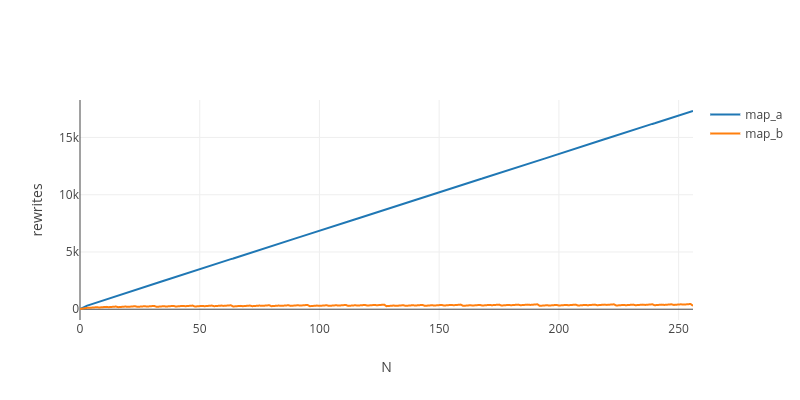 Complexity (total rewrites) of applying “map” N times to a list of 4 elements
As you can see, the same behavior is observed here: the version that fuses performs logarithmically, while the version that doesn’t performs linearly, supporting our hypothesis. Woa! But why would that happen?
(Here is the code for reproducing that experiment and generate the charts.)
2. Exponentiation by squaring = composition by sharing -------------------------------------------------------
To understand that, let’s first talk about integer exponentiation. If you’re a developer, chances are you’ve heard about exponentiation by squaring. It is an ancient, simple algorithm capable of computing A^B in much less steps than it’d take to multiply A repeatedly, B times. To refresh our minds, let’s visualize how it works:
\# Computing 13^8 with repeated multiplication
13^2 = 13 \* 13 = 169
13^3 = 13 \* 169 = 2197
13^4 = 13 \* 2197 = 28561
13^5 = 13 \* 28561 = 371293
13^6 = 13 \* 371293 = 4826809
13^7 = 13 \* 4826809 = 62748517
13^8 = 13 \* 62748517 = 815730721\
# Computing 13^8 with exponentiation by squaring
13^2 = 13 \* 13 = 169
13^4 = 169 \* 169 = 28561
13^8 = 28561 \* 28561 = 815730721As you can see, the first approach multiplies 13 one-by-one, needing N multiplications to reach 13^N (linear time), while the second repeatedly squares the first number instead, allowing it to jump from 13^1 to 13^2 to 13^4 to 13^8 in a single multiplication for each jump (logarithmic time). To compute values that aren’t perfect squares, you just multiply sub-terms, i.e., 13^11 = 13^8 * 13^2 * 13^1.
Neat, right? But how is that relevant? Due to a less known fact, for any function that can be fused by composition, we can also compute its repeated application in O(log(N)) steps using that same trick! Let’s visualize it too:
\# Computing not^8(t) with repeated application
not^2(t) = (λb.λf.λt. b f t) . (λb.λf.λt. b f t) = (λb.λf.λt. b t f)
not^3(t) = (λb.λf.λt. b f t) . (λb.λf.λt. b t f) = (λb.λf.λt. b f t)
not^4(t) = (λb.λf.λt. b f t) . (λb.λf.λt. b f t) = (λb.λf.λt. b t f)
not^5(t) = (λb.λf.λt. b f t) . (λb.λf.λt. b t f) = (λb.λf.λt. b f t)
not^6(t) = (λb.λf.λt. b f t) . (λb.λf.λt. b f t) = (λb.λf.λt. b t f)
not^7(t) = (λb.λf.λt. b f t) . (λb.λf.λt. b t f) = (λb.λf.λt. b f t)
not^8(t) = (λb.λf.λt. b f t) . (λb.λf.λt. b f t) = (λb.λf.λt. b t f)
\# Computing not^8(t) with composition by sharing
not^2(t) = (λb.λf.λt. b f t) . (λb.λf.λt. b f t) = (λb.λf.λt. b t f)
not^4(t) = (λb.λf.λt. b t f) . (λb.λf.λt. b t f) = (λb.λf.λt. b t f)
not^8(t) = (λb.λf.λt. b t f) . (λb.λf.λt. b t f) = (λb.λf.λt. b t f)Ok, that is way too hard to read. Let’s replace lambdas by their names:
\# Computing not^8(x) with repeated application
not^2(x) = not . not = id
not^3(x) = not . id = not
not^4(x) = not . not = id
not^5(x) = not . id = not
not^6(x) = not . not = id
not^7(x) = not . id = not
not^8(x) = not . not = id
\# Computing not^8(x) with composition by sharing
not^2(x) = not . not = id
not^4(x) = id . id = id
not^8(x) = id . id = idCan you see it? The first approach applies nots one by one, needing N applications to reach the final result (linear time), while the second repeatedly self-composes the initial function, jumping from not^2 to not^4 to not^8 with just a single composition for each jump (logarithmic time). In other words, as long as the self-composition of **f** fuses, we can implement repeated application in logarithmic time, using the same trick behind exponentiation by squaring!
3. Absal performs runtime fusion ---------------------------------
Sadly, knowing that trick isn’t sufficient to speed-up fusible algorithms: we also need a functional language capable of performing short-cut fusion during runtime. Haskell, for one, isn’t capable of doing that for native functions. To illustrate, let’s implement “composition by sharing” in it:
comp :: Int -> (a -> a) -> (a -> a)
comp 0 f x = x
comp n f x = comp (n `div` 2) g (r x)
where g = f . f
r = if even n then id else fThis function takes a number n, a function f, and returns a new function that applies f repeatedly to x, n times, using the “composition by sharing” method. As an example, (comp(not,10,x)) evaluates to the equivalent of:
not_10_times :: Bool -> Bool
not_10_times x =
let f1 = not in
let f2 = f1 . f1 in
let f4 = f2 . f2 in
let f8 = f4 . f4 in
f8 (f2 x)Notice how this function applies not 10 times to its input, even though it only uses composition 3 times? That’s why it should be efficient. So, what is the complexity of comp(not, N, x) in Haskell? Not logarithmic as we’d expect, but linear! You can test that fact by running this Gist. If you change 2^20 to something higher such as 2^40, it will run out of memory. Why? Because it is too lazy and never evaluates inside lambdas, which would be necessary to fuse those intermediate expressions. And, even if it did, it’d still not work. This separate posts investigates why, examining Haskell and JavaScript’s evaluation model and why they’re not optimal.
Now we’re real close to solving our puzzle. But, first, we need to talk about parallel universes; I mean, parallel reductions. The main insight behind Absal is the use of interaction nets instead of simpler textual representations. Interaction nets are a model of computation based on graphs with labelled ports (one being the “main port”) and a very peculiar caveat: whenever two “main ports” met, the nodes connected by them are rewritten.
 Rewrite rules of interaction combinators, a type of interaction net
That causes a very interesting effect: no matter what order you rewrite your nodes, the total number of steps stays constant. If, thus, you compile λ-terms to interaction nets, then you can reduce expressions in any order: functions first, arguments first, even in parallel. In the end, the performed work will be the same!
The trick, of course, is how to properly translate λ-terms to interaction nets. Sadly, there is no solution to that covers all λ-terms efficiently. But, for a huge class of them (probably whatever you’d write in practice), there is a simple and elegant way to do it: that’s the Abstract Algorithm. To explain it shortly, each lambda and each application of a λ-term becomes a ternary node on the net, and each repeated occurrence of a variable becomes a “fan node”. Also, the main port of an application node points to the function port, which is why redexes can never be duplicated.
If you’re overwhelmed, don’t worry. The main insight is that, by being free to reduce terms in whatever order it wants, Absal is capable of being as eager as possible without any performance penalty, which, in turn, allows it to fuse intermediate compositions. This is exactly what is needed to exploit the “composition by sharing” trick. If you do want to have a better understanding of the Abstract Algorithm, I recommend reading this book, it is extremely pedagogical. Alternatively, you can just contemplate the image below:

It depicts the evaluation of the(λg. g (g λx. x)) (λh. (λf. f (f λz. z)) (h λy. y)) term on the abstract algorithm. Notice how sub-expressions can be shared by several terms, how we can evaluate inside lambdas without ever risking duplicating work (and while still being able to be lazy), and how a single constant-time beta-reduction in this format is equivalent to several beta-reductions on more traditional representations. Beautiful, no?
But what about the negative complexity stuff? =============================================
Let’s recap all that we have learned so far. First, some λ-calculus functions fuse when they are self composed. By “fuse”, I mean the size of their normal forms stay constant. Second, those functions can be applied N times with O(log(N)) complexity using the “composition by sharing” strategy, as long as the host language can eagerly normalize sub-expressions inside lambdas. Third, Absal is capable of evaluating inside lambdas, which allows it to do exactly that, fusing inner compositions during runtime. That leads us to one logical conclusion: copy must somehow cause inc to fuse! Wow! Could it be? Let’s test that hypothesis by looking normal forms!
-- Normal form of inc:
λa. λb. λc. λd. (((a c) λe. (b λf. λg. λh. (((e g) λi. (f λj.
λk. λl. (((i k) λm. (j m)) l))) h))) d)
-- Normal form of inc . inc:
λa. λb. λc. λd. (((a λe. (b λf. λg. λh. (((e g) λi. (f λj. λk
. λl. (((i k) λm. (j m)) l))) h))) λe. (c λf. λg. λh. (((e g)
λi. (f λj. λk. λl. (((i k) λm. (j m)) l))) h))) d)
-- Normal form of inc . inc . inc:
λa. λb. λc. λd. (((a λe. (c λf. λg. λh. (((e g) λi. (f λj. λk
. λl. (((i k) λm. (j m)) l))) h))) λe. (b λf. λg. λh. (((e λi
. (f λj. λk. λl. (((i k) λm. (j m)) l))) λi. (g λj. λk. λl. (
((i k) λm. (j m)) l))) h))) d)
-------------------------------------------------------------
-- Normal form of copy . inc:
λa. (((a λb. λc. λd. λe. (d (((b λf. λg. λh. λi. (g (((f λj.
λk. λl. λm. (k j)) λj. λk. λl. λm. (l j)) λj. λk. λl. l))) λf
. λg. λh. λi. (h (((f λj. λk. λl. λm. (k j)) λj. λk. λl. λm.
(l j)) λj. λk. λl. l))) λf. λg. λh. h))) λb. λc. λd. λe. (c (
((b λf. λg. λh. λi. (h (((f λj. λk. λl. λm. (k j)) λj. λk. λl
. λm. (l j)) λj. λk. λl. l))) λf. λg. λh. λi. (g (((f λj. λk.
λl. λm. (l j)) λj. λk. λl. λm. (k j)) λj. λk. λl. l))) λf. λg
. λh. h))) λb. λc. λd. d)
-- Normal form of copy . inc . inc:
λa. (((a λb. λc. λd. λe. (c (((b λf. λg. λh. λi. (h (((f λj.
λk. λl. λm. (k j)) λj. λk. λl. λm. (l j)) λj. λk. λl. l))) λf
. λg. λh. λi. (g (((f λj. λk. λl. λm. (l j)) λj. λk. λl. λm.
(k j)) λj. λk. λl. l))) λf. λg. λh. h))) λb. λc. λd. λe. (d (
((b λf. λg. λh. λi. (h (((f λj. λk. λl. λm. (k j)) λj. λk. λl
. λm. (l j)) λj. λk. λl. l))) λf. λg. λh. λi. (g (((f λj. λk.
λl. λm. (l j)) λj. λk. λl. λm. (k j)) λj. λk. λl. l))) λf. λg
. λh. h))) λb. λc. λd. d)
-- Normal form of copy . inc . inc . inc:
λa. (((a λb. λc. λd. λe. (d (((b λf. λg. λh. λi. (h (((f λj.
λk. λl. λm. (k j)) λj. λk. λl. λm. (l j)) λj. λk. λl. l))) λf
. λg. λh. λi. (g (((f λj. λk. λl. λm. (l j)) λj. λk. λl. λm.
(k j)) λj. λk. λl. l))) λf. λg. λh. h))) λb. λc. λd. λe. (c (
((b λf. λg. λh. λi. (g (((f λj. λk. λl. λm. (l j)) λj. λk. λl
. λm. (k j)) λj. λk. λl. l))) λf. λg. λh. λi. (h (((f λj. λk.
λl. λm. (l j)) λj. λk. λl. λm. (k j)) λj. λk. λl. l))) λf. λg
. λh. h))) λb. λc. λd. d)
-- Note: using a fixed depth of 3 for better visualizationThere it is! That’s exactly what happens. Don’t worry about the contents of those terms, we’re just considering their sizes. Here, the composition of inc with itself is small, but as we keep appending more inc.s, the normal form grows bigger, linearly. In other words, inc does not fuse with itself. If we just append copy. to the sequence of inc.s, then the normal form of the resulting function is larger, but stays constant, regardless of the number of compositions. In other words, its self-composition merely permutes variables and, thus, fuses. That, in turn, allows the “composition by sharing” effect to kick off, which causes the Nth composition of inc to have logarithmic complexity. Feels good, inc.!
And that’s it. Mystery solved. Here is the code for replicating this experiment with Absal (see my previous post for install instructions).
A last pending question would be: why copy causes inc to fuse? But that’s not hard to understand. First, let’s visualize the definitions of copy and inc:
inc = λd. λbits.
-- Folds over d (the recursion depth)
d
-- Succ branch of fold
λrec. λbits.
-- Return constructors in advance (important for fusion)
λB0. λB1. λEnd.
-- Pattern matches bits
bits
-- B0 case
B1
-- B1 case
λxs. B0 (rec xs)
-- End caase
End
-- Zero branch of fold
λxs. xs
-- Applies resulting function to bits
bits
copy = λd.
-- Folds over d (the recursion depth)
d
-- Succ branch of fold
λrec. λxs.
-- Pattern matches xs
xs
-- B0 case
λxs. B0 (R xs)
-- B1 case
λxs. B1 (R xs)
-- End case
End
-- Zero branch of fold
λxs. xsNow, let’s fix a depth d=2 and visualize what inc becomes when composed with copy:
inc = λbits.
-- Pattern matches bits
bits
-- B0 case
λbits. λB0. λB1. λEnd.
-- Returns B1
B1
-- Pattern matches bits
(bits
-- B0 case (returns B0)
λbits. λB0. λB1. λEnd. (B0 bs)
-- B1 case (returns B1)
λbits. λB0. λB1. λEnd. (B1 bs)
-- End case
λB0. λB1. λEnd. End)
-- B1 case
λbits. λB0. λB1. λEnd.
-- Returns B0
B0
-- Pattern matches bits
(bits
-- B0 case (returns B0)
λbits. λB0. λB1. λEnd. (B0 bs)
-- B1 case (returns B1)
λbits. λB0. λB1. λEnd. (B1 bs)
-- End case
λB0. λB1. λEnd. End)
-- End case
λB0. λB1. λEnd. EndTurns out copy sucked inc into itself, feeding it a bunch of constructors, which transformed it into a function that exhaustively pattern-matches all branches of its input to the maximum depth, instead of prematurely returning when no more work is needed, as it did before. Notice how line 16 on the first snippet was replaced by lines 8-21 on the second one. In other words, inc essentially became a big permutation / lookup table instead of a normal recursive function. That sounds like a bad idea, but turns out this complete coverage is exactly what was needed for the function to be able to fuse with itself. Without it, the symbolic variables that are prematurely returned in certain branches couldn’t be reduced further, accumulating in self-composed terms, causing them to grow larger and larger. Or, alternatively, the additional pattern matches self-destroy under self-composition, keeping the function’s body small.
Conclusion ----------
Well, that was quite a trip. Turns out that the Abstract Algorithm had simple explanations behind its magical results. I’m glad I finally figured those things out, and thankful to the Redditors who commented with insights and speculations; in special, /u/matt-noonan, who mentioned the composition by sharing trick which put all pieces together in my head.
tl;dr -----
In Absal, an optimal implementation of functional languages, repeated application is performed with church-numbers, which are represented by functions with a high amount of internal sharing. For example, 21 is represented as:
λf1. λx.
let f2 = f1 . f1 in
let f4 = f2 . f2 in
let f8 = f4 . f4 in
let f16 = f8 . f8 in
f16 (f4 (f1 x))That format is very similar to “exponentiation by squaring”, a classic algorithm capable of computing the exponentiation of A^B in O(log(N)) instead of O(N). That alone isn’t sufficient to explain the phenomena; in Haskell, for example, using that function gives no speedups. Absal, though, is extremely eager (despite suffering no slowdowns for it), which makes it capable of computing the normal form of intermediate f . f compositions, essentially performing fusion at runtime. That’s only useful when f fuses when self-composed, otherwise the growth of its normal form would cause an exponential slowdown due to the cost of copying increasingly larger terms.
If f fuses under self-composition, though, then Absal manifests a “composition by sharing” effect, which is similar to “exponentiation by squaring”, except with functions and composition instead of integers and multiplication. This is what allows it to compute N repeated applications of f in O(log(N)) time. Finally, turns out copy . inc transforms inc into a function that self-fuses, by replacing symbols that accumulate by lambdas that self-destroy under self-composition, which is why it is asymptotically faster than inc alone.
tl;dr tl;dr -----------
Magic.
H.49 · bend-docs/openspec/changes/bend-docs-site/research/victor/hvm-sat.md
Simple SAT Solver via superpositions
URL: https://gist.github.com/VictorTaelin/9061306220929f04e7e6980f23ade615
File: sat.md
Solving SAT via interaction net superpositions
I've recently been amazed, if not mind-blown, by how a very simple, "one-line" SAT solver on Interaction Nets can outperform brute-force by orders of magnitude by exploiting "superposed booleans" and optimal evaluation of λ-expressions. In this brief note, I'll provide some background for you to understand how this works, and then I'll present a simple code you can run in your own computer to observe and replicate this effect. Note this is a new observation, so I know little about how this algorithm behaves asymptotically, but I find it quite interesting that this simple approach performs much better than it should.
What are interaction net superpositions?
Interaction Nets are a new model of computation capable of evaluating lambdas optimally. HVM is a practical implementation of that system. Since INets are fully linear, variables must be "cloned" via "dup-nodes", which can be seen as "lazy cloners". Usually, these can only be linked to variables, and are "invisible" to the user. But what happens if we expose dup nodes as a first-class feature of the user-facing language?
Turns out that they behave like "superposed values", which can be seen as a new
programming feature that semantically means "this expression has two values at
the same time". In HVM, the superposition of X and Y is written as {X Y}.
When you apply a function to a superposed value, as in, F({X Y}), F will be
executed for each input, X and Y. So, for example, double({2 3}) computes
to {4 6}. What makes this interesting, though, is that these calls are
"overlapped", in a way that shares computations, giving you a huge performance
boost.

What are its applications?
1. Fast function calls
When we apply a function to a tree of superposed values, it will behave like a
"map", and be applied to each value. For example, if F(x) = x * 10, then F({1 2 3 4}) is seen as {F(1) F(2) F(3) F(4)}, which reduces to {10 20 30 40},
with the advantage of computations being shared optimally across different
calls. For example, suppose that F has a heavy computation inside it:
def F(x):
return x + slow(999999)Here, slow(999999) would take a long time to compute. Yet, when F is
applied to superposed values, that sub-expression would only be computed once,
saving a lot of work. This is a very general behavior. For example,
sub-expressions that depend on the inputs (and, thus, can't be computed once)
will still be "partly computed only once", as much as possible, making your
program much faster.
2. Automated vectorization
Another application is automated vectorization. If we compile eliminators and
destructors of datatypes to lambdas with different labels, these behave like
superpositions across different types. As such, if we evaluate, say, (Not (Pair True False)), it will reduce to (Pair False True). The Not eliminator
"passes through" the Pair constructor, and only interacts with the bools.
3. Search
Now, for the most interesting part; and what made me hyped enough to make this
post; we can also use superposition to search. For example, if we evaluate
(And {True False} {True False}), it will output {{True False} {False False}}, which is the truth-table for the And function. In other words,
applying a function to a superposition of its complete domain results in a
superposition of its complete image.
So, what happens if we're searching for a specific output? Turns out we can use superpositions to perform this "brute-force" search without loops. In other words, instead of:
for x0 in [T, F]:
for x1 in [T, F]:
for x2 in [T,F]:
...
print F(x0, x1, x2, ...)We do this instead:
print F({T,F}, {T,F}, {T,F}, ...)As you may have expected, the later will share a lot of computation across "guesses", resulting in a search that is much faster than a naive brute-force search would be. Below, we exploit this technique to find the solution of a SAT problem in HVM. The "brute-force" algorithm takes 3 minutes to solve a random instance with 32 variables in Rust. In HVM, the same instance is solved in 1 second by using superpositions. Below is an example SAT solver in HVM, for a random instance with 16 variables:
// Bool/List constructors and functions
(Cons h t) = λcλn(c h (t c n))
Nil = λcλn(n)
T = λt λf t
F = λt λf f
(Id a) = a
(Not a) = λt λf (a f t)
(And a b) = (a λx(x) λx(F) b)
(Or a b) = (a λx(T) λx(x) b)
(Or3 a b c) = (Or a (Or b c))
// Pretty prints a bool
(Bool x) = (x 1 0)
// Converts a solution to a pretty-printed church-list singleton
(Log x0 x1 x2 x3 x4 x5 x6 x7 x8 x9 xA xB xC xD xE xF x) = (x (Cons λt(t
(Bool x0) (Bool x1) (Bool x2) (Bool x3)
(Bool x4) (Bool x5) (Bool x6) (Bool x7)
(Bool x8) (Bool x9) (Bool xA) (Bool xB)
(Bool xC) (Bool xD) (Bool xE) (Bool xF)
) Nil) Nil)
// A random 3-SAT instance with 16 variables
(Foo x0 x1 x2 x3 x4 x5 x6 x7 x8 x9 xA xB xC xD xE xF) =
(Log x0 x1 x2 x3 x4 x5 x6 x7 x8 x9 xA xB xC xD xE xF
(And (Or3 xC x8 (Not xB))
(And (Or3 (Not xA) (Not x2) (Not x8))
(And (Or3 xB (Not x9) x4)
(And (Or3 xA x1 (Not x8))
(And (Or3 (Not x9) x0 x5)
(And (Or3 (Not x4) (Not x4) xD)
(And (Or3 (Not x1) (Not x4) xB)
(And (Or3 (Not x2) xE (Not xD))
(And (Or3 xD (Not x8) (Not x7))
(And (Or3 xD (Not x1) x7)
(And (Or3 (Not x8) x4 x8)
(And (Or3 x5 (Not x0) xC)
(And (Or3 x1 x0 (Not x3))
(And (Or3 x3 xE (Not xD))
(And (Or3 x9 (Not xC) (Not xB))
(And (Or3 x8 (Not xE) (Not x5))
(And (Or3 (Not x7) (Not x9) (Not xF))
(And (Or3 xF xB x2)
(And (Or3 (Not x2) (Not xE) (Not x7))
(And (Or3 (Not xE) x3 (Not x3))
(And (Or3 x3 (Not xF) x1)
(And (Or3 (Not x0) x0 xD)
(And (Or3 (Not x8) (Not x3) xC)
(And (Or3 xC (Not x1) x7)
(And (Or3 x2 (Not xE) (Not x0))
(And (Or3 x6 (Not x5) x1)
(And (Or3 (Not xC) x3 (Not x3))
(And (Or3 (Not x1) (Not xC) (Not x5))
(And (Or3 xB xA x6)
(And (Or3 xF x6 x9)
(And (Or3 (Not xF) x3 (Not x9))
(And (Or3 (Not xB) x1 x8)
(And (Or3 x9 (Not xE) xE)
(And (Or3 (Not xA) (Not x2) x2)
(And (Or3 x5 xE (Not x2))
(And (Or3 (Not xB) xC x2)
(And (Or3 x1 xB (Not x2))
(And (Or3 x8 (Not x6) (Not x7))
(And (Or3 xD x9 (Not xA))
(And (Or3 x0 x8 (Not x8))
(And (Or3 (Not xA) x9 (Not x0))
(And (Or3 (Not xE) (Not x7) (Not xC))
(And (Or3 x9 xC (Not xA))
(And (Or3 (Not x7) (Not xF) xD)
(And (Or3 x0 (Not x2) xD)
(And (Or3 xC (Not x9) (Not x0))
(And (Or3 (Not xA) x8 (Not x1))
(And (Or3 x4 x5 (Not xE))
(And (Or3 (Not x0) x5 (Not x7))
(And (Or3 (Not x1) (Not xC) xA)
(And (Or3 x0 xF x9)
(And (Or3 (Not xA) x3 (Not x2))
(And (Or3 (Not x7) (Not xF) x6)
(And (Or3 (Not x1) x4 (Not x5))
(And (Or3 xC (Not x8) x2)
(And (Or3 x4 x7 (Not x5))
(And (Or3 (Not x9) (Not x0) (Not xA))
(And (Or3 xC x1 (Not x2))
(And (Or3 xB xE (Not xB))
(And (Or3 xF x5 xA)
(And (Or3 (Not x6) xE x3)
(And (Or3 (Not xB) xB x1)
(And (Or3 (Not xF) x0 x7)
(Or3 xE (Not x3) (Not x2))))))))))))))))))))))))))))))))))))))))))))))))))))))))))))))))))
// Collapsers (to retrieve solutions from superpositions) - credit to @Franchu
Join = λaλbλcλn(a c (b c n))
Col0 = λx let #A0{x0 x1} = x; (Join x0 x1)
Col1 = λx let #A1{x0 x1} = x; (Join x0 x1)
Col2 = λx let #A2{x0 x1} = x; (Join x0 x1)
Col3 = λx let #A3{x0 x1} = x; (Join x0 x1)
Col4 = λx let #A4{x0 x1} = x; (Join x0 x1)
Col5 = λx let #A5{x0 x1} = x; (Join x0 x1)
Col6 = λx let #A6{x0 x1} = x; (Join x0 x1)
Col7 = λx let #A7{x0 x1} = x; (Join x0 x1)
Col8 = λx let #A8{x0 x1} = x; (Join x0 x1)
Col9 = λx let #A9{x0 x1} = x; (Join x0 x1)
ColA = λx let #AA{x0 x1} = x; (Join x0 x1)
ColB = λx let #AB{x0 x1} = x; (Join x0 x1)
ColC = λx let #AC{x0 x1} = x; (Join x0 x1)
ColD = λx let #AD{x0 x1} = x; (Join x0 x1)
ColE = λx let #AE{x0 x1} = x; (Join x0 x1)
ColF = λx let #AF{x0 x1} = x; (Join x0 x1)
// Finds a solution by applying Foo to superposed inputs
Main =
(Col0 (Col1 (Col2 (Col3
(Col4 (Col5 (Col6 (Col7
(Col8 (Col9 (ColA (ColB
(ColC (ColD (ColE (ColF
(Foo
#A0{T F} #A1{T F} #A2{T F} #A3{T F}
#A4{T F} #A5{T F} #A6{T F} #A7{T F}
#A8{T F} #A9{T F} #AA{T F} #AB{T F}
#AC{T F} #AD{T F} #AE{T F} #AF{T F}
)))))))))))))))))Discussion: https://twitter.com/VictorTaelin/status/1744788091833917696
H.50 · bend-docs/openspec/changes/bend-docs-site/research/victor/hvm-search1.md
Fast Discrete Program Search with HVM Superpositions (SUP nodes) - finding ADD-CARRY
URL: https://gist.github.com/VictorTaelin/d5c318348aaee7033eb3d18b0b0ace34
File: fast_dps_add_carry.md
HOC's Fast Discrete Program Search (DPS)
HOC will soon (EOY?) launch an API for our DPS solution. The interface will be simple:
You give us a set of examples (input/output pairs)
We'll give you a (Python?) function that models it
And that's it. It will be an universal function finder.
We'll not release the full source, but, meanwhile, I can talk about the theory. As I've written before, the main idea is to exploit "superpositions" - a feature that HVM inherited from Interaction Combinators - to accelerate DPS (or Symbolic Regression). SUPs are the opposite of DUPs: instead of "cloning one value into two locations", they "merge two values into one location". For example, if you write:
Main = (+ {10 20} 1)HVM will add the superposition of {10 20} to 1, resulting in {11 21}. While this looks like something simple you could just add to existing languages - it isn't. To get an asymptotical speedup, SUPs must be first-class, deeply ingrained into the runtime - and that's incompatible with the classical model that all languages use (the full λ-Calculus).
But how SUPs accelerate DPS?
To explain this, suppose you're trying to find the binary ADD-CARRY algorithm. Assume you don't know the implementation, but you know it can be done with a single recursive pass through both strings. As such, you write the following template:
ADC :: Int -> [Int] -> [Int] -> Bool -> [Int]
ADC 0 a b c = []
ADC n (0:a) (0:b) 0 = ? : ADC (n-1) a b ?
ADC n (0:a) (1:b) 0 = ? : ADC (n-1) a b ?
ADC n (1:a) (0:b) 0 = ? : ADC (n-1) a b ?
ADC n (1:a) (1:b) 0 = ? : ADC (n-1) a b ?
ADC n (0:a) (0:b) 1 = ? : ADC (n-1) a b ?
ADC n (0:a) (1:b) 1 = ? : ADC (n-1) a b ?
ADC n (1:a) (0:b) 1 = ? : ADC (n-1) a b ?
ADC n (1:a) (1:b) 1 = ? : ADC (n-1) a b ?Now, all you need to do is find the correct replacement for each of the 16 missing bits (?). In a conventional language (like Haskell), you'd need to use a loop to enumerate and try all the 65,536 options separately. Now, here's the insight: all these "add candidates" share a lot in common. Couldn't we save a lot of time if we could optimally "cache" identical computations across different guesses? Indeed: that's where hash-consing - lol, jk - SUP nodes come to save the day.
On HVM, instead of trying each candidate separately, we can create a superposition of all possible functions. Then, we can apply them all to some test cases. Finally, we can collapse the result into a single value, to recover a function that works. More or less like this:
let adc = {superposition of candidates}
let test_0 = add 48436 10318 == 58754
let test_1 = add 38148 25462 == 63610
collapse $ if test_0 && test_1 then None else Some BITSRunning this on HVM will output the missing bits:
[0, 1, 1, 0, 1, 0, 0, 1, 1, 1, 1, 0, 1, 0, 0, 0]And voilà: we just discovered the ADD-CARRY function!
So, how fast this is? In this implementation, a single call to 'add' takes about ~4k interactions. As such, calling it 65k times would take about 262m interactions. Yet, the program above returns in just 36k interactions! That's a ridiculous 7277x speedup. More impressively, we achieved sub-1 interactions per guess! And that speedup only gets larger as the search space grows.
Below I publish the HVM1 source to replicate this experiment:
// type Bool = F | T
F = λf λt f
T = λf λt t
// type Bin = (O Bin) | (I Bin)
(O xs) = λo λi (o xs)
(I xs) = λo λi (i xs)
// type Nat = (S n) | Z
(S n) = λs λz (s n)
Z = λs λz z
// If-Then-Else
(If 0 t f) = f
(If x t f) = t
// Converts U60 to Bin
(Bin 0 n) = E
(Bin s n) = (If (== (% n 2) 0) (O (Bin (- s 1) (/ n 2))) (I (Bin (- s 1) (/ n 2))))
// Converts Bin to U60
(U60 0 bs) = 0
(U60 n bs) = (bs λp (+ (* 2 (U60 (- n 1) p)) 0) λp (+ (* 2 (U60 (- n 1) p)) 1))
// Converts U60 to Nat
(Nat 0) = Z
(Nat n) = (S (Nat (- n 1)))
// Boolean Fns
And = λa (a λb(F) λb(b))
Or = λa (a λb(T) λb(b))
// Maybe Or
(Join None b) = b
(Join (Some x) b) = (Some x)
// Collapse an N-label Superposition
(Collapse 0 x) = x
(Collapse n x) = (HVM.DUP (- n 1) x λx0λx1(Collapse (- n 1) (Join x0 x1)))
// Checks if two Bins are equal
Eq = λn (n
λn λa (a
λa λb (b λb ((Eq) n a b) λb F)
λa λb (b λb F λb ((Eq) n a b)))
λa λb T)
// Target Add Function (we're searching this)
Add = λn (n
λn λa (a
λa λb (b
λb λk (k
(O ((Add) n a b F))
(I ((Add) n a b F)))
λb λk (k
(I ((Add) n a b F))
(O ((Add) n a b T))))
λa λb (b
λb λk (k
(I ((Add) n a b F))
(O ((Add) n a b T)))
λb λk (k
(O ((Add) n a b T))
(I ((Add) n a b T)))))
λa λb λk E)
// Superposed Function Template (with 16 missing bits)
Fun = λn (n
λn λa (a
λa λb (b
λb λk (k
(#0{λx(O x) λx(I x)} ((Fun) n a b #8{T F}))
(#1{λx(O x) λx(I x)} ((Fun) n a b #9{T F})))
λb λk (k
(#2{λx(O x) λx(I x)} ((Fun) n a b #10{T F}))
(#3{λx(O x) λx(I x)} ((Fun) n a b #11{T F}))))
λa λb (b
λb λk (k
(#4{λx(O x) λx(I x)} ((Fun) n a b #12{T F}))
(#5{λx(O x) λx(I x)} ((Fun) n a b #13{T F})))
λb λk (k
(#6{λx(O x) λx(I x)} ((Fun) n a b #14{T F}))
(#7{λx(O x) λx(I x)} ((Fun) n a b #15{T F})))))
λa λb λe E)
// Superposition Labels used in the Template
Map = [
#0{0 1} #1{0 1} #2{0 1} #3{0 1} #4{0 1} #5{0 1} #6{0 1} #7{0 1}
#8{0 1} #9{0 1} #10{0 1} #11{0 1} #12{0 1} #13{0 1} #14{0 1} #15{0 1}
]
// Tests if `Fun a b == c`
(Test s a b c) =
let x = ((Fun) (Nat s) (Bin s a) (Bin s b) F)
let y = (Bin s c)
((Eq) (Nat s) x y)
// Main
// ----
// Finds the Binary Addition Function
Main =
let e0 = (Test 16 48436 10318 58754) // test: 48436 + 10318 = 58754
let e1 = (Test 16 38148 25462 63610) // test: 38148 + 25462 = 63610
let ok = ((And) e0 e1) // looks for a Fun that passes both tests
(Collapse 16 (ok None (Some Map))) // output: [0, 1, 1, 0, 1, 0, 0, 1, 1, 1, 1, 0, 1, 0, 0, 0]This is the heart of the algorithm we'll be running, and I'm posting it for anyone to explore. In special, note how we fully replaced loops and enumeration by superposition and collapsing. Of course, this version is greatly simplified, as I provided a template for the ADD-CARRY shape, simplifying the task. Our full solution generates the templates on the fly, and employs a bunch of new tricks to let us to recover functions from I/O pairs alone. We also use a custom HVM version, and (depending on our Series A outcome 😅) a MASSIVE LOT of compute.
Even with all these tricks, the general problem is still exponential, but, by greatly optimizing the cost of a guess (all the way to <1 interaction), and with massive compute, this "dumb" approach can discover programs and proofs that would otherwise be intractable.
Discussion: https://x.com/VictorTaelin/status/1819774880130158663
H.51 · bend-docs/openspec/changes/bend-docs-site/research/victor/hvm-search3.md
A Superposed λ-Calculus Enumerator for Program Search
URL: https://gist.github.com/VictorTaelin/7c4c69a1f07b5c668be613f1032e7d4e
File: superposed_lambda_calculus_evaluator.c
// This file is a mirror of: // https://github.com/HigherOrderCO/HVM3/blob/main/book/lambda_enumerator_optimal.hvml
// An Optimal λ-Calculus Enumerator for Program Search
// ---------------------------------------------------
// This file shows a template on how to enumerate superposed terms in a
// higher-order language (here, the affine λ-Calculus) for proof search.
// Instead of generating the source syntax (like superposing all binary strings
// and parsing it as a binary λ-calculus), we create a superposition of all
// λ-terms directly, in a way that head constructors are emitted as soon as
// possible. This allows HVM to prune branches and backtrack efficiently as it
// computes the application of all λ-terms to some expression. The result is a
// reduction in the interactions needed to solve the equation:
// > (?X λt(t 1 2)) == λt(t 2 1)
// From ~32 million to just 76k, a 420x speedup*, which increases the harder the
// problem is. This generator works by synthesizing a λ-term in layers. On each
// layer, we either generate a lambda and extend a context, or select one of the
// variables in the context to return. When we select a variable, we will apply
// it to either 0, 1 or 2 other variables in the context (we don't generate
// terms with >2 arity apps here). This is not ideal; in a typed version, we
// would be able to tell the arity of the context variable, and generate the
// right amount of applications, without making a guess.
// * NOTE: we're actually able to bring the naive approach down to 1.7 million
// interactions. So, the numbers are:
// - Enum binary λC with loops (Haskell): 0.992s
// - Enum binary λC with sups (HVM): 0.026s (38x speedup)
// - Enum λC directly with sups (HVM): 0.0011s (862x speedup)
// The main contribution of this file is on the shape of the superposer. There
// are a few things that one must get right to achieve the desired effect.
// First, how do we split a linear context? It depends: when generating an
// application like (f ?A ?B), we need to pass the context to ?A, get the
// leftover, and pass it to ?B, in such a way that ?A and ?B won't use the
// same variable twice. This happens within the same "universe". Yet, when
// making a choice, like "do we return a lambda or a variable here", we need to
// clone the linear context with the same label forked the universe itself,
// allowing a variable to be used more than once, as long as its occurrences are
// in different universes. Handling this correctly is very subtle, which is why
// this file can be useful for study.
// Second, how do we handle labels? As discussed recently on Discord:
// https://discord.com/channels/912426566838013994/915345481675186197/1311434500911403109
// We only need one label to fully enumerate all natural numbers. Yet, that
// doesn't work for binary trees. My conclusion is that we need to "fork" the
// label whenever we enumerate a constructor that branches; i.e., that has more
// than one field. Nats and Bits are safe because their constructors only have
// one field, but a binary Tree needs forking. To fork a label, we just mul by 2
// and add 0 or 1, and the seed has to be 1, so that forked branches never use
// the same label. We apply this here to the arity-2 app case.
// Third, how do we emit constructors as soon as possible, while still passing a
// context down? It is easy to accidentally mess this up by making the enum
// monadic. This will cause it to sequentialize its execution, meaning no ctor
// is emitted until the entire enumerator returns. That's a big problem, since
// we need head ctors to be available as soon as possible. That's how HVM is
// able to invalidate universes and backtrack. While this is a silly issue, it
// can spoil the whole thing, so I've elaborated it here:
// https://gist.github.com/VictorTaelin/fb798a5bd182f8c57dd302380f69777a
// The enumerator in this file is the simplest "template" enumerator that has
// everything a higher order language needs and is structured in a way that can
// be studied and extended with more sophisticate approaches, like types.
// EDIT: the dependently typed version has been pushed. It reduces the rewrite
// count to 3k, and greatly improves the enumerator shape.
data List { #Nil #Cons{head tail} }
data Bits { #O{pred} #I{pred} #E }
data Term { #Lam{bod} #App{fun arg} #Var{idx} #Sub{val} }
data pair { #Pair{fst snd} }
data Result { #Result{src val} }
data Maybe { #None #Some{value} }
// Prelude // -------
@if(c t f) = ~ c { 0: f p: t }
@when(c t) = ~ c { 0: * p: t }
@tail(xs) = ~ xs { #Nil: * #Cons{h t}: t }
@and(a b) = ~ a !b { 0: 0 p: b }
@unwrap(mb) = ~ mb { #None: * #Some{x}: x }
@tm0(x) = !&0{a b}=x a @tm1(x) = !&0{a b}=x b
// Stringification // ---------------
@show_nat(nat) = ~nat { 0: λk #Cons{'Z' k} p: λk #Cons{'S' (@show_nat(p) k)} }
@show_dec(n r) = ! &{n n0} = n ! &{n n1} = n ! chr = (+ (% n 10) '0') ~ (< n0 10) !chr !r { 0: @show_dec((/ n1 10) #Cons{chr r}) t: #Cons{chr r} }
@do_show_dec(n) = @show_dec(n #Nil)
@show_bits(bits) = ~bits { #O{pred}: λk #Cons{'#' #Cons{'O' #Cons{'{' (@show_bits(pred) #Cons{'}' k})}}} #I{pred}: λk #Cons{'#' #Cons{'I' #Cons{'{' (@show_bits(pred) #Cons{'}' k})}}} #E: λk #Cons{'#' #Cons{'E' k}} }
@do_show_bits(bits) = (@show_bits(bits) #Nil)
@show_term(term dep) = ~term !dep { #Var{idx}: λk @show_dec((- (- dep idx) 1) k) #Lam{bod}: λk !&{d0 d1}=dep #Cons{'λ' (@show_term((bod #Var{d0}) (+ d1 1)) k)} #App{fun arg}: λk !&{d0 d1}=dep #Cons{'(' (@show_term(fun d0) #Cons{' ' (@show_term(arg d1) #Cons{')' k})})} #Sub{val}: * }
@do_show_term(term) = (@show_term(term 0) #Nil)
// Equality // --------
@eq(a b dep) = ~ a !b !dep { #Lam{a_bod}: ~ b !dep { #Lam{b_bod}: !&{dep d0}=dep !&{dep d1}=dep !&{dep d2}=dep @eq((a_bod #Var{d0}) (b_bod #Var{d1}) (+ 1 d2)) #App{b_fun b_arg}: 0 #Var{b_idx}: 0 #Sub{b_val}: * } #App{a_fun a_arg}: ~ b !dep { #Lam{b_bod}: 0 #App{b_fun b_arg}: !&{dep d0}=dep !&{dep d1}=dep @and(@eq(a_fun b_fun d0) @eq(a_arg b_arg d1)) #Var{b_idx}: 0 #Sub{b_val}: * } #Var{a_idx}: ~ b !dep { #Lam{b_bod}: 0 #App{b_fun b_arg}: 0 #Var{b_idx}: (== a_idx b_idx) #Sub{b_val}: * } #Sub{a_val}: * }
// Evaluation // ----------
@wnf(term) = ~ term { #Lam{bod}: #Lam{bod} #App{fun arg}: @wnf_app(@wnf(fun) arg) #Var{idx}: #Var{idx} #Sub{val}: #Sub{val} }
@wnf_app(f x) = ~ f !x { #Lam{bod}: @wnf((bod @wnf(x))) #App{fun arg}: #App{#App{fun arg} x} #Var{idx}: #App{#Var{idx} x} #Sub{val}: #App{#Sub{val} x} }
// Normalization // -------------
@nf(term) = ~ @wnf(term) { #Lam{bod}: #Lam{λx @nf((bod #Sub{x}))} #App{fun arg}: #App{@nf(fun) @nf(arg)} #Var{idx}: #Var{idx} #Sub{val}: val }
// Enumeration // -----------
// Enumerates affine λ-terms. // - lim: max context length (i.e., nested lambdas) // - lab: superposition label. should be 1 initially. // - ctx: the current scope. should be [] initially. // If the binder limit has been reached, destroy this universe. // Otherwise, make a choice. // - A. We generate a fresh lambda. // - B. We select a variable from context. // Note that, every time we make a choice, we "fork" the current context by // using DUP nodes with the same label that we used in the choice SUP node. @all(&L &lim ctx) = ~&lim { 0: * &lim: !&L{ctxL ctxR} = ctx &L{ @lam(&L &lim ctxL) @ret(&L (+ &lim 1) ctxR λk(k)) } }
// Generate a fresh lambda and extend the context with its variable. @lam(&L &lim ctx) = !&0{ctx bod} = @all(&L &lim #Cons{#Some{$x} ctx}) &0{@tail(ctx) #Lam{λ$x(bod)}}
// Return a variable from the context. // If the context is empty, destroy this universe. // Otherwise, make a choice. // - A. We emit the head of the context, and apply it to things. // - B. We keep the head of the context, and go to the next element. @ret(&L &lim ctx rem) = ~ctx { #Nil: * #Cons{val ctx}: !&L{remL remR} = rem !&L{valL valR} = val !&L{ctxL ctxR} = ctx &L{ @app(&L &lim (remL #Cons{#None ctxL}) valL) @ret(&L &lim ctxR λk(remR #Cons{valR k})) } }
// To apply a value to things, we will make a triple choice.
// - A. Just return it directly.
// - B. Apply it to 1 argument.
// - C. Apply it to 2 arguments.
// When we apply it to 2 arguments, as in (App ?A ?B), we need to fork the
// label, so that DUPs/SUPs in ?A and ?B never use the same label.
@app(&L &lim ctx val) = ~ val {
#None: *
#Some{val}:
!&L{val val0} = val
!&L{val val1} = val
!&L{val val2} = val
!&L{ctx ctx0} = ctx
!&L{ctx ctx1} = ctx
!&L{ctx ctx2} = ctx
! arity_0 =
&0{ctx0 val0}
! arity_1 =
!&0{ctx1 argX} = @all(&L &lim ctx1)
&0{ctx1 #App{val1 argX}}
! arity_2 =
!&0{ctx2 argX} = @all((+(&L 2) 0) &lim ctx2)
!&0{ctx2 argY} = @all((+(&L 2) 1) &lim ctx2)
&0{ctx2 #App{#App{val2 argX} argY}}
&L{arity_0 &L{arity_1 arity_2}}
}
// Tests // -----
//A= λt (t ^1 ^2) //A= λ((Z SZ) SSZ) @A = #Lam{λt #App{#App{t #Var{1}} #Var{2}}}
//B= λt (t ^2 ^1) //B= λ((Z SSZ) SZ) @B = #Lam{λt #App{#App{t #Var{2}} #Var{1}}}
//R= λx (x λa λb λt (t b a)) //R= λ(Z λλλ((SSSZ SSZ) SZ)) @R = #Lam{λx #App{x #Lam{λa #Lam{λb #Lam{λt #App{#App{t b} a}}}}}}
//X= (all terms) @X = @tm1(@all(1 5 #Nil))
// Solves for ?X in (?X λt(t A B)) == λt(t B A).
// It finds ?X = λλ(1 λλ((2 0) 1)) in 76k interactions.
@main =
! solved = @eq(@nf(#App{@X @A}) @B 0)
@when(solved @do_show_term(@X))
H.52 · bend-docs/openspec/changes/bend-docs-site/research/victor/hvm-sieve.md
Can a simple functional sieve be fast? Optimizing Tromp's algorithm on HVM.
URL: https://gist.github.com/VictorTaelin/a5571afaf5ee565689d2b9a981bd9df8
File: simple_fast_functional_sieve.md
Can a simple functional sieve be fast? Optimizing Tromp's algorithm on HVM.
Today, John Tromp - creator of the Binary λ-Calculus, and one of the smartest functional wizards alive - ported his famous prime number generator (first published 12 years ago!) to HVM:
B0 = λx λy x
B1 = λx λy y
cons = λx λy λz (z x y)
cons0 = λy λz (z B0 y)
Y = λf ((λx (x x)) (λx (f (x x))))
S0 = λcont λx λxs (cons0 (xs cont))
Ssucc = λSn λc λx λxs (cons x (xs (Sn c)))
ap = λx λy λz (x z (y z))
sieve = λSn (cons B1 (ap sieve Y (Ssucc Sn)))
primes = (cons0 (cons0 (sieve S0)))
C2 = λf λx (f (f x))
C5 = λf λx (f (f (f (f (f x)))))
C10 = λf (C2 (C5 f))
C1K = (C10 C2)
C3 = λf λx (f (f (f x)))
C4 = λf λx (f (f (f (f x))))
C8 = (C3 C2)
C256 = (C8 C2)
C12 = λf (C3 (C4 f))
C4K = (C12 C2)
Take = λcont λx λxs (SCons (x '0' '1') (xs cont))
Main = (primes (C1K Take (B0 (B0 SNil))))His algorithm is remarkable for being extremely elegant and small - possibly,
the smallest of all! Sadly, it isn't so fast. To generate the Nth bit, a
"siever" has to be applied N times to it, which makes its complexity
quadratic. So, the question is: can we take advantage of HVM's optimality, to
gain an asymptotical speedup on this elegant algorithm? My first intuition was
to isolate the simplest siever (i.e., siever(1)), and measure its iterated
complexity. As expected, it was linear; applying 1 million sievers had a cost of
30,000,040 interactions.
App = λn λf λx match n { 0: x; +: (App (- n 1) f (f x)) } // applies a function N times
Y = λf (f (Y f)) // y-combinator
B0 = λb0 λb1 b0 // bit 0
B1 = λb0 λb1 b1 // bit 1
cons = λx λxs λcons (cons x xs) // cons on infinite lists
head = λxs (xs λx λxs x) // gets the first bit
ones = λc(c B1 ones) // infinite bitstring with 1's
S0 = λcont λx λxs (cons B0 (xs cont)) // the first siever (i.e., siever(1))
apply = λs λx (x (Y s)) // applies a siever
(F n) = (head (App n (apply S0) ones)) // applies siever(1) N times to [1..], and gets the first bit
Main = (F 1000000) // COST: 30,000,040 interactionsNote that, on HVM, each interaction (also called "rewrite") is a constant-time
operation that takes just a few ASM instructions. As such, it is a precise
measure of complexity. That is, instead of measuring time and using the
imprecise big-O notation (siever1^N = O(N)), we can measure and write it in
terms of interactions: siever1^N = 30*N + 40 interactions. Below are some
specific measures:
// F(100) = 3040 interactions
// F(200) = 6040 interactions
// F(300) = 9040 interactions
// F(400) = 12040 interactions
// F(500) = 15040 interactions
// F(600) = 18040 interactions
// F(700) = 21040 interactions
// F(800) = 24040 interactions
// F(900) = 27040 interactions
// F(1k) = 30040 interactions
// F(1kk) = 30000040 interactionsThankfully, HVM as a clever way to perform repeated application in logarithmic time: fusion! To obtain a fusible siever, I applied 3 transformations:
Perform repeated application by squared self-composition.
Flip the siever, so that it is a applied to the list (not the other way around).
Lift the cons lambda inside the siever, allowing it to be shared.
I then ran the same computation and - wow - it completed in just 1012 interactions! Now, that's an optimization. By merely fusing the siever, we got a massive 29644x speedup. Asymptotics!
App = λn λf λx match n { 0: x; +: (App (/ n 2) λx(f (f x)) (match m = (% n 2) { 0: x; +: (f x) })) } // applies a function N times
Y = λf (f (Y f)) // y-combinator
B0 = λb0 λb1 b0 // bit 0
B1 = λb0 λb1 b1 // bit 1
cons = λx λxs λcons (cons x xs) // cons on infinite lists
head = λxs (xs λx λxs x) // gets the first bit
ones = λc(c B1 ones) // infinite bitstring with 1's
S0 = λcont λbs λcons (bs λxλxs(cons B0 (cont xs))) // the first siever (i.e., siever(1))
apply = λs λx ((Y s) x) // applies a siever
(F n) = (head (App n (Y S0) ones)) // applies siever(1) N times to [1..], and gets the first bit
Main = (F 1000000) // COST: 1012Below are some updated measures:
// F(1) = 381 interactions
// F(2) = 428 interactions
// F(3) = 480 interactions
// F(4) = 475 interactions
// F(5) = 490 interactions
// F(6) = 527 interactions
// F(7) = 537 interactions
// F(8) = 522 interactions
// F(9) = 527 interactions
// F(1k) = 537 interactions
// F(1kk) = 1012 interactionsSo, can this trick be used to create a simple and fast pure functional prime sieve? Probably! But one would need to carefully apply this technique to fuse arbitrary sievers during the sieve generation. Tricky, yes; but doable. So, a better question is: who will be the first one to develop it? Could be you!
Note that, as of today (29 Jan 2024), HVM's production-ready version isn't
officially available yet, but you can already test the code above by installing
the lazy_mode branch of HVM-Lang,
with the -L flag.
This discussion is taking place right now on HOC's Discord:
https://discord.HigherOrderCO.com/ (#hvm channel)
H.53 · bend-docs/openspec/changes/bend-docs-site/research/victor/hvm-unordered-sup.md
Truly Optimal Evaluation with Unordered Superpositions
URL: https://gist.github.com/VictorTaelin/93c327e5b4e752b744d7798687977f8a
File: truly_optimal_evaluation_with_unordered_superpositions.md
Truly Optimal Evaluation with Unordered Superpositions
In this post, I'll address two subjects:
How to solve HVM's quadratic slowdown compared to GHC in some cases
Why that is relevant to logic programming, unification, and program search
Optimal Evaluators aren't Optimal
HVM is an optimal λ-calculus evaluator in Lévy's sense: given an admissible λ-term, it computes its normal form with the minimal number of β-reductions. This, in some cases, leads to exponential speedups compared to non β-optimal evaluators like Haskell's GHC, making HVM a promising tool for designing purely functional algorithms. No wonder I was surprised when @oxalica opened a GitHub issue reporting a function which HVM computes quadratically slower than GHC.
After some research, I learned this problem isn't a bug - it is known and documented in the literature. The culprit is the accumulation of "redundant" control nodes or duplication nodes in some cases. To my understanding, only by eliminating these can an "optimal" evaluator be truly optimal, not just in Lévy's sense (minimizing β-reductions), but also in general (minimizing all steps in a Turing machine). Asperti, BOHM's author, "patched" this by using "safe nodes", which they describe in chapter 9 of "The Optimal Implementation of Functional Programming Languages". Unfortunately, while this solution "works well in practice", it is more of a workaround that doesn't work in all cases.
What it Takes to be Optimal
After reasoning about the problem, I developed a good intuition about the issue, which I'll explain in simple terms. To perform optimal evaluation, in the sense of minimizing β-reductions, we need two things: 1. laziness, and 2. incremental duplications. These must be features of an optimal evaluator since, without them, work can be wasted either by evaluating unnecessary expressions or by evaluating the same expression more than once. That's the key insight when it comes to optimal functional evaluation.
Interestingly, Haskell is accidentally "almost optimal" because 1. it is lazy, and 2. it also implements a form of lazy cloning via STG's thunks. Haskell's thunks allow immutable datatypes to be shared and expressions to be "memoized". Unfortunately, this doesn't work with lambdas, since we can't share free variables, as they can become different in different contexts. This forces Haskell to undo sharing to evaluate lambdas, duplicating work and leading to the famous cases where Haskell is exponential while HVM is linear. Church Number exponentiation is notorious precisely because it is a λ-term with tons of inherent sharing, which fails to be captured by Haskell's evaluator.
Fan nodes, discovered in Optimal Evaluation literature, solve that issue precisely by providing a solution to the problem of incrementally cloning a lambda. Sadly, they introduce a different issue: that of accumulating "redundant" fan nodes, leading to a quadratic slowdown in some cases. A question thus remains: how do we avoid this quadratic slowdown in an otherwise optimal evaluator, without an "ugly hack" like safe nodes? I now believe I have a satisfactory approach that is quite elegant, which I'm going to share soon. But before that, let's talk about superpositions and program search.
Emulating Logic Programming with Superpositions
An interesting potential application of optimal evaluation is search. In particular, if we turn fan nodes into first-class constructs, they can be used directly in a program to express "superposed expressions", allowing us to greatly optimize some computations. For example, consider:
@main = (@sum [1, 2, {3,4}, 5])Here, {3,4} represents a superposition of 3 and 4, placed in the same
index of the list. HVM will compute this expression and return {11,12}, which
is a superposition of the sum of both lists:
@main = {(@sum [1,2,3,5]) (@sum [1,2,4,5])}Except that it won't actually clone the list like that. Instead, it will traverse it only once, sharing computations along the way. In this Gist, I elaborate on how that can be used to accelerate Discrete Program Search. It can also be used to emulate logic-based programming by representing pseudo metavars as superpositions of all terms of a type, and then collapsing them to a single value. See here for a SAT solving example.
For the purpose of this post, let's focus on a simpler example. Suppose we want to solve the following equation:
X + 1 == 0b10010111That is, we want to invert the + 1 operation and find the predecessor of
0b10010111. With superpositions, we could do it like this:
// Metavar X: a superposition of all bitstrings
X = {E {(O X) (I X)}}
// BitString representing 0b10010111
Y = (I (I (I (O (I (O (O (I E))))))))
// Solves X + 1 == Y
Main =
let goal = (Equal (Add X (I E)) Y)
(Collapse (if goal { X } else { * }))This will essentially "fork" HVM's runtime into infinite universes, one for each
value of X, and return the first one that satisfies the equation X + 1 == Y.
Then, in that universe, we print the value of X. In any other runtime, doing
so would be exponential on the bitstring length S - after all, there are 2^S
values to consider. Yet, this actually works on HVM and is merely quadratic.
The reason is that there is an immense amount of shared work across these
"universes", and optimal lazy evaluation quickly "aborts" any universe where the
equation isn't satisfied.
Visualizing Quadratic Slowdown on Pseudo Unification
Does the above mean HVM (and Bend) can be used as great logic-based programming tools out of the box? Not quite yet. Unfortunately, this same quadratic slowdown also manifests here, somewhat preventing the idea. The issue is that, while we indeed avoid the exponential blowup in cases like searching for a binary string that satisfies a proposition - which is cool - we embarrassingly need quadratic time to in cases that should absolutely be linear. For example, consider the goal:
X = 100Where X is a Peano Nat. In any half-decent logic-based programming language,
this equation would immediately unify X as 100 in O(1) time - obviously
so. Now, in the "pseudo metavar" solution, we should expect that to be, at best,
linear time; after all, we need to spawn 100 "parallel universes" only to
destroy all universes where X != 100. Even if we completely ignored the cost
of spawning and destroying universes, just comparing 100 == 100 is already
linear. So, that's the best we can do. Yet, that's not too bad either. If it was
indeed linear, and efficient, it would actually be quite practical.
Yet, unfortunately, it isn't linear - it is quadratic. And the interaction count blows up pretty badly for large enough numbers. Not exponentially bad, but quadratically bad. Which is still bad. So, why does that happen?
To visualize this issue, I've drawn, by hand, the full evaluation of the process
of solving X == 4 in HVM, where 4 is a Peano Nat, and X is a superposition
of all Peano Nats up to 4. Here it is:
{Z (S {Z (S {Z (S {Z (S Z)})})})} == (s (s (s (s z))))
------------------------------------------------------
{x0 x1} = (s (s (s (s z))))
{(Z == x0) ((S {Z (S {Z (S {Z (S Z)})})}) == x1)}
-------------------------------------------------
{x0 x1} = (s (s (s z)))
{(Z == (s x0)) ((S {Z (S {Z (S {Z (S Z)})})}) == (s x1))}
---------------------------------------------------------
{* x1} = (s (s (s z)))
{⊥ ({Z (S {Z (S {Z (S Z)})})} == x1)}
-------------------------------------
{* x1} = (s (s (s z)))
{x2 x3} = x1
{⊥ {(Z == x2) ((S {Z (S {Z (S Z)})}) == x3)}}
--------------------------------------------- WASTED 1
{* x1} = (s (s z))
{x2 x3} = (s x1)
{⊥ {(Z == x2) ((S {Z (S {Z (S Z)})}) == x3)}}
--------------------------------------------- WASTED 2
{* x1} = (s (s z))
{x2 x3} = x1
{⊥ {(Z == (s x2)) ((S {Z (S {Z (S Z)})}) == (s x3))}}
-----------------------------------------------------
{* x1} = (s (s z))
{* x3} = x1
{⊥ {⊥ ({Z (S {Z (S Z)})} == x3)}}
---------------------------------
{* x1} = (s (s z))
{* x3} = x1
{x4 x5} = x3
{⊥ {⊥ {(Z == x4) ((S {Z (S Z)}) == x5)}}}
----------------------------------------- WASTED 3
{* x1} = (s z)
{* x3} = (s x1)
{x4 x5} = x3
{⊥ {⊥ {(Z == x4) ((S {Z (S Z)}) == x5)}}}
----------------------------------------- WASTED 4
{* x1} = (s z)
{* x3} = x1
{x4 x5} = (s x3)
{⊥ {⊥ {(Z == x4) ((S {Z (S Z)}) == x5)}}}
----------------------------------------- WASTED 5
{* x1} = (s z)
{* x3} = x1
{x4 x5} = x3
{⊥ {⊥ {(Z == (s x4)) ((S {Z (S Z)}) == (s x5))}}}
-------------------------------------------------
{* x1} = (s z)
{* x3} = x1
{* x5} = x3
{⊥ {⊥ {⊥ ({Z (S Z)} == x5)}}}
-----------------------------
{* x1} = (s z)
{* x3} = x1
{* x5} = x3
{x6 x7} = x5
{⊥ {⊥ {⊥ {(Z == x6) ((S Z) == x7)}}}}
------------------------------------- WASTED 6
{* x1} = z
{* x3} = (s x1)
{* x5} = x3
{x6 x7} = x5
{⊥ {⊥ {⊥ {(Z == x6) ((S Z) == x7)}}}}
------------------------------------- WASTED 7
{* x1} = z
{* x3} = x1
{* x5} = (s x3)
{x6 x7} = x5
{⊥ {⊥ {⊥ {(Z == x6) ((S Z) == x7)}}}}
------------------------------------- WASTED 8
{* x1} = z
{* x3} = x1
{* x5} = x3
{x6 x7} = (s x5)
{⊥ {⊥ {⊥ {(Z == x6) ((S Z) == x7)}}}}
------------------------------------- WASTED 9
{* x1} = z
{* x3} = x1
{* x5} = x3
{x6 x7} = x5
{⊥ {⊥ {⊥ {(Z == (s x6)) ((S Z) == (s x7))}}}}
---------------------------------------------
{* x1} = z
{* x3} = x1
{* x5} = x3
{* x7} = x5
{⊥ {⊥ {⊥ {⊥ (Z == x7)}}}}
-------------------------
{* x1} = z
{* x3} = x1
{* x5} = x3
{* x7} = x5
{⊥ {⊥ {⊥ {⊥ (Z == x7)}}}}
------------------------- WASTED 10
{* x3} = z
{* x5} = x3
{* x7} = x5
{⊥ {⊥ {⊥ {⊥ (Z == x7)}}}}
------------------------- WASTED 11
{* x5} = z
{* x7} = x5
{⊥ {⊥ {⊥ {⊥ (Z == x7)}}}}
------------------------- WASTED 12
{* x7} = z
{⊥ {⊥ {⊥ {⊥ (Z == x7)}}}}
------------------------- WASTED 13
{⊥ {⊥ {⊥ {⊥ (Z == z)}}}}
------------------------ WASTED 14
{⊥ {⊥ {⊥ {⊥ ⊤}}}}Now, take a careful look at the computation above. Can you spot the issue? Of
course you can, since I labeled the bad interactions with "WASTED". The issue
is, precisely, that of accumulating redundant duplication nodes. For example, in
the part from "WASTED 6" to "WASTED 9", it takes 4 interactions to copy that
single "S" from the right-hand side value to the equations, because the constructor has to
jump between a chain of "redundant" duplications that make a copy only to immeidatelly
discard it. As the program evolves, each subsequent copy of a head "S"
constructor takes +1 interaction, resulting in a quadratic blowup. To fully copy
the Peano Nat 1000, we would need about 1 million interactions!
BOHM's Old Solution: Safe Nodes and Interactions
So, how could we solve this? As I mentioned, Asperti solved it "in practice" on BOHM by implementing "safe nodes". The idea is to remove redundant duplications; i.e., whenever we have:
{* x} = TWe just substitute x <- T and remove that fan node. The problem is that this
rule isn't always safe: if there is a SUP node with the same label as that DUP
node in some other part of the program, merely removing it could result in an
incorrect interaction later on. Asperti's idea is to flag nodes that are safe in
the sense that applying this rule is harmless. That basically happens when a
DUP node never annihilated with a LAM node. In HVM terms, that's because the
DUP-LAM rule creates a DUP and a SUP, rather than two DUPs:
! &L{r s} = λx(f)
----------------- DUP-LAM
! &L{f0 f1} = f
r <- λx0(f0)
s <- λx1(f1)
x <- &L{x0 x1}As long as there are only DUPs (or only SUPs) of a given fan node label, this rule can be safely applied for these nodes. Asperti keeps a boolean flag on the nodes, which works well enough. For HVM, this approach isn't so promising, though, because this technique relies on erasure interactions, which HVM doesn't perform. So, what's the plan?
Visualizing a Haskellish Solution
Let's for a moment consider the following thought experiment: imagine we had a new kind of superposition node that behaved like a hybrid of Haskell's thunks and HVM's duplicators. That is, whenever a SUP would generate a DUP; for example, via the APP-SUP rule:
(&L{a b} c)
----------------- APP-SUP
! &L{x0 x1} = c
&L{(a x0) (b x1)}We, instead, create a "Haskell-like thunk". How would that work? Let's try.
{Z (S {Z (S {Z (S {Z (S Z)})})})} == (s (s (s (s z))))
------------------------------------------------------
{x} = (s (s (s (s z))))
{(Z == x) ((S {Z (S {Z (S {Z (S Z)})})}) == x)}
-------------------------------------------------
{x} = (s (s (s z)))
{(Z == (s x)) ((S {Z (S {Z (S {Z (S Z)})})}) == (s x))}
--------------------------------------------------------
{x} = (s (s (s z)))
{⊥ ({Z (S {Z (S {Z (S Z)})})} == x)}
------------------------------------ *
{x} = (s (s (s z)))
{⊥ {(Z == x) ((S {Z (S {Z (S Z)})}) == x)}}
---------------------------------------------
{x} = (s (s z))
{⊥ {(Z == (s x)) ((S {Z (S {Z (S Z)})}) == (s x))}}
---------------------------------------------------
{x} = (s (s z))
{⊥ {⊥ ({Z (S {Z (S Z)})} == x)}}
-------------------------------- JOIN x
{x} = (s (s z))
{⊥ {⊥ {(Z == x) ((S {Z (S Z)}) == x)}}}
---------------------------------------
{x} = (s z)
{⊥ {⊥ {(Z == (s x)) ((S {Z (S Z)}) == (s x))}}}
-------------------------------------------------
{x} = (s z)
{⊥ {⊥ {⊥ ({Z (S Z)} == x)}}}
----------------------------
{x} = (s z)
{⊥ {⊥ {⊥ {(Z == x) ((S Z) == x)}}}}
-------------------------------------
{x} = z
{⊥ {⊥ {⊥ {(Z == (s x)) ((S Z) == (s x))}}}}
-------------------------------------------
{x} = z
{⊥ {⊥ {⊥ {⊥ (Z == x)}}}}
------------------------
{⊥ {⊥ {⊥ {⊥ (Z == z)}}}}
------------------------
{⊥ {⊥ {⊥ {⊥ ⊤}}}}Well, that's much shorter! But what does that even mean in the context of Interaction Combinators? Can these concepts mix? I think they can.
Thunks are Unordered DUP Nodes
My interpretation of this is that, from the point of view of Interaction
Combinators, what the program above did was exploit the concept of an unordered
superposition - that is, a SUP node {x y} such that ∀x y. {x y} == {y x} -
as well as its DUP node counterpart. In other words, where the runtime is free
to swap the SUP's ports, and where the user isn't able to split a SUP node in
two; they can only "pop an element of the bag". But how does that relate to the
evaluation above?
Let's think about this: suppose we had a tree of DUP nodes cloning the nat 3,
and using it inside some list later:
{x0 xA} = (S (S (S Z)))
{x1 xB} = xA
{x2 xC} = xB
{x3 xD} = xC
...
[... x0 x1 x2 x3 ... ]How many steps would HVM need to take the wnf of x0, x1, x2 and x3?
Intuitively, it should be 1 for all - but that's not what happens. Since the
DUP nodes form a tree, x0 will immediately evaluate to (S ...), in a single
DUP-CTR interaction, while x3 will require 4 interactions, as S moves down
the tree, all the way to the list:
{x0 xA} = (S (S (S Z)))
{x1 xB} = xA
{x2 xC} = xB
{x3 xD} = xC
...
[... x0 x1 x2 x3 ... ]
----------------------
{x0 xA} = (S (S Z))
{x1 xB} = (S xA)
{x2 xC} = xB
{x3 xD} = xC
...
[... (S x0) x1 x2 x3 ... ]
--------------------------
{x0 xA} = (S (S Z))
{x1 xB} = xA
{x2 xC} = (S xB)
{x3 xD} = xC
...
[... (S x0) (S x1) x2 x3 ... ]
------------------------------
{x0 xA} = (S (S Z))
{x1 xB} = xA
{x2 xC} = xB
{x3 xD} = (S xC)
...
[... (S x0) (S x1) (S x2) x3 ... ]
----------------------------------
{x0 xA} = (S (S Z))
{x1 xB} = xA
{x2 xC} = xB
{x3 xD} = xC
...
[... (S x0) (S x1) (S x2) (S x3) ... ]
--------------------------------------Which is suboptimal. Now, suppose that SUP/DUP nodes were unordered. This would
allow the runtime to freely rearrange the tree of DUPs. So, if we knew, for a
fact, that x3 was more important, for whatever reason - we could, in theory,
rearrange the nodes so that x3 is the closest to the number instead. That
alone would be enough for us to solve the quadratic slowdown in that case. But
why stop there? If we're able to rearrange DUPs at will, why do we need to store
two variables on DUP nodes at all? After all, if DUPs are unordered, then the
x and y in {x y} = V are observationally equivalent. So, we can, instead,
merge both ports and store a single variable instead:
{x} = (S (S (S Z)))
{y} = x
{z} = y
{w} = z
...
[... x y z w ... ]But wait - these chains of DUPs are now clearly redundant. So, we can just shorten it all as:
{x} = (S (S (S Z)))
[... x x x x ... ]And, now, any of the occurrences of x can wnf in O(1)! Cool, right?
Unordered DUP/SUP Interactions: where they help, what they break
But wait, hold on - have we actually just reinvented Haskell's thunk? Are we discovering the groundbreaking technique of... ref counting? Well, yes and no. Let's take a moment to reason about how this would actually work in the context of interactions. For example, if the conventional DUP-CTR interaction is:
{x0 x1} = (S pred)
------------------ DUP-CTR
x0 <- (S y0)
x1 <- (S y1)
{y0 y1} = predThen, the UDUP-CTR interaction is:
{x} = (S pred)
-------------- UDUP-CTR
x <- (S y)
{y} = predThat basically means that the first thread to come in performs the interaction,
peeling an S layer off, and storing (S y) as x in the substitution map,
where y = pred is a fresh new unordered duplication node. Moreover, since many
parts of the program can now access the same variable x, we better make the
subst map ref-counted, allowing us to clear an entry when a substitution has
been consumed by all of its occurrences. Fair enough, right? And indeed, so far,
this looks almost exactly like how Haskell behaves. So, where do things fall apart?
Let's have a look at the DUP-LAM interaction:
{f0 f1} = λx(body)
-------------------- DUP-LAM
{body0 body1} = body
f0 <- λx0(body0)
f1 <- λx1(body1)
x <- {x0 x1}If we collapsed SUPs and DUPs to be unordered, then the corresponding UDUP-LAM would become something like...
{f0 f1} = λx(body)
-------------------- UDUP-LAM
{body'} = body
f0 <- λx0(body')
f1 <- λx1(body')
x <- {x0 x1}Which looks rather problematic. This is why Haskell undoes sharing when a
lambda is involved. Otherwise, we'd have the bizarre behavior that cloned
lambdas become "entangled" in a rather defective manner: they now share the same
body, and whenever we apply one of them to an argument, the substitution may
end up happening on its entangled lambda's body - randomly so. After all, the
{x0 x1} superposition is part of both bodies, but that SUP is unordered! That
looks like a very useless feature to have and definitely something too strange
to call a lambda - even by my standards. For example, consider:
{f0 f1} = λx(x)
[f0 f1]
----------------
{f0 f1} = {x0 x1}
[λx1(f0) λx0(f1)]
-----------------
[λx1(x0) λx0(x1)]The program above attempted to copy the identity function by using an unordered DUP. It resulted in two lambdas with their bodies hilariously mixed up - which is not invalid in HVM, but is devoid of any meaning or sense. This also means that, sadly, unordered dups can't really be used to emulate logic-based programming with λ-encodings. But they provide a way to copy low-order datatypes that is closer to how Haskell does it (solving the quadratic issue posted by @oxalica), while also allowing us to emulate logic-based programming on HVM with, I believe, possibly reasonable asymptotics: to emulate a metavariable, we just create a superposition of all elements of a datatype.
Conclusion
In essence, this is kinda like ref counting - or, rather, how ref counting would work in the context of an interaction net system, and where it would break. In special, it justifies and explains how we should proceed to incorporate something akin to Haskell's thunk on HVM's model. This gives us Haskell-like asymptotics in cases where HVM would be quadratic (as pointed in that old GitHub issue), while still allowing us to remain linear in cases where GHC is exponential (sharing closures). And a cool side-effect is that we gain access to the dual of thunks - i.e., unordered superpositions. And that could have powerful applications to search and logic based programming, since USUP nodes allow us to create superposed values in a way that optimally reuses computation across universes.
I've not implemented any of this yet, and this is all theoretical for now and I could be wrong. But it makes sense to me, and I plan to add it soon to the HVM3 WIP repository.
Edit:
This has now been implemented experimentally on HVM3 and it, indeed, reduces the interaction count (and run time) of the program above, from quadratic to linear! That said, I have more to say about the UDUP-LAM interaction.
Initially, my plan was to just not implement it. That is, consider it undefined
behavior and throw a runtime error when it occurs. Sadly, for the examples above
to work, we actually need to provide some UDUP-LAM rule. That's because UDUPs
will eventually interact with LAM nodes during its reduction. This was not
visible on my drawings because I conveniently reduced A == B in a single step,
but == is meant to represent a user-defined equality function for Peano Nats.
Something like:
eq a b = match a {
#Z: match b {
#Z: 1
#S: λb_pred 0
}
#S: λa_pred match b {
#Z: 0
#S: λb_pred (eq ap bp)
}
}So, when we have an application like (eq {A0 A1} B), i.e., with an unordered
superposition, it will reduce to:
match {A0 A1} {
#Z: zero-case
#S: λa_pred succ-case
}Which will then reduce to:
{Z} = zero-case
{S} = λa_pred succ-case
{
match A0 { #Z:zero-case #S:succ-case }
match A1 { #Z:zero-case #S:succ-case }
}And here we have {S} = λa_pred succ-case, which means we absolutely need to
provide some justification for the UDUP-LAM rule. What now?
I could go ahead and just implement the rule I suggested. It would actually work, if we ignore the fact it isn't too useful to clone lambdas (due to the swapped bodies issue). The problem is, due to the optimization where we store both UDUP binders in a single port - which is what allow us to merge UDUP nodes and get the quadratic speedup - we can't actually implement the UDUP-LAM rule as written. That rule relies on both ports existing.
Now, observe that, for this specific case, the {Z} = zero-case and the {S} = succ-case do not actually need to clone anything, because our initial
superposition covered different variants of the Nat type: Z and S. As such,
either we'll select zero/succ, or succ/zero, but never zero/zero or succ/succ.
The body is never cloned. This "happy coincidence" (inets have many of these,
don't they?) suggests a clever solution: rather than making the UDUP-LAM rule
undefined, we can define it, under the assumption that it will only be used
once. The definition, thus, becomes:
! &L{F} = λx(f)
----------------- UDUP-LAM
! &L{G} = f
F <- λx0(G)
F <- *
x <- &L{x0 *}That is, when we perform an "unordered duplication" of a lambda, we forcefully erase one of the copies, based on the assumption that this UDUP node is only triggered once. That's always the case when it was generated by a superposition of different variants of an ADT, which is the main use-case I'm looking for. That said, this means HVM3 is not a faithful implementation of unordered superpositions. I'll think whether we can have the quadratic speedup and a proper UDUP-LAM interaction later on, as the "body swapping" behavior might perhaps be desirable in some contexts (which?). Perhaps we should just keep the 2 ports, and just swap UDUPs when convenient?
Edit: simpler implementation based on oportunistic swaps
(Note: ignore this section - move to the last edit)
I've now changed HVM3's implementation to keep unordered DUP/SUP nodes identical
to the ordered versions; that is, I'm not merging UDUP binders into a single
port anymore. That greatly simplifies the code, as we don't need to implement a
new node type: just store an "unordered" bit on normal DUP/SUP nodes, and reuse
the same code. That bit essentially tells the runtime we don't care about the
order of elements, allowing it to permute nodes at will. Then, to solve the
quadratic issue, it suffices to perform oportunistic swaps on unordered DUP
nodes. Specifically, whenever we enter an UDUP node from its aux port, and
provided its parent node is also an UDUP node, we will swap these nodes - and
that's it.
The reason this work is that, whenever we access a DUP node, we essentially push
it closer to the values it wants to clone, giving it "higher priority". The
chain of "redundant" UDUP nodes will still be formed, but it will now be
harmless, since redundant nodes will be "pushed away from the action", and be
collected later. This solves the quadratic issue, as now we're able to use
unordered dups to share immutable datatypes with the same asymptotics of
Haskell's thunks.
In short: the simplest way to solve the quadratic slowdown in an optimal
evaluator is to merely store an "unordered" bit on SUP/DUP nodes, and swap UDUP
with their parents whenever we access them during the lazy evaluation
traversal.
To be more specific, I use the following commutation rules in HVM3:
// ,----------------,---------------,
// : v v : v v :
// : | | : | | :
// : /#\ /_\ : /#\ /_\ :
// : | | | | : | | | | :
// : /_\y a/#\ : /_\y /#\b :
// : | | ↑| | : | | | |↑ :
// : a b x y : a b x y :
// : ↑ b : ↑ a :
// :----------------|---------------|
// : v v : v v :
// : | | : | | :
// : /#\ /_\ : /#\ /_\ :
// : | | | | : | | | | :
// : x /_\ a/#\ : x /_\ /#\b :
// : | | ↑| | : | | | |↑ :
// : a b x y : a b x y :
// : ↑ b : ↑ a :
// '----------------'---------------'Or, in textual form:
// %L{y0 y1} = v
// %L{x0 x1} = y0
// --------------- DUH_DUH
// %L{x0 x1} = v
// %L{y0 y1} = y0
// x1 <- y0(And variations.)
This approach is cleaner than what I wrote earlier not just because it is much
simpler to implement, but because it is a proper implementation of unordered
sups/dups, allowing us to define all interactions, including UDUP-LAM, without
the weird issues and limitations I mentioned earlier. An "unordered duplication"
of a lambda might still cause lambdas to swap their bodies, but the operation is
well-defined now.
It is worth noting, though, that unordered sups/dups might break strong
confluence, as it is an interaction that happens between a node and its aux
port. Specifically, the use of unordered node causes HVM3 to report different
interaction counts when certain optimizations are on (i.e., when the graph is
traversed in a different order). This is something that I plan to investigate
futurely.
Edit:
Oops - after testing and inspecting the memory, I realize the "cleaner" approach above doesn't actually solve the quadratic issue, as the complexity is just moved to swap rules. That said, the initial approach works, and I also realize there is a more sensible definition for the UDUP-LAM rule:
{F} = λx(f)
---------------- UDP-LAM
{F} = λx0(G)
{G} = f
x <- {x0 x1}
λx1(G)This says that, to unordered-dup a lambda, we create two fresh lambdas: λx0,
for our immediate consumption, and λx1, for future cloners. Then, we
substitute x by an unordered superposition, {x0 x1}, including both lambda's
variables. Finally, we create an unordered duplication of the λ's body, and
attach it to both fresh lambdas. Essentially, this creates a mechanism to clone
a λ infinitely many times. Each time a clone is made, its bound variable if
superposed further and further.
As far as my tests go, this works really well. I also realized that we don't need to store two ports on UDUP nodes; just one. That's because an UDUP node is never "consumed", becoming a substitution. It is always kept alive, serving as an "infinite" (or ref-counted) producer of the value it duplicates. In a way, this also means UDUPs are actually an implementation of non-linear variables on interaction nets, sort of?
Below is an example on how to use that to solve X + 12345 = 1000000 on HVM3:
// Unary Peano Nats
data Nat { #Z #S{pred} }
// Converts an U32 to a Nat
@nat(n) = ~n{
0: #Z
_: λnp #S{@nat(np)}
}
// Converts a Nat to an U32
@u32(n) = ~n{
#Z: 0
#S: λnp (+ 1 @u32(np))
}
// Adds two Nats
@add(a b) = ~a{
#Z: b
#S: λap #S{@add(ap b)}
}
// Compares two Nats for equality
@eq(a b) = ~a{
#Z: ~b{
#Z: 1
#S: λbp 0
}
#S: λap ~b{
#Z: 0
#S: λbp @eq(ap bp)
}
}
// A Pseudo Metavar "X"
// (Implemented as a superposition of all Nats)
@X = %0{#Z #S{@X}}
// Collapses a boolean view on 'X', returning it
@colX(X) = !%0{v}=X @colXGo(v)
@colXGo(v) = ~v{
0: (+ 1 @colXGo(v))
_: λp 0
}
// Solves X + 1234 = 10000
@main = @colX(@eq(@add(@nat(12345) @X) @nat(1000000)))The program above correctly outputs 987655 in just 24m interactions, showing
it is clearly linear on the length of the Nat (which is 1m). We've
successfully used HVM3 as a logic programming language, even though it isn't!
For completion, below is an snapshot of the entire HVM3 lazy-mode design:
HVM3 Syntax
// Top-Level Function
@name(x y z) = body
// Expressions
@name(x y z) // Function Call
x // Variable
λx λy λz expr // Lambda
(f x y z) // Application
&L{x y} // Superposition
!%L{x y}=v expr // Duplication
!x=a expr // Let binding
#Ctr{x y z} // Constructor
~x{ #Z:A #S:λp B } // Pattern matching
123 // Number literal
(+ x y) // Numeric operation
%L{x y} // Unordered Superposition
!%L{x}=a expr // Unordered DuplicationHVM3 Interactions
@foo
--------- REF
book[foo]
! x = val
bod
--------- LET
x <- val
bod
(* a)
----- APP-ERA
*
(λx(body) a)
-------------- APP-LAM
x <- a
body
(&L{a b} c)
----------------- APP-SUP
! &L{x0 x1} = c
&L{(a x0) (b x1)}
(%L{a b} c)
----------------- APP-USUP
! %L{x} = c
%L{(a x) (b x)}
(#{x y z ...} a)
---------------- APP-CTR
⊥
(123 a)
------- APP-W32
⊥
! &L{x y} = *
------------- DUP-ERA
x <- *
y <- *
! &L{x y} = λz(f)
----------------- DUP-LAM
! &L{f0 f1} = f
x <- λz0(f0)
y <- λz1(f1)
z <- &L{z0 z1}
! &L{x y} = &R{a b}
------------------- DUP-SUP
if L == R:
x <- a
y <- b
else:
x <- &R{a0 b0}
y <- &R{a1 b1}
! &L{a0 a1} = a
! &L{b0 b1} = b
! &L{x y} = %R{a b}
------------------- DUP-USUP
x <- %R{a0 b0}
y <- %R{a1 b1}
! &L{a0 a1} = a
! &L{b0 b1} = b
! &L{x y} = #{a b c ...}
------------------------ DUP-CTR
! &L{a0 a1} = a
! &L{b0 b1} = b
! &L{c0 c1} = c
...
x <- #{a0 b0 c0 ...}
y <- #{a1 b1 c1 ...}
! &L{x y} = 123
--------------- DUP-W32
x <- 123
y <- 123
~ * {K0 K1 K2 ...}
------------------ MAT-ERA
*
~ λx(x) {K0 K1 K2 ...}
---------------------- MAT-LAM
⊥
~ &L{x y} {K0 K1 K2 ...}
------------------------ MAT-SUP
! &L{k0a k0b} = K0
! &L{k1a k1b} = K1
! &L{k2a k2b} = K2
...
&L{ ~ x {K0a K1a K2a ...}
~ y {K0b K1b K2b ...} }
~ %L{x y} {K0 K1 K2 ...}
------------------------ MAT-USUP
! %L{k0} = K0
! %L{k1} = K1
! %L{k2} = K2
...
%L{ ~ x {K0 K1 K2 ...}
~ y {K0 K1 K2 ...} }
~ #N{x y z ...} {K0 K1 K2 ...}
------------------------------ MAT-CTR
(((KN x) y) z ...)
~ num {K0 K1 K2 ... KN}
----------------------- MAT-W32
if n < N: Kn
else : KN(num-N)
<op(* b)
--------- OPX-ERA
*
<op(λx(B) y)
------------- OPX-LAM
⊥
<op(&L{x0 x1} y)
------------------------- OPX-SUP
! &L{y0 y1} = y
&L{<op(x0 y0) <op(x1 y1)}
<op(%L{x0 x1} y)
------------------------- OPX-USUP
! %L{y0} = y
%L{<op(x0 y0) <op(x1 y0)}
<op(#{x0 x1 x2...} y)
---------------------- OPX-CTR
⊥
<op(x0 x1)
----------- OPX-W32
<op(x0 x1)
>op(a *)
--------- OPY-ERA
*
>op(a λx(B))
------------- OPY-LAM
⊥
>op(a &L{x y})
------------------------- OPY-SUP
&L{>op(a x) >op(a y)}
>op(a %L{x y})
--------------------- OPY-USUP
%L{>op(a x) >op(a y)}
>op(#{x y z ...} b)
---------------------- OPY-CTR
⊥
>op(x y)
--------- OPY-W32
x op y
! %L{x} = *
----------- UDUP-ERA
x <- *
! %L{x} = λz(f)
---------------- UDUP-LAM
! %L{G} = f
x <- λz0(G)
z <- %L{z0 z1}
λz1(G)
! %L{x} = &R{a b}
----------------- UDUP-SUP
x <- &R{a0 b0}
! %L{a0} = a
! %L{b0} = b
! %L{x} = %R{a b}
----------------- UDUP-USUP
if L == R:
! %L{x} = b
a
else:
x <- %R{a0 b0}
! %L{a0} = a
! %L{b0} = b
! %L{x} = #{a b c ...}
---------------------- UDUP-CTR
! %L{ax} = a
! %L{bx} = b
! %L{cx} = c
...
x <- #{ax bx cx ...}
! %L{x} = 123
------------- UDUP-W32
x <- 123H.54 · bend-docs/openspec/changes/bend-docs-site/research/victor/kind-conv-checker.md
Kind2's Conversion Checker
URL: https://gist.github.com/VictorTaelin/3f748a46e95071e29462b1ac93c294c5
File: kind2_equality.md
Kind2's Conversion Checker
Since Kind2 is based on Self Types, that allows us to dispense a native datatype system in favor of existing λ-Encodings. We can represent ANY inductive family by taking the dependent eliminator of that family and replacing the witness by a self type. For example, Nats are just:
Nat
: *
= $self
∀(P: ∀(n: Nat) *)
∀(succ: ∀(n: Nat) (P (Nat.succ n)))
∀(zero: (P Nat.zero))
(P self)
Nat.succ : ∀(n: Nat) Nat
= λn ~λP λsucc λzero (succ n)
Nat.zero : Nat
= ~λP λsucc λzero zeroNotice, though, there are many degrees of recursion in this representation:
The Nat.succ constructor stores a Nat.
The Nat motive, P, refers to Nat.
The Nat constructors Nat.succ and Nat.zero refer to Nat, and vice-versa.
This kind of self-reference is inevitable, because the dependent eliminator of an inductive datatype refers to the type being eliminated. This truth is universal: even in langauges like Coq, this effect is present, it is merely hidden within the type-checker of dependent eliminators.
Since we can't rely on a hard-coded datatype system, that means conversion checking must be capable of dealing with the degree of mutual recursion seen in these encodings, otherwise, it would fail to halt. Most dependent type checkers are NOT capable of handling even simple recursive types; for example, it is impossible to represent Scott Nats directly (without wrappers) in Coq, Lean, Agda, and even Haskell. Given that the type above is an inductive view of Scott Nats, there would be no hope to type-check it in existing proof assistants.
In Kind1, the solution we adopted for this was to keep a map of "seen" equations. If, during the recursion process, we arrive to an equation that we previously visited, we just return true, short-cutting the recursion. This approach works, but is also complex and slow. Thankfully, Kind2's approach is much simpler, faster, but it is also subtler, in the sense we rely on reductions being performed in a precise order, otherwise it would fall into infinite recursive limbos. The way it works is straightforward:
// Equal
A == B ::=
If A and B are identical:
return true
Otherwise:
reduce A and B to weak normal
check if A and B are similar
// Similar
A ~~ B ::=
check if the fields of A and B are equal
// Identical
A <> B ::=
check if A and B are "textually" the sameSo, for example, to check if (pair 1 4) == (pair 1 (+ 2 2)), we would first
check of both sides are identical. They're not, as evidenced by the fact they
have different writings. We then reduce A and B to weak normal, and check if
they're similar. This will recursivelly check if 1 == 1 and 4 == (+ 2 2).
The first is already identical. The second becomes identical after a single
reduction. And that's it!
As you can see, this is obvious enough. So, what's the catch? Suppose we
wanted to check a self-encoded type like (List #U60) == (List Char), where
Char is just an alias to #U60. In this case, we'd have something like:
(List #U60) == (List Char)
------------------------------------------------------------------------ // not identical; reduce
$self ∀(P: ∀(x:(List #U60)) *) ... ~~ $self ∀(P: ∀(x:(List Char)) *) ...
------------------------------------------------------------------------ // recurse on components
∀(P: ∀(x:(List #U60)) *) ... == ∀(P: ∀(x:(List Char)) *) ...
------------------------------------------------------------------------ // not identical; reduce
∀(P: ∀(x:(List #U60)) *) ... ~~ ∀(P: ∀(x:(List Char)) *) ...
------------------------------------------------------------------------ // recurse on components
(List #U60) == (List Char)
------------------------------------------------------------------------ // not identical; reduce
... infinite loop ...Now, as inoffensive as this problem may look, solving it often lead us to
undesirable directions. It may be a good exercise to pause here and think
about how you'd solve it. For example, an obvious idea could be to have a
special flag for "constructors" (like List and Char), and never reduce
these during the equality. This would cause the algorithm to check if both
sides are component-wise equal BEFORE reducing, which would work on this
case. Yet, in other cases where we need to expand a constructor, such as
(not true) == false, that would fail. Kind1's approach was a solution,
albeit over-engineered. There are many "wrong" ways one might approach this
problem, that inevitably lead to complexity bloat and alterations on the
"natural" equality algorithm that inevitably come to bite us later.
So, how do we solve it on Kind2? First, we must note that this algorithm is, obviously, undecidable in general. So, our first goal must be to cover, at least, the same set of instances that a classical checker like Coq would. The algorithm above accomplishes exactly that. After all, if two terms have the same normal form, this algorithm will identify them as equal, as can be easily seen. Coq only deals with normalizable terms, thus, this already covers the same set of programs and proofs!
The only problem is how we deal with terms that are NOT expressive in Coq. In most cases, we don't care! After all, if Kind isn't capable of handling a term that no other checker would, then it doesn't matter. The problem is, the example above IS an instance the algorithm above can't handle, and we NEED it to, because, otherwise, we'd not have a way to encode inductive datatypes! So, how do we modify our equality checker just enough to make it not drown in that specific case, without making it complex, slow or, worse, wrong?
First, notice that this problem is non-existant in existing proof checkers,
because they can NOT reduce (List #U60) further; List is an axiom. Sadly, we
can not prevent it from unrolling in Kind, since this mechanism is necessary
to check constructors properly (otherwise, λP λt λf t :: Bool would be a
non-function-application). So, it is unavoidable that self-types will,
depending on the situation, unroll during conversion checking.
As such, what we need is not a mechanism to block reduction, but a mechanism to undo a reduction.
In general, this looks like a terrible idea and a massive complication. But, for
self-types specifically, there is a quite straight-forward way to do it: just
annotate the self binder! For example, List would be written as:
List = λT
$(self: (List T))
∀(P: ∀(xs: (List T)) *)
∀(cons: ∀(head: T) ∀(tail: (List T)) (P (List.cons T head tail)))
∀(nil: (P (List.nil T)))
(P self)This looks like a small redundancy, but it allows us to modify the similar
algorithm to do exactly that: "undo" the reduction on the self case. That is,
instead of:
($x A) ~~ ($y B) ::= (A x) == (B y)We have:
($(x:X) A) ~~ ($(y:Y) B) ::= X ~~ YNote that we do NOT recurse to == (equality), but to ~~ (similarity), which
will NOT reduce X and Y and will, instead, check each component separately.
This simple change effectively gives a mechanism for the conversion checker to
move from the complex expansion of a self-type to its compact applicative form,
and proceed to compare it component-wise.
This is correct, because type constructors are injective, so, no false positive
can occur by doing this; it merely provides the checker a simpler route. Yet,
this WILL result in a false negative: two "identical" self-types (such as Bit
and Bool) will no longer pass the type-checker, because it will not try
expanding these references. Which may even be seen as a feature, as it gives us
a newtype functionality for free. (Note that a checker must not give false
positives; false negatives are fine.)
This article turned out to be way more verbose, but this is a big problem that deserves to be documented in details. Not in the sense that it is hard, but in the sense that it is really easy to get wrong; so much that Kind1 operated for years with an inefficient solution that was one of its one of its main drawbacks. So, I'm glad to have made some progress in that front, and the new approach looks promising. Now, this all is just for conversion checking; now, on to actual unification. 💀
This Gist is a snapshot of https://github.com/HigherOrderCO/kind2/blob/c8fd9e54d500a783dc9e428b178647cbcb27235f/docs/equality.md
H.55 · bend-docs/openspec/changes/bend-docs-site/research/victor/term-checker.md
Mini Termination Checker Via Fold Generation
URL: https://gist.github.com/VictorTaelin/676241eb4e290a006e5618f97b8a1c25
File: mini_termination_checker_via_fold_generation.hs
-- ============================================================================
-- MINI TERMINATION CHECKER VIA FOLD GENERATION
-- finding the legal recursive calls of a clause, without comparing sizes
-- ============================================================================
--
-- Everything here is written in the term language and nothing else:
--
-- x a variable
-- λx. e a lambda
-- (f x) application (n-ary: (f x y))
-- () the unit value
-- #0{e} left injection (the first constructor of a sum)
-- #1{e} right injection (the second constructor of a sum)
-- (e, e') a pair
-- λ{#0: o; #1: i} a match
--
-- Types: 1 (unit) · A|B (sum) · A&B (pair) · A→B · μX.B · X~[…] (see below).
-- The two example types are encodings, nothing built in:
--
-- N = μX. 1 | X zero = #0{()} succ p = #1{p}
-- N[] = μX. 1 | (N & X) nil = #0{()} cons h t = #1{(h, t)}
--
--
-- WHAT WE WANT
-- ============
-- A recursive function may only call itself on smaller arguments, or it can
-- loop forever. For each clause we want the exact list of calls that are sure
-- to be smaller: its FOLDS. Below, the folds sit in place of each body; a fold
-- with a leftover λ may be applied to anything in that spot.
--
-- F : N → N → N
-- F #0{()} b = (no folds)
-- F #1{a} #0{()} = λy.(F a y)
-- F #1{a} #1{#0{()}} = λy.(F a y)
-- F #1{a} #1{#1{b}} = λy.(F a y), (F #1{a} b), (F #1{a} #1{b})
--
-- G : N[] → N
-- G #0{()} = (no folds)
-- G #1{(#0{()}, t)} = (G t)
-- G #1{(#1{p}, t)} = λs.(G #1{(p, s)}), (G t)
--
-- These folds ARE the permitted recursive calls. A clause is safe exactly when
-- every self-call in its body is one of its folds with the leftover λ's filled
-- by anything: λy.(F a y) permits (F a ANYTHING); (F #1{a} b) permits only that
-- exact call; λs.(G #1{(p,s)}) permits (G #1{(p, ANYTHING)}). This file only
-- GENERATES the folds; checking a body against them is that one extra step.
--
-- How could we KNOW these are right? Why is λy.(F a y) fine for any second
-- argument, but (F #1{a} b) only for that exact b? Why does a #1 head give
-- λs.(G #1{(p,s)}) but a #0 head gives no such call? Why does the last clause,
-- which peels the second argument twice and binds b, get BOTH (F #1{a} b) and
-- (F #1{a} #1{b})? The rest of the file answers this, never measuring a size.
--
--
-- THE OVERVIEW
-- ============
-- Walk down the function's type, following the clause's pattern, and carry the
-- recursive call with its undecided arguments left as λ-holes. Call that term
-- the CARRY. Three things happen on the way down:
--
-- SPEC the pattern matches a constructor → wrap it onto the carry.
-- SNAP we open a recursive type → save the carry at the spot.
-- EMIT the pattern binds a variable → apply each snapshot saved
-- there to it; each is one fold.
--
-- The folds are just snapshots applied to the variables the pattern binds.
--
--
-- THE DETAILS
-- ===========
-- A recursive type μX.B refers to itself as X. In N = μX. 1 | X the X is the
-- RECURSIVE SPOT: where a smaller value of the same type sits (the predecessor
-- of #1, the tail of #1{(h,t)}). Snapshots are saved on spots.
--
-- Why every fold is smaller.
-- A snapshot is saved BEFORE the constructor at that spot is peeled. The
-- variable bound there later is what is LEFT after peeling one constructor.
-- Feeding it back into the snapshot rebuilds the call with one argument one
-- constructor shorter. So it is smaller, always, for free.
--
-- Why snapshots are a list, not one.
-- A pattern can peel the same spot twice (#1{#1{b}}). Each peel saves another
-- snapshot, one layer deeper. Binding the last variable applies them all, one
-- fold per depth: the deep snapshot gives (F #1{a} b) (two layers off), the
-- shallow one gives (F #1{a} #1{b}) (one layer off). This only happens when a
-- clause matches a BOUND variable again; a language that cannot do that keeps a
-- single snapshot per spot, so the list is always a singleton there.
--
-- Why some λ-holes survive into a fold.
-- Applying a snapshot fills one hole; the carry's other holes stay as λ's, and
-- can be anything, because once one argument shrinks, everything to its right
-- is free. Two cases: a later argument not yet reached → a partial fold,
-- λy.(F a y); a sibling field not yet bound → a flexible field, λs.(G #1{(p,s)}).
--
--
-- THE CARRY
-- =========
-- The carry is the clause's left side, rebuilt as a call as far as we have
-- matched, the unfinished spots left as λ-holes. It grows. For f : N → N on the
-- clause f #1{a}:
--
-- start λx. (f x) one hole
-- match #1 λp. (f #1{p}) the hole slid under a #1
-- bind a (f #1{a}) no holes: the clause's own lhs
--
-- A pair field ADDS a hole. For g : N[] → N on g #1{(h,t)}:
--
-- start λx. (g x) one hole
-- match #1 λp. (g #1{p}) one hole
-- split pair λh.λt. (g #1{(h,t)}) two holes now (head, tail)
-- bind h, t (g #1{(h,t)}) no holes: the lhs again
--
-- The final carry is always the clause's own lhs, the same size, never a legal
-- call. Folds come from EARLIER carries (the snapshots) applied to the bound
-- variables: the snapshot λx.(f x) applied to a is (f a), one constructor smaller.
--
-- Strip the bookkeeping and a fold is just the recursive call with ONE argument
-- replaced by a structurally smaller variable, the rest left free. The carry as a
-- term is one way to compute that; an implementation may instead carry the plain
-- list of arguments-so-far and skip the rebuilding entirely.
--
--
-- THE ALGORITHM
-- =============
-- fold takes the carry c, the type still to walk, the clause skeleton (itself a
-- term: a match, a λ that binds, or () for the body), and the folds so far.
-- Xms is a spot already opened, holding the snapshot list ms.
--
-- fold c k () ms-fs = ms-fs
-- fold c (1 → k) s fs = fold (c ()) k s fs
-- fold c (A&B → k) s fs = fold (λh.λt. (c (h,t))) (A→B→k) s fs
-- fold c (μX.B → k) λ{#0:o;#1:i} fs = fold c (B[X := X[c]] → k) λ{#0:o;#1:i} fs
-- fold c (Xms → k) λ{#0:o;#1:i} fs = fold c (B[X := X(ms++[c])] → k) λ{#0:o;#1:i} fs
-- fold c (A|B → k) λ{#0:o;#1:i} fs = λ{ #0: fold (λw. (c #0{w})) (A→k) o fs
-- ; #1: fold (λw. (c #1{w})) (B→k) i fs }
-- fold c (Xms → k) λv. s fs = λv. fold (c v) k s (fs ++ [(m v) | m ← ms])
-- fold c (A → k) λv. s fs = λv. fold (c v) k s fs
--
-- line 1 (body) return the folds collected.
-- line 2 (1) a unit field: plug (), no bind, no fold.
-- line 3 (A&B) a pair field: SPEC, the carry grows two holes.
-- line 4 (μX.B) open a fresh μ to match it: SNAP, save c (ms = [c]).
-- line 5 (Xms) match an opened spot again: SNAP, add c (ms ++ [c]).
-- line 6 (A|B) the match: each branch SPECs its tag and walks its payload.
-- line 7 (Xms) bind a variable at a spot: EMIT one fold per snapshot.
-- line 8 (A) bind a variable elsewhere: no snapshot, no fold.
--
-- Every line rebuilds the carry the same way — app fills a hole, the constructor
-- cases wrap one on — and walks on. Binding is uniform: lines 7 and 8 both do
-- (c v); only line 7, sitting at a spot, also emits. There is no per-argument
-- special-casing and no notion of "this λ binds a whole argument" versus "a
-- field": a bind is a bind, an emit only happens on a spot.
--
--
-- WORKED DERIVATIONS
-- ==================
-- Each derivation reduces one whole function. The dashed line names the rule
-- applied next. A leaf shows < carry : remaining-type ; [folds] > while it
-- has work, or just its [folds] at a body. A snapshot list is written T[…]. To
-- save steps, a #0 branch fills its () and a #1 branch splits its pair in the
-- same match step, so neither shows as a binder. The leaves are the clauses.
--
--
-- F : N → N → N
--
-- < F : N → N → N ; [] >
-- ---------------------------------------------------------------------- unroll-N
-- < F : (1 | N~[F]) → N → N ; [] >
-- ---------------------------------------------------------------------- mat-N
-- λ{
-- #0: < (F #0{()}) : N → N ; [] >;
-- #1: < λp.(F #1{p}) : N~[F] → N → N ; [] >
-- }
-- ---------------------------------------------------------------------- abs-N
-- λ{
-- #0: λb. [];
-- #1: λa. < (F #1{a}) : N → N ; [λy.(F a y)] >
-- }
-- ---------------------------------------------------------------------- unroll-N
-- λ{
-- #0: λb. [];
-- #1: λa. < (F #1{a}) : (1 | N~[(F #1{a})]) → N ; [λy.(F a y)] >
-- }
-- ---------------------------------------------------------------------- mat-N
-- λ{
-- #0: λb. [];
-- #1: λa. λ{
-- #0: [λy.(F a y)];
-- #1: < λp.(F #1{a} #1{p}) : N~[(F #1{a})] → N ; [λy.(F a y)] >
-- }
-- }
-- ---------------------------------------------------------------------- unroll-N
-- λ{
-- #0: λb. [];
-- #1: λa. λ{
-- #0: [λy.(F a y)];
-- #1: < λp.(F #1{a} #1{p})
-- : (1 | N~[(F #1{a}), λp.(F #1{a} #1{p})]) → N
-- ; [λy.(F a y)] >
-- }
-- }
-- ---------------------------------------------------------------------- mat-N
-- λ{
-- #0: λb. [];
-- #1: λa. λ{
-- #0: [λy.(F a y)];
-- #1: λ{
-- #0: [λy.(F a y)];
-- #1: < λp.(F #1{a} #1{#1{p}})
-- : N~[(F #1{a}), λp.(F #1{a} #1{p})] → N
-- ; [λy.(F a y)] >
-- }
-- }
-- }
-- ---------------------------------------------------------------------- abs-N
-- λ{
-- #0: λb. [];
-- #1: λa. λ{
-- #0: [λy.(F a y)];
-- #1: λ{
-- #0: [λy.(F a y)];
-- #1: λb. [λy.(F a y), (F #1{a} b), (F #1{a} #1{b})]
-- }
-- }
-- }
--
--
-- G : N[] → N
--
-- < G : N[] → N ; [] >
-- ---------------------------------------------------------------------- unroll-N[]
-- < G : (1 | (N & N[][G])) → N ; [] >
-- ---------------------------------------------------------------------- mat-N[]
-- λ{
-- #0: [];
-- #1: < λh.λt.(G #1{(h,t)}) : N → N[][G] → N ; [] >
-- }
-- ---------------------------------------------------------------------- unroll-N
-- λ{
-- #0: [];
-- #1: < λh.λt.(G #1{(h,t)})
-- : (1 | N~[λh.λt.(G #1{(h,t)})]) → N[][G] → N
-- ; [] >
-- }
-- ---------------------------------------------------------------------- mat-N
-- λ{
-- #0: [];
-- #1: λ{
-- #0: < λt.(G #1{(#0{()},t)}) : N[][G] → N ; [] >;
-- #1: < λp.λt.(G #1{(#1{p},t)})
-- : N~[λh.λt.(G #1{(h,t)})] → N[][G] → N
-- ; [] >
-- }
-- }
-- ---------------------------------------------------------------------- abs-N[]
-- λ{
-- #0: [];
-- #1: λ{
-- #0: λt. [(G t)];
-- #1: < λp.λt.(G #1{(#1{p},t)})
-- : N[λh.λt.(G #1{(h,t)})] → N[][G] → N
-- ; [] >
-- }
-- }
-- ---------------------------------------------------------------------- abs-N
-- λ{
-- #0: [];
-- #1: λ{
-- #0: λt. [(G t)];
-- #1: λp. < λt.(G #1{(#1{p},t)}) : N[][G] → N ; [λs.(G #1{(p,s)})] >
-- }
-- }
-- ---------------------------------------------------------------------- abs-N[]
-- λ{
-- #0: [];
-- #1: λ{
-- #0: λt. [(G t)];
-- #1: λp. λt. [λs.(G #1{(p,s)}), (G t)]
-- }
-- }
--
-- ============================================================================
module Main where
import Data.List (intercalate) import Control.Monad (forM_)
-- Types
<hr>-- Term ::= x | λx.f | (f x) | () | #0{x} | #1{x} | λ{#0:o;#1:i} | (x,y) | [folds] -- Type ::= 1 | A|B | A&B | A→B | μX.T | T~[carry,...] -- Mat, Lam and One double as the clause skeleton; Fds holds a body's folds.
type Name = String
data Term = Var Name | Lam (Term -> Term) | App Term Term | One | Inl Term | Inr Term | Mat Term Term | Con Term Term | Fds [Term]
-- Rec holds its own unrolling and the snapshots saved while reaching it. data Type = Uni | Eit Type Type | Par Type Type | Fun Type Type | Fix (Type -> Type) | Rec (Type -> Type) [(Term, Type)]
type Test = (Name, Term, Type, Term)
-- Stringification
<hr>name :: Int -> Name name n = [['a' .. 'z'] !! n]
-- flatten an application into head and arguments: (App (App F a) b) -> [F,a,b] spine :: Term -> [Term] spine (App f x) = spine f ++ [x] spine t = [t]
show_term :: Int -> Term -> String show_term d (Fds fs) = "[" ++ intercalate ", " (map (show_term d) fs) ++ "]" show_term d (Mat o i) = "λ{#0: " ++ show_term d o ++ "; #1: " ++ show_term d i ++ "}" show_term d (Lam f) = "λ" ++ name d ++ ". " ++ show_term (d + 1) (f (Var (name d))) show_term d (App f x) = "(" ++ unwords (map (show_term d) (spine (App f x))) ++ ")" show_term _ (Var x) = x show_term _ One = "()" show_term d (Inl x) = "#0{" ++ show_term d x ++ "}" show_term d (Inr x) = "#1{" ++ show_term d x ++ "}" show_term d (Con a b) = "(" ++ show_term d a ++ ", " ++ show_term d b ++ ")"
-- Carry application
<hr>-- Fill the carry's outermost hole, and nothing else: (λx.f)(v) reduces, anything -- else stays applied. This is NOT the language's evaluator. The carry's only -- redexes are the holes we put there with Lam; its head (F, G) is a plain Var and -- is never the function of an App, so the recursive call is never run. Keep this -- restraint when porting: there F is a real reference, and a true evaluator would -- unfold and EXECUTE the very call we are trying to inspect (and likely diverge). app :: Term -> Term -> Term app (Lam f) x = f x app f x = App f x
-- Termination
<hr>-- folds tm fn ty fs walks the type ty along the skeleton tm, carrying the carry -- fn and the folds fs so far, returning the skeleton with each body replaced by -- its fold list. The eight clauses are the eight lines of THE ALGORITHM. folds :: Term -> Term -> Type -> [Term] -> Term folds One _ _ fs = Fds fs folds tm fn (Fun Uni b) fs = folds tm (app fn One) b fs folds tm fn (Fun (Par ax ay) b) fs = folds tm (Lam (\h -> Lam (\t -> app fn (Con h t)))) (Fun ax (Fun ay b)) fs folds (Mat o i) fn (Fun (Fix nf) b) fs = folds (Mat o i) fn (Fun (nf (Rec nf [(fn, Fun (Fix nf) b)])) b) fs folds (Mat o i) fn (Fun (Rec nf ms) b) fs = folds (Mat o i) fn (Fun (nf (Rec nf (ms ++ [(fn, Fun (Rec nf ms) b)]))) b) fs folds (Mat o i) fn (Fun (Eit l r) b) fs = Mat (folds o (Lam (\w -> app fn (Inl w))) (Fun l b) fs) (folds i (Lam (\w -> app fn (Inr w))) (Fun r b) fs) folds (Lam g) fn (Fun (Rec _ ms) b) fs = Lam (\v -> folds (g v) (app fn v) b (fs ++ map (\m -> app (fst m) v) ms)) folds (Lam g) fn (Fun _ b) fs = Lam (\v -> folds (g v) (app fn v) b fs) folds _ _ _ _ = error "folds: ill-formed skeleton"
-- Tests
<hr>nat :: Type nat = Fix (\x -> Eit Uni x)
lst :: Type lst = Fix (\x -> Eit Uni (Par nat x))
-- each carry is the recursive call eta-expanded to the function's arity, so a -- partial fold keeps a visible λ per argument not yet supplied selfF :: Term selfF = Lam (\x -> Lam (\y -> App (App (Var "F") x) y))
selfG :: Term selfG = Lam (\x -> App (Var "G") x)
-- a skeleton is a case tree: Mat is a match, Lam binds a variable, One is a body. -- Each test runs one whole function; its leaves are that function's clauses. tests :: [Test] tests = [ ("F : N -> N -> N", selfF, Fun nat (Fun nat nat), Mat (Lam (_ -> One)) (Lam (_ -> Mat One (Mat One (Lam (_ -> One)))))), ("G : N[] -> N", selfG, Fun lst nat, Mat One (Mat (Lam (_ -> One)) (Lam (_ -> Lam (_ -> One))))) ]
main :: IO () main = do forM_ tests $ (lbl, fn, ty, sk) -> do putStrLn ("-- " ++ lbl) putStrLn (show_term 0 (folds sk fn ty [])) putStrLn ""
PART I · HVM4 runtime documentation (HigherOrderCO/HVM4 clone, verbatim)
The HVM4 repository's own docs (C runtime 'before launch'): README + agent onboarding, docs/primer.md, docs/theory/interaction_calculus.md, and docs/hvm/ core (term AST + grammar), memory (term layout, linked/quoted terms), syntax (parser/desugaring), collapser (CNF readback) and ffi, followed by all 61 per-rule sheets in docs/hvm/interactions (APP-LAM, DUP-SUP, … one file per WNF interaction, each mirroring the matching C module's sequent-calculus comment). Ends with the repository's whole test suite (216 tiny .hvm programs with expected outputs in comments) as one aggregated section — raw material for exercises.
Source root: forgecode_clone/hvm · 71 files · 138.4 KB
In this part (file list)
- I.1 ·
forgecode_clone/hvm/README.md - I.2 ·
forgecode_clone/hvm/CLAUDE.md - I.3 ·
forgecode_clone/hvm/docs/primer.md - I.4 ·
forgecode_clone/hvm/docs/theory/interaction_calculus.md - I.5 ·
forgecode_clone/hvm/docs/hvm/core.md - I.6 ·
forgecode_clone/hvm/docs/hvm/memory.md - I.7 ·
forgecode_clone/hvm/docs/hvm/syntax.md - I.8 ·
forgecode_clone/hvm/docs/hvm/collapser.md - I.9 ·
forgecode_clone/hvm/docs/hvm/ffi.md - I.10 ·
forgecode_clone/hvm/docs/hvm/interactions/alo_cop.md - I.11 ·
forgecode_clone/hvm/docs/hvm/interactions/alo_dry.md - I.12 ·
forgecode_clone/hvm/docs/hvm/interactions/alo_dup.md - I.13 ·
forgecode_clone/hvm/docs/hvm/interactions/alo_lam.md - I.14 ·
forgecode_clone/hvm/docs/hvm/interactions/alo_nam.md - I.15 ·
forgecode_clone/hvm/docs/hvm/interactions/alo_nod.md - I.16 ·
forgecode_clone/hvm/docs/hvm/interactions/alo_var.md - I.17 ·
forgecode_clone/hvm/docs/hvm/interactions/and_era.md - I.18 ·
forgecode_clone/hvm/docs/hvm/interactions/and_inc.md - I.19 ·
forgecode_clone/hvm/docs/hvm/interactions/and_num.md - I.20 ·
forgecode_clone/hvm/docs/hvm/interactions/and_sup.md - I.21 ·
forgecode_clone/hvm/docs/hvm/interactions/app_ctr.md - I.22 ·
forgecode_clone/hvm/docs/hvm/interactions/app_dry.md - I.23 ·
forgecode_clone/hvm/docs/hvm/interactions/app_era.md - I.24 ·
forgecode_clone/hvm/docs/hvm/interactions/app_inc.md - I.25 ·
forgecode_clone/hvm/docs/hvm/interactions/app_lam.md - I.26 ·
forgecode_clone/hvm/docs/hvm/interactions/app_mat_ctr.md - I.27 ·
forgecode_clone/hvm/docs/hvm/interactions/app_mat_num.md - I.28 ·
forgecode_clone/hvm/docs/hvm/interactions/app_mat_sup.md - I.29 ·
forgecode_clone/hvm/docs/hvm/interactions/app_nam.md - I.30 ·
forgecode_clone/hvm/docs/hvm/interactions/app_sup.md - I.31 ·
forgecode_clone/hvm/docs/hvm/interactions/ddu_era.md - I.32 ·
forgecode_clone/hvm/docs/hvm/interactions/ddu_inc.md - I.33 ·
forgecode_clone/hvm/docs/hvm/interactions/ddu_num.md - I.34 ·
forgecode_clone/hvm/docs/hvm/interactions/ddu_sup.md - I.35 ·
forgecode_clone/hvm/docs/hvm/interactions/dsu_era.md - I.36 ·
forgecode_clone/hvm/docs/hvm/interactions/dsu_inc.md - I.37 ·
forgecode_clone/hvm/docs/hvm/interactions/dsu_num.md - I.38 ·
forgecode_clone/hvm/docs/hvm/interactions/dsu_sup.md - I.39 ·
forgecode_clone/hvm/docs/hvm/interactions/dup_dry.md - I.40 ·
forgecode_clone/hvm/docs/hvm/interactions/dup_lam.md - I.41 ·
forgecode_clone/hvm/docs/hvm/interactions/dup_nam.md - I.42 ·
forgecode_clone/hvm/docs/hvm/interactions/dup_nod.md - I.43 ·
forgecode_clone/hvm/docs/hvm/interactions/dup_sup.md - I.44 ·
forgecode_clone/hvm/docs/hvm/interactions/eql_any.md - I.45 ·
forgecode_clone/hvm/docs/hvm/interactions/eql_ctr.md - I.46 ·
forgecode_clone/hvm/docs/hvm/interactions/eql_dry.md - I.47 ·
forgecode_clone/hvm/docs/hvm/interactions/eql_era.md - I.48 ·
forgecode_clone/hvm/docs/hvm/interactions/eql_inc.md - I.49 ·
forgecode_clone/hvm/docs/hvm/interactions/eql_lam.md - I.50 ·
forgecode_clone/hvm/docs/hvm/interactions/eql_mat.md - I.51 ·
forgecode_clone/hvm/docs/hvm/interactions/eql_nam.md - I.52 ·
forgecode_clone/hvm/docs/hvm/interactions/eql_num.md - I.53 ·
forgecode_clone/hvm/docs/hvm/interactions/eql_sup.md - I.54 ·
forgecode_clone/hvm/docs/hvm/interactions/eql_use.md - I.55 ·
forgecode_clone/hvm/docs/hvm/interactions/mat_inc.md - I.56 ·
forgecode_clone/hvm/docs/hvm/interactions/op2_era.md - I.57 ·
forgecode_clone/hvm/docs/hvm/interactions/op2_inc.md - I.58 ·
forgecode_clone/hvm/docs/hvm/interactions/op2_num_era.md - I.59 ·
forgecode_clone/hvm/docs/hvm/interactions/op2_num_num.md - I.60 ·
forgecode_clone/hvm/docs/hvm/interactions/op2_num_sup.md - I.61 ·
forgecode_clone/hvm/docs/hvm/interactions/op2_sup.md - I.62 ·
forgecode_clone/hvm/docs/hvm/interactions/or_era.md - I.63 ·
forgecode_clone/hvm/docs/hvm/interactions/or_inc.md - I.64 ·
forgecode_clone/hvm/docs/hvm/interactions/or_num.md - I.65 ·
forgecode_clone/hvm/docs/hvm/interactions/or_sup.md - I.66 ·
forgecode_clone/hvm/docs/hvm/interactions/uns.md - I.67 ·
forgecode_clone/hvm/docs/hvm/interactions/use_era.md - I.68 ·
forgecode_clone/hvm/docs/hvm/interactions/use_inc.md - I.69 ·
forgecode_clone/hvm/docs/hvm/interactions/use_sup.md - I.70 ·
forgecode_clone/hvm/docs/hvm/interactions/use_val.md - I.71 ·
forgecode_clone/hvm/test/*.hvm (aggregated)
I.1 · forgecode_clone/hvm/README.md
HVM
HVM is a high-performance runtime for the Interaction Calculus.
NOTE: you're here before launch. Use at your own risk.
Building and Running
# Build
cd clang && clang -O2 -o main main.c
# On Linux, add: -ldl
# Run a file (use collapse mode by default)
./clang/main test/file.hvm -s -C10
# Run all tests
./test/_all_.sh
# Run benchmarks (from sibling bench repo)
cd ../bench && ./bench.ts --hvm-interpretedFlags:
-sshows performance stats-Dprints each intermediate reduction step with interaction labels-C10collapses and flattens superpositions (limit to 10 lines)--to-cemits a standalone AOT C program to stdout--as-cemits + compiles + runs a standalone executable once-o <path>,--output <path>emits + compiles a standalone executable to a file path--ffi <path>loads one FFI shared library before parsing--ffi-dir <path>loads all FFI shared libraries in a directory before parsing
Examples
@main = ((@add 1) 2)
//3@main = (&{1, 2} + 10)
//11
//12@main = (! x &A= 3; (x₀ + x₁))
//6Documentation
- Theory: docs/theory/interaction_calculus.md
- Core language: docs/hvm/core.md
- Memory layout: docs/hvm/memory.md
- Interaction rules: docs/hvm/interactions/
I.2 · forgecode_clone/hvm/CLAUDE.md
AGENTS.md
Quick Onboarding
HVM is a runtime for the Interaction Calculus (IC), a lambda-calculus extension with explicit duplication (DUP) and superposition (SUP). These primitives enable optimal sharing for lazy evaluation, even inside lambdas. This repo is the C runtime: parse source -> build static book terms -> lazily allocate dynamic heap terms -> reduce with WNF/SNF interactions -> print results.
Key terms:
- static/book term: immutable definition stored in the book (de Bruijn levels).
- dynamic term: mutable heap term used during evaluation (linked by pointers).
- WNF: weak normal form (head reduction with interactions).
- SNF: strong normal form (full reduction).
- CNF: collapsed normal form (full lambda-calculus readback).
- interaction: a rewrite rule (APP-LAM, DUP-SUP, etc.).
Build and Test
# Build
cd clang && clang -O2 -o main main.c
# Run a file
./clang/main test/file.hvm -s -C10
# Run tests (interpreted, then AOT compiled)
./test/_all_.sh
# Run benchmarks (from the unified bench repo)
cd ../bench && ./bench.ts --hvm-interpreted
cd ../bench && ./bench.ts --hvm-compiledDocs Map
README.md: entry point, build/run examples, links.STYLEGUIDE.md: authoritative C style rules forclang/(mirrored inclang/STYLE.md).docs/primer.md: quick intro to the language and runtime usage.docs/theory/interaction_calculus.md: IC theory + examples.docs/hvm/core.md: core term AST and grammar.docs/hvm/syntax.md: parser syntax, precedence, and desugaring rules.docs/hvm/memory.md: term layout, heap representation, linked/quoted terms.docs/hvm/collapser.md: CNF readback and collapse algorithm.docs/hvm/interactions/*.md: one file per WNF interaction; mirrors the sequent calculus comment in the matchingclang/wnf/<name>.c.
Code Map (C Runtime)
Top-Level Entry
clang/hvm.c: single translation unit; defines tags/bit layout/globals and includes every module in build order. Start here to understand the whole runtime.clang/main.c: CLI entry point and runtime setup.
Term Representation
clang/term/new.c: pack a term word from fields.clang/term/tag.c: extract tag.clang/term/ext.c: extract ext.clang/term/val.c: extract val.clang/term/arity.c: arity per tag.clang/term/clone.c: duplication helper.clang/term/sub/get.c: read SUB bit.clang/term/sub/set.c: set/clear SUB bit.clang/term/new/*.c: constructors for each tag;clang/term/new/_.callocates heap nodes.
Parser
clang/parse/*.c: lexer utilities, binding stack, and definition parsing.clang/parse/term/*.c: term parsers;clang/parse/term/_.cdispatches.
Evaluation
clang/wnf/_.c: stack-based WNF evaluator and interaction dispatch.clang/wnf/*.c: one interaction per file; see matching doc indocs/hvm/interactions/.clang/eval/normalize.c: SNF normalization (WNFs every reachable node).
Collapse (CNF Readback)
clang/cnf/_.c: lift one SUP to the top, without recursing into branches.clang/eval/collapse.c: BFS enumeration of SUP branches; prints quoted SNF.clang/data/pq.c: priority queue for collapse ordering (INC affects priority).clang/data/wspq.c: work-stealing priority queue for parallel collapse.
Printing and Names
clang/print/term.c: term pretty-printer (dynamic/static modes).clang/print/name.c: alpha name generation.clang/print/utf8.c: UTF-8 printing helpers.clang/nick/*.c: base64-ish name encoding/decoding utilities.clang/table/*.c: global name table (id <-> string) with lookup helpers.
Heap and System
clang/heap/alloc.c: heap allocation helpers.clang/heap/subst_var.c: install lam substitutions.clang/heap/subst_cop.c: install dup substitutions.clang/prim/init.c: register built-in primitives at startup.clang/prim/register.c: primitive registration helpers.clang/prim/fn/*.c: primitive implementations.clang/thread/get_count.c: read worker thread count.clang/thread/set_count.c: set worker thread count.clang/sys/error.c: error formatting.clang/sys/file_read.c: file read utility.clang/sys/path_join.c: path joining.clang/prelude/_.c: prelude stub (empty).
Naming Rule (Critical)
The file path is the function name: replace / with _, drop .c. Example:
wnf/app_lam.c defines wnf_app_lam(). _.c represents the directory root.
I.3 · forgecode_clone/hvm/docs/primer.md
HVM Primer
HVM is a runtime for the Interaction Calculus, a model of computation that extends lambda calculus to achieve optimal reduction: no work is ever duplicated, even when copying functions. It's lazy like Haskell, but sharing extends inside lambdas, not just at the data level.
Running HVM
hvm file.hvm -s -C10 # run with collapseFlags:
-s: show performance stats-D: print intermediate reduction steps-C10: collapse superpositions (limit output to 10 lines)
Modes:
- Normalize: reduce to SNF. Keeps SUPs and DUPs in output.
- Collapse: eliminate SUPs and DUPs, enumerate as pure lambda terms.
Grammar
File ::= (Include | Def)*
Include ::= "#include" '"' Path '"'
Def ::= "@" Name "=" Term
Term ::=
| Name -- variable
| Name "₀" | Name "₁" -- dup variable (first/second)
| Integer -- number literal
| "@" Name -- reference to definition
| "*" -- wildcard (erased)
-- Lambda & Application
| "λ" Params "." Term -- lambda: λx.body
| "λ" "&" Name "." Term -- cloned lambda: λ&x.body
| "λ" Name "&" Label "." Term -- lambda with inline dup
| Term "(" Args ")" -- application: f(x,y)
-- Pattern Matching
| "λ" "{" Cases "}" -- match lambda
| "λ" "{" Term "}" -- use (strict unbox)
-- Duplication & Superposition
| "!" Name "&" Label "=" Term ";" Term -- dup: !x&L=val;body
| "!" Name "&" "(" Term ")" "=" Term ";" Term -- dynamic dup
| "&" Label "{" Term "," Term "}" -- superposition: &L{a,b}
| "&" "(" Term ")" "{" Term "," Term "}" -- dynamic superposition
| "&" "{" "}" -- erasure
-- Let Bindings (sugar)
| "!" Name "=" Term ";" Term -- let: !x=val;body
| "!" "&" Name "=" Term ";" Term -- cloned let
| "!!" Name "=" Term ";" Term -- strict let
-- Constructors
| "#" Name "{" Args "}" -- constructor: #Pair{a,b}
| "#" Name "{" "}" -- nullary: #ZER{} or #True{}
-- Operators
| Term Op Term -- binary: (a + b), (x == y)
| Term "===" Term -- structural equality
| Term ".&." Term -- short-circuit AND
| Term ".|." Term -- short-circuit OR
-- Special
| "↑" Term -- priority (collapse order)
| "&" Label "λ" Names "{" Term ";" Term "}" -- fork
| "[" Args "]" -- list: [a,b,c]
| '"' Chars '"' -- string
| "'" Char "'" -- char: 'x' -> #CHR{120}
| Integer "n" -- nat: 2n -> #SUC{#SUC{#ZER}}
Cases ::= (Pattern ":" Term ";")* [Default]
Pattern ::= "#" Name | Integer | "[]" | "<>" | Integer "n" | Integer "n+"
Operators (low to high): || && == != < <= > >= << >> + - * / % ^Key Concepts
Affine Variables
Variables are affine: used at most once.
// WRONG: x used twice
@bad = λx. (x + x)
// RIGHT: use cloned binder
@square = λ&x. (x * x)
@main = @square(5)
//25The & prefix tells the parser to auto-insert duplication nodes.
Common affinity errors:
- Using a variable in multiple match branches:
// WRONG: x appears in both branches
@bad = λx. λ{
#T: x
#F: x
}
// RIGHT: match first, then bind x in each branch
@good = λ{
#T: λx. x
#F: λx. x
}
@main = @good(#T{}, 42)
//42- Using unnecessary clones:
// BAD: inline λ{...}(x) is poor style
@filter = λ&f. λ{
[]: []
<>: λ&h. λ&t.
λ{
#T: h <> @filter(f, t)
#F: @filter(f, t)
}(f(h))
}
// GOOD: split into two functions
@keep = λ{
#T: λh. λt. h <> t
#F: λh. λt. t
}
@filter = λ&f. λ{
[]: []
<>: λ&h. λt. @keep(f(h), h, @filter(f, t))
}
It is very important, on HVM, to avoid dups as much as possible. As such, it is
considered a good style to format all top-level definitions as case-trees,
rearranging arguments to avoid unecessary clones, and avoiding inline λ-match
applications (such as λ{...}(x)).
Superposition (SUP)
A SUP &L{a,b} represents two values in one location:
@main = (&X{10, 20} + 5)
//15
//25When collapsed (-C flag), each branch prints separately.
Label Mechanics
Labels control how DUPs interact with SUPs:
- Same label: DUP and SUP annihilate (pair extraction)
- Different labels: they commute (cross product)
To observe this, use explicit DUP syntax !x&L = val; body which
binds x₀ and x₁:
// Same label: pairwise extraction
@main =
!x&A = &A{1, 2};
[x₀, x₁]
//[1,2]// Different labels: the DUP stays inside each SUP branch
@main =
!x&A = &B{1, 2};
[x₀, x₁]
//[1,1]
//[2,2]// Cross product from two SUPs with different labels (4 results)
@main = [&A{1, 2}, &B{10, 20}]
//[1,10]
//[1,20]
//[2,10]
//[2,20]Prefer λ&x for general functions. Use explicit DUPs only when you
need label control (pairwise extraction or explicit SUP/DUP interactions).
Pattern Matching
Match on constructors with λ{...}:
@not = λ{
#T: #F{}
#F: #T{}
}
@main = @not(#T{})
//#F{}@pred = λ{
0n: 0n
1n+: λp. p
}
@main = @pred(3n)
//2nMatch cases bind constructor fields as lambda arguments.
Peano Naturals
Nn is sugar for #SUC{...#SUC{#ZER}...}. Patterns: 0n: matches
#ZER, 1n+: matches #SUC and binds predecessor:
@add = λ{
0n: λb. b
1n+: λa. λb. 1n+@add(a, b)
}
@main = @add(2n, 3n)
//5nCharacters
A char literal 'x' desugars to #CHR{120} (the constructor #CHR wrapping the
Unicode codepoint as a number). Escape sequences: '\n', '\t', '\r', '\0',
'\\', '\'', '\"'.
@main = 'A'
//'A'To match on a character, match the #CHR constructor to extract the codepoint,
then switch on the numeric value:
@is_a = λ{
#CHR: λ{'A': #T; λn. #F}
}
@main = @is_a('A')
//#T{}Lists
Lists use the built-in constructors #CON and #NIL (all caps).
Sugar:
[]desugars to#NIL{}[a, b, c]desugars to#CON{a, #CON{b, #CON{c, #NIL{}}}}a <> bdesugars to#CON{a, b}(cons)
Pattern sugar:
[]:matches#NIL<>:matches#CON
@len = λ{
[]: 0
<>: λh. λt. (1 + @len(t))
}
@main = @len([1, 2, 3, 4, 5])
//5Strings
Strings are lists of #CHR. "hi" desugars to:
#CON{#CHR{104}, #CON{#CHR{105}, #NIL{}}}
Backtick can be used instead of quotes.
@main = "hi"
//"hi"Since strings are just lists, list functions work on them directly:
...
@main = @len("hello")
//5Numeric Patterns
Switch on machine ints with 0:, 1:, etc., and λn. for default:
@fib = λ{
0: 0
1: 1
λ&n. (@fib((n - 1)) + @fib((n - 2)))
}
@main = @fib(10)
//55Fork Notation
&Lλx,y{A;B} is sugar for parallel branching. A uses x₀,y₀; B uses
x₁,y₁:
@main = (&Lλx,y{(x + y); (x * y)})(3, 4)
//7
//12This desugars to:
@main =
!x&L = 3;
!y&L = 4;
&L{(x₀ + y₀), (x₁ * y₁)}
//7
//12Unscoped Lambdas
Unscoped lambdas allow a variable to be used outside its binder's lexical scope. You can write them directly as:
λ$x. bodyThis is sugar for:
! f = λ x ; bodyThis declares in body:
f=λy. λ$x. y— a function that wraps its argument in an unscoped lambdax=$x— an unscoped variable usable anywhere
So λ$x.body is equivalent to constructing it as f(body):
@main = (λ$x. (x + 1))(10)
//11Applying the unscoped lambda to 10 binds x to 10, yielding 11.
(Equivalent sugar: ! f = λ x ; f(x + 1)(10).)
Another example using the unscoped variable in a pair:
@main = ! f = λ v ; #P{f(1, 2), v}
//#P{1,2}Here f(1, 2) is f(1)(2) which produces λ$v.1 then applies it to 2,
binding v to 2. The pair contains 1 and the captured value 2.
This is useful for continuation-passing or "exporting" a binding out of a nested context.
Examples
Factorial with Peano Naturals
@add = λ{
0n: λb. b
1n+: λa. λb. 1n+@add(a, b)
}
@mul = λ{
0n: λb. 0n
1n+: λa. λ&b. @add(b, @mul(a, b))
}
@fac = λ{
0n: 1n
1n+: λ&p. @mul(1n+p, @fac(p))
}
@main = @fac(3n)
//6nList Map
@map = λ&f. λ{
[]: []
<>: λh. λt. (f(h) <> @map(f, t))
}
@main = @map(λx. (x * 2), [1, 2, 3])
//[2,4,6]Enumerating Binary Strings
Superpositions can enumerate multiple results; each branch prints separately in collapse mode:
@bits = λ{
0n: #E{}
1n+: λ&p.
&B{#O{@bits(p)}, #I{@bits(p)}}
}
@main = @bits(2n)
//#O{#O{#E{}}}
//#O{#I{#E{}}}
//#I{#O{#E{}}}
//#I{#I{#E{}}}Church Numerals
Standard lambda encoding with a cloned binder for s:
@c2 = λ&s. λz. s(s(z))
@cmul = λa. λb. λs. λz. a(b(s), z)
@main = @cmul(@c2, @c2)
//λa.λb.a(a(a(a(b))))Solving Equations via Enumeration
@add = λ{
0n: λb. b
1n+: λa. λb. 1n+@add(a, b)
}
@eq = λ{
0n: λ{
0n: #T{}
1n+: λp. #F{}
}
1n+: λa. λ{
0n: #F{}
1n+: λb. @eq(a, b)
}
}
@if = λ{
#T: λt. λf. t
#F: λt. λf. f
}
// All naturals: 0, 1, 2, ...
@X = &N{0n, 1n+@X}
// Solve X + 2 = 4
@main = @if(@eq(@add(@X, 2n), 4n), @X, &{})
//2nFilter
@even = λ{
0: #T{}
1: #F{}
λp. @even((p - 2))
}
@filter = λ&f. λ{
[]: []
<>: λ&h. λt. @keep(f(h), h, @filter(f, t))
}
@keep = λ{
#T: λh. λr. (h <> r)
#F: λh. λr. r
}
@main = @filter(@even, [0, 1, 2, 3, 4, 5, 6])
//[0,2,4,6]Common Patterns
λ&x.: Cloned binder (auto-dup)!x&L = v; body: Explicit dup with label Lx₀,x₁: Dup variable branches&L{a,b}: Superposition&{}: Erasure (discard value)a <> b: List cons@name: Reference to definition
Constructor match:
λ{
#C: ...
}Peano natural match:
λ{
0n: ...
1n+: λp. ...
}Numeric switch (machine ints):
λ{
0: ...
1: ...
λn. ...
}Gotchas
- No whitespace application: use
f(x)notf x - Variables are affine: use
&for multiple uses - Subscripts required: dup-bound vars need
₀or₁ - Labels matter: same labels annihilate, different multiply branches
- Constructor syntax: always
#Name{...}, even nullary#ZER{} - Pattern arms are lambdas:
1n+: λpred. body"binds" the field - No inline match application: avoid writting
λ{...}(x)
Reduction Modes
- WNF: weak normal form (head only)
- SNF: strong normal form (full, keeps SUPs/DUPs)
- CNF: collapsed normal form (enumerate as pure lambda terms)
Use -C flag for collapse mode, omit for normalize mode.
I.4 · forgecode_clone/hvm/docs/theory/interaction_calculus.md
Interaction Calculus
The Interaction Calculus is a model of computation that extends the Lambda Calculus with duplications and superpositions, two primitives that enable optimal lazy evaluation.
Contents
- Optimal Lazy Evaluation
- Duplications
- Superpositions
- Duplicating Lambdas
- Dup/Sup Labels
- The Four Core Interactions
- Relation to Interaction Combinators
- Complete Examples
Optimal Lazy Evaluation
Programs can be evaluated strictly (compute everything immediately) or lazily (compute only when needed). Lazy evaluation avoids unnecessary work, but has a flaw: when a value is used twice, its computation might happen twice. Haskell solves this with memoization (thunks), caching results so repeated access doesn't recompute. This works for data, but breaks down inside lambdas.
The Interaction Calculus achieves optimal sharing: work is never duplicated, even inside lambdas. Two dual primitives make this possible:
- Duplications: allow a single value to exist in multiple locations
- Superpositions: allow multiple values to exist in a single location
These correspond to Lafont's "fan nodes" in Interaction Combinators (1997), with opposite polarities. Together, they provide the mechanics for lazy cloning that extends into lambda bodies.
Duplications
Duplications allow a single value to exist in two locations. The
! x &= v; t construct duplicates v, making it available as x₀ and x₁
in t:
! x &= 2;
(x₀ + x₁)
--------- DUP-NUM
(2 + 2)
--------- OP2-NUM
4Here, the number 2 was duplicated, then added to itself.
Duplication is incremental - it happens layer by layer, on demand:
! x &= [1, 2, 3];
(x₀, x₁)
--------------------------------------- DUP-CTR, DUP-NUM
! t &= [2, 3];
(1 <> t₀, 1 <> t₁)
--------------------------------------- DUP-CTR, DUP-NUM
! t &= [3];
(1 <> 2 <> t₀, 1 <> 2 <> t₁)
--------------------------------------- DUP-CTR, DUP-NUM
! t &= [];
(1 <> 2 <> 3 <> t₀, 1 <> 2 <> 3 <> t₁)
--------------------------------------- DUP-CTR
([1, 2, 3], [1, 2, 3])The list was cloned element by element. Each step peels off one layer - duplicating the head and creating a duplication for the tail. The tail duplication only triggers when both copies are accessed.
Superpositions
Superpositions allow two values to exist in one location. The &{a, b}
construct creates a superposition of a and b:
(&{1, 2} + 10)
--------------------- OP2-SUP
! x &= 10;
&{(1 + x₀), (2 + x₁)}
--------------------- DUP-NUM
&{(1 + 10), (2 + 10)}
--------------------- OP2-NUM, OP2-NUM
&{11, 12}Here, we added 10 to a superposition of 1 and 2. The addition applied to
both values, producing a superposition of results. Notice that 10 had to be
duplicated; SUPs generate DUP nodes (DP0/DP1) as byproducts, and vice-versa.
Superpositions and duplications are duals. When a DUP meets a SUP, they annihilate, extracting the two values:
! x &= &{1, 2};
(x₀ + x₁)
--------------- DUP-SUP
(1 + 2)
--------------- OP2-NUM
3This is like a pair projection: x₀ gets the first element, x₁ gets the
second. SUPs and DUP nodes create and eliminate each other, just like LAMs and
APPs.
Duplicating Lambdas
Lambdas are also duplicated incrementally. When that happens, the bound variable becomes superposed, and temporarily escapes its scope:
! f &= λx.(x + 1);
(f₀(10), f₁(20))
------------------------------ DUP-LAM
! b &= (&{$x0, $x1} + 1);
((λ$x0.b₀)(10), (λ$x1.b₁)(20))
------------------------------ APP-LAM, APP-LAM
! b &= (&{10, 20} + 1);
(b₀, b₁)
------------------------------ OP2-SUP, DUP-NUM
! b &= &{(10 + 1), (20 + 1)};
(b₀, b₁)
------------------------------ OP2-NUM, OP2-NUM
! b &= &{11, 21};
(b₀, b₁)
------------------------------ DUP-SUP
(11, 21)Notice how, on the first step, the variables $x0 and $x1 are bound outside
the lambda's body. This is why the Interaction Calculus needs globally scoped
variables. It's also what enables optimal sharing inside lambdas: the body
is now shared by b, so any computation there only happens once.
Dup/Sup Labels
Consider this example:
(&A{1, 2} + &A{10, 20})
----------------------- OP2-SUP
! x &A= &A{10, 20};
&A{(1 + x₀), (2 + x₁)}
----------------------- DUP-SUP (same label: annihilate)
&A{(1 + 10), (2 + 20)}
----------------------- OP2-NUM, OP2-NUM
&A{11, 22}Here, the superpositions annihilated: the first element paired with the first, and the second with the second. But what if we wanted all combinations instead?
Labels control this behavior. When a DUP meets a SUP with the same label, they annihilate. With different labels, they commute:
(&A{1, 2} + &B{10, 20})
-------------------------------------------------- OP2-SUP
! x &A= &B{10, 20};
&A{(1 + x₀), (2 + x₁)}
-------------------------------------------------- DUP-SUP (different labels: commute)
! a &A= 10;
! b &A= 20;
&A{(1 + &B{a₀, b₀}), (2 + &B{a₁, b₁})}
-------------------------------------------------- DUP-NUM, DUP-NUM
&A{(1 + &B{10, 20}), (2 + &B{10, 20})}
-------------------------------------------------- OP2-SUP, OP2-SUP
&A{&B{(1 + 10), (1 + 20)}, &B{(2 + 10), (2 + 20)}}
-------------------------------------------------- OP2-NUM (x4)
&A{&B{11, 21}, &B{12, 22}}Now we get a nested superposition containing all four results. Labels let us control whether superpositions collapse together or stay independent.
The Four Core Interactions
The minimal Interaction Calculus has just four rules. Two create computation (APP-LAM, DUP-SUP) and two propagate it (APP-SUP, DUP-LAM):
APP-LAM - Application eliminates lambda:
(λx.body)(arg)
-------------- APP-LAM
x ← arg
bodyDUP-SUP - Duplication eliminates superposition (same label):
! x &L= &L{a, b}; t
------------------- DUP-SUP
x₀ ← a
x₁ ← b
tAPP-SUP - Application propagates through superposition:
(&L{a, b})(c)
------------------- APP-SUP
! x &L= c;
&L{a(x₀), b(x₁)}DUP-LAM - Duplication propagates through lambda:
! f &L= λx.body; t
------------------ DUP-LAM
f₀ ← λ$X0.B₀
f₁ ← λ$X1.B₁
x ← &L{$X0, $X1}
! B &L= body;
tWhen labels differ, DUP-SUP commutes instead of annihilating:
! x &L= &R{a, b}; t
-------------------- DUP-SUP (L ≠ R)
! A &L= a;
! B &L= b;
x₀ ← &R{A₀, B₀}
x₁ ← &R{A₁, B₁}
tThese four rules form a complete system. Every other interaction in HVM is an extension for practical constructs: numbers, constructors, pattern-matching.
Relation to Interaction Combinators
The Interaction Calculus is similar to Interaction Combinators, a parallel model of computation described by Lafont (1997). This similarity can be visualized as:
ASCII source, as archived
┌─────┬─────────────────────┬──────────────────┐
│ │ INTERACTION │ INTERACTION │
│ ITR │ COMBINATORS │ CALCULUS │
├─────┼─────────────────────┼──────────────────┤
│ │ ↓ a ↓ a │ (λx.f)(a) │
│ │ |___| | | │ -------- │
│ APP │ \ / \ / │ x ← a │
│ X │ | => X │ f │
│ LAM │ / \ / \ │ │
│ │ |‾‾‾| | | │ │
│ │ x f x f │ │
├─────┼─────────────────────┼──────────────────┤
│ │ ↓ x ↓ x │ (&L{a,b} x) │
│ │ |___| | | │ ----------- │
│ APP │ \ / /L\ /L\ │ ! X &L= x │
│ X │ | => |_ X _| │ &L{a(X₀),b(X₁)} │
│ SUP │ /L\ \ / \ / │ │
│ │ |‾‾‾| | | │ │
│ │ a b a b │ │
├─────┼─────────────────────┼──────────────────┤
│ │ F₁ F₀ F₁ F₀ │ ! F &L= λx.g │
│ │ |___| | | │ ------------ │
│ DUP │ \L/ /_\ /_\ │ F₀ ← λ$y.G₀ │
│ X │ | => |_ X _| │ F₁ ← λ$z.G₁ │
│ LAM │ / \ \L/ \L/ │ x ← &L{$y,$z} │
│ │ |‾‾‾| | | │ ! G &L= g │
│ │ x g x g │ │
├─────┼─────────────────────┼──────────────────┤
│ │ S₁ S₀ S₁ S₀ │ ! S &L= &L{a,b} │
│ │ |___| | | │ --------------- │
│ DUP │ \L/ \ / │ S₀ ← a │
│ X │ | => X │ S₁ ← b │
│ SUP │ /L\ / \ │ t │
│ │ |‾‾‾| | | │ │
│ │ a b a b │ │
└─────┴─────────────────────┴──────────────────┘It can also be seen as a completion of the λ-Calculus, giving a computational meaning to previously undefined expressions: applying a pair and projecting a lambda. The Interaction Calculus provides sensible reduction rules for these, inspired by its Interaction Combinator equivalence: applying a pair (superposition) distributes over both elements (APP-SUP), and duplicating a lambda creates two lambdas with a superposed bound variable (DUP-LAM). This makes every possible interaction well-defined.
Complete Examples
Here's an example demonstrating optimal sharing. We duplicate a lambda
containing (2 + 2) and apply the copies to different arguments:
! F &= (λx. λy. ! z &= x; ((z₀ + z₁), y) 2);
(F₀(10), F₁(20))
---------------------------------------------- APP-LAM
! z &= 2;
! F &= λy.((z₀ + z₁), y);
(F₀(10), F₁(20))
---------------------------------------------- DUP-NUM
! F &= λy.((2 + 2), y);
(F₀(10), F₁(20))
---------------------------------------------- DUP-LAM
! B &= ((2 + 2), &{y0, y1});
((λy0.B₀ 10), (λy1.B₁ 20))
---------------------------------------------- APP-LAM (x2)
! B &= ((2 + 2), &{10, 20});
(B₀, B₁)
---------------------------------------------- DUP-CTR
! H &= (2 + 2);
! T &= &{10, 20};
((H₀, T₀), (H₁, T₁))
---------------------------------------------- OP2-NUM (shared!)
! H &= 4;
! T &= &{10, 20};
((H₀, T₀), (H₁, T₁))
---------------------------------------------- DUP-NUM, DUP-SUP
((4, 10), (4, 20))Notice that (2 + 2) was computed only once, even though the lambda was
duplicated and each copy was applied to a different argument. The result 4
flowed to both copies through the DUP-NUM interaction.
Church 2²
Here's a more complex example - computing 2² using Church numerals:
(λf. ! F &L= f; λx.(F₀ (F₁ x)) λg. ! G &K= g; λy.(G₀ (G₁ y)))
------------------------------------------------------------- APP-LAM
! F &L= λg. ! G &K= g; λy.(G₀ (G₁ y));
λx.(F₀ (F₁ x))
------------------------------------------------------------- DUP-LAM
! G &K= &L{g0, g1};
! F &L= λy.(G₀ (G₁ y));
λx.((λg0.F₀) (λg1.F₁ x))
------------------------------------------------------------- APP-LAM
! G &K= &L{(λg1.F₁ x), g1};
! F &L= λy.(G₀ (G₁ y));
λx.F₀
------------------------------------------------------------- DUP-LAM
! G &K= &L{(λg1.λy1.F₁ x), g1};
! F &L= (G₀ (G₁ &L{y0, y1}));
λx.λy0.F₀
------------------------------------------------------------- DUP-SUP (L ≠ K)
! A &K= (λg1.λy1.F₁ x);
! B &K= g1;
! F &L= (&L{A₀, B₀} (&L{A₁, B₁} &L{y0, y1}));
λx.λy0.F₀
------------------------------------------------------------- APP-SUP
! A &K= (λg1.λy1.F₁ x);
! B &K= g1;
! U &L= (&L{A₁, B₁} &L{y0, y1});
! F &L= &L{(A₀ U₀), (B₀ U₁)};
λx.λy0.F₀
------------------------------------------------------------- DUP-SUP (L = L)
! A &K= (λg1.λy1.(B₀ U₁) x);
! B &K= g1;
! U &L= (&L{A₁, B₁} &L{y0, y1});
λx.λy0.(A₀ U₀)
------------------------------------------------------------- APP-LAM
! A &K= λy1.(B₀ U₁);
! B &K= x;
! U &L= (&L{A₁, B₁} &L{y0, y1});
λx.λy0.(A₀ U₀)
------------------------------------------------------------- DUP-LAM
! A &K= (B₀ U₁);
! B &K= x;
! U &L= (&L{λy11.A₁, B₁} &L{y0, &K{y10, y11}});
λx.λy0.((λy10.A₀) U₀)
------------------------------------------------------------- APP-LAM
! A &K= (B₀ U₁);
! B &K= x;
! U &L= (&L{λy11.A₁, B₁} &L{y0, &K{U₀, y11}});
λx.λy0.A₀
------------------------------------------------------------- APP-SUP
! A &K= (B₀ U₁);
! B &K= x;
! V &L= &L{y0, &K{U₀, y11}};
! U &L= &L{((λy11.A₁) V₀), (B₁ V₁)};
λx.λy0.A₀
------------------------------------------------------------- DUP-SUP (L = L), APP-LAM
! A &K= (B₀ U₁);
! B &K= x;
! U &L= &L{(A₁ y0), (B₁ &K{U₀, y11})};
λx.λy0.A₀
------------------------------------------------------------- DUP-SUP (L = L)
! A &K= (B₀ (B₁ &K{(A₁ y0), y11}));
! B &K= x;
λx.λy0.A₀At this point, the computation is done. The result is a lambda λx.λy0.A₀
connected to a small network of nodes. This compressed form represents the
answer but is hard to read directly. To see the familiar Church numeral 4, we
can collapse the Interaction Calculus term back into a proper λ-Term, by
applying 2 extra interactions, DUP-VAR and DUP-APP:
...
--------------------------------- DUP-VAR
! A &K= (x (x &K{(A₁ y0), y11}));
λx.λy0.A₀
--------------------------------- DUP-APP, DUP-VAR
! X &K= (x &K{((x X₁) y0), y11});
λx.λy0.(x X₀)
--------------------------------- DUP-APP, DUP-VAR
! Y &K= &K{((x (x Y₁)) y0), y11};
λx.λy0.(x (x Y₀))
--------------------------------- DUP-SUP (K = K)
λx.λy0.(x (x ((x (x y11)) y0)))
--------------------------------- APP-LAM (x2)
λx.λy0.(x (x (x (x y0))))The Church numeral 2 (λf.λx.(f (f x))) was applied to itself, yielding 4
(λf.λx.(f (f (f (f x))))). Despite temporarily escaping variables, the system
correctly computes the result. This is the kind of symbolic computation where
sharing matters most, and is often used as a benchmark in the literature. HVM
completes it in 14 interactions, which is optimal.
I.5 · forgecode_clone/hvm/docs/hvm/core.md
HVM Core Terms
This document defines the core surface syntax for HVM terms. These terms are
parsed into static (book) terms and later instantiated as dynamic terms during
execution. See docs/hvm/memory.md for the dynamic/static memory layout.
Grammar
Term ::=
| Var Name -- variable
| Dp0 Name "₀" -- first dup variable
| Dp1 Name "₁" -- second dup variable
| Ref "@" Name -- reference
| Pri "%" Name -- primitive (native) function
| Nam "^" Name -- name (stuck head)
| Dry "^" "(" Term " " Term ")" -- dry (stuck application)
| Era "&{}" -- erasure
| Sup "&" Label "{" Term "," Term "}" -- superposition
| Dup "!" Name "&" Label "=" Term ";" Term -- duplication term
| Ctr "#" Name "{" Term,* "}" -- constructor
| Mat "λ" "{" "#" Name ":" Term ";" Term "}" -- pattern match
| Swi "λ" "{" Num ":" Term ";" Term "}" -- number switch
| Use "λ" "{" Term "}" -- use (unbox)
| Lam "λ" Name "." Term -- lambda
| App "(" Term " " Term ")" -- application
| Num integer -- number literal
| Op2 "(" Term Oper Term ")" -- binary operation
| Eql "(" Term "==" Term ")" -- equality test
| And "(" Term ".&." Term ")" -- short-circuit AND
| Or "(" Term ".|." Term ")" -- short-circuit OR
| DSu "&" "(" Term ")" "{" Term "," Term "}" -- dynamic superposition
| DDu "!" Name "&" "(" Term ")" "=" Term ";" Term -- dynamic duplication term
| Inc "↑" Term -- priority wrapper
| Alo "@" "{" Name,* "}" Term -- allocation
| Uns "!" "$" "{" Name "," Name "}" ";" Term -- unscoped binding
Name ::= [_A-Za-z0-9]+
Label ::= Name
Oper ::= "+" | "-" | "*" | "/" | "%" | "&&" | "||"
| "^" | "~" | "<<" | ">>" | "==" | "!="
| "<" | "<=" | ">" | ">="Notes
- Variables are affine: each variable is used at most once.
- Variables are global: a variable can occur outside its binder's lexical scope.
- Labels determine how duplications and superpositions interact; equal labels annihilate, different labels commute.
- Primitives (
%name) are native functions and must be fully applied with the correct arity;%logprints a string and yields#Nil. - Surface sugar accepts
λ$x. bodyas an unscoped lambda, equivalent to! f = λ x ; f(body)with freshf(seedocs/hvm/syntax.md).
I.6 · forgecode_clone/hvm/docs/hvm/memory.md
HVM Memory Layout
HVM represents every term as a 64-bit word. The same layout is used for dynamic terms (mutable heap entries) and static terms (immutable book entries).
Term Pointer Layout (64-bit)
SUB (1 bit) | TAG (7 bits) | EXT (16 bits) | VAL (40 bits)SUB: marks a substitution cell; ignored for immediates.TAG: constructor variant (APP, LAM, SUP, etc.).EXT: metadata (dup label, ctor/ref name, level, op code, flags).VAL: payload (heap loc, immediate, or 0).
Term Memory Table
| TERM | TAG | EXT | VAL | NOTES |
|---|---|---|---|---|
| application | APP | 0 | node: [func, arg] | dynamic or static |
| linked variable | VAR | 0 | lam body or subst | dynamic only; follows SUB cells |
| linked duplicate 0 | DP0 | label | dup expr or subst | dynamic only; twin of DP1 |
| linked duplicate 1 | DP1 | label | dup expr or subst | dynamic only; twin of DP0 |
| linked lambda | LAM | level+flags | node: [body] | dynamic only; binder for VAR |
| quoted lam | LAM | level+flags | node: [body] | quoted; level stored in EXT |
| superposition | SUP | label | node: [tm0, tm1] | dynamic or static |
| linked duplication term | DUP | label | node: [expr, body] | dynamic or static; binder for DP0/DP1 |
| quoted duplication term | DUP | label | node: [expr, body] | expr typically &L{BJ0,BJ1} in quoted mode |
| number literal | NUM | 0 | unboxed u32 | |
| constructor arity 0 | C00 | ctor name | 0 | tag encodes arity |
| constructor arity N | C01-16 | ctor name | node: [field0..fieldN-1] | N = tag - C00 |
| pattern match | MAT | ctor name | node: [hit, miss] | match on constructor |
| number switch | SWI | number literal | node: [zero, succ] | parser/printer distinction from MAT |
| use (unbox) | USE | 0 | node: [fun] | forces argument, then applies |
| binary op | OP2 | op code | node: [lhs, rhs] | EXT stores OP_ADD, OP_MUL, etc. |
| equality | EQL | 0 | node: [lhs, rhs] | structural equality |
| logical AND | AND | 0 | node: [lhs, rhs] | short-circuit AND |
| logical OR | OR | 0 | node: [lhs, rhs] | short-circuit OR |
| priority wrapper | INC | 0 | node: [term] | collapse priority wrapper |
| name literal | NAM | name id | 0 | literal ^name |
| stuck application | DRY | 0 | node: [fun, arg] | literal ^(f x) |
| reference | REF | name id | 0 | book reference @name |
| primitive | PRI | name id | node: [arg0..argN-1] | native function call; arity from prim table |
| allocation | ALO | bind list length | direct or packed pair | len=0: VAL=book term; len>0: VAL->(low24=book term, high40=bind list head) |
| unscoped binding | UNS | 0 | node: [body] | helper to construct unscoped lams |
| wildcard | ANY | 0 | 0 | duplicates itself, equals anything |
| quoted lam var | BJV | 0 | de Bruijn level | quoted lam-bound var |
| quoted dup var 0 | BJ0 | label | de Bruijn level | quoted dup-bound var |
| quoted dup var 1 | BJ1 | label | de Bruijn level | quoted dup-bound var |
| dynamic superposition | DSU | 0 | node: [lab, tm0, tm1] | label computed dynamically |
| dynamic duplication | DDU | 0 | node: [lab, val, body] | label computed dynamically |
Substitution Cells (SUB Bit)
When a linked binder interacts (APP-LAM, DUP-*), its body or expr slot is replaced by a substitution term with the SUB bit set. Any VAR/DP0/DP1 that points to that heap location must read the substitution instead of the original binder. This is how linked variables resolve their binders without extra maps.
DUP Nodes vs DUP Terms
A DUP term is the syntactic binder [expr, body] with tag DUP. A DUP node is
the shared expr slot that DP0/DP1 point to; it has no body and no parent, and it
is substituted when a duplication interaction occurs.
Linked vs Quoted Binders
Linked binders are dynamic lams/dups whose vars point to heap locations. Linked
LAM uses EXT = level | flags and its VARs point to the body slot. Linked DUP
uses DP0/DP1 vars that point to the shared expr slot.
Quoted binders are terms encoded with de Bruijn levels in EXT (and for BJ0/BJ1,
the dup label). Their variables are BJV/BJ0/BJ1 indices, so there are no heap
links and no interaction with APP-LAM or DUP-SUP.
During collapse, linked LAM/DUP binders are converted into quoted LAM/DUP binders, and free VAR/DP0/DP1 become BJV/BJ0/BJ1 at the current level. This is used to turn interaction nets into full lambda terms.
Dynamic vs Static Terms
Dynamic terms live on the heap and are mutable: binders can be replaced by substitutions, and DUP nodes evolve as duplication is forced. Static terms live in the book and are immutable; they store de Bruijn levels and are never updated in place.
Allocation (ALO) terms bridge the two: they reference a static book term and a bind list, lazily expanding one layer into a dynamic term when forced. This keeps static definitions compact while still allowing dynamic sharing during execution.
ALO Runtime Encodings
ALOwithlen == 0(empty substitution list) is stored directly:ALO.val = book_term_loc- no extra heap allocation for an ALO pair node.
ALOwithlen > 0stores one packed ALO pair word atALO.val:high 40 bits = bind list head locationlow 24 bits = book term location(truncated static location)
This keeps len > 0 ALO pairs at one heap word while preserving full 40-bit
dynamic locations for bind-list heads.
Static Book Location Bound
Because packed ALO pairs store book term locations in 24 bits, static/book
allocation must fit in that range. After parsing, the runtime checks this bound
and reports an error if static locations exceed 2^24 words.
ALO Bind-List Nodes
For len > 0, the bind list is a linked list of 2-slot nodes:
node[0]: bound term cell (the substitution target term lives here).node[1]:NUM(next_node_loc);0means end of list.
This means the pointer used by variables/copiers is the bind-node location
itself (slot 0), not a separate allocation.
- In
ALO-LAM,node[0]is the lambda body slot. - In
ALO-DUP,node[0]is the shared DUP expr slot.
LAM Ext Flags
LAM_ERA_MASK(0x8000): binder is unused in lambda body (erasing lambda).
I.7 · forgecode_clone/hvm/docs/hvm/syntax.md
HVM Parser Syntax
Desugarings use the core surface syntax from docs/hvm/core.md.
Core application is written there as (f x), so this doc uses that notation
for desugaring only; the parser itself does not accept whitespace application.
Parsing model (how terms group)
- Base unit: an atom.
- Postfix call:
f(...)binds tightest. <>binds tighter than infix operators.===,.&.,.|.bind tighter than infix operators (same precedence class as==,&&,||, but separate nodes).- Infix operators are left-associative, by the precedence table below.
- No whitespace application:
f xis not an application; usef(x).
Lexical rules
- Whitespace: space, tab, newline,
\r. - Line comments:
// .... - Names:
_a-zA-Z0-9$.- A term starting with a digit is parsed as a number literal, not a name.
Atoms
- Variable:
x - Dup variables:
x₀orx₁(see “Dup variables”) - Grouping:
(term) - Constructor:
#Nameor#Name{a,b,c}(commas optional, trailing comma ok) - Reference:
@Name - Primitive:
%Name - Name head:
^Name - Dry app:
^(f x) - Priority wrapper:
↑atom - Wildcard:
* - Lambda / dup / sup / match / literals (see below)
Application
f(a, b, c)desugars to((f a) b) c.- Commas are optional:
f(a b c)is the same. f()is allowed and desugars tof.
- Commas are optional:
Literals
Numbers
123is a numeric literal.
Naturals (Peano)
Using built-in constructors #Zer and #Suc:
Nndesugars to#Suc{...#Suc{#Zer}...}(N times)Nn+termdesugars to#Suc{...#Suc{term}...}(N times)n+must be contiguous;3n + xis not a natural literal.
Examples:
3n => #Suc{#Suc{#Suc{#Zer}}}
2n+xs => #Suc{#Suc{xs}}Characters
'c'desugars to#Chr{#<codepoint>}.
Escapes:
- Standard escapes:
\n,\t,\r,\0,\\,\',\". - Other backslashes escape the next byte verbatim.
- Otherwise UTF-8 sequences are decoded into a numeric codepoint.
Strings
Strings are lists of #Chr:
"str"desugars to#Con{#Chr{#s}, #Con{#Chr{#t}, #Con{#Chr{#r}, #Nil}}}.
Same escape rules as characters.
Lists
Lists use built-in #Nil and #Con:
[]desugars to#Nil.[a, b, c]desugars to#Con{a, #Con{b, #Con{c, #Nil}}}.- Commas are optional; trailing comma allowed.
a <> bdesugars to#Con{a, b}(cons sugar).
Lambdas and binders
Lambda
λx. bodyis coreLam.λx,y,z. bodydesugars toλx. λy. λz. body.λ$x. bodyis an unscoped lambda binder (see “Unscoped lambda (UNS)”).
Cloned binders (auto-dup)
Prefix & allows multiple uses; the parser inserts dup nodes.
λ&x. bodydesugars toλx. bodyplus auto-duplication ofx.- Auto-duplication expands a cloned variable with N uses into N-1 nested dups
using fresh labels. Example for three uses:
body[x,x,x]becomes!d0&=x; !d1&=d0₁; body[d0₀,d1₀,d1₁].
Inline duplication on lambdas
Short form for inserting a dup on the bound variable:
λx&L. bodydesugars toλx. !x&L = x; body.λx&. bodyuses a fresh label.λx&(lab). bodydesugars toλx. !x&(lab) = x; body.
All of these combine with cloning: λ&x&L. ....
Duplication and let (!)
Let sugar
!x = v; bodydesugars to((λx. body) v).!!x = v; bodydesugars to((λ{λx. body}) v)(strict let).- Cloned forms
!&x = ...and!!&x = ...allow multiple uses ofxand insert auto-dup as needed.
Duplication (static label)
!x&L = v; bodyis coreDup.!x& = v; bodyuses a fresh label.- Optional
;aftervis allowed. - Cloned dup binder:
!&x&L = v; body(or!&x& = ...).
Duplication (dynamic label)
!x&(lab) = v; bodyis coreDDu.!&x&(lab) = v; bodyis the cloned form.
Unscoped lambda (UNS)
! f = λ x ; bodydesugars to!${f,x}; body.λ$x. bodydesugars to! f = λ x ; f(body)with freshf.- Commas are allowed:
λ$x,y. body(x unscoped, y scoped). - The unscoped variable is referenced as plain
xinside the body.
- Commas are allowed:
Superposition (&) and fork
Superposition and erasure
&L{a, b}is coreSup.&(lab){a, b}is coreDSu.&{}is coreEra.- Commas are optional; trailing comma allowed.
Fork sugar
&Lλx,y{A;B}desugars to:
λx&L. λy&L. &L{A', B'}where A' uses x₀, y₀ and B' uses x₁, y₁.
Inside each branch you can omit ₀/₁ and the parser chooses the side
automatically. You can also prefix branches with &₀: or &₁: to force the
side for all un-subscripted dup variables in that branch. Semicolons between
branches are optional; trailing ; allowed.
Dynamic labels are supported: &(lab)λx,y{A;B}.
Match / switch / use (λ{...})
Erasure
λ{}desugars to&{}.
Use / unbox
λ{term}is coreUse.λ{_: term}also desugars toλ{term}if it is the only entry.
Pattern match and numeric switch
Syntax:
λ{
pat1: t1;
pat2: t2;
...
_ : default
}Patterns:
#Name:match constructor#Name[]:match#Nil<>:match#Con0n:match#Zer1n+:match#Suc(digits beforen+are ignored)N:numeric switch on literalN_:default branch
Desugaring is right-nested:
λ{#A: t1; #B: t2; d}
=> λ{#A: t1; λ{#B: t2; d}}
λ{0: t0; 1: t1; d}
=> λ{0: t0; λ{1: t1; d}}Semicolons between cases are optional; trailing ; allowed. The final default
can be written as _ : d or as a bare d.
Names and references
@Nameis a book reference.%Nameis a primitive (native) function; it must be fully applied as%Name(arg1, arg2, ...)with the correct arity (bare%Nameis a parse error).^Nameis a stuck name head.^(f x)is a dry application.
Primitives
%logprints a string (list of#Chr) to stdout and returns#Nil.
Priority wrapper and wildcard
↑atomis coreInc(binds to a single atom).*is coreAny.
Infix operators
All infix operators are left-associative.
Precedence (higher binds tighter):
- 8:
^ - 7:
*/% - 6:
+- - 5:
<<>> - 4:
<<=>>= - 3:
==!= - 2:
&& - 1:
||
Notes:
~parses asOP_NOTbut is infix. Evaluation ignores the left operand and uses only the right one (~b). For unary not, write0 ~ x.
Structural equality and short-circuit ops
These are separate nodes (not Op2):
a === bstructural equalitya .&. bshort-circuit ANDa .|. bshort-circuit OR
Dup variables and subscripts
- Variables bound by
Dup(or inlineλx&L) must be referenced asx₀orx₁. - Inside fork branches, the parser can auto-select the side if you omit the subscript.
- Dynamic dup variables (
!x&(lab)=...) always require a subscript.
Not parsed directly
Some internal terms have print forms but are not parsed directly (for example
@{...} for ALO). The list above reflects what the parser accepts today.
I.8 · forgecode_clone/hvm/docs/hvm/collapser.md
Collapser (CNF Readback)
Interaction Calculus is affine and uses explicit duplication (DUP) and superposition (SUP). That is great for optimal sharing but hard for humans to read. The collapser is the readback procedure: it turns one IC term into a stream of ordinary lambda terms, i.e., collapsed normal form (CNF).
Two insights make this possible:
- Quoting removes DUPs. When a branch is ready to print, we run
cnf(term). Linked vars become quoted vars (BJV/BJ0/BJ1). DUP interactions are defined on quoted dup vars, so DUP nodes are cloned away and disappear from the printed term. - Lifting removes SUPs. We lift the first SUP to the top and enumerate its branches. Same-label SUPs annihilate pairwise; different-label SUPs commute and create a cross product of branches.
Algorithm (as implemented)
cnf(clang/cnf/_.c): reduce to WNF, then lift the first SUP to the top and return immediately. ERA propagates upward; INC is left in place for the flattener. When collapse threads are idle, cnf can spawn subterm tasks to use the same worker pool.eval_collapse(clang/eval/collapse.c): breadth-first traversal with a work-stealing key queue. Lower numeric keys are popped first; SUP increases key, INC decreases key. Single-threaded runs pop FIFO within each key bucket for deterministic ordering. When a branch has no SUP, it printscnf(term).
Label Behavior (pairwise vs cross product)
Different labels commute (cross product):
[&A{1,2}, &B{3,4}][1,3]
[1,4]
[2,3]
[2,4]Same labels annihilate pairwise:
[&A{1,2}, &A{3,4}][1,2]
[3,4]Where To Look
clang/cnf/_.c: SUP lifting rules.clang/eval/collapse.c: branch enumeration + SNF quoting for output.clang/data/wspq.c: work-stealing key queue used by collapse (FIFO when T=1).
I.9 · forgecode_clone/hvm/docs/hvm/ffi.md
C FFI
This document describes the C FFI for HVM: how it is implemented in the runtime and how to use it from external C code.
Overview
- FFI libraries are loaded before parsing, so primitives can be registered in time for arity checks.
- Each library exposes
hvm_ffi_initand receives an API table with all safe entry points. - Registered primitives are callable with the
%name(args...)syntax. - Re-registering an existing primitive name overrides it and prints a warning.
FFI Header
- Include the public header at
clang/hvm_ffi.h. - This header defines
HvmApi,Term, tags, andABI_VERSION.
Loading Model
- Load a shared library with
--ffi <path>. - Load all shared libraries in a directory with
--ffi-dir <path>. - Libraries must export:
void hvm_ffi_init(const HvmApi *api);Implementation Notes
- Dynamic loading is done with
dlopen/dlsyminclang/ffi/load.candclang/ffi/load_dir.c. - The API table is built in
clang/ffi/api.cand passed tohvm_ffi_init. - Primitive registration uses
prim_registerinclang/prim/register.c, which stores a function pointer and arity by name ID. - The parser uses
prim_arityto validate%name(...)applications before evaluation. - The evaluator calls primitives via
wnf/pri.c.
Minimal Example
#include "clang/hvm_ffi.h"
static const HvmApi *api;
static Term prim_c_add(Term *args) {
Term a = api->wnf(args[0]);
Term b = api->wnf(args[1]);
if (api->term_tag(a) != NUM || api->term_tag(b) != NUM) {
api->runtime_error("%c_add expected numbers");
}
return api->term_new_num(api->term_val(a) + api->term_val(b));
}
void hvm_ffi_init(const HvmApi *api_arg) {
api = api_arg;
if (api->abi_version != ABI_VERSION) {
api->runtime_error("FFI ABI mismatch");
}
api->register_prim("c_add", 5, 2, prim_c_add);
}Build the FFI Library
- macOS:
clang -dynamiclib -fPIC -I /path/to/hvm \
-o /path/to/libffi_example.dylib \
/path/to/ffi_example.c- Linux:
clang -shared -fPIC -I /path/to/hvm \
-o /path/to/libffi_example.so \
/path/to/ffi_example.cUse It
./clang/main program.hvm --ffi /path/to/libffi_example.dylib
./clang/main program.hvm --ffi-dir /path/to/ffi_dirStrings and Constructors
- HVM strings are lists using
#CON,#CHR, and#NIL(uppercase). term_new_ctrtakes a symbol-table constructor ID.- Use
name_from_str("CON", 3)and friends to intern/get the correct constructor IDs.
Threading and Safety
- Primitives may run concurrently in
-T<N>mode. - Calling
wnf,heap_alloc, orheap_read/setinside a primitive is safe because primitives run on runtime worker threads with proper thread IDs. - Do not call HVM API functions from threads you create yourself.
table_findmutates global state, so only call it duringhvm_ffi_init.- Any external side effects (I/O, logging, global state) must be synchronized by the FFI if you need deterministic ordering.
Limitations
- GPU execution does not support FFI (runtime aborts).
I.10 · forgecode_clone/hvm/docs/hvm/interactions/alo_cop.md
ALO-COP
@{s} n₀
------- ALO-DP0
s[n]₀ or n₀ when substitution missing (n is a de Bruijn level)
@{s} n₁
------- ALO-DP1
s[n]₁ or n₁ when substitution missing (n is a de Bruijn level)I.11 · forgecode_clone/hvm/docs/hvm/interactions/alo_dry.md
ALO-DRY
@{s} ^(f x)
-------------- ALO-DRY
^(@{s}f @{s}x)I.12 · forgecode_clone/hvm/docs/hvm/interactions/alo_dup.md
ALO-DUP
@{s} ! x &L = v; t
------------------ ALO-DUP
x' ← fresh
! x' &L = @{s} v
@{x',s} tI.13 · forgecode_clone/hvm/docs/hvm/interactions/alo_lam.md
ALO-LAM
@{s} λx.f
------------ ALO-LAM
x' ← fresh
λx'.@{x',s}fI.14 · forgecode_clone/hvm/docs/hvm/interactions/alo_nam.md
ALO-NAM
@{s} ^n
------- ALO-NAM
^nI.15 · forgecode_clone/hvm/docs/hvm/interactions/alo_nod.md
ALO-NOD
@{s} T{a,b,...}
---------------- ALO-NOD
T{@{s}a, @{s}b, ...}I.16 · forgecode_clone/hvm/docs/hvm/interactions/alo_var.md
ALO-VAR
@{s} n
------ ALO-VAR
s[n] or n when substitution missing (n is a de Bruijn level)I.17 · forgecode_clone/hvm/docs/hvm/interactions/and_era.md
AND-ERA
(&{} .&. b)
----------- AND-ERA
&{}I.18 · forgecode_clone/hvm/docs/hvm/interactions/and_inc.md
AND-INC
(↑a & b)
--------- AND-INC
↑(a & b)I.19 · forgecode_clone/hvm/docs/hvm/interactions/and_num.md
AND-NUM
(#0 .&. b)
---------- AND-ZER
#0
(#n .&. b) [n ≠ 0]
-------------------- AND-ONE
bI.20 · forgecode_clone/hvm/docs/hvm/interactions/and_sup.md
AND-SUP
(&L{a0,a1} .&. b)
-------------------------- AND-SUP
! B &L = b
&L{(a0 .&. B₀), (a1 .&. B₁)}I.21 · forgecode_clone/hvm/docs/hvm/interactions/app_ctr.md
APP-CTR
(ctr a)
----------- APP-CTR (stuck)
^(ctr a)I.22 · forgecode_clone/hvm/docs/hvm/interactions/app_dry.md
APP-DRY
(^(f x) a)
----------- APP-DRY
^(^(f x) a)I.23 · forgecode_clone/hvm/docs/hvm/interactions/app_era.md
APP-ERA
(&{} a)
------- APP-ERA
&{}I.24 · forgecode_clone/hvm/docs/hvm/interactions/app_inc.md
APP-INC
(↑f x)
-------- APP-INC
↑(f x)I.25 · forgecode_clone/hvm/docs/hvm/interactions/app_lam.md
APP-LAM
(λx.f a)
-------- APP-LAM
x ← a
fI.26 · forgecode_clone/hvm/docs/hvm/interactions/app_mat_ctr.md
APP-MAT-CTR
(λ{#K:h; m} #K{a,b})
-------------------- APP-MAT-CTR-MAT
(h a b)
(λ{#K:h; m} #L{a,b})
-------------------- APP-MAT-CTR-MIS
(m #L{a,b})I.27 · forgecode_clone/hvm/docs/hvm/interactions/app_mat_num.md
APP-MAT-NUM
(λ{#a:h; m} #a)
--------------- APP-MAT-NUM-MAT
h
(λ{#a:h; m} #b)
--------------- APP-MAT-NUM-MIS
(m #b)I.28 · forgecode_clone/hvm/docs/hvm/interactions/app_mat_sup.md
APP-MAT-SUP
(λ{#K:h; m} &L{a,b})
-------------------- APP-MAT-SUP
! H &L = h
! M &L = m
&L{(λ{#K:H₀; M₀} a)
,(λ{#K:H₁; M₁} b)}I.29 · forgecode_clone/hvm/docs/hvm/interactions/app_nam.md
APP-NAM
(name a)
--------- APP-NAM
^(name a)I.30 · forgecode_clone/hvm/docs/hvm/interactions/app_sup.md
APP-SUP
(&L{f,g} a)
----------------- APP-SUP
! A &L = a
&L{(f A₀),(g A₁)}I.31 · forgecode_clone/hvm/docs/hvm/interactions/ddu_era.md
DDU-ERA
! X &(&{}) = v; b
----------------- DDU-ERA
&{}I.32 · forgecode_clone/hvm/docs/hvm/interactions/ddu_inc.md
DDU-INC
! X &(↑x) = v; b
---------------- DDU-INC
↑(! X &(x) = v; b)I.33 · forgecode_clone/hvm/docs/hvm/interactions/ddu_num.md
DDU-NUM
! X &(#n) = v; b
---------------- DDU-NUM
! X &n = v
b(X₀, X₁)I.34 · forgecode_clone/hvm/docs/hvm/interactions/ddu_sup.md
DDU-SUP
! X &(&L{x,y}) = v; b
------------------------------ DDU-SUP
! V &L = v
! B &L = b
&L{! X &(x) = V₀; B₀, ! X &(y) = V₁; B₁}I.35 · forgecode_clone/hvm/docs/hvm/interactions/dsu_era.md
DSU-ERA
&(&{}){a, b}
------------ DSU-ERA
&{}I.36 · forgecode_clone/hvm/docs/hvm/interactions/dsu_inc.md
DSU-INC
&(↑x){a, b}
------------ DSU-INC
↑(&(x){a, b})I.37 · forgecode_clone/hvm/docs/hvm/interactions/dsu_num.md
DSU-NUM
&(#n){a, b}
----------- DSU-NUM
&n{a, b}I.38 · forgecode_clone/hvm/docs/hvm/interactions/dsu_sup.md
DSU-SUP
&(&L{x,y}){a, b}
-------------------------- DSU-SUP
! A &L = a
! B &L = b
&L{&(x){A₀,B₀}, &(y){A₁,B₁}}I.39 · forgecode_clone/hvm/docs/hvm/interactions/dup_dry.md
DUP-DRY
! X &L = ^(f x)
--------------- DUP-DRY
! F &L = f
! A &L = x
X₀ ← ^(F₀ A₀)
X₁ ← ^(F₁ A₁)I.40 · forgecode_clone/hvm/docs/hvm/interactions/dup_lam.md
DUP-LAM
! F &L = λx.f
---------------- DUP-LAM
F₀ ← λ$x0.G₀
F₁ ← λ$x1.G₁
x ← &L{$x0,$x1}
! G &L = fI.41 · forgecode_clone/hvm/docs/hvm/interactions/dup_nam.md
DUP-NAM
! X &L = name
------------ DUP-NAM
X₀ ← name
X₁ ← nameI.42 · forgecode_clone/hvm/docs/hvm/interactions/dup_nod.md
DUP-NOD
! X &L = T{a,b,...}
------------------- DUP-NOD
! A &L = a
! B &L = b
...
X₀ ← T{A₀,B₀,...}
X₁ ← T{A₁,B₁,...}I.43 · forgecode_clone/hvm/docs/hvm/interactions/dup_sup.md
DUP-SUP
! X &L = &R{a,b}
---------------- DUP-SUP
if L == R:
X₀ ← a
X₁ ← b
else:
! A &L = a
! B &L = b
X₀ ← &R{A₀,B₀}
X₁ ← &R{A₁,B₁}I.44 · forgecode_clone/hvm/docs/hvm/interactions/eql_any.md
EQL-ANY
(* === b)
----------- EQL-ANY-L
1
(a === *)
----------- EQL-ANY-R
1I.45 · forgecode_clone/hvm/docs/hvm/interactions/eql_ctr.md
EQL-CTR
(#K{a0,a1...} === #K{b0,b1...}) (same tag)
--------------------------------------- EQL-CTR-MAT
For SUC (1n+): ↑(pred === pred)
For CON (<>): ↑((head === head) & ↑(tail === tail))
Others: (a0 === b0) & (a1 === b1) & ...
(#K{...} === #L{...}) (different tag)
------------------------------------- EQL-CTR-MIS
#0I.46 · forgecode_clone/hvm/docs/hvm/interactions/eql_dry.md
EQL-DRY
(^(af ax) === ^(bf bx))
----------------------- EQL-DRY
(af === bf) & (ax === bx)I.47 · forgecode_clone/hvm/docs/hvm/interactions/eql_era.md
EQL-ERA
(&{} === b)
----------- EQL-ERA-L
&{}
(a === &{})
----------- EQL-ERA-R
&{}I.48 · forgecode_clone/hvm/docs/hvm/interactions/eql_inc.md
EQL-INC
(↑a === b)
----------- EQL-INC-L
↑(a === b)
(a === ↑b)
----------- EQL-INC-R
↑(a === b)I.49 · forgecode_clone/hvm/docs/hvm/interactions/eql_lam.md
EQL-LAM
(λax.af === λbx.bf)
------------------- EQL-LAM
X := fresh_nam()
ax ← X
bx ← X
af === bfI.50 · forgecode_clone/hvm/docs/hvm/interactions/eql_mat.md
EQL-MAT
(λ{#K:ah;am} === λ{#K:bh;bm}) (same tag)
----------------------------------------- EQL-MAT-MAT
(ah === bh) & (am === bm)
(λ{#K:...} === λ{#L:...}) (different tag)
----------------------------------------- EQL-MAT-MIS
#0I.51 · forgecode_clone/hvm/docs/hvm/interactions/eql_nam.md
EQL-NAM
I.52 · forgecode_clone/hvm/docs/hvm/interactions/eql_num.md
EQL-NUM
(#a === #b)
------------ EQL-NUM
#(a == b)I.53 · forgecode_clone/hvm/docs/hvm/interactions/eql_sup.md
EQL-SUP
(&L{a0,a1} === b)
---------------------- EQL-SUP-L
! B &L = b
&L{(a0 === B₀), (a1 === B₁)}
(a === &L{b0,b1})
---------------------- EQL-SUP-R
! A &L = a
&L{(A₀ === b0), (A₁ === b1)}I.54 · forgecode_clone/hvm/docs/hvm/interactions/eql_use.md
EQL-USE
(λ{af} === λ{bf})
----------------- EQL-USE
af === bfI.55 · forgecode_clone/hvm/docs/hvm/interactions/mat_inc.md
MAT-INC
(λ{...} ↑x)
------------ MAT-INC
↑(λ{...} x)I.56 · forgecode_clone/hvm/docs/hvm/interactions/op2_era.md
OP2-ERA
@@opr(&{}, y)
------------- OP2-ERA
&{}I.57 · forgecode_clone/hvm/docs/hvm/interactions/op2_inc.md
OP2-INC
(↑x op y)
---------- OP2-INC-X
↑(x op y)
(#n op ↑y)
---------- OP2-INC-Y
↑(#n op y)I.58 · forgecode_clone/hvm/docs/hvm/interactions/op2_num_era.md
OP2-NUM-ERA
(x op &{}) where x is NUM
-------------- OP2-NUM-ERA
&{}I.59 · forgecode_clone/hvm/docs/hvm/interactions/op2_num_num.md
OP2-NUM-NUM
(#a op #b)
-------------- OP2-NUM-NUM
#(a opr b)I.60 · forgecode_clone/hvm/docs/hvm/interactions/op2_num_sup.md
OP2-NUM-SUP
(x op &L{a,b}) where x is NUM
------------------------- OP2-NUM-SUP
! X &L = x
&L{(X₀ op a), (X₁ op b)}I.61 · forgecode_clone/hvm/docs/hvm/interactions/op2_sup.md
OP2-SUP
@@opr(&L{a,b}, y)
------------------------- OP2-SUP
! Y &L = y
&L{@@opr(a,Y₀), @@opr(b,Y₁)}I.62 · forgecode_clone/hvm/docs/hvm/interactions/or_era.md
OR-ERA
(&{} .|. b)
----------- OR-ERA
&{}I.63 · forgecode_clone/hvm/docs/hvm/interactions/or_inc.md
OR-INC
(↑a | b)
--------- OR-INC
↑(a | b)I.64 · forgecode_clone/hvm/docs/hvm/interactions/or_num.md
OR-NUM
(#0 .|. b)
---------- OR-ZER
b
(#n .|. b) [n ≠ 0]
-------------------- OR-ONE
#1I.65 · forgecode_clone/hvm/docs/hvm/interactions/or_sup.md
OR-SUP
(&L{a0,a1} .|. b)
-------------------------- OR-SUP
! B &L = b
&L{(a0 .|. B₀), (a1 .|. B₁)}I.66 · forgecode_clone/hvm/docs/hvm/interactions/uns.md
UNS
! ${f, v}; t
------------- WNF UNS
t(λy.λ$x.y, $x)I.67 · forgecode_clone/hvm/docs/hvm/interactions/use_era.md
USE-ERA
(λ{f} &{})
---------- USE-ERA
&{}I.68 · forgecode_clone/hvm/docs/hvm/interactions/use_inc.md
USE-INC
(use ↑x)
--------- USE-INC
↑(use x)I.69 · forgecode_clone/hvm/docs/hvm/interactions/use_sup.md
USE-SUP
(λ{f} &L{a,b})
----------------- USE-SUP
! F &L = f
&L{(λ{F₀} a), (λ{F₁} b)}I.70 · forgecode_clone/hvm/docs/hvm/interactions/use_val.md
USE-VAL
(λ{f} x)
--------- USE-VAL
(f x)I.71 · forgecode_clone/hvm/test/*.hvm (aggregated)
*HVM4 test suite — every .hvm program with its expected output (aggregated at build time)
These are the repository's own test programs. Each file is quoted verbatim; a //... line is the expected output where the authors wrote one. _all_.sh is the runner.
test/_all_.sh
#!/usr/bin/env bash
# test/_all_.sh
# ===============
# Unified test runner for HVM4.
# Runs interpreted and AOT-compiled modes in sequence.
#
# Test format:
# @main = <expression>
# //<expected output>
#
# For multi-line expected output, use multiple // lines.
# Tests starting with _ are skipped.
# Per-test CLI flags can be set with one leading directive line:
# //!--flag1 --flag2
set -uo pipefail
DIR="$(cd "$(dirname "$0")" && pwd)"
ROOT_DIR="$(cd "$(dirname "$0")/.." && pwd)"
C_BIN="$ROOT_DIR/clang/main"
C_MAIN="${C_BIN}.c"
FFI_DIR="$DIR/ffi"
# Config
# ------
# CLI options
# -----------
interpreted_only=0
while [ $# -gt 0 ]; do
case "$1" in
-i|--interpreted-only)
interpreted_only=1
;;
-h|--help)
cat <<'EOF'
usage: test/_all_.sh [--interpreted-only|-i]
Options:
-i, --interpreted-only Run interpreted tests only (skip AOT tests)
-h, --help Show this help message
EOF
exit 0
;;
*)
echo "error: unknown option: $1" >&2
echo "run test/_all_.sh --help for usage" >&2
exit 1
;;
esac
shift
done
TEST_TIMEOUT_INTERPRETED_SECS=2
TEST_TIMEOUT_COMPILED_SECS=20
HVM_TMP_DIR="${TMPDIR:-/tmp}"
shared_flags=()
# Allow env overrides
if [ -n "${HVM_TEST_TIMEOUT_SECS:-}" ]; then
TEST_TIMEOUT_INTERPRETED_SECS="$HVM_TEST_TIMEOUT_SECS"
TEST_TIMEOUT_COMPILED_SECS="$HVM_TEST_TIMEOUT_SECS"
fi
if [ -n "${HVM_TEST_FLAGS:-}" ]; then
read -r -a shared_flags <<< "$HVM_TEST_FLAGS"
fi
if [ -n "${HVM_TMPDIR:-}" ]; then
HVM_TMP_DIR="$HVM_TMPDIR"
fi
if ! mkdir -p "$HVM_TMP_DIR"; then
echo "error: failed to create temp directory '$HVM_TMP_DIR'" >&2
exit 1
fi
ffi_ext=".so"
ffi_ldflags=(-shared -fPIC)
case "$(uname -s)" in
Darwin*)
ffi_ext=".dylib"
ffi_ldflags=(-dynamiclib -fPIC)
;;
esac
# Timeout
# -------
# Runs a command with a timeout; stores output in the named variable
run_with_timeout() {
local out_var="$1" t="$2" marker cap_file pid status
shift 2
marker="${HVM_TMP_DIR}/hvm4-test-runner.timeout.marker"
cap_file="${HVM_TMP_DIR}/hvm4-test-runner.capture.log"
rm -f "$marker"
: > "$cap_file" || return 1
"$@" >"$cap_file" 2>&1 & pid=$!
( sleep "$t"; kill -0 "$pid" 2>/dev/null || exit 0; : > "$marker"; kill -KILL "$pid" 2>/dev/null || true ) &
wait "$pid" 2>/dev/null; status=$?
[ -f "$marker" ] && status=124
printf -v "$out_var" '%s' "$(cat "$cap_file")"
rm -f "$cap_file" "$marker"
return $status
}
# Build
# -----
# Compiles the C binary
if [ ! -f "$C_MAIN" ]; then
echo "error: expected C entrypoint at $C_MAIN" >&2
exit 1
fi
(cd "$ROOT_DIR/clang" && clang -O2 -o main main.c)
# Collect
# -------
# Tracks generated artifact files for cleanup
cleanup_files=()
cleanup() {
if [ ${#cleanup_files[@]} -gt 0 ]; then
rm -f "${cleanup_files[@]}"
fi
}
trap cleanup EXIT
# Collect test files
shopt -s nullglob
tests=()
for f in "$DIR"/*.hvm "$FFI_DIR"/*.hvm; do
name="$(basename "$f")"
case "$name" in
_* ) continue ;;
* ) tests+=("$f") ;;
esac
done
shopt -u nullglob
if [ ${#tests[@]} -eq 0 ]; then
echo "no .hvm files found under $DIR" >&2
exit 1
fi
# Run
# ---
# Runs all collected tests against the given binary
run_tests() {
local bin="$1"
local label="$2"
local timeout_secs="$3"
shift 3
local status=0
echo "=== Testing $label ==="
for test_file in "${tests[@]}"; do
name="$(basename "${test_file%.hvm}")"
# Read leading //!... directive lines as CLI flags
extra_flags=()
while IFS= read -r line; do
if [[ "$line" == "//! "* ]]; then
flag_line="${line#//! }"
read -r -a more_flags <<< "$flag_line"
extra_flags+=("${more_flags[@]}")
continue
fi
if [[ "$line" == "//!-"* ]]; then
flag_line="${line#//!}"
read -r -a more_flags <<< "$flag_line"
extra_flags+=("${more_flags[@]}")
continue
fi
if [[ -z "$line" ]]; then
continue
fi
break
done < "$test_file"
# Extract trailing // comment lines (consecutive from end of file)
expected=""
nlines_expected=0
nocollapse=0
expect_prefix=""
expect_contains=""
while IFS= read -r line; do
if [[ "$line" == //* ]]; then
if [[ "$line" == "//EXPECT_PREFIX:"* ]]; then
expect_prefix="${line#//EXPECT_PREFIX:}"
continue
fi
if [[ "$line" == "//EXPECT_CONTAINS:"* ]]; then
expect_contains="${line#//EXPECT_CONTAINS:}"
continue
fi
if [[ "$line" == '//!'* ]]; then
nocollapse=1
content="${line#//!}"
else
content="${line#//}"
fi
[ -n "$expected" ] && expected="${content}"$'\n'"$expected"
[ -z "$expected" ] && expected="${content}"
((nlines_expected++))
else
break
fi
done < <(tail -r "$test_file" 2>/dev/null || tac "$test_file")
# For collapse_* and enum_* tests, infer limit from expected output lines
collapse_count=""
if [[ "$name" == collapse_* || "$name" == enum_* ]]; then
collapse_count="$nlines_expected"
fi
if [ $nlines_expected -eq 0 ] && [ -z "$expect_prefix" ] && [ -z "$expect_contains" ]; then
echo "[FAIL] $name (missing expected result comment)" >&2
status=1
continue
fi
# Determine flags: all tests use -C by default unless //! is used
flags=""
if [ "$nocollapse" -eq 0 ]; then
flags="-C"
case "$name" in
collapse_* | enum_* )
[ -n "$collapse_count" ] && flags="${flags}${collapse_count}"
;;
esac
fi
# Build FFI flags if applicable
ffi_flag=""
ffi_target=""
if [[ "$test_file" == "$FFI_DIR/"* ]]; then
base="${test_file%.hvm}"
if [ -d "$base" ]; then
ffi_flag="--ffi-dir"
ffi_target="$base"
shopt -s nullglob
c_files=("$base"/*.c)
shopt -u nullglob
if [ ${#c_files[@]} -eq 0 ]; then
echo "[FAIL] $name (no .c files under $base)" >&2
status=1
continue
fi
for src in "${c_files[@]}"; do
out="${src%.c}${ffi_ext}"
if ! clang "${ffi_ldflags[@]}" -I "$ROOT_DIR" -o "$out" "$src"; then
echo "[FAIL] $name (failed to build $src)" >&2
status=1
continue 2
fi
cleanup_files+=("$out")
done
else
src="${base}.c"
out="${base}${ffi_ext}"
if [ ! -f "$src" ]; then
echo "[FAIL] $name (missing $src)" >&2
status=1
continue
fi
if ! clang "${ffi_ldflags[@]}" -I "$ROOT_DIR" -o "$out" "$src"; then
echo "[FAIL] $name (failed to build $src)" >&2
status=1
continue
fi
cleanup_files+=("$out")
ffi_flag="--ffi"
ffi_target="$out"
fi
fi
# Assemble the command
cmd=("$bin" "$test_file")
if [ $# -gt 0 ]; then
cmd+=("$@")
fi
if [ -n "$flags" ]; then
cmd+=("$flags")
fi
if [ ${#extra_flags[@]} -gt 0 ]; then
cmd+=("${extra_flags[@]}")
fi
if [ -n "$ffi_flag" ]; then
cmd+=("$ffi_flag" "$ffi_target")
fi
# Execute and compare
run_with_timeout actual "$timeout_secs" "${cmd[@]}"
cmd_status=$?
if [ $cmd_status -eq 124 ]; then
echo "[FAIL] $name (timeout after ${timeout_secs}s)"
status=1
continue
fi
# Strip ANSI escape codes for comparison
actual_clean="$(echo "$actual" | sed 's/\x1b\[[0-9;]*m//g')"
expected_clean="$(echo "$expected" | sed 's/\x1b\[[0-9;]*m//g')"
# Compare output
if [ -n "$expect_prefix" ]; then
if [[ "$actual_clean" == "$expect_prefix"* ]]; then
echo "[PASS] $name"
else
echo "[FAIL] $name"
echo " expected prefix: $expect_prefix"
echo " detected: $actual_clean"
status=1
fi
elif [ -n "$expect_contains" ]; then
if [[ "$actual_clean" == *"$expect_contains"* ]]; then
echo "[PASS] $name"
else
echo "[FAIL] $name"
echo " expected to contain: $expect_contains"
echo " detected: $actual_clean"
status=1
fi
elif [ "$expected_clean" = "PARSE_ERROR" ]; then
if [[ "$actual_clean" == PARSE_ERROR* ]]; then
echo "[PASS] $name"
else
echo "[FAIL] $name"
echo " expected: PARSE_ERROR"
echo " detected: $actual_clean"
status=1
fi
elif [ "$actual_clean" = "$expected_clean" ]; then
echo "[PASS] $name"
else
echo "[FAIL] $name"
echo " expected: $expected"
echo " detected: $actual"
status=1
fi
done
echo ""
return $status
}
# Main
# ----
status=0
if [ -n "${HVM_TEST_FLAGS:-}" ]; then
run_tests "$C_BIN" "HVM (interpreted)" "$TEST_TIMEOUT_INTERPRETED_SECS" "${shared_flags[@]}"
else
run_tests "$C_BIN" "HVM (interpreted)" "$TEST_TIMEOUT_INTERPRETED_SECS"
fi
if [ $? -ne 0 ]; then
status=1
fi
if [ "$interpreted_only" -eq 0 ]; then
if [ -n "${HVM_TEST_FLAGS:-}" ]; then
run_tests "$C_BIN" "HVM (AOT)" "$TEST_TIMEOUT_COMPILED_SECS" "${shared_flags[@]}" "--as-c"
else
run_tests "$C_BIN" "HVM (AOT)" "$TEST_TIMEOUT_COMPILED_SECS" "--as-c"
fi
if [ $? -ne 0 ]; then
status=1
fi
fi
if [ $status -eq 0 ]; then
echo "All tests passed!"
exit 0
else
exit 1
fitest/_book_.hvm
@ctru = λt. λf. t
@cfal = λt. λf. f
@cnot = λb. λt. λf. b(f, t)
@cadd = λa. λb. λs. λz. !S&B=s; a(S₀, b(S₁, z))
@cmul = λa. λb. λs. λz. a(b(s), z)
@cexp = λa. λb. b(a)
@c1 = λs. λx. s(x)
@k1 = λs. λx. s(x)
@c2 = λs. !S0&C=s; λx0.S0₀(S0₁(x0))
@k2 = λs. !S0&K=s; λx0.S0₀(S0₁(x0))
@c4 = λs. !S0&C=s; !S1&C=λx0.S0₀(S0₁(x0)); λx1.S1₀(S1₁(x1))
@k4 = λs. !S0&K=s; !S1&K=λx0.S0₀(S0₁(x0)); !S2&K=λx1.S1₀(S1₁(x1)); λx3.S2₀(S2₁(x3))
@c8 = λs. !S0&C=s; !S1&C=λx0.S0₀(S0₁(x0)); !S2&C=λx1.S1₀(S1₁(x1)); λx3.S2₀(S2₁(x3))
@k8 = λs. !S0&K=s; !S1&K=λx0.S0₀(S0₁(x0)); !S2&K=λx1.S1₀(S1₁(x1)); λx3.S2₀(S2₁(x3))
@mul2 = λ{#Z:#Z{}; λ{#S:λp.#S{#S{@mul2(p)}}; &{}}}
@add = λ{#Z:λb.b; λ{#S:λa.λb.#S{@add(a, b)}; &{}}}
@sum = λ{#Z:#Z{}; λ{#S:λp.!P&S=p;#S{@add(P₀, @sum(P₁))}; &{}}}test/aot_helper_name_collision.hvm
// AOT helper names must not collide with user definitions like @foo_1.
@foo = λ{#A:1; λx.2}
@foo_1 = 7
@main = [@foo(#A{}), @foo(#B{}), @foo_1]
//[1,2,7]test/app_lam.hvm
@foo = λx. λy. λz. y
@main = @foo(1, 2, 3)
//2test/autodup_1.hvm
// 1 use: no dup inserted
@f = λ&x. [x]
@main = @f(5)
//[5]test/autodup_2.hvm
// 2 uses: 1 dup inserted
@f = λ&x. [x,x]
@main = @f(5)
//[5,5]test/autodup_3.hvm
// 3 uses: 2 dups inserted
@f = λ&x. [x,x,x]
@main = @f(7)
//[7,7,7]test/autodup_4.hvm
// 4 uses: 3 dups inserted
@f = λ&x. [x,x,x,x]
@main = @f(7)
//[7,7,7,7]test/autodup_bound_vars.hvm
// Test: cloning bound variables through complex structures
// Focus on lambdas capturing cloned vars, lists with vars, nested cloning
@test1 =
λ&a. λ&b. // cloned outer vars
! &X & = [a, λk. [b, k]]; // X is list with lambda capturing b
[X₀, X₀, X₁] // X used 3 times total
@test2 =
λ&a. λ&b. λ&c.
! &P & = [a, [b, c]]; // nested list with all cloned vars
! &Q & = [P₀, P₁]; // Q captures P refs
[[P₀, P₀], [Q₀, Q₁]] // mix of P and Q uses
@test3 =
λ&f. // f is a cloned function
! &X & = [f(1), f(2)]; // X contains applications of f
[X₀, X₀, X₁] // X used 3 times
@main = [
@test1(10)(20),
@test2(1)(2)(3),
@test3(λx. x + 100)
]
//[[[10,λa.[20,a]],[10,λa.[20,a]],[10,λa.[20,a]]],[[[1,[2,3]],[1,[2,3]]],[[[1,[2,3]],[1,[2,3]]],[[1,[2,3]],[1,[2,3]]]]],[[101,102],[101,102],[101,102]]]test/autodup_deep.hvm
// Deeply nested cloned lambdas
@f = λ&a. λ&b. λ&c. [a,a,b,b,c,c]
@main = @f(1)(2)(3)
//[1,1,2,2,3,3]test/autodup_dup_dyn_3each.hvm
// Auto-dup on dynamic dup: 3 uses each side
@main = ! &X &(0) = 5; [[X₀, X₀, X₀], [X₁, X₁, X₁]]
//[[5,5,5],[5,5,5]]test/autodup_dup_dyn_both.hvm
// Auto-dup on dynamic dup: both sides used multiple times
@main = ! &X &(0) = 5; [[X₀, X₀], [X₁, X₁]]
//[[5,5],[5,5]]test/autodup_dup_dyn.hvm
// Auto-dup on dynamic dup: ! &X &(L) = v; [X₀, X₀, X₁]
@main = ! &X &(0) = 10; [X₀, X₀, X₁]
//[10,10,10]test/autodup_dup_static_3each.hvm
// Auto-dup on static dup: X₀ and X₁ both used 3 times
@main = ! &X & = 5; [[X₀, X₀, X₀], [X₁, X₁, X₁]]
//[[5,5,5],[5,5,5]]test/autodup_dup_static_both.hvm
// Auto-dup on static dup: both sides used twice
@main = ! &X & = 3; [[X₀, X₀], [X₁, X₁]]
//[[3,3],[3,3]]test/autodup_dup_static.hvm
// Auto-dup on static dup: ! &X &L = v; [X₀, X₀, X₁]
@main = ! &X &L = 10; [X₀, X₀, X₁]
//[10,10,10]test/autodup_let.hvm
// Auto-dup with let binding: ! &x = val
@main = ! &x = 2 + 3; x * x
//25test/autodup_many.hvm
// Many uses (8)
@f = λ&x. [x,x,x,x,x,x,x,x]
@main = @f(9)
//[9,9,9,9,9,9,9,9]test/autodup_mat_lam.hvm
// Auto-dup in match branch with inner lambda
@fun = λ&v. λ{
#A: [v,v]
λx. x
}
@main = @fun(0, #B)
//#B{}test/autodup_mixed.hvm
// Mix of cloned and non-cloned variables
@f = λ&x. λy. [x,x,y]
@main = @f(1)(2)
//[1,1,2]test/autodup_nested_lam.hvm
// Nested cloned lambdas
@f = λ&x. λ&y. [[x,x], [y,y]]
@main = @f(1)(2)
//[[1,1],[2,2]]test/autodup_nightmare.hvm
// Nightmare test: clone complex expressions with bound vars, lambdas, apps, nested structures
// Uses lambda variables (not applied) to create well-typed stuck applications
@nightmare =
λ&f. λ&g. λh. // f, g cloned; h not
λ&x. λ&y. // x, y cloned
! &A &(0) = λk. f(x, g(λu. u(h, k))); // lambda with apps of outer vars
! &B & = [A₀(y), λv. [v, A₁(x)]]; // list with A applied, lambda with A
! &C &(1) = [B₀, g(y), f(x, B₁)]; // list using B and outer funcs
[C₀, C₀, C₁]
@main = @nightmare
//λa.λb.λc.λd.λe.[[[a(d,b(λf.f(c,e))),λf.[f,a(d,b(λg.g(c,d)))]],b(e),a(d,[a(d,b(λf.f(c,e))),λf.[f,a(d,b(λg.g(c,d)))]])],[[a(d,b(λf.f(c,e))),λf.[f,a(d,b(λg.g(c,d)))]],b(e),a(d,[a(d,b(λf.f(c,e))),λf.[f,a(d,b(λg.g(c,d)))]])],[[a(d,b(λf.f(c,e))),λf.[f,a(d,b(λg.g(c,d)))]],b(e),a(d,[a(d,b(λf.f(c,e))),λf.[f,a(d,b(λg.g(c,d)))]])]]test/autodup_outer_ref.hvm
// Cloned inner var with outer var reference
@f = λ&x. λ&y. [x,y,y]
@main = @f(1)(2)
//[1,2,2]test/autodup_strict.hvm
// Auto-dup with strict let: !! &x = val
@main = !! &x = 1 + 2; [x,x]
//[3,3]test/autodup_sup_mix.hvm
// Test: superpositions mixed with cloned bindings
// SUP branches may have different auto-dup behavior
@sup_test =
! &X & = 10; // cloned dup
λ&y. // cloned lambda
&L{ // superposition
[X₀, X₀, y, y], // branch 0: uses X₀ twice, y twice
[X₁, X₁, X₁, y] // branch 1: uses X₁ three times, y once
}
@main = @sup_test(99)
//[10,10,99,99]
//[10,10,10,99]test/autodup_value_path.hvm
// Test: cloned refs inside dup VALUE positions (not just bodies)
// The value path uses idx+0, dep+0 which could have different behavior
@val_test =
! &X & = 100; // X at level 0, cloned
! A & = [X₀, X₀, X₁]; // X refs in A's VALUE
! B & = λ&y. [X₀, X₀, y, y]; // X refs + cloned y in B's VALUE
[A₀, A₁, B₀(1), B₁(2)] // Use all the dups
@main = @val_test
//[[100,100,100],[100,100,100],[100,100,1,1],[100,100,2,2]]test/bind_lam_fork.hvm
@main = λ&x. &Lλy{[x,y];[x,y]}
//λa.λb.[a,b]
//λa.λb.[a,b]test/bind_shadow_dup_lam.hvm
@main = λ&x&.λ&x.[x₀,x₀,x₁,x₁,x,x]
//λa.λb.[a,a,a,a,b,b]test/bind_shadow_lam_dup.hvm
@main = λ&x.λ&x&.[x₀,x₀,x₁,x₁,x,x]
//λa.λb.[b,b,b,b,a,a]test/c2_not_t.hvm
#include "_book_.hvm"
@main = @c2(@cnot, @ctru)
//λa.λb.atest/c8_k8_not_t.hvm
#include "_book_.hvm"
@main = @c8(@k8, @cnot, @ctru)
//λa.λb.atest/cadd_c1_c1_not.hvm
#include "_book_.hvm"
@main = @cadd(@c1, @c1, @cnot)
//λa.λb.λc.a(b,c)test/cadd_c1_c4_not_t.hvm
#include "_book_.hvm"
@main = @cadd(@c1, @c4, @cnot, @ctru)
//λa.λb.btest/cadd_c1_c4.hvm
#include "_book_.hvm"
@main = @cadd(@c1, @c4)
//λa.λb.a(a(a(a(a(b)))))test/cadd_c2_c1.hvm
#include "_book_.hvm"
@main = @cadd(@c2, @c1)
//λa.λb.a(a(a(b)))test/cadd_c2_c2.hvm
#include "_book_.hvm"
@main = @cadd(@c2, @c2)
//λa.λb.a(a(a(a(b))))test/cadd_c2_c4_not_t.hvm
#include "_book_.hvm"
@main = @cadd(@c2, @c4, @cnot, @ctru)
//λa.λb.atest/cadd_c4_c1_not_t.hvm
#include "_book_.hvm"
@main = @cadd(@c4, @c1, @cnot, @ctru)
//λa.λb.btest/cadd_c4_c1.hvm
#include "_book_.hvm"
@main = @cadd(@c4, @c1)
//λa.λb.a(a(a(a(a(b)))))test/cadd_c4_c2_not_t.hvm
#include "_book_.hvm"
@main = @cadd(@c4, @c2, @cnot, @ctru)
//λa.λb.atest/cadd_c4_c4.hvm
#include "_book_.hvm"
@main = @cadd(@c4, @c4)
//λa.λb.a(a(a(a(a(a(a(a(b))))))))test/cmul_c4_c2_not_t.hvm
#include "_book_.hvm"
@main = @cmul(@c4, @c2, @cnot, @ctru)
//λa.λb.atest/cmul_c4_c2.hvm
#include "_book_.hvm"
@main = @cmul(@c4, @c2)
//λa.λb.a(a(a(a(a(a(a(a(b))))))))test/cmul_c4_c4_not_t.hvm
#include "_book_.hvm"
@main = @cmul(@c4, @c4, @cnot, @ctru)
//λa.λb.atest/cmul_c4_c4.hvm
#include "_book_.hvm"
@main = @cmul(@c4, @c4)
//λa.λb.a(a(a(a(a(a(a(a(a(a(a(a(a(a(a(a(b))))))))))))))))test/cnot_not.hvm
#include "_book_.hvm"
@main = @cnot(@cnot(@ctru))
//λa.λb.atest/cnot_true.hvm
#include "_book_.hvm"
@main = @cnot(@ctru)
//λa.λb.btest/collapse_0.hvm
#include "_book_.hvm"
@main = λt.t(&A{#S{#Z{}},#S{#S{#Z{}}}}, #S{#S{#S{#Z{}}}})
//λa.a(#S{#Z{}},#S{#S{#S{#Z{}}}})
//λa.a(#S{#S{#Z{}}},#S{#S{#S{#Z{}}}})test/collapse_1.hvm
#include "_book_.hvm"
@main = λt.t(&A{#S{#Z{}},#S{#S{#Z{}}}}, &A{#S{#S{#S{#Z{}}}},#S{#S{#S{#S{#Z{}}}}}})
//λa.a(#S{#Z{}},#S{#S{#S{#Z{}}}})
//λa.a(#S{#S{#Z{}}},#S{#S{#S{#S{#Z{}}}}})test/collapse_2.hvm
#include "_book_.hvm"
@main = λt.t(&A{#S{#Z{}},#S{#S{#Z{}}}}, &B{#S{#S{#S{#Z{}}}},#S{#S{#S{#S{#Z{}}}}}})
//λa.a(#S{#Z{}},#S{#S{#S{#Z{}}}})
//λa.a(#S{#Z{}},#S{#S{#S{#S{#Z{}}}}})
//λa.a(#S{#S{#Z{}}},#S{#S{#S{#Z{}}}})
//λa.a(#S{#S{#Z{}}},#S{#S{#S{#S{#Z{}}}}})test/collapse_3.hvm
#include "_book_.hvm"
@main = λt.t(#S{#Z{}}, &B{#S{#S{#S{#Z{}}}},#S{#S{#S{#S{#Z{}}}}}})
//λa.a(#S{#Z{}},#S{#S{#S{#Z{}}}})
//λa.a(#S{#Z{}},#S{#S{#S{#S{#Z{}}}}})test/collapse_4.hvm
#include "_book_.hvm"
@main = λa.!A&L=a;&L{A₀,A₁}
//λa.a
//λa.atest/collapse_5.hvm
#include "_book_.hvm"
@main = λa.λb.!A&L=a;!B&L=b;&L{λx.x(A₀,B₀),λx.x(A₁,B₁)}
//λa.λb.λc.c(a,b)
//λa.λb.λc.c(a,b)test/collapse_6.hvm
#include "_book_.hvm"
@main = #S{&A{&B{#Z{},#S{#Z{}}},&C{#S{#S{#Z{}}},#S{#S{#S{#Z{}}}}}}}
//#S{#Z{}}
//#S{#S{#Z{}}}
//#S{#S{#S{#Z{}}}}
//#S{#S{#S{#S{#Z{}}}}}test/collapse_7.hvm
#include "_book_.hvm"
@main = #S{&L{#Z{},#S{#Z{}}}}
//#S{#Z{}}
//#S{#S{#Z{}}}test/collapse_8.hvm
#include "_book_.hvm"
@main = #T{&A{#Z{}, #Z{}}, &A{#Z{}, #S{#S{#Z{}}}}}
//#T{#Z{},#Z{}}
//#T{#Z{},#S{#S{#Z{}}}}test/collapse_9.hvm
// Tests lazy enumeration of infinite structures
// The stream @X = &L{#Z, #S{@X}} enumerates as #Z, #S{#Z}, #S{#S{#Z}}, ...
@X = &L{#Z, #S{@X}}
@main = @X
//#Z{}
//#S{#Z{}}
//#S{#S{#Z{}}}
//#S{#S{#S{#Z{}}}}
//#S{#S{#S{#S{#Z{}}}}}
//#S{#S{#S{#S{#S{#Z{}}}}}}
//#S{#S{#S{#S{#S{#S{#Z{}}}}}}}
//#S{#S{#S{#S{#S{#S{#S{#Z{}}}}}}}}
//#S{#S{#S{#S{#S{#S{#S{#S{#Z{}}}}}}}}}
//#S{#S{#S{#S{#S{#S{#S{#S{#S{#Z{}}}}}}}}}}test/collapse_era_ctr.hvm
// Test: #F{&{}} collapses to ERA, which is not printed (universe destroyed)
@main = #F{&{}}
//test/collapse_era_deep.hvm
// Test: λx.[0, λy.λz.z(&{})] collapses to ERA, which is not printed (universe destroyed)
@id = λx.x
@main = λx.[0, λy.λz.@id(&{})]
//test/collapse_era_multi_ctr.hvm
// Test: #A{#B{&{}}} collapses to ERA, which is not printed (universe destroyed)
@main = #A{#B{&{}}}
//test/collapse_era_nested.hvm
// Test: λx.λy.λz.&{} collapses to ERA, which is not printed (universe destroyed)
@main = λx.λy.λz.&{}
//test/collapse_era_pair.hvm
// Test: [0, &{}] collapses to ERA, which is not printed (universe destroyed)
@main = [0, &{}]
//test/collapse_era.hvm
// Test: ERA propagation through collapse
// λx.&{} collapses to ERA, which is not printed (universe destroyed)
@main = λx.&{}
//test/collapse_inc_lam.hvm
// Test: INC inside lambda should not leak SUP in CNF
@main = λx. ↑(&A{0, 1})
//λa.0
//λa.1test/collapse_supgen_mul.hvm
@X=λ&f.f(@X(f))
@W=λ{[]:λx.x;<>:λ{0:λt.&{};1:λt.λx.@W(t,x)}}
@A=λ{[]:λys.ys;<>:λx.λxs.λys.x<>@A(xs,ys)}
@M=λ&f.λ{[]:[];<>:λx.λxs.f(x)<>@M(f,xs)}
@Y=λx.(x*2+0)%16777216
@Z=λx.(x*2+1)%16777216
@P=λF.λT.λ{#B:λ{#A:λA.λB.λv.#B{T(B),F(v)}}}
@S=λF.λT.λR.@M(@P(F,T),R)
@L=λ&L.λ{#A:λ{#N:λB&(L).λF&(L).λS&(L).λI&(L).λU&(L).λC&(L).&(L){@V(L,#N,B₀,F₀,S₀,I₀,U₀,C₀),@N(L,B₁,F₁,S₁,I₁,U₁,C₁)}#Z:λA.λB.λF.λS.λI.λU.λC.@V(L,A,B,F,S,I,U,C)λA.λB.λF.λS.λI.λU.λC.@V(L,A,B,F,S,I,U,C)};λT.λF.λS.λI.λU.λC.@E(L,T,F,I,U,C)}
@V=λL.λA.λB.λF.λS.λI.λU.λC.λ&x.@L(L,B(x),F,λk.S(k,x),I,@S(λv.λk.v(k,x),λt.t(x),U),@A(C,[#B{A,x}]))
@N=λ&L.λ&B.λ&F.λ&S.λ&I.λ&U.λ&C.λ{0n:@L(@Y(L),B(0n),F,λk.S(k,0n),I,@S(λv.λk.v(k,0n),λt.t(0n),U),C);1n+:@L(@Z(L),#A{#Z{#N},λx.B(1n+x)},F,λk.λx.S(k,1n+x),I,@A(@S(λv.λk.λx.v(k,#SUC{x}),λt.#A{#N,λx.t(#SUC{x})},U),[#B{#A{#N,λx.B(x)},λk.λx.S(k,x)}]),C)}
@E=λ&L.λT&(L).λF&(L).λI&(L).λU&(L).λC&(L).&(L){@I(L,I₀,T₀,F₀,U₀,C₀),@K(L,T₁,F₁,I₁,U₁,C₁)}
@K=λ&L.λ{#N:λF&(L).λI&(L).λU&(L).λC&(L).&(L){0n,1n+@E(L,#N,F₁,I₁,U₁,C₁)}λT.λF.λI.λU.λC.&{}}
@I=λ&L.λ{[]:λT.λF.λU.λC.@U(L,U,T,F,C);<>:λ{#B:λIT&(L).λIV&(L).λI&(L).λT&(L).λF&(L).λU&(L).λC&(L).&(L){@F(L,IT₀,T₀,F₀,I₀,U₀,C₀,IV₀),@I(L,I₁,T₁,F₁,U₁,C₁)}}}
@U=λ&L.λ{[]:λT.λF.λC.@C(L,C,T,F);<>:λ{#B:λUT&(L).λUV&(L).λU&(L).λT&(L).λ&F&(L).λC&(L).&(L){@F(L,UT₀,T₀,F₀,[],U₀,C₀,UV₀(F₀)),@U(L,U₁,T₁,F₁,C₁)}}}
@C=λ&L.λ{[]:λT.λF.&{};<>:λ{#B:λCT&(L).λCV&(L).λC&(L).λT&(L).λF&(L).&(L){@F(L,CT₀,T₀,F₀,[],[],C₀,CV₀),@C(L,C₁,T₁,F₁)}}}
@F=λ&L.λ{#A:λ&A.λB.λ&T.λ&F.λ&I.λ&U.λ&C.λv.@F(@Z(L),B(@E(@Y(L),A,F,I,U,C)),T,F,I,U,C,v(@E(@Y(L),A,F,I,U,C)))λt.λT.λF.λI.λU.λC.λv.@W([T===t],v)}
@main=!&a=λF.λ{0n:λb.b;1n+:λa.λb.1n+F(a,b)};!&F=λa.λF.@L(1,#A{#N,λx.#A{#N,λy.#N}},F,λk.k,[#B{#A{#N,λx.#A{#N,λy.#N}},a}],[],[]);@W([@X(F(@X(a)))(2n,3n)===6n,@X(F(@X(a)))(3n,3n)===9n,@X(F(@X(a)))(4n,1n)===4n,@X(F(@X(a)))(4n,2n)===8n],F)
//λa.λb.λc.λ{0n:0n;1n+:λd.a(c,b(c,d))}
//λa.λb.λ{0n:λc.0n;1n+:λc.λd.a(d,b(c,d))}
//λa.λb.λ{0n:λ{0n:0n;1n+:λc.0n};1n+:λc.λd.a(d,b(c,d))}
//λa.λb.λ{0n:λ{0n:1n;1n+:λc.0n};1n+:λc.λd.a(d,b(c,d))}test/dup_affine_bare.hvm
// Error: bare x refers to dup binding, but outer x has no capacity
@main = λx. !x&L=x; (x₀ + x)
//PARSE_ERRORtest/dup_affine_cloned.hvm
// OK: d is cloned so d₀ can be used multiple times
@main = (λx. !&d&L=x; (d₀ + d₀ + d₁))(5)
//15test/dup_affine_co0.hvm
// Error: d₀ used twice without cloning
@main = λx. !d&L=x; (d₀ + d₀)
//PARSE_ERRORtest/dup_affine_co1.hvm
// Error: d₁ used twice without cloning
@main = λx. !d&L=x; (d₁ + d₁)
//PARSE_ERRORtest/dup_affine_shadow_ok.hvm
// OK: bare x falls through to cloned outer x
@main = (λ&x. !x&L=x; (x₀ + x))(5)
//10test/dup_affine_valid.hvm
// OK: each side used once
@main = (λx. !d&L=x; (d₀ + d₁))(5)
//10test/dup_fresh.hvm
// Auto-label dup: !x& = val desugars to !x&N = val with fresh N
@main = !x& = 5; x₀ + x₁
//10test/dup_ref.hvm
#include "_book_.hvm"
@main = !F&LL=@mul2; F₀(F₁(#S{#S{#Z{}}}))
//#S{#S{#S{#S{#S{#S{#S{#S{#Z{}}}}}}}}}test/dyn_dup_nested.hvm
@main = !X&(1)=10; !Y&(2)=X₀; λf.f(X₁,Y₀,Y₁)
//λa.a(10,10,10)test/dyn_dup_sup.hvm
@main =
! X &(1) = &(1){10,20};
[X₀, X₁]
//[10,20]test/enum_bits.hvm
#include "_book_.hvm"
// Bits = { #E{} #O{p} #I{p} }
@two = #S{#S{#Z{}}}
@bits = λ{
#Z: #E{} ;
#S: λp.!P&L=p ; &L{ #O{@bits(P₀)}, #I{@bits(P₁)} }
}
@main = @bits(@two)
//#O{#O{#E{}}}
//#O{#I{#E{}}}
//#I{#O{#E{}}}
//#I{#I{#E{}}}test/enum_nat.hvm
// data Nat { #Z #S{pred} }
@if = λ{
#T: λt.λf.t
#F: λt.λf.f
}
@add = λ{ #Z: λb.b ; #S: λp.λb.#S{@add(p, b)}; }
@mul = λ{ #Z: λb.#Z{} ; #S: λp.λb. !B&A=b ; @add(B₀, @mul(p, B₁)); }
@eq = λ{
#Z: λ{
#Z: #T{}
#S: λbp. #F{}
};
#S: λap.λ{
#Z: #F{}
#S: λbp. @eq(ap, bp)
};
}
@X = &Z{#Z{}, #S{@X}}
@two = #S{#S{#Z{}}}
@four = #S{#S{#S{#S{#Z{}}}}}
// solves x + 2 = 4
@main = @if(@eq(@add(@X, @two), @four), @X, &{})
//#S{#S{#Z{}}}test/enum_primes.hvm
@if = λ{
0: λt.λf.f
_: λc.λt.λf.t
}
@u32 = λ{
#O: λp. 2*@u32(p) + 0
#I: λp. 2*@u32(p) + 1
#E: 0
}
@bin = λ{
0: λ &n. #E
_: λs,&n. @bin_go(n%2, s-1, n)
}
@bin_go = λ{
0: λp,n. #O{@bin(p, n/2)}
_: λe.λp,n. #I{@bin(p, n/2)}
}
@eq = λ{
#E: λ{
#O: λbp.0
#I: λbp.0
#E: 1
}
#O: λap,{
#O: λbp.@eq(ap bp)
#I: λbp.0
#E: 0
}
#I: λap.λ{
#O: λbp.0;
#I: λbp.@eq(ap,bp);
#E: 0;
}
}
@inc = λ{
#O: λp. #I{p}
#I: λp. #O{@inc(p)}
#E: #E
}
@dec = λ{
#O: λp. #O{@dec(p)}
#I: λp. #I{p}
#E: #E
}
@add = λ{
#O: λ&ap. λ{
#O: λbp. #O{@add(ap, bp)}
#I: λbp. #I{@add(ap, bp)}
#E: #E
}
#I: λ&ap. λ{
#O: λbp. #I{@add(ap, bp)}
#I: λbp. #O{@inc(@add(ap, bp))}
#E: #I{ap}
}
#E: λb. #E
}
@mul = λ&a. λ{
#O: λbp. #O{@mul(a, bp)}
#I: λbp. @add(a, #O{@mul(a, bp)})
#E: #E
}
@cat = λ{
#O: λap, b. #O{@cat(ap, b)}
#I: λap, b. #I{@cat(ap, b)}
#E: λb.b
}
@all1 = λ{
0: #E;
_: λs. !p&L = s-1; &L{
#O{@all1(p₀)}
#I{@all1(p₁)}
}
}
@all2 = λ{
0: #E;
_: λs. !p&M = s-1; &M{
#O{@all2(p₀)}
#I{@all2(p₁)}
}
}
@K_B = 9
@H_B = 10
@S_B = 20
@X_B = @cat(@all1(@H_B) @bin(@H_B, 0))
@Y_B = @cat(@all2(@H_B) @bin(@H_B, 0))
@P_B = #I{#I{#I{#I{#O{#I{#I{#O{#I{#I{#O{#O{#I{#O{#I{#O{#O{#O{#I{#I{#E}}}}}}}}}}}}}}}}}}}}
@main = @if(@eq(@mul(@X_B @Y_B), @P_B), [@u32(@X_B), @u32(@Y_B)], &{})
//[853,947]
//[947,853]test/eql_app_fun.hvm
// Test: structural equality involving function application
@add = λx.λy.(x + y)
@main = @add(1, 2) === 3
//1test/eql_ctr_empty.hvm
// Test: structural equality of nullary constructors
@main = #Unit{} === #Unit{}
//1test/eql_ctr_f1.hvm
// Test: structural equality of constructors (same tag, different fields)
@main = #Pair{1,2} === #Pair{1,3}
//0test/eql_ctr_f2.hvm
// Test: structural equality of constructors (different tag)
@main = #Pair{1,2} === #Triple{1,2}
//0test/eql_ctr_t.hvm
// Test: structural equality of constructors (same tag, same fields)
@main = #Pair{1,2} === #Pair{1,2}
//1test/eql_dup_lam_ctr_left.hvm
// Test: structural equality should preserve both cloned branches when a
// duplicated lambda compares a constructor on the left.
@main = !f& = λa. #A{} === a; f₀(#A{})
//1test/eql_dup.hvm
// Test: structural equality with duplicated variables
@main = !x &a = 42; (x₀ === x₁)
//1test/eql_lam_f.hvm
// Test: structural equality of lambdas (not equal)
@main = (λx.x) === (λy.0)
//0test/eql_lam_nested_f.hvm
// Test: structural equality of nested lambdas (different)
@main = (λx.λy.x) === (λa.λb.b)
//0test/eql_lam_nested.hvm
// Test: structural equality of nested lambdas
@main = (λx.λy.x) === (λa.λb.a)
//1test/eql_lam_t.hvm
// Test: structural equality of lambdas (equal - identical bodies)
@main = (λx.x) === (λy.y)
//1test/eql_list_f.hvm
// Test: structural equality of lists (different)
@main = [1,2,3] === [1,2,4]
//0test/eql_list_t.hvm
// Test: structural equality of lists (equal)
@main = [1,2,3] === [1,2,3]
//1test/eql_mixed_f.hvm
// Test: structural equality of different types (num vs ctr)
@main = 42 === #Box{42}
//0test/eql_nat_f.hvm
// Test: structural equality of nat sugar (different)
@main = 3n === 4n
//0test/eql_nat_t.hvm
// Test: structural equality of nat sugar
@main = 3n === 3n
//1test/eql_nested.hvm
// Test: structural equality of nested structures
@main = #Pair{#Pair{1,2}, 3} === #Pair{#Pair{1,2}, 3}
//1test/eql_num_f.hvm
// Test: structural equality of numbers (not equal)
@main = 42 === 7
//0test/eql_num_t.hvm
// Test: structural equality of numbers (equal)
@main = 42 === 42
//1test/eql_ref.hvm
// Test: structural equality via reference
@id = λx.x
@main = @id === @id
//1test/eql_str_f.hvm
// Test: structural equality of strings (different)
@main = "hello" === "world"
//0test/eql_str_t.hvm
// Test: structural equality of strings
@main = "hello" === "hello"
//1test/eql_sup.hvm
// Test: structural equality with superposition (eql-sup-l, collapse flattens)
@main = &a{1,2} === 1
//1
//0test/factorial.hvm
#include "_book_.hvm"
@one = #S{#Z{}}
@two = #S{#S{#Z{}}}
@add = λ{ #Z: λb.b ; #S: λp.λb.#S{@add(p, b)}; }
@mul = λ{ #Z: λb.#Z{} ; #S: λp.λb. !B&A=b ; @add(B₀, @mul(p, B₁)); }
@fac = λ{ #Z: #S{#Z{}} ; #S: λp. !P&A=p ; @mul(#S{P₀}, @fac(P₁)); }
@main = @fac(@add(@two, @one))
//#S{#S{#S{#S{#S{#S{#Z{}}}}}}}test/fib_small.hvm
@fib = λ{
0: 0;
1: 1;
_: λ&n. @fib(n - 1) + @fib(n - 2)
}
@main = @fib(34)
//5702887test/fib.hvm
#include "_book_.hvm"
@fib = λ{#Z:#Z{}; λ{#S:λ{#Z:#S{#Z{}}; λ{#S:λn.!F&=@fib; !N&=n; @add(F₀(N₀), F₁(#S{N₁})); &{}}}; &{}}}
@main = @fib(#S{#S{#S{#S{#S{#Z{}}}}}})
//#S{#S{#S{#S{#S{#Z{}}}}}}test/fibo.hvm
// @add = λ{0: λb.b ; 1+: λa.λb. 1+(@add a b)}
// @fib = λ{0:0; 1+:λ{0: 1; 1+:λp. ! P & L = p ; (@add (@fib (1+P₀)) (@fib P₁))}}"
@add = λ{ #Z: λb.b ; #S: λp.λb. #S{@add(p, b)}; }
@fib = λ{ #Z: #Z{} ; #S: λ{ #Z: #S{#Z{}} ; #S: λp. !P&L=p ; @add(@fib(#S{P₀}), @fib(P₁))}}
@two = #S{#S{#Z{}}}
@three = #S{#S{#S{#Z{}}}}
@main = @fib(@add(@three, @three))
//#S{#S{#S{#S{#S{#S{#S{#S{#Z{}}}}}}}}}test/fork_dynamic.hvm
// Fork notation with dynamic label: &(L)λx,y{A;B}
@main = (λ&L.&(L)λx,y{(x+y);(x*y)})(1)(&(1){2,100},&(1){3,100})
//5
//10000test/fork_static.hvm
// Fork notation with static label: &Lλx,y{A;B}
@main = (&Lλx,y{(x+y);(x*y)})(&L{2,100},&L{3,100})
//5
//10000test/fuse_inc.hvm
// Fuse_Inc: A minimal example of Optimal Evaluation
// Computes ~1m calls to inc(x) in 6876 interactions
@O = λx. λo. λi. λe. o(x)
@I = λx. λo. λi. λe. i(x)
@E = λo. λi. λe. e
@inc = λxs.
λo. λi. λe. xs(i, λp.o(@inc(p)), e)
@rep = λ{
#E: λf. λx. x
#O: λp. λf. λx.
! F &A = f;
@rep(p, λk.F₀(F₁(k)), x)
#I: λp. λf. λx.
! G &A = f;
! F &A = G₀;
@rep(p, λk.F₀(F₁(k)), G₁(x))
}
@sbin_to_bin = λxs.
xs( λp.#O{@sbin_to_bin(p)}
, λp.#I{@sbin_to_bin(p)}
, #E{})
@sbin_zero_32 =
@rep(#O{#O{#O{#O{#O{#I{#E{}}}}}}}, λx.@O(x), @E)
@bin_1048576 =
#O{#O{#O{#O{#O{#O{#O{#O{#O{#O{#O{#O{#O{#O{#O{#O{#O{#O{#O{#O{#O{#I{#E{}}}}}}}}}}}}}}}}}}}}}}}
@main =
@sbin_to_bin(@rep(@bin_1048576, @inc, @sbin_zero_32))
//#O{#O{#O{#O{#O{#O{#O{#O{#O{#O{#O{#O{#O{#O{#O{#O{#O{#O{#O{#O{#O{#I{#O{#O{#O{#O{#O{#O{#O{#O{#O{#O{#E{}}}}}}}}}}}}}}}}}}}}}}}}}}}}}}}}}test/gen_mul4.hvm
@Y = λ&f. f(@Y(f))
@when = λ{[]: λx.x; <>: λ{0: λt. &{}; 1: λt,x. @when(t, x)}}
@muln = λ&L,&K. λF. λ{
0n: 0n
1n+: λp. @expr(L, K, F, p)
}
@expr = λ&L. λ{
0n: λf. λx. x;
1n+: λ&K. λf. λx.
! f &(L) = f
! x &(L) = x
&(L){f₀(x₀), 1n+@expr(L+1,K,f₁,x₁)}
}
@main =
! &F = λF. @muln(1, 100000n, F)
! e0 = @Y(F)(3n) === 12n
! e1 = @Y(F)(4n) === 16n
@when([e0,e1], [F])
//[λa.λ{0n:0n;1n+:λb.4n+a(b)}]test/lam_dup_auto.hvm
@main = (λx&.[x₀,x₁])(7)
//[7,7]test/lam_dup_dyn.hvm
@main = (λx&(0).[x₀,x₁])(&(0){1,2})
//[1,2]test/lam_dup_static.hvm
@main = (λx&L.[x₀,x₁])(7)
//[7,7]test/lam_dup_sup.hvm
@main = (λx&L.[x₀,x₁])(&L{1,2})
//[1,2]test/lambda_env0.hvm
// lambda_env0.hvm
// ----------------
// Baseline standalone environment-based lambda-calculus interpreter.
//
// Terms:
// - #Var{idx}
// - #Lam{body}
// - #App{fun, arg}
//
// Values:
// - #VLam{env, body}
// - #VNeu{neu}
//
// Neutrals:
// - #NVar{lev}
// - #NApp{fun, arg}
// Subst
// -----
@env_get = λ{
[]: λidx.
#VNeu{#NVar{idx + 1000}};
<>: λh. λt. λidx.
@env_get_0(idx, h, t)
}
@env_get_0 = λ{
0: λh. λt.
h
λn. λh. λt.
@env_get(t, n - 1)
}
@subst = λenv. λbod. λarg.
@eval_0(arg <> env, bod)
// Eval
// ----
@eval = λtrm.
@eval_0([], trm)
@eval_0 = λ&env. λ{
#Var: λidx.
@env_get(env, idx)
#Lam: λbod.
#VLam{env, bod}
#App: λfun. λarg.
! e &D = env
@wnf_app(@eval_0(e₀, fun), @eval_0(e₁, arg))
}
// Quote
// -----
@quote_wnf = λ{
#VLam: λenv. λbod. λ&lvl.
! l &D = lvl
#Lam{@quote_wnf_body(env, 1, l₀ + 1, bod)}
#VNeu: λneu. λlvl.
@quote_wnf_neu(neu, lvl)
}
@quote_wnf_body = λ&env. λ&cut. λ&lvl. λ{
#Var: λidx.
! i &D = idx
! c &D = cut
@quote_wnf_var(i₀ < c₀, env, c₁, lvl, i₁)
#Lam: λbod.
#Lam{@quote_wnf_body(env, cut + 1, lvl + 1, bod)}
#App: λfun. λarg.
! e &D = env
! c &D = cut
! l &D = lvl
#App{@quote_wnf_body(e₀, c₀, l₀, fun), @quote_wnf_body(e₁, c₁, l₁, arg)}
}
@quote_wnf_var = λ{
1: λ&env. λ&cut. λ&lvl. λidx.
#Var{idx}
0: λ&env. λ&cut. λ&lvl. λidx.
@quote_wnf(@env_get(env, idx - cut), lvl)
}
@quote_wnf_neu = λ{
#NVar: λlev. λlvl.
#Var{lvl - lev - 1}
#NApp: λfun. λarg. λ&lvl.
! l &D = lvl
#App{@quote_wnf_neu(fun, l₀), @quote_wnf(arg, l₁)}
}
@quote = λ{
#VLam: λenv. λbod. λ&lvl.
! l &D = lvl
! x = #VNeu{#NVar{l₀}}
#Lam{@quote(@subst(env, bod, x), l₁ + 1)}
#VNeu: λneu. λlvl.
@quote_neu(neu, lvl)
}
@quote_neu = λ{
#NVar: λlev. λlvl.
#Var{lvl - lev - 1}
#NApp: λfun. λarg. λ&lvl.
! l &D = lvl
#App{@quote_neu(fun, l₀), @quote(arg, l₁)}
}
// WNF
// ---
@wnf = λtrm.
@quote_wnf(@eval(trm), 0)
@wnf_app = λ{
#VLam: λenv. λbod. λarg.
@subst(env, bod, arg)
#VNeu: λneu. λarg.
#VNeu{#NApp{neu, arg}}
}
// SNF
// ---
@snf = λtrm.
@quote(@eval(trm), 0)
// Terms
// -----
@c2 = #Lam{#Lam{#App{#Var{1}, #App{#Var{1}, #Var{0}}}}}
@c8 = #Lam{#Lam{#App{#Var{1}, #App{#Var{1}, #App{#Var{1}, #App{#Var{1}, #App{#Var{1}, #App{#Var{1}, #App{#Var{1}, #App{#Var{1}, #Var{0}}}}}}}}}}}
@t = #Lam{#Lam{#Var{1}}}
@f = #Lam{#Lam{#Var{0}}}
@not = #Lam{#App{#App{#Var{0}, @f}, @t}}
@xor = #Lam{#Lam{#App{#App{#Var{1}, #App{@not, #Var{0}}}, #Var{0}}}}
@tog = #Lam{#App{#App{@xor, #Var{0}}, @t}}
// Main
// ----
@main = @snf(#App{#App{#App{@c8, @c2}, @tog}, @t})
//#Lam{#Lam{#Var{1}}}test/lambda_env1.hvm
// lambda_env1.hvm
// ----------------
// Tuple-threaded standalone environment-based lambda-calculus interpreter.
//
// Terms:
// - #Var{idx}
// - #Lam{body}
// - #App{fun, arg}
//
// Values:
// - #VLam{env, body}
// - #VNeu{neu}
//
// Neutrals:
// - #NVar{lev}
// - #NApp{fun, arg}
//
// Why this is faster than lambda_env0.hvm:
//
// On HVM, duplications (ex: variables that use &) are very costly, in special
// when the cloned structure is large. To avoid that, a trick we often use is
// to pass that variable linearly, using a tuple (&T{x,y}) and tuple projections
// (! x_ret &T = ...), and avoiding cross-branch dups by moving the
// pattern-matched value to the beginning of the argument list.
//
// Bad:
//
// @foo = λ&big. λ{
// #Foo: λx. λy. @foo(x,big) + @foo(y,big)
// #Bar: λx. λy. @foo(x,big) + @foo(y,big)
// ...
// }
//
// Here, big is duplicated for two reasons:
// - to pass it to both branches
// - to pass it to both recursive calls
//
// Better:
//
// @foo = λ{
// #Foo: λx. λy. λbig.
// ! x_ret &T = @foo(x,big);
// ! y_ret &T = @foo(y,x_ret₀);
// &T{y_ret₀, x_ret₁ + y_ret₁}
// #Bar: λx. λy. λbig. ...
// }
//
// Here, we avoid all dups of big:
// - by moving it to the last argument, so it gets its own λ on each branch
// - by using tuples to pass leftover big's from recursive calls in a chain-like fashion
// Subst
// -----
@env_nil = λidx.
#VNeu{#NVar{idx + 1000}}
@env_get = λidx. λ&env.
! e &D = env
&T{e₀, e₁(idx)}
@env_ext = λenv. λarg. λ{
0: arg
λn.
env(n - 1)
}
@subst = λenv. λbod. λarg.
! ret &T = @eval_0(bod, @env_ext(env, arg))
ret₁
// Eval
// ----
@eval = λtrm.
! ret &T = @eval_0(trm, @env_nil)
ret₁
@eval_0 = λ{
#Var: λidx. λenv.
@env_get(idx, env)
#Lam: λbod. λ&env.
! e &D = env
&T{e₀, #VLam{e₁, bod}}
#App: λfun. λarg. λenv.
! fun_ret &T = @eval_0(fun, env)
! arg_ret &T = @eval_0(arg, fun_ret₀)
@wnf_app(fun_ret₁, arg_ret₁, arg_ret₀)
}
// Quote
// -----
@quote_wnf = λ{
#VLam: λenv. λbod. λ&lvl.
! l &D = lvl
! ret &T = @quote_wnf_body(bod, env, 1, l₀ + 1)
ret₁
#VNeu: λneu. λlvl.
@quote_wnf_neu(neu, lvl)
}
@quote_wnf_body = λ{
#Var: λ&idx. λenv. λ&cut. λlvl.
! i &D = idx
! c &D = cut
@quote_wnf_var(i₀ < c₀, i₁, env, c₁, lvl)
#Lam: λbod. λenv. λcut. λ&lvl.
! l &D = lvl
! ret &T = @quote_wnf_body(bod, env, cut + 1, l₀ + 1)
&T{ret₀, #Lam{ret₁}}
#App: λfun. λarg. λenv. λcut. λ&lvl.
! c &D = cut
! l &D = lvl
! fun_ret &T = @quote_wnf_body(fun, env, c₀, l₀)
! arg_ret &T = @quote_wnf_body(arg, fun_ret₀, c₁, l₁)
&T{arg_ret₀, #App{fun_ret₁, arg_ret₁}}
}
@quote_wnf_var = λ{
1: λidx. λenv. λcut. λlvl.
&T{env, #Var{idx}}
0: λidx. λenv. λcut. λlvl.
! ret &T = @env_get(idx - cut, env)
&T{ret₀, @quote_wnf(ret₁, lvl)}
}
@quote_wnf_neu = λ{
#NVar: λlev. λlvl.
#Var{lvl - lev - 1}
#NApp: λfun. λarg. λ&lvl.
! l &D = lvl
#App{@quote_wnf_neu(fun, l₀), @quote_wnf(arg, l₁)}
}
@quote = λ{
#VLam: λenv. λbod. λ&lvl.
! l &D = lvl
! x = #VNeu{#NVar{l₀}}
#Lam{@quote(@subst(env, bod, x), l₁ + 1)}
#VNeu: λneu. λlvl.
@quote_neu(neu, lvl)
}
@quote_neu = λ{
#NVar: λlev. λlvl.
#Var{lvl - lev - 1}
#NApp: λfun. λarg. λ&lvl.
! l &D = lvl
#App{@quote_neu(fun, l₀), @quote(arg, l₁)}
}
// WNF
// ---
@wnf = λtrm.
@quote_wnf(@eval(trm), 0)
@wnf_app = λ{
#VLam: λenv. λbod. λarg. λout.
&T{out, @subst(env, bod, arg)}
#VNeu: λneu. λarg. λout.
&T{out, #VNeu{#NApp{neu, arg}}}
}
// SNF
// ---
@snf = λtrm.
@quote(@eval(trm), 0)
// Terms
// -----
@c2 = #Lam{#Lam{#App{#Var{1}, #App{#Var{1}, #Var{0}}}}}
@c8 = #Lam{#Lam{#App{#Var{1}, #App{#Var{1}, #App{#Var{1}, #App{#Var{1}, #App{#Var{1}, #App{#Var{1}, #App{#Var{1}, #App{#Var{1}, #Var{0}}}}}}}}}}}
@t = #Lam{#Lam{#Var{1}}}
@f = #Lam{#Lam{#Var{0}}}
@not = #Lam{#App{#App{#Var{0}, @f}, @t}}
@xor = #Lam{#Lam{#App{#App{#Var{1}, #App{@not, #Var{0}}}, #Var{0}}}}
@tog = #Lam{#App{#App{@xor, #Var{0}}, @t}}
// Main
// ----
@main = @snf(#App{#App{#App{@c8, @c2}, @tog}, @t})
//#Lam{#Lam{#Var{1}}}test/lambda_eval.hvm
// lambda_eval.hvm
// ---------------
// Native HVM lambda benchmark.
// Terms
// -----
@c2 = λ&f. λx. f(f(x))
@c8 = λ&f. λx. f(f(f(f(f(f(f(f(x))))))))
@t = λt. λf. t
@f = λt. λf. f
@not = λb. b(@f, @t)
@xor = λa. λ&b. a(@not(b), b)
@tog = λb. @xor(b, @t)
// Main
// ----
@main = @c8(@c2, @tog, @t)
//λa.λb.atest/lambda_hoas.hvm
// lambda_hoas.hvm
// ---------------
// Minimal standalone HOAS lambda-calculus interpreter.
//
// Terms:
// - #Lam{λ&x. body}
// - #App{fun, arg}
// Subst
// -----
@subst = λbod. λarg.
bod(arg)
// WNF
// ---
@wnf = λ{
#App: λfun. λarg.
@wnf_app(@wnf(fun), arg)
λx.
x
}
@wnf_app = λ{
#Lam: λbod. λarg.
@wnf(@subst(bod, @wnf(arg)))
λ&fun. λarg.
#App{fun, arg}
}
// SNF
// ---
@snf = λtrm.
@snf_0(@wnf(trm))
@snf_0 = λ{
#Lam: λbod.
#Lam{λ&x. @snf(bod(#Sub{x}))}
#App: λfun. λarg.
#App{@snf(fun), @snf(arg)}
#Sub: λx.
x
λx.
x
}
// Terms
// -----
@c2 = #Lam{λ&f. #Lam{λ&x. #App{f, #App{f, x}}}}
@c8 = #Lam{λ&f. #Lam{λ&x. #App{f, #App{f, #App{f, #App{f, #App{f, #App{f, #App{f, #App{f, x}}}}}}}}}}
@t = #Lam{λ&t. #Lam{λ&f. t}}
@f = #Lam{λ&t. #Lam{λ&f. f}}
@not = #Lam{λ&b. #App{#App{b, @f}, @t}}
@xor = #Lam{λ&a. #Lam{λ&b. #App{#App{a, #App{@not, b}}, b}}}
@tog = #Lam{λ&b. #App{#App{@xor, b}, @t}}
// Main
// ----
@main = @snf(#App{#App{#App{@c8, @c2}, @tog}, @t})
//#Lam{λa.#Lam{λb.a}}test/lambda_subs.hvm
// lambda_subs.hvm
// ---------------
// Minimal standalone explicit-substitution lambda-calculus interpreter.
//
// Terms:
// - #Var{idx}
// - #Lam{body}
// - #App{fun, arg}
// Subst
// -----
@lift = λcut. λtrm.
@lift_0(cut, trm)
@lift_0 = λ&cut. λ{
#Var: λ&idx.
! c &D = cut
! i &D = idx
@lift_var(i₀ < c₀, i₁, c₁)
#Lam: λbod.
#Lam{@lift_0(cut + 1, bod)}
#App: λfun. λarg.
! c &D = cut
#App{@lift_0(c₀, fun), @lift_0(c₁, arg)}
}
@lift_var = λ{
1: λidx. λcut.
#Var{idx}
0: λidx. λcut.
#Var{idx + 1}
}
@subst = λval. λbod.
@subst_0(0, val, bod)
@subst_0 = λ&dep. λ&val. λ{
#Var: λ&idx.
! d &D = dep
! i &D = idx
! x &D = i₀
@subst_var(x₀ < d₀, x₁ > d₁, i₁, val)
#Lam: λbod.
#Lam{@subst_0(dep + 1, @lift(0, val), bod)}
#App: λfun. λarg.
! d &D = dep
! v &D = val
#App{@subst_0(d₀, v₀, fun), @subst_0(d₁, v₁, arg)}
}
@subst_var = λ{
1: λgt. λidx. λval.
#Var{idx}
0: λgt. λidx. λval.
@subst_var_0(gt, idx, val)
}
@subst_var_0 = λ{
1: λidx. λval.
#Var{idx - 1}
0: λidx. λval.
val
}
// Eval
// ----
@eval = λtrm.
trm
// Quote
// -----
@quote_wnf = λtrm. λlvl.
trm
@quote = λtrm. λlvl.
trm
// WNF
// ---
@wnf = λtrm.
@wnf_0(@eval(trm))
@wnf_0 = λ{
#App: λfun. λarg.
@wnf_app(@wnf(fun), arg)
λtrm.
@eval(trm)
}
@wnf_app = λ{
#Lam: λbod. λarg.
@wnf(@subst(@wnf(arg), bod))
λ&fun. λarg.
#App{fun, arg}
}
// SNF
// ---
@snf = λtrm.
@snf_0(@quote(@wnf(trm), 0), 0)
@snf_0 = λ{
#Var: λidx. λlvl.
#Var{idx}
#Lam: λbod. λ&lvl.
! l &D = lvl
#Lam{@snf_0(@quote(@wnf(bod), l₀ + 1), l₁ + 1)}
#App: λfun. λarg. λ&lvl.
! l &D = lvl
! x &D = l₀
! y &D = l₁
#App{@snf_0(@quote(@wnf(fun), x₀), x₁), @snf_0(@quote(@wnf(arg), y₀), y₁)}
}
// Terms
// -----
@c2 = #Lam{#Lam{#App{#Var{1}, #App{#Var{1}, #Var{0}}}}}
@c8 = #Lam{#Lam{#App{#Var{1}, #App{#Var{1}, #App{#Var{1}, #App{#Var{1}, #App{#Var{1}, #App{#Var{1}, #App{#Var{1}, #App{#Var{1}, #Var{0}}}}}}}}}}}
@t = #Lam{#Lam{#Var{1}}}
@f = #Lam{#Lam{#Var{0}}}
@not = #Lam{#App{#App{#Var{0}, @f}, @t}}
@xor = #Lam{#Lam{#App{#App{#Var{1}, #App{@not, #Var{0}}}, #Var{0}}}}
@tog = #Lam{#App{#App{@xor, #Var{0}}, @t}}
// Main
// ----
@main = @snf(#App{#App{#App{@c8, @c2}, @tog}, @t})
//#Lam{#Lam{#Var{1}}}test/let.hvm
// Let sugar: !x = val; body → (λx.body)(val)
// Strict let: !!x = val; body → (λ{λx.body(x)})(val)
// Cloned let: ! &x = val allows multiple uses of x
@lazy = ! &x = 1 + 2; x * x
@strict = !! &x = 1 + 2; x * x
@nested = !a = 1; !b = 2; !c = 3; a + (b + c)
@main = [@lazy, @strict, @nested]
//[9,9,6]test/long_name_ctor_no_collision.hvm
@main = [#mse{} === #c_mse{}, #mse{}, #c_mse{}]
//[0,#mse{},#c_mse{}]test/long_name_def.hvm
@my_very_long_function_name = λx. [1,x]
@other_very_long_function_name = λx. [2,x]
@main = [@my_very_long_function_name(42), @other_very_long_function_name(42)]
//[[1,42],[2,42]]test/long_name_label_no_collision.hvm
@main = !x&mse = &c_mse{1,2}; [x₀,x₁]
//PARSE_ERRORtest/long_name_match_no_collision.hvm
@main = λ{ #mse: #t{}; _: λx.#f{} }(#c_mse{})
//#f{}test/long_name_no_collision.hvm
@my_very_long_ref = λx. x
@main = @other_undefined_ref
//@other_undefined_reftest/long_name_undef.hvm
@main = @this_function_is_not_defined
//@this_function_is_not_definedtest/map.hvm
#include "_book_.hvm"
@inc = λx.#S{x}
@map = λf.λ{#Nil: #Nil{} ; #Cons: λh.λt. !F&L=f ; #Cons{F₀(h), @map(F₁, t)} }
@main = @map(@inc, #Cons{#Z{}, #Cons{#S{#Z{}}, #Nil{}}})
//#Cons{#S{#Z{}},#Cons{#S{#S{#Z{}}},#Nil{}}}test/match_0.hvm
// Chained SWI and MAT with defaults
@swi = λ{0:10; 1:20; 2:30; λ&x.x * x}
@mat = λ{#A:1; #B:λx.x; #C:λx.λy.x + y; λz.0}
@main = [
@swi(0),
@swi(2),
@swi(5),
@mat(#A{}),
@mat(#B{7}),
@mat(#C{3,4}),
@mat(#D{})]
//[10,30,25,1,7,7,0]test/match_1.hvm
// Nat and List sugar patterns
@len = λ{[]:0; <>:λh.λt.1 + @len(t)}
@sum = λ{0n:0; 1n+:λp.1 + @sum(p)}
@main = [
@len([]),
@len([1,2,3]),
@sum(0n),
@sum(5n)]
//[0,3,0,5]test/match_2.hvm
// Nested matches and fallthrough
@f = λ{0:λ{0:0; 1:1; λy.2}; 1:λ{0:3; 1:4; λy.5}; λx.λy.x + y}
@g = λ{#A:λ{#X:1; #Y:2; λx.0}; #B:λ{#X:3; #Y:4; λx.0}; λa.λb.9}
@main = [
@f(0,0),
@f(0,1),
@f(1,0),
@f(5,3),
@g(#A{},#X{}),
@g(#B{},#Y{}),
@g(#C{},#Z{})]
//[0,1,3,8,1,4,9]test/match_3.hvm
// Mixed: MAT on list structure with nesting
@classify = λ{
[]: 0;
<>: λh.λt.λ{
[]: 1;
<>: λh2.λt2.λ{[]: 2; λx.3}(t2)
}(t)
}
@main = [
@classify([]),
@classify([1]),
@classify([1,2]),
@classify([1,2,3])]
//[0,1,2,3]test/match_4.hvm
// SWI with sparse values and MAT extracting fields
@sparse = λ{0:1; 10:2; 100:3; 1000:4; λx.0}
@get = λ{#None:0; λsome.λ{#Some:λx.x}(some)}
@pair = λ{#P:λa.λb.a + b; λx.0}
@main = [
@sparse(0),
@sparse(100),
@sparse(50),
@get(#None{}),
@get(#Some{42}),
@pair(#P{3,7})]
//[1,3,0,0,42,10]test/match_5.hvm
// Default case with _: syntax
@swi = λ{0:10; 1:20; _:λ&x.x * x}
@mat = λ{#A:1; #B:2; _:λx.0}
@lst = λ{[]:0; <>:λh.λt.h + @lst(t); _:0}
@main = [@swi(0), @swi(1), @swi(5), @mat(#A{}), @mat(#C{}), @lst([1,2,3])]
//[10,20,25,1,0,6]test/match_chr_escape.hvm
@main = (λ{
#CHR: λc. (λ{
'\n': 1;
0
})(c);
})('\n')
//1test/match_chr_switch.hvm
@main = (λ{
#CHR: λc. (λ{
'λ': 1;
0
})(c);
})('λ')
//1test/match_ctr_miss.hvm
@pick = λ{#A: 10; λx. 20}
@main = @pick(#B{})
//20test/match_ctr_pair.hvm
@sum_pair = λ{#P: λa. λb. a + b; λx.0}
@main = @sum_pair(#P{20,22})
//42test/match_recursive_arg.hvm
@mat_self = λ{
0n: #Z{};
1n+: λd. (λ{ #Z: #Z{}; #S: λp. @mat_self(p)})(@mat_self(d));
}
@main = @mat_self(100000n)
//#Z{}test/match_u32.hvm
@succ_or_100 = λ{0:100; λx. x + 1}
@main = @succ_or_100(5)
//6test/mul2_4.hvm
#include "_book_.hvm"
@main = @mul2(#S{#S{#S{#S{#Z{}}}}})
//#S{#S{#S{#S{#S{#S{#S{#S{#Z{}}}}}}}}}test/multiarg_cloned.hvm
// λ&x,&y,&z.f - all cloned (auto-dup)
@main = (λ&x,&y,&z.[x,x,y,y,z,z])(1,2,3)
//[1,1,2,2,3,3]test/multiarg_inline_dup.hvm
// λx&L,y&M.f - each arg has inline dup
@main = (λx&L,y&M.[x₀,x₁,y₀,y₁])(1,2)
//[1,1,2,2]test/multiarg_mixed.hvm
// λ&x,y&L,z.f - mixed: cloned, static dup, simple
@main = (λ&x,y&L,z.[x,x,y₀,y₁,z])(1,2,3)
//[1,1,2,2,3]test/multiarg_simple.hvm
// λx,y,z.f → λx.λy.λz.f
@main = (λx,y,z.[x,y,z])(1,2,3)
//[1,2,3]test/nat_eql.hvm
@eql = λ{
#ZER: λ{
#ZER: 1
#SUC: λb. 0
}
#SUC: λa. λ{
#ZER: 0
#SUC: λb. @eql(a, b)
}
}
@main = @eql(7n, 7n)
//1test/pair_swap.hvm
#include "_book_.hvm"
// Pair = { #P{a, b} }
@swap = λ{ #P: λa.λb. #P{b, a} }
@main = @swap(#P{#Z{}, #S{#Z{}}})
//#P{#S{#Z{}},#Z{}}test/parser.hvm
@def = λa.a
@ref = @def(λa.a)
@stuck = λa.^a
@dry = ^(λa.a λb.b)
@era = &{}
@sup = &L{λa.a, λb.b}
@dyn_sup = λL.&(L){λa.a, λb.b}
@dup = λa.!A&L=a ; 1
@co0 = λa.!A&L=a ; A₀
@co1 = λa.!A&L=a ; A₁
@ctr = #Ctor{}
@nest_ctr = #Ctor{#Another{}}
@match_ctr = λ{
#Z: #Z{} ;
#S: λs.#Z{} ;
}
@num_mat = λ{
0: 0 ;
1: 1 ;
λx.x
}
@use = λ{λx.x}
@era2 = λ{}
@lam = λx.x
@paren = (λx.x) // NOT an APP
@app = λx.x(2)
@num = 102
@plus = 10 + 10
@sub = 10 - 10
@mul = 10 * 10
@mod = 10 % 10
@and = 1 && 1
@or = 1 || 1
@xor = 1 ^ 1
@lshf = 1 << 1
@rshf = 1 >> 1
@lt = 2 < 1
@lte = 2 <= 1
@gt = 1 > 1
@gte = 2 >= 1
@eq = 1 == 1
@neq = 1 != 1
@strct_eq = λx.x === λa.a
@unsc = ! a = λ b ; λa.2
// sugars
@autodup_lam = λ&x.x + x
@dup_lam = λx&L.x₀ + x₁
@dyn_dup_lam = λL.λx&(L).x₀ + x₁
@dyn_auto_dup_lam = λ&x&.x₀ * x₁
@multi_arg_lam = λx,y,z.y
@multi_arg_autodup_lam = λ&x,&y,z.y * y + x + x
@multi_arg_inl_dup = λx&L,y&D.x₀ + x₁ + y₀ + y₁
@list_mat = λ{
[]: #Z{} ;
<>: λh.λt. #Z{} ;
}
@def_case = λ{
0n: #Z{} ;
λsuc.suc
}
@nat_mat = λ{
0n: #Z{} ;
1n+: λs.#S{s} ;
}
@frk = &Lλx{x ; x}
@frk_dyn = λ&L.&(L) λx,y {x ; y}
@frk_brnch = &L λx,y {
&₀: x ;
&₁: y ;
}
@frk_brnch_dyn = λ&L. &(L) λx, y {
&₀: x ;
&₁: y ;
}
@let =
!x = 1 ;
x
@stri_let =
!!x = λx.x(1)
x
@dup_let = λx.
!&y = x * 2 ;
y + y
@stri_dup_let = λx.
!!&y = x * 2 ;
y * y
@dup_auto_lab = λx.
!X& = x ;
X₀ + X₁
@auto_dup_auto_lab = λx.
!&X& = x ;
X₀ + X₁
@auto_dup_static_lab = λx.
!&X&L = x ;
X₀
@auto_dup_dyn_lab = λL.λx.
!&X&(L) = x ;
X₁
@list_lit = [1, 2, 3]
@list_cons = 1 <> 2 <> []
@string_lit = "hello"
@nat_lit = 4n
@suc_lit = 1n+ 3n
@main = 1
//1test/partial_fallback.hvm
@foo = λx. λy. λz. y
@main = !F&=@foo(1); F₀
//λa.λb.atest/prim_add.hvm
@main = 1 + 2 + 3 + 4
//10test/prim_and.hvm
@main = 12 && 10
//8test/prim_div.hvm
@main = 20 / 4
//5test/prim_dup.hvm
@main = λx. !X&(5)=x; !Y&(4)=X₀; λy. y(X₁,Y₀,Y₁)
//λa.λb.b(a,a,a)test/prim_eq_f.hvm
@main = 42 == 43
//0test/prim_eq_t.hvm
@main = (2 + 3) == (1 * 5)
//1test/prim_ge_f.hvm
@main = 5 >= 10
//0test/prim_ge_t.hvm
@main = 5 >= 5
//1test/prim_gt_f.hvm
@main = 5 > 10
//0test/prim_gt_t.hvm
@main = 10 > 5
//1test/prim_le_f.hvm
@main = 10 <= 5
//0test/prim_le_t.hvm
@main = 5 <= 5
//1test/prim_log_arity.hvm
@main = %log
//PARSE_ERRORtest/prim_log_basic.hvm
@main = %log("hi")
//!hi
//![]test/prim_log_newline.hvm
@main = %log("foo\nbar")
//!foo
//!bar
//![]test/prim_log_reverse.hvm
@rev = λxs. @rev_go(xs, [])
@rev_go = λxs.λ&acc. λ{
[]: acc;
<>: λh.λt. @rev_go(t, h <> acc)
}(xs)
@main = %log(@rev("dlrow\nolleh"))
//!hello
//!world
//![]test/prim_lsh.hvm
@main = 3 << 4
//48test/prim_lt_f.hvm
@main = 10 < 5
//0test/prim_lt_t.hvm
@main = (2 * 3) < (3 * 3)
//1test/prim_mod.hvm
@main = 17 % 5
//2test/prim_mul.hvm
@main = 2 * 3 + 4 * 5
//26test/prim_ne_f.hvm
@main = 42 != 42
//0test/prim_ne_t.hvm
@main = 42 != 43
//1test/prim_not.hvm
// NOT is implemented as 0 ~ x (bitwise complement)
@main = (0 ~ 0) && 255
//255test/prim_or.hvm
@main = 12 || 10
//14test/prim_rsh.hvm
@main = 48 >> 4
//3test/prim_sp0.hvm
@main = ((1 * 16293) + 1) && 65535
//16294test/prim_sp1.hvm
@main = ((1 * 32677) + 3) && 65535
//32680test/prim_sub.hvm
@main = 100 - 20 - 50 + 40
//70test/prim_sup.hvm
@main = &(1){&(2){1, 2}, 3}
//3
//1
//2test/prim_xor.hvm
@main = 12 ^ 10
//6test/print_chr_escape.hvm
@main = #CHR{10}
//'\n'test/print_mat_default.hvm
// Test that MAT with default prints correctly
@main = λ{#A:1;#B:2;99}
//λ{#A:1;#B:2;99}test/print_mat_lst.hvm
// Test that list sugar in MAT prints correctly
@main = λ{[]:1;<>:2}
//λ{[]:1;<>:2}test/print_mat_nat.hvm
// Test that nat sugar in MAT prints correctly
@main = λ{0n:1;1n+:2}
//λ{0n:1;1n+:2}test/print_mat.hvm
// Test that MAT chains print in sugared form
@main = λ{#A:1;#B:2;#C:3}
//λ{#A:1;#B:2;#C:3}test/print_str_escape.hvm
@main = [#CHR{64}, #CHR{64}, #CHR{10}, #CHR{64}]
//"@@\n@"test/print_swi.hvm
// Test that SWI chains print in sugared form
@main = λ{0:10;1:20;2:30}
//λ{0:10;1:20;2:30}test/regression_autodup_3uses_recursive.hvm
// Regression test: auto-dup with 3 uses in recursive context
// Bug: DP1 in dup chain had wrong De Bruijn index (1 instead of 0)
// This caused crashes or wrong results with 3+ uses of auto-dup var
@app = λ{
[]: [];
<>: λx. λxs. λ&f. f(x) <> @app(xs, f);
}
@lam = λ&L. λ{
#All: λ{
#Boo: λB. λS. λR.
λ&x. @lam(L, B(x), S(x), @app(R,x))
λA. λB. λS. λR. &{}
}
λT. λS. λR. S
}
@main = @lam(0, #All{#Boo, λx. #Boo}, ^F, [])
//λa.F(a)test/regression_mt_dup_race.hvm
//!-T8 -S
@Leaf = λl.λn.l
@Node = λa.λb.λl.λn.n(a)(b)
@Y = λ&f.(λ&x.f(x(x)))(λ&x.f(x(x)))
@mkTree = λ&rec. λ{
0n : @Leaf
1n+:λ&p. @Node(rec(p))(rec(p))
}
@main = @Y(@mkTree)(14n)
//!
//EXPECT_PREFIX:- Itrs:test/scoped_var_both.hvm
// Tests both X₀ and X₁ used in correct positions
// X₀ in position 0, X₁ in position 1
@main = λx. !X&L=x ; &L{X₀, X₁}
//λa.a
//λa.atest/scoped_var.hvm
// Tests that properly scoped variables resolve correctly
// Using X₁ in position 1 of same-labeled SUP is correct
@main = λx. !X&L=x ; &L{1, X₁}
//λa.1
//λa.atest/snf_c2_k2.hvm
@c2 = λs. !S0&C=s; λx0.S0₀(S0₁(x0))
@k2 = λs. !S0&K=s; λx0.S0₀(S0₁(x0))
@main = @c2(@k2)
//!λa.λb.A₀;!A&K=B₀(B₁(&K{A₁,b}));!B&K=a;test/snf_unscoped.hvm
@main = λk.
! F = λx;
! K &L = k;
#Tup{x, F, K₀, K₁, λv.v}
//!λa.#Tup{b,λc.λb.c,A₀,A₁,λd.d};!A&L=a;test/sugar_chr.hvm
@main = 'x'
//'x'test/sugar_cons.hvm
@main = 1 <> [2,3]
//[1,2,3]test/sugar_lst.hvm
@main = [1,2,3]
//[1,2,3]test/sugar_mat_lst.hvm
@head = λ{[]: 0; <>: λh.λt. h}
@main = @head([1,2])
//1test/sugar_mat_nat.hvm
@pred = λ{0n: 0n; 1n+: λp. p}
@main = @pred(3n)
//2ntest/sugar_nat_plus.hvm
@main = 2n+3
//2n+3test/sugar_nat.hvm
@main = 3n
//3ntest/sugar_nil.hvm
@main = []
//[]test/sugar_str_bt.hvm
@main = `hi`
//"hi"test/sugar_str.hvm
@main = "hi"
//"hi"test/sum_4.hvm
#include "_book_.hvm"
@main = @sum(#S{#S{#S{#S{#Z{}}}}})
//#S{#S{#S{#S{#S{#S{#S{#S{#S{#S{#Z{}}}}}}}}}}}test/unicode_char.hvm
// Unicode character literals
@a = 'λ'
@b = '世'
@c = '🎉'
@d = 'α'
@main = [@a, @b, @c, @d]
//"λ世🎉α"test/unicode_cjk.hvm
// CJK characters (Chinese, Japanese, Korean)
@main = "你好世界"
//"你好世界"test/unicode_emoji.hvm
// Emoji (4-byte UTF-8)
@main = "🎉🚀💻🔥"
//"🎉🚀💻🔥"test/unicode_greek.hvm
// Greek letters commonly used in math/CS
@main = "αβγδλμπσ"
//"αβγδλμπσ"test/unicode_mixed.hvm
// Mixed ASCII and Unicode
@hello = "Hello"
@world = "世界"
@arrow = "→"
@main = [@hello, @arrow, @world]
//["Hello","→","世界"]test/unicode_string.hvm
// Unicode strings with various scripts
@main = "λx.世界🎉"
//"λx.世界🎉"test/unscoped_callcc.hvm
@Seq = λ{λa.λ{λb.a}}
@CC_lang =
λprogram.
! callccf = λ callccv ;
! garbagef = λ garbagev ;
! holef = λ holev ;
! callcc = λcallback. garbagef(holev, callback(holef(0)));
! result = program(callcc);
@Seq(result, garbagev)
@main = @CC_lang(λcallcc.(10 + callcc(λk.k(42) + 1729)))
//52test/unscoped_lambda_direct.hvm
@main = (λ $x,y. (x + y))(10, 20)
//30test/unscoped_mut_ref.hvm
@mut =
λref. λfn.
! newf = λ newv ;
!! new = fn(ref(newv));
newf(0, new)
@spt =
λref. λfn.
! yf = λ yv ;
! zf = λ zv ;
fn(yf(ref(zv)), zf(yv))
@main =
! xf = λ xv ;
! X0f = λ X0v ;
! X1f = λ X1v ;
! X = xf(0);
!! a = @spt(X, X0f(X1f(0)));
!! a = @mut(X0v, λx.x+1);
!! a = @mut(X1v, λx.x+1);
xv
//2test/unscoped_nested.hvm
// Tests unscoped variable in nested lambda context
// Inner lambda uses B₀ in wrong position, outer A₁ is correct
@main = λa. !A&L=a; &L{λb. !B&L=b; &L{1, B₀}, A₁}
//λa.a
//λa.λb.1
//λa.λb.btest/unscoped_queue.hvm
@Qnew = λx.x
@Qadd = λx.λq.λk.q(λc.c(x, k))
@Qrem = ! kf = λ kv ; λq.q(kv, λx.λxs.λp.p(x, kf(xs)))
@queue = @Qadd(3, @Qadd(2, @Qadd(1, @Qnew)))
@main =
@Qrem(@queue, λv0.λq0.
@Qrem(q0, λv1.λq1.
@Qrem(q1, λv2.λq2.
[v0, v1, v2])))
//[1,2,3]test/unscoped_var.hvm
// Tests that unscoped variables print as _ instead of garbage
// Using X₀ in position 1 of same-labeled SUP causes world mismatch
@main = λx. !X&L=x ; &L{1, X₀}
//λa.1
//λa.atest/unscoped.hvm
@main = ! f = λ v ; #P{f(1, 2), v}
//#P{1,2}test/use_match_depth.hvm
// USE+MAT stress: recursively peels a constructor argument through
// a strict USE wrapper, controlled by numeric depth.
@mk = λ{
0n: #Z{}
1n+: λp. #S{@mk(p)}
}
@peel = λ{
0n: λx. x
1n+: λd. λx.
((λ{λv. λ{
#Z: #Z{}
#S: λp. @peel(d, p)
}(v)})(x))
}
@run = λ&d. @peel(d, @mk(d))
@main = @run(100000n)
//#Z{}test/use_sup_id.hvm
// Test: USE over a superposition must preserve both cloned branches.
@main = λ{λx.x}(&a{1,2})
//1
//2PART K · Workspace context: Bend experiments and docs-site design notes
Orientation material found while scanning the workspace: the bend-runtime README (where the HVM5 work lives), two small Bend 2 experiments about sharing vs copying (bend-branch-graph, bend-branch-lab), and the design/proposal notes for this very docs site (content model, page conventions) which are the starting point for the later course document.
Source root: bend-runtime · bend-branch-graph · bend-branch-lab · bend-docs/openspec · 5 files · 15.7 KB
In this part (file list)
- K.1 ·
bend-runtime/README.md - K.2 ·
bend-branch-graph/README.md - K.3 ·
bend-branch-lab/README.md - K.4 ·
bend-docs/openspec/changes/bend-docs-site/proposal.md - K.5 ·
bend-docs/openspec/changes/bend-docs-site/design.md
K.1 · bend-runtime/README.md
bend-runtime — HVM5 v1
HVM5 v1 is a reference runtime for compiled interaction nets. A smart contract is written in Bend 2; deploy compiles it to an inet package; the runtime reduces that package on BendRT. The runtime never parses contract source at send time.
contracts/counter.bend
-> deploy: compile_for_deploy (automatic)
-> inet package (Term)
-> parse/reduce in Bend 2
-> state / receiptThe reducer is Bend 2 compiled by BendRT. The deployed contract is inet data, so
fork/test/merge and patches operate on the same Term representation.
Layout
| Path | What |
|---|---|
docs/ |
copied Bend tutorial/reference content |
knowledge/ |
renamed research base (bend2-knowledge) |
hvm5/reference/ |
early-draft HVM5 port, kept as history |
hvm5/version1/spec/ |
normative v1 spec |
hvm5/version1/plan/ |
phases, slices, gates, risks |
hvm5/version1/maps/ |
goal/system/type/space/lifecycle/code/risk maps |
hvm5/version1/compiler/ |
compiler bootstrap |
hvm5/version1/contracts/ |
Bend 2 contract sources |
hvm5/version1/src/ |
deploy compiler, inet parser, reducer, simulator |
examples/bend2-basics/ |
original small Bend app |
deploy/ |
v0 Worker prototype, not the v1 engine |
lattice/ absent; see hvm5/version1/legacy/lattice-v0/ |
Quickstart
# Check a contract
bend hvm5/version1/contracts/counter.bend --check-only
# Deploy it: source is compiled to inet automatically
bend hvm5/version1/src/deploy.bend hvm5/version1/contracts/counter.bend
# Full ten-node model
bend hvm5/version1/src/sim.bend
# Benchmark
bend hvm5/version1/bench/bench.bend
# Proof gate for the closed topology laws
bend hvm5/version1/PROOF.bendExpected simulation:
NODES 10
PUB Counter{4}
PRIV Counter{3}
N4 Counter{3}
ISOLATED True
PUB-OK True
PRIV-OK True
CATCHUP-OK True
REPLICAS-OK True
QUORUM-OK True
BRIDGE-OK True
DIGEST 2815417948
PASSStatus
Implemented in Bend 2:
- Bend 2 source parser/compiler for the v1 counter contract, invoked automatically by deploy;
- inet package parser and reducer;
- public/private ten-node model with three replicas each;
- kill/heal/catch-up, quorum loss, isolation, bridge negative test;
- fork/test/merge over compiled inet terms;
- benchmark and proof gate;
- native BendRT builds of the reducer and simulator.
Open gaps:
- official checked core IR emitter + generic
bendc.bendlowering for arbitrary Bend 2; no second frontend; - full HVM4 rules (DUP-LAM, different-label DUP/SUP);
- native Ed25519/SHA-256 and signed deploy envelopes;
- a real process/network cluster and WAL persistence;
- Worker/WASM target.
The authoritative status is hvm5/version1/spec/11-acceptance.md.
K.2 · bend-branch-graph/README.md
bend-branch-graph
A persistent program graph for "copy, change a small part, keep the rest", the git-branch idea, written as Bend 2 data. A branch is a new root. Its patch shares every untouched subtree with the parent root.
Status
LAWS.bend: four laws drafted. Waiting for your review. No proofs yet.main.bend: header only until the laws are accepted.spike/: measurement scaffold, used to check that the design is feasible. It is not the implementation, and it will be replaced after review.
What the spike measured
Bend 2.0.25, native build, one thread, 12-core machine. Each run commits a
chain of patches to a perfect tree of depth d.
| Variant | Depth | Commits | Time per commit |
|---|---|---|---|
share: untouched siblings reused through + |
12 | 200,000 | 0.054 µs |
| share | 20 | 200,000 | 0.111 µs |
| copy: untouched siblings copied | 12 | 20,000 | 22.8 µs |
| copy | 16 | 20,000 | 450.8 µs |
- Sharing cost grows with the depth of the path. Copying cost grows with the tree size, about 2^depth.
- Persistence check (
spike/demo.bend): the old root reads 0 after a patch, the new root reads 1, and an untouched path reads 0. Output(0n, 1n, 0n). - Emitted C (
bend x.bend -o x.c, compared with a program that shares nothing): the sharing variant adds twoctr_takesites and twoterm_peeksites.term_keepandrfc_sealdo not change. The twoctr_takesites are the shared siblings. Removing them means copying.
The spike uses /tmp/opencode/bend-graph as its working directory and reads a
baseline C file from /tmp/opencode/bend-verify. Those paths are not part of
the repository.
Laws and non-laws
Laws, once accepted and proved:
read_back: a write at a fitting path reads back.isolated: a write leaves every other fitting path unchanged.last_write_wins: the second write at a path is the value a reader sees.sharing_is_invisible: the sharing patch equals the copying patch.
Not laws, because the type system does not state cost: time, memory, the number of nodes allocated, and whether two roots share memory.
What Bend 2 cannot do yet
- Sharing between interaction nets. BendRT compiles to C and does not reduce interaction nets, so Bend 2 cannot share sub-nets across programs. The Interaction Calculus does this with DUP and SUP (chapter 14 of the tutorial). Its reference binary shows the rules at small scale.
- HVM5 and "Bend in Bend". I found no public source. A web search returned nothing, and the local docs and compiler have no reference. A grep matched a random string inside the compiler binary, which is not a mention. I have not designed around either.
Decisions for review
- Accept the four laws, or change them.
- Start with a generic tree of
Natvalues (as in the spike), or go straight to anExprprogram tree witheval, which is the homoiconic step? - Paths: keep binary paths with a
Fitsprecondition, or move to depth-indexed trees? - Keep the Interaction Calculus experiments as a separate track?
Commands after acceptance
bend main.bend --check-only
bend main.bend
bend PROOF.bend
bend main.bend -o main && ./main --threads 1K.3 · bend-branch-lab/README.md
bend-branch-lab
A small Bend 2 project for the laws-first workflow in the tutorial's chapter 10
(bend-docs/src/content/tutorial/10-branching-and-self-change.md).
Status
main.bend: header only. Purpose, expected output, and commands. The implementation waits for review of the laws.LAWS.bend: six laws drafted, waiting for review. They type-check as statements (against a throwaway stub outside this project they reportError: 6 TODOs found., the expected state before proofs), and they hold on a 25 x 25 x 25 grid of stock, request, and reserve values.PROOF.bend: not written. It starts after the laws are accepted.
Until main.bend defines Desk.decide and Desk.Policy, bend LAWS.bend
reports undefined names. That is expected at this stage.
Layout
Follows the Bend demos:
main.bend: the program, under a header comment.LAWS.bend: importsmain.bendasDeskand states the laws. Human-owned. An accepted law is never deleted or weakened.PROOF.bend: imports both, proves each law withdef Laws.<name>. Agent-written after acceptance.
Commands (after acceptance)
bend main.bend --check-only
bend main.bend
bend PROOF.bend
bend main.bend -o main && ./main --threads 1 && ./main --threads 12bend PROOF.bend is the gate. Read its output, not only its exit status: Bend
2.0.25 can exit 0 when a proof depends on @unsafe code.
Requirements and what they map to
| Requirement | Status | Law or note |
|---|---|---|
| Main keeps working | law | plain_grants_min pins the main policy |
| A new branch is tested | law | reserve_keeps_back pins the reserve branch |
| A fork that changes nothing behaves like main | law | zero_reserve_is_plain |
| A branch never grants more than main | law | reserve_never_more (difference law) |
| A branch keeps its reserve | law | reserve_is_kept |
| Every future policy stays safe | law | never_oversells quantifies over every Desk.Policy |
| SupGen | not a law | not in the released compiler; the site calls it private |
Copy-on-write forks with sup and dup |
not a law | no sup syntax; Array.fork is @unsafe |
| Homoiconic self-change | not yet | an Expr interpreter would be the next step, after review |
| Cheap forks | not a law | cost is measured, not proved |
| Test branches cheaply and fast | not a law | the gate checks the laws; run time is measured with native builds |
Decisions to review
- The domain: a stock desk with
PlainandReservepolicies. Replace it with your own domain if you have one. - Parallel forks: if this project adds a parallel tree, the midpoint must be
i + (L << p), whereLis the leaf size.i + (1 << p)overlaps leaves that cover more than one index. --verdictneeds Bend 2.0.36. Bend 2.0.25, the version installed when this was written, does not have it.
K.4 · bend-docs/openspec/changes/bend-docs-site/proposal.md
Why
Bend (massively parallel language), HVM/Interaction Calculus (its runtime), and the unreleased Bend2 are scattered across bend2.dev notes, Taelin's 261 personal repos, and HigherOrderCO org repos. No single source explains the main concept simply first, then deep. A from-scratch Astro docs site, deployed reproducibly via Alchemy to Cloudflare, fixes that.
What Changes
- Research-first content sourcing: deep-read all 14
bend2.devpages (release tracker, 7 notes, 5 learn pages) plus Taelin/HigherOrderCO source repos (Bend2, Interaction-Calculus, hvm4-formal, Bend, HVM, Kind) and distill verified concepts with citations andLast updateddates. - New docs site in
bend-docs/: concept-first pages (what/why in plain language, then deep dives), runnable-style Bend examples clearly marked by verification status, diagrams for interaction nets / HVM reduction. - Astro static build + Alchemy
Cloudflare.Website.Astro(output: static, assets-only) deploy to the user's Cloudflare account; Cloudflare Speed Brain for prefetch, no custom prefetch code. - OpenSpec stays the long-term record: specs + changes versioned in this repo for every future improve/delete decision.
Capabilities
New Capabilities
content-model: what the docs cover and how (concept-first structure, verification labels, citation + last-updated rules,index.mdmirrors,llms.txt).docs-site: observable site behavior (routes, navigation, themes, search/ToC, fonts, zero-JS default, offline/print behavior).cloudflare-deploy: reproducible Alchemy deploy (static assets-only Worker, custom domain handling, Speed Brain + cache expectations, credential/profile flow).
Modified Capabilities
- None (greenfield;
openspec/specs/is empty).
Impact
- New code: Astro site (
src/,public/),alchemy.run.ts, package setup (bun). No changes to existing code (repo currently only holdsopenspec/+.opencode/). - External systems: Cloudflare account (Workers Assets, optional custom domain, Speed Brain toggle). Requires user login (
alchemy loginOAuth or API token) — blocked on user until credentials provided. - Sources are third-party and pre-release: content must never claim unverified Bend2 code compiles; every claim cites canonical URL + date.
K.5 · bend-docs/openspec/changes/bend-docs-site/design.md
Context
See proposal.md for motivation. Current state: bend-docs/ holds only openspec/ + .opencode/ (greenfield). Sources verified so far: bend2.dev serves 14 pages as Astro static on Cloudflare (cf-cache-status: HIT, ~28kB, speculation-rules: /cdn-cgi/speculation → Speed Brain conservative prefetch); VictorTaelin has 261 repos with key ones Bend2 (WIP), Interaction-Calculus (948 stars), hvm4-formal, plus HigherOrderCO Bend/HVM/Kind; Alchemy provides Cloudflare.Website.Astro with astro: { output: "static" } assets-only deploys and profile-based login (alchemy login, ~/.alchemy/profiles.json).
Goals / Non-Goals
Goals:
- Research-first: read before writing; every claim cited with source URL + date.
- Concept-first content (plain idea, then depth) with honest verification labels.
- Reproducible edge deploy a second person can repeat from docs alone.
Non-Goals:
- No Bend2 compiler/runtime implementation or fork of Bend/HVM code.
- No SSR, auth, comments, or analytics beyond a minimal privacy-friendly beacon.
- No visual clone of
bend2.dev; original minimal paper-style design.
Decisions
- Astro
output: static, no adapter in config:bend2.devproves the shape works (zero JS framework, inline CSS, preloaded subset fonts). Alternativeoutput: serverrejected — no dynamic need; server bundle adds cost and complexity. - Alchemy
StaticSiteover theAstroresource and raw wrangler: singlealchemy.run.tsdeclares build + assets (notFoundHandling: 404-page); nowrangler.jsonchand-maintenance, content-hashed deploys skip no-op rebuilds. The dedicatedAstroresource was tried first and rejected: its builder injects a rolldown plugin that crashes with Astro 7's bundled Vite (esmExternalRequirePlugin is not a function), while plainbun run buildsucceeds. Revisit if alchemy/astro versions realign. - Cloudflare Speed Brain over Astro/inline prefetch: the analyzed instant-navigation effect comes from the edge
Speculation-Rulesheader, not site code. Ship zero prefetch JS; document the dashboard toggle. Alternativeastro:prefetch/ inline speculation rules rejected to keep bundles at zero. - Research notes live in the change, specs version long-term: per-page notes under the change during research; only durable behavior contracts graduate to
openspec/specs/at archive. Keeps the record useful for future improve/delete calls.
Risks / Trade-offs
- [Bend2 is pre-release; facts decay fast] → every page shows source date + own verification date; research tasks re-check sources before drafting.
- [261 personal repos + org repos is too much to read fully] → bound scope to key repos + READMEs first; gap notes for the rest instead of pretending full coverage.
- [Cloudflare credentials not yet provided] → design and site build proceed without them; deploy task stays blocked until user runs
alchemy login. - [Bend examples may mislead if presented as runnable] → verification labels are a spec requirement, not a nice-to-have.
Migration Plan
Greenfield, no migration. Deploy: bun install → bun run build → alchemy login (user) → alchemy deploy. Rollback: redeploy prior commit via Alchemy; static assets make this a cache-purge at most. Custom domain is a later additive step.
Open Questions
- Cloudflare account + domain: reuse an existing zone or new subdomain? (Deferrable; deploy works on
workers.devfirst.) - Content language: English only for v1? (Assumed yes; recorded in tasks.)
- Speed Brain on
workers.dev: thespeculation-rulesheader is absent on the workers.dev URL (platform zone, no user toggle); verify it appears once a custom domain is attached and Speed Brain is enabled there.
PART L · HVM4 at HEAD 6defdfc (2026-05-29), verbatim
The current upstream HVM4 documentation. Part I holds the March 2026 snapshot (
2d7f28e, multi-fileclang/tree with AOT/FFI/threads); since commit4bc2336the runtime is one sequential C file,src/hvm.c, and these docs describe it. Read Part L for the present machine, Part I for history. Copied byte for byte; only the banner is added.
Source: https://github.com/HigherOrderCO/HVM4 · commit 6defdfc7dae2a3cca5dd6e74ed0612385b5646a8 Fri May 29 23:42:54 2026 -0300 · retrieved 2026-11-06 · 69 files
In this part (file list)
- L.1 ·
HVM4/README.md - L.2 ·
HVM4/AGENTS.md - L.3 ·
HVM4/docs/primer.md - L.4 ·
HVM4/docs/theory/interaction_calculus.md - L.5 ·
HVM4/docs/hvm/core.md - L.6 ·
HVM4/docs/hvm/memory.md - L.7 ·
HVM4/docs/hvm/syntax.md - L.8 ·
HVM4/docs/hvm/collapser.md - L.9 ·
HVM4/docs/hvm/interactions/alo_cop.md - L.10 ·
HVM4/docs/hvm/interactions/alo_dry.md - L.11 ·
HVM4/docs/hvm/interactions/alo_dup.md - L.12 ·
HVM4/docs/hvm/interactions/alo_lam.md - L.13 ·
HVM4/docs/hvm/interactions/alo_nam.md - L.14 ·
HVM4/docs/hvm/interactions/alo_nod.md - L.15 ·
HVM4/docs/hvm/interactions/alo_var.md - L.16 ·
HVM4/docs/hvm/interactions/and_era.md - L.17 ·
HVM4/docs/hvm/interactions/and_inc.md - L.18 ·
HVM4/docs/hvm/interactions/and_num.md - L.19 ·
HVM4/docs/hvm/interactions/and_sup.md - L.20 ·
HVM4/docs/hvm/interactions/app_ctr.md - L.21 ·
HVM4/docs/hvm/interactions/app_dry.md - L.22 ·
HVM4/docs/hvm/interactions/app_era.md - L.23 ·
HVM4/docs/hvm/interactions/app_inc.md - L.24 ·
HVM4/docs/hvm/interactions/app_lam.md - L.25 ·
HVM4/docs/hvm/interactions/app_mat_ctr.md - L.26 ·
HVM4/docs/hvm/interactions/app_mat_num.md - L.27 ·
HVM4/docs/hvm/interactions/app_mat_sup.md - L.28 ·
HVM4/docs/hvm/interactions/app_nam.md - L.29 ·
HVM4/docs/hvm/interactions/app_sup.md - L.30 ·
HVM4/docs/hvm/interactions/ddu_era.md - L.31 ·
HVM4/docs/hvm/interactions/ddu_inc.md - L.32 ·
HVM4/docs/hvm/interactions/ddu_num.md - L.33 ·
HVM4/docs/hvm/interactions/ddu_sup.md - L.34 ·
HVM4/docs/hvm/interactions/dsu_era.md - L.35 ·
HVM4/docs/hvm/interactions/dsu_inc.md - L.36 ·
HVM4/docs/hvm/interactions/dsu_num.md - L.37 ·
HVM4/docs/hvm/interactions/dsu_sup.md - L.38 ·
HVM4/docs/hvm/interactions/dup_dry.md - L.39 ·
HVM4/docs/hvm/interactions/dup_lam.md - L.40 ·
HVM4/docs/hvm/interactions/dup_nam.md - L.41 ·
HVM4/docs/hvm/interactions/dup_nod.md - L.42 ·
HVM4/docs/hvm/interactions/dup_sup.md - L.43 ·
HVM4/docs/hvm/interactions/eql_any.md - L.44 ·
HVM4/docs/hvm/interactions/eql_ctr.md - L.45 ·
HVM4/docs/hvm/interactions/eql_dry.md - L.46 ·
HVM4/docs/hvm/interactions/eql_era.md - L.47 ·
HVM4/docs/hvm/interactions/eql_inc.md - L.48 ·
HVM4/docs/hvm/interactions/eql_lam.md - L.49 ·
HVM4/docs/hvm/interactions/eql_mat.md - L.50 ·
HVM4/docs/hvm/interactions/eql_nam.md - L.51 ·
HVM4/docs/hvm/interactions/eql_num.md - L.52 ·
HVM4/docs/hvm/interactions/eql_sup.md - L.53 ·
HVM4/docs/hvm/interactions/eql_use.md - L.54 ·
HVM4/docs/hvm/interactions/mat_inc.md - L.55 ·
HVM4/docs/hvm/interactions/op2_era.md - L.56 ·
HVM4/docs/hvm/interactions/op2_inc.md - L.57 ·
HVM4/docs/hvm/interactions/op2_num_era.md - L.58 ·
HVM4/docs/hvm/interactions/op2_num_num.md - L.59 ·
HVM4/docs/hvm/interactions/op2_num_sup.md - L.60 ·
HVM4/docs/hvm/interactions/op2_sup.md - L.61 ·
HVM4/docs/hvm/interactions/or_era.md - L.62 ·
HVM4/docs/hvm/interactions/or_inc.md - L.63 ·
HVM4/docs/hvm/interactions/or_num.md - L.64 ·
HVM4/docs/hvm/interactions/or_sup.md - L.65 ·
HVM4/docs/hvm/interactions/uns.md - L.66 ·
HVM4/docs/hvm/interactions/use_era.md - L.67 ·
HVM4/docs/hvm/interactions/use_inc.md - L.68 ·
HVM4/docs/hvm/interactions/use_sup.md - L.69 ·
HVM4/docs/hvm/interactions/use_val.md
L.1 · HVM4/README.md
HVM
HVM is a high-performance runtime for the Interaction Calculus.
NOTE: you're here before launch. Use at your own risk.
Building and Running
# Build
clang -O2 -o src/hvm src/hvm.c
# Run a file (use collapse mode by default)
hvm devs/test/file.hvm -s -C10
# Run all tests
./devs/test/_all_.sh
# Run a benchmark file
hvm devs/bench/u32_fib.hvm -sFlags:
-sshows performance stats-Dprints each intermediate reduction step with interaction labels-C10collapses and flattens superpositions (limit to 10 lines)
Examples
@main = ((@add 1) 2)
//3@main = (&{1, 2} + 10)
//11
//12@main = (! x &A= 3; (x₀ + x₁))
//6Documentation
- Theory: docs/theory/interaction_calculus.md
- Core language: docs/hvm/core.md
- Memory layout: docs/hvm/memory.md
- Interaction rules: docs/hvm/interactions/
L.2 · HVM4/AGENTS.md
AGENTS.md
Quick Onboarding
HVM is a runtime for the Interaction Calculus (IC), a lambda-calculus extension with explicit duplication (DUP) and superposition (SUP). These forms enable optimal sharing for lazy evaluation, even inside lambdas. This repo is the C runtime: parse source -> build static book terms -> lazily allocate dynamic heap terms -> reduce with WNF/SNF interactions -> print results.
Key terms:
- static/book term: immutable definition stored in the book (de Bruijn levels).
- dynamic term: mutable heap term used during evaluation (linked by pointers).
- WNF: weak normal form (head reduction with interactions).
- SNF: strong normal form (full reduction).
- CNF: collapsed normal form (full lambda-calculus readback).
- interaction: a rewrite rule (APP-LAM, DUP-SUP, etc.).
Build and Test
# Build
clang -O2 -o src/hvm src/hvm.c
# Run a file
hvm devs/test/file.hvm -s -C10
# Run all tests
./devs/test/_all_.shDocs Map
README.md: entry point, build/run examples, links.docs/primer.md: quick intro to the language and runtime usage.docs/theory/interaction_calculus.md: IC theory + examples.docs/hvm/core.md: core term AST and grammar.docs/hvm/syntax.md: parser syntax, precedence, and desugaring rules.docs/hvm/memory.md: term layout, heap representation, linked/quoted terms.docs/hvm/collapser.md: CNF readback and collapse algorithm.docs/hvm/interactions/*.md: one file per WNF interaction; mirrors the sequent calculus comments in the WNF section ofsrc/hvm.c.
Code Map (C Runtime)
src/hvm.c is the only C runtime source. It is organized as broad sections,
inspired by Bend's Core.ts:
Types: scalar aliases, term tags, parser/runtime structs, globals.Term: term packing, tag/ext/val helpers, constructors, clone helpers, OP2.Heap: allocation, heap access, and substitutions.Nick,System,Table,Print: names, file/path helpers, intern table, and dynamic/static pretty-printing.Runtime: process setup, program preparation, entry lookup, and @main eval.Parse: lexer, bindings, syntax sugar, includes, and top-level definitions.WNF: stack evaluator and interaction rules.Data: small runtime data structures used by evaluation.CNF: one-step collapsed normal form readback and SUP lifting.Eval: SNF traversal and CNF branch enumeration.CLI: option parsing and program entry point.
There is no external call layer. HVM now runs pure programs and prints the result
of evaluating @main.
L.3 · HVM4/docs/primer.md
HVM Primer
HVM is a runtime for the Interaction Calculus, a model of computation that extends lambda calculus to achieve optimal reduction: no work is ever duplicated, even when copying functions. It's lazy like Haskell, but sharing extends inside lambdas, not just at the data level.
Running HVM
hvm file.hvm -s -C10 # run with collapseFlags:
-s: show performance stats-D: print intermediate reduction steps-C10: collapse superpositions (limit output to 10 lines)
Modes:
- Normalize: reduce to SNF. Keeps SUPs and DUPs in output.
- Collapse: eliminate SUPs and DUPs, enumerate as pure lambda terms.
Grammar
File ::= (Include | Def)*
Include ::= "#include" '"' Path '"'
Def ::= "@" Name "=" Term
Term ::=
| Name -- variable
| Name "₀" | Name "₁" -- dup variable (first/second)
| Integer -- number literal
| "@" Name -- reference to definition
| "*" -- wildcard (erased)
-- Lambda & Application
| "λ" Params "." Term -- lambda: λx.body
| "λ" "&" Name "." Term -- cloned lambda: λ&x.body
| "λ" Name "&" Label "." Term -- lambda with inline dup
| Term "(" Args ")" -- application: f(x,y)
-- Pattern Matching
| "λ" "{" Cases "}" -- match lambda
| "λ" "{" Term "}" -- use (strict unbox)
-- Duplication & Superposition
| "!" Name "&" Label "=" Term ";" Term -- dup: !x&L=val;body
| "!" Name "&" "(" Term ")" "=" Term ";" Term -- dynamic dup
| "&" Label "{" Term "," Term "}" -- superposition: &L{a,b}
| "&" "(" Term ")" "{" Term "," Term "}" -- dynamic superposition
| "&" "{" "}" -- erasure
-- Let Bindings (sugar)
| "!" Name "=" Term ";" Term -- let: !x=val;body
| "!" "&" Name "=" Term ";" Term -- cloned let
| "!!" Name "=" Term ";" Term -- strict let
-- Constructors
| "#" Name "{" Args "}" -- constructor: #Pair{a,b}
| "#" Name "{" "}" -- nullary: #ZER{} or #True{}
-- Operators
| Term Op Term -- binary: (a + b), (x == y)
| Term "===" Term -- structural equality
| Term ".&." Term -- short-circuit AND
| Term ".|." Term -- short-circuit OR
-- Special
| "↑" Term -- priority (collapse order)
| "&" Label "λ" Names "{" Term ";" Term "}" -- fork
| "[" Args "]" -- list: [a,b,c]
| '"' Chars '"' -- string
| "'" Char "'" -- char: 'x' -> #CHR{120}
| Integer "n" -- nat: 2n -> #SUC{#SUC{#ZER}}
Cases ::= (Pattern ":" Term ";")* [Default]
Pattern ::= "#" Name | Integer | "[]" | "<>" | Integer "n" | Integer "n+"
Operators (low to high): || && == != < <= > >= << >> + - * / % ^Key Concepts
Affine Variables
Variables are affine: used at most once.
// WRONG: x used twice
@bad = λx. (x + x)
// RIGHT: use cloned binder
@square = λ&x. (x * x)
@main = @square(5)
//25The & prefix tells the parser to auto-insert duplication nodes.
Common affinity errors:
- Using a variable in multiple match branches:
// WRONG: x appears in both branches
@bad = λx. λ{
#T: x
#F: x
}
// RIGHT: match first, then bind x in each branch
@good = λ{
#T: λx. x
#F: λx. x
}
@main = @good(#T{}, 42)
//42- Using unnecessary clones:
// BAD: inline λ{...}(x) is poor style
@filter = λ&f. λ{
[]: []
<>: λ&h. λ&t.
λ{
#T: h <> @filter(f, t)
#F: @filter(f, t)
}(f(h))
}
// GOOD: split into two functions
@keep = λ{
#T: λh. λt. h <> t
#F: λh. λt. t
}
@filter = λ&f. λ{
[]: []
<>: λ&h. λt. @keep(f(h), h, @filter(f, t))
}
It is very important, on HVM, to avoid dups as much as possible. As such, it is
considered a good style to format all top-level definitions as case-trees,
rearranging arguments to avoid unecessary clones, and avoiding inline λ-match
applications (such as λ{...}(x)).
Superposition (SUP)
A SUP &L{a,b} represents two values in one location:
@main = (&X{10, 20} + 5)
//15
//25When collapsed (-C flag), each branch prints separately.
Label Mechanics
Labels control how DUPs interact with SUPs:
- Same label: DUP and SUP annihilate (pair extraction)
- Different labels: they commute (cross product)
To observe this, use explicit DUP syntax !x&L = val; body which
binds x₀ and x₁:
// Same label: pairwise extraction
@main =
!x&A = &A{1, 2};
[x₀, x₁]
//[1,2]// Different labels: the DUP stays inside each SUP branch
@main =
!x&A = &B{1, 2};
[x₀, x₁]
//[1,1]
//[2,2]// Cross product from two SUPs with different labels (4 results)
@main = [&A{1, 2}, &B{10, 20}]
//[1,10]
//[1,20]
//[2,10]
//[2,20]Prefer λ&x for general functions. Use explicit DUPs only when you
need label control (pairwise extraction or explicit SUP/DUP interactions).
Pattern Matching
Match on constructors with λ{...}:
@not = λ{
#T: #F{}
#F: #T{}
}
@main = @not(#T{})
//#F{}@pred = λ{
0n: 0n
1n+: λp. p
}
@main = @pred(3n)
//2nMatch cases bind constructor fields as lambda arguments.
Peano Naturals
Nn is sugar for #SUC{...#SUC{#ZER}...}. Patterns: 0n: matches
#ZER, 1n+: matches #SUC and binds predecessor:
@add = λ{
0n: λb. b
1n+: λa. λb. 1n+@add(a, b)
}
@main = @add(2n, 3n)
//5nCharacters
A char literal 'x' desugars to #CHR{120} (the constructor #CHR wrapping the
Unicode codepoint as a number). Escape sequences: '\n', '\t', '\r', '\0',
'\\', '\'', '\"'.
@main = 'A'
//'A'To match on a character, match the #CHR constructor to extract the codepoint,
then switch on the numeric value:
@is_a = λ{
#CHR: λ{'A': #T; λn. #F}
}
@main = @is_a('A')
//#T{}Lists
Lists use the built-in constructors #CON and #NIL (all caps).
Sugar:
[]desugars to#NIL{}[a, b, c]desugars to#CON{a, #CON{b, #CON{c, #NIL{}}}}a <> bdesugars to#CON{a, b}(cons)
Pattern sugar:
[]:matches#NIL<>:matches#CON
@len = λ{
[]: 0
<>: λh. λt. (1 + @len(t))
}
@main = @len([1, 2, 3, 4, 5])
//5Strings
Strings are lists of #CHR. "hi" desugars to:
#CON{#CHR{104}, #CON{#CHR{105}, #NIL{}}}
Backtick can be used instead of quotes.
@main = "hi"
//"hi"Since strings are just lists, list functions work on them directly:
...
@main = @len("hello")
//5Numeric Patterns
Switch on machine ints with 0:, 1:, etc., and λn. for default:
@fib = λ{
0: 0
1: 1
λ&n. (@fib((n - 1)) + @fib((n - 2)))
}
@main = @fib(10)
//55Fork Notation
&Lλx,y{A;B} is sugar for paired branching. A uses x₀,y₀; B uses
x₁,y₁:
@main = (&Lλx,y{(x + y); (x * y)})(3, 4)
//7
//12This desugars to:
@main =
!x&L = 3;
!y&L = 4;
&L{(x₀ + y₀), (x₁ * y₁)}
//7
//12Unscoped Lambdas
Unscoped lambdas allow a variable to be used outside its binder's lexical scope. You can write them directly as:
λ$x. bodyThis is sugar for:
! f = λ x ; bodyThis declares in body:
f=λy. λ$x. y— a function that wraps its argument in an unscoped lambdax=$x— an unscoped variable usable anywhere
So λ$x.body is equivalent to constructing it as f(body):
@main = (λ$x. (x + 1))(10)
//11Applying the unscoped lambda to 10 binds x to 10, yielding 11.
(Equivalent sugar: ! f = λ x ; f(x + 1)(10).)
Another example using the unscoped variable in a pair:
@main = ! f = λ v ; #P{f(1, 2), v}
//#P{1,2}Here f(1, 2) is f(1)(2) which produces λ$v.1 then applies it to 2,
binding v to 2. The pair contains 1 and the captured value 2.
This is useful for continuation-passing or "exporting" a binding out of a nested context.
Examples
Factorial with Peano Naturals
@add = λ{
0n: λb. b
1n+: λa. λb. 1n+@add(a, b)
}
@mul = λ{
0n: λb. 0n
1n+: λa. λ&b. @add(b, @mul(a, b))
}
@fac = λ{
0n: 1n
1n+: λ&p. @mul(1n+p, @fac(p))
}
@main = @fac(3n)
//6nList Map
@map = λ&f. λ{
[]: []
<>: λh. λt. (f(h) <> @map(f, t))
}
@main = @map(λx. (x * 2), [1, 2, 3])
//[2,4,6]Enumerating Binary Strings
Superpositions can enumerate multiple results; each branch prints separately in collapse mode:
@bits = λ{
0n: #E{}
1n+: λ&p.
&B{#O{@bits(p)}, #I{@bits(p)}}
}
@main = @bits(2n)
//#O{#O{#E{}}}
//#O{#I{#E{}}}
//#I{#O{#E{}}}
//#I{#I{#E{}}}Church Numerals
Standard lambda encoding with a cloned binder for s:
@c2 = λ&s. λz. s(s(z))
@cmul = λa. λb. λs. λz. a(b(s), z)
@main = @cmul(@c2, @c2)
//λa.λb.a(a(a(a(b))))Solving Equations via Enumeration
@add = λ{
0n: λb. b
1n+: λa. λb. 1n+@add(a, b)
}
@eq = λ{
0n: λ{
0n: #T{}
1n+: λp. #F{}
}
1n+: λa. λ{
0n: #F{}
1n+: λb. @eq(a, b)
}
}
@if = λ{
#T: λt. λf. t
#F: λt. λf. f
}
// All naturals: 0, 1, 2, ...
@X = &N{0n, 1n+@X}
// Solve X + 2 = 4
@main = @if(@eq(@add(@X, 2n), 4n), @X, &{})
//2nFilter
@even = λ{
0: #T{}
1: #F{}
λp. @even((p - 2))
}
@filter = λ&f. λ{
[]: []
<>: λ&h. λt. @keep(f(h), h, @filter(f, t))
}
@keep = λ{
#T: λh. λr. (h <> r)
#F: λh. λr. r
}
@main = @filter(@even, [0, 1, 2, 3, 4, 5, 6])
//[0,2,4,6]Common Patterns
λ&x.: Cloned binder (auto-dup)!x&L = v; body: Explicit dup with label Lx₀,x₁: Dup variable branches&L{a,b}: Superposition&{}: Erasure (discard value)a <> b: List cons@name: Reference to definition
Constructor match:
λ{
#C: ...
}Peano natural match:
λ{
0n: ...
1n+: λp. ...
}Numeric switch (machine ints):
λ{
0: ...
1: ...
λn. ...
}Gotchas
- No whitespace application: use
f(x)notf x - Variables are affine: use
&for multiple uses - Subscripts required: dup-bound vars need
₀or₁ - Labels matter: same labels annihilate, different multiply branches
- Constructor syntax: always
#Name{...}, even nullary#ZER{} - Pattern arms are lambdas:
1n+: λpred. body"binds" the field - No inline match application: avoid writting
λ{...}(x)
Reduction Modes
- WNF: weak normal form (head only)
- SNF: strong normal form (full, keeps SUPs/DUPs)
- CNF: collapsed normal form (enumerate as pure lambda terms)
Use -C flag for collapse mode, omit for normalize mode.
L.4 · HVM4/docs/theory/interaction_calculus.md
Interaction Calculus
The Interaction Calculus is a model of computation that extends the Lambda Calculus with duplications and superpositions, two core forms that enable optimal lazy evaluation.
Contents
- Optimal Lazy Evaluation
- Duplications
- Superpositions
- Duplicating Lambdas
- Dup/Sup Labels
- The Four Core Interactions
- Relation to Interaction Combinators
- Complete Examples
Optimal Lazy Evaluation
Programs can be evaluated strictly (compute everything immediately) or lazily (compute only when needed). Lazy evaluation avoids unnecessary work, but has a flaw: when a value is used twice, its computation might happen twice. Haskell solves this with memoization (thunks), caching results so repeated access doesn't recompute. This works for data, but breaks down inside lambdas.
The Interaction Calculus achieves optimal sharing: work is never duplicated, even inside lambdas. Two dual forms make this possible:
- Duplications: allow a single value to exist in multiple locations
- Superpositions: allow multiple values to exist in a single location
These correspond to Lafont's "fan nodes" in Interaction Combinators (1997), with opposite polarities. Together, they provide the mechanics for lazy cloning that extends into lambda bodies.
Duplications
Duplications allow a single value to exist in two locations. The
! x &= v; t construct duplicates v, making it available as x₀ and x₁
in t:
! x &= 2;
(x₀ + x₁)
--------- DUP-NUM
(2 + 2)
--------- OP2-NUM
4Here, the number 2 was duplicated, then added to itself.
Duplication is incremental - it happens layer by layer, on demand:
! x &= [1, 2, 3];
(x₀, x₁)
--------------------------------------- DUP-CTR, DUP-NUM
! t &= [2, 3];
(1 <> t₀, 1 <> t₁)
--------------------------------------- DUP-CTR, DUP-NUM
! t &= [3];
(1 <> 2 <> t₀, 1 <> 2 <> t₁)
--------------------------------------- DUP-CTR, DUP-NUM
! t &= [];
(1 <> 2 <> 3 <> t₀, 1 <> 2 <> 3 <> t₁)
--------------------------------------- DUP-CTR
([1, 2, 3], [1, 2, 3])The list was cloned element by element. Each step peels off one layer - duplicating the head and creating a duplication for the tail. The tail duplication only triggers when both copies are accessed.
Superpositions
Superpositions allow two values to exist in one location. The &{a, b}
construct creates a superposition of a and b:
(&{1, 2} + 10)
--------------------- OP2-SUP
! x &= 10;
&{(1 + x₀), (2 + x₁)}
--------------------- DUP-NUM
&{(1 + 10), (2 + 10)}
--------------------- OP2-NUM, OP2-NUM
&{11, 12}Here, we added 10 to a superposition of 1 and 2. The addition applied to
both values, producing a superposition of results. Notice that 10 had to be
duplicated; SUPs generate DUP nodes (DP0/DP1) as byproducts, and vice-versa.
Superpositions and duplications are duals. When a DUP meets a SUP, they annihilate, extracting the two values:
! x &= &{1, 2};
(x₀ + x₁)
--------------- DUP-SUP
(1 + 2)
--------------- OP2-NUM
3This is like a pair projection: x₀ gets the first element, x₁ gets the
second. SUPs and DUP nodes create and eliminate each other, just like LAMs and
APPs.
Duplicating Lambdas
Lambdas are also duplicated incrementally. When that happens, the bound variable becomes superposed, and temporarily escapes its scope:
! f &= λx.(x + 1);
(f₀(10), f₁(20))
------------------------------ DUP-LAM
! b &= (&{$x0, $x1} + 1);
((λ$x0.b₀)(10), (λ$x1.b₁)(20))
------------------------------ APP-LAM, APP-LAM
! b &= (&{10, 20} + 1);
(b₀, b₁)
------------------------------ OP2-SUP, DUP-NUM
! b &= &{(10 + 1), (20 + 1)};
(b₀, b₁)
------------------------------ OP2-NUM, OP2-NUM
! b &= &{11, 21};
(b₀, b₁)
------------------------------ DUP-SUP
(11, 21)Notice how, on the first step, the variables $x0 and $x1 are bound outside
the lambda's body. This is why the Interaction Calculus needs globally scoped
variables. It's also what enables optimal sharing inside lambdas: the body
is now shared by b, so any computation there only happens once.
Dup/Sup Labels
Consider this example:
(&A{1, 2} + &A{10, 20})
----------------------- OP2-SUP
! x &A= &A{10, 20};
&A{(1 + x₀), (2 + x₁)}
----------------------- DUP-SUP (same label: annihilate)
&A{(1 + 10), (2 + 20)}
----------------------- OP2-NUM, OP2-NUM
&A{11, 22}Here, the superpositions annihilated: the first element paired with the first, and the second with the second. But what if we wanted all combinations instead?
Labels control this behavior. When a DUP meets a SUP with the same label, they annihilate. With different labels, they commute:
(&A{1, 2} + &B{10, 20})
-------------------------------------------------- OP2-SUP
! x &A= &B{10, 20};
&A{(1 + x₀), (2 + x₁)}
-------------------------------------------------- DUP-SUP (different labels: commute)
! a &A= 10;
! b &A= 20;
&A{(1 + &B{a₀, b₀}), (2 + &B{a₁, b₁})}
-------------------------------------------------- DUP-NUM, DUP-NUM
&A{(1 + &B{10, 20}), (2 + &B{10, 20})}
-------------------------------------------------- OP2-SUP, OP2-SUP
&A{&B{(1 + 10), (1 + 20)}, &B{(2 + 10), (2 + 20)}}
-------------------------------------------------- OP2-NUM (x4)
&A{&B{11, 21}, &B{12, 22}}Now we get a nested superposition containing all four results. Labels let us control whether superpositions collapse together or stay independent.
The Four Core Interactions
The minimal Interaction Calculus has just four rules. Two create computation (APP-LAM, DUP-SUP) and two propagate it (APP-SUP, DUP-LAM):
APP-LAM - Application eliminates lambda:
(λx.body)(arg)
-------------- APP-LAM
x ← arg
bodyDUP-SUP - Duplication eliminates superposition (same label):
! x &L= &L{a, b}; t
------------------- DUP-SUP
x₀ ← a
x₁ ← b
tAPP-SUP - Application propagates through superposition:
(&L{a, b})(c)
------------------- APP-SUP
! x &L= c;
&L{a(x₀), b(x₁)}DUP-LAM - Duplication propagates through lambda:
! f &L= λx.body; t
------------------ DUP-LAM
f₀ ← λ$X0.B₀
f₁ ← λ$X1.B₁
x ← &L{$X0, $X1}
! B &L= body;
tWhen labels differ, DUP-SUP commutes instead of annihilating:
! x &L= &R{a, b}; t
-------------------- DUP-SUP (L ≠ R)
! A &L= a;
! B &L= b;
x₀ ← &R{A₀, B₀}
x₁ ← &R{A₁, B₁}
tThese four rules form a complete system. Every other interaction in HVM is an extension for practical constructs: numbers, constructors, pattern-matching.
Relation to Interaction Combinators
The Interaction Calculus is similar to Interaction Combinators, the graph rewriting model described by Lafont (1997). This similarity can be visualized as:
ASCII source, as archived
┌─────┬─────────────────────┬──────────────────┐
│ │ INTERACTION │ INTERACTION │
│ ITR │ COMBINATORS │ CALCULUS │
├─────┼─────────────────────┼──────────────────┤
│ │ ↓ a ↓ a │ (λx.f)(a) │
│ │ |___| | | │ -------- │
│ APP │ \ / \ / │ x ← a │
│ X │ | => X │ f │
│ LAM │ / \ / \ │ │
│ │ |‾‾‾| | | │ │
│ │ x f x f │ │
├─────┼─────────────────────┼──────────────────┤
│ │ ↓ x ↓ x │ (&L{a,b} x) │
│ │ |___| | | │ ----------- │
│ APP │ \ / /L\ /L\ │ ! X &L= x │
│ X │ | => |_ X _| │ &L{a(X₀),b(X₁)} │
│ SUP │ /L\ \ / \ / │ │
│ │ |‾‾‾| | | │ │
│ │ a b a b │ │
├─────┼─────────────────────┼──────────────────┤
│ │ F₁ F₀ F₁ F₀ │ ! F &L= λx.g │
│ │ |___| | | │ ------------ │
│ DUP │ \L/ /_\ /_\ │ F₀ ← λ$y.G₀ │
│ X │ | => |_ X _| │ F₁ ← λ$z.G₁ │
│ LAM │ / \ \L/ \L/ │ x ← &L{$y,$z} │
│ │ |‾‾‾| | | │ ! G &L= g │
│ │ x g x g │ │
├─────┼─────────────────────┼──────────────────┤
│ │ S₁ S₀ S₁ S₀ │ ! S &L= &L{a,b} │
│ │ |___| | | │ --------------- │
│ DUP │ \L/ \ / │ S₀ ← a │
│ X │ | => X │ S₁ ← b │
│ SUP │ /L\ / \ │ t │
│ │ |‾‾‾| | | │ │
│ │ a b a b │ │
└─────┴─────────────────────┴──────────────────┘It can also be seen as a completion of the λ-Calculus, giving a computational meaning to previously undefined expressions: applying a pair and projecting a lambda. The Interaction Calculus provides sensible reduction rules for these, inspired by its Interaction Combinator equivalence: applying a pair (superposition) distributes over both elements (APP-SUP), and duplicating a lambda creates two lambdas with a superposed bound variable (DUP-LAM). This makes every possible interaction well-defined.
Complete Examples
Here's an example demonstrating optimal sharing. We duplicate a lambda
containing (2 + 2) and apply the copies to different arguments:
! F &= (λx. λy. ! z &= x; ((z₀ + z₁), y) 2);
(F₀(10), F₁(20))
---------------------------------------------- APP-LAM
! z &= 2;
! F &= λy.((z₀ + z₁), y);
(F₀(10), F₁(20))
---------------------------------------------- DUP-NUM
! F &= λy.((2 + 2), y);
(F₀(10), F₁(20))
---------------------------------------------- DUP-LAM
! B &= ((2 + 2), &{y0, y1});
((λy0.B₀ 10), (λy1.B₁ 20))
---------------------------------------------- APP-LAM (x2)
! B &= ((2 + 2), &{10, 20});
(B₀, B₁)
---------------------------------------------- DUP-CTR
! H &= (2 + 2);
! T &= &{10, 20};
((H₀, T₀), (H₁, T₁))
---------------------------------------------- OP2-NUM (shared!)
! H &= 4;
! T &= &{10, 20};
((H₀, T₀), (H₁, T₁))
---------------------------------------------- DUP-NUM, DUP-SUP
((4, 10), (4, 20))Notice that (2 + 2) was computed only once, even though the lambda was
duplicated and each copy was applied to a different argument. The result 4
flowed to both copies through the DUP-NUM interaction.
Church 2²
Here's a more complex example - computing 2² using Church numerals:
(λf. ! F &L= f; λx.(F₀ (F₁ x)) λg. ! G &K= g; λy.(G₀ (G₁ y)))
------------------------------------------------------------- APP-LAM
! F &L= λg. ! G &K= g; λy.(G₀ (G₁ y));
λx.(F₀ (F₁ x))
------------------------------------------------------------- DUP-LAM
! G &K= &L{g0, g1};
! F &L= λy.(G₀ (G₁ y));
λx.((λg0.F₀) (λg1.F₁ x))
------------------------------------------------------------- APP-LAM
! G &K= &L{(λg1.F₁ x), g1};
! F &L= λy.(G₀ (G₁ y));
λx.F₀
------------------------------------------------------------- DUP-LAM
! G &K= &L{(λg1.λy1.F₁ x), g1};
! F &L= (G₀ (G₁ &L{y0, y1}));
λx.λy0.F₀
------------------------------------------------------------- DUP-SUP (L ≠ K)
! A &K= (λg1.λy1.F₁ x);
! B &K= g1;
! F &L= (&L{A₀, B₀} (&L{A₁, B₁} &L{y0, y1}));
λx.λy0.F₀
------------------------------------------------------------- APP-SUP
! A &K= (λg1.λy1.F₁ x);
! B &K= g1;
! U &L= (&L{A₁, B₁} &L{y0, y1});
! F &L= &L{(A₀ U₀), (B₀ U₁)};
λx.λy0.F₀
------------------------------------------------------------- DUP-SUP (L = L)
! A &K= (λg1.λy1.(B₀ U₁) x);
! B &K= g1;
! U &L= (&L{A₁, B₁} &L{y0, y1});
λx.λy0.(A₀ U₀)
------------------------------------------------------------- APP-LAM
! A &K= λy1.(B₀ U₁);
! B &K= x;
! U &L= (&L{A₁, B₁} &L{y0, y1});
λx.λy0.(A₀ U₀)
------------------------------------------------------------- DUP-LAM
! A &K= (B₀ U₁);
! B &K= x;
! U &L= (&L{λy11.A₁, B₁} &L{y0, &K{y10, y11}});
λx.λy0.((λy10.A₀) U₀)
------------------------------------------------------------- APP-LAM
! A &K= (B₀ U₁);
! B &K= x;
! U &L= (&L{λy11.A₁, B₁} &L{y0, &K{U₀, y11}});
λx.λy0.A₀
------------------------------------------------------------- APP-SUP
! A &K= (B₀ U₁);
! B &K= x;
! V &L= &L{y0, &K{U₀, y11}};
! U &L= &L{((λy11.A₁) V₀), (B₁ V₁)};
λx.λy0.A₀
------------------------------------------------------------- DUP-SUP (L = L), APP-LAM
! A &K= (B₀ U₁);
! B &K= x;
! U &L= &L{(A₁ y0), (B₁ &K{U₀, y11})};
λx.λy0.A₀
------------------------------------------------------------- DUP-SUP (L = L)
! A &K= (B₀ (B₁ &K{(A₁ y0), y11}));
! B &K= x;
λx.λy0.A₀At this point, the computation is done. The result is a lambda λx.λy0.A₀
connected to a small network of nodes. This compressed form represents the
answer but is hard to read directly. To see the familiar Church numeral 4, we
can collapse the Interaction Calculus term back into a proper λ-Term, by
applying 2 extra interactions, DUP-VAR and DUP-APP:
...
--------------------------------- DUP-VAR
! A &K= (x (x &K{(A₁ y0), y11}));
λx.λy0.A₀
--------------------------------- DUP-APP, DUP-VAR
! X &K= (x &K{((x X₁) y0), y11});
λx.λy0.(x X₀)
--------------------------------- DUP-APP, DUP-VAR
! Y &K= &K{((x (x Y₁)) y0), y11};
λx.λy0.(x (x Y₀))
--------------------------------- DUP-SUP (K = K)
λx.λy0.(x (x ((x (x y11)) y0)))
--------------------------------- APP-LAM (x2)
λx.λy0.(x (x (x (x y0))))The Church numeral 2 (λf.λx.(f (f x))) was applied to itself, yielding 4
(λf.λx.(f (f (f (f x))))). Despite temporarily escaping variables, the system
correctly computes the result. This is the kind of symbolic computation where
sharing matters most, and is often used as a benchmark in the literature. HVM
completes it in 14 interactions, which is optimal.
L.5 · HVM4/docs/hvm/core.md
HVM Core Terms
This document defines the core surface syntax for HVM terms. These terms are
parsed into static (book) terms and later instantiated as dynamic terms during
execution. See docs/hvm/memory.md for the dynamic/static memory layout.
Grammar
Term ::=
| Var Name -- variable
| Dp0 Name "₀" -- first dup variable
| Dp1 Name "₁" -- second dup variable
| Ref "@" Name -- reference
| Nam "^" Name -- name (stuck head)
| Dry "^" "(" Term " " Term ")" -- dry (stuck application)
| Era "&{}" -- erasure
| Sup "&" Label "{" Term "," Term "}" -- superposition
| Dup "!" Name "&" Label "=" Term ";" Term -- duplication term
| Ctr "#" Name "{" Term,* "}" -- constructor
| Mat "λ" "{" "#" Name ":" Term ";" Term "}" -- pattern match
| Swi "λ" "{" Num ":" Term ";" Term "}" -- number switch
| Use "λ" "{" Term "}" -- use (unbox)
| Lam "λ" Name "." Term -- lambda
| App "(" Term " " Term ")" -- application
| Num integer -- number literal
| Op2 "(" Term Oper Term ")" -- binary operation
| Eql "(" Term "==" Term ")" -- equality test
| And "(" Term ".&." Term ")" -- short-circuit AND
| Or "(" Term ".|." Term ")" -- short-circuit OR
| DSu "&" "(" Term ")" "{" Term "," Term "}" -- dynamic superposition
| DDu "!" Name "&" "(" Term ")" "=" Term ";" Term -- dynamic duplication term
| Inc "↑" Term -- priority wrapper
| Alo "@" "{" Name,* "}" Term -- allocation
| Uns "!" "$" "{" Name "," Name "}" ";" Term -- unscoped binding
Name ::= [_A-Za-z0-9]+
Label ::= Name
Oper ::= "+" | "-" | "*" | "/" | "%" | "&&" | "||"
| "^" | "~" | "<<" | ">>" | "==" | "!="
| "<" | "<=" | ">" | ">="Notes
- Variables are affine: each variable is used at most once.
- Variables are global: a variable can occur outside its binder's lexical scope.
- Labels determine how duplications and superpositions interact; equal labels annihilate, different labels commute.
- Surface sugar accepts
λ$x. bodyas an unscoped lambda, equivalent to! f = λ x ; f(body)with freshf(seedocs/hvm/syntax.md).
L.6 · HVM4/docs/hvm/memory.md
HVM Memory Layout
HVM represents every term as a 64-bit word. The same layout is used for dynamic terms (mutable heap entries) and static terms (immutable book entries).
Term Pointer Layout (64-bit)
TAG (8 bits) | EXT (24 bits) | VAL (32 bits)TAG: constructor variant (APP, LAM, SUP, etc.); the high bit is the SUB flag.EXT: metadata (dup label, ctor/ref name, level, op code, flags).VAL: payload (heap loc, immediate, or 0).
Term Memory Table
| TERM | TAG | EXT | VAL | NOTES |
|---|---|---|---|---|
| application | APP | 0 | node: [func, arg] | dynamic or static |
| linked variable | VAR | 0 | lam body or subst | dynamic only; follows SUB cells |
| linked duplicate 0 | DP0 | label | dup expr or subst | dynamic only; twin of DP1 |
| linked duplicate 1 | DP1 | label | dup expr or subst | dynamic only; twin of DP0 |
| linked lambda | LAM | level+flags | node: [body] | dynamic only; binder for VAR |
| quoted lam | LAM | level+flags | node: [body] | quoted; level stored in EXT |
| superposition | SUP | label | node: [tm0, tm1] | dynamic or static |
| linked duplication term | DUP | label | node: [expr, body] | dynamic or static; binder for DP0/DP1 |
| quoted duplication term | DUP | label | node: [expr, body] | expr typically &L{BJ0,BJ1} in quoted mode |
| number literal | NUM | 0 | unboxed u32 | |
| constructor arity 0 | C00 | ctor name | 0 | tag encodes arity |
| constructor arity N | C01-16 | ctor name | node: [field0..fieldN-1] | N = tag - C00 |
| pattern match | MAT | ctor name | node: [hit, miss] | match on constructor |
| number switch | SWI | number literal | node: [zero, succ] | parser/printer distinction from MAT |
| use (unbox) | USE | 0 | node: [fun] | forces argument, then applies |
| binary op | OP2 | op code | node: [lhs, rhs] | EXT stores OP_ADD, OP_MUL, etc. |
| equality | EQL | 0 | node: [lhs, rhs] | structural equality |
| logical AND | AND | 0 | node: [lhs, rhs] | short-circuit AND |
| logical OR | OR | 0 | node: [lhs, rhs] | short-circuit OR |
| priority wrapper | INC | 0 | node: [term] | collapse priority wrapper |
| name literal | NAM | name id | 0 | literal ^name |
| stuck application | DRY | 0 | node: [fun, arg] | literal ^(f x) |
| reference | REF | name id | 0 | book reference @name |
| allocation | ALO | bind list length | direct or packed pair | len=0: VAL=book term; len>0: VAL->(low32=book term, high32=bind list head) |
| unscoped binding | UNS | 0 | node: [body] | helper to construct unscoped lams |
| wildcard | ANY | 0 | 0 | duplicates itself, equals anything |
| quoted lam var | BJV | 0 | de Bruijn level | quoted lam-bound var |
| quoted dup var 0 | BJ0 | label | de Bruijn level | quoted dup-bound var |
| quoted dup var 1 | BJ1 | label | de Bruijn level | quoted dup-bound var |
| dynamic superposition | DSU | 0 | node: [lab, tm0, tm1] | label computed dynamically |
| dynamic duplication | DDU | 0 | node: [lab, val, body] | label computed dynamically |
Substitution Cells (SUB Bit)
When a linked binder interacts (APP-LAM, DUP-*), its body or expr slot is replaced by a substitution term with the SUB bit set. Any VAR/DP0/DP1 that points to that heap location must read the substitution instead of the original binder. This is how linked variables resolve their binders without extra maps.
DUP Nodes vs DUP Terms
A DUP term is the syntactic binder [expr, body] with tag DUP. A DUP node is
the shared expr slot that DP0/DP1 point to; it has no body and no parent, and it
is substituted when a duplication interaction occurs.
Linked vs Quoted Binders
Linked binders are dynamic lams/dups whose vars point to heap locations. Linked
LAM uses EXT = level | flags and its VARs point to the body slot. Linked DUP
uses DP0/DP1 vars that point to the shared expr slot.
Quoted binders are terms encoded with de Bruijn levels in EXT (and for BJ0/BJ1,
the dup label). Their variables are BJV/BJ0/BJ1 indices, so there are no heap
links and no interaction with APP-LAM or DUP-SUP.
During collapse, linked LAM/DUP binders are converted into quoted LAM/DUP binders, and free VAR/DP0/DP1 become BJV/BJ0/BJ1 at the current level. This is used to turn interaction nets into full lambda terms.
Dynamic vs Static Terms
Dynamic terms live on the heap and are mutable: binders can be replaced by substitutions, and DUP nodes evolve as duplication is forced. Static terms live in the book and are immutable; they store de Bruijn levels and are never updated in place.
Allocation (ALO) terms bridge the two: they reference a static book term and a bind list, lazily expanding one layer into a dynamic term when forced. This keeps static definitions compact while still allowing dynamic sharing during execution.
ALO Runtime Encodings
ALOwithlen == 0(empty substitution list) is stored directly:ALO.val = book_term_loc- no extra heap allocation for an ALO pair node.
ALOwithlen > 0stores one packed ALO pair word atALO.val:high 32 bits = bind list head locationlow 32 bits = book term location
This keeps len > 0 ALO pairs at one heap word while preserving the full
32-bit location range for both bind-list heads and book terms.
ALO Bind-List Nodes
For len > 0, the bind list is a linked list of 2-slot nodes:
node[0]: bound term cell (the substitution target term lives here).node[1]:NUM(next_node_loc);0means end of list.
This means the pointer used by variables/copiers is the bind-node location
itself (slot 0), not a separate allocation.
- In
ALO-LAM,node[0]is the lambda body slot. - In
ALO-DUP,node[0]is the shared DUP expr slot.
LAM Ext Flags
LAM_ERA_MASK(0x800000): binder is unused in lambda body (erasing lambda).
L.7 · HVM4/docs/hvm/syntax.md
HVM Parser Syntax
Desugarings use the core surface syntax from docs/hvm/core.md.
Core application is written there as (f x), so this doc uses that notation
for desugaring only; the parser itself does not accept whitespace application.
Parsing model (how terms group)
- Base unit: an atom.
- Postfix call:
f(...)binds tightest. <>binds tighter than infix operators.===,.&.,.|.bind tighter than infix operators (same precedence class as==,&&,||, but separate nodes).- Infix operators are left-associative, by the precedence table below.
- No whitespace application:
f xis not an application; usef(x).
Lexical rules
- Whitespace: space, tab, newline,
\r. - Line comments:
// .... - Names:
_a-zA-Z0-9$.- A term starting with a digit is parsed as a number literal, not a name.
Atoms
- Variable:
x - Dup variables:
x₀orx₁(see “Dup variables”) - Grouping:
(term) - Constructor:
#Nameor#Name{a,b,c}(,and;are equivalent, trailing separator ok) - Reference:
@Name - Name head:
^Name - Dry app:
^(f x) - Priority wrapper:
↑atom - Wildcard:
* - Lambda / dup / sup / match / literals (see below)
Application
f(a, b, c)desugars to((f a) b) c.,and;are equivalent, and separators are optional:f(a b c)is the same.f()is allowed and desugars tof.
Literals
Numbers
123is a numeric literal.
Naturals (Peano)
Using built-in constructors #Zer and #Suc:
Nndesugars to#Suc{...#Suc{#Zer}...}(N times)Nn+termdesugars to#Suc{...#Suc{term}...}(N times)n+must be contiguous;3n + xis not a natural literal.
Examples:
3n => #Suc{#Suc{#Suc{#Zer}}}
2n+xs => #Suc{#Suc{xs}}Characters
'c'desugars to#Chr{#<codepoint>}.
Escapes:
- Standard escapes:
\n,\t,\r,\0,\\,\',\". - Other backslashes escape the next byte verbatim.
- Otherwise UTF-8 sequences are decoded into a numeric codepoint.
Strings
Strings are lists of #Chr:
"str"desugars to#Con{#Chr{#s}, #Con{#Chr{#t}, #Con{#Chr{#r}, #Nil}}}.
Same escape rules as characters.
Lists
Lists use built-in #Nil and #Con:
[]desugars to#Nil.[a, b, c]desugars to#Con{a, #Con{b, #Con{c, #Nil}}}.,and;are equivalent; trailing separator allowed.
a <> bdesugars to#Con{a, b}(cons sugar).
Lambdas and binders
Lambda
λx. bodyis coreLam.λx,y,z. bodydesugars toλx. λy. λz. body.,and;are equivalent between binders.
λ$x. bodyis an unscoped lambda binder (see “Unscoped lambda (UNS)”).
Cloned binders (auto-dup)
Prefix & allows multiple uses; the parser inserts dup nodes.
λ&x. bodydesugars toλx. bodyplus auto-duplication ofx.- Auto-duplication expands a cloned variable with N uses into N-1 nested dups
using fresh labels. Example for three uses:
body[x,x,x]becomes!d0&=x; !d1&=d0₁; body[d0₀,d1₀,d1₁].
Inline duplication on lambdas
Short form for inserting a dup on the bound variable:
λx&L. bodydesugars toλx. !x&L = x; body.λx&. bodyuses a fresh label.λx&(lab). bodydesugars toλx. !x&(lab) = x; body.
All of these combine with cloning: λ&x&L. ....
Duplication and let (!)
Let sugar
!x = v; bodydesugars to((λx. body) v).!!x = v; bodydesugars to((λ{λx. body}) v)(strict let).- Cloned forms
!&x = ...and!!&x = ...allow multiple uses ofxand insert auto-dup as needed.
Duplication (static label)
!x&L = v; bodyis coreDup.!x& = v; bodyuses a fresh label.- Optional
,or;aftervis allowed. - Cloned dup binder:
!&x&L = v; body(or!&x& = ...).
Dup destructuring sugar
Short form for binding each side of a duplicated value as a plain variable:
! &L{x,y} = v; bodydesugars like!x_y&L = v; body[x := x_y₀, y := x_y₁].! &{x,y} = v; bodyuses a fresh label.! &(lab){x,y} = v; bodyuses a dynamic label.- Branch binders can be cloned independently:
! &L{&x,y} = v; body. ,and;are equivalent between branch binders; trailing separator allowed.
Duplication (dynamic label)
!x&(lab) = v; bodyis coreDDu.!&x&(lab) = v; bodyis the cloned form.
Unscoped lambda (UNS)
! f = λ x ; bodydesugars to!${f,x}; body.λ$x. bodydesugars to! f = λ x ; f(body)with freshf.,and;are allowed between binders:λ$x,y. body(x unscoped, y scoped).- The unscoped variable is referenced as plain
xinside the body.
Superposition (&) and fork
Superposition and erasure
&L{a, b}is coreSup.&(lab){a, b}is coreDSu.&{}is coreEra.,and;are equivalent; trailing separator allowed.
Auto-fork sugar
&L!{A;B}desugars to &L[&x,&y,&z,...]{A;B} where x,y,z,... are all variables
currently in scope (lambda/let bindings and fork bindings, excluding
raw dup bindings that require subscripts). All captured variables are
automatically cloned. Dynamic labels are supported: &(lab)!{A;B}.
This is a convenience for the common pattern of forking the entire context into a superposition's two branches.
Fork sugar
&Lλx,y{A;B}desugars to:
λx&L. λy&L. &L{A', B'}where A' uses x₀, y₀ and B' uses x₁, y₁.
Inside each branch you can omit ₀/₁ and the parser chooses the side
automatically. You can also prefix branches with &₀: or &₁: to force the
side for all un-subscripted dup variables in that branch. , and ; are
equivalent between branches; trailing separator allowed.
Dynamic labels are supported: &(lab)λx,y{A;B}.
Match / switch / use (λ{...})
Erasure
λ{}desugars to&{}.
Use / unbox
λ{term}is coreUse.λ{_: term}also desugars toλ{term}if it is the only entry.
Pattern match and numeric switch
Syntax:
λ{
pat1: t1;
pat2: t2;
...
_ : default
}Patterns:
#Name:match constructor#Name[]:match#Nil<>:match#Con0n:match#Zer1n+:match#Suc(digits beforen+are ignored)N:numeric switch on literalN_:default branch
Desugaring is right-nested:
λ{#A: t1; #B: t2; d}
=> λ{#A: t1; λ{#B: t2; d}}
λ{0: t0; 1: t1; d}
=> λ{0: t0; λ{1: t1; d}}, and ; are equivalent between cases; trailing separator allowed, including
after the final default. The final default can be written as _ : d or as a
bare d.
Names and references
@Nameis a book reference.^Nameis a stuck name head.^(f x)is a dry application.
Priority wrapper and wildcard
↑atomis coreInc(binds to a single atom).*is coreAny.
Infix operators
All infix operators are left-associative.
Precedence (higher binds tighter):
- 8:
^ - 7:
*/% - 6:
+- - 5:
<<>> - 4:
<<=>>= - 3:
==!= - 2:
&& - 1:
||
Notes:
~parses asOP_NOTbut is infix. Evaluation ignores the left operand and uses only the right one (~b). For unary not, write0 ~ x.
Structural equality and short-circuit ops
These are separate nodes (not Op2):
a === bstructural equalitya .&. bshort-circuit ANDa .|. bshort-circuit OR
Dup variables and subscripts
- Variables bound by
Dup(or inlineλx&L) must be referenced asx₀orx₁. - Inside fork branches, the parser can auto-select the side if you omit the subscript.
- Dynamic dup variables (
!x&(lab)=...) always require a subscript.
Not parsed directly
Some internal terms have print forms but are not parsed directly (for example
@{...} for ALO). The list above reflects what the parser accepts today.
L.8 · HVM4/docs/hvm/collapser.md
Collapser (CNF Readback)
Interaction Calculus is affine and uses explicit duplication (DUP) and superposition (SUP). That is great for optimal sharing but hard for humans to read. The collapser is the readback procedure: it turns one IC term into a stream of ordinary lambda terms, i.e., collapsed normal form (CNF).
Two insights make this possible:
- Quoting removes DUPs. When a branch is ready to print, we run
cnf(term). Linked vars become quoted vars (BJV/BJ0/BJ1). DUP interactions are defined on quoted dup vars, so DUP nodes are cloned away and disappear from the printed term. - Lifting removes SUPs. We lift the first SUP to the top and enumerate its branches. Same-label SUPs annihilate pairwise; different-label SUPs commute and create a cross product of branches.
Algorithm (as implemented)
cnf(src/hvm.c, CNF section): reduce to WNF, then lift the first SUP to the top and return immediately. ERA propagates upward; INC is left in place for the flattener.eval_collapse(src/hvm.c, Eval section): breadth-first traversal with a sequential priority queue. Lower numeric keys are popped first; SUP increases key, INC decreases key. Branches with the same key are popped FIFO for deterministic ordering. When a branch has no SUP, it printscnf(term).
Label Behavior (pairwise vs cross product)
Different labels commute (cross product):
[&A{1,2}, &B{3,4}][1,3]
[1,4]
[2,3]
[2,4]Same labels annihilate pairwise:
[&A{1,2}, &A{3,4}][1,2]
[3,4]Where To Look
src/hvm.c,CNFsection: SUP lifting rules.src/hvm.c,Evalsection: branch enumeration + SNF quoting for output.
L.9 · HVM4/docs/hvm/interactions/alo_cop.md
ALO-COP
@{s} n₀
------- ALO-DP0
s[n]₀ or n₀ when substitution missing (n is a de Bruijn level)
@{s} n₁
------- ALO-DP1
s[n]₁ or n₁ when substitution missing (n is a de Bruijn level)L.10 · HVM4/docs/hvm/interactions/alo_dry.md
ALO-DRY
@{s} ^(f x)
-------------- ALO-DRY
^(@{s}f @{s}x)L.11 · HVM4/docs/hvm/interactions/alo_dup.md
ALO-DUP
@{s} ! x &L = v; t
------------------ ALO-DUP
x' ← fresh
! x' &L = @{s} v
@{x',s} tL.12 · HVM4/docs/hvm/interactions/alo_lam.md
ALO-LAM
@{s} λx.f
------------ ALO-LAM
x' ← fresh
λx'.@{x',s}fL.13 · HVM4/docs/hvm/interactions/alo_nam.md
ALO-NAM
@{s} ^n
------- ALO-NAM
^nL.14 · HVM4/docs/hvm/interactions/alo_nod.md
ALO-NOD
@{s} T{a,b,...}
---------------- ALO-NOD
T{@{s}a, @{s}b, ...}L.15 · HVM4/docs/hvm/interactions/alo_var.md
ALO-VAR
@{s} n
------ ALO-VAR
s[n] or n when substitution missing (n is a de Bruijn level)L.16 · HVM4/docs/hvm/interactions/and_era.md
AND-ERA
(&{} .&. b)
----------- AND-ERA
&{}L.17 · HVM4/docs/hvm/interactions/and_inc.md
AND-INC
(↑a & b)
--------- AND-INC
↑(a & b)L.18 · HVM4/docs/hvm/interactions/and_num.md
AND-NUM
(#0 .&. b)
---------- AND-ZER
#0
(#n .&. b) [n ≠ 0]
-------------------- AND-ONE
bL.19 · HVM4/docs/hvm/interactions/and_sup.md
AND-SUP
(&L{a0,a1} .&. b)
-------------------------- AND-SUP
! B &L = b
&L{(a0 .&. B₀), (a1 .&. B₁)}L.20 · HVM4/docs/hvm/interactions/app_ctr.md
APP-CTR
(ctr a)
----------- APP-CTR (stuck)
^(ctr a)L.21 · HVM4/docs/hvm/interactions/app_dry.md
APP-DRY
(^(f x) a)
----------- APP-DRY
^(^(f x) a)L.22 · HVM4/docs/hvm/interactions/app_era.md
APP-ERA
(&{} a)
------- APP-ERA
&{}L.23 · HVM4/docs/hvm/interactions/app_inc.md
APP-INC
(↑f x)
-------- APP-INC
↑(f x)L.24 · HVM4/docs/hvm/interactions/app_lam.md
APP-LAM
(λx.f a)
-------- APP-LAM
x ← a
fL.25 · HVM4/docs/hvm/interactions/app_mat_ctr.md
APP-MAT-CTR
(λ{#K:h; m} #K{a,b})
-------------------- APP-MAT-CTR-MAT
(h a b)
(λ{#K:h; m} #L{a,b})
-------------------- APP-MAT-CTR-MIS
(m #L{a,b})L.26 · HVM4/docs/hvm/interactions/app_mat_num.md
APP-MAT-NUM
(λ{#a:h; m} #a)
--------------- APP-MAT-NUM-MAT
h
(λ{#a:h; m} #b)
--------------- APP-MAT-NUM-MIS
(m #b)L.27 · HVM4/docs/hvm/interactions/app_mat_sup.md
APP-MAT-SUP
(λ{#K:h; m} &L{a,b})
-------------------- APP-MAT-SUP
! H &L = h
! M &L = m
&L{(λ{#K:H₀; M₀} a)
,(λ{#K:H₁; M₁} b)}L.28 · HVM4/docs/hvm/interactions/app_nam.md
APP-NAM
(name a)
--------- APP-NAM
^(name a)L.29 · HVM4/docs/hvm/interactions/app_sup.md
APP-SUP
(&L{f,g} a)
----------------- APP-SUP
! A &L = a
&L{(f A₀),(g A₁)}L.30 · HVM4/docs/hvm/interactions/ddu_era.md
DDU-ERA
! X &(&{}) = v; b
----------------- DDU-ERA
&{}L.31 · HVM4/docs/hvm/interactions/ddu_inc.md
DDU-INC
! X &(↑x) = v; b
---------------- DDU-INC
↑(! X &(x) = v; b)L.32 · HVM4/docs/hvm/interactions/ddu_num.md
DDU-NUM
! X &(#n) = v; b
---------------- DDU-NUM
! X &n = v
b(X₀, X₁)L.33 · HVM4/docs/hvm/interactions/ddu_sup.md
DDU-SUP
! X &(&L{x,y}) = v; b
------------------------------ DDU-SUP
! V &L = v
! B &L = b
&L{! X &(x) = V₀; B₀, ! X &(y) = V₁; B₁}L.34 · HVM4/docs/hvm/interactions/dsu_era.md
DSU-ERA
&(&{}){a, b}
------------ DSU-ERA
&{}L.35 · HVM4/docs/hvm/interactions/dsu_inc.md
DSU-INC
&(↑x){a, b}
------------ DSU-INC
↑(&(x){a, b})L.36 · HVM4/docs/hvm/interactions/dsu_num.md
DSU-NUM
&(#n){a, b}
----------- DSU-NUM
&n{a, b}L.37 · HVM4/docs/hvm/interactions/dsu_sup.md
DSU-SUP
&(&L{x,y}){a, b}
-------------------------- DSU-SUP
! A &L = a
! B &L = b
&L{&(x){A₀,B₀}, &(y){A₁,B₁}}L.38 · HVM4/docs/hvm/interactions/dup_dry.md
DUP-DRY
! X &L = ^(f x)
--------------- DUP-DRY
! F &L = f
! A &L = x
X₀ ← ^(F₀ A₀)
X₁ ← ^(F₁ A₁)L.39 · HVM4/docs/hvm/interactions/dup_lam.md
DUP-LAM
! F &L = λx.f
---------------- DUP-LAM
F₀ ← λ$x0.G₀
F₁ ← λ$x1.G₁
x ← &L{$x0,$x1}
! G &L = fL.40 · HVM4/docs/hvm/interactions/dup_nam.md
DUP-NAM
! X &L = name
------------ DUP-NAM
X₀ ← name
X₁ ← nameL.41 · HVM4/docs/hvm/interactions/dup_nod.md
DUP-NOD
! X &L = T{a,b,...}
------------------- DUP-NOD
! A &L = a
! B &L = b
...
X₀ ← T{A₀,B₀,...}
X₁ ← T{A₁,B₁,...}L.42 · HVM4/docs/hvm/interactions/dup_sup.md
DUP-SUP
! X &L = &R{a,b}
---------------- DUP-SUP
if L == R:
X₀ ← a
X₁ ← b
else:
! A &L = a
! B &L = b
X₀ ← &R{A₀,B₀}
X₁ ← &R{A₁,B₁}L.43 · HVM4/docs/hvm/interactions/eql_any.md
EQL-ANY
(* === b)
----------- EQL-ANY-L
1
(a === *)
----------- EQL-ANY-R
1L.44 · HVM4/docs/hvm/interactions/eql_ctr.md
EQL-CTR
(#K{a0,a1...} === #K{b0,b1...}) (same tag)
--------------------------------------- EQL-CTR-MAT
For SUC (1n+): ↑(pred === pred)
For CON (<>): ↑((head === head) & ↑(tail === tail))
Others: (a0 === b0) & (a1 === b1) & ...
(#K{...} === #L{...}) (different tag)
------------------------------------- EQL-CTR-MIS
#0L.45 · HVM4/docs/hvm/interactions/eql_dry.md
EQL-DRY
(^(af ax) === ^(bf bx))
----------------------- EQL-DRY
(af === bf) & (ax === bx)L.46 · HVM4/docs/hvm/interactions/eql_era.md
EQL-ERA
(&{} === b)
----------- EQL-ERA-L
&{}
(a === &{})
----------- EQL-ERA-R
&{}L.47 · HVM4/docs/hvm/interactions/eql_inc.md
EQL-INC
(↑a === b)
----------- EQL-INC-L
↑(a === b)
(a === ↑b)
----------- EQL-INC-R
↑(a === b)L.48 · HVM4/docs/hvm/interactions/eql_lam.md
EQL-LAM
(λax.af === λbx.bf)
------------------- EQL-LAM
X := fresh_nam()
ax ← X
bx ← X
af === bfL.49 · HVM4/docs/hvm/interactions/eql_mat.md
EQL-MAT
(λ{#K:ah;am} === λ{#K:bh;bm}) (same tag)
----------------------------------------- EQL-MAT-MAT
(ah === bh) & (am === bm)
(λ{#K:...} === λ{#L:...}) (different tag)
----------------------------------------- EQL-MAT-MIS
#0L.50 · HVM4/docs/hvm/interactions/eql_nam.md
EQL-NAM
L.51 · HVM4/docs/hvm/interactions/eql_num.md
EQL-NUM
(#a === #b)
------------ EQL-NUM
#(a == b)L.52 · HVM4/docs/hvm/interactions/eql_sup.md
EQL-SUP
(&L{a0,a1} === b)
---------------------- EQL-SUP-L
! B &L = b
&L{(a0 === B₀), (a1 === B₁)}
(a === &L{b0,b1})
---------------------- EQL-SUP-R
! A &L = a
&L{(A₀ === b0), (A₁ === b1)}L.53 · HVM4/docs/hvm/interactions/eql_use.md
EQL-USE
(λ{af} === λ{bf})
----------------- EQL-USE
af === bfL.54 · HVM4/docs/hvm/interactions/mat_inc.md
MAT-INC
(λ{...} ↑x)
------------ MAT-INC
↑(λ{...} x)L.55 · HVM4/docs/hvm/interactions/op2_era.md
OP2-ERA
@@opr(&{}, y)
------------- OP2-ERA
&{}L.56 · HVM4/docs/hvm/interactions/op2_inc.md
OP2-INC
(↑x op y)
---------- OP2-INC-X
↑(x op y)
(#n op ↑y)
---------- OP2-INC-Y
↑(#n op y)L.57 · HVM4/docs/hvm/interactions/op2_num_era.md
OP2-NUM-ERA
(x op &{}) where x is NUM
-------------- OP2-NUM-ERA
&{}L.58 · HVM4/docs/hvm/interactions/op2_num_num.md
OP2-NUM-NUM
(#a op #b)
-------------- OP2-NUM-NUM
#(a opr b)L.59 · HVM4/docs/hvm/interactions/op2_num_sup.md
OP2-NUM-SUP
(x op &L{a,b}) where x is NUM
------------------------- OP2-NUM-SUP
! X &L = x
&L{(X₀ op a), (X₁ op b)}L.60 · HVM4/docs/hvm/interactions/op2_sup.md
OP2-SUP
@@opr(&L{a,b}, y)
------------------------- OP2-SUP
! Y &L = y
&L{@@opr(a,Y₀), @@opr(b,Y₁)}L.61 · HVM4/docs/hvm/interactions/or_era.md
OR-ERA
(&{} .|. b)
----------- OR-ERA
&{}L.62 · HVM4/docs/hvm/interactions/or_inc.md
OR-INC
(↑a | b)
--------- OR-INC
↑(a | b)L.63 · HVM4/docs/hvm/interactions/or_num.md
OR-NUM
(#0 .|. b)
---------- OR-ZER
b
(#n .|. b) [n ≠ 0]
-------------------- OR-ONE
#1L.64 · HVM4/docs/hvm/interactions/or_sup.md
OR-SUP
(&L{a0,a1} .|. b)
-------------------------- OR-SUP
! B &L = b
&L{(a0 .|. B₀), (a1 .|. B₁)}L.65 · HVM4/docs/hvm/interactions/uns.md
UNS
! ${f, v}; t
------------- WNF UNS
t(λy.λ$x.y, $x)L.66 · HVM4/docs/hvm/interactions/use_era.md
USE-ERA
(λ{f} &{})
---------- USE-ERA
&{}L.67 · HVM4/docs/hvm/interactions/use_inc.md
USE-INC
(use ↑x)
--------- USE-INC
↑(use x)L.68 · HVM4/docs/hvm/interactions/use_sup.md
USE-SUP
(λ{f} &L{a,b})
----------------- USE-SUP
! F &L = f
&L{(λ{F₀} a), (λ{F₁} b)}L.69 · HVM4/docs/hvm/interactions/use_val.md
USE-VAL
(λ{f} x)
--------- USE-VAL
(f x)L.70 · HVM4/devs/test/ (generated listing, 218 programs)
The test programs themselves are code (each is @main = … followed by //expected lines); the March versions are in Part I. Run ./devs/test/_all_.sh (217 tests; all pass at HEAD with HVM_TEST_TIMEOUT_SECS=20).
_book_, app_lam, autodup_1, autodup_2, autodup_3, autodup_4, autodup_bound_vars, autodup_deep, autodup_dup_dyn, autodup_dup_dyn_3each, autodup_dup_dyn_both, autodup_dup_static, autodup_dup_static_3each, autodup_dup_static_both, autodup_let, autodup_many, autodup_mat_lam, autodup_mixed, autodup_nested_lam, autodup_nightmare, autodup_outer_ref, autodup_strict, autodup_sup_mix, autodup_value_path, bind_lam_fork, bind_shadow_dup_lam, bind_shadow_lam_dup, c2_not_t, c8_k8_not_t, cadd_c1_c1_not, cadd_c1_c4, cadd_c1_c4_not_t, cadd_c2_c1, cadd_c2_c2, cadd_c2_c4_not_t, cadd_c4_c1, cadd_c4_c1_not_t, cadd_c4_c2_not_t, cadd_c4_c4, cmul_c4_c2, cmul_c4_c2_not_t, cmul_c4_c4, cmul_c4_c4_not_t, cnot_not, cnot_true, collapse_0, collapse_1, collapse_2, collapse_3, collapse_4, collapse_5, collapse_6, collapse_7, collapse_8, collapse_9, collapse_era, collapse_era_ctr, collapse_era_deep, collapse_era_multi_ctr, collapse_era_nested, collapse_era_pair, collapse_inc_lam, collapse_supgen_mul, dup_affine_bare, dup_affine_cloned, dup_affine_co0, dup_affine_co1, dup_affine_shadow_ok, dup_affine_valid, dup_fresh, dup_pattern_affine, dup_pattern_basic, dup_pattern_cloned, dup_pattern_dynamic, dup_pattern_fork, dup_pattern_fresh, dup_ref, dyn_dup_nested, dyn_dup_sup, enum_bits, enum_nat, enum_primes, eql_app_fun, eql_ctr_empty, eql_ctr_f1, eql_ctr_f2, eql_ctr_t, eql_dup, eql_dup_lam_ctr_left, eql_lam_f, eql_lam_nested, eql_lam_nested_f, eql_lam_t, eql_list_f, eql_list_t, eql_mixed_f, eql_nat_f, eql_nat_t, eql_nested, eql_num_f, eql_num_t, eql_ref, eql_str_f, eql_str_t, eql_sup, factorial, fib, fib_small, fibo, fork_dynamic, fork_static, fuse_inc, gen_mul4, lam_dup_auto, lam_dup_dyn, lam_dup_static, lam_dup_sup, lambda_env0, lambda_env1, lambda_eval, lambda_hoas, lambda_subs, let, long_name_ctor_no_collision, long_name_def, long_name_label_no_collision, long_name_match_no_collision, long_name_no_collision, long_name_undef, map, match_0, match_1, match_2, match_3, match_4, match_5, match_chr_escape, match_chr_switch, match_ctr_miss, match_ctr_pair, match_recursive_arg, match_u32, mul2_4, multiarg_cloned, multiarg_inline_dup, multiarg_mixed, multiarg_simple, nat_eql, op2_add, op2_and, op2_div, op2_dup, op2_eq_f, op2_eq_t, op2_ge_f, op2_ge_t, op2_gt_f, op2_gt_t, op2_le_f, op2_le_t, op2_lsh, op2_lt_f, op2_lt_t, op2_mod, op2_mul, op2_ne_f, op2_ne_t, op2_not, op2_or, op2_rsh, op2_sp0, op2_sp1, op2_sub, op2_sup, op2_xor, pair_swap, parser, partial_fallback, print_chr_escape, print_mat, print_mat_default, print_mat_lst, print_mat_nat, print_str_escape, print_swi, regression_autodup_3uses_recursive, scoped_var, scoped_var_both, separators, snf_c2_k2, snf_unscoped, spin, sugar_chr, sugar_cons, sugar_lst, sugar_mat_lst, sugar_mat_nat, sugar_nat, sugar_nat_plus, sugar_nil, sugar_str, sugar_str_bt, sum_4, unicode_char, unicode_cjk, unicode_emoji, unicode_greek, unicode_mixed, unicode_string, unscoped, unscoped_callcc, unscoped_lambda_direct, unscoped_mut_ref, unscoped_nested, unscoped_queue, unscoped_var, use_match_depth, use_sup_id
APPENDIX R · Audit ledger (Claude edition, 2026-11-06)
Findings against the first edition of both documents, and against upstream where it matters to readers. Severity: blocker / major / minor / polish. Every finding names its evidence; every fix is applied in this edition.
| Id | Sev. | Finding | Evidence | Fix |
|---|---|---|---|---|
| R-01 | blocker | The coursebook described HVM4 as a multi-file clang/ runtime with AOT, FFI and threads. At HEAD that tree does not exist. |
git log 2d7f28e..6defdfc (17 commits); 4bc2336 deletes clang/** and adds src/hvm.c; --help: "A sequential Interaction Calculus runtime." |
Part L added; coursebook Part 8 rewritten from src/hvm.c at 6defdfc. |
| R-02 | major | Build command outdated (cd clang && clang -O2 -o main main.c -ldl). |
upstream README/AGENTS at HEAD | clang -O2 -o src/hvm src/hvm.c everywhere. |
| R-03 | major | Flags --to-c, --as-c, FFI and thread options documented; absent at HEAD. |
src/hvm --help lists -s -S -C[=N] -D -d -v -h only |
Coursebook §8.7–8.8; history table. |
| R-04 | major | The #N printed after each collapsed answer was called a "collapse-queue key". It is the running interaction count. |
src/hvm.c:6193: printf(" #%llu", wnf_itrs_total()); e.g. 11 #3, 12 #4, total 4 |
Coursebook §0.5, §6.1, §8.6. |
| R-05 | major | 3n was presented as sugar for #S{#S{#S{#Z{}}}}. They are distinct forms with distinct pattern families; mixing fails. |
@add(chain patterns)(1n, 2n) → RUNTIME_ERROR: cannot apply a number |
Coursebook §7.3 table, E7.4. |
| R-06 | major | A runnable-looking fence (@X solver) was pseudo-code (-- comments, ...). HVM4 comments are //. |
parse failure; fixed program → #S{#S{#Z{}}}, Itrs 536 |
Full program in §6.5; all fences re-run. |
| R-07 | minor (upstream) | HVM4's README examples ((@add 1) 2) and (&{1, 2} + 10) do not parse at HEAD. |
PARSE_ERROR … expected: ) / expected: } |
Noted in coursebook §5.7; use f(a) and labelled sups. |
| R-08 | minor (upstream) | docs/hvm/interactions/eql_nam.md is empty (20 bytes), although wnf_eql_nam exists. |
wc -c; grep wnf_eql_nam src/hvm.c |
Noted in §8.10 and Appendix B. |
| R-09 | major | DUP-NOD was described as copying only childless nodes. The sheet copies any node T{a,b,…} one layer, re-duplicating its children. |
dup_nod.md (Part L) |
Coursebook §5.3, §8.10. |
| R-10 | major | The sharing showpiece's baseline was misidentified. "8 interactions" is calling @f twice (two OP2-NUM-NUM); the literal [[(2+2),10],[(2+2),20]] takes 2. |
runs at HEAD: 11 / 8 / 2; -D OP2 count 1 vs 2 |
Coursebook §7.5. |
| R-11 | minor | The asterisk trap: * is erasure in the IC reference and the wildcard ANY (tag 40) in HVM4. |
@main = [*, 1] → [*,1], 0 itrs; tag table src/hvm.c:38–88 |
§5.7, D4. |
| R-12 | minor | "Never reuse a label" was too strong. @cmul(@c2,@c2) gives 4 with equal labels; only a fan meeting a same-labelled non-partner fan is wrong (@c2(@c2)). |
14 itrs, λa.λb.a(a(a(a(b)))); @c2(@c2) → λa.λb.a, 9 itrs |
§7.2 rule restated; E7.3. |
| R-13 | polish | The c2/k2 accident is also a deliberate HVM5 kernel test. | G.51 status: "K3 shown (same label gives 1, not 4)"; version2/tests/kernel_rules.bend:110 |
§10.5. |
| R-14 | major | The compendium's HVM4 part was a March snapshot without notice. HEAD changed README (16 diff lines), memory.md (24), syntax.md (53: dup destructuring, auto-fork, separators), collapser.md (18: sequential queue), interaction_calculus.md (8); tests: aot_helper_name_collision, ffi removed; dup_pattern_* added. |
diff old clone vs HEAD |
Part L added; Part I labelled as history. |
| R-15 | minor | "1 timeout (fib_small)" in the test suite is a timing artifact of the 2 s default. |
HVM_TEST_TIMEOUT_SECS=20 ./devs/test/_all_.sh → 217 PASS, "All tests passed!" |
Coursebook Appendix A/C. |
| R-16 | polish | Quotes attributed to Taelin and to the HVM5 documents were not systematically checked. | script: 41 quoted passages, whitespace-normalized substring match against the cited files → 41/41 | Coursebook §11 and every blockquote. |
| R-17 | minor | §3.8's hand reduction drew the commutation copies on the wrong sides in a draft; cell counts must be re-checked. | rule §3.6: γ-copies to δ's side | Corrected gallery, explicit warning box, E3.3. |
| R-18 | minor | Links were not checked. Spot check (curl -sIL, 12 core URLs): 11 × 200; https://github.com/HigherOrderCO/HVM/issues/60 → 404 (cited in H.53). |
command output | Listed here; the URL stays in H.53 as written. |
| R-19 | major | HVM5 claims needed status classes: v1 reducer is a tree evaluator (not an inet), v2 kernel done sequentially, capabilities "checks, untested", TCP "not started". | G.2, G.51, G.52 | Coursebook §10.5 with the status table. |
| R-22 | minor | The first edition's appendix mapped content onto planned /course/ page scaffolds. Both documents are now self-contained; nothing refers to a scaffold. |
— | Removed; the coursebook has a generated table of contents, the compendium a numbered one. |
| R-23 | major | Both editions stated Lafont's universality theorem (every interaction system) for the symmetric combinators. Mazza: the symmetric combinators are universal only for polarized systems, and differ from Lafont's in that γ–γ annihilation is straight instead of crossed. | Mazza abstract, §2.4, §5 | Coursebook §3 intro and §3.9 corrected; claim table row added. |
| R-24 | major | The coursebook attributed the non-elementary cost of optimal reduction to the oracle's bookkeeping. Asperti–Mairson bound the total work of any Lévy-optimal implementation; Asperti–Coppola–Martini (2004) show duplication alone is non-elementary and that EAL-typable terms need only simple fan labels. | Laretto slides 34–36 | §9.3, claim table, E9.5 corrected. |
| R-25 | major | The quadratic slowdown was cited but never measured. HVM4 HEAD: @eq(@X, @N) costs 2,376 → 498,576 interactions for n = 16 → 256 (×3.9 per doubling), dominated by DUP-NOD; the control is linear. |
§9.4 measurement | §9.4 rewritten with the table, the mechanism, safe nodes and unordered DUPs. |
| R-26 | minor | Missing topics found while reading the user's notes (HOC.pdf): vicious circles, runtime fusion, effects, Taelin's 2022 design account. Each was checked against a primary source or a HEAD run before being added. | Mazza §2.3; H.48 + HEAD runs; Borner; Taelin's 2022 HN comment | Coursebook §2.4, §7.7, §9.4a, §8B.0. |
| R-27 | minor | Second pass over all 450 pages of HOC.pdf. Added, each checked: Wadsworth's 1971 graph reduction and why it is not optimal (Laretto); superposition misconceptions (collapse does not pick a winner; SUP is not a task runner; two wrong rule shortcuts); trees vs lists as work vs span, measured on HEAD (list 5n + 1, tree 7n − 5); the roots in proof nets, the ! comonad and the geometry of interaction (Mazza §1, Thm 4.7; Laretto). Not added: claims in the notes that are wrong (annihilation = erasure; REF needed for recursion), unsourced performance figures, and the speculative LLM/agent/consensus designs. |
Mazza, Laretto, HEAD runs | Coursebook §1.2, §6.6, §9.5, §9.5a; E9.9–E9.10. |
| R-20 | polish | The first edition counted 76 exercises with uneven coverage of the machine and HVM5. | — | 114 exercises (E1.1–E11.3, E8B.1–E8B.9, D1–D20, C1–C12), every part covered. |
What changed, first edition → Claude edition
- Compendium: Parts A–I and K unchanged byte for byte (old ids valid); new Part L (HVM4 HEAD, 70 files incl. all 61 sheets); new introduction with part map, reading paths and a Taelin reading map; Appendix R; regenerated link index; provenance with sha256 for Part L.
- Coursebook: rewritten. New: legend; port-by-port galleries for all six combinator rules; real
-Dtraces for every IC rule; Part 8 fromsrc/hvm.cat HEAD (term word, 45 tags, ITRS, ALO, SUB, collapse); Part 9 with a claim-class table; Part 10 with HVM5 v2's fork/test/merge and its dated status; 15 verbatim insight cards; Appendix B with all 61 sheets; a ledger of every run.
LINK INDEX (regenerated 2026-11-06)
421 distinct URLs, grouped by domain; each with the section where it first appears and its number of occurrences. Core links were spot-checked with curl -sIL on 2026-11-06 (Appendix R, R-18); the rest are listed as found, not verified.
github.com (201)
- https://github.com/bendlang/bend · first in front · ×36
- https://github.com/HigherOrderCO/HVM4 · first in front · ×22
- https://github.com/VictorTaelin/Interaction-Calculus · first in front · ×24
- https://github.com/VictorTaelin · first in front · ×13
- https://github.com/HigherOrderCO · first in front · ×14
- https://github.com/HigherOrderCO/HVM · first in front · ×1
- https://github.com/VictorTaelin/optlam · first in front · ×2
- https://github.com/HigherOrderCO/HVM3 · first in front · ×13
- https://github.com/VictorTaelin/Symmetric-Interaction-Calculus · first in front · ×2
- https://github.com/VictorTaelin/Interaction-Calculus.git · first in A.15 · ×2
- https://github.com/AdrielSantana/metal-bending · first in A.17 · ×4
- https://github.com/aivv73/bend-voxel · first in A.17 · ×3
- https://github.com/costamatheus97/bend-craft · first in A.17 · ×3
- https://github.com/eliesgalvira/bendoom · first in A.17 · ×4
- https://github.com/gildrb/elpis-fast · first in A.17 · ×3
- https://github.com/Giulio2002/bend-collections · first in A.17 · ×3
- https://github.com/i2cjak/Backplane · first in A.17 · ×3
- https://github.com/ind-igo/bend-frontend · first in A.17 · ×3
- https://github.com/lilalittle/bend-packages · first in A.17 · ×5
- https://github.com/Lulzx/bendc · first in A.17 · ×3
- https://github.com/paymog/bend-kit · first in A.17 · ×3
- https://github.com/nuxyel/bend-ml · first in A.17 · ×3
- https://github.com/angerman/birc · first in A.17 · ×3
- https://github.com/FabianVegaA/mylsm · first in A.17 · ×3
- https://github.com/bendlib/bendlib · first in A.17 · ×3
- https://github.com/777genius/awesome-bend · first in A.17 · ×4
- https://github.com/nuxyel/llama.bend · first in A.17 · ×2
- https://github.com/rootagi/bend-json · first in A.17 · ×2
- https://github.com/ind-igo/bend-evm · first in A.17 · ×2
- https://github.com/CrocSwap/bendSVM · first in A.17 · ×2
- https://github.com/MatheusBBarni/bendJVM · first in A.17 · ×2
- https://github.com/nicolas-abril/bend2-libs · first in A.17 · ×2
- https://github.com/OkeyAmy/bend-voxel-bench · first in A.17 · ×2
- https://github.com/jonathanperis/jonlib · first in A.17 · ×2
- https://github.com/bendlang/bend/blob/main/guide/GUIDE.md · first in C.2 · ×30
- https://github.com/VictorTaelin/Bend2 · first in C.3 · ×3
- https://github.com/VictorTaelin/Formality · first in C.19 · ×1
- https://github.com/HigherOrderCO/Kind · first in C.19 · ×19
- https://github.com/VictorTaelin/articles · first in C.19 · ×1
- https://github.com/luiscleto/minebender · first in C.38 · ×1
- https://github.com/bendlang/bend.git · first in C.39 · ×1
- https://github.com/HigherOrderCO/HVM4/blob/main/docs/primer.md · first in C.44 · ×1
- https://github.com/HigherOrderCO/HVM4/blob/main/docs/hvm/syntax.md · first in C.44 · ×1
- https://github.com/HigherOrderCO/HVM4/blob/main/docs/theory/interaction_calculus.md · first in C.46 · ×3
- https://github.com/HigherOrderCO/HVM4/blob/main/docs/hvm/memory.md · first in C.46 · ×3
- https://github.com/bendlang/bend/tree/main/demos · first in F.1 · ×15
- https://github.com/kindelia/Kindelia · first in F.1 · ×19
- https://github.com/HigherOrderCO/HVM1 · first in F.4 · ×18
- https://github.com/HigherOrderCO/HVM2 · first in F.4 · ×13
- https://github.com/HigherOrderCO/Bend1 · first in F.4 · ×9
- https://github.com/bendlang/bend/issues · first in F.10 · ×15
- https://github.com/bendlang/bend/tree/main/guide · first in F.11 · ×3
- https://github.com/bendlang/bend/blob/main/bend2/base.bend · first in F.11 · ×11
- https://github.com/HigherOrderCO/HVM1/blob/master/guide/HOW.md · first in F.18 · ×1
- https://github.com/HigherOrderCO/hvm/blob/main/src/hvm.rs · first in F.18 · ×1
- https://github.com/bendlang/bend/tree/main/paper · first in F.23 · ×1
- https://github.com/kindelia/Kindelia/blob/master/WHITEBOOK.md · first in F.29 · ×8
- https://github.com/HigherOrderCO/Bend2 · first in F.29 · ×6
- https://github.com/don2e4/bend2-lsp · first in F.29 · ×10
- https://github.com/HigherOrderCO/HVM/issues/167#issuecomment-1314665474 · first in F.30 · ×4
- https://github.com/HigherOrderCO/KindBook · first in F.30 · ×2
- https://github.com/VictorTaelin/Cedille-Core · first in F.30 · ×4
- https://github.com/bendlang/bend/blob/main/paper/BendTT.pdf · first in F.31 · ×8
- https://github.com/bendlang/bend/blob/main/paper/BendRT.pdf · first in F.31 · ×5
- https://github.com/bendlang/bend/blob/main/bend2/bend.lean · first in F.31 · ×3
- https://github.com/VictorTaelin/WebMonkeys · first in F.32 · ×3
- https://github.com/VictorTaelin/UrnaCripto · first in F.32 · ×3
- https://github.com/HigherOrderCO/HVM/blob/73da3bbc4b222fb8f044fcc5dad202e9752a0abc/HOW.md · first in F.32 · ×4
- https://github.com/bendlang/bend/tree/main/bench/runtime · first in F.34 · ×6
- https://github.com/bendlang/bend/tree/main/bench/checker · first in F.37 · ×5
- https://github.com/dart-lang/sdk/blob/main/runtime/docs/hot-reload.md · first in F.39 · ×6
- https://github.com/HigherOrderCO/Bend1/tree/main/examples · first in F.41 · ×7
- https://github.com/HigherOrderCO-archive/hvm-64 · first in F.41 · ×5
- https://github.com/bendlang/bend/blob/main/guide/EFFECTS.md · first in F.55 · ×2
- https://github.com/bendlang/bend/tree/main/demos/pure_hvm5_mini · first in F.55 · ×4
- https://github.com/kindelia/Kindelia/blob/master/WHITEPAPER.md · first in F.55 · ×2
- https://github.com/bendlang/bend/tree/main/bench · first in F.55 · ×2
- https://github.com/bendlang/bend/tree/main/demos/app_slash_boss_3d · first in F.55 · ×4
- https://github.com/bendlang/bend/tree/main/demos/app_pong_game_2d · first in F.55 · ×2
- https://github.com/bendlang/bend/tree/main/demos/pure_par_sum · first in F.55 · ×2
- https://github.com/bendlang/bend/tree/main/demos/pure_par_sort · first in F.55 · ×2
- https://github.com/bendlang/bend/tree/main/evals · first in F.55 · ×2
- https://github.com/bendlang/bend/tree/main/demos/proof_insertion_sort · first in F.55 · ×2
- https://github.com/bendlang/bend/tree/main/demos/app_win_is_bug_2d · first in F.55 · ×2
- https://github.com/kindelia/Kindelia/blob/master/genesis.kdl · first in F.57 · ×1
- https://github.com/bendlang/bend/blob/main/demos/pure_hvm5_mini/main.bend · first in G.35 · ×1
- https://github.com/golemfactory/golem · first in G.35 · ×1
- https://github.com/unisonweb/unison · first in G.35 · ×1
- https://github.com/NixOS/nix · first in G.35 · ×1
- https://github.com/tezos/tezos · first in G.35 · ×1
- https://github.com/starkware-libs/cairo · first in G.35 · ×1
- https://github.com/risc0/risc0 · first in G.35 · ×1
- https://github.com/mirage/mirage · first in G.35 · ×1
- https://github.com/mirage/irmin · first in G.35 · ×1
- https://github.com/bendlang/bend/pull/866 · first in G.35 · ×1
- https://github.com/rchain/rchain · first in G.35 · ×1
- https://github.com/Lorenzobattistela · first in H.1 · ×1
- https://github.com/pjcavalcanti · first in H.1 · ×1
- https://github.com/nicolas-abril · first in H.1 · ×1
- https://github.com/Ostrowskii · first in H.1 · ×1
- https://github.com/Sipher · first in H.1 · ×1
- https://github.com/HigherOrderCO/Bend · first in H.10 · ×12
- https://github.com/leanprover/lean4 · first in H.11 · ×1
- https://github.com/leanprover-community/mathlib4 · first in H.11 · ×1
- https://github.com/modular/modular · first in H.12 · ×1
- https://github.com/HigherOrderCO/HVM4/tree/main/docs/hvm/interactions · first in H.17 · ×1
- https://github.com/HigherOrderCO/Bend#running-bend-programs · first in H.22 · ×1
- https://github.com/higherorderco/hvm · first in H.26 · ×4
- https://github.com/HigherOrderCO/Bend/issues/341 · first in H.26 · ×1
- https://github.com/HigherOrderCO/Bend/tree/main/examples · first in H.26 · ×1
- https://github.com/HigherOrderCO/Bend/blob/main/GUIDE.md · first in H.26 · ×1
- https://github.com/HigherOrderCO/Bend/blob/main/FEATURES.md · first in H.26 · ×1
- https://github.com/HigherOrderCO/HVM-Core · first in H.27 · ×1
- https://github.com/HigherOrderCO/Kindex/blob/master/Apps/IC/_.kind2 · first in H.27 · ×1
- https://github.com/HigherOrderCO/HVM/blob/master/guide/HOW.md · first in H.27 · ×1
- https://github.com/HigherOrderCO/HVM/issues/60 · first in H.27 · ×2
- https://github.com/HigherOrderCO/HVM/issues/167 · first in H.27 · ×1
- https://github.com/inpla/inpla · first in H.27 · ×1
- https://github.com/VictorTaelin/abstract-algorithm · first in H.41 · ×2
- https://github.com/victortaelin/interaction-calculus-of-constructions · first in H.41 · ×2
- https://github.com/VictorTaelin/Formality-Net-legacy · first in H.41 · ×1
- https://github.com/HigherOrderCO/HVM/blob/main/paper/PAPER.pdf · first in H.41 · ×1
- https://github.com/higherorderco/kind · first in H.41 · ×1
- https://github.com/Kindelia/HVM/issues/64#issuecomment-1030688993 · first in H.46 · ×1
- https://github.com/Kindelia/HVM/blob/master/src/runtime.c · first in H.46 · ×1
- https://github.com/HigherOrderCO/kindbook · first in H.47 · ×1
- https://github.com/VictorTaelin/articles/tree/master/0004-supercompilation-for-free · first in H.48 · ×1
- https://github.com/HigherOrderCO/HVM3/blob/main/book/lambda_enumerator_optimal.hvml · first in H.51 · ×1
- https://github.com/higherOrderCO/HVM-lang · first in H.52 · ×1
- https://github.com/HigherOrderCO/kind2/blob/c8fd9e54d500a783dc9e428b178647cbcb27235f/docs/equality.md · first in H.54 · ×1
- https://github.com/HigherOrderCO/HVM4` · first in K.5 · ×1
- https://github.com/HigherOrderCO/HVM4/blob/6defdfc/README.md · first in K.5 · ×1
- https://github.com/HigherOrderCO/HVM4/blob/6defdfc/AGENTS.md · first in L.1 · ×1
- https://github.com/HigherOrderCO/HVM4/blob/6defdfc/docs/primer.md · first in L.2 · ×1
- https://github.com/HigherOrderCO/HVM4/blob/6defdfc/docs/theory/interaction_calculus.md · first in L.3 · ×1
- https://github.com/HigherOrderCO/HVM4/blob/6defdfc/docs/hvm/core.md · first in L.4 · ×1
- https://github.com/HigherOrderCO/HVM4/blob/6defdfc/docs/hvm/memory.md · first in L.5 · ×1
- https://github.com/HigherOrderCO/HVM4/blob/6defdfc/docs/hvm/syntax.md · first in L.6 · ×1
- https://github.com/HigherOrderCO/HVM4/blob/6defdfc/docs/hvm/collapser.md · first in L.7 · ×1
- https://github.com/HigherOrderCO/HVM4/blob/6defdfc/docs/hvm/interactions/alo_cop.md · first in L.8 · ×1
- https://github.com/HigherOrderCO/HVM4/blob/6defdfc/docs/hvm/interactions/alo_dry.md · first in L.9 · ×1
- https://github.com/HigherOrderCO/HVM4/blob/6defdfc/docs/hvm/interactions/alo_dup.md · first in L.10 · ×1
- https://github.com/HigherOrderCO/HVM4/blob/6defdfc/docs/hvm/interactions/alo_lam.md · first in L.11 · ×1
- https://github.com/HigherOrderCO/HVM4/blob/6defdfc/docs/hvm/interactions/alo_nam.md · first in L.12 · ×1
- https://github.com/HigherOrderCO/HVM4/blob/6defdfc/docs/hvm/interactions/alo_nod.md · first in L.13 · ×1
- https://github.com/HigherOrderCO/HVM4/blob/6defdfc/docs/hvm/interactions/alo_var.md · first in L.14 · ×1
- https://github.com/HigherOrderCO/HVM4/blob/6defdfc/docs/hvm/interactions/and_era.md · first in L.15 · ×1
- https://github.com/HigherOrderCO/HVM4/blob/6defdfc/docs/hvm/interactions/and_inc.md · first in L.16 · ×1
- https://github.com/HigherOrderCO/HVM4/blob/6defdfc/docs/hvm/interactions/and_num.md · first in L.17 · ×1
- https://github.com/HigherOrderCO/HVM4/blob/6defdfc/docs/hvm/interactions/and_sup.md · first in L.18 · ×1
- https://github.com/HigherOrderCO/HVM4/blob/6defdfc/docs/hvm/interactions/app_ctr.md · first in L.19 · ×1
- https://github.com/HigherOrderCO/HVM4/blob/6defdfc/docs/hvm/interactions/app_dry.md · first in L.20 · ×1
- https://github.com/HigherOrderCO/HVM4/blob/6defdfc/docs/hvm/interactions/app_era.md · first in L.21 · ×1
- https://github.com/HigherOrderCO/HVM4/blob/6defdfc/docs/hvm/interactions/app_inc.md · first in L.22 · ×1
- https://github.com/HigherOrderCO/HVM4/blob/6defdfc/docs/hvm/interactions/app_lam.md · first in L.23 · ×1
- https://github.com/HigherOrderCO/HVM4/blob/6defdfc/docs/hvm/interactions/app_mat_ctr.md · first in L.24 · ×1
- https://github.com/HigherOrderCO/HVM4/blob/6defdfc/docs/hvm/interactions/app_mat_num.md · first in L.25 · ×1
- https://github.com/HigherOrderCO/HVM4/blob/6defdfc/docs/hvm/interactions/app_mat_sup.md · first in L.26 · ×1
- https://github.com/HigherOrderCO/HVM4/blob/6defdfc/docs/hvm/interactions/app_nam.md · first in L.27 · ×1
- https://github.com/HigherOrderCO/HVM4/blob/6defdfc/docs/hvm/interactions/app_sup.md · first in L.28 · ×1
- https://github.com/HigherOrderCO/HVM4/blob/6defdfc/docs/hvm/interactions/ddu_era.md · first in L.29 · ×1
- https://github.com/HigherOrderCO/HVM4/blob/6defdfc/docs/hvm/interactions/ddu_inc.md · first in L.30 · ×1
- https://github.com/HigherOrderCO/HVM4/blob/6defdfc/docs/hvm/interactions/ddu_num.md · first in L.31 · ×1
- https://github.com/HigherOrderCO/HVM4/blob/6defdfc/docs/hvm/interactions/ddu_sup.md · first in L.32 · ×1
- https://github.com/HigherOrderCO/HVM4/blob/6defdfc/docs/hvm/interactions/dsu_era.md · first in L.33 · ×1
- https://github.com/HigherOrderCO/HVM4/blob/6defdfc/docs/hvm/interactions/dsu_inc.md · first in L.34 · ×1
- https://github.com/HigherOrderCO/HVM4/blob/6defdfc/docs/hvm/interactions/dsu_num.md · first in L.35 · ×1
- https://github.com/HigherOrderCO/HVM4/blob/6defdfc/docs/hvm/interactions/dsu_sup.md · first in L.36 · ×1
- https://github.com/HigherOrderCO/HVM4/blob/6defdfc/docs/hvm/interactions/dup_dry.md · first in L.37 · ×1
- https://github.com/HigherOrderCO/HVM4/blob/6defdfc/docs/hvm/interactions/dup_lam.md · first in L.38 · ×1
- https://github.com/HigherOrderCO/HVM4/blob/6defdfc/docs/hvm/interactions/dup_nam.md · first in L.39 · ×1
- https://github.com/HigherOrderCO/HVM4/blob/6defdfc/docs/hvm/interactions/dup_nod.md · first in L.40 · ×1
- https://github.com/HigherOrderCO/HVM4/blob/6defdfc/docs/hvm/interactions/dup_sup.md · first in L.41 · ×1
- https://github.com/HigherOrderCO/HVM4/blob/6defdfc/docs/hvm/interactions/eql_any.md · first in L.42 · ×1
- https://github.com/HigherOrderCO/HVM4/blob/6defdfc/docs/hvm/interactions/eql_ctr.md · first in L.43 · ×1
- https://github.com/HigherOrderCO/HVM4/blob/6defdfc/docs/hvm/interactions/eql_dry.md · first in L.44 · ×1
- https://github.com/HigherOrderCO/HVM4/blob/6defdfc/docs/hvm/interactions/eql_era.md · first in L.45 · ×1
- https://github.com/HigherOrderCO/HVM4/blob/6defdfc/docs/hvm/interactions/eql_inc.md · first in L.46 · ×1
- https://github.com/HigherOrderCO/HVM4/blob/6defdfc/docs/hvm/interactions/eql_lam.md · first in L.47 · ×1
- https://github.com/HigherOrderCO/HVM4/blob/6defdfc/docs/hvm/interactions/eql_mat.md · first in L.48 · ×1
- https://github.com/HigherOrderCO/HVM4/blob/6defdfc/docs/hvm/interactions/eql_nam.md · first in L.49 · ×1
- https://github.com/HigherOrderCO/HVM4/blob/6defdfc/docs/hvm/interactions/eql_num.md · first in L.50 · ×1
- https://github.com/HigherOrderCO/HVM4/blob/6defdfc/docs/hvm/interactions/eql_sup.md · first in L.51 · ×1
- https://github.com/HigherOrderCO/HVM4/blob/6defdfc/docs/hvm/interactions/eql_use.md · first in L.52 · ×1
- https://github.com/HigherOrderCO/HVM4/blob/6defdfc/docs/hvm/interactions/mat_inc.md · first in L.53 · ×1
- https://github.com/HigherOrderCO/HVM4/blob/6defdfc/docs/hvm/interactions/op2_era.md · first in L.54 · ×1
- https://github.com/HigherOrderCO/HVM4/blob/6defdfc/docs/hvm/interactions/op2_inc.md · first in L.55 · ×1
- https://github.com/HigherOrderCO/HVM4/blob/6defdfc/docs/hvm/interactions/op2_num_era.md · first in L.56 · ×1
- https://github.com/HigherOrderCO/HVM4/blob/6defdfc/docs/hvm/interactions/op2_num_num.md · first in L.57 · ×1
- https://github.com/HigherOrderCO/HVM4/blob/6defdfc/docs/hvm/interactions/op2_num_sup.md · first in L.58 · ×1
- https://github.com/HigherOrderCO/HVM4/blob/6defdfc/docs/hvm/interactions/op2_sup.md · first in L.59 · ×1
- https://github.com/HigherOrderCO/HVM4/blob/6defdfc/docs/hvm/interactions/or_era.md · first in L.60 · ×1
- https://github.com/HigherOrderCO/HVM4/blob/6defdfc/docs/hvm/interactions/or_inc.md · first in L.61 · ×1
- https://github.com/HigherOrderCO/HVM4/blob/6defdfc/docs/hvm/interactions/or_num.md · first in L.62 · ×1
- https://github.com/HigherOrderCO/HVM4/blob/6defdfc/docs/hvm/interactions/or_sup.md · first in L.63 · ×1
- https://github.com/HigherOrderCO/HVM4/blob/6defdfc/docs/hvm/interactions/uns.md · first in L.64 · ×1
- https://github.com/HigherOrderCO/HVM4/blob/6defdfc/docs/hvm/interactions/use_era.md · first in L.65 · ×1
- https://github.com/HigherOrderCO/HVM4/blob/6defdfc/docs/hvm/interactions/use_inc.md · first in L.66 · ×1
- https://github.com/HigherOrderCO/HVM4/blob/6defdfc/docs/hvm/interactions/use_sup.md · first in L.67 · ×1
- https://github.com/HigherOrderCO/HVM4/blob/6defdfc/docs/hvm/interactions/use_val.md · first in L.68 · ×1
- https://github.com/HigherOrderCO/HVM/issues/60` · first in L.70 · ×1
bend2.dev (54)
- https://bend2.dev/ · first in front · ×8
- https://bend2.dev/contents/ · first in C.2 · ×2
- https://bend2.dev/llms.txt · first in C.2 · ×2
- https://bend2.dev/learn/examples.json · first in C.2 · ×1
- https://bend2.dev/errors/diagnostics.json · first in C.2 · ×2
- https://bend2.dev/notes/what-is-bend2/ · first in C.3 · ×7
- https://bend2.dev/learn/hello/ · first in C.4 · ×6
- https://bend2.dev/notes/bend2-release-date/ · first in C.5 · ×5
- https://bend2.dev/learn/ · first in C.6 · ×12
- https://bend2.dev/notes/bend2-vs-lean/ · first in C.6 · ×7
- https://bend2.dev/notes/interaction-nets-explained/ · first in C.6 · ×8
- https://bend2.dev/learn/functions/ · first in C.8 · ×1
- https://bend2.dev/learn/numbers/ · first in C.8 · ×1
- https://bend2.dev/notes/bend2-syntax-primer/ · first in C.8 · ×1
- https://bend2.dev/learn/adts/ · first in C.9 · ×1
- https://bend2.dev/learn/records/ · first in C.9 · ×1
- https://bend2.dev/learn/pattern-matching/ · first in C.9 · ×1
- https://bend2.dev/learn/recursion/ · first in C.9 · ×1
- https://bend2.dev/learn/totality/ · first in C.9 · ×2
- https://bend2.dev/learn/imports/ · first in C.9 · ×1
- https://bend2.dev/learn/definition-order/ · first in C.9 · ×1
- https://bend2.dev/errors/ · first in C.11 · ×1
- https://bend2.dev/notes/ai-agents-bend/ · first in C.11 · ×4
- https://bend2.dev/learn/proofs/ · first in C.15 · ×6
- https://bend2.dev/learn/induction/ · first in C.15 · ×1
- https://bend2.dev/learn/equality/ · first in C.15 · ×1
- https://bend2.dev/learn/holes/ · first in C.15 · ×1
- https://bend2.dev/learn/types-as-specifications/ · first in C.15 · ×2
- https://bend2.dev/learn/dependent-types/ · first in C.16 · ×1
- https://bend2.dev/learn/sized-lists/ · first in C.16 · ×1
- https://bend2.dev/errors/unsafe-dependents/ · first in C.16 · ×1
- https://bend2.dev/learn/duplication/ · first in C.22 · ×3
- https://bend2.dev/learn/kinds/ · first in C.22 · ×1
- https://bend2.dev/learn/arrays/ · first in C.22 · ×1
- https://bend2.dev/learn/maps/ · first in C.22 · ×1
- https://bend2.dev/learn/templates/ · first in C.22 · ×1
- https://bend2.dev/learn/closures/ · first in C.22 · ×1
- https://bend2.dev/learn/folds/ · first in C.22 · ×1
- https://bend2.dev/notes/hvm4-explained/ · first in C.25 · ×8
- https://bend2.dev/notes/search-by-superposition/ · first in C.25 · ×1
- https://bend2.dev/notes/release-status/ · first in C.25 · ×2
- https://bend2.dev/notes/bend2-vs-bend1/ · first in C.25 · ×5
- https://bend2.dev/learn/io/ · first in C.31 · ×1
- https://bend2.dev/learn/concurrency/ · first in C.31 · ×1
- https://bend2.dev/learn/files/ · first in C.31 · ×1
- https://bend2.dev/learn/compile-to-c/ · first in C.31 · ×2
- https://bend2.dev/learn/compile-to-javascript/ · first in C.31 · ×1
- https://bend2.dev/notes/install-bend2-from-source/ · first in C.39 · ×1
- https://bend2.dev/notes/bend-runtime-options/ · first in C.39 · ×1
- https://bend2.dev/notes/bendrt-explained/ · first in C.39 · ×3
- https://bend2.dev/learn/parallelism/ · first in C.41 · ×6
- https://bend2.dev/learn/measuring-speedup/ · first in C.41 · ×1
- https://bend2.dev/learn/gpu/ · first in C.41 · ×6
- https://bend2.dev/notes/bend2-vs-mojo/ · first in C.49 · ×5
gist.github.com (26)
- https://gist.github.com/VictorTaelin/9061306220929f04e7e6980f23ade615 · first in C.26 · ×9
- https://gist.github.com/VictorTaelin/d5c318348aaee7033eb3d18b0b0ace34 · first in C.26 · ×5
- https://gist.github.com/VictorTaelin/5d42e97684ff81f7e507aa5c149b2a64 · first in C.26 · ×1
- https://gist.github.com/VictorTaelin/7c4c69a1f07b5c668be613f1032e7d4e · first in C.26 · ×5
- https://gist.github.com/VictorTaelin/311f6a58a7756945196c15733e61d0c6 · first in C.45 · ×11
- https://gist.github.com/VictorTaelin/46936b9fdfc3f982f07963c11756e36b · first in C.48 · ×12
- https://gist.github.com/VictorTaelin/77fd5a2a8a4a07e1da6157ebca3c7cf1 · first in C.48 · ×5
- https://gist.github.com/VictorTaelin/a5571afaf5ee565689d2b9a981bd9df8 · first in F.30 · ×4
- https://gist.github.com/VictorTaelin/5776ede998d0039ad1cc9b12fd96811c · first in F.30 · ×3
- https://gist.github.com/VictorTaelin/2aba162f2b04478dc53e5615f482db7b · first in F.30 · ×4
- https://gist.github.com/VictorTaelin/93c327e5b4e752b744d7798687977f8a · first in F.30 · ×4
- https://gist.github.com/VictorTaelin/3f748a46e95071e29462b1ac93c294c5 · first in F.30 · ×6
- https://gist.github.com/VictorTaelin/85b94b5ba5b8b5440ded64bba8c89ac2 · first in F.32 · ×3
- https://gist.github.com/VictorTaelin/676241eb4e290a006e5618f97b8a1c25 · first in F.32 · ×3
- https://gist.github.com/VictorTaelin/7fe49a99ebca42e5721aa1a3bb32e278 · first in F.32 · ×3
- https://gist.github.com/VictorTaelin/60d3bc72fb4edefecd42095e44138b41 · first in F.32 · ×3
- https://gist.github.com/VictorTaelin/fb798a5bd182f8c57dd302380f69777a · first in F.32 · ×3
- https://gist.github.com/VictorTaelin/c672b5bd9e734bae63ac35c010be38ab · first in F.32 · ×2
- https://gist.github.com/VictorTaelin/1af22e2c87f176da0e5ff8cd3430b04f · first in F.32 · ×2
- https://gist.github.com/VictorTaelin/d293328f75291b23e203e9d9db9bd136 · first in F.32 · ×2
- https://gist.github.com/VictorTaelin/997260bc68dc35acb82960051176daf4 · first in H.47 · ×1
- https://gist.github.com/VictorTaelin/27e1bce6f5c8d2f89aafef75025b4765 · first in H.47 · ×1
- https://gist.github.com/VictorTaelin/2a1914bf827ae4c20b9e26d0c708ed99 · first in H.48 · ×1
- https://gist.github.com/VictorTaelin/bc0e8b38f93130a083b8de293d9cc7f5 · first in H.48 · ×1
- https://gist.github.com/VictorTaelin/053b3a608e633b826cfd79bc749d9cdf · first in H.48 · ×1
- https://gist.github.com/VictorTaelin/25da5d76f4be0c9ccf7e9c9c3e5693d7 · first in H.48 · ×1
x.com (10)
- https://x.com/bendlang · first in F.10 · ×11
- https://x.com/VictorTaelin/status/1806690584670679387 · first in F.32 · ×2
- https://x.com/VictorTaelin/status/1791213162525524076 · first in F.32 · ×5
- https://x.com/avsa · first in H.1 · ×1
- https://x.com/VictorTaelin/status/2093045510101676483 · first in H.9 · ×2
- https://x.com/VictorTaelin/status/2078471338755232193 · first in H.10 · ×5
- https://x.com/VictorTaelin/status/2029567059881857081 · first in H.10 · ×5
- https://x.com/VictorTaelin/status/2078553927268589989 · first in H.11 · ×3
- https://x.com/VictorTaelin/status/1779203515098845626 · first in H.18 · ×1
- https://x.com/VictorTaelin/status/1819774880130158663 · first in H.50 · ×1
raw.githubusercontent.com (8)
- https://raw.githubusercontent.com/HigherOrderCO/HVM4/main/src/hvm.c · first in B.6 · ×2
- https://raw.githubusercontent.com/bendlang/bend/main/demos/pure_par_sort/main.bend · first in F.25 · ×1
- https://raw.githubusercontent.com/bendlang/bend/main/demos/pure_hvm5_mini/main.bend · first in F.27 · ×1
- https://raw.githubusercontent.com/bendlang/bend/main/demos/pure_hvm5_mini/LAWS.bend · first in F.27 · ×2
- https://raw.githubusercontent.com/bendlang/bend/main/demos/pure_hvm5_mini/PROOF.bend · first in F.27 · ×1
- https://raw.githubusercontent.com/bendlang/bend/main/demos/proof_insertion_sort/LAWS.bend · first in F.28 · ×1
- https://raw.githubusercontent.com/bendlang/bend/main/demos/pure_par_sort/LAWS.bend · first in F.28 · ×1
- https://raw.githubusercontent.com/kindelia/Kindelia/master/genesis.kdl · first in F.38 · ×6
dl.acm.org (7)
- https://dl.acm.org/doi/10.1145/96709.96718 · first in C.40 · ×5
- https://dl.acm.org/doi/pdf/10.1145/96709.96718 · first in F.31 · ×8
- https://dl.acm.org/doi/pdf/10.1145/96709.96711 · first in F.31 · ×8
- https://dl.acm.org/doi/10.1145/96709.96711 · first in H.18 · ×3
- https://dl.acm.org/doi/10.1145/268946.268971 · first in H.18 · ×2
- https://dl.acm.org/doi/10.1145/232627.232639 · first in H.41 · ×1
- https://dl.acm.org/doi/abs/10.1145/1131313.1131315 · first in H.41 · ×1
en.wikipedia.org (7)
- https://en.wikipedia.org/wiki/Interaction_nets · first in F.1 · ×12
- https://en.wikipedia.org/wiki/Bitonic_sorter · first in H.26 · ×1
- https://en.wikipedia.org/wiki/Bubble_sort · first in H.27 · ×1
- https://en.wikipedia.org/wiki/Radix_sort · first in H.27 · ×1
- https://en.wikipedia.org/wiki/Church_encoding · first in H.27 · ×1
- https://en.wikipedia.org/wiki/Amdahl%27s_law · first in H.41 · ×1
- https://en.wikipedia.org/wiki/Exponentiation_by_squaring · first in H.48 · ×1
rholang.org (6)
- https://rholang.org/docs/rholang/ · first in G.35 · ×1
- https://rholang.org/docs/deploy-contract/ · first in G.35 · ×1
- https://rholang.org/docs/propose-block/ · first in G.35 · ×1
- https://rholang.org/docs/names-processes/ · first in G.35 · ×1
- https://rholang.org/docs/send-receive/ · first in G.35 · ×1
- https://rholang.org/docs/rholang-cost-accounting · first in G.35 · ×1
bend-lang.com (5)
- https://bend-lang.com/install.sh · first in A.2 · ×16
- https://bend-lang.com · first in F.1 · ×17
- https://bend-lang.com/bender/terms#s18 · first in F.5 · ×12
- https://bend-lang.com/#lab · first in F.29 · ×7
- https://bend-lang.com/bendai/terms#s18 · first in H.2 · ×1
lean-lang.org (5)
- https://lean-lang.org/papers/lean4.pdf · first in H.11 · ×1
- https://lean-lang.org/use-cases/mathlib/ · first in H.11 · ×1
- https://lean-lang.org/doc/reference/latest/Run-Time-Code/Reference-Counting/ · first in H.22 · ×1
- https://lean-lang.org/doc/reference/latest/IO/Tasks-and-Threads/ · first in H.22 · ×1
- https://lean-lang.org/doc/reference/latest/ · first in H.22 · ×1
www.reddit.com (5)
- https://www.reddit.com/r/bendlang/ · first in F.10 · ×11
- https://www.reddit.com/user/SrPeixinho/ · first in F.32 · ×4
- https://www.reddit.com/r/haskell/comments/2zqtfk/why_isnt_anyone_talking_about_optimal_lambda/ · first in H.41 · ×1
- https://www.reddit.com/r/haskell/comments/568gtk/why_the_overall_lack_of_interest_in_interaction/ · first in H.41 · ×1
- https://www.reddit.com/user/matt-noonan · first in H.48 · ×1
docs.modular.com (4)
- https://docs.modular.com/mojo/manual/gpu/intro-tutorial/ · first in H.12 · ×1
- https://docs.modular.com/mojo/manual/values/ownership/ · first in H.22 · ×1
- https://docs.modular.com/mojo/std/algorithm/backend/cpu/parallelize/parallelize/ · first in H.22 · ×1
- https://docs.modular.com/mojo/manual/gpu/fundamentals/ · first in H.22 · ×1
miro.medium.com (4)
- https://miro.medium.com/max/1400/1*o12r581ZcQ1k2CoaVX9G5Q.png · first in H.48 · ×1
- https://miro.medium.com/max/1400/1*opcLp8r3HQDgz8O4Ypzv1g.png · first in H.48 · ×1
- https://miro.medium.com/max/830/1*96aAfAWW-Q7GdJpY2P281Q.png · first in H.48 · ×1
- https://miro.medium.com/max/1400/1*Vdf-gN8Wq1Kj80AdZiqo_g.png · first in H.48 · ×1
twitter.com (4)
- https://twitter.com/HigherOrderComp · first in F.30 · ×1
- https://twitter.com/VictorTaelin · first in F.32 · ×1
- https://twitter.com/victortaelin · first in F.55 · ×3
- https://twitter.com/VictorTaelin/status/1744788091833917696 · first in H.49 · ×1
hub.bend-lang.com (3)
- https://hub.bend-lang.com · first in A.17 · ×23
- https://hub.bend-lang.com/packages · first in C.1 · ×2
- https://hub.bend-lang.com/0x729eecea86ea5a2cdba3a2856a313bca?f=bolt%2Fconfig.bend · first in F.55 · ×2
i.imgur.com (3)
- https://i.imgur.com/tMhe73c.png · first in H.41 · ×1
- https://i.imgur.com/Dxf9qRK.png · first in H.41 · ×1
- https://i.imgur.com/HjsjqlE.png · first in H.41 · ×1
www.youtube.com (3)
- https://www.youtube.com/watch?v=sDPuQ-UjhVQ · first in F.32 · ×4
- https://www.youtube.com/watch?v=HCOQmKTFzYY · first in F.32 · ×4
- https://www.youtube.com/watch?v=NaytZOiX3fs · first in F.32 · ×4
builtwithbend.com (2)
- https://builtwithbend.com/ · first in C.1 · ×2
- https://builtwithbend.com/?q=http&category=libraries` · first in C.31 · ×1
doc.rust-lang.org (2)
- https://doc.rust-lang.org/book/ch04-01-what-is-ownership.html · first in H.22 · ×1
- https://doc.rust-lang.org/book/ch16-04-extensible-concurrency-sync-and-send.html · first in H.22 · ×1
docs.python.org (2)
- https://docs.python.org/3/howto/free-threading-python.html · first in H.22 · ×1
- https://docs.python.org/3/library/concurrent.futures.html · first in H.22 · ×1
docs.tezos.com (2)
- https://docs.tezos.com/smart-contracts/languages/michelson · first in G.35 · ×1
- https://docs.tezos.com/smart-contracts · first in G.35 · ×1
downloads.haskell.org (2)
- https://downloads.haskell.org/ghc/latest/docs/users_guide/using-concurrent.html · first in H.22 · ×1
- https://downloads.haskell.org/ghc/latest/docs/users_guide/exts/types.html · first in H.22 · ×1
higherorderco.com (2)
- https://higherorderco.com · first in F.32 · ×7
- https://higherorderco.com/ · first in H.26 · ×1
news.ycombinator.com (2)
- https://news.ycombinator.com/item?id=40390287 · first in F.32 · ×9
- https://news.ycombinator.com/edit?id=35342297 · first in H.27 · ×1
ocaml.org (2)
- https://ocaml.org/manual/5.5/parallelism.html#parallel-garbage-collection · first in H.22 · ×1
- https://ocaml.org/manual/5.5/parallelism.html · first in H.22 · ×1
paper.higherorderco.com (2)
- https://paper.higherorderco.com · first in F.31 · ×8
- https://paper.higherorderco.com/ · first in H.26 · ×1
127.0.0.1:7070 (1)
- http://127.0.0.1:7070 · first in F.58 · ×1
HigherOrderCO.com (1)
- https://HigherOrderCO.com/ · first in H.28 · ×1
adrielsantana.github.io (1)
- https://adrielsantana.github.io/metal-bending/ · first in A.17 · ×3
api.marketdata.app (1)
- https://api.marketdata.app/v1/options/expirations/GME/?date=2026-10-29 · first in C.31 · ×1
arxiv.org (1)
- https://arxiv.org/pdf/1701.04240 · first in H.41 · ×1
ayushsomani.me (1)
- https://ayushsomani.me/ · first in H.1 · ×1
c.tenor.com (1)
- https://c.tenor.com/md3foOULKGIAAAAC/magic.gif · first in H.46 · ×1
chart-studio.plotly.com (1)
- https://chart-studio.plotly.com/ · first in H.27 · ×1
cleto.dev (1)
- https://cleto.dev/minebender/ · first in C.34 · ×1
dev.risczero.com (1)
- https://dev.risczero.com/terminology · first in G.35 · ×1
developer.nvidia.com (1)
- https://developer.nvidia.com/cuda-downloads?target_os=Linux · first in H.26 · ×1
discord.HigherOrderCO.com (1)
- https://discord.HigherOrderCO.com/ · first in H.52 · ×1
discord.bend-lang.com (1)
- https://discord.bend-lang.com · first in F.10 · ×11
discord.com (1)
- https://discord.com/channels/912426566838013994/915345481675186197/1311434500911403109 · first in H.51 · ×1
discord.higherorderco.com (1)
- https://discord.higherorderco.com · first in F.32 · ×5
docs.golem.network (1)
- https://docs.golem.network/docs/creators/javascript/task-executor/task-model · first in G.35 · ×1
docs.google.com (1)
- https://docs.google.com/viewer?url=https://raw.githubusercontent.com/HigherOrderCO/HVM/main/paper/HVM2.pdf · first in F.32 · ×3
docs.openzeppelin.com (1)
- https://docs.openzeppelin.com/contracts/5.x/learn/upgrading-smart-contracts · first in F.39 · ×6
docs.oracle.com (1)
- https://docs.oracle.com/en/java/javase/26/core/virtual-threads.html · first in H.22 · ×1
docs.ton.org (1)
- https://docs.ton.org/blockchain-basics/contract-dev/techniques/upgrades · first in F.39 · ×6
ethereum.org (1)
- https://ethereum.org/developers/docs/smart-contracts/upgrading · first in F.39 · ×6
homepage.divms.uiowa.edu (1)
- https://homepage.divms.uiowa.edu/~astump/papers/fu-stump-rta-tlca-14.pdf · first in H.41 · ×1
imgur.com (1)
- https://imgur.com/a/Zb0W7FQ · first in H.41 · ×1
instagram.com (1)
- https://instagram.com/victortaelin · first in F.32 · ×4
kindelia.org (1)
- https://kindelia.org · first in F.38 · ×6
learn.microsoft.com (1)
- https://learn.microsoft.com/en-us/windows/wsl/install · first in H.26 · ×2
mathlib-initiative.org (1)
- https://mathlib-initiative.org/roadmap/ · first in H.11 · ×1
medium.com (1)
- https://medium.com/@maiavictor/some-functions-may-have-negative-complexity-im-worried-for-my-crypto-c53f6e7343d3 · first in H.48 · ×2
nix.dev (1)
- https://nix.dev/concepts/flakes.html · first in G.35 · ×1
np.github.io (1)
- https://np.github.io/bend-workshop/ · first in H.1 · ×1
pauillac.inria.fr (1)
- http://pauillac.inria.fr/~levy/pubs/80curry.pdf · first in F.31 · ×8
pbs.twimg.com (1)
- https://pbs.twimg.com/media/GArVWfTW4AASNfQ?format=png · first in H.49 · ×1
pdf.sciencedirectassets.com (1)
pedrovioliv.github.io (1)
- https://pedrovioliv.github.io/bend-crater/ · first in C.1 · ×2
s3 (1)
- https://s3 · first in F.58 · ×1
sh.rustup.rs (1)
- https://sh.rustup.rs · first in H.26 · ×3
stackoverflow.com (1)
- https://stackoverflow.com/questions/31707614/why-are-%CE%BB-calculus-optimal-evaluators-able-to-compute-big-modular-exponentiation · first in H.41 · ×3
tromp.github.io (1)
- https://tromp.github.io/cl/Binary_lambda_calculus.html · first in H.52 · ×1
wiki.haskell.org (1)
- https://wiki.haskell.org/Introduction_to_IO · first in F.16 · ×3
www.amazon.com (1)
- https://www.amazon.com/Implementation-Functional-Programming-Languages-Theoretical/dp/0521621127 · first in H.43 · ×3
www.cambridge.org (1)
- https://www.cambridge.org/core/services/aop-cambridge-core/content/view/1F2763B0F931680F9B15BDC750BEB343/S0956796800001994a.pdf/bologna_optimal_higherorder_machine.pdf · first in H.41 · ×1
www.cas.mcmaster.ca (1)
- http://www.cas.mcmaster.ca/~kahl/Haskell/HINet/ · first in H.27 · ×1
www.cs.umd.edu (1)
- https://www.cs.umd.edu/class/fall2017/cmsc330/lectures/02-lambda-calc-encodings.pdf · first in H.48 · ×1
www.modular.com (1)
- https://www.modular.com/blog/the-next-big-step-in-mojo-open-source · first in H.12 · ×1
www.researchgate.net (1)
- https://www.researchgate.net/publication/235778993_The_optimal_implementation_of_functional_programming_languages · first in H.27 · ×2
www.sciencedirect.com (1)
- https://www.sciencedirect.com/science/article/pii/S0890540197926432 · first in C.40 · ×12
www.semanticscholar.org (1)
- https://www.semanticscholar.org/paper/Interaction-Combinators-Lafont/6cfe09aa6e5da6ce98077b7a048cb1badd78cc76 · first in H.28 · ×1
www.unison-lang.org (1)
- https://www.unison-lang.org/docs/the-big-idea/ · first in G.35 · ×1
PROVENANCE
Claude edition (2026-11-06)
Parts A–I and K: copied byte for byte from
bend-hvm-inet-compendium.md(v1, assembled 2026-11-06 from the workspace; its own provenance follows below, unchanged).Part L: HVM4
6defdfc7dae2a3cca5dd6e74ed0612385b5646a8 Fri May 29 23:42:54 2026 -0300, cloned 2026-11-06; sha256 of every file:README.md7b5189dbd32c241613de515bb60a1e8d3265a6b78d1075dcf7460f12a4a5a542AGENTS.md5b25af5425ae2f26fb6ebb92a7b2243268ffd5db36460a84a610216f73186f74docs/primer.mdf5bb698e0e28bd6f2d6b74b170e39542e660d28d20edc74917a6ae05defcfde1docs/theory/interaction_calculus.md6f201c05cb0ff4fe6e6816b2f93131270fdaec1f7791569395a61c3ef89d4647docs/hvm/core.md87827527f60a2819a91fefdb78d0aef91c9ff6780c4aa5d5231a1f13f66410cadocs/hvm/memory.mdb3625f5ad17763d658f25a37d347cf79c5301dcc07e34ec6edec05e7754a50bbdocs/hvm/syntax.md5fbbf6be67cd02ca7ca70c524a751c1b8ae0ca61fc96e1c465e549320161a059docs/hvm/collapser.md9c0cc95831409d1880075ad122c880f8f93fa6057a83855f19c2ed7cb4151da0docs/hvm/interactions/alo_cop.mda5adcafb5bc1b5cea5eb77fb369c44ed4ef776cc2a796c03f90119bd17f05de7docs/hvm/interactions/alo_dry.md36551727a31e64c6bdb8586bd8fe333bf22b4bbb84d3600935dbf6a096b008e7docs/hvm/interactions/alo_dup.mdc834965ca5fcce4362425bd04161d941072e46bb6e5f231d13b3e97237e14f5bdocs/hvm/interactions/alo_lam.mdcbb635eff68d2117673f20786d0bfc011d9e39f37aa43fd6022d39a03f5f4fc0docs/hvm/interactions/alo_nam.md579f8297074b0a89e4794e5099e057164dcdfa61886f62968f9eb42b36e97864docs/hvm/interactions/alo_nod.md5842601e1843d88c945ec972cddf02b3bc7a74713960317b36db6a37a6e49be0docs/hvm/interactions/alo_var.mdc16cd5e2e1a3904e3706467522e4fe77936b76a43a2fb3d2f4d3601e5fa9be04docs/hvm/interactions/and_era.md0d8d5470af3852cd399c8742c13447276ca028a8bc13163d4b6bfa604860f58adocs/hvm/interactions/and_inc.mdf1a0562049c1e539cbe2cbb7c70594519e2693d3984e1e986b095e9fdc816bffdocs/hvm/interactions/and_num.md8b21b758e83ed64c2f7c7bafaec2cf005ec97656f18a1cec3a1ce375a04f19cadocs/hvm/interactions/and_sup.mdae3de6e21b6af6da50add3c0f18640d9cab656dd68d60a79db7349a395bdd2abdocs/hvm/interactions/app_ctr.md22874f02a60411118c1ae9b1593fdbe76429a5e7becd2d882034ce5498332ed5docs/hvm/interactions/app_dry.md18a4c2cf81e9255c7ecaae43fb118fdba271d8efa1ca7a1aa1113107a63f65d9docs/hvm/interactions/app_era.mdae44bfff69b93587ebd1ccf1e19c3c743a2cd175559c76a634fd7384b7ffd5dbdocs/hvm/interactions/app_inc.mdc02e736535cc35603593067223dd799b26c49aedb0f008c3f727e337a07bd614docs/hvm/interactions/app_lam.md2cb8df6bacd1dd0464d4f12cc1eb082af87f16563248733a6af5c84527cabcd6docs/hvm/interactions/app_mat_ctr.mdcba24df652c5d40f8b23d847f452f4a978e0b6525a5078b38fff4b887764e483docs/hvm/interactions/app_mat_num.md948fc7644bbf899541303f5acf0dd97251261376d32b8304566253bbeb8562addocs/hvm/interactions/app_mat_sup.mdaa4a8ea6b6b7483ae3f7e595e94a94798b987042aaed2c7df003e8184fdde4d6docs/hvm/interactions/app_nam.mdbef26d18c4c38ce3e5aa34095b4b9e4b14d698750c7e63f59e84c9b859bfddb3docs/hvm/interactions/app_sup.md1e77a7da29fcea9f56f49ff517f0d7867713e7e3323b98ad233c6280e3a786ccdocs/hvm/interactions/ddu_era.mdd8465000cc188b097e02da32c7d45a7f0cf28eaa2069cedda4990a15d177fa67docs/hvm/interactions/ddu_inc.mda6bf4a6a2e0911b1781cc339ff508e03679158a985d3ee6e0825904ed09c8498docs/hvm/interactions/ddu_num.md2151115d31e4256fa05acff68e0e984a30aa47717757ff64a930708e94b0c140docs/hvm/interactions/ddu_sup.mdd3c0e49dc36fcbfb90cb468ee7260313fc1da0037fe6d338bc9117d804d76948docs/hvm/interactions/dsu_era.md6884e66f98f4599a61a27f92d9112df1ed2980ffc183e05e7b12003ca1de2e43docs/hvm/interactions/dsu_inc.mdfd2d02bf501778bbee88de83192b6b7966cdd57d3fcde2ce3143bd92e13312c5docs/hvm/interactions/dsu_num.mde23e1764a53627f1e5766b05332fb9ce5a572f473a20d5f2f6cb37da8af96361docs/hvm/interactions/dsu_sup.md25e3e363bebdcce4a4f91270e2472610834168ef80c5fa7dc54c468f929630eadocs/hvm/interactions/dup_dry.md345369581ebcb0df4c8395e6f6f08800b4fc6b08250b39bb35f76a55632e2c43docs/hvm/interactions/dup_lam.mde54e8d3183fb1ab04f639742eebcc3aa6a411182280f4cdcdbb57d885ff98502docs/hvm/interactions/dup_nam.md1cc75f0c62d2ddb39ccae304dcd5ffba795d4d452387765e024fff6dc8999b87docs/hvm/interactions/dup_nod.md7cf7e906813b52521ff6bf48a7837d7cb050b070ba942ae5011c6caf92c6634ddocs/hvm/interactions/dup_sup.md843f20cf1512cda50780751285d813234a579463f5613aedc08b0eb6f4b9bc18docs/hvm/interactions/eql_any.md5be7ce1e03af9f37175a48759688816ced225bf3d5be37f2427a77dce8514b6ddocs/hvm/interactions/eql_ctr.md2266c01b83d3a0df22b1a4020e5cafecb9de321fc9d6788a5eb8cda403f8c00ddocs/hvm/interactions/eql_dry.md1f3fa9bae92550ae2494628d38fa97c31b1f9da765a878609ddb9c496ed00fccdocs/hvm/interactions/eql_era.md95af364283558ba35c981ee8811eb021dc8c77ad58ff6cb2a4e7f2876e21808fdocs/hvm/interactions/eql_inc.md667d6e16a11f4f4b83f8d748135d223b4d9edc3f68b31e77c84a3195830f402bdocs/hvm/interactions/eql_lam.md6fda3622754d9f8ffa97f93af797bd74d73d45a40e7c3f32cd502fa1536fb902docs/hvm/interactions/eql_mat.mdfeef42ba481eb12d72c850b78da88d2c4cdcde54cecbb99f0a86ef911c620c79docs/hvm/interactions/eql_nam.md16f42a2060bd5ec373bd708d5a578d397712149e30a3e873bd4223ae69c5e74ddocs/hvm/interactions/eql_num.md0524c59d7d6a8e595a9783453f6ed7904cefaa53006d829681c168d2059a5b8cdocs/hvm/interactions/eql_sup.md229616b9d058f92bd6f2bdbd5efb173ad09d6f0c51bf22589d127e1daaa36aa0docs/hvm/interactions/eql_use.md4462dd0ed2020c0624e708da9428d226bce595d961e7bac548d402375673799cdocs/hvm/interactions/mat_inc.md4434cf7c19f715cc3f5f55813c2f651894c4be1a2f2ff361043f7f4327e74edbdocs/hvm/interactions/op2_era.mdafd8f400bd4cab805737804cf3ab9df0eac88163874cc673fe8bbb1146177cc6docs/hvm/interactions/op2_inc.md2c3921de50ccc8aaa9851fca87beb2b4f643ea316205c69dffd89899311ef371docs/hvm/interactions/op2_num_era.md47dde3fd6bd6904cb1b016919580ed80b7aeb79537a43577e4e05a2d49bf879ddocs/hvm/interactions/op2_num_num.md895d0ecbb68c2330c554fb837fbc4f5b1e724fb1de686c891b94623156180de1docs/hvm/interactions/op2_num_sup.mdb463a50eb815d49f3235583b5081a3e3dc6e2c8529719cbcfff41bb3de5aff57docs/hvm/interactions/op2_sup.md4648987fb2dc3c88e568dcb5e498a56c166696fa9b36c48d510ae4e72cedfba7docs/hvm/interactions/or_era.mde55a41b3161779144a67c6262ee90ef6266f96dcc3fd5d6414ac14aa607e8aa3docs/hvm/interactions/or_inc.mddb4e80c3b4a32baa75e9adf21efe71c9e0c4315b4a44bd0e8cb855f22145bba1docs/hvm/interactions/or_num.mdd92946d8c1b20ec09d8acd5fa0a0853dfee55051d30524979fe0e126c491f51cdocs/hvm/interactions/or_sup.md75d398e065347e7686eb186310fac282ca675fab591ac7938aadae3f592f7ceddocs/hvm/interactions/uns.mdb2db1050595412dd9a27d2eb0306755ff6ce366ba893b2e7722c33a647f79b31docs/hvm/interactions/use_era.md8aef6f01f7aea73a5e85ae3e26be4fe071a8646f0a2ab4ef112c7c5cae9d6f33docs/hvm/interactions/use_inc.md96e4df6c8cc442f8d80ea4d5ca047519e5ca0bbaf3ed49d8281202e08ff27353docs/hvm/interactions/use_sup.mdccb36a4ea884b0330370ec9e3eb8735a3097d4e8bc9eb9f42f3943357c5c207fdocs/hvm/interactions/use_val.md4cb6984d6478e96a5aab06f755b4a88c026ad887155cf5401afd69b4bd6bd737
Part M: sources fetched 2026-11-06 from the URLs in each banner; sha256
HVM2.pdf589ac12512472ecc…,BendRT.pdfef9f9fbc1a2e3435…,BendTT.pdf954be63fcd63bffe…,Mazza-CombSem-MSCS.pdff637cabc8fa49f0b…,Laretto-optimal-reduction.pdfe96c6f02861bd284…,Borner-optimal-effects.pdfbcc4170bb6ce7fd9…,HN-30227823.txt4b783e2279b9feb3…; PDF text extracted with pypdf.Interaction-Calculus reference:
VictorTaelin/Interaction-Calculuse9f0185(2025-11-13); its README is H.33.Licences: Bend is Apache-2.0. The HVM4 and Interaction-Calculus repositories ship no licence text: their files are reproduced here for study, which is not a grant of rights.
v1 provenance (unchanged)
Parts A–I and K hold 376 files / 2.65 MB of verbatim source. Counts per part:
| Part | What | Items | Size | Source root |
|---|---|---|---|---|
| A | Bend 2 tutorial (complete) | 17 | 201.6 KB | bend-docs/src/content/tutorial |
| B | Bend 2 site pages: learn + notes | 21 | 69.1 KB | bend-docs/src/content/learn · bend-docs/src/content/notes |
| C | Bend 2 skills (.opencode → bend2*, verbatim) | 49 | 384.8 KB | bend-gme/version-1/.opencode/skills |
| D | HVM5 Interaction Calculus skill (.opencode → hvm5-ic, verbatim) | 16 | 94.7 KB | bend-gme/version-1/.opencode/skills/hvm5-ic |
| E | Runtime-project skills (.opencode → research-to-release, verbatim) | 16 | 81.8 KB | bend-gme/version-1/.opencode/skills/research-to-release |
| F | Bend2 / HVM5 / INET knowledge base (bend-runtime/knowledge, verbatim) | 60 | 820.6 KB | bend-runtime/knowledge |
| G | HVM5 runtime specifications (bend-runtime/hvm5, verbatim) | 66 | 423.6 KB | bend-runtime/hvm5 |
| H | Primary sources: Victor Taelin, HigherOrderCO, bend2.dev, upstream bendlang/bend (verbatim) | 55 | 480.7 KB | bend-docs/openspec/changes/bend-docs-site/research + fresh fetches |
| I | HVM4 runtime documentation (HigherOrderCO/HVM4 clone, verbatim) | 71 | 138.4 KB | forgecode_clone/hvm |
| K | Workspace context: Bend experiments and docs-site design notes | 5 | 15.7 KB | bend-runtime · bend-branch-graph · bend-branch-lab · bend-docs/openspec |
What was found but deliberately excluded (and why)
| Found | Where | Why not included |
|---|---|---|
bend-runtime/docs/** |
bend-runtime | An older copy of the same tutorial/learn/notes content that is in Parts A/B (only 6 files differ, all version drift; the bend-docs copies are newer) |
bend-runtime/hvm5/version1/legacy/lattice-v0/{slices,checkpoints}/*, legacy/ts-oracle |
bend-runtime | Slice/checkpoint execution planning and a TS oracle — no HVM/INET knowledge; the design-level files of that folder are included in Part G |
bend-runtime/hvm5/** non-doc files (src, bench code, tests, contracts, compiler) |
bend-runtime | Code and fixtures, not documents; the READMEs that explain them are included |
bend-video/** |
bend-video | A Remotion video project about the Bend story (the lattice/ there is the video's editorial plan) — not a knowledge source |
weather/.opencode/skills/bend-hvm, lambench-pro/.opencode/skills/bend-hvm, effect-hvm-1/.opencode/skills/bend-hvm |
three other projects | Found while scanning; all are 2-line stubs (front matter + title), no content |
effect-hvm-1/** except packages/hvm4/docs |
effect-hvm-1 | An Effect-TS fork; its packages/hvm4 is the same HVM4 C runtime clone already included as Part I (docs verified byte-identical to the forgecode_clone copy) |
forgecode_clone/hvm/** except README/CLAUDE/docs |
forgecode_clone | The C sources, clang/, bench, bindings — code; the docs are Part I, and the whole test suite is aggregated at the end of Part I |
bend-game/**, bend-docs site infra, openspec/changes/bend-docs-site/{tasks,specs}/* |
workspace | Scaffolding and site mechanics; only the docs-site proposal/design are included (Part K) |
bend-docs/openspec/changes/bend-docs-site/research/new-style.txt |
bend-docs | A CSS stylesheet fragment for the docs site, not prose |
Known duplicates (kept on purpose)
- The
hvm5-icskill (Part D) and the HVM5 v1/v2 specs (Part G) are different edits of overlapping material; same for the knowledge-base rollupsALL-COMBINED*(end of Part F) versus the reorganized files that precede them. - Interactive duplicates: the tutorial (Part A) and the bend2-* skills (Part C) share chapters; the bend2.dev pages (Part H
sources/) back the tutorial; the HVM4 docs exist twice in the workspace (only one copy was included). - When two copies disagree, prefer the one with the newer date in its banner; the tutorial and knowledge base were checked against
bend 2.0.25, the .opencode skills against 2.0.38/2.0.39, and the fresh fetches aremainon 2026-11-06.